

Crypto World
Moonwell’s ‘vibe-coded’ oracle in $1.8M blowup



It was only a matter of time before “vibe-coded” smart contracts led to a significant loss of funds and on Sunday, an oracle misconfiguration led to users of DeFi lending platform Moonwell being liquidated for a total of 1,096 Coinbase Wrapped Staked Ether (cbETH).
The protocol was also saddled with $1.8 million worth of bad debt as a result.
The error was introduced in pull request 578, submitted by Moonwell core contributor “anajuliabit” and co-authored by Claude Opus 4.6.
Including this incident, Moonwell has suffered three oracle malfunctions in the past six months, leading to over $7 million in bad debt.
Read more: Claude AI plugins can now vibe code smart contracts
cbETH = $1.12
Moonwell’s post-mortem report states that, this time, the issue lies in calculating the dollar price of cbETH.
“The oracle used only the raw cbETH/ETH exchange rate. This misconfiguration caused the oracle to report cbETH’s price as approximately $1.12 (reflecting the cbETH/ETH ratio of ~1.12) rather than the intended market value of roughly $2,200,” the report explains.
As a result, the error “wiped out most or all of the cbETH collateral for many borrowers.”
A total of 1,096 cbETH was liquidated. In turn, $1.78 million worth of bad debt was generated for the protocol.
Monitoring systems picked up the discrepancy and strict borrow and supply caps were set to prevent further interaction.
Despite this, liquidation of existing positions continued. Any oracle correction requires “a five-day governance voting and timelock period, which could not be bypassed.”
Trading Strategy’s Mikko Ohtamaa pointed out that “regardless of whether the code is written by an AI or by a human, these kinds of errors are caught in an automated integration test suite.”
He highlights that Claude can even write these tests itself, but that in this case “there was no test case for price sanity.”
Others highlighted the contributor’s GitHub profile which shows an extremely high workrate, over 1,000 commits in the past week.
Read more: Clawdbot creator Peter Steinberger: ‘Crypto folks, stop harassing me’
The dark side of the moon
Moonwell is a lending protocol active on the Base, Optimism, and Moonbeam networks. It holds around $90 million in total value locked (TVL), according to DeFiLlama data, down from a peak of $380 million in August last year.
Since then, the project has suffered a number of hiccups.
DeFi commentary account “Yieldsandmore” details two further incidents in recent months. The first came during last year’s infamous October 10 crash, when a pricing discrepancy between Chainlink feeds and decentralized exchanges on Base led to $12 million in liquidations and $1.7 million of bad debt.
The second came less than a month later, on November 4, when the $129 million Balancer hack had a knock on effect on Moonwell’s market-based wrsETH/ETH oracle, leading to $3.7 million of bad debt.
The two incidents were apparently exploited by the same attacker, who is “clearly constantly scanning Moonwell for extractable value.”
Previously, 2022’s $190 million Nomad Bridge hack devastated the protocol’s Moonbeam deployment, its sole instance at the time.
The incident saw TVL drop 80%, from over $100 million to just $21 million.
Got a tip? Send us an email securely via Protos Leaks. For more informed news, follow us on X, Bluesky, and Google News, or subscribe to our YouTube channel.



Network News
ZORA MOVES FROM BASE TO SOLANA: On-chain social platform and decentralized protocol Zora is making a decisive shift beyond its non-fungible tokens (NFT) and creator roots with the launch of “attention markets” on Solana, a product that allows users to trade tokens tied to internet trends, memes and cultural moments. The feature, unveiled Feb. 17, lets anyone create a new market for 1 SOL. Once live, users can buy and sell positions on whether a topic will gain or lose traction across social media. Instead of wagering on elections or macro data, traders speculate on buzz itself — such as hashtags, viral narratives, even broad themes like “AI girlfriend” or “bitcoin.” The design leans heavily into Solana’s strengths. Fast block times and low transaction costs make it easier to support rapid price updates and frequent trading, which are essential for markets built around fleeting online momentum. Initial activity was limited, however. The primary “attentionmarkets” token briefly touched roughly $70,000 in market capitalization, with around $200,000 in trading volume. Most other trend markets struggled to attract meaningful liquidity, with few crossing the $10,000 mark on their first day. Percentage swings were sharp, though largely driven by thin order books rather than sustained demand. Zora was among the breakout applications on Coinbase’s Layer 2 Base network in the past few years. It launched its ZORA token there in April and helped roll out Creator Coins tied to Base profiles in July, a push that briefly helped Base overtake Solana in daily token creation. Creator coins are tokens tied to an individual creator’s online profile, brand or community. Think of them as tradable “shares” in a person’s internet presence. On platforms like Zora and Base, a creator coin could be automatically generated from a user’s profile. Fans could buy the coin to signal support, gain social clout, or speculate that the creator’s popularity would grow. As more people bought in, the price could rise, and interest faded, it could fall. As such, some in the Base community saw the new “attention markets” product as a pivot away from that momentum. — Shaurya Malwa Read more.
EF EXECUTIVE-DIRECTOR TO LEAVE: Tomasz Stańczak, co-executive director of the Ethereum Foundation (EF), announced he will step down from his leadership role at the end of February 2026, marking a notable shift in the organization’s executive team. Stańczak, who has co-led the foundation alongside Hsiao-Wei Wang since early 2025, said in a blog post that he believes the foundation and the broader Ethereum ecosystem are “in a healthy state” as he prepares to hand over the reins to Bastian Aue, who will take the co-executive director role alongside Wang. Stańczak’s tenure began at a turbulent time for the EF. He was brought aboard following the transition of long-time executive director Aya Miyaguchi into a new leadership position amid mounting community criticism that the foundation wasn’t doing enough to aggressively push the Ethereum ecosystem forward. At the time, detractors pointed to a perceived disconnect between the EF and developers, including conflicts of interest, clashes over strategic direction and frustrations about ETH’s price performance. Such criticisms helped spur a broader leadership restructuring. While Stańczak stressed his confidence in the team’s ability to carry forward the EF’s mission, he also signaled his intention to remain involved in the ecosystem. — Margaux Nijkerk Read more.
XRP LEDGER RELEASES MEMBER-ONLY DEX: The XRP Ledger has activated a new “Permissioned DEX” amendment, a technical upgrade designed to let regulated institutions trade on XRPL without opening markets to everyone. The change, known as XLS-81, allows the creation of permissioned decentralized exchanges that work like XRPL’s existing built-in DEX, but with a key difference. A permissioned domain can restrict who can place offers and who can accept them, creating a gated trading venue where participation is tied to compliance requirements such as KYC and AML checks. Think of it as a ‘members only’ marketplace, while still keeping the trading mechanics native to the ledger. The feature is aimed at banks, brokers and other firms that may want onchain settlement and liquidity but cannot interact with fully open DeFi markets. For these players, the ability to control access is not optional; it is a minimum requirement. The activation also adds to a growing set of “institutional DeFi” primitives XRPL has been rolling out this month. Token Escrow, or XLS-85, went live last week, extending XRPL’s native escrow system beyond XRP to all trustline-based tokens and Multi-Purpose Tokens, including stablecoins such as RLUSD and tokenized real-world assets. — Shaurya Malwa Read more.
ETHEREUM MEMBERS REVIVE NEW VERSION OF THE DAO: In the summer of 2016, the Decentralized Autonomous Organization, known as the DAO, became the defining crisis of Ethereum’s early years. A smart contract exploit siphoned millions of dollars’ worth of ether (ETH) from that initial project, and the community’s response — a contentious hard fork to recover those funds, splintered the original chain from the current one, leaving the old chain behind, known as Ethereum Classic. The DAO was once the greatest crowdfunding effort in crypto’s history, but faded into a cautionary tale of governance, security, and the limits of “code is law.” Now, nearly a decade later, that story has taken an unexpected turn. What was lost, or rather, left untouched, is being repurposed as a ~$150 million (at today’s prices) security endowment for the Ethereum ecosystem. The endowment, now known as TheDAO Security Fund, will stake some of the 75,000 dormant ether (ETH) and deploy the yield through community-driven funding rounds to support Ethereum security research, tooling and rapid-response efforts, while keeping claims open for any remaining eligible token holders. At the center of this story is Griff Green, one of the original DAO curators and a veteran of Ethereum decentralized governance. “When the DAO hack happened [in 2016], obviously, I jumped into action and basically led everything but the hard fork,” Green said of assembling the white hat group that rescued funds on the original Ethereum chain. “We hacked all these hackers. It was straight up DAO wars”. That effort, alongside others, helped salvage funds that might otherwise have been lost forever. At the time, the hard fork restored roughly 97% of the DAO’s funds to token holders, but left a small fraction, roughly 3%, in limbo. These “edge case” funds came from quirks of the original smart contracts: people who paid more than expected, those who burned tokens to form sub-DAOs, and other anomalies that didn’t cleanly map back. Over time, that leftover balance, once only worth a few million, ballooned into something far more significant due to ether’s appreciation. “The value of the funds we control has grown dramatically… well over 75,000 ETH,” a blog post for the new DAO fund states. — Margaux Nijkerk Read more.
In Other News
- A recent poll of 1,000 American investors in digital assets found that over half are scared they’ll face an IRS tax penalty this year as new transparency rules governing crypto exchanges take effect. The data collected at the end of January by crypto tax platform Awaken Tax canvassed U.S. holders’ concerns about a radical shift from self-disclosure to automatic reporting of transactions. This has been enacted through the introduction of the “Digital Asset Proceeds From Broker Transactions,” or Form 1099-DA, which tens of millions of Americans will be made aware of over the next month or so. The new rules are designed to clamp down on crypto tax evasion and compel brokers, such as crypto exchange Coinbase (COIN), to report all sales and exchanges of digital assets that occurred in 2025 to the tax agency. The aim is to give tax authorities a clear view of investor gains and losses by opening up customer data inside exchanges for the first time, allowing the IRS to compare what crypto brokers report with what taxpayers file. While the goal is to remove any margin of error, the rules are a “blunt instrument,” created by legislators who know nothing about crypto, according to Awaken Tax founder Andrew Duca. “It means crypto is being treated like stocks, but it doesn’t behave in that way. Real crypto users will move assets between multiple wallets and interact with decentralized finance (DeFi) protocols, using pretty complex trading strategies,” Duca said. — Ian Allison Read more.
- Crypto venture firm Dragonfly Capital completed a $650 million fourth fund, marking one of the largest raises in the sector at a time when many blockchain-focused VCs are struggling, Managing Partner Haseeb Qureshi said. “It’s a weird time to celebrate,” Qureshi wrote on a social media post, describing low spirits and “the gloom of a bear market” for crypto. However, he noted that Dragonfly has historically raised capital during downturns, including the 2018 ICO crash and just before the 2022 Terra collapse, ‘vintages,’ he said, ultimately became the firm’s best performers. In September, the firm said it aimed to raise $500 million for its fourth fund, targeting early-stage projects. It has not yet identified any of them. In May 2023, Dragonfly Capital raised $650 million for its third crypto fund for later-stage companies. — Olivier Acuna Read more.
Regulatory and Policy
- Hyperliquid (HYPE), a blockchain-based exchange that processed more than $250 billion in perpetual futures trading last month, has launched a U.S. lobbying and research arm to shape how lawmakers regulate decentralized finance (DeFi). The Hyperliquid Policy Center, a Washington, D.C.-based nonprofit, will focus on regulatory frameworks for decentralized exchanges, perpetual futures and blockchain-based market infrastructure, according to a press release. Jake Chervinsky, a prominent crypto lawyer and former policy head at the Blockchain Association, will serve as founder and CEO. The launch comes as Congress and federal agencies debate how to oversee crypto trading platforms and derivatives markets. Perpetual futures, which allow traders to hold leveraged positions without an expiration date, are widely used on offshore venues but remain a gray area under U.S. law. The arrival of a new group also represents just the latest entrant into a Washington crypto-policy scene that’s jammed with similar organizations, including the DeFi Education Fund and Solana Policy Institute, in addition to the broader groups such as the Digital Chamber, Blockchain Association and Crypto Council for Innovation. And the new organization lands as negotiation is well underway on Senate legislation that may set U.S. DeFi policy. — Kristzian Sandor Read more.
- The legal challenges from state governments against certain aspects of prediction markets such as Polymarket and Kalshi received a sharp rebuke from U.S. Commodity Futures Trading Commission Chairman Mike Selig, who is arguing that his federal agency has jurisdiction, not the states. “To those who seek to challenge our authority in this space, let me be clear: we will see you in court,” Selig said in a video statement posted on social media site X. He said his agency filed a legal brief in court to back up the federal role as the leading regulator over this corner of the derivatives markets. “The CFTC has regulated these markets for over two decades,” he said. “They provide useful functions for society by allowing everyday Americans to hedge commercial risks like increases in temperature and energy price spikes; they also serve as an important check on our news media and our information streams.” — Jesse Hamilton Read more.
Calendar
- Feb. 18-21, 2026: EthDenver, Denver
- Feb. 23-24, 2026: NearCon, San Francisco
- Mar. 24-26, 2026: Digital Asset Summit, New York City
- Mar. 30-Apr. 2, 2026: EthCC, Cannes
- Apr.15-16, 2026: Paris Blockchain Week, Paris
- Apr. 29-30, 2026: Token2049, Dubai
- May 5-7, 2026: Consensus, Miami
- Sept. 29-Oct.1, 2026: Korea Blockchain Week, Seoul
- Oct. 7-8, 2026: Token2049, Singapore
- Nov. 3-6, 2026: Devcon, Mumbai
- Nov. 15-17, 2026: Solana Breakpoint, London
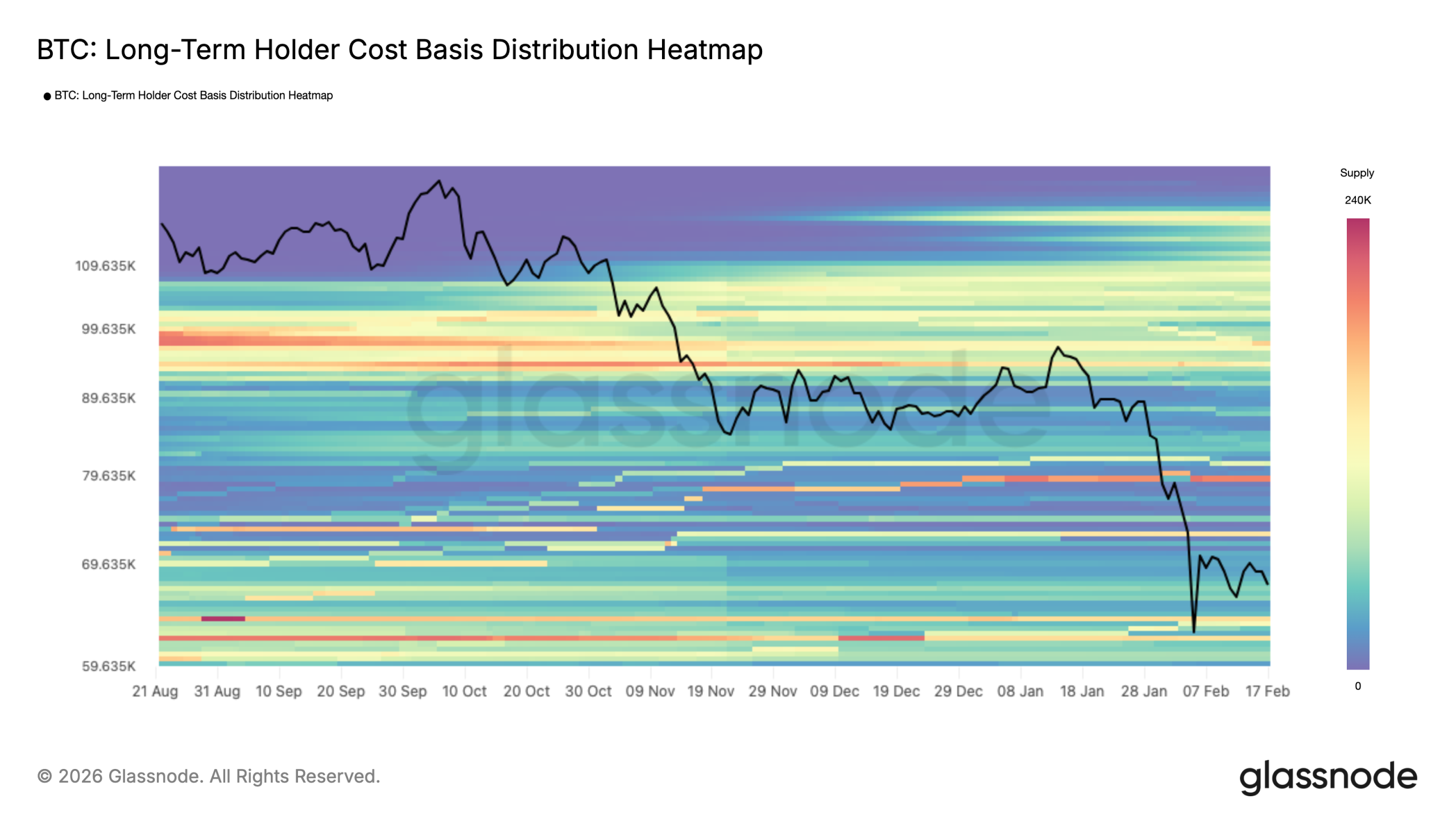
Two-year Bitcoin hodlers “absorbed” seller pressure in recent weeks, according to new research, but most analysts still expect new macro BTC price lows.
New analysis suggests that Bitcoin (BTC) is “relying” on early 2024 buyers as its price action stalls below $70,000.
Key points:
-
Bitcoin buyers from early 2024 are in focus as a giant potential safety net for BTC price.
-
Their cost basis extends down to $60,000, and a major capitulation has not yet happened.
-
New macro BTC price lows remain a popular near-term bet.
2024 Bitcoin hodlers have “absorbed” new sellers
In the latest edition of its weekly newsletter, “The Week Onchain,” crypto analytics platform Glassnode said that BTC price was in a “dense demand zone.”
As BTC/USD treads water around 45% below its October 2025 all-time highs, buyers from long before that event are holding up the market.
Their importance has become much more noticeable since Bitcoin dropped below its true market mean price near $80,000.
“A closer inspection of price behavior since the breakdown below the True Market Mean indicates that downside pressure has largely been absorbed within a dense demand zone between $60k and $69k,” Glassnode summarized.
“This cluster was primarily established during the H1 2024 consolidation phase, where investors accumulated within a prolonged range and have since held their positions for over a year.”

Researchers referenced the seven-month consolidation structure that characterized much of 2024, and which itself placed old all-time highs of $69,000 from late 2021 in focus.
Now, those buyers face falling into unrealized loss, but are so far avoiding capitulation.
“The positioning of this cohort near breakeven levels appears to have moderated incremental sell pressure, contributing to the development of another sideways structure since late January 2026,” “The Week Onchain” continued.
“The defense of the $60k–$69k range suggests that medium-term holders remain resilient, allowing the market to transition from impulsive decline into range-bound absorption.”

New BTC price lows in “next week or so?”
The presence of hodler resilience comes at a crucial time as market participants still expect new macro lows to come next.
Related: Bitcoin price ignores $168M Strategy BTC purchase as Iran tensions escalate
As Cointelegraph reported, Bitcoin traders have little faith in the current range holding as support, with $50,000 now a popular target.
“Expected a quick bounce to reset indicators then straight back down. I still believe 52-53k is coming in the next week or so,” one such forecast from trader Roman stated this week.

An accompanying chart suggested that the indicator “reset” would affect the relative strength index (RSI) and moving average convergence/divergence (MACD) on four-hour time frames.
Earlier, Cointelegraph noted rare lows for weekly RSI, with analysis hinting that such levels were a once-per-cycle phenomenon.
This article does not contain investment advice or recommendations. Every investment and trading move involves risk, and readers should conduct their own research when making a decision. While we strive to provide accurate and timely information, Cointelegraph does not guarantee the accuracy, completeness, or reliability of any information in this article. This article may contain forward-looking statements that are subject to risks and uncertainties. Cointelegraph will not be liable for any loss or damage arising from your reliance on this information.


Trust Wallet, the world’s leading self-custody web3 wallet with over 220 million users, today announced the launch of Cash Deposits in the United States, a new feature that allows users to load physical cash and convert it into digital assets directly inside their Trust Wallet – without a bank account, debit card, or custodial balance.
Powered by Coinme, a leading enterprise crypto infrastructure platform, Cash Deposits enables users to load cash into a digital wallet at over 15,000 retail locations nationwide and receive stablecoins and other digital assets (BTC, SOL etc) directly into their self-custodial wallet.
With this launch, Trust Wallet removes one of the biggest barriers to participating in the digital economy: access to traditional banking.
“Millions of people in the U.S. earn and live on cash, yet most digital financial tools still assume all have a bank account or card,” said Felix Fan, CEO of Trust Wallet.
“Cash Deposits is about meeting these users where they are. If you have cash, you now have a fast, direct way to turn it into digital assets that you fully control – no intermediaries holding your funds, and no reliance on traditional banks.”
Across the United States, millions of people are paid fully or partially in cash, such as gig workers, service workers, and individuals in cash-heavy local economies. For many, opening or maintaining a bank account can be difficult, cards may not be available, and existing cash services can be slow, expensive, or require giving up control of funds.
Cash Deposits removes those barriers. With Trust Wallet, users can now load cash and convert their money to digital assets, enabling them to receive directly into a self-custody wallet they control – unlocking faster payments, easier remittances, and broader access to decentralised and digital finance.
Unlike traditional cash services that rely on banks, cards, or custodial accounts, Cash Deposits enables a direct path from physical cash to a user’s self-custody wallet. Through Coinme’s nationwide retail network, cash is converted into digital assets and delivered straight to the user’s Trust Wallet – without intermediaries holding funds after the transaction is completed.
The supported retail locations are displayed in the Trust Wallet app before users begin, allowing them to view nearby deposit options available through Coinme’s retail network.
“At Coinme, our focus has always been building compliant, nationwide infrastructure that bridges physical cash with digital assets,” said Neil Bergquist, CEO and co-founder of Coinme.
“By powering Trust Wallet’s Cash Deposits feature, we’re enabling that infrastructure to operate seamlessly within a leading self-custody experience, making it simple for users to move from cash to crypto at scale.”
Funds typically arrive within minutes rather than days, giving users faster access to their money while maintaining full control over their assets. Available across 48 U.S. states*, the feature brings national scale to a cash-to-digital experience that has historically been fragmented or inaccessible.
By combining Coinme’s established cash onramp infrastructure with Trust Wallet’s self-custody wallet, the partnership delivers one of the first mainstream, nationwide cash-to-stablecoin experiences within a single app – making digital finance more practical and accessible for everyday users.
*The cash on-ramp is currently available in the U.S. and Puerto Rico, excluding New York and Vermont. Stablecoin purchases are available in supported states, excluding Texas.
About Trust Wallet
Trust Wallet is the secure, self-custody Web3 wallet and gateway for people who want to fully own, control, and leverage the power of their digital assets. From beginners to experienced users, Trust Wallet makes it easier, safer, and convenient for millions of people around the world to experience Web3, access dApps securely, store and manage their crypto and NFTs, as well as buy, sell, and stake crypto to earn rewards — all in one place and without limits.
About Coinme Crypto-as-a-Service
Founded in 2014, Coinme is a leading licensed and regulated provider of an enterprise stablecoin and crypto payments platform. Coinme enables a fully native and seamless stablecoin and crypto payment experience within partners’ web or mobile apps. By integrating with Coinme’s simple API suite, SDKs, and widget, partners can quickly deploy crypto and stablecoin products and services natively while leveraging Coinme’s robust exchange and compliance infrastructure. For more information, please visit https://coinme.com.

TLDR
- Société Générale Forge has launched EUR CoinVertible on the XRP Ledger, expanding its stablecoin to a new Layer-1 network.
- The deployment follows previous integrations on Ethereum and Solana, strengthening the firm’s multi-chain strategy.
- Ripple supports the launch by providing institutional-grade custody and infrastructure services to ensure security.
- The integration on XRP Ledger enhances scalability, reduces transaction costs, and offers a secure decentralized architecture.
- SG-FORGE aims to increase the adoption of its euro-backed stablecoin for trading, payments, and collateral use cases.
Société Générale Forge has launched its euro-backed stablecoin, EUR CoinVertible, on the XRP Ledger. This move expands the stablecoin’s presence, following previous deployments on Ethereum and Solana. The integration into the XRP Ledger strengthens the firm’s multi-chain strategy and enhances the adoption of compliant digital assets across various blockchain networks.
EUR CoinVertible Expands to XRP Ledger
Société Générale Forge has successfully deployed EUR CoinVertible on the XRP Ledger. This launch adds another Layer-1 network to the stablecoin’s ecosystem, which already includes Ethereum and Solana. According to SG-FORGE, the decision to use the XRP Ledger stems from its high-performance capabilities, which can provide faster transactions, lower fees, and a secure decentralized architecture.
Ripple has supported the launch by providing its institutional-grade custody and infrastructure services. This partnership aims to ensure the stablecoin’s seamless integration while maintaining high security standards. Ripple’s technology enables SG-FORGE to enhance the operational and security standards for the stablecoin’s use cases.
SG-FORGE highlighted several key advantages of integrating EUR CoinVertible into the XRP Ledger. The platform’s scalability and low transaction costs are central to its appeal. XRP Ledger’s decentralized infrastructure also ensures a high level of security for institutional users of the stablecoin.
Jean-Marc Stenger, CEO of SG-FORGE, emphasized the firm’s focus on delivering transparent and secure digital assets. “The launch of EUR CoinVertible on XRP is a milestone in our effort to advance regulated digital assets that are compliant and scalable,” Stenger stated. The integration on XRP reinforces SG-FORGE’s commitment to expanding its offering of euro-backed stablecoins for trading, payments, and collateral use.
Ripple’s Role in Expanding EUR CoinVertible Use Cases
Ripple’s involvement in the launch is crucial, as it provides both infrastructure and custody services for EUR CoinVertible. The partnership with Ripple supports SG-FORGE’s strategy of driving the adoption of the stablecoin across various financial and crypto markets.
Cassie Craddock, Ripple’s Managing Director for UK and Europe, remarked that SG-FORGE is at the forefront of creating structured crypto-asset offerings in Europe. “Ripple’s infrastructure has been integral to supporting the launch and ongoing expansion of regulated stablecoins like EUR CoinVertible,” Craddock added. The move to integrate with XRP’s robust platform is expected to unlock new use cases for the stablecoin, such as trading collateral and further integration into Ripple’s product suite.
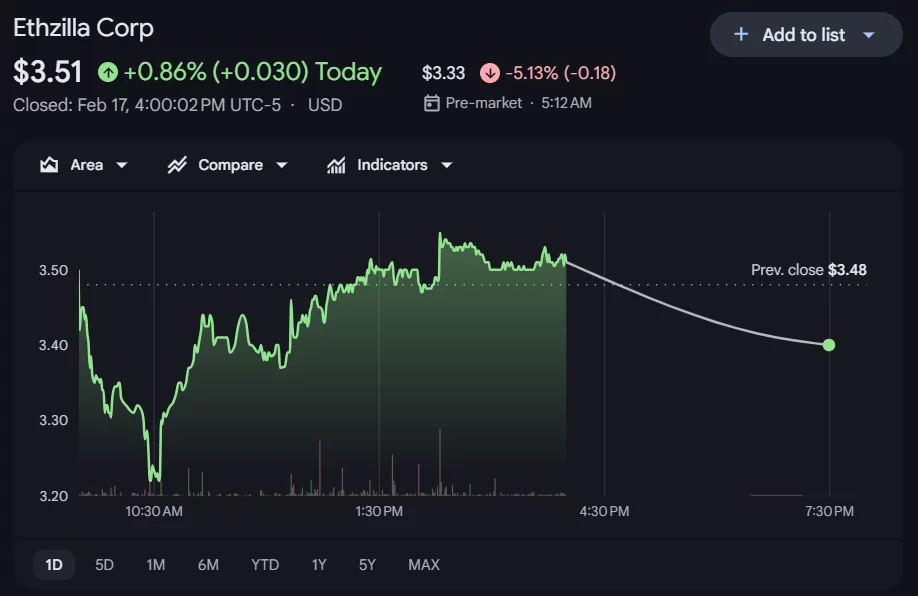
ETHZilla Corp (ETHZ) shares faced intense pressure in pre-market trading this Wednesday following news that billionaire investor Peter Thiel and his venture firm, Founders Fund, have completely liquidated their position.
Summary
- An SEC filing revealed that Peter Thiel and Founders Fund have completely liquidated their 7.5% stake in Ethzilla (ETHZ), triggering a 5.13% pre-market drop to $3.33.
- Originally a biotech firm (180 Life Sciences), Ethzilla’s high-leverage pivot to a “corporate Ethereum treasury” model has faltered, with the stock currently down 97% from its 2025 highs.
- Amidst heavy debt and market volatility, the company is attempting to stabilize by pivoting again, this time toward tokenizing jet engines and home loans, though investor confidence remains shaken.
The Thiel exodus: Founders Fund liquidates stake in ETHZilla
The stock, which has already plummeted over 97% from its 2025 highs, hit a pre-market low of $3.33, representing a 5.13% drop from its previous close.
The sell-off was triggered by a late Tuesday SEC filing revealing that Thiel’s entities now hold zero shares in the company. This marks a dramatic reversal from August 2025, when the fund disclosed a significant 7.5% stake.
At the time, Thiel’s entry was seen as a massive vote of confidence for ETHZilla’s pivot from biotechnology to a corporate Ethereum (ETH) treasury model.
The massive sell-off marks a dramatic fall from grace for the firm, which rebranded from 180 Life Sciences last year to become a high-leverage Ethereum treasury. While the initial pivot drew over $425 million in institutional backing, the recent liquidation of its ETH holdings has left investors questioning the sustainability of its ‘crypto-first’ balance sheet.
Crisis in the ETH treasury model
The full exit by Founders Fund underscores the growing skepticism surrounding companies that use high-leverage strategies to accumulate Ethereum. While similar “Bitcoin treasury” plays have remained popular, Ether-focused firms like ETHZilla have struggled under the weight of market volatility and debt obligations.
ETHZilla has recently attempted to diversify its business to stabilize its balance sheet. Recent moves include:
- Asset Tokenization: Launching “ETHZilla Aerospace” to tokenize leased jet engines.
- Debt Repayment: Liquidating over 24,000 ETH in late 2025 to settle convertible bond obligations.
- Real Estate: Acquiring modular home loan portfolios for on-chain yields.
Despite these efforts to pivot toward Real World Assets (RWA), the market appears focused on the loss of its most prominent institutional backer. For many investors, Thiel’s departure signals that the “Saylor-style” accumulation strategy for Ethereum may be facing a structural breakdown.
The divergence between Bitcoin and tech stocks is a warning sign of a potential artificial intelligence-driven credit crisis that could lead to more central bank money printing, says Arthur Hayes.
“Bitcoin is the global fiat liquidity fire alarm. It is the most responsive freely traded asset to the fiat credit supply,” said the crypto entrepreneur in his latest blog post on Wednesday.
Hayes went on to caution that the recent divergence between Bitcoin (BTC) and the tech-heavy Nasdaq 100 Index “sounds the alarm that a massive credit destruction event is nigh.”
When these two previously correlated asset classes diverge, “it warrants further investigation into any trigger that could cause a destruction of fiat” — mostly dollars and credit, which is also known as deflation, he said.
Hayes believes that job losses due to AI adoption will have a major impact on consumer credit and mortgage debt “because of the inability of white-collar knowledge worker debt donkeys to meet their monthly payments.”
“That’s a bold statement to call for a financial crisis because of job losses caused by AI adoption.”
AI job losses could trigger another banking crisis
In 2025, companies cited AI when announcing 55,000 job cuts, more than 12 times the number of layoffs attributed to AI just two years earlier, reported CBS News in early February.
“This AI financial crisis will restart the money printing machine for realz,” said Hayes.
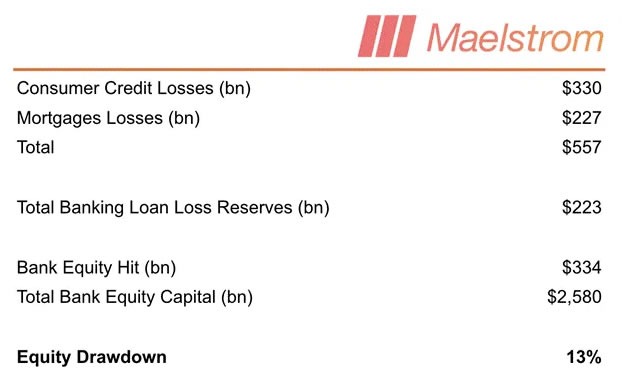
His loose model suggests that a 20% reduction in the 72 million “knowledge workers” in the US could produce around $557 billion in consumer credit and mortgage losses, representing a 13% write-down of US commercial bank equity.

Hayes speculates that weaker regional banks would buckle first, depositors would flee, and credit markets would seize. The Federal Reserve would eventually panic and start printing money.
“While the Fed is fighting windmills, AI-related job losses will destroy the balance sheets of American banks,” he said.
“Finally, the monetary mandarins panic and press that Brrrr button harder than I shred pow the morning after a one-meter dump.”
Related: 1 in 4 CEOs expect to sack staff due to AI this year
Hayes predicted that this surge in fiat credit creation would “pump Bitcoin decisively off its lows,” and that the future expectation of increased fiat creation to save the banking system would “propel Bitcoin to a new all-time high.”
In addition to Bitcoin, Hayes said there are two altcoins that his company, Maelstrom, will “deploy excess stables into once the Fed blinks.” Those coins are Zcash (ZEC) and Hyperliquid (HYPE).
More money-printing theories abound
However, this is not the first radical money-printing thesis Hayes has proposed.
In January, he said that the Federal Reserve would print money to alleviate the Japanese bond crisis.
In December 2025, he predicted that BTC would surge to $200,000 by March due to money printing through a new Fed liquidity tool called Reserve Management Purchases, which resembles quantitative easing.
Magazine: Chinese New Year boosts interest, TradFi buying crypto exchanges: Asia Express

Lawmakers, Wall Street executives, and cryptocurrency leaders will meet at US President Donald Trump’s private Mar-a-Lago club for a crypto “forum” organized by World Liberty Financial, the company backed by Trump and his sons.
Ahead of the event, the price of World Liberty’s WLFI token surged by more than 23%, to about $0.12 from $0.10. Trading volume in the past 24 hours topped $466 million.
On Wednesday, the president’s sons, Eric Trump and Donald Trump Jr. — also the co-founders of World Liberty Financial — along with Coinbase CEO Brian Armstrong, BitGo co-founder and CEO Mike Belshe, CFTC Chair Michael Selig and others will gather to discuss crypto-related policy issues at Trump’s Florida property.

The event, described as a crypto-aligned “forum” by World Liberty, comes as US lawmakers consider a comprehensive digital asset market structure bill amid concerns about how to address stablecoin yield. Selig is scheduled to speak with New York Stock Exchange President Lynn Martin on the bill.
Although aligned with crypto policy and including lawmakers like Ohio Senator Bernie Moreno and Florida Senator Ashley Moody, the President was not slated to appear at the event as of Wednesday morning.
Meanwhile, many Democratic senators are still pushing for the market structure bill to include provisions addressing conflicts of interest for US lawmakers and elected officials profiting from the crypto industry while in office.
Related: CFTC chair doubles down on defending prediction markets from state lawsuits
Media outlets have reported that Trump and his family have generated more than $1 billion from crypto projects since he took office in January 2025. In contrast to the president’s second term, Trump in 2019 said he was “not a fan” of Bitcoin (BTC) and other cryptocurrencies, while referring to the coin as a “scam” after leaving office in 2021.
US market structure bill is under scrutiny
Passed as the CLARITY Act in the US House of Representatives in July, the market structure bill under consideration in the Senate is expected to provide clarification on oversight of digital assets by the Commodity Futures Trading Commission and Securities and Exchange Commission, Washington’s two main financial markets regulators.
In January, the Senate Agriculture Committee, which has CFTC oversight, advanced its version of the bill along partisan lines, with no Democrats voting for the legislation. The Senate Banking Committee postponed its markup of the bill in January after the Coinbase CEO said he could not support the legislation as written, citing concerns about tokenized equities and decentralized finance.
Magazine: Brandt says Bitcoin yet to bottom, Polymarket sees hope: Trade Secrets


Telegram use in Russia faces rising blocks and slowdown as regulators tighten controls.
Summary
- Telegram blocked 238.8k channels on Feb 15 and 187.3k on Feb 16, taking total blocked groups and channels to over 7.463m since Jan 1.
- Russia fully blocked WhatsApp and removed its domains from DNS, steering users toward the state-backed Max messenger amid broader social-media restrictions.
- Despite throttling and potential April 1 blocking, Russian users increasingly rely on VPNs and alternative apps like imo to keep messaging access.
Telegram has begun blocking illegal content and has sufficient time to meet Russian regulatory requirements, according to a senior parliamentary committee member overseeing the matter.
Andrey Svintsov, deputy chairman of the Committee on Information Policy at the State Duma, told state news agency TASS that the messaging platform has started actively complying with Russian Federation requirements. “Over the past week, Telegram has blocked more than 230,000 channels and pieces of content that violated current legislation,” Svintsov stated. “This indicates that Durov’s company has begun to interact more actively.”
Russian authorities slowed traffic to the messenger earlier this month, citing non-compliance with national regulations. Media reports emerged this week suggesting the platform could be fully blocked on April 1, though Russian officials have neither confirmed nor denied the reports.
Svintsov said Telegram could fulfill Roskomnadzor’s requirements within one to two months and continue operating in Russia. “In my opinion, Telegram will not be blocked before April 1,” he stated, referring to messenger founder and CEO Pavel Durov.
Roskomnadzor, the Federal Service for Supervision of Communications, Information Technology and Mass Media, serves as Russia’s telecommunications regulator and media oversight body. According to Svintsov, the requirements include opening a legal entity, storing data on Russian territory, paying taxes and blocking prohibited content. “Opening a legal entity takes a week at most. Moving personal data processing takes another two or three weeks,” the deputy said.
Last summer, reports that Telegram was preparing to establish an office in Russia under the country’s “landing law” were denied by Durov, either directly or indirectly, according to previous media accounts.
Yulia Dolgova, president of the Russian Association of Bloggers and Agencies, told TASS that determining whether Telegram will be fully blocked remains difficult at this stage. She noted that unlike WhatsApp, Telegram is actively taking measures to maintain service functionality. Roskomnadzor completely removed Meta’s WhatsApp domain from its DNS servers last week, effectively blocking access from Russia. Dolgova also noted widespread VPN usage among Russian users to bypass such restrictions.
Telegram, the government and crypto
The Telegram channel Baza, citing government sources, reported that Roskomnadzor is preparing to “begin a total blocking of the messenger” on April 1. In response to media inquiries, Roskomnadzor said it had “nothing to add” to previous statements threatening “sequential restrictions.”
TASS reported this week that Telegram’s administration blocked 238,800 channels and groups on February 15 and 187,300 channels and groups worldwide on February 16, according to updated statistics on the messenger’s website. As of February 17, more than 7.463 million groups and channels have been blocked on Telegram since the beginning of the year, the agency reported.
Telegram ranks as the second most popular messaging application in Russia with 93.6 million users, trailing WhatsApp, which had 94.5 million monthly users before being blocked. As Russia implements restrictive measures against both platforms while promoting the state-backed Max messenger, Russian citizens have increasingly turned to imo, a U.S.-made messaging alternative, according to reports.

US lawmakers may face a narrowing window to pass long-awaited crypto legislation. Speaking at the World Liberty Forum, Senator Bernie Moreno said a comprehensive market structure bill could pass “hopefully by the end of April.”
The Ohio Senator stressed that Congress must act within the next 90 days to maintain momentum.
Sponsored
A Compressed Timeline for Crypto Rules
The remarks, delivered at an event hosted by World Liberty Financial at Mar-a-Lago on February 18, highlighted both urgency and persistent friction between the banking sector and the digital asset industry.
According to live reporting, Bernie Moreno acknowledged the difficulty of negotiations, saying the process had “taken years off my life,” while reiterating that lawmakers “have to get it done in the next 90 days.”

Moreno has been one of the most vocal advocates for federal crypto legislation, particularly measures tied to frameworks such as the Digital Asset Market Clarity Act, which aims to define whether digital tokens fall under securities or commodities law and to establish clearer oversight of trading platforms and stablecoins.
Although elements of crypto legislation have already passed the House, Senate progress has slowed in recent months amid lobbying, technical disagreements, and partisan divisions.
Moreno’s timeline suggests lawmakers are attempting to push negotiations toward a decisive phase before the legislative calendar tightens further.
Sponsored
Stablecoin Yield Debate Remains a Sticking Point
One of the most contentious issues remains whether stablecoin issuers should be allowed to offer yield or rewards to users.
Banks have argued that yield-bearing stablecoins could draw deposits away from the TradFi system. Meanwhile, crypto firms maintain that such features are essential to innovation and competition.
At the forum, Moreno drew applause after vowing not to allow banks to reopen provisions already settled in the GENIUS Act.
“We’re not going to go back and revisit legislation that’s already passed,” Moreno said, adding that he would not permit changes in the digital asset space that could undermine prior agreements.
Sponsored
Sources familiar with negotiations indicated that talks between banks and crypto stakeholders have made little progress in recent weeks. This strengthens concerns that the legislative timetable could slip further.
Political Signals and Industry Pressure
Standing alongside Moreno, Ashley Moody injected a note of humor into the discussion, drawing laughter from the audience.
She also highlighted the intense scrutiny facing lawmakers as they attempt to finalize the bill.
Sponsored
“He’s in Banking. If they don’t get it done, we can blame Bernie,” she quipped.
Meanwhile, a potential White House meeting to advance negotiations may be postponed. One invitee reportedly described the planned gathering as likely to be “just for show,” suggesting that insufficient progress has been made to justify another high-level session.
The World Liberty Forum itself drew roughly 300 to 400 leaders from finance, technology, policy, and media.
This suggests growing institutional interest in how stablecoins, DeFi, and blockchain infrastructure could shape the future of the US dollar and global markets.
Moreno’s 90-day deadline serves less as a guarantee than a signal. After years of debate, the window for decisive US crypto regulation may finally be narrowing.
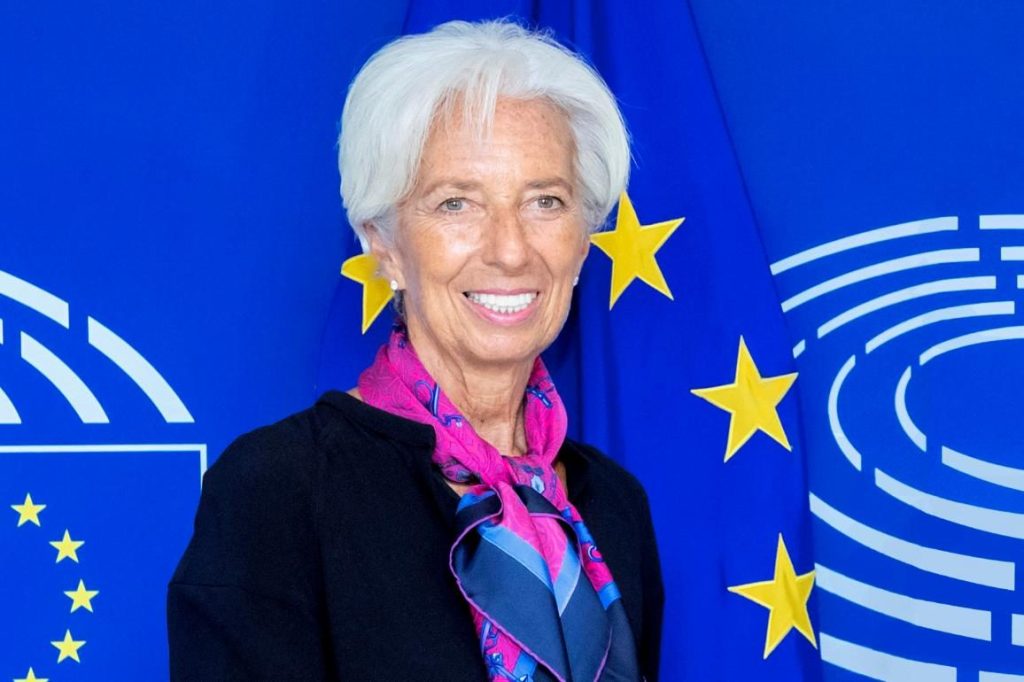
Christine Lagarde might not stick around until 2027. Reports suggest the ECB president is weighing an early exit.
If that happens, it is not just a personnel change. It could scramble the timeline for the digital euro and stablecoin oversight right as MiCA rules start taking effect.
A leadership shakeup at this stage would inject fresh uncertainty into Europe crypto roadmap.
Key Takeaways
- Early Departure: Lagarde is reportedly weighing an exit before October 2027 to align with French presidential elections.
- Succession Race: Top contenders include Dutch central bank chief Klaas Knot and Spain’s Pablo Hernández de Cos.
- Project Risk: A change in leadership threatens the continuity of the digital euro project and euro-stablecoin oversight.
Why Is The Timing Critical for Crypto?
Lagarde has been the driving force behind the ECB digital push. Since 2019, she moved the digital euro from theory into formal investigation. Now, just as MiCA stablecoin rules are being finalized, her potential exit lands at a sensitive moment.
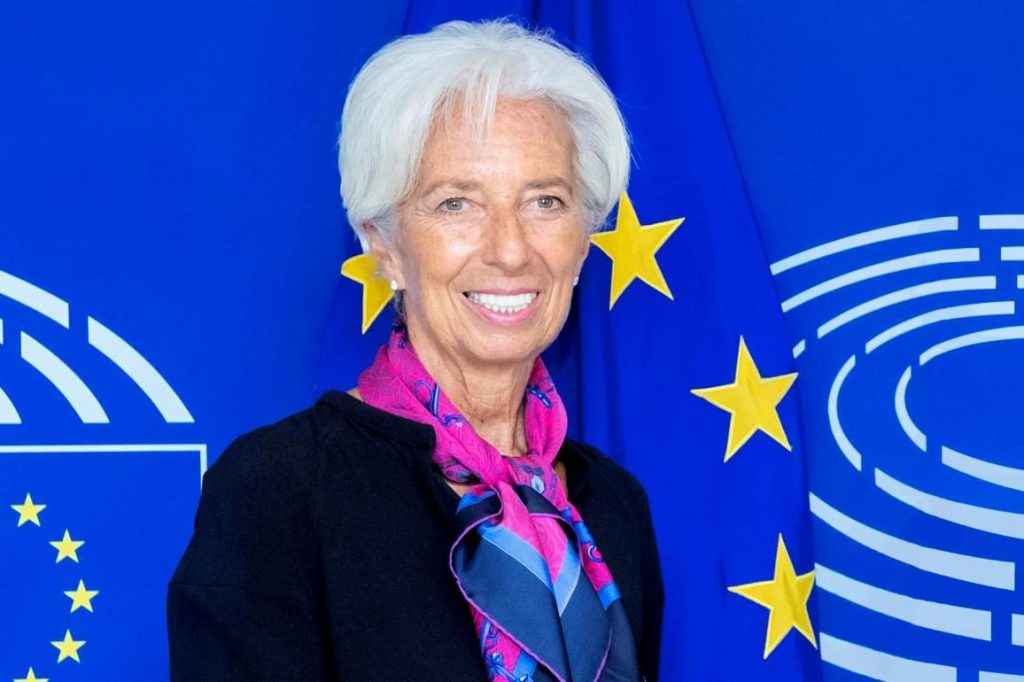
Without her leading the charge, the sovereign payment narrative weakens. There are also political layers here. Aligning her departure with the April 2027 French election could give President Macron influence over who steps in next.
The bigger concern is policy drift. A new ECB chief could shift focus back to traditional tightening and slow down digital euro efforts. That would leave more room for private stablecoins to fill the gap.
Who Could Take The Reins?
Publicly, the ECB says she is fully focused on her job. But the timing being floated suggests this is more than random chatter. The idea is to step aside before political shifts in France and Germany complicate the process.
Names are already circulating. Spain’s Pablo Hernández de Cos. Dutch central bank chief Klaas Knot. Even Bundesbank head Joachim Nagel is in the conversation.
Officially, nothing is confirmed. ECB executive Piero Cipollone says he has no knowledge of an early exit plan. Still, markets tend to price political risk before headlines become formal announcements.
With 21 eurozone nations needing to approve a successor, whoever takes over could significantly shape Europe’s stance on crypto and the digital euro.
What Happens to the Digital Euro?
A leadership vacuum would leave the digital euro in a fragile spot. The project already faces pushback from banks and privacy advocates. Without Lagarde driving it forward, momentum could fade fast.
And this is happening while stablecoin liquidity is shifting quickly. If the ECB hesitates on building a serious euro alternative to US dollar tokens, private players will not wait.
At the same time, the US and other major economies are accelerating their crypto frameworks. Europe cannot really afford a slowdown. Leadership uncertainty rarely supports long term institutional projects.
Discover: Here are the crypto likely to explode!
The post Lagarde Exit Report Raises Questions Over Digital Euro Timeline and Stablecoin Policy appeared first on Cryptonews.
Form 144 PNC FINANCIAL SERVICES GROUP For: 18 February

The Protocol: Zora moves to Solana

All-Time Greatest Space Series Siloed And Ruined By Broken, Low-Quality Streaming


-

 Sports7 days ago
Big Tech enters cricket ecosystem as ICC partners Google ahead of T20 WC | T20 World Cup 2026
-

 Video2 days ago
Bitcoin: We’re Entering The Most Dangerous Phase
-

 Tech4 days ago
Luxman Enters Its Second Century with the D-100 SACD Player and L-100 Integrated Amplifier
-

 Video5 days ago
The Final Warning: XRP Is Entering The Chaos Zone
-
 Tech2 days ago
The Music Industry Enters Its Less-Is-More Era
-

 Sports2 days ago
GB's semi-final hopes hang by thread after loss to Switzerland
-

 Crypto World1 day ago
Can XRP Price Successfully Register a 33% Breakout Past $2?
-

 Business18 hours ago
Infosys Limited (INFY) Discusses Tech Transitions and the Unique Aspects of the AI Era Transcript
-

 Video1 day ago
Financial Statement Analysis | Complete Chapter Revision in 10 Minutes | Class 12 Board exam 2026
-

 Entertainment4 hours ago
Kunal Nayyar’s Secret Acts Of Kindness Sparks Online Discussion
-

 Crypto World5 days ago
Bhutan’s Bitcoin sales enter third straight week with $6.7M BTC offload
-

 Tech9 hours ago
Retro Rover: LT6502 Laptop Packs 8-Bit Power On The Go
-
 Crypto World7 days ago
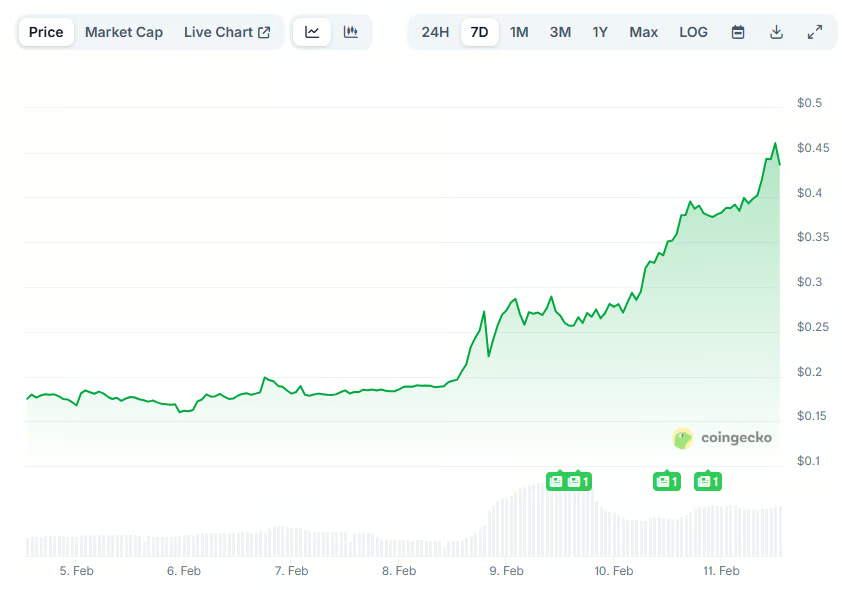
Pippin (PIPPIN) Enters Crypto’s Top 100 Club After Soaring 30% in a Day: More Room for Growth?
-

 Video7 days ago
Prepare: We Are Entering Phase 3 Of The Investing Cycle
-
 NewsBeat3 days ago
The strange Cambridgeshire cemetery that forbade church rectors from entering
-

 Business6 days ago
Barbeques Galore Enters Voluntary Administration
-

 Business10 hours ago
Tesla avoids California suspension after ending ‘autopilot’ marketing
-
 Crypto World6 days ago
Ethereum Price Struggles Below $2,000 Despite Entering Buy Zone
-
 NewsBeat3 days ago
Man dies after entering floodwater during police pursuit
-

 Crypto World5 days ago
Kalshi enters $9B sports insurance market with new brokerage deal