

Tech
Data breach at fintech firm Figure affects nearly 1 million accounts



Hackers have stolen the personal and contact information of nearly 1 million accounts after breaching the systems of Figure Technology Solutions, a self-described blockchain-native financial technology company.
Founded in 2018, Figure uses the Provenance blockchain for lending, borrowing, and securities trading, and has unlocked over $22 billion in home equity with over 250 partners, including banks, credit unions, fintechs, and home improvement companies.
While the blockchain lender didn’t publicly disclose the incident, a Figure spokesperson told TechCrunch on Friday that the attackers stole “a limited number of files” in a social engineering attack.

BleepingComputer has also reached out to Figure with further questions about the breach, but a response was not immediately available.
Although the company has yet to share how many individuals were affected by the data breach, notification service Have I Been Pwned has now revealed the extent of the incident, reporting that data from 967,200 accounts was stolen in the attack.
“In February 2026, data obtained from the fintech lending platform Figure was publicly posted online,” Have I Been Pwned said on Wednesday.
“The exposed data, dating back to January 2026, contained over 900k unique email addresses along with names, phone numbers, physical addresses and dates of birth. Figure confirmed the incident and attributed it to a social engineering attack in which an employee was tricked into providing access.”
The ShinyHunters extortion group claimed responsibility for the breach and added the company to its dark web leak site, leaking 2.5GB of data allegedly stolen from thousands of loan applicants.

In recent weeks, ShinyHunters claimed similar breaches at Canada Goose, Panera Bread, Betterment, SoundCloud, PornHub, and CrowdStrike.
While not all of them are part of the same campaign, some of these victims were breached in a voice phishing (vishing) campaign targeting single sign-on (SSO) accounts at Okta, Microsoft, and Google across more than 100 high-profile organizations.
The attackers are impersonating IT support, calling their targets’ employees and tricking them into entering credentials and multi-factor authentication (MFA) codes on phishing sites that impersonate their companies’ login portals.
Once in, they gain access to the victim’s SSO account, which provides them with access to other connected enterprise applications and services, including Salesforce, Microsoft 365, Google Workspace, SAP, Slack, Zendesk, Dropbox, Adobe, Atlassian, and many others.
As part of this campaign, ShinyHunters also breached online dating giant Match Group, which owns multiple popular dating services, including Tinder, Hinge, Meetic, Match.com, and OkCupid.

Modern IT infrastructure moves faster than manual workflows can handle.
In this new Tines guide, learn how your team can reduce hidden manual delays, improve reliability through automated response, and build and scale intelligent workflows on top of tools you already use.


Andrew Yang, the former presidential candidate and longtime Universal Basic Income advocate, published a blog post this week warning that AI is about to displace millions of white-collar workers in the U.S. over the next 12 to 18 months, a wave he has taken to calling “the Fuckening.”
Yang cited a conversation with the CEO of a publicly traded tech company who said the firm is cutting 15% of its workforce now and plans another 20% cut in two years, followed by yet another 20% two years after that. The U.S. currently has about 70 million white-collar workers, and Yang expects that number to fall by 20 to 50% over the next several years.
Underemployment among recent college graduates has already hit 52%, and only 30% of graduating seniors have landed a job in their field. Yang’s proposed remedy remains the same one he ran on in 2020: Universal Basic Income.

The Pixel 10A is now here, bringing a lower-cost option to Google’s Pixel 10 lineup. Starting at just $500, the Pixel 10A is more affordable than the $800 Pixel 10, and it’s significantly cheaper than the $1,000 Pixel 10 Pro and the $1,200 10 Pro XL.
Watch this: Google’s $499 Pixel 10A Launches with AirDrop Support and Faster Charging
Yet, despite a number of tradeoffs to hit its lower price, the 10A is not too shabby. These trade-offs include using the Tensor G4 processor instead of the newer Tensor G5, and the fact that PixelSnap magnetic accessories won’t attach directly to the phone. Still, if you can live without those upgrades, you’re getting a full-featured phone at a relatively low price.
Here’s how the Pixel 10A compares with the rest of Google’s Pixel 10 lineup.
Display
When it comes to display quality, the Pixel 10A compares very well to the rest of the Pixel 10 lineup. It has almost the same exact specs as the Pixel 10, with a 6.3-inch pOLED (the Pixel 10 has a 6.3-inch OLED instead), 2,424 x 1,080 pixel resolution and a 60 to 120 Hertz variable refresh rate.
Of course, the 10 Pro and 10 Pro XL are more premium. The 10 Pro has a 6.3-inch LTPO OLED, 2,856 x 1,280 pixel resolution and a 1 to 120 Hertz variable refresh rate, while the 10 Pro XL has a 6.8-inch LTPO OLED, 2,992 x 1,344 pixel resolution and the same refresh rate.
The Pixel 10A has two rear cameras: a 48-megapixel wide-angle camera and a 13-megapixel ultrawide camera.
Cameras
While most of the Pixel 10 series has at least three rear cameras, the 10A has just two. The 10A has a 48-megapixel wide and a 13-megapixel ultrawide camera, while the 10 has a 48-megapixel wide, a 13-megapixel ultrawide and a 10.8-megapixel 5x telephoto. Both the 10 Pro and the 10 Pro XL have a 50-megapixel wide, a 48-megapixel ultrawide and a 48-megapixel 5x telephoto. Both the 10A and the 10 have 4K video capture, while the 10 Pro and 10 Pro XL have 8K video capture.
The 10A does have a fairly decent front-facing camera with a 13-megapixel selfie cam, while the 10 only has a 10.5-megapixel front-facing camera. The 10 Pro and 10 Pro XL have 42-megapixel front-facing cameras.
Like the rest of the Pixel 10 line, the Pixel 10A can use Quick Share to AirDrop photos and files to an iPhone.
Battery and Performance
Surprisingly, the Pixel 10A actually has a bigger battery than some of its more expensive brethren. The 10A has a 5,100-mAh battery, which is more than the Pixel 10’s 4,970-mAh battery as well as the 10 Pro’s 4,870-mAh battery. The 10 Pro XL, however, does have a slightly larger 5,200-mAh battery, befitting its more premium features.
The Pixel 10A has 30W wired fast charging when using a 45W charging adapter, which matches the 30W wired fast charging on the Pixel 10 and the 10 Pro. As for wireless charging, the 10A supports up to 10W (Qi-certified), which isn’t quite as good as the Qi2 15W speed on the Pixel 10 and the 10 Pro, and the Qi2.2 25W speed on the Pixel 10 Pro XL.
Processor-wise, the Pixel 10A has the same Google Tensor G4 as its predecessor, while the pricier 10, 10 Pro and 10 Pro XL all have the upgraded Google Tensor G5. The Pixel 10A also only has 8GB of RAM, which is considered the bare minimum these days. By contrast, the 10 has 12GB of RAM while the 10 Pro and 10 Pro XL both have 16GB of RAM.
Check out the chart to see more ways the Pixel 10A compares to the rest of the Pixel 10 line.
Google’s Pixel 10A Looks Stylish for a Low-Cost Flagship Phone
Google Pixel 10A vs. Pixel 10, Pixel 10 Pro, Pixel 10 Pro XL
| Google Pixel 10A | Google Pixel 10 | Google Pixel 10 Pro | Google Pixel 10 Pro XL | |
|---|---|---|---|---|
| Display size, tech, resolution, refresh rate | 6.3-inch pOLED, 2,424×1,080 pixels, 60-120 Hz variable refresh rate | 6.3-inch OLED; 2,424×1,080 pixels; 60 to 120 Hz variable refresh rate | 6.3-inch LTPO OLED; 2,856×1,280 pixels; 1 to 120 Hz variable refresh rate | 6.8-inch LTPO OLED; 2,992×1,344 pixels; 1 to 120 Hz variable refresh rate |
| Pixel density | 422 ppi | 422 ppi | 495 ppi | 486 ppi |
| Dimensions (inches) | 6.1×2.9×0.4 in | 6×2.8×0.3 in | 6×2.8×0.3 in | 6.4x3x0.3 in |
| Dimensions (millimeters) | 154.7×73.3×8.9 mm | 152.8x72x8.5 mm | 152.8x72x8.5 mm | 162.8×76.6×8.5 mm |
| Weight (grams, ounces) | 183g (6.5oz) | 204g (7.2oz) | 207g (7.3oz) | 232g (8.2oz) |
| Mobile software | Android 16 | Android 16 | Android 16 | Android 16 |
| Camera | 48-megapixel (wide), 13-megapixel (ultrawide) | 48-megapixel (wide), 13-megapixel (ultrawide), 10.8-megapixel (5x telephoto) | 50-megapixel (wide), 48-megapixel (ultrawide), 48-megapixel (5x telephoto) | 50-megapixel (wide), 48-megapixel (ultrawide), 48-megapixel (5x telephoto) |
| Front-facing camera | 13-megapixel | 10.5-megapixel | 42-megapixel | 42-megapixel |
| Video capture | 4K | 4K | 8K | 8K |
| Processor | Google Tensor G4 | Google Tensor G5 | Google Tensor G5 | Google Tensor G5 |
| RAM + storage | 8GB + 128GB, 256GB | 12GB RAM + 128GB, 256GB | 16GB RAM + 128GB, 256GB, 512GB, 1TB | 16GB RAM + 256GB, 512GB, 1TB |
| Expandable storage | None | None | None | None |
| Battery | 5,100 mAh | 4,970 mAh | 4,870 mAh | 5,200 mAh |
| Fingerprint sensor | Under display | Under display | Under display | Under display |
| Connector | USB-C | USB-C | USB-C | USB-C |
| Headphone jack | None | None | None | None |
| Special features | 7 years of OS, security and Pixel feature drops; Gorilla Glass 3 cover glass; IP68 dust and water resistance; 3,000-nit peak brightness; 2,000,000:1 contrast ratio; 45W fast charging (charger not included); 10W wireless charging Qi certified; Satellite SOS; Wi-Fi 6E; NFC; Bluetooth 6; dual-SIM (nano SIM + eSIM); Camera Coach, Add Me; Best Take; Magic Eraser; Magic Editor; Photo Unblur; Super Res Zoom; Circle to Search. Colors: Lavender, berry, fog, obsidian (black) | Gorilla Glass 2 Victus cover glass; 3,000 nits peak brightness; Satellite SOS; dual-eSIM; Wi-Fi 6E; NFC; Bluetooth 6; 30W fast charging (wall charger not included); Qi2 15W wireless charging; support for PixelSnap magnetic accessories; Google VPN; Super Res Zoom up to 20x; Camera Coach; Add Me; Macro mode; Face Unblur; Auto Best Take; IP68 rating for dust and water resistance; 7 years of OS, security and Pixel Drop updates; Corning Gorilla Glass Victus 2 polished back with satin finish aluminum frame | Gorilla Glass 2 Victus cover glass; 3,300 nits peak brightness; Satellite SOS; Dual-eSIM; Wi-Fi 7; NFC; Bluetooth 6; 30W fast charging (wall charger not included); Qi2 15W wireless charging; support for PixelSnap magnetic accessories; Google VPN; Pro Res zoom up to 100x; Camera Coach; Add Me; Macro mode; Face Unblur; Auto Best Take; High-Res Portrait mode; IP68 rating for dust and water resistance; 7 years of OS, security and Pixel Drop updates; Corning Gorilla GlassVictus 2 silky matte back with polished finish aluminum frame; ultrawideband chip | Gorilla Glass 2 Victus cover glass; 3,300 nits peak brightness; Satellite SOS; Dual-eSIM; Wi-Fi 7; NFC; Bluetooth 6; 45W fast charging (wall charger not included); Qi2.2 25W wireless charging; support for PixelSnap magnetic accessories; Google VPN; Pro Res zoom up to 100x; Camera Coach; Add Me; Macro mode; Face Unblur; Auto Best Take; High-Res Portrait mode; IP68 rating for dust and water resistance; 7 years of OS, security, and Pixel Drop updates; Corning Gorilla GlassVictus 2 silky matte back with polished finish aluminum frame; ultrawideband chip |
| US price starts at | $500 (128GB) | $800 (128GB) | $1,000 (128GB) | $1,200 (256GB) |
One day soon, a doctor might prescribe a pill that doesn’t just deliver medicine but also reports back on what it finds inside you—and then takes actions based on its findings.
Instead of scheduling an endoscopy or CT scan, you’d swallow an electronic capsule smaller than a multivitamin. As it travels through your digestive system, it could check tissue health, look for cancerous changes, and send data to your doctor. It could even release drugs exactly where they’re needed or snip a tiny biopsy sample before passing harmlessly out of your body.
This dream of a do-it-all pill is driving a surge of research into ingestible electronics: smart capsules designed to monitor and even treat disease from inside the gastrointestinal (GI) tract. The stakes are high. GI diseases affect tens of millions of people worldwide, including such ailments as inflammatory bowel disease, celiac disease, and small intestinal bacterial overgrowth. Diagnosis often involves a frustrating maze of blood tests, imaging, and invasive endoscopy. Treatments, meanwhile, can bring serious side effects because drugs affect the whole body, not just the troubled gut.
If capsules could handle much of that work—streamlining diagnosis, delivering targeted therapies, and sparing patients repeated invasive procedures—they could transform care. Over the past 20 years, researchers have built a growing tool kit of ingestible devices, some already in clinical use. These capsule-shaped devices typically contain sensors, circuitry, a power source, and sometimes a communication module, all enclosed in a biocompatible shell. But the next leap forward is still in development: autonomous capsules that can both sense and act, releasing a drug or taking a tissue sample.
That’s the challenge that our lab—the MEMS Sensors and Actuators Laboratory (MSAL) at the University of Maryland, College Park—is tackling. Drawing on decades of advances in microelectromechanical systems (MEMS), we’re building swallowable devices that integrate sensors, actuators, and wireless links in packages that are small and safe enough for patients. The hurdles are considerable: power, miniaturization, biocompatibility, and reliability, to name a few. But the potential payoff will be a new era of personalized and minimally invasive medicine, delivered by something as simple as a pill you can swallow at home.
The Origin of Ingestible Devices
The idea of a smart capsule has been around since the late 1950s, when researchers first experimented with swallowable devices to record temperature, gastric pH, or pressure inside the digestive tract. At the time, it seemed closer to science fiction than clinical reality, bolstered by pop-culture visions like the 1966 film Fantastic Voyage, where miniaturized doctors travel inside the human body to treat a blood clot.
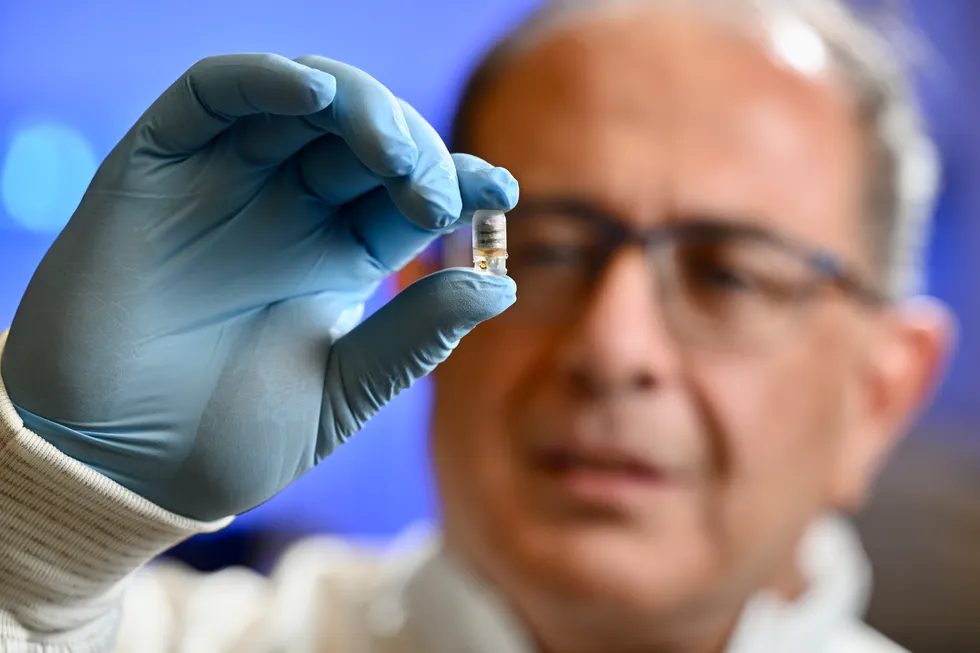
 One of the authors (Ghodssi) holds a miniaturized drug-delivery capsule that’s designed to release medication at specific sites in the gastrointestinal tract.Maximilian Franz/Engineering at Maryland Magazine
For decades, though, the mainstay of GI diagnostics was endoscopy: a camera on a flexible tube, threaded down the throat or up through the colon. These procedures are quite invasive and require patients to be sedated, which increases both the risk of complications and procedural costs. What’s more, it’s difficult for endoscopes to safely traverse the circuitous pathway of the small intestine. The situation changed in the early 2000s, when video-capsule endoscopy arrived. The best-known product, PillCam, looks like a large vitamin but contains a camera, LEDs, and a transmitter. As it passes through the gut, it beams images and videos to a wearable device.
Today, capsule endoscopy is a routine tool in gastroenterology; ingestible devices can measure acidity, temperature, or gas concentrations. And researchers are pushing further, with experimental prototypes that deliver drugs or analyze the microbiome. For example, teams from Tufts University, in Massachusetts, and Purdue University, in Indiana, are working on devices with dissolvable coatings and mechanisms to collect samples of liquid for studies of the intestinal microbiome.
Still, all those devices are passive. They activate on a timer or by exposure to the neutral pH of the intestines, but they don’t adapt to conditions in real time. The next step requires capsules that can sense biomarkers, make decisions, and trigger specific actions—moving from clever hardware to truly autonomous “smart pills.” That’s where our work comes in.
Building on MEMS technology
Since 2017, MSAL has been pushing ingestible devices forward with the goal of making an immediate impact in health care. The group built on the MEMS community’s legacy in microfabrication, sensors, and system integration, while taking advantage of new tools like 3D printing and materials like biocompatible polymers. Those advances have made it possible to prototype faster and shrink devices smaller, sparking a wave of innovation in wearables, implants, and now ingestibles. Today, MSAL is collaborating with engineers, physicians, and data scientists to move these capsules from lab benches to pharmaceutical trials.
As a first step, back in 2017, we set out to design sensor-carrying capsules that could reliably reach the small intestine and indicate when they reached it. Another challenge was that sensors that work well on the benchtop can falter inside the gut, where shifting pH, moisture, digestive enzymes, and low-oxygen conditions can degrade typical sensing components.
Our earliest prototype adapted MEMS sensing technology to detect abnormal enzyme levels in the duodenum that are linked to pancreatic function. The sensor and its associated electronics were enclosed in a biocompatible, 3D-printed shell coated with polymers that dissolved only at certain pH levels. This strategy could one day be used to detect biomarkers in secretions from the pancreas to detect early-stage cancer.
 A high-speed video shows how a capsule deploys microneedles to deliver drugs into intestinal tissue.University of Maryland/Elsevier
That first effort with a passive device taught us the fundamentals of capsule design and opened the door to new applications. Since then, we’ve developed sensors that can track biomarkers such as the gas hydrogen sulfide, neurotransmitters such as serotonin and dopamine, and bioimpedance—a measure of how easily ions pass through intestinal tissue—to shed light on the gut microbiome, inflammation, and disease progression. In parallel, we’ve worked on more-active devices: capsule-based tools for controlled drug release and tissue biopsy, using low-power actuators to trigger precise mechanical movements inside the gut.
Like all new medical devices and treatments, ingestible electronics face many hurdles before they reach patients—from earning physician trust and insurance approval to demonstrating clear benefits, safety, and reliability. Packaging is a particular focus, as the capsules must be easy to swallow yet durable enough to survive stomach acid. The field is steadily proving safety and reliability, progressing from proof of concept in tissue, through the different stages of animal studies, and eventually to human trials. Every stage provides evidence that reassures doctors and patients—for example, showing that ingesting a properly packaged tiny battery is safe, and that a capsule’s wireless signals, far weaker than those of a cellphone, pose no health risk as they pass through the gut.
Engineering a Pill-Size Diagnostic Lab
The gastrointestinal tract is packed with clues about health and disease, but much of it remains out of reach of standard diagnostic tools. Ingestible capsules offer a way in, providing direct access to the small intestine and colon. Yet in many cases, the concentrations of chemical biomarkers can be too low to detect reliably in early stages of a disease, which makes the engineering challenge formidable. What’s more, the gut’s corrosive, enzyme-rich environment can foul sensors in multiple ways, interfering with measurements and adding noise to the data.


 Microneedle designs for drug-delivery capsules have evolved over the years. An early prototype [top] used microneedle anchors to hold a capsule in place. Later designs adopted molded microneedle arrays [center] for more uniform fabrication. The most recent version [bottom] integrates hollow microinjector needles, allowing more precise and controllable drug delivery.From top: University of Maryland/Wiley;University of Maryland/Elsevier;University of Maryland/ACS
Take, for example, inflammatory bowel disease, for which there is no standard clinical test. Rather than searching for a scarce biomarker molecule, our team focused on a physical change: the permeability of the gut lining, which is a key factor in the disease. We designed capsules that measure the intestinal tissue’s bioimpedance by sending tiny currents across electrodes and recording how the tissue resists or conducts those currents at different frequencies (a technique called impedance spectroscopy). To make the electrodes suitable for in vivo use, we coated them with a thin, conductive, biocompatible polymer that reduces electrical noise and keeps stable contact with the gut wall. The capsule finishes its job by transmitting its data wirelessly to our computers.
In our lab tests, the capsule performed impressively, delivering clean impedance readouts from excised pig tissue even when the sample was in motion. In our animal studies, it detected shifts in permeability triggered by calcium chelators, compounds that pry open the tight junctions between intestinal cells. These results suggest that ingestible bioimpedance capsules could one day give clinicians a direct, minimally invasive window into gut-barrier function and inflammation. We believe that ingestible diagnostics can serve as powerful tools—catching disease earlier, confirming whether treatments are working, and establishing a baseline for gut health.
Drug Delivery at the Right Place, Right Time
Targeted drug delivery is one of the most compelling applications for ingestible capsules. Many drugs for GI conditions—such as biologics for inflammatory bowel disease—can cause serious side effects that limit both dosage and duration of treatment. A promising alternative is delivering a drug directly to the diseased tissue. This localized approach boosts the drug’s concentration at the target site while reducing its spread throughout the body, which improves effectiveness and minimizes side effects. The challenge is engineering a device that can both recognize diseased tissue and deliver medication quickly and precisely.
With other labs making great progress on the sensing side, we’ve devoted our energy to designing devices that can deliver the medicine. We’ve developed miniature actuators—tiny moving parts—that meet strict criteria for use inside the body: low power, small size, biocompatibility, and long shelf life.
Some of our designs use soft and flexible polymer “cantilevers” with attached microneedle systems that pop out from the capsule with enough force to release a drug, but without harming the intestinal tissue. While hollow microneedles can directly inject drugs into the intestinal lining, we’ve also demonstrated prototypes that use the microneedles for anchoring drug payloads, allowing the capsule to release a larger dose of medication that dissolves at an exact location over time.
In other experimental designs, we had the microneedles themselves dissolve after injecting a drug. In still others, we used microscale 3D printing to tailor the structure of the microneedles and control how quickly a drug is released—providing either a slow and sustained dose or a fast delivery. With this 3D printing, we created rigid microneedles that penetrate the mucosal lining and gradually diffuse the drug into the tissue, and soft microneedles that compress when the cantilever pushes them against the tissue, forcing the drug out all at once.
Tissue Biopsy via Capsule
Tissue sampling remains the gold standard diagnostic tool in gastroenterology, offering insights far beyond what doctors can glean from visual inspection or blood tests. Capsules hold unique promise here: They can travel the full length of the GI tract, potentially enabling more frequent and affordable biopsies than traditional procedures. But the engineering hurdles are substantial. To collect a sample, a device must generate significant mechanical force to cut through the tough, elastic muscle of the intestines—while staying small enough to swallow.
Different strategies have been explored to solve this problem. Torsion springs can store large amounts of energy but are difficult to fit inside a tiny capsule. Electrically driven mechanisms may demand more power than current capsule batteries can provide. Magnetic actuation is another option, but it requires bulky external equipment and precise tracking of the capsule inside the body.
Our group has developed a low-power biopsy system that builds on the torsion-spring approach. We compress a spring and use adhesive to “latch” it closed within the capsule, then attach a microheater to the latch. When we wirelessly send current to the device, the microheater melts the adhesive on the latch, triggering the spring. We’ve experimented with tissue-collection tools, integrating a bladed scraper or a biopsy punch (a cylindrical cutting tool) with our spring-activated mechanisms; either of those tools can cut and collect tissue from the intestinal lining. With advanced 3D printing methods like direct laser writing, we can put fine, microscale edges on these miniature cutting tools that make it easier for them to penetrate the intestinal lining.
Storing and protecting the sample until the capsule naturally passes through the body is a major challenge, requiring both preservation of the sample and resealing the capsule to prevent contamination. In one of our designs, residual tension in the spring keeps the bladed scraper rotating, pulling the sample into the capsule and effectively closing a hatch that seals it inside.
The Road to Clinical Use for Ingestibles
Looking ahead, we expect to see the first clinical applications emerge in early-stage screening. Capsules that can detect electrochemical, bioimpedance, or visual signals could help doctors make sense of symptoms like vague abdominal pain by revealing inflammation, gut permeability, tumors, or bacterial overgrowth. They could also be adapted to screen for GI cancers. This need is pressing: The American Cancer Society reports that as of 2021, 41 percent of eligible U.S. adults were not up to date on colorectal cancer screening. What’s more, effective screening tools don’t yet exist for some diseases, such as small bowel adenocarcinoma. Capsule technology could make screening less invasive and more accessible.
Of course, ingestible capsules carry risks. The standard hazards of endoscopy still apply, such as the possibility of bleeding and perforation, and capsules introduce new complications. For example, if a capsule gets stuck in its passage through the GI tract, it could cause bowel obstruction and require endoscopic retrieval or even surgery. And concerns that are specific to ingestibles, including the biocompatibility of materials, reliable encapsulation of electronics, and safe battery operation, all demand rigorous testing before clinical use.
 A microbe-powered biobattery designed for ingestible devices dissolves in water within an hour. Seokheun Choi/Binghamton University
Powering these capsules is a key challenge that must be solved on the path to the clinic. Most capsule endoscopes today rely on coin-cell batteries, typically silver oxide, which offer a safe and energy-dense source but often occupy 30 to 50 percent of the capsule’s volume. So researchers have investigated alternatives, from wireless power transfer to energy-harvesting systems. At the State University of New York at Binghamton, one team is exploring microbial fuel cells that generate electricity from probiotic bacteria interacting with nutrients in the gut. At MIT, researchers used the gastric fluids of a pig’s stomach to power a simple battery. In our own lab, we are exploring piezoelectric and electrochemical approaches to harvesting energy throughout the GI tract.
The next steps for our team are pragmatic ones: working with gastroenterologists and animal-science experts to put capsule prototypes through rigorous in vivo studies, then refining them for real-world use. That means shrinking the electronics, cutting power consumption, and integrating multiple functions into a single multimodal device that can sense, sample, and deliver treatments in one pass. Ultimately, any candidate capsule will require regulatory approval for clinical use, which in turn demands rigorous proof of safety and clinical effectiveness for a specific medical application.
The broader vision is transformative. Swallowable capsules could bring diagnostics and treatment out of the hospital and into patients’ homes. Whereas procedures with endoscopes require anesthesia, patients could take ingestible electronics easily and routinely. Consider, for example, patients with inflammatory bowel disease who live with an elevated risk of cancer; a smart capsule could perform yearly cancer checks, while also delivering medication directly wherever necessary.
Over time, we expect these systems to evolve into semiautonomous tools: identifying lesions, performing targeted biopsies, and perhaps even analyzing samples and applying treatment in place. Achieving that vision will require advances at the very edge of microelectronics, materials science, and biomedical engineering, bringing together capabilities that once seemed impossible to combine in something the size of a pill. These devices hint at a future in which the boundary between biology and technology dissolves, and where miniature machines travel inside the body to heal us from within.
From Your Site Articles
Related Articles Around the Web


Griptape, a Seattle-based startup founded in 2023 by former Amazon Web Services executives, has been acquired by Foundry, a London-based company whose software is used in visual effects and animation across Hollywood. Terms of the deal were not disclosed.
Griptape built a platform that helps companies securely manage and coordinate multiple AI models and agents. Foundry said the deal will boost its push into AI-powered production tools.
“By bringing Griptape into Foundry, we can provide the tools our customers want to realize their creative vision more efficiently, while retaining control,” Foundry CEO Jody Madden said in a press release.
Griptape initially pitched itself as an enterprise-grade alternative to frameworks such as LangChain. The startup, which works with several production studios, raised a $12.5 million round in 2023. Investors include Seattle-area firm Fuse, as well as Acequia Capital, Crosslink Capital, Range Ventures, and Peterson Ventures. The company has 22 employees, according to LinkedIn.
Roche spent more than eight years at AWS. He previously founded 2lemetry, an IoT startup that Amazon acquired in 2015.
Vasily Vasinov, the company’s co-founder and former CTO, left Griptape in 2025.

An anonymous reader writes:
Electric buses are proving unreliable this winter for Vermont’s Green Mountain Transit, as it needs to be over 41 degrees for the buses to charge, but due to a battery recall the buses are a fire hazard and can’t be charged in a garage.
Spokesman for energy workers advocacy group Power the Future Larry Behrens told the Center Square: “Taxpayers were sold an $8 million ‘solution’ that can’t operate in cold weather when the home for these buses is in New England.”
“We’re beyond the point where this looks like incompetence and starts to smell like fraud,” Behrens said.
“When government rushes money out the door to satisfy green mandates, basic questions about performance, safety, and value for taxpayers are always pushed aside,” Behrens said. “Americans deserve to know who approved this purchase and why the red flags were ignored.”
General manager at Green Mountain Transit (GMT) Clayton Clark told The Center Square that “the federal government provides public transit agencies with new buses through a competitive grant application process, and success is not a given.”


Typically, when building, training and deploying AI, enterprises prioritize accuracy. And that, no doubt, is important; but in highly complex, nuanced industries like law, accuracy alone isn’t enough. Higher stakes mean higher standards: Models outputs must be assessed for relevancy, authority, citation accuracy and hallucination rates.
To tackle this immense task, LexisNexis has evolved beyond standard retrieval-augmented generation (RAG) to graph RAG and agentic graphs; it has also built out “planner” and “reflection” AI agents that parse requests and criticize their own outputs.
“There’s no such [thing] as ‘perfect AI’ because you never get 100% accuracy or 100% relevancy, especially in complex, high stake domains like legal,” Min Chen, LexisNexis’ SVP and chief AI officer, acknowledges in a new VentureBeat Beyond the Pilot podcast.
The goal is to manage that uncertainty as much as possible and translate it into consistent customer value. “At the end of the day, what matters most for us is the quality of the AI outcome, and that is a continuous journey of experimentation, iteration and improvement,” Chen said.
Getting ‘complete’ answers to multi-faceted questions
To evaluate models and their outputs, Chen’s team has established more than a half-dozen “sub metrics” to measure “usefulness” based on several factors — authority, citation accuracy, hallucination rates — as well as “comprehensiveness.” This particular metric is designed to evaluate whether a gen AI response fully addressed all aspects of a users’ legal questions.
“So it’s not just about relevancy,” Chen said. “Completeness speaks directly to legal reliability.”
For instance, a user may ask a question that requires an answer covering five distinct legal considerations. Gen AI may provide a response that accurately addresses three of these. But, while relevant, this partial answer is incomplete and, from a user perspective, insufficient. This can be misleading and pose real-life risks.
Or, for example, some citations may be semantically relevant to a user’s question, but they may point to arguments or instances that were ultimately overruled in court. “Our lawyers will consider them not citable,” Chen said. “If they’re not citable, they’re not useful.”
Moving beyond standard RAG
LexisNexis launched its flagship gen AI product, Lexis+ AI — a legal AI tool for drafting, research and analysis — in 2023. It was built on a standard RAG framework and hybrid vector search that grounds responses in LexisNexis’ trusted, authoritative knowledge base.
The company then released its personal legal assistant, Protégé, in 2024. This agent incorporates a knowledge graph layer on top of vector search to overcome a “key limitation” of pure semantic search. Although “very good” at retrieving contextually relevant content, semantic search “doesn’t always guarantee authoritative answers,” Chen said.
Initial semantic search returns what it deems relevant content; Chen’s team then traverses those returns across a “point of law” graph to further filter the most highly authoritative documents.
Going beyond this, Chen’s team is developing agentic graphs and accelerating automation so agents can plan and execute complex multi-step tasks.
For instance, self-directed “planner agents” for research Q&A break user questions into multiple sub-questions. Human users can review and edit these to further refine and personalize final answers. Meanwhile, a “reflection agent” handles transactional document drafting. It can “automatically, dynamically” criticize its initial draft, then incorporate that feedback and refine in real time.
However, Chen said that all of this is not to cut humans out of the mix; human experts and AI agents can “learn, reason and grow together.” “I see the future [as] a deeper collaboration between humans and AI.”
Watch the podcast to hear more about:
-
How LexisNexis’ acquisition of Henchman helped ground AI models with proprietary LexisNexis data and customer data;
-
The difference between deterministic and non-deterministic evaluation;
-
Why enterprises should identify KPIs and definitions of success before rushing to experimentation;
-
The importance of focusing on a “triangle” of key components: Cost, speed and quality.
You can also listen and subscribe to Beyond the Pilot on Spotify, Apple or wherever you get your podcasts.

After years spent finding and investigating data breaches, Greg Pollock admits that when he comes across yet another exposed database full of passwords and Social Security numbers, “I come to it with some fatigue.” But Pollock, director of research at the cybersecurity company UpGuard, says he and his colleagues found an exposed, publicly accessible database online in January that appeared to contain a trove of Americans’ sensitive personal data so massive that his weariness lifted and they sprang to action to validate the finding.
The UpGuard researchers point out that not all of the records represent unique, valid information, but the raw totals they found in the January exposure included roughly 3 billion email addresses and passwords as well as about 2.7 billion records that included Social Security numbers. It was unclear who had set up the database, but it seemed to contain personal details that may have been cobbled together from multiple historic data breaches—including, perhaps, the trove from the 2024 breach of the background-checking service National Public Data. It is common for data brokers and cybercriminals to combine and recombine old datasets, but the scale and the potential quantity of Social Security numbers—even if only a fraction of them were real—was striking.
“Every week, there’s another finding where it looks big on paper, but it’s probably not very novel,” Pollock says. “So I was surprised when I started digging into the specific cases here to validate the data. In some cases, the identities in this data breach are at risk because they have been exposed, but they have not yet been exploited.”
The data was hosted by the German cloud provider Hetzner. Since Pollock could not identify an owner of the database to contact, he notified Hetzner on January 16. The company, in turn, said it notified its customer, which removed the data on January 21.
Hetzner did not provide WIRED with comment ahead of publication.
The researchers did not download the entire dataset for analysis due to its size and sensitivity. Instead they worked with a sample of 2.8 million records—a tiny fraction of the total trove. By analyzing trends in the data, including the popularity of certain cultural references in passwords, they concluded that much of the data likely dates to the United States in roughly 2015. For example, passwords referencing One Direction, Fall Out Boy, and Taylor Swift were very common. Meanwhile, references to Blackpink, Katseye, and Btsarmy were just barely beginning to show up.
Old data is still valuable for two reasons. First, people often reuse the same email address and password, or a variation of the password, across many different websites and services. This means that cybercriminals can keep trying the same login credentials for the same people over time. The second reason is that people’s Social Security numbers are often linked to their most sensitive and high-stakes data but almost never change during their lifetimes. As a result, valid SSNs are one of the crown jewels of identity theft for attackers.
In the sample of data the researchers reviewed, Pollock says that one in four Social Security numbers appeared to be valid and legitimate. The sample was too small to extrapolate to the entire dataset, but a quarter of all the records containing SSNs would be 675 million. A fraction of that would still represent a very significant set of Social Security numbers.
To verify the data, UpGuard researchers contacted a handful of people whose data appeared in the leaked trove. Pollock emphasizes that one of the most concerning findings from speaking to those individuals was that not all of them have had their identities stolen or suffered hacks. In other words, there was information in the database that has not been exploited by cybercriminals—and potential victims don’t necessarily know that their information has been exposed.
from the good-deals-on-cool-stuff dept
To completely understand computer security, it’s vital to step outside the fence and to think outside the box. Computer security is not just about firewalls, Intrusion Prevention Systems, or anti-viruses. It’s also about tricking people into doing whatever a hacker wishes. A secure system, network, or infrastructure is also about informed people. The All-in-One Super-Sized Ethical Hacking Bundle will help you learn to master ethical hacking techniques and methodologies over 14 courses. It’s on sale for $28 for a limited time.

Note: The Techdirt Deals Store is powered and curated by StackCommerce. A portion of all sales from Techdirt Deals helps support Techdirt. The products featured do not reflect endorsements by our editorial team.
Filed Under: daily deal


In an interview with NR Nieuwsradio, Tuinman was asked if the F-35’s software could be altered by European forces without the United States’ consent should they lose the US as an ally – a prospect that has been repeatedly raised as tensions between the continent and President Trump continue to…
Read Entire Article
Source link

Ring’s AI-powered “Search Party” feature, which links neighborhood cameras into a networked surveillance system to find lost dogs, was never intended to stop at pets, according to an internal email from founder Jamie Siminoff obtained by 404 Media.
Siminoff told employees in early October, shortly after the feature launched, that Search Party was introduced “first for finding dogs” and that the technology would eventually help “zero out crime in neighborhoods.” The on-by-default feature faced intense backlash after Ring promoted it during a Super Bowl ad. Ring has since also rolled out “Familiar Faces,” a facial recognition tool that identifies friends and family on a user’s camera, and “Fire Watch,” an AI-based fire alert system.
A Ring spokesperson told the publication Search Party does not process human biometrics or track people.

MemeCore Rally Prompts Criticism Over Valuation

Anne Hathaway’s Out Of Control In Netflix’s R-Rated Sci-Fi Comedy

Laura Whitmore shares pregnancy snaps and confirms second baby with Iain Stirling


-

 Sports7 days ago
Big Tech enters cricket ecosystem as ICC partners Google ahead of T20 WC | T20 World Cup 2026
-

 Video2 days ago
Bitcoin: We’re Entering The Most Dangerous Phase
-

 Tech4 days ago
Luxman Enters Its Second Century with the D-100 SACD Player and L-100 Integrated Amplifier
-

 Video5 days ago
The Final Warning: XRP Is Entering The Chaos Zone
-

 Sports2 days ago
GB's semi-final hopes hang by thread after loss to Switzerland
-
 Tech2 days ago
The Music Industry Enters Its Less-Is-More Era
-

 Crypto World1 day ago
Can XRP Price Successfully Register a 33% Breakout Past $2?
-

 Business19 hours ago
Infosys Limited (INFY) Discusses Tech Transitions and the Unique Aspects of the AI Era Transcript
-

 Entertainment6 hours ago
Kunal Nayyar’s Secret Acts Of Kindness Sparks Online Discussion
-

 Video1 day ago
Financial Statement Analysis | Complete Chapter Revision in 10 Minutes | Class 12 Board exam 2026
-
 Crypto World7 days ago
Pippin (PIPPIN) Enters Crypto’s Top 100 Club After Soaring 30% in a Day: More Room for Growth?
-

 Crypto World5 days ago
Bhutan’s Bitcoin sales enter third straight week with $6.7M BTC offload
-

 Tech10 hours ago
Retro Rover: LT6502 Laptop Packs 8-Bit Power On The Go
-

 Video7 days ago
Prepare: We Are Entering Phase 3 Of The Investing Cycle
-
 NewsBeat3 days ago
The strange Cambridgeshire cemetery that forbade church rectors from entering
-

 Business6 days ago
Barbeques Galore Enters Voluntary Administration
-

 Business12 hours ago
Tesla avoids California suspension after ending ‘autopilot’ marketing
-
 Crypto World6 days ago
Ethereum Price Struggles Below $2,000 Despite Entering Buy Zone
-
 NewsBeat3 days ago
Man dies after entering floodwater during police pursuit
-

 Crypto World5 days ago
Kalshi enters $9B sports insurance market with new brokerage deal