

Business
Dutch Off-Spinner Shines Against India in T20 World Cup 2026


Aryan Dutt, the 22-year-old Dutch off-spinner, delivered a standout performance in the ICC Men’s T20 World Cup 2026, claiming 2/19 in four overs against defending champions India on Feb.18, including the prized wicket of world No.1 T20I batter Abhishek Sharma for a third consecutive duck in the tournament. His economical spell helped Netherlands restrict India to 193/6 before the Dutch fell short by 17 runs, but Dutt’s control in the powerplay earned praise as the pick of the bowlers.

Born in The Hague to Punjabi-Indian heritage, Dutt has emerged as a key figure in the Netherlands’ associate-nation cricket renaissance, blending tall-frame leverage with sharp spin to trouble top international lineups.
Here are 10 key things to know about Aryan Dutt, the rising star whose recent exploits highlight the growing depth of Dutch cricket.
- Early Life and Heritage Aryan Dutt was born May 12, 2003, in The Hague, Netherlands. His father hails from Punjab, India, with his parents migrating to the Netherlands in the 1980s. Raised in The Hague, Dutt grew up immersed in a multicultural environment that fueled his passion for cricket through local clubs.
- Youth Development at Voorburg CC Dutt honed his skills in the productive Voorburg Cricket Club academy, one of the Netherlands’ premier development programs. Initially viewed as a triple-threat — opening the batting and bowling before specializing in off-spin — he transitioned fully to spin, capitalizing on his 6-foot frame for extra bounce and revs.
- International Debut at 18 Dutt made his senior debut for the Netherlands in June 2021 during a T20I series against Scotland. He quickly established himself in limited-overs formats, earning spots in both ODI and T20I squads by leveraging economical spells and middle-order contributions.
- Breakout in 2023 World Cup During the 2023 ODI World Cup, Dutt opened the bowling in several matches, showcasing maturity beyond his years. His performances against full-member nations helped Netherlands secure notable upsets and boosted his profile on the global stage.
- T20 World Cup 2026 Heroics In the Feb. 18, 2026, clash with India in Ahmedabad, Dutt struck early: clean-bowling Abhishek Sharma for a golden duck on the third ball and later dismissing Ishan Kishan in unusual fashion (ball off arm onto stumps). Finishing with 2/19 in four overs, he dominated the powerplay, denying India boundaries for long stretches and earning acclaim as Netherlands’ standout bowler.
- Career Stats and Rankings As of February 2026, Dutt has taken 27 T20I wickets at an average of 22.93, with strong economy rates in high-pressure games. In ODIs, he ranks around No. 44 among bowlers, while sitting at No. 57 in T20Is and No. 87 as an all-rounder. He has scored 127 T20I runs at a strike rate reflecting utility batting.
- All-Round Capabilities Though primarily an off-spinner, Dutt’s early career saw him open batting and bowling in youth cricket. He contributes handy lower-middle-order runs and has taken key catches in the field, adding versatility to the Dutch lineup alongside players like Bas de Leede and Logan van Beek.
- Social Media Presence Dutt maintains an active Instagram account (@aryan.dutt) with over 11,000 followers, sharing glimpses of training, matches and personal moments. Posts from the 2026 T20 World Cup highlight his calm demeanor and team spirit amid big-stage pressure.
- Role in Netherlands’ Rise As an associate nation, Netherlands relies on talents like Dutt to punch above their weight. His ability to exploit turning conditions and control run rates has been crucial in competitive matches against India, Sri Lanka and others, helping elevate Dutch cricket’s profile in ICC events.
- Future Outlook At just 22, Dutt is poised for further growth with potential domestic league opportunities and continued ICC tournaments. His recent spell against India’s star-studded batting order signals he could become a mainstay in global T20 cricket, inspiring the next generation of Dutch players of South Asian descent.
Dutt’s performance against India — including dismissing the tournament’s top-ranked batter — underscores his rising stature, even in defeat for Netherlands. As the T20 World Cup progresses toward the Super Eight and beyond, expect the young spinner to remain a focal point for associate cricket enthusiasts.



AI pioneer Fei-Fei Li’s World Labs raises $1 billion in funding


Food and Drug Administration Commissioner Marty Makary warned that the U.S. is falling behind China in early-stage drug development and called for reforms that could streamline the process for starting trials on new treatments.
In an interview with CNBC on Wednesday, Makary specifically pointed to three bottlenecks that he said cause the U.S. to fall behind on those early drug trials.
That includes hospital contracting as well as ethical reviews and approvals, both of which he called “clunky processes that take too long and are leaving us non-competitive with the countries that are moving a lot faster.” He also pointed to the process for submitting and receiving approvals for so-called Investigational New Drug applications, which companies submit to test a product in humans.
“We walked into a mess,” Makary said, referring to how behind China the U.S. was in terms of phase one clinical trials conducted in 2024.
Food and Drug Administration (FDA) Commissioner Marty Makary speaks in the Oval Office at the White House on Jan. 29, 2026 in Washington, DC.
Samuel Corum | Getty Images
He said the FDA is “looking at everything,” such as whether it can partner with health systems and academic medical centers on the pre-IND process. That refers to when companies consult the FDA before formally filing an application.
He said the Trump administration should “partner with industry to help them deliver more cures and meaningful treatments for the American public because that is a common bipartisan goal that we all want,” he added. “And we’re going to get it done in this administration.”
China’s biotech ecosystem has flourished over the last several years, driven by massive state investment, a vast talent pool and accelerated regulatory reforms. Once known for being a low-cost manufacturing base that pumps out copycats, China is rapidly evolving into a global innovation powerhouse.
Data from Global Data and Morgan Stanley show that China now conducts more clinical trials than the U.S., accounts for nearly a third of new global drug approvals and is on pace to reach 35% of FDA approvals by 2040.
U.S. policymakers have been under pressure to take steps to boost innovation domestically.


The sparkling water features 6 grams of fiber.


Eight skiers confirmed dead in California avalanche, one still missing


The waffles are free from added sugar.

Mark Selles is an award-winning landscape designer and Executive Director and Senior Landscape Designer at DeSignia Inc in Kannapolis, North Carolina. He has built his career on discipline, craftsmanship, and steady leadership in an industry often driven by trends.
From a young age, Selles was drawn to gardening, camping, fishing, and building mechanical devices. He enjoyed working with his hands and understanding how things functioned. That early interest in both nature and engineering shaped his professional path. Today, he blends practical design with creative vision.
Selles believes strong landscape design must reflect the architecture of a home and support how people use the space. He has written about the difference between style and fashion in landscaping, arguing that trends fade but disciplined design endures. His approach focuses on quality over quantity and careful attention to detail.
Much of his growth came through experience. Early career challenges became learning moments. He continues to submit himself to certification processes and ongoing education. He values humility and believes arrogance is a barrier to progress.
Beyond design, Selles is also an inventor. He holds a patent for a mower blade sharpener that sharpens three blades at once, reflecting his practical engineering mindset.
For Selles, leadership is rooted in character. Faith, accountability, and teamwork guide his decisions. He measures success simply: a completed landscape that works well, looks right, and leaves the client genuinely satisfied.
In Conversation with Mark Selles: Discipline, Design and Leadership
Q: Let’s start at the beginning. What first drew you to landscape design?
I have always loved the outdoors. As a child, I enjoyed gardening, camping, fishing, and spending time at the beach. I also liked building mechanical things. I was curious about how things worked. Landscape design felt like a natural blend of those interests. It allowed me to work outside while still thinking structurally and creatively.
Q: How did those early interests shape your career?
They gave me a practical mindset. I do not see landscaping as decoration. I see it as structure, movement, and function. A landscape must reflect the style of the home, but it must also work in real life. Walkways, elevations, plant placement — all of it has purpose.
Q: You have written about style and fashion in landscaping. What is the difference?
Fashion changes. Twenty-five years ago, everyone wanted Bradford Pear trees. Then Knock-out Roses became popular. Trends come and go. Style should be tied to the architecture of the home. If you design with discipline and follow a clear strategy, the result can outlast fashion.
Q: Were there defining challenges early in your career?
Certainly. Often, issues arose from lack of experience. Those moments forced me to learn. I developed better forms, stronger design strategies, and clearer processes. Failure has been a motivator for me. It pushes you to improve.
Q: How would you describe your leadership style at DeSignia Inc?
Quality over quantity. Attention to detail. I believe in providing the same level of work to everyone, regardless of status. I also rely on my team. When challenges arise, we talk through client needs and site conditions together.
Q: You also hold a patent. How did that come about?
I enjoy mechanical and prototype engineering. I designed a mower blade sharpener that sharpens three blades at once. It reflects how I think. I look for efficiency and improvement in systems, whether that is equipment or design.
Q: How do you stay current in the industry?
I submit to certification processes that require recertification and continuing education. That means seminars and personal study. One of the biggest risks in any field is arrogance. You must stay open to learning.
Q: What role does character play in your work?
Character defines everything. Work and personal life influence each other. If your character is weak, your work will reflect it. For me, faith is foundational. It shapes my work ethic and how I treat people.
Q: How do you measure success?
When I visit a completed site, and the client is happy, and the space looks right — that is success. The design must function well and age well. Landscaping is living art. It grows and evolves.
Q: What advice would you give someone entering the industry?
Stay teachable. Work hard. Pay attention to details. Do not chase trends without understanding structure. Develop discipline. Over time, that foundation will speak for itself.

You ever meet a business owner who says, “We’re fine, all our sales come from one platform,” and your stomach tightens a little? Not because they’re wrong today. But because you’ve seen how fast “fine” can flip.
Here’s the thing: single-channel success feels efficient right up until it becomes fragile. One algorithm tweak. One policy change. One shipping disruption. And suddenly revenue isn’t dipping — it’s gasping.
I’ve watched perfectly healthy SMEs wobble because their entire pipeline ran through one door. Diversification used to be a growth strategy. Now it’s resilience strategy.
The Hidden Fragility Of Single-Channel Success
A lot of founders mistake stability for safety. Sales look consistent. Costs are predictable. The platform works. Why complicate it?
But single-channel businesses are structurally exposed. If 80% of your revenue flows from one marketplace, ad platform, or distributor, you’re effectively renting your business model. And landlords change terms.
We’ve seen it repeatedly. Algorithm shifts that bury organic reach overnight. If you’ve ever searched how to relist on Poshmark just to get fresh eyes on a listing again, you already understand how quickly visibility can become something you have to fight for.
And the tricky part is that none of this is malicious. Platforms optimize for their ecosystem, not your balance sheet. SMEs caught in the middle feel it first.
Take a hypothetical example. A retailer driving 90% of sales through one marketplace sees a category rule change. Their product suddenly needs new compliance documentation. Sales pause for 30 days. That’s not an inconvenience. That’s payroll risk.
Diversification Isn’t Growth, It’s Insurance
Let’s be real: most founders don’t diversify because they’re bored. They diversify because concentration risk is terrifying once you see it clearly.
Multi-channel presence spreads exposure. When one stream slows, others stabilize cash flow. It’s not about chasing every shiny platform. It’s about building redundancy into your revenue system.
I’ve seen brands triple their engagement by layering channels intelligently instead of doubling down on one. Direct site, marketplace presence, wholesale relationships, social commerce — each behaves differently under pressure.
What’s interesting is the geographic side effect. Different channels reach different regions and demographics.
A downturn in one market doesn’t hit every stream equally. That diversification softens economic shocks in ways spreadsheets rarely predict upfront.
It depends on your category, of course. Physical goods behave differently from digital services. But concentration risk exists everywhere.
Growth Gets Messy Before It Gets Stable
Nobody tells founders this part loudly enough: multi-channel expansion is operationally awkward at first. Inventory coordination gets complicated.
Pricing parity becomes a puzzle. Manual processes start cracking under volume. And that friction scares people back into simplicity.
But the complexity isn’t a sign diversification is wrong. It’s a signal your systems need to evolve. Early-stage SMEs often run on heroic manual effort. Founders patch gaps personally. That works at one channel. It collapses at three.
You know what works? Treating operations like infrastructure, not an afterthought. Standardized processes. Shared data layers. Clear inventory logic. Once the backbone exists, adding channels stops feeling chaotic.
The tricky part is timing. Invest too early, and you overspend. Invest too late and growth chokes. Most resilient businesses upgrade systems right as pain appears, not years after.
Automation Is The Quiet Growth Engine
There’s a romantic myth about scrappy founders doing everything by hand. And sure, hustle matters early. But sustainable scale runs on automation.
Streamlined stock management prevents overselling. Automated order routing reduces human error. Integrated reporting replaces spreadsheet archaeology at midnight. Administrative overhead shrinks while output grows.
On top of that, automation gives founders back cognitive space. Instead of chasing logistics fires, they focus on strategy. Product expansion. Partnerships. Brand positioning. The work that actually compounds.
I’ve watched teams cut operational hours by 40% just by connecting systems properly. Same revenue. Less chaos. Higher margins because mistakes dropped.
And mistakes are expensive. Duplicate shipments. Missed invoices. Pricing inconsistencies. They look small individually. Together, they bleed profit invisibly.
Data Stops Being Noise And Starts Being Guidance
Multi-channel businesses generate more data than single-channel ones. At first, that feels overwhelming. Dashboards multiply. Metrics compete. Signals blur.
But when integrated properly, that data becomes a strategic asset.
Cross-channel performance reveals demand patterns you’d never see in isolation. One platform might spike on weekends. Another might peak midweek. Combined, they stabilize production forecasting.
What’s interesting is how margin optimization emerges from comparison. You spot where logistics costs creep. Which channel tolerates premium pricing? Where discounts actually drive volume versus cannibalize profit.
Smarter forecasting follows naturally. Inventory aligns with real behavior instead of guesswork. Cash flow smooths. Risk shrinks.
And yes, analytics takes discipline. Bad data pipelines create false confidence. But good data turns diversification into a measurable advantage instead of a juggling act.
Resilience Is Built Before Disruption Arrives
Economic shocks don’t announce themselves politely. Supply chain interruptions. Currency swings. Platform crackdowns. Consumer behavior shifts. They land suddenly.
Diversified SMEs absorb those shocks differently. Revenue doesn’t vanish all at once. It redistributes. Adaptive businesses pivot faster because their infrastructure already supports multiple pathways.
That’s the real competitive edge. Not just survival, but optionality.
Adaptive models let you test emerging channels without betting the company. Infrastructure becomes a buffer, not a bottleneck. When markets change — and they always do — diversified businesses adjust instead of freezing.
But here’s the nuance: diversification isn’t about chasing every trend. It’s intentional expansion aligned with capacity.
Too many channels without operational maturity create fragility of a different kind. Balance matters. Depth and breadth grow together.
The Uncomfortable Truth Founders Eventually Accept
Resilient SMEs look less elegant than single-channel darlings. More moving parts. More systems. More decisions. From the outside, it can seem messy.
But under the surface, that complexity distributes risk. It transforms dependency into flexibility. And flexibility is what keeps businesses alive through cycles nobody can predict.
The irony is that diversification feels inefficient in calm markets. Focus wins short-term. But resilience wins in the long term. And long-term is where real businesses live.
Here’s the thing: the goal isn’t to avoid disruption. That’s impossible. The goal is to design a business that bends instead of breaks. Diversified sales channels aren’t just a growth lever anymore. They’re structural insurance for the modern SME.

OpenAI launches EVMbench to test AI agents on smart contract security

Merz to seek strategic partnerships with China amid US tariff push

Dareke Young #83 of the Seattle Seahawks celebrates with teammates during the third quarter of the NFC Championship game against the Los Angeles Rams at Lumen Field on Jan. 25, 2026 in Seattle, Washington.
Jane Gershovich | Getty Images
The Seattle Seahawks are officially up for sale.
The NFL team, which defeated the New England Patriots in Super Bowl 60 earlier this month, announced on Wednesday that it has begun a process through which it could sell the franchise. The process, led by investment bank Allen & Company and law firm Latham & Watkins, is expected to continue through the 2026 off-season.
The Seahawks franchise is owned by the estate of Paul Allen, the Microsoft co-founder who helmed the Seahawks from 1997 until his death in 2018. His sister, Jody Allen, became executor of his estate after his death and took over the leadership of the franchise, overseeing the sale of his assets and donations to charity.
“The Estate of Paul G. Allen today announced it has commenced a formal sale process for the Seattle Seahawks NFL franchise, consistent with Allen’s directive to eventually sell his sports holdings and direct all Estate proceeds to philanthropy,” the franchise wrote on social media.
Prior to the Seahawks’ Super Bowl win, the Seattle team was valued at roughly $7 billion, according to CNBC’s official NFL valuations. In that range, the sale has the potential to become one of the biggest in NFL history, after the Washington Commanders sold for roughly $6 billion in 2023.
A sale would be finalized after NFL owners ratify a purchase agreement, according to the Seahawks.

Canada’s Steven Dubois wins Olympic short-track gold

Deadliest US avalanche in 45 years leaves 8 dead and 1 missing

AI pioneer Fei-Fei Li’s World Labs raises $1 billion in funding


-

 Sports7 days ago
Big Tech enters cricket ecosystem as ICC partners Google ahead of T20 WC | T20 World Cup 2026
-

 Video2 days ago
Bitcoin: We’re Entering The Most Dangerous Phase
-

 Tech4 days ago
Luxman Enters Its Second Century with the D-100 SACD Player and L-100 Integrated Amplifier
-

 Video5 days ago
The Final Warning: XRP Is Entering The Chaos Zone
-

 Sports2 days ago
GB's semi-final hopes hang by thread after loss to Switzerland
-

 Crypto World1 day ago
Can XRP Price Successfully Register a 33% Breakout Past $2?
-
 Tech2 days ago
The Music Industry Enters Its Less-Is-More Era
-

 Business21 hours ago
Infosys Limited (INFY) Discusses Tech Transitions and the Unique Aspects of the AI Era Transcript
-

 Video1 day ago
Financial Statement Analysis | Complete Chapter Revision in 10 Minutes | Class 12 Board exam 2026
-

 Entertainment7 hours ago
Kunal Nayyar’s Secret Acts Of Kindness Sparks Online Discussion
-
 Crypto World7 days ago
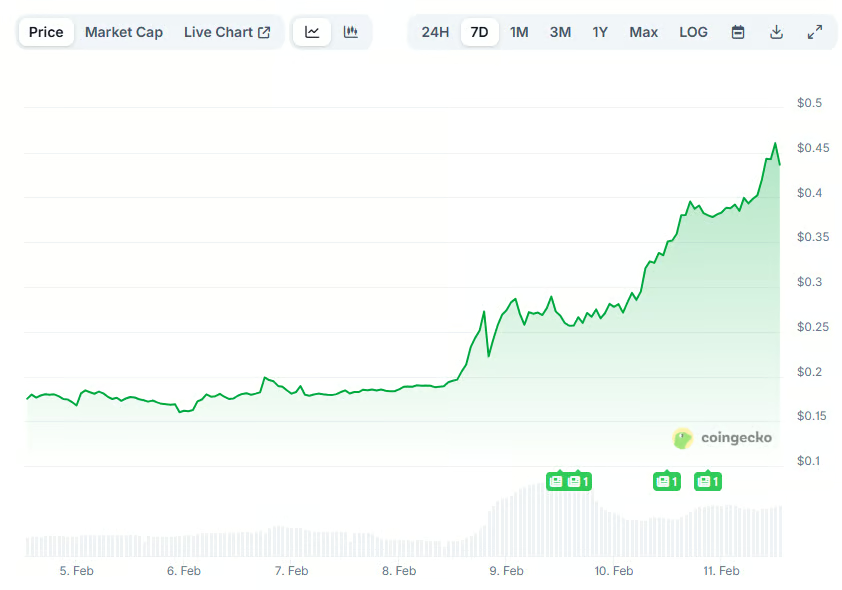
Pippin (PIPPIN) Enters Crypto’s Top 100 Club After Soaring 30% in a Day: More Room for Growth?
-

 Crypto World5 days ago
Bhutan’s Bitcoin sales enter third straight week with $6.7M BTC offload
-

 Tech12 hours ago
Retro Rover: LT6502 Laptop Packs 8-Bit Power On The Go
-

 Video7 days ago
Prepare: We Are Entering Phase 3 Of The Investing Cycle
-
 NewsBeat3 days ago
The strange Cambridgeshire cemetery that forbade church rectors from entering
-

 Business6 days ago
Barbeques Galore Enters Voluntary Administration
-

 Business13 hours ago
Tesla avoids California suspension after ending ‘autopilot’ marketing
-
 Crypto World6 days ago
Ethereum Price Struggles Below $2,000 Despite Entering Buy Zone
-

 Crypto World5 days ago
Kalshi enters $9B sports insurance market with new brokerage deal
-
 NewsBeat3 days ago
Man dies after entering floodwater during police pursuit