

Tech
Seattle Seahawks are for sale as Paul Allen estate seeks buyer shortly after Super Bowl win



The Seattle Seahawks are officially for sale.
A week after parading through the city to celebrate the team’s second Super Bowl championship, the team announced Wednesday that the Paul G. Allen Estate is seeking a buyer for the NFL franchise.
A sale of the 50-year-old team is “consistent with Allen’s directive to eventually sell his sports holdings and direct all estate proceeds to philanthropy,” a statement posted by the estate read.
The news confirms reports from ESPN and others ahead of Super Bowl LX that team would go up for sale after that game on Feb. 8, in which the Seahawks beat the New England Patriots, 29-13. The estate, chaired by Allen’s sister Jody Allen, denied at the time that the team was for sale, and said “that will change at some point per Paul’s wishes.”
The team, which entered the league in 1976, could fetch as much as $10 billion according to projections following the championship season. The Washington Commanders sold in 2023 for a then-record $6.05 billion.
Paul Allen, the Microsoft co-founder and billionaire philanthropist, bought the Seahawks in 1997 for approximately $200 million from previous owner Ken Behring, securing the team’s home in Seattle after Behring threatened a move to California. Allen ran the team until his death in 2018 at the age of 65 after he was diagnosed with a recurrence of non-Hodgkin’s lymphoma.
The sale is part of the long process of divesting many of the assets and investments that Allen made during his lifetime. Since his death, Allen’s estate has steadily moved to sell major assets, including real estate holdings and, more recently, advancing the sale process for the NBA’s Portland Trail Blazers.
The estate said Wednesday that it has selected investment bank Allen & Company and law firm Latham & Watkins to lead the sale process, which is estimated to continue through the 2026 off-season. NFL owners must then ratify a final purchase agreement.
Allen became the 12th member of the Seahawks’ Ring of Honor, a distinguished group of people who made significant contributions to the franchise, on Oct. 3, 2019.
“He was the proudest 12 of all,” Jody Allen said in a statement at the time, in a nod to the team’s fanbase nickname.
Related:
- When the Seattle Seahawks sell, will any tech execs step up for the 12s?
- Want to own a piece of the Seahawks? Seattle startup presents its private equity idea to fans


Ask anyone what Nvidia makes, and they’re likely to first say “GPUs.” For decades, the chipmaker has been defined by advanced parallel computing, and the emergence of generative AI and the resulting surge in demand for GPUs has been a boon for the company.
But Nvidia’s recent moves signal that it’s looking to lock in more customers at the less compute-intensive end of the AI market—customers who don’t necessarily need the beefiest, most powerful GPUs to train AI models, but instead are looking for the most efficient ways to run agentic AI software. Nvidia recently spent billions to license technology from a chip startup focused on low-latency AI computing, and it also started selling stand-alone CPUs as part of its latest superchip system.
Yesterday, Nvidia and Meta announced that the social media giant had agreed to buy billions of dollars’ worth of Nvidia chips to provide computing power for its massive infrastructure projects—with Nvidia’s CPUs as part of the deal.
The multiyear deal is an expansion of a cozy ongoing partnership between the two companies. Meta previously estimated that by the end of 2024, it would have purchased 350,000 H100 chips from Nvidia, and that by the end of 2025 the company would have access to 1.3 million GPUs in total (though it wasn’t clear whether those would all be Nvidia chips).
As part of the latest announcement, Nvidia said that Meta would “build hyperscale data centers optimized for both training and inference in support of the company’s long-term AI infrastructure roadmap.” This includes a “large-scale deployment” of Nvidia’s CPUs and “millions of Nvidia Blackwell and Rubin GPUs.”
Notably, Meta is the first tech giant to announce it was making a large-scale purchase of Nvidia’s Grace CPU as a stand-alone chip, something Nvidia said would be an option when it revealed the full specs of its new Vera Rubin superchip in January. Nvidia has also been emphasizing that it offers technology that connects various chips, as part of its “soup-to-nuts approach” to compute power, as one analyst puts it.
Ben Bajarin, CEO and principal analyst at the tech market research firm Creative Strategies, says the move signaled that Nvidia recognizes that a growing range of AI software now needs to run on CPUs, much in the same way that conventional cloud applications do. “The reason why the industry is so bullish on CPUs within data centers right now is agentic AI, which puts new demands on general-purpose CPU architectures,” he says.
A recent report from the chip newsletter Semianalysis underscored this point. Analysts noted that CPU usage is accelerating to support AI training and inference, citing one of Microsoft’s data centers for OpenAI as an example, where “tens of thousands of CPUs are now needed to process and manage the petabytes of data generated by the GPUs, a use case that wouldn’t have otherwise been required without AI.”
Bajarin notes, though, that CPUs are still just one component of the most advanced AI hardware systems. The number of GPUs Meta is purchasing from Nvidia still outnumbers the CPUs.
“If you’re one of the hyperscalers, you’re not going to be running all of your inference computing on CPUs,” Bajarin says. “You just need whatever software you’re running to be fast enough on the CPU to interact with the GPU architecture that’s actually the driving force of that computing. Otherwise, the CPU becomes a bottleneck.”
Meta declined to comment on its expanded deal with Nvidia. During a recent earnings call, the social media giant said that it planned to dramatically increase its spending on AI infrastructure this year to between $115 billion and $135 billion, up from $72.2 billion last year.

Looking for the most recent regular Connections answers? Click here for today’s Connections hints, as well as our daily answers and hints for The New York Times Mini Crossword, Wordle and Strands puzzles.
Today’s Connections: Sports Edition is a tough one, although I got a kick out of the blue group. If you’re struggling with today’s puzzle but still want to solve it, read on for hints and the answers.
Connections: Sports Edition is published by The Athletic, the subscription-based sports journalism site owned by The Times. It doesn’t appear in the NYT Games app, but it does in The Athletic’s own app. Or you can play it for free online.
Read more: NYT Connections: Sports Edition Puzzle Comes Out of Beta.
Hints for today’s Connections: Sports Edition groups
Here are four hints for the groupings in today’s Connections: Sports Edition puzzle, ranked from the easiest yellow group to the tough (and sometimes bizarre) purple group.
Yellow group hint: Torso clothing.
Green group hint: Start your engines.
Blue group hint: Team towns.
Purple group hint: Blue Devils.
Answers for today’s Connections: Sports Edition groups
Yellow group: Upper-body wear.
Green group: Flags in NASCAR.
Blue group: Last words in two-word NFL team locations.
Purple group: Duke players drafted No. 1 in NBA.
Read more: Wordle Cheat Sheet: Here Are the Most Popular Letters Used in English Words.
What are today’s Connections: Sports Edition answers?
The completed NYT Connections: Sports Edition puzzle for Feb. 19, 2026.
The yellow words in today’s Connections
The theme is upper-body wear. The four answers are jersey, pinnie, sweater and tee.
The green words in today’s Connections
The theme is flags in NASCAR. The four answers are checkered, green, red and yellow.
The blue words in today’s Connections
The theme is last words in two-word NFL team locations. The four answers are (Green) Bay, (Kansas) City, (New) England and (San) Francisco.
The purple words in today’s Connections
The theme is Duke players drafted No. 1 in NBA. The four answers are Banchero, Brand, Flagg and Irving.
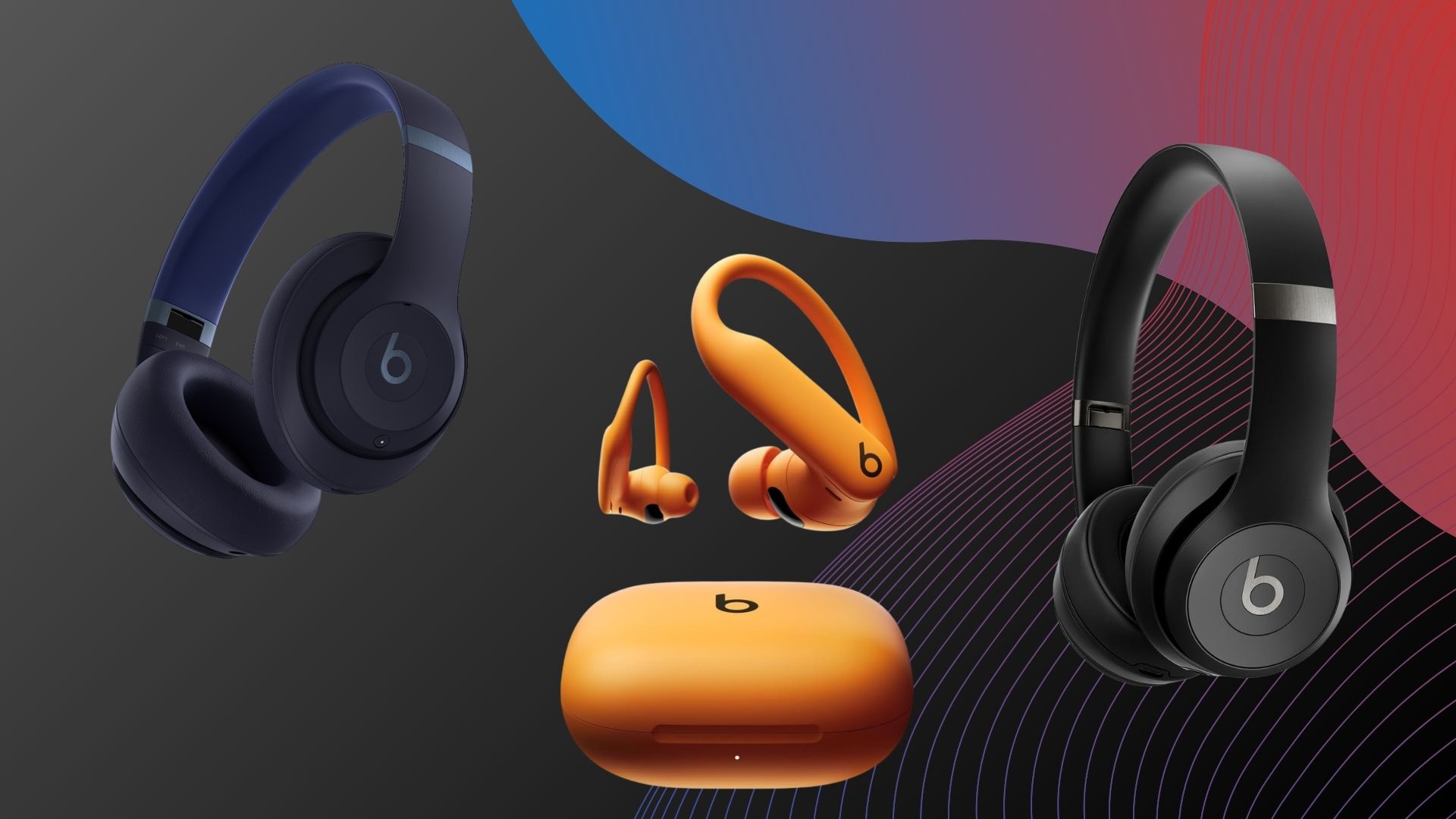
If you’re a fan after Beats headphones, we’re here to help you make the right choice with this list of the best Beats headphones.
Beats has changed its tune (quite literally) in recent years, changing from the bass-heavy approach of its earlier years to a more neutral and balanced sound. It’s also launched an array of headphones in different forms, so you can now choose from on-ears, over-ears or true wireless earbuds.
We’ve reviewed practically all the Beats headphones out there, so we’re very familiar with the brand and what makes a good Beats headphone. We’ve tested each pair of Beats headphones like we would do with any other pair of headphones.
Our testing process goes through the design to determine how well they fit and how comfortable they are to wear. We’ll test the features they have, carrying out battery drains to see how long they last, test the call quality where necessary, and judge how good the ANC and wireless connection are by taking them out in the world. And of course we’ll test how they sound, judging them against previous Beats headphones.
We put all this effort into testing these headphones to give you insights into their performance, so you can be confident that you’re getting value for money.
If you’re considering other pairs to buy, have a look at our list of the best headphones and best over-ears to the best wireless earbuds and best noise-cancelling headphones.
SQUIRREL_ANCHOR_LIST
How we test
Our headphone tests are done by some of the best and most prolific reviewers in the industry, with years of experience listening to everything from the plasticky freebie earbuds that come with your smartphone, to five-figure beasts of glass and marble. We love music and we want your tunes to sound good, too.
So we listen every pair of headphones we can get on or in our ears. We use a variety of sources, from basic MP3s playing on a laptop to high-quality tracks on dedicated hi-res audio players.
Our test tracks are wide-ranging to give headphones a thorough challenge. They’re also familiar, so we know every track backwards, and we know which bits might trouble the lesser performers.
We listen again and again, and we do that for weeks in case the sound changes – because it usually does. Then we’ll listen to similarly priced rivals and come up with a verdict that reflects the performance and features for the money.
Pros
- Strong noise-cancelling
- Neutral, clear presentation
- Excellent wireless performance
- Physical controls
- USB-C audio
Cons
- ANC suffers with wind noise
- No room for higher quality Bluetooth codecs
- Design better suited for smaller ears
Pros
- Clear, detailed and balanced sound
- Strong noise-cancellation performance
- Long battery life
- Comfortable to wear
Cons
- Not the most exciting audio delivery
- No customisation of sound or ANC
- Charging case is still on the big side
- Expensive
Pros
- Clear, detailed sound
- Improved noise-cancellation
- Smaller design and case
- Better battery life than Fit Pro
- Comfortable to wear
Cons
- Lack of any new features
- Still only IPX4
- Strong alternatives from Bose and JBL
Pros
- Improved noise-cancellation over original
- Clear, spacious audio
- Excellent call performance
- Improved battery
- Feature parity on Android and iOS
Cons
- Patchy performance in busy signal areas
- Slightly loose fit
- More expensive
- No support for higher-quality Bluetooth codecs
Pros
- Natural, balanced tone
- Solid noise cancellation/transparency mode
- iOS and Android support
- Comfortable to wear
Cons
- Battery life less than rivals
- No wireless charging
- App is slim on features
Pros
- Small package
- Plenty of features
- Long battery life
-
Strong noise-cancelling -
Neutral, clear presentation -
Excellent wireless performance -
Physical controls -
USB-C audio
-
ANC suffers with wind noise -
No room for higher quality Bluetooth codecs -
Design better suited for smaller ears
The Studio Pro are a largely successful reboot of Beats full-sized headphones. They’re comfortable enough to wear with their soft, pliable earpads, though we would say they’re best suited for smaller ears. The space inside the earcups is a little compact and can pinch around the ears.
The design is more minimalist than before, and feels better constructed than the heavily plastic vibes of previous models, with physical buttons provided for playback, noise-cancellation and volume control which we liked. There’s no wear sensor so the headphones won’t automatically pause audio when taken off.
Like the other Beats headphones on this list, there’s support for Android and iOS with the ‘Find My’ functionality that searches for the headphone’s last known location: one-touch pairing on iOS and Google Fast Pair, and the ability to switch between devices within their respective ecosystems.
The Bluetooth performance is vastly better than the Studio Buds Plus and among some of the best headphones we’ve tested with barely any signal disruption. The call quality is solid but an area we feel there is room for improvement. While background noise was effectively muzzled, in busy areas we were told our voices sounded robotic and fuzzy.
The noise-cancelling is very strong though it comes with a few caveats. One is that the headphones are susceptible to wind noise, and the second is that noise leaks through when we turned our head. Otherwise the Studio Pro put the kibosh on the most noises we came across, including crying children. They’re an excellent choice for commuter journeys.
The transparency mode is very natural sounding but our only other issue is that there’s no room to customise the performance of the noise-cancellation to hear what we want to hear.
Battery life is claimed to be 24 hours but we found these headphones can go even longer streaming audio at about 50%. The headphones don’t sound as good at that volume level but you get more than 24 hours from each charge.
The sound quality is neutral with lots of detail and clarity. Some may feel that the Beats’ sound lacks character, but in our minds it serves to present music as is without much tweaking. Bass is weighty and punchy; midrange clarity is excellent, and while the treble isn’t as bright as we’d like, it is clear and detailed.
Plug them into a wired USB-C connection and they sound even better, able to support 24-bit/96kHz files. In this mode the Studio Pro sound more energetic, lively, and dynamic.
-
Clear, detailed and balanced sound -
Strong noise-cancellation performance -
Long battery life -
Comfortable to wear
-
Not the most exciting audio delivery -
No customisation of sound or ANC -
Charging case is still on the big side -
Expensive
For those searching for a pair of Beats headphones for running and fitness, the Powerbeats Pro 2 are your best bet.
While the Powerbeats Fit and Fit Pro offer a sturdy enough fit and IP resistance to be used in the gym, the Powerbeats have a sporty design with a lightweight plastic build, hook design and a malleable rubber stem. They offer the better, more stable fit.
As far as features go, these are a big upgrade on the original Powerbeats Pro.
There’s the addition of noise cancellation, which is the best we’ve heard from a Beats true wireless. There’s transparency mode for when you need to hear what’s around you.
There’s also a heart-rate monitor, which tracks your heart rate via various apps so you can keep track fo your cardiovascular health; and battery life has been boosted to up to 45 hours.
Disappointingly the earbuds stick with their water IPX4 and include a wear sensor to automatically play and pause your tunes.
When it comes to sound, the Powerbeats Pro 2 share the same charateristics as the other models on this list. It’s not the most exciting sound, but it’s clear, spacious and detailed; with a solid bass performance. They lack a little fun with their sound but they are a clear, balanced listen.
-
Clear, detailed sound -
Improved noise-cancellation -
Smaller design and case -
Better battery life than Fit Pro -
Comfortable to wear
-
Lack of any new features -
Still only IPX4 -
Strong alternatives from Bose and JBL
The Powerbeats Fit can be worn for casual use or exercise with its wing-tip design.
It’s still powered by Apple’s H1 chip (the same one found in the AirPods), the headphones have a number of iOS-exclusive features but work with Android devices too.
Connected to an iOS device and the earbuds operate at a system level, which means there’s no need for a separate iOS app – and users benefit from exclusive features such as dynamic head tracking with Spatial Audio with head tracking and Dolby Atmos.
There’s also automatic switching between iOS devices, audio sharing with Apple products and hands-free voice assistance from Siri, and for even more convenience there’s one-touch pairing and support for the Find My app in case they go missing.
Android users benefit from the Beats app, which includes control customisation, battery levels and the Ear Tip Fit Test, with one-touch pairing possible when setting the buds up. However, some Apple-exclusive features such as Spatial audio aren’t available.
We’re at the point where the feature set is a little samey, and the Powerbeats Fit doesn’t bring anything new to the table, not even an increase in the IP rating.
The noise-cancelling performance is a big improvement over the Fit Pro. When we used them in the gym they reduced the noise of the machinery around us, and when we took them for a run outside, we found they removed most noises, though cars and bigger vehicles can penetrate your bubble of isolation.
The audio performance is much better than the Fit Pro, a bigger soundstage, louder, clearer and more detailed sound; with a better bass performance and a clearer treble response.
They’re an upgrade of the Fit Pro, but we were hoping for more on the feature front. Regardless, if you’re after a pair for sports and general use, this Beats true wireless is recommended.
-
Improved noise-cancellation over original -
Clear, spacious audio -
Excellent call performance -
Improved battery -
Feature parity on Android and iOS
-
Patchy performance in busy signal areas -
Slightly loose fit -
More expensive -
No support for higher-quality Bluetooth codecs
The Studio Buds Plus carry the same design as other efforts in the Beats range with its sculpted boot-shape design but there are now vents to relieve pressure in the ear and allow for a better fit to improve the noise-cancelling performance.
We found the fit does feel more secure, although they still have a habit of moving about.
Otherwise they’re pretty much the same as the original pair. They’re nice to use with the glossy multi-function button providing good feedback, and volume control is included though it has to be activated within the app which comes at the expense of onboard control over noise-cancellation. It’s not the best compromise.
The Studio Buds Plus pack features for Android and IOS users, a list that includes one-touch pairing, the Find My function on both platforms, and device switching. Apple users get hands-free Siri too.
Battery life is better than the original, as we tested you can get around six hours of battery from a charge. There is no wireless charging support, but fast-charging is provided with a five-minute providing an hour of playback.
The earbuds’ active noise cancellation performance is better as it suppresses more noise. The transparency mode is clear, avoiding any noise; and call quality is strong, with very little noise affecting the levels of clarity. An area we find the Beats are poorer in is its wireless connection, which gets patchy in busy areas.
As far as audio quality goes, the performance mirrors previous models in being flat and balanced across the frequency range, and it sounds punchier and more spacious too. Bass is slightly more effective than it was on the original model.
-
Natural, balanced tone -
Solid noise cancellation/transparency mode -
iOS and Android support -
Comfortable to wear
-
Battery life less than rivals -
No wireless charging -
App is slim on features
The Beats Studio Buds are a solid pair of all-rounders for anyone searching for Beats on a budget.
The earbuds feature a sculpted boot-shaped design with ear-tips to help them slot into the ear. However, the fit isn’t quite secure enough that you could take them on a run – instead, we’d recommend the Powerbeats Pro or Fit Pro if that’s your use case.
Like the Beats Fit Pro, the Studio Buds come with a good range of features for both Android and iOS users, including one-touch pairing and the Find My headphones feature.
The earbuds offer solid active noise cancellation for their price provided you get a tight seal, and there’s a Transparency mode along with voice assistant support for whichever device you’re using. All of this operates at a system level for iOS users, whereas Android users will need to download the Beats app.
As far as audio quality goes, the Studio Buds offer a neutral and balanced sound across the frequency range, though the soundstage is limited in width compared to the Fit Pro. Highs are described with a sharpness but can become too bright if the fit isn’t correct, while the bass is solid it does lack depth. The Studio Buds Plus are better in pretty much every way, though they come with a jump in price to around £180 / $170. For an even cheaper true wireless pair, there are the Solo Buds, which we’re still yet to review.
-
Small package -
Plenty of features -
Long battery life
With the Solo 4, Beats now offers headphones in true wireless, over-ear and on-ear forms, so there’s a choice for anyone depending on the form factor you prefer.
On-ears can be uncomfortable for some but at first we didn’t find the headphones to be uncomfortable to wear but after a few hours we did find that they pinched our earlobes. We wouldn’t recommend that you wear these headphones for hours on end.
However, for those who can wear on-ears for several hours, the compact form factor means you can carry and store them without taking up much space. Build quality is fine but there are some creaks to in the plastic structure of the headband. It’s an area where the Solo 4 could be better in.
In terms of features there is no noise-cancelling but the battery life is excellent wiht 50 hours of charge available, and there is Spatial Audio support, though that’s only for iOS users. Despite that, like the rest of Beats’ headphones, it supports features across the iOS and Android ecosystem with Find My support.
The sound quality is also like the rest of the Beats’ headphones: balanced, clear, and works solidly across a range of music genres. The Solo 4 doesn’t excel in terms of sound, but nor does it sound bad with anything you pass through it. There’s enough clarity and detail to make for an enjoyable listen.
Full Specs
| Beats Studio Pro Review | Beats Powerbeats Pro 2 Review | Beats Powerbeats Fit Review | Beats Studio Buds Plus Review | Beats Studio Buds Review | Beats Solo 4 Review | |
|---|---|---|---|---|---|---|
| UK RRP | £349.99 | £249 | – | £179.99 | £130 | £199 |
| USA RRP | $349.99 | $249 | – | $169.99 | $149.99 | $199 |
| EU RRP | €399.95 | €299 | – | €199.95 | €149.95 | – |
| CA RRP | CA$466.95 | – | – | CA$229.95 | CA$179.95 | – |
| AUD RRP | AU$529.95 | – | – | AU$269.95 | AU$199.95 | – |
| Manufacturer | Beats by Dr Dre | Beats | Beats | Beats by Dr Dre | Beats by Dr Dre | Beats |
| IP rating | No | IPX4 | IPX4 | IPX4 | IPX4 | No |
| Battery Hours | 24 | 45 | 30 | 24 | 24 | 50 00 |
| Wireless charging | – | Yes | – | – | – | – |
| Fast Charging | Yes | Yes | Yes | Yes | Yes | Yes |
| Size (Dimensions) | x x INCHES | – | – | x x INCHES | x x INCHES | x x INCHES |
| Weight | 260 G | 86.4 G | 61.3 G | 59 G | 58.2 G | 217 G |
| ASIN | B0C95J98LV | B0DT4WR7ZB | B0FPGQZTFB | B0C384VMY2 | B0979RDMR4 | B0CZPMXGSH |
| Release Date | 2023 | 2025 | 2025 | 2023 | 2021 | 2024 |
| First Reviewed Date | – | – | – | – | – | 26/06/2024 |
| Model Number | Studio Pro | Powerbeats Pro 2 | – | Studio Buds + | – | – |
| Audio Resolution | SBC, AAC | SBC, AAC | SBC, AAC | SBC, AAC | – | – |
| Driver (s) | Beats custom-designed, two-layer dynamic diaphragm transducer | Custom-designed, dual-element dynamic diaphragm transducer | – | – | 8.2mm dual-element diaphragm | – |
| Noise Cancellation? | Yes | Yes | Yes | Yes | Yes | – |
| Connectivity | Bluetooth 5.3 | Bluetooth 5.3 | Bluetooth 5 | Bluetooth 5.3 | Bluetooth 5.2 | Bluetooth |
| Colours | Sandstone, Navy, Black, and Deep Brown | Jet Black, Quick Sand, Hyper Purple,, Electric Orange | Jet Black, Spark Orange, Gravel Grey, and Power Pin | Black/Gold, Ivory, Transpareny | Black, White, Beats Red | Black, Pink, Blue |
| Frequency Range | 20 20000 – Hz | – Hz | 20 20000 – Hz | 20 20000 – Hz | – Hz | – Hz |
| Headphone Type | Over-ear | True Wireless | True Wireless | True Wireless | True Wireless | On-ear |
| Voice Assistant | Siri | Siri | – | – | Yes | Siri, Google Assistant |
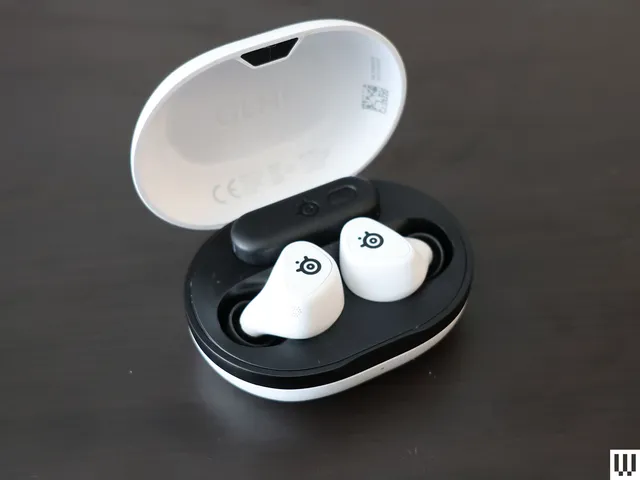
While I’ve tested a lot of gaming headsets meant for sitting on a couch or at a desk, very few are easy to pocket and take on the go. The SteelSeries Arctis GameBuds fill that need, and are perfectly matched for consoles like the Nintendo Switch 2 and ROG Xbox Ally. They’re currently marked down to just $160 at Best Buy, a $40 discount from their usual price.

Photograph: Eric Ravenscraft
SteelSeries
Arctis GameBuds
While most gamers prefer over-ear headsets for the sound isolation and comfort, these earbuds have some special features that help them bridge the gap. The Arctis mobile app has a huge variety of sound profiles for individual games, letting you quickly swap your EQ when you move from a shooter to a racing game. The included USB-C dongle ensures a latency-free 2.4-GHz wireless connection, much better than Bluetooth for the serious gamer on the go. They have great battery life, too, at around 10 hours on a single charge, and up to 40 when you include the battery in the case. They’re compact enough that they fit in the extra compartment on my favorite Switch 2 carrying case, the Belkin Charger Case.
They aren’t just great for gaming, either. I often use these while I’m out doing yard work or walking the dog, thanks to their snug fit. I also appreciate that they have physical buttons instead of touch controls, which helps prevent accidental track skips during intense workouts. While they may not sound as sharp as some of our other favorite nongaming wireless earbuds, they have a clear and punchy sound profile that works just fine for a little Steely Dan. The noise canceling is surprisingly adept too. I recently took a short flight with just these and didn’t bring my usual Sony over-ear ANC headset, and they worked perfectly for squeezing in a few hours of Donkey Kong Bonanza without missing out on that great soundtrack.
If you’re ready to turn your portable gaming up a notch, head on over to Best Buy for a $40 discount on the black Arctis Earbuds, or check out our other favorite gaming headsets for something more traditional.


In the rapidly evolving world of engineering technology, professionals devote enormous energy to such tasks as mastering the latest frameworks, optimizing architectures, and refining machine learning models. It’s easy to let technical expertise become the sole measure of professional value. However, one of the most important skills an engineer can develop is the capacity to write and communicate effectively.
Whether you’re conducting research at a university or leading systems development projects at a global firm, your expertise can become impactful only when you share it in a way that others can understand and act upon. Without a clear narrative, even groundbreaking data or innovative designs can fail to gain traction, limiting their reach among colleagues and stakeholders, and in peer‑reviewed journals.
The cost of the “soft skill” misnomer
Writing is often labeled a “soft skill”—which can diminish its importance. In reality, communication is a core engineering competency. It lets us document methods, articulate research findings, and persuade decision-makers who determine whether projects move forward.
If your writing is dense, disorganized, or overloaded with technical jargon, the value of the underlying work can become obscured. A strong proposal might be dismissed not because the idea lacks merit but because the justification is difficult to follow.
Clear writing can strengthen the impact of your work. Poor writing can distract from the points you’re trying to make, as readers might not understand what you’re saying.
The architecture of authority
Technical writing differs from other forms of prose because readers expect information to follow predictable, logical patterns. Unclear writing can leave readers unsure of the author’s intent.
One of the most enduring frameworks for writing about technology in an understandable manner is the IMRaD structure: introduction, methods, results, and discussion.
- Introduction: Define the problem and its relevance.
- Methods: Detail the approach and justify the choices.
- Results: Present the empirical findings.
- Discussion: Interpret the outcomes and their implications.
More than just a template for academic papers, IMRaD is a road map for logical reasoning. Mastering the structure can help engineers communicate in a way that aligns with professional writing standards used in technical journals, so their work is better understood and more respected.
Bridging the training gap
Despite technical communication’s importance, engineering curricula often limit or lack formal instruction in it.
Recognizing that gap, IEEE has expanded its role as a global knowledge leader by offering From Research to Publication: A Step-by-Step Guide to Technical Writing. The course is led by Traci Nathans-Kelly, director of the engineering communications program at Cornell.
Developed by IEEE Educational Activities and the IEEE Professional Communication Society, the learning opportunity goes beyond foundational writing skills. It addresses today’s challenges, such as the ethical use of generative AI in the writing workflow, the complexities of team-based authorship, and publishing strategies.
The program centers on core skill areas that can influence an engineer’s ability to communicate. Participants learn to master the IMRaD structure and learn advanced editing techniques to help strip away jargon, making complex ideas more accessible. In addition, the course covers strategic approaches to publishing work in high‑impact journals and improving a writer’s visibility within the technical community.
The course is available on the IEEE Learning Network. Participants earn professional development credit and a shareable digital badge. IEEE members receive a US $100 discount. Organizations can connect with an IEEE content specialist to offer the training to their teams.
From Your Site Articles
Related Articles Around the Web
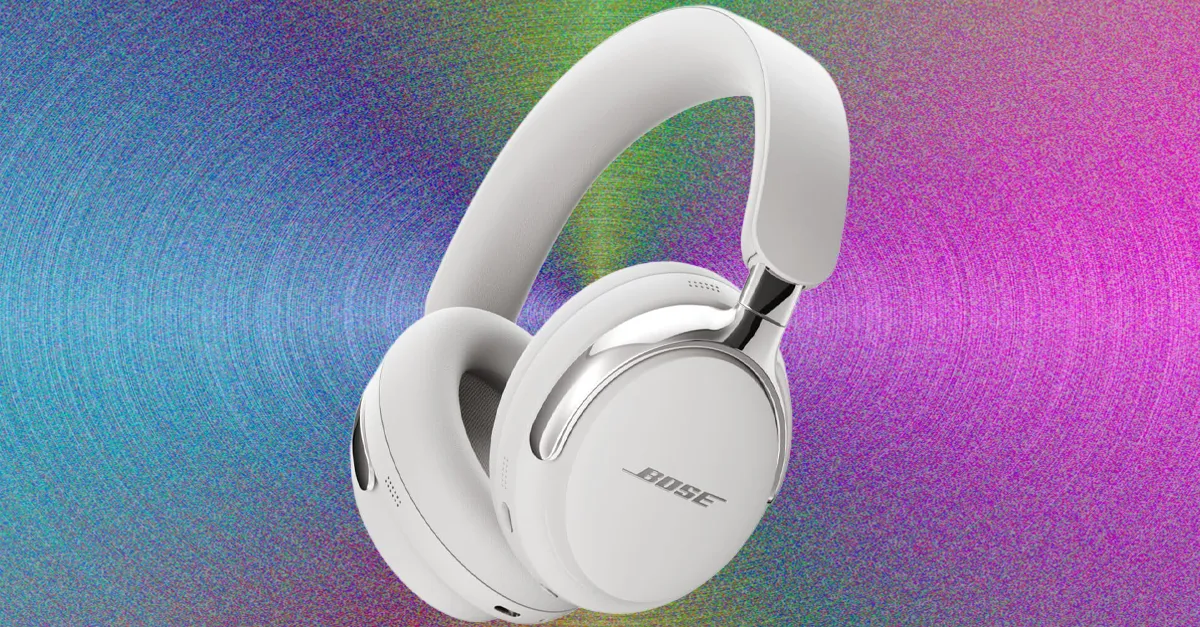
Bose helped write the book on noise canceling when it entered the market way back in the 1970s. Lately, the brand has been on a tear, with the goal of creating the ultimate in sonic solitude. The QuietComfort Ultra Gen 2 are Bose’s latest and greatest creation, offering among the very best noise canceling we’ve ever tested.
Just as importantly, they’re currently on sale for $50 off. Now, this might not seem like a huge discount on a $450 pair of headphones, but this is the lowest price we’ve seen on these headphones outside of a major shopping holiday. So if you missed your chance during Black Friday but you have a spring break trip to Mexico or Hawaii on the calendar, this is your best bet.
The Best Noise Canceling Headphones Are on Sale
I’ve wondered over the last few years if the best noise cancelers even needed another potency upgrade. Previous efforts like Sony’s WH-1000XM5, Apple’s AirPods Max, and Bose’s own QuietComfort 45 offering enough silence that my own wife gives me a jump scare when she walks up behind me.
Then I had a kid.
Bose’s properly named QuietComfort Ultra not only do a fantastic job quelling the many squeaks, squawks, and adorable pre-nap protests my baby makes. Now that my wife and I have turned my solo office into a shared space, I can go about my business in near total sonic freedom, even as she sits in on a loud Zoom call.
In testing, we found Sony’s latest WH-1000XM6 offered a slight bump in noise canceling performance over Bose’s latest, due in part to their zippy response time when attacking unwanted sounds. But both were within a hair of each other when tested across frequencies. I prefer Bose’s pair for travel, due to their more cushy design that lets me listen for a full cross-country flight in luxe comfort.
Upgrades to the latest generation, like the ability to sleep them and quickly wake them, make these headphones surprisingly more intuitive to use daily. The new built-in USB-C audio interface lets you listen to lossless audio directly from supported devices, a nice touch now that Spotify has joined Apple Music and other services with lossless audio support.
Speaking of audio, the QC Ultra Gen 2’s performance is impressive, providing clear and crisp detail and dialog, with a lively touch that brings some added excitement to instruments like percussion or zippy guitar tones. It’s a lovely overall presentation. I’m not a huge fan of the new spatial audio mode (what Bose calls Cinema mode), but it’s always nice to have options.
These headphones often bounce between full price and this $50 discount, so if you’ve been waiting for the dip, now’s the time to buy. If you’ve deal with daily distractions like me, whether at home or in a busy office space, you’ll appreciate the latest level of sound-smashing solitude Bose’s best noise-cancelers ever can provide.
Power up with unlimited access to WIRED. Get best-in-class reporting and exclusive subscriber content that’s too important to ignore. Subscribe Today.

Google has announced that using its newly incorporated Lyria 3 model, Gemini users will be able to generate 30-second music tracks based on a prompt, or remix an existing track to their liking. The new model builds on Gemini’s pre-existing ability to generate text, images and video, and will also be available in YouTube’s “Dream Track” feature, where it can be used to generate detailed backing tracks for Shorts.
Like some other music generation tools, prompting Gemini doesn’t require a lot of detail to produce serviceable results. Google’s example prompt is “a comical R&B slow jam about a sock finding their match,” but after playing with Lyria 3, you can definitely get more granular about individual elements of a track — changing the tempo or the style of drumming, for example — if you want to. Outside of text, Gemini can also generate music based on a photo or video, and tracks can be paired with album art created by Google’s Nano Banana image model.
Google says that Lyria 3 improves on its previous audio generation models in its ability to create more “realistic and musically complex” tracks, give prompters more control over individual components of a song and automatically generate lyrics. Gemini’s outputs are limited to 30-second clips for now, but given how Google’s promotional video shows off the feature, it’s not hard to imagine those clips getting longer or the model getting incorporated into other apps, like Google Messages.
Like Gemini’s other AI-generated outputs, songs made with Lyria 3 are also watermarked with Google’s SynthID, so a Gemini clip can’t as easily be passed off as a human one. Google started rolling out its SynthID Detector for identifying AI-generated content at Google I/O 2025. The sample tracks Google included alongside its announcement are convincing, but you might not need the company’s tool to notice their machine-made qualities. The instrumental parts of Gemini’s clips often sound great, but the composition of the lyrics Lyria 3 produces sounds alternately corny and strange.
If you’re curious to try Lyria 3 for yourself, Google says you can prompt tracks in Gemini starting today, provided you’re 18 years or older and speak English, Spanish, German, French, Hindi, Japanese, Korean or Portuguese.

from the flow-my-sewage,-said-the-swamp dept
The ICE surge in Minneapolis, Minnesota was instigated by a far-right click bait artist and encouraged by the president’s portrayal of Somali immigrants as “garbage” people from a “garbage” country. And those were some of the nicer words Trump used to describe the people his agencies would be hunting down first.
Several weeks later, a draw-down has begun, prompted by two murders committed by federal officers, an inability to obtain indictments against protesters, and every narrative about violence perpetrated by federal officers disintegrating the moment the government was asked to provide some evidence of its claims to the court.
Hundreds of judges in hundreds of immigration cases have found that the government has routinely violated the due process rights of the immigrants it has arrested. This dates all the way back to the beginning of Trump’s second term, but months of roving patrols by masked men with guns has created a massive influx of cases courts are still trying to sort out. But one thing is clear: the government will do anything it can to keep the people it arrests from availing themselves of their constitutional rights.
This starts with the arrests themselves, which most often occur without a judicial warrant. The same goes for the invasion of people’s houses and places of business. With the Supreme Court giving its tacit blessing to casual racism (the so-called “Kavanaugh stops”), anyone who looks less than white or whose English has a bit of an accent is considered reasonably suspicious enough to detain.
The government has been on the losing end of hundreds of cases involving due process rights. This decision [PDF], coming to us via Politico’s Kyle Cheney, details the massive amount of constant movement this government engages in to keep people separated from their rights and physical freedom.
It opens with this:
Immigrations and Customs Enforcement (“ICE”) recognizes that noncitizen detainees have a constitutional right to access counsel. But in recent weeks, ICE has isolated thousands of people—most of them detained at the Bishop Henry Whipple Federal Building—from their attorneys. Plaintiffs, who are noncitizen detainees and a nonprofit that represents noncitizens, have presented substantial, specific evidence detailing these alleged violations of the United States Constitution. In response, Defendants offer threadbare declarations generally asserting, without examples or evidence, that ICE provides telephone access to counsel for noncitizens in its custody. The Plaintiffs’ declarations provide specifics of the opposite. The gulf between the parties’ evidence is simply too wide and too deep for Defendants to overcome.
It’s not like ICE can’t provide detainees with access to attorneys or respect their due process rights. It’s that they choose not to, now that Trump is in charge. The access is theoretically possible. It’s just being purposefully denied. And it’s not even just being denied in the sense that phone call requests are being refused. People detained by ICE are placed into a constant state of flux for the sole purpose of making it as difficult as possible for them to avail themselves of their rights.
The devil is in the details. And the court brings plenty of those, all relating to the administration’s “Operation Metro Surge” that targeted Minneapolis, Minnesota:
Detainees are moved frequently, quickly, without notice,and often with no way for attorneys to know where or how long they will be at a given facility. (ECF No. 20 (“Boche Decl.”) ¶¶ 9, 13, 18; ECF No. 24 (“Edin Decl.”) ¶ 6; Heinz Decl. ¶ 5 (explaining that of eleven clients initially detained at Whipple, ten were transferred out of the state within twenty-four hours); Kelley Decl. ¶ 19.) Once a person has been transferred out of Minnesota, “representation becomes substantially more difficult”—attorneys must secure local counsel to sponsor a pro hac vice application and navigate additional barriers.
This is a key part of the administration’s deliberate destruction of constitutional rights. Moving people quickly helps prevent habeas corpus motions from being filed, since they need to be filed in the jurisdiction where they’re being held. If detainees are shifted from place to place quickly enough, their counsel needs to figure out where they’re being held and hope that their challenge lands in court before their clients are moved again. And with the Fifth Circuit basically codifying the denial of due process to migrants, more and more people arrested elsewhere in the nation are being sent to detainment centers in Texas as quickly as possible.
All of this is intentional:
Defendants transfer people so quickly that even Defendants struggle to locate detainees. Often, Defendants do not accurately or timely input information into the Online Detainee Locator System. This prevents Minnesota-based attorneys from locating and speaking with their clients.The locator either produces no search results or instructs attorneys to call for details, referencing a phone number that ICE does not answer. Often, Defendants do not update the locator until after detainees areout of state. Attorneys frequently learn of their client’s location for the first time when the government responds to a habeas petition.
These are not the good faith efforts of a government just trying to get a grasp on the immigration situation. These are the bad faith efforts of government hoping to violate rights quickly enough that the people it doesn’t like will be remanded to the nearest war-torn nation/foreign torture prison before the judicial branch has a chance to catch up.
There’s more. There’s the phone that detainees supposedly have access to for their one phone call. It’s the same line used to receive calls for inmates, so that means lawyers calling clients back either run into a busy signal or a ringing phone that detainees aren’t allowed to answer and ICE officers certainly aren’t interested in answering.
Lawyers seeking access to their clients have been refused access. In some cases, they’ve been threatened with arrest by officers simply for showing up. Even if they happen to make it inside the Whipple Detention Center, ICE officers and detention center employees usually refuse them access to their clients.
And when people try to work within the unconstitutional limitations of this deliberately broken system, they’re mocked for even bothering to avail themselves of their rights.
When an attorney told an agent that she sent a copy of a releaseorder to the specified email address, the agent laughed and said “something to the effect of ‘yeah we really need to get someone to check that email.’”
To sum up, the government is exactly what the court thinks it is: a set of deliberate rights violations pretending it’s a legitimate government operation that’s just trying to do the best it can in these troubling times:
It appears that in planning for Operation Metro Surge, the government failed to plan for the constitutional rights of its civil detainees. The government suggests—with minimal explanation and even less evidence—that doing so would result in “chaos.” The Constitution does not permit the government to arrest thousands of individuals and then disregard their constitutional rights because it would be too challenging to honor those rights.
The administration has long lost the “presumption of regularity” that courts have utilized for years while handling lawsuits and legal challenges against the government. It no longer is considered to be acting in good faith in much of the country (Fifth Circuit excluded, for the most part). This is the “rule of law” party making it clear that it will only follow the rules and laws it likes. And it will continue to do so because courts can’t actually physically free people or force the government to respect their rights. The Trump administration is fine with losing in court and losing the hearts and minds of most of America as long as those in power keep getting to do what they want.
Filed Under: dhs, doj, due process, ice, immigration, kristi noem, mass deportation, minnesota, rights violations, todd lyons, tom homan, trump administration

A study of more than 12,000 European firms found that AI adoption causally increases labour productivity by 4% on average across the EU, and that it does so without reducing employment in the short run.
Researchers from the Bank for International Settlements and the European Investment Bank used an instrumental variable strategy that matched EU firms to comparable US firms by sector, size, investment intensity and other characteristics, then used the AI adoption rates of those US counterparts as a proxy for exogenous AI exposure among European firms.
The productivity gains, however, skewed heavily toward medium and large companies. Among large firms, 45% had deployed AI, compared to just 24% of small firms. The study also found that complementary investments mattered enormously: an extra percentage point of spending on workforce training amplified AI’s productivity effect by 5.9%, and an extra point on software and data infrastructure added 2.4%.
Tech
Marantz A/V Separates Herald a New Era of Home Theater Where Luxury and Performance Finally Align
This story was sponsored and fact checked by Marantz
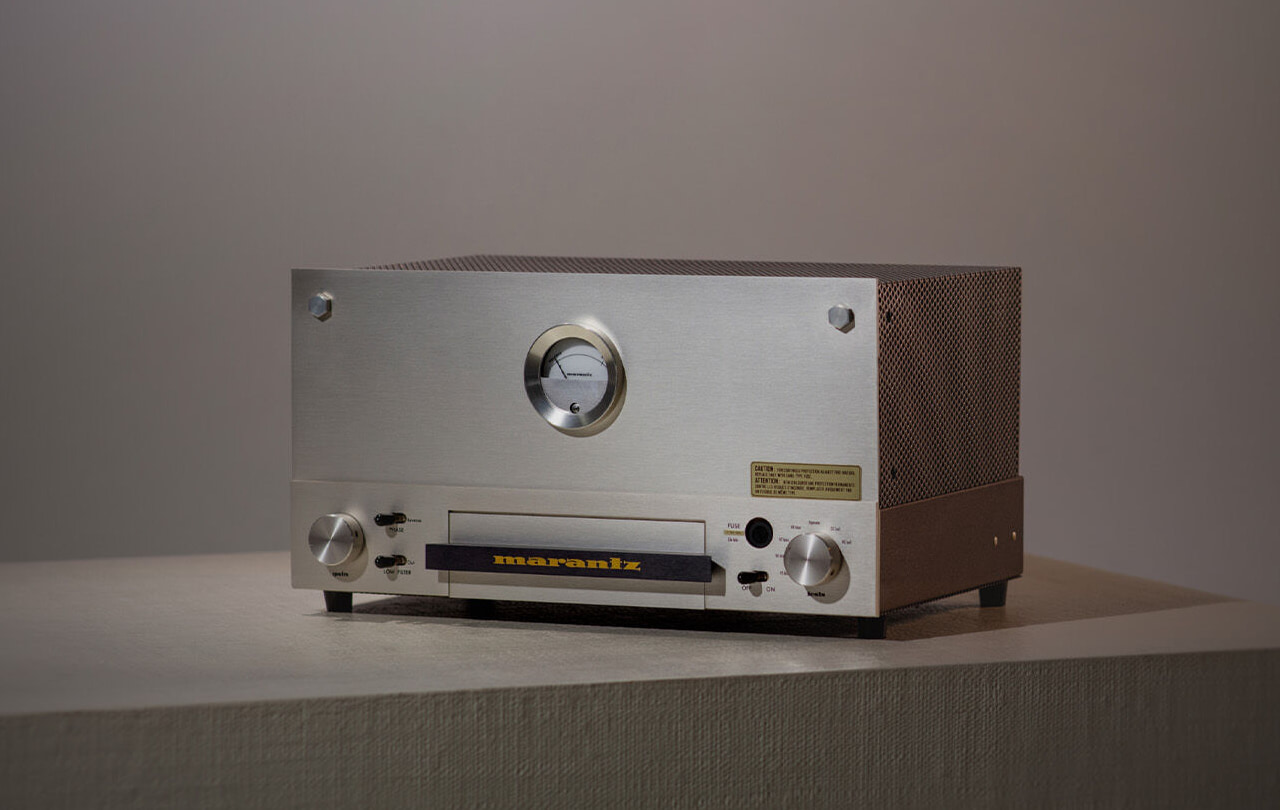
Marantz is redefining what reference level home theater looks and sounds like for today’s listener. The focus is no longer on excess hardware or visual dominance, but on delivering uncompromising performance, meticulous tuning, and premium build quality within a refined, contemporary industrial design that complements modern living spaces. It is theater-grade sound, executed with intention and restraint.
That philosophy comes into full view with the introduction of the AV30 and AMP30, completing Marantz’s new A/V separate series alongside the AV10 and AMP10 and the AV20 and AMP20. The result is a deliberately tiered lineup of preamp/processors and multi-channel amplifiers offering mix-and-match configurations, including support for immersive layouts up to 9.4.6 Dolby Atmos.
Whether building a reference system from the ground up or integrating selectively with the Cinema Series AVRs to add power where it matters most, Marantz has designed an ecosystem that scales performance with consistent visual elegance.
Execution matters at this level, and Marantz’s latest A/V separates reflect that standard. All components are engineered and manufactured at the Marantz Shirakawa Audio Works facility in Japan, and each product is certified by a Marantz Sound Master, currently Yoshinori Ogata, to ensure tuning accuracy, consistency, and performance integrity.
The result is a modern reference platform that prioritizes sound quality, visual refinement, and long term relevance, delivering premium home theater without the traditional equipment rack mentality and signaling clearly where Marantz believes high-end A/V performance belongs today.
From Foundational Engineering to Modern Reference Home Theater
The current Marantz A/V separates continue the ethos, engineering discipline, and design principles established by founder Saul Marantz beginning in 1953. Most notably, the Marantz Model 9 from 1960 introduced the porthole and architectural symmetry that remain defining elements of the 2026 lineup. From the outset, Marantz established a clear technical philosophy centered on precise power control, stability under load, and system designs that balance performance with usability.
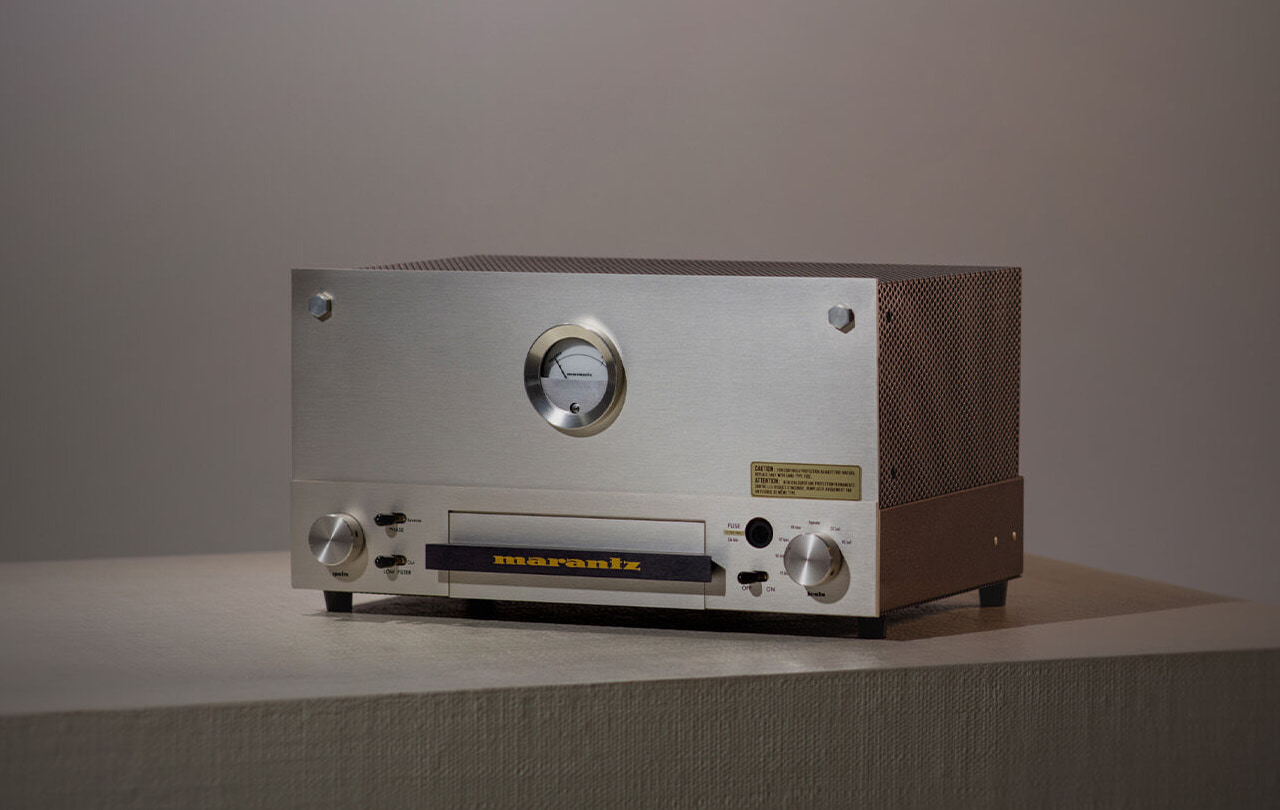
Inspired by the proportion and resonance of musical instruments, Marantz components use symmetry not as a stylistic gesture but as a visual expression of control and order, reinforcing the central role of sound rather than competing with it. The iconic porthole carries that same philosophy forward. Originally a functional window for an analog VU meter, it has evolved into a modern aperture into the heart of the component, maintaining a sense of connection between listener and system whether the technology inside is analog or digital.
The warmth long associated with Marantz sound is equally present in its physical form. Materials, finishes, and color choices are selected to feel inviting rather than clinical, while controls are designed to respond with precision and confidence in hand. Anchoring it all is the Marantz mark, placed deliberately at the pinnacle of each product as a quiet statement of lineage and intent.
As formats evolved and system complexity increased, Marantz expanded its engineering and tuning operations, reinforcing a culture of precision and consistency. Rather than treating home theater as a departure from high-fidelity design, Marantz applied its amplification expertise directly to multichannel systems, focusing on clarity, spatial coherence, and controlled dynamics across increasingly demanding channel counts.
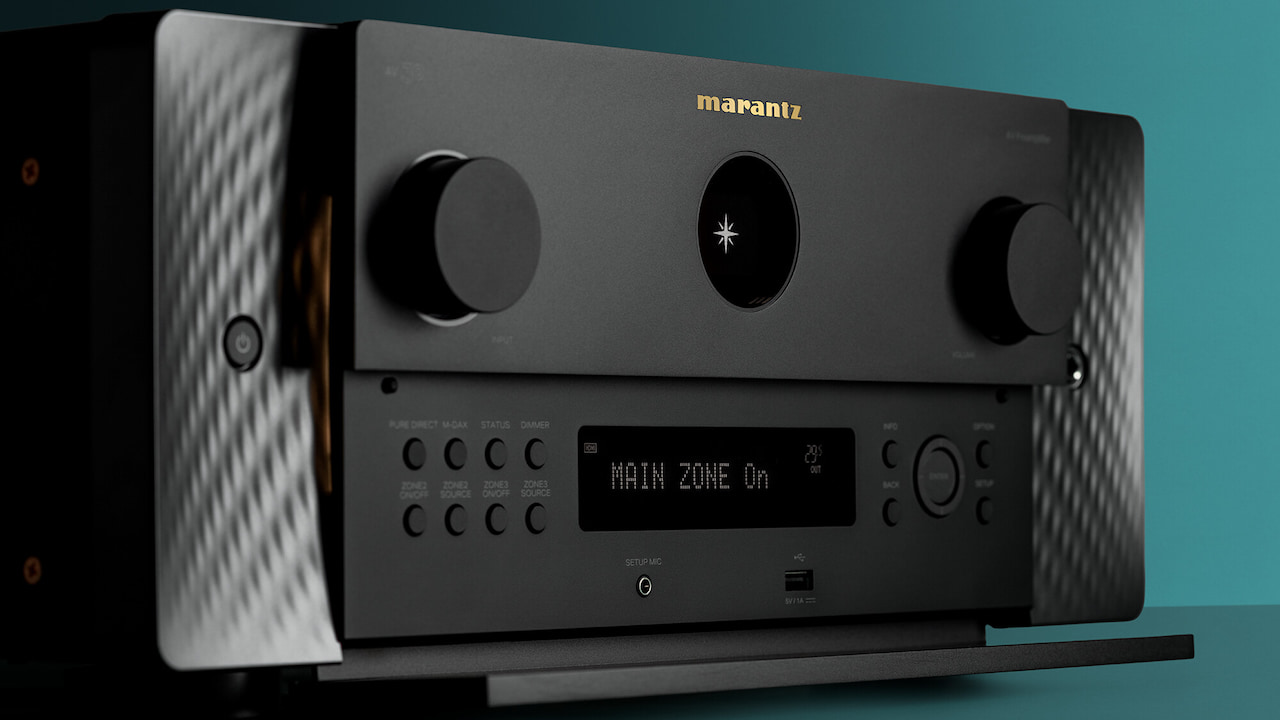
A key technical milestone followed with the development of Hyper Dynamic Amplifier Module technology. Created as a discrete alternative to conventional integrated circuits, HDAM established Marantz’s approach to faster signal response, wider bandwidth, and more precise dynamic control—an architecture that continues to define the brand’s amplification.
That lineage is carried forward in Marantz’s latest A/V separates, which translates decades of amplification and tuning expertise into reference-level home theater as it is experienced today.
A Tiered Reference System Designed for Modern Home Theater
Marantz’s current A/V separates are designed as a deliberately tiered system rather than a single statement product. The lineup comprises three preamp processors, the AV10, AV20, and AV30, and three multichannel power amplifiers, the AMP10, AMP20, and AMP30, allowing system builders to scale performance while maintaining a consistent design and tuning philosophy.

The newest additions, the AV30 and AMP30, serve as the most accessible entry point in the lineup, complemented by the AV20 and AMP20 and the flagship AV10 and AMP10. Together, they form three clearly defined performance tiers that allow systems to scale without sacrificing a unified design language or tuning philosophy.
Signal integrity, tonal balance, and amplification control are consistent across the Marantz separates range. The differences come down to channel capacity. The AV30 supports up to 7.4.4 Dolby Atmos processing, the AV20 adds 2 additional height or surround channels, and the flagship AV10 expands that by another 2 channels. The amplifier lineup follows the same logic: the AMP30 provides 6 channels, the AMP20 offers 12, and the AMP10 tops the range with 16. All amplifier channels are rated at 200 watts into 8 ohms and support bi-amping or bridging, which doubles output to 400 watts per channel.
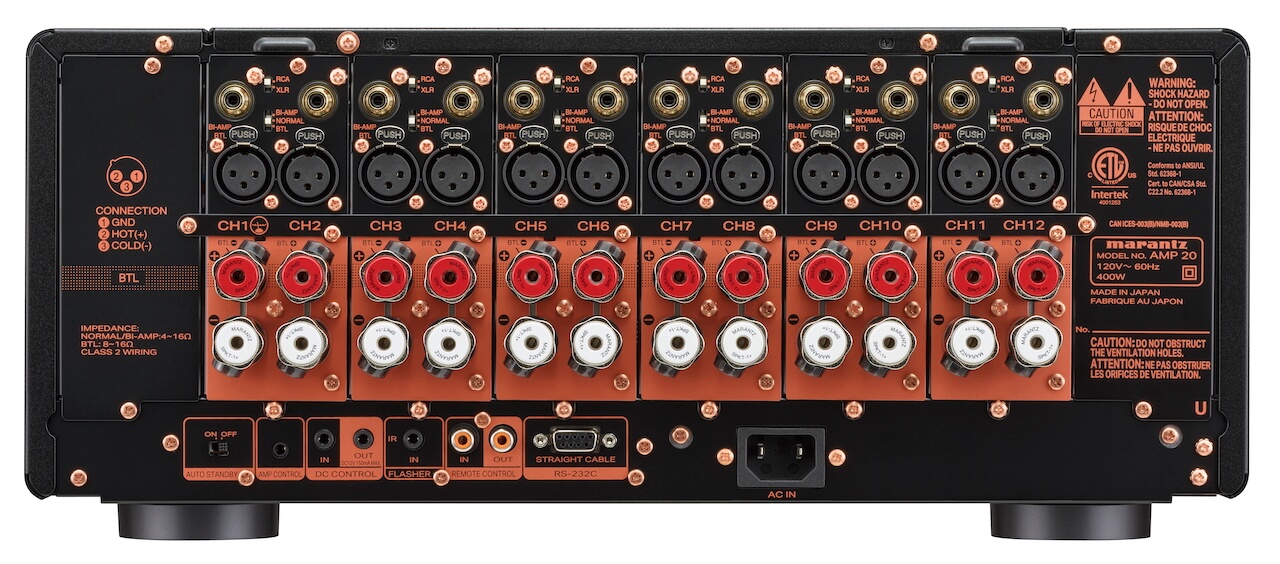
With support for immersive configurations from 11 to 15 channels, Marantz A V separates are well suited to high-performance living spaces and dedicated theaters where integration, efficiency, and visual restraint matter as much as output. Their focus is consistency, maintaining clarity, stability, and coherence as channel counts and speaker demands increase. All three AMP models also provide a flexible upgrade path for Marantz Cinema Series AVR owners who need additional power or channel expansion.
The result is a separates platform defined by flexibility rather than hierarchy. Whether beginning with the AV30 and AMP30 or building toward a flagship configuration, each tier reflects the same approach to amplification, tuning, and industrial design.
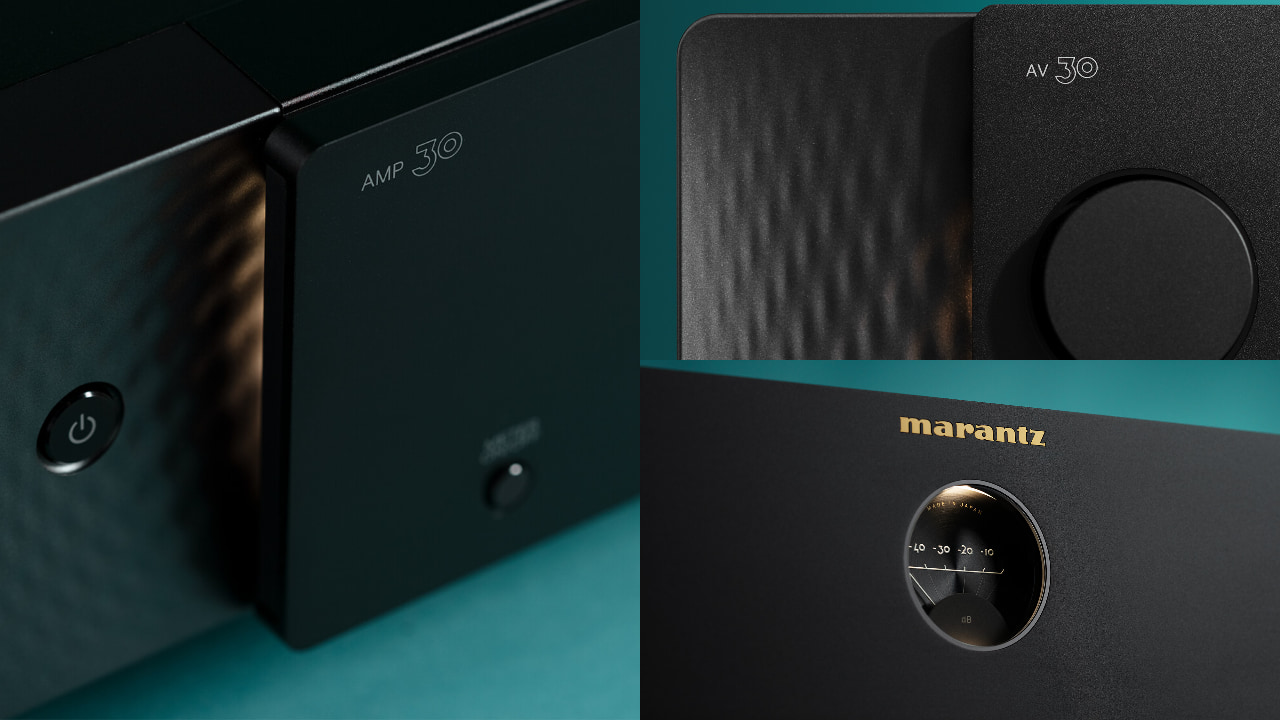
AV30 and AMP30: A Modern Entry Point to Marantz Reference Home Theater
Marantz reinforces its tiered separates strategy with the AV30 and AMP30 by addressing a buyer who wants a high-performance home theater that is equally capable with film, music, and modern displays. Positioned as the most accessible entry point in the Marantz separates lineup, the pairing is designed to deliver the core elements that matter at this level: format flexibility, system integration, and the ability to adapt as the system and room evolve.
The AV30 serves as the system’s control center, supporting the surround formats that define today’s premium home theater, including Dolby Atmos, DTS X, Auro 3D, and IMAX Enhanced. Four independent subwoofer outputs allow precise low-frequency integration and compatibility with advanced room optimization such as Dirac Live ART. On the video side, support for HDR10, HDR10+, Dolby Vision, HLG, and Dynamic HDR pass-through ensures full compatibility with modern displays and high-quality sources.
Beyond home theater, the AV30 is designed to integrate easily into everyday listening. It supports a wide range of streaming services, including Amazon Music, TIDAL, Deezer, Napster, and SoundCloud, Qobuz Connect, and is Roon Ready for library-based playback. HEOS enables multiroom integration, while Bluetooth, Apple AirPlay 2, and Wi-Fi provide straightforward access across devices and use cases.
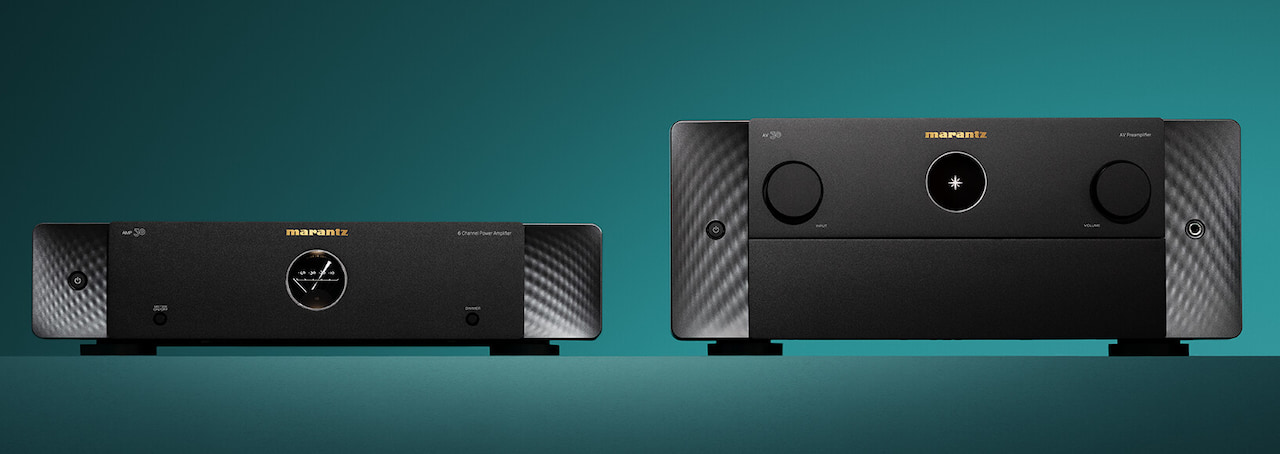
Paired with the AV30, the AMP 30 delivers controlled, scalable amplification for modern multichannel systems. Its six-channel Class D design provides up to 200 watts per channel, reinforced by Marantz’s HDAM-SA2 circuitry for stability and tonal consistency. Systems can grow by adding additional AMP30 units or pairing with higher-channel-count amplifiers such as the AMP20, while support for bi-amp and bridge-tied load configurations and both XLR and RCA inputs keeps integration straightforward.
Taken together, the AV30 and AMP30 form a cohesive foundation for buyers considering an $8,000 separates investment. As a system, they deliver modern surround processing, refined low-frequency control, scalable amplification, and seamless integration with both home theater and whole-home audio environments.
More importantly, they reflect Marantz’s long-standing priorities; clarity, control, and thoughtful system design applied to the realities of contemporary home theater, where performance must coexist with flexibility and long-term relevance.
Tip: In the coming weeks our Editor-at-Large, Chris Boylan will be releasing his hands-on review of the AV30, AMP30 and AMP20.
Price & Availability
Home Theater Preamplifier/Processors:
Multi-channel Power Amplifiers:
For more information, visit marantz.com
Related Reading:

Can a psychedelic-induced mystical experience really improve your mental health?

TSLL Vs. TSLS: Trading TSLA Through The Pricing Cycle

Banking trade groups responsible for impasse on market structure bill, Brian Armstrong says


-

 Sports7 days ago
Big Tech enters cricket ecosystem as ICC partners Google ahead of T20 WC | T20 World Cup 2026
-

 Video2 days ago
Bitcoin: We’re Entering The Most Dangerous Phase
-

 Tech4 days ago
Luxman Enters Its Second Century with the D-100 SACD Player and L-100 Integrated Amplifier
-

 Sports2 days ago
GB's semi-final hopes hang by thread after loss to Switzerland
-

 Video5 days ago
The Final Warning: XRP Is Entering The Chaos Zone
-

 Crypto World2 days ago
Can XRP Price Successfully Register a 33% Breakout Past $2?
-
 Tech2 days ago
The Music Industry Enters Its Less-Is-More Era
-

 Business23 hours ago
Infosys Limited (INFY) Discusses Tech Transitions and the Unique Aspects of the AI Era Transcript
-

 Video2 days ago
Financial Statement Analysis | Complete Chapter Revision in 10 Minutes | Class 12 Board exam 2026
-

 Entertainment9 hours ago
Kunal Nayyar’s Secret Acts Of Kindness Sparks Online Discussion
-
 Crypto World7 days ago
Pippin (PIPPIN) Enters Crypto’s Top 100 Club After Soaring 30% in a Day: More Room for Growth?
-

 Crypto World5 days ago
Bhutan’s Bitcoin sales enter third straight week with $6.7M BTC offload
-

 Tech14 hours ago
Retro Rover: LT6502 Laptop Packs 8-Bit Power On The Go
-

 Video7 days ago
Prepare: We Are Entering Phase 3 Of The Investing Cycle
-
 NewsBeat3 days ago
The strange Cambridgeshire cemetery that forbade church rectors from entering
-

 Business6 days ago
Barbeques Galore Enters Voluntary Administration
-

 Business15 hours ago
Tesla avoids California suspension after ending ‘autopilot’ marketing
-

 Crypto World4 hours ago
WLFI Crypto Surges Toward $0.12 as Whale Buys $2.75M Before Trump-Linked Forum
-

 Crypto World6 days ago
Ethereum Price Struggles Below $2,000 Despite Entering Buy Zone
-

 Crypto World5 days ago
Kalshi enters $9B sports insurance market with new brokerage deal