
Crypto World
BIS Tests XRP Ledger to Anchor Official Statistics On-Chain in Proof-of-Concept Paper


A Bank for International Settlements (BIS) working paper tests the XRP Ledger (XRPL) as a proof-of-concept for verifying official statistics on-chain, recording cryptographic fingerprints of public datasets that publish in three to five seconds and verify in one to two.
The Working Paper No 1374 essentially asks how statistical agencies can give users an independent way to check the origin and integrity of published data without changing their existing dissemination systems.
International organizations (the BIS among them) rely on the SDMX standard to exchange official statistics, and the prototype binds each SDMX dataset to its source by hashing it and writing a single summary value to the ledger.
Though only the fingerprints reach the chain, never the underlying numbers, so confidential data stays off-ledger, and the method extends to formats such as XBRL. The BIS has tested public blockchains before, including Project Mariana, which trialed wholesale central bank digital currency settlement on a public chain with the central banks of France, Singapore, and Switzerland.
The system normalizes each file with Canonical XML 1.1, hashes it with SHA3-512 at the whole-file and per-series level, and collapses those hashes into one Merkle root written to the Memos field of an XRPL Payment transaction. Each file also carries a W3C Verifiable Credential in its header, signed by the publisher’s identity keys.
Cost and Simplicity
The memo approach needs no smart contracts, so the authors avoided gas costs and contract risk, and XRPL’s base fee of 10 drops, or 0.00001 XRP, put anchoring close to free. Batching compounds that.
A single ledger entry can cover thousands of datasets, dropping the on-chain cost to a fraction of a cent each. The paper also cites the ledger’s fast consensus finality and the published technical analysis of its consensus protocol.
XRPL has taken on other institutional workloads this year. CryptoPotato reported on a pilot that linked the ledger to interbank rails with JPMorgan, Mastercard and Ondo, which settled tokenized Treasury bills in under five seconds, and Ripple has published an institutional roadmap adding compliance credentials and permissioned trading. The BIS tests ran on XRPL’s DevNet, a test network.
It notes that DevNet shares the mainnet’s transaction format and close cadence, so the latency figures carry over, and mainnet fees stay in the sub-cent range.
A Few Firm Limits
The paper also describes the build as an experimental proof-of-concept, stating a production service would need hardware-backed signing, pinned validator nodes and formal load testing.
Though keep in mind the ledger certifies only what was published, by whom and when, so the paper reaches no adoption decision and gives no endorsement of XRP, and the authors attribute the views to themselves, not to the BIS or its member central banks.
The post BIS Tests XRP Ledger to Anchor Official Statistics On-Chain in Proof-of-Concept Paper appeared first on CryptoPotato.


Mellody Hobson opens the Lucas Museum of Narrative Art in Los Angeles on September 22 with her husband. The privately funded project cost roughly $1 billion.
Hobson co-chairs the museum’s board. She co-runs Ariel Investments and holds a seat on the JPMorgan Chase board, where she also serves on the risk committee.
The Wall Street Half of the Museum Sits on JPMorgan’s Board
Hobson joined the JPMorgan board in 2018. She has served as co-CEO of Ariel Investments since 2019, after serving as president from 2000. Meanwhile, the bank she helps oversee has turned into one of the loudest institutional voices in digital assets.
JPMorgan’s blockchain unit, Kinexys, has processed more than $3 trillion since its inception. It now averages over $5 billion in daily volume. This year, the bank opened its JPM Coin deposit token, JPMD, to institutional clients on Base, the Ethereum layer-2 network built by Coinbase.
South Korea’s KB Kookmin Bank said in July it would start routing dollar trade payments over JPMorgan’s Kinexys network in August. As a result, the risk committee Hobson sits on covers a lender that already settles billions onchain. Strategy meanwhile ranked JPMorgan behind Fidelity in its Bitcoin banking index.
The Lucas Museum Hides a Banksy Gallery Upstairs
Lucas built the collection around storytelling rather than abstraction. Visitors will find Frida Kahlo and Norman Rockwell works beside Luke’s landspeeder and General Grievous’s wheel bike. The building holds more than 1,300 pieces and 30,000 comic books.
Curators added two walls of Banksy works to the fifth-floor murals gallery at the last minute. One carries the silhouette of a girl releasing a heart-shaped balloon. The same gallery also holds works by Diego Rivera, Judith Baca and JR.
Lucas chased sites in San Francisco and Chicago for more than a decade before Los Angeles agreed. Hobson now straddles both worlds. One holds Star Wars props, the other decides how fast big banks move tokenized money.
The post Banksy, Star Wars and JPMorgan Meet in a $1 Billion Museum appeared first on BeInCrypto.

Standard Chartered extended its deliverable Bitcoin (BTC) and Ether (ETH) spot trading to institutional clients in the United Arab Emirates on September 3, becoming the first Global Systemically Important Bank (G-SIB) to offer the service in the country.
The offering runs through Standard Chartered DIFC, the bank’s arm in the Dubai International Financial Center (DIFC), which said it is the only global bank currently providing institutional digital asset spot trading in the region.
Built on the UK Launch
The launch adds trade execution to a custody service the bank already runs in the UAE. The trades are deliverable, so clients take possession of the underlying Bitcoin and Ether at settlement, and they can settle through a custodian of their choice, including Standard Chartered’s own digital asset custody solution that went live in September 2024.
Trades run through the bank’s electronic channels and sit inside its existing platforms, letting clients access the two assets through the same FX interfaces they already use. Standard Chartered DIFC is regulated by the Dubai Financial Services Authority (DFSA).
“The UAE has developed a clear digital assets regulatory framework that supports institutional participation and innovation,” said Rola Abu Manneh, Chief Executive Officer for the UAE, Middle East and Pakistan at Standard Chartered. She said pairing execution with custody, governance, and the bank’s global connectivity gives clients a more integrated way to participate in digital asset markets.
Standard Chartered first introduced institutional Bitcoin and Ether spot trading through its UK branch in July 2025, the first G-SIB to offer deliverable spot crypto trading to institutional clients.
“DIFC provides an established platform for international financial institutions to deploy global capabilities across markets,” said Christopher Parsons, Senior Executive Officer at Standard Chartered DIFC. He said the arrangement combines the bank’s global markets network with a regulated base for serving clients across the region.
A Wider UAE Digital Asset Push
The trading service sits inside a broader digital asset strategy that spans custody, trading and tokenization through Standard Chartered’s Corporate and Investment Bank, with its ventures ecosystem reaching into Zodia Markets and Libeara.
The bank already lets institutional clients mint and redeem USDC directly through its DIFC platform, a service it built with Circle. SC Ventures, its innovation arm, has backed a $100 million digital asset joint venture in the UAE with Japan’s SBI Holdings that targets market infrastructure, compliance tools, DeFi and tokenization.
The post Standard Chartered Extends Institutional Bitcoin and Ether Spot Trading to the UAE appeared first on CryptoPotato.
Crypto World
Dogecoin (DOGE) Suddenly Pumps by Double Digits as Analysts Declare the Start of Altseason
The largest meme coin by market cap has soared on Saturday evening to $0.094, hitting a two-week high. The move is rather unexpected given the typically calm nature of the weekends.
However, there were certain signs about a potential rally, even though DOGE has slipped from its local high to $0.09 as of press time.

CryptoPotato outlined yesterday the three major signals that flashed for DOGE, including the TD Sequential. Analysts quickly determined that the OG meme coin is primed for another leg up.
However, that didn’t transpire at first, as the asset was rejected at $0.088 and slipped back down to $0.084 as the entire market bled following the strong US jobs report, which was considered bearish for risk-on assets.
Nevertheless, DOGE exploded on Saturday evening, gaining 12% from its low yesterday to the two-week high at $0.094. Popular analyst CW noted that the meme coin has reached the first major sell wall on its path forward, which is too solid to be broken now. If it falls, though, the next such wall sits all the way up at $0.14.
Fellow analyst Alex Marzell believes DOGE did “exactly what it needed to,” as it rebounded from the Friday lows to reclaim a key resistance.
$DOGE did exactly what it needed to.
Friday’s jobs print dumped it back to the $0.083 base, six flat 4H candles held it, and today one 4H candle ripped $0.0876 to $0.0952 straight back through $0.088.
Old resistance is the new line. Hold $0.088 and I think $0.095 goes next and… pic.twitter.com/y7hW91yCek
— Alex Marzell (@MarzellCrypto) September 5, 2026
Max Crypto also weighed in on DOGE’s impressive move and even suggested that its breakouts have been the “best indicator” for the start of an Altseason.
The post Dogecoin (DOGE) Suddenly Pumps by Double Digits as Analysts Declare the Start of Altseason appeared first on CryptoPotato.

Ripple is trading around $1.44, following a volatile week that saw the token rebound sharply from the $1.31 area and briefly approach $1.48. XRP has gained roughly 6% to 7% over the past week, although profit-taking has kept the token below its recent highs. With the market heading into the weekend, traders are increasingly focused on a potential regulatory catalyst later this month.
Ripple CEO Brad Garlinghouse has given traders another reason to keep the CLARITY Act on their radar. Responding to CFTC Chairman Michael Selig’s comments about the administration’s crypto push, Garlinghouse said that “making America the crypto capital of the world is within reach, let’s finish the job.”
— AltcoinPro (@AltcoinPro_) September 4, 2026
 NEW :
NEW :
Ripple CEO Brad Garlinghouse says "making America the crypto capital of the world is within reach — let's finish the job"
Comes less than two weeks before the Senate's September 15 cloture vote on the Clarity Act
Response to CFTC Chair Michael Selig thanking Trump for… pic.twitter.com/tqGncD2U1h
The Senate is scheduled to hold a cloture vote on the motion to proceed to the CLARITY Act on September 15 at 2:15 PM ET. This is not a final passage vote. Instead, the motion requires 60 votes to open the door to formal Senate consideration, meaning the result could determine whether the bill moves forward for debate and further negotiations.
For XRP, the regulatory optimism is arriving alongside a market still sensitive to macroeconomic conditions. The CLARITY Act continues to face disagreements over stablecoin rewards, DeFi rules, ethics provisions, and consumer protections. That leaves XRP caught between a potentially bullish regulatory catalyst and broader market volatility.
Discover: The Best Token Presales
Can Ripple XRP Price Hit $2.50 Next Week?
XRP’s recent rebound has brought the token back toward the $1.40 to $1.48 range after a sharp selloff pushed prices toward the $1.30s. The recovery has been accompanied by stronger trading activity, suggesting traders are repositioning around the regulatory catalyst rather than simply chasing momentum.
Heading into the weekend, XRP remains close to the middle of this range, leaving the $1.35 and $1.50 areas as key levels to watch. The $1.35 area has emerged as an important support zone for the bullish case. A sustained break below it could expose XRP to another test of the low $1.30s, especially if expectations surrounding the CLARITY Act deteriorate.
On the other hand, reclaiming $1.48 to $1.50 would strengthen the short-term setup and potentially open the door toward $1.60. Prediction markets currently show meaningful interest in that level, with Coinbase markets pricing a roughly 67% probability of XRP reaching $1.60 during September.

Longer-term expectations remain considerably more divided. Our current prediction puts a 41% probability of XRP exceeding $2 in 2026 and about 29% for a move above $2.50. That makes the $2.50 target a possible bullish scenario rather than a base case. The market is also pricing substantial uncertainty, with XRP’s year-end outcomes spread across the $1.25 to $2.50 range.
The bigger catalyst remains the Senate’s September 15 cloture vote on the CLARITY Act. The vote is scheduled for 2:15 PM ET and requires 60 votes to advance the legislation toward formal Senate debate. It is not a final passage vote, but failure could effectively derail the bill’s progress this year.
For the weekend setup, XRP holding roughly $1.40 to $1.45 would keep the rebound intact, while $1.50 is the first major upside test, and $1.35 remains the key downside level.
Earn $50 and Enter $300K Prize Draw on EdgeX
Bitcoin Hyper Targets Early Mover Upside as XRP Tests Key Levels
Ripple holders riding this bounce have a fair case for optimism, but let’s be honest about the math: even the bullish $4.40 target represents roughly 3x from current levels on a token with a market cap already in the tens of billions. That kind of upside takes real catalysts and time.
For traders hunting asymmetric setups, early-stage infrastructure plays at a fraction of that valuation are where the multiples get interesting, and Bitcoin Hyper is positioning itself as exactly that kind of bet.
Bitcoin Hyper ($HYPER) bills itself as the first Bitcoin Layer 2 with full SVM integration. It boasts a smart contract execution faster than Solana itself, built on Bitcoin’s base-layer security.
The presale has raised $33 million at a current token price of $0.0136857, with staking rewards already live for early buyers. Its Decentralized Canonical Bridge aims to solve Bitcoin’s long-standing programmability gap without compromising trust assumptions.
Research Bitcoin Hyper before the presale window closes.
Discover: The Best Crypto to Diversify Your Portfolio
The post Ripple CEO, Brad Garlinghouse, Calls CLARITY Act Within Reach as XRP Runs appeared first on Cryptonews.
Crypto World
Why crypto experts say buying and holding bitcoin easily beats trying to time the market
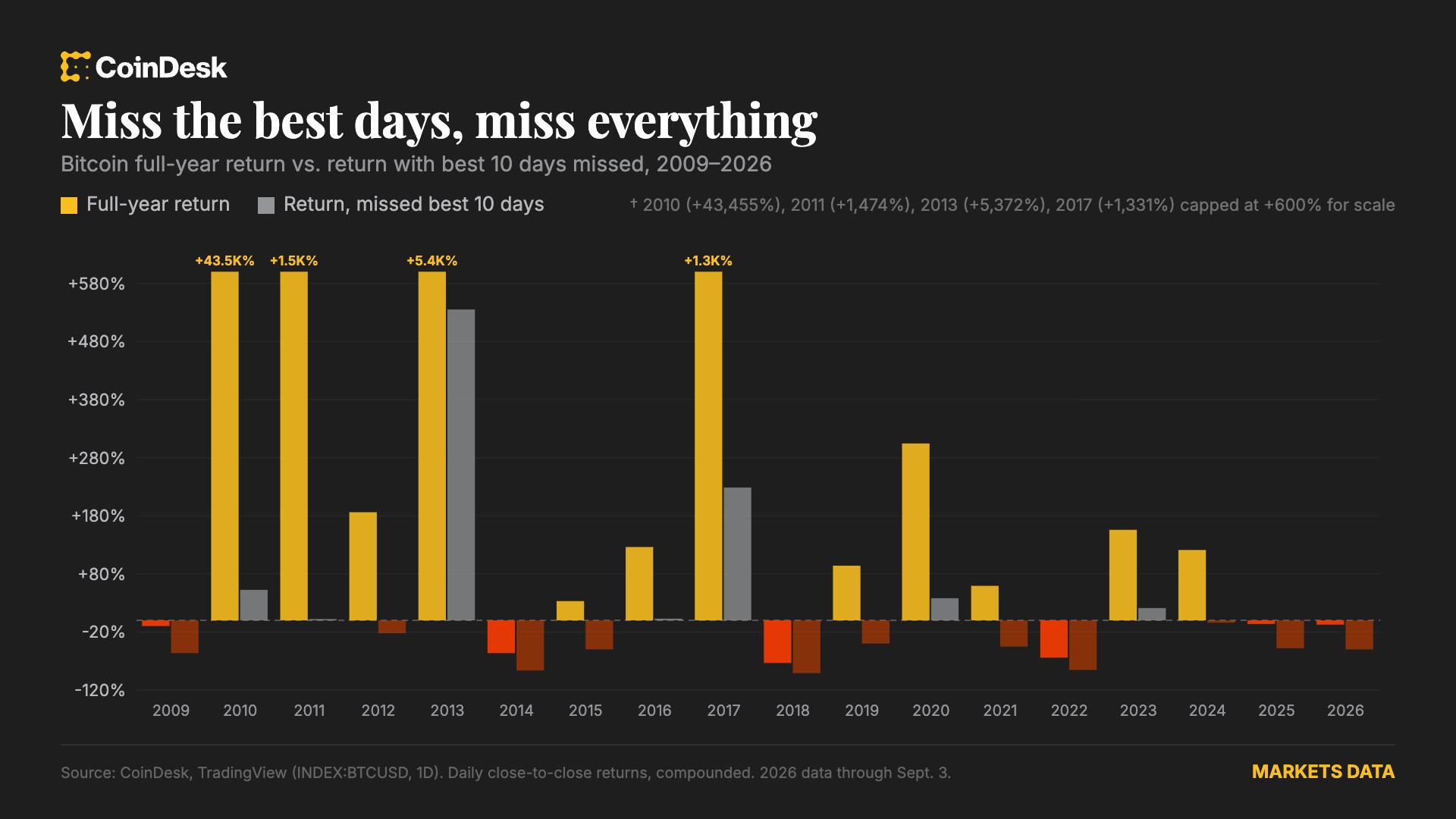
A historical analysis of bitcoin price performance from 2010 through 2026 demonstrates that the vast majority of the asset’s annual returns occur during a tiny fraction of the calendar year.
Polygon CEO Marc Boiron says staff time off pains him. His post on X split the crypto industry within hours.
The Polygon Labs boss admitted he prefers speed over rest. Critics called that a fiat mindset, so Boiron answered with a lesson about Bitcoin culture.
Polygon CEO Triggers a Fast Community Backlash
Boiron wrote that he feels torn whenever staff step away from work. He genuinely wants people to relax with their families. However, he cannot stomach the thought of a rival moving faster.
He wrote that time off “pains me so much” and conceded that he struggles to admit the preference. In the end, he prefers the pace over the pause.
The timing sharpened the reaction. Polygon Labs cut nearly 30% of its workforce in January. Then the company trimmed staff again in July while it pivoted toward stablecoin payments.
Both cuts followed a wider industry pivot toward revenue. Many readers therefore judged the post through that lens.
A Bitcoin supporter on X dismissed the stance as a fiat mindset. He also labeled Boiron a shitcoiner and told him to weigh what actually holds value.
Why He Answered With a Bitcoin Lesson
Boiron pushed back with a credential check. He said he worked as an investor, adviser and early lawyer for companies that Bitcoin maximalists admire. He also argued that he knows those founders better than his critics do.
“Before being a ‘shitcoiner’, I’ve been an investor, advisor and early lawyer for some of the most bitcoin maxi companies that bitcoiners love… They understand that bitcoin gets more valuable with time so getting more of it is actually more difficult with time,” Marc Boiron, CEO of Polygon Labs, on X
His argument rests on scarcity. Bitcoiners guard every coin, because each one gets harder to obtain over time. Therefore, he says, they maximize the hours they spend working on Bitcoin.
That reading of the culture remains contested. Maximalists split openly this year over Saylor’s first BTC sale, which exposed real disagreement on strategy.

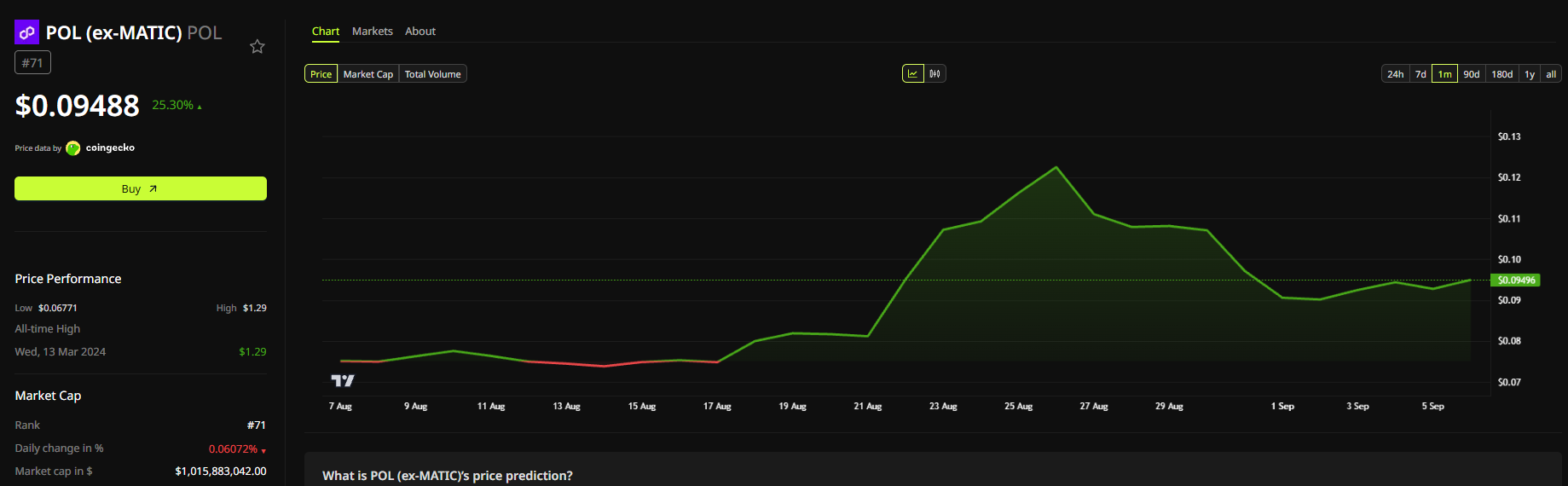
Polygon itself has momentum to protect. POL, the native token of the network, trades near $0.095 and ranks 71st by market value. Its market cap sits just above $1 billion.
The token has added roughly 25% over the past month. However, the rally stalled after a peak near $0.125 in late August, and POL has drifted sideways since then.
Boiron shows no sign of softening either message. The harder question now sits inside Polygon Labs, not on X. Staff there decide whether the exchange reads as candor or as pressure.
The post Polygon CEO Triggers Crypto Community With Vacation Take and Schools Critics appeared first on BeInCrypto.
In its 250th year, America finds itself confronting an age-old question with new urgency: what, exactly, counts as progress? 1776 was a hinge year for the modern world. Adam Smith published The Wealth of Nations, America adopted the Declaration of Independence, and Matthew Boulton and James Watt commercialized the steam engine—three developments that unleashed an age of capitalism, bringing unprecedented growth and unprecedented inequality.
And while growth and inequality are often treated as separate stories, fetishized respectively by the right and the left, corporate America and labor unions, and Wall Street and Main Street, this November’s midterm elections will put them on a collision course. But they have always gone hand in hand, their fates inextricably intertwined.
America’s triumphs are real. The United States is still the world’s largest economy. It remains a global engine of innovation. Its stock market is booming thanks to artificial intelligence, while its capital markets remain the deepest and most powerful in the world. And despite tariffs, a labor market slowed by restrictive immigration and repeated energy price shocks, its growth—as attested to by its $32.3 trillion GDP, larger than China, India, and Germany combined—appears to defy the odds and remains resilient.
Yet this dynamism is only half the story. Affordability has become the defining issue of the moment, and many signs indicate that the midterms in November will be decided on that basis. The Pew Research Center has found that the voters place the economy front and center by a wide margin, even as only 24% of Americans describe it as “good” or “excellent.” Gallup, meanwhile, reports that voters identify the cost of living as their foremost concern in the election.
GDP, the single statistic that now determines a country’s economic might, traces its roots to the scholarship of the American economist Simon Kuznets during the Great Depression, particularly his landmark 1934 report, National Income, 1929-1932. But as the Cambridge economist Diane Coyle points out, Kuznets was, himself, aware of the many flaws and pitfalls of the metric he had developed and warned against confusing economic output with human welfare.
What even fewer people know is that the “godfather” of GDP was also a pioneer in the study of inequality. The Kuznets curve—his famous prediction that inequality would eventually decline as economies grew richer—is not one history has obliged, but it points to the Janus-headed quality of modern capitalism.
Indeed, it’s been exactly 15 years since the Occupy Wall Street protests radiated out of Zuccotti Park in New York’s Financial District. Born in the aftermath of the Great Recession of 2008, the movement became the most visible public outcry against economic inequality in recent American history and gave the country an enduring rallying cry: “We are the 99%.”
While the movement dissipated, the issues it raised have not. If anything, the concerns it foregrounded have migrated from the political margins to the mainstream in American politics, championed by progressive figures like Bernie Sanders, Alexandria Ocasio-Cortez, and Zohran Mamdani.
The World Inequality Report 2026 finds that the top 0.001% of the globe’s population own “three times more wealth” than the entire bottom half of humanity combined, and within “almost every region, the top 1% alone” hold more wealth than the bottom 90% combined. Inequality in America is no longer only a question of who has more; increasingly, it is a question of who has enough to make ends meet. According to the Brookings Institution, 45.5% of American households do not earn enough to cover even basic necessities, with housing, health care, and childcare among the most acute pressures.
The problem is that a single statistic can conceal as much as it reveals. GDP can tell us how the economy is performing without telling us how Americans are faring. It can tell us how much an economy produces, but not who receives the rewards, whether those gains improve people’s lives, or what is destroyed and what is sacrificed in producing them.
Some of the things on which society most depends—unpaid caregiving, clean air, cohesive communities—barely register in its accounts. Economists classify many of these costs as “externalities”: consequences borne by people and places that fall outside the transaction being measured.
Climate change provides perhaps the starkest example of GDP’s glaring blind spots. A natural disaster can destroy homes, lives, and ecosystems without being registered as an equivalent loss in GDP; the money spent to rebuild afterward, meanwhile, counts as additional economic activity. The meter can rise even as human welfare falls.
But the two metrics—GDP, our shorthand for growth, and the Gini coefficient, our shorthand for inequality—are not rival ways of describing the economy so much as incomplete halves of the same story; the two key consequences of capitalism, joined at the hip. One shows us how large the pie has grown; the other, something about how it has been sliced.
On growth and inequality
When it comes to growing the pie, the relentless efficiency of global capitalism in allocating resources is hard to match. It has allowed, in the aggregate, societies to eke out more from finite resources than ever before. Its advocates point out that most people live longer and better lives: they are better fed, more securely housed, and better protected against diseases that once routinely killed them.
Capitalism’s champions can reasonably claim that it has helped lift much of humanity above bare subsistence while proving more compatible with individual freedom than its major rivals. It holds out the promise of a game that everyone has an equal chance to play—and win. Its defenders often invoke the specter of repression and unfreedom associated with state-led communism or socialism as a cautionary tale.
Capitalism’s unique two-plus-two-equals-five quality—its capacity to produce more than the sum of its parts—may also have helped pave the way for the material foundations of modernity. The shift from sustenance to surplus created, in many ways, the foundations for our moral revolutions, from liberalism and feminism to cosmopolitanism.
Yet, beyond some vague gestures toward “trickle-down economics,” the discipline’s approach has largely been to focus on growing the pie and argue about slicing it later. Economics has tried to separate the two: markets create wealth; politics distributes it. Friedrich von Hayek, the Nobel Prize-winning economist, who was an early and influential proponent of free-market economics, warned against the “fatal conceit” that governments could know enough to design an economic order from above.
The Kaldor–Hicks principle, a dominant idea in modern economics, offered a technical basis for avoiding the reckoning with distributive questions. An outcome counts as an improvement if the winners gain enough that they could compensate the losers—even if they never do. That “even if” is a significant caveat.
Kenneth Arrow’s Impossibility Theorem, another foundational result in economics, exposes the deeper difficulty: there is no perfect mathematical procedure for turning individual preferences into a coherent collective choice. At some point, as even mainstream economists recognize, economic calculation must give way to political judgment. It follows that morality should trump mathematics.
But what if inequality is baked into the pie itself? Thomas Piketty coined the famous formulation for the notion that the odds may be stacked against the ordinary person: r > g, the proposition that the return on capital tends to exceed the rate of economic growth. History suggests that the playing field was never level.
In Empire of Cotton and, now, Capitalism, Sven Beckert excavates the blood-soaked origins of modern capitalism through slavery, colonialism, and state power; Ha-Joon Chang shows how rich countries used tariffs and industrial policy before prescribing freer markets to poorer ones. Such empirical evidence reinforces a broader idea: markets do not simply materialize, as the spectral metaphor of the “invisible hand” suggests. Markets are made—by human hands.
If the economy is a game, then the question is not merely who wins and who loses. The question instead is: Who designed the board, who wrote the rules, and whether the game was rigged from the start? Today, capitalism treats Monopoly money as real while human beings are reduced to pieces on a chessboard.
Perhaps the most important omission from the current economic paradigm concerns the psychology of the sport. Research on “inequality aversion,” the idea that who gets what matters as much as how much there is, suggests that people care deeply about how the pie is sliced, even when a fairer division means settling for a slightly smaller one.
The economics of the everyman
Can growth, given enough time, deliver widely shared prosperity, as capitalism’s champions still insist? Or does the way the game is designed predetermine who benefits from growth? Far from disappearing, could excessive inequality gnaw away at the very foundations of economic growth?
GDP’s shortcomings have inspired repeated attempts to devise a better answer. In Mismeasuring Our Lives, Joseph Stiglitz, Amartya Sen, and Jean-Paul Fitoussi argued for moving beyond economic production and measuring well-being, distribution, and sustainability. Sen’s capabilities approach asks a still more fundamental question: not merely what resources people possess, but what those resources actually enable them to be and to do.
The late Pakistani economist Mahbub ul Haq’s Human Development Index, inspired in part by Sen’s work, was an attempt to translate that insight into numbers, treating health, education, and income as measures of human progress.
The point is not to dispense with GDP. Growth matters enormously. It has financed scientific discovery, lengthened lives, reduced material deprivation, and expanded the range of human possibility. But human progress may be better represented by a dashboard of indicators rather than by a single number. More fundamentally, what should be a means to an end has too often become an end in itself. A metric intended to crudely measure the output of the market economy has gradually acquired the authority to tell us whether society itself is succeeding.
America’s 250th anniversary offers an unusually apt moment to question that bargain. The Declaration of Independence did not promise Americans the pursuit of economic growth. It promised something considerably more ambitious: the pursuit of happiness. Two and a half centuries later, perhaps the most important economic question America can ask is also the simplest: Who is the economy for?
Fittingly, this fall, American voters will have an opportunity to offer their answer. If the elections of the past decade were won in part by rejecting an outdated economic playbook, 2026 may present a more constructive opportunity: not merely to discard the economic playbook, but to redesign and rewrite it with Everyman, the ordinary American, as its protagonist.
Adapted with permission from Everyman: The Untold Story of Economics by Antara Haldar.
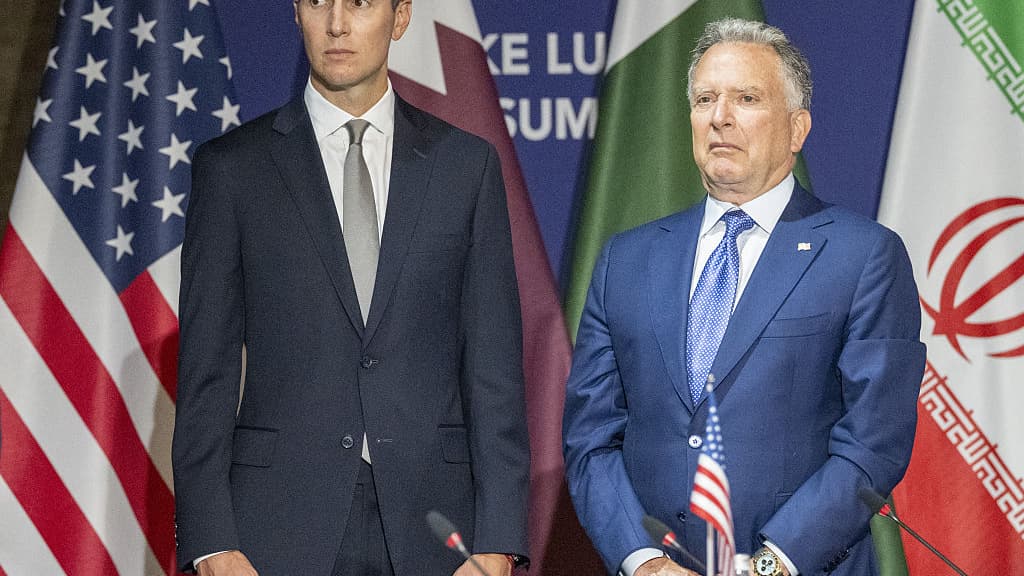
Trump attempts to revive stalled Ukraine-Russia peace talks
Trump has repeatedly stated that ending the Russia-Ukraine war is a major priority of his Administration, but the reality of that aim has proven difficult.
In August 2025, the U.S. President met his Russian counterpart in Anchorage, Alaska, to pursue a ceasefire agreement. The talks proved unsuccessful, and Trump left empty-handed.
In October 2025, Trump and Putin planned to meet in Budapest in hopes of furthering peace talks. But the summit was canceled just a few days after the summit was announced after Russia indicated that its hard-line stance on the war had not shifted.
“It just didn’t feel right to me,” Trump said at the time. “It didn’t feel like we were going to get to the place we have to get. So I canceled it.”
Strain between Trump and Zelensky also impeded progress. In February 2025, Oval Office talks collapsed within minutes when the U.S. President accused Zelensky of being “ungrateful” for U.S. aid and refusing to agree to a ceasefire without security assurances. In the 18 months since, however, that tension has largely dissipated, with Trump saying at this year’s NATO summit that the two had “actually developed a good relationship.”
CryptoQuant data shows that bitcoin investors started realizing major profits after the explosive August rally, disposing of roughly 110,000 BTC in just a few weeks.
Such highly concentrated profit-taking developments have historically been followed by substantial price correction for the underlying asset, the analysts warned. Moreover, several demand indicators have weakened, which could add to the selling pressure.
110K BTC Profit Taken
The major run that began on August 19 at prices of under $65,000 drove the leading cryptocurrency to almost $80,000 in just two days. According to CQ’s latest weekly report, holders realized net profits of 23,000 BTC on that day alone (August 21), which became the largest single-day profit realization this year.
The asset indeed dipped in the following days as it felt almost inevitable after such a gigantic jump, but went on the offensive once again in the following week or so. It rocketed past $82,000 on Friday before it was rejected following the US jobs report, and now sits below $80,000.
The report described the major profit-taking as a classic characteristic of a bullish cooldown, but warned that if they continue at such a rapid pace, the asset’s price could be primed for another correction. Historical occurrences have shown that BTC tends to dump hard after a major rally if investors are not convinced about its potential.
“It is a hallmark of a bullish cooldown: bullish because it happens into strength, cautionary because concentrated realization can cap near-term upside,” reads the report.

Cooling Demand
CryptoQuant outlined another reason why BTC could be primed for a more profound correction, even though it already slipped from $82,400 to $79,600. Its apparent spot demand briefly expanded by 43,000 units, marking its fastest growth pace of the year. However, that metric has lost its momentum and is now back in contraction.
US investors’ demand has weakened as well. The most used metric for this, the Coinbase Premium, measuring the price difference between the asset on the leading US exchange and other trading platforms, has returned to slightly negative territory at -0.05.
The analysts said similar periods of soft US spot demand have capped the cryptocurrency’s rallies three other times this year alone.
Nevertheless, the short-term picture does not necessarily mean that BTC’s run is over and that it will return to a bearish phase. The Bull Score currently stands at 70, which is above the 60 threshold historically associated with sustainable bull markets.
” This keeps the broader picture constructive: Bitcoin remains in the early phase of a new bull market even as short-term momentum cools. The “official” bull market begins once price closes above its 365-day moving average,” they added, outlining that this key MA is located at around $83,000 – the level that stopped BTC in May.
The post Bitcoin Holders Just Cashed Out 110,000 BTC in Profits: Is a Bigger Price Drop Coming? appeared first on CryptoPotato.


Buying pressure in Binance-paired currencies correlates with local currency depreciation as market makers balance positions.

Natalie Portman Gives Birth to 1st Baby With Tanguy Destable
Is the latest rebound in the Japanese yen real?

Coco Gauff extends winning streak to reach US Open Fourth Round





-
 Crypto World1 day ago
Bitcoin price stalls near $82K as key resistance holds
-

 Politics1 day ago
Best Gaming Laptops, CPUs, TVs, And Keyboards To Upgrade Your Set Up For GTA VI
-

 Tech1 day ago
The Birds Outside, Drawn For You Automatically
-

 Crypto World2 days ago
IMF Says El Salvador’s Post-Review Bitcoin Purchases Used No Public Funds
-

 Fashion1 day ago
Weekend Open Thread: Beyond Yoga
-
 Crypto World1 day ago
U.S. added stronger than expected 162,000 jobs in August as labor market bounced back
-

 Sports2 days ago
Alexandre Pato consortium’s Northampton Town investment approved
-

 Sports1 day ago
Golden Eaglets Drawn in Group B for 2026 WAFU B U17 Championship
-

 Sports2 days ago
Commanders’ Chig Okonkwo is a top breakout fantasy football candidate
-
 Crypto World1 day ago
XRP price breaks falling channel as bulls target $1.53
-

 Politics2 days ago
A new European chapter for Gibraltar
-

 Politics1 day ago
How To Avoid Winter Colds: 4 Everyday Habits That Spread Germs, Says Pharmacist
-

 Politics2 days ago
The House | Bin the lectures, bring gossip and be ready to banter: how the new PM should prepare for his Trump encounter
-

 Crypto World1 day ago
From warning to listing: UK’s largest retail investment platform opens access to crypto ETNs
-

 Tech1 day ago
A Worthy Android Ereader, With Some Tradeoffs
-

 Crypto World1 day ago
FinCEN flags $12.7B tied to Southeast Asia crypto investment scams
-

 Crypto World1 day ago
Trezor Data Breach Impacts 67,000 More US Customers
-

 Politics2 days ago
33 Cosy Autumn Home Decor Ideas: Blankets, Pumpkin Decorations, And Candles
-

 Sports2 days ago
Seven wickets in 21 balls: Sri Lanka’s Chamari Athapaththu scripts history with record-breaking spell
-

 Tech1 day ago
How To Edit Claude’s Memory
You must be logged in to post a comment Login