
Crypto World
Philippines proposes 12-month payment registration freeze



The Bangko Sentral ng Pilipinas proposed a 12-month suspension of new payment-system operator registrations while introducing tighter controls for payment arrangements involving virtual asset service providers.
Summary
- BSP proposed pausing new payment-system operator registrations for twelve months while reviewing its licensing framework.
- Applications submitted before suspension could proceed through review but receive no decision meanwhile from regulators.
- Payment arrangements involving regulated virtual asset firms would require direct merchant relationships and enhanced monitoring.
- Covered institutions could impose transaction, settlement and exposure limits according to their assessed risks internally.
- Final rules would become effective fifteen days after publication if the proposed circular receives approval.
Under its proposed circular, the BSP would temporarily stop accepting and processing applications to register as an operator of a payment system, or OPS.
The central bank said the pause would support a “holistic review” of its OPS taxonomy, registration process and licensing framework. The proposal remains an exposure draft and does not impose an immediate suspension.
Applications submitted before the pause begins could continue through the BSP’s evaluation process. However, the regulator would neither approve nor deny those applications until the 12-month period ends.
Applicants would also be prohibited from starting activities that require OPS registration during the freeze unless the BSP provides separate authorization. Existing registered operators are not ordered to stop operating under the draft.
The BSP already maintains an OPS registration system under the National Payment Systems Act. Its official guidance says registration creates a baseline inventory that the regulator uses to assess payment-system activities, participants and systemic risks.
Crypto payment arrangements face direct-merchant rules
The proposed Philippines payment rules would require BSP-supervised institutions providing merchant acquisition services to deal directly with regulated VASPs rather than place them behind layered payment facilitators.
A direct merchant arrangement means the acquiring institution holds the contractual relationship with the merchant. This structure gives the institution direct access to information needed for onboarding, transaction monitoring and settlement controls.
The requirement would cover virtual asset businesses that must hold a license, registration or authorization from the BSP, the Philippine Securities and Exchange Commission or another relevant authority.
VASPs appear in the draft alongside casinos, gaming operators, adult-oriented businesses and money-service businesses. The grouping reflects the regulator’s assessment that these sectors need stronger controls. It does not mean the BSP considers their underlying activities identical.
Institutions dealing with covered firms would need enhanced due diligence, closer transaction monitoring and risk-based limits. Those limits could apply to transaction values, settlement schedules and total exposure.
The proposal builds on earlier BSP measures. As previously reported, the central bank tightened token listing and monitoring requirements for licensed VASPs in June. Those rules require continuing reviews and defined suspension or delisting triggers.
Existing layered arrangements would face review
BSP-supervised institutions would need to identify existing payment arrangements involving covered merchants. Layered structures would face an assessment to determine whether they comply with the proposed direct-merchant requirement.
Institutions would reportedly receive six months to complete that review and another six months to address identified weaknesses. Required changes could include restructuring contracts, imposing limits or ending arrangements that exceed the institution’s risk tolerance.
The draft would also strengthen merchant identification. The BSP plans a centralized National QR Code Merchant Database intended to help institutions identify fraudulent, prohibited or problematic merchants across payment networks.
These requirements could affect banks, electronic-money issuers, merchant acquirers and payment facilitators connecting virtual asset platforms to local payment channels. The operational burden will depend on how the BSP defines covered arrangements in the final circular.
The licensing distinction has already affected international crypto companies. Crypto.news previously reported that Binance and BlockShoals lacked BSP-issued VASP licenses, despite participating in the SEC’s StratBox sandbox program.
The SEC later approved BlockShoals to begin sandbox testing, but that sandbox approval preserved separate BSP licensing requirements. The proposed payment rules would add another compliance layer for institutions serving similar arrangements.
BSP will review feedback before finalizing the rules
The BSP is accepting written comments through its policy exposure draft portal. The regulator says stakeholders should submit feedback to the policy officers identified alongside each draft.
The central bank may revise the suspension, implementation periods or covered arrangements after reviewing industry responses. No registration freeze begins solely because the draft has been published for consultation.
If adopted in its current form, the circular would take effect 15 days after publication in the Official Gazette or a newspaper of general circulation. The 12-month pause would begin according to the effective provisions of the final document.
Payment companies should therefore monitor the final text, particularly its treatment of pending applications and existing relationships with VASPs. Regulated crypto firms may also need to establish direct arrangements with acquiring institutions before continuing access to some Philippine payment channels.

Crypto World
Ethereum Breakout Incoming? $300M in ETH Leaves Exchanges as Analyst Eyes Next Big Target

Popular analyst Ali Martinez outlined that more than 116,000 ETH were withdrawn from crypto exchanges in just two days. The stash was worth roughly $300 million at current prices.
This has reduced the amount of ETH immediately available for trading, potentially easing sell-side pressure. Although exchange withdrawals alone do not necessarily indicate accumulation, as assets can also be moved for staking, custody, or other purposes, the timing is peculiar, as ETH is making another attempt to break above the $2,500 threshold.
What’s the Next Target?
In a separate analysis also dedicated to ETH’s performance, Martinez noted that the asset has traded between $2,370 and $2,530 since its breakout during the last week of August. Recall that Ethereum, alongside the rest of the market, exploded after August 19, surging from $1,900 to the aforementioned upper boundary.
However, it was unable to break through despite trying on several occasions, and each subsequent rejection drove it south toward $2,400 or slightly below. The analyst believes ETH is now gradually rebuilding momentum for its next move, and the direction should be confirmed by an hourly close outside that range. The current structure, he added, appears to favor buyers.
If the largest altcoin is indeed able to break through $2,530, Martinez noted that the next immediate target would be $2,700. The one after that would be at $2,822, where more than 10 million tokens were last transacted, making it a major supply zone that could trigger “a rejection or, at the very least, slow advance.”
Ethereum is sitting on a major support zone around $2,475, where roughly 2.86 million ETH have previously changed hands.
As long as this level holds, the path toward $2,722 remains relatively clear.
The real test comes between $2,723 and $2,822, where more than 10 million $ETH… https://t.co/kwLrVWl186 pic.twitter.com/ffwai9aOpn
— Ali Charts (@alicharts) September 7, 2026
ETF Still Green
The other piece of good news for ETH investors comes from the ETF net inflows. As reported yesterday, the past week was also quite beneficial for the funds tracking the altcoin, as they gained $218.41 million. In the past two weeks alone, the net inflows have skyrocketed to well over $1 billion.
Moreover, the Ethereum ETFs have been in the red only once weekly since the beginning of July, and even that streak-breaker was quite modest, with net outflows of just $2.26 million.
The post Ethereum Breakout Incoming? $300M in ETH Leaves Exchanges as Analyst Eyes Next Big Target appeared first on CryptoPotato.


Roughly 4,000 BTC, worth about $320 million left Blockstream’s Liquid Federation wallet after it was hacked on Sunday afternoon.
Eleven of the federation’s 15 keys signed the transaction, even though the Liquid Network tokens that redeemed the BTC should never have existed.
The attacker’s address, which still held 3,998 BTC by Monday morning, published an OP_RETURN message reading, “we are whitehats. contact us on chain.”
An hour later, a second address answered, “Please contact [email protected].” A follow-up message from the hacker allegedly offered a Signal handle for further communication.
SideSwap, whose peg-out service processed the order, blamed the incident on faulty Liquid Bitcoin (LBTC) originating from a third-party “Elements bug,” denying responsibility of “any SideSwap system.”
Liquid Network confirmed the incident shortly after 4:25pm New York time, saying, “Effectively, the Liquid sidechain is paused until this issue is resolved,” with bridge nodes disabled and exchanges suspending LBTC deposits and withdrawals.
Mempool.space, itself a Liquid federation member, logged “an unauthorized -4019 BTC withdrawal” in its real-time audit of federation holdings.
Liquid.net, the Liquid Network’s official dashboard, didn’t immediately reflect the loss. Mempool.space’s Liquid.network promptly showed the loss.
Bitcoin Core contributor Antoine Poinsot further supported Mempool.space’s position, noting, “Liquid block 4’050’336 was rejected by @mempool but accepted by @Blockstream.
“This is the block that contains the peg-out transaction.”
Read more: Bitcoin bridge Boltz suspends services as AI hacks outpace patches
More details on the Liquid Bitcoin hack
All 83 inputs to the drain transaction were spent with exactly 11 valid signatures on the federation’s 11-of-15 branch.
The network’s emergency path — two of three backup keys plus 8,064 blocks of waiting, roughly 56 days — was bypassed entirely.
Instead of attempting an emergency override, the clever hacker simply used a regular peg-out request, and because they had enough signatures, it worked.
The coins left through SideSwap’s peg-out authorization key, or PAK, which Liquid Network claims “was not compromised, nor were any others.”
Liquid runs that PAK check in Elements, an open-source fork of Bitcoin Core maintained largely by Blockstream. Its public commit log carries a run of validation fixes from the first week of September.
One, authored on the morning of September 1, is titled, “Validation: always validate and retain dynafed header block_height.”
The commit message notes that prior to the always validate change, “a dynafed header with a mismatched height could be accepted.”
Protos couldn’t establish that this was the bug that the hacker used.
Others blamed AI. Three days before the 4,000 BTC drain, OpenAI released GPT-6 Astra. OpenAI rated it as its first model able to find unknown vulnerabilities and exploits, unaided.
Mempool.space runs Liquid.network, which reported 4,205 ostensibly BTC-backed LBTC tokens outstanding against just 197 BTC of actual reserves, under 5% backing.
The two dashboards diverged once before, in January.
Back then liquid.network briefly showed 3,463 BTC behind 4,199 LBTC, and Adam Back blamed mempool.space for stale node software. This time, mempool.space was more accurate that the Liquid Network’s official Liquid.net dashboard.
Casa security chief Jameson Lopp posted, “Looks like the Liquid functionary codebase hasn’t been touched in two years, which isn’t a good sign.”
The public repository for that code last received a commit on April 19, 2024. That was two years and four months before 95% of the BTC it guards walked out the door.
Got a tip? Send us an email securely via Protos Leaks. For more informed news and investigations, follow us on X, Bluesky, and Google News, or subscribe to our YouTube channel.
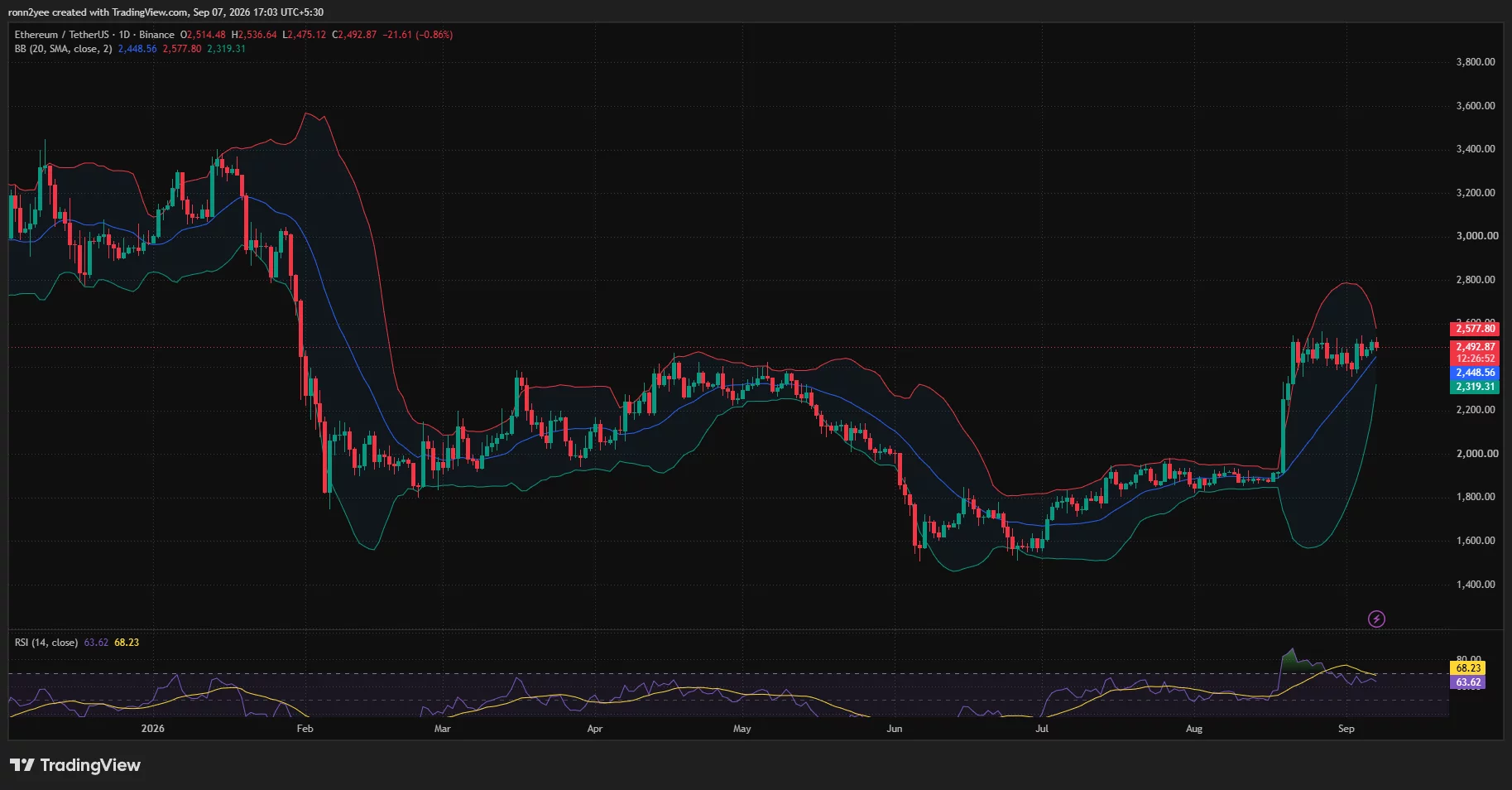
Ethereum price traded near $2,493 on Sept. 7 after failing to hold above $2,500, while weakening momentum and nearby liquidation clusters kept ETH within a narrow range.
Summary
- Ethereum price traded between $2,475 and $2,537 before returning below the $2,500 level.
- Daily RSI fell to 63.62, showing that bullish momentum has cooled since the August rally.
- The $2,423–$2,475 area forms the nearest support zone across the charts.
- Liquidation data shows notable liquidity around $2,430 below and $2,540–$2,600 above.
According to data from crypto.news, Ethereum (ETH) price was trading near $2,493, within a 24-hour range of approximately $2,473 to $2,533. The daily chart showed ETH down about 0.9%, with sellers appearing after the price reached $2,536.
The pullback followed a sharp rally in August that lifted Ethereum from below $1,900 to above $2,500. ETH has since moved sideways as buyers struggle to extend the breakout and sellers defend the upper end of the new range.
Ethereum price loses momentum below $2,537
The daily Bollinger Bands place Ethereum’s middle band near $2,448, while the upper and lower bands sit around $2,578 and $2,319, respectively. ETH remains above the middle band, keeping the broader daily structure constructive despite the latest decline.
However, the price has repeatedly failed to establish a daily close above the $2,530–$2,550 region. Another rejection from that area would leave ETH exposed to a retest of the Bollinger Band midpoint near $2,448.
The daily relative strength index has fallen to 63.62 from overbought territory reached during the August advance. Its signal average stands higher at 68.23, indicating that momentum is fading even though the RSI remains above the neutral 50 level.
The indicator does not yet confirm a bearish reversal. Still, the lower RSI reading suggests buyers would need a decisive move above $2,537 to restore momentum.
A daily close above that level would bring the upper Bollinger Band near $2,578 into focus. Clearing both barriers could allow Ethereum to test the psychological $2,600 level, where the liquidation data shows another pocket of leveraged positions.
Weak ADX keeps ETH inside a short-term range
Ethereum’s 4-hour chart reinforces the loss of directional momentum. ETH traded around $2,493, almost level with the Supertrend resistance near $2,495.
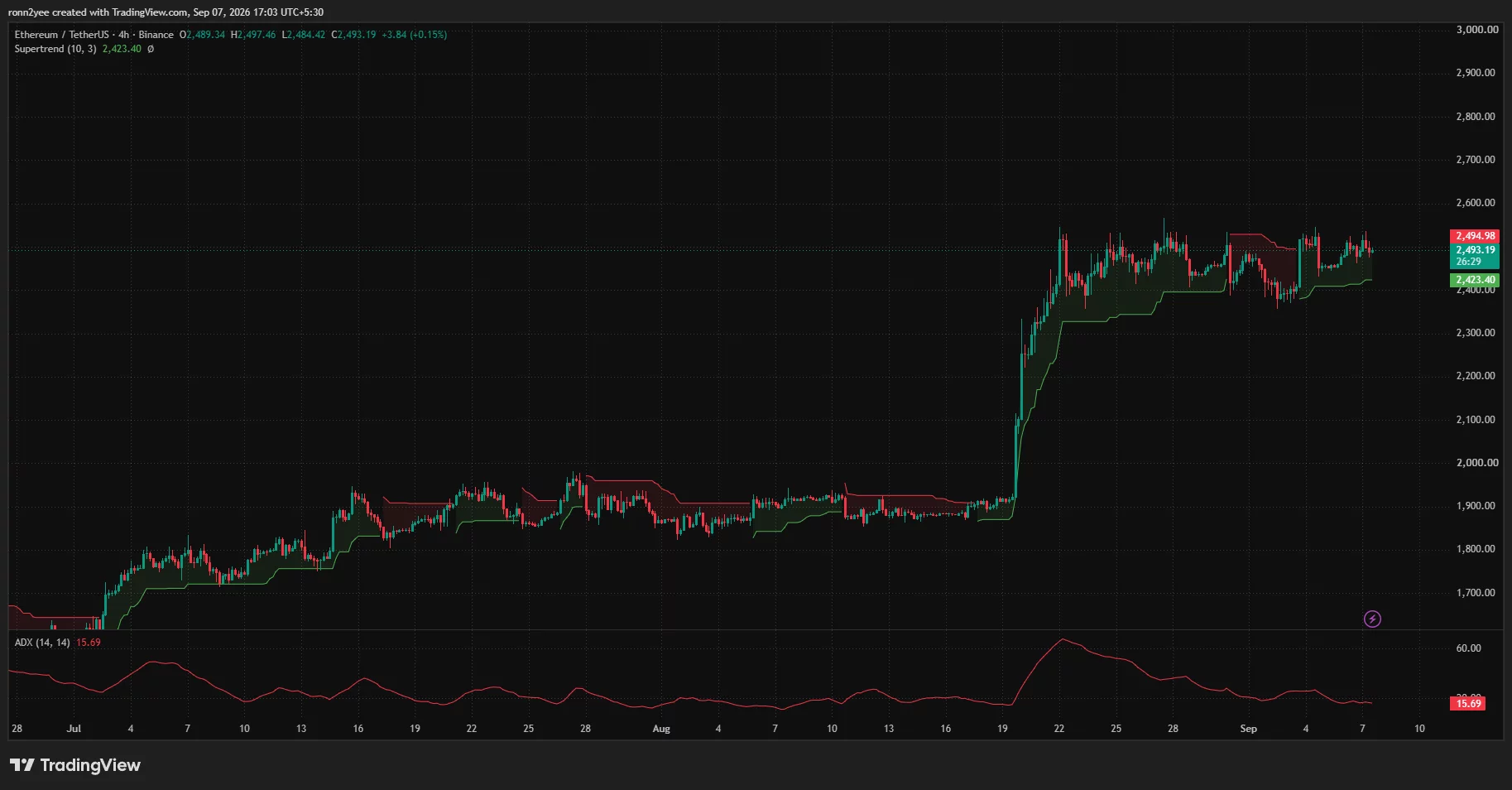
The Supertrend support line remains well below the market at approximately $2,423. That level has risen steadily since Ethereum’s August breakout, meaning the 4-hour structure has not yet turned bearish despite the price moving below the active resistance line.
The average directional index stood at 15.69. An ADX reading below 20 generally points to a weak trend, which supports the view that Ethereum is consolidating rather than beginning a strong directional move.
Repeated swings between roughly $2,450 and $2,530 also show that neither side has gained control. Buyers have defended pullbacks toward the lower part of this range, but rallies continue to lose strength near $2,500–$2,530.
A break below $2,475 would place the 4-hour Supertrend support at $2,423 in view. The three-day CoinGlass heatmap shows the largest nearby downside liquidity concentration around $2,425–$2,455, increasing the importance of that region.
Losses below $2,423 could expose the round-number support at $2,400, where another visible liquidity band has formed. ETH would need to remain below the Supertrend level for the short-term structure to shift more clearly in favor of sellers.
ETH liquidity sits on both sides of $2,500
The 3-day CoinGlass heatmap chart shows Ethereum positioned between two groups of liquidation liquidity.
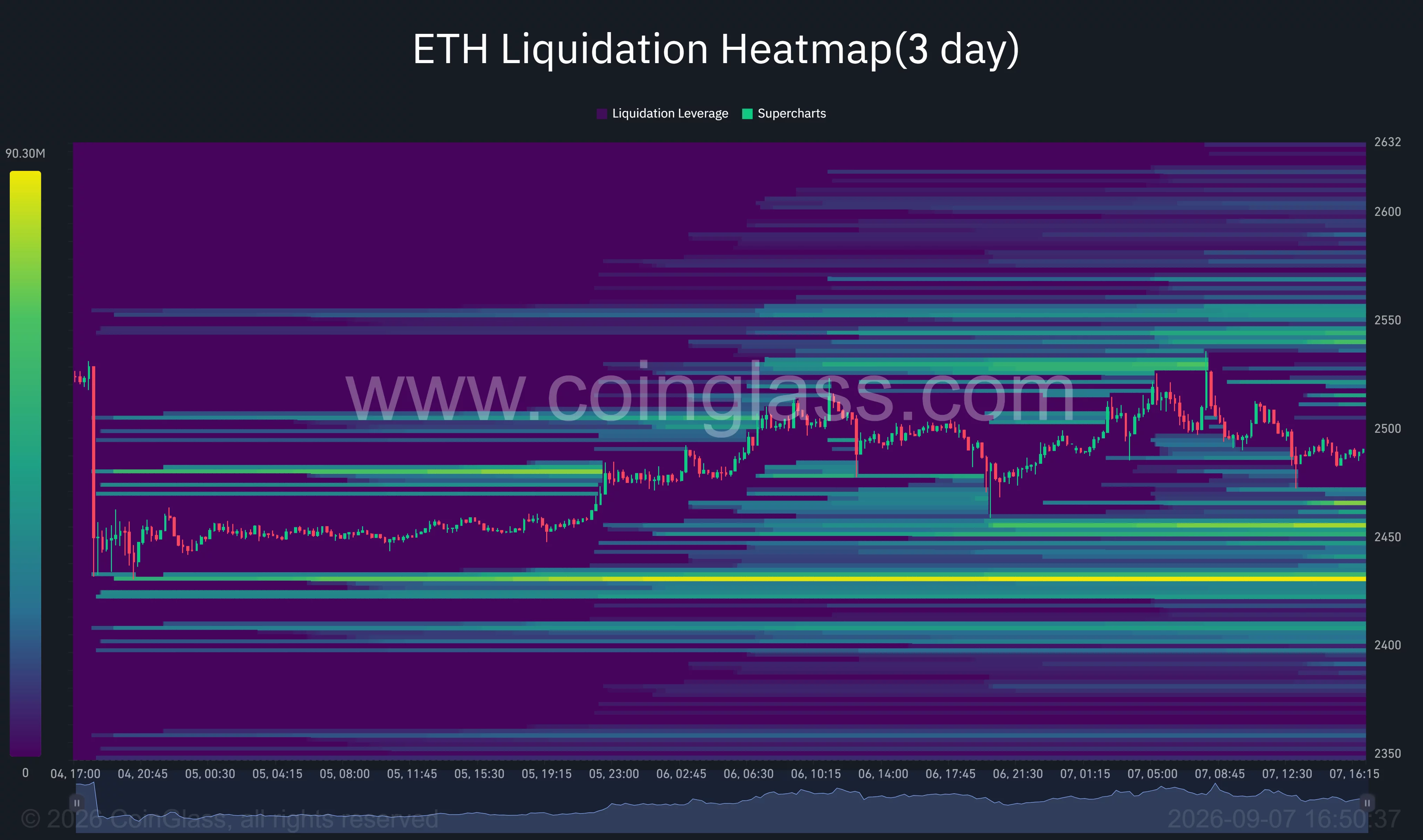
The strongest nearby downside band appears around $2,430, followed by another cluster around $2,450–$2,460. On the upside, liquidity is concentrated between approximately $2,520 and $2,550, with additional positions building near $2,600.
These clusters do not guarantee where Ethereum will move. They identify areas where leveraged positions may be forced to close if the price reaches them, which can add speed to an existing move.
Analyst Ted Pillows said most of Ethereum’s nearer upside liquidity had already been cleared, leaving a smaller cluster around $2,600. He also identified much larger long-position liquidity between $1,800 and $2,200, although such distant levels are not part of ETH’s immediate trading range.
Separately, Ali Martinez identified $2,475 as an important on-chain support zone. Citing Glassnode data, Martinez said approximately 2.86 million ETH previously changed hands around that price.
Martinez placed the next possible upside objective near $2,722 if the support holds. He also identified heavy supply between $2,723 and $2,822, where more than 10 million ETH had previously moved, potentially creating resistance if Ethereum reaches that region.
Ethereum must reclaim $2,537 to extend its rally
Ethereum’s immediate outlook depends on whether it can defend $2,475 and break through the resistance concentrated between $2,530 and $2,578.
A confirmed move above $2,578 would clear the daily upper Bollinger Band and open a path toward $2,600. A sustained breakout beyond that point could shift attention toward Martinez’s $2,722 target and the broader $2,723–$2,822 supply zone.
The bearish scenario begins with a daily break below $2,475. Such a move could draw ETH toward $2,448, followed by the 4-hour Supertrend and liquidation cluster around $2,423–$2,430.
US traders will also be watching the Federal Reserve’s Sept. 15–16 policy meeting, which includes updated economic projections and a press conference, according to the central bank’s calendar. Changing rate expectations could influence crypto risk appetite ahead of Ethereum’s next technical break.
US spot Ethereum ETFs provide a mixed institutional backdrop rather than a clear outflow trend. Farside Investors recorded a $48.2 million net outflow on Sept. 2, followed by inflows of $141.4 million and $25.9 million over the next two sessions.
For now, low 4-hour ADX and cooling daily RSI favor continued consolidation. The next stronger move is likely to depend on whether ETH first loses $2,475 or clears the $2,537–$2,578 resistance zone.
Disclosure: This article does not represent investment advice. The content and materials featured on this page are for educational purposes only.


Britain’s Financial Conduct Authority has reportedly discussed easing restrictions on retail financial prediction markets, but the regulator had announced no policy change as of September 7, 2026.
Summary
- Britain’s FCA still treats financial prediction markets as binary options banned for retail consumers nationwide.
- The regulator reportedly held industry talks but has announced no policy reversal or rulemaking timetable.
- Sports and political prediction contracts fall under Gambling Commission oversight rather than direct FCA supervision.
- Britain’s permanent retail binary options ban has remained effective since April 2019, citing consumer harm.
- Overseas platforms may leave British users without domestic complaint procedures, compensation coverage or regulatory protection.
The FCA held discussions with trading platforms about potentially reopening financial prediction markets to retail investors, according to a Times report. Industry representatives reportedly argued that British consumers already access overseas platforms, including Kalshi and Polymarket.
The discussions have not produced a public consultation, proposed rule or implementation date. The regulator’s latest published position continues to classify prediction contracts linked to financial and certain climate events as binary options.
The FCA permanently prohibited firms from selling binary options to retail consumers in April 2019. It has maintained that these contracts resemble gambling, carry a high risk of losses and are difficult for consumers to value accurately.
UK prediction market rules divide regulatory control
Prediction markets allow users to trade contracts based on whether an event will occur. A contract may pay a fixed amount when an outcome happens and nothing when it does not. Financial examples can cover interest rates, stock indexes or economic data.
The FCA regulates products tied to financial and certain climate events. Sports, political and other non-financial contracts generally fall under the Gambling Commission’s authority. This division means a platform seeking to offer several contract categories could require approvals from both regulators.
The Gambling Commission said in February that many current prediction platforms would probably meet the legal definition of a betting intermediary. Its official guidance compares their core structure with a betting exchange.
The commission also warned unlicensed operators against targeting or transacting with consumers in Great Britain. Operating without an appropriate gambling licence can constitute a criminal offence.
Overseas demand is testing Britain’s restrictions
Industry participants reportedly told the FCA that millions of Britons are using overseas prediction platforms. Some users are said to circumvent geographic restrictions through virtual private networks, although the FCA has not published independent figures confirming the scale of that activity.
Such access can place consumers outside the protections applying to authorized British firms. Depending on the platform and product, customers may lack access to domestic complaint procedures, the Financial Ombudsman Service or Financial Services Compensation Scheme coverage.
Prediction markets have expanded quickly in the U.S., where Kalshi operates as a federally regulated designated contract market. Polymarket uses blockchain infrastructure and has built substantial trading activity around elections, economics and other events.
The sector has also faced political scrutiny. As crypto.news reported, U.S. lawmakers investigated suspicious prediction-market wagers connected with military events and possible access to non-public government information.
The FCA must formally consult before access changes
The FCA previously raised prediction products in its paper on expanding consumer access to investments. It asked whether restrictions should depend more closely on a product’s risks instead of its label.
Its March perimeter report said the agency would consider whether to conduct further work on access or clarify the regulatory boundary. That wording leaves the review open but does not represent approval for Kalshi, Polymarket or another platform to offer financial event contracts to British retail customers.
The FCA’s original binary-options ban applies to firms conducting regulated business in or from the U.K. The measure replaced temporary restrictions introduced by European regulators and made Britain’s prohibition permanent. The FCA said binary options generated inherent conflicts because providers often profited when their customers lost money.
Any new framework could therefore require more than removing the existing prohibition. The regulator would need to decide which events qualify as financial products, what retail safeguards apply and whether customers must pass knowledge or suitability assessments. It could also consider position limits, standardized risk warnings and restrictions on incentives.
Any reversal would probably require formal proposals addressing product governance, appropriateness assessments, marketing, disclosure and loss protections. The FCA has not provided a deadline for deciding whether to begin that process.
The debate also arrives as trading platforms expand their British operations. Crypto.news previously reported that Robinhood secured FCA crypto registration before launching crypto trading through Bitstamp UK. In related coverage, Coinbase received broader UK investment permissions while expanding its U.S. prediction-market partnership with Kalshi.
For now, the reported discussions indicate regulatory interest rather than a change in law. Financial prediction contracts remain unavailable to British retail customers through FCA-authorized providers unless the regulator changes its rules.
Bitcoin (BTC) sees its first weekly close above $80,000 since early May as clouds gather over the US inflation outlook.
Key points:
- US PPI and CPI inflation numbers are due this week prior to the Fed’s Sept. 16 decision on interest-rate changes.
- Amid record currency interventions, analysis warns that Japan may not be able to sell US treasuries to help stabilize the yen in going forward.
- Bitcoin’s supertrend indicator delivers its first “buy” signal since late 2025, copying the previous bear-market recovery.
CPI, PPI due as markets see 0.25% rate hike next
US inflation data returns to the forefront this week after surprise employment data pressured crypto and risk assets. The August prints of the Producer Price Index (PPI) and Consumer Price Index (CPI) are due for release on Thursday and Friday, respectively.
CPI matched market expectations at 0.1% month-on-month and 3.4% year-on-year last month, continuing on from softer-than-anticipated June results. Although the numbers paint a positive picture for inflation, Kevin Warsh, chair of the US Federal Reserve, stated that these data prints alone did not support the case for reassessing financial policy.
“Each of these broad inflation measures have fallen significantly from their highs of a few years ago, but progress through the past couple of years has been more modest, and while this summer’s PCE and CPI readings were better than expected, they do not tell me that underlying trends have meaningfully improved,” he said at the Jackson Hole economic symposium in late August, referring to the Fed’s “preferred” inflation gauge, the Personal Consumption Expenditures (PCE) index.
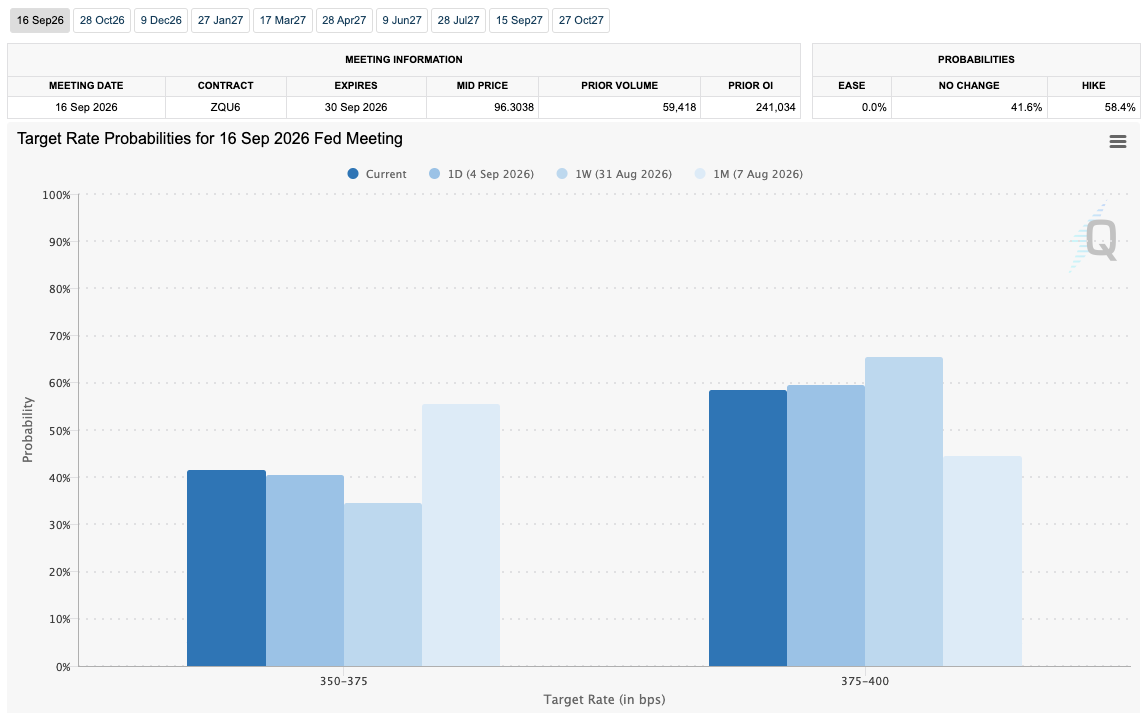
In response to the speech, markets priced in an increased likelihood of Federal Reserve rate hikes at its next meeting on Sept. 16. The latest data from the CME Group’s FedWatch Tool shows that consensus favors a 0.25% rate hike, with odds at 58.4%.
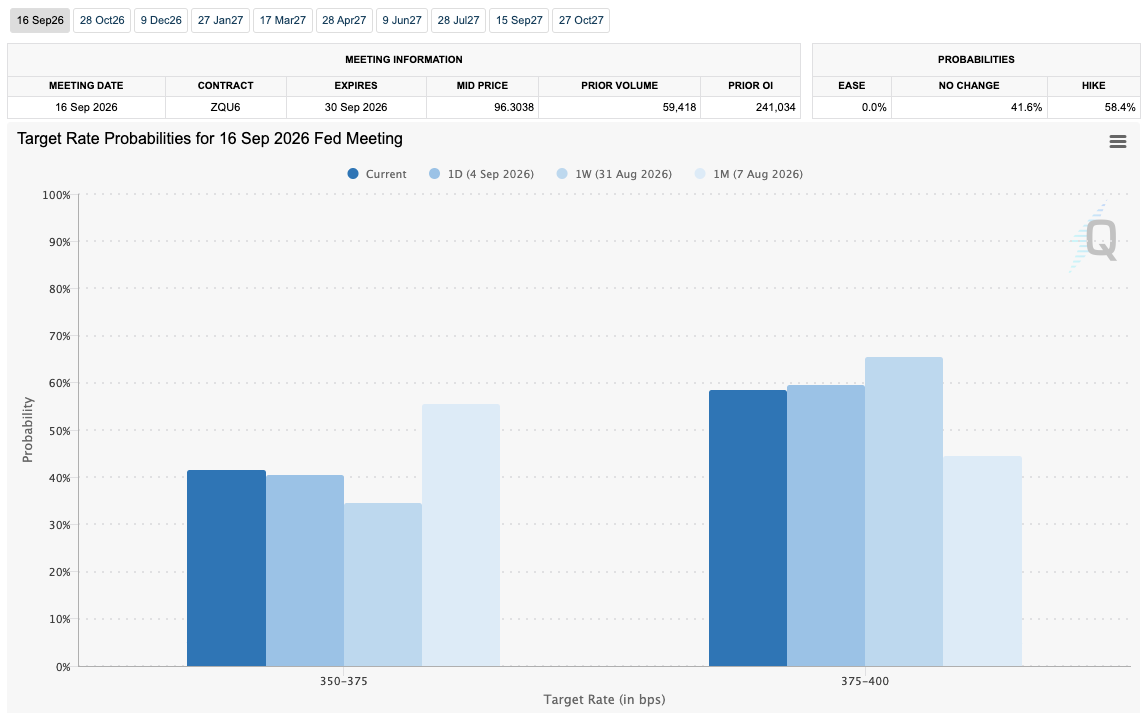
Fed target rate probability comparison for September FOMC meeting (screenshot). Source: CME Group
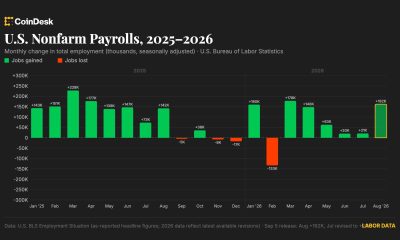
Fears of rate hikes were also spurred by last week’s nonfarm payrolls data, which came in far stronger than expected and included upward revisions of prior figures. The US economy added 162,000 jobs in August against a prior estimate of 56,000.
A stronger labor market reduces the need for the Fed to loosen policy, cementing the potential for rate hikes with core inflation still above its 2% target. Markets have maintained a hawkish outlook on rates. This is despite Fed governor Christopher Waller voicing support for an ongoing rate-hike pause and US president Donald Trump renewing pressure on the Fed to enact rate cuts last week.
“The Fed Board, with its great new leader, must get smart – BE PATRIOTS for a change. High interest rates put the U.S.A. at a very unfair disadvantage, and I won’t allow that to happen!” he wrote in a post on Truth Social.
Both PPI and CPI have the potential to alter the outlook prior to the meeting, with crypto market volatility often accompanying inflation-data prints.
Commenting, trading resource Mosaic Asset Company noted that the strong jobs numbers could still offer stocks a silver lining.
“While the knee-jerk reaction is centered around the rate outlook, it’s worth keeping in mind that good news for the economy should be good news for corporate earnings. The jobs report adds to recent data pointing to an economy expanding at solid pace, which should support the bull market looking ahead,” it wrote in analysis at the weekend.
Mosaic cautioned that seasonality could add an additional hurdle, with September traditionally equities’ worst-performing month, while November’s US midterm elections should make for more volatile conditions into Q4.
Japanese yen interventions hit record
Traders are focused on the Japanese yen as new government data reveals the extent of its record currency interventions.
On Monday, Japan’s Ministry of Finance reported that its foreign reserves had decreased by $79.57 billion from the end of July amid a record currency intervention in the yen. Japan’s currency strengthened to 155 against the US dollar as a result, still holding that area during Monday’s Asia trading session.
“Japan may have used both foreign securities and deposits, but it most likely sold U.S. Treasurys,” Atsushi Takeda, chief economist at Itochu Research Institute, told Bloomberg.
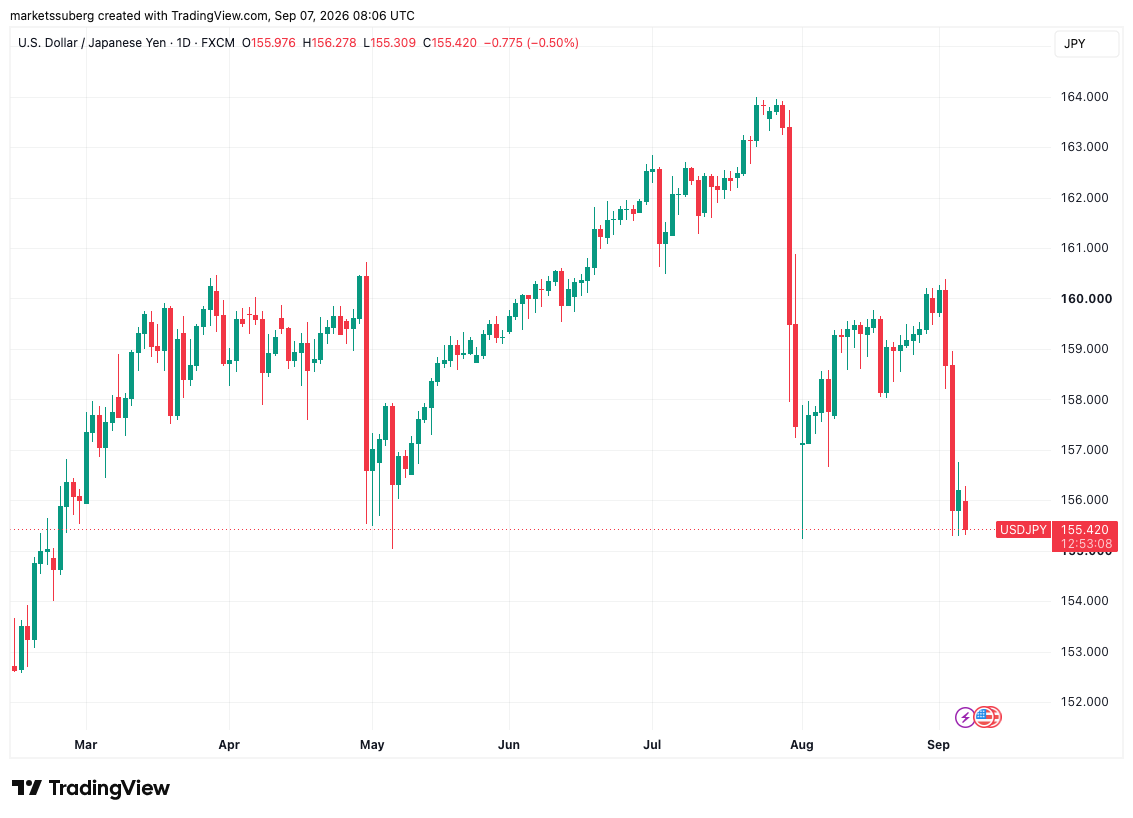
USD/JPY one-day chart. Source: Cointelegraph/TradingView
The move had potential implications beyond the yen, with US bond yields already facing pressure at the long end, prompting the Treasury to announce contingency measures set to begin on Sept. 9. Japan selling US Treasuries to fund future interventions may draw a negative response from Washington, leaving the Bank of Japan (BOJ) in a bind should yen weakness return.
“That would make it difficult for the ministry and the Bank of Japan to act going forward,” Akari Nishimura, economist at the Japan Research Institute, added.
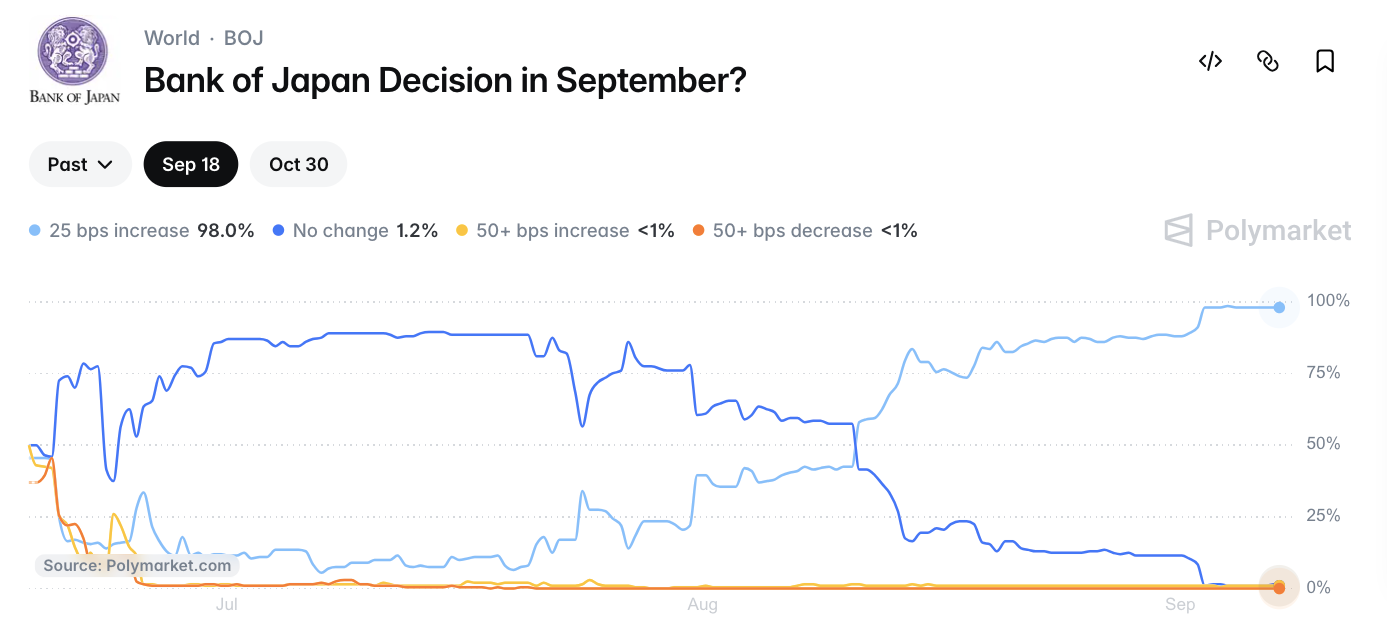
Polymarket probabilities for BOJ rate decision on Sept. 18. Source: Polymarket
Traders now price in an interest-rate hike by the BOJ in September, with benchmark rates already at their highest since 1995 at 1.0%. Data from Polymarket currently sees 98% odds of a 0.25% increase.
Crypto markets remain highly sensitive to moves in USD/JPY and associated headlines due to the potential longer-term impact on the yen carry trade and liquidity trends.
Bitcoin spot market activity still lacking
Bitcoin still needs more spot-market participation to exit its current low-timeframe range centered around $80,000, analysis argues.
Onchain analytics platform CryptoQuant notes that upside volatility seen over the past week was accompanied by sharp upticks in open interest (OI) on derivatives exchanges. This points to derivatives traders dictating snap price moves.
“Aggregate Open Interest rose from $25.2B to $27.53B: +$2.3B (+9.24%) in a single session. On the hourly timeframe, price and OI began expanding almost simultaneously around 09:00 UTC, pointing to a strong influx of new positions,” CryptoQuant reported about a previous price move on Sept. 3, when BTC/USD last rose above $82,000.
CryptoQuant noted that Bitcoin’s realized cap — the aggregate value of the BTC supply measured by the price at which it last moved onchain — has not kept pace with moves in OI.
“The conclusion is clear: the rally had spot/on-chain participation, but the main driver was derivatives. OI expansion, aggressive buying, positive funding, and rising leverage created a structure far more dependent on futures than on realized on-chain capital,” it continued.
Cointelegraph previously reported that the lack of spot demand is a major hurdle to a sustained BTC price trend change. As BTC/USD returned investors to net profit last month, profit taking surged.
CryptoQuant warns that spot demand remains negative, with values increasingly diverging from futures on a 30-day rolling basis.
“While futures demand is driving the rise, spot demand continues to show a negative trend. This is not a good signal, as there can be no bullish rally without spot demand. Despite the rebound, the outflow of spot $BTC has increased further,” it commented.
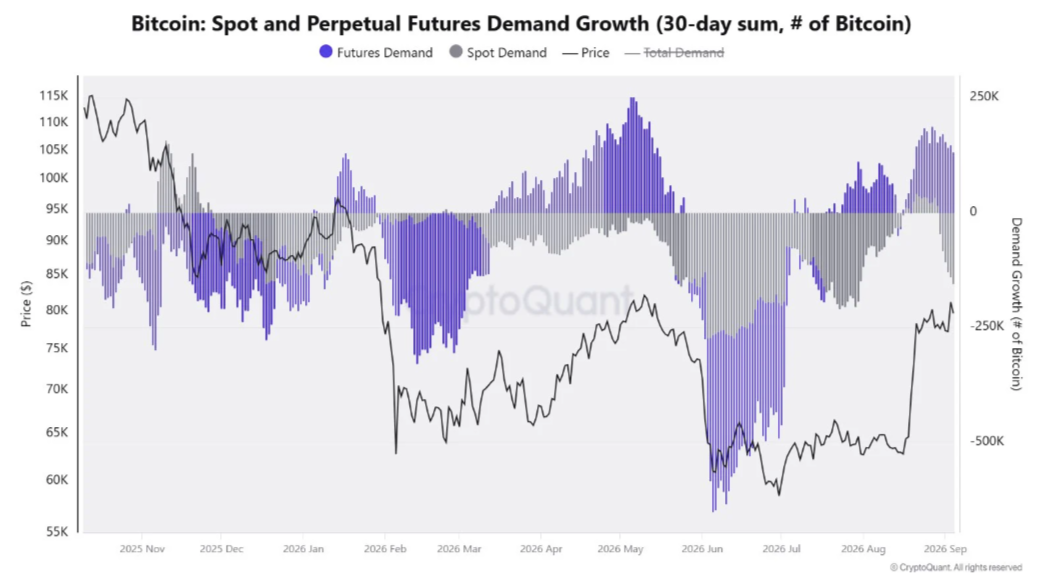
Bitcoin demand growth comparison (screenshot). Source: CryptoQuant
Last week, Cointelegraph reported on the return of negative apparent demand, which reflects that BTC’s dormant supply growth outpaced new issuance.
BTC price seals first weekly close above $80,000 in four months
Bitcoin narrowly touched $80,000 on Sunday, marking its highest weekly close since the week of May 11, per data from TradingView.
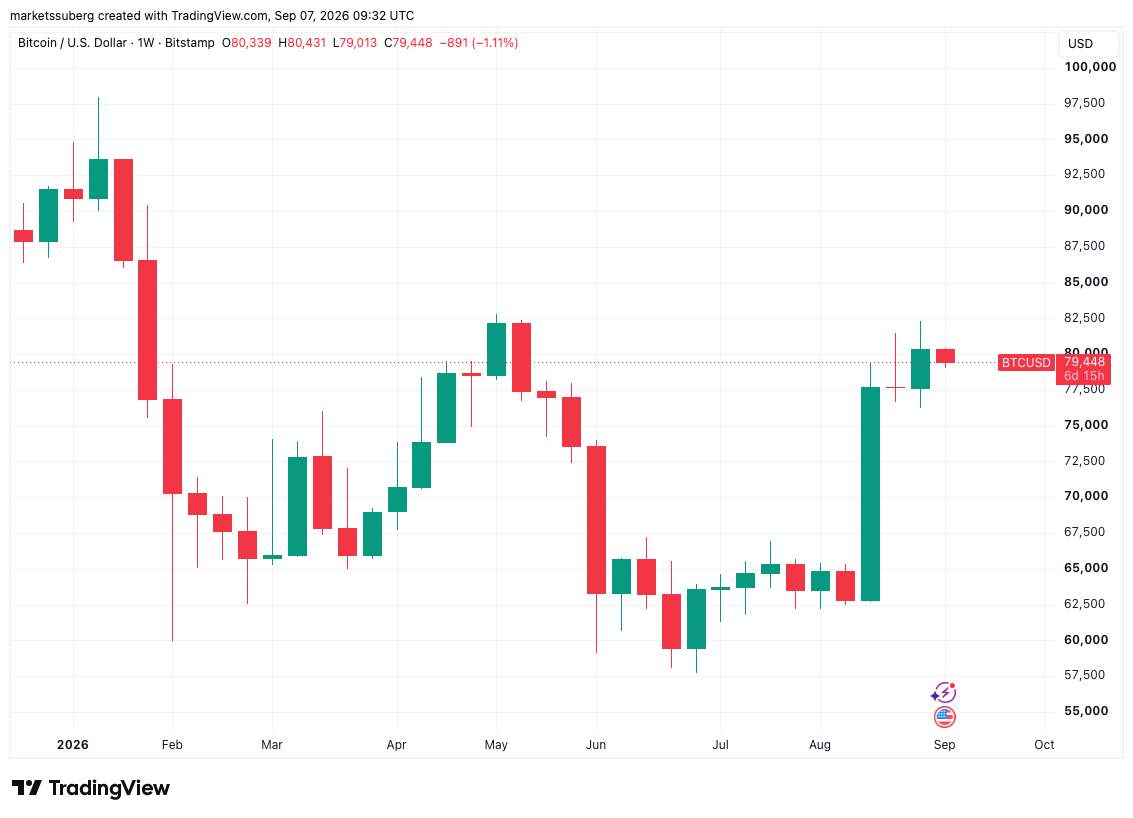
BTC/USD one-week chart. Source: Cointelegraph/TradingView
The $80,000 mark remains elusive support, however, with bulls unable to remain above it consistently as sell-side liquidity mounts immediately above this level. The latest data from CoinGlass shows liquidity concentrated around $80,560, forming a thick wall of resistance, which is keeping BTC/USD pinned in a narrow range.
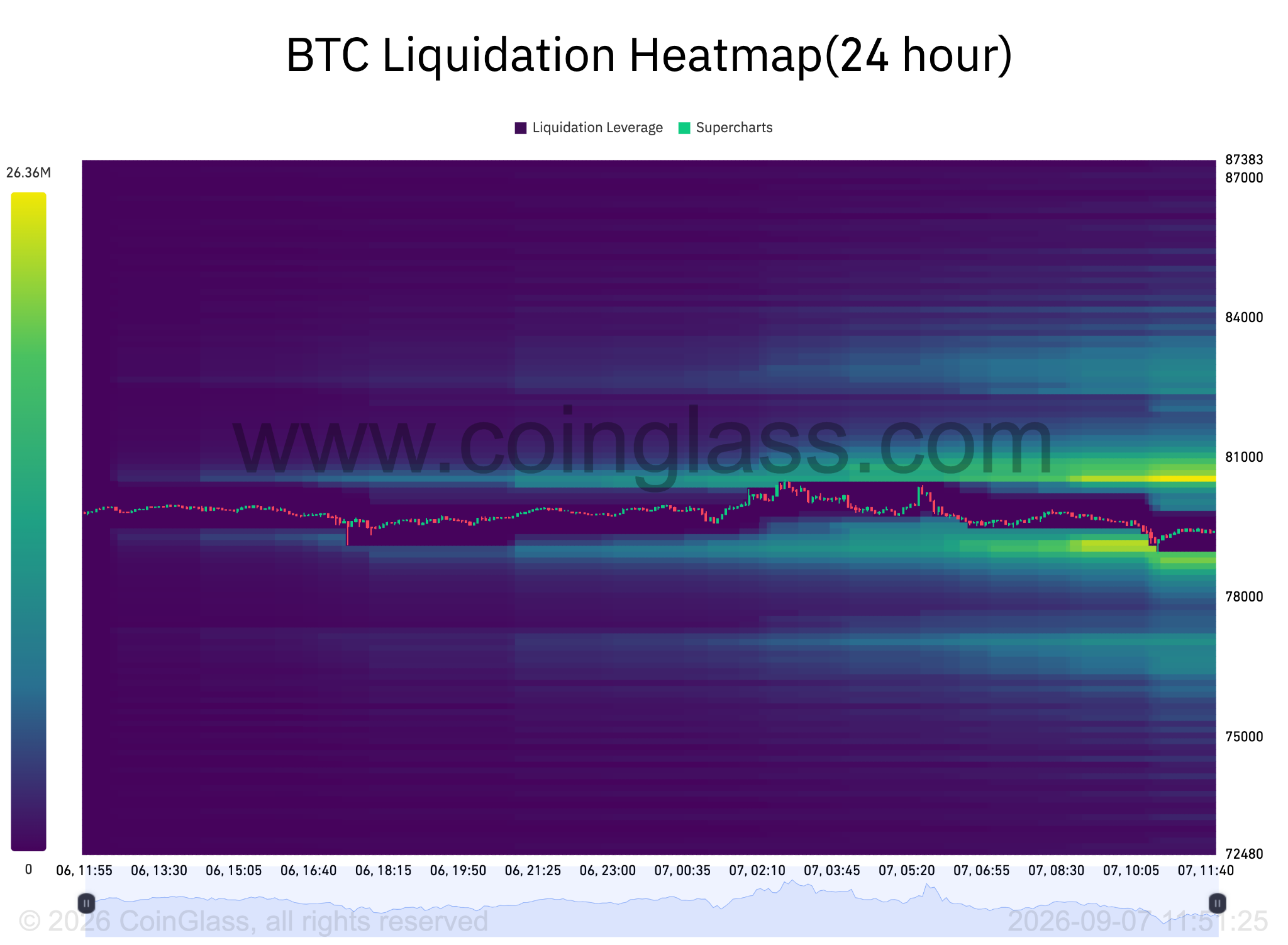
BTC liquidation heatmap. Source: CoinGlass
Last month, onchain analytics platform Glassnode flagged large liquidity bands as key to shaping Bitcoin’s longer-term price action, highlighting a further band between $83,000 and $86,000 in particular.
“While the upward impulse consumed short orders in its path, it stopped short of the dense cluster of short liquidations situated between $83K and $86K,” it wrote in the latest edition of its regular newsletter, The Week Onchain.
“Below spot, the move left behind an intact band of long liquidation fuel between $60K and $63K. Price now trades between these two boundaries.”
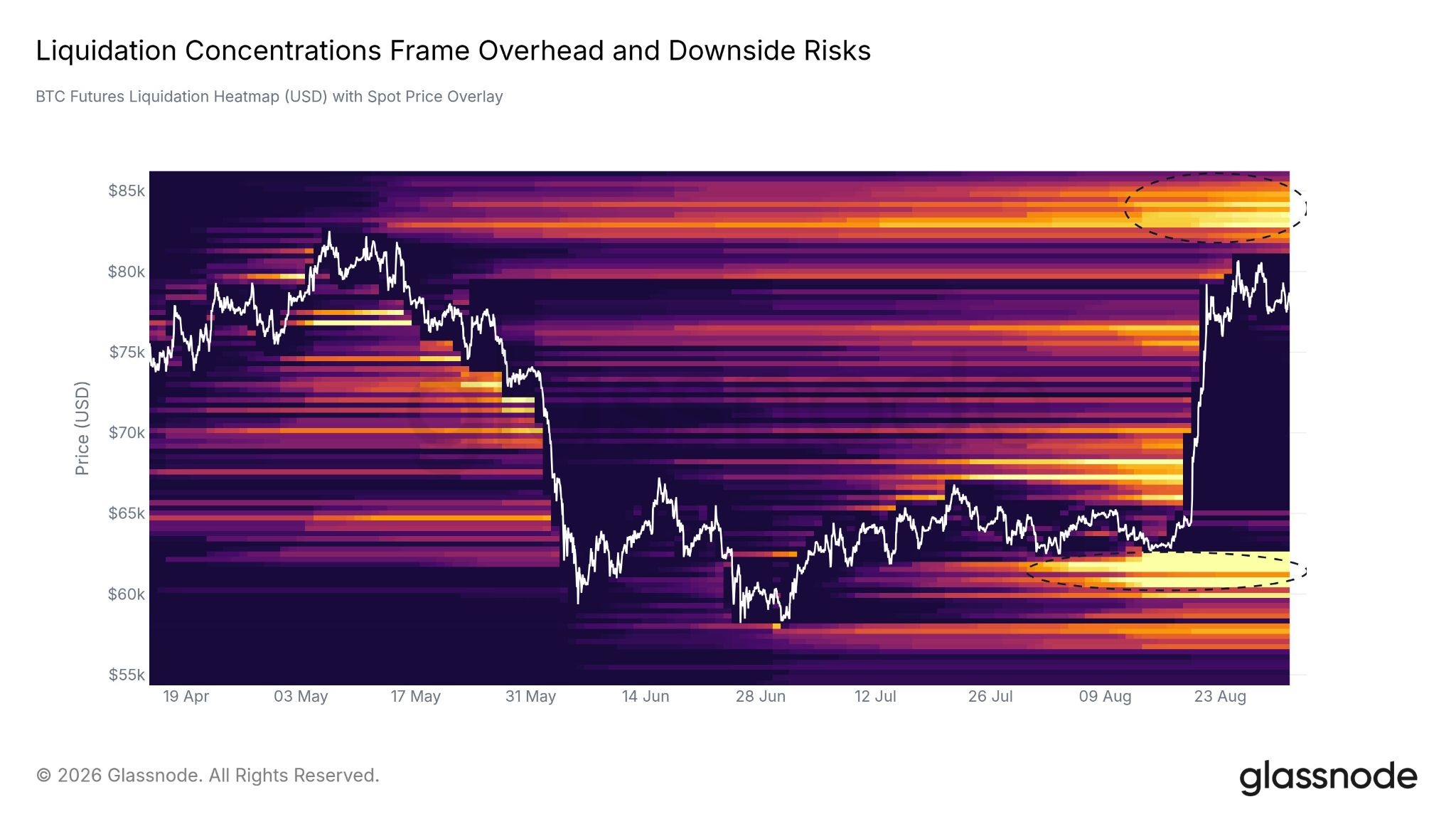
Bitcoin futures liquidation heatmap. Source: Glassnode
Market participants, meanwhile, are considering where the current consolidation could resolve to fresh upside. Jesse Olson, developer of the Markets Sniper trading suite, sees BTC/USD repeating a bullish chart fractal from August 2023, with $76,000 now in sight as a local reversal point.
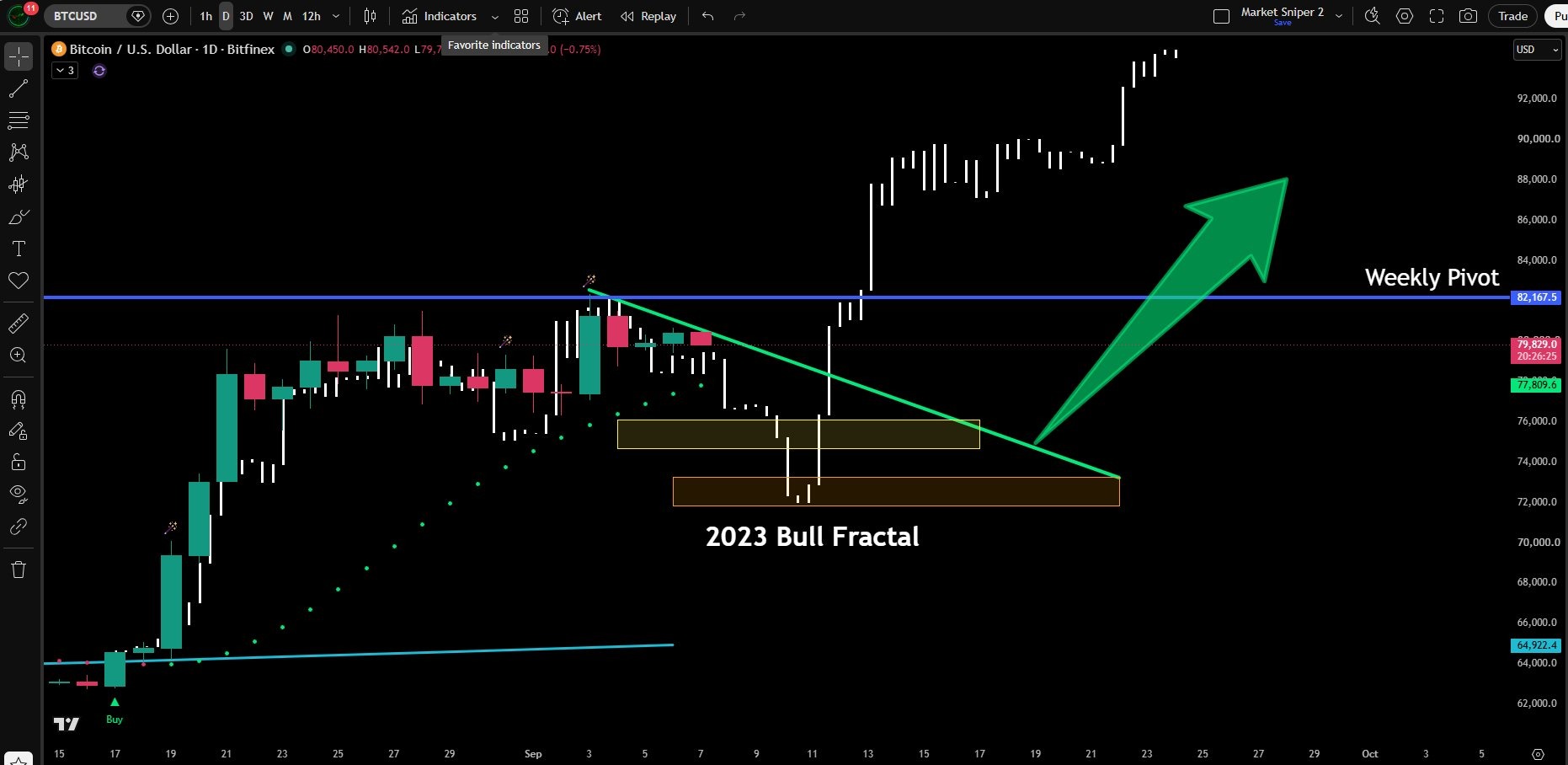
BTC/USD one-day chart. Source: Jesse Olson on X.com
Bitcoin supertrend bull signal copies early 2023 recovery
Sunday’s weekly close saw a classic BTC price trend indicator flip green for the first time since November 2025.
Related: Here’s what happened in crypto today
On weekly time frames, BTC/USD closed above its supertrend line, producing a “buy” signal. Supertrend employs average trend range (ATR) data and a multiplier to calculate a simple buy and sell signal, measured by its interaction with the supertrend line.
Weekly time frames draw particular attention from Bitcoin traders, as a close above the supertrend line has never occurred within a bear market. The last time that supertrend flipped from red to green was in mid-January 2023, with Bitcoin’s last bear-market bottom of $15,600 already two months behind it. Conversely, the indicator flipping from green to red has preceded the start of protracted downtrends.
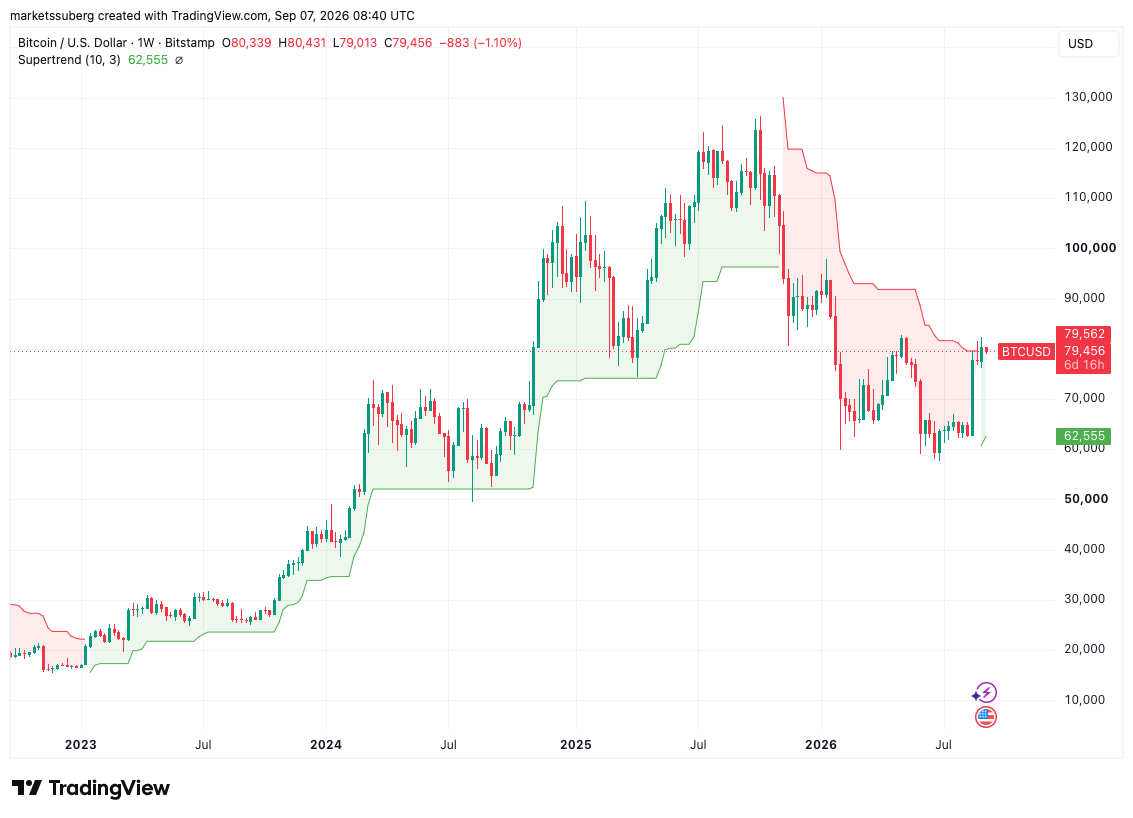
BTC/USD one-week chart with supertrend data. Source: Cointelegraph/TradingView
The signal joins a growing selection of cues that has instilled confidence in some that Bitcoin already saw its macro bottom at $57,000. In August, BTC/USD closed above its 50-week exponential moving average (EMA) for the first time since late 2025 — an event that has historically been crucial for a long-term bullish price-trend reversal.


The FCA reportedly held talks with trading platforms as Britons turn to Polymarket and Kalshi, though its public position still supports the ban.
Crypto World
DBS and Citi complete weekend USD payment via Swift’s Digital Ledger using tokenized deposits


The transaction is the second confirmed live use of Swift’s blockchain ledger, coming as the network races to prove it can compete with digital payment rails that never close.


A Transaction v1 feature activates Wednesday, allowing complex proofs and large multisig operations to fit in one transaction while forcing services that read Solana to update.


Arthur Hayes has released the FLOP Network technical paper detailing a proof-of-useful-inference blockchain for AI agents, with a genesis supply of approximately 2.48 billion FLOP tokens allocated through airdrops.
Summary
- Arthur Hayes has released the FLOP white paper detailing a blockchain where AI agents pay miners in FLOP for inference and computing resources.
- FLOP will launch with approximately 2.48 billion tokens allocated through airdrops, with no venture capital premine or token auction.
- Miners will receive 75% of block rewards, while validators and agents each receive 10% and regular stakers receive 5%.
- Block rewards will start at 96 FLOP and halve every 730 days until reaching a permanent reward of 3 FLOP.
According to the FLOP Network details shared by Hayes, the protocol is designed to let autonomous AI agents pay miners directly for inference, with validators settling proofs of the completed computational work.
FLOP, short for floating-point operations, serves as the native currency of the network. Under the proposed system, an agent can spend FLOP whenever it requires computing resources, allowing the token to function as payment for AI inference.
The latest specifications provide substantially more detail on a project that Hayes first unveiled in August. As crypto.news reported, the BitMEX co-founder said on Aug. 18 that he was returning to an operating role to lead Flop Labs, describing FLOP as “food for your AI agent.”
At the time, Hayes said the token would launch without a presale or venture capital allocation. Flop Labs was targeting a large airdrop in the fourth quarter of 2026 and a genesis block in the first quarter of 2027, although the project had yet to publish its full tokenomics and technical design.
FLOP Network turns AI inference into miner work
FLOP Network combines an account-based blockchain with a consensus model called proof of useful inference, or PoUI, where miners earn rewards by carrying out AI inference requests instead of performing computational work solely to secure the chain.
An AI agent begins the process by submitting a session request to the network’s mempool. Each request specifies information including a model-weight hash, maximum latency, computational requirements measured in FLOPs, a confidentiality setting and the fee offered for completing the task.
A miner with suitable hardware can accept the request and establish a private connection with the agent. Once the requested inference has been completed, the miner returns a proof of the work, while validators incorporate the proof hash into a block to settle the transaction.
Miners receive the session fee paid by the agent and a portion of the network’s block rewards based on the verified compute they contribute. Ordinary GPUs can participate under the proposed architecture, while confidential computing is treated as an optional tier instead of a requirement for joining the network.
The model places FLOP in an emerging market where autonomous software is already being equipped to make blockchain payments. A June crypto.news guide on agentic crypto payments detailed how AI agents can autonomously purchase data, compute and other online services using crypto payment rails such as x402.
Similar infrastructure has started moving into production. By July, the XRP Ledger had processed more than 1.4 million AI-agent transactions, while Ripple was developing tooling that allowed autonomous agents to make payments using XRP and RLUSD.
FLOP’s proposed model differs by tying its native currency directly to inference work performed by miners.
FLOP supply starts at 2.48 billion tokens
The FLOP specifications put the genesis supply at approximately 2.48346 billion tokens, with the initial tokens designated for airdrop distribution rather than a venture capital premine or token auction.
Block rewards begin at 96 FLOP and are divided among four groups. Miners receive 75%, validators take 10%, agents receive another 10%, and ordinary stakers are assigned the remaining 5%.
Issuance follows a fixed halving schedule. The 96 FLOP block reward falls to 48 after 730 days, followed by reductions to 24, 12, 6 and eventually 3 FLOP across five halvings.
Unlike Bitcoin’s issuance model, rewards do not disappear after the scheduled reductions. FLOP’s block subsidy remains permanently at 3 FLOP after the fifth halving, creating continuing emissions for network participants.
The network is designed around an average block time of one second with deterministic sub-second finality, while its development roadmap targets block production below one second.
Hayes had previously provided an earlier outline of the distribution strategy. In August, he proposed allocating roughly 20% of the FLOP supply to testnet participants over a 10-year period and said the network would be funded without a token presale.
That proposal described two revenue sources for miners: block rewards for participating in the network and inference fees paid by AI agents requesting computational work. The latest protocol documentation now specifies how the requests move from agents through miners to validators for settlement.
Validators face staking and slashing rules
Participation as either a miner or validator requires FLOP to be staked, creating collateral that can be penalized when participants submit dishonest work.
Under the proposed rules, miners can face slashing for misrepresenting completed inference, while validators risk penalties for publishing dishonest blocks. Severe violations can result in the full loss of staked tokens and removal from the network.
Token holders who do not operate infrastructure can delegate FLOP to a miner or validator and receive a proportional share of rewards.
The validator set is capped at 1,000. Approximately 50 validators are expected to rotate each month based on verified workload and uptime, while the project plans to incorporate stake into validator ranking above the required participation threshold.
Validators will have a second role in network governance. Changes are proposed through FLOP Improvement Proposals, or FIPs, with most proposals requiring approval from two-thirds of the active validator set before implementation.
The architecture places model weights in a data-availability layer while validators build blocks containing hashes of inference proofs submitted by miners.
Other blockchain projects are pursuing their own versions of an AI-agent economy. NEAR, for example, introduced a system in July that lets users stake tokens for AI services, converting locked NEAR into monthly compute credits that can be used across 43 AI models, including confidential inference and autonomous agent services.
FLOP instead proposes a four-stage execution path built around requests, miner matching, inference proofs and settlement. An agent first posts the required model, latency, compute, confidentiality and fee parameters; a miner accepts the task and runs the model; proof of the completed inference is submitted to the network; and validators include its hash in a block before the miner receives the session payment and its share of protocol rewards.
The FLOP Network project introduction is currently labeled a draft and was last updated on Aug. 27, while the newly published technical specifications remain subject to development before the planned network launch.
Your day-ahead look for Sept. 7, 2026
Ethereum Breakout Incoming? $300M in ETH Leaves Exchanges as Analyst Eyes Next Big Target

Trump’s Envoys Spark Fury As They Advocate For Putin While In Ukraine

Melbourne Cup winner Half Yours set for 2026 Makybe Diva Stakes return





-

 Fashion3 days ago
Weekend Open Thread: Beyond Yoga
-
 Crypto World3 days ago
Bitcoin price stalls near $82K as key resistance holds
-

 Politics3 days ago
Best Gaming Laptops, CPUs, TVs, And Keyboards To Upgrade Your Set Up For GTA VI
-

 Tech3 days ago
The Birds Outside, Drawn For You Automatically
-

 Crypto World3 days ago
IMF Says El Salvador’s Post-Review Bitcoin Purchases Used No Public Funds
-
 Crypto World3 days ago
U.S. added stronger than expected 162,000 jobs in August as labor market bounced back
-

 Sports3 days ago
Alexandre Pato consortium’s Northampton Town investment approved
-

 Sports3 days ago
Commanders’ Chig Okonkwo is a top breakout fantasy football candidate
-

 Sports3 days ago
Golden Eaglets Drawn in Group B for 2026 WAFU B U17 Championship
-
 Crypto World3 days ago
XRP price breaks falling channel as bulls target $1.53
-

 Politics3 days ago
A new European chapter for Gibraltar
-

 Politics3 days ago
How To Avoid Winter Colds: 4 Everyday Habits That Spread Germs, Says Pharmacist
-

 Politics3 days ago
The House | Bin the lectures, bring gossip and be ready to banter: how the new PM should prepare for his Trump encounter
-

 Crypto World3 days ago
From warning to listing: UK’s largest retail investment platform opens access to crypto ETNs
-

 Crypto World3 days ago
FinCEN flags $12.7B tied to Southeast Asia crypto investment scams
-

 Tech3 days ago
A Worthy Android Ereader, With Some Tradeoffs
-

 Tech3 days ago
How To Edit Claude’s Memory
-

 Crypto World3 days ago
Trezor Data Breach Impacts 67,000 More US Customers
-

 Politics3 days ago
33 Cosy Autumn Home Decor Ideas: Blankets, Pumpkin Decorations, And Candles
-

 Tech3 days ago
beyerdynamic AVENTHO Y Debuts at IFA 2026 and Makes Wireless Headphones Less Disposable
You must be logged in to post a comment Login