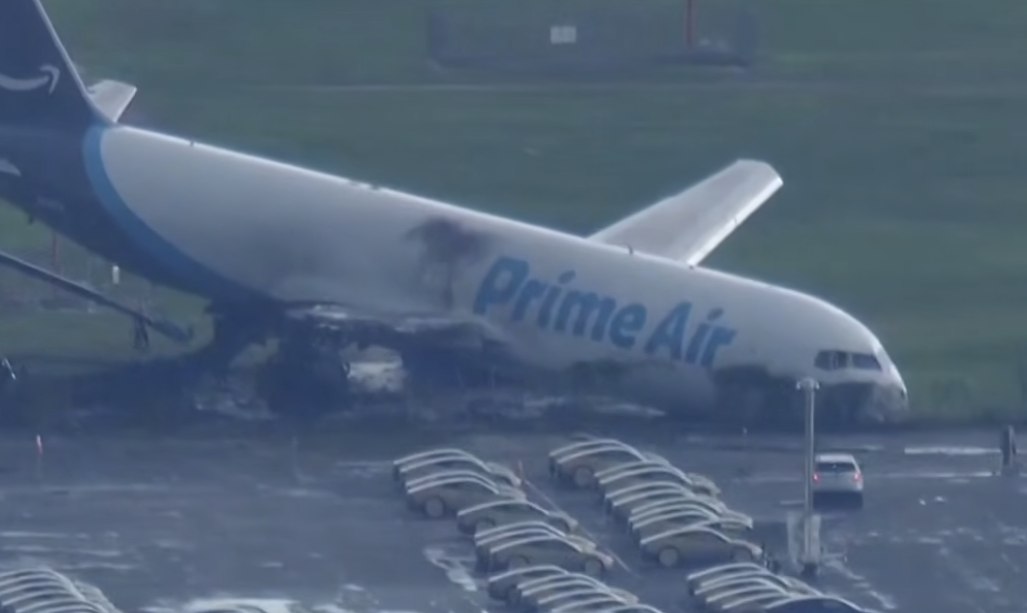
MIAMI — An Amazon Prime Air cargo jet was still moving at about 129 mph when it ran off a Miami International Airport runway, crossed a perimeter road and struck vehicles, killing five people and injuring five others on a busy Labor Day weekend afternoon.
The Boeing 767-300 freighter, Prime Air Flight 7598, arrived from San Juan, Puerto Rico, and overran Runway 30 around 2 p.m. Sunday. Tracking data compiled by Flightradar24 put the jet at 112 knots — roughly 129 mph — as it left the usable pavement. Miami-Dade Fire Rescue Chief Ray Jadallah said five people died, three were taken to a trauma center in critical condition and two others were hospitalized with less severe injuries. Officials had not said by Sunday night whether the dead were in the cockpit, in cars on the road, or both.
The National Transportation Safety Board sent a go-team led by Chair Jennifer Homendy and scheduled the agency’s first public briefing for Monday. Investigators are expected to start with a simple question captured on video and flight tracks: where the airplane touched down, and why the crew did not abandon the landing if the jet floated past the normal zone.
Advertisement
Aviation safety specialist Steve Arroyo said the typical touchdown area is within the first 3,000 feet of a runway. If the cargo jet was beyond that, he said, the pilots should have gone around. Mary Schiavo, a pilot and former inspector general of the Transportation Department, said online video showed the Amazon plane remaining airborne well down the strip without the usual flare that puts the main gear on the pavement. It was not raining, she said, but dark storm clouds were nearby and strong winds had been reported. “A tail wind would certainly add to your troubles if you’ve already given up a good chunk of the runway by not touching down and landing right away,” Schiavo said.
CNN’s review of air-traffic control audio found the crew did not declare an emergency before landing. Flightradar24 data showed the jet rose above the normal approach path to Runway 30, then dropped back toward the glide path. The runway is more than 9,000 feet long. That length did not keep the airplane on airport property.
The 767 crossed a safety area and a fence, then hit vehicles on a road used by warehouse workers and businesses that ring the field. It came to rest on its belly near two semitrucks and a parking lot that serves an Amazon warehouse. Thick black smoke rose as fire burned. Jadallah said crews trapped in the cockpit had to be reached through a window by ladder and that occupants were cut from cars. Firefighters also freed a person pinned under a vehicle. Miami-Dade Fire Rescue sent more than 60 units and about 200 people. Jadallah said crews arrived within about 30 seconds of the first call and were still dealing with a fuel leak later in the afternoon.
Miami-Dade Mayor Daniella Levine Cava said at least five people had lost their lives and five others were injured, and that rescue crews reached the scene within seconds. Sheriff Rosie Cordero-Stutz put the time near 1:58 p.m. A student pilot, Rohan Ellis, who saw the wreckage, told a reporter the vehicles “were mangled.” Names of the dead had not been released.
Advertisement
The airplane, registered N1997A, is 32 years old. It was built as a passenger 767 around 1994, flew for airlines for more than two decades and was converted to a freighter in 2015, according to Cirium and Flightradar24 records. 21 Air, a Greensboro, North Carolina, cargo carrier that also flies for DHL, operated the trip under contract. Amazon does not hold the air-operator certificate for those flights. 21 Air said it was devastated by the accident involving one of its aircraft. CEO Keith Winters said the company was cooperating with federal investigators. Boeing said it was supporting the inquiry.
Amazon spokesperson Kelly Nantel said the company was “heartbroken to learn that five people lost their lives” and extended sympathies to families and others affected. In another statement she said Amazon was “still gathering details” and would “cooperate fully with any investigation.” Schiavo said investigators will review the jet’s maintenance history, including periods of foreign ownership.
Miami International is among the busiest U.S. airports for freight. It does not have an engineered materials arresting system — the crushable bed the FAA says has been installed at more than 120 airports and credited with helping save at least 497 lives in overruns. Mike O’Donnell, the FAA’s former director of airport safety and accident investigations, said Miami appears to meet federal rules because it has a 1,000-foot safety area beyond the runway. That standard followed the 1999 American Airlines Flight 1420 overrun in Little Rock, Arkansas, which killed nine.
The crash shut the airport’s runways and taxiways on a holiday Sunday. FlightAware logged more than 160 cancellations and nearly 325 delays by late day. Some flights diverted to Orlando, more than 200 miles north. Two of four runways later reopened and flights resumed Sunday evening, but the disabled 767 remained at the northwest end of the field.
Advertisement
The accident follows last year’s UPS crash in Louisville, Kentucky, in which a jet lost an engine on takeoff and killed three people in the cockpit and 12 on the ground. Sunday’s sequence was different: a landing, not a departure; a long runway; no declared emergency on the frequency CNN reviewed; and enough leftover speed to leave the airport and hit traffic.
What investigators will pull first is mechanical and human at once. Flight data and cockpit voice recorders should show airspeed, thrust, spoiler and reverse-thrust use, brake pressure and what the pilots said in the last minutes. Weather records will show whether a tail wind was on Runway 30. Maintenance logs will show the converted 767’s recent work. Videos and ADS-B tracks already sketch a long float and a high-speed exit. They do not explain it.
Until Homendy speaks, the confirmed picture is narrow and grim. A contracted Amazon 767 from San Juan did not stop on Runway 30. It left the pavement at highway-plus speed, hit vehicles on a working road and burned. Five people are dead. Five are in hospitals. The airport is moving airplanes again. The reason the jet used up the runway is the question the NTSB came to Miami to answer.
The Securities and Exchange Board of India (SEBI) has extended the deadline for angel funds registered on or before September 10, 2025, to comply with the accredited investor mandate to March 31, 2027, according to its latest circular.
The market regulator said the extension was decided based on representations from the Alternative Investment Fund (AIF) industry seeking additional time for existing angel funds to meet the mandate.
Under the revised timeline, angel funds registered with SEBI on or before September 10, 2025, will have to implement the accredited investor mandate by March 31, 2027. During the extended transition period, these funds cannot offer investment opportunities to more than 200 non-accredited investors, SEBI said.
Such angel funds will also not be allowed to accept contributions from non-accredited investors for investment in an investee company after March 31, 2027, according to the circular.
Advertisement
Existing investors in these angel funds will continue to hold their investments already made in the funds in accordance with the terms of the private placement memorandum (PPM) and/or other fund documents, SEBI said.
Live Events
ALSO READ: Rs 10,000 SIP can create Rs 87.3 lakh in 20 years. Why this projection may not match your actual outcome The revised deadline replaces the earlier timeline of September 8, 2026. Under the previous provisions, angel funds registered with SEBI on or before September 10, 2025, were required to implement the accredited investor mandate by September 8, 2026 and could not offer investment opportunities to more than 200 non-accredited investors during the transition period.SEBI had amended the AIF Regulations on September 9, 2025, to prescribe a revised regulatory framework for angel funds. It subsequently issued a circular on September 10, 2025, specifying the conditions and modalities for the revised framework. These provisions were later subsumed into Chapter 8 of SEBI’s AIF Master Circular dated June 3, 2026.
For angel funds granted registration after September 10, 2025, the existing requirement remains unchanged. Such funds are required to onboard and offer investment opportunities only to Accredited Investors, SEBI said. All other provisions under Chapter 8 of the AIF Master Circular remain unchanged. The latest circular comes into force with immediate effect.
(Disclaimer: Recommendations, suggestions, views and opinions given by the experts are their own. These do not represent the views of Economic Times)
Swiss Re AG (SSREY) Discusses Global Reinsurance Market Dynamics, Inflation Impact and Emerging Industry Opportunities September 7, 2026 8:15 AM EDT
Company Participants
Charlotte Nelson – Senior Manager of Media Relations Communications Urs Baertschi – Chief Executive Officer of Property & Casualty Reinsurance Gianfranco Lot – Chief Underwriting Officer of P&C Reinsurance
Advertisement
Conference Call Participants
Gavin Souter Tim Adler
Presentation
Advertisement
Charlotte Nelson Senior Manager of Media Relations Communications
Hello, everyone. Welcome to Swiss Re’s Rendez-Vous de Septembre 2026 Media Conference. I’m Charlotte Nelson, and I’m responsible for P&C Re Media Relations at Swiss Re. Joining me here today is Urs Baertschi, our CEO, P&C Reinsurance; and Gianfranco Lot, our Chief Underwriting Officer, P&C Reinsurance.
In the next hour, we want to share our perspective on the forces impacting the reinsurance market, what it means for demand for underwriting and for reinsurance. And we will do so by Urs and Gianfranco will walk through our presentation first, and then we will open the floor for your questions.
And I think with that short introduction, Urs, the floor is yours.
Advertisement
Urs Baertschi Chief Executive Officer of Property & Casualty Reinsurance
Thank you, Charlotte, and good afternoon, everybody. Welcome, and thank you for being with us here today. I will start at a fairly high level, and we’ll zoom in progressively here, and then Gianfranco is going to get into the real details when he takes over.
I want to start with the factors that are impacting the reinsurance and insurance industry globally. When we just look at the reinsurance industry and we think about the capital base here, there’s a strong capital base of about $660 billion out there. I’ll show you more details about that in a bit. The main message here is it’s important for the reinsurance industry to have a strong capitalization, strong balance sheet. And I’ll tell
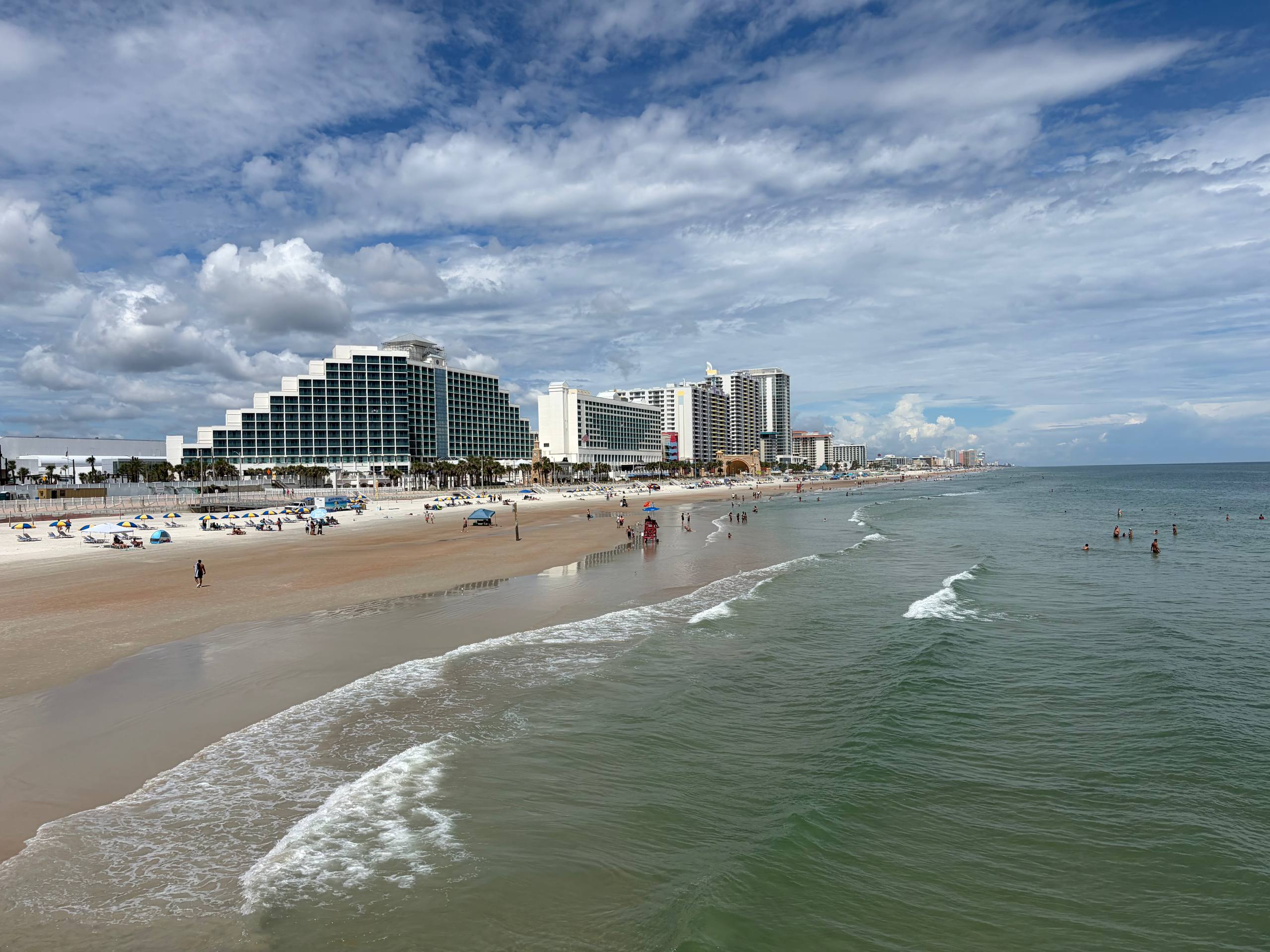
DAYTONA BEACH, Fla. — Daytona Beach still sells the same three promises that put it on postcards: a hard-packed Atlantic strand you can drive, a 2.5-mile speedway that opens and closes NASCAR’s season, and motorcycle rallies that refill hotels when the rest of Florida is waiting on winter.
The city of about 91,900 people on Florida’s Volusia County coast is growing fast — estimates put the 2026 population near 91,916, up more than 27 percent from the 2020 census count of 72,283 — but the brand has not changed. Visitors still call it the World’s Most Famous Beach. Locals still argue about whether cars belong on that sand. And the calendar still turns on engines.
Beach driving is the first fact most first-timers get wrong. Pedestrians and cyclists can use the sand around the clock when tides and weather allow. Vehicles cannot. Volusia County lets cars onto marked lanes from sunrise to sunset from Nov. 1 through April 30, and from 8 a.m. to 7 p.m. from May 1 through Oct. 31, the sea-turtle nesting window. The posted limit is 10 mph. Headlights stay on. At least one front window stays down. Passing is forbidden. Alcohol and glass are banned. Pets are not allowed except service animals. Daily visitor driving passes have been listed at $30 a vehicle; annual visitor permits at $150. Ramps close when tides run high. County Beach Safety, not a travel blog, has the last word.
That tradition is also the loudest local fight. Sheriff Mike Chitwood said last year 1.37 million vehicles used Volusia beaches. He said vehicles hit people twice last year and four times this year, two of them fatal, including a toddler at New Smyrna Beach who ran from between parked cars. “That person was doing everything that we asked you to do — speed limit, window down, lights on, no radio, no texting — and never saw the toddler run out in front of the car,” Chitwood said. He has argued the mix of heavy cars and small children is a risk the county has been lucky to carry. The practice survives because it is identity as much as transportation. Only a handful of Florida beaches still allow it.
Advertisement
The second engine is Daytona International Speedway. The 68th Daytona 500 on Feb. 15 sold out for an 11th straight year. The speedway said about 150,000 people were on the property for race day and about 450,000 across Speedweek. Tyler Reddick won; 25 drivers led at least one lap, a race record; the purse topped $31 million. In January the Rolex 24 At Daytona drew what IMSA called record weekend attendance above 180,000. Track president Frank Kelleher, speaking later in the year ahead of the Coke Zero Sugar 400, said, “It all comes to a head at Daytona, where we start the regular season and now end it,” and, “I wake up every day motivated to go earn it.” The oval sits west of the shore on International Speedway Boulevard. On race weekends it is the city’s extra downtown.
Motorcycles are the third engine. Official Bike Week in 2026 ran Feb. 27 through March 8. Using geofencing for the first time on the March event, the city counted 423,300 unique visitors across three zones over 10 days, according to figures reported from that tracking. City Economic and Strategic Opportunities Director Jeff Brown said, “Visitor numbers aren’t going to be exact, but it’s a start and better than a wild guess.” The next date on the same circuit is the 34th Biketoberfest, Oct. 15-18. Lori Campbell Baker, executive director of the Daytona Beach Area Convention and Visitors Bureau, said, “Biketoberfest has become one of our signature annual events and a tradition that motorcycle enthusiasts look forward to every year. Whether you’re visiting for the first time or making your annual return, there’s something special about experiencing the camaraderie of all attendees, our scenic coastal roads, and the energy throughout the destination.” Typical estimates put the October rally near 100,000 people — smaller than Bike Week, easier to ride. Main Street, A1A and the Ormond Scenic Loop are the advertised roads. Two new Marriott-brand hotels were expected to open ahead of the fall dates.
The boardwalk and Main Street Pier remain the postcard strip between those weekends. Spring break still arrives. So do families who never sit in a grandstand. The city is not only a party town. Embry-Riddle Aeronautical University and Bethune-Cookman University give the place a year-round student population that does not show up in tourism ads. Median household income estimates sit near $52,000, with a poverty rate near 20 percent — a reminder that the beach economy and the residential city are not the same paycheck.
Traffic on the beachside streets is the next fight after sand driving. In early September the City Commission took up a proposal to convert one-way streets between Seabreeze Boulevard and International Speedway Boulevard to two-way traffic, a change business owners said could help tourists find bars and shops that suffered when the grid became a maze. Mayor Derrick Henry and commissioners scheduled public comment at Peabody Auditorium. Some of those roads sit on state right of way, which means Florida DOT, not only City Hall, would have to sign off.
Advertisement
Conservation sits under all of it. Driving is banned west of the marked dune line. Night lighting rules exist because hatchling turtles crawl toward the brightest horizon. Disturbing nests or dune plants can bring fines. Surf zones are marked in peak hours. Officials tell swimmers to stay in front of a lifeguard. Those are not slogans. They are the conditions that keep the driving lanes open at all.
What a visitor needs, then, is a short list that is also the city’s whole pitch. You can walk the beach at 2 a.m. and not drive it. You can pay $30 and roll at 10 mph if the ramp is open. You can sit among 150,000 people for a 500 and among a few hundred thousand more for Bike Week. You can come back in October for four days of motorcycles when the humidity finally drops. You can hit a university town that still has a 20 percent poverty rate. You can watch commissioners argue about two-way streets while the sheriff argues about cars on sand. You can treat Daytona as a race, a rally or a beach. The place is built to be all three at once, and that is why the crowds keep coming even when the rules get tighter and the ramps close with the tide.
Janus Henderson Investors exists to help clients achieve their long-term financial goals. Formed in 2017 from the merger between Janus Capital Group and Henderson Global Investors, we are committed to adding value through active management. For us, active is more than our investment approach – it is the way we translate ideas into action, how we communicate our views and the partnerships we build in order to create the best outcomes for clients. While our investment managers have the flexibility to follow approaches best suited to their areas of expertise, overall our people come together as a team. This is reflected in our Knowledge. Shared ethos, which informs the dialogue across the business and drives our commitment to empowering clients to make better investment and business decisions.www.janushenderson.com
The Cardiff-based firm has struck a three year partnership deal with the governing body
16:48, 07 Sep 2026Updated 16:55, 07 Sep 2026
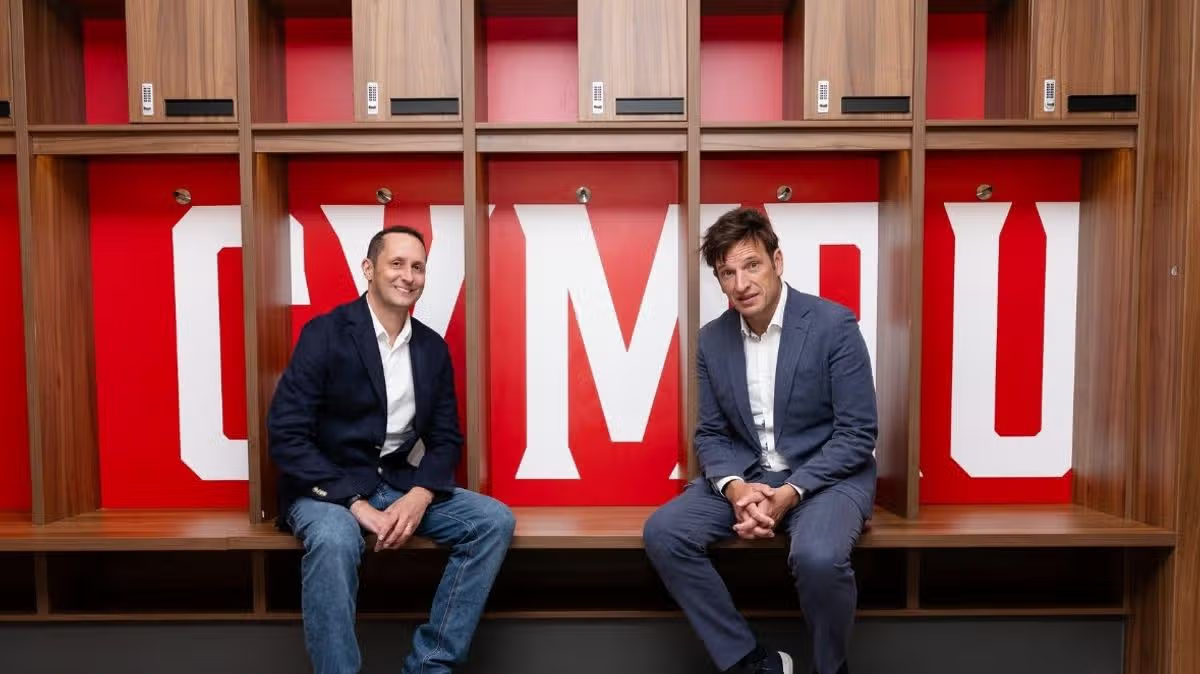
Andrew Kays chief executive of Socura and chief executive of the FAW Noel Mooney
Socura has been appointed the official cybersecurity partner of the Football Association of Wales .
The Cardiff-based firm will protect the critical systems, sensitive data and digital services of the FAW – spanning 822 affiliated clubs, 120,000 playing participants, and hundreds of thousands of fans from grassroots football to the national team.
Advertisement
It also follows a major digital transformation project at the FAW, which now has a range of digital services that connect players, coaches, referees, clubs and supporters.
Under the three-year partnership, Socura will also work alongside the FAW to raise awareness of cyber resilience through digital content, educational initiatives and collaborative campaigns .
Wales will be a co-host nation of the Euro 28 men’s tournament with games played at the Principality Stadium, including the opening game.
Andrew Kays, chief executive of Socura, said: “Welsh football is entering one of the most exciting chapters in its history. From the continued growth of the women’s game and the evolution of the domestic pyramid to the arrival of UEFA Euro 2028, football in Wales has never had greater momentum.
Advertisement
“Technology now underpins almost every aspect of the modern game. It connects supporters, enables competitions, supports clubs and helps develop players. Protecting those digital services has become fundamental to the future of football.
“We’re incredibly proud that the FAW has chosen Socura as its official cyber security partner. It’s a partnership between two ambitious Welsh organisations committed to excellence, innovation and representing Wales on the international stage. Together, we’ll help ensure Welsh football can continue to grow with confidence, knowing its digital infrastructure is protected around the clock.”
FAW chief executive, Noel Mooney, said: “Football today depends on technology more than ever before. From supporting grassroots clubs and volunteers to delivering international fixtures and engaging supporters across Wales and beyond, secure digital services are essential to everything we do.
“As we continue investing in the future of Welsh football and expanding our digital capabilities, partnering with Socura strengthens our ability to protect our people, our systems and our data.
Advertisement
“We’re delighted to be working with another leading Welsh organisation that shares our ambition to deliver excellence and innovation on and off the pitch.”
Copper prices hit a record high on Monday as the prospect of shortages outside the U.S. fuelled buying, while a softer dollar further supported positive sentiment, according to a Reuters report.
Traders said volumes were likely to remain muted due to a U.S. holiday, with attention focused on copper and zinc.
Benchmark copper on the London Metal Exchange touched a record high of $14,533 a metric ton, surpassing its previous all-time peak of $14,527.50 reached in January. It later pared gains slightly to $14,518 by 1515 GMT, up 0.7%.
Traders and producers have been shipping large volumes of copper to the U.S. since President Donald Trump first mooted import tariffs in February last year. Comex copper stocks currently stand at a record 766,795 short tons, or 695,624 metric tons.
Live Events
“It’s hard to know what will happen on tariffs, but the longer there is uncertainty, the longer prices will remain elevated as material flows to the U.S.,” Albert Mackenzie, an analyst at Benchmark Mineral Intelligence, told Reuters. Elevated premiums, or backwardations, for nearby contracts over longer-dated forwards have encouraged some copper to flow back to the LME.However, cancelled warrants, which represent metal earmarked for delivery, stood at 51%, indicating that more than 121,000 tons of copper is likely to leave the LME system over the next few weeks.
The premium for cash copper over the three-month forward contract climbed above $430 a ton in the middle of August, its highest level since 2021. It closed at around $74 on Friday.
Another indication of tightening supplies outside the U.S. is the level of stocks in warehouses monitored by the Shanghai Futures Exchange. Inventories stood at 63,000 tons, down 85% since the middle of March and at their lowest level since January 2024.
Copper prices on the SHFE are also in backwardation, suggesting that the industry in top consumer China is increasingly concerned about supplies.
Advertisement
Elsewhere, zinc gained 1.1% to $3,988 a ton, supported by tight supplies, after touching its highest level since May 2022 at $3,998.
A weaker U.S. currency, which makes dollar-priced metals cheaper for holders of other currencies, provided broader support to base metals.
Aluminium rose 0.7% to $3,315 a ton and tin added 0.4% to $55,100, while nickel slipped 0.7% to $16,725 and lead declined 0.3% to $1,903.
(Disclaimer: This article is based on inputs from agencies. These do not represent the views of The Economic Times)
Good afternoon since it is almost 12:00 afternoon, not morning. It’s not a very good morning in Johannesburg. I don’t think we like presenting results unless the sun is shining. But welcome to everybody who’s taken the trouble to come and join us at the JSE today. Thank you and also to everybody online.
These are our results for the 30th of June 2026. We’ve got a pretty normal presentation. Key features and results history, I think I’ll cover. Justin will talk to you about some of the more detailed group financial numbers, and then we’ll go into the performance and prospects and then take questions. It’s certainly a tale of 2 halves. The first semester was much stronger. Second was much more challenging. Certainly, from February onwards, steep price increases in energy — and certainly, quarter 4 of the second semester was particularly challenging from a sales point of view where we saw a market slowdown with respect to anxieties with our wholesale and distribution channel.
So revenue only increasing by 1.4%, some leverage, 4.4% at the operating profit level, but strong protection of the margins across the portfolio, and we’ll go into some of that in more detail. Pretty tough semester, particularly the second semester with creamer, but still a very, very strong results, but a lot more competitive than the prior year.
Tesla Tells Cybercab Riders to Talk to Grok for Climate, YouTube, Music and Destination Changes
AUSTIN, Texas — Tesla’s official Robotaxi account said riders can run a Cybercab cabin by talking to Grok, amplifying a passenger video that showed climate, video and music changing without a finger on the screen.
“Talk to Grok to control your Cybercab,” the @robotaxi account posted on Sept. 6, quoting Owen Sparks, who had written: “Cybercab has some pretty in-depth Grok integration, so for many actions, you never have to touch the screen. You can just use natural language to control the climate, YouTube, Music, and it will even send a notification to your phone so you can easily edit your destination.”
The post did not list a software version, a city-by-city rollout or a claim that every Austin Cybercab already behaves that way. It did put Tesla’s own stamp on a feature that matters in a car with no steering wheel and no pedals: if no one is driving, the cabin has to work like a lounge, not a cockpit.
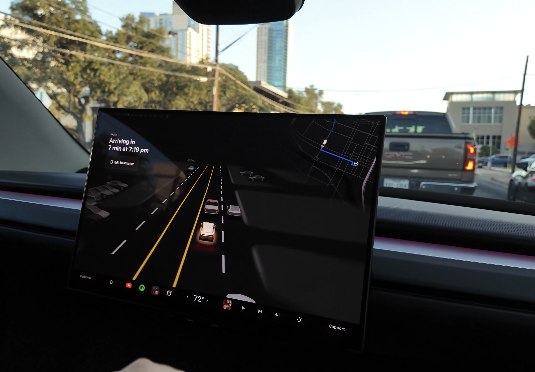
Sparks’s clip, about three and a half minutes long, shows the production two-seater moving through Austin traffic while a large landscape display handles the trip. The visualization puts the Cybercab on a digital roadway with other vehicles. On-screen copy tracks an arrival window measured in minutes. A Grok chip sits in the interface. The rider opens YouTube and Apple Music, adjusts climate settings labeled low, medium and high, and later holds a phone showing an “Edit Dropoff” card for the Courtyard by Marriott Austin Downtown Convention Center, with a fare near $26. Buttons visible on the bar include Pull Over and Support.
Voice control is not a new Tesla idea. It is new as the public pitch for this body style. In Tesla’s 2026 Summer Update notes the company wrote that Grok “can now make phone calls, search and play music, adjust climate, open the glovebox, and answer questions about your Tesla.” Tesla also said the summer release uses “Grok Think Fast 2.0.” In privately owned cars with the right infotainment hardware, testers have described chained commands — climate, wipers, seat heaters — in one spoken sentence. Cybercab applies that stack to a cabin where there is no driver to reach a stalk or a wheel.
The destination piece is the one that crosses from entertainment into the trip itself. Sparks said Grok can push a notification to the rider’s phone so the drop-off can be edited there. The video shows the phone card, not the car rewriting the route from the cabin screen alone. That split is practical. Tesla’s robotaxi service is geofenced. Changing an address mid-ride is a billing and routing event as much as a voice trick. The phone remains the booking tool. Grok becomes the hands-free remote for comfort and media.
Musk has sketched a deeper layer that the Robotaxi post does not claim is live. Asked in June about talking to Grok “like we can with an Uber driver,” he wrote that “this functionality will be there in about 3 months or so.” He said Tesla would eventually have “fully integrated voice control commands that can control the vehicle,” but that it was “just a bit too early for that.” Three months from late June lands near this launch window. The official Cybercab line still describes cabin control — climate, YouTube, music, a phone ping for the pin — not “turn right here” as a spoken override of the driving stack.
That distinction matters to regulators and to riders. A voice that lowers the temperature is an amenity. A voice that changes lanes on command is a driving control. Cybercab’s Rider Guide still centers the in-cabin screen for trip functions and a stop or pull-over control that brings the car to a safe stop and connects the passenger to support. Tesla has also said riders will be able to plug in a PlayStation or Xbox and has teased theater, music, gaming and later Starlink connectivity. A reply under the Robotaxi post asked for TIDAL HiFi and Spotify Lossless because the car has “Starlink onboard + great sound system.” Tesla did not answer in that thread.
Advertisement
The commercial context is still small. Paid Cybercab trips are Austin-only. Tesla’s Model Y robotaxis run in additional Texas and Florida markets. The company has not posted a Cybercab expansion calendar or a consumer MSRP. Musk has previously said the car should cost under $30,000 and that Tesla would sell units to customers, not only operate them. The September event did not confirm either number. Ashok Elluswamy, Tesla’s head of AI software, posted last month that “the streets won’t be the same anymore.” Asked whether Cybercabs would flood Austin, Musk replied, “Yes.” Forty-five registered cars and a voice demo are not a flood.
They are, however, a consistent software strategy. Tesla wants the same assistant in a Model Y glovebox command and in a robotaxi that has no glovebox driver. Grok already lives in Tesla cars as a chatbot with a “Hey Grok” wake word. The summer notes extended it into calls and climate. Cybercab is the first vehicle where talking to that assistant is not a convenience for a person who is also steering. It is the intended way to live in the cabin for the length of a $26 downtown hop.
What Tesla has not published is a reliability rate for those spoken commands in the robotaxi fleet, or whether every public Cybercab in Austin is on the same Grok build Sparks filmed. Community tests of the summer update in regular Teslas found mixed hit rates on long command lists. A robotaxi ride is shorter and the command set Sparks named is smaller: temperature, YouTube, music, a destination edit on the phone. That is an easier demo than “drive like my usual Uber.”
The company that posted “Talk to Grok to control your Cybercab” is the same company asking riders to trust a car with no wheel. The sentence is marketing. It is also an accurate description of the cabin Tesla showed: a screen that can stay dark while a voice changes the climate, a phone that still owns the pin, and a two-seat car that keeps moving through Austin whether anyone touches glass or not.


















































You must be logged in to post a comment Login