
Crypto World
Joe Biden’s Son to Launch Memecoin, Will Send to TRUMP Holders: WSJ

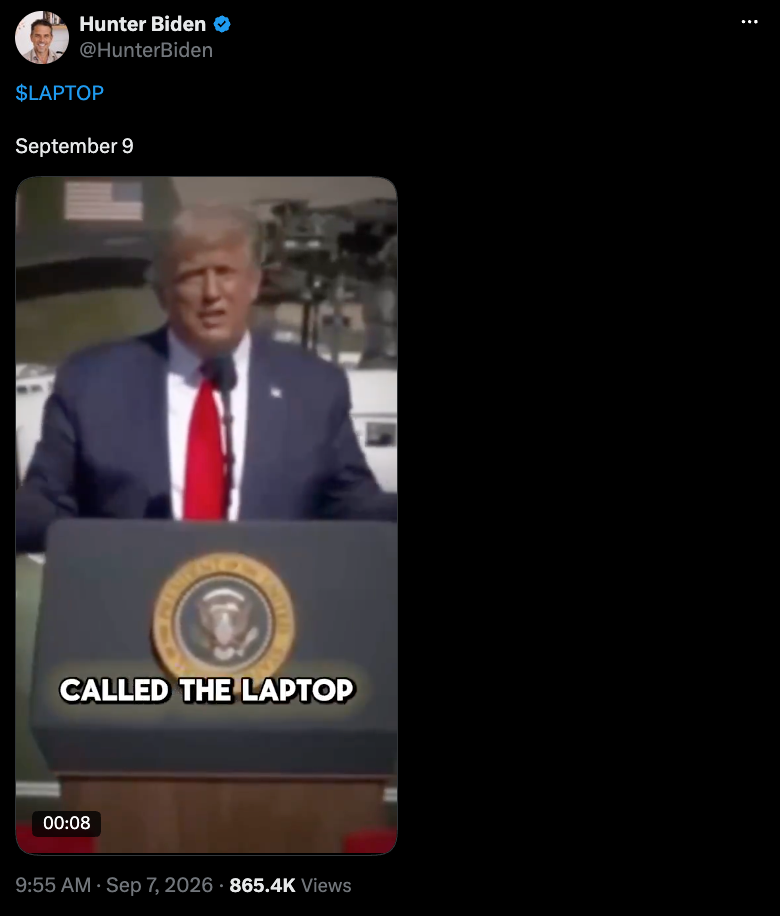
Hunter Biden, son of former US President Joe Biden, announced that he plans to launch a memecoin based on the reports of his infamous laptop, which has been subject to intense media scrutiny.
In a Monday announcement on X, Hunter Biden posted the memecoin’s ticker symbol, $LAPTOP, signaling a Wednesday launch. The Wall Street Journal reported that Biden would send 20% of the one-billion token supply to substack subscribers, members of a mailing list and investors in President Donald Trump’s memecoin, Official Trump (TRUMP), whose value has dropped by about 97% since reaching an all-time high price in January 2025.
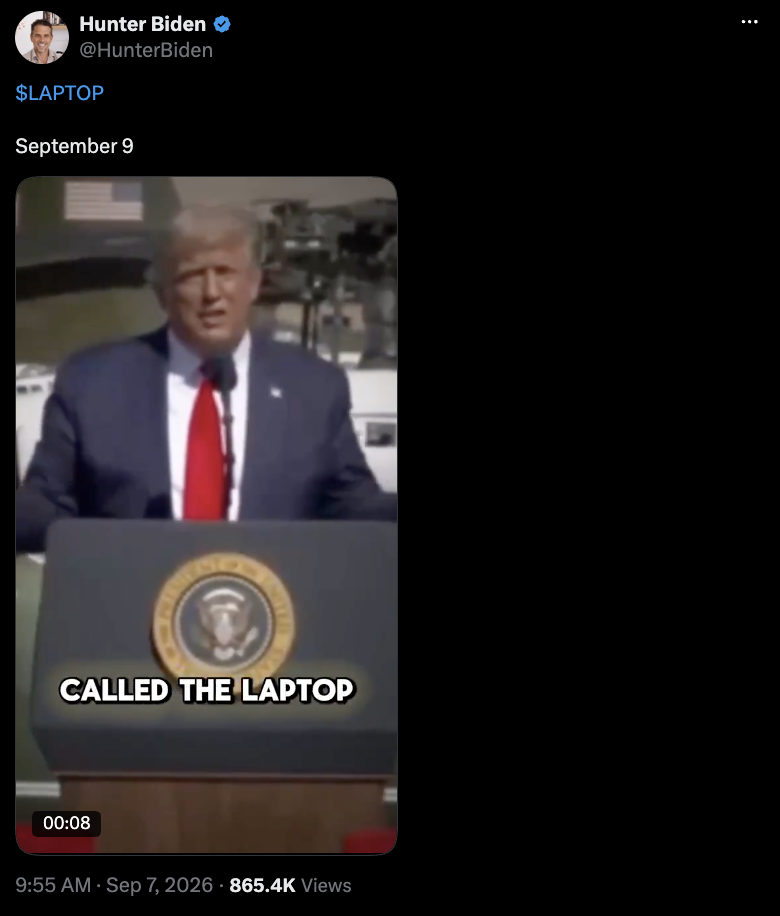
Source: Hunter Biden
The basis for the memecoin’s namesake is Biden’s computer, whose existence and contents were subject to scrutiny before the 2020 election, in which his father was running against Trump. The laptop continues to be invoked by many right-wing media figures and was the subject of two lawsuits filed by Biden over privacy laws.
Since his father left office in January 2025, Biden has stepped up his rhetoric on crypto and blockchain, specifically criticizing the Trump family’s entanglements with the industry through its World Liberty Financial business.
In August, he called World Liberty “corruption at a scale we’ve never seen,” comparing its business practices with those of defunct crypto exchange FTX and pointing to its ties to foreign governments like the UAE. Biden also said in June that “decentralized digital currency and the blockchain are the inevitable future.”
Related: Real Trump Coins denies launching GOLD token, blames ‘bad actors’
The LAPTOP founders, holding 30% of the token supply, will reportedly burn up to 30% of the memecoins depending on the outcome of events, including a Democrat winning the presidency in 2028, the price of Bitcoin (BTC) reaching an all-time high and LAPTOP’s fully diluted value exceeding TRUMP’s.
CLARITY Act vote set for later this month
The LAPTOP memecoin, if launched as planned, could shine more of a spotlight on Trump’s crypto ventures at a time when lawmakers in Congress are considering a comprehensive market structure bill to regulate the digital asset industry. The Digital Asset Market Clarity Act, also known as the CLARITY Act, is scheduled for a cloture vote in the Senate on Sept. 15.
Cointelegraph reached out to the White House for comment but did not receive an immediate response.
Magazine: Who is legally liable when an AI agent goes rogue?

The UK’s Financial Conduct Authority (FCA) reportedly has reached out to prediction market companies as part of discussions over whether the regulator would loosen a ban for retail investors, in place since 2019.
According to a Friday report from The Times, the FCA is weighing lifting a ban on prediction market platforms like Polymarket and Kalshi for UK-based retail investors. Because prediction markets offer binary options on event contracts, such as for sports, politics and the weather, they fall under an April 2019 ban imposed by the FCA, in which companies were “prohibited from selling, marketing or distributing binary options to retail consumers.”
“Binary options are gambling products dressed up as financial instruments,” said the FCA’s executive director of strategy and competition, Christopher Woolard, at the time of the ban.
According to The Times report, many retail investors based in the UK have been using virtual private networks (VPNs) to bypass the country’s restrictions on prediction markets and execute trades on Kalshi and Polymarket, both with operations in the US. Bernstein Research speculated in April that the total prediction market industry could rise to about $240 billion in trading volume in 2026 and $1 trillion in 2030.
Should the FCA overturn the 2019 ban, prediction market platforms like Kalshi and Polymarket could face similar challenges as they are dealing with in the US, where individual state gaming authorities are filing lawsuits against the companies over sporting event contracts. Last week, New Jersey officials petitioned the Supreme Court to hear its case against Kalshi, potentially leading to clarification between state and federal authorities over prediction markets.
Related: Kalshi issues first lifetime ban for Republican politician over insider bets
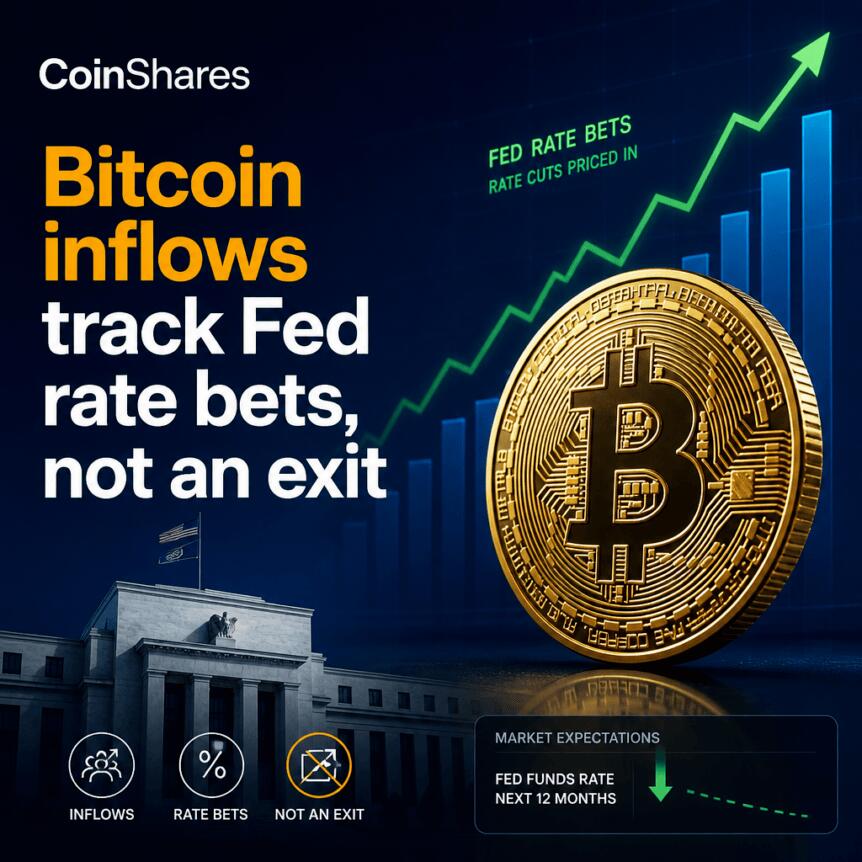
Crypto investment flows are increasingly reacting not to crypto-specific news, but to shifts in the US interest-rate outlook. CoinShares said this week that the Federal Reserve remains a major constraint on Bitcoin’s ability to decisively break above the psychologically important $80,000 level—even as inflows show investors are still willing to hold the asset.
In a market update released on April 9, 2026, CoinShares head of research James Butterfill argued that Bitcoin is beginning to trade “like gold again,” but that monetary policy is still effectively placing a ceiling around $80,000.
Key takeaways
- CoinShares links recent crypto flow swings to changes in the Fed’s perceived path for rates rather than to new crypto catalysts.
- Following remarks from Fed Chair Kevin Warsh at Jackson Hole, about $100 million left digital asset investment products as markets raised expectations for a September rate hike.
- Flows reversed over the next week, reaching roughly $1 billion by Sept. 4, coinciding with signals from Fed Governor Christopher Waller that he could support holding rates steady in September if inflation data continues to improve.
- Fed Funds futures priced near a 60% chance of a rate hike after the Sept. 4 period, according to CME Group’s FedWatch tool.
- CoinShares’ rate sensitivity comes as US Treasury plans to increase long-dated buybacks aim to support broader liquidity conditions that have historically helped risk assets.
Why the “rate path” matters for Bitcoin
CoinShares’ central message is that investor behavior is not necessarily moving away from crypto; instead, it is reacting to the market’s evolving assumptions about the Fed. Butterfill’s comment that “investors are not exiting the asset class… they are trading the rate path” frames the recent pattern: when expectations for tightening rose, money flowed out; when the odds shifted toward steadier policy, inflows returned.
The immediate catalyst for that sensitivity came after Fed Chair Kevin Warsh’s Jackson Hole remarks. Warsh said progress on inflation had been modest and that price pressures were not easing quickly enough to give the central bank confidence inflation was moving back toward its 2% target. CoinShares reported that roughly $100 million exited digital asset investment products right after the speech as markets quickly increased the probability of a September rate hike.
That “risk-off to risk-on” reversal underscores how marginal changes in liquidity expectations are influencing crypto positioning. Easier financial conditions have historically been supportive for Bitcoin and other risk assets, and CoinShares’ analysis suggests the market is currently treating the Fed as the primary driver of that liquidity impulse.
From Jackson Hole to September: inflows rebound
CoinShares said flows improved after the initial post–Jackson Hole reaction. Over the following week, inflows reached about $1 billion by Sept. 4, indicating investors were willing to return once the probability of further tightening appeared less aggressive.
This rebound coincided with comments from Fed Governor Christopher Waller. According to the same CoinShares discussion, Waller highlighted recent signs of “disinflation” and indicated he was inclined to keep rates steady in September if upcoming inflation data continued showing progress. For traders and fund managers, this kind of language matters because it shifts how quickly the market expects policy to change—and those expectations often translate into broader moves in yields and risk appetite.
As of Monday, CoinShares pointed to data from CME Group showing Fed Funds futures implied about a 60% chance of a rate hike after the next FOMC meeting. The implication is straightforward: Bitcoin’s performance around key technical levels like $80,000 may remain vulnerable to any sudden repricing of the probability distribution around September’s decision.
Liquidity signals beyond crypto: Treasury buybacks
CoinShares’ interest-rate focus comes alongside a separate, potentially supportive liquidity backdrop. The firm’s assessment is occurring after the US Treasury announced plans to double certain long-dated bond buybacks—from $2 billion to $4 billion per operation—aimed at increasing demand for Treasurys over a defined window.
Cointelegraph reported that Bitcoin rose from the low $60,000s to above $80,000 during last month’s advance. The buyback program is expected to run from Sept. 9 through Nov. 4, spanning multiple weeks into the period when markets will be re-evaluating the Fed’s stance and inflation trajectory.
One way to interpret this overlap is through portfolio behavior. As noted in an excerpt from 21Shares co-founder Ophelia Snyder’s Substack newsletter, the Treasury announcement was accompanied by equity sell-offs and shifts across the yield curve, with other macro noise—such as developments related to the Iran conflict and how markets interpreted diplomatic prospects—adding volatility to oil and equity pricing.
Snyder argued that, taken together, these factors point to the rally having “less to do with crypto-specific catalysts” and more to do with investors adjusting de-risking exposure specifically to the US. Whether or not that interpretation proves entirely correct, it aligns with CoinShares’ broader theme: investors are sensitive to the macro transmission mechanism that affects liquidity and relative asset attractiveness.
Standard Chartered has also forecast that Bitcoin could reach $100,000 before year-end, as cited in earlier coverage that framed the bond-buyback backdrop as part of the broader driver set for liquidity and risk positioning.
What to watch next as pricing tightens
The practical takeaway for market participants is that Bitcoin’s near-term trading behavior may continue to track rate expectations more than it tracks internal crypto fundamentals. Investors should watch how quickly Fed-related odds change heading into the September decision—especially since CoinShares’ flow data suggests sudden repricing can move money rapidly into or out of digital asset investment products.
At the same time, the Treasury buybacks schedule starting Sept. 9 through Nov. 4 will be a parallel factor that could influence broader liquidity conditions. The key question is whether incoming inflation and Fed signals reinforce steadier policy expectations—or force another shift in the rate path that crypto flows have shown they are willing to respond to immediately.


Polish prosecutors have charged Roman Ż., a former business partner of missing BitBay founder Sylwester Suszek, with two offenses as the Zondacrypto investigation expands beyond 3,600 customer complaints.
Summary
- Roman Ż. is at least the fifth person charged in the Zondacrypto investigation.
- One charge concerns alleged fraud, while prosecutors have not disclosed the second offense.
- Customers face estimated losses of at least 350 million zlotys, or about $94 million.
- A court will decide whether Ż. remains in custody during the investigation.
Zondacrypto suspect faces two charges
According to a report published Monday, Roman Ż. was arrested on Saturday in Poland’s Silesia region before being taken to the National Prosecutor’s Office branch in Katowice for questioning.
Prosecutors charged him with two offenses, including fraud, according to his lawyer, Błażej Gazda. Authorities have not publicly described the second allegation or released a detailed account of the evidence supporting either charge.
Ż. denied the allegations and gave investigators an extensive statement, Gazda said. His lawyer described him as a former business partner of Suszek who helped manage BitBay before the exchange changed its name to Zonda in 2021.
During searches at the arrest location and Ż.’s registered address, officers seized valuable watches and documents tied to Zondacrypto’s operations. Poland’s Central Bureau for Combating Cybercrime and the Katowice regional police took part in the operation, according to the National Prosecutor’s Office.
Prosecutors ordered the arrest after learning that Ż. planned to travel to China, which they viewed as grounds for a flight risk. Gazda said the planned journey was a business trip and that his client had a return ticket dated Sept. 13.
Polish prosecutors intend to seek pretrial detention while the investigation continues. A court must decide whether the evidence and stated flight risk justify keeping Ż. in custody.
Exchange losses are estimated at $94 million
Founded by Suszek in 2014, BitBay developed into one of Poland’s best-known cryptocurrency exchanges before adopting the Zondacrypto name in 2021. The platform reported having more than 1 million registered users around the time of the rebrand.
Problems became public in early 2026 when customers began reporting delayed or frozen withdrawals. Zondacrypto acknowledged payment delays affecting some users in late February and suspended Bitcoin deposits on March 17, citing market volatility.
The exchange stopped trading in April, while its website went offline on April 23. Available market trackers later showed no active Zondacrypto trading pairs or reported trading volume, and the company-linked ZND token lost almost all of its value.
As crypto.news previously reported, prosecutors estimated customer losses at more than 350 million zlotys, equivalent to approximately $94 million at the reported exchange rate. The figure is considerably higher than the 35 million zlotys cited in some early accounts of the case.
Polish authorities opened their investigation in April over suspected large-scale fraud and money laundering. By June, prosecutors had received more than 3,600 complaints from customers who said they could not recover assets held on the platform.
Investigators have frozen €4 million held in one bank account, according to local media reports. Authorities have also secured more than 100 million zlotys in assets that could potentially support compensation claims, although no repayment process or final distribution has been announced.
The Estonian Financial Intelligence Unit initially restricted the license of BB Trade Estonia OÜ, the legal entity behind the exchange, preventing it from accepting new customer assets. A previous report said the regulator revoked the company’s operating license on June 29 after the earlier suspension.
Suszek disappearance forms part of the investigation
Suszek disappeared on March 10, 2022, after travelling to a meeting in Czeladź, Poland. He had left his executive position before Zondacrypto’s collapse, but authorities continue to examine events surrounding BitBay’s creation and early operations.
In August, prosecutors combined the Zondacrypto criminal investigation with the inquiry into Suszek’s disappearance. Authorities said information about BitBay’s management, ownership and financial activity could help investigators establish what happened to its founder.
Suszek’s family reportedly received messages claiming that he had been kidnapped and that the people responsible wanted a Bitcoin payment. Publicly available information has not established whether the messages were genuine, and no court has determined what happened to him.
Roman Ż. is at least the fifth person to face charges after prosecutors joined the two investigations. His past business relationship with Suszek and his reported role in managing BitBay place his activities within the period now being examined by investigators.
In a separate case dating to 2019, prosecutors accused Ż. of leading an organized criminal group and laundering 28 million zlotys through BitBay accounts, according to Polish news outlet Interia. The allegation relates to separate proceedings and has not been presented as proof of the charges filed in the Zondacrypto case.
Other Zondacrypto suspects remain under investigation
Ż.’s detention followed a series of arrests involving people allegedly connected to the exchange. Police detained stock-market investor Rafał Z., Jaromira W., and Anna P. during the previous week, and a court later approved their continued detention. All three denied the alleged offenses, according to local reports.
Polish Olympic Committee President Radosław Piesiewicz has also been charged with paid influence and favoring one group of Zondacrypto creditors over others while the exchange was approaching insolvency.
An Aug. 27 report on Piesiewicz said investigators were examining whether he received advance information that allowed him to withdraw his entire investment while other customers could not access their funds. Piesiewicz denied receiving preferential treatment and described himself as a victim of the platform.
The second allegation against Piesiewicz concerns a claim that he offered to use his contacts to help Zondacrypto address problems involving Poland’s Office of Competition and Consumer Protection. Investigators have also examined a €40,000 Patek Philippe watch allegedly purchased by former Zondacrypto chief Przemysław Kral before a meeting with Piesiewicz in Monaco.
Neither Piesiewicz nor Roman Ż. has been convicted in the Zondacrypto proceedings. Their legal status remains that of suspects while prosecutors collect evidence and the courts consider detention requests.
Poland’s crypto rules remain disputed
The case has entered Poland’s debate over how the country should apply the European Union’s Markets in Crypto-Assets framework. Proposed domestic legislation would have made the Polish Financial Supervision Authority, known as the KNF, the national supervisor for crypto companies.
On Sept. 4, Poland’s lower house fell 25 votes short of overriding President Karol Nawrocki’s third veto of the bill. The Poland crypto bill vote ended with 241 lawmakers supporting the override, 198 opposing it and three abstaining, below the 266 votes required.
Prime Minister Donald Tusk referred to testimony from the Zondacrypto investigation while urging lawmakers to support the legislation. Nawrocki has said he favors rules against fraud and financial crime but considers the government-backed proposal too restrictive for legitimate crypto businesses.
For U.S. users, the Polish criminal case and licensing dispute do not change access to American exchanges, spot crypto exchange-traded funds, or other U.S.-regulated investment products. The proceedings concern alleged conduct tied to a Polish-run, Estonian-registered exchange and enforcement actions taken by European authorities.
MiCA already applies across the European Union, with national regulators responsible for licensing, supervision and enforcement. Its transition period ended on July 1, leaving firms without authorization subject to service restrictions or an orderly closure.
Crypto World
Exclusive Abu Dhabi F1 Hospitality Experience Now Available for Crypto Executives, Investors and VIP Guests

The Formula 1 Abu Dhabi Grand Prix is one of the most anticipated events on the UAE calendar, bringing together motorsport, luxury, business and entertainment at Yas Marina Circuit.
For the 2026 season finale, Crypto Breaking News and Web3 Digital can now provide access to an exclusive Sunday hospitality experience at the W Garage Terrace at W Abu Dhabi – Yas Island, designed for executives, investors, entrepreneurs, corporate guests and VIP clients looking to experience Formula 1 from a premium setting.
Located directly alongside the circuit, the W Garage Terrace offers an exceptional race-day environment combining close-up Formula 1 action with premium hospitality, networking and the distinctive atmosphere of Yas Marina.
Experience the Abu Dhabi Grand Prix from the W Garage Terrace
The W Garage Terrace offers an open-air vantage point overlooking Turns 12 and 13, placing guests close to the action while providing views across Yas Marina and its iconic superyachts.
The experience has been designed to combine the excitement of the Formula 1 season finale with a more intimate and sophisticated hospitality environment, making it particularly suitable for corporate entertainment, client engagement and private networking.
What the Experience Includes
- Exclusive Sunday access to the W Garage Terrace at W Abu Dhabi – Yas Island
- Premium views of the Formula 1 action around Turns 12 and 13
- Dedicated terrace and lounge seating
- Premium international dining throughout the experience
- Champagne service and premium beverages
- Curated social and networking areas
- Live entertainment and DJ sets
- Access to the unique W Abu Dhabi atmosphere during race weekend
- Post-race concert access, depending on the applicable ticket category
A Premium Setting for Business and Networking
The Abu Dhabi Grand Prix has become much more than a motorsport event. Every year, it attracts international entrepreneurs, investors, executives, celebrities and decision-makers to Abu Dhabi for one of the region’s most important lifestyle and networking weekends.
For companies operating in crypto, Web3, fintech, trading, investment and digital assets, premium Formula 1 hospitality can also provide an alternative environment for building relationships with clients and partners outside the traditional conference setting.
The experience can be particularly suitable for:
- Crypto exchanges and trading platforms hosting VIP clients
- Web3 and fintech companies entertaining partners or executives
- Private investors and high-net-worth individuals
- Corporate leadership and incentive programmes
- Family offices and investment companies
- International founders and entrepreneurs visiting the UAE
- Brands looking for premium client-engagement experiences
Corporate and Group Hospitality
Companies interested in bringing multiple guests can also request tailored corporate and group arrangements.
Depending on the size of the group and specific requirements, additional services and hospitality elements can be arranged to create a more personalised experience for clients, executives or strategic partners.
For larger corporate requirements, bespoke options can be explored individually based on availability.
More Than Just a Formula 1 Ticket
This experience is designed for guests looking for more than simply attending the race.
The combination of premium track views, hospitality, dining, entertainment and networking creates an opportunity to experience the Abu Dhabi Grand Prix from one of Yas Marina’s most distinctive locations.
Previous editions of the Garage Terrace experience have welcomed hundreds of guests, combining premium race viewing with elevated dining, free-flowing beverages and the atmosphere of the Formula 1 finale at Yas Marina.
Limited Availability for Abu Dhabi F1 2026
Hospitality inventory for the Abu Dhabi Grand Prix is limited and availability can change quickly as the race weekend approaches.
For this reason, current availability must be confirmed before any booking can be finalised.
Pricing is available privately upon request.
Individuals, companies and corporate groups interested in the W Garage Terrace experience can contact us directly with the number of guests and any specific hospitality requirements.
Premium Access to Other Global Sporting Events
Through our international hospitality network, Web3 Digital and Crypto Breaking News can also assist clients looking for premium access to other major sporting and live entertainment events worldwide.
Opportunities can include Formula 1 Grand Prix weekends, Grand Slam tennis, international football, major cricket events, concerts and bespoke VIP experiences.
If you are planning to attend a major international event and are looking for premium hospitality or hard-to-access experiences, our team can check available options based on your requirements.
Request Abu Dhabi F1 Hospitality Availability
To request current availability, private rates or corporate hospitality options for the 2026 Formula 1 Abu Dhabi Grand Prix, contact:
Web3 Digital / Crypto Breaking News
Email: hello@web3digital.ae
Website: www.web3digital.ae
Availability and hospitality options are subject to confirmation at the time of booking.

Tokenized versions of SPY, Google, and Robinhood’s own stock led a burst of on-chain trading activity over the past month, with Token Terminal data showing SPY on Robinhood Chain up by more than 1,300% in 30 days to an over $17 million market cap.
The moves point to fast-growing retail and platform interest in tokenized equities across several blockchains and issuers, even as trading volume in the category stays concentrated in a handful of tokens.
SPY, rGOOGL, and HOODb Lead a Month of Rapid Growth
Token Terminal posted the data on September 7, showing SPY’s Robinhood Chain deployment gained the most ground of any tokenized stock over the past 30 days, jumping 1,314% to a $17.4 million market cap. Reality’s rGOOGL on Arbitrum followed with a 530.9% increase to $18.8 million, while Binance bStocks’ HOODb rose 428.7% to $5.7 million.
The gains were not limited to the three largest movers. Binance bStocks’ MSTRb reached $53.8 million after rising 334.6%, making it the largest asset by market capitalization among the top five listed by Token Terminal. Robinhood’s NVDA climbed 284.4% to $15.2 million.
Other Robinhood assets also posted large increases. SPACEX rose 276.6% to $8.7 million, AAPL gained 249.9% to $5.6 million, and GME increased 219.4% to $3.9 million. Across the wider table, dozens of other tokenized stocks recorded gains of at least 50% during the same period.
Trading activity tells a more concentrated story. Token Terminal separately reported that QQQb was the most traded tokenized stock over the past 90 days, with $4.5 billion in volume, ahead of SPYx at $1.5 billion and SPCXb at $1.1 billion.
Those three tokens alone accounted for $7.1 billion, or 44.7%, of total decentralized exchange volume in the category, out of $15.9 billion overall, a figure that itself rose 1,250.8%.
Robinhood Chain’s Momentum Fits a Wider Pattern
The activity builds on a run Robinhood Chain has been on since its early July launch, when, as CryptoPotato reported earlier, the network topped $200 million in total value locked within its first week, drawing attention as much for meme coin trading as for tokenized stocks.
Tokenized equities were already the fastest-growing category tracked by CoinGecko between January 2024 and May 2026, expanding from 14 listed coins to 478, a jump of more than 3,300%, faster than either real-world assets or AI-linked tokens over the same stretch.
But not everyone views the shift as purely positive, with the International Monetary Fund warning in an April note that tokenization removes the settlement delays that normally give banks and regulators time to manage liquidity and intervene before problems become irreversible, arguing the efficiency gains come with less room to catch mistakes.
The post Tokenized Stocks See Explosive Growth as SPY, Google, and Robinhood Lead Rally appeared first on CryptoPotato.

XRP price is sitting well inside a range that’s frustrated bulls for weeks, even though the whole market is in a bullish prediction environment. A $60 target sounds absurd at that price point, until you see the chart behind the claim. There’s a specific number standing between here and there, and it’s not the one most traders are watching.
Analyst Ali Martinez laid out the case on a monthly chart, pointing to a decade-old ascending triangle with its upper boundary at $3.66.
“For nearly a decade, XRP has been forming a massive ascending triangle on the monthly chart,” Martinez wrote, adding that a monthly close above that level, not just a wick through it, would confirm the breakout and unlock a technical target near $60. At the current supply, that price implies a market cap near $3.76 trillion.
Context matters here. XRP just absorbed a 1 billion token escrow unlock worth roughly $1.38 billion, and the market has spent the last 48 hours oscillating between $1.39 and $1.43 rather than trending. That’s the backdrop against which any $60 conversation has to be judged.
Discover: The Best Token Presales
XRP Price Prediction: Hit $3.66 Resistance This Week?
Short answer: not likely within days, but the setup is worth tracking. XRP is consolidating just above its 24-hour floor near $1.39–$1.40, with immediate resistance at $1.43 and a secondary ceiling at $1.48 based on the 7-day range.
Volume and momentum data suggest the token is coiling rather than breaking, with 7-day performance running +1.9% to +4.5% depending on the feed.

- The bull case: XRP reclaims $1.48, builds a base, and starts the long grind toward $3.66 over multiple quarters, the monthly close Martinez needs for triangle confirmation.
- The base case: continued range-bound trading between $1.35 and $1.48 while the market digests unlock supply and waits for a catalyst, potentially tied to regulatory clarity progress.
- The bear case: a break below the $1.35 demand zone flagged by analyst Ali Charts, which would invalidate the near-term bullish structure.
None of these moves the needle toward $60 without patience measured in years, not weeks.
Earn $50 and Enter $300K Prize Draw on EdgeX
Bitcoin Hyper Targets Early Mover Upside as XRP Tests Key Levels
A 4,100% move from current levels isn’t impossible over a decade, but it’s not a trade. It’s a thesis requiring years of confirmation candles. Traders looking for asymmetric upside without waiting for a monthly close in 2030 are increasingly rotating into earlier-stage infrastructure plays instead.
That’s the pitch behind Bitcoin Hyper ($HYPER), a Bitcoin Layer 2 integrating the Solana Virtual Machine, the first project claiming to run smart contracts on Bitcoin’s base layer faster than Solana’s own mainnet.
Bitcoin Hyper is refining the developer experience with clearer documentation, familiar tooling, predictable APIs, and better feedback for builders. — Bitcoin Hyper (@BTC_Hyper2) September 2, 2026
The goal: make the network easier to understand, connect existing tools, and start building with less friction. 

Read the… pic.twitter.com/kAo1w7Xa06
The presale has raised $33 million at a current token price of $0.0136858, with a huge 35% staking rewards on offer only for early buyers. Its architecture pairs low-latency L2 processing with a decentralized canonical bridge for native BTC transfers, targeting Bitcoin’s long-standing programmability gap without sacrificing base-layer security.
Research Bitcoin Hyper directly before the funding window closes.
Trade Crypto on Bybit and Get a Chance to Win Our $1,000 USDT Airdrop
The post XRP Price Prediction: Analyst Calls $60 Ripple If it Breaks The Heavy Resistance appeared first on Cryptonews.


Galaxy said 82% of Bitcoin stolen across all Coldcard attacks remains in the original addresses, with 18% moved in apparent laundering.
Local-currency stablecoin launches have increased demand for 24/7 foreign exchange liquidity as more than 70% of conversions into dollar stablecoins begin in another currency.
Summary
- TransFi CEO Raj Kamal expects local-currency stablecoins to move more foreign exchange activity onchain.
- Round-the-clock settlement could produce thinner liquidity and higher conversion costs outside normal trading hours.
- Fragmentation across currencies, issuers, and blockchains may leave businesses relying on dollar stablecoins as intermediary assets.
- Banks will need redemption, FX, and network connections to turn token issuance into regular commercial use.
Raj Kamal, founder and CEO of payments company TransFi, told crypto.news that issuing euro, sterling, yen, and other local-currency stablecoins would bring more foreign exchange activity directly into payment transactions.
More than 70% of flows from fiat currencies into dollar stablecoins already originate outside the U.S. dollar, according to data cited by Kamal. Each flow requires a currency conversion somewhere in the process, even when the token used for payment is denominated in dollars.
The Bank for International Settlements reported in its 2026 Annual Economic Report that 99.4% of fiat-backed stablecoins by market value were pegged to the dollar. Kamal expects the mix to change as regulated issuers add tokens tied to currencies used by companies for payroll, supplier payments and treasury operations.
“For a corporate treasury, the value will come from being able to move between those currencies at a reliable price, with enough depth to execute larger payments whenever they need to.”
Stablecoin payments require 24/7 FX liquidity
Blockchain settlement can remain available during nights, weekends, and holidays, but Kamal said continuous token transfers do not guarantee continuous access to deep currency markets.
A company may want to move money late on Friday or during Asian trading hours when the underlying currency pair has limited activity. Although the stablecoin payment could still settle, a liquidity provider would have to price and hold the resulting exposure until it could hedge the position efficiently.
For large transactions, Kamal said the process becomes a balance-sheet decision. Market makers must determine how much currency inventory they can carry, how much exposure they will accept outside the most active FX hours, and what fee would compensate them for taking the risk.
Spreads and available transaction sizes could therefore change depending on when a business requests a conversion. According to Kamal, moving a token may take seconds, while securing the pricing and depth normally available during the working week could remain difficult at certain times.
“A payment rail that is always open has limited value if a large conversion becomes materially more expensive at the weekend.”
Corporate treasury teams would focus on execution certainty as well as settlement speed, Kamal added. Companies processing payroll, supplier invoices, or treasury transfers need to know how much currency they can convert and what price they will receive before committing funds.
The existing foreign exchange market provides substantial capacity, with the BIS reporting average daily turnover of $9.6 trillion in April 2025, up 28% from $7.5 trillion in 2022. However, much of its liquidity remains connected to trading sessions, bank balance sheets and separate regional markets, while stablecoin networks operate continuously.
Kamal expects providers serving several currencies and time zones to gain an advantage because they may be able to offset customer flows internally before entering the external FX market. In his view, access to capital and the ability to manage currency inventory will become important competitive factors as stablecoins gain use in cross-border business payments.
Dollar stablecoins may remain key conversion routes
While local-currency tokens could let companies settle in currencies they already use, Kamal expects liquidity to remain concentrated in a limited number of trading pairs during the first stage of adoption.
The dollar may retain an intermediary role even when neither side of a payment uses it as its domestic currency. A transfer between two local-currency stablecoins could still pass through a dollar token if the dollar pair offers deeper liquidity, tighter spreads and better execution.
Dollar dominance is already visible in conventional FX markets. The BIS found that the U.S. dollar appeared on one side of 89% of all foreign exchange trades recorded in April 2025, while the euro and Japanese yen ranked behind it.
Kamal said businesses would judge onchain currencies by the amounts they can convert, the spreads available, and the consistency of execution across markets and time zones. Token supply alone would not establish whether a payment route can support corporate-scale transactions.
The issue has become more relevant as financial institutions add new currencies to blockchain networks. Revolut began rolling out EURR to selected customers in Denmark, Poland and Portugal on Aug. 26. Issued by Stripe-owned Bridge Building, the Ethereum-based token is designed to maintain a value of €1, with availability across other European Economic Area markets planned later in 2026.
In Hong Kong, Standard Chartered became the first bank distributor of Anchorpoint Financial’s regulated HKDAP stablecoin in August. The bank initially offered access to eligible institutional clients and partners, while controlled beta use focused on institutions and professional investors.
According to Standard Chartered, planned uses include treasury management, cross-border trade payments and tokenized fund settlement. The bank also plans to introduce money market fund subscription and settlement services using HKDAP in the fourth quarter of 2026.
More stablecoins could divide liquidity
An increase in bank and local-currency tokens would give companies more settlement choices, but Kamal warned that it could also distribute liquidity across additional issuers, currencies, venues and blockchain networks.
A cross-border payment may begin with a euro token issued by one bank, move to a different blockchain, convert into another currency, and finally enter the recipient’s bank account. Each stage may require a separate market, technical connection, and pool of available funds.
For market makers, supporting numerous tokens would require placing capital across different currencies and venues. Kamal said fragmented transaction volume could make it expensive to hold enough inventory for large conversions without moving market prices.
“I expect liquidity concentration to matter much more than the headline number of stablecoins in circulation,” he said.
Corporate users would probably favor tokens and payment routes that support large transfers at predictable prices, according to Kamal. Such behavior could concentrate activity among a limited group of liquid stablecoins, even if the total number of issuers continues to increase.
Shared issuance could reduce some of the fragmentation. Bank of America, Citi, Goldman Sachs and 18 other institutions committed to create a joint stablecoin company during the second half of 2026, subject to closing conditions.
The group plans to introduce a U.S. dollar stablecoin in the first half of 2027 and may later issue tokens tied to other G7 currencies, starting with the euro. Proposed uses include wholesale, institutional, and retail payments as well as settlement for digital asset transactions.
Several U.S. institutions participating in the project give the liquidity question direct relevance for American companies and banks. The consortium said its planned venture would seek to comply with applicable requirements under the U.S. GENIUS Act and the European Union’s Markets in Crypto-Assets framework before starting operations.
Kamal cited the 21-member project as an early example of institutions pooling distribution and liquidity through shared infrastructure instead of asking markets to support an isolated token for each bank.
Banks need connections after stablecoin issuance
Issuing a token gives a bank an onchain form of its currency, but Kamal said commercial adoption depends on the services available after customers receive it.
A company operating in several countries is unlikely to maintain a different treasury process for every token. Corporate users would need to move between bank-issued stablecoins, tokenized deposits, conventional bank balances and foreign currencies through a connected operation.
Banks will therefore need reliable redemption systems, FX liquidity, links to other financial institutions, and access to multiple blockchain networks, according to Kamal. Settlement arrangements must also allow funds to leave the issuing bank’s customer base and reach counterparties using another form of money.
Stablecoins are not the only bank-backed assets entering blockchain payment systems. In July, Swift launched the first phase of a shared ledger with 17 banks preparing to test cross-border payments using tokenized deposits.
Participants include Citi, Wells Fargo, HSBC, Standard Chartered, BNP Paribas, UBS, and MUFG. Swift said the system would support overnight and weekend transactions while retaining the compliance, credit, risk, and control standards used by banks.
Stablecoins and tokenized deposits carry different legal and balance-sheet structures. Stablecoins represent claims against an issuer and its reserve assets, while tokenized deposits remain claims on the bank holding the underlying account. Kamal expects banks to support one or both forms as digital money systems develop.
Corporate clients would eventually expect the different systems to interact, he said. A treasury team may want to fund a transfer from a conventional deposit, route the payment through tokenized infrastructure, and deliver the recipient’s preferred currency without creating separate liquidity arrangements for every network.
“I think that will influence where banks invest after the first wave of issuance,” Kamal said. “Distribution, liquidity and connectivity become critical once these products move beyond pilots.”


Polish prosecutors investigating cryptocurrency exchange Zondacrypto, have formally charged an individual, identified as Romana Ż., with participating in an organized criminal group and allegedly misappropriating 7.8 million zlotys ($2.1 million) in user funds.
Prosecutors also asked the Katowice-Wschód District Court to place the suspect in pretrial detention, citing concerns that he could flee or interfere with the investigation, according to an official announcement on Monday.
Romana Ż. was detained on Sept. 5 over concerns they might flee and was subsequently questioned by prosecutors. The suspect denied the charges and provided a statement, according to Poland’s National Prosecutor’s Office.
Prosecutors allege Romana Ż. acted with others to misappropriate funds entrusted to the exchange by making unauthorized changes to computer records and interfering with the processing and transmission of exchange data.
The charges come after three others detained on Sept. 2 were charged in the investigation over allegations including money laundering, misappropriation of company assets and participation in an organized criminal group. A Polish court ordered all three held in pretrial detention for up to three months.
As Cointelegraph previously reported, prosecutors estimated losses connected to Zondacrypto at no less than 350 million zlotys. The investigation was also merged in July with a probe into the 2022 disappearance of Sylwester Suszek, the founder of BitBay, which was later renamed Zondacrypto.
Zondacrypto’s Estonian operator, BB Trade Estonia, was declared bankrupt in August, with its first creditors’ meeting scheduled for Sept. 17.
Magazine: ‘White hats’ take 4000 BTC from Liquid, ETFs see best inflows of 2026: Hodler’s Digest
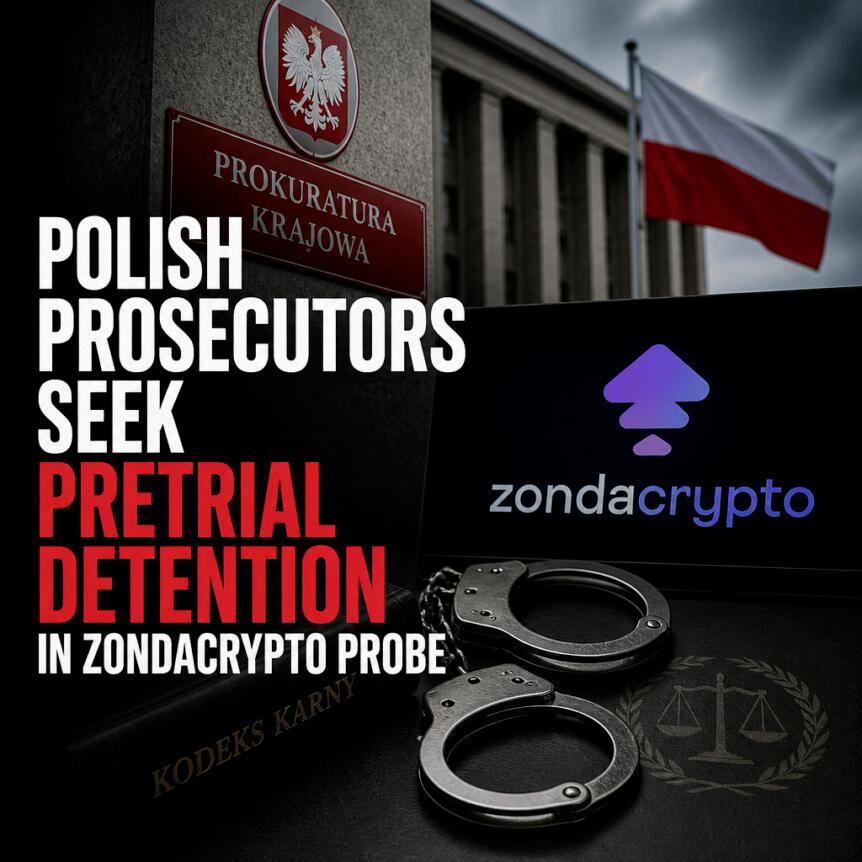
Polish prosecutors have expanded their criminal case involving crypto exchange Zondacrypto by formally charging an additional suspect, identified as Romana Ż., with allegedly taking part in an organized criminal group and misappropriating user funds.
According to an announcement from Poland’s National Prosecutor’s Office, prosecutors also requested that the Katowice-Wschód District Court order Romana Ż. to be held in pretrial detention, citing concerns that the suspect could flee or obstruct the investigation.
Key takeaways
- Romana Ż. has been formally charged in Poland’s Zondacrypto investigation with participating in an organized criminal group.
- Prosecutors allege the suspect misappropriated 7.8 million zlotys (about $2.1 million) in user funds.
- Prosecutors asked for pretrial detention, arguing the suspect may flee or interfere with the probe.
- The latest charges follow earlier detentions and charges of three other individuals connected to Zondacrypto.
- Earlier reporting and court actions cited far larger loss estimates tied to the exchange and related investigations.
New charges filed in the Zondacrypto case
Prosecutors said Romana Ż. was detained on Sept. 5 due to concerns about flight risk and possible interference with the investigation. After the detention, the suspect was questioned by prosecutors, according to the National Prosecutor’s Office. The suspect denied the allegations and provided a statement.
In their filing, prosecutors accuse Romana Ż. of acting with others to misappropriate funds entrusted to the exchange. The alleged conduct, as described in the prosecutor’s submission, includes unauthorized changes to computer records and interference with the way Zondacrypto processed and transmitted exchange data.
Prosecutors’ motion for detention was submitted to the Katowice-Wschód District Court on Monday, with the announcement pointing to the same stated risks: potential flight and interference with the investigation. The court’s decision on detention was not described in the announcement.
Poland’s National Prosecutor’s Office announcement (linked in the source)
Earlier detentions and the group-wide allegations
The Romana Ż. charges follow a broader escalation earlier in September. The National Prosecutor’s Office reported that three other individuals had been detained on Sept. 2 and subsequently charged. Those allegations included money laundering, misappropriation of company assets, and participation in an organized criminal group.
Polish court records referenced in the source indicate that the court ordered all three suspects held in pretrial detention for up to three months. This is important for investors and users watching the case: it suggests prosecutors are framing the alleged misconduct as systemic rather than isolated, and they are building a timeline intended to support an organized-crime theory.
Poland’s National Prosecutor’s Office announcement (linked in the source)
Loss estimates and the expanding scope of the probe
Earlier coverage from Cointelegraph, linked in the source material, said prosecutors estimated losses connected to Zondacrypto at no less than 350 million zlotys. That figure dwarfs the 7.8 million zlotys attributed to the newly charged suspect, highlighting how individual defendants may be tied to different alleged portions of a larger total.
Cointelegraph also previously reported that the investigation was merged in July with a separate probe into the 2022 disappearance of Sylwester Suszek, the founder of BitBay, later renamed Zondacrypto. The merger matters because it suggests prosecutors are connecting the exchange’s later operations and the alleged handling of user funds to broader events around its leadership and corporate history.
Earlier Cointelegraph coverage (linked in the source)
Bankruptcy proceedings for the Estonian operator
Beyond criminal charges, the case has already spilled into formal insolvency steps. The source notes that Zondacrypto’s Estonian operator, BB Trade Estonia, was declared bankrupt in August. It also states that the first creditors’ meeting is scheduled for Sept. 17.
For creditors and affected users, bankruptcy timelines can be as consequential as criminal proceedings. Criminal cases often determine responsibility and potential recovery routes, while insolvency processes are typically where claims are filed, assets are managed, and distributions may be negotiated or decided.
While the source does not detail whether claimants are expecting crypto-specific asset recovery or fiat distributions, the scheduled creditors’ meeting is likely to influence how quickly affected parties can formalize their requests and learn what portion—if any—may be recoverable.
What to watch next
The immediate next step is the Katowice-Wschód District Court’s decision on the detention request for Romana Ż. Separately, the Sept. 17 creditors’ meeting for BB Trade Estonia will be a key milestone for anyone seeking to understand their prospects for recovery as the criminal investigation continues to build its case against multiple defendants.

NVIDIA The SAFEST Architecture for Future Tech Investment #ai #investing #Finance #aistocks #news

Mirra Andreeva helps injured opponent Potapova in US Open victory

Glen ‘Big Baby’ Davis Names Ex-NBA Stars He Says Escaped Charges In Healthcare Fraud Scandal, Some Deny





-

 Fashion3 days ago
Weekend Open Thread: Beyond Yoga
-
 Crypto World3 days ago
Bitcoin price stalls near $82K as key resistance holds
-

 Politics3 days ago
Best Gaming Laptops, CPUs, TVs, And Keyboards To Upgrade Your Set Up For GTA VI
-

 Tech3 days ago
The Birds Outside, Drawn For You Automatically
-

 Crypto World3 days ago
IMF Says El Salvador’s Post-Review Bitcoin Purchases Used No Public Funds
-
 Crypto World3 days ago
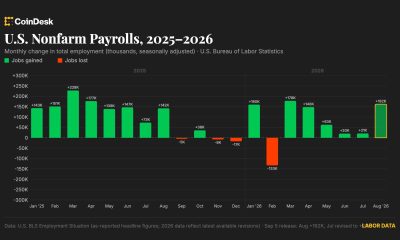
U.S. added stronger than expected 162,000 jobs in August as labor market bounced back
-

 Sports3 days ago
Alexandre Pato consortium’s Northampton Town investment approved
-

 Sports4 days ago
Commanders’ Chig Okonkwo is a top breakout fantasy football candidate
-

 Sports3 days ago
Golden Eaglets Drawn in Group B for 2026 WAFU B U17 Championship
-
 Crypto World3 days ago
XRP price breaks falling channel as bulls target $1.53
-

 Politics4 days ago
A new European chapter for Gibraltar
-

 Politics3 days ago
How To Avoid Winter Colds: 4 Everyday Habits That Spread Germs, Says Pharmacist
-

 Politics3 days ago
The House | Bin the lectures, bring gossip and be ready to banter: how the new PM should prepare for his Trump encounter
-

 Crypto World3 days ago
From warning to listing: UK’s largest retail investment platform opens access to crypto ETNs
-

 Crypto World3 days ago
FinCEN flags $12.7B tied to Southeast Asia crypto investment scams
-

 Tech3 days ago
A Worthy Android Ereader, With Some Tradeoffs
-

 Tech3 days ago
How To Edit Claude’s Memory
-

 Crypto World3 days ago
Trezor Data Breach Impacts 67,000 More US Customers
-

 Politics3 days ago
33 Cosy Autumn Home Decor Ideas: Blankets, Pumpkin Decorations, And Candles
-

 Tech3 days ago
beyerdynamic AVENTHO Y Debuts at IFA 2026 and Makes Wireless Headphones Less Disposable
You must be logged in to post a comment Login