
Crypto World
Joe Biden’s Son to Launch Memecoin, Will Send to TRUMP Holders: WSJ


Hunter Biden, son of former US President Joe Biden, announced that he plans to launch a memecoin based on the reports of his infamous laptop, which has been subject to intense media scrutiny.
In a Monday announcement on X, Hunter Biden posted the memecoin’s ticker symbol, $LAPTOP, signaling a Wednesday launch. The Wall Street Journal reported that Biden would send 20% of the one-billion token supply to substack subscribers, members of a mailing list and investors in President Donald Trump’s memecoin, Official Trump (TRUMP), whose value has dropped by about 97% since reaching an all-time high price in January 2025.

Source: Hunter Biden
The basis for the memecoin’s namesake is Biden’s computer, whose existence and contents were subject to scrutiny before the 2020 election, in which his father was running against Trump. The laptop continues to be invoked by many right-wing media figures and was the subject of two lawsuits filed by Biden over privacy laws.
Since his father left office in January 2025, Biden has stepped up his rhetoric on crypto and blockchain, specifically criticizing the Trump family’s entanglements with the industry through its World Liberty Financial business.
In August, he called World Liberty “corruption at a scale we’ve never seen,” comparing its business practices with those of defunct crypto exchange FTX and pointing to its ties to foreign governments like the UAE. Biden also said in June that “decentralized digital currency and the blockchain are the inevitable future.”
Related: Real Trump Coins denies launching GOLD token, blames ‘bad actors’
The LAPTOP founders, holding 30% of the token supply, will reportedly burn up to 30% of the memecoins depending on the outcome of events, including a Democrat winning the presidency in 2028, the price of Bitcoin (BTC) reaching an all-time high and LAPTOP’s fully diluted value exceeding TRUMP’s.
CLARITY Act vote set for later this month
The LAPTOP memecoin, if launched as planned, could shine more of a spotlight on Trump’s crypto ventures at a time when lawmakers in Congress are considering a comprehensive market structure bill to regulate the digital asset industry. The Digital Asset Market Clarity Act, also known as the CLARITY Act, is scheduled for a cloture vote in the Senate on Sept. 15.
Cointelegraph reached out to the White House for comment but did not receive an immediate response.
Magazine: Who is legally liable when an AI agent goes rogue?


Tokenized versions of SPY, Google, and Robinhood’s own stock led a burst of on-chain trading activity over the past month, with Token Terminal data showing SPY on Robinhood Chain up by more than 1,300% in 30 days to an over $17 million market cap.
The moves point to fast-growing retail and platform interest in tokenized equities across several blockchains and issuers, even as trading volume in the category stays concentrated in a handful of tokens.
SPY, rGOOGL, and HOODb Lead a Month of Rapid Growth
Token Terminal posted the data on September 7, showing SPY’s Robinhood Chain deployment gained the most ground of any tokenized stock over the past 30 days, jumping 1,314% to a $17.4 million market cap. Reality’s rGOOGL on Arbitrum followed with a 530.9% increase to $18.8 million, while Binance bStocks’ HOODb rose 428.7% to $5.7 million.
The gains were not limited to the three largest movers. Binance bStocks’ MSTRb reached $53.8 million after rising 334.6%, making it the largest asset by market capitalization among the top five listed by Token Terminal. Robinhood’s NVDA climbed 284.4% to $15.2 million.
Other Robinhood assets also posted large increases. SPACEX rose 276.6% to $8.7 million, AAPL gained 249.9% to $5.6 million, and GME increased 219.4% to $3.9 million. Across the wider table, dozens of other tokenized stocks recorded gains of at least 50% during the same period.
Trading activity tells a more concentrated story. Token Terminal separately reported that QQQb was the most traded tokenized stock over the past 90 days, with $4.5 billion in volume, ahead of SPYx at $1.5 billion and SPCXb at $1.1 billion.
Those three tokens alone accounted for $7.1 billion, or 44.7%, of total decentralized exchange volume in the category, out of $15.9 billion overall, a figure that itself rose 1,250.8%.
Robinhood Chain’s Momentum Fits a Wider Pattern
The activity builds on a run Robinhood Chain has been on since its early July launch, when, as CryptoPotato reported earlier, the network topped $200 million in total value locked within its first week, drawing attention as much for meme coin trading as for tokenized stocks.
Tokenized equities were already the fastest-growing category tracked by CoinGecko between January 2024 and May 2026, expanding from 14 listed coins to 478, a jump of more than 3,300%, faster than either real-world assets or AI-linked tokens over the same stretch.
But not everyone views the shift as purely positive, with the International Monetary Fund warning in an April note that tokenization removes the settlement delays that normally give banks and regulators time to manage liquidity and intervene before problems become irreversible, arguing the efficiency gains come with less room to catch mistakes.
The post Tokenized Stocks See Explosive Growth as SPY, Google, and Robinhood Lead Rally appeared first on CryptoPotato.

XRP price is sitting well inside a range that’s frustrated bulls for weeks, even though the whole market is in a bullish prediction environment. A $60 target sounds absurd at that price point, until you see the chart behind the claim. There’s a specific number standing between here and there, and it’s not the one most traders are watching.
Analyst Ali Martinez laid out the case on a monthly chart, pointing to a decade-old ascending triangle with its upper boundary at $3.66.
“For nearly a decade, XRP has been forming a massive ascending triangle on the monthly chart,” Martinez wrote, adding that a monthly close above that level, not just a wick through it, would confirm the breakout and unlock a technical target near $60. At the current supply, that price implies a market cap near $3.76 trillion.
Context matters here. XRP just absorbed a 1 billion token escrow unlock worth roughly $1.38 billion, and the market has spent the last 48 hours oscillating between $1.39 and $1.43 rather than trending. That’s the backdrop against which any $60 conversation has to be judged.
Discover: The Best Token Presales
XRP Price Prediction: Hit $3.66 Resistance This Week?
Short answer: not likely within days, but the setup is worth tracking. XRP is consolidating just above its 24-hour floor near $1.39–$1.40, with immediate resistance at $1.43 and a secondary ceiling at $1.48 based on the 7-day range.
Volume and momentum data suggest the token is coiling rather than breaking, with 7-day performance running +1.9% to +4.5% depending on the feed.

- The bull case: XRP reclaims $1.48, builds a base, and starts the long grind toward $3.66 over multiple quarters, the monthly close Martinez needs for triangle confirmation.
- The base case: continued range-bound trading between $1.35 and $1.48 while the market digests unlock supply and waits for a catalyst, potentially tied to regulatory clarity progress.
- The bear case: a break below the $1.35 demand zone flagged by analyst Ali Charts, which would invalidate the near-term bullish structure.
None of these moves the needle toward $60 without patience measured in years, not weeks.
Earn $50 and Enter $300K Prize Draw on EdgeX
Bitcoin Hyper Targets Early Mover Upside as XRP Tests Key Levels
A 4,100% move from current levels isn’t impossible over a decade, but it’s not a trade. It’s a thesis requiring years of confirmation candles. Traders looking for asymmetric upside without waiting for a monthly close in 2030 are increasingly rotating into earlier-stage infrastructure plays instead.
That’s the pitch behind Bitcoin Hyper ($HYPER), a Bitcoin Layer 2 integrating the Solana Virtual Machine, the first project claiming to run smart contracts on Bitcoin’s base layer faster than Solana’s own mainnet.
Bitcoin Hyper is refining the developer experience with clearer documentation, familiar tooling, predictable APIs, and better feedback for builders. — Bitcoin Hyper (@BTC_Hyper2) September 2, 2026
The goal: make the network easier to understand, connect existing tools, and start building with less friction. 

Read the… pic.twitter.com/kAo1w7Xa06
The presale has raised $33 million at a current token price of $0.0136858, with a huge 35% staking rewards on offer only for early buyers. Its architecture pairs low-latency L2 processing with a decentralized canonical bridge for native BTC transfers, targeting Bitcoin’s long-standing programmability gap without sacrificing base-layer security.
Research Bitcoin Hyper directly before the funding window closes.
Trade Crypto on Bybit and Get a Chance to Win Our $1,000 USDT Airdrop
The post XRP Price Prediction: Analyst Calls $60 Ripple If it Breaks The Heavy Resistance appeared first on Cryptonews.


Galaxy said 82% of Bitcoin stolen across all Coldcard attacks remains in the original addresses, with 18% moved in apparent laundering.


Local-currency stablecoin launches have increased demand for 24/7 foreign exchange liquidity as more than 70% of conversions into dollar stablecoins begin in another currency.
Summary
- TransFi CEO Raj Kamal expects local-currency stablecoins to move more foreign exchange activity onchain.
- Round-the-clock settlement could produce thinner liquidity and higher conversion costs outside normal trading hours.
- Fragmentation across currencies, issuers, and blockchains may leave businesses relying on dollar stablecoins as intermediary assets.
- Banks will need redemption, FX, and network connections to turn token issuance into regular commercial use.
Raj Kamal, founder and CEO of payments company TransFi, told crypto.news that issuing euro, sterling, yen, and other local-currency stablecoins would bring more foreign exchange activity directly into payment transactions.
More than 70% of flows from fiat currencies into dollar stablecoins already originate outside the U.S. dollar, according to data cited by Kamal. Each flow requires a currency conversion somewhere in the process, even when the token used for payment is denominated in dollars.
The Bank for International Settlements reported in its 2026 Annual Economic Report that 99.4% of fiat-backed stablecoins by market value were pegged to the dollar. Kamal expects the mix to change as regulated issuers add tokens tied to currencies used by companies for payroll, supplier payments and treasury operations.
“For a corporate treasury, the value will come from being able to move between those currencies at a reliable price, with enough depth to execute larger payments whenever they need to.”
Stablecoin payments require 24/7 FX liquidity
Blockchain settlement can remain available during nights, weekends, and holidays, but Kamal said continuous token transfers do not guarantee continuous access to deep currency markets.
A company may want to move money late on Friday or during Asian trading hours when the underlying currency pair has limited activity. Although the stablecoin payment could still settle, a liquidity provider would have to price and hold the resulting exposure until it could hedge the position efficiently.
For large transactions, Kamal said the process becomes a balance-sheet decision. Market makers must determine how much currency inventory they can carry, how much exposure they will accept outside the most active FX hours, and what fee would compensate them for taking the risk.
Spreads and available transaction sizes could therefore change depending on when a business requests a conversion. According to Kamal, moving a token may take seconds, while securing the pricing and depth normally available during the working week could remain difficult at certain times.
“A payment rail that is always open has limited value if a large conversion becomes materially more expensive at the weekend.”
Corporate treasury teams would focus on execution certainty as well as settlement speed, Kamal added. Companies processing payroll, supplier invoices, or treasury transfers need to know how much currency they can convert and what price they will receive before committing funds.
The existing foreign exchange market provides substantial capacity, with the BIS reporting average daily turnover of $9.6 trillion in April 2025, up 28% from $7.5 trillion in 2022. However, much of its liquidity remains connected to trading sessions, bank balance sheets and separate regional markets, while stablecoin networks operate continuously.
Kamal expects providers serving several currencies and time zones to gain an advantage because they may be able to offset customer flows internally before entering the external FX market. In his view, access to capital and the ability to manage currency inventory will become important competitive factors as stablecoins gain use in cross-border business payments.
Dollar stablecoins may remain key conversion routes
While local-currency tokens could let companies settle in currencies they already use, Kamal expects liquidity to remain concentrated in a limited number of trading pairs during the first stage of adoption.
The dollar may retain an intermediary role even when neither side of a payment uses it as its domestic currency. A transfer between two local-currency stablecoins could still pass through a dollar token if the dollar pair offers deeper liquidity, tighter spreads and better execution.
Dollar dominance is already visible in conventional FX markets. The BIS found that the U.S. dollar appeared on one side of 89% of all foreign exchange trades recorded in April 2025, while the euro and Japanese yen ranked behind it.
Kamal said businesses would judge onchain currencies by the amounts they can convert, the spreads available, and the consistency of execution across markets and time zones. Token supply alone would not establish whether a payment route can support corporate-scale transactions.
The issue has become more relevant as financial institutions add new currencies to blockchain networks. Revolut began rolling out EURR to selected customers in Denmark, Poland and Portugal on Aug. 26. Issued by Stripe-owned Bridge Building, the Ethereum-based token is designed to maintain a value of €1, with availability across other European Economic Area markets planned later in 2026.
In Hong Kong, Standard Chartered became the first bank distributor of Anchorpoint Financial’s regulated HKDAP stablecoin in August. The bank initially offered access to eligible institutional clients and partners, while controlled beta use focused on institutions and professional investors.
According to Standard Chartered, planned uses include treasury management, cross-border trade payments and tokenized fund settlement. The bank also plans to introduce money market fund subscription and settlement services using HKDAP in the fourth quarter of 2026.
More stablecoins could divide liquidity
An increase in bank and local-currency tokens would give companies more settlement choices, but Kamal warned that it could also distribute liquidity across additional issuers, currencies, venues and blockchain networks.
A cross-border payment may begin with a euro token issued by one bank, move to a different blockchain, convert into another currency, and finally enter the recipient’s bank account. Each stage may require a separate market, technical connection, and pool of available funds.
For market makers, supporting numerous tokens would require placing capital across different currencies and venues. Kamal said fragmented transaction volume could make it expensive to hold enough inventory for large conversions without moving market prices.
“I expect liquidity concentration to matter much more than the headline number of stablecoins in circulation,” he said.
Corporate users would probably favor tokens and payment routes that support large transfers at predictable prices, according to Kamal. Such behavior could concentrate activity among a limited group of liquid stablecoins, even if the total number of issuers continues to increase.
Shared issuance could reduce some of the fragmentation. Bank of America, Citi, Goldman Sachs and 18 other institutions committed to create a joint stablecoin company during the second half of 2026, subject to closing conditions.
The group plans to introduce a U.S. dollar stablecoin in the first half of 2027 and may later issue tokens tied to other G7 currencies, starting with the euro. Proposed uses include wholesale, institutional, and retail payments as well as settlement for digital asset transactions.
Several U.S. institutions participating in the project give the liquidity question direct relevance for American companies and banks. The consortium said its planned venture would seek to comply with applicable requirements under the U.S. GENIUS Act and the European Union’s Markets in Crypto-Assets framework before starting operations.
Kamal cited the 21-member project as an early example of institutions pooling distribution and liquidity through shared infrastructure instead of asking markets to support an isolated token for each bank.
Banks need connections after stablecoin issuance
Issuing a token gives a bank an onchain form of its currency, but Kamal said commercial adoption depends on the services available after customers receive it.
A company operating in several countries is unlikely to maintain a different treasury process for every token. Corporate users would need to move between bank-issued stablecoins, tokenized deposits, conventional bank balances and foreign currencies through a connected operation.
Banks will therefore need reliable redemption systems, FX liquidity, links to other financial institutions, and access to multiple blockchain networks, according to Kamal. Settlement arrangements must also allow funds to leave the issuing bank’s customer base and reach counterparties using another form of money.
Stablecoins are not the only bank-backed assets entering blockchain payment systems. In July, Swift launched the first phase of a shared ledger with 17 banks preparing to test cross-border payments using tokenized deposits.
Participants include Citi, Wells Fargo, HSBC, Standard Chartered, BNP Paribas, UBS, and MUFG. Swift said the system would support overnight and weekend transactions while retaining the compliance, credit, risk, and control standards used by banks.
Stablecoins and tokenized deposits carry different legal and balance-sheet structures. Stablecoins represent claims against an issuer and its reserve assets, while tokenized deposits remain claims on the bank holding the underlying account. Kamal expects banks to support one or both forms as digital money systems develop.
Corporate clients would eventually expect the different systems to interact, he said. A treasury team may want to fund a transfer from a conventional deposit, route the payment through tokenized infrastructure, and deliver the recipient’s preferred currency without creating separate liquidity arrangements for every network.
“I think that will influence where banks invest after the first wave of issuance,” Kamal said. “Distribution, liquidity and connectivity become critical once these products move beyond pilots.”


Polish prosecutors investigating cryptocurrency exchange Zondacrypto, have formally charged an individual, identified as Romana Ż., with participating in an organized criminal group and allegedly misappropriating 7.8 million zlotys ($2.1 million) in user funds.
Prosecutors also asked the Katowice-Wschód District Court to place the suspect in pretrial detention, citing concerns that he could flee or interfere with the investigation, according to an official announcement on Monday.
Romana Ż. was detained on Sept. 5 over concerns they might flee and was subsequently questioned by prosecutors. The suspect denied the charges and provided a statement, according to Poland’s National Prosecutor’s Office.
Prosecutors allege Romana Ż. acted with others to misappropriate funds entrusted to the exchange by making unauthorized changes to computer records and interfering with the processing and transmission of exchange data.
The charges come after three others detained on Sept. 2 were charged in the investigation over allegations including money laundering, misappropriation of company assets and participation in an organized criminal group. A Polish court ordered all three held in pretrial detention for up to three months.
As Cointelegraph previously reported, prosecutors estimated losses connected to Zondacrypto at no less than 350 million zlotys. The investigation was also merged in July with a probe into the 2022 disappearance of Sylwester Suszek, the founder of BitBay, which was later renamed Zondacrypto.
Zondacrypto’s Estonian operator, BB Trade Estonia, was declared bankrupt in August, with its first creditors’ meeting scheduled for Sept. 17.
Magazine: ‘White hats’ take 4000 BTC from Liquid, ETFs see best inflows of 2026: Hodler’s Digest

Polish prosecutors have expanded their criminal case involving crypto exchange Zondacrypto by formally charging an additional suspect, identified as Romana Ż., with allegedly taking part in an organized criminal group and misappropriating user funds.
According to an announcement from Poland’s National Prosecutor’s Office, prosecutors also requested that the Katowice-Wschód District Court order Romana Ż. to be held in pretrial detention, citing concerns that the suspect could flee or obstruct the investigation.
Key takeaways
- Romana Ż. has been formally charged in Poland’s Zondacrypto investigation with participating in an organized criminal group.
- Prosecutors allege the suspect misappropriated 7.8 million zlotys (about $2.1 million) in user funds.
- Prosecutors asked for pretrial detention, arguing the suspect may flee or interfere with the probe.
- The latest charges follow earlier detentions and charges of three other individuals connected to Zondacrypto.
- Earlier reporting and court actions cited far larger loss estimates tied to the exchange and related investigations.
New charges filed in the Zondacrypto case
Prosecutors said Romana Ż. was detained on Sept. 5 due to concerns about flight risk and possible interference with the investigation. After the detention, the suspect was questioned by prosecutors, according to the National Prosecutor’s Office. The suspect denied the allegations and provided a statement.
In their filing, prosecutors accuse Romana Ż. of acting with others to misappropriate funds entrusted to the exchange. The alleged conduct, as described in the prosecutor’s submission, includes unauthorized changes to computer records and interference with the way Zondacrypto processed and transmitted exchange data.
Prosecutors’ motion for detention was submitted to the Katowice-Wschód District Court on Monday, with the announcement pointing to the same stated risks: potential flight and interference with the investigation. The court’s decision on detention was not described in the announcement.
Poland’s National Prosecutor’s Office announcement (linked in the source)
Earlier detentions and the group-wide allegations
The Romana Ż. charges follow a broader escalation earlier in September. The National Prosecutor’s Office reported that three other individuals had been detained on Sept. 2 and subsequently charged. Those allegations included money laundering, misappropriation of company assets, and participation in an organized criminal group.
Polish court records referenced in the source indicate that the court ordered all three suspects held in pretrial detention for up to three months. This is important for investors and users watching the case: it suggests prosecutors are framing the alleged misconduct as systemic rather than isolated, and they are building a timeline intended to support an organized-crime theory.
Poland’s National Prosecutor’s Office announcement (linked in the source)
Loss estimates and the expanding scope of the probe
Earlier coverage from Cointelegraph, linked in the source material, said prosecutors estimated losses connected to Zondacrypto at no less than 350 million zlotys. That figure dwarfs the 7.8 million zlotys attributed to the newly charged suspect, highlighting how individual defendants may be tied to different alleged portions of a larger total.
Cointelegraph also previously reported that the investigation was merged in July with a separate probe into the 2022 disappearance of Sylwester Suszek, the founder of BitBay, later renamed Zondacrypto. The merger matters because it suggests prosecutors are connecting the exchange’s later operations and the alleged handling of user funds to broader events around its leadership and corporate history.
Earlier Cointelegraph coverage (linked in the source)
Bankruptcy proceedings for the Estonian operator
Beyond criminal charges, the case has already spilled into formal insolvency steps. The source notes that Zondacrypto’s Estonian operator, BB Trade Estonia, was declared bankrupt in August. It also states that the first creditors’ meeting is scheduled for Sept. 17.
For creditors and affected users, bankruptcy timelines can be as consequential as criminal proceedings. Criminal cases often determine responsibility and potential recovery routes, while insolvency processes are typically where claims are filed, assets are managed, and distributions may be negotiated or decided.
While the source does not detail whether claimants are expecting crypto-specific asset recovery or fiat distributions, the scheduled creditors’ meeting is likely to influence how quickly affected parties can formalize their requests and learn what portion—if any—may be recoverable.
What to watch next
The immediate next step is the Katowice-Wschód District Court’s decision on the detention request for Romana Ż. Separately, the Sept. 17 creditors’ meeting for BB Trade Estonia will be a key milestone for anyone seeking to understand their prospects for recovery as the criminal investigation continues to build its case against multiple defendants.
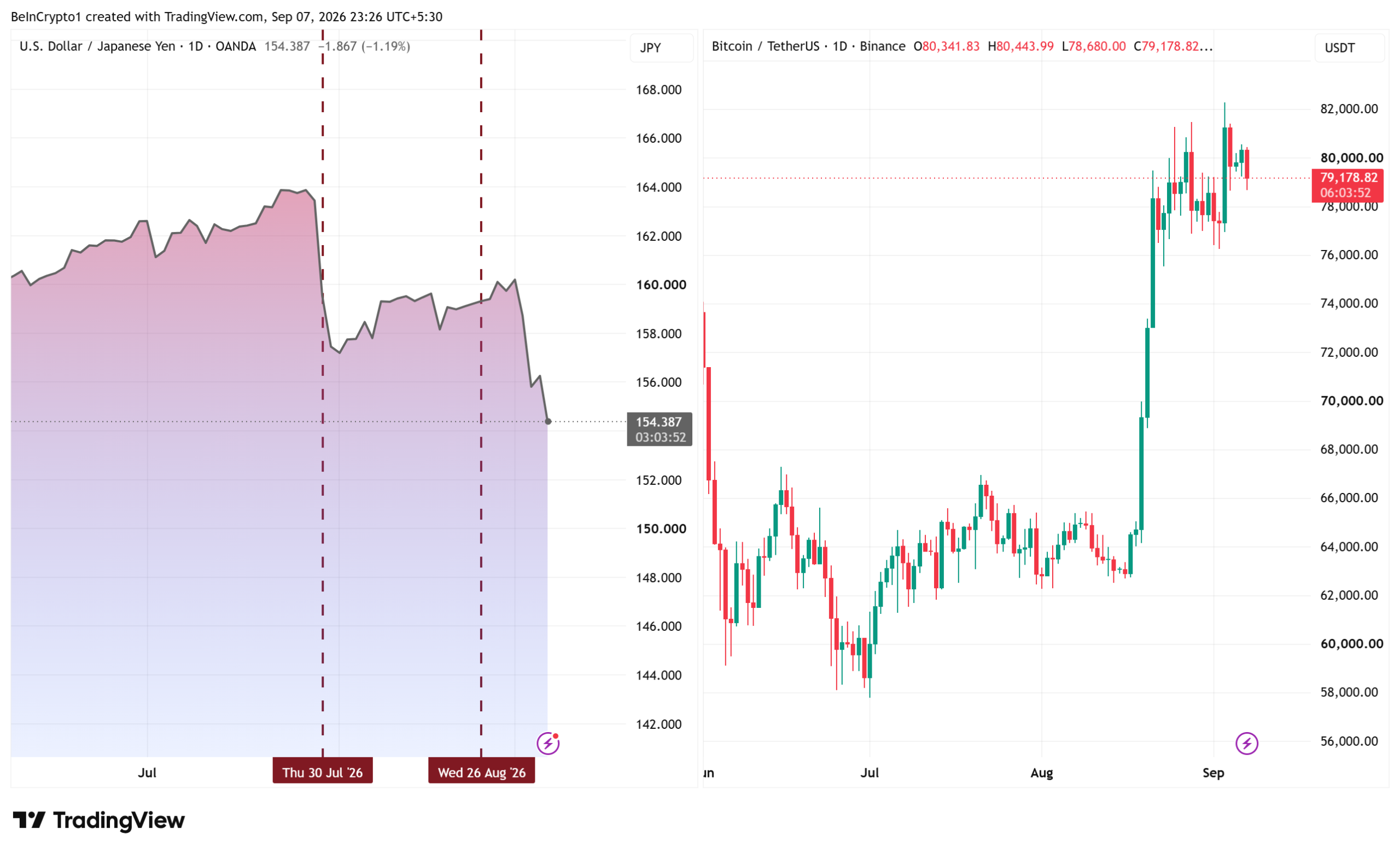
Japan spent nearly $100 billion in August trying to strengthen the yen. Even after that intervention, the currency failed to reach 154 against the dollar.
Then traders pushed it there themselves. USD/JPY fell from 160.39 on Wednesday to 154.50 by Monday, meaning the yen strengthened 3.7% in three sessions without another confirmed rescue from Tokyo.
Now, why does this matter for the crypto market? Because a similar yen surge in August 2024 forced investors to unwind cheap yen-funded trades and dump risk assets, including Bitcoin.

Bitcoin Just Passed the Yen Test
The danger was always the speed of the move. BeInCrypto flagged the risk on September 1, when the yen was still near 159.75 per dollar.
In August 2024, a similar rush out of yen-funded trades forced investors to dump risk assets. Bitcoin and Ethereum fell as much as 20%.
This time, Bitcoin held above $79,000. That makes Monday’s move a useful stress test for a trade that hurt crypto badly last year. It also comes as Japan reveals how much the first intervention cost — and why another rescue may be harder to repeat.
This time, Bitcoin remains above $79,000, close to its highest level since May. That makes the current move an important break from the 2024 playbook.
Japan May Have Less Firepower Left
The Ministry of Finance also revealed where the first intervention money came from.
Japan’s foreign reserves fell $94.6 billion in August to $995 billion. Foreign securities alone dropped $87.8 billion, suggesting Tokyo sold short-dated US Treasuries to fund the defense.
That creates a political problem.
“Japan still has room to intervene given the amount of securities it holds, but given comments from Bessent, selling US Treasuries to fund further intervention could end up attracting pressure from the US,” Japan Research Institute economist Akira Nishimura said.
That leaves the Bank of Japan carrying more of the burden.
Markets now price around 75 basis points of cumulative rate hikes by April 2027, according to HSBC. A quarter-point increase next week would take rates to 1.25%, extending the tightening path BeInCrypto highlighted after July’s inflation data.
BOJ board member Hajime Takata has already pushed for faster action, urging policymakers to move “nimbly” against rising inflation.
The remaining question is how fast the yen keeps rising. Bitcoin has survived the first shock. A more violent move would be the real test.
The post Bitcoin Just Survived the Yen Shock That Crushed Crypto 2 Years Ago appeared first on BeInCrypto.

Significance of the financial pledges amid fraught geopolitical tensions
The investment package is a strong “signal” that Europe is committed to Greenland’s growth and security, says Katja Bego, senior research fellow at think tank Chatham House’s Europe programme.
“Traditionally, before the situation now with Trump, the E.U. and Denmark itself have been accused of not paying quite enough attention to Greenland, especially not enough to genuinely support economic development there,” Bego tells TIME.
Trump’s threats towards the territory have “put a bit of urgency behind the E.U.’s efforts,” Bego adds, but notes there are also other factors, such as the economic benefits of critical mineral mining.
The emphasis on improving satellite communications in the Arctic region is particularly interesting, experts tell TIME, given Greenland’s previous rejection of Starlink, the satellite internet technology made by Elon Musk’s Space X.


Bitcoin has fallen 0.8% to about $79,176 over the past 24 hours as analysts forecast continued trading between $78,000 and $82,000 before the Federal Reserve’s September policy decision.
Summary
- Bitcoin traded between $78,707 and $80,494 over the past 24 hours, according to CoinGecko.
- CoinEx expects the price to remain between $78,000 and $82,000 until the Fed meeting.
- US spot Bitcoin ETFs attracted $986.9 million last week, lifting three-week inflows to about $3.8 billion.
- CPI, Treasury yields, and spot demand could determine whether Bitcoin breaks its current range.
Bitcoin price remains capped near $82,000
Bitfinex analysts told crypto.news that Bitcoin’s current structure supports “continued consolidation with an upside bias” rather than a confirmed breakout, as ETF demand counters pressure from elevated Treasury yields and expectations of another US interest rate increase.
Bitcoin (BTC) was trading near $79,176 at the time of writing, down 0.8% over 24 hours, according to CoinGecko data. The asset moved between a low of $78,707 and a high of $80,494 during the period, while trading volume increased nearly 30% to about $24.4 billion.
The intraday retreat followed another failed attempt to remain above $80,000. Sellers entered as the price approached $80,500, keeping BTC inside the $77,200–$82,100 range identified by Bitfinex.
Jeff Ko, chief analyst at CoinEx, expects even tighter trading before the Fed announces its next interest-rate decision.
“I expect compression into a tight range, capped around $82,000 with support at $78,000–$79,000, and a directional resolution once the Fed is out of the way,” Ko told the publication.
A move below the lower end of Ko’s range would bring the $77,200 level identified by Bitfinex into focus. On the upside, Bitcoin would need to clear $80,500 before testing the stronger supply area around $82,000.
Earlier technical conditions also showed why that upper zone could remain difficult to cross. On Aug. 27, Bitcoin traded near $79,500 after climbing about 25% from its mid-August range, but daily relative strength index readings had reached overbought territory at 81.14. The 200-day SMA breakout kept the recovery structure intact, while fading short-term momentum and liquidity near $81,000 raised the risk of another pullback.
ETF inflows support Bitcoin price near $79,000
US-listed spot Bitcoin ETFs absorbed $986.9 million in net inflows during the week ending Sep. 4, taking the three-week total to approximately $3.8 billion, according to Ko.
Institutional demand has helped Bitcoin remain near $80,000 even as markets have raised their expectations for another Fed rate increase. Ko, however, said three weeks of positive flows were not enough to confirm a sustained accumulation period.
“The $986.9 million of inflows brought the three-week total to roughly $3.8 billion, which is clearly constructive. But I would still like to see another few weeks of sustained net inflows, particularly if Bitcoin turns boring and trades sideways, before calling this a genuine accumulation phase.”
Ko argued that continued purchases during flat or falling prices would provide stronger evidence of allocation demand than inflows that follow a rapid rally. Bitcoin gained 25% in August, meaning some recent ETF purchases may have been driven by price momentum rather than long-term accumulation.
Data cited in an earlier report showed that US spot Bitcoin ETFs collected $3.52 billion during August, recording positive flows on 16 of 21 trading days. The funds maintained demand while Bitcoin climbed from the low-$60,000 area toward $80,000.
ETF products did not prevent losses earlier in 2026. During the first half of the year, the funds registered a combined $5.29 billion in net outflows as Bitcoin fell from approximately $94,000 to $63,000, according to the previous Fed and ETF analysis.
Bitfinex analysts said stablecoin supply growth has also provided support during the latest recovery. Even with fresh capital entering the market, profitable holders could add selling pressure as BTC moves toward the top of its range.
More than 71% of Bitcoin’s circulating supply is now held at a profit, compared with about 67% when the asset traded above $82,500 during its May consolidation. Bitfinex attributed the difference to summer accumulation, which lowered the short-term holder cost basis to $68,400 at its weakest point.
At similar prices, a larger share of holders can now sell without realizing a loss. Bitfinex said supply in profit is approaching its historical average of 74.7%, with previous moves above that threshold often occurring during transitions from bear to bull markets.
Fed decision and CPI could resolve the range
Interest-rate expectations remain the main external test for Bitcoin ahead of the Sep. 15–16 Federal Open Market Committee meeting. Markets are considering a 25-basis-point increase from the current federal funds target range of 3.50%–3.75%, Ko said.
Federal Reserve Chair Kevin Warsh adopted a hawkish tone during his Jackson Hole speech, after which CME FedWatch probabilities for a September increase climbed to around 66%. The estimate has moved with each subsequent economic release and should not be treated as a Fed commitment.
Stronger August employment figures renewed the case for tighter policy. Nonfarm payrolls increased by 162,000, while the unemployment rate remained at 4.1%, according to figures cited by Bitfinex. Manufacturing activity also expanded, with the Purchasing Managers’ Index reaching 54.6, although elevated input costs continued to raise inflation concerns.
US inflation data will provide the next evidence for policymakers. As previously detailed, the Producer Price Index is scheduled for Sep. 10, followed by the Consumer Price Index on Sep. 11 and the Fed decision on Sep. 16.
“A hot print that pushes yields and the dollar sharply higher would be the cleanest test of Bitcoin’s resilience,” Ko said.
The two-year Treasury yield recently moved above 4.34%, while Ko placed the 10-year yield near 4.8%. Higher yields can reduce demand for assets that do not pay interest by giving investors access to stronger returns from US government debt.
Bitfinex said the important signal would be continued ETF buying while short-term yields remain elevated. Persistent demand under such conditions would indicate that the policy rate no longer acts as Bitcoin’s main constraint, according to the analysts.
Treasury buybacks provide another liquidity test
The US Treasury’s expanded buyback operation on Sep. 9 will give investors another measure of bond-market liquidity before the inflation data and Fed meeting.
Treasury Secretary Scott Bessent announced in August that the maximum size of liquidity-support buybacks for 10-to-20-year and 20-to-30-year nominal coupon securities would increase from $2 billion to at least $4 billion per operation. The higher limits are scheduled to remain in place from Sep. 9 through Nov. 4.
After the announcement, the 30-year Treasury yield dropped from a 19-year high above 5.34% to 5.19%, while the 10-year yield fell to 4.647%. During the same period, Bitcoin climbed 8.2% from $64,100 to $69,500 in less than 12 hours, although Treasury officials did not establish that the buyback change caused the rally.
The move also triggered $1.44 billion in short liquidations across major crypto exchanges, including $1.29 billion within one hour, according to an earlier Treasury buyback report.
For the next breakout attempt, Ko said investors should track ETF flows, spot-market buying near current levels, and Bitcoin’s reaction to Treasury yields. He also wants to see whether futures open interest grows meaningfully alongside any move outside the $78,000–$82,000 range, with CPI due Sep. 11 and the FOMC decision scheduled for Sep. 16.
Crypto World
Axis Robotics Open-Sources One of the Largest Franka Arm Simulation Datasets for Physical AI
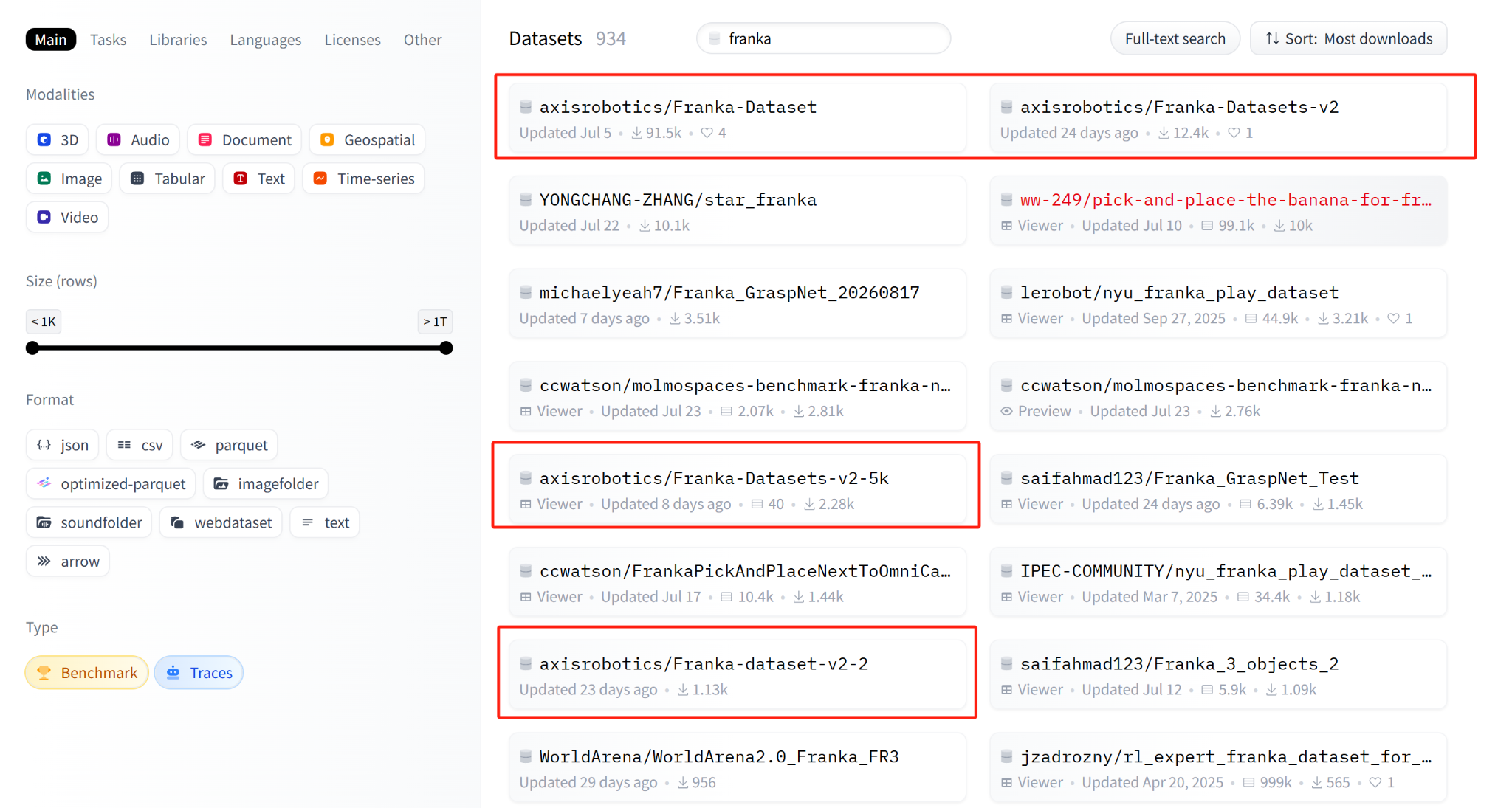
Axis Robotics has released Axis Sim Dataset V1, one of the largest open-source simulation datasets for Franka arm manipulation, with the full dataset, training code, and benchmarks publicly available. V1 is built from more than 50,000 human-teleoperated simulation trajectories across 207 manipulation tasks and 60,000+ scene variants on a simulated Franka Research 3 arm.
This dataset drew over 160,000 downloads, making it the most downloaded open-source simulation Franka manipulation dataset on Hugging Face. In benchmarks, continual pretraining on V1 lifted π0.5 and beat a volume-matched RoboCasa baseline, with every result open and verifiable.

Axis Robotics is building the ultimate compounding data engine for Physical AI, a vertically integrated system spanning large-scale simulation, egocentric real-world capture, humanoid loco-manipulation, and human-gated DAgger post-training. The company raised $12 million in seed funding led by Hack VC, with participation from Nomad Capital, Pi Network Ventures, 10K Ventures, and angel investors.
A Bet Against “Clean Data Only”
A common assumption in robotics is that demonstrations must be near-optimal to begin with — filter down to expert trajectories, standardize the setup, and discard anything noisy before it is safe to imitate. Axis’s thesis runs the other way: data quality lives at the distribution level, not the single trajectory. When a large and diverse enough crowd produces noisy, suboptimal trajectories and their errors are uncorrelated, the noise averages out and a working policy survives during training.
Axis Sim Dataset V1 puts that thesis to a public test. Its trajectories span pick-and-place, stacking, pouring, articulated-object manipulation, and tool use, all collected through Axis’s browser-based teleoperation platform, Axis Hub, by a distributed crowd rather than a single expert team. The dataset was built with researchers from UC Berkeley, Johns Hopkins, the University of Michigan, and other institutions.
Results That Scale
On LIBERO-Plus, continual pretraining on V1 lifts π0.5 from 83.9% to 88.8% success and outperforms a volume-matched RoboCasa365 baseline by 37.3%. Performance improves consistently as pretraining data scales from 25% to 100% of the dataset, with no saturation in sight, evidence that the gains come from diversity and coverage rather than a one-off bump. The largest improvements appear under camera, sensor-noise, and layout perturbations, the exact axes Axis randomizes during generation.

The team says V2 is already underway, scaling to 1.2 million trajectories across 1,200 tasks, with cross-embodiment generalization and results across multiple VLA models showing that suboptimal simulation data trains robust policies.
The Engine Behind the Dataset
The dataset is one output of a larger, actively compounding data engine. Where a traditional data vendor collects to a fixed spec and stops, Axis uses model performance and failure cases to determine what should be collected next, so every training round informs the next. That engine runs on a hybrid strategy across four data lines, and all four now run at scale:
- Simulation: over 200,000 distributed contributors on Axis Hub, a top-3 dApp on Base, producing 4.7M+ trajectories across 13 embodiments.
- Egocentric: a managed network of 1,000+ full-time, QC-trained collectors capturing first-person activity in real homes and businesses across 14 industries: 200,000+ hours already banked and growing by 4,000+ hours every day, with Vicon-verified hand pose.
- Loco-manipulation: 500+ hours combining mobility and dexterity on real humanoids (Unitree G1, Booster T2) through hardware-agnostic teleoperation.
- Human-gated DAgger post-training: 500+ hours of human-in-the-loop correction targeted at deployment edge cases.
Every task and trajectory is recorded on-chain on Base for provenance, and contributors are rewarded for verified work quality.
From Open Data to Commercial Deployment
Beyond open-sourcing simulation data, Axis works directly with robot embodiment companies to build customized, embodiment-specific data pipelines and model priors.
As Booster Robotics’ first sim-data partner, Axis rebuilt Booster’s real workspace as a task-aligned digital twin, had distributed contributors collect 42,000+ simulation episodes on it, and distilled them into a Booster-specific model prior. With just 30 real-robot demos, that prior reached 87.5% success versus 37.5% for an out-of-the-box π0.5, matching π0.5 using half the real-world demonstrations.
Other partners span embodiment companies (Feagine Robotics), model companies (Manycore Tech, Dexmal) and industrial automation (Lotus Cars, Geely Auto). Axis also supplies on-chain robotics networks: BitRobot on Solana and OpenRoboto on Bittensor.
Redefining Physical AI’s Data Foundation
“The future of Physical AI isn’t a static dataset you download once,” said Chris Feng, founder of Axis Robotics. “It’s an engine that keeps producing the data the model needs next. Scale gets you broad coverage. Diversity keeps the noise unbiased. The closed loop turns every failure into progress. That’s what compounds.”
Axis was founded by researchers from UC Berkeley, CMU, Georgia Tech, and SJTU, alongside serial founders who have scaled consumer platforms to over 30 million users. Its research is advised by Jiachen Li, Assistant Professor at Georgia Tech.
Paper Link: https://arxiv.org/abs/2607.21588
Project Page: https://axisaiorg.github.io/AXIS-V1/
Dataset Link: https://huggingface.co/datasets/axisrobotics/Franka-Dataset
Github Codebase: https://github.com/AxisAIOrg/Axis-V1-Training
The post Axis Robotics Open-Sources One of the Largest Franka Arm Simulation Datasets for Physical AI appeared first on BeInCrypto.

Horror as dad spent weeks at wrong teen’s hospital bed before learning son had died in crash

(VIDEO) Racing Driver Ollie Millroy Says Rival Loek Hartog Saved His Life After Fiery China GT Crash
Tokenized Stocks See Explosive Growth as SPY, Google, and Robinhood Lead Rally





-

 Fashion3 days ago
Weekend Open Thread: Beyond Yoga
-
 Crypto World3 days ago
Bitcoin price stalls near $82K as key resistance holds
-

 Politics3 days ago
Best Gaming Laptops, CPUs, TVs, And Keyboards To Upgrade Your Set Up For GTA VI
-

 Tech3 days ago
The Birds Outside, Drawn For You Automatically
-

 Crypto World3 days ago
IMF Says El Salvador’s Post-Review Bitcoin Purchases Used No Public Funds
-
 Crypto World3 days ago
U.S. added stronger than expected 162,000 jobs in August as labor market bounced back
-

 Sports3 days ago
Alexandre Pato consortium’s Northampton Town investment approved
-

 Sports3 days ago
Commanders’ Chig Okonkwo is a top breakout fantasy football candidate
-

 Sports3 days ago
Golden Eaglets Drawn in Group B for 2026 WAFU B U17 Championship
-
 Crypto World3 days ago
XRP price breaks falling channel as bulls target $1.53
-

 Politics4 days ago
A new European chapter for Gibraltar
-

 Politics3 days ago
How To Avoid Winter Colds: 4 Everyday Habits That Spread Germs, Says Pharmacist
-

 Politics3 days ago
The House | Bin the lectures, bring gossip and be ready to banter: how the new PM should prepare for his Trump encounter
-

 Crypto World3 days ago
From warning to listing: UK’s largest retail investment platform opens access to crypto ETNs
-

 Crypto World3 days ago
FinCEN flags $12.7B tied to Southeast Asia crypto investment scams
-

 Tech3 days ago
A Worthy Android Ereader, With Some Tradeoffs
-

 Tech3 days ago
How To Edit Claude’s Memory
-

 Crypto World3 days ago
Trezor Data Breach Impacts 67,000 More US Customers
-

 Politics3 days ago
33 Cosy Autumn Home Decor Ideas: Blankets, Pumpkin Decorations, And Candles
-

 Tech3 days ago
beyerdynamic AVENTHO Y Debuts at IFA 2026 and Makes Wireless Headphones Less Disposable
You must be logged in to post a comment Login