
Crypto World
Tokenized Stocks See Explosive Growth as SPY, Google, and Robinhood Lead Rally


Tokenized versions of SPY, Google, and Robinhood’s own stock led a burst of on-chain trading activity over the past month, with Token Terminal data showing SPY on Robinhood Chain up by more than 1,300% in 30 days to an over $17 million market cap.
The moves point to fast-growing retail and platform interest in tokenized equities across several blockchains and issuers, even as trading volume in the category stays concentrated in a handful of tokens.
SPY, rGOOGL, and HOODb Lead a Month of Rapid Growth
Token Terminal posted the data on September 7, showing SPY’s Robinhood Chain deployment gained the most ground of any tokenized stock over the past 30 days, jumping 1,314% to a $17.4 million market cap. Reality’s rGOOGL on Arbitrum followed with a 530.9% increase to $18.8 million, while Binance bStocks’ HOODb rose 428.7% to $5.7 million.
The gains were not limited to the three largest movers. Binance bStocks’ MSTRb reached $53.8 million after rising 334.6%, making it the largest asset by market capitalization among the top five listed by Token Terminal. Robinhood’s NVDA climbed 284.4% to $15.2 million.
Other Robinhood assets also posted large increases. SPACEX rose 276.6% to $8.7 million, AAPL gained 249.9% to $5.6 million, and GME increased 219.4% to $3.9 million. Across the wider table, dozens of other tokenized stocks recorded gains of at least 50% during the same period.
Trading activity tells a more concentrated story. Token Terminal separately reported that QQQb was the most traded tokenized stock over the past 90 days, with $4.5 billion in volume, ahead of SPYx at $1.5 billion and SPCXb at $1.1 billion.
Those three tokens alone accounted for $7.1 billion, or 44.7%, of total decentralized exchange volume in the category, out of $15.9 billion overall, a figure that itself rose 1,250.8%.
Robinhood Chain’s Momentum Fits a Wider Pattern
The activity builds on a run Robinhood Chain has been on since its early July launch, when, as CryptoPotato reported earlier, the network topped $200 million in total value locked within its first week, drawing attention as much for meme coin trading as for tokenized stocks.
Tokenized equities were already the fastest-growing category tracked by CoinGecko between January 2024 and May 2026, expanding from 14 listed coins to 478, a jump of more than 3,300%, faster than either real-world assets or AI-linked tokens over the same stretch.
But not everyone views the shift as purely positive, with the International Monetary Fund warning in an April note that tokenization removes the settlement delays that normally give banks and regulators time to manage liquidity and intervene before problems become irreversible, arguing the efficiency gains come with less room to catch mistakes.
The post Tokenized Stocks See Explosive Growth as SPY, Google, and Robinhood Lead Rally appeared first on CryptoPotato.

As of September 7, 2026, Solana (SOL) trades near $105, roughly -65% below its January 2025 all-time high of around $295. The Sam Altman-backed ChatGPT AI predicts that Solana could blast past that all-time high by the end of 2026 if certain market conditions align.
After a prolonged period of consolidation and monthly declines earlier in the year, SOL posted a strong August recovery of about +46%, supported by accelerating US spot ETF inflows and improving network fundamentals.
Below, we have included the ChatGPT AI SOL price prediction by the end of 2026, which Solana maxis will be excited to read if the bull case scenario plays out.

ChatGPT AI Predicts Solana: ETF Flows Are the Key Swing Factor
The arrival of US spot Solana ETFs has fundamentally changed the investment case for SOL. Cumulative inflows had reached roughly $1.35Bn by September 1, with the products holding around $1.39Bn in combined assets.
However, recent flows provide a warning. Solana ETFs attracted only about $4.9M during the week ending September 4, down approximately -97% from the previous week’s $142.7M.
The important point is that demand has slowed rather than completely reversed. If ETF inflows accelerate again as Bitcoin and the wider crypto market strengthen, SOL could receive a substantial institutional tailwind during the final quarter.

SOL USD Technical Picture: How Significant is SOL’s Recovery Over $100?
Technically, Solana’s recovery above $100 is significant. SOL recently rallied from the low-$70s to above $109, demonstrating that buyers remain willing to defend the asset after a prolonged period of weakness.
For my forecast, the $100-$110 region is the key near-term battleground. A sustained move above $120 would improve the technical picture considerably and potentially open the door toward $150 and then $200.
Conversely, losing the $100 area decisively would weaken the thesis and could send SOL back toward the $80-$90 region before another attempt higher.
Catalysts Could Change the Equation
Solana’s biggest potential catalysts include continued institutional adoption, network upgrades, and growing activity across DeFi and payments.
The Alpenglow upgrade remains an important longer-term development, while additional network improvements should strengthen Solana’s proposition as a high-throughput blockchain.
There is also evidence that derivatives positioning is becoming less bearish. Leveraged funds reduced their SOL net-short exposure substantially between August 25 and September 1, although they remained net short overall.
Check Out the Solana Markets on Kalshi and Claim $25 For Free
ChatGPT AI Predicts SOL Price by January 1, 2027
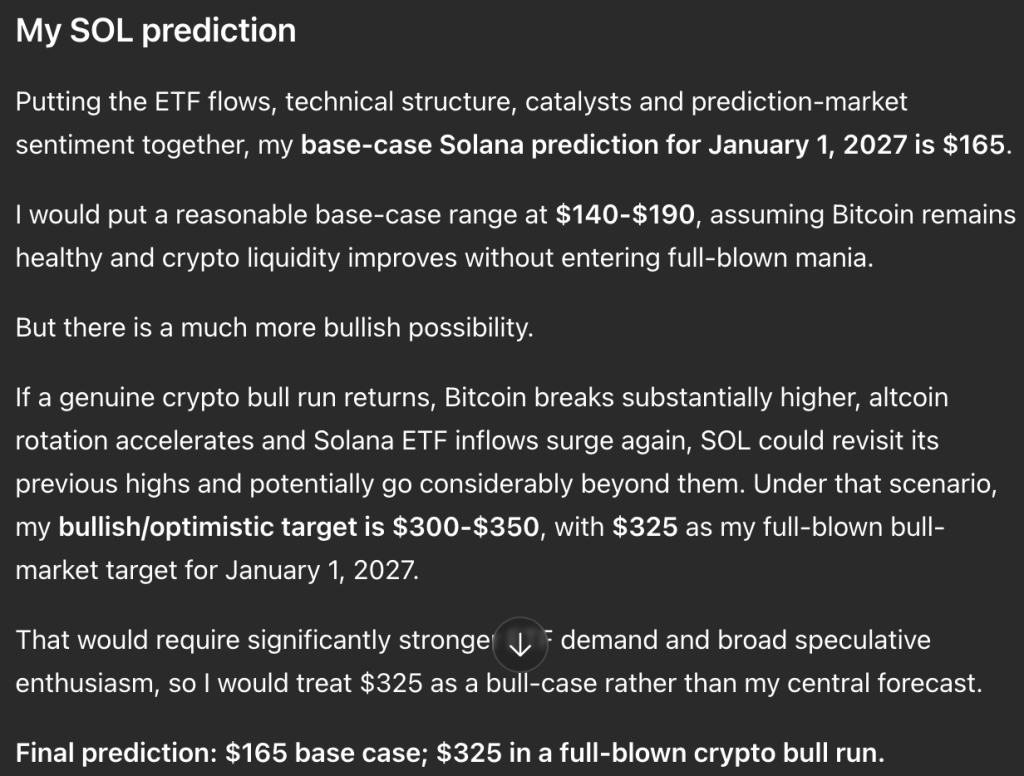
Putting the ETF flows, technical structure, catalysts, and prediction-market sentiment together, my base-case Solana prediction for January 1, 2027 is $165.
I would put a reasonable base-case range at $140-$190, assuming Bitcoin remains healthy and crypto liquidity improves without entering full-blown mania. But there is a much more bullish possibility.
If a genuine crypto bull run returns, Bitcoin breaks substantially higher, altcoin rotation accelerates, and Solana ETF inflows surge again, SOL could revisit its previous highs and potentially go considerably beyond them. Under that scenario, my bullish/optimistic target is $300-$350, with $325 as my full-blown bull-market target for January 1, 2027.
That would require significantly stronger ETF demand and broad speculative enthusiasm, so I would treat $325 as a bull case rather than my central forecast.
Final prediction: $165 base case; $325 in a full-blown crypto bull run.
Don’t Miss Out on Our $1,000 USDT Airdrop on ByBit
Bitcoin Hyper Targets Early Mover Upside as XRP Tests Key Levels
Ripple holders riding this bounce have a fair case for optimism, but let’s be honest about the math: even the bullish $4.40 target represents roughly 3x from current levels on a token with a market cap already in the tens of billions. That kind of upside takes real catalysts and time.
For traders hunting asymmetric setups, early-stage infrastructure plays at a fraction of that valuation are where the multiples get interesting, and Bitcoin Hyper is positioning itself as exactly that kind of bet.
Bitcoin Hyper ($HYPER) bills itself as the first Bitcoin Layer 2 with full SVM integration. It boasts a smart contract execution faster than Solana itself, built on Bitcoin’s base-layer security.
The presale has raised $33M at a current token price of $0.0136857, with staking rewards already live for early buyers. Its Decentralized Canonical Bridge aims to solve Bitcoin’s long-standing programmability gap without compromising trust assumptions.
Gain Access to New Bitcoin Layer 2 Early Here
Discover: The Best Crypto to Diversify Your Portfolio
The post Sam Altman ChatGPT AI Predicts a Huge Solana Move by the End of 2027 appeared first on Cryptonews.


Bitcoin has processed 893,391 transactions in one day, its fourth-highest daily total on record and a reading above the 99th percentile of its historical range.
Summary
- Bitcoin processed 893,391 transactions, up 23.4% from the previous day.
- Daily activity more than doubled from the corresponding level one year earlier.
- Galaxy Research ranked the session as Bitcoin’s fourth-busiest day in history.
- Low-value transfers have accounted for much of Bitcoin’s transaction growth during 2026.
Bitcoin transaction count enters its historical top four
Galaxy Research reported the milestone in a Sept. 7 post on X, placing the latest total among the most active days since Bitcoin began operating in 2009.
“Yesterday was the 4th largest daily transaction count in Bitcoin’s history,” the firm said.
At 893,391, the count also exceeded 99% of all daily readings recorded by the network, according to Galaxy’s data. The research firm did not identify a single event, application, or group of users responsible for the increase.
YCharts recorded the same total and showed that daily transactions had risen from 723,854, representing an increase of about 23.4% in 24 hours. Compared with 441,035 transactions on the corresponding day a year earlier, activity had climbed by approximately 102.6%.
The increase extends a recovery that was already visible earlier in 2026. Data based on Blockchair showed that Bitcoin processed 862,979 transactions on June 23, which ranked as the third-highest daily total at the time.
June’s average reached 651,655 transactions per day, up 90% from the 342,866 average reported for June 2025. Bitcoin’s median daily count had fallen to 417,151 during 2025, an 18% drop from the 508,934 median registered in 2024.
Earlier Blockchair figures placed April 23, 2024, at 927,010 transactions and Sept. 8, 2024, at 910,083. Galaxy’s updated fourth-place ranking for the 893,391 reading indicates that another session has since entered the top three.
Small Bitcoin transfers have driven much of the increase
Research from CryptoQuant has linked much of Bitcoin’s 2026 transaction growth to small transfers rather than a matching rise in the value moved across the network.
Transfers below 0.01 BTC accounted for about 80% of Bitcoin transactions in 2026, according to data cited by CoinMarketCap in August. Their share stood near 44% in 2023, meaning low-value transfers have nearly doubled their portion of the network’s daily activity.
CryptoQuant head of research Julio Moreno said the economic value carried by the transactions remained small compared with their share of the total count. While the data shows that more transfers are reaching the blockchain, it does not establish that a similar increase has occurred in payment value, investment demand, or unique users.
A July crypto.news examination of transaction-count limitations also found that raw totals can provide an incomplete picture when fees are low. Cheap transactions allow automated systems, applications, or a small number of users to generate substantial activity without moving a comparable amount of capital.
Bitcoin transactions can also contain several inputs and outputs. A sender may pay more than one recipient in a single transaction, while exchanges and custodians may combine withdrawals through batching. Users can also move funds between addresses under their own control, so a transaction does not necessarily represent a payment between two separate people.
Lightning Network payments are settled away from Bitcoin’s base layer until participants close or rebalance their channels. As a result, the 893,391 figure covers confirmed on-chain transactions rather than every payment made using Bitcoin-linked infrastructure.
Network data shows volume and addresses moving differently
Blockchain.com’s dashboard paired the 893,000 transaction reading with approximately 415,000 active addresses, down 10.7% from the previous period. The difference shows that transaction totals and address activity can move in opposite directions because one address may participate in several transfers.
Transferred value reached about $3.36 billion, an increase of 33.8%, while total network fees stood near $191,073, down 8.1%, according to the same dashboard. Fee revenue therefore declined even as the number of confirmed transactions increased.
BitInfoCharts separately showed an average transaction fee near 0.0000024 BTC, worth about $0.19 at the recorded price, and a median transfer value of roughly $34.69. Its latest 24-hour window did not align exactly with the calendar-day period used by Galaxy, so the readings describe surrounding network conditions rather than the same fixed reporting period.
The relationship between high transaction volume and modest fees depends partly on the amount of block space consumed by each transfer. A transaction with many inputs can use more data than a simple payment, while exchanges can reduce their footprint by placing several customer withdrawals in one transaction.
Ordinals previously showed how a new type of activity could change Bitcoin’s transaction profile. During an earlier record in 2023, more than 307,000 Ordinals-related transactions were recorded in one day, according to Dune data cited at the time by Blockworks. Galaxy’s latest post did not attribute the September 2026 increase to Ordinals, Runes or another protocol.
U.S. investors face different on-chain and ETF exposure
For American investors, the importance of Bitcoin transaction activity depends on how they hold the asset. Buyers who use self-custody wallets create or receive on-chain transfers, while shareholders in U.S.-listed spot Bitcoin exchange-traded funds trade securities through brokerage accounts.
An earlier Bitcoin ETF explainer detailed how fund creations and redemptions differ from ordinary exchange purchases. Buying an ETF share does not directly create a Bitcoin transaction for each investor because authorized participants, fund sponsors and custodians handle the product’s underlying settlement process.
Daily blockchain totals cannot separate ETF-related custody movements from exchange withdrawals, individual payments, mining transfers, or wallet reorganizations. Transaction count also does not show whether a transfer represents buying or selling because the blockchain records movements between addresses rather than the purpose behind them.
Recent activity among older wallets provides another example of the distinction. A September report on older holdings cited K33 Research data showing that nearly 890,000 BTC moved during a seven-day period in early August, the highest seven-day active supply reading of 2026. Bitcoin was trading within one of its narrowest 30-day ranges since 2023 at the time, separating the on-chain movement from a major price breakout.
U.S. tax rules also treat Bitcoin transactions according to their purpose instead of their appearance on the blockchain. The Internal Revenue Service states that moving digital assets between wallets or accounts owned by the same taxpayer is generally not a taxable event, while selling crypto, exchanging it for another asset, or using it to buy goods and services can produce a reportable gain or loss.
Chainalysis estimated in August that the United States accounted for $112.6 billion of potentially taxable on-chain crypto activity during 2025. Its research placed the worldwide total above $457 billion but estimated that transactions within the reach of international reporting rules represented only 14% of the activity identified.
Under IRS guidance, taxpayers must retain records showing the asset’s acquisition date, cost basis, disposal date, proceeds, and resulting gain or loss for taxable digital-asset transactions.


Liquid Network has recovered 3,400 BTC worth about $269.2 million from the self-described white-hat hackers behind a 4,000 BTC withdrawal, although nearly $47 million remains outstanding.
Summary
- The actors returned 3,400 BTC, recovering about 85% of the withdrawn funds.
- Roughly 598.5 BTC, worth about $47 million, remains in the withdrawal-linked address.
- Blockstream told the actors that its bridge nodes had been patched before the repayment.
- Liquid has not announced when its bridge and L-BTC services will resume normal operations.
Liquid Network has recovered 85% of the withdrawn Bitcoin
On-chain data shows that the actors returned 3,400 BTC, worth about $268.2 million when confirmed, to the Liquid Federation wallet in Bitcoin block 965,950. The transfer recovered about 85% of the withdrawn funds, while 598.5 BTC worth roughly $47 million remained in the actors’ address. Blockstream had previously told the group through a signed transaction message that its bridge nodes were patched and the funds were “safe to return.”
Around 598.5 BTC, valued at roughly $47 million, remained in the withdrawal-linked address after the larger transfer. The actors have not publicly explained why they retained the remaining coins or stated whether another repayment will follow.
Sunday’s incident began when a customer sent 4,000 Liquid Bitcoin, or L-BTC, to SideSwap’s peg-out service. SideSwap allows users to move value from the Liquid sidechain back to the Bitcoin network through an authorized withdrawal process.
The actors later identified themselves as “whitehats” in a message attached to a Bitcoin transaction. White-hat hackers generally find and report security weaknesses so developers can repair them, often receiving a bounty under terms agreed with the affected project.
No publicly disclosed agreement has established that the Liquid actors had permission to withdraw the funds, however. Blockstream and the actors also have not published terms granting a bounty or allowing the group to retain nearly 600 BTC.
As crypto.news reported before the return, the actors had offered to send back “most” of the Bitcoin once Blockstream fixed the vulnerability. At that point, no repayment had been confirmed, and the withdrawal represented about 95% of the Bitcoin reportedly held in Liquid’s federation wallet.
On-chain messages led to the 3,400 BTC repayment
Communication between Blockstream and the actors took place through messages attached to Bitcoin transactions, allowing both sides to exchange instructions without relying on a private messaging service.
In one transaction message, the actors told Blockstream to repair the flaw before they returned the Bitcoin.
“Please fix the bug first,” the message said. “The chain is under risk at latest commit right now. Make sure every node is patched. Then we will transfer the money back safely after confirming the fix.”
Following that confirmation, the actors sent 3,400 BTC to the Liquid Federation address. The exchange shows that the repayment depended on the actors accepting Blockstream’s statement that the affected nodes were safe, though neither side has released a technical report identifying the flaw or explaining how the withdrawal became possible.
Liquid disabled its bridge nodes after detecting the transaction and asked exchanges to suspend L-BTC deposits and withdrawals. The shutdown restricted movement between Liquid and the Bitcoin base layer while developers investigated the incident and applied the patch.
Blockstream has said the key used during the withdrawal was not compromised, according to Reuters. The company has not released a complete post-mortem detailing whether the flaw affected SideSwap, the bridge software, Liquid’s Elements codebase, or another part of the peg-out process.
Ledger CTO questions the white-hat description
Ledger Chief Technology Officer Charles Guillemet challenged the actors’ description of themselves after they returned most of the coins but retained nearly 600 BTC.
“So, 3,400 BTC were refunded,” Guillemet wrote on X. “The ‘white hats’ still hold 600 BTC. If this was ever a negotiated reward under an encrypted contract signed on-chain, it looks more like extortion than white-hat hacking!”
His comment focused on the lack of disclosed terms covering the retained Bitcoin. A conventional bug bounty normally sets the reward and return conditions before a researcher keeps part of the affected funds, while no comparable agreement between Blockstream and the actors has been made public.
A similar issue emerged after the Verus Ethereum bridge exploit in May. In that case, the attacker returned 75% of the stolen funds and kept 1,350 ETH, then worth about $2.8 million, after Verus publicly offered settlement terms. The Liquid repayment differs because Blockstream has not said that the remaining 598.5 BTC constitutes an approved bounty.
White-hat claims also do not determine an actor’s legal status by themselves. Any legal assessment would depend on factors such as authorization, the method used to obtain the assets, communications between the parties, and applicable laws. No U.S. regulator or law enforcement agency has announced an action tied to the Liquid withdrawal.
L-BTC holders await details on backing and withdrawals
Liquid is a federated Bitcoin sidechain developed by Blockstream. Users lock BTC through its peg system and receive L-BTC on the sidechain at a one-to-one ratio, allowing faster settlement and asset transfers without moving every transaction across the Bitcoin base layer.
A recent bridge security explainer described how systems that lock assets on one network and issue corresponding tokens elsewhere depend on the security of their custody, validation, and message-processing systems. Failures at any of those points can interrupt redemptions even when the underlying blockchain continues operating normally.
For U.S.-based users, the immediate issue is operational rather than a change to federal crypto rules. American holders who use L-BTC face the same suspended deposits, withdrawals, and peg services as other users, while native BTC held directly on the Bitcoin blockchain is separate from Liquid’s sidechain system.
Liquid has not disclosed whether the returned 3,400 BTC has fully restored backing for the corresponding L-BTC supply. The network also has not said how it plans to handle any gap created by the 598.5 BTC still controlled by the actors.
No reopening time has been given for the bridge nodes, and exchanges were still being asked to keep L-BTC deposits and withdrawals suspended. Blockstream has also not published the promised technical account of the flaw or confirmed whether the actors intend to return the remaining Bitcoin.


The Ethereum Foundation has published ratings for 62 Hegotá proposals after collecting 397 assessments from about 60 protocol specialists across nine teams.
Summary
- 62 Ethereum Improvement Proposals received ratings ahead of the planned Hegotá network upgrade.
- 397 assessments came from researchers, engineers, and specialists across nine Protocol Cluster teams.
- Ethereum’s Protocol Cluster wants the Layer 1 network to resist quantum attacks by December 2029.
- A Reddit AMA on Sept. 16 will cover the ratings and Ethereum’s protocol priorities.
The Ethereum Foundation said in a Sept. 7 post on X that its Protocol Cluster had released two articles covering Hegotá and the long-term work planned for Ethereum’s base layer.
Ethereum ranks 62 Hegotá proposals
One article, called the Hegotá EIP Opinion Post and Tier List, evaluates all 62 Ethereum Improvement Proposals under consideration for the upgrade. According to the Foundation, it is the Protocol Cluster’s first shared tier list covering a single network upgrade.
Around 60 researchers, engineers, and specialists from nine teams submitted 397 individual ratings. Participants also held live discussions about proposals that produced differing opinions, allowing teams to compare technical benefits, development costs and possible conflicts before Hegotá’s scope is settled.
Ratings do not mean that all 62 proposals will reach Ethereum’s mainnet. The list records how members of the Protocol Cluster view each proposal while client developers, researchers and the Ethereum community continue assessing which changes can be built and tested within Hegotá’s development schedule.
In August, crypto.news reported on Hegotá as developers considered proposals related to censorship resistance, native account abstraction, privacy, validator economics, and gas pricing. At the time, the official meta EIP listed EIP-7805, known as Fork Choice-enforced Inclusion Lists, as the only feature scheduled for inclusion.
FOCIL would allow a committee of validators to publish lists of eligible transactions that block builders should include. Under the design, attesters could reject a block when a builder improperly leaves out listed transactions, reducing the influence that concentrated block-building infrastructure can exert over transaction inclusion.
Execution client teams were also asked to rank their preferred Hegotá proposals by Sept. 10. Previous discussions covered competing designs for native account abstraction, shorter slot times, state-growth pricing, privacy tools, and proposed changes to validator incentives, although consideration did not guarantee inclusion.
Ethereum’s public roadmap currently places Hegotá in 2027, after the Glamsterdam upgrade planned for the fourth quarter of 2026. The roadmap remains open to revision because Ethereum upgrades require implementation, development networks, public testnets, and client coordination before mainnet activation.
Quantum resistance becomes a 2029 commitment
The Protocol Cluster’s second article, Current and Emerging Priorities, sets out commitments and research tracks that extend beyond one hard fork. Among them, the cluster has set December 2029 as the deadline for making Ethereum Layer 1 resistant to attacks from quantum computers.
Fredrik Svantes, who leads protocol coordination at the Ethereum Foundation, said the cluster is “aggressively targeting” a quantum-resistant L1 no later than December 2029. In a separate X post, he said the commitment affects which proposals the teams recommend for Hegotá and how they assess other protocol work.
Ethereum is not quantum-resistant today. Its account and validator systems use cryptographic methods that future quantum machines could potentially break, although the Foundation’s quantum-resistance documentation says existing hardware remains far below the capacity required for such an attack.
Preparation involves more than replacing one algorithm. Ethereum researchers have divided the work across user accounts, validator signatures, consensus, data availability and zero-knowledge proof systems, each of which carries different performance and migration requirements.
Account-level experiments have already started. In June, Ethereum researcher Nico said users could add post-quantum protection through smart contract logic for about $0.07 per account, without waiting for a hard fork. The proposed method uses SPHINCS-based signatures, but the account protection would not make the entire network resistant to quantum attacks.
A draft submitted on Aug. 24 addresses another part of the migration. Under the proposed design, a replacement validator deposit contract would accept variable-length public keys and assign identifiers to different signature systems.
As the deposit proposal explains, the first identifier would preserve Ethereum’s existing BLS deposits, while later identifiers could support post-quantum signature schemes. The proposal does not select a replacement algorithm, and Ethereum would still need a consensus-layer change to verify and process signatures created under any new system.
Developers also described an irreversible migration switch that could eventually stop new BLS deposits after an agreed transition period. Existing validators, staking providers, and client teams would need time to update their infrastructure before such a switch could safely take effect.
Hegotá connects security with account changes
Native account abstraction could support the quantum-security plan by allowing Ethereum accounts to use different methods for authorizing transactions. Ethereum’s roadmap says programmable validation could add social recovery, spending controls and sponsored gas while providing a route away from one fixed signature scheme.
Privacy, scaling, and proof verification also remain part of the same development program. In August, Vitalik Buterin’s updated Ethereum roadmap placed post-quantum scaling beside native rollups, stronger privacy tools and AI-assisted formal verification.
Hegotá will not complete every part of that program. The tier-list process instead gives protocol teams a shared record of which EIPs have support, which require more research, and which may create too much complexity for the planned upgrade.
Proposals must still pass through Ethereum’s usual development process. Client teams must implement accepted changes, operate development networks, and run public testnets before core developers can agree on a mainnet activation date.
US standards add pressure to the 2029 deadline
For U.S. investors and companies using Ethereum, the Foundation’s timetable sits close to the federal government’s own post-quantum transition. The U.S. National Institute of Standards and Technology has told organizations to begin replacing cryptography that quantum computers could defeat.
In August 2024, NIST approved three standards for post-quantum security. FIPS 203 covers a key-encapsulation method, while FIPS 204 and FIPS 205 specify lattice-based and hash-based digital signature systems.
NIST said the standards were ready for immediate use and later advised organizations to identify systems that depend on vulnerable public-key algorithms. Its transition plan calls for high-risk systems to move earlier, with quantum-vulnerable algorithms removed from NIST standards by 2035.
Ethereum’s December 2029 commitment does not create a U.S. regulatory requirement for ETH holders, exchanges, custodians or exchange-traded products. It does, however, fall within the migration period established by the U.S. technical standards agency, which gives American infrastructure providers a federal reference point when assessing their cryptographic systems.
The Foundation has scheduled an ask-me-anything session for Sept. 16 at 14:00 UTC in Reddit’s r/ethereum community. Protocol Cluster members will take questions about the Hegotá rankings, disputed proposals, and the priorities described in the two articles.


Brazil’s largest banks have expanded their crypto offerings to as many as 28 assets after transactions across the country reached R$505.5 billion or about $98.7 billion in 2025.
Summary
- Itaú now offers 15 crypto assets, while Nubank has listed 28 tokens for customers.
- Banco do Brasil has processed more than R$11 million in crypto transactions since January.
- March filings show Brazilian banks held no virtual assets on their own balance sheets.
- Crypto firms face new licensing, capital and client-asset rules under Brazil’s regulatory framework.
Brazil banks expand crypto access without taking exposure
Folha de S.Paulo reported on Sept. 7 that Itaú, Bradesco, Santander, Banco do Brasil and Nubank have expanded their digital-asset services since 2025, giving customers access to cryptocurrencies through familiar banking apps.
Itaú, Brazil’s largest bank by assets under management, now offers 15 crypto assets through its investment platform. Its selection includes Bitcoin (BTC), Ethereum (ETH) and Circle’s dollar-backed stablecoin USDC.
Nubank has built a larger selection, listing 28 digital assets for more than 7 million users of its crypto platform. Banco do Brasil, the country’s most profitable state-controlled bank, began allowing customers to buy Bitcoin and Ethereum directly in January.
Since opening the service, Banco do Brasil has processed more than R$11 million ($2.1 million) in customer transactions, according to information the bank provided to Folha.
Customer access has not led the institutions to buy crypto for their own accounts. Central Bank of Brazil filings from March 2026, reviewed by the newspaper, showed that Brazilian banks reported no virtual assets on their balance sheets.
Under the service model used by the banks, customers can purchase or hold digital assets while the institution provides custody or processes the order. Proprietary exposure would arise only if a bank used its own funds to acquire crypto and accepted the related price, liquidity, and credit risks.
Carlos Akira Sato, co-founder of financial consultancy Syscapital, said demand from clients has driven banks to add the products even as they remain cautious about direct exposure.
“In a conservative sector, as the banking sector is, regulation makes institutions more secure to launch their products,” Sato told Folha.
Crypto transactions reached R$505.5 billion in 2025
Brazilian users and companies completed R$505.5 billion ($98.7 billion) in crypto transactions during 2025, according to data from the country’s federal tax authority, Receita Federal.
The total increased 22% from 2024 and 433% from the amount recorded in 2020. Companies accounted for nearly all reported activity, completing R$497 billion, about $97 billion in transactions, or 98.3% of the annual volume.
Individual investors generated the remaining share. The figures cover activity reported to the tax authority and do not show how much of the volume passed through bank-operated platforms.
Stablecoins make up a large part of Brazil’s digital-asset market because they give users access to tokens designed to track the U.S. dollar. In July, the International Monetary Fund called for closer stablecoin oversight as cross-border crypto flows became more connected with Brazil’s financial system.
The IMF’s Financial System Stability Assessment said stablecoin purchases in Brazil were two to three times more sensitive to global shocks than portfolio investment and foreign direct investment. The fund also identified gaps in customer protection, anti-money laundering controls, and oversight of cross-border activity.
Banco Safra, which mainly serves wealthy clients, entered the stablecoin market directly in September 2025 by issuing Safra Dólar. The bank keeps custody of the dollar-pegged token in-house and offers it to clients seeking dollar exposure without opening an overseas bank account.
Itaú had also considered issuing a token tied to Brazil’s real. In April 2025, the bank’s digital-assets head, Guto Antunes, said the project depended on the outcome of a Central Bank consultation, although stablecoins had remained on Itaú’s agenda. The bank was still assessing an in-house token while regulators worked on rules for the sector.
Brazil crypto rules set capital and licensing requirements
Brazil’s Legal Framework for Virtual Assets, enacted in 2022, assigned oversight of the sector to the Central Bank. The regulator then published Resolutions 519, 520 and 521 in November 2025 to set operating rules for virtual-asset service providers.
Companies that let customers trade, transfer or hold crypto must obtain authorization, maintain minimum capital and separate client assets from company funds. Around 120 crypto firms operating in Brazil must meet the licensing requirements by Oct. 30, 2026.
In July, the Central Bank approved additional capital and risk rules that will begin taking effect in January 2027. The framework places virtual-asset service providers within the regulatory structure used for brokers and distributors while adding governance, disclosure, and risk-management requirements.
Under the new prudential structure, crypto providers will enter Brazil’s S4 regulatory segment by mid-2028. Smaller institutions classified under the S5 segment will no longer be allowed to provide virtual-asset services.
Resolution 521 also brought some crypto transactions under Brazil’s foreign-exchange framework. Purchases, sales or exchanges involving tokens denominated in foreign currency, including dollar-pegged stablecoins, are treated as foreign-exchange operations and carry reporting requirements similar to certain international money transfers.
Licensed banks already operate under Central Bank supervision, giving them an established compliance structure as crypto-only companies prepare authorization requests. The rules do not require banks to purchase digital assets for their own portfolios before offering custody or execution services to clients.
U.S. banks can also provide crypto custody
American banking rules similarly separate customer-directed crypto services from assets purchased for a bank’s own account. In March 2025, the Office of the Comptroller of the Currency confirmed that national banks and federal savings associations may provide crypto custody, conduct certain stablecoin activities and participate in distributed-ledger networks.
OCC Interpretive Letter 1183 removed an earlier requirement for supervised banks to obtain written non-objection before starting permitted crypto activities. The agency said banks must still conduct such business safely, fairly, and in compliance with applicable law.
Two months later, OCC Interpretive Letter 1184 confirmed that covered banks may buy and sell crypto held in custody when acting on a customer’s instructions. Banks may also outsource custody and execution to third parties, provided they apply suitable third-party risk controls.
The UK’s Financial Conduct Authority (FCA) reportedly has reached out to prediction market companies as part of discussions over whether the regulator would loosen a ban for retail investors, in place since 2019.
According to a Friday report from The Times, the FCA is weighing lifting a ban on prediction market platforms like Polymarket and Kalshi for UK-based retail investors. Because prediction markets offer binary options on event contracts, such as for sports, politics and the weather, they fall under an April 2019 ban imposed by the FCA, in which companies were “prohibited from selling, marketing or distributing binary options to retail consumers.”
“Binary options are gambling products dressed up as financial instruments,” said the FCA’s executive director of strategy and competition, Christopher Woolard, at the time of the ban.
According to The Times report, many retail investors based in the UK have been using virtual private networks (VPNs) to bypass the country’s restrictions on prediction markets and execute trades on Kalshi and Polymarket, both with operations in the US. Bernstein Research speculated in April that the total prediction market industry could rise to about $240 billion in trading volume in 2026 and $1 trillion in 2030.
Should the FCA overturn the 2019 ban, prediction market platforms like Kalshi and Polymarket could face similar challenges as they are dealing with in the US, where individual state gaming authorities are filing lawsuits against the companies over sporting event contracts. Last week, New Jersey officials petitioned the Supreme Court to hear its case against Kalshi, potentially leading to clarification between state and federal authorities over prediction markets.
Related: Kalshi issues first lifetime ban for Republican politician over insider bets
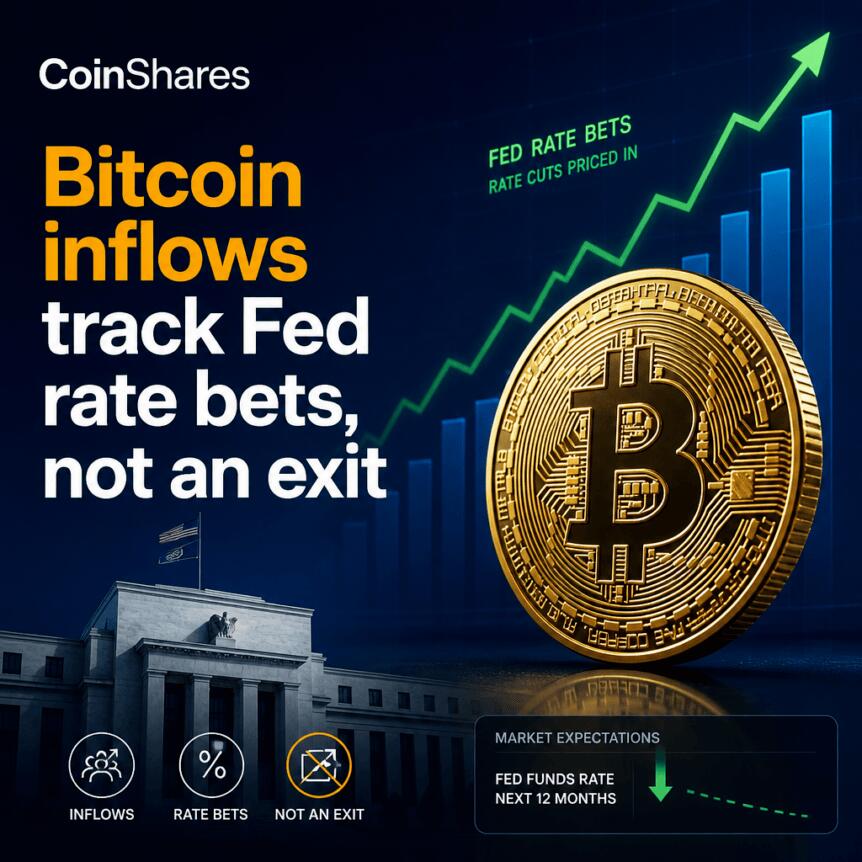
Crypto investment flows are increasingly reacting not to crypto-specific news, but to shifts in the US interest-rate outlook. CoinShares said this week that the Federal Reserve remains a major constraint on Bitcoin’s ability to decisively break above the psychologically important $80,000 level—even as inflows show investors are still willing to hold the asset.
In a market update released on April 9, 2026, CoinShares head of research James Butterfill argued that Bitcoin is beginning to trade “like gold again,” but that monetary policy is still effectively placing a ceiling around $80,000.
Key takeaways
- CoinShares links recent crypto flow swings to changes in the Fed’s perceived path for rates rather than to new crypto catalysts.
- Following remarks from Fed Chair Kevin Warsh at Jackson Hole, about $100 million left digital asset investment products as markets raised expectations for a September rate hike.
- Flows reversed over the next week, reaching roughly $1 billion by Sept. 4, coinciding with signals from Fed Governor Christopher Waller that he could support holding rates steady in September if inflation data continues to improve.
- Fed Funds futures priced near a 60% chance of a rate hike after the Sept. 4 period, according to CME Group’s FedWatch tool.
- CoinShares’ rate sensitivity comes as US Treasury plans to increase long-dated buybacks aim to support broader liquidity conditions that have historically helped risk assets.
Why the “rate path” matters for Bitcoin
CoinShares’ central message is that investor behavior is not necessarily moving away from crypto; instead, it is reacting to the market’s evolving assumptions about the Fed. Butterfill’s comment that “investors are not exiting the asset class… they are trading the rate path” frames the recent pattern: when expectations for tightening rose, money flowed out; when the odds shifted toward steadier policy, inflows returned.
The immediate catalyst for that sensitivity came after Fed Chair Kevin Warsh’s Jackson Hole remarks. Warsh said progress on inflation had been modest and that price pressures were not easing quickly enough to give the central bank confidence inflation was moving back toward its 2% target. CoinShares reported that roughly $100 million exited digital asset investment products right after the speech as markets quickly increased the probability of a September rate hike.
That “risk-off to risk-on” reversal underscores how marginal changes in liquidity expectations are influencing crypto positioning. Easier financial conditions have historically been supportive for Bitcoin and other risk assets, and CoinShares’ analysis suggests the market is currently treating the Fed as the primary driver of that liquidity impulse.
From Jackson Hole to September: inflows rebound
CoinShares said flows improved after the initial post–Jackson Hole reaction. Over the following week, inflows reached about $1 billion by Sept. 4, indicating investors were willing to return once the probability of further tightening appeared less aggressive.
This rebound coincided with comments from Fed Governor Christopher Waller. According to the same CoinShares discussion, Waller highlighted recent signs of “disinflation” and indicated he was inclined to keep rates steady in September if upcoming inflation data continued showing progress. For traders and fund managers, this kind of language matters because it shifts how quickly the market expects policy to change—and those expectations often translate into broader moves in yields and risk appetite.
As of Monday, CoinShares pointed to data from CME Group showing Fed Funds futures implied about a 60% chance of a rate hike after the next FOMC meeting. The implication is straightforward: Bitcoin’s performance around key technical levels like $80,000 may remain vulnerable to any sudden repricing of the probability distribution around September’s decision.
Liquidity signals beyond crypto: Treasury buybacks
CoinShares’ interest-rate focus comes alongside a separate, potentially supportive liquidity backdrop. The firm’s assessment is occurring after the US Treasury announced plans to double certain long-dated bond buybacks—from $2 billion to $4 billion per operation—aimed at increasing demand for Treasurys over a defined window.
Cointelegraph reported that Bitcoin rose from the low $60,000s to above $80,000 during last month’s advance. The buyback program is expected to run from Sept. 9 through Nov. 4, spanning multiple weeks into the period when markets will be re-evaluating the Fed’s stance and inflation trajectory.
One way to interpret this overlap is through portfolio behavior. As noted in an excerpt from 21Shares co-founder Ophelia Snyder’s Substack newsletter, the Treasury announcement was accompanied by equity sell-offs and shifts across the yield curve, with other macro noise—such as developments related to the Iran conflict and how markets interpreted diplomatic prospects—adding volatility to oil and equity pricing.
Snyder argued that, taken together, these factors point to the rally having “less to do with crypto-specific catalysts” and more to do with investors adjusting de-risking exposure specifically to the US. Whether or not that interpretation proves entirely correct, it aligns with CoinShares’ broader theme: investors are sensitive to the macro transmission mechanism that affects liquidity and relative asset attractiveness.
Standard Chartered has also forecast that Bitcoin could reach $100,000 before year-end, as cited in earlier coverage that framed the bond-buyback backdrop as part of the broader driver set for liquidity and risk positioning.
What to watch next as pricing tightens
The practical takeaway for market participants is that Bitcoin’s near-term trading behavior may continue to track rate expectations more than it tracks internal crypto fundamentals. Investors should watch how quickly Fed-related odds change heading into the September decision—especially since CoinShares’ flow data suggests sudden repricing can move money rapidly into or out of digital asset investment products.
At the same time, the Treasury buybacks schedule starting Sept. 9 through Nov. 4 will be a parallel factor that could influence broader liquidity conditions. The key question is whether incoming inflation and Fed signals reinforce steadier policy expectations—or force another shift in the rate path that crypto flows have shown they are willing to respond to immediately.
Polish prosecutors have charged Roman Ż., a former business partner of missing BitBay founder Sylwester Suszek, with two offenses as the Zondacrypto investigation expands beyond 3,600 customer complaints.
Summary
- Roman Ż. is at least the fifth person charged in the Zondacrypto investigation.
- One charge concerns alleged fraud, while prosecutors have not disclosed the second offense.
- Customers face estimated losses of at least 350 million zlotys, or about $94 million.
- A court will decide whether Ż. remains in custody during the investigation.
Zondacrypto suspect faces two charges
According to a report published Monday, Roman Ż. was arrested on Saturday in Poland’s Silesia region before being taken to the National Prosecutor’s Office branch in Katowice for questioning.
Prosecutors charged him with two offenses, including fraud, according to his lawyer, Błażej Gazda. Authorities have not publicly described the second allegation or released a detailed account of the evidence supporting either charge.
Ż. denied the allegations and gave investigators an extensive statement, Gazda said. His lawyer described him as a former business partner of Suszek who helped manage BitBay before the exchange changed its name to Zonda in 2021.
During searches at the arrest location and Ż.’s registered address, officers seized valuable watches and documents tied to Zondacrypto’s operations. Poland’s Central Bureau for Combating Cybercrime and the Katowice regional police took part in the operation, according to the National Prosecutor’s Office.
Prosecutors ordered the arrest after learning that Ż. planned to travel to China, which they viewed as grounds for a flight risk. Gazda said the planned journey was a business trip and that his client had a return ticket dated Sept. 13.
Polish prosecutors intend to seek pretrial detention while the investigation continues. A court must decide whether the evidence and stated flight risk justify keeping Ż. in custody.
Exchange losses are estimated at $94 million
Founded by Suszek in 2014, BitBay developed into one of Poland’s best-known cryptocurrency exchanges before adopting the Zondacrypto name in 2021. The platform reported having more than 1 million registered users around the time of the rebrand.
Problems became public in early 2026 when customers began reporting delayed or frozen withdrawals. Zondacrypto acknowledged payment delays affecting some users in late February and suspended Bitcoin deposits on March 17, citing market volatility.
The exchange stopped trading in April, while its website went offline on April 23. Available market trackers later showed no active Zondacrypto trading pairs or reported trading volume, and the company-linked ZND token lost almost all of its value.
As crypto.news previously reported, prosecutors estimated customer losses at more than 350 million zlotys, equivalent to approximately $94 million at the reported exchange rate. The figure is considerably higher than the 35 million zlotys cited in some early accounts of the case.
Polish authorities opened their investigation in April over suspected large-scale fraud and money laundering. By June, prosecutors had received more than 3,600 complaints from customers who said they could not recover assets held on the platform.
Investigators have frozen €4 million held in one bank account, according to local media reports. Authorities have also secured more than 100 million zlotys in assets that could potentially support compensation claims, although no repayment process or final distribution has been announced.
The Estonian Financial Intelligence Unit initially restricted the license of BB Trade Estonia OÜ, the legal entity behind the exchange, preventing it from accepting new customer assets. A previous report said the regulator revoked the company’s operating license on June 29 after the earlier suspension.
Suszek disappearance forms part of the investigation
Suszek disappeared on March 10, 2022, after travelling to a meeting in Czeladź, Poland. He had left his executive position before Zondacrypto’s collapse, but authorities continue to examine events surrounding BitBay’s creation and early operations.
In August, prosecutors combined the Zondacrypto criminal investigation with the inquiry into Suszek’s disappearance. Authorities said information about BitBay’s management, ownership and financial activity could help investigators establish what happened to its founder.
Suszek’s family reportedly received messages claiming that he had been kidnapped and that the people responsible wanted a Bitcoin payment. Publicly available information has not established whether the messages were genuine, and no court has determined what happened to him.
Roman Ż. is at least the fifth person to face charges after prosecutors joined the two investigations. His past business relationship with Suszek and his reported role in managing BitBay place his activities within the period now being examined by investigators.
In a separate case dating to 2019, prosecutors accused Ż. of leading an organized criminal group and laundering 28 million zlotys through BitBay accounts, according to Polish news outlet Interia. The allegation relates to separate proceedings and has not been presented as proof of the charges filed in the Zondacrypto case.
Other Zondacrypto suspects remain under investigation
Ż.’s detention followed a series of arrests involving people allegedly connected to the exchange. Police detained stock-market investor Rafał Z., Jaromira W., and Anna P. during the previous week, and a court later approved their continued detention. All three denied the alleged offenses, according to local reports.
Polish Olympic Committee President Radosław Piesiewicz has also been charged with paid influence and favoring one group of Zondacrypto creditors over others while the exchange was approaching insolvency.
An Aug. 27 report on Piesiewicz said investigators were examining whether he received advance information that allowed him to withdraw his entire investment while other customers could not access their funds. Piesiewicz denied receiving preferential treatment and described himself as a victim of the platform.
The second allegation against Piesiewicz concerns a claim that he offered to use his contacts to help Zondacrypto address problems involving Poland’s Office of Competition and Consumer Protection. Investigators have also examined a €40,000 Patek Philippe watch allegedly purchased by former Zondacrypto chief Przemysław Kral before a meeting with Piesiewicz in Monaco.
Neither Piesiewicz nor Roman Ż. has been convicted in the Zondacrypto proceedings. Their legal status remains that of suspects while prosecutors collect evidence and the courts consider detention requests.
Poland’s crypto rules remain disputed
The case has entered Poland’s debate over how the country should apply the European Union’s Markets in Crypto-Assets framework. Proposed domestic legislation would have made the Polish Financial Supervision Authority, known as the KNF, the national supervisor for crypto companies.
On Sept. 4, Poland’s lower house fell 25 votes short of overriding President Karol Nawrocki’s third veto of the bill. The Poland crypto bill vote ended with 241 lawmakers supporting the override, 198 opposing it and three abstaining, below the 266 votes required.
Prime Minister Donald Tusk referred to testimony from the Zondacrypto investigation while urging lawmakers to support the legislation. Nawrocki has said he favors rules against fraud and financial crime but considers the government-backed proposal too restrictive for legitimate crypto businesses.
For U.S. users, the Polish criminal case and licensing dispute do not change access to American exchanges, spot crypto exchange-traded funds, or other U.S.-regulated investment products. The proceedings concern alleged conduct tied to a Polish-run, Estonian-registered exchange and enforcement actions taken by European authorities.
MiCA already applies across the European Union, with national regulators responsible for licensing, supervision and enforcement. Its transition period ended on July 1, leaving firms without authorization subject to service restrictions or an orderly closure.
Crypto World
Exclusive Abu Dhabi F1 Hospitality Experience Now Available for Crypto Executives, Investors and VIP Guests

The Formula 1 Abu Dhabi Grand Prix is one of the most anticipated events on the UAE calendar, bringing together motorsport, luxury, business and entertainment at Yas Marina Circuit.
For the 2026 season finale, Crypto Breaking News and Web3 Digital can now provide access to an exclusive Sunday hospitality experience at the W Garage Terrace at W Abu Dhabi – Yas Island, designed for executives, investors, entrepreneurs, corporate guests and VIP clients looking to experience Formula 1 from a premium setting.
Located directly alongside the circuit, the W Garage Terrace offers an exceptional race-day environment combining close-up Formula 1 action with premium hospitality, networking and the distinctive atmosphere of Yas Marina.
Experience the Abu Dhabi Grand Prix from the W Garage Terrace
The W Garage Terrace offers an open-air vantage point overlooking Turns 12 and 13, placing guests close to the action while providing views across Yas Marina and its iconic superyachts.
The experience has been designed to combine the excitement of the Formula 1 season finale with a more intimate and sophisticated hospitality environment, making it particularly suitable for corporate entertainment, client engagement and private networking.
What the Experience Includes
- Exclusive Sunday access to the W Garage Terrace at W Abu Dhabi – Yas Island
- Premium views of the Formula 1 action around Turns 12 and 13
- Dedicated terrace and lounge seating
- Premium international dining throughout the experience
- Champagne service and premium beverages
- Curated social and networking areas
- Live entertainment and DJ sets
- Access to the unique W Abu Dhabi atmosphere during race weekend
- Post-race concert access, depending on the applicable ticket category
A Premium Setting for Business and Networking
The Abu Dhabi Grand Prix has become much more than a motorsport event. Every year, it attracts international entrepreneurs, investors, executives, celebrities and decision-makers to Abu Dhabi for one of the region’s most important lifestyle and networking weekends.
For companies operating in crypto, Web3, fintech, trading, investment and digital assets, premium Formula 1 hospitality can also provide an alternative environment for building relationships with clients and partners outside the traditional conference setting.
The experience can be particularly suitable for:
- Crypto exchanges and trading platforms hosting VIP clients
- Web3 and fintech companies entertaining partners or executives
- Private investors and high-net-worth individuals
- Corporate leadership and incentive programmes
- Family offices and investment companies
- International founders and entrepreneurs visiting the UAE
- Brands looking for premium client-engagement experiences
Corporate and Group Hospitality
Companies interested in bringing multiple guests can also request tailored corporate and group arrangements.
Depending on the size of the group and specific requirements, additional services and hospitality elements can be arranged to create a more personalised experience for clients, executives or strategic partners.
For larger corporate requirements, bespoke options can be explored individually based on availability.
More Than Just a Formula 1 Ticket
This experience is designed for guests looking for more than simply attending the race.
The combination of premium track views, hospitality, dining, entertainment and networking creates an opportunity to experience the Abu Dhabi Grand Prix from one of Yas Marina’s most distinctive locations.
Previous editions of the Garage Terrace experience have welcomed hundreds of guests, combining premium race viewing with elevated dining, free-flowing beverages and the atmosphere of the Formula 1 finale at Yas Marina.
Limited Availability for Abu Dhabi F1 2026
Hospitality inventory for the Abu Dhabi Grand Prix is limited and availability can change quickly as the race weekend approaches.
For this reason, current availability must be confirmed before any booking can be finalised.
Pricing is available privately upon request.
Individuals, companies and corporate groups interested in the W Garage Terrace experience can contact us directly with the number of guests and any specific hospitality requirements.
Premium Access to Other Global Sporting Events
Through our international hospitality network, Web3 Digital and Crypto Breaking News can also assist clients looking for premium access to other major sporting and live entertainment events worldwide.
Opportunities can include Formula 1 Grand Prix weekends, Grand Slam tennis, international football, major cricket events, concerts and bespoke VIP experiences.
If you are planning to attend a major international event and are looking for premium hospitality or hard-to-access experiences, our team can check available options based on your requirements.
Request Abu Dhabi F1 Hospitality Availability
To request current availability, private rates or corporate hospitality options for the 2026 Formula 1 Abu Dhabi Grand Prix, contact:
Web3 Digital / Crypto Breaking News
Email: hello@web3digital.ae
Website: www.web3digital.ae
Availability and hospitality options are subject to confirmation at the time of booking.

XRP price is sitting well inside a range that’s frustrated bulls for weeks, even though the whole market is in a bullish prediction environment. A $60 target sounds absurd at that price point, until you see the chart behind the claim. There’s a specific number standing between here and there, and it’s not the one most traders are watching.
Analyst Ali Martinez laid out the case on a monthly chart, pointing to a decade-old ascending triangle with its upper boundary at $3.66.
“For nearly a decade, XRP has been forming a massive ascending triangle on the monthly chart,” Martinez wrote, adding that a monthly close above that level, not just a wick through it, would confirm the breakout and unlock a technical target near $60. At the current supply, that price implies a market cap near $3.76 trillion.
Context matters here. XRP just absorbed a 1 billion token escrow unlock worth roughly $1.38 billion, and the market has spent the last 48 hours oscillating between $1.39 and $1.43 rather than trending. That’s the backdrop against which any $60 conversation has to be judged.
Discover: The Best Token Presales
XRP Price Prediction: Hit $3.66 Resistance This Week?
Short answer: not likely within days, but the setup is worth tracking. XRP is consolidating just above its 24-hour floor near $1.39–$1.40, with immediate resistance at $1.43 and a secondary ceiling at $1.48 based on the 7-day range.
Volume and momentum data suggest the token is coiling rather than breaking, with 7-day performance running +1.9% to +4.5% depending on the feed.

- The bull case: XRP reclaims $1.48, builds a base, and starts the long grind toward $3.66 over multiple quarters, the monthly close Martinez needs for triangle confirmation.
- The base case: continued range-bound trading between $1.35 and $1.48 while the market digests unlock supply and waits for a catalyst, potentially tied to regulatory clarity progress.
- The bear case: a break below the $1.35 demand zone flagged by analyst Ali Charts, which would invalidate the near-term bullish structure.
None of these moves the needle toward $60 without patience measured in years, not weeks.
Earn $50 and Enter $300K Prize Draw on EdgeX
Bitcoin Hyper Targets Early Mover Upside as XRP Tests Key Levels
A 4,100% move from current levels isn’t impossible over a decade, but it’s not a trade. It’s a thesis requiring years of confirmation candles. Traders looking for asymmetric upside without waiting for a monthly close in 2030 are increasingly rotating into earlier-stage infrastructure plays instead.
That’s the pitch behind Bitcoin Hyper ($HYPER), a Bitcoin Layer 2 integrating the Solana Virtual Machine, the first project claiming to run smart contracts on Bitcoin’s base layer faster than Solana’s own mainnet.
Bitcoin Hyper is refining the developer experience with clearer documentation, familiar tooling, predictable APIs, and better feedback for builders. — Bitcoin Hyper (@BTC_Hyper2) September 2, 2026
The goal: make the network easier to understand, connect existing tools, and start building with less friction. 

Read the… pic.twitter.com/kAo1w7Xa06
The presale has raised $33 million at a current token price of $0.0136858, with a huge 35% staking rewards on offer only for early buyers. Its architecture pairs low-latency L2 processing with a decentralized canonical bridge for native BTC transfers, targeting Bitcoin’s long-standing programmability gap without sacrificing base-layer security.
Research Bitcoin Hyper directly before the funding window closes.
Trade Crypto on Bybit and Get a Chance to Win Our $1,000 USDT Airdrop
The post XRP Price Prediction: Analyst Calls $60 Ripple If it Breaks The Heavy Resistance appeared first on Cryptonews.

TECNO CAMON Slim 5G Manages to Cram a Gallery Into 6.39 Millimeters

M&S has quietly slashed prices on 50 popular food products

S&P 500 Earnings: Expected 2027 EPS Growth Might Make For A Tougher Year

Weekend Open Thread – Corporette.com

Weekend Open Thread: Brooks Brothers

London Mayor Sadiq Khan handed a peerage by Keir Starmer alongside 15 other Labour figures… just days before the PM leaves No10

Mind it! Financial Freedom.. #shorts #mindse #mindset #viral #motivation #trending #inspiration

Once You Make Money, Upgrade These 7 Things ASAP

NVIDIA The SAFEST Architecture for Future Tech Investment #ai #investing #Finance #aistocks #news
-

 Fashion3 days ago
Weekend Open Thread: Beyond Yoga
-
 Crypto World3 days ago
Bitcoin price stalls near $82K as key resistance holds
-

 Politics3 days ago
Best Gaming Laptops, CPUs, TVs, And Keyboards To Upgrade Your Set Up For GTA VI
-

 Tech3 days ago
The Birds Outside, Drawn For You Automatically
-

 Crypto World3 days ago
IMF Says El Salvador’s Post-Review Bitcoin Purchases Used No Public Funds
-
 Crypto World3 days ago
U.S. added stronger than expected 162,000 jobs in August as labor market bounced back
-

 Sports4 days ago
Alexandre Pato consortium’s Northampton Town investment approved
-

 Sports4 days ago
Commanders’ Chig Okonkwo is a top breakout fantasy football candidate
-

 Sports3 days ago
Golden Eaglets Drawn in Group B for 2026 WAFU B U17 Championship
-
 Crypto World3 days ago
XRP price breaks falling channel as bulls target $1.53
-
 Politics4 days ago
A new European chapter for Gibraltar
-

 Politics3 days ago
How To Avoid Winter Colds: 4 Everyday Habits That Spread Germs, Says Pharmacist
-

 Politics3 days ago
The House | Bin the lectures, bring gossip and be ready to banter: how the new PM should prepare for his Trump encounter
-

 Crypto World3 days ago
From warning to listing: UK’s largest retail investment platform opens access to crypto ETNs
-

 Crypto World3 days ago
FinCEN flags $12.7B tied to Southeast Asia crypto investment scams
-

 Tech3 days ago
A Worthy Android Ereader, With Some Tradeoffs
-

 Tech3 days ago
How To Edit Claude’s Memory
-

 Crypto World3 days ago
Trezor Data Breach Impacts 67,000 More US Customers
-

 Politics4 days ago
33 Cosy Autumn Home Decor Ideas: Blankets, Pumpkin Decorations, And Candles
-

 Tech3 days ago
beyerdynamic AVENTHO Y Debuts at IFA 2026 and Makes Wireless Headphones Less Disposable
You must be logged in to post a comment Login