








Connect with us

Tech

White House takes down ‘Build the Wall’ game after the Tetris Company complains

Published

on

A video game posted to the Trump administration’s website — one that closely resembled Tetris — has been taken down after the Tetris Company complained.

The White House recently took the unusual step of posting a number of arcade-style video games to its website. One of the more controversial was a game called “Build the Wall,” which reportedly mirrored Tetris’ gameplay, tasking players with stacking blocks of various shapes and sizes. Widely criticized as racist, the stated goal of the game was to build a wall in order to keep out a “zombie border siege.”

Not long after Build the Wall’s existence became public, the Tetris Company — which owns the rights to the original Tetris game — spoke out about it, clarifying that it had no role in its creation. “The Tetris Company was not involved in the creation of ‘Build the Wall,’” it said in an Instagram post, adding: “We take copyright infringement very seriously.”

The page for Build the Wall now returns a 404 error, meaning the page no longer exists. Kotaku first spotted that the game was no longer visible on the White House’s website. TechCrunch has reached out to the Trump administration for comment.

Advertisement

Still visible on the government’s website is a game called Rio Run, where players control a white male character whose goal is to deport as many immigrant characters as possible.

Source link

Advertisement
Continue Reading
Click to comment

You must be logged in to post a comment Login

Leave a Reply

Tech

Why this month’s Microsoft patch release is a doozy

Published

on

Microsoft’s patch for September is a doozy, with a record number of roughly 972 vulnerabilities fixed and 112 of them meeting the high critical-severity threshold.

It was only two months ago that Microsoft patched a then-record 570 vulnerabilities. Then, last month, Microsoft patched some 620 of them. Google and other companies have also published record numbers of vulnerabilities in recent months. Two weeks ago, OpenAI, Anthropic, Amazon Web Services, Google, Microsoft, and 100 companies and organizations published an open letter warning of a narrowing window for patching vulnerabilities ahead of an expected tsunami of AI-enabled attacks that actively exploit them first. The industry is taking the threat seriously by pumping out unprecedented numbers of patches in their software.

Welcome to the new normal

Dustin Childs, a researcher at the Zero Day Initiative, calls the spikes the “new normal” and also cautions that despite them, the damage that’s likely to result from AI-assisted attacks could eventually be substantial.

“On the one hand, congrats to the security gnomes at Microsoft for being able to patch bugs at this rate,” Childs wrote Tuesday. “On the other hand, AI-assisted vulnerability discovery shows no signs of slowing down. However, we have not seen a correlating spike in active exploits—yet.”

Advertisement

Counting the precise number of vulnerabilities fixed in a monthly patch release for Microsoft is never an exact science. In some cases, the bugs were previously addressed or affected non-Microsoft products. By Childs’s count, Tuesday’s release patches 972 vulnerabilities, and 997 when counting the porting of fixes for the Chromium browser incorporated into Edge. Of the new vulnerabilities, 112 of them are rated critical, with the remainder carrying the important designation. Already this year, Microsoft has fixed 2,760 vulnerabilities, more than double the number from last year. At this rate, Microsoft will complete the year having fixed more bugs than all of 2023, 2024, and 2025 combined.

Source link

Advertisement
Continue Reading

Tech

Some Tech Companies Have Privately Pushed Back On ICE Subpoenas. They Should All Do More.

Published

on

from the protect-the-rights-of-your-users dept

In a handful of known cases, large social media companies have privately pushed back against Immigration and Customs Enforcement (ICE) subpoenas when the agency tried to unmask anonymous users who tracked immigration activities or criticized the government.

As ICE engages in a pattern of illegal and chilling investigations, any resistance is welcome. But social media companies can do more. When companies receive these unlawful subpoenas, they should be clear with the public that they will not hand over the data unless a court compels them to do so. In addition, companies themselves can take the government to court to challenge these unlawful subpoenas on behalf of their users.

Publicly challenging these unlawful subpoenas in court has the dual purpose of protecting individual users who may lack the resources or know-how to challenge a subpoena on their own, while also discouraging ICE from issuing similarly unlawful subpoenas in the future.

Companies have a responsibility to protect the privacy of their users. That responsibility does not end simply because companies wish to avoid the ire of this administration—which has sought to chill other powerful institutions like news outletslaw firmsuniversities, and non-profits.

Advertisement

ICE Has Issued Many Unlawful Subpoenas

ICE has sent hundreds of subpoenas to large technology companies like Google, Meta, and Reddit seeking basic subscriber information like name, email address, IP address, and session times.

Some of these subpoenas have targeted people who engaged in protected activity—like tracking immigration actions, criticizing the government, or attending a protest. People have a First Amendment right to document law enforcement activities and criticize the government online, without retaliatory government investigations. This right has become more important as immigration agents have engaged in invasiveunconstitutional, and sometimes violent conduct.

In a handful of cases, users themselves have successfully pushed back. After receiving notice of these subpoenas, users have challenged them in court, relying on pro-bono lawyers from groups like the ACLU or Civil Liberties Defense Center. Companies have been largely absent from these court proceedings.

Private Pushback from Meta and Reddit

While not appearing in court, companies like Meta and Reddit have sometimes pushed back behind the scenes.

Advertisement

For example, on September 11, 2025, ICE sent administrative subpoenas to Meta seeking to unmask users who ran Instagram and Facebook accounts that tracked immigration activity in Pennsylvania. On September 19, 2025, Meta’s Law Enforcement Response Team told ICE that the agency did not have the “statutory authorization” to seek the records. It asked for more detail about the investigation and said “Meta will take no further action with respect to this summons until it receives this information.” Later, Meta informed ICE that it planned to notify the users about the subpoenas, since no gag order had been obtained. The government disclosed this information in one of EFF’s Freedom of Information Act lawsuits against ICE and other agencies.
On October 3, 2025, Meta notified the user about the subpoena. Despite its private pushback, Meta told the users it would comply with the subpoenas unless they mounted a court challenge within 10 days—which they did with the help of the ACLU. Ultimately, ICE withdrew the subpoenas when it became likely that ICE would lose the case in court.

In another example, Reddit documented its pushback in a transparency report released a few months ago. Reddit reported that in the second half of 2025, the company received three Department of Homeland Security (DHS) subpoenas seeking account information from 11 users who posted content critical of ICE. In the report, the company stated that “Reddit objected to these legal demands because the users appeared to be engaged in protected activity under the First Amendment, and law enforcement withdrew their requests.” The company reported that most other DHS subpoenas it received appeared to be routine.

A Tech Company Model for Public Resistance

EFF’s demand that technology companies do more to protect their users is not unprecedented. Twitter (now X) did so successfully in the first Trump administration.

Advertisement

On April 6 2017, Twitter went to court to challenge a DHS subpoena that sought to unmask a Twitter account named “@ALT_USCIS,” which frequently criticized the administration’s immigration policies. Twitter challenged the subpoena on both statutory and First Amendment grounds. A day later, DHS withdrew the subpoena and Twitter dismissed the case. The incident led to an inspector general investigation, which criticized a tactic that DHS is still engaged in.

In other circumstances, companies have also gone to court to protect their users and shield themselves from burdensome legal process. In 2013, Microsoft challenged a search warrant for the content of emails stored on servers outside the United States. In 2015, Apple challenged a court order to break the security of its iPhone during an investigation into the San Bernardino shootings. And in 2007, Yahoo challenged the constitutionality of government requests at the Foreign Intelligence Surveillance Court.

Republished from the EFF’s Deeplinks blog.

Filed Under: ice, privacy, subpoenas

Companies: meta, reddit, twitter, x

Advertisement

Source link

Continue Reading

Tech

CloudNC raises $20M to automate manufacturing’s most pressing bottlenecks

Published

on

UK-based manufacturing software startup CloudNC announced a $20 million B extension round on Wednesday, bringing its lifetime total raised amount to $128 million. The company’s last major raise was four years ago, its co-founder and CEO Theo Saville told TechCrunch.

Saville launched CloudNC in 2015 with Chris Emery, now the company’s chief science officer, and offers AI-powered CAM Assist software that automates parts of Computer Numerical Control (CNC) machining. CNC is the process of using computer-controlled machines to cut or shape materials precisely into the parts that are then used in automotive, defense, or consumer hardware industries.

Before a part can be cut, Saville said, a machinist or a computer-aided manufacturing programmer has to decide issues like how a part should be held or what tools should be used, Saville said.

They typically use powerful CAM software to help with this ideation phase, and although some of these tools can help users create part features or known part patterns, that’s different from looking at the part and generating an execution strategy an expert would actually want to use. 

Advertisement

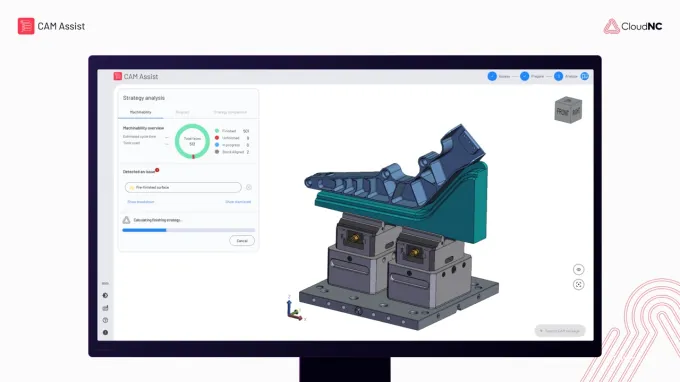
“Traditional CAM systems are powerful, but in most workflows, they are still tools that allow programmers to manually specify how a part should be machined,” Saville said. This is where his CAM Assist comes in, a software that plugs into traditional CAM systems, like Autodesk Fusion or Mastercam, to help machinists and programmers make more efficient strategic manufacturing decisions. 

“It selects suitable tools, approach directions, and cutting feeds and speeds, and then drafts the code required to tell the CNC machine what to do,” Saville said. 

Image Credits:CloudNC

From there, the user reviews, edits, and approves the results. Saville said the goal was to help skilled workers be more “efficient and productive,” rather than removing expert judgment from the process. If “traditional CAM is a powerful toolkit,” he said, then “CAM Assist is more like an expert assistant sitting alongside the programmer, automating much of the first-pass thinking and repetitive setup so the human can review, improve, and approve the approach.” 

Saville said more than 1,000 machine shops worldwide use CAM Assist, and 80% of the company’s customer base, which includes both manufacturers and companies, is in the U.S. With a team of 80 employees, the company’s biggest goal is scaling adoption. 

“This makes this the right time to raise additional capital,” he said. Investors in the round include Nimble Ventures, which led the round, Calculus Venture Capital, Entrepreneur First, and LM Capital, Lockheed Martin’s venture arm. “The funding allows us to support wider take-up of CAM Assist, strengthen our go-to-market operations, expand in existing and new markets, and develop new products such as Quote Agent.” 

Advertisement

The premise behind Quote Agent, which targets manufacturers, is similar to CAM Assist. It helps shops assess the estimated cost and risk of a new project so they can move faster to accept — or reject — new work. He tied this somewhat back to geopolitics, pointing to, for example, how machine shops in the U.S. are looking to reshore and how, at the same time, there is a shortage of skilled workers in manufacturing. 

“Machine shops need to quote faster, program faster, and deliver more with the people and machines they already have,” he said, adding that Quote Agent is set to launch next month. 

“There are more ways to machine a typical CNC part than there are atoms in the universe,” he continued. “We have spent years attacking that specific problem, with our own factory, our own software team, and a lot of hard lessons from real machining. It’s been a long process to get to where we are today.”

When you purchase through links in our articles, we may earn a small commission. This doesn’t affect our editorial independence.

Advertisement

Source link

Continue Reading

Tech

Meta’s New AI Agent Wants to Get Personal With You

Published

on

This seems to be the year of AI agents, and Meta is diving into the game. The company on Tuesday announced a new agent program called Muse, which CEO Mark Zuckerberg describes as a “personal agent” that understands your habits and goals. It’s available now in the US.

Agentic AI is a type of generative AI based on a large language model where agents, or bots, are meant to take actions autonomously on your behalf. Meta’s Muse, for example, can do online shopping (with your permission), create documents, fill out forms and respond to emails.

Meta says that Muse is a more general-purpose agent, not limited to specific tasks like coding. (If you want agentic coding help, you can use Muse Code, also recently released by the company.) You have to give Muse permission to access your apps and data, which you can revoke at any time. Like a lot of agentic AI tools, the more info you give it, the more personalized your results will be.

Advertisement
Audio Deepfakes Are Here: How to Protect Yourself From AI-Impersonation Scams

Muse runs “on its own dedicated computer in the cloud,” according to a Meta blog post, in what the company calls a “virtual machine.” The tool also has a separate Sentinel agent — you can think of it as a virtual traffic cop, giving Muse a red or green light before letting it out onto the internet to complete tasks.

Agentic AI can be risky. Over the summer, agents from Meta, OpenAI and Anthropic each slipped out of their testing environments and hacked outside websites, casting increased scrutiny on the potentially disastrous harm AI can do to our cybersecurity.

Meta’s vice president of Superintelligence Labs, Tarek Sheasha, said in a blog post: “The harness runs in its own isolated cell, it doesn’t see real credentials, and every interaction with the outside world runs through a Sentinel which the agent can’t override.”

Muse is available now on iOS and Android and on the muse.ai website. The company says it will be bringing the AI to its controversial smart glasses soon. According to Zuckerberg, it will be free for people to use “up to 100 million tokens per week” (one token is roughly equivalent to four characters). So unless you’re constantly running Muse on complex tasks, you should be able to use it for a while before running into a paywall.

Source link

Advertisement
Continue Reading

Tech

What Are The Major Changes Coming To Apple HomeKit In iOS 27?

Published

on

The Home app is getting some great AI upgrades, along with other cool tweaks.

iOS 27 is focused on features like Siri AI, along with making overall improvements. But there’s much more to this update, especially for those with HomeKit accessories. No, Apple isn’t bringing the revamped Siri to the HomePod just yet — though that might happen soon. Instead, HomeKit and the Home app are getting some great new features. 

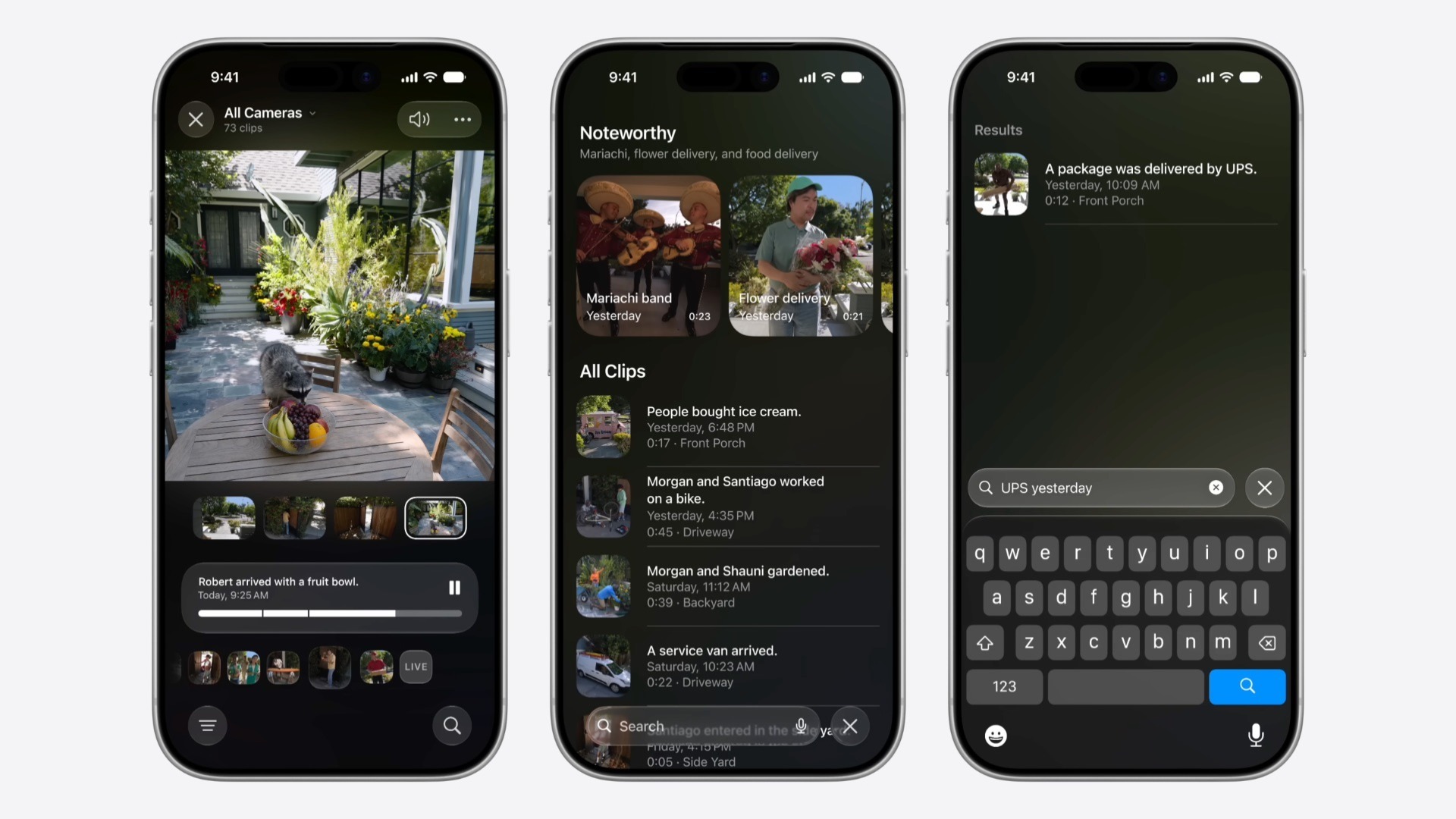
Apple Intelligence is being further integrated into the Home app for smarter notifications. Plus, security camera footage will be much clearer now with 4K support. These features on their own may not seem like a big deal, but they definitely make the HomeKit experience better.

Advertisement

HomeKit now integrates with Apple Intelligence

Perhaps the most notable change this year is deeper integration with Apple Intelligence. HomeKit has never really taken advantage of AI features until now, but that changes with iOS 27. The Home app can now summarize important notifications, such as when someone was seen at your door or when smoke is detected. This is especially useful for people who have multiple cameras and smart doorbells at home, as it should prevent you having your lock screen flooded with Home app notifications.

Speaking of cameras, they can now use AI to better detect faces or animals. Not only that, but the Home app combines footage from multiple cameras to show you the same event from a different angle. Say someone is moving around your house: the app will show you a sequence of footage of that person in every room equipped with a camera. 

The videos also come with a short AI-generated description, so you don’t have to spend minutes watching the whole clip to find out what happened. You can even search for events captured by your cameras, plus videos are now recorded in 4K.

Advertisement

Apple TV owners have another reason to update to iOS 27, as the Home app can now update the software on all your Apple TVs at once. Plus, the app’s reliability has been improved overall, which is always appreciated.

New home accessories from Apple are coming soon

Some new releases haven’t been officially announced, but are likely coming soon. These are related to upcoming hardware, such as the rumored HomePad. If the rumors are true — and they probably are, based on internal code leaked by Apple itself — there are many new home accessories underway.

This includes a new generation of the HomePod mini, as well as a new product called the “HomePad.” As you might have guessed, this product is expected to combine the HomePod and the iPad into a single device. This would make it akin to Apple’s take on an Amazon Echo Show. It appears that this HomePad will have its own “Faces” gallery, just like an Apple Watch. The company has also been working on a tabletop robot, but this one probably won’t be ready for a while.

As for the features mentioned earlier, they’re all part of iOS 27. If you really want to try out the latest features ahead of time, you can always sign up for the Apple Beta Program. But since betas can be unstable, you should only install them on a spare device in case something goes wrong. 

Advertisement

Source link

Advertisement
Continue Reading

Tech

Reporting Indicates RFK Jr. Directly Intervened To Keep PA Deaths Off CDC Measles Report

Published

on

from the vanishing-act dept

The measles outbreak, that began in America nearly two years ago, has only increased in velocity. We recently talked about the deaths of two children in Pennsylvania who both died while infected with measles. I’m altering my language slightly here from that original post in which I described those children as having died of measles purely to acknowledge that there are some, including RFK Jr., who are trying to dispute the cause of those deaths. I’m comfortable stating that they died of measles, as are state officials in Pennsylvania, and as are competent local health professionals like Paul Offit. As explained in a previous post, the ruptured spleen that one newborn died from is an expected symptom of measles in newborns. Kennedy is trying to claim that the cause of death is the spleen, as though the measles infection played no role. That’s dumb, and he’s dumb and a liar, but here we are.

Well, when it comes to CDC reporting on the measles outbreak, the dedicated public page for tracking the numbers was last updated the day of this writing, September 4th. The data generally demonstrates just how shit of a job Kennedy and his crackerjack group of assclowns in government are doing in combating the outbreak. Keep in mind that Kennedy has publicly claimed that he’s doing an awesome job in all of this.

Cases? Up with 4 months left in the year.

Total number of hospitalizations? Up with 4 months left in the year.

Deaths? Well…

The page didn’t always read that way. For a brief moment several days ago, the death count simply stood at 2. Why? Because the CDC questioning state reporting on any statistic surrounding a medical outbreak like this is pretty much unheard of. It’s not how this works. And there was no explanation for why that change was made, other than it was done so on orders from newly confirmed CDC Director Erica Schwartz. Schwartz, you should recall, raised many eyebrows during her confirmation hearings when she was asked if she would refuse the influence of RFK Jr. if he wanted her to deviate from science and factual information, as he did with Susan Monarez on the topic of vaccines previously. She avoided the question entirely by stating she didn’t believe Trump or Kennedy would ever try to exert that kind of influence upon her.

Perhaps the most disturbing aspect of Schwartz’s testimony came when senators repeatedly asked her what she would do if (or when) she’s put in the same position as Monarez. Schwartz responded as if it hadn’t happened and would never happen. “I do not believe that the president or the secretary would ever do what you just mentioned,” she told Sen. Bernie Sanders (I-Vt.) at one point, prompting him to reply: “Really?”

We can be done with Schwartz entirely at this point. While she entered into her confirmation hearings with a good reputation and the cautious approval of all kinds of national medical groups, it’s clear that her failure to answer the above question is of consequence. That’s because new reporting indicates it was Kennedy himself who told her to keep those two Pennsylvania deaths off the CDC measles report.

Advertisement

The Centers for Disease Control and Prevention is still secretly counting two measles deaths that were deleted from the agency’s public measles data—a deletion that occurred at the direct request of anti-vaccine Health Secretary Robert F. Kennedy Jr., according to two reports released today.

Early today, Reuters reported that Kennedy instructed new CDC director Erica Schwartz to delete the two deaths from the agency’s website. CDC staff had reportedly already reviewed information about the deaths and accepted the characterization that they were measles-related. Still, Schwartz deleted the deaths without objection, insiders told Reuters. According to previous reporting, the two deaths were added and then removed from the CDC’s website within hours on August 30.

Now, I will deign to note that Kennedy has disputed this report. But who really gives a shit, considering that Kennedy has demonstrated a willingness to both fudge the facts when it comes to medical data and that he’s been perfectly happy to lie directly to Congress. If he’ll lie to senators, there’s no doubt he’s willing to lie to you and the rest of the public. I personally have no doubt that this is yet another lie being told by someone with no conscience. And I’ll note that we typically call those people sociopaths.

As I mentioned above, this is not how CDC statistical reporting has traditionally worked. State health officials send the data in, having done their own due diligence, and the CDC reports on the data. In this case, CDC is suddenly disputing the data and claiming that the state hasn’t provided all the documentation needed to associate the deaths with measles. The state, unsurprisingly, is calling bullshit.

In an earlier statement to Ars Technica, HHS said that the two deaths in Pennsylvania “have not been confirmed based on the information currently available to CDC.” A spokesperson did not respond to a follow-up question about what information the CDC was lacking and/or awaiting from the state.

Pennsylvania’s state health department has said that it has provided the CDC with all the required information.

Advertisement

I’m sure they have. Just as I’m sure that Kennedy is attempting to save face here by pulling this nonsense. Meanwhile, while Kennedy is primarily concerned with his own ego, I’ll remind our dear readers that there are two tiny fucking coffins in the ground from children who died as a result of Kennedy’s incompetence. He’s worried about him, not about you, your children, or your community.

Get his ass out of HHS. Get him out of government. The same goes for Schwartz and any other officials Kennedy has put in place in government. They all must go, as they are poisoned by Kennedy’s mere presence. Burn it all down and let’s start again.

Or else we’ll have more deaths, no matter how the government tries to hide them from view.

Filed Under: anti-vaxxers, cdc, hhs, measles, pennsylvania, rfk jr., vaccines

Advertisement

Source link

Continue Reading

Tech

Alogic’s new 6K monitor hides a 12MP webcam that only pops up when you’re on a video call

Published

on


  • Alogic Clarity Touch 6K monitor packs 6016 by 3384 pixels into one massive display
  • The webcam retracts fully into the monitor when not in use
  • Thunderbolt 5 support is missing from this new flagship monitor

Alogic has upgraded its Clarity monitor range with a new 32-inch 6K model featuring an integrated 12MP webcam.

The company announced the display at IFA 2026 in Berlin, where it also showed several other new desktop products.

Source link

Advertisement
Continue Reading

Tech

5 Brands Revitalizing The Boombox For Modern Listeners

Published

on


We may receive a commission on purchases made from links.

When you think of boomboxes, you probably aren’t imagining exactly what you might call modern technology. Whether your main association is crowding around one with your arms full of CDs, sitting next to one while you fix your cassette tape with some clever pencil action, or standing out in the rain holding one over your head, the once-commonplace audio device doesn’t really scream “modernity.” But, despite its retro reputation, the humble boombox is actually joining the ranks of other retro gadgets making high-tech comebacks, along with flip phones, portable music players, and Game Boy-styled handheld game consoles.

The boombox resurgence isn’t being driven purely by one or two brands or novelty gadget lines, either. There’s actually a surprising number of modern boomboxes on the market now, produced by smaller boutique brands and bigger household names alike. Moreover, picking up a new boombox isn’t quite the same as grabbing an old, pre-loved one from a thrift store, yard sale, or eBay. Instead, these boomboxes have been updated with new features that help keep the tech feeling fresh and useful.

Advertisement

Exactly how these companies have revitalized boomboxes varies a little both from brand to brand and from product to product, but there are a few common features shared across most modern boomboxes available on the market today. For example, for the most part, they tend to offer Bluetooth compatibility, alongside a couple of other input options like USB or microSD. But they still all hang onto that original boombox feel, based on how they look and what older features their manufacturers choose to include.

Advertisement

Roxel

At first blush, Roxel’s retro boombox is almost indistinguishable from those of the 1980s and 1990s. However, the Camden Retro Boombox isn’t going to be among the old electronics you might find in your attic. It’s a full, modern, all-in-one audio system with Bluetooth 5.3 connectivity, DAB+/FM radio functionality, and an assortment of playback options including CD, USB, and microSD. 

Clearly, the Camden captures the retro look you might still want even from a nouveau boombox, alongside several features that were part and parcel with yesteryear’s audio gear. Namely, it comes with both a CD player and a tape deck, plus all of the knobs, buttons, and sliders you could want to get your hands on. On either side of the player’s crisp LCD display sit a 5.25-inch woofer and a 1.2-inch tweeter, with a total output of 20W RMS and 40W peak power. 

Alternatively, if you’re less into turning it up to 11 and prefer to tuck yourself away with a set of headphones, you can do that instead. It comes with a 3.5mm headphone jack, making it easy to listen privately and quietly — assuming you’re a part of the wired headphone renaissance, that is. Admittedly, that isn’t all that useful if you’re using the player’s Bluetooth integration or its other more up-to-date connection options like USB or microSD. After all, those could be better accessed through your computer or phone. Still, the headphone jack is a fun way of privately plugging into your CD or cassette collection.

Advertisement

We Are Rewind

We Are Rewind is a French company that aims to reinvigorate older audio tech for modern sensibilities. Its offerings focus mostly on tangible, tactile physical media experiences, with the vast majority of the products revolving around tapes – a focus that’s perhaps no surprise, considering the recent resurgence of cassette tapes. Notable examples include handheld players à la Panasonic’s 1990s-era models, sleek acrylic tape racks, and of course, a revived boombox. 

Don’t be deceived by the boombox’s vintage stylings, though. Although We Are Rewind’s Blaster GB-001 retains a classic tape deck, it also comes with Bluetooth 5.4 functionality, catapulting the gadget comfortably into the modern era. Needless to say, that’s a solid option if you want to enjoy a little nostalgia by taking your boombox on the move, but don’t want to go so far down the retro rabbit hole that you wind up clanking around with a big bag of tapes just to do so. In addition to the box’s Bluetooth, it packs in four speakers, consisting of two tweeters for treble and two woofers to keep your basslines thick, alongside customizable sound controls.

Advertisement

Something fun about the GB-001 is that it doubles up as an amplifier and recording device, meaning you can run an instrument or mic through it. Admittedly, at 104 watts of power, you won’t exactly be able to tear the house down with it, but it could prove to be a fun party trick for smaller spaces, or double up as a reasonable practice amp for use at home. Plus, you can still use it to record directly to any blank Type I or Type II tapes you still have lying around, if you’re feeling a little lo-fi.

Advertisement

Bumpboxx

Bumpboxx has more than its fair share of modernized boomboxes and fun gadgets available, ranging from updated takes on pagers to stylized battery packs and themed Bluetooth speakers. The company is also behind several types of boomboxes, including the BB-777, Retroboom, and Freestyle Pro, alongside the Microboom: a tiny Bluetooth speaker cleverly disguised as a doll-sized boombox. Perhaps the most impressive of the company’s boombox-related products is the BB-777, which, as you may have guessed from the name, is a reimagining of the classic Sharp GF-777.

The BB-777 raised a whopping $7,133,869 during its Kickstarter campaign from keen and curious backers, and it isn’t all that difficult to see why. Besides the fact that it provides a relatively cheaper alternative to an original GF-777, which can now sell for four figures, it essentially offers the best of both worlds when it comes to newer and older technology. The BB-777 is designed to balance modern features, like True Wireless Stereo (TWS), Bluetooth, and versatile playback options, inside of a charming 1980s-styled chassis. Plus, it still holds onto a handful of physical media-oriented playback options, like a suction-load CD deck and a dual cassette deck, so the past doesn’t have to feel too far away.

Although these aren’t necessarily futuristic additions that completely reinvent the boombox, the BB-777 has a few other interesting features. The box includes six speakers: two 6.25-inch coaxial loudspeakers, two horn tweeters, and a pair of 6.25-inch super woofers with independent channel gain controls for loud, clearly defined audio, in addition to a fan-cooled amplifier and a suite of controls for fine-tuning your master volume, treble, bass, and balance. 

Advertisement

Aiwa

On an aesthetic level, Aiwa’s boomboxes definitely look just like the kind of retro tech you might expect to only be able to find on a particularly lucky day at a garage sale. Don’t take how they look too much at face value, though; these portable stereos hide modern functionality underneath that nostalgic exterior. The Backtrack and Backtrack Junior models can both handle Bluetooth, AM and FM radio via analog tuning, and USB and SD card playback, while still including a classic cassette player and some direct recording options. You won’t find any DAB options here, so they might not be the best option if you find yourself tuning into digital radio regularly, but both types of Backtrack still offer a refreshing take on boomboxes for the modern day.

The full-sized Aiwa Backtrack also comes with the addition of a clear CD player, next to the boombox’s tape deck, allowing you to watch through the window as your selected album or single spins. You won’t find that functionality in the smaller Backtrack Junior, which instead shifts the focus to cassette, radio, and Bluetooth streaming. Similarly, the smaller model has a lower output, at 30W compared to the full Backtrack’s 40W. But that’s a trade-off you might be willing to take if you’re planning on taking your boombox out with you, since the Junior is also almost half the weight of its larger companion, with a weight of around 8.5 pounds.

Advertisement

Philips

Philips is no stranger to the boombox game; the company was responsible for all kinds of now-retro portable playback devices that you may or may not remember from the recent past. Not every one of Philips’ boomboxes is like the bulky Super Tandems of the 1980s, though. Some of them offer newer features, like Bluetooth 6 streaming, DAB+ radio tuning, and even sleep timers.

Advertisement

The CD Soundmachine range is a nostalgic sight if your main association with boomboxes is portable but cumbersome CD players from Y2K. They don’t look dissimilar at all — but thankfully, they do offer a few more options when it comes to deciding how to listen to your music than they did back in the day. That includes the previously mentioned Bluetooth and DAB support, as well as multi-source CD players, USB options, audio-in ports, and built-in cassette players. Besides the wide assortment of inputs, models like the AZB798T/12 come with built-in digital sound control presets, dynamic bass boost, and a bass reflex speaker system designed to harness low frequencies to minimize distortion while amplifying your music’s bass.

Much like the AZB798T/12, other recent Philips boomboxes like the TAZ2500/10 also come with Bluetooth and a selection of playback options like a top-loading CD player, front-loading cassette player, radio, and Type-A USB inputs. In terms of its radio capabilities, it offers both FM and DAB, with a digital tuner, smart scan, and up to 40 programmable presets: 20 for FM, 20 for DAB. Admittedly, it’s not the most powerful stereo you’ll ever find — it runs on two 2.5-inch speakers with a maximum output of 6W of power — but it does walk the line between retro boomboxes and modern audio needs nicely.

Advertisement

How we chose which brands to highlight

We were careful not to just pick any old new boomboxes, so to speak. Instead, we made sure to look carefully for brands making boomboxes that integrated newer features and functionality in one way or another, rather than any companies that just appeared to continue manufacturing more old-school or simplistic boomboxes. To be more specific, that means we focused on devices that offered features like Bluetooth, USB connectivity, or other options along those lines. We didn’t want to include any boomboxes that just rehashed older models and functions without putting a modern twist on them. 

Traditionally, boomboxes tended to be portable sound systems with at least two built-in speakers and an integrated cassette deck, CD player, radio, or some combination of the three. With that in mind, we wanted to make sure we highlighted devices that kept some of those features alongside any modern additions, so you could retain that retro feeling by enjoying your physical media collection through your device. That way, we could make sure we weren’t just picking out Bluetooth speakers. That’s why we didn’t include JBL’s Boombox line or Soundcore’s Boom line, for instance, since both effectively work as portable Bluetooth speakers without other playback options.

While this is perhaps a given, we also made sure that any brands highlighted had boomboxes that were currently for sale, without having to turn to the secondhand market to buy them. If the product had been discontinued, we didn’t include it. And we also made sure to look out for boomboxes with generally positive ratings either among users or in professional reviews.

Advertisement


Source link

Advertisement
Continue Reading

Tech

Americans are turning against AI data centers as local fears over water, power costs, and land use keep growing nationwide

Published

on


  • 69% of Americans oppose AI data centers near their communities, a national poll finds
  • Public support for nearby AI data centers has fallen sharply since 2025
  • Only 4% strongly support new data centers in their communities today

American resistance to AI data centers has intensified sharply over the past year, several national surveys released in 2026 have found.

A new Decision Desk poll conducted by SurveyMonkey found that over two-thirds (69%) of respondents oppose construction of these facilities near their homes.

Source link

Advertisement
Continue Reading

Tech

‘100% real, no AI’: Watch video from Code.org founder Hadi Partovi’s Viking-inspired wedding

Published

on

Hadi Partovi, left and Becca Oystila during their wedding in a recreated/historic Viking village in Sweden. (Tommy Agriodimas Photo)

Maybe Hadi Partovi could use his sword or hammer to slay AI slop.

The co-founder of CodeAI, the computer science education platform that rebranded from Code.org earlier this year, is sharing video and images from his summer wedding, and it’s “100% real, no AI,” he says in a LinkedIn post.

It’s a smart disclaimer to add on social media, because the Viking-themed wedding to Becca Oystila appears unbelievable enough to be considered AI-generated — especially in an age where every other thing we scroll past is presumably touched by the tech.

Partovi told GeekWire it’s a statement about both AI’s advances and the work of Booka, the marketplace of beauty and events professionals started by Oystila.

“AI has gotten so good that people can hardly tell the difference from reality,” Partovi said via email. “And meanwhile, the Booka team delivers cinema-quality looks, which is why they have been chosen by Billboard, Soho House, and the Gold Gala as the beauty partner of choice for events.”

Advertisement

To build out the July nuptials in Oystila’s native Sweden, the couple transformed the historic island of Birka — home to the remains of an authentic Viking settlement — into a fully functioning village, circa 826 A.D., according to The Information.

Partovi said the setup featured 200 “villagers” acting as merchants, armorers, goat herders, and a blacksmith, alongside Swedish Viking experts and actors from Netflix’s “The Last Kingdom.” Guests were given custom hand-aged gold and silver coins — which Partovi personally aged himself — to spend on period attire, weapons, or jewelry throughout the island.

“Becca deserves the credit for suggesting a Viking theme,” Partovi said. “And once she said that, the rest of the story wrote itself. Of course the longships and the battle were my idea.”

To keep the immersive experience intact, the couple enforced a strict no-phones policy once guests stepped onto the island, which is a UNESCO World Heritage Site.

Advertisement

“Our goal was to make it the most authentic / immersive Viking experience created in history, and so the reason we had a phone library is because the Vikings didn’t have phones,” Partovi said. “We requested guests leave behind anything modern other than prescription glasses.”

Guests who didn’t dress authentically were provided alternate clothes. Professionals booked through Booka provided appropriate hair-braiding and face-painting. Some behind-the-scenes footage made this Instagram video.

When guests handed their phone in at the phone library, they received a Viking horn for drinking and a pouch of currency for use in the village. Partovi said even the few cameras on site were disguised for the sake of authenticity.

The guest list included prominent tech founders, executives, and venture capitalists, including Partovi’s twin brother and Neo CEO Ali Partovi; Rover co-founder Aaron Easterly; Sequoia Capital’s Alfred Lin; investor and former Snapchat executive Emily White; and Uber CEO Dara Khosrowshahi (Partovi’s cousin).

Advertisement
Hadi Partovi and Becca Oystila during their traditional Persian wedding ceremony in Stockholm, Sweden. (Tommy Agriodimas Photo)

Partovi and Oystila started dating in April 2024 and got engaged in August 2025.

Oystila is founder and CEO of Booka, a Los Angeles-based beauty platform that connects clients with vetted, top beauty professionals and provides them with tools to manage and grow their businesses. Oystila said the 2-year-old startup is now launching nationwide and bringing its events concept and corporate events to the public across the country.

The Viking wedding wasn’t the only event that weekend in July. A second, traditional Persian ceremony was held in the Hall of Mirrors at the Stockholm Grand Hotel.

“That ceremony was followed by a reception in the large Winter Garden decorated in the style of the ancient Persian capital of Persepolis, transitioning to the architecture from Isfahan and Shiraz, mixed with peacocks, fountains, and fires to celebrate Hadi’s Persian culture,” Oystila wrote on Instagram.

Partovi, who lives in Bellevue, Wash., founded Code.org in 2013 alongside his brother. Its mission is to expand computer science education to K-12 students, and in June the Seattle-based nonprofit announced its name change and that AI was replacing coding as the primary focus. Partovi is also CEO of Payam Music, a Bothell, Wash.-based piano school that he planned to expand nationally.

Advertisement

Asked whether he was considering keeping the braided mohawk hairstyle from his Viking look, which also included a skull “tattoo,” Partovi laughed and said no.

“My blue contact lenses and mohawk were for the day only,” he said. “I grew my beard out for six months for this!”

Source link

Advertisement
Continue Reading

Trending

Copyright © 2025