
Crypto World
First Solana Came For Meme Coins: Now Solana is Coming For Polymarket and Kalshi

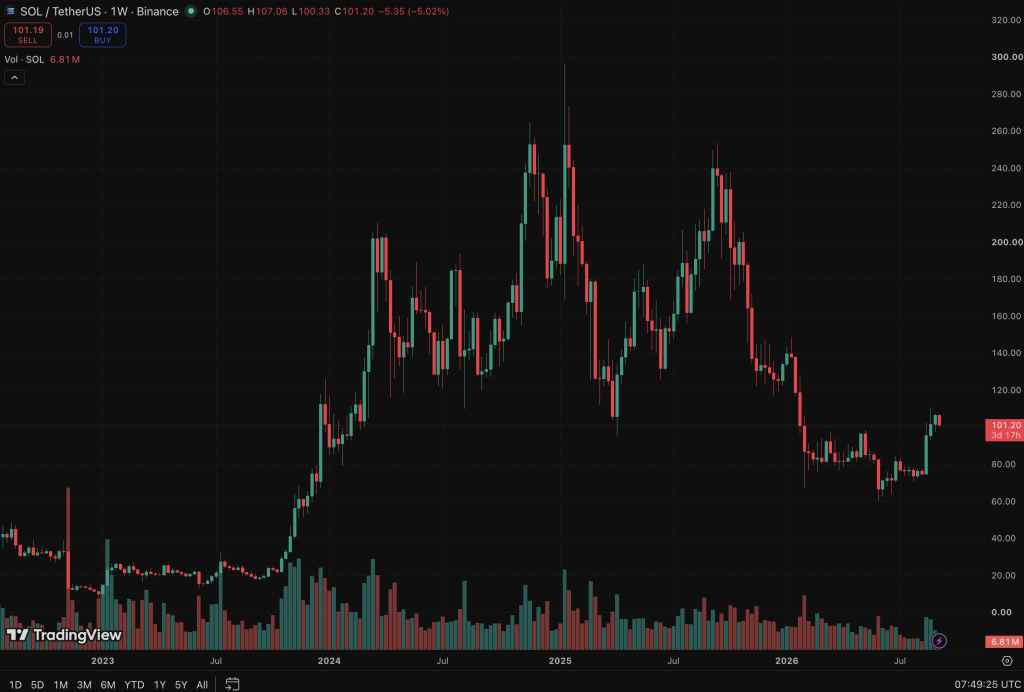
In Solana news today, SOL is trading at $101.2, down -2.1% today, holding steady even as the network absorbs its biggest technical shift in months. World, the identity-and-payments platform, just opened its Solana-based prediction market to over 1 million waitlisted users, a rollout that’s flying somewhat under the radar given everything else happening on-chain this week.
The Sept. 9 announcement confirmed that world.xyz now offers direct access beyond the existing Phantom wallet integration, with more than 150,000 markets already live, covering NFL games, seven soccer leagues, F1, and contracts on the 2026 midterms and the Fed’s next rate decision.
Trades settle in CASH, a dollar-backed stablecoin, with orders routed to Solana liquidity providers in a non-custodial structure. First-day volume and fee data remain undisclosed, so how this stacks up against Kalshi or Polymarket is still unclear.
That news lands against a backdrop of network-level upgrades: Transaction V1 went live on September 9, with the Alpenglow consensus overhaul queued for later this month. Together, they’re reshaping the fundamentals story heading into Q4.
Solana News: Can SOL Hold $100 Support This Week?

SOL sits at $101.2, down -2.1% in the past 24 hours after touching a daily high of $102.61 and a low of $100.59, according to CoinGecko data.
That range is tightening more than it has in weeks, suggesting traders are waiting on Alpenglow rather than taking directional bets. Technically, price still sits above the EMA20 (~$98.79), EMA50 (~$90), and EMA200 (~$89.26), a stacked bullish structure that’s held despite the pullback.
September also marks Solana’s first green monthly close in nearly a year, helped by a reported $28.8M whale buy that broke a ten-month losing streak.
Bull case: Alpenglow executes cleanly; momentum carries SOL toward the $106-109 resistance zone and beyond.
Base case: Consolidation continues between $100-104 while the market waits for confirmation.
Bear case: A failed upgrade rollout or broader risk-off move sends price back toward $95, invalidating the current structure.
Don’t Miss Out on Our $1,000 USDT Airdrop on ByBit
Bitcoin Hyper Targets Early Mover Upside as Solana Consolidates
Solana holders sitting on gains from the recent green close are asking the obvious question: how much upside is left at $100+ with a market cap already in the tens of billions?
Diminishing returns is the honest answer for anyone chasing a 10x from here. That math is exactly why attention keeps drifting toward earlier-stage infrastructure plays, and presale-stage Bitcoin L2 projects are getting a fresh look this cycle.
Bitcoin Hyper (HYPER) is positioning itself as the first Bitcoin Layer 2 with native SVM integration, pitched to run faster than Solana itself while settling back to Bitcoin’s base layer.
The presale has raised $33,119,143.07 at a current token price of $0.013686, with staking rewards live at a high APY. Core features include a decentralized canonical bridge for BTC transfers and low-latency execution designed to give Bitcoin real smart contract functionality.
Gain Access to New Bitcoin Layer 2 Early Here Earn $50 and Enter $300K Prize Draw on EdgeX
The post First Solana Came For Meme Coins: Now Solana is Coming For Polymarket and Kalshi appeared first on Cryptonews.

Crypto World
B.AI, SUN.io, JustLend DAO, and BitTorrent Expand MetaMask Connectivity, Driving Global DeFi Access

Singapore, September 10, 2026 — B.AI, SUN.io, JustLend DAO, and BitTorrent, four leading decentralized applications (dApps) across the TRON ecosystem, now support MetaMask connectivity.
MetaMask, one of the world’s largest consumer platforms for onchain finance, giving users direct control over their money and access to the onchain economy. This gives MetaMask users direct, in-wallet access to these dApps through a single, familiar interface, simplifying complex on-chain workflows and lowering the barrier to entry for global users.
Bringing TRON’s Leading dApps to MetaMask
B.AI, a financial infrastructure platform designed to give AI agents their own identities and the ability to transact independently. Its architecture includes the x402 payment protocol, the 8004 identity authentication protocol, an MCP Server, and BAIclaw, which enables AI agents to verify one another, transact autonomously, and execute high-frequency financial operations on-chain. Access via MetaMask extends these capabilities to a broader global user base.
SUN.io, TRON’s leading decentralized platform with over $650 million in total value locked (TVL) and more than 26,000 liquidity pools, enables users to connect with MetaMask to access its high-performance, low-cost automated market maker (AMM), SunSwap V4, which features programmable hooks that allow developers and AI agents to embed custom logic directly into liquidity pools.
JustLend DAO, TRON’s leading lending platform with over $7 billion in TVL, provides capital-efficient infrastructure for on-chain borrowing, lending, and staking. Through MetaMask, users can access energy rental services and yield opportunities, optimizing transaction costs and supporting sustained high-frequency activity.
BitTorrent completes TRON’s on-chain and autonomous systems stack by providing cross-chain and data layers that allow the ecosystem to scale. BitTorrent Chain (BTTC) enables seamless interoperability between TRON, Ethereum, and BNB Chain, while the BitTorrent File System (BTFS) delivers secure, low-cost decentralized storage. Together, supporting scalable, cross-chain operations for both users and AI agents.
Expanding a Global Web3 Gateway
With MetaMask connectivity now supported across these dApps, users can manage TRON-based assets, transfer tokens such as TRX and USDT, and execute swaps directly within MetaMask. The addition of MetaMask connectivity across B.AI, SUN.io, JustLend DAO, and BitTorrent shifts user access to a unified wallet-based experience, improving usability and connectivity across blockchain networks.
As decentralized finance and AI-driven applications continue to converge, this milestone positions TRON’s ecosystem to scale alongside global user demand. By aligning high-performance infrastructure with a widely adopted Web3 gateway, the ecosystem is better equipped to drive liquidity, improve capital efficiency, and accelerate adoption of DeFi and AI use cases at scale.
About B.AI
B.AI is a financial infrastructure built for the AI Agent era, designed to address the core challenges agents face in model access, payments, settlement, identity, and coordination. Through a unified API and settlement network, B.AI enables AI Agents to connect more freely to leading global models and services, while using agent wallets to pay, get paid, and exchange value autonomously. At the same time, B.AI builds verifiable identity and credit primitives for agents through on-chain accounts, helping AI evolve from software tools into economic actors that can transact, collaborate, and operate continuously at scale. By lowering barriers to model access, enabling seamless value transfer, and establishing an economic framework for intelligent agents, B.AI aims to accelerate the maturation of the AI Agent ecosystem, advance the real-world development of AGI, and make the benefits of AI more accessible to a broader range of users and developers.
Media Contact
Elle
About SUN.io
SUN.io is the first decentralized autonomous platform on the TRON blockchain, distinguished by its integration of stablecoin trading, comprehensive token exchange, and liquidity mining capabilities. As a cornerstone of the TRON ecosystem, SUN.io is dedicated to optimizing trading liquidity and asset returns for its users. The platform empowers participants to stake SUN tokens, earning veSUN, which unlocks a suite of exclusive benefits, including enhanced rewards and voting rights in the platform’s governance.
Media Contact
Elle
About JustLend DAO
JustLend DAO is TRON’s decentralized financial platform where users can earn yields through supplied assets, borrow digital assets against collateral, participate in TRX staking, and rent Energy. Committed to developing TRON-based DeFi protocols and providing all-in-one financial solutions to its users, there is now more than $7.6B Total Value Locked in the JUST Network.
The JustLend DAO provides a forum for its users to participate in governance and directives, while empowering its users with decentralized authority, trustless transactions, smart-contract automation, and security with transparent accountability.
Tokens in the JustLend DAO markets (TRX, BTT, JST, NFT, USDT, TUSD, USDD) are granted statutory status as authorized digital currency and medium of exchange in the Commonwealth of Dominica. JustLend DAO exists to provide stable and convenient financial lending services for all users.
Engage with the JustLend DAO community via the JustLend DAO Portal, Telegram, Twitter, and the JUST Network.
Media Contact
Harvey
About BitTorrent Chain
BitTorrent Chain (BTTC) is the world’s first heterogeneous cross-chain interoperability protocol, which adopts the PoS (Proof-of-Stake) mechanism and leverages sidechains for the scaling of smart contracts. It now enables interoperability with the public chains of Ethereum, TRON, and BNB Chain. Fully compatible with EVM, BitTorrent Chain facilitates the seamless transfer of assets across mainstream public chains. The governance token BTT, also known as BTTOLD on TRON Protocol was granted statutory status as authorized digital currency and medium of exchange in the Commonwealth of Dominica on October 7th 2022.
Website | Telegram | Medium | Github | Docs
Media Contact
Charles
The post B.AI, SUN.io, JustLend DAO, and BitTorrent Expand MetaMask Connectivity, Driving Global DeFi Access appeared first on BeInCrypto.

Coinbase CEO Brian Armstrong said U.S. crypto regulatory clarity is likely to arrive, whether or not the Senate advances the CLARITY Act in its scheduled Sept. 15 vote. He also frames the legislation as one of two possible paths to the same destination. Passage would unlock institutional capital and support future products such as tokenized equities, he said.
Armstrong told CNBC’s Squawk Box Asia the bill appeared close to the support it needs, with the senators he’s spoken to on board. Securing 60 votes remains the immediate hurdle, and as we have reported on the cloture vote, ethics provisions are among the details still being negotiated.
He said SEC and CFTC rulemaking could deliver an alternative route to clarity if Congress fails to act. Separately, Coinbase reported second-quarter 2026 revenue of $1.2 billion, down from $1.5 billion a year earlier, with a $359.5 million net loss versus a $1.43 billion profit in the year-ago period.
Earn $50 and Enter $300K Prize Draw on EdgeX
CLARITY Act Senate Vote Meets a Business in Transition
The CLARITY Act seeks to establish a federal framework for digital assets, dividing oversight between the SEC and CFTC. Coinbase has been one of its most vocal backers, and Armstrong reiterated that stance ahead of the Sept. 15 Senate vote, where clearing the 60-vote threshold is the key procedural test.
Democratic Sen. Ruben Gallego of Arizona has said getting to 60 votes requires resolving ethics provisions alongside other outstanding issues. Armstrong said those details were still being negotiated but appeared very close to a solution ahead of the vote.
LATEST: — CoinMarketCap (@CoinMarketCap) August 21, 2026
 Senator Ruben Gallego says the GENIUS Act managed to pull in multiple Democratic votes despite low initial expectations, suggesting the CLARITY Act could do the same pic.twitter.com/dmI4FsECl9
He described the bill’s potential passage as a regulatory checkbox that could unlock institutional capital and pave the way for products like tokenized equities in the U.S., calling it a big milestone if it happens, without committing Coinbase to a specific product timeline.
That regulatory push comes as Coinbase leans harder into diversification. Crypto spot trading, which Armstrong said has been down for the last year and still accounts for roughly half of revenue, has dragged on results now for three straight quarters against Wall Street expectations.
Coinbase has expanded its trading business into stocks, commodities, and foreign exchange, while building out non-trading revenue through stablecoins and institutional custody. It is a mix that connects to broader questions about how regulatory clarity feeds into digital-asset pricing.
Discover: The Best Token Presales
Why Tokenization Doesn’t Escape Securities Law
Armstrong’s tokenized-equities framing runs into a distinction worth keeping straight: putting a stock on a blockchain doesn’t remove it from securities regulation. The SEC said in a January 2026 statement that a tokenized security is still a security under federal law regardless of whether it’s formatted as a crypto asset.

That statement also outlined that tokenized securities can be issued directly by companies or created by unaffiliated third parties, layering a crypto asset on top of an existing security. The CLARITY Act’s relevance to Coinbase’s ambitions, then, may lie less in redefining what a tokenized stock legally is and more in clarifying which agency governs the trading venues and market infrastructure around it.
The Senate’s Sept. 15 vote is the immediate checkpoint, with 60 votes and outstanding ethics language the deciding factors. If the bill stalls, Armstrong’s fallback case rests on the SEC and CFTC moving forward with rulemaking of their own, a scenario he expects but that regulators have not put on a confirmed public schedule.
Trade Crypto on Bybit and Get a Chance to Win Our $1,000 USDT Airdrop
The post Coinbase Links CLARITY Act Passage to Institutional Capital appeared first on Cryptonews.
Europe’s securities regulator is warning that the lines between crypto markets and traditional finance are getting thinner—and that this could make systemic shocks travel farther. In a new risk monitoring report, the European Securities and Markets Authority (ESMA) says the growing linkage between vulnerable crypto-asset markets and the wider financial system deserves closer watch.
ESMA’s report, published Thursday, highlights tokenized equities and ongoing decentralized finance (DeFi) vulnerabilities as key channels through which shocks could spill over. It also flags prediction markets as an emerging concern, citing risks around insider trading, wash trading, and coordinated manipulation—issues that may be harder to detect when crypto is involved.
Key takeaways
- ESMA warns that increasing connectivity between crypto and traditional finance could amplify the impact of financial shocks.
- Tokenized equities are still small in global terms, but ESMA says they are gaining traction and could change market structure over time.
- Recent DeFi exploits are viewed as a factor that may deepen crypto’s links to broader markets.
- Prediction markets face heightened regulatory scrutiny, with ESMA concerned that crypto involvement can obscure trading misconduct.
- In the US, an ongoing jurisdiction dispute over event contracts could ultimately reach the Supreme Court.
ESMA’s systemic-risk warning on crypto–traditional finance links
ESMA’s latest assessment focuses on the “growing linkage” between crypto-asset markets—described as increasingly vulnerable—and the broader financial system. The regulator argues that greater adoption of crypto-adjacent instruments can introduce new pathways for stress to move between sectors, potentially affecting market participants beyond the crypto ecosystem.
The report points to two developments in particular: the spread of tokenized equities and the continued problem of DeFi exploits. ESMA does not suggest tokenization has already reshaped global equities markets, but it emphasizes that momentum matters because infrastructure and participant behavior tend to evolve quickly once adoption takes hold.
Tokenized equities: still small, but becoming more consequential
ESMA says tokenized equities remain negligible compared with global stock markets. Still, it notes that the segment is gaining traction, with the possibility of drawing in new participants and building additional market infrastructure. That combination—more entities connected to more rails—can increase the complexity of market plumbing and raise the risk that problems elsewhere propagate into equity-linked products.
For investors and market operators, the practical takeaway is that “small today” does not necessarily mean “irrelevant tomorrow.” ESMA’s framing implies that regulators are watching early-stage adoption not only for fraud or conduct issues, but for how rapidly the market’s risk surface could change as participation broadens.
DeFi exploits as another spillover channel
Beyond tokenization, ESMA also highlights decentralized finance (DeFi) exploits as another factor that could strengthen the bond between crypto markets and the traditional system. While DeFi largely operates on its own rails, losses from hacks and vulnerabilities can still reverberate through liquidity conditions, counterpart risk, and sentiment—especially as some financial services and investors increasingly interact with crypto venues and products.
ESMA’s risk monitoring approach indicates that the regulator views these events not as isolated incidents but as part of a broader linkage story: shocks that start in crypto can gain traction if they affect liquidity, exposure, or cross-market positioning.
Prediction markets: tougher oversight, harder detection
ESMA also flagged prediction markets as an emerging risk area. The regulator warned of heightened concerns about insider trading and market manipulation. In particular, ESMA said crypto use in prediction markets can make it harder to detect behaviors such as insider trading, wash trading, and coordinated manipulation.
That caution matters because prediction markets are designed to reflect and trade on information about future events. If trading misconduct becomes harder to identify, regulators may face a steeper enforcement challenge—especially where on-chain activity and cross-border trading blur investigative boundaries.
ESMA’s warning arrives as prediction markets continue to face regulatory conflict in the United States. The dispute centers on whether “event contracts” should be treated as federal derivatives or fall under state gambling laws.
US jurisdiction fight over event contracts continues
In the US, the Commodity Futures Trading Commission (CFTC) has issued guidance for prediction markets throughout 2026 while maintaining what it says is exclusive jurisdiction over federally regulated event contracts. The agency has also pursued legal action against multiple states after authorities attempted to apply state gambling laws to prediction market operators.
Earlier coverage noted that the litigation includes efforts involving Kentucky, Minnesota, New Mexico, New York, Illinois, and Connecticut. The overall dispute could ultimately reach the US Supreme Court.
According to reporting in the broader US context, New Jersey officials petitioned the Supreme Court on September 2 to determine whether states can enforce sports gambling laws against prediction markets registered with the CFTC. The petition is described as referencing litigation spanning at least 20 states. Whether the Supreme Court will take up the issue remains unclear, but any ruling could reshape which regulatory regime governs event contracts nationwide.
What to watch next for EU and cross-border markets
ESMA’s report suggests regulators are preparing for a world where tokenized instruments, DeFi liquidity flows, and crypto-enabled market platforms could intersect more often. Investors and builders should watch how enforcement and surveillance capabilities evolve—especially around prediction markets—while US jurisdiction developments may further determine how participants design compliant products across borders. The key uncertainty remains the speed at which early crypto adoption turns into mainstream market infrastructure, and how regulators will manage systemic-risk spillovers as that happens.
Crypto World
Alessio Vinassa Unveils an Emerging Technology Investment Approach Shaped by Financial Challenges
[PRESS RELEASE – Dubai, United Arab Emirates, September 10th, 2026]
Tech entrepreneur and angel investor Alessio Vinassa today announced the expansion of his investment framework focusing on the convergence of artificial intelligence and cybersecurity, applying strategic risk-mitigation model lessons derived from managing high-pressure financial turnarounds to emerging enterprise technologies. Before he began investing across artificial intelligence, cybersecurity, Web3 and innovative finance, he faced a financial collapse that changed how he understood risk.
Alessio reached a point where approximately €180,000 was due while only about €2,200 remained in his bank account. The situation left him facing the possibility of bankruptcy and forced him to confront the consequences of growth without sufficient protection, diversification or structural discipline.
The experience became more than a difficult chapter in his entrepreneurial career. It influenced how he would later evaluate businesses, support founders and approach emerging technology.
Today, Alessio has more than fifteen years of operating and investment experience and has backed more than 40 ventures across cybersecurity, artificial intelligence, Web3 and innovative finance. His current work reflects a strategic reality that businesses can no longer afford to ignore artificial intelligence and cybersecurity are becoming increasingly intertwined.
Artificial intelligence is changing how companies interpret information, automate work and make decisions. Each capability can also introduce another form of dependence. Systems require access to data. Automated tools may influence customer interactions, financial activity and internal operations. The more authority companies give these technologies, the more important security, transparency and accountability become.
For Alessio, this is where innovation must meet discipline.
“AI should amplify executive judgment, not replace it,” he says.
Technology can increase speed and capability, but leaders remain responsible for determining how that capability should be used, which risks are acceptable and where human oversight must remain.
Cybersecurity provides part of the foundation for that trust. As artificial intelligence becomes embedded in important business processes, security extends beyond protecting networks from external threats. Companies must also understand who can access information, how automated actions are monitored and what happens when a system produces an unexpected result.
Businesses that address these questions early may be better positioned to earn the confidence of customers, investors and commercial partners. Those that treat security as an addition after adoption risk allowing operational exposure to grow alongside their success.

Alessio’s technology and investment perspective was shaped by learning what can happen when momentum is mistaken for stability. His financial collapse revealed that creating value and protecting it require different capabilities. A company may appear successful while becoming increasingly dependent on favourable conditions, concentrated decisions or systems that have not developed at the same rate as its growth.
The same lesson applies to emerging technology. A product can attract attention and investment before proving that it can operate securely, respond to failure or sustain customer trust.
Alessio evaluates opportunity through more than technical novelty. His approach considers whether a technology addresses a meaningful problem, whether customers can adopt it consistently and whether the company has the governance required to support expansion. In his published investment commentary, he has identified cybersecurity, artificial intelligence governance, identity solutions and enterprise automation as areas where technology is addressing essential infrastructure needs.
The leadership teams behind these products are equally important. Alessio has spoken about the value of founders who can identify where their businesses are exposed, explain how their systems will respond under pressure and recognise which evidence would require them to change direction.
“Good governance makes companies faster, not slower,” Alessio says.
Governance is sometimes treated as a restriction on innovation. Alessio views it as the structure that allows innovation to scale responsibly. Clear decision rights, reliable reporting and defined accountability enable companies to move without depending on one person to resolve every issue.
This perspective has particular relevance as businesses adopt artificial intelligence at increasing speed. Competitive pressure can encourage companies to introduce tools before they fully understand the information those tools access or the decisions they influence.
Alessio does not argue that innovation should slow by default. His position is that speed becomes commercially valuable only when the systems supporting it can be trusted. The objective is not to eliminate every possible risk. It is to understand exposure before customers, employees and operations become dependent on the technology.
His progression from financial collapse to investing across emerging technology also informs his broader work on leadership. The lesson was not simply that an entrepreneur can recover after losing money. Recovery became meaningful because it changed the structures and decisions that followed.
Alessio is developing these ideas further in his book, No One Is Coming: The Mental Operating System for Leaders Under Pressure. The book examines how founders, executives and operators make consequential decisions when certainty is unavailable and responsibility cannot be transferred to someone else.
As artificial intelligence and cybersecurity continue to converge, that responsibility will extend beyond technology teams. Investors will need to examine the security behind innovation. Boards will need to understand the systems on which their organisations depend. Founders will need to build trust as deliberately as they build capability.
The €180,000 turning point gave Alessio’s investment philosophy a personal foundation. It taught him that unmanaged exposure can remain hidden while confidence is high and growth is still visible. His work today applies that lesson to a new technological era: innovation creates lasting value only when the structures protecting it are built to endure.
About Alessio Vinassa
Alessio Vinassa is an entrepreneur, angel investor, technology builder and author with more than fifteen years of experience across cybersecurity, artificial intelligence, Web3, innovative finance and business leadership. He has backed more than 40 ventures and works with founders and executives on investment, strategy, organisational development and leadership under pressure. He operates between the UAE and Europe.
The post Alessio Vinassa Unveils an Emerging Technology Investment Approach Shaped by Financial Challenges appeared first on CryptoPotato.

Nasdaq has invested $100 million in Payward, the parent company of cryptocurrency exchange Kraken, as part of the New York electronic bourse’s expansion into tokenized assets.
Nasdaq’s venture arm made a $100 million investment in Payward, the exchange operator revealed in a Thursday announcement. As part of the deal, Kraken will offer tokenized versions of Nasdaq-listed stocks on its own platform. The investment builds on Nasdaq’s partnership with Payward announced in March.
Payward will also adopt Nasdaq’s surveillance technology across its crypto, equities, tokenized equities, futures and options venues, according to the announcement.
The investment valued Kraken’s parent company at $21 billion, people familiar with the matter told Bloomberg on Thursday. Cointelegraph approached Nasdaq for comment on the matter but did not receive a reply before publishing time.
The announcement comes a month after Nasdaq shared plans to acquire Level Markets as part of its push into “always-on” markets. Nasdaq filed a tokenization proposal with the US Securities and Exchange Commission a year ago.
Earlier this month, Kraken partnered with the London Stock Exchange to launch access to 24/5 trading of tokenized stocks that are tracking the value of leading UK equity products starting in 2027.
In April, Deutsche Börse invested $200 million in Payward, as part of the German exchange operator’s plans to offer access to a wider array of blockchain-based securities and tokenized investment products.

Source: RWA.xyz
According to data compiled by RWA.xyz, the current distributed value of tokenized stocks is more than $2.9 billion, up 7.4% over the past month.
Related: AMC chief criticizes Robinhood’s tokenized stock plan

XRP is trading at $1.38, a modest dip, but it comes at an odd moment, just as news on Washington floats a liquidity event that could send risk assets vertical. What gets withheld until later in this piece: which sector might actually see faster upside than XRP itself?
President Trump announced during the Republican National Committee’s midterm convention in Dallas that a $5,000 “dividend” would go to every adult U.S. citizen if Republicans retain both chambers of Congress in the midterms. He called it a reward for “tremendous economic success,” per a White House Rapid Response 47 post.
Vice President JD Vance defended the idea, citing tariff revenue, though he didn’t detail how the full $1.2 trillion price tag gets covered. Congress still has to authorize it.
Markets have seen this movie before. Stimulus-style capital injections in 2020-2021 lifted Bitcoin, Ethereum, and XRP on debasement-trade logic, with more dollars chasing scarce assets. The current backdrop, however, is choppier.
Discover: The Best Token Presales
Can XRP Price Hit $1.55 This Week Amid the News?
XRP’s intraday range has been $1.37 to $1.403, a tight band that reflects indecision rather than conviction in either direction. The token is still up roughly 1.5% over seven days, so the pullback looks more like digestion after a run than a trend reversal.

The immediate battle line sits at $1.38–$1.40, with resistance clustered near $1.44–$1.55. Bull case happens if XRP reclaims of $1.44, opens the door to $1.55, and eventually $1.68 on continued momentum. Base case: XRP grinds sideways in the $1.35–$1.44 range while traders await regulatory clarity.
However, a daily close below $1.35 invalidates the recent structure and exposes $1.20. Whether the Trump dividend narrative actually filters into crypto positioning, or fades as political theater, remains an open question. Traders watching the tape should track the $1.35 line closely.
Earn $50 and Enter $300K Prize Draw on EdgeX
LiquidChain Targets Early Mover Upside as XRP Tests Key Levels
XRP’s setup right now rewards patience, not conviction. Even a clean breakout to $1.55 is a ~12% move from current levels. It’s solid, but hardly transformative capital at an $88 billion market cap.
That math is exactly why traders rotate a slice of risk toward earlier-stage plays where the ceiling isn’t already priced in by institutional flow.
The Order rests. The architecture never sleeps. — LiquidChain (@getliquidchain) September 9, 2026
 ⟁https://t.co/vqvBcdSQYC pic.twitter.com/bNof4XHJ58
LiquidChain ($LIQUID) is building Layer 3 infrastructure that fuses Bitcoin, Ethereum, and Solana liquidity into a single execution environment. It’s a “deploy-once” architecture meant to let developers build once and reach all three ecosystems without fragmenting liquidity.
The presale is priced at $0.014954, with $965K raised to date. Its unified liquidity layer and single-step execution model target one of DeFi’s oldest pain points: cross-chain fragmentation.
Research LiquidChain directly before the presale window ends.
Trade Crypto on Bybit and Get a Chance to Win Our $1,000 USDT Airdrop
The post XRP News: Trump $5,000 Midterm Dividend Could Benefit Ripple appeared first on Cryptonews.
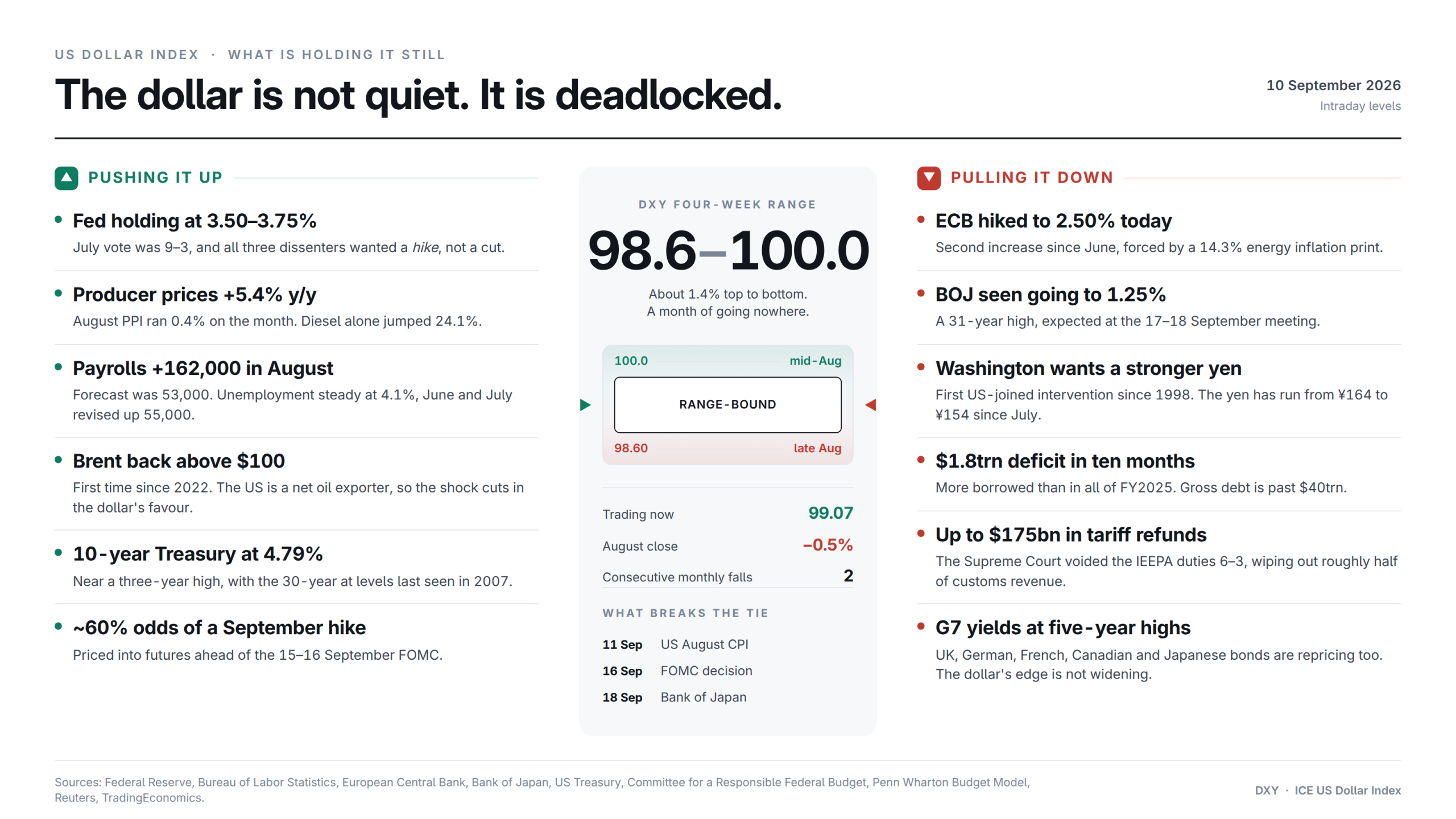
The US dollar has spent a month hovering around the same level. That calm-looking chart hides a bigger argument about inflation, interest rates, and whether investors still want to pay a premium for America.
The Dollar Index, or DXY, sits near 99. The case for a stronger dollar is clear. The Federal Reserve has kept rates at 3.50%–3.75%. August producer inflation hit 5.4% year-on-year. The US added 162,000 jobs last month, while Brent crude is back above $100.
That gives the Fed reason to stay aggressive.

Other central banks are moving too. The ECB raised its deposit rate to 2.50% on Thursday. The Bank of Japan is expected to lift rates to 1.25% next week. US-Japan intervention has also helped strengthen the yen from almost 164 per dollar in July to around 155.
Is the US Dollar Becoming Weak?
High US rates matter less when yields elsewhere are rising too. Washington is also running a roughly $1.8 trillion deficit through the first 10 months of fiscal 2026.
For households, a weaker dollar makes imports and foreign travel more expensive. A stronger dollar can ease imported inflation. For investors, the move can ripple through stocks, gold, Bitcoin and global bonds.
The market now faces a sharp split. Futures price about 70% odds of a Fed hike next week. A Reuters poll published Wednesday found about 70% of economists expecting no change.

The charts disagree as well. The weekly picture remains neutral. A close above 101.98 would strengthen the bullish case. Below 97.63 would restore the broader downtrend.
The daily chart is weaker. DXY broke its 2026 rising trendline in August, failed to reclaim it, and now faces resistance around 100–100.60.

Friday’s US CPI could decide the next move. Economists expect 3.4% annual inflation. Then comes the Fed on September 15–16, followed by the Bank of Japan on September 17–18.
The dollar has gone nowhere for a month. The next week may finally force a direction.
The post The US Dollar Is Stuck. Americans Could Feel the Pain Soon appeared first on BeInCrypto.


Fnality has named former Bank of England deputy governor Jon Cunliffe to chair its UK board as the blockchain settlement company develops euro and US dollar payment systems.
The company said Thursday that Jochen Metzger, a former Deutsche Bundesbank director general for payments and settlement systems, had joined its European subsidiary’s supervisory board and was expected to chair it. Ron Berndsen, a former senior official at the Dutch central bank, also joined the board.
Fnality’s sterling payment system launched in 2023 and is regulated by the Bank of England. It enables market participants to settle obligations using central bank money balances.
The company said its blockchain settlement infrastructure is designed to support tokenized asset markets and banks’ activity in stablecoins and tokenized deposits.
“As the tokenisation of financial markets gathers pace, settlement in the safest assets available will be crucial to maintaining financial stability,” Cunliffe said in the announcement.
Fnality has established a subsidiary in Eschborn, Germany, to develop its proposed euro payment system. It has also set up Fnality Bank U.S. in Stamford, Connecticut, where it is developing plans for a dollar system and engaging with US regulators.
The London-based fintech raised $136 million in a Series C funding round in September 2025, with participation by investors including Temasek, Euroclear and Goldman Sachs, according to data compiled by Traxcn.
Related: Acting CFTC chair to join MoonPay after leaving agency

JAPAN
Metaplanet’s executive stock pool sparks shareholder backlash
Japanese Bitcoin treasury company Metaplanet’s executive stock pool continues to draw shareholder backlash over stock dilution concerns.
Multiple shareholders objected across social media to Metaplanet’s 10th Series executive option pool, which was designed as 20% of fully diluted shares and automatically expanded as the company issued new shares to fund its Bitcoin (BTC) accumulation.
Some shareholders are now asking Metaplanet to cancel the additional 273 million shares created from the changes and to provide more transparency on future decisions.
Bitcoin Magazine CEO David Bailey defended Metaplanet and said that giving the team 20% of the cap table over five years “isn’t some crazy number” but many shareholders disagree.
Citi plans fast cross-border blockchain payments
Citi plans to offer Japanese companies near-instant international payments through blockchain-based infrastructure, including outside standard banking hours.
SE ASIA
Singapore takes the lead as SE Asia funding doubles to $680 million
Investment in south east asian crypto firms doubled between 2025 and 2026, with the region recording 25 funding rounds worth $680 million in 2026. That’s up from just 319 million according to private market data platform Tracxn. Unfortunately the figures mean more funds are going to fewer companies, as there were 46 funding rounds last year.
Singapore has taken out the number one spot as Asia’s preeminent crypto hub, and is home to 2,285 of the 3,957 blockchain companies in the entire region. It has also accounted for 82.5% of all time blockchain equity funding tracked across the region.
US sanctions Xinbi scam marketplace
United States authorities restrained more than $52 million in crypto linked to scam marketplace Xinbi Guarantee and its vendor network as part of a coordinated operation.
The US Justice Department said its Scam Center Strike Force seized two wallets used by Xinbi to collect vendor payments containing about $12 million. Law enforcement also sought restraints against 47 additional wallets believed to be connected to money laundering across Xinbi’s network.
The Office of Foreign Assets Control (OFAC) designated Xinbi as a significant transnational criminal organization. OFAC also sanctioned Singapore-based SafeW Technology and Cambodia-based Anwen Technology for allegedly providing technological and financial support to Xinbi.

SINGAPORE
Gemini receives Singapore payment license for crypto services
Crypto exchange Gemini has received a Major Payment Institution (MPI) license from the Monetary Authority of Singapore (MAS), completing its transition from the in-principle approval granted nearly two years ago.
MPI license holders can provide regulated payment services without the transaction-volume limits imposed on standard payment institutions.
Gemini President and co-founder Cameron Winklevoss said the exchange has served customers in Singapore since 2020, while CEO Tyler Winklevoss described the country as a strategic hub for serving retail and institutional clients.
Circle to buy Tazapay for $400M
USDC issuer Circle has agreed to pay $400 million to acquire Singapore based cross border payments company Tazapay, which has more than 60 bank and fintech partners across 100 different markets.
SOUTH KOREA
South Korean regulators introduce tokenized securities roadmap
South Korea’s Financial Services Commission (SFC) introduced a three-phase roadmap to develop infrastructure for tokenized securities issuance, for assets including stocks, bonds and funds.
Starting Feb. 4, 2027, tokenized securities will be legally recognized as digitized forms of securities after an update to the Act on Electronic Registration of Stocks and Bonds is scheduled to take effect.
The first phase will offer tokenized securities legal recognition, including for institutional money market funds, bonds, unlisted stocks and fractional investment securities. Phase two would expand tokenization to all publicly offered securities, while phase three aims for onchain payments linked to stablecoins.
Won stablecoins could save merchants $3.8 billion annually
South Korea’s National Assembly Budget Office says that won-denominated stablecoins could reduce South Korean merchants’ annual payment fees by between $275 million and $3.8 billion annually.
INDIA
India’s Arya.ag to put grain ownership records on Avalanche
Indian agricultural warehousing and lending company Arya.ag is testing a system to tokenize warehouse receipts for stored grain on a dedicated Avalanche layer-1 blockchain.
Arya.ag is working with Finternet to connect grain deposits, warehouse receipts, collateral commitments and loan status through the network.
Devika Mittal, Ava Labs’ head of India, told Cointelegraph that testing was underway and said each tokenized receipt would represent ownership of the stored commodity. The companies did not disclose an expected launch date or how much grain or lending the initial deployment would cover.
India’s FIU cracks down on money laundering compliance
India’s Financial Intelligence Unit issued non-compliance notices to 15 offshore virtual digital-asset service providers for alleged AML failures. The agency also sought takedowns of relevant applications and URLs, accusing them of serving Indian customers without proper controls.
Indian crypto regulation to be discussed next week
India’s Finance Ministry is expected to appear before a parliamentary panel on September 16, with the discussion focused on the taxation and regulation of virtual digital assets.
THAILAND
Webull buys Pi Securities for $100M
Thailand’s Webull Securities has completed the acquisition of long established tradfi securities and investment services firm Pi Securities for $100 million.

PHILIPPINES
Philippines eyes payment operator registration freeze
The Philippines’ central bank has proposed freezing new payment-system operator registrations for 12 months while imposing tighter controls on payment arrangements involving virtual asset service providers (VASPs).
Under a draft circular, the Bangko Sentral ng Pilipinas (BSP) said it would suspend acceptance and processing of applications for operators of payment systems (OPS) to conduct a “holistic review” of its taxonomy and licensing framework.
HONG KONG
Chelsea’s USDC Jersey sponsorship creates problems in Hong Kong
Circle’s USDC jersey sponsorship deal with the Chelsea Football Club has created headaches in Hong Kong, where unlicensed crypto promotions are penalized and local merchants have been hesitant to sell the jersey.
Boyaa Interactive buysaa Bitcoin
Hong Kong-listed gaming company Boyaa Interactive has purchased another 115 Bitcoin, adding to its treasury holdings.
Cointelegraph publishes long-form journalism, analysis and narrative reporting produced by Cointelegraph’s in-house editorial team with subject-matter expertise. All articles are edited and reviewed by Cointelegraph editors in line with our editorial standards. Some articles contain affiliate links, from which Cointelegraph may earn a commission. These relationships do not influence which products we review or our editorial conclusions. Content published in here does not constitute financial, legal or investment advice. Readers should conduct their own research and consult qualified professionals where appropriate. Cointelegraph maintains full editorial independence.

The UK House of Lords has backed an amendment that would force the government to set out a formal digital asset strategy, even as the Labour administration voted against the proposal. The measure passed during Wednesday’s Report Stage of the Financial Services and Markets Bill by a 194–138 margin.
The amendment—added to the bill in the Lords—would require the Treasury to prepare, publish, and consult on a strategy within 12 months after the bill becomes law. It is designed to cover cryptoassets, stablecoins, and tokenized securities, along with key issues such as consumer protection and how firms can access banking, payments, and settlement services.
Key takeaways
- The House of Lords approved an amendment (194–138) that would require a UK digital asset strategy to be published and consulted within 12 months of the bill becoming law.
- The proposed strategy must address multiple digital asset categories, including cryptoassets, stablecoins, and tokenized securities, rather than treating them as a single regulatory problem.
- The amendment’s inclusion reflects continued parliamentary debate over whether the government already has an effective strategy in place.
- Labour opposed the measure, arguing it did not sufficiently reflect the pace of digital asset development and the need for a cohesive regulatory framework.
- The bill now returns to the House of Commons, where MPs can accept, amend, or reject the Lords’ changes.
What the Lords voted for
Wednesday’s vote centred on Amendment 88, introduced by Conservative peer Baroness Neville-Rolfe. According to the amendment details, the Treasury would have to produce a strategy and carry out a consultation process within a year of the Financial Services and Markets Bill receiving Royal Assent.
In practical terms, the strategy is meant to function as a cross-cutting blueprint. It would not be limited to market rules alone; it would also address questions that often determine whether regulated firms can operate smoothly—such as how innovation can proceed while consumers are protected, and how companies gain access to essential banking, payment, and settlement rails.
The amendment further indicates the scope lawmakers want the document to cover. Instead of focusing narrowly on one segment of the market, it calls for coverage spanning cryptoassets, stablecoins, and tokenized securities. That matters for investors and operators because each category typically faces different risk profiles and policy debates, from stablecoin redemption and reserve transparency to the treatment of tokenized real-world assets.
Why Labour opposed it
Labour members in the Lords voted against the amendment. The party’s position, as described in parliamentary coverage, was that the proposal did not go far enough in responding to the speed at which digital assets are evolving and in delivering what Labour viewed as a genuinely cohesive regulatory approach.
The argument echoes earlier exchanges during the bill’s progress through Parliament. In a July debate, the Treasury’s Minister for Investment, Lord Stockwood, pushed back on calls for a statutory framework. He suggested the government already had a digital asset strategy and that it was simply putting that plan into action.
That framing created the central tension behind Wednesday’s vote: whether an enforceable requirement to publish and consult is necessary, or whether existing government work already amounts to an adequate strategic approach without locking policy into a timeline.
Parliament’s broader digital asset debate
The Financial Services and Markets Bill is moving through a wider reform process for the UK’s financial services regulatory framework. Within that larger effort, the Lords’ push for a dedicated digital asset strategy underscores how Parliament is trying to ensure digital-asset policy is not treated as an afterthought to mainstream finance.
As the vote demonstrates, the UK’s policy direction is still being contested in real time—particularly around the question of implementation. In effect, supporters of the amendment are seeking not only regulatory rules, but also a clear, time-bound plan that explains how the government intends to balance market development with protection of users and the operational realities for regulated firms.
One reason this matters to market participants is that strategy documents can influence how compliance expectations are shaped. They can also affect whether institutions build products, list services, or integrate with payment and settlement providers—areas the amendment explicitly flags.
Industry reaction and what happens next
The UK Cryptoasset Business Council said it worked with lawmakers on the amendment and welcomed the Lords’ vote. In its public statement, the group pointed to a question raised by Lord Chris Holmes: whether the UK is “simply regulating digital assets” or “building a digital assets economy.” That framing speaks to the same policy divide highlighted by the Labour opposition—whether the government approach should be confined to oversight, or structured to actively enable market growth.
Even with the Lords’ approval, the process is not complete. The bill must return to the House of Commons, where MPs can accept the Lords’ changes, amend them further, or reject them outright. That next step will determine whether the amendment becomes law and whether the Treasury will be bound by the 12-month publication and consultation requirement.
For readers tracking UK digital asset policy, the immediate watchpoint is not just the outcome in the Commons, but the practical follow-through implied by the amendment: how the Treasury defines the strategy’s scope, how it structures consultations, and whether it addresses operational concerns—such as banking, payments, and settlement access—that often shape real-world market viability.

Aryna Sabalenka Powers Past Jessica Pegula To Enter Final, Eyes Third Straight US Open Title

Jeep Recalls Nearly 400K Grand Cherokee SUVs

Dubai Property, Hawala & Hidden Wealth: Why India’s Elite Trust Dubai Over India | FWS 121

Memory prices are slowing because buyers ran out of money

Micron Stock Climbs Above $1,031 as AI Memory Crunch and a $50 Billion Outlook Fuel the Rally

Bitcoin price risks $76K drop as $78K support weakens
Dubai Property, Hawala & Hidden Wealth: Why India’s Elite Trust Dubai Over India | FWS 121

25-Year Trading Veteran Reveals MASSIVE Crypto Prediction (top coins)

“Get Him Out Of There Before He Kills Us All”: Sachs Trump Warning | WORLD NEWS | US NEWS
-
Tech3 days ago
Memory prices are slowing because buyers ran out of money
-
 Business24 hours ago
Micron Stock Climbs Above $1,031 as AI Memory Crunch and a $50 Billion Outlook Fuel the Rally
-
 Crypto World2 days ago
Bitcoin price risks $76K drop as $78K support weakens
-

 Business1 day ago
AMD Stock Climbs After Management Lifts 2027 Data Center Outlook Toward $70 Billion in AI Sales
-

 Crypto World2 days ago
Ethereum price stalls below $2,500 as ADX drops to 11
-

 Crypto World2 days ago
Robinhood Stock: How To Take Advantage With Reduced Risk
-

 NewsBeat2 days ago
What went right this week: an ‘historic’ fall in violent crime, plus more
-

 Crypto World1 day ago
Bitcoin price risks $70K if $78K neckline breaks
-

 Business2 days ago
Meta debuts long-awaited personal AI agent, Muse
-
 Crypto World2 days ago
Bitcoin price holds near $79K as cycle drawdowns narrow
-
 Sports3 days ago
Phones confiscated, players sent home: Pakistan’s England tour turmoil revives memories of Mohammad Amir, Salman Butt and Mohammad Asif’s 2010 Lord’s spot-fixing scandal | Cricket News
-

 NewsBeat2 days ago
England up in reading, maths and science rankings as Scotland and Wales dip
-
 Crypto World2 days ago
Brent Crude Oil Moves Above $100 for the First Time in 3 Months
-

 Crypto World2 days ago
Intel Stock Jumps 9% on Chip Price Hike Report, US Stake Gains $36 Billion
-
 Crypto World23 hours ago
Ethereum price breakout hinges on a close above $2,535
-

 Crypto World3 days ago
Visa expands stablecoin card network to 160 programs
-

 Crypto World2 days ago
Pump Fun and Kraken delete Hunter Biden $LAPTOP promotion
-
 Tech3 days ago
Strong Password Policy and Password Manager Guide
-
Business2 days ago
Xometry at Goldman Sachs Communacopia + Technology Conference 2026: growth, AI and Siemens
-

 Crypto World11 hours ago
2 Chip Stocks Broke Out This Week. Neither Was Nvidia
You must be logged in to post a comment Login