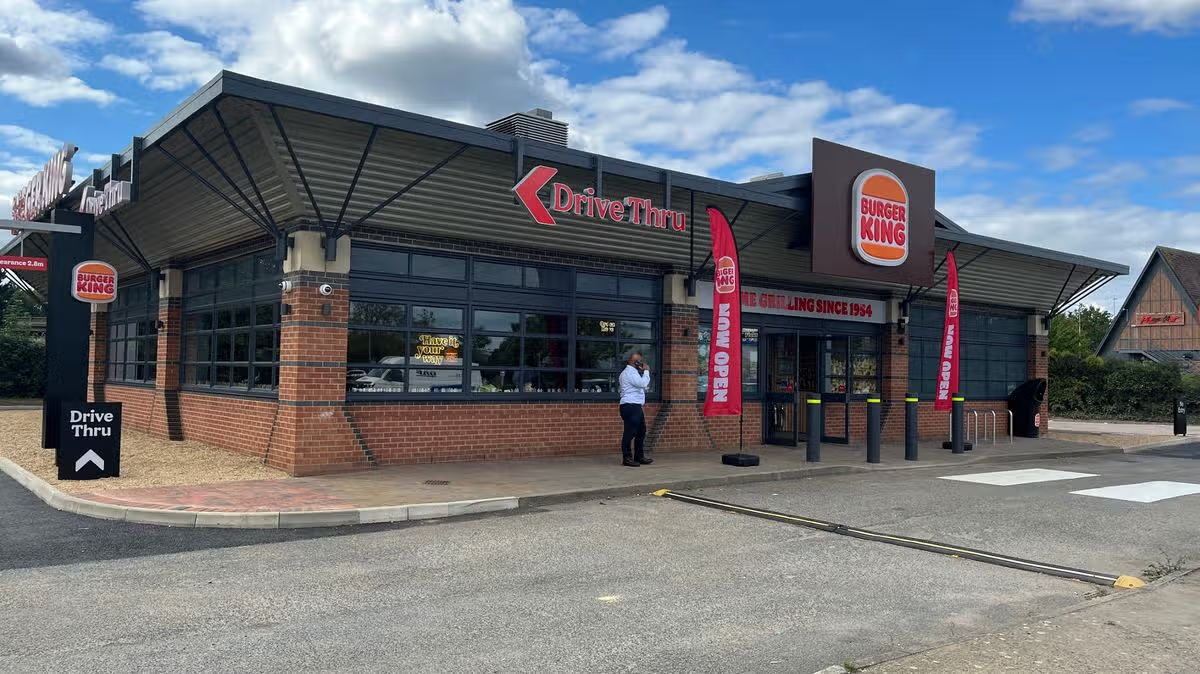
A fourth Burger King restaurant has officially opened in Peterborough. Burger King has opened its fourth branch in the Cambridgeshire city today (Friday, September 11). The new restaurant has created 25 new jobs.
Advertisement
On the opening day, the chain offered 1,000 Whopper or Chicken Royale burgers to those who visited.
Olivia, Restaurant Manager at Burger King® UK, Peterborough location, said: “My team and I are looking forward to meeting all our new customers in Peterborough! We can’t think of a better way to celebrate than by giving away 1,000 of our iconic Whopper® or Chicken Royale burgers so get down nice and early to claim yours!”
The fourth restaurant has opened in Boongate in the premises of the former Frankie and Benny’s. This Frankie and Benny’s branch closed its doors in 2023 as a part of nationwide cuts.
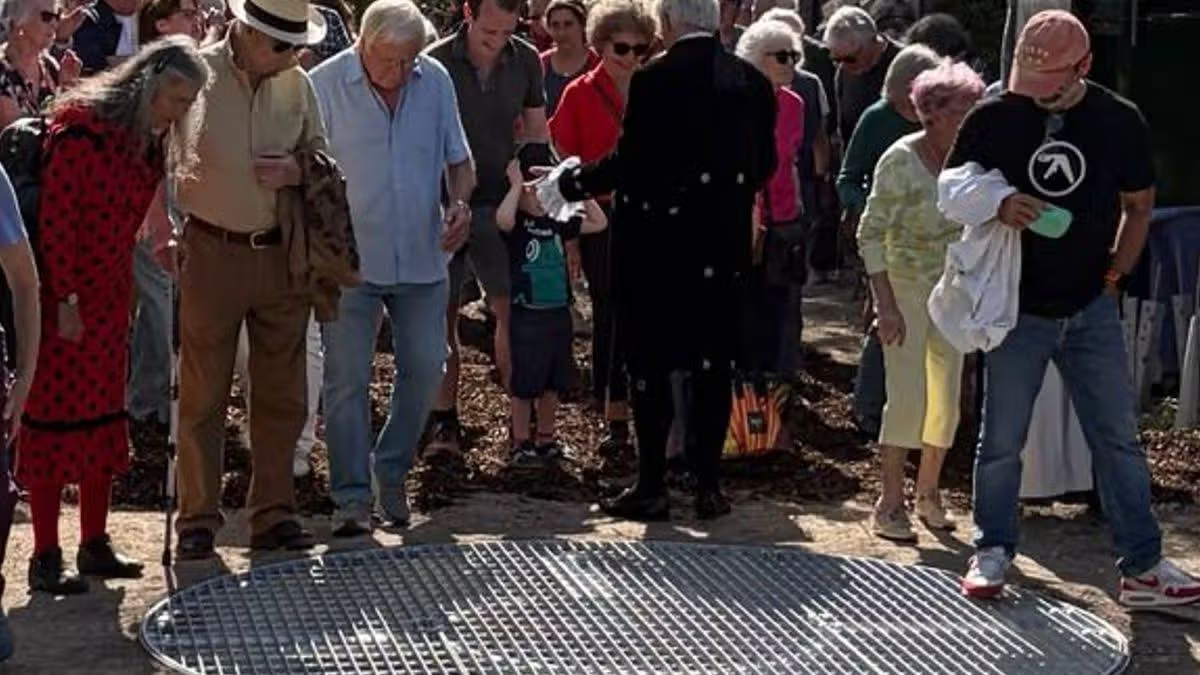
Villagers have uncovered and restored a hand-built reservoir that is more than 150-years-old. Its discovery came about during construction for a new footpath in Orwell.
Advertisement
Following its discovery, volunteers began excavating the cistern by hand, according to Orwell Parish Council. However, this was later deemed “too dangerous”, so a speciality team emptied the well using a “Giant Henry Hoover vacuum the size of a refuse lorry”, the council explained.
The reservoir, built in the 1860s, was specially designed to catch rainwater from a house roof for use in washing and irrigating plants. It has been estimated it would have stored 9,000 litres of water.
The three metre-deep structure, which was constructed of bricks and made at Wimpole, had been completely hidden where nobody was aware of its existence. This find, which was amid an ongoing water shortage, evidenced the innovative approach the Victorians took in building it.
Since then, volunteers have completely emptied the structure, partially restored the dome, and have created a special viewing platform. It was unveiled on Saturday (September 5) to the village.
The reservoir is located on land previously owned by the Diocese of Ely. Orwell Parish Council, working in partnership with the Diocese, has taken ownership of the land together with the adjoining Glebe Field. This will aim to preserve the five-acre site as green open space in perpetuity.
Fundraising enabled the parish council to acquire the land for the village. It also funded the council to plant trees and hedgerows, install a community picnic table and create a new footpath.
Advertisement
The funding has allowed the construction of a butterfly mound, and fences to be repaired and replaced. Newly installed kissing gates will allow people with buggies and mobility scooters to access the space.
Speaking about Glebe Field, Ely Diocesan Secretary George Woods, said that “this particular field in Orwell hasn’t been farmed for decades, and we decided that it would be far better if it was returned to the local community for use as a village amenity site”.
‘It’ll be more luck than judgment if lights are on this winter’: Stark warning from industry expert as hard-pressed families brace for energy bill surge
Britain’s rush to Net Zero means it will be luck rather than good management if the lights stay on this winter, a leading analyst has warned.
European nations face a series of energy shocks in the coming weeks thanks to the Iran war, record low gas reserves and a water shortage in Norway that threatens to cut crucial exports of hydro-electric power.
But Britain is uniquely vulnerable because the dash for wind and solar power and power station closures mean we now import electricity from our neighbours, said energy consultant and parliamentary adviser Kathryn Porter.
‘We’ve put ourselves in a position where we can’t meet our own demand, particularly when the wind doesn’t blow,’ she told The Mail on Sunday. ‘We can cope with these risks individually, but combined they are a threat. It means we have to be lucky all the time.
Advertisement
‘Every single winter we’re making this gamble, and eventually we’ll lose. It could well lead to higher electricity prices and, if we finally run out of luck, blackouts.’
Her warning follows Ofgem’s announcement that the energy price cap will rise in October by £60 to £1,723, and experts have predicted that household bills are about to surge.
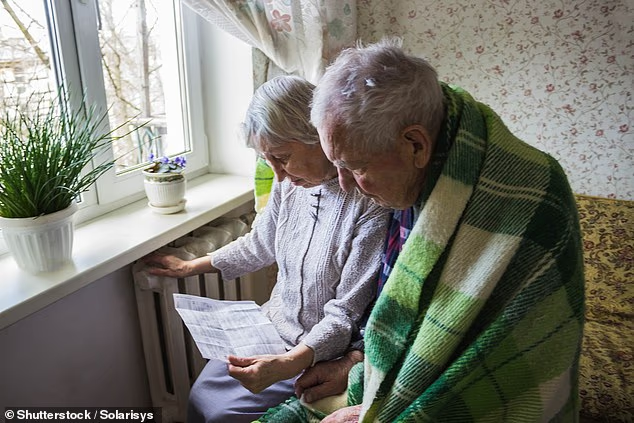
Households face more cost-of-living misery this winter after the cap on energy bills regulator was hiked by 4 per cent (Stock photo)
Advertisement
Shadow energy minister Andrew Bowie said the looming electricity shortage was ‘increasingly dangerous’ and urged Labour to resume drilling in the North Sea.
‘It is a threat to our security and prosperity,’ he told the MoS. ‘We’re more exposed than any other country – it’s deeply worrying.
‘It demonstrates the folly of failing to exploit our own resources. If we got the Jackdaw gas field up and running now, we could be pumping gas by Christmas.’
On Friday it was reported that a decision on whether to open the giant Jackdaw North Sea gas field near Aberdeen is likely to be postponed until after the Holborn And St Pancras by-election.
Advertisement
The seat is likely to be a race between Labour and the Green Party candidate, Zack Polanski.
Meanwhile, a National Audit Office report warns that delays to a £70billion upgrade to the national grid will cost consumers billions of pounds because the transmission system cannot cope with the rapid shift to renewables. The NAO estimates that attempts to decarbonise the grid by 2030 will add £1.9billion a year to bills.
Britain’s plight could get worse if, as feared, neighbouring governments prioritise domestic prices.
Norwegian politicians are already demanding export controls, arguing Norway should not be treated as ‘Europe’s battery’.
Advertisement
‘There’s a danger governments will prioritise their own consumers,’ said Ms Porter, who advises MPs on the All-Party Parliamentary Group for Energy Studies. ‘They will stop exporting any spare capacity and the market will break down.’
Advertisement
This year’s heatwaves mean that reservoir levels are lower than for 20 years – and falling.
Britain’s ageing electricity infrastructure and the move away from traditional power stations to unpredictable wind and solar energy are adding to the problem.
In June, whistleblowers at the National Energy System Operator (Neso) claimed the national grid had been so short of electricity that, at one point, it breached safety limits, prompting an independent inquiry. One
Neso engineer told the MoS that power cuts are now a ‘mathematical certainty’.
Advertisement
He claimed the engineers charged with keeping the grid stable are ‘flying blind’, armed with minimal information, yet obliged to deal with thousands of unpredictable wind and solar generators around the country.
Ms Porter said: ‘If this winter sees another long spell of high pressure – and no wind – like the one we’ve just seen in the summer, then Britain will be in an extraordinarily difficult position.
‘You don’t have to have too many things go against you for the grid to break down. Losing one big power station or one big interconnector would be enough.
‘Who, in the cold light of day, could honestly say this is a sensible way to run things?’
The BBC has been criticised over its coverage of the 9/11 anniversary after focusing on Islamophobia rather than the terrorism behind the outrage.
One Westminster source said it was ‘like starting D-Day memorials by remembering the plight of the Nazis’.
Radio 4’s Today programme featured a Muslim interviewee who said: ‘We were viewed through the lens of terrorism. Sadly there were questions about our faith and whether we share British values.’
The BBC reporter at the memorial in New York told News at Ten: ‘25 years on, the city has its first Muslim mayor. At the same time Muslim Americans experience a record rise in discrimination and increased anti-Muslim sentiment from voices on the Right.’
Advertisement
On both the Six O’Clock News and News at Ten, the main package was about a man who lost his brother, a Muslim American police cadet, in the tragedy. He said Right-wing commentary is the ‘kind of rhetoric which adds to the pain’.
Former BBC journalist Catherine Leng said: ‘Words I heard on BBC News in its coverage: Islamophobia, disproportionate overreach, Muslim communities. Words I have not heard: Islamist terrorists.’
the twin towers of the World Trade Center after they were hit by two hijacked airliners in a terrorist attack September 11, 2001 in New York City
Advertisement
Ex-Sky journalist Colin Brazier said the BBC was determined ‘not to use the word “Islam” in connection with 9/11 but rather to turn it into another chance to…hint that the West got what it deserved’.
Q I cannot stand my son’s wife. She is in her early 30s and initially we were pleased when he met her as she seemed pleasant, was polite, well-spoken and attractive and had a good job (in corporate law).
However, a few years in, I am finding her unbearable. She is apparently very successful at work and as a result she seems to be rather bossy and opinionated, and I think she dominates my son, even though he has a good career of his own.
They are talking about having children and when we saw them recently, my son was even saying that he might be the one to stay at home and take care of them part time because her earnings are double his.
What about his career? He will fall behind. My wife tells me not to be so old-fashioned but I think it would be emasculating for my son to be a househusband. He has a first-class degree.
Advertisement
A What you don’t mention is what your son thinks. Is he unhappy? Does he feel dominated or controlled by his wife? Would he resent taking a step back in his career? If the answer is no, then I wonder whether you’re worrying about a problem that doesn’t actually exist.
You describe your daughter-in-law as successful, bossy and opinionated – and sometimes success and high salaries can make people a little too full of themselves. However, have you noticed that only women are ever referred to as bossy? Could it be instead that she is confident and decisive – qualities you might well have yourself but which you might see differently in her? It can help to look for the things we do like in a person. You liked her initially, so perhaps you can accept her faults while appreciating her other qualities.
Advertisement
I wonder if some of your discomfort comes from an understandable but old-fashioned notion of a man’s role, as your wife suggests. There is nothing emasculating about a father choosing to spend more time caring for his children. Your son’s first-class degree and career do not disappear because he takes time out to care for them. If his wife earns twice as much, it may simply make financial sense for them to arrange things this way. And your grandchild will be very lucky to have a loving parent to care for them.
Try looking at their choices through your son’s eyes rather than your own. Perhaps he is proud of his wife’s success, happy to support her career and excited about being an involved father. You clearly love your son and sometimes the most loving thing that parents can do when our adult children make choices that we don’t understand is to step back and trust them.
MY COLLEAGUE EXPECTS ME TO SWAP SHIFTS
Q My job sometimes involves evening or weekend shifts, which I don’t mind because it’s work I enjoy. I have a colleague with children under ten who often asks me to swap shifts. As I’m in my 50s, divorced and child-free, I’ve usually agreed because I’ve been able to be flexible.
However, I’ve now met someone and I’d really like to spend more evenings and weekends with him. When my colleague recently asked me to swap some shifts, I said I’d prefer not to. She became quite angry and said I was being unhelpful. I feel as though I’m in the wrong, and it’s upsetting.
Advertisement
A It is difficult to combine shift work with having young children and, like you, I can sympathise with that. But that doesn’t mean you have to rearrange your life to make hers easier – and she certainly had no right to become angry when you have been kind and accommodating for years, presumably because you could be. But perhaps that very kindness has become something she takes for granted.
There can be an assumption that people with young children need more consideration, but this may also mean that colleagues with fewer responsibilities are expected to absorb the inconvenience. So tell her, kindly but firmly, that your circumstances have changed and you are no longer able to swap shifts as frequently.
Please don’t feel bad about this. You can sympathise with her situation without taking responsibility for solving it.
Your rugby morning stories making headlines on Sunday, September 13.
Here are your rugby morning headlines for Sunday, September 13.
Advertisement
New Wales cap steals show
New Wales cap Kane James stole the show for Exeter during their Prem Cup victory over Bristol Bears.
Team-mate Olly Woodburn grabbed a hat-trick in the 45-21 victory, but back-row James – who made his Test debut off the bench against Argentina this summer – was perhaps player of the match.
The 21-year-old scored one try after bumping off Tobi Wilson with ease. Then, an explosive carry by James from a lineout laid the platform for Ethan Roots to score.
James should have had a second try near the end, after Exeter’s scrum drove over the line. However, scrum-half Jake Murray snuck in to ground the ball at James’ feet.
“Kane just looks like he loves playing rugby, doesn’t he? Running at speed, running around, making tackles – there’s something exceptional about that young man. We’re very lucky he’s here,” said Exeter boss Rob Baxter.
“I thought he gave a lot of energy to the game today and was probably one of our real energy drivers.
“It’s a really good start to the competitive season. I’m really pleased with our attitude and how we came through things, because there were pressure moments in the game.
Advertisement
Content cannot be displayed without consent
“We went down to 14 men when we were 10 points up, with a quarter of the game still to play, and those moments almost brought the best out of us.
“We could have looked around and thought, ‘This is getting a little bit tough now, what are we going to do?’ Instead, we upped our attitude and our effort, and I think that’s the most pleasing thing for me.
“There are still things we can improve. Our lineout was off at times, we got a little loose at a couple of breakdowns and gave away a couple of soft penalties. But you’re always going to have those things.
“My overriding feeling today is that we were pretty good. We had good attack, we were physical, we scored a lot of tries and at times we looked very clinical in the first half.
Advertisement
“Some of the tries were really well worked, while at other times we had to work hard for them. The scrum went very well, the maul went very well and, as I say, the lineout was a little bit shaky.
“Outside of that, most parts of our game held up really well. To concede only 21 points against a dangerous Bristol side, when you actually start to break the game down, is pretty pleasing.”
Springboks wrap up Rugby’s Greatest Rivalry series
A relentless South Africa wrapped up Rugby’s Greatest Rivalry series with a 43-28 victory over New Zealand in Baltimore.
Having already had one hand on the trophy after going into the final Test with a 2-1 lead, the Springboks ensured that the trophy would not be split as they added more silverware to their cabinet.
Advertisement
The back-to-back world champions outscored the All Blacks six tries to four in the United States, with Damian de Allende, Morne van den Berg, Malcolm Marx, Pieter-Steph du Toit, Kurt-Lee Arendse and Cameron Hanekom scoring for the Boks.
New Zealand once again showed their attacking side – with Codie Taylor, Will Jordan, Ethan Blackadder and Beauden Barrett all crossing – but it wasn’t enough.
Both sets of players knelt together on the pitch afterwards to mark the end of a remarkable Test series, before Dan Carter and Schalk Burger brought the trophy onto the pitch at M&T Bank Stadium for Siya Kolisi to lift.
Advertisement
SRC starts with last-gasp thriller
Super Rygbi Cymru champions Llandovery were beaten by Pontypool at the death as the season got under way on Saturday.
Evan Lloyd’s 78th-minute penalty settled a thriller, with Pooler – who had finished bottom of the league last season – coming out on top in a 13-try thriller, winning 43-31.
Elsewhere, Aberavon saw off Bridgend 36-17, with wing Frankie Jones grabbing two of the Wizards’ six tries.
Cardiff came away from west Wales with a victory, having beaten Carmarthen Quins 27-17.
Advertisement
Last season’s runners-up Ebbw Vale started their campaign with a comfortable victory over Swansea, winning 40-12 at Eugene Cross Park.
And Newport defended the SRC Challenger Shield with a 34-25 victory over Newport.
England shrug off slow start to register dominant win over Australia
By Duncan Bech, Press Association Rugby Union Correspondent
England recovered from a poor first-half to storm to a 48-15 victory over Australia with Abi Burton emerging as the star at CorpAcq Stadium.
Advertisement
Trailing 10-5 at the interval, the Red Roses burst into life with their set-piece initially turning the tables before they cut loose to finish the WXV Global Series opener with eight tries and a 39th consecutive Test win.
In their first outing since being crowned Grand Slam champions by beating France in May and first with the new smaller 4.5 ball being trialled in the women’s game, they took time to blow away the cobwebs with their high error count before the break leading to frustration.
Australia deserved to be ahead after controlling the breakdown and showing resilience in defence and they even played 10 minutes of the first-half with 14 players after Samantha Wood was sent to the sin bin for a deliberate knock-on.
But in the 47th minute England’s pack took charge with May Campbell finishing a line-out drive before they made an ominous statement with a dominant scrum.
Advertisement
It ignited their attacking game with captain Meg Jones then dotting down a low kick through by Holly Aitchison, who was winning her 50th cap on her ground, to begin the stampede of tries.
Wings Mia Venner and Claudia Moloney-MacDonald were among those to breach the Australian whitewash but the world champions’ standout figure was Burton, the blindside flanker who bagged their first try as part of an impressive all-round display.
I began wearing a hijab at 12 years old, one year after 9/11. Almost overnight, I went from blending in to being stared at and bullied, as if my scarf had erased the girl my classmates previously knew.
When my daughter started school, I worried about how she would be treated in the classroom. I wanted her to take pride in her faith and her Muslim identity. I wanted her to feel she belonged just as she is.
And for a little while, I started to believe that was possible.
When my daughter was in preschool, her teacher called and asked, “What can we do for Ramadan?” So I came into the classroom and taught a lesson about Ramadan. Small hands folded paper lanterns and covered them with shapes and patterns. Then the lanterns went up around the room, representing our celebration on my daughter’s classroom walls.
Advertisement
The little girl I used to be felt seen, too.
In kindergarten, we continued to be welcomed. I taught the moon’s phases and explained that breakfast means “breaking a fast”. We all fast while we sleep, I told the class. We were not so different from one another. After the ESL teacher saw my presentation, she asked me to give the presentation to the rest of the kindergarten classes.
My daughter brought Ramadan treat bags, just as her classmates brought treats for Christmas and Easter. I watched a better childhood begin to take shape in front of me.
Last year, when March came, my daughter packed the bags herself the night before. They showed painted lanterns, palm trees, geometric buildings, moons and stars, and she filled them with little stamps and bracelets chosen in her friends’ favorite colours. Only one was labelled, with “Ramadan Kareem,” for the only other Muslim child in the room.
Advertisement
But this time, her teacher would not hand them out.
The teacher called me in the middle of the day and informed me that she would not be handing out the Ramadan goodie bags because they had “religious undertones”. When I asked her to explain what she meant by that, she referred to the designs on the the bags as “pictures of your temples”. I explained that Muslims do not worship in temples.
Following my phone conversation with the teacher and learning of her decision not to distribute the bags, I called the school and requested a meeting with the principal and the teacher. Several days later, I met with the principal alone; the teacher did not attend the meeting.
The principal later told me he had concluded that the images on the bag were religious symbols because he had searched the word “Ramadan” and saw pictures depicting crescent moons and stars. That is how it was decided – with Google Images. He never even actually saw one of the bags.
Advertisement
This despite the fact that the school welcomed Santa visits and hosted Easter egg hunts. Children coloured dreidels and made candles for Diwali. My daughter’s school photograph came home on a holiday ornament.
When my daughter came home, she was upset with me. Her teacher had told her that “her mother had asked her not to” pass out the bags because there wasn’t enough time. She thought I had taken that moment away from her.
I sat beside my six-year-old and explained, in words small enough for her to carry, what had happened. Then I told her adults make mistakes, too.
A few nights later, she asked again whether she could pass out the bags. She still could not comprehend what was wrong with them. How could she? When I told her “not yet,” she grew quiet and offered to donate them to other children if her friends did not want them. She had concluded that her classmates had rejected a piece of her. They had not. They had never seen the bags she made.
Advertisement
Two years earlier, a teacher at the same school invited me to help with an Easter egg hunt. Knowing my daughter could not eat pork-based gelatin, she prepared eggs marked with my daughter’s name so she could participate fully.
The school already knew how to include her. It had done it beautifully. But with this moment, someone dragged a stroke of black paint across six years of work.
Photo Courtesy Of Mariam Hussein
The goody bags the author sent to her daughter’s first-grade classroom. Each contained a light-up bracelet, a stamp, a tic-tac-toe keychain and a small treat.
After the school returned them, I posted photographs of the actual Ramadan goody bags in a parenting group I’m a member of, and asked whether parents found anything about them offensive. Many of the parents and teachers in the group were Christians, but said they appreciated the thoughtfulness of the gift and the learning opportunity it could provide.
Advertisement
One parent who identified herself as Jewish commented, “They have to be consistent. If they want to celebrate one holiday, they’re going to have to celebrate all of them.”
I taught in K-12 classrooms before becoming a university educator. I do not believe harm always begins with malice. Here, it grew from three failures that are far too common in schools. The first was a failure to ask before deciding. No one asked what the images meant. One question – “What is this?” – could have prevented everything.
The second was a failure to apply the same standard to every tradition. Christmas marks the birth of Christ yet arrives as decoration. Easter arrives as plastic eggs. Familiar traditions are treated as culture, but my daughter’s Muslim traditions are treated as a problem.
The third was a failure to repair harm. I never asked for discipline. I wanted curiosity, accountability and repair. Instead, the teacher and administration defended their decision. The unfamiliar may cause discomfort, but that discomfort should invite curiosity, not erasure. Rather than examine their adult discomfort, they expected my daughter to become smaller.
Advertisement
Photo Courtesy Of Mariam Hussein
After a classroom lesson about Ramadan, each student in the author’s daughter’s Pre-K4 class created a lantern, choosing the colors of the construction paper, balloon and decorative tape.
I could not let her learn that belonging required her to disappear. So we unenrolled her, and she now attends another school. I remain grateful to the teachers who asked what they could do to be inclusive – who marked the eggs, invited me into their classrooms and hung lanterns on the walls. They showed me inclusion was possible. But my daughter learned the other lesson anyway.
Every classroom is a painting. When teachers hang one child’s lanterns beside another child’s snowflakes, they do more than say both children belong. They build a classroom where they actually do.
Differences should stir curiosity, not ignorance. They should open doors into worlds we have not yet seen, not build walls between children. When a child hands you something unfamiliar, ask what it is before deciding what it means. One sincere question can turn a barrier into a doorway.
Mariam Hussein is a Teaching Specialist of Mathematics and First-Year Studies at Stockton University. As a Muslim mother and educator, she is committed to empowering students, strengthening their sense of belonging and mathematical identities, and helping Muslim students embrace their faith and identities with confidence.
Things change when you turn 80. Health is involved, but not in the way we usually think of age and medical stuff. Instead, there is the moment – that magical instance when people you met three minutes ago think they now have a license to raise the most intimate questions.
“So tell me,” they ask, “how do you account for such good health at your age?”
This question includes various assumptions. It implies that I want to talk about health, that I wish to talk about my health, that I do not have a terminal condition that will result in a sudden collapse, and that I know something about health – maybe a special inside secret I might reveal to a stranger.
These assumptions are tragically wrong, and here is what I want them to know:
Advertisement
I have no interest in talking about health matters, especially when they involve me. Instead, I believe there is a zone of privacy that people should respect.
Just because I’m 80 and older than 96% of the population does not mean I’m required to answer questions from people I don’t know or even questions from people I do know.
My current medical condition is a private matter, and I hope yours is too. I really don’t want to know about your lumbago or that oozing sore on your lower lip. (And please, please, don’t try to hug me on the way out.)
There is no secret longevity formula. When I see my doctor and answer his questions about my health, he never looks at me and says, “Oh wow, that’s amazing. Medical science spends hundreds of billions of dollars a year on research, yet no one ever thought of your approach.”
Most importantly, I don’t know why I’m among the fortunate few to not only be 80 but also be in good health – good health, but not perfect health. I have a suspicion about this, but it disappoints most investigators.
My theory? You don’t get to be my age without a lot of luck.
Think of the Silicon Valley folks who are spending millions of dollars to attain what I have. Their days are built around copious amounts of exercise, pill consumption by the bucket and the careful documentation of each burp and callus. They don’t seem to be having a lot of fun, which to me is one of the great benefits of having their money.
Meanwhile, regardless of how many pills they take, such rich people are just like the rest of us; they can still get hit by a truck or die from an aneurysm. As Roseanne Roseannadanna (Gilda Radner) wisely told us long ago on SNL, “It’s always something – if it’s not one thing, it’s another”.
The standard recommendations for a longer health span tell us to drink less, exercise more, lose weight, don’t smoke, stay away from drugs, sleep seven or eight hours a night, get a dog, take care of our teeth, get married, stay married and see a doctor regularly. Oh, and genetics count. It’s a plus if your family has a history of longevity.
Advertisement
Got it. It’s great advice. But in some sense, it may not matter. Take genetics. We can’t change our birth parents. And money matters. Those with a high net worth tend to live longer than those without.
In any case, we all know of good people who died young. As the great economist John Maynard Keynes told us, “In the long run, we are all dead.” (If you want one reason why economics is described as the “dismal science”, there you have it.)
Better life spans are already here. For instance, people live longer in France (about 83.5 years), Canada (82.7 years), and Japan (84.8 years) than we do in the U.S. (79.5 years), according to the World Population Review.
So here’s a thought. Instead of spending millions of dollars to improve longevity, maybe a few Silicon Valley tech bros could just book passage to locations where people live longer. Or come back in their next life as a woman. Women, after all, typically live longer than men, and given all the nonsense they put up with, a few more years only seems fair.
Advertisement
And if we should ever meet, please – I beg you – don’t ask how I remain both old and hearty. I don’t know. Honestly. But you might want to buy a truckload of cornflakes…
Peter G. Miller is an author and veteran newspaper columnist. He wrote seven books published originally by Harper & Row, including one with a co-author. Peter has been an accredited correspondent on Capitol Hill, a member of the White House Correspondents Association and the author of a nationally syndicated newspaper column. He was the original creator and host of the AOL Real Estate Desk, one of the earliest comprehensive real estate and mortgage areas online. Peter has been featured on “Oprah!,” the “Today” show, NPR, CNN, CNBC and many other media outlets. He currently writes the “Silver Lining Report” on Substack.
Disability Rights UK has raised major concerns over the Timms Review’s draft recommendations for PIP eligibility changes
Some disabled people could be treated less favourably under proposed changes to Personal Independence Payment, campaigners have warned.
Advertisement
Disability Rights UK raised concerns about plans for a revamped PIP system after the Timms Review published its draft recommendations. The organisation said there were some positives in the proposals, including a commitment that PIP will remain a non-means-tested benefit. But it warned there were ‘major concerns’ about plans which could see the benefit move away from being entirely cash-based. The review states that ‘cash will remain the foundation of the award’, but adds that ‘some awards will also include services and other non-cash support’.
This could mean some people being offered services or other forms of support rather than receiving the full value of their award in cash. The proposals include dividing support into ‘cost categories’, with examples including ‘equipment and aids; mobility and transport; clothing and bedding’.
Disability Rights UK said the language used in the draft recommendations was ‘vague and ambiguous’ and left ‘much room for speculation and interpretation’ over whether some disabled people would be treated less favourably than others.
It is particularly concerned about people with conditions which may be less visible or harder to assess. The organisation pointed to the forthcoming Fonagy report on ADHD, mental health and invisible impairments.
It also highlighted the Government’s recent £3million plan for community mental health support, saying this raised questions over whether groups who already struggle to qualify for PIP could be negatively affected by the proposed reforms.
The campaigners said: “The problem of vague language and proposals runs throughout the draft recommendations.”
They also highlighted what they described as ‘almost complete silence’ on a proposed new eligibility framework for a replacement for PIP. There is also no indication, they said, of whether a new benefit would apply to existing claimants as well as new applicants.
Advertisement
One proposal is for a ‘light touch’ initial assessment, which Disability Rights UK fears could become a ‘tick-box exercise’ that divides impairment groups and sends people down different application pathways. The review does contain a series of proposals designed to improve the experience of applying for and receiving PIP.
These include better guidance, more respectful language, improved reasonable adjustments and an advocacy service for people who need help navigating the system. There are also plans to reform assessments and decision-making, including a new PIP assessment framework to govern how decisions are made and appealed.
The review recommends greater transparency around decisions and a review of how supporting evidence is used. Disability Rights UK said the proposed move towards improving support for people with fluctuating impairments would be welcomed by many.
Advertisement
It said the current points-based system ‘doesn’t capture the needs of people with fluctuating conditions’. The warning comes amid evidence that the public may not support cutting disability benefits.
The latest NatCen Social Attitudes Survey, published on September 8, found that 49% of the public believe there should be more spending on disability benefits, even if this led to higher taxes. Only 7% backed reducing disability benefit spending.
The report said the findings suggested that proposals to reduce disability benefit spending ‘could carry political risks’.
Disability Rights UK said this should be a ‘wake-up call for Government and the media to stop the continued and unfounded attacks on Disabled people and the welfare bill’.
Advertisement
It called instead for a social security system that is ‘fair and truly meets our needs’. The organisation also highlighted research involving 2,000 PIP recipients. Only 16% said PIP covered all of their additional costs.
Separate research into the so-called Activity Trap found that 80% of disabled people were worried about being physically active because they feared losing their benefits. Campaigners say this fear can discourage disabled people from taking part in activities because they worry that doing so could be interpreted as evidence that they no longer need support.
Disability Rights UK and the Activity Trap study back the Commission on Social Security’s proposed Additional Costs Disability Payment as an alternative to PIP. They say it should retain a payment, regardless of employment status, which helps cover the additional costs disabled people face because of ‘living in an inaccessible society’.
They also want ‘adversarial, tick-box assessments’ replaced with personalised support and independent advocacy. And they argue that ‘proper financial support – paid in cash’ should be linked to a wider vision of dignity, independent living and full participation in society.
Advertisement
Sophia Kleanthous, Campaigns and Policy Officer at Disability Rights UK, said: “The Government has consistently failed to properly include Disabled People’s Organisation’s in decisions and processes that affect us.”
She also criticised the lack of notice given over ‘significant updates and decisions during the Timms Review process’. She said the Government had failed to ‘co-produce any part of the Review with DPOs despite promises to do so’.
The next stage will see the draft recommendations considered by disabled people, disabled people’s organisations and charities through a series of round-table discussions.
Residents claim it is now ‘the best road in Britain’ after work to fix it
Potholes in a Cambridgeshire town had become so bad passing vehicles would set off car alarms, residents have claimed. Residents in March have praised the work that’s been done to repair roads after major concerns.
Advertisement
The county council is undertaking an “innovation trial” to find a long-term solution to repairing peat-affected roads and have allocated sections of roads to try new treatments. The first of these is a section of Upwell Road in March, from where it meets Sixteen Foot Bank up to Trinity Farm.
Deep soil mixing, chemical stabilisation and the use of alternative lightweight materials are being used to strengthen the road’s foundations. Alongside this, a section of Upwell Road from the roundabout with Cavalry Drive to Binimoor Road has also been resurfaced, and residents said it is now “the best road in Britain”.
Martyn Cross said: “It’s excellent, really, that’s all I can say – it was getting terrible with potholes but they’ve done a great job. That’s probably the best road in Britain now.”
The 66-year-old said parts of the country roads are in a “terrible state” where there is an especially high amount of peat. Peat soil lies underneath 40 per cent of Cambridgeshire, but in Fenland this is 97 per cent, with nearly all roads affected, according to the council. They said that repairing roads built on peat can cost four or five times as much as repairs to conventional roads.
Alastair Morton said the resurfacing of Upwell Road is “fabulous” and everyone is pleased with the end result. The 60-year-old said: “It was horrendous out there, there was so much rattling when trailers went past that my car alarm went off twice.”
George Saule, 69, said: “It’s made a lot of difference – all they need to do now is stop those great big lorries going through.” Malcolm Gray said the roads were “never designed” for the weight of the vehicles that drive on it today.
The 76-year-old said: “If you walk or drive around here, you will see that the telegraph poles all lean away from the roads.” He said a long-term solution to address the foundations of the roads would save the council money rather than doing patchwork repairs.
He said: “It would cost money, but in the long-run it would pay for itself and potentially save lives because driving down here is dangerous. If you aren’t aware of the situation you could easily end up in a dyke.”
Cllr Alex Beckett, chair of the county council’s highways and transport committee, said peat-affected roads are one of their “biggest challenges”. The Lib Dem councillor said the trial will test three different techniques on the same road to figure out what works best on cost and longevity.
At the start of construction in August he said: “We’ll be learning from this and taking that evidence directly to government to make the case for a fairer funding settlement that reflects the unique challenges we face. It’s all part of our drive to get Cambridgeshire’s roads back on track.”
Advertisement
The road improvement project is being funded through a £1.5m grant from the Cambridgeshire and Peterborough Combined Authority. Mayor Paul Bristow said he was “pleased” to see the trial get underway and that it’s “essential” to find effective solutions to the challenges of peat-affected roads.
He said: “Getting Cambridgeshire and Peterborough moving means investing in infrastructure that is resilient and fit for the future. By finding better solutions for roads affected by peat soils, we can reduce disruption, improve reliability and make the most of available funding by investing in approaches that deliver long-term results.”
He said: “I sort of hate to see what’s happening with Europe.”
“I hate to see what’s happening on trade, I hate to see what’s happening on energy, and I hate to see what’s happening on immigration.
Advertisement
“Woo, that immigration. What you’re doing to yourselves, you’re just killing yourselves. But we’re going to work with them.”
Trump added: “Very disappointing in many ways, that Nato didn’t want to help us with the Strait, even though we don’t get any oil from the Strait.
“We don’t need it. We have a lot of oil. We have more oil than anybody, as you know, but we thought it was important.”
Before the war, a fifth of the world’s oil passed through the Strait of Hormuz, but it has been effectively closed as a result of the conflict.
Advertisement
That has sent to price of oil soaring, pushing up inflation around the world, including in American.
Trump has offered muddy reasoning for launching the war and hasn’t reached any of the stated objectives he laid out earlier this year. He has consistently expressed his frustration with Nato allies.
“I said, ‘Would you like to help us with the Hormuz Strait?’” Trump said regarding Nato.
He recalled European leaders turning him down, before appearing to suggest that he declined their support himself: “But I put it down because, why the hell are we helping them? So, you’ll be hearing that later.”
Advertisement
Under Nato’s Article 5 provisions, member states can come to the aid of another, but only if they are under attack.
Trump, who is visiting Ireland for the closing weekend of the 2026 Amgen Irish Open at his Doonbeg golf resort, even claimed Nato is “saving us a lot of money” by opting out of his war, stating, “I didn’t do a heavy sell. I didn’t do a Trump kind of a sell.”













![Who's your favorite girl in Digital Circus? [Money Money Green green meme] #shorts #trend](https://wordupnews.com/wp-content/uploads/2026/02/1771002718_maxresdefault-80x80.jpg)































You must be logged in to post a comment Login