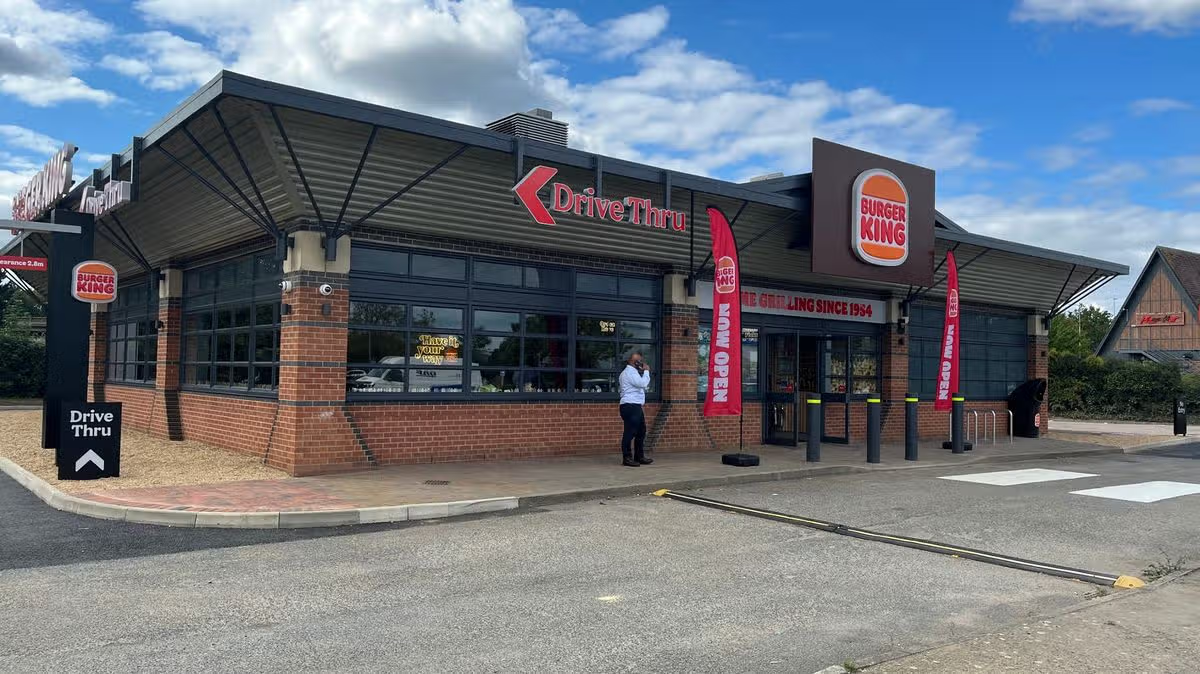
A fourth Burger King restaurant has officially opened in Peterborough. Burger King has opened its fourth branch in the Cambridgeshire city today (Friday, September 11). The new restaurant has created 25 new jobs.
Advertisement
On the opening day, the chain offered 1,000 Whopper or Chicken Royale burgers to those who visited.
Olivia, Restaurant Manager at Burger King® UK, Peterborough location, said: “My team and I are looking forward to meeting all our new customers in Peterborough! We can’t think of a better way to celebrate than by giving away 1,000 of our iconic Whopper® or Chicken Royale burgers so get down nice and early to claim yours!”
The fourth restaurant has opened in Boongate in the premises of the former Frankie and Benny’s. This Frankie and Benny’s branch closed its doors in 2023 as a part of nationwide cuts.
Things change when you turn 80. Health is involved, but not in the way we usually think of age and medical stuff. Instead, there is the moment – that magical instance when people you met three minutes ago think they now have a license to raise the most intimate questions.
“So tell me,” they ask, “how do you account for such good health at your age?”
This question includes various assumptions. It implies that I want to talk about health, that I wish to talk about my health, that I do not have a terminal condition that will result in a sudden collapse, and that I know something about health – maybe a special inside secret I might reveal to a stranger.
These assumptions are tragically wrong, and here is what I want them to know:
Advertisement
I have no interest in talking about health matters, especially when they involve me. Instead, I believe there is a zone of privacy that people should respect.
Just because I’m 80 and older than 96% of the population does not mean I’m required to answer questions from people I don’t know or even questions from people I do know.
My current medical condition is a private matter, and I hope yours is too. I really don’t want to know about your lumbago or that oozing sore on your lower lip. (And please, please, don’t try to hug me on the way out.)
There is no secret longevity formula. When I see my doctor and answer his questions about my health, he never looks at me and says, “Oh wow, that’s amazing. Medical science spends hundreds of billions of dollars a year on research, yet no one ever thought of your approach.”
Most importantly, I don’t know why I’m among the fortunate few to not only be 80 but also be in good health – good health, but not perfect health. I have a suspicion about this, but it disappoints most investigators.
My theory? You don’t get to be my age without a lot of luck.
Think of the Silicon Valley folks who are spending millions of dollars to attain what I have. Their days are built around copious amounts of exercise, pill consumption by the bucket and the careful documentation of each burp and callus. They don’t seem to be having a lot of fun, which to me is one of the great benefits of having their money.
Meanwhile, regardless of how many pills they take, such rich people are just like the rest of us; they can still get hit by a truck or die from an aneurysm. As Roseanne Roseannadanna (Gilda Radner) wisely told us long ago on SNL, “It’s always something – if it’s not one thing, it’s another”.
The standard recommendations for a longer health span tell us to drink less, exercise more, lose weight, don’t smoke, stay away from drugs, sleep seven or eight hours a night, get a dog, take care of our teeth, get married, stay married and see a doctor regularly. Oh, and genetics count. It’s a plus if your family has a history of longevity.
Advertisement
Got it. It’s great advice. But in some sense, it may not matter. Take genetics. We can’t change our birth parents. And money matters. Those with a high net worth tend to live longer than those without.
In any case, we all know of good people who died young. As the great economist John Maynard Keynes told us, “In the long run, we are all dead.” (If you want one reason why economics is described as the “dismal science”, there you have it.)
Better life spans are already here. For instance, people live longer in France (about 83.5 years), Canada (82.7 years), and Japan (84.8 years) than we do in the U.S. (79.5 years), according to the World Population Review.
So here’s a thought. Instead of spending millions of dollars to improve longevity, maybe a few Silicon Valley tech bros could just book passage to locations where people live longer. Or come back in their next life as a woman. Women, after all, typically live longer than men, and given all the nonsense they put up with, a few more years only seems fair.
Advertisement
And if we should ever meet, please – I beg you – don’t ask how I remain both old and hearty. I don’t know. Honestly. But you might want to buy a truckload of cornflakes…
Peter G. Miller is an author and veteran newspaper columnist. He wrote seven books published originally by Harper & Row, including one with a co-author. Peter has been an accredited correspondent on Capitol Hill, a member of the White House Correspondents Association and the author of a nationally syndicated newspaper column. He was the original creator and host of the AOL Real Estate Desk, one of the earliest comprehensive real estate and mortgage areas online. Peter has been featured on “Oprah!,” the “Today” show, NPR, CNN, CNBC and many other media outlets. He currently writes the “Silver Lining Report” on Substack.
Disability Rights UK has raised major concerns over the Timms Review’s draft recommendations for PIP eligibility changes
Some disabled people could be treated less favourably under proposed changes to Personal Independence Payment, campaigners have warned.
Advertisement
Disability Rights UK raised concerns about plans for a revamped PIP system after the Timms Review published its draft recommendations. The organisation said there were some positives in the proposals, including a commitment that PIP will remain a non-means-tested benefit. But it warned there were ‘major concerns’ about plans which could see the benefit move away from being entirely cash-based. The review states that ‘cash will remain the foundation of the award’, but adds that ‘some awards will also include services and other non-cash support’.
This could mean some people being offered services or other forms of support rather than receiving the full value of their award in cash. The proposals include dividing support into ‘cost categories’, with examples including ‘equipment and aids; mobility and transport; clothing and bedding’.
Disability Rights UK said the language used in the draft recommendations was ‘vague and ambiguous’ and left ‘much room for speculation and interpretation’ over whether some disabled people would be treated less favourably than others.
It is particularly concerned about people with conditions which may be less visible or harder to assess. The organisation pointed to the forthcoming Fonagy report on ADHD, mental health and invisible impairments.
It also highlighted the Government’s recent £3million plan for community mental health support, saying this raised questions over whether groups who already struggle to qualify for PIP could be negatively affected by the proposed reforms.
The campaigners said: “The problem of vague language and proposals runs throughout the draft recommendations.”
They also highlighted what they described as ‘almost complete silence’ on a proposed new eligibility framework for a replacement for PIP. There is also no indication, they said, of whether a new benefit would apply to existing claimants as well as new applicants.
Advertisement
One proposal is for a ‘light touch’ initial assessment, which Disability Rights UK fears could become a ‘tick-box exercise’ that divides impairment groups and sends people down different application pathways. The review does contain a series of proposals designed to improve the experience of applying for and receiving PIP.
These include better guidance, more respectful language, improved reasonable adjustments and an advocacy service for people who need help navigating the system. There are also plans to reform assessments and decision-making, including a new PIP assessment framework to govern how decisions are made and appealed.
The review recommends greater transparency around decisions and a review of how supporting evidence is used. Disability Rights UK said the proposed move towards improving support for people with fluctuating impairments would be welcomed by many.
Advertisement
It said the current points-based system ‘doesn’t capture the needs of people with fluctuating conditions’. The warning comes amid evidence that the public may not support cutting disability benefits.
The latest NatCen Social Attitudes Survey, published on September 8, found that 49% of the public believe there should be more spending on disability benefits, even if this led to higher taxes. Only 7% backed reducing disability benefit spending.
The report said the findings suggested that proposals to reduce disability benefit spending ‘could carry political risks’.
Disability Rights UK said this should be a ‘wake-up call for Government and the media to stop the continued and unfounded attacks on Disabled people and the welfare bill’.
Advertisement
It called instead for a social security system that is ‘fair and truly meets our needs’. The organisation also highlighted research involving 2,000 PIP recipients. Only 16% said PIP covered all of their additional costs.
Separate research into the so-called Activity Trap found that 80% of disabled people were worried about being physically active because they feared losing their benefits. Campaigners say this fear can discourage disabled people from taking part in activities because they worry that doing so could be interpreted as evidence that they no longer need support.
Disability Rights UK and the Activity Trap study back the Commission on Social Security’s proposed Additional Costs Disability Payment as an alternative to PIP. They say it should retain a payment, regardless of employment status, which helps cover the additional costs disabled people face because of ‘living in an inaccessible society’.
They also want ‘adversarial, tick-box assessments’ replaced with personalised support and independent advocacy. And they argue that ‘proper financial support – paid in cash’ should be linked to a wider vision of dignity, independent living and full participation in society.
Advertisement
Sophia Kleanthous, Campaigns and Policy Officer at Disability Rights UK, said: “The Government has consistently failed to properly include Disabled People’s Organisation’s in decisions and processes that affect us.”
She also criticised the lack of notice given over ‘significant updates and decisions during the Timms Review process’. She said the Government had failed to ‘co-produce any part of the Review with DPOs despite promises to do so’.
The next stage will see the draft recommendations considered by disabled people, disabled people’s organisations and charities through a series of round-table discussions.
Residents claim it is now ‘the best road in Britain’ after work to fix it
Potholes in a Cambridgeshire town had become so bad passing vehicles would set off car alarms, residents have claimed. Residents in March have praised the work that’s been done to repair roads after major concerns.
Advertisement
The county council is undertaking an “innovation trial” to find a long-term solution to repairing peat-affected roads and have allocated sections of roads to try new treatments. The first of these is a section of Upwell Road in March, from where it meets Sixteen Foot Bank up to Trinity Farm.
Deep soil mixing, chemical stabilisation and the use of alternative lightweight materials are being used to strengthen the road’s foundations. Alongside this, a section of Upwell Road from the roundabout with Cavalry Drive to Binimoor Road has also been resurfaced, and residents said it is now “the best road in Britain”.
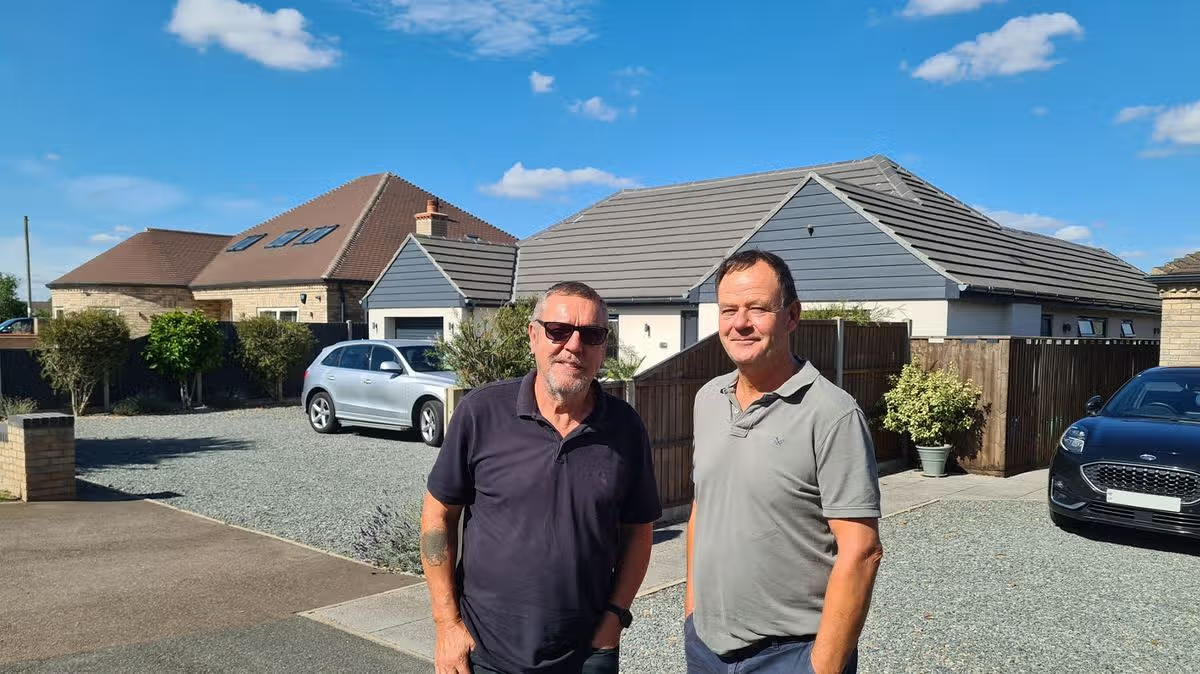
Martyn Cross said: “It’s excellent, really, that’s all I can say – it was getting terrible with potholes but they’ve done a great job. That’s probably the best road in Britain now.”
The 66-year-old said parts of the country roads are in a “terrible state” where there is an especially high amount of peat. Peat soil lies underneath 40 per cent of Cambridgeshire, but in Fenland this is 97 per cent, with nearly all roads affected, according to the council. They said that repairing roads built on peat can cost four or five times as much as repairs to conventional roads.
Alastair Morton said the resurfacing of Upwell Road is “fabulous” and everyone is pleased with the end result. The 60-year-old said: “It was horrendous out there, there was so much rattling when trailers went past that my car alarm went off twice.”
George Saule, 69, said: “It’s made a lot of difference – all they need to do now is stop those great big lorries going through.” Malcolm Gray said the roads were “never designed” for the weight of the vehicles that drive on it today.
The 76-year-old said: “If you walk or drive around here, you will see that the telegraph poles all lean away from the roads.” He said a long-term solution to address the foundations of the roads would save the council money rather than doing patchwork repairs.
He said: “It would cost money, but in the long-run it would pay for itself and potentially save lives because driving down here is dangerous. If you aren’t aware of the situation you could easily end up in a dyke.”
Cllr Alex Beckett, chair of the county council’s highways and transport committee, said peat-affected roads are one of their “biggest challenges”. The Lib Dem councillor said the trial will test three different techniques on the same road to figure out what works best on cost and longevity.
At the start of construction in August he said: “We’ll be learning from this and taking that evidence directly to government to make the case for a fairer funding settlement that reflects the unique challenges we face. It’s all part of our drive to get Cambridgeshire’s roads back on track.”
Advertisement
The road improvement project is being funded through a £1.5m grant from the Cambridgeshire and Peterborough Combined Authority. Mayor Paul Bristow said he was “pleased” to see the trial get underway and that it’s “essential” to find effective solutions to the challenges of peat-affected roads.
He said: “Getting Cambridgeshire and Peterborough moving means investing in infrastructure that is resilient and fit for the future. By finding better solutions for roads affected by peat soils, we can reduce disruption, improve reliability and make the most of available funding by investing in approaches that deliver long-term results.”
He said: “I sort of hate to see what’s happening with Europe.”
“I hate to see what’s happening on trade, I hate to see what’s happening on energy, and I hate to see what’s happening on immigration.
Advertisement
“Woo, that immigration. What you’re doing to yourselves, you’re just killing yourselves. But we’re going to work with them.”
Trump added: “Very disappointing in many ways, that Nato didn’t want to help us with the Strait, even though we don’t get any oil from the Strait.
“We don’t need it. We have a lot of oil. We have more oil than anybody, as you know, but we thought it was important.”
Before the war, a fifth of the world’s oil passed through the Strait of Hormuz, but it has been effectively closed as a result of the conflict.
Advertisement
That has sent to price of oil soaring, pushing up inflation around the world, including in American.
Trump has offered muddy reasoning for launching the war and hasn’t reached any of the stated objectives he laid out earlier this year. He has consistently expressed his frustration with Nato allies.
“I said, ‘Would you like to help us with the Hormuz Strait?’” Trump said regarding Nato.
He recalled European leaders turning him down, before appearing to suggest that he declined their support himself: “But I put it down because, why the hell are we helping them? So, you’ll be hearing that later.”
Advertisement
Under Nato’s Article 5 provisions, member states can come to the aid of another, but only if they are under attack.
Trump, who is visiting Ireland for the closing weekend of the 2026 Amgen Irish Open at his Doonbeg golf resort, even claimed Nato is “saving us a lot of money” by opting out of his war, stating, “I didn’t do a heavy sell. I didn’t do a Trump kind of a sell.”
It would take a heart of stone not to laugh at the lumpy stormtroopers deployed on our streets (including the street outside our offices) last week by the new national figure ‘Tommo’. It would also be hard not to cackle at Kent Police’s description of their carefully-planned appearance on Dover streets last weekend as ‘spontaneous’.
Tommo is a retired kidnapper, who failed at that ancient trade, and also (so we are told) a born-again Christian. I am tickled by the idea of ‘Tommo’, real name Daniel Thomas, trilling ‘Jesus Wants Me for a Sunbeam’ in whatever Church, chapel or tent he worships at. I await the moving publicity video with sanctified soundtrack.
Did you notice his black-clad followers wear shorts rather than grown-up trousers? This is very odd. Having had a private education, can Mr Thomas be unaware of a previous (but fictional) organisation called the Black Shorts, a fascistic 1930s militia headed by the ludicrous Roderick Spode.
This was the invention of the comic genius PG Wodehouse, also known for creating Jeeves and Wooster. Wodehouse wrote of Spode that he looked ‘as if Nature had intended to make a gorilla and had changed its mind at the last moment’, but Spode’s ferocious, glowering image was undermined by his secret life as a purveyor of frilly ladies’ underwear.
Advertisement
Should we also not laugh at people who no doubt growl that we should ‘ban the burqa’ – while themselves wearing a garment which is rather like a burqa, the balaclava helmet?
But dare we laugh? The accelerating collapse of the conventional parties, especially over immigration, makes it almost certain that people of this sort will grow closer to actual power in the years to come. In France, the dubious National Rally edges towards office. In Germany the AfD, which has some creepy connections, does the same. In the USA, the increasingly erratic Mr Trump continues to stomp wildly across the country and the planet like a giant with a sore head. The problem is that, just like the conventional parties, these movements will fail. Mass immigration has already happened. Italy’s Giorgia Meloni, who posed as the scourge of migrants and so won office, has almost entirely failed to do anything to solve the problem.
It would take a heart of stone not to laugh at the lumpy stormtroopers deployed on our streets (including the street outside our offices) last week by this new national figure, ‘Tommo’
Advertisement
These movements are like miracle cures which we buy in the hope they will work, then discard and replace with new, allegedly more powerful remedies.
Until eventually we realise there is no cure, or that the cure will be much worse than the disease.
Meanwhile our political system rots and loses confidence. Poverty, disorder and a strong intolerant state grow daily more likely. The governments of the last 30 years have much to answer for.
BBC can’t face the truth about grammar schools
Isn’t it inspiring that Diane Reay, the rather Left-wing Emeritus Professor of Education at Cambridge University, began life as a coalminer’s daughter on a Leicestershire council estate?
Advertisement
I think so. It rejoices my heart that her talents were discovered and nurtured, instead of being ignored and wasted in some disorderly, bog-standard comp.
What is not so wonderful is that it can never happen again. The girls’ state grammar school where Professor Reay studied in the 1960s, and from which by dedicated hard work she won a place at university, was abolished in 1972. How odd then that Professor Reay’s moving achievement wasn’t even mentioned in a recent BBC Radio 4 documentary on the comprehensive school revolution, even though she appeared in it.
Don’t tell me, by the way, that this was especially rare in those days. In 1954 the Gurney-Dixon report noted that almost 65 per cent of grammar school pupils came from working class homes.
The BBC programme was very odd. I tried to get an advance recording but could not do so.
Advertisement
It mistakenly suggested that the Left’s war of destruction on grammar schools dates from 1976, when it really got under way in 1965.
It interviewed plenty of supporters of comps, not least my former colleague Fiona Millar (another grammar school product), who is the mother of Alastair Campbell’s children.
But it did not interview a single supporter of selection by ability at 11.
Note to the BBC, I am such a supporter, I’ve written a book about it and am easily contacted. I have made several rather good documentaries on TV and radio.
Advertisement
If you want to have another go at this very important subject, I am your man.
But you’ll be comforted to know that, despite my unpopular Right-wing opinions, I do still get some offers of broadcast appearances. Last week I was invited to take part in a Channel 4 Unreality Show called ‘Handcuffed’, in which (if I were fool enough to accept) I would be chained for the day to some other minor celebrity (chosen to be as different from me as possible).
If this were not bad enough, it would involve being superintended by the ghastly Jonathan Ross, embodiment of all that is wrong with today’s culture. Just so you know people do turn these things down, I can reveal here that I said ‘no thanks’.
Wingate Nursery School has become the first nursery school in the country to be rated ‘exceptional’ by Ofsted across every area inspected under the watchdog’s new framework.
The inspection, which took place on June 9, saw the school described as a place where ambition for children is “without limit” and where youngsters are encouraged to “think big”.
The nursery also ensures children get a breadth of experiences, learning essential skills and foundational skills so they are “exceptionally well prepared” for the future.
Children at Wingate Nursery School (Image: WINGATE NURSERY SCHOOL)
Headteacher Becky Wood said she was “incredibly proud” and “deeply moved”, saying: “It is an acknowledgement of the extraordinary work of our children, our families and our staff.”
Advertisement
Inspectors awarded the top grade, the highest of five possible ratings, in all six categories assessed: achievement; attendance and behaviour; curriculum and teaching; inclusion; leadership and governance; and personal development and wellbeing.
Safeguarding standards were also confirmed as met.
The report derailed how leaders focus on forming “positive, supportive relationships” with the families and welcome them into the Wingate community.
Children at Wingate Nursery School (Image: WINGATE NURSERY SCHOOL)
Inspectors noted how children make “exceptional progress” where the opportunities for investigation and learning are “endless”
Advertisement
The report describes how children thrive and have “consistently superb” behaviour, treating others and their environment with respect.
The nursery’s three sites – the main building, an allotment, and a woodland cottage – give children a “breadth of experiences” rarely seen in early years settings.
Staff, who are “excellent” role models, are “highly skilled” in supporting children with special educational needs and disabilities, ensuring “no ceiling” on what any child can achieve.
Children at Wingate Nursery School (Image: WINGATE NURSERY SCHOOL)
Leaders’ expertise is influencing practice within the nursery, locally and nationally.
Advertisement
Inspectors also recognised Wingate’s special relationship with the local community and its families with parents and carers describing it as a “special place in the community.”
Ms Wood said: “I am incredibly proud of this outcome, but more than anything, I feel deeply moved that the inspectors have recognised what we have always believed makes Wingate so special.
“This is not simply an inspection outcome; it is an acknowledgement of the extraordinary work of our children, our families and our staff, and of the courage we have to do things differently.
Children at Wingate Nursery School (Image: WINGATE NURSERY SCHOOL)
“This result belongs to every member of our Wingate family. I feel incredibly privileged to lead a school where creativity, curiosity, compassion and a respect for children and their childhood are at the heart of everything we do – every single day.”
Advertisement
Chair of Governors Barbara Beels OBE, known to Wingate as ‘Paddy’, added: “This recognition of Exceptional, at the highest possible level, expresses the passion, vision, love and dedication that has been at the heart of Wingate Nursery School for many years.
“Under Becky’s inspirational leadership, the whole brilliant team remains true to the school’s values, working tirelessly to truly protect childhood.
“Children are ensured uninterrupted time for play within an enabling environment that provokes and empowers them to take responsibility for their own learning, supported sensitively by dedicated educators.
“We are so proud that these unique values and the joyful success they bring to the children, families and the whole community have been acknowledged nationally.’
Avid runners are often chasing speed. Whether that’s improving their 5K or shaving seconds off their marathon time to nail a personal best. The idea that exercise should involve pushing further, harder or faster has long been embedded in fitness culture.
But against this backdrop, some people have adopted the almost counter-cultural belief that the key to fitness is to take things slow.
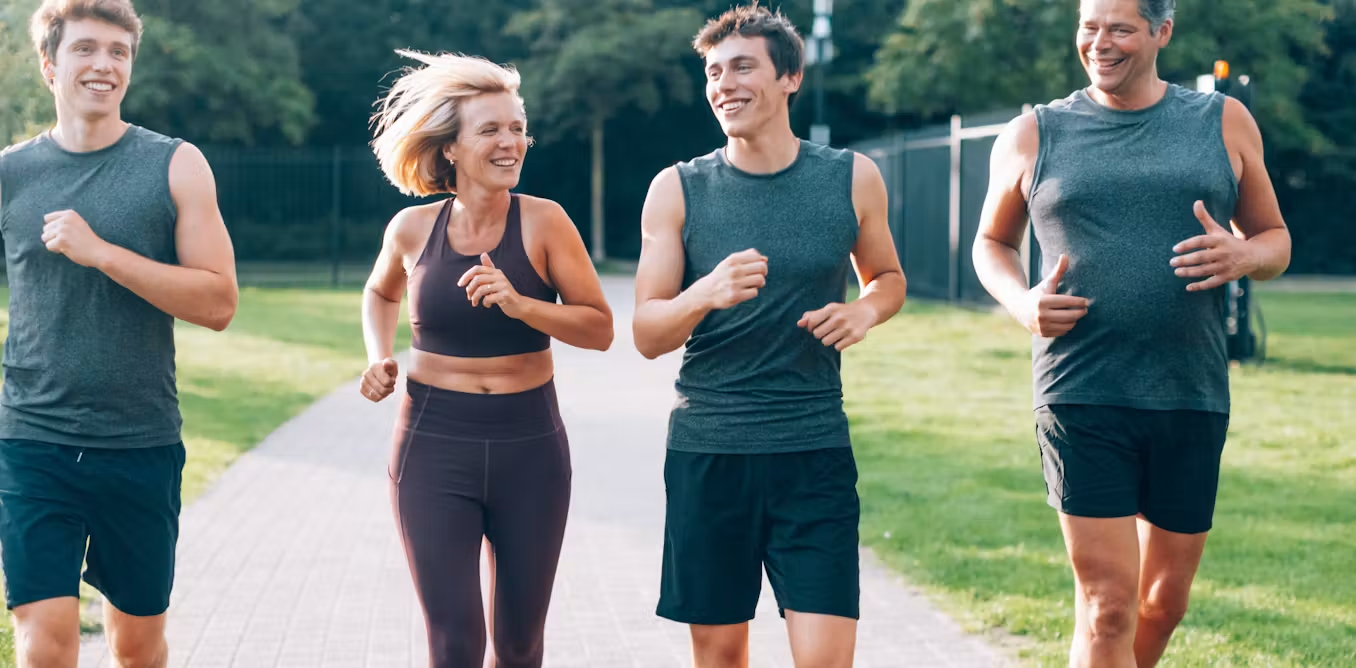
The growing popularity of the “slow jogging” trend online counters a lot of what we’ve been taught about fitness. Rather than striving for speed, the slow jogging trend encourages people to take short steps and move at a pace slow enough to comfortably hold a conversation.
To some people, this might look too easy to count as exercise. But exercise does not have to be intense to improve health.
Advertisement
The slow jogging trend was originally developed by a Japanese researcher named Hiroaki Tanaka. According to the researcher, jogging at “niko-niko pace” (which translates to “smiling pace”) could be a more enjoyable way to improve cardiovascular fitness. The trend eventually caught on in South Korea before going viral online, where it is now being adopted by people all around the world.
The fact that an activity looks easy doesn’t necessarily mean it’s ineffective. This is because exercise intensity is relative. A pace that feels effortless for an experienced runner may feel moderately challenging for someone who has been largely inactive. For that person, slow jogging can still provide a meaningful stimulus to the cardiovascular system and help improve aerobic fitness over time.
It’s for this reason that slow jogging may particularly be beneficial for people who don’t exercise very often or who have perhaps never tried jogging before.
Advertisement
The World Health Organization recommends that adults get between 150 and 300 minutes of moderate-intensity physical activity each week. More recent guidelines also emphasise a simpler message: some activity is better than none, more is generally better than less, and sedentary time should be reduced.
This message reflects growing evidence that inactivity itself is a health risk. Long periods of sitting have been associated with increased risks of cardiovascular disease, type 2 diabetes and premature death. Researchers now recognise that health is influenced not only by how much exercise we do, but also by how much we move throughout the day.
This is where slow jogging may be particularly useful.
Even avid runners may benefit from slow jogging. Dean Drobot/ Shutterstock
One of the most consistent findings in exercise science is that some of the largest health gains occur when people move from doing almost nothing to doing something. For someone who is largely sedentary, gradually introducing regular bouts of activity can improve cardiorespiratory fitness, help regulate blood sugar, lower blood pressure and reduce future risk of heart disease and stroke.
Advertisement
Slow jogging offers a relatively accessible way to achieve this. Compared with joining a gym, participating in organised sport or signing up for a running event, the barrier to entry is low. The pace is manageable and can easily be adapted to people of different ages, fitness levels and abilities.
But the benefits of slow jogging may extend beyond simply helping inactive people exercise more.
Many of the videos shared online show people slow jogging in groups. This social aspect may be important. One of the strongest predictors of long-term participation in physical activity is whether people enjoy the activity enough to keep doing it. Exercise performed with friends, family members or community groups can promote social connection, enjoyment and a sense of belonging, all of which can support long-term adherence.
Slow jogging may even have a role for people who already exercise regularly.
Although it’s unlikely to replace more challenging workouts for those pursuing specific fitness goals, endurance athletes who want to improve their aerobic fitness and even their race times may benefit from slowing down.
This is because slow jogging may overlap with what runners often call “zone 2 pace” – a running pace which raises your heart rate but is still slow enough to hold a conversation.
This lower intensity running can help runners more effectively build their aerobic base (their foundational fitness level and how effectively the body can use oxygen during long runs), and can also help the body learn to burn more fat for energy during exercise.
Advertisement
For active people, slow jogging could therefore serve as an easier option on days when high-intensity training is neither necessary nor desirable.
Seen in this light, the appeal of slow jogging becomes easier to understand. Its value may not lie in being a revolutionary new form of exercise. Rather, it reflects a growing recognition that health does not need to be extreme to be beneficial. Sometimes the biggest challenge is simply finding a form of movement that people enjoy enough to do consistently.
Benn admitted earlier this week that the cut felt like he had been “dragged down to the pits of hell, had a fight with Satan and God brought me back to life” as he described it as the “hardest thing” he had done, having fought arch-rival Chris Eubank Jr twice at middleweight last year before then battling Regis Prograis at a 150lb catchweight in April.
Inheritance tax is likely to be abolished if Kemi Badenoch becomes Prime Minister, party sources have told the Mail on Sunday.
The move – which the sources said will happen if ‘the sums can be made to add up’ – would strike a powerful contrast with the array of new taxes being imposed by Labour.
Last week Prime Minister Andy Burnham announced plans to impose a £1.6billion ‘tourist tax’, which would hit Britons holidaying in the UK with a 5 per cent surcharge – the latest in a raft of rises to tax and National Insurance since Labour’s 2024 general election victory.
Inheritance tax is charged at 40 per cent on estates over the standard tax-free threshold of £325,000, although the exempted amount can rise to £1million when the main home is passed on and married couples transfer their allowances between themselves.
Advertisement
Scrapping IHT would cost an estimated £9billion, with the funds most likely to be found from cutting the spiralling welfare bill.
The move could be announced at the Tory party conference in Birmingham next month, although sources close to Ms Badenoch said they had ‘not decided our policy platform yet’.
It would have echoes of George Osborne’s announcement at the Tories’ 2007 party conference that a future Conservative government would raise the IHT threshold from £300,000 to £1million.
Advertisement
Sources have said inheritance tax is likely to be abolished if Kemi Badenoch (pictured on September 11, 2026) becomes Prime Minister
Burnham (pictured on September 10, 2026) announced plans to impose a £1.6billion ‘tourist tax’ that means Britons holidaying in the UK would be left with a 5 per cent surcharge
The surge in support that followed heavily influenced Gordon Brown’s decision to ‘bottle’ a snap election that autumn.
Given the Tory Party is currently unprepared for an election, many of Ms Badenoch’s aides hope that such a policy would deter Mr Burnham from calling an early election himself.
Advertisement
Last year, Mrs Badenoch successfully kept her plans to axe stamp duty secret ahead of her conference announcement – a move credited with shoring up her leadership.
Senior sources in Mrs Badenoch’s office have told the MoS they want conference to create a ‘sense of momentum’ following on from a successful Tory shadow ministerial re-shuffle.
Mrs Badenoch has already said abolishing the ‘death tax’ is ‘high on my list’ and last week she said she commissioned internal research to see whether it is affordable – because ‘we are the party of fiscal responsibility’.
A source said: ‘Abolition is high on Kemi’s policy wish-list, but will only happen if we can make the sums add up’.
Advertisement
Her new Shadow Chancellor, Andrew Griffith, has also made no secret that he hates the levy.
Last year he told the TaxPayers’ Alliance: ‘I was asked at my selection, what’s the single tax, if you ever had a chance to scrap? And it’s inheritance tax.’
And in August, four days before his promotion, he said Britain can ‘learn from’ Sweden after they scrapped inheritance tax.
A poll for the Adam Smith Institute showed significant support for cutting IHT. It showed 45 per cent of Britons oppose inheritance tax and only 25 per cent support it in its current form.
Advertisement
John O’Connell, chief executive at the TaxPayers’ Alliance said: ‘Inheritance tax is one of the most unfair and hated taxes on the books, punishing families for saving, investing and building something to pass on. Scrapping it would send a powerful signal that Britain wants to reward aspiration rather than tax people again after death.’
And James Lawson, chairman of the Adam Smith Institute, called for ‘abolition’. He said: ‘We welcome this bold and growth-boosting announcement. The Adam Smith Institute has made the case against the death tax for the best part of 50 years.
‘Inheritance tax does a great deal of damage for very little money. It raises less than 1 per cent of the total tax take. It forces panic sales of family businesses, farms and homes.It falls hardest on family firms, whose owners cannot simply sell shares to pay the bill. And it taxes income that has already been taxed. The British public have never accepted it. Abolition is long overdue.’
A Conservative spokesman said: ‘We have not decided our policy platform for conference and anyone claiming they know what we’re announcing clearly has nothing to do with the planning.
Advertisement
‘Kemi has made no secret of her desire to cut taxes, singling out inheritance tax as one of those taxes she wants to cut in a speech last week.
‘But, unlike Reform, the Conservatives do not announce policies unless they are fully costed, backed up by specific savings, and in line with our Golden Economic Rule.’
Donald Trump has said his son Don Jr has become ‘a different human being’ since he got married earlier this year, joking that the 48-year-old has finally ‘calmed down.’
Don Jr tied the knot with 39-year-old socialite and model Bettina Anderson at a Palm Beach ceremony late May before heading to the Bahamas for a luxury reception.
The president did not attend his eldest son’s wedding, citing national security responsibilities as the war with Iran escalated.
Speaking at the US ambassador’s Deerfield Residence in Phoenix Park, Dublin, during his trip to Ireland on Saturday, Trump, 80, said Don Jr was also in the country.
Advertisement
‘Don’s here with a whole group of family. And he just got married, he’s happily married, which is nice,’ the president told staff and diplomats.
‘He’s calmed down so much. That’s a good sign. He’s like a different human being,’ Trump added to laughter from the assembled guests.
Trump also addressed the absence of First Lady Melania Trump.
‘My wife is here – my wife is here in spirit,’ Trump said, before admitting that he had tried to persuade her to join the trip but she did not want to make the seven-hour journey.
Advertisement
Donald Trump has said his son Don Jr has become ‘a different human being’ since he got married earlier this year. He made the comment during his trip to Ireland, shown above
Don Jr tied the knot with 39-year-old socialite and model Bettina Anderson at a Palm Beach ceremony late May before heading to the Bahamas for a luxury party
Trump then joked that Melania should have simply donned a ‘Make America Great Again’ hat and come along.
Advertisement
He previously said he missed Don Jr’s wedding because he had been distracted by the war in Iran.
‘This is not good timing for me,’ he said at the time. ‘I have a thing called Iran and other things.
‘That’s one I can’t win on,’ he added. ‘If I do attend, I get killed. If I don’t attend, I get killed by the fake news. Hopefully they’re going to have a great marriage.’
Don Jr and his new bride instead celebrated their wedding with his siblings, Eric, 42, and Ivanka, 44, who also came with them to the Bahamas afterwards.
Advertisement
The couple’s marriage certificate, obtained by the Daily Mail, shows that they officially became husband and wife in a secret ceremony held at the West Palm Beach home of Anderson’s sister, Kristina McPherson.
Anderson said she would be taking the Trump surname.
Join the discussion
How do you think family dynamics change when public figures miss major life events like weddings?
Advertisement
Don Jr and his new bride instead celebrated their wedding with his siblings, Eric, 42, and Ivanka, 44, who also came with them to the Bahamas afterwards
Don Jr was also among the speakers at the Republican midterm convention in Dallas, Texas, on Wednesday and Thursday.
He is typically ranked third in 2028 polls for the Republican presidential nomination.
President Trump arrived at Dublin Airport on Saturday morning, before holding official meetings at Phoenix Park with Irish President Catherine Connolly at Áras an Uachtaráin.
Advertisement
He also met Taoiseach Micheál Martin at Farmleigh House, before making his address at the US Ambassador’s Deerfield Residence.
Trump will spend the remainder of the trip at his resort, Trump International Golf Links & Hotel in Doonbeg, and attending the closing weekend of the Amgen Irish Open golf tournament.















































You must be logged in to post a comment Login