Connect with us

NewsBeat

Snakebites kill tens of thousands every year, could our new research change that?

Published

on

Snakebites kill tens of thousands every year, could our new research change that?

Every year, between 80,000 and 140,000 people die from snakebites worldwide. Hundreds of thousands more are left with amputated limbs or permanent disabilities.

India accounts for roughly half of these deaths, with around 58,000 people dying from snakebites each year. Many of the victims are farmers, labourers and children in rural communities, bitten while working in the fields or walking home after dark.

Yet the basic way we treat snakebite has changed little in more than a century. Traditional antivenom is made using horses: they are injected with small doses of snake venom, prompting their immune systems to produce antibodies. Blood is then collected from the horse and processed to make the antivenom.

This type of antivenom has saved countless lives, but it has drawbacks. The antivenom can vary from batch to batch, cause severe allergic reactions and is expensive to produce.

Advertisement

It can also offer limited protection. For example, in India, antivenom is mainly made using venoms from four snake species known as the “big four”: the Indian spectacled cobra, common krait, Russell’s viper, and saw-scaled viper. But these antivenoms do not always work well against venoms from other snake species, or populations of the same snake species, found across the country.

We wanted to know whether modern biotechnology could offer a better approach. Our new study in mice, suggests it might.

Small antibodies, big ambitions

Our approach uses nanobodies, tiny versions of antibodies. Antibodies are proteins made by the immune system that recognise and help neutralise harmful substances, including toxins. Nanobodies do a similar job but are much smaller.

Their size could make them useful for treating snakebites because they can move through tissue quickly and reach venom before it causes permanent damage. They can be also be produced in microbes, rather than using horses.

Advertisement
Are scientists close to a cure for world’s deadliest snakebites?
Kartik Sunagar, Author provided (no reuse)

We have already developed nanobodies that can neutralise venoms from African cobras and mambas. Because different cobra species produce many of the same types of toxins, we wanted to see whether these nanobodies could also work against Indian cobra venoms.

In our lab, we mixed five nanobodies and tested them against venoms from several cobra and king cobra species from India. We found that all five were able to target the toxins across the different venoms. This was encouraging because the nanobodies had originally been developed using African snake venoms.

From lab to living animal

We then tested the cocktail in mice. When the venoms and treatment were given together, all of the treated mice survived. While untreated mice died within 30 minutes because of neurotoxicity, typical of cobra bites.

We also tested what would happen if the treatment was given after a simulated bite. The mice received venom first, followed by the nanobody treatment through a vein. This was to simulate someone reaching a clinic after being bitten by a snake.

Advertisement

We found that the treatment still saved the mice when given 20 minutes after the venom. The treatment also prevented the severe effects of the venom, including paralysis and breathing failure.

We checked that the nanobodies did not bind to human proteins, which is important as doing so could cause unwanted side effects. We also found that the nanobodies remained intact at high temperatures, which is important in places where keeping medicines cold can be difficult.

A long road still ahead

These results are promising, but this was a study in mice, so the findings do not necessarily translate directly to people. What works in an animal model may not work in humans in exactly the same way. So the results are best seen as an indication that this approach could be worth developing further.

Advertisement

The cocktail is also not a universal antivenom. Our tests showed that it doesn’t work against Indian kraits, meaning that additional nanobodies would be needed to target these and India’s dangerous vipers. More research is also needed to understand the right dose, how long the treatment lasts and how well it works when treatment is further delayed in larger animal and humans.

The next step would be to test the antivenom in people. First, we would need to make sure it’s safe, decide the right dose and produce it to pharmaceutical standards. The treatment would then be tested in people who come to hospital after being bitten by a snake.

So even though there’s some way to go before this way of making antivenoms could actually be used in humans, these results build on our previous work and suggest that nanobody-based antivenoms could eventually provide a more flexible and effective approach to treating snakebite.

This means that instead of developing a completely new treatment for every snake species, a shared set of nanobodies could potentially be combined and adapted for different geographical regions.

Advertisement

For the people and communities living with the greatest risk of snakebite, this could make an enormous difference. And potentially save tens of thousands of lives every year.


This series was commissioned as part of a partnership between Videnskab.dk and The Conversation, where articles are published in English and Danish.


Source link

Advertisement
Continue Reading
Click to comment

You must be logged in to post a comment Login

Leave a Reply

NewsBeat

Ministers called to step in after US diplomat secretly removed from UK

Published

on

Manchester Evening News

The diplomate was accused of possessing indecent images of children

Government officials have been urged to act after an American diplomat was smuggled out of the UK by US authorities after he was accused of possessing indecent images of children.

Advertisement

According to reports, the diplomat’s London flat was raided by US officials last month and he was taken to an American airbase for transportation.

The British police were not informed of this first, it is being reported. American personnel have no powers of arrest in Britain and there was no formal request for the man to be extradited.

Click here to get the biggest stories straight to your inbox in our Daily Newsletter

UK ministers are understood to be in contact with the US embassy over the incident, which could further strain relations between London and Washington.

Advertisement

In a letter to Justice Secretary Alex Norris, his Conservative counterpart Nick Timothy said he was concerned that the US actions represented “a cover-up” and the diplomat may have committed offences in the UK.

He said: “If this is the case, the diplomat should face trial in an English court.”

A Government spokesperson declined to comment due to the ongoing US investigation, but said Britain expects all foreign diplomats to obey the law while in the UK “in the same way we expect all UK diplomats to do so when posted overseas”.

A spokesperson for the US embassy said it was “aware of allegations” about one of their staff, and expected “all personnel to adhere to the highest standards of conduct”.

Advertisement

Saying they could not comment on the specifics of the case, the spokesperson added: “We quickly informed UK law enforcement and took swift action, and we will continue to work closely with our law enforcement partners regarding these allegations.

“The individual in question has been reassigned to the United States in conjunction with an ongoing investigation. The embassy has informed British authorities of the case.”

A spokesperson for the Metropolitan Police said: “On Tuesday August 25, US authorities made us aware of an investigation they are conducting into suspected offences in London relating to indecent images of children.

“We continue to liaise with them regarding this matter.”

Advertisement

In his letter, Mr Timothy added that the incident was part of a “concerning pattern” in which US authorities prosecuted cases against American servicemen accused of offences against British civilians while based in the UK.

He referenced the case of an American fighter pilot who avoided a trial under English law for strangling a woman in Cambridge while off-duty.

Captain Jacob Wulfson was tried at a court martial on a US airbase and was jailed for six months after being convicted of strangulation.

He was acquitted of charges of sexual assault and aggravated sexual contact.

Advertisement

Mr Timothy said he had received reports of other offences that had been dealt with in the same way, writing: “These cases should have been investigated by the English police, and prosecuted in our courts.

“I ask you to urgently explain what action you are taking to address this, and what will be done to ensure the accused diplomat faces a proper investigation in this country.”

The diplomat’s case has also been likened to that of US State Department employee Anne Sacoolas who caused the death of teenager Harry Dunn in a car crash in 2019.

Sacoolas was able to leave the country shortly after causing the fatal collision after the US asserted diplomatic immunity on her behalf.

Advertisement

She eventually pleaded guilty to causing death by careless driving at a virtual High Court hearing in December 2022 and was sentenced to eight months in prison, suspended for a year.

Source link

Continue Reading

NewsBeat

DR MAX PEMBERTON: I’ve seen the damage caused by the insidious creep of holiday drinking. But doing THIS before your first sip will transform your relationship with alcohol for good

Published

on

One in five drink more when the weather¿s nice, a survey found

Source link

Advertisement
Continue Reading

NewsBeat

how danger and uncertainty can affect the mental health of seafarers

Published

on

how danger and uncertainty can affect the mental health of seafarers

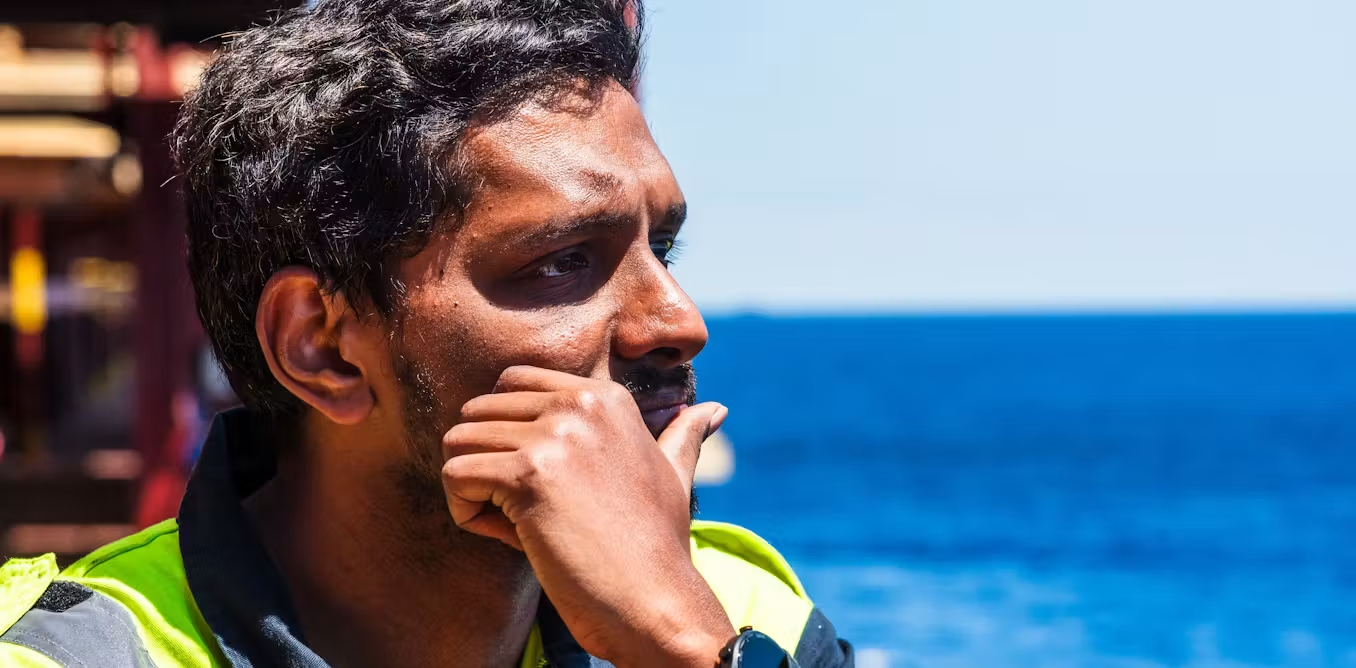
As instability in the Strait of Hormuz disrupts shipping, public discussion tends to focus on fuel prices and supplies. Less attention is paid to the people working on the ships.

The International Maritime Organization (IMO) says more than 20,000 seafarers in the region have been affected, including people stranded on vessels unable to leave.

Their work supports much of everyday life. The global merchant fleet, meaning ships carrying commercial cargo, is staffed by nearly 1.9 million seafarers, while around 80% of international trade in goods travels by sea. Supply chains therefore depend partly on the wellbeing of this international workforce.

The danger has immediate human consequences. The IMO prepared a plan to evacuate about 6,000 seafarers and reported that an estimated 2,900 had left before it was paused. Its updated incident list records seafarers killed, injured or missing.

Advertisement

These figures document exposure and physical harm, but not the mental health effects on crews caught in the disruption. Existing research shows why prolonged danger and uncertainty are concerning. A systematic review of 63 studies associated poorer mental health among maritime workers with feeling unsafe, long or irregular hours, poor sleep, weak support, uncertain schedules and extended periods at sea.

Crew members may spend months living at their workplace, separated from family and sharing confined spaces. Ships operate around the clock, and rotating watches can disrupt sleep and the circadian rhythm, the body’s internal clock.

Research has linked these conditions to stress, depressive symptoms and burnout. The World Health Organization describes burnout as a work-related condition involving exhaustion, growing detachment or cynicism, and reduced effectiveness.

Advertisement

Conflict can intensify several pressures at once. In a survey of 319 seafarers who had sailed in the Black Sea conflict zone during the war in Ukraine, more than 70% reported that their safety had been at risk, 95% experienced increased stress or anxiety at least once, and almost 80% felt their mental health had been compromised. The study also identified sleep loss and reduced contact with family. More broadly, limited control over work, uncertain schedules and long periods at sea have been associated with poorer mental health and wellbeing.

Seafarers’ ability to refuse a hazardous route can depend on the specific agreement covering their vessel. On March 5, 2026, the International Transport Workers’ Federation and the Joint Negotiating Group designated the Persian Gulf, Strait of Hormuz and Gulf of Oman a “Warlike Operations Area”. Seafarers on covered vessels gained enhanced pay, doubled compensation for death or disability, and the right to refuse to enter the area and return home at the company’s expense, with compensation equal to two-month’s basic wage.

The seafarers’ union Nautilus, meanwhile, secured double pay for seafarers on Dutch-flagged vessels. But such protections reach only those the agreement covers.

Pay belongs in this wider discussion of wellbeing. A review of 24 studies linked an imbalance between workers’ effort and rewards to burnout. Higher pay, family benefits and training opportunities were associated with greater job satisfaction. Because the studies examined workers at only one point in time, they cannot show that low or unequal pay directly causes mental illness.

Advertisement

International labour rules offer minimum protections. The Maritime Labour Convention, in force since 2013, covers employment terms, accommodation, healthcare and social protection. Its binding wage standard requires wages to be paid at least monthly, with an account of what is owed and paid. A separate, non-binding guideline supports equal pay for work of equal value on the same ship without discrimination, but this is not a universally enforceable rule.

Large differences within the same crew remain possible. Research aboard merchant ships found that some seafarers had permanent contracts, higher monthly pay and shorter tours, while colleagues doing the same tasks earned less on temporary contracts and stayed at sea longer. Nationality and residence can determine which labour market and agreement applies.

In two linked decisions in August 2025, the Netherlands Institute for Human Rights found that two shipowners had unlawfully discriminated against Filipino and Indonesian seafarers by paying them substantially less than European colleagues doing comparable work. One European night cook earned at least twice as much as an Indonesian colleague. In the Filipino case, the Institute accepted that the difference contributed to a sense of class division on board.

Advertisement

The Institute is an official equality body rather than a court, and its decisions are non-binding. Even so, the cases show how unequal pay can reinforce status divisions among people living and working together under the same conditions.

Protecting seafarers’ mental health requires action throughout their working lives. Employers should provide safe staffing and adequate rest, reliable contact with home, access to medical and psychological care, supportive management and a genuine right to leave dangerous areas. Clear wage bands and independent ways to challenge discriminatory pay would strengthen these protections. Overtime and hazard pay should reflect the work and risk involved, regardless of nationality or residence.

The Strait of Hormuz crisis is an immediate test of seafarer welfare. Longer-term preparedness will depend on whether governments and the shipping industry treat mental health, physical safety and fair employment as connected responsibilities before workers reach a crisis point.

Advertisement

Source link

Continue Reading

NewsBeat

US Open men’s final prize money: How much winner and runner-up get

Published

on

Wales Online

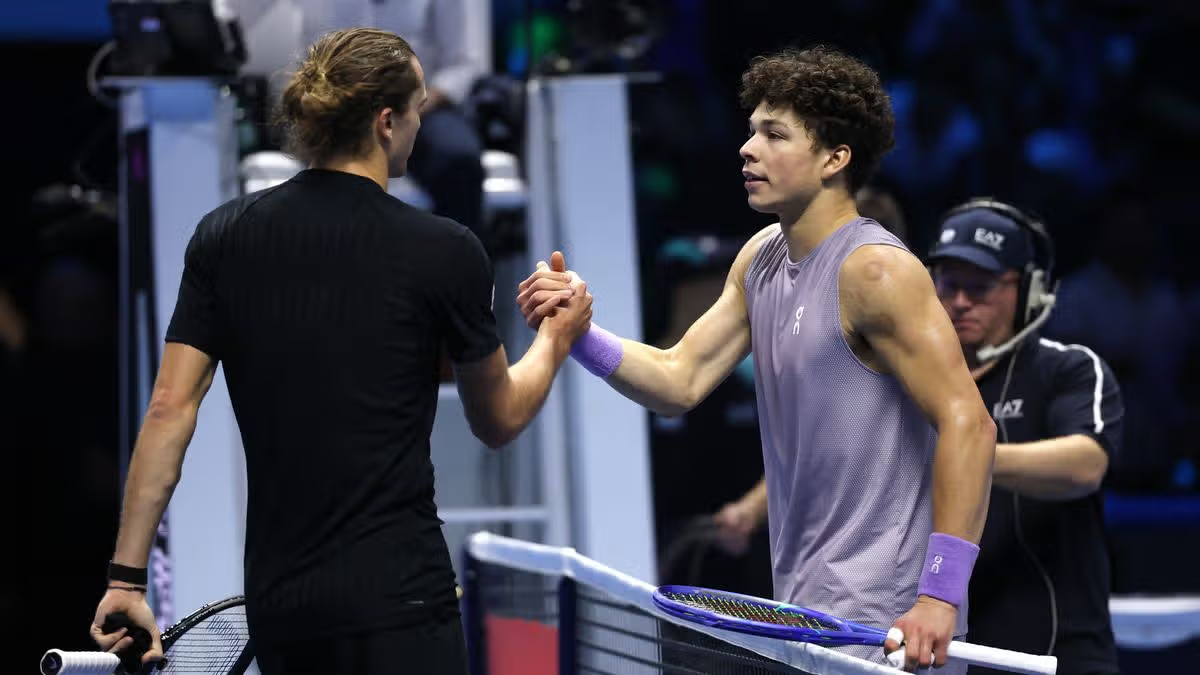
The US Open sees Alexander Zverev and Ben Shelton battle it out in New York tonight

Alexander Zverev and Ben Shelton meet in the final of the US Open at Flushing Meadows tonight.

Advertisement

Top seed German Zverev will be favourite to secure the Grand Slam title but with home support likely to be in Sheldon’s corner, there could be an upset this evening.

“For me, this whole tournament has been uncharted territory,” said Shelton, who will likely be roared on by a 24,000-strong crowd in New York.

“I’m in positions I’ve never been in before. I’ve beaten guys I’ve never beaten before.”

Shelton has lost to Zverev in their last five meetings and he has never beaten the German.

Advertisement

Zverev, the top seed, reached the final by beating Karen Khachanov 6-3, 7-6, 7-6 in the last four. Shelton beat Frances Tiafoe in four sets in the other semi.

Tonight’s final is set to offer a record-breaking prize fund, with the world’s best tennis players competing for a share of $108 million (£80m).

The men’s and women’s singles champions will each receive $5.5million (£4.1million), making it the biggest winner’s prize in tennis history.

Last night, Elena Rybakina was crowned US Open winner in the women’s competition, beating Aryna Sabalenka, the No 1 seed and current champion.

Advertisement

The US Open will continue to offer equal prize money in the men’s and women’s singles competitions, with identical payments available to players at every stage of the tournament.

The match is set to get under way at 7pm UK time. Here is the prize money pot broken down for the singles competitions.

US Open singles prize money

First round: $140,000

Second round: $190,000

Advertisement

Third round: $290,000

Round of 16: $480,000

Quarter-finals: $780,000

Semi-finals: $1,450,000

Advertisement

Runner-up: $2,800,000

Winner: $5,500,000

Source link

Advertisement
Continue Reading

NewsBeat

I’m A Celebrity spinoff ‘chaos’ as Venezuela Fury and Noah Price dramatically quit

Published

on

Daily Mirror

Venezuela Fury and Noah Price are said to have quit I’m A Celebrity The Wild Frontier just days into filming, giving ITV bosses a major headache

I’m A Celebrity’s latest spinoff show was thrust into chaos just days into filming amid reports Venezuela Fury and her husband Noah Price quit. The duo are said to have called time on their journey in Canada, telling producers they don’t want to carry on.

Advertisement

It’s claimed the 16-year-old daughter of Tyson and Paris Fury and her new husband, 18, decided the show simply isn’t for them and walked away from the show days into filming. ,

Reports suggest bosses quickly moved to bring in a reality TV favourite and her pal. A source said Venezuela and Noah didn’t want to carry on.

The insider told The Sun: “They both realised early on it was too much. The challenges are tough, the living conditions aren’t easy. They both gave it their best shot but when push came to shove, it all got too much and they walked out.”

Saying the decision will make “amazing television,” the source said it “caused a headache for producers.” But it’s reported 2025 Love Island victor Toni Laites and her best friend Marielle were sought as their replacement.

The source said bosses felt Toni was the perfect person to step in. “She has a lot of grit and determination and will show that when she starts filming,” they said.

The show will see celebrities competing in pairs, with friends, relatives and couples taking on Bushtucker-style trials together before facing elimination as a duo. While the lineup is yet to have been confirmed by ITV, a number of famous faces were seen jetting off last week.

Advertisement

At the airport, Jeremy Lynch and Paul Olima were seen laughing as the prepared to board their flight to Vancouver for the show. Jeremy smiled and laughed as he walked through the airport, donning a grey sweatpants as he wheeled his blue hand luggage beside him. He also tried to disguise himself by hiding behind a pair of rose tinted glasses and a black hat.

While the official lineup is being kept quiet, presenters Ant and Dec did admit two celebrities were banned. Speaking on their podcast, the Geordie duo joked Jimmy Bullard and David Haye are banned from the latest series.

On their Hanging Out with Ant & Dec podcast, the presenters discussed the show and Dec said: “We are doing a new spinoff series of I’m A Celebrity called I’m A Celebrity… The Wild Frontier.”

After explaining the concept of the show, he added: “They will enter as a pair, compete as a pair, and eventually leave as a pair. “And then it will all build up to a live grand final in London…” at which point Ant jumped in and joked: “What could possibly go wrong?”

Advertisement

Laughing, Dec insisted: “Jimmy Bullard and David Haye are barred from the series.” Ant added: “I’d like them just in the front row, just for heckles, we like hecklers don’t we hecklers corner?”

The show is due to air in 2027, as part of celebrations marking 25 years of I’m A Celebrity – which first hit our screens in August, 2002. Rather than competing individually, contestants will reportedly tackle challenges as pairs, working together to win food and survive eliminations before one winning duo is crowned.

Like this story? For more of the latest showbiz news and gossip, follow Mirror Celebs on TikTok, Snapchat, Instagram, Twitter, Facebook, YouTube and Threads.

Advertisement

Source link

Continue Reading

NewsBeat

Four arrested over fights at Newcaslte Misfits Boxing event

Published

on

Four arrested over fights at Newcaslte Misfits Boxing event

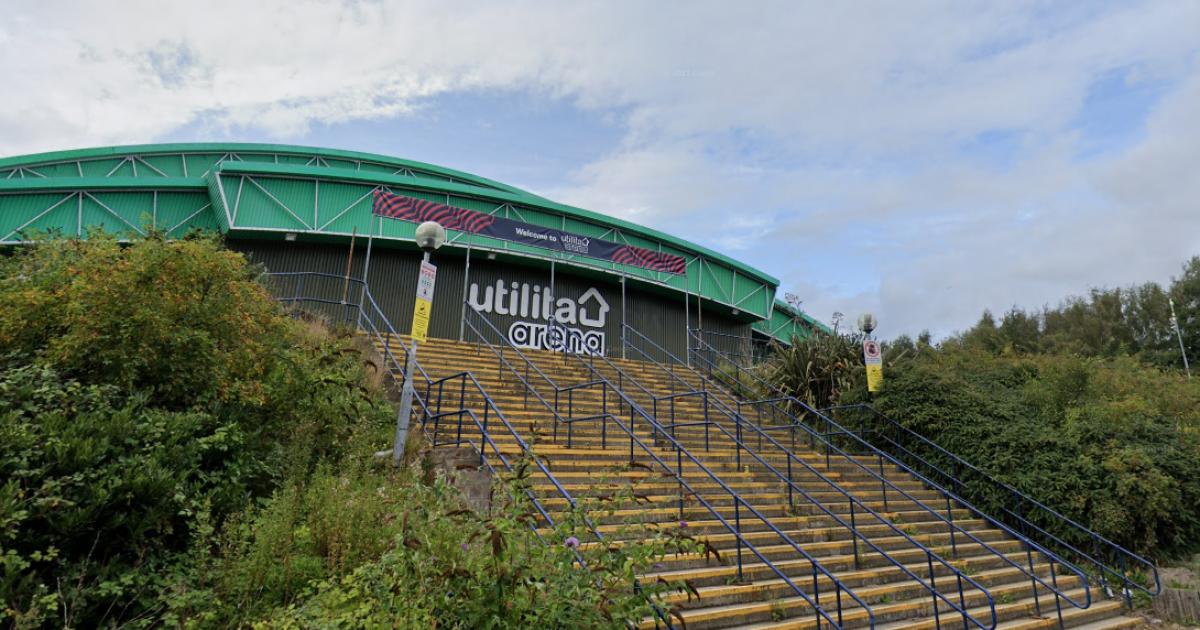
Police were called to the Misfits Boxing event at Utilita Arena on Saturday (September 12) after viral videos showed disturbances involving a number of people. 

Officers attended and arrested four people on suspicion of assault – with Northumbria Police saying that no serious injuries have been reported. 

Several videos of fights at the venue have been posted and shared on X, with one video showing security staff trying to break up the altercations.

Advertisement

Thousands flocked to the event on Saturday night to watch the “UK’s hardest man” Big Stacks triumph over Jordan McCann. 

A force spokesperson said enquiries now remain ongoing into incidents at the venue, with officers trying to identify all those involved. 

The statement said: “We are aware of videos circulating online in relation to disturbances involving a number of people in attendance at a boxing event in Newcastle city centre yesterday (Saturday). 

“Officers attended and arrested four individuals on suspicion of assault, with no serious injuries reported to us. We want to make it clear that behaviour of this kind will not be tolerated. 

Advertisement

“The safety of the public is our utmost priority and enquiries are ongoing to identify all of those involved.

“Anyone with information should contact us online via direct message on social media or submit a report form on our website.”

Source link

Advertisement
Continue Reading

NewsBeat

Reform rules out abolishing inheritance tax as party brands Tories ‘out of touch’ for considering it

Published

on

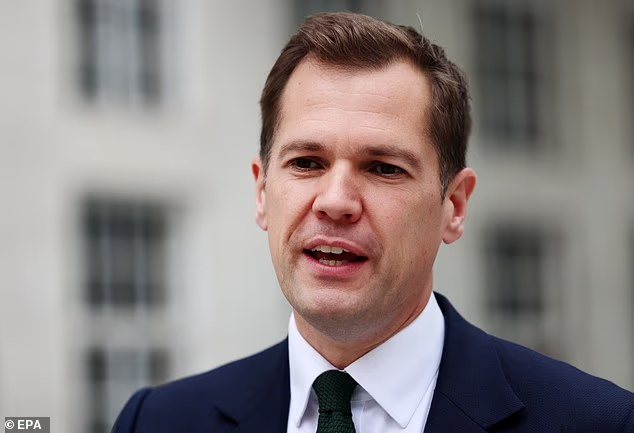
Robert Jenrick said Reform would not match a plan being considered by the Tories to abolish inheritance tax

Advertisement

Reform has ruled out abolishing inheritance tax and branded the Tories ‘out of touch’ for considering it.

Robert Jenrick, Reform’s pick for Chancellor, admitted the 40 per cent levy on deceased people’s estates is ‘unfair’ and ‘very unpopular’ but said it ‘doesn’t raise very much money’.

He said Reform would not match a plan being considered by the Tories to scrap it, calling it ‘morally wrong’ to prioritise cutting taxes for the ‘super-rich’ in a cost of living crisis.

As revealed by The Mail on Sunday, Tory leader Kemi Badenoch may unveil the major policy of abolishing inheritance tax at the party’s annual conference next month.

Advertisement

It would echo a similar pledge by Shadow Chancellor George Osborne in 2007 which was credited with deterring Prime Minister Gordon Brown from calling a snap election.

Conservative sources insist the tax cut is still under discussion and will only be confirmed if it can be fully costed. 

Shadow Foreign Secretary Tom Tugendhat said: ‘Kemi’s not going to be announcing anything until conference.’ A party spokesman added: ‘Kemi has made no secret of her desire to cut taxes, singling out inheritance tax as one of those she wants to cut in a speech last week.’

But Mr Jenrick said he would not scrap inheritance tax, which is only paid by about 30,000 estates worth more than £325,000.

Advertisement

Robert Jenrick said Reform would not match a plan being considered by the Tories to abolish inheritance tax

He told Sky News: ‘I find it as unfair as the next person. It’s a very unpopular tax. It doesn’t raise very much but causes a huge amount of damage to family farms and businesses.’

But he said there would be a ‘big divide in British politics’ if Mrs Badenoch focuses on cutting taxes for a small number of people, while Reform instead vows to increase the personal allowance so that workers earning less than £15,000 and pensioners are spared paying income tax.

Advertisement

‘That’s the big difference,’ he said. ‘If you ask are we in hock to wealthy people? No, absolutely not, because we’re not reducing taxes for the super-rich, for big businesses, for Belgravia. We are on the side of working people.’

Told scrapping inheritance tax would be a popular policy, he insisted: ‘I think it’s very out of touch, actually. And also it’s not going to happen.’

He highlighted Mr Osborne’s pledge, which was never implemented, adding: ‘We’ve heard this before, but it’s a big divide now in British politics.

‘Are you on the side of the wealthy or of the workers? We’re on the side of workers.’  

Advertisement

He added: ‘I thought that it would be morally wrong as Chancellor, in a time of such straitened circumstances, to privilege a small number of households over the lowest income people in our country.’

Advertisement

Source link

Continue Reading

NewsBeat

Trains carrying Boris Johnson and foreign dignitaries were intended targets of Russian drone attack in Ukraine, experts fear

Published

on

A rail worker is seen assessing the damage after a train was hit by a Russian missile near the Ukrainian border with Poland

Trains carrying Boris Johnson and foreign dignitaries were the intended targets of a Russian drone attack in Ukraine, experts fear.

The former Prime Minister was on a charter train from Kyiv when it received a drone alert as it approached the Polish border.

Amid fears of a targeted attack, a last-minute timetable change allowed it to speed across the border into Poland earlier than scheduled.

Just over an hour later, a train on the same route was evacuated, with terrified passengers forced to run for safety as a nearby stationary locomotive exploded in flames after being struck. The jet-propelled drone hit only a mile inside Ukrainian territory. No-one was injured.

Advertisement

Security experts said last night the near-miss could be ‘a Mafia-style message straight from the Kremlin’ aimed at Mr Johnson – a staunch supporter of Ukraine who was returning from a security conference in Kyiv.

But a defiant Mr Johnson told the Daily Mail: ‘Nothing will deter me from using Ukrainian railways or going back to Ukraine.’

Passengers on the charter trains included UK national security adviser Jonathan Powell and former CIA chief David Petraeus. Former Swedish prime minister Carl Bildt said passengers on his train had been told to prepare for evacuation, but were then allowed to continue their journey.

The terrifying escalation demonstrates that Vladimir Putin is ‘playing with fire right on the border of the European Union and Nato’, said a German MP who was on the same train as Mr Johnson.

Advertisement

A rail worker is seen assessing the damage after a train was hit by a Russian missile near the Ukrainian border with Poland

Frantic footage shared to social media showed passengers desperately fleeing the train prior to the attack

Frantic footage shared to social media showed passengers desperately fleeing the train prior to the attack

This photo shows the damage to the front of the locomotive in the aftermath of the drone strike

This photo shows the damage to the front of the locomotive in the aftermath of the drone strike

Advertisement
It is now feared that an earlier train carrying Boris Johnson (pictured last week) and other political figures was the target of the attack

It is now feared that an earlier train carrying Boris Johnson (pictured last week) and other political figures was the target of the attack 

Advertisement

Robin Wagener, a Green Party member of the Bundestag, said: ‘These drone attacks are blind terror against Ukrainian civilians and a dangerous escalation. We must finally put a clear stop to this terror.’

Ukrainian rail chiefs said a drone strike so close to its border with an EU country was ‘unprecedented’ and raised fears that Mr Johnson and his fellow VIPs had been targeted. 

‘This is the first time the Russians have launched a massive attack towards our western frontier,’ Ukrainian railways boss Oleksandr Pertsovskyi said.

‘Whether or not it’s a coincidence that this happened at the same time as a train carrying high-profile foreign figures was passing through this specific crossing, that we cannot say. But it certainly poses many questions.’

Advertisement

Daily Mail columnist Mr Johnson, 62, was among scores of foreign dignitaries who had travelled to Kyiv for a major conference on the country’s security, which finished on Saturday evening.

As members of the European delegation were approaching the Yahodyn crossing to Poland on an overnight train to Warsaw shortly after 7am local time, some passengers were given an evacuation warning.

But after being dispatched earlier than scheduled, the train safely crossed into Poland at 7.46am. At 9.15am, the next train on the route was evacuated, and a shunting locomotive burst into flames when it was struck just before 9.30am.

A nearby petrol station also exploded after being hit, Ukrainian media reported, with a fireball spreading to nearby lorries.

Advertisement

Peter Dickinson, editor of Ukraine Alert at the Atlantic Council think-tank, told the Mail: ‘This was a Mafia-style message straight from the Kremlin.’

Describing it as a ‘deliberate and calculated attack’, he said Moscow would have been ‘very well aware that plenty of senior foreign officials would be traveling along that train route’.

‘It is part of a broader intimidation campaign currently being waged by the Kremlin as Putin seeks to bully Europe into abandoning Ukraine,’ he added.

Maksym Kuzakhmetov, a prominent Russian journalist and historian in exile, said: ‘I have no difficulty whatsoever believing this was a deliberate, planned attack.

Advertisement

‘The Kremlin has little hesitation in ordering the physical elimination of anyone Putin comes to regard as a personal enemy.

Mr Johnson and other officials had been in Kyiv for the 2026 annual meeting of the Yalta European Strategy. He is pictured addressing the conference earlier this year in February

Mr Johnson and other officials had been in Kyiv for the 2026 annual meeting of the Yalta European Strategy. He is pictured addressing the conference earlier this year in February

Mr Johnson hit out later on Sunday at Russian leader Vladimir Putin (pictured on Sunday) in a post on X

Mr Johnson hit out later on Sunday at Russian leader Vladimir Putin (pictured on Sunday) in a post on X 

‘Western politicians who openly back Ukraine are anathema to him, especially someone as outspoken and steadfast in his support for Kyiv as Boris Johnson.’

Advertisement

Mr Johnson’s train was also carrying Gunter Sautter, one of German chancellor Friedrich Merz’s closest foreign and security-policy advisers, as well as security advisers from France and Italy.

They were returning via what should have been the only safe route out of Ukraine after discussions with president Volodymyr Zelensky’s government about possible peace negotiations with Russia.

The trains were all passing through the Yahodyn border crossing, one of the country’s most important links with the EU following the suspension of civilian air travel.

The Conservatives described yesterday’s incident as a ‘stark escalation’ by Moscow and urged the Government to increase defence spending. Stuart Anderson, who was appointed shadow minister for war preparedness yesterday, said: ‘It is yet another reminder that Russian aggression is a real and growing threat to European security and, ultimately, our own national security.’

Advertisement

Defence Secretary Wes Streeting said: ‘Reckless, dangerous attacks on civilian infrastructure so close to Poland underline the wider security threat Russia poses.’

Ukrainian foreign minister Andrii Sybiha said ‘Putin’s terror was knocking directly on the doors of the EU and Nato’.

‘Putin needs to understand that his barbarism will be met with decisive action. This is the only way to stop him.’

Source link

Advertisement
Continue Reading

NewsBeat

Charlie Kirk statue outside Turning Point HQ in Arizona is DEFACED by twisted vandals making a mockery of his killing… as vile message is left for his supporters

Published

on

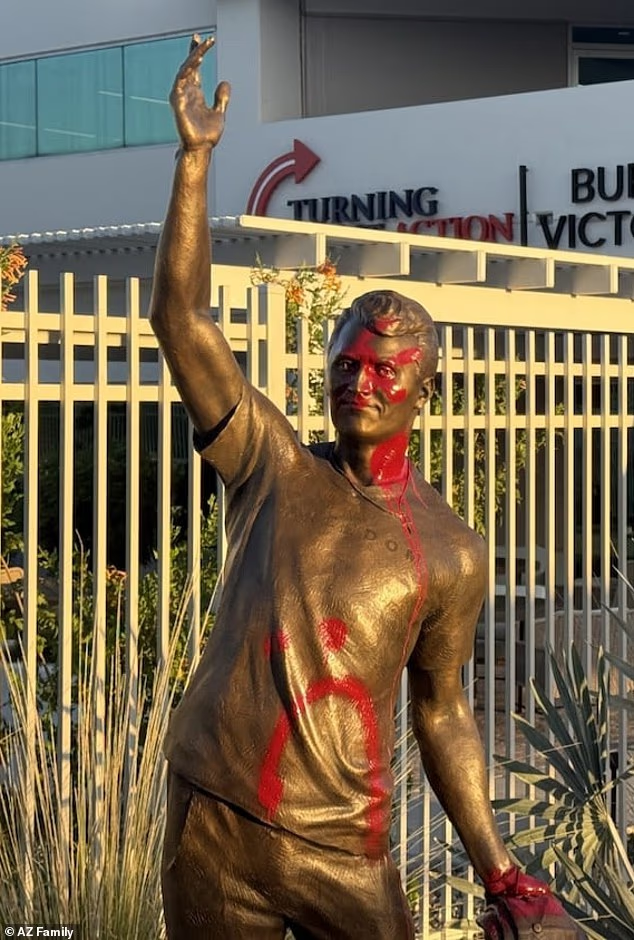
The Charlie Kirk statue outside the Turning Point USA headquarters in Phoenix, Arizona, was vandalized on Sunday morning

A Charlie Kirk statue erected outside the Turning Point USA headquarters in Arizona has been vandalized. 

The statue, which was unveiled on Thursday – the first anniversary of Kirk’s death – was found covered in red spray paint on Sunday morning in Phoenix. 

Officers with the Phoenix Police Department were called to the scene around 9am after someone reported the defaced memorial.

The bronze statue also had paint on it that appeared to be concentrated on the neck of the statue – an apparent mockery of where Kirk was shot. A frowny face was also drawn on its torso.

Advertisement

Another memorial outside the building, which features the late conservative next to a quote that reads: ‘May Charlie be received into the merciful arms of Jesus, our loving Savior,’ was also vandalized. 

A large red ‘X’ was drawn on his face, and red paint covered the word ‘Jesus’, as flowers and American flags lay near the memorial, photos show. 

It’s unclear if any suspects have been identified. 

The anti-Christian theme of the vandalism has upset Kirk’s supporters, with one online user reacting: ‘These animals will burn in hell for all eternity.’ 

Advertisement

The Charlie Kirk statue outside the Turning Point USA headquarters in Phoenix, Arizona, was vandalized on Sunday morning

Another larger memorial for the late conservative was also defaced

Another larger memorial for the late conservative was also defaced

‘So, killing Charlie wasn’t enough. So noted,’ wrote another. 

Advertisement

Kirk was fatally shot on September 10, 2025, while speaking at a Turning Point USA event at Utah Valley University. 

Kirk, a close ally of President Donald Trump, co-founded and ran the conservative youth organization. 

The 31-year-old father and husband was shot in the neck by a single rifle shot while he hosted a debate event in front of roughly 3,000 people. 

He was rushed to a local hospital, where he was pronounced dead. 

Advertisement

A manhunt was quickly launched for his alleged shooter, who was later identified as Tyler Robinson, 22. 

The Utah native surrendered to the local sheriff’s office after his parents allegedly convinced him to turn himself in following his confession to them. 

The 31-year-old father and husband was shot in the neck by a single rifle shot while he hosted a debate event in front of roughly 3,000 people

The 31-year-old father and husband was shot in the neck by a single rifle shot while he hosted a debate event in front of roughly 3,000 people

Robinson has been charged with ten criminal counts, including aggravated murder. That charge makes him eligible for the death penalty.

Advertisement

On September 1, a judge ruled that Robinson’s trial will move forward after prosecutors argued there was enough evidence against him. Meanwhile, his defense claimed the evidence was insufficient. 

His defense attorney then entered pleas of not guilty on all counts on his behalf. 

Robinson’s next court date is scheduled for October 23. 

Before the latest ruling, Utah County prosecutor Ryan McBride told the court: ‘It’s not difficult to understand the motive here. 

Advertisement

‘The defendant’s views were repugnant to the positions that Charlie Kirk famously took.’ 

The state has pointed to Robinson and Kirk’s opposing views on same-sex marriage and gender transitioning after it was revealed that the alleged shooter was in a romantic relationship with his former roommate, Lance Twiggs. 

A manhunt was quickly launched for his alleged shooter, who was later identified as Tyler Robinson, 22

A manhunt was quickly launched for his alleged shooter, who was later identified as Tyler Robinson, 22

Twiggs told investigators that he had been considering transitioning around the time Kirk was shot and killed, according to prosecutors. 

Advertisement

A note that Robinson wrote to Twiggs, who also went by Luna, was also presented by prosecutors. 

It read: ‘I had the opportunity to take out Charlie Kirk, and I took it. I wish we could have lived in a world where this was not necessary.’

The vandalism comes just days after chaos erupted in New York City after another Charlie Kirk statue was displayed. 

The life-sized statue was erected in Times Square on the one-year anniversary of Kirk’s death after sculptor Sergio Furnaru created the piece. 

Advertisement

Madness quickly ensued after its installation as both Kirk supporters and critics clashed on the streets.  

The Daily Mail contacted the Phoenix Police Department and Turning Point USA for comment. 

Source link

Advertisement
Continue Reading

NewsBeat

How Donald Trump’s war in Iran is failing the legitimacy test in the eyes of US voters

Published

on

How Donald Trump’s war in Iran is failing the legitimacy test in the eyes of US voters

Donald Trump now has a new proposed timetable for his war with Iran, albeit without a clear purpose. Heading to the Republicans’ midterm convention in Texas this week, the US president told reporters the war would end “immediately after the election”. This is coming from a president seven months into a conflict that he predicted would last only weeks.

For all that time, the US has been jostling with Iran for military and strategic control over the Strait of Hormuz while seeking to further degrade the Islamic Revolutionary Guard Corps’ military capabilities. But without strategic direction, victory is impossible and Iran’s leverage over the Strait allows it to keep defining the negotiating battlefield.

Capability without a definition of victory produces exactly what we have watched for weeks: tit-for-tat strikes that have failed to move the needle on the Strait, let alone Iran’s nuclear program.

But behind the shortcomings of Trump’s kinetic application of hard power lies a more profound failure. As much as wars depend on a coherent military strategy, they also need a strategic narrative – a story that provides and sustains the legitimacy of war. Trump’s war has never had one.

Advertisement

With the mid-term elections looming in November, the political costs of that absence are only becoming more acute for Trump and the Republican party.

Consider the inventory of justifications offered since February. Before the war began, Trump promised anti-government protesters that “help is on its way”. But when the bombing started it was about destroying Tehran’s nuclear and ballistic missile programmes. Then, within a day, it was also about forcing regime change.

Over several months, none of these ambitions were realised. In August, the vice-president, JD Vance, announced a new hierarchy of aims: keeping oil and gas cheap for Americans as “goal No. 1”, with Iran’s nuclear question demoted to second place.

Last week Vance went further by insisting that there isn’t a “war” at all, even though Iran had fired missiles at Kuwait in retaliation to US strikes on the cities of Bandar Abbas, Ahvaz, Aghajari, and Sirik. With each new justification and framing of this conflict, the original rationale for the war becomes harder to identify.

Advertisement

This matters because legitimacy is itself a source of state influence, especially in the context of wars of choice. It is what generates societal resolve at home, sustains the support of allies, and preserves the institutional prestige of the military asked to do the fighting. Strategic narratives are the vehicle through which such legitimacy is achieved; they can convert painful sacrifice into a cost that is worth sustaining.

And there is now a great deal of sacrifice that has yet to be given meaning. US Navy sailors enforcing the blockade have suffered from low morale – one crew member of the USS Abraham Lincoln went overboard in August due to mental health, after a record deployment without a port call.

American military fatalities resulting from Iranian retaliatory strikes on US bases in the region have been quietly reclassified by the Pentagon and moved out of the war’s official death toll. There are mounting accusations of civilian casualties in Iran, where Iranian officials claim that a US strike targeted a wedding ceremony near the Hormuz coast last week that killed four.

Unconvincing narrative

These losses strain America’s image among allies. However, the audience that most needs convincing is Trump’s own. His Maga approach was built on the premise that: “Great nations do not fight endless wars” and his support base is clearly concerned about lengthy foreign entanglements. Yet these are the voters now being asked to absorb the war’s costs without a compelling story that justifies them.

Advertisement
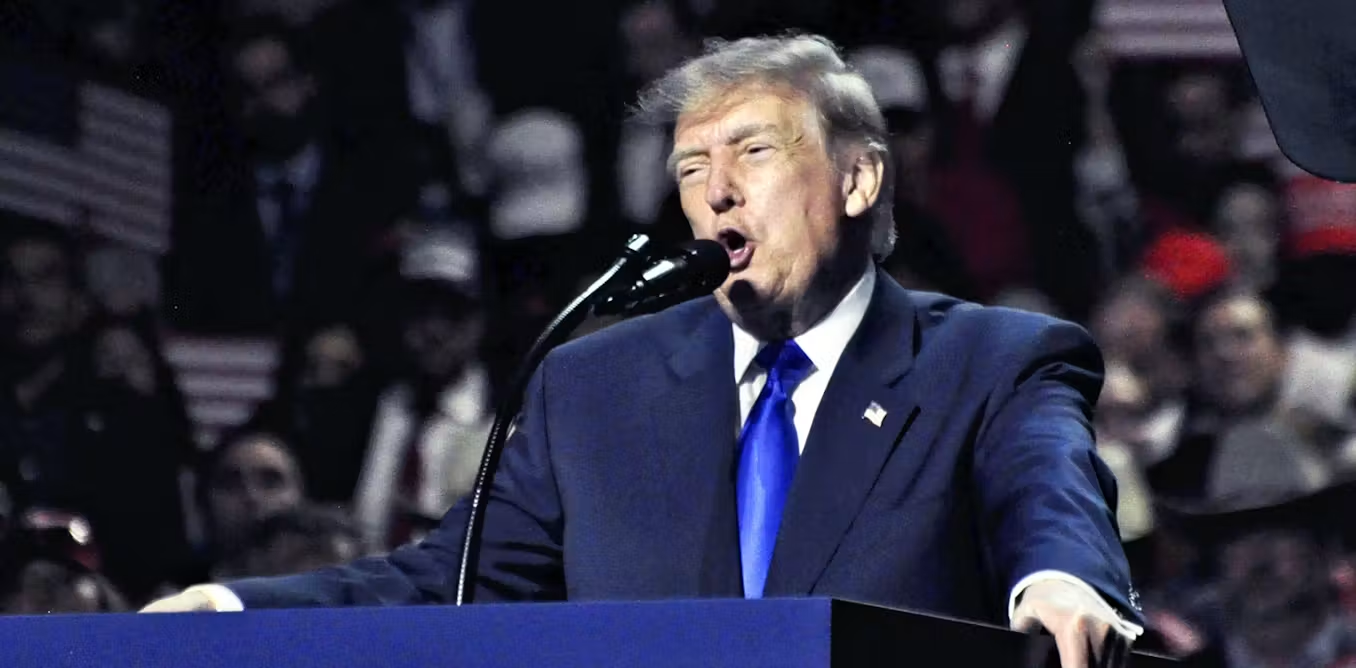
Donald Trump and the Republican Party will need to convince US voters that the war against Iran is justified.
Sue Dorfman/ZUMA Press Wire

Come the mid-terms, they will inevitably vote with inflation and gas prices in mind when they reach the ballot box. Polling already shows an erosion in support for the war.

Wars of choice have failed this legitimacy test before – sometimes before a single shot was fired. In August 2013, the then UK prime minister David Cameron asked parliament to sanction airstrikes against Syria’s Assad regime after chemical attacks and lost.

The government’s case rested on a story of salvation, national standing and the moral duty to act. But that narrative could not compete with a rival story of loss, in which intervention meant repeating the errors of Iraq: mission creep, the futile sacrifice of soldiers’ lives, and further damage to a reputation already bruised by two inconclusive wars in Iraq and Afghanistan.

There is an uncomfortable lesson for Washington here. The British case suggests that once a public comes to view a war of choice through the frame of loss – futile sacrifice, eroded prestige, no discernible end – no quantity of firepower can restore its legitimacy. The problem Trump has is that he initiated a shooting war with Iran first, leaving the narrative vacuum to be filled afterwards. Now it is filled with images of a bombed wedding, exhausted sailors and vessels sitting stranded in the Strait of Hormuz.

Advertisement

Stories which successfully sustain public consent for military force often share two main ingredients: an immediate threat to the homeland, and an opportunity for the initiator to assume the role of saviour. Twenty-five years ago, the September 11 attacks supplied both in their most visceral form. This is why the invasion of Afghanistan garnered public and allied support.

Trump currently has neither of these to fall back on. There is no communicated threat to Americans at home and no one is being rescued. There is only a rotating stock of rationales, none of which has held long enough to become convincing.

Until his administration can communicate a narrative that speaks to an existential Iranian threat at home and casts America as the saviour of something worth saving, Trump’s story will be written for him.

He risks being remembered as just another gung-ho president who rushed into a Middle Eastern war he did not understand – the very legacy he promised voters he would never repeat.

Advertisement

Source link

Continue Reading

Trending

Copyright © 2025