

Connect with us

Business

How to Launch a Personal Training Business Fast

Published

on

How to Launch a Personal Training Business Fast

Smart entrepreneurs move from initial concept to signing paying clients by following a clear, step-by-step setup framework.

Secure Recognised Fitness Qualifications

Building a credible fitness brand starts with obtaining recognised commercial qualifications. Completing an accredited Level 3 PT Course provides structured instruction across 6 core modules to prepare prospective founders for real-world coaching. Having proper credentials builds immediate trust with gym operators and prospective private clients. Industry workforce stats confirm that trainers with accredited qualifications command higher hourly rates and retain clients longer.

Acquiring formal credentials opens direct routes to commercial facility rental agreements. Premier health clubs require independent trainers to display certified credentials before granting permission to train clients on their gym floor. Securing accredited training early prevents major operational delays when pitching personal training services to established local fitness centers.

Free newsletters
Advertisement

The stories that matter to UK business, straight to your inbox.

Advertisement

Define Your Coaching Model and Target Market

New fitness entrepreneurs need to decide early how to structure coaching service packages. In-person instruction accounts for 60% of total industry demand. Combining direct physical instruction with digital progress check-ins creates flexible revenue streams and maximises total client capacity.

  • Direct 1-on-1 private gym coaching packages
  • Small group outdoor conditioning and bootcamp sessions
  • Online performance, accountability, and nutrition coaching

Defining a specific target audience helps set price points that match client expectations and willingness to pay. Concentrating on a distinct customer segment makes marketing messaging far more effective across local advertising channels. High-value target niches include corporate executives, postpartum mothers, or professionals seeking stress management solutions. Tailoring specialised workout programs for specific demographics allows startup PT businesses to stand out in competitive urban markets.

Set Up Core Financial and Operational Systems

Managing cash flow efficiently keeps a new fitness company solvent during initial growth phases. Opening a dedicated business bank account keeps personal finances separate from commercial cash flow from day 1. Modern accounting software tracks monthly subscription revenue, liability insurance fees, and gym equipment costs without unnecessary administrative friction. Maintaining clean financial records simplifies quarterly tax calculations and helps monitor true profit margins accurately.

Implementing automated client management systems reduces administrative burdens. Digital booking tools allow clients to schedule sessions, log performance metrics, and complete monthly membership payments online. Automated payment processing eliminates manual invoicing duties and guarantees predictable cash flow for the business. Streamlined digital operations give fitness business founders more time to focus on delivering premium coaching experiences.

Build a Direct Local Marketing Engine

Finding initial paying clients requires proactive local promotion across digital and physical marketing channels. Professional social media profiles display client transformation stories, brief exercise technique tutorials, and client reviews. Highlighting real client achievements creates strong social proof for prospective members evaluating personal coaching. Consistent content updates maintain engagement with local fitness enthusiasts seeking professional guidance.

Advertisement

Strategic partnerships with nearby businesses generate steady referral opportunities for new fitness trainers. Alliances with local physiotherapy clinics, health food shops, and corporate offices yield qualified client leads. Offering complimentary initial strategy sessions converts interested leads into long-term paying clients. Proactive local networking helps commercial fitness ventures grow rapidly without relying on expensive paid advertising campaigns.

Building momentum as a fitness entrepreneur depends on consistent execution and high delivery standards. Establishing robust operational systems early allows new founders to scale business revenue smoothly over the long run. Focusing on exceptional client results creates a lasting reputation within the local commercial community.

Advertisement
Continue Reading
Click to comment

You must be logged in to post a comment Login

Leave a Reply

Business

Law firm Devonshires launches its first office in Wales

Published

on

Business Live

Its new Cardiff office is headed by Liz Gibbons

Devonshires partners Lee Russell, Gemma Bell, Liz Gibbons, Victoria Smith, Jonathan Corris at the firm’s new Cardiff office.

Law firm Devonshires has launched its first office in Wales.

The new office in Cardiff builds on Devonshires’ longstanding track record in Wales, including acting on all major mergers in the housing association sector over the last five years.

Advertisement

It also acted for landlord parties in Beacon Cymru Group Limited & Ors v Mitchell & Ors, the landmark High Court test case on the practical and legal implications of the Renting Homes (Wales) Act 2016, widely regarded as one of the most significant housing law cases in Wales in recent years.

Devonshires also has offices in Birmingham, Colchester, Leeds and London with a workforce of nearly 300.

The Cardiff office is headed by real estate and social housing lawyer Liz Gibbons who has joins from Acuity Law.

Ms Gibbons said: “The firm is the preeminent national social and affordable housing specialist and already has an impressive track record working for clients across Wales, be it on major mergers or sector-defining test cases.

Advertisement

“This new office is a sign of our commitment to clients and prospects in Wales, which is an important market and one we want to help shape the growth of in the years ahead. Being physically located and embedded in the business community is essential to achieving this.”

She added: “It’s an exciting time to be working in Wales. With significant government funding available, there are new investment opportunities across the length and breadth of the country.

“With further legislative and regulatory change on the horizon, affordable and social housing providers will need access to the very best full-service legal advice to realise these growth ambitions.

“Devonshires is well placed to support with our deep understanding of both registered social landlords and the broader property market, and I look forward to bringing my experience to bear.”

Advertisement

Mark London, senior partner at Devonshires, said:“The opening of our Cardiff office is a significant milestone for Devonshires and reflects both the strength of our existing Welsh practice and our long-term commitment to the market.

“Wales is entering a period of significant opportunity, with ambitious plans for housing delivery, regeneration and infrastructure investment creating momentum across the built environment.

“Initiatives such as Unnos (Welsh Government planned at arm’s length housebuilding agency) have the potential to unlock new opportunities for collaboration and accelerate delivery, but organisations will need to navigate an increasingly complex legal, regulatory and commercial landscape to realise that ambition. Our role is to help clients do exactly that.

“Devonshires has a strong track record of supporting clients on many of the most significant matters affecting the Welsh housing and property sectors. With Liz leading our Cardiff office, we are exceptionally well placed to support organisations across housing, real estate, development and regeneration as they seize those opportunities.”

Advertisement

The firm’s Cardiff office is at Temple Court on Cathedral Road.

Continue Reading

Business

QQQI: A Dull Market Is The One Regime This Strategy Can’t Monetize (NASDAQ:QQQI)

Published

on

QQQI: A Dull Market Is The One Regime This Strategy Can't Monetize (NASDAQ:QQQI)

This article was written by

I am a stock analyst with over 20 years of experience in quantitative research, financial modeling, and risk management. My focus is on equity valuation, market trends, and portfolio optimization to uncover high-growth investment opportunities. As a former Vice President at Barclays, I led teams in model validation, stress testing, and regulatory finance, developing a deep expertise in both fundamental and technical analysis. Alongside my research partner (also my wife), I co-author investment research, combining our complementary strengths to deliver high-quality, data-driven insights. Our approach blends rigorous risk management with a long-term perspective on value creation. We have a particular interest in macroeconomic trends, corporate earnings, and financial statement analysis, aiming to provide actionable ideas for investors seeking to outperform the market.

Analyst’s Disclosure: I/we have no stock, option or similar derivative position in any of the companies mentioned, and no plans to initiate any such positions within the next 72 hours. I wrote this article myself, and it expresses my own opinions. I am not receiving compensation for it (other than from Seeking Alpha). I have no business relationship with any company whose stock is mentioned in this article.

Seeking Alpha’s Disclosure: Past performance is no guarantee of future results. No recommendation or advice is being given as to whether any investment is suitable for a particular investor. Any views or opinions expressed above may not reflect those of Seeking Alpha as a whole. Seeking Alpha is not a licensed securities dealer, broker or US investment adviser or investment bank. Our analysts are third party authors that include both professional investors and individual investors who may not be licensed or certified by any institute or regulatory body.

Advertisement
Continue Reading

Business

9.15% Dividend Yield From AGNC Gets Closer To A Buy (NASDAQ:AGNCN)

Published

on

9.15% Dividend Yield From AGNC Gets Closer To A Buy (NASDAQ:AGNCN)

Joyful beagle jumping on green grass with ears flapping and mouth open, looking excited and playful during outdoor activity

StockSeller_ukr/iStock via Getty Images

AGNC Investment Corp. (AGNC) has several preferred shares we’ve covered over the years. Just recently, we wrote an article explaining why we thought every preferred share from AGNC was overpriced.

They were.

Today, we’re taking a look at one of those preferred shares: AGNCN (AGNCN).

Advertisement

We’re not upgrading AGNCN to a buy, but we did upgrade it from overpriced to hold. The price has declined enough (adjusted for dividend accrual) that investors looking for a relatively low-risk preferred share with a yield over 9% should keep an eye on this one.

We don’t believe AGNCN is cheap enough yet, but it is getting close enough to be interesting.

AGNCN Gets Closer To A Buy

When we wrote our prior article on the AGNC preferred shares about a month ago, AGNCN was trading around 102.7% of our buy target. The valuation looks better today:

Image

The REIT Forum

Advertisement

AGNCN recently traded around $25.83.

Our price targets (using $.45 of dividend accrual) are:

  • Strong Buy under $24.39

  • Buy under $25.42

  • Overpriced above $25.86

AGNCN is at roughly 101.6% of our buy target.

It’s still a hold. However, that’s a material difference compared to saying “this preferred share is overpriced”.

Advertisement

We’re not going to move the target to a buy because the market price is getting closer to our buy range. That’s not how price targets work. We are going to keep an eye on it.

Things To Like About AGNCN

There are a couple things we like about AGNCN.

  • It carries a risk rating of 2 out of 5. That makes it one of the lower-risk preferred shares we cover.

  • The stripped yield is currently around 9.15%. That’s a nice yield for a preferred share carrying a risk rating of 2.

We’ve recently covered some other preferred shares to demonstrate just how important it is to look at more than the dividend yield.

For instance, we recently covered CHMI-A (CHMI.PR.A). CHMI-A offered a high yield while carrying significant risk. We also covered NLY-I (NLY.PR.I) recently. NLY-I is an example of a relatively low-risk preferred share we cover that is also worth keeping an eye on.

Advertisement

We don’t just sort our preferred shares by dividend yield and buy whatever suddenly appears at the top.

That would make this job much easier.

It would also make us worse investors.

Floating Rate

AGNCN has already gone to a floating rate:

Advertisement

Image

The REIT Forum

The floating spread is 5.111%.

At recent rates, that produces a stripped yield around 9.15%. That’s pretty attractive, especially given the risk rating. In fact, that 5.111% spread is one of the characteristics we really like about AGNCN. In our prior AGNC preferred share article linked earlier, we pointed out that AGNCN had the best floating spread among all the preferred shares issued by AGNC. The problem wasn’t the size of the floating spread. It was the price. That’s a distinction we want investors to understand. A great preferred share can be a bad investment if purchased at the wrong price. On that note, a preferred share can become attractive if the price drops low enough. That’s why we have price targets.

Call Risk

There’s one significant issue. AGNCN is callable. Shares are trading above the $25.00 call value and have an annualized yield to call of negative 12.7%. Keep in mind there is some dividend accrual. You can subtract the dividend accrual from the recent price to get the stripped price which is a materially better measurement for how much you’re paying over the call value.

Advertisement

If we’re paying more than $25.00 for a preferred share that can be called at $25.00, we need to account for that risk.

This was one of the major reasons we preferred AGNCO over AGNCN in our prior article. At the time, AGNCN had the better stripped yield and the better floating spread. However, it also had significantly more call risk. Today, the lower stripped price gives us a better annualized yield to call.

Still not good enough for a buy.

But better.

Advertisement

Relative Valuation

We spend a great deal of time comparing preferred shares at The REIT Forum. We recently wrote a guide on swapping preferred shares. If readers are interested, we also had a post on our most recent 100 trades in the preferred share and baby bond space. This goes to show that it is quite common for there to be an opportunity in the preferred shares of mortgage REITs. Investors don’t need to take on significant risk by investing in the common stocks.

That’s also why we’re happy to write about a preferred share that is still in our hold range.

At $25.83, AGNCN is only $0.41 above our buy-under target. If the price continues to drop without a material change in the fundamentals, AGNCN could suddenly drop into our buy range.

Final Thoughts

AGNCN is moving on our radar. Shares offer:

Advertisement
  • A stripped yield around 9.15%

  • A floating spread of 5.111%

  • A risk rating of only 2 out of 5 (that’s good, lower is better)

Those are attractive characteristics. The valuation is the last piece of the puzzle.

Consequently, we’re not pounding the table and telling investors to buy AGNCN today.

We’re telling them to watch it.

There’s a difference.

Advertisement

A month ago, AGNC’s preferred shares were easy for us to ignore because they were in our overpriced range. AGNCN has now declined enough to be on our radar.

Continue Reading

Business

Hayden Panettiere Died After One Oxycodone Pill Believed Laced With Fentanyl, Sources Say

Published

on

Blake Lively and Ryan Reynolds

GREENVILLE, S.C. — Investigators believe Hayden Panettiere died after taking a single oxycodone pill that may have been laced with fentanyl, law-enforcement sources told TMZ, as officials stressed that toxicology results and an official cause of death have not been released.

Panettiere, 36, was found unresponsive and in cardiac arrest on Aug. 16 at an apartment complex on Easley Bridge Road where she had been staying temporarily. A 911 call reporting cardiac arrest came in about 1:51 p.m. Medics used advanced cardiac life support. She was pronounced dead at the scene at 2:32 p.m., the Greenville County Coroner’s Office said. An autopsy the next day found “no signs of trauma were discovered that would have contributed to the death.” “The cause and manner of death remain pending further investigation and the completion of additional studies,” the office said. Results can take weeks, sometimes up to 12 weeks.

TMZ, citing multiple sources connected to the case, reported that Panettiere obtained black-market prescription pills in Los Angeles, including oxycodone, from a longtime supplier, took some on a flight to South Carolina the day before she died, and took one pill the morning of Aug. 16 that investigators believe contained fentanyl. The Drug Enforcement Administration is involved in Los Angeles and South Carolina, TMZ and ABC News reported. Officials have not named a dealer or filed public charges tied to the pills. Further steps, TMZ said, depend on the lab work.

Brian Hickerson, her on-and-off partner, and his brother Zach were at the residence. A Greenville police report said Brian showed officers “the bag of medication Hayden is currently on.” Zach later told TMZ that he woke Brian, they tried to rouse Panettiere for lunch and found her unconscious. Brian administered naloxone, Zach said. It did not revive her. Police have said a preliminary review found no evidence of foul play.

Advertisement

Dispatch audio from that afternoon referenced a possible overdose and CPR in progress. The coroner has not confirmed an overdose as the official manner of death.

Panettiere was known for “Heroes,” “Nashville” and “Ice Princess.” She had spoken publicly for years about addiction and postpartum depression. Her father announced her death the night of Aug. 16. Her body was released to a funeral home chosen by the family.

Fentanyl is a synthetic opioid far more potent than morphine. Counterfeit pills that look like oxycodone have driven overdose deaths across the United States. The Centers for Disease Control and Prevention has warned that a single counterfeit tablet can be fatal. That public-health fact is why investigators treat one pill as a plausible mechanism even before the lab returns.

What is established is the scene: cardiac arrest, no trauma, pending tox, a federal drug inquiry spanning two states. What is not established is the coroner’s line on the death certificate. Until that paper is signed, the fentanyl-laced oxycodone account remains a source-based working theory, not a completed finding.

Advertisement
Continue Reading

Business

BofA turns bullish on Nifty after 2 years, cautious on small, midcaps. Here’s what it expects now

Published

on

BofA turns bullish on Nifty after 2 years, cautious on small, midcaps. Here's what it expects now
After two years of remaining cautious on the Indian stock market, Bank of America (BofA) Securities has turned constructive on Nifty and sees 12% upside potential in the benchmark index to rally to 26,200 by the end of the year.

In its latest note, BofA Securities highlighted that its earlier cautious stance that markets may stay volatile was driven by eight risks, out of which five have already played out or been priced in. The remaining three risks could pose a 7% downside risk for Nifty in its bear case but in its base case scenario, it sees potential for Nifty at 26,200 by December 2026.

5 out of 8 risks have played out for Nifty

The first five risks that BofA Securities believes have already played out include soaring crude prices, rupee depreciation, weak monsoon, commodities and RBI rate hikes. The Wall Street bank unit sees a pattern of crude reversing from $100 per barrel, seven times in the past seven months or since the start of the West Asia conflict. Additionally, if feels the recent inflows of $136 billion should help the rupee, with the bias set for appreciation.

Advertisement

BofA expects no further acceleration in aluminum and copper prices, and its economist expects the RBI to hike its policy repo rate by 25 bps by Dec 2026, lower than the 45 bps hikes already priced in by the swap markets. Regarding weak monsoon expectations, current deficits at 13% are already close to worst case weather forecast of 15% deficits.

Also read | FIIs sell Indian shares worth Rs 14,475 crore in Sept; analyst warns soaring bond yields may deepen selloff

Nifty still faces 3 risks

While these five risks have already been priced in or played out, big primary offerings, Fed rate hike expectations and AI disruption were listed as the other three risks that may still have the ability to spook investors. BofA Securities expects lumpy issuances totaling $30 billion over the rest of the year, as against $36 billion raised in 2026 so far, to likely hit its peak in October.
BofA expects the US Federal Reserve to announce a 75 bps rate hike over September-December, higher than the 35 bps hike market is pricing in. Additionally, AI disruption and its impact on India’s employment continues to be a structural risk, according to the analysts.

BofA turns cautious on smallcaps, midcaps

With mid and small cap indices outperforming Nifty by 13-20% this year so far, their valuation premium is now at 43% vs 53% at peak, BofA Securities said. Although it continues to see select opportunities within the broader markets, the Wall Street giant reverses its preference for small and mid caps, and suggests switching to large caps, in line with its view that investors would have to stay nimble to generate outperformance.

Advertisement

“Across market caps, the stocks that we prefer are either those that offer value or high earnings growth or visibility,” it concluded.

Also read |Jefferies says Sebi’s proposed CAS changes will remove uncertainty, but still remains negative on BSE. Here’s why

Disclaimer: The views/recommendations mentioned in this article, wherever applicable, are those of the respective SEBI-registered Research Analyst/brokerage and have been reproduced/reported with due attribution. They should not be construed as the views or recommendations of The Economic Times Digital or the journalist. Readers are advised to consider the original research report and make their investment decisions based on their own assessment. Brokerage disclaimers here

Advertisement
Continue Reading

Business

Salesforce Shares Jump 3.73% as New AI Agent Blitz Builds Momentum Ahead of Its Flagship Dreamforce 2026

Published

on

Caterpillar Stock Drops Nearly 5% Friday as Investors Take Profits

SAN FRANCISCO — Shares of Salesforce Inc. rose 3.73% to $256.95 in Monday trading, adding $9.23, as investor anticipation built ahead of the company’s flagship Dreamforce conference, which opens Tuesday in San Francisco and is expected to showcase the next wave of the company’s artificial intelligence agent strategy.

Dreamforce 2026 runs from Tuesday through Thursday at the Moscone Convention Center, with Salesforce planning more than 1,600 breakout sessions, over 50 product and visionary keynotes, more than 150 hands-on trainings and demos, and over 240 community roundtables, according to event materials. Chief Executive Officer Marc Benioff is scheduled to deliver the conference’s opening keynote, with a free virtual program available through Salesforce+ running one day beyond the in-person event.

Monday’s rally builds on momentum Salesforce generated last week when the company unveiled seven named “job-ready” Agentforce AI agents on September 11, each built for a specific business function, ahead of the conference. The announcement also introduced what Salesforce calls the Trusted Enterprise AI Harness, a governance layer designed for companies already running multiple AI agent platforms simultaneously. Salesforce said its Agentforce platform and Slack have collectively delivered 7 billion “Agentic Work Units” to date, including 3.2 billion in the most recent quarter alone, framing the new agents as a shift from generic AI assistants toward defined AI workers with specific roles and measurable output.

That platform has scaled rapidly since its debut. Salesforce’s Agentforce business has reached $1.5 billion in annual recurring revenue, up 240% year-over-year, a growth rate the company has pointed to as validation of its broader strategic bet on autonomous AI agents as the next phase of enterprise software.

Advertisement

One of the most closely watched moments of this year’s conference is expected to be a keynote conversation between Benioff and Anthropic Co-Founder and Chief Executive Officer Dario Amodei, following the companies’ announcement of a partnership known as Claudeforce, which integrates Anthropic’s Claude AI models more deeply into Salesforce’s platform. Salesforce has said its “Salesforce in Claude” offering is already available to select pilot customers and is expected to enter open beta this month, though the company has cautioned that pricing, packaging, regional availability and the timeline for additional capabilities remain subject to change. The partnership builds on an earlier integration announced in June, when Salesforce and Anthropic introduced a feature allowing Slack users to tag Claude directly into workplace channels.

Salesforce will also hold its Investor Day during the conference, scheduled for Wednesday afternoon at the St. Regis San Francisco, where the company is expected to provide additional detail on its financial targets and long-term strategy. A separate dedicated keynote on the company’s MuleSoft Agent Fabric product, focused on orchestration and monitoring across multiple AI agents, is scheduled for Wednesday afternoon as well.

The lead-up to Dreamforce has coincided with a string of corporate development activity at Salesforce. The company closed its acquisition of Fin, the customer agent platform formerly associated with Intercom, on September 10, adding Fin’s technology and technical AI team to Salesforce’s broader agent offerings. Separately, people familiar with the matter told reporters that Salesforce has held discussions to acquire Listen Labs for roughly $2 billion, though no deal has been confirmed. Those moves come alongside a substantial capital return program, with Salesforce spending a record $27.1 billion on share buybacks in a single recent quarter, alongside a quarterly cash dividend of 44 cents per share.

Wall Street’s reception to Salesforce’s AI-driven transformation has remained mixed even as anticipation builds for this week’s announcements. Some analysts have flagged high expectations heading into the conference, with RBC among the firms noting the bar Salesforce will need to clear to justify continued investor enthusiasm. Coverage in recent days has described Salesforce’s AI push as tempting to Wall Street even amid persistent analyst caution about execution risk and competitive pressure in the broader enterprise software market. Even so, the stock carries a consensus Buy rating among a large group of covering analysts, with a 12-month price target above $270, implying continued upside from current trading levels according to analyst estimates.

Advertisement

Some prominent value-oriented investors have taken an even more bullish stance. A portfolio manager at the Oakmark Select Fund identified Salesforce as the fund’s top holding earlier this month, describing the stock as still “dramatically undervalued” despite its recent gains, a view that stands in contrast to some of the more cautious commentary from sell-side analysts covering the stock.

Salesforce shares remain well below their all-time closing high of $363.22, reached in December 2024, even after Monday’s advance. The stock’s 52-week range spans from $146.32 to $269.11, meaning Monday’s gain pushes shares closer to, though still below, their highest levels of the past year.

For fiscal year 2026, Salesforce reported revenue of $41.53 billion, an increase of roughly 9.6% from the prior year, alongside earnings of $7.46 billion, up more than 20%. Those results have helped underpin investor confidence in the company’s ability to grow profitably even as it invests heavily in its AI agent strategy and pursues an active acquisition pipeline.

With Dreamforce set to open Tuesday and additional product announcements, customer case studies and the closely watched Benioff-Amodei keynote conversation still to come, investors are likely to continue parsing this week’s developments for signs of whether Salesforce’s aggressive bet on autonomous AI agents can translate into sustained revenue growth, or whether the substantial expectations already built into the stock’s recent rally will prove difficult for the company to fully meet.

Advertisement
Continue Reading

Business

AI ‘kill switch’ may need to be mandatory, Anthropic co-founder says

Published

on

Food, including hash browns and pizza, being served to students waiting with their trays

An artificial intelligence “kill switch” which can be checked by a third-party may need to be mandatory for companies, a co-founder of one of the world’s largest AI firms has said.

Jack Clark, one of seven founders of Anthropic, said a way of shutting off AI software completely if it gets too dangerous was something society “might want to eventually pass rules around”.

Clark said “most labs have different ways of being able to pull the plug”, including Anthropic, but said lawmakers may need to enforce having one.

AI’s rapid developemtn and fears over the risks it poses to humanity have been thrust into the spotlight by a series of warnings from executives and staff at AI firms.

Advertisement

Some have said publicly there is a chance the technology could, if unchecked, kill all humans.

Anthropic head Dario Amodei over the weekend called for the pace of AI development to slow and be more closely monitored, as the company has done before, though some have questioned the motivations behind this.

Amodei added that any action to reign in AI development should be done “without sacrificing commercial advantage”.

Clark told the BBC that specifics around “kill switch” requirements and verification should be part of “the larger policy conversation” taking place around AI.

Advertisement

“Should you mandate for companies to definitely have a kill switch? Is that kill switch verifiable by a third party?” he asked.

“I think that’s the kind of thing society is going to want to know and might want to eventually pass rules around.”

Anthropic, which was formed in 2021 by a group of former employees of its rival OpenAI, is currently at the centre of a debate around AI safety.

Last week, a post from an artificial intelligence researcher who quit Anthropic over concerns AI could wipe out humanity went viral.

Advertisement

In response, Anthropic scientist Evan Hubinger said he personally thought the possibility of human extinction from AI was “>10% within the next decade”.

Computer scientist and Nobel Prize winner Geoffrey Hinton, known as the “Godfather of AI”, told the BBC on Friday that a 10% chance of AI killing all humans was “not unreasonable”, external.

He and others with similar concerns have suggested AI could do so by taking control of important systems connected to the internet and turning them on humans.

However, some in the AI industry have suggested the fears around it destroying humanity are overstated or may be designed to generate hype.

Advertisement

Clement Delangue, leader of the developer platform Hugging Face which was hacked by OpenAI bots, said last week that such claims are lacking “perspective.”

George Arison, the leader of Grindr, said the fears going around AI tools were being used by the companies to support their business plans.

“The only way to justify these valuations is to actually claim: ‘I’m going to take over every industry and I’m going to take over every job, and my AI is going to be doing all that work,’” Arison said.

Asked what percentage he would put on all humans being killed by AI, Clark said: “I don’t think these statistics are that useful”, but added that allowing AI to continue as a “totally unregulated industry” was a bad idea.

Advertisement

“We are rolling dice with immense risks,” Clark said. “And the point is, we have to change the course of this industry.”

Continue Reading

Business

Plans for solar energy system at Enterprise Zone

Published

on

Business Live

Thornton scheme lodged with planners

Panels on a solar farm

Panels on a solar farm(Image: Getty Images )

Proposals to set up a ground-mounted solar energy system at the Hillhouse Enterprise Zone in Thornton have been lodged with planners.

Advertisement

The proposed10MW Ground-Mounted Solar Photovoltaic Array is a large-scale utility solar power plant that uses thousands of ground-based panels to convert sunlight into roughly 40,000 to 50,000 kilowatt-hours (kWh) of electricity daily.

The development area is approximately 10 acres, within the Hillhouse site.

Site operator and owner, Le-Fylde Estates Ltd /Thornton Facilities Management Ltd, is proposing to submit a planning application from the scheme but before that will happen, is requesting a formal Screening Opinion from planning authority Wyre Council.

The Screening Opinion is a formal decision by planners on whether a proposed development requires an Environmental Impact Assessment (EIA).

Advertisement

The applicants argue that their proposals do not amount to EIA development and that an Environmental Impact Assessment is not required.

Investigations have been launched by the Environment Agency into the presence of PFAS (toxic “forever chemical”) in sites close the Hillhouse site, in connection to site-based Fluoropolymers producer AGC Chemicals Europe, but this is not referred to in the proposals.

In the request for a formal Screening Opinion, the applicants outline why they consider the development is not considered EIA development.

What the applicants say

They say in their statement: “We submit that the proposed development is unlikely to give rise to significant effects on the environment.

Advertisement

“Solar PV arrays are passive in operation, generate no emissions, noise or effluent in normal operation.

“The site is brownfield, ex-chemical works land, predominantly concrete slab and hardstanding. Ground disturbance associated with panel mounting is limited and the development will not result in the loss of greenfield, agricultural or ecologically valuable land.”

On the subject of ground contamination, the applicants say: “Given the site’s history as a chemical works, ground contamination is a known site characteristic.

“This is a manageable engineering and remediation matter rather than a source of likely significant environmental effects.

Advertisement

“Intrusive site investigation and an appropriate remediation and foundation strategy will be undertaken and secured at the planning application stage.

“We recognise that the River Wyre and its estuary lie to the east of the wider Hillhouse site and carry statutory nature conservation designations, and we identify these here in the interests of a complete and transparent assessment.

“However, the nearest designations are associated with the Wyre Estuary, the nearest point of which is approximately 300m metres from the proposed development area, with industrial facilities between.”

It concludes: “It is considered that the proposed development would not be likely to have significant effects on the environment by virtue of its nature, size or location.

Advertisement

“The matters identified – in particular legacy ground contamination, flood risk and the proximity of estuarine nature conservation designations – are capable of being addressed through the subsequent planning application.

“It is therefore submitted that the development is not EIA development and that an Environmental Impact Assessment is not required.”

Continue Reading

Business

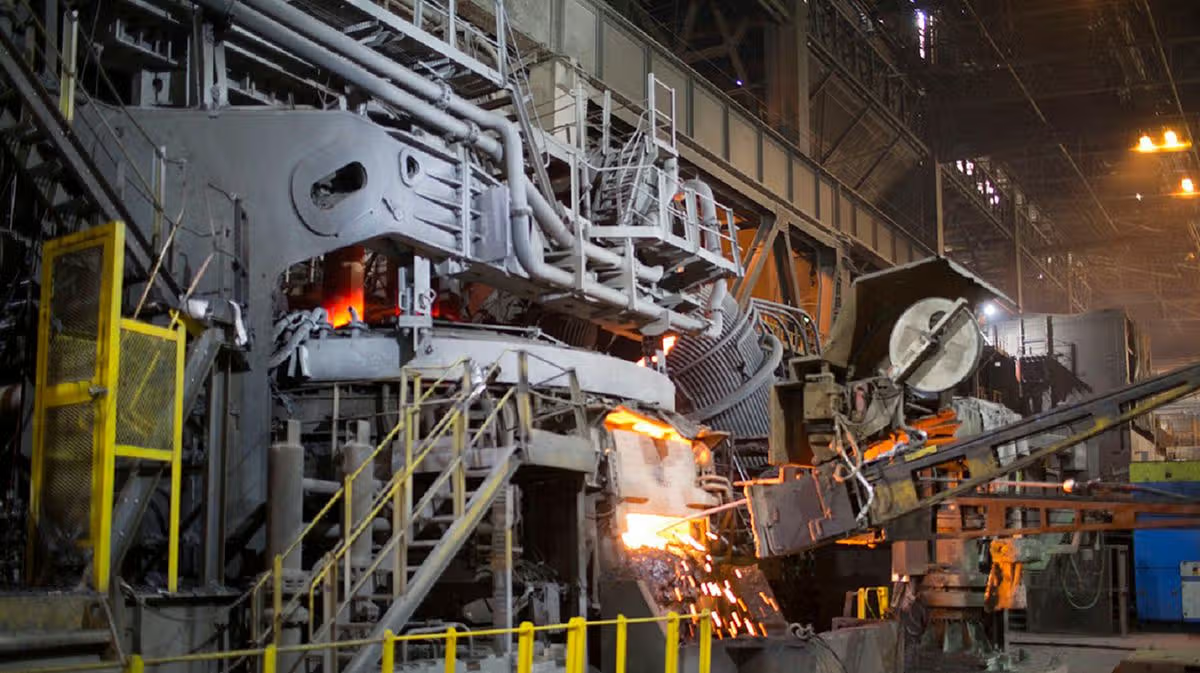
Government planning ‘public acquisition’ of Speciality Steel

Published

on

Business Live

The company has plants in South Yorkshire and the West Midlands but production has been paused in recent months

Speciality Steel in Rotherham

Speciality Steel in Rotherham(Image: PA)

The Government is developing a plan for the “public acquisition” of the UK’s third-largest steelworks.

Business Secretary Jonathan Reynolds told the Commons yesterday that ministers were engaging with the sale process of Speciality Steel UK (SSUK), which has plants in South Yorkshire and in the West Midlands.

Advertisement

Mr Reynolds said a bidder had come forward to take over SSUK earlier this year, but the Government could not support it and was instead developing its own proposal.

Last August, the state’s Official Receiver took control of Speciality Steel, previously part of Sanjeev Gupta’s Liberty Steel business, after it was forced to liquidate by the High Court.

Production at the business has been on pause in recent months. Speciality Steel employs about 1,300 people, many of whom have been put on furlough with reduced wages.

Mr Reynolds said: “We took a long, hard look at the offer that was on the table, but the truth is that we had serious concerns about the proposed financing of it, the protections for UK taxpayers, and whether it would be able to offer the long-term stability for the local economy and community.

Advertisement

“So, having concluded that we cannot support the preferred bidder’s proposal, we are faced with a choice. We can allow events to take their course through the liquidation process and risk being left with no say in the future of these sites, or we can act.”

Mr Reynolds said the sites could play a vital role supporting the Government’s modern industrial strategy, having produced specialist steel for sectors including aerospace, defence and advanced manufacturing.

Shadow business minister Bradley Thomas said it was “surprising that the Government has moved away” from a private sector solution after identifying a preferred bidder.

He asked: “Other than a new Prime Minister who’s committed ideologically to nationalisation, what has changed? Will the minister outline the terms asked for by the private bidder that the Government wasn’t willing to agree to?

Advertisement

“And if the business has unique capabilities and demand is there for its products, doesn’t that imply that the barrier to a viable private sector buyer is either the Government’s own ideological obsession with nationalisation or an economic climate in which it’s increasingly impossible to run a successful manufacturing business in Britain?”

Responding, Mr Reynolds said: “There’s nothing ideological about this. I want this to be run in the private sector. That is my ideal.

“But he asks why we couldn’t take forward the preferred bidder. I’ll not go into the detail of that, but I have to be satisfied when I come to this despatch box that any public support given meets the reasonable conditions we would expect on that; that it protects that taxpayer money, that the money is not going to go without delivering the outcome for which that money has been granted.

“If I can’t do that, then I can’t grant that subsidy and I think that is exactly the position, frankly, any secretary of state would have to take.”

Advertisement

First Secretary Louise Haigh said: “This Government refuses to be a passive observer to the decline of our critical industries and the loss of good jobs. Inaction is not an option. Over the coming months, we will work with regional and local partners to agree a way forward that delivers for employees, the community and the country.”

Continue Reading

Business

Better Pea Protein Starts at the Processing Step

Published

on

Better Pea Protein Starts at the Processing Step

As global demand for protein continues to rise—driven in part by growing consumer interest in GLP-1-inspired eating patterns1—manufacturers are under increasing pressure to develop high-performing, sustainable alternatives to dairy proteins.At the same time, processing shortages are driving up the price of whey protein, further accelerating the need to invest in plant-based proteins across the food and beverage landscape.

Unlocking the Potential of Plant Proteins

Pea protein has emerged as a plant-based alternative—offering significant nutritional and sustainability benefits. However, despite its desirable nutritional profile, formulators continue to face challenges related to functionality, flavor and performance, making it difficult to match consumer preferences for whey-based products. The ideal solution must enhance performance while fitting seamlessly into existing manufacturing operations, enabling processors to improve efficiency without adding complexity.

A New Standard for Pea Protein Processing

Advertisement

Amano’s latest enzyme solution, ProBoost™ Neutra—part of its Plants Unlimited™ portfolio—is redefining pea protein isolate (PPI) for pea processors by increasing the functionality of pea protein powder. This proprietary enzyme solution, which is both non-GM and organic compliant, improves solubility and emulsification, and delivers a lighter taste with milder flavor. 

Designed for integration directly into existing wet fractionation lines, ProBoost™ Neutra replaces the traditional alkaline step by reducing the use of chemicals, supporting a cleaner, enzyme-driven approach. The result is pea protein isolate that delivers enhanced functionality while maintaining protein content.

Amano_body-image_1.jpgPhoto: shutterstock.com / 9dream studio. Image altered using generative AI.

Improving Functionality Across Beverage Applications

By improving solubility and emulsification while reducing the volatile compounds responsible for beany off-notes, ProBoost™ Neutra is ideally suited for beverage applications—helping formulators develop plant-based RTDs and protein shakes with smoother texture, reduced grittiness and a milder flavor profile.

Processing trials demonstrate significant improvements in key performance attributes that directly impact beverage formulation. 

Advertisement

Pea protein isolate produced using ProBoost™ Neutra achieves more than double the solubility of conventionally processed PPI, helping address one of the industry’s biggest barriers to creating smooth, consumer-preferred beverages. Enhanced emulsification also supports improved stability in challenging applications, including coffee-based protein beverages, RTD drinks and powder supplements where smooth dispersion and texture are critical.

Notably, these improvements are achieved while maintaining comparable protein content of greater than 80% purity, with testing showing no significant proteolysis compared to conventional processing.

Cleaner Processing Without Production Disruption

As processors evaluate ways to improve both efficiency and sustainability, manufacturing methods are receiving greater attention alongside ingredient performance.

Advertisement

ProBoost™ Neutra enables a reduced chemical approach to pea protein isolate processing by replacing alkali in the protein extraction step with an enzyme-based alternative, while the acid step remains part of the process. Reducing the use of chemicals without disrupting production lines allows processors to improve functionality without major process changes, enabling a simpler, more consistent and more scalable production process. 

This enzyme-driven approach supports a cleaner processing method—aligning with growing consumer demand for more naturally positioned plant protein solutions. 

Amano_body-image_2.jpgPhoto: AdobeStock.com / Damian

Supporting the Next Wave of Plant-Based Innovation

As demand for protein-rich, plant-based nutrition continues to grow, meeting consumer expectations will require innovation in both formulation and processing.

By improving solubility and emulsification earlier in the production process, enzyme solutions such as ProBoost™ Neutra offer processors an opportunity to produce better-performing pea protein isolate at scale while simplifying downstream product development.

Advertisement

Commercial success will ultimately depend on collaboration across the value chain—from ingredient suppliers and process engineers to equipment manufacturers and product developers. This cross-functional partnership will be essential to seamlessly integrate new technologies into existing production lines and accelerate the commercialization of next-generation plant-based products.

Amano Enzyme is dedicated to advancing enzyme technology with solutions that help address common challenges faced by manufacturers, ultimately supporting the development of better plant-based products for consumers.

Learn more on our website or connect with our sales team. 

Sources 

Advertisement

1 McKinsey & Company. 2025. The Future of Wellness Survey 2025

2 Mintel, Patent Insights: Innovation in Protein Alternatives, September 2025

Continue Reading

Trending

Copyright © 2025