

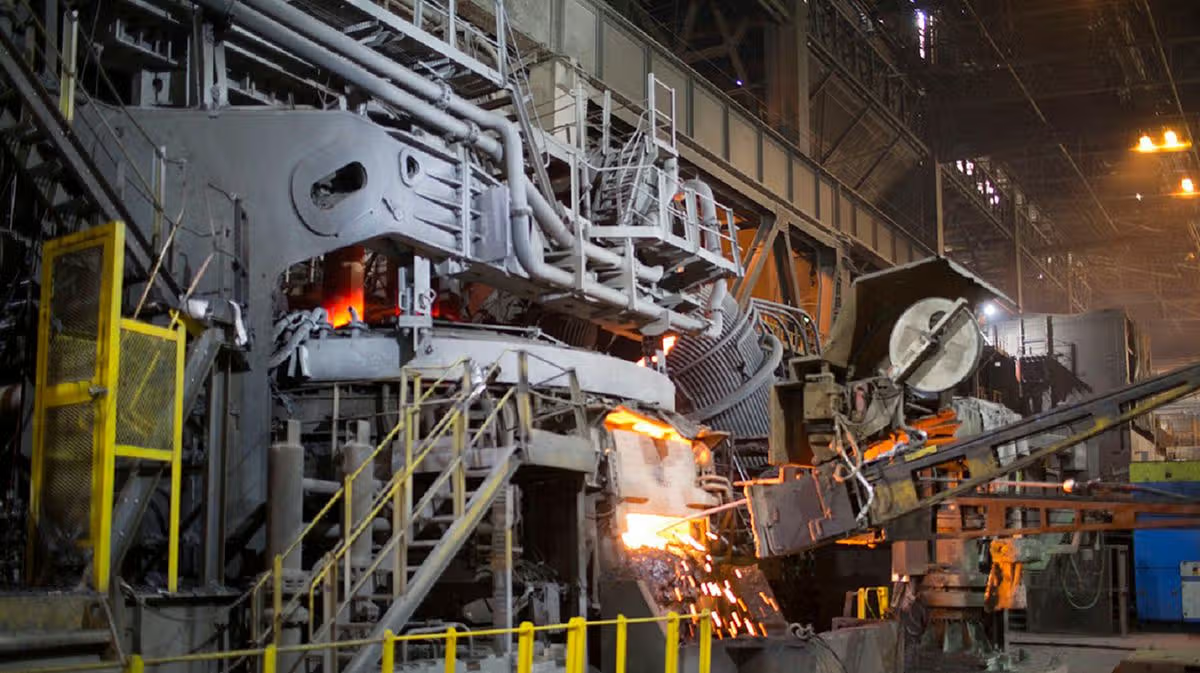
The company has plants in South Yorkshire and the West Midlands but production has been paused in recent months

Speciality Steel in Rotherham(Image: PA)
The Government is developing a plan for the “public acquisition” of the UK’s third-largest steelworks.
Business Secretary Jonathan Reynolds told the Commons yesterday that ministers were engaging with the sale process of Speciality Steel UK (SSUK), which has plants in South Yorkshire and in the West Midlands.
Mr Reynolds said a bidder had come forward to take over SSUK earlier this year, but the Government could not support it and was instead developing its own proposal.
Last August, the state’s Official Receiver took control of Speciality Steel, previously part of Sanjeev Gupta’s Liberty Steel business, after it was forced to liquidate by the High Court.
Production at the business has been on pause in recent months. Speciality Steel employs about 1,300 people, many of whom have been put on furlough with reduced wages.
Mr Reynolds said: “We took a long, hard look at the offer that was on the table, but the truth is that we had serious concerns about the proposed financing of it, the protections for UK taxpayers, and whether it would be able to offer the long-term stability for the local economy and community.
“So, having concluded that we cannot support the preferred bidder’s proposal, we are faced with a choice. We can allow events to take their course through the liquidation process and risk being left with no say in the future of these sites, or we can act.”
Mr Reynolds said the sites could play a vital role supporting the Government’s modern industrial strategy, having produced specialist steel for sectors including aerospace, defence and advanced manufacturing.
Shadow business minister Bradley Thomas said it was “surprising that the Government has moved away” from a private sector solution after identifying a preferred bidder.
He asked: “Other than a new Prime Minister who’s committed ideologically to nationalisation, what has changed? Will the minister outline the terms asked for by the private bidder that the Government wasn’t willing to agree to?
“And if the business has unique capabilities and demand is there for its products, doesn’t that imply that the barrier to a viable private sector buyer is either the Government’s own ideological obsession with nationalisation or an economic climate in which it’s increasingly impossible to run a successful manufacturing business in Britain?”
Responding, Mr Reynolds said: “There’s nothing ideological about this. I want this to be run in the private sector. That is my ideal.
“But he asks why we couldn’t take forward the preferred bidder. I’ll not go into the detail of that, but I have to be satisfied when I come to this despatch box that any public support given meets the reasonable conditions we would expect on that; that it protects that taxpayer money, that the money is not going to go without delivering the outcome for which that money has been granted.
“If I can’t do that, then I can’t grant that subsidy and I think that is exactly the position, frankly, any secretary of state would have to take.”
First Secretary Louise Haigh said: “This Government refuses to be a passive observer to the decline of our critical industries and the loss of good jobs. Inaction is not an option. Over the coming months, we will work with regional and local partners to agree a way forward that delivers for employees, the community and the country.”




















![Savage Plug X Didine Canon 16 - MONEY CASH (Official Music Video) [Prod. Blackrock Chonique]](https://wordupnews.com/wp-content/uploads/2026/08/1788053076_maxresdefault-80x80.jpg)




























You must be logged in to post a comment Login