
Crypto World
Six signs a crypto winter is ending

5) Thermocap multiple: The thermocap multiple is a measure like price to book that compares bitcoin’s market capitalization to the cumulative dollar value ever paid to miners, with each coin valued at its market price when it was mined. Prior crypto winters ended at single-digit multiples, but this cycle it only declined to 13 times, according to Glassnode data as of June 30, 2026. These levels are not a guarantee of future price action.
6) Price action: A 50% rally from the low has historically coincided with prior market troughs, although no such relationship guarantees future outcomes.
Once the next cycle does begin, we expect two key debates to persist throughout:
Will bitcoin reach a new high before the next halving? During both the 2012 to 2016 cycle and the 2016 to 2020 cycle, bitcoin did not surpass its prior cycle high until after the halving. However, in the 2024 cycle, bitcoin surpassed the 2021 high one month before the April 2024 halving, according to Bloomberg data.
Has AI replaced crypto as the market’s leading speculative/disruptive-technology narrative? In 2020 and 2021, crypto was one of the clearest expressions of a high-liquidity, disruptive-technology market. Since 2024, however, AI has become the dominant growth story.

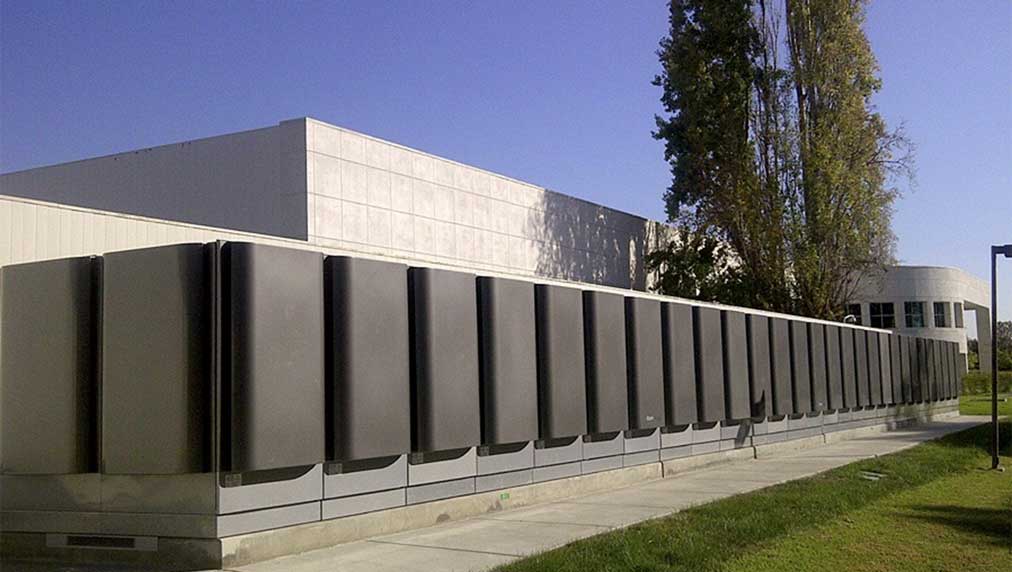
Bloom Energy (BE), an AI energy infrastructure play, has gained important validation for the use of fuel cells to power data centers, an analyst said. BE stock popped near a buy point on Wednesday. Analysts at RBC Capital said in a research note on Tuesday that Bloom Energy is enjoying “another meaningful proof point” with its fuel cells set to…
Copyright ©2026 Investor’s Business Daily, LLC. All rights reserved. 87990cbe856818d5eddac44c7b1cdeb8


Ondo Finance has become the first tokenization company to enter DTCC’s Fund/SERV network, connecting its regulated U.S. subsidiary with infrastructure that processes more than 85% of domestic mutual fund transaction volume.
Summary
- Oasis Pro Markets can connect with fund companies and financial distributors through one standardized network.
- Fund/SERV processes transactions, confirmations, reconciliation, distributions, and several reporting functions.
- Oasis Pro holds registrations covering broker-dealer, trading system, and transfer-agent services in the United States.
- Ondo has also expanded its tokenized securities business through U.S., Japanese, and blockchain-based products.
Ondo Finance said its subsidiary Oasis Pro Markets has joined Fund/SERV as a member, making it the first tokenization platform to enter the Depository Trust & Clearing Corporation-operated network.
The membership gives Oasis Pro, a U.S.-registered broker-dealer, a standard route to fund companies, wealth platforms and other service providers already connected to Fund/SERV. Without such a link, the company could need separate technical connections for each distributor.
Fund/SERV sits at the center of mutual fund transaction processing in the United States. According to Ondo, DTCC infrastructure handles more than 85% of U.S. mutual fund transaction volume, giving participating firms access to an established network used across the investment industry.
Ondo gains one connection to multiple fund distributors
Through Fund/SERV, Oasis Pro can process several parts of a fund transaction within the same system. The network supports transaction confirmations, reconciliation and distributions, while account records, tax information and regulatory reports can also move through its infrastructure.
Using one established network may reduce the number of separate integrations required when Oasis Pro connects with fund companies, broker-dealers, advisers or wealth platforms. Ondo expects the connection to support distribution of its tokenized investment products through firms that already rely on DTCC systems.
“We’re excited to be the first tokenization platform to become part of Fund/SERV,” Ondo President Ian De Bode said.
De Bode added that the standardized connection allows Oasis Pro to reach multiple companies without building a new integration for each firm. His comments describe an operational benefit rather than a change to the legal status of the underlying investment products.
DTCC Managing Director Talia Klein said participation by a tokenization business shows how existing financial systems can accommodate products issued or managed using blockchain technology.
“Ondo’s participation in Fund/SERV demonstrates how established industry infrastructure can support the next phase of market evolution,” Klein said.
The connection deals mainly with distribution and fund processing. It does not replace the securities rules, custody arrangements, or investor protections that apply to each product offered through Oasis Pro.
Oasis Pro gives Ondo a regulated route into US markets
Oasis Pro Markets operates as an SEC-registered broker-dealer and alternative trading system and is a member of the Financial Industry Regulatory Authority and the Securities Investor Protection Corporation. Its affiliated Oasis Pro TA business is registered with the SEC as a transfer agent.
In July, Oasis Pro received FINRA authorizations covering tokenized corporate equities and fund products for U.S. institutions and retail investors. According to Ondo’s announcement at the time, the permissions support over-the-counter retail transactions, underwritten primary offerings, private placements and secondary trading.
The authorizations cover National Market System equities and interests in ETFs, mutual funds and index funds. Oasis Pro also said transactions could settle through fiat currencies or supported stablecoins, including transfers between blockchain wallets.
For American investors, the distinction between Ondo’s U.S. and overseas businesses remains important. Oasis Pro’s registrations provide the regulated channel for products offered domestically, while some Ondo products issued through offshore structures are restricted from U.S. persons unless they are registered or qualify for an exemption.
Omnibus account support also allows Oasis Pro to connect with existing broker-dealer and advisory channels. Ondo has said the structure could give institutions, registered investment advisers and retirement accounts access to tokenized securities through financial firms they already use.
Registration with the SEC and membership in FINRA or SIPC do not mean regulators have approved or recommended a particular tokenized security. Ondo’s regulatory disclosure also warns that buyers may lose some or all of the money invested in such products.
DTCC ties deepen after tokenization working group
The Fund/SERV membership builds on Ondo’s earlier involvement with DTCC. In June, crypto.news reported that Ondo had joined a DTCC tokenization working group alongside more than 50 financial companies, including BlackRock, Goldman Sachs, JPMorgan, Nasdaq, NYSE, Robinhood and Circle.
DTCC formed the group to test operational and technical processes for tokenizing assets held at the Depository Trust Company. The planned service covers DTC-custodied securities and is designed to preserve the ownership rights, investor protections and entitlements attached to their conventional forms.
A no-action letter issued by the SEC in December 2025 authorized DTC to operate the defined tokenization service for three years. DTCC said the eligible assets include Russell 1000 stocks, ETFs tracking major indexes and U.S. Treasury securities.
DTCC planned limited production transactions for July 2026, followed by a full launch in October. The organization said DTC held more than $114 trillion in assets when it announced the timetable in May.
Fund/SERV serves a different function within DTCC’s infrastructure. While the tokenization service focuses on converting eligible DTC-held securities into blockchain-recorded forms, Fund/SERV handles communication and transaction processing between fund managers and distributors.
Ondo has expanded its tokenized securities operations
Ondo has been adding products and distribution channels while developing its U.S. infrastructure. Oasis Pro can issue Ethereum-based tokens backed by securities held with regulated custodians, linking blockchain records with assets kept inside conventional custody systems.
In July, Ondo completed an onchain securities deployment tied to BlackRock’s iShares Core S&P 500 ETF and shares of Micron Technology. The underlying securities remained with regulated U.S. custodians under a structure Ondo said followed an SEC staff framework.
The arrangement was designed to keep the underlying shares inside the regulated custody system while using Ethereum-based tokens to represent exposure to them. Investor rights and product terms still depend on the legal structure of each token rather than the blockchain record alone.
Ondo has also developed Ondo Network as an execution layer for tokenized financial markets. The network launched in July with separate functions for trade execution, validation, and settlement, while supporting tokenized assets and stablecoin-based payments.
Outside the United States, Japan’s SBI Group agreed in July to tokenize Japanese stocks with Ondo. Under the proposed structure, Ondo Global Markets would issue the products, SBI would distribute them through its financial platforms, and the JPYSC stablecoin would support settlement and collateral.
The SBI-linked products have not been registered under the U.S. Securities Act and cannot be offered to U.S. persons unless they receive registration or qualify for an exemption.


Bitcoin has failed to activate every proposed soft fork since Taproot went live in 2021, leading Drivechain creator Paul Sztorc to argue that the network cannot approve any such upgrade for the foreseeable future.
Summary
- BIP-110 attracted 2.53% miner support before its enforcing branch stalled after two blocks.
- Paul Sztorc said every proposed soft fork since Taproot has failed to activate.
- Drivechains would place experimental rules on separate chains but require a Bitcoin consensus change first.
- Sztorc said sidechain fee revenue would influence miners’ incentive to protect Drivechain withdrawals.
Paul Sztorc, CEO of LayerTwo Labs and creator of the Drivechain proposal, told crypto.news that BIP-110’s failed activation points to a problem extending far beyond one disputed Bitcoin upgrade.
“All soft forks since Taproot have failed to activate, and this was no exception,” Sztorc said.
His assessment followed the collapse of BIP-110, a proposed temporary soft fork that sought to restrict some forms of non-financial data stored in Bitcoin transactions. The proposal drew only 51 supporting blocks during a 2,016-block difficulty period, leaving miner signaling at 2.53%.
BIP-110 enforcing nodes later split from the dominant Bitcoin network at block 961,632 on Aug. 8. The new branch produced only two blocks before stalling, while the main chain continued processing blocks at its usual pace.
BIP-110 failure points to a frozen Bitcoin upgrade process
The BIP-110 result showed how difficult it has become for developers to secure support for changes to Bitcoin’s consensus rules, according to Sztorc.
The proposal’s voluntary activation process required 55% of blocks to signal support. By Aug. 2, the target had become mathematically unreachable because just 28 of the first 1,108 blocks had signaled, according to earlier miner data.
Its enforcing software still entered a mandatory signaling period at block 961,632. Nodes running BIP-110 then rejected blocks that did not signal support, although most miners continued building on the non-enforcing Bitcoin chain.
By Aug. 9, the minority branch remained frozen at block 961,633 as the main chain moved 111 blocks ahead. OCEAN’s BIP-110 endpoint showed about 257 petahashes per second assigned to the branch at the time, while Strategy Executive Chairman Michael Saylor estimated that roughly 99.85% of Bitcoin’s hash power had remained with the dominant chain.
The two-block chain stall became more severe because the branch inherited Bitcoin’s mining difficulty of 127.48 trillion. Without enough computing power, its miners could not quickly produce the remaining blocks required to reach a difficulty adjustment.
BIP-110, formally called the Reduced Data Temporary Softfork, proposed seven consensus restrictions lasting 52,416 blocks, or approximately one year at Bitcoin’s normal block rate. The rules included an 83-byte cap on OP_RETURN outputs, a 256-byte limit on certain data pushes, and restrictions affecting some Taproot functions.
Supporters, including Bitcoin Knots maintainer Luke Dashjr, argued that the restrictions would reduce arbitrary data storage linked to inscriptions and keep Bitcoin focused on monetary transactions. Critics such as Saylor and Blockstream co-founder Adam Back said the proposal could undermine Bitcoin’s neutrality by rejecting transaction structures that the network currently accepts.
Even OP_CAT faces the same Bitcoin consensus barrier
Sztorc said BIP-110 was not an isolated failure, pointing to the lack of activation for other proposed soft forks since Taproot.
Taproot activated at block 709,632 on Nov. 14, 2021, after miners used the Speedy Trial process to signal readiness. The upgrade introduced Schnorr signatures and new Taproot spending rules without forcing non-upgraded nodes onto a separate blockchain.
Since then, proposals seeking to add features or change Bitcoin’s scripting rules have remained under discussion without activation. Sztorc cited OP_CAT as an example, describing it as a small code change that appeared in Bitcoin’s original software and has attracted support from developers.
“Nothing can — not even OP_CAT, which is just 13 lines of code and was in the original software and had lots of support,” he said when asked how BIP 300 could overcome resistance to consensus changes.
“Bitcoin cannot activate any soft forks, for the foreseeable future.”
OP_CAT would let Bitcoin scripts join two data elements. Satoshi Nakamoto disabled the operation in 2010 over security concerns, but a later proposal sought to restore it through a backward-compatible soft fork.
Supporters say the opcode could help developers create covenants, vaults, bridges and other programmable spending conditions. However, the OP_CAT proposal still depends on technical review and sufficient agreement among Bitcoin developers, miners, node operators and users.
Other proposals face the same coordination problem. BIP-360, for example, proposes a new output type designed to support post-quantum signatures through a soft fork. Its authors present the design as a possible path for users to move funds into quantum-resistant addresses, though activation would require the type of network agreement that Sztorc says Bitcoin can no longer achieve.
Drivechains would move experimentation away from Bitcoin’s base layer
Drivechains are designed to let developers test different rules and applications on opt-in sidechains instead of seeking repeated changes to Bitcoin’s base layer.
Under BIP 300, users could move BTC between Bitcoin and separate sidechains through a two-way peg. Each sidechain could apply its own rules, allowing developers to test privacy systems, smart contracts, faster transactions, or other functions without requiring every Bitcoin user to adopt them.
Sidechains would also maintain separate brands and software, which Sztorc compared with existing systems such as Liquid and Lightning. Users could choose whether to move funds into a particular chain, while Bitcoin’s base rules would remain unchanged after the initial Drivechain upgrade.
Asked whether multiple Drivechains could fragment liquidity and leave users unsure which implementations to trust, Sztorc compared the model with developers launching separate altcoins.
“Each Drivechain will have its own brand, same as Liquid, Lightning, etc.,” he said.
Drivechains would still face the same immediate obstacle identified in Sztorc’s assessment: BIP 300 itself needs a consensus change on Bitcoin. Without activation, developers cannot deploy its proposed withdrawal system as part of the network’s rules.
“It cannot,” Sztorc said when asked how BIP 300 could overcome the resistance that stopped other proposals.
Miner control remains Drivechain’s central security dispute
BIP 300 would assign Bitcoin miners a major role in approving withdrawals from Drivechains, an arrangement that has drawn concerns about theft, censorship and miner collusion.
Under the proposal, withdrawal requests would remain pending while miners vote on them through Bitcoin blocks. A request receiving enough support over the required voting period could release BTC from the sidechain peg.
Sztorc said the security model depends partly on the economic value that a popular sidechain creates for miners.
“If the chain is popular, it will be generating fees for miners. If this fee revenue is large, relative to the number of circulating coins on the L2, then it will be secure.”
Users would therefore need to assess the relationship between sidechain fee revenue, miner incentives, and the value of BTC held within the peg. Critics argue that miners could coordinate to approve an invalid withdrawal, while supporters contend that attacking a profitable sidechain could destroy future fee income and damage confidence in the system.
For U.S. participants, BIP-110 already demonstrated how American mining operations can become involved in Bitcoin governance disputes. Foundry USA Pool asked mining customers to vote on BIP-110 signaling before the mandatory period, while Strategy, a U.S.-listed company and one of the largest corporate Bitcoin holders, publicly opposed the proposal through Saylor.
The failed fork also created a practical risk for holders because BIP-110 did not include automatic replay protection. Bitcoin developer Kevin Loaec warned that a transaction sent on one branch could potentially be copied to the other, putting pre-fork coins at risk if users tried to move or sell assets on the minority chain without first separating them.
BIP-110 supporters also prepared code for a possible proof-of-work change, which would allow the stalled branch to abandon Bitcoin’s existing mining algorithm. The code included a configurable hard-fork time, although developer Chris Guida described it as a contingency and had not set an activation date.
Crypto World
Bernstein Expects ‘Aggressive’ Rulemaking from SEC, CFTC, Following CLARITY Act Failure
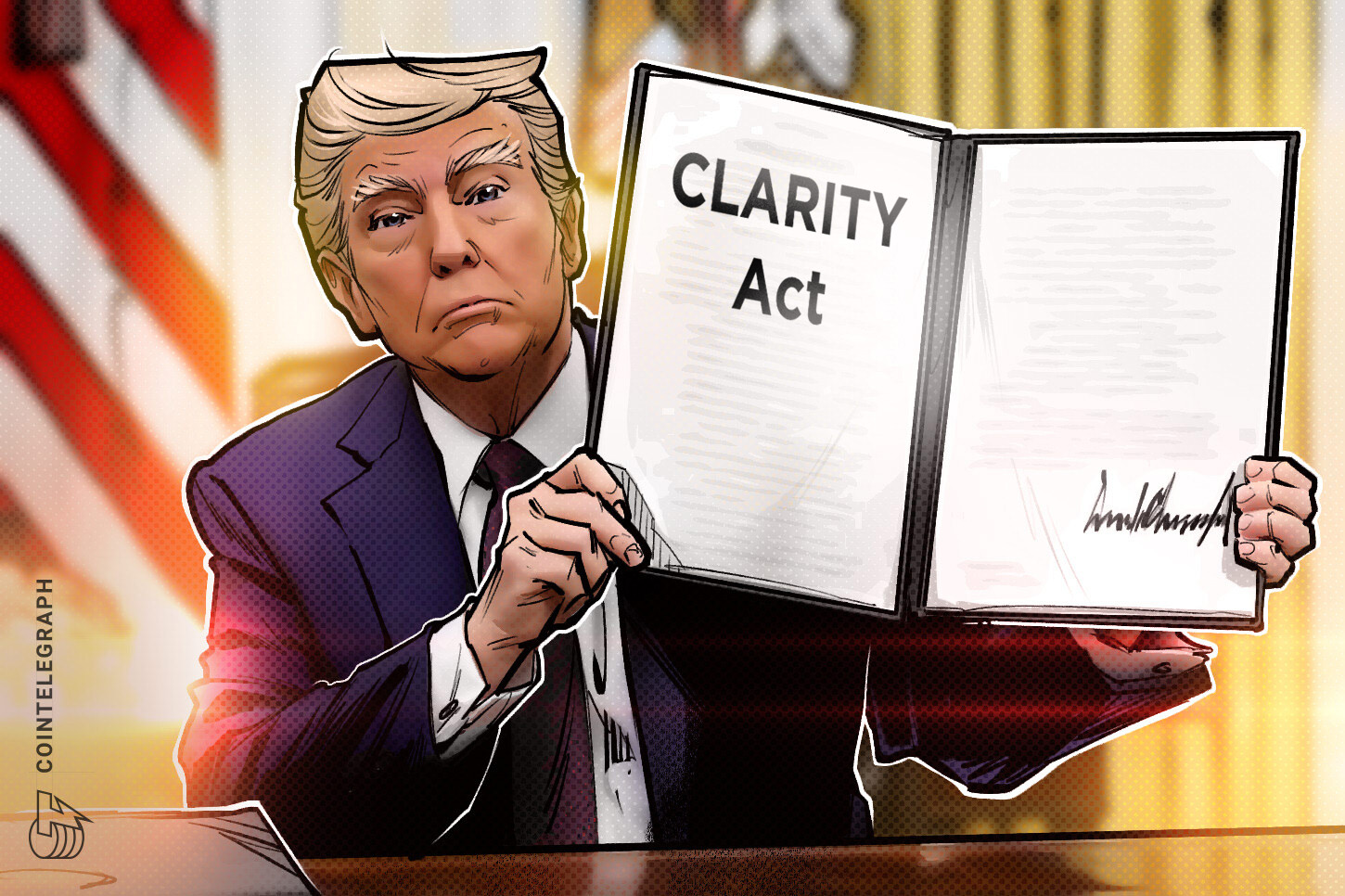
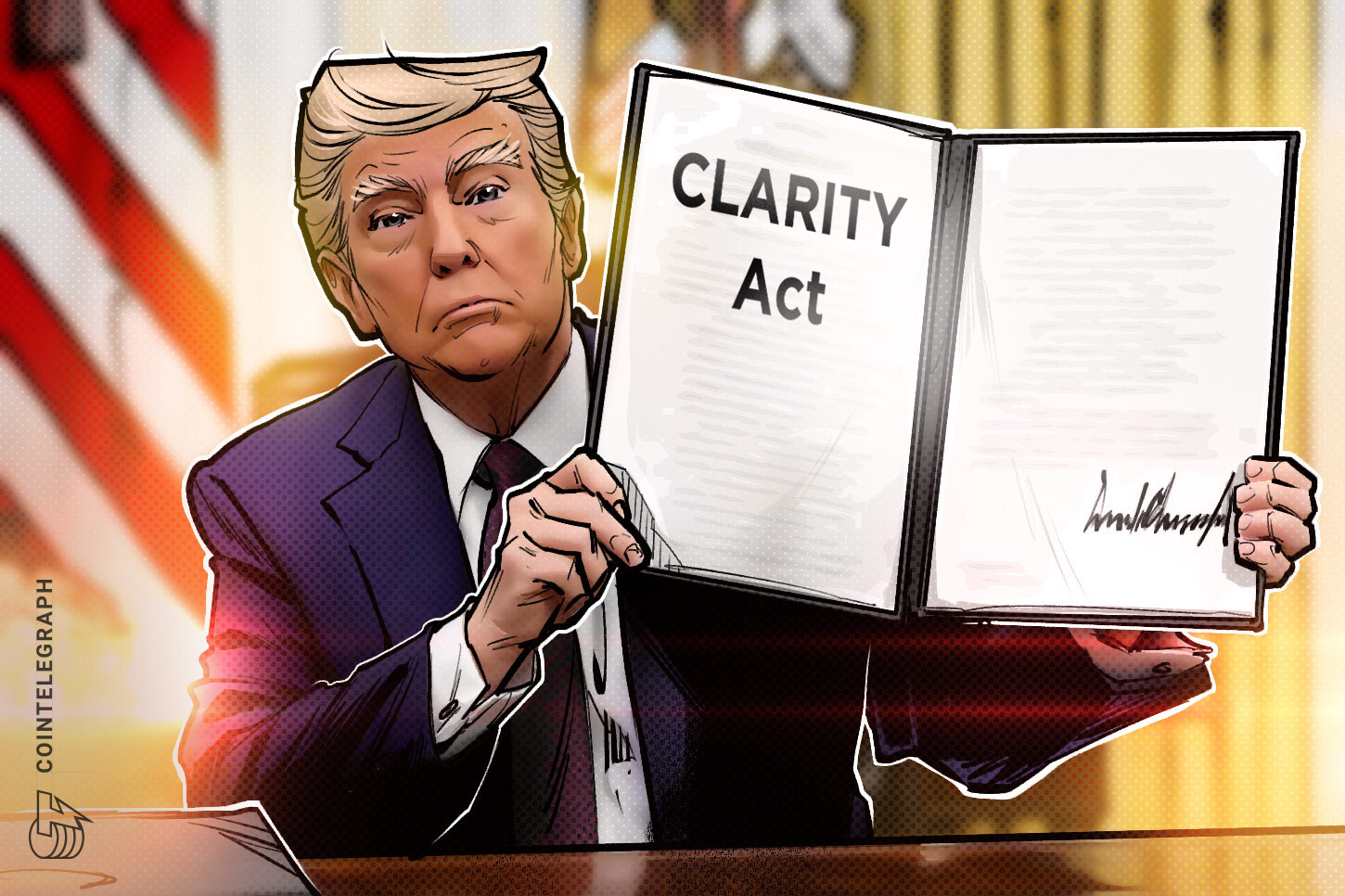
Bernstein analysts expect “aggressive and swift” rulemaking from the US Securities and Exchange Commission (SEC) and Commodity Futures Trading Commission (CFTC), after the Digital Asset Market Clarity (CLARITY) Act failed to pass a Senate cloture vote on Tuesday.
Bernstein analysts said the regulatory agencies will publish new regulations to “make up for the time lost negotiating the CLARITY Act,” in a Wednesday note shared with Cointelegraph.
The analysts said they expect agency regulations including token taxonomy for raising capital, developer protection measures concerning decentralized finance and self-custodial protocols, innovation exemptions for equity tokenization, faster approval times for real-world asset perpetual futures, and amendments to rules around federal sports even contracts and their classification as swaps.
Bernstein said that these federal agencies will bring more regulatory clarity for the industry, to compensate for the failure of the CLARITY Act, which would have “fool-proofed the industry against political regime shifts.”
On Tuesday, the US Senate failed to pass a cloture motion on the CLARITY Act, which would have established the country’s first regulatory framework for digital assets. Bernstein’s analysts said that a re-vote of the act was unlikely, citing a limited time window and concerns over the bill’s ethics provisions.
On Aug. 19, the SEC proposed new rules to create a “clear and fit-for-purpose framework for certain investment contracts involving crypto assets,” allowing entities to raise capital while preserving investor protections. The proposed rules offer crypto companies exemptions allowing the issuance of up to $5 million in tokens during four years and up to $75 million during 12 months, as well as a safe harbor exempting cryptocurrencies from being treated as ”investment contracts.”
On July 27, SEC Chair Paul Atkins told CNBC that the agency was “ready, willing, and able to come out with rules“ on digital assets if the Senate failed to pass the CLARITY Act.
Related: Deutsche Bank awaits regulatory nod to launch institutional crypto custody solutions
Countries in the Gulf Cooperation Council, whose economies have benefitted massively from natural resources like oil and gas, have been increasingly diversifying their economies beyond the hydrocarbon business.
“In terms of economic strategy, [the GCC countries have] gotten the message that oil is not going to be there for long,” says Adnan Mazarei, a senior fellow at the Peterson Institute for International Economics and former deputy director of the IMF’s Middle East and Central Asia department. “They’ve been aware that the geopolitical landscape is changing. They have a role to play by being a platform for various things in between these two poles: China versus the West.”
To gauge how different industries are developing across the GCC countries, TIME partnered with data firm Statista on a research project aimed at identifying the top-performing 200 companies in Bahrain, Kuwait, Oman, Qatar, Saudi Arabia, and United Arab Emirates based on employee satisfaction, revenue growth in recent years, and sustainability transparency informed by self-reporting.
Methodology: How TIME and Statista Determined Arabia’s Top Companies of 2026
There are varied diversification efforts across the GCC countries. The United Arab Emirates, Qatar, Saudi Arabia, and Bahrain have entered into agreements as part of the Trump Administration’s America First Investments to put more money into AI data centers and other technology innovations over the coming years. Saudi Arabia has been interested in becoming a hub where critical minerals are processed. And in the UAE and Saudi Arabia, which lead the region in economic diversification, other growing industries include health services, health tourism, and regular tourism.
Developmental differences in each country have affected which non-oil industries excel. “The most profitable investments are still in energy,” says Mazarei, and an increasing share of their own energy use mix is renewables, which has also been a key part of their diversification strategy. States are investing more in renewable energy and green tech as they consider energy efficiency to meet their enormous electricity needs, and saving oil for exports, says Karen Young, political economist and senior fellow at the Middle East Institute. “There was a lot of inefficient power generation from oil that’s being phased out,” she says. “That makes sense from a climate perspective, but also from a cost perspective.” For example, in late 2025, QatarEnergy (no. 1 in the country and no. 6 overall), signed a deal with Samsung C&T to build a 2,000MW solar facility in Dukhan that could supply 750,000 households with energy by 2030.
Banking and finance is the industry most represented on TIME and Statista’s list, with 15.5% of the companies. Bahrain was the first of the GCCs to develop its financial services sector, allowing private equity funds like Investcorp, an investment vehicle that connected Gulf institutions with global business opportunities, to flourish. Places like Abu Dhabi are trying to follow suit. In 2023, Bahrain-headquartered Investcorp spun out Investcorp Capital (no. 84 in the overall list) in an IPO on the Abu Dhabi stock exchange.
Top-ranked First Abu Dhabi Bank’s largest shareholder is the state-owned Mubadala Investment Company. State activity and investment has been behind the expansion of the real estate industry as well as the development of giga-projects. All of these projects are “big business,” Young says, and “the bank sector is doing a lot of lending to these projects.” According to a 2024 McKinsey report, GCC banks tend to be more profitable than their global peers because of a balance of good oil prices, stable domestic deposits, and ambitious public investment programs.
The GCC’s economic development plans have experienced disruptions this year from geopolitical conflicts, and in response, companies have had to pivot their plans. Aluminum Bahrain Alba (no. 1 in country and no. 51 overall), which has long been a driver of the country’s non-oil economy, has had to lower output to protect itself from attack, driving up global prices for the metal and creating supply uncertainties. There’s now new attention on transport and infrastructure in the region. Logistics giant, DP World (no. 2 overall), which has been influential in the region, is now planning on building new shipping ports and boosting its ground transport fleets to accommodate supply chain disruptions through the Strait of Hormuz.
Still, economists are projecting that the region will make a recovery starting 2027, as spending in non-oil sectors gains momentum.
See the full list:
Ethereum is still trading around $2.4K after a sharp recovery from the $1.5K area. The latest charts show ETH consolidating beneath the $2.5K resistance region, while supply continues to tighten. The technical structure remains constructive on the higher timeframe, although short-term momentum has weakened.
Ethereum Price Analysis: The Daily Chart
The daily chart shows a significant structural improvement compared with the June lows. ETH formed a base around the $1.5K-$1.6K region before beginning a sustained recovery that eventually pushed the price above the $2K area and into the $2.5K zone.
The most important near-term resistance is the $2.5K zone, where ETH has spent several weeks consolidating. The price has repeatedly struggled to confirm a breakout above this range, and the latest candles show another rejection at this level. A decisive daily close above $2.5K could open the way toward the next major psychological resistance around $3K.
On the downside, the first important support appears around $2.0K-$2.1K. This zone is particularly significant because it also closely overlaps with the 100-day and 200-day moving averages. The 200-day moving average is around $2.05K and is rising, while the 100-day moving average is also turning upward near the $1.95K area. Holding this region would help preserve the improving medium-term structure.
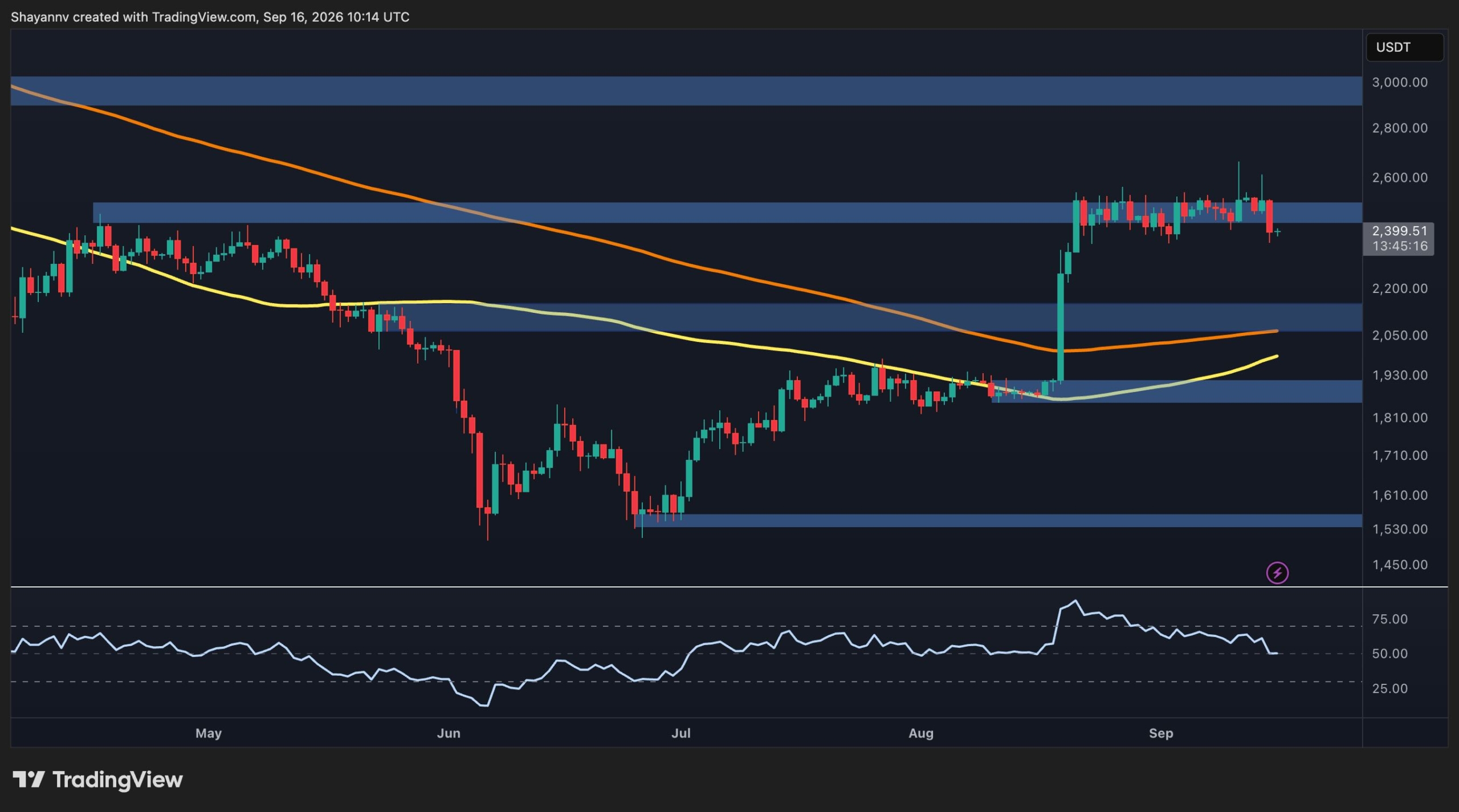
ETH/USDT 4-Hour Chart
The 4-hour chart demonstrates a more granular picture of the current consolidation. ETH experienced a powerful upside move around August 19-22, climbing from roughly $1.9K toward the $2.5K region. Since then, the market has largely remained inside a broad horizontal range.
The range currently appears to extend from approximately $2.35K to $2.6K, with the $2.5K zone acting as the central resistance area. ETH is now trading around $2.4K after recently falling from the upper half of the range.
The immediate technical concern is that the price has moved toward the lower boundary of the range. The $2.35K area is therefore an important short-term support. If buyers defend this region and reclaim $2.5K, the range could remain intact, and the upper boundary near $2.6K could come back into consideration.
Conversely, a breakdown below $2.35K would weaken the range structure. In that scenario, the next visible support is the $2.25K order block. A loss of that region would expose the broader $1.9K support area.
The 4-hour RSI has fallen toward the 30 region, indicating that short-term momentum has become significantly weaker following the rejection from the $2.5K area. This leaves room for a technical rebound, but the RSI alone does not confirm that a durable bottom has formed. Price’s reaction around $2.3K-$2.35K should therefore be important for determining whether this is simply a pullback within the range or the beginning of a deeper correction.

On-Chain Analysis
The exchange-reserve chart shows a clear long-term decline in ETH held on exchanges. The visible reserve level has fallen from above 21M ETH during the first half of 2025 to approximately 14.6M ETH currently.
Notably, the decline in exchange reserves has continued even as ETH recovered toward $2.4K. This indicates that the amount of ETH tracked on exchanges has been trending lower rather than expanding alongside the recent price recovery.
A continued reduction in exchange balances can mean that fewer coins are immediately available on exchanges for potential selling, which can reduce readily available exchange supply. However, the metric by itself does not establish future price direction, since ETH can move between exchanges, wallets, custodians, and other entities for numerous reasons.
From a technical perspective, however, the combination is worth watching. ETH remains below the key $2.5K resistance, while exchange reserves are near their lowest visible level on this chart. If ETH manages to reclaim $2.5K while reserves continue declining, it would provide a supportive backdrop for the breakout. On the other hand, failure to hold the $2.3K-$2.35K 4-hour support would keep the market in a corrective phase despite the longer-term decline in exchange reserves.

The post Ethereum Price Analysis: Is ETH Heading Toward $2K After Another Rejection at $2.5K? appeared first on CryptoPotato.
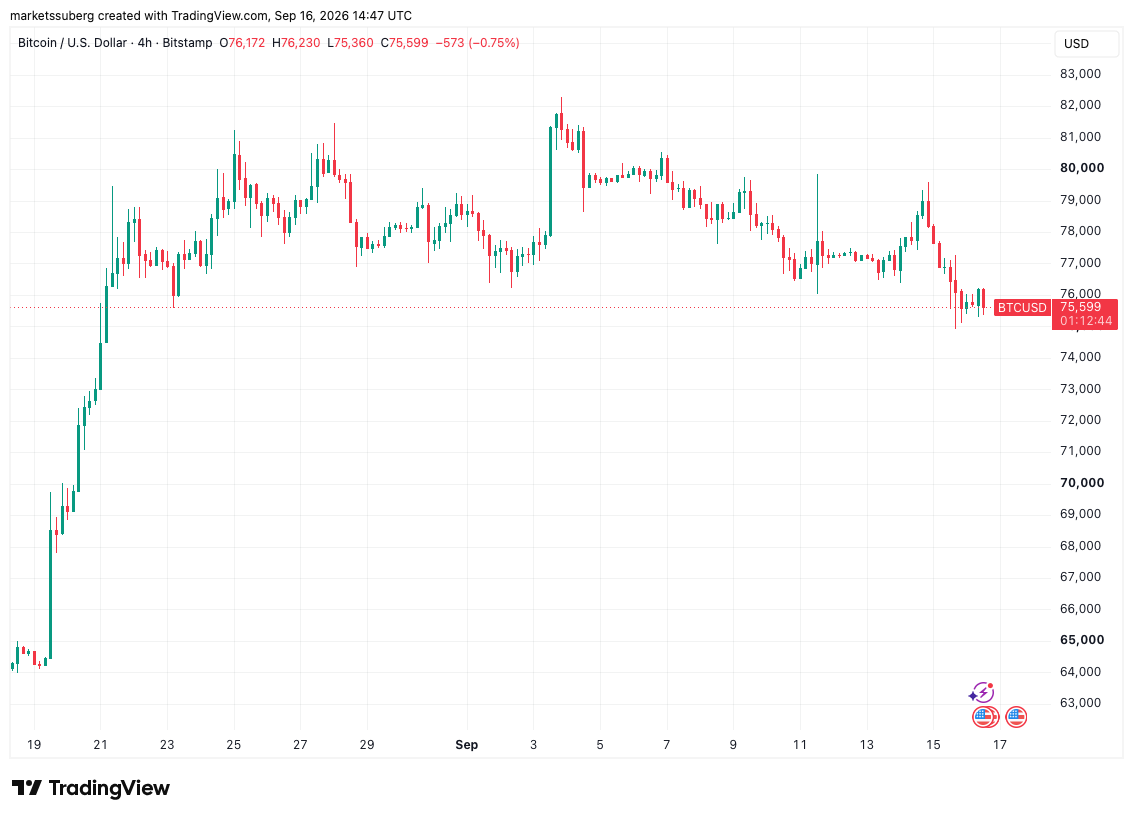
Bitcoin (BTC) stayed near monthly lows at Wednesday’s Wall Street open as markets awaited the US Federal Reserve’s decision on interest rates.
Key points:
- Bitcoin continued to trade under $76,000 into the Federal Reserve interest-rate decision. It stands near its lowest levels since Aug. 21.
- Markets saw nearly 93% odds of the Fed enacting a 0.25% rate hike, bringing the federal funds rate to 3.75-4%.
- Onchain support thickened at $68,000 as bid liquidity moved toward the current spot price.
Fed rate-hike odds pass 90% despite Trump demands
Data from TradingView showed BTC/USD trading below $76,000 after hitting new September lows of $74,960 the day prior.
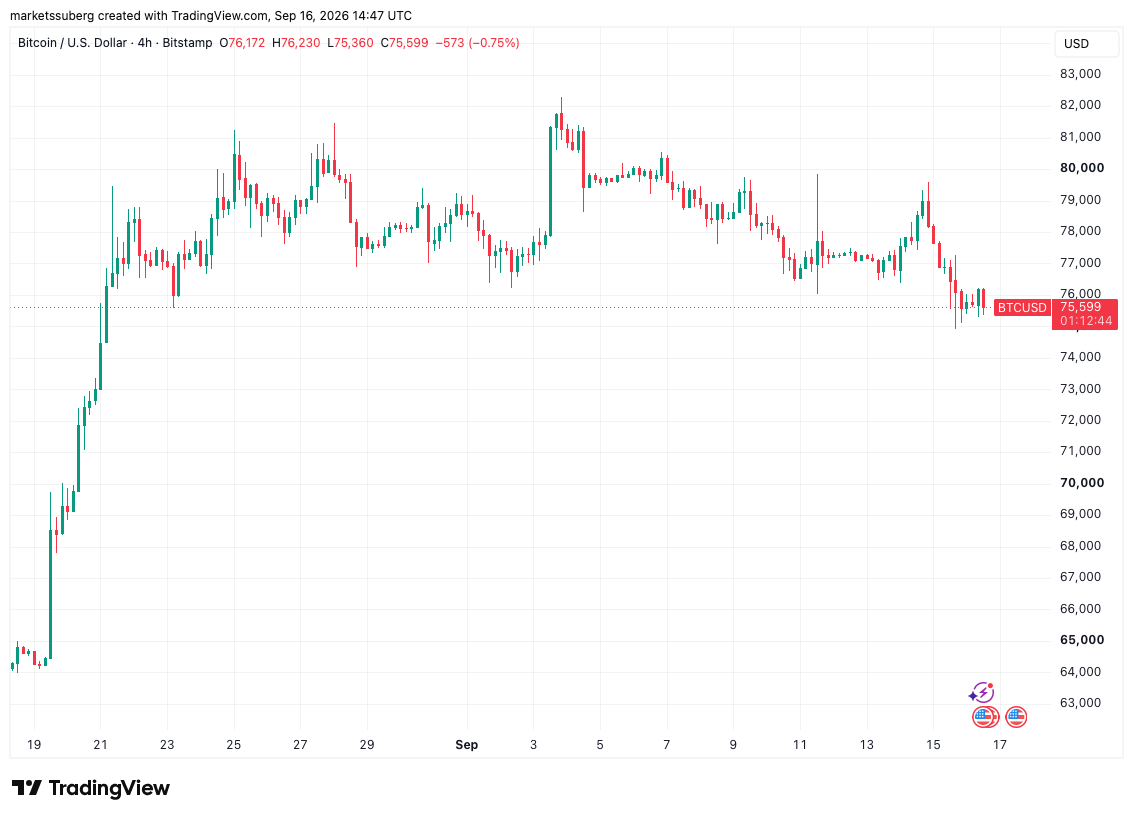
BTC/USD one-hour chart. Source: Cointelegraph/TradingView
The weakness occurred as the CLARITY Act failed to garner enough votes in the Senate to advance to the debate stage, falling short of the 60 required. Now, attention has turned to the Fed, as it is facing a balancing act between taming inflation and satisfying the demand of US president Donald Trump, who has repeatedly demanded that rates be cut.
The latest data from CME Group’s FedWatch Tool put the odds of officials confirming a 0.25% rate hike at over 90% at the time of writing, bringing the federal funds rate to 3.75-4%.
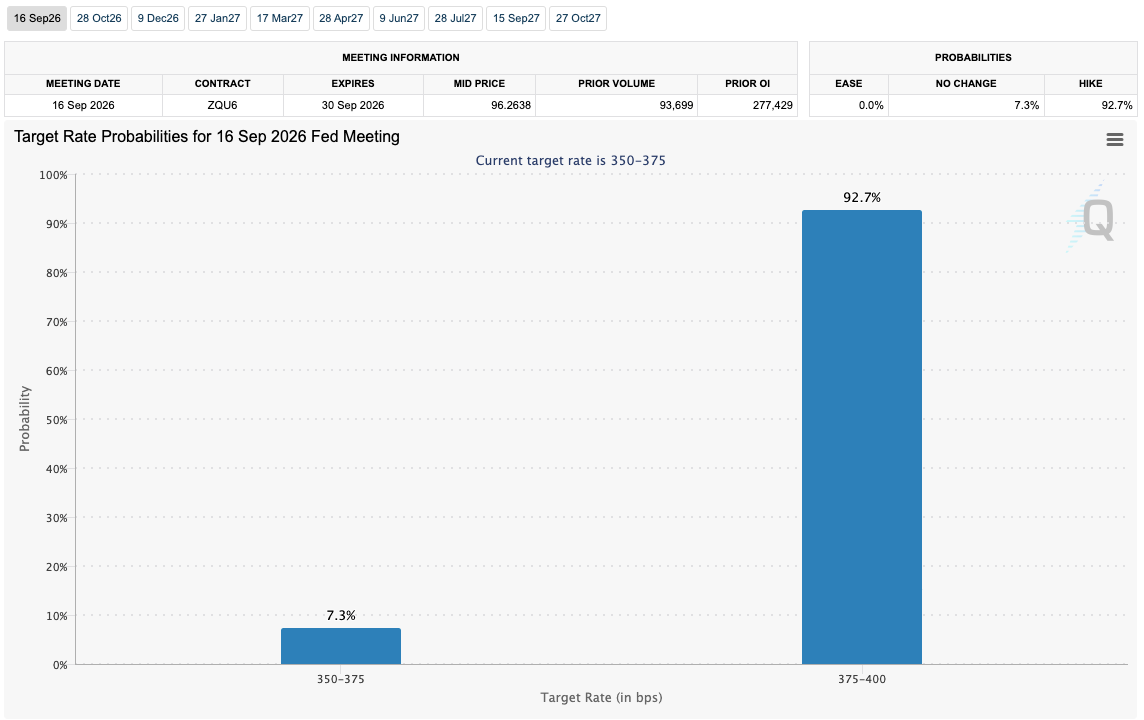
Fed target rate probabilities for Sept. 16 FOMC meeting (screenshot). Source: CME Group
Commenting, trading resource The Kobeissi Letter noted that these odds made a rate hike a near certainty.
“In data going back to 2008, whenever expectations of a hike have been this high, the Fed has invariably delivered one. If the Fed decided to leave interest rates unchanged today, it would mark the biggest dovish surprise at a scheduled policy meeting since 1994,” it wrote in a post on X.
The meeting marks just one of three central-bank rate decisions this month. The European Central Bank enacted a 0.25% hike last week, while the Bank of Japan is expected to do likewise at its Friday meeting, bringing its benchmark rate to 1.25%, its highest in 31 years.
Central banks worldwide face increasing price pressures as oil supply chains battle the impact of an expanding war in the Middle East. US WTI crude oil hit $106.70 per barrel on Tuesday, its highest level since May 4.
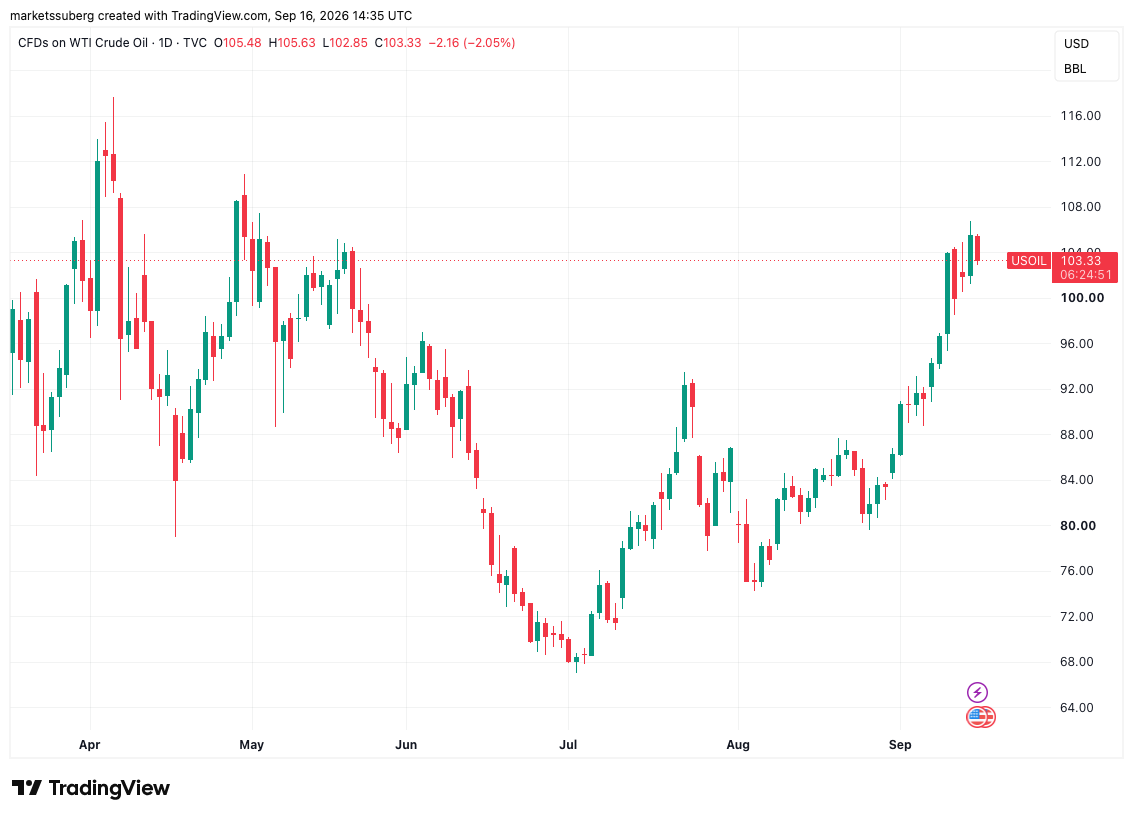
CFDs on WTI crude oil one-day chart. Source: Cointelegraph/TradingView
As Cointelegraph had reported earlier, oil-price increases have had a pronounced knock-on effect on US Consumer Price Index (CPI) inflation.
Bitcoin price support converges around $70,000
Analyzing short-term BTC price action, onchain analytics platform Glassnode considered where BTC/USD could fall to should it deviate further from its local range, which has been in place since Aug. 21.
Related: Bitcoin Coinbase Premium hits monthly low as CLARITY Act vote squeezes US demand
“Resting bids, the buy orders waiting in the book, have pulled in toward price. Nearly two thirds of the bids resting within 20% of price now sit between 1% and 10% below it, up from about half at the start of the year,” it reported in the latest edition of its regular newsletter, The Week Onchain.
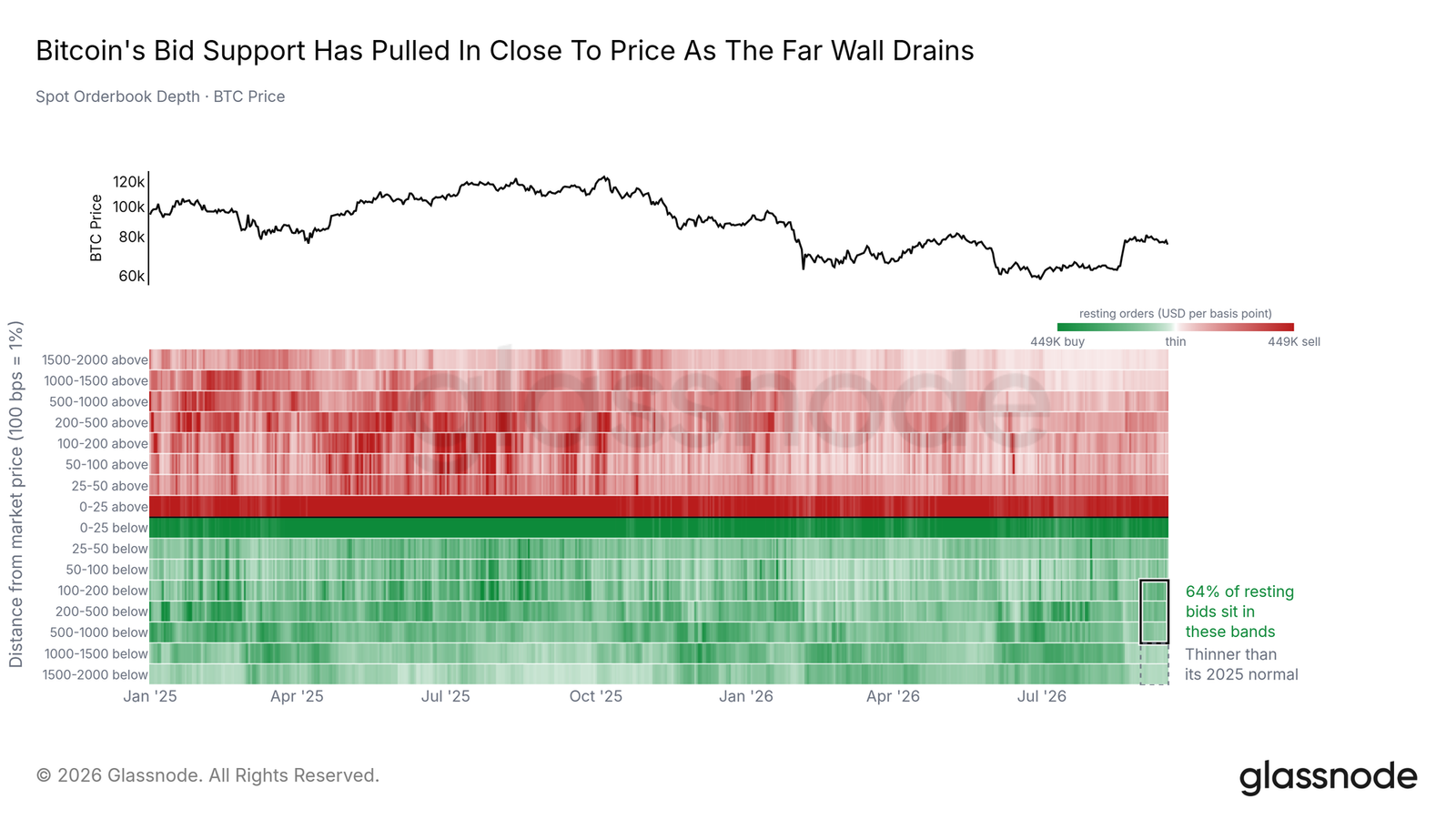
Bitcoin spot-market order-book depth data. Source: Glassnode
Exchange order-book bid liquidity points to $68,000 as the next line of support. Price currently sits just below the True Market Mean, the aggregate cost basis of the currently active BTC supply. The aggregate cost basis of short-term holders, defined as wallets holding an unspent transaction output (UTXO) for less than six months, provides another potential support level at $71,300.
“If the range breaks and those bids are used up, the next floor is the on-chain one at $62K to $65K, where the heaviest block of supply below the market was last bought,” Glassnode added, referring to the price at which around 9% of the supply last moved onchain.
Anchorage Digital Bank, the first federally chartered crypto bank in the US, has added custody support for Etherlink and seven assets on the Tezos layer-2 network, including xU3O8, a token representing physical uranium.
The other supported assets include wrapped XTZ (WXTZ), liquid staking token stXTZ, stablecoins USDT, USDC and USDSM, and wrapped Ether (WETH), according to an announcement shared with Cointelegraph.
The integration allows Anchorage’s institutional clients to custody assets issued on Etherlink, an Ethereum Virtual Machine-compatible layer-2 network that settles on Tezos, through segregated accounts at the federally chartered bank.
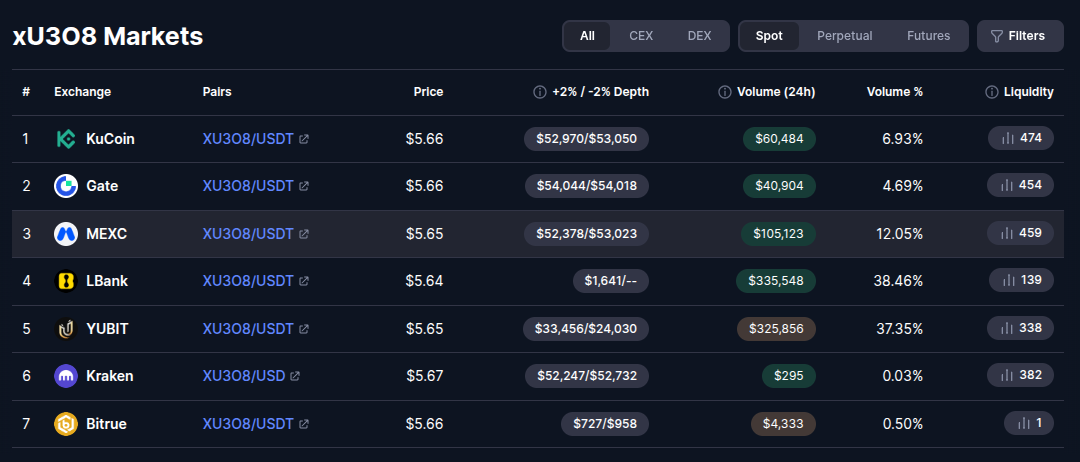
xU3O8 represents ownership of physical uranium, giving investors exposure to the commodity without directly handling or storing it. At current price levels, it has a market cap just above $9 million, CoinMarketCap data shows.
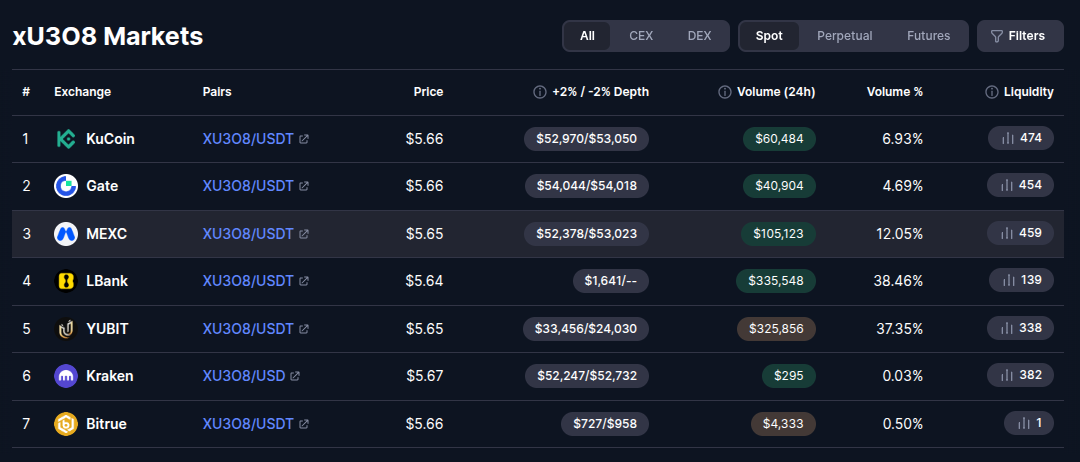
xU308 markets. Source: CoinMarketCap
Anchorage is not the first institutional custodian to support xU3O8. In August 2025, digital asset custodian Hex Trust integrated Etherlink to offer custody for xU3O8 and other assets issued on the network.
Physical uranium exposure has traditionally involved specialist intermediaries, lengthy settlement periods and relatively high minimum investment sizes, according to Anchorage. The company said tokenization allows the commodity to be transferred and settled in minutes rather than weeks.
Magazine: Bitcoin Coinbase Premium hits monthly low as CLARITY Act vote squeezes US demand
Crypto-linked equities slid again after the U.S. Senate failed to move forward the Digital Asset Market Clarity (CLARITY) Act through a key procedural vote, leaving the bill’s timeline in serious doubt. According to Yahoo Finance data cited in coverage, shares of Coinbase, Circle, and Strategy continued to trade lower into Wednesday.
While the selloff affected multiple parts of the crypto market, Saxo Bank said the impact is not uniform—exchange operators like Coinbase face a more direct regulatory exposure because market-structure rules can shape registration requirements, eligible assets, and who is allowed to participate in U.S. crypto markets.
Key takeaways
- Saxo Bank highlighted Coinbase as the most directly exposed company to CLARITY because market-structure provisions could determine its core trading operating model in the U.S.
- Circle’s exposure is more closely tied to U.S. stablecoin adoption and earnings from reserves, while Strategy’s performance depends primarily on its Bitcoin holdings and financing.
- The CLARITY Act failed a procedural vote on Tuesday (49-50), falling short of the 60 votes required to advance.
- Ethics provisions remained a major sticking point even after last-minute concessions.
- The Senate’s limited remaining calendar before the Nov. 3 midterm elections and Dec. 18 adjournment creates a narrow window for any revival of the legislation this year.
Why the bill matters more for exchanges
In a Wednesday note, Saxo strategist Ruben Dalfovo argued that exchanges may be more vulnerable to CLARITY’s final shape than other crypto-linked businesses. The reason is straightforward: if Congress adopts “market-structure” rules, those provisions can influence whether firms must register in particular ways, what assets can be traded, and the conditions under which investors and participants can access U.S. crypto markets.
“Coinbase is most exposed to clearer market rules because trading and crypto participation directly affect its business,” Dalfovo wrote.
That distinction is important for investors trying to parse a sector-wide move after procedural legislative setbacks. Even though the same headline—CLARITY failing to advance—hit crypto stocks broadly, Saxo’s framework suggests the regulatory “transmission mechanism” differs by business model.
Different exposures across Coinbase, Circle, and Strategy
Saxo’s note separated the companies into different regulatory sensitivities.
Circle’s business, Dalfovo said, is more tightly linked to adoption of its U.S. dollar stablecoin, USDC. The firm’s revenue dynamics are also connected to interest earned on its reserves—so stablecoin-related policy developments and the broader environment for regulated stablecoins may matter more for Circle than exchange-specific rules.
For Strategy, Saxo described exposure as primarily driven by its Bitcoin holdings and financing structure. In other words, the company’s near-term performance is less about trading-market participation rules and more about its capital structure and BTC exposure.
Despite these differing exposures, the market still reacted as a group. Cointelegraph reported that shares of the three companies fell between 5% and 10% after the Senate procedural vote, even though the potential implications for each business are not identical. Early Wednesday trading continued the pressure, with Coinbase, Circle, and Strategy down between 2% and 6% according to Yahoo Finance data.
The procedural defeat and the ethics hurdle
CLARITY’s setback came on Tuesday when senators voted 49-50 against invoking cloture on a motion to proceed. That procedural step is often crucial because it limits further debate and allows a bill to move toward consideration on the Senate floor. In this case, it fell far short of the 60 votes needed.
According to the reporting referenced in the article, ethics provisions remained a major sticking point. Even with last-minute concessions aimed at addressing concerns over public officials’ crypto-related interests, lawmakers did not reach consensus sufficient to move the bill forward.
This matters because procedural votes are frequently treated by markets as a signal about whether legislative momentum exists. When cloture fails, the practical likelihood of reaching a final vote can drop sharply—especially in a shorter session with competing priorities.
Narrow time window in the Senate
The failure also significantly narrows the bill’s prospects for the rest of this Congress. The Senate has a limited legislative calendar around the Nov. 3 midterm elections and is targeting Dec. 18 for adjournment, which leaves fewer opportunities to revive the bill and schedule additional votes before the current term ends.
In practical terms, that creates uncertainty for firms and investors that have been watching CLARITY as a potential source of clarity. The bill is not just “on or off” but may effectively move into a delayed or uncertain future depending on whether new negotiations can overcome the ethics concerns.
For exchange operators in particular, the stakes are tightly linked to how market-structure rules ultimately land—because those rules can determine operating requirements and trading scope. For stablecoin issuers, the policy pathway may be more about adoption and reserve treatment, while for Bitcoin treasury companies the key variable remains the interplay between crypto regulation and their BTC-focused strategies.
Going forward, traders and investors will likely watch whether CLARITY returns to the agenda before the end-of-year deadline, and whether the Senate can reach a workable compromise on the ethics language that stalled the cloture vote.


Russian spies are using Telegram and crypto to entice teenagers and young adults across Europe to carry out acts of sabotage and violence.
That’s according to a study released by the Institute for Strategic Dialogue (ISD) and shared with the i Paper.
The study revealed that Russian actors are targeting teenagers and young adults via a network of Telegram groups called “com networks” in which participants compete for clout by uploading harmful content.
I Paper discovered two clips shared in these groups took place in the UK. In one instance, someone filmed themselves smashing a car that belonged to a care worker.
Read more: Russia offered crypto to firebomb Sir Keir Starmer’s home, report
Another showed what appears to be the same person throwing a brick through the window of a house.
One week after these incidents, Ukrainian police arrested two young boys, aged 11 and 15, who were allegedly planning to attack their school with guns and explosives “on the orders of the Russian Federation.”
The Security Service of Ukraine described these incidents as a Russian intelligence operation.
According to the ISD, there are “multiple indicators suggesting possible Russian state-linked support” for parts of the network, and organizers “mirror established Russian methods for recruiting ‘disposable agents’ for violence abroad.”
The study’s author, Steven Rai, claims they’ve seen the Russia-linked Telegram chats offer crypto for arson attacks, and that these payments within the com networks are “completely new.”
An all-encompassing umbrella group made up of a collection of these Telegram networks claims it wants to bring participants of different views together with “one goal” to cause chaos.
One part of this collective claims to be allied with Direct Action, a Russian-manufactured far-right group that organised the fire bombing of former UK Prime Minister Sir Keir Starmer’s house.
In this case, thousands of dollars worth of the stablecoin USDT was reportedly offered to a 22-year-old Ukrainian in return for carrying out the attacks in the hopes of attracting press coverage.
Got a tip? Send us an email securely via Protos Leaks. For more informed news and investigations, follow us on X, Bluesky, and Google News, or subscribe to our YouTube channel.

Vaibhav Sooryavanshi’s Father Asked About Teenager’s Absence In India XI vs Afghanistan. His Reply

Google DeepMind launches the DeepMind Institute to debate AGI

“Mythical Supercycle”! Crypto About To Do Something It Hasn’t Done Since 2015 (Stocks Can’t Stop it)

Weekend Open Thread – Corporette.com

Memory prices are slowing because buyers ran out of money

Micron Stock Climbs Above $1,031 as AI Memory Crunch and a $50 Billion Outlook Fuel the Rally
“Mythical Supercycle”! Crypto About To Do Something It Hasn’t Done Since 2015 (Stocks Can’t Stop it)

How much a Financial Planner makes in Toronto

BITCOIN WARNING: LIQUIDATIONS ARE HERE (Price Target)!!! – Bitcoin News Today, Ethereum & Altcoins
-
 Fashion5 days ago
Weekend Open Thread – Corporette.com
-
 Business7 days ago
Micron Stock Climbs Above $1,031 as AI Memory Crunch and a $50 Billion Outlook Fuel the Rally
-

 Tech3 days ago
The Latest Weird Thing to Play Doom Is the Mapped-Out Brain of a Fruit Fly
-

 Business7 days ago
AMD Stock Climbs After Management Lifts 2027 Data Center Outlook Toward $70 Billion in AI Sales
-

 Business5 days ago
10 Most-Streamed Songs On Spotify In 2026 So Far, Led By Ella Langley’s Dominant Run On The Charts This Year
-

 Crypto World5 days ago
XAG/USD: Silver’s Short-Term Rally Meets Its Moment of Truth
-

 Crypto World6 days ago
2 Chip Stocks Broke Out This Week. Neither Was Nvidia
-

 Crypto World7 days ago
Pi Network ships Protocol 27 on a network with 14 million users and zero DeFi
-

 Tech6 days ago
Battery life is the only iPhone 18 Pro and iPhone Duo upgrade I care about. Apple didn’t disappoint
-

 Crypto World6 days ago
OKX launches 10x OpenAI, Anthropic X-Perps in Europe
-

 Crypto World5 days ago
Diesel Tops $6 a Gallon for the First Time as 28 States Set Records
-

 Tech7 days ago
Apple Watch Ultra 4 vs Watch Ultra 3: Should you really spend another $799?
-

 News Videos5 days ago
Facing Financial Fears
-

 Crypto World7 days ago
Bitcoin price risks $70K if $78K neckline breaks
-

 Business6 days ago
Western Digital Slips 2.7% as AI Storage Rally Cools After Record Cash and Guidance
-

 Entertainment7 days ago
Case Sees Major Update As Jury Deliberations Begin
-

 Business3 days ago
Rivals Sam Altman and Elon Musk Rally Behind Dario Amodei’s Call for a Slowdown in AI Development
-

 Business6 days ago
Five Leading AI Experts Warn Superintelligence Could Kill Humans and Explain Their Case
-

 Crypto World2 days ago
Elon Musk Drops a Bombshell: Grok 5 Could Be the AGI Breakthrough
-
Crypto World6 days ago
Ethereum Price Analysis: Consolidation at $2.5K Tests Momentum as On-Chain Activity Surges
You must be logged in to post a comment Login