
Crypto World
Bitcoin dip-buying rises below $77,100, but spot demand lags: Bitfinex



Bitcoin has fallen 3.2% to a $75,702 close after losing the $77,100 range floor, while futures data has shown traders rebuilding long positions despite weak U.S. spot demand.
Summary
- Bitcoin closed below $77,100 for a third session and could retest $73,500.
- Futures open interest recovered to $52.15 billion after falling by $1.7 billion.
- U.S. spot Bitcoin ETFs recorded $450.4 million in daily net outflows.
- Coinbase’s spot discount widened as perpetual traders increased buy-side activity.
Bitfinex Alpha said in a Sep. 16 market update that Bitcoin traders have bought the decline through perpetual futures, even as spot-market data points to limited demand below the former range floor.
Bitcoin had traded between $77,100 and $81,300 for 24 days from Aug. 21 before breaking lower ahead of the Federal Reserve’s interest-rate decision. Tuesday’s $75,702 close left BTC 3.2% lower and below the $76,043 low set after the Aug. consumer price index report.
The close was Bitcoin’s third below $77,100 in six sessions, activating a downside path that Bitfinex had identified in an earlier report. Analysts said BTC could now revisit $73,500, the average cost basis of investors who acquired their holdings three to six months ago.
A recovery above $77,100 would weaken that scenario only if spot trading volume increases, according to the report.
Bitcoin dip-buyers rebuild futures positions
Derivatives traders initially reduced exposure during the decline but quickly returned to the market. Global Bitcoin futures open interest fell by $1.7 billion during a 3.5% peak-to-trough move on Sep. 15, then recovered to $52.15 billion by the following morning.
Open interest had stood at $52.1 billion before the breakdown, leaving total futures exposure slightly above its earlier level despite the price decline.
At the same time, funding rates stayed positive without reaching levels that Bitfinex considered overheated. Traders continued adding long exposure while Bitcoin formed lower highs and lower lows.
“Longs are being re-added as funding remains positive, albeit not overheated, even as price continues to decline with lower highs and lower lows,” Bitfinex Alpha told crypto.news.
The analysts said the recovery in open interest differs from a capitulation event, when funding usually turns negative and traders close leveraged positions. Such events commonly produce a steep fall in open interest rather than a rapid rebuild.
Aggregated cumulative volume delta, which measures market orders from buyers and sellers, also showed an increase in buy-side taker activity after Bitcoin lost $77,100. Positive price moves were accompanied by positive funding and rising open interest, which the report described as dip-buying in perpetual markets.
Liquidations still removed some leverage from the market. About $571 million in long positions across crypto assets were liquidated on Sep. 15, compared with approximately $100 million in shorts. Bitcoin and Ethereum each accounted for roughly $190 million of the long-liquidation total.
The event was the largest long liquidation since Aug. 22. During an earlier test of $77,100 on Sep. 10, total liquidations reached $562 million, with long positions accounting for 86%.
Spot Bitcoin demand remains weak below $77,100
Futures traders have added exposure, but Bitfinex found less buying pressure in the spot market. Coinbase’s spot discount widened from 0.03% on Monday to 0.08% at the Sep. 16 daily open, indicating weaker demand on the U.S. exchange than on other trading venues.
The discount was its deepest since Aug. 15, when Bitcoin traded below $65,000 before its subsequent advance. Passive bids have absorbed part of the recent ETF selling, according to Bitfinex, but buyers have not shown enough urgency to return BTC above $77,000.
U.S. spot Bitcoin ETFs recorded $450.4 million in net outflows on Tuesday. Fidelity’s FBTC lost $214.8 million, while BlackRock’s IBIT recorded $161.7 million in redemptions. Together, the two funds accounted for 84% of the daily total.
The outflow ranked as the 33rd largest across the 687 trading sessions since U.S. spot Bitcoin ETFs launched in January 2024. Bitfinex also ranked it as the 14th-largest daily withdrawal of 2026.
ETF demand had been stronger earlier in September. During the week ending Sep. 4, the funds attracted $986.7 million in net inflows, led by approximately $691.5 million across BlackRock’s Bitcoin products.
Tuesday’s selling therefore reversed part of the institutional support that had helped BTC remain inside its August-to-September range. Bitfinex said ETF flows should now provide a clearer reading of institutional positioning than the options market.
Recent Bitcoin buyers account for exchange deposits
Short-term holders supplied another source of selling as Bitcoin moved below its range. Exchange inflows from coins held for less than 155 days rose from about 19,400 BTC to 33,100 BTC on Tuesday.
Of the total, 23,200 BTC reached exchanges at a loss, the highest amount in a month. Loss-making deposits from the same group reached 8,260 BTC across major offshore spot exchanges, the largest reading since Aug. 11, when Bitcoin traded near $64,000.
Deposits into U.S. institutional products, including ETFs and investment wrappers, remained close to their typical level of 7,300 BTC. Bitfinex attributed the additional exchange inflows to recent buyers holding retail-sized positions rather than institutional investors.
The affected group acquired 1.23 million BTC between $77,100 and $81,300 during the previous four weeks. With Bitcoin trading below that area, the cohort now holds the coins at an unrealized loss.
The decline also accelerated as resting orders disappeared. Bitcoin fell about $1,100 between 18:30 and 18:45 UTC on Tuesday despite almost no net taker flow on Bitfinex, suggesting buyers withdrew limit orders instead of sellers aggressively striking bids.
The move occurred alongside the failed Senate cloture vote on the CLARITY Act. As previously reported by crypto.news, the motion received 50 votes in favor and 49 against, leaving it 10 votes short of the 60 required to open debate.
Bitcoin faces support at $75,412 and $73,500
Bitfinex placed the first support area between $74,985 and $75,412, combining Tuesday’s low, Strategy’s average Bitcoin purchase price, and a liquidation cluster previously located between $75,000 and $76,000.
Strategy holds 845,050 BTC at an average cost of $75,412, according to the report. Tuesday’s low fell below the company’s cost basis before Bitcoin closed about 0.4% above it.
For the support zone to hold, Bitfinex said ETF flows would need to stabilize while open interest in Sep. 18 options at the $75,000 strike remains contained. A sustained break below the area would expose the $73,500 cost basis of three-to-six-month holders.
Below $73,500, the report identified $71,300 as the short-term holder realized price. The level also sits near a $70,000-to-$71,500 volume node containing a cost-basis concentration of close to 350,000 BTC.
A return to the $62,500-to-$71,000 first-quarter range would carry more serious implications under Bitfinex’s model. The analysts said a close inside that band would indicate a return to a bear-market regime rather than a temporary dip within the post-August structure.
Options traders have also paid more for downside protection beyond the Fed meeting. Open interest for the Sep. 18 expiry rose 22% during the week, with calls increasing 30% and puts rising 12%. Longer-dated 25-delta risk reversals moved toward puts across the September, October and December expiries.
Ahead of the decision, earlier Bitfinex analysis had identified large liquidation zones near $76,000 and $82,000. The lower cluster has since been tested, with more than $500 million in liquidations clearing positions around $75,000 to $76,000.
Bitcoin’s 10-day correlation with the S&P 500 rose to 0.76 from 0.20 on Sep. 11, while its correlation with the Nasdaq 100 increased to 0.66 from 0.15. Over the same period, its correlation with gold fell from 0.79 to 0.51, according to Bitfinex.
From Sep. 8 to Sep. 15, Bitcoin fell 3.7% as the 10-year Treasury yield increased from 4.8% to 5%. The 10-year inflation-adjusted yield closed at 2.62%, raising the available return on U.S. government debt while Bitcoin continued trading as a non-yielding asset.


U.S. lawmakers moved a step closer to turning President Donald Trump’s proposal for a strategic Bitcoin reserve into law after the American Reserve Modernization Act of 2026 (H.R. 8957) cleared the House Committee on Financial Services on Wednesday.
The committee approved the bill in a 28–21 vote, setting up the next phase of legislative review in the full House and, later, the Senate. If enacted, the measure would create a Strategic Bitcoin Reserve and a separate Digital Asset Stockpile inside the Department of the Treasury to hold federally forfeited Bitcoin and other digital assets.
Key takeaways
- The American Reserve Modernization Act of 2026 (H.R. 8957) advanced after a 28–21 vote in the House Financial Services Committee.
- It would establish a Strategic Bitcoin Reserve for Bitcoin held by the federal government for at least 20 years.
- The proposal aims to improve oversight via agency-wide asset accounting, quarterly “proof of reserve” reporting, and third-party audits.
- It would also commission a study on budget-neutral strategies for expanding the reserve and allow states to store their Bitcoin with the Federal Reserve.
- The bill explicitly affirms private Bitcoin ownership and the importance of self-custody and private key control.
From executive idea to draft legislation
The bill, introduced by Representative Nicholas Begich on May 21, is designed to address what supporters describe as fragmented and inconsistent custody practices for Bitcoin currently held under federal authority. Begich argued that allowing federal Bitcoin holdings to remain scattered across custody arrangements creates unacceptable cybersecurity risks and undermines accurate accounting of what the government actually owns.
In his view, the legislation would help make Bitcoin a durable part of U.S. reserve policy—while providing a clearer framework for how those assets are stored, reported, and secured.
What the bill would create at Treasury
According to the bill text described in coverage, H.R. 8957 would establish two related structures inside the Department of the Treasury:
- A Strategic Bitcoin Reserve for federally held Bitcoin; and
- A Digital Asset Stockpile for other digital assets acquired through criminal or civil forfeiture.
The proposal also sets a minimum holding period: Bitcoin placed in the federal reserve would have to remain there for at least 20 years. That requirement indicates the act is not being framed as a short-term treasury maneuver, but as a long-duration policy shift.
For investors and market participants, the key point is less about immediate market effects and more about the administrative pathway: if H.R. 8957 becomes law, it would standardize federal custody and governance around digital assets acquired through forfeiture—potentially reducing uncertainty about how such holdings are managed over time.
Transparency and audits built into the framework
The act would also require federal agencies to provide a comprehensive accounting of digital assets they currently hold or control. It further introduces transparency mechanisms that include:
- Quarterly “proof of reserve” reports; and
- Third-party audits.
Supporters appear to see these provisions as a direct response to custody and reporting gaps. By mandating recurring disclosures and independent verification, the bill attempts to make the reserve more measurable and harder to obscure through fragmented reporting.
Some context for why this matters: the U.S. government is estimated to hold 324,527 Bitcoin, worth $24.7 billion at the time of writing, according to Arkham Intelligence. While estimates can vary by methodology, the broad takeaway is that the federal government’s on-chain footprint is large enough that custody and reporting practices can become politically and operationally consequential.
Custody rules, self-custody rights, and what still needs to happen
Beyond reserve creation and transparency requirements, H.R. 8957 would direct a study of budget-neutral acquisition strategies for expanding the Strategic Bitcoin Reserve. The bill would also affirm that states could store their Bitcoin in the Federal Reserve.
Just as notably, the legislation would explicitly recognize private ownership and self-custody rights of Bitcoin, describing control of private keys as fundamental to “financial sovereignty, privacy, and personal liberty in the digital age.” That language is likely intended to address concerns that any federal Bitcoin framework could be interpreted as limiting individual control over assets.
Bitcoin Policy Institute executive director Connor Brown described the committee vote as a “genuinely historic step for Bitcoin policy,” while Strive CEO Matt Cole previously called the measure “the single most important crypto legislation that can come out of DC.”
However, the committee approval is only an intermediate milestone. The bill still has to pass the full U.S. House and then the Senate before it can reach President Trump for a final decision.
As lawmakers consider the next stages, readers should watch two things closely: whether the reserve and audit requirements survive amendments in the full House and Senate, and how negotiators balance federal reserve objectives with the bill’s explicit protections for private self-custody and key ownership.


Morgan Stanley co-president Dan Simkowitz said the push by OpenAI and Anthropic to slow releases of the most advanced artificial intelligence (AI) models will not dent demand or the spending behind it.
His bank is a reported lead underwriter on Anthropic’s coming stock market listing. Simkowitz spoke to CNBC on Wednesday and declined to discuss individual deals.
AI Demand and Financing Will Keep Moving
Spending on compute and chips is not stopping, he said. Nor is the financing behind that build.
“I think the pause or the slowing of release on the frontier really doesn’t change the core dynamics,” Simkowitz said in the interview.
Demand is coming from large companies and consumers alike, according to Simkowitz. He said Morgan Stanley is scaling AI across research, cybersecurity and customer service.
Its partners include Anthropic, Google, xAI and Microsoft. Sam Altman presented to the bank’s board in May 2022, months before ChatGPT launched.
Simkowitz said he does not know when Anthropic will go public. He called the initial public offering (IPO) market ready for large deals and pointed to SpaceX.
His stated worries sit elsewhere. He named fiscal policy, $100 oil and $40 trillion of federal debt.
Morgan Stanley Advises the Companies Who Spend Big on AI
Asked whether the capital could run out, Simkowitz listed his own client book.
“We’re the advisor to Nvidia and Broadcom and Google and the and the LLMs, uh as well as some of the neo clouds. They’re all raising the capital”
Neoclouds are data center firms that rent out AI computing power. Large language models, or LLMs, are the systems behind chatbots such as ChatGPT and Claude.
That list covers the chipmaker, the networking supplier, the search giant and the labs. Morgan Stanley is also among the banks reported to be leading Anthropic’s IPO, alongside Goldman Sachs and JPMorgan.
Anthropic was last valued at nearly $965 billion in May, and its listing has been reported for the autumn.
Simkowitz also said Alphabet and SpaceX raised close to $150 billion in equity in June.
Critics Question the Timing of the Slowdown Call
Anthropic chief executive Dario Amodei asked rival labs on September 12 to slow capability gains. Altman and Elon Musk backed him.
Investor Michael Burry argued two days later that the push serves the listings rather than safety. He described it as hype around the listings.
Altman has since pushed OpenAI’s own debut beyond 2026.
Simkowitz said each company will make its own timing call.
The post Anthropic IPO Underwriter Says AI Spending Won't Slow: Can He Be Neutral? appeared first on BeInCrypto.

Tuesday was one of the most important days of the year for the cryptocurrency industry, as the US Senate was scheduled to vote on the key market-structure legislation, the CLARITY Act, which, unfortunately for its backers, went sideways.
The Senate rejected cloture on the motion to proceed with the bill, with the vote falling well short of the 60 votes required. BTC reacted with an immediate price drop, but there’s more to the story.
STHs Capitulate
According to CryptoQuant’s analyst Darkfost, Bitcoin short-term holders sent over 23,000 BTC to exchanges at a loss following the Senate setback. In USD terms, this massive stash was worth close to $1.8 billion. This represented the largest capitulation event in about a month.
STHs are generally more sensitive to sudden price movements, making their behavior expected and also useful for tracking periods of fear and forced selling, CQ explained. The reaction on September 15 is particularly worth observing because this cohort of investors spent almost a month in partial profit before yesterday’s price decline, the longest sustained profitable period of the year.
The CLARITY disappointment therefore quickly tested these investors’ confidence, which had accumulated during BTC’s latest recovery. Nevertheless, it’s still worth noting that exchange deposits do not necessarily prove every unit was subsequently sold. Instead, they represent potential selling pressure rather than confirmed disposals.
Investors Reacted Before the Vote
Santiment Intelligence’s data shows that the market started to react even before the final vote came in. Just a day before the Senate rejected cloture on the bill, BTC rocketed to over $79,500. However, selling accelerated at this point as doubts emerged that the CLARITY Act could gather the necessary support despite the last-minute changes.
Later, on September 15, the cryptocurrency had already retreated to $76,000. Santiment argued that traders were repricing the deteriorating probability of passage before cloture officially failed, and social activity confirmed it.
Discussion surrounding the bill exploded after the failure and was significantly higher than when the legislation advanced through the Senate Banking Committee in May. The analysts said the reaction illustrates clearly how strongly traders respond when anticipated bullish catalysts suddenly disappear.
Nevertheless, yesterday’s setback, albeit being a major one, does not mean the bill is dead. The failed vote delays the process rather than permanently rejecting the entire legislation, and another attempt remains procedurally possible. Still, the negative impact was felt immediately, while all eyes in crypto now turn to the Fed and the FOMC meeting today.
The post Bitcoin Holders Capitulate After CLARITY Act Failure: What the Data Shows appeared first on CryptoPotato.
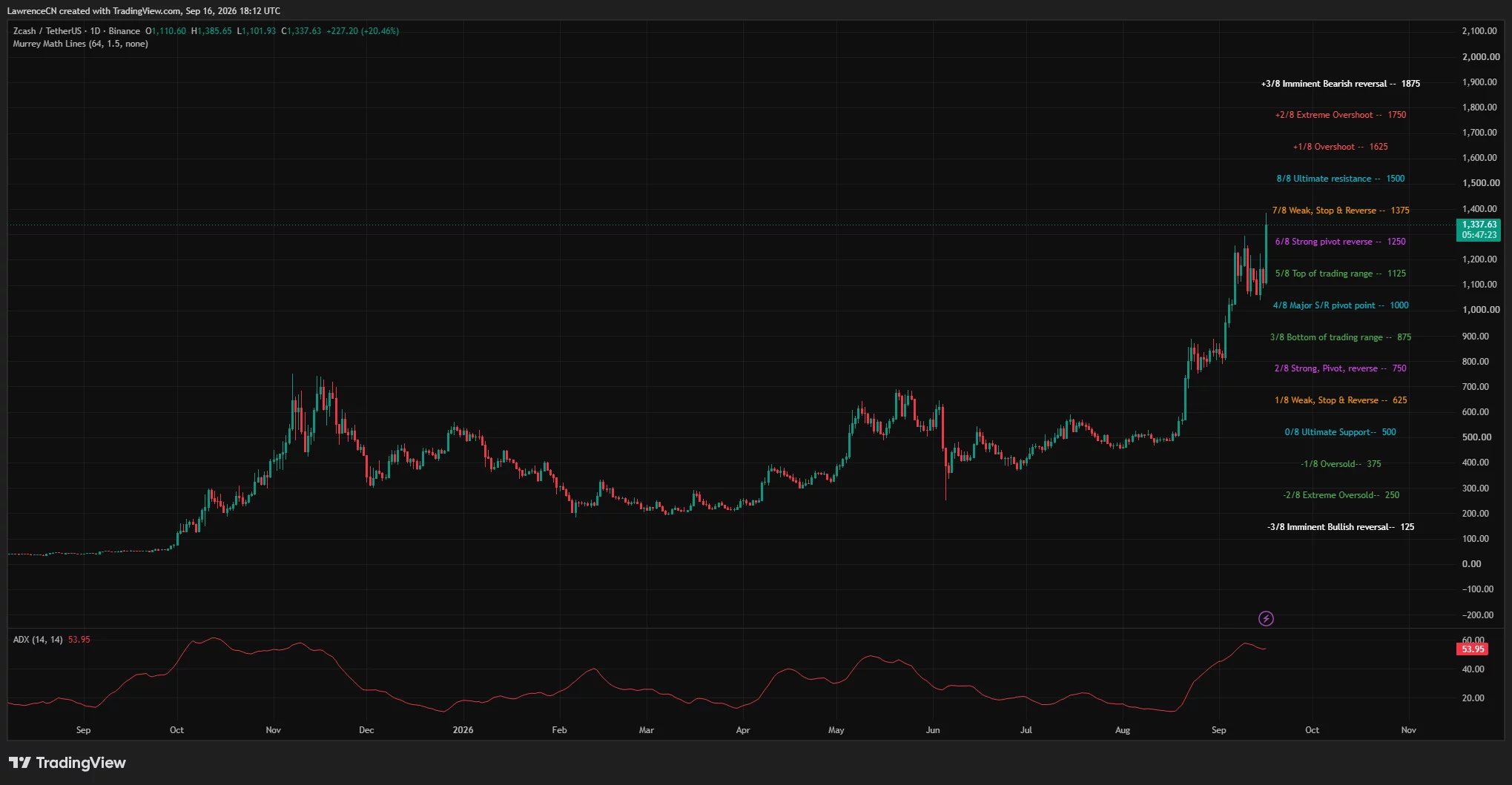
Zcash price rallied more than 20% on Sep. 16, breaking above $1,300 as network upgrade optimism helped ZEC resist a broader crypto market sell-off.
Summary
- Zcash price climbed 20.46% to $1,337 after reaching an intraday high of $1,385.
- Price broke above the $1,250 pivot, placing $1,375 and $1,500 in focus.
- The 4-hour Supertrend flipped bullish, with support near $1,128.
- Liquidity remained concentrated below $1,170 after higher clusters were swept.
Zcash price action today
According to data from crypto.news, Zcash (ZEC) price traded at approximately $1,337 at the time of writing, up 20.46% over the daily session. The privacy coin opened near $1,110 and reached a high of $1,385 before giving back part of the move.
The advance placed ZEC among the strongest-performing large-cap crypto assets while Bitcoin and several major altcoins faced selling pressure following the failed CLARITY Act vote in the US Senate.
Network-specific developments helped separate ZEC from the wider market. Zcash holders backed a proposal to reduce block times from 75 seconds to 25 seconds in the Network Upgrade 7 governance poll, according to the information provided. The proposal received 98.9% support while retaining the network’s existing halving schedule.
Plans to integrate the Ironwood shielded pool with Ledger hardware wallets also supported sentiment around the network’s privacy infrastructure.
ZEC’s performance extended a strong recovery that began in August. The daily chart shows price accelerating from around $500 in mid-August to above $1,300, with the sharpest gains arriving after ZEC cleared the $800 region in early September.
ZEC breaks above a major technical pivot
The daily chart shows ZEC moving above the Murrey Math resistance level at $1,250, identified as a strong pivot and reversal zone. Price then tested the next resistance at $1,375 during the intraday rally.
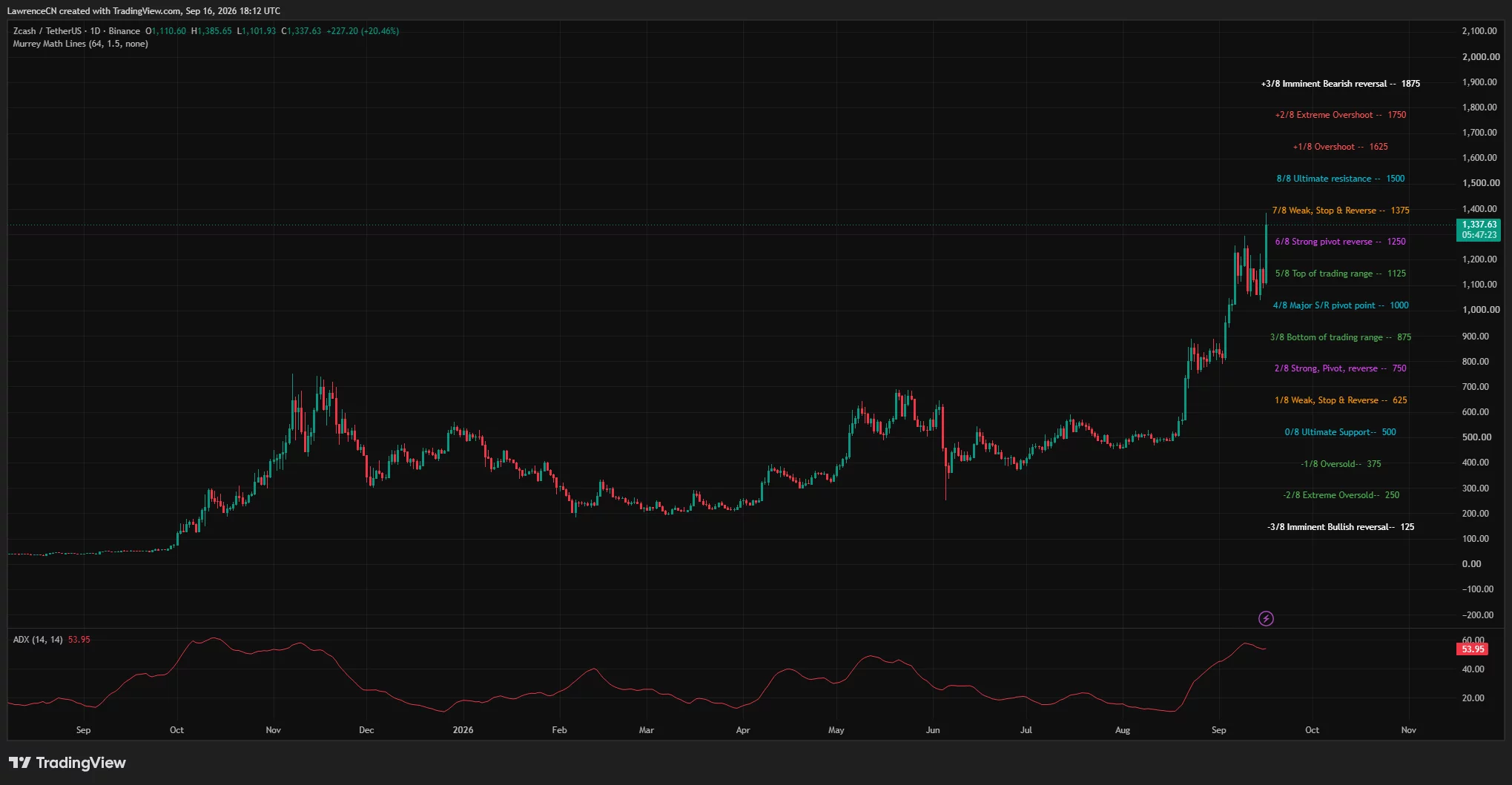
A daily close above $1,250 would keep the immediate structure favorable for buyers. The next upside level sits at $1,375, followed by the $1,500 “ultimate resistance” zone.
ZEC would need to clear $1,500 and hold above it before traders could consider the next extensions at $1,625 and $1,750. Such targets remain conditional because the current rally has already carried price far above its August trading range.
The Average Directional Index stood at 53.95 on the daily chart. An ADX reading above 25 usually indicates a strong trend, while the current reading suggests ZEC’s directional move remains powerful. ADX does not identify whether the trend is bullish or bearish, however, and an elevated reading can persist during a reversal.
Immediate support lies at $1,250. A loss of that level could expose $1,125, which marks the top of the previous trading range. The larger pivot at $1,000 would become relevant if selling pushes ZEC below both supports.
4-hour indicators support the breakout
ZEC also broke above its Supertrend resistance on the 4-hour chart. The indicator had capped price near $1,206 before the latest candle advanced as high as $1,385.
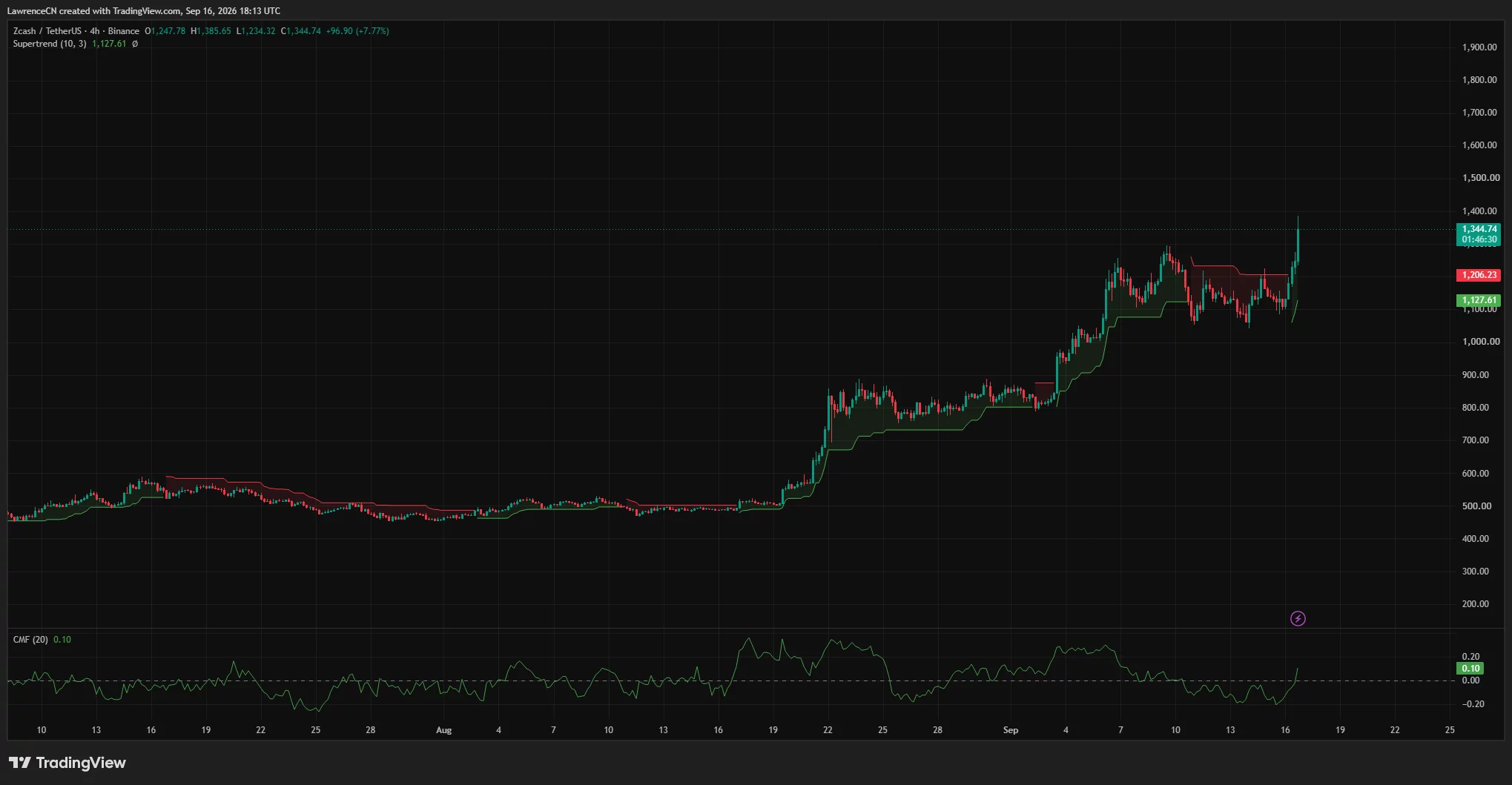
The breakout shifted the Supertrend into a bullish position, with its support line moving toward $1,128. Price was trading more than $200 above that indicator at the time of the chart capture, reflecting strong momentum but also a widening distance from short-term support.
Chaikin Money Flow rose to 0.10 on the 4-hour chart. A reading above zero points to net buying pressure, supporting the price breakout. CMF had recovered from negative territory during the rally, suggesting capital flows improved as ZEC moved beyond its recent consolidation range.
A pullback that holds between $1,250 and $1,206 would allow the bullish structure to remain intact. A drop through that area would raise the risk of a deeper move toward $1,128–$1,125.
Liquidation levels could increase ZEC volatility
The 24-hour CoinGlass liquidation heatmap shows that ZEC moved through several liquidity concentrations during its advance from approximately $1,100. Dense bands appeared around $1,150–$1,170, $1,205–$1,215, and $1,235–$1,240.
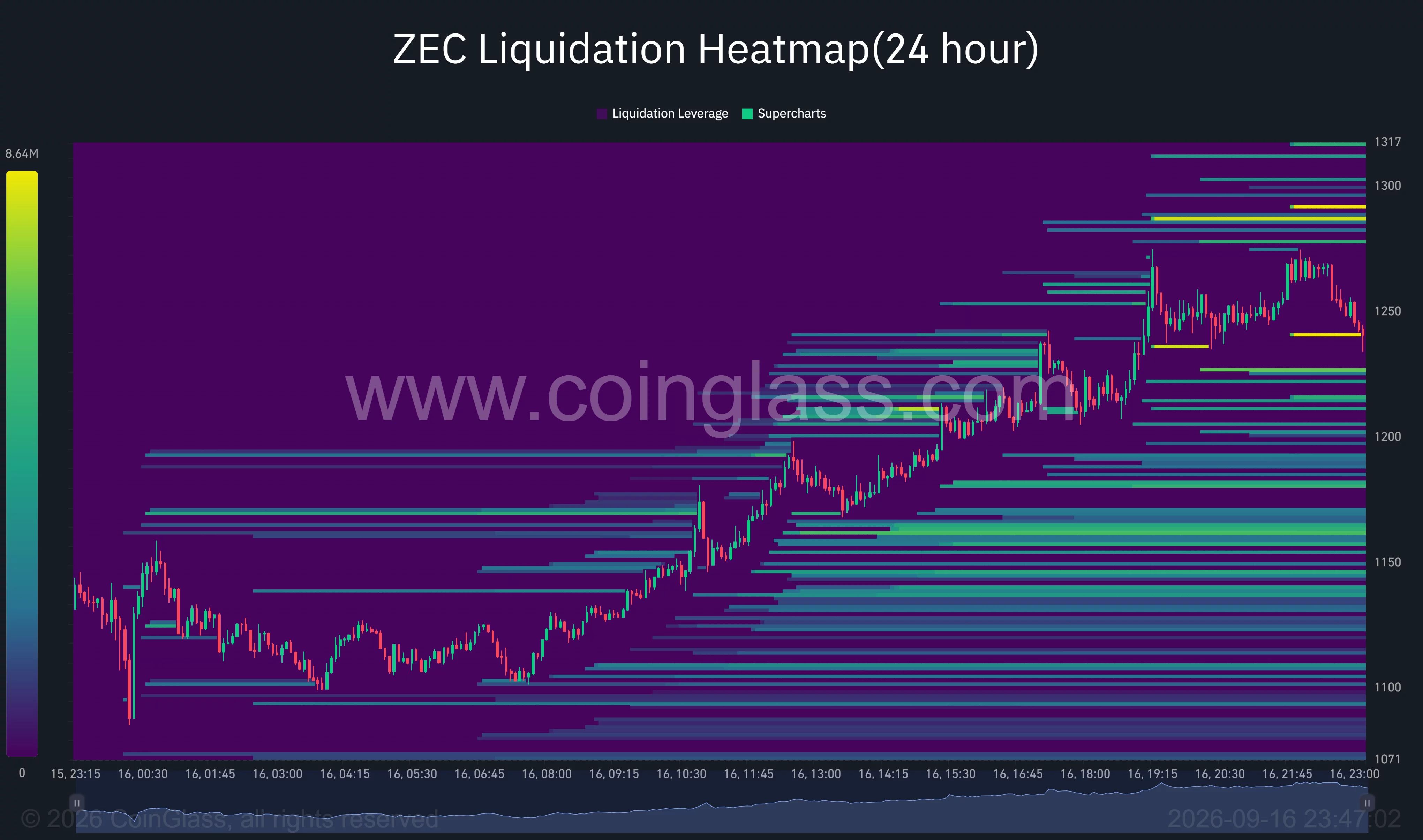
The heatmap snapshot ended with price near $1,235, before the TradingView charts recorded the later push above $1,300. ZEC therefore appears to have cleared several overhead liquidation zones during the breakout.
The strongest remaining liquidity visible on the map was concentrated below the market around $1,150–$1,170. Additional bands appeared near $1,125–$1,145 and around $1,090–$1,110. Such clusters can become areas of interest during a correction, although liquidation heatmaps do not guarantee that price will move toward them.
Higher bands were visible around $1,285–$1,295 and $1,305–$1,315. The later rally to $1,385 suggests those short-liquidation areas were likely swept as price accelerated.
Analysts split over Zcash’s next move
Altcoin Sherpa said ZEC appeared to be consolidating rather than preparing for a deep correction toward $1,000. The trader expected choppy Bitcoin conditions to keep the consolidation in place but identified $1,500–$2,000 as the potential range for another upward leg.
Crypto Patel presented a more cautious outlook, pointing to a bearish momentum divergence near $1,300. The analyst said a sustained rejection from that supply zone could expose support around $800 and a larger demand area near $500.
The bearish scenario cited by Patel requires ZEC to fail below $1,300. Price’s later move through that level weakened the immediate rejection case, but bulls still need to defend $1,250 and establish support above $1,300.
For US traders, the failed CLARITY Act vote remains a wider market risk even as ZEC benefits from network-specific demand. Continued weakness in Bitcoin or a hawkish Federal Reserve signal could increase profit-taking across leveraged altcoin positions.
ZEC’s short-term direction now depends on whether buyers can secure a daily close above $1,250 and challenge $1,375 again. A clean break above $1,375 would place $1,500 in view, while failure to protect $1,250 could send the price back toward $1,125.
Disclosure: This article does not represent investment advice. The content and materials featured on this page are for educational purposes only.

XRP is changing hands at $1.30, after a brutal overnight leg that saw the token shed more than 9% in less than 12 hours. XRP is volatile. But now, will $1.30 holds as anything more than a bounce point before the next leg down? Here’s our full XRP price prediction.
A failed procedural vote on the CLARITY Act last night has reignited the regulatory ambiguity XRP has spent years trying to shed. Ripple CEO Brad Garlinghouse called the setback “stings’ in a same-day post on X, a rare public admission of frustration from a CEO usually disciplined about messaging.
Bitcoin dipped briefly below $75,000 before recovering, while Ethereum, BNB, and Solana slid 3-5%, confirming this was a market-wide risk-off event, not an XRP-specific breakdown.
Still, XRP’s decline outpaced the majors by a wide margin. That elasticity is the story. Regulatory clarity was priced in; its absence is now being priced out.
Earn $50 and Enter $300K Prize Draw on EdgeX
XRP Price Prediction: Can Ripple Recover and Run to $1.50 This Week?
XRP trades at $1.30, down from an intraday low near $1.27 after the CLARITY Act news broke. Liquidity and open interest data suggest the selloff, while sharp, hasn’t triggered the kind of cascading liquidations that mark a true breakdown. The immediate technical battle is at the $1.30 level here, which flips from support to resistance if buyers can’t reclaim it convincingly.

Three scenarios frame the next move, all pinned to the Fed’s rate decision. A 25 basis point hike likely sends XRP toward the $1.00 psychological floor, with $1.21 and $1.10 as intermediate stops. An unchanged rate probably supports a reclaim of $1.30, with $1.36 and $1.45 as next resistance.
How about the best case? A surprise cut, although low probability, could open a path toward $1.60, then $1.68, potentially $1.86. Triangle-pattern analysis puts $2.19 on the table if resistance clears, though that scenario currently sits well outside base-case odds.
Discover: The Best Token Presales
Maxi Doge Targets Early Mover Upside as XRP Tests Key Levels
A 9% overnight drop on a top-five asset is a reminder of how exposed large-cap crypto remains to single legislative headlines. Traders who bought the CLARITY Act narrative are now underwater, waiting on a Fed decision they can’t control.
This is the pain point, and it’s exactly the kind of setup that pushes capital toward assets with no regulatory overhang and no $1.30 resistance ceiling to fight through.

Enter Maxi Doge ($MAXI), a meme token built around leverage-trading culture rather than legal precedent. The project has raised $4.8 million in presale funding at a current price of $0.0002839, with a huge 65% APY staking already live only for early holders.
Its identity leans into gym-bro absurdity (240 lbs of “1000x leverage” energy, holder-only trading competitions, a treasury fund for liquidity and partnerships), but the mechanics are straightforward presale economics.
Research Maxi Doge before the next presale tier prices in.
Trade XRP on Bybit and Get a Chance to Win Our $1,000 USDT Airdrop
The post XRP Price Prediction: 9% Drop in 12 Hours, Can XRP Survive CLARITY Act Setback? appeared first on Cryptonews.
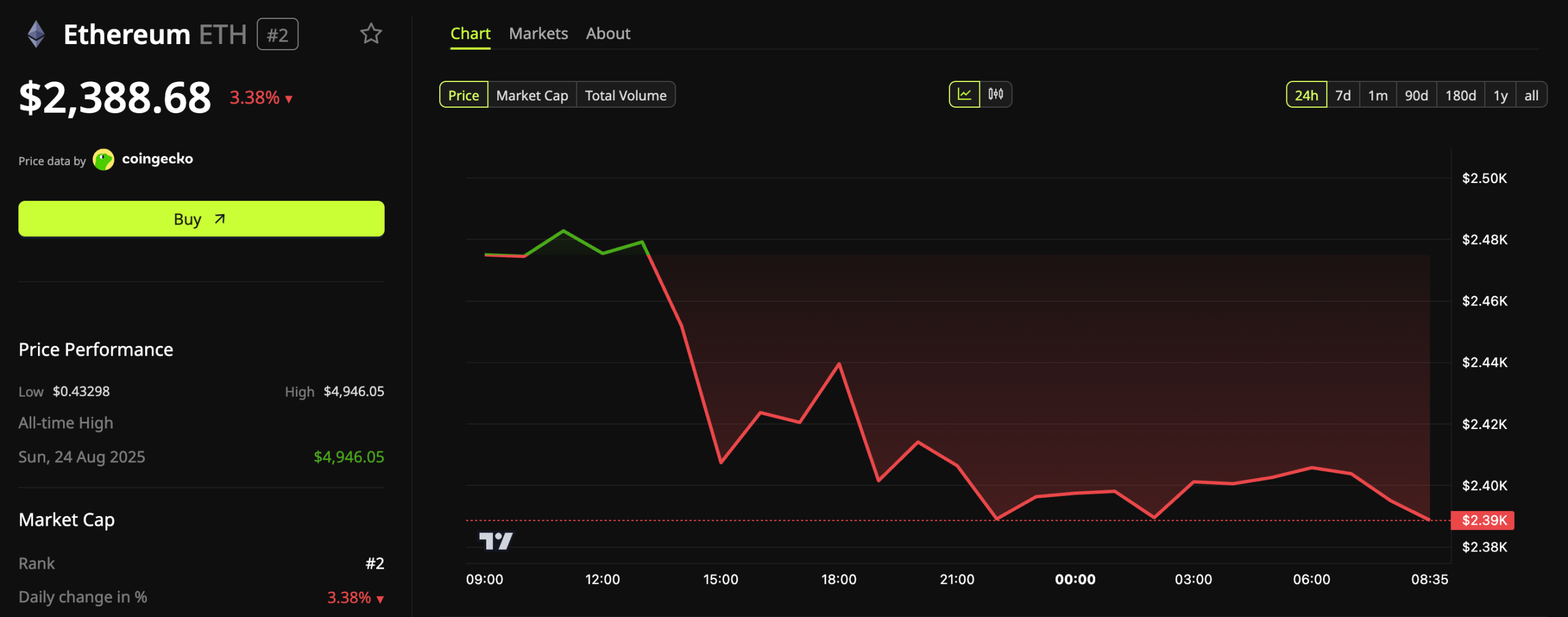
Ethereum (ETH) and the wider crypto market felt the impact of the Clarity Act failing to clear the Senate. Analysts had touted the bill as a major tailwind for the second-largest cryptocurrency.
Expectations that its advance would trigger a rally have now been reset. The setback has left its mark on ETH.
How Much of This Was the Vote
Over the past week, Ethereum price dropped around 3%. The altcoin dipped to $2,388 after the CLARITY Act failed, then rebounded to $2,400 shortly after. In comparison, other major altcoins like XRP and Hyperliquid have dropped over 8%.

US-listed spot Ethereum funds also saw heavy selling. They recorded their largest outflow since January on Tuesday as the bill stalled.
Not all of the selling started in Washington. ETH was already sliding before the Senate voted, then extended the decline once the result landed.
Exchange data points the same way. CryptoQuant recorded roughly 709,400 ETH moving into Binance on September 11, four days before the vote. That was the highest daily total since June.
Large exchange inflows can signal that more coins are becoming available for potential selling. However, an exchange deposit does not mean those coins were sold.
What Happens to Ethereum Price Now?
The failed vote removes a potential catalyst for ETH in the short term. However, its longer-term supply dynamics remain intact.
CryptoQuant put exchange reserves at 14.6 million ETH, the lowest level since 2016. Reserves have fallen steadily since 2022, and this week’s inflows barely register against that trend.

Staking also continues to absorb supply. Analyst Leon Waidmann put the total staked at 43 million ETH, a record, or close to 35% of supply.
Coins in a validator cannot be sold until the queue is cleared. That leaves a smaller pool of ETH available to trade than in any previous cycle.
Valuation has improved alongside it. Analyst MorenoDV noted that ETH’s MVRV ratio has moved above 1 and has remained there for several sessions. ETH also trades above its realized price near $2,300.
“A sustained MVRV > 1 together with ETH holding above its ~$2.3K Realized Price would strengthen the case that June–July marked the cycle low and that the market is transitioning from repair into expansion,” the analyst said.
The signals are not clean, though. CryptoQuant’s Coinbase Premium Index sits near -0.08, indicating softer US spot demand relative to offshore.

Taken together, ETH’s supply backdrop remains supportive, but demand has yet to provide a clear counterweight to the recent selling pressure.
Washington Steps Aside, the Fed Steps Up
Not everyone sees the bill as decisive. Grayscale’s head of research argued that crypto can advance without the Clarity Act.
That view puts the weight back on macro. With Washington out of the picture, at least for now, rates could be the variable driving ETH.
The Federal Reserve has already increased interest rates on Wednesday, with Kevin Warsh warning further tightening could be ahead.
This hike is the first of this cycle. What traders want is a signal about what follows. For now, it looks like the Crypto market has already priced in the CLARITY Act failing and the Fed rate hike.
“If the Fed sounded like this rate hike was a one-time thing, I expect a good pump,” analyst Ted Pillows stated. “But if Warsh insists more on the Fed’s 2% inflation target, the market will see this as a hint of more future hikes. In that scenario, there’ll be a dump across stocks, crypto, and even precious metals, while bond yields will surge.”
Subscribe to our YouTube channel to watch leaders and journalists provide expert insights
The post What Happens to Ethereum Price Now That the Clarity Act Has Failed appeared first on BeInCrypto.
Baron Capital founder Ron Baron told CNBC on Wednesday that now is the moment to buy Tesla stock, pointing to the carmaker’s self-driving software as the next driver of its share price.
His firm holds roughly $5 billion in Tesla shares and about $25 billion in SpaceX, making it one of the largest outside backers of Elon Musk’s companies.
Baron Points to Self-Driving Uptake and Rising Market Share
Baron said Tesla’s Full Self-Driving system, the paid software that steers the car while a driver stays in the seat, is spreading quickly. He put growth at 55% a year.
Tesla’s own second-quarter figures, however, are narrower. It reported 1.48 million active FSD subscriptions, up 56% in a year, with 55% of new North American deliveries having the software on at purchase.
Baron also argued Tesla’s US market share is climbing because legacy carmakers have slowed their electric vehicle (EV) plans. Motor Intelligence data reported by the Wall Street Journal puts Tesla at 52% of US EV sales through August, up from 43%.
That share grew as the market shrank. Total US EV sales fell 30% over the stretch, and Tesla’s own US deliveries dropped 16% to 325,351.
Wall Street Targets Split as Musk Leaves Merger Door Open
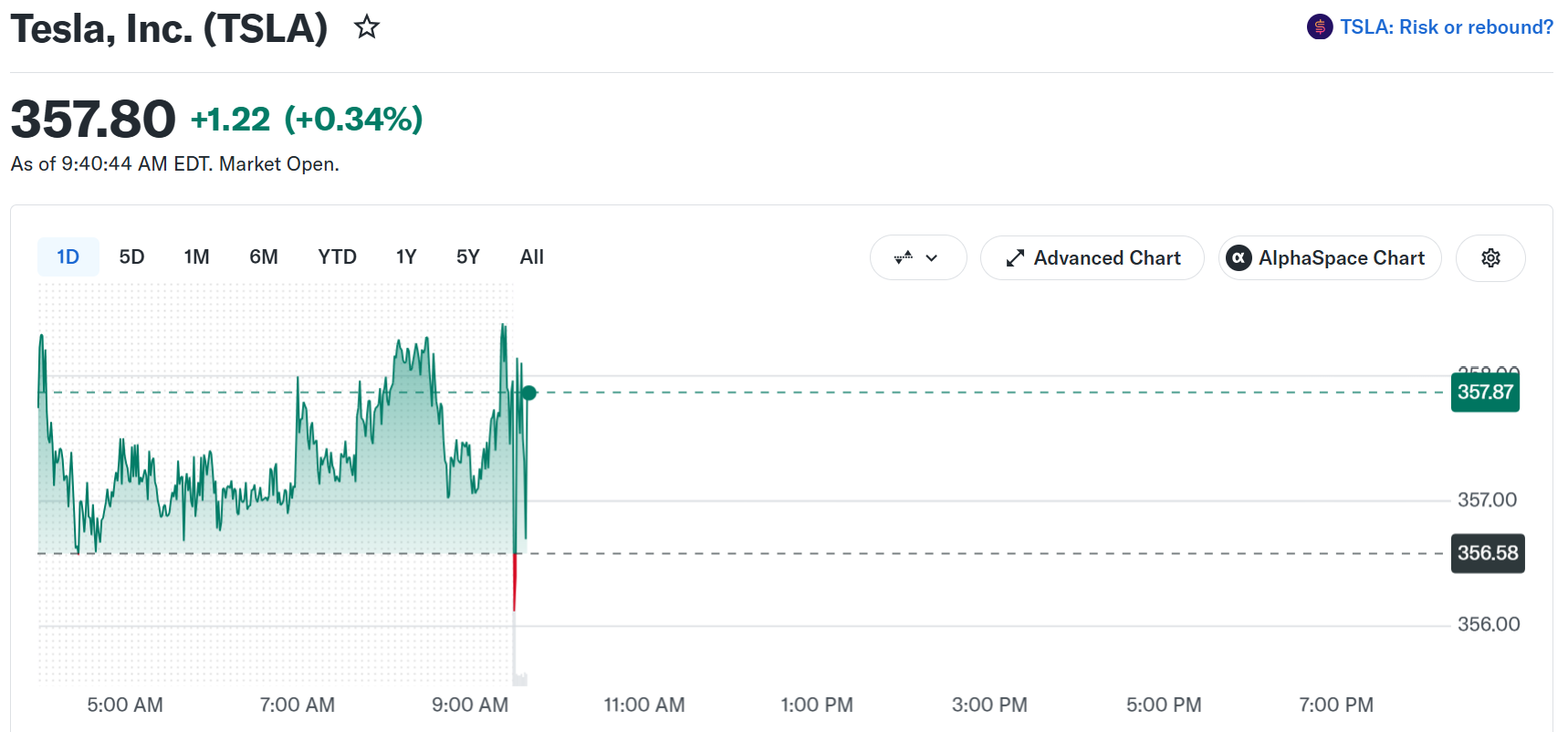
Tesla traded near $358 on Wednesday, up 0.3%, valuing the company at about $1.4 trillion, according to Yahoo Finance.

TipRanks shows 26 analysts rating the stock a Moderate Buy, averaging a $377.08 target. The high sits at $505 and the low at $24.86, across 11 buys, 12 holds and three sells. Wells Fargo, among the bears, values the shares at $130 in its Wells Fargo sell call.

Baron’s remarks come as Musk, Tesla’s chief executive, again declined to rule out folding the carmaker into SpaceX. At the All-In Summit this week, he said the companies already work closely together.
“With all this collaboration, on so many levels, who can imagine what action one might take when there’s so much close collaboration in so many areas,” Musk said, speaking at the All-In Summit.
BeInCrypto reported Tesla SpaceX merger odds of just 18% for an announcement this year. Baron said he will back whichever route Musk picks.
Tesla’s next delivery report will test his case, showing whether record deliveries and FSD demand hold up while US EV sales keep contracting.
The post Billionaire Ron Baron is Extremely Bullish on Tesla Stock. What’s His Reason? appeared first on BeInCrypto.
Crypto World
BTC, ETH, and XRP Plunge After CLARITY Setback but All Eyes Turn on Fed Now: Market Watch
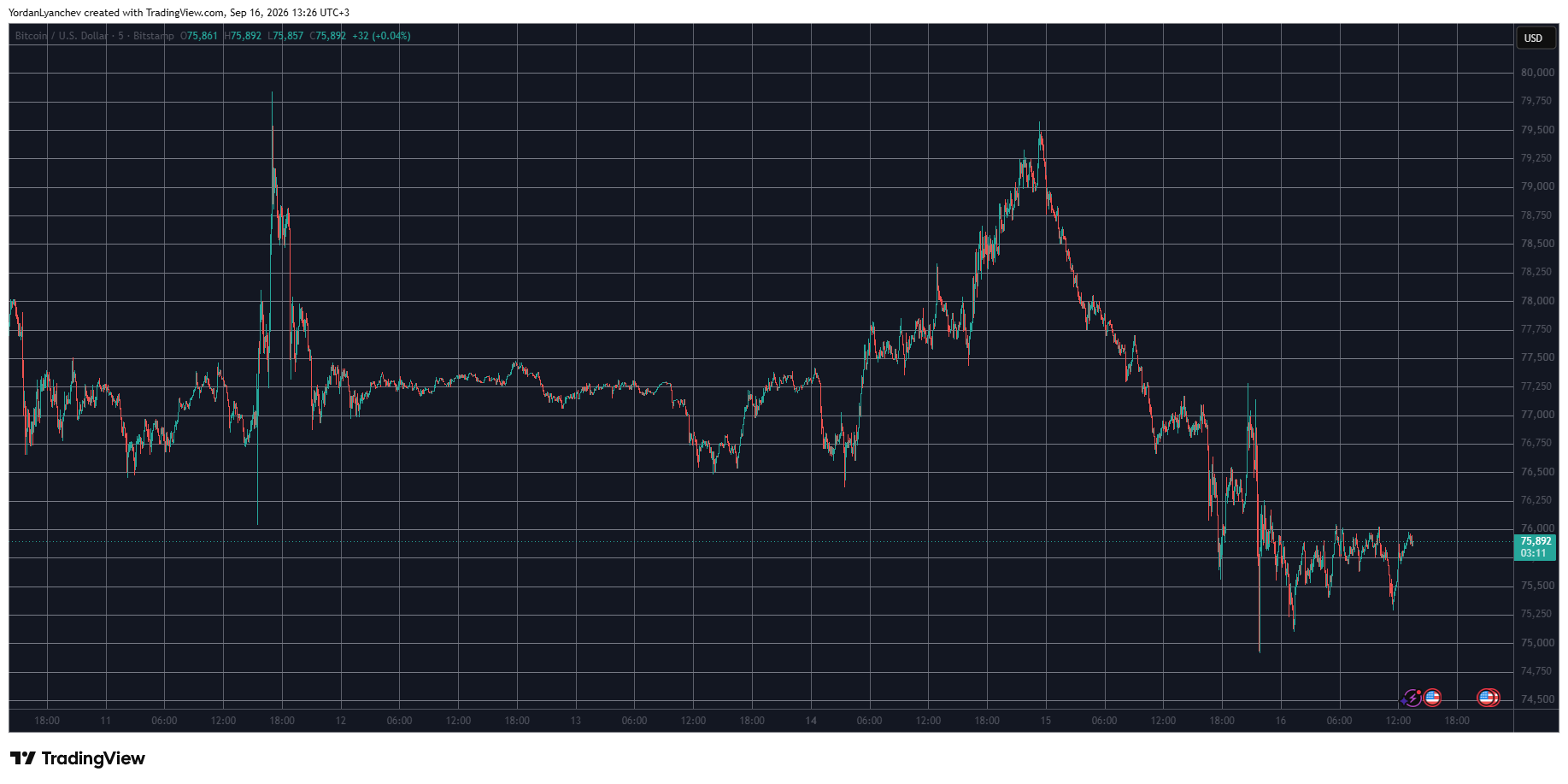
The first of the two massive events that can rattle the crypto markets occurred yesterday, and it didn’t go in the industry’s favor, resulting in immediate price pullbacks. Bitcoin, for example, slumped to a monthly low of $75,000.
The altcoins, especially those that were expected to benefit the most from the bill’s potential progress, are also well in the red today.
BTC Saw Monthly Low
Bitcoin’s intense volatility began at the end of the previous business week, after the release of the US CPI data. Even though the numbers matched expectations, BTC first dropped from $77,000 to $76,000 before it suddenly and unexpectedly skyrocketed to $79,800. It was rejected there and driven south to its starting point, and all of these moves occurred in the span of less than two hours.
The weekend was significantly less volatile, with the asset remaining sideways at around $77,000. It dipped again on Monday morning but then started to gradually rise in value and surged to $79,500 during the afternoon session.
More fluctuations were expected on Tuesday evening, when the US Senate was set to vote on cloture for the CLARITY Act. Once it became official that the bill was rejected, BTC went wild, going from $77,000 to a monthly low of $75,000, before it recovered some ground to just under $76,000 now. However, the situation later tonight could be just as eventful as the US Federal Reserve will announce its long-anticipated interest rate decision.
BTC’s market cap has dumped to $1.520 trillion on CMC, while its dominance over the alts is up to 59%.
XRP and Most Alts Dump
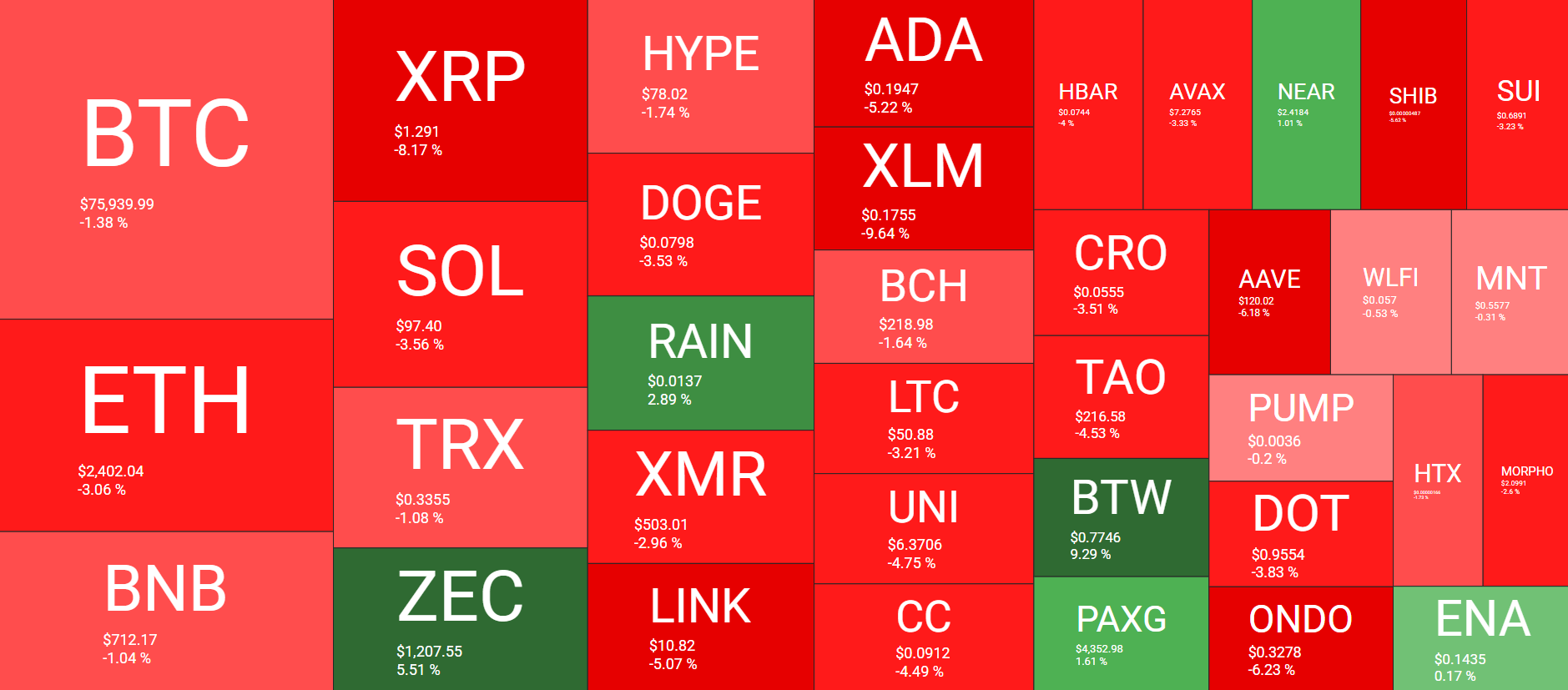
Ripple’s cross-border token is among the poorest performers today. The token was recently rejected at $1.50 and has since slumped to under $1.30 after another 8% daily decline.
Ethereum is down to $2,400 after a 3% slide, similar to SOL, DOGE, XMR, and HYPE; LINK has plummeted by 5%, and so has ADA. XLM has dived by 10% to $0.175. BTW and ZEC are among the few exceptions in the green today.
The total crypto market cap has dropped by over 2.3% in a day, according to CMC, and is below $2.6 trillion now.
The post BTC, ETH, and XRP Plunge After CLARITY Setback but All Eyes Turn on Fed Now: Market Watch appeared first on CryptoPotato.

Circle, the company behind USDC, has officially launched the public mainnet of Arc today. This is a Layer 1 blockchain as infrastructure built specifically for financial markets, payments, and AI-powered economic activity.
According to the firm’s official announcement, the protocol debuts with more than 100 institutional and ecosystem participants.
USDC, the stablecoin with more than $74 billion in circulating supply, is integrated in the network directly as the main gas token, meaning that users will have a degree of predictability that other networks might lack.
USDC Powers Network Fees
Unlike most Layer 1 networks, which have a USD-denominated cryptocurrency as the native token, Arc allows users to pay for transaction fees directly with USDC.
Circle also says that the network provides sub-second finality and supports assets including USDC, EURC, and tokenized real-world assets.
Some of the founding validators include BlackRock, Mastercard, Visa, Standard Chartered, Galaxy, ICE, DTCC, and MoneyGram. Crypto firms, on the other hand, include Binance, Coinbase, Kraken, Bybit, Aave, Morpho, Uniswap, MetaMask, and others.
ARC Token Into Spotlight
Circle also revealed that it has minted the full initial supply of 10 billion ARC tokens earlier this week. The company, however, stressed that this does not confirm a public token launch.
ARC is intended to support network security, utility, and governance eventually. This should come into prominence once Arc starts exploring a transition from Proof of Authority to Proof of Stake in 2027.
The next key thing that many in the industry are currently watching is if Arc’s blockchain will become a playground for traders and on-chain enthusiasts in a similar way Robinhood Chain did.
The post Circle Launches Arc Mainnet With 100+ Institutional and Crypto Partners appeared first on CryptoPotato.


US lawmakers took a step on Wednesday to put US President Donald Trump’s executive order to establish a strategic Bitcoin reserve into law.
The American Reserve Modernization Act of 2026 (H.R. 8957) passed the US House Committee on Financial Services in a 28-21 vote. The bill would establish a Strategic Bitcoin Reserve and a separate Digital Asset Stockpile within the Department of the Treasury for federally held Bitcoin and other digital assets acquired through criminal or civil forfeiture.
“We cannot allow Bitcoin to be held by the federal government to languish in fragmented and inconsistent custody,” said US Representative Nicholas Begich, who introduced the bill on May 21. “It poses unacceptable cybersecurity risks and fails to give an adequate accounting of what the federal government actually owns.”
The move brings Washington closer to making Bitcoin a lasting part of the federal government’s reserves.
Related: CLARITY Act vote meets Fed rate hike: Five things to know in Bitcoin this week
The US government is estimated to hold 324,527 Bitcoin, worth $24.7 billion at the time of writing, according to Arkham Intelligence.
Under ARMA, Bitcoin in the federal government’s reserve would have to be held for a minimum of 20 years.
The legislation requires all federal agencies to provide a full accounting of digital assets currently held or controlled by the federal government and establishes transparency measures, including quarterly “proof of reserve” reports and third-party audits.
It would also direct a study of budget-neutral acquisition strategies for expanding the Strategic Bitcoin Reserve and allow states to store their Bitcoin in the Federal Reserve.
The bill also affirms private ownership and self-custody rights of Bitcoin, describing the control of private keys as “fundamental to the principles of financial sovereignty, privacy, and personal liberty in the digital age.”
Bitcoin Policy Institute executive director Connor Brown on Wednesday called it a “genuinely historic step for Bitcoin policy.”
In May, Strive CEO Matt Cole called it “the single most important crypto legislation that can come out of DC.”
The committee’s approval clears a hurdle for the legislation, but it still needs to pass the full House and Senate before reaching the president’s desk.
Magazine: Revolut ID thefts highlight KYC’s dangers: Here’s how to fix it

Robert Kraft says he and Ed Sheeran have both donated $2m to Palestinian relief groups amid Macklemore backlash

EXI: Industrials Dashboard For September

US Lawmakers Move Bill to Codify a Trump-Era Bitcoin Reserve



-

 Fashion5 days ago
Weekend Open Thread – Corporette.com
-

 Business7 days ago
Micron Stock Climbs Above $1,031 as AI Memory Crunch and a $50 Billion Outlook Fuel the Rally
-

 Tech4 days ago
The Latest Weird Thing to Play Doom Is the Mapped-Out Brain of a Fruit Fly
-

 Business6 days ago
10 Most-Streamed Songs On Spotify In 2026 So Far, Led By Ella Langley’s Dominant Run On The Charts This Year
-

 Crypto World6 days ago
XAG/USD: Silver’s Short-Term Rally Meets Its Moment of Truth
-

 Crypto World6 days ago
2 Chip Stocks Broke Out This Week. Neither Was Nvidia
-

 Tech6 days ago
Battery life is the only iPhone 18 Pro and iPhone Duo upgrade I care about. Apple didn’t disappoint
-

 Crypto World6 days ago
OKX launches 10x OpenAI, Anthropic X-Perps in Europe
-

 Crypto World6 days ago
Diesel Tops $6 a Gallon for the First Time as 28 States Set Records
-

 Business6 days ago
Western Digital Slips 2.7% as AI Storage Rally Cools After Record Cash and Guidance
-

 News Videos5 days ago
Facing Financial Fears
-

 Crypto World3 days ago
Elon Musk Drops a Bombshell: Grok 5 Could Be the AGI Breakthrough
-

 Business4 days ago
Rivals Sam Altman and Elon Musk Rally Behind Dario Amodei’s Call for a Slowdown in AI Development
-

 Business7 days ago
Five Leading AI Experts Warn Superintelligence Could Kill Humans and Explain Their Case
-
 Crypto World7 days ago
Ethereum price breakout hinges on a close above $2,535
-
Crypto World6 days ago
Ethereum Price Analysis: Consolidation at $2.5K Tests Momentum as On-Chain Activity Surges
-

 Crypto World7 days ago
Ant International joins Visa, Mastercard to build AI agent payment standards
-
 NewsBeat2 days ago
‘Sick conspiracy’: Trump says only guardrails AI needs is ‘a strong and smart (High IQ!) president’ in all-caps rant
-

 Crypto World5 days ago
Can AI Build a Startup in 72 Hours? Elon Musk's Team Will Livestream the Test
-

 Entertainment5 days ago
News Specials, Movies, Shows, More
You must be logged in to post a comment Login