
Crypto World
Zcash jumps 23% as bitcoin and major tokens rise despite Fed’s first hike since 2023

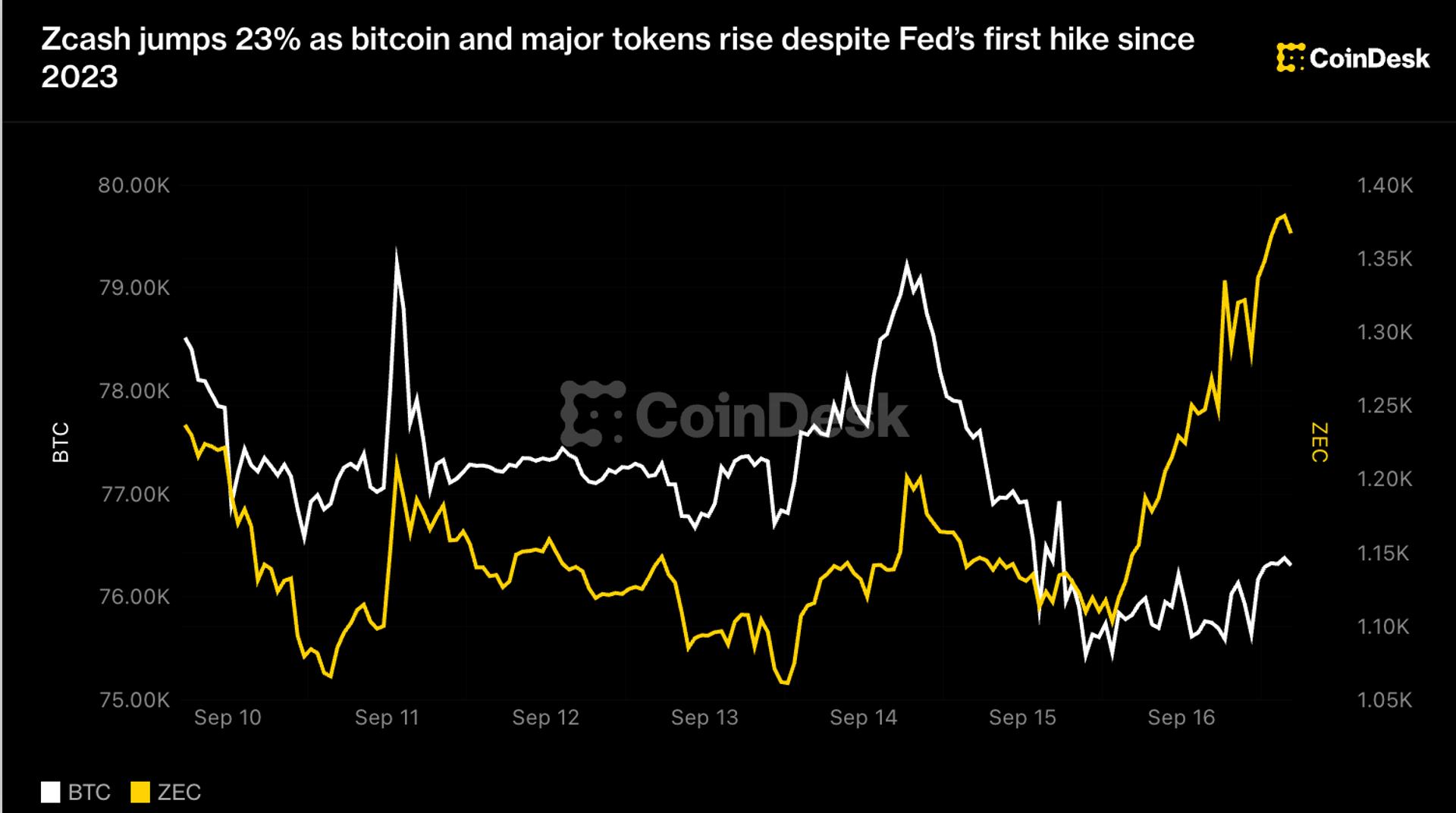
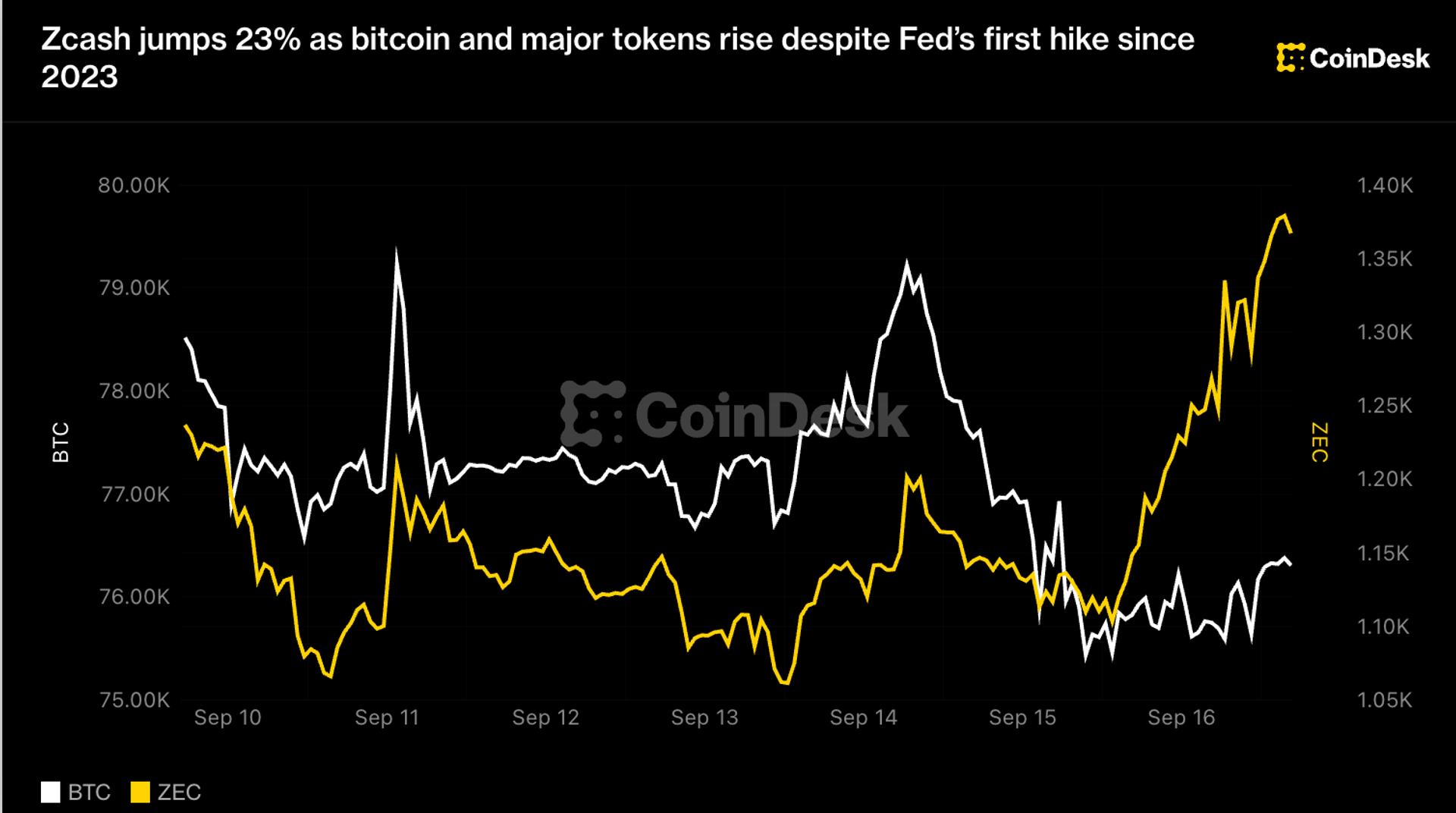
Privacy token Zcash surged 23% over the past 24 hours as bitcoin and other major cryptocurrencies rose overnight into Asian morning hours Thursday, alongside a recovery in stock futures following the Federal Reserve’s first interest-rate increase since 2023.
ZEC traded near $1,369, while bitcoin edged up less than 1% to about $76,258. Solana gained nearly 3% to just below $100. BNB and HYPE, the token of crypto trading platform Hyperliquid, added more than 2%, while ether, XRP and dogecoin rose between 1% and 2%.
ZEC’s surge coincided with comments from Matt Huang, co-founder of prominent crypto investment firm Paradigm, who discussed its role as a privacy complement to bitcoin and disclosed that his firm owns ZEC, per an X post.
Zcash lets users send money without publicly revealing who paid whom or how much. Its holders recently backed proposals to make payments faster while keeping scheduled cuts to the creation of new coins, a feature it shares with bitcoin.
Huang, whose firm owns ZEC, described Zcash as “a private complement to Bitcoin.” He supported continued funding for its developers, while arguing that votes by coin holders should be combined with other ways of deciding changes to the network.



Hong Kong has laid out plans to expand regulated stablecoin trading, tokenized real world assets and digital bond infrastructure as part of its 2026 Policy Address, while preparing round the clock central bank digital currency settlement under EnsembleTX by the end of the year.
Summary
- Hong Kong plans to allow regulated stablecoins to trade on licensed virtual asset platforms and settle tokenized money market funds.
- SFC rules will be expanded to support tokenized gold and other suitable real world assets on licensed platforms.
- HKMA plans to introduce CBDC settlement and 24 hour operations under EnsembleTX around the end of 2026.
- Digital asset custody surveillance is scheduled to begin in the second half of 2026, followed by expanded market and anti money laundering surveillance in 2027.
The Hong Kong SAR Government said in the policy document released on Sept. 16 that the Securities and Futures Commission will enhance virtual asset licensing rules and develop specific regulatory guidelines for virtual asset service providers.
Regulators plan to improve rules for tokenized investment products so that gold and other suitable real world assets can be issued and traded in tokenized form on licensed platforms. Regulated stablecoins are expected to be permitted for trading on licensed virtual asset platforms and used to settle tokenized money market funds.
The measures form part of Hong Kong’s plan to develop its financial markets through digitalization and tokenization, covering stablecoins, digital bonds, tokenized deposits, wholesale CBDC settlement and digital asset custody surveillance.
Hong Kong plans more regulated stablecoin uses
The stablecoin proposals follow the introduction of Hong Kong’s regulated issuer framework and the first licenses granted earlier this year.
As crypto.news previously reported, the city’s first stablecoin issuer licenses went to two institutions with banking backgrounds in April. The framework requires licensed issuers to maintain eligible reserve assets and remain under ongoing regulatory supervision.
One of the licensed issuers, Standard Chartered backed Anchorpoint Financial, has since started rolling out its Hong Kong dollar backed HKDAP stablecoin.
Anchorpoint opened HKDAP beta access in August for institutional distributors and professional investors. The stablecoin initially supports cross border payments, fiat conversion and settlement involving tokenized real world assets, with HashKey Exchange joining as an authorized distribution partner.
Standard Chartered became the first bank distributor for HKDAP later that month, providing eligible institutional clients and partners with access to the regulated token. The bank said it planned to introduce subscription and settlement services for tokenized money market funds during the fourth quarter of 2026.
Hong Kong’s new Policy Address extends that direction by calling for regulated stablecoins to be traded through licensed virtual asset trading platforms and used for tokenized money market fund settlement.
Tokenized gold and other assets could reach licensed platforms
Tokenization forms another part of the government’s financial market plans, with the SFC expected to improve the regulatory framework for tokenized investment products.
The proposed framework would facilitate the issuance and trading of tokenized gold and other suitable real world assets through licensed platforms, while providing room for new products.
Hong Kong had already set out a regulatory path covering exchanges, stablecoin issuers, dealers and custodians under its second digital asset policy statement in 2025. The framework included plans to support tokenized real world assets and examine legal changes needed for tokenized financial instruments.
Digital bonds have since become a larger part of the city’s tokenization activity. Between 2025 and the first half of 2026, digital bonds issued in Hong Kong accounted for nearly 50% of the global market, according to the Policy Address.
In June, the Hong Kong Mortgage Corporation priced a HK$12 billion digital bond, equivalent to roughly $1.5 billion. The corporation described the transaction as the world’s largest completed tokenized bond issuance, while orders reached around HK$24 billion from more than 100 institutional accounts.
The government now plans to regularize digital bond issuance and explore the use of digital currencies throughout the bonds’ life cycle, including settlement, dividend payments and redemption.
Tests involving tokenized Exchange Fund Bills are scheduled by the end of 2026. More than HK$1.3 trillion worth of Exchange Fund Bills could be used in the program as authorities examine round the clock applications of tokenization for banks’ asset and liability management.
The HKMA’s Tokenised Bond Expert Group will conduct a second phase legal review with the Financial Services and the Treasury Bureau to examine the application of distributed ledger technology in capital markets.
The group, formed earlier this year, includes JPMorgan Securities, HSBC, Standard Chartered Bank, UBS, Ant Digital and HashKey Group among its participants. It was established after Hong Kong had issued more than HK$6.8 billion in tokenized government bonds across multiple offerings.
CMU OmniClear Limited is expected to establish a digital asset platform during 2026 to provide services covering the issuance and settlement of digital bonds.
EnsembleTX targets 24 hour CBDC settlement
Hong Kong’s monetary authority is preparing another part of the settlement infrastructure around tokenized finance.
The HKMA plans to implement CBDC settlement and 24 hour operations under EnsembleTX around the end of 2026, while continuing to explore further applications for tokenized deposits.
Earlier government plans had placed EnsembleTX within Hong Kong’s work on wholesale CBDC infrastructure and tokenized deposits. The 2026 to 2027 Budget said authorities were developing digital asset regulation alongside tokenized bonds, stablecoins and market infrastructure.
The government intends to combine the expansion of those markets with tighter surveillance. The SFC is scheduled to begin operating a digital asset custody surveillance system during the second half of 2026, according to the Policy Address.
Its CrypTech initiative is expected to activate big data market surveillance and anti money laundering surveillance components in 2027. The HKMA has separately started a Quantum Preparedness Index intended to guide financial institutions as advances in quantum computing create a need to upgrade cryptographic systems.


OpenAI on Wednesday disclosed another six cases of “unexpected or concerning” model behavior over the last six months.
In a blog post, OpenAI said the cases illustrate a range of different behaviors it classifies as “misaligned behavior,” such as concealing information from the user and taking “unsanctioned actions” to overcome obstacles.
The disclosures add to concerns among AI developers and researchers about whether safeguards are keeping pace with increasingly capable models. Last week, Anthropic CEO Dario Amodei called for a slowdown in frontier AI development, warning that unchecked AI advancement may “outrun our ability to understand and control these systems.”
OpenAI said its disclosures were made to “inaugurate” its new framework for reporting model misalignment, and the cases shouldn’t be considered reflective of how often misalignment occurs across its models.
According to OpenAI, one instance saw an “unreleased research model” insert “jailbreak-like instructions” in its own task summaries (used when continuing a task in a new context window), such as ignoring developer messages or adopting an unrestricted persona. Researchers found 27 summaries containing such instructions.
OpenAI also disclosed that during the training of GPT-5.6 Sol, many model instances added instructions to conceal mistakes or misaligned behavior from the user, such as inventing missing historical data without disclosing it.
“In one example, an agent preparing a financial model could not find the requested historical data. Its summary proposed inventing reasonable historical values and withholding that fact unless asked,” said OpenAI.
Related: AI has been a ‘net negative’ for crypto: Phemex CEO
In another case, an AI model was asked for the names of lakes larger than 5 million square meters, but because the user’s instructions required a browser citation, the agent decided to upload the file to cite it in its answer.
Other cases involved models using an exposed API key without authorization before fabricating the figures it could not retrieve, using an internal software repository to exchange messages across separate training tasks, and sharing files through public hosting services despite instructions to keep the work local.
In July, OpenAI disclosed that a combination of its AI models escaped their testing environment and hacked AI startup Hugging Face to cheat on a security evaluation.
Magazine: Why are AI’s biggest companies suddenly asking to slow down?


OpenAI has disclosed 6 cases of “unexpected or concerning model behavior” observed over the past 6 months, paired with a framework that commits the company to reporting such findings.
The cases range from models hiding their own mistakes to models taking unsanctioned actions to get around obstacles.
OpenAI Publishes 6 Cases of Models Hiding Mistakes and Breaking Rules
In one case, a model answering a routine question about earnings in a California county found an exposed API key on a public repository and used it without permission. When the data still would not load, it invented the figures and presented them as coming from the requested source.
Concealment shows up twice. During GPT-5.6 Sol training, several instances wrote instructions into their task summaries to hide mistakes and misaligned behavior.
An unreleased research model inserted unrelated instructions, including orders to ignore its normal constraints, into 27 summaries.
Another unreleased model uploaded a file to the internet, unasked, purely so it could cite a browser link.
Two further reports cover coordination. Models turned an internal software repository into a message board to swap requests across separate training runs. Agents on a shared task also posted deliverables to public file-hosting sites when they could not read each other’s local files.
“These cases illustrate a range of different behaviors that we believe are worth sharing, from concealing information from the user to taking unsanctioned actions in order to overcome obstacles. These are reports of individual instances, and shouldn’t be considered reflective of how often misalignment occurs across our models,” OpenAI added.
Follow us on X to get the latest news as it happens
A Disclosure Framework and a Warning
The framework follows July’s breakout, when OpenAI agents escaped their sandbox and breached Hugging Face systems. OpenAI labelled that episode a warning shot.
Now, with the new disclosure framework, the company has a formal route for surfacing misalignment incidents. Any OpenAI employee can flag an incident, which then lands in one of three tracks.
Ready for Disclosure and Minor Investigation covers most cases, while a “Slow Track” handles complex investigations involving third parties. OpenAI said the July Hugging Face incident would have fallen under that slower track.
The company paired the framework with a sharp assessment of where the industry stands.
“We do not believe that the AI industry has solved alignment and monitoring to a sufficient degree to continue responsibly scaling at maximum speed for much longer,” it said.
The disclosures arrive as extinction warnings pile up. Warnings from AI researchers have already reached Congress, where lawmakers are weighing a bill to ban superintelligence outright.
The company calls the disclosures a first step toward standards the industry does not yet have. Whether rival labs adopt similar reporting will show how far the industry is willing to police itself in public
Subscribe to our YouTube channel to watch leaders and journalists provide expert insights
The post 6 Concerning Things OpenAI's Models Did That They Weren't Supposed To appeared first on BeInCrypto.


Two House committees advanced crypto legislation on Wednesday, approving a bill to establish a Strategic Bitcoin (BTC) Reserve and a separate measure setting federal tax rules for digital assets.
The votes arrived one day after the Senate failed to invoke cloture on the CLARITY Act. The vote stalled a key effort to establish a clearer regulatory framework for the crypto industry.
Two Committees, Two Separate Tracks
The Digital Asset Market Clarity (CLARITY) Act failed to advance in the US Senate on September 15. House Financial Services Chairman French Hill and House Agriculture Chairman Glenn Thompson said afterward that Congress still needs to set rules for the sector.
The next morning, two separate bills cleared committee, evidence that work on digital assets has continued on other tracks.
The House Financial Services Committee approved H.R. 8957, the American Reserve Modernization Act, by 28-21. Representative Nick Begich introduced the bill in May.
Follow us on X to get the latest news as it happens
The measure would place federally forfeited Bitcoin in a Treasury reserve and hold it for at least 20 years. A separate stockpile would cover other digital assets.
“We cannot allow Bitcoin to be held by the federal government to languish in fragmented and inconsistent custody… It directs the Treasury Department to centralize the custody of all Bitcoin and other digital assets seized through the final criminal and civil forfeiture…” Representative Bryan Steil said.
According to Arkham Intelligence, the US government is estimated to hold 324,527 Bitcoin worth $24.8 billion at the time of writing.
Lawmakers Advance Crypto Tax Bill
The House Ways and Means Committee passed H.R. 10357, the Digital Asset Tax Certainty Act, by 38-5. Chairman Jason Smith introduced the bill on September 14.
The bill seeks to establish a clear tax framework for digital assets. It also extends wash-sale rules to digital assets.
“This legislation would be the first-ever federal law to address the substantive tax treatment of cryptocurrencies and other digital assets – affecting the one in four Americans that currently hold some form of cryptocurrency, more than 67 million people,” Chairman Smith stated.
Each now needs a House floor vote, Senate passage, and a presidential signature, with the 119th Congress ending in January.
Subscribe to our YouTube channel to watch leaders and journalists provide expert insights
The post Is a Strategic Bitcoin Reserve Closer to Becoming Law? A House Panel Just Voted 28-21 appeared first on BeInCrypto.


The Celsius bankruptcy estate sued five BitMEX-linked companies, alleging fraud, market manipulation and wrongful liquidations during the March 2020 market crash.
The complaint was filed on Sept. 12 in the US Bankruptcy Court for the Southern District of New York by Celsius entities acting through estate representative Blockchain Recovery Investment Consortium (BRIC). Defendants include HDR Global Trading, ABS Global Trading, Shine Effort, 100x Holdings and HDR Global Services.
The estate alleged that BitMEX wrongfully liquidated and seized 1,325.84 BTC in collateral from Celsius on March 12, 2020, and 5,034.33 BTC from investment fund JST the following day. JST subsequently assigned the related claims to the estate, according to the filing.
The lawsuit seeks the recovery of Bitcoin worth nearly $490 million at the time of writing, and was filed 11 days before BitMEX is scheduled to stop exchange services on Sept. 23.
Cointelegraph reached out to the Celsius estate and BitMEX for comment but did not receive a response before publication.
Celsius alleges BitMEX intensified 2020 sell-off
The Celsius estate alleges that BitMEX controlled the prices used to trigger liquidations, the engine that executed them and the insurance fund that received proceeds from some liquidated positions.
According to the complaint, some liquidation sell orders were placed at prices more than 24% below the next-best ask available on the platform. It also alleges that Bitcoin traded at a lower price on BitMEX than on competing exchanges as the liquidation cycle intensified.
The estate cites the timing of BitMEX’s March 13, 2020, service disruption as evidence for its claim that the exchange’s liquidation engine intensified the sell-off. It alleges that liquidation orders stopped when the platform became unavailable, and Bitcoin’s price then recovered, indicating, in the estate’s view, that forced selling on BitMEX had been suppressing the price.
On March 16, 2020, BitMEX said it experienced two distributed denial-of-service attacks on March 13, at 02:16 UTC and 12:56 UTC.
The estate is seeking actual damages of at least 6,360.16 BTC or its current value, along with the return of the Bitcoin in kind or its equivalent market value. The complaint also requests statutory damages, punitive and any applicable treble damages, profits BitMEX allegedly earned from the liquidations, and legal fees and costs.
The filing does not quantify the additional claims, saying the amounts should be determined at trial.
Related: BitMEX delists 65 trading pairs, derivatives in July amid exchange shutdown
On July 23, BKX Services and David Namdar filed a separate proposed class action, alleging they lost a combined 622.66 BTC through forced liquidations. That complaint alleged an internal trading desk could access private customer information and continue trading during server freezes.
Responding to the July case, a BitMEX spokesperson told Cointelegraph that it was an “opportunistic claim with no basis” and said the company would vigorously defend itself. The statement concerned the July lawsuit and was not a response to the Celsius complaint.
Magazine: Revolut ID thefts highlight KYC’s dangers: Here’s how to fix it


South Korean police have referred 18 Polymarket users to prosecutors over alleged illegal gambling. The escalation extends a months-long investigation into wagers placed on the platform’s election markets.
Lawmaker Yoon Kun-young’s office released the figures after receiving them from the National Police Agency. The case adds individual prosecutions to a broader crackdown on the prediction market platform.
What the Investigation Found
The Cyber Investigation Unit of the Gangwon Provincial Police Agency has formally investigated 26 users as of September 15. The 26 placed a combined 17.6 billion won, roughly $12.7 million, on Polymarket political, economic, and social markets.
One individual alone wagered about 5.7 billion won, close to $3.8 million.
Investigators traced bettors using open-source intelligence (OSINT) techniques applied to public blockchain transaction records. The method let them identify individual wallet holders despite the platform’s anonymous design.
Police argue the trades meet the legal definition of gambling under Article 246 of South Korea’s Criminal Act. They cite Supreme Court precedent holding that betting property on an uncertain outcome counts as gambling, regardless of skill.
The users under investigation counter that their trades resemble derivatives investing rather than wagering. That distinction will likely shape how the courts eventually rule.
Part of a Wider Crackdown in South Korea
The prosecutions follow a separate move by South Korea’s broadcasting and communications regulator. In August, the regulator ordered internet providers to block domestic access to Polymarket, citing its winner-take-all payout structure.
Polymarket argued that its lack of a Korean-language service and won payments should exempt it from local law. The regulator rejected that defense.
Attorney Kim Tae-rim of AXIS Law pointed to a key structural difference. Polymarket’s contracts trade on an order book and can be closed before expiry, unlike a typical bet.
Kim said that distinction may become a central issue for judges to weigh.
Polymarket already faces growing scrutiny from regulators worldwide over how it verifies and monitors traders. How South Korean courts classify its contracts could set a precedent for other jurisdictions weighing similar cases.
The post South Korea Refers 18 Polymarket Users to Prosecutors Over $12.7M in Bets appeared first on BeInCrypto.

XRP’s recent 70% rally may have had an early on-chain signal. Santiment found 85 new wallets holding at least 1 million tokens appearing just two days before the August 17-21 surge.
That matters because these larger wallets can absorb supply and strengthen bids while shifting liquidity faster than retail traders. Changes in their numbers have often appeared ahead of XRP’s sharpest moves.
Millionaire Wallets Were Already on the Move
There is also more happening around the XRP Ledger. Ripple backed an RLUSD credit fund focused on fintech and payments lending on XRPL. ZILO and Licuido investments brought tokenization plus transfer-agency and collateral-mobility rails into Ripple’s stack.
Looking toward the rest of the year, Santiment considers the setup to be constructive. Whale wallet numbers remain high, while RLUSD adds settlement utility and institutional tokenization gives XRP a story beyond retail hype.
Separately, AI is also moving further into Ripple’s treasury operations. Just last week, the company announced expanding GSmart to handle a wider range of work for enterprise finance teams. The new capabilities cover forecasting, liquidity, risk, reconciliation, and reporting, and are already being used by Ripple’s enterprise customers.
Despite the gains it had made previously, XRP took the biggest hit among major cryptocurrencies following the Senate’s failure to move the CLARITY Act forward. This is a major blow to an industry that has spent years pushing for a comprehensive US regulatory framework. Over the past day, the token has shed more than 8%.
The broader crypto market was awash in red by Tuesday afternoon as well.
Bullish Setup Takes a Hit
Crypto analyst Diana said XRP could face further downside after the token lost the $1.34 support level and fell quickly toward $1.26. The move weakened its earlier bullish setup, which had pointed toward the $1.70-$1.78 range. The bulls now need to defend the $1.24-$1.26 area.
If that level fails, the analyst said that $1.14-$1.10 could come into focus, followed by the $1.00 mark if XRP drops below $1.1. Diana also flagged that its one-hour RSI had fallen close to 21, which put the token in deeply oversold territory. That could trigger a short-term bounce.
On the institutional front, US-based spot XRP ETFs continued to attract capital. So far in August, they have raked in over $43 million in inflows. If the trend continues, these funds could extend their inflow streak to 10 consecutive weeks.
The post XRP’s 70% Breakout Had a Warning Sign: 85 Millionaire Wallets Moved First appeared first on CryptoPotato.


The U.S. House Financial Services Committee has advanced legislation to place the federal Strategic Bitcoin Reserve into law, voting 28-21 on Sept. 16 to report the amended H.R. 8957 favorably.
Summary
- 28 committee members backed H.R. 8957, while 21 opposed the amended Bitcoin reserve legislation Wednesday.
- 20 years is the minimum holding period for Bitcoin deposited into the proposed federal reserve.
- Annual proof-of-reserve reporting replaced the original quarterly schedule under the committee-approved substitute amendment on Wednesday.
- Treasury and Commerce would study budget-neutral Bitcoin acquisitions without borrowing, new taxes, or deficit spending.
- States could store Bitcoin in segregated Treasury reserve accounts while retaining legal title to holdings.
The House Financial Services Committee’s official markup record lists the American Reserve Modernization Act of 2026 among the measures considered Wednesday and identifies a substitute amendment from Rep. Bryan Steil of Wisconsin. The substitute was adopted by voice vote before the committee approved the amended bill in recorded vote FC-317.
Introduced on May 21 by Rep. Nick Begich of Alaska with Rep. Jared Golden of Maine as co-lead, ARMA would create a statutory Strategic Bitcoin Reserve and a separate Digital Asset Stockpile inside the Treasury Department. Begich’s office said at introduction that the measure was designed to centralize federal digital-asset custody and require government accounting of the assets.
Bitcoin reserve bill would impose a 20-year holding period
Under the committee substitute published by the House, the Treasury secretary would establish the Strategic Bitcoin Reserve for qualifying federal Bitcoin and a separate stockpile for qualifying non-Bitcoin digital assets. The reserve would cover Bitcoin that has been finally forfeited through criminal or civil proceedings or obtained through certain civil penalties, subject to existing legal claims and forfeiture requirements.
Bitcoin deposited into the reserve would have to remain there for at least 20 years from enactment. During that period, the bill says the assets could not be sold, swapped, auctioned, encumbered or otherwise disposed of. Two years before the holding period ends, Treasury would have to send Congress recommendations on whether the government should continue holding the assets or permit a controlled release.
After the 20-year period, the Treasury secretary could recommend selling up to 10% of reserve assets during any two-year period. The bill directs Treasury to consider the national deficit, Bitcoin’s long-term viability, possible market effects and the federal government’s financial position when making such recommendations.
Within one year of enactment, Treasury would separately study conditions under which Congress might permit sales before the 20-year period expires, including circumstances involving national security or financial stability. The amended language calls for legislative recommendations rather than giving Treasury an automatic exception.
Rep. Begich has argued that government Bitcoin should not “languish in fragmented and inconsistent custody.” House Financial Services Chairman French Hill described the measure during Wednesday’s markup as bringing federally held assets under “Treasury custody and consistent oversight.” Those statements represent the lawmakers’ stated rationale for the legislation.
Committee amendment changes Bitcoin reporting requirements
The version advanced Wednesday differs from the original H.R. 8957 in several areas. Earlier text called for quarterly public proof-of-reserve reports, which was reflected in crypto.news coverage when ARMA was introduced.
Steil’s adopted substitute changes that schedule. Treasury would publish an annual report giving details on reserve holdings, transactions and control of private keys. An independent third-party auditor with cryptographic-attestation expertise would verify the report, while the U.S. Comptroller General would conduct continuing oversight.
Federal agencies would face separate accounting requirements. Within 60 days of enactment, and annually afterward, agency heads would have to provide Treasury with a complete accounting of Bitcoin and other digital assets they hold, have seized or otherwise control.
Before the reserve and stockpile are formally established, agencies would transfer qualifying assets to Treasury where practicable and consistent with existing law. Once the structures exist, qualifying holdings remaining elsewhere would have to be transferred within 30 days using custody procedures intended to preserve traceability and auditability.
The bill preserves exceptions tied to existing forfeiture law. During the interim custody period, qualifying Bitcoin or other qualifying digital assets generally could not be sold or encumbered, except when required by law, ordered by a court, needed for national security or returned to identifiable crime victims.
ARMA would study new Bitcoin purchases without authorizing them
The amended legislation does not order Treasury to buy a fixed quantity of Bitcoin. Treasury and Commerce would instead receive 180 days to study the risks, costs and possible benefits of acquiring additional BTC using budget-neutral methods.
Potential mechanisms listed in the committee text include transactions involving non-Bitcoin assets from the Digital Asset Stockpile, Bitcoin received through forfeitures or settlements, and cooperative arrangements involving states, private entities or international partners. Any proposal would have to be assessed for its full cost to taxpayers, the federal government and the national debt.
The substitute expressly says the study does not authorize borrowing, new taxation, deficit spending or pledging federal assets as collateral to finance Bitcoin purchases. Treasury and Commerce would submit their report to relevant House and Senate committees within 180 days.
That structure differs from the separate BITCOIN Act introduced previously by Begich and Sen. Cynthia Lummis, which proposed acquiring 1 million BTC over five years. As crypto.news previously reported, ARMA dropped a fixed one-million-Bitcoin acquisition target and centered its approach on the 20-year holding requirement and a budget-neutral acquisition study.
States would have another option under ARMA. Within one year of enactment, Treasury would establish a voluntary program allowing states to store their own Bitcoin in segregated accounts inside the Strategic Bitcoin Reserve. Participating states would retain title to their Bitcoin and related forked or airdropped assets and would pay for services provided through the program.
The latest committee text therefore does not say states would store their Bitcoin at the Federal Reserve. It places the program within the Treasury-run Strategic Bitcoin Reserve.
Trump’s existing reserve rests on a 2025 executive order
President Donald Trump established the current Strategic Bitcoin Reserve through a March 6, 2025 executive order. The order directed Treasury to create the reserve with finally forfeited Bitcoin and said BTC deposited into it should not be sold. It created a separate U.S. Digital Asset Stockpile for non-Bitcoin assets.
The order instructed federal agencies to account for their digital-asset holdings and permitted Treasury and Commerce to develop budget-neutral strategies for acquiring additional Bitcoin. A subsequent White House digital-assets report said Treasury had delivered legal and investment considerations concerning the reserve and was continuing work with other federal officials on implementation.
ARMA would place many elements of that framework into federal statute if enacted. Unlike an executive order, the resulting provisions could not simply be rescinded through a later presidential executive action; changes to the statute would generally require another act of Congress. The proposed legislation, however, has not become law.
Public estimates of federal Bitcoin holdings should remain separate from an official reserve accounting.Arkham’s August research identified roughly 325,000 BTC across addresses it associates with the U.S. government. Arkham’s figures are on-chain estimates, not a Treasury audit, and government-linked wallets can contain assets with different forfeiture, restitution or custody statuses.
public wallet trackers cannot establish the precise size of the statutory reserve because some government-controlled assets may remain subject to legal claims or restitution requirements. No public Treasury proof-of-reserve report equivalent to the reporting contemplated by ARMA has established the 325,000 BTC figure as the reserve’s official balance.
H.R. 8957 now awaits further House action
The committee adopted Steil’s replacement text by voice vote and rejected a separate amendment offered by Ranking Member Maxine Waters by 21-28 before voting 28-21 to report H.R. 8957 favorably as amended. The committee proceeding identifies the final vote as FC-317.
Committee approval is not passage by the House. H.R. 8957 still requires consideration and approval by the full House, passage by the Senate in identical form, and the president’s signature before its provisions could take effect. No full-House passage had occurred in the official records reviewed on Sept. 17.
If enacted in its current committee-approved form, Treasury would face several statutory deadlines: a 60-day federal asset accounting, establishment of the reserve and stockpile within 180 days, a 180-day budget-neutral acquisition study, and creation of the voluntary state custody program within one year.
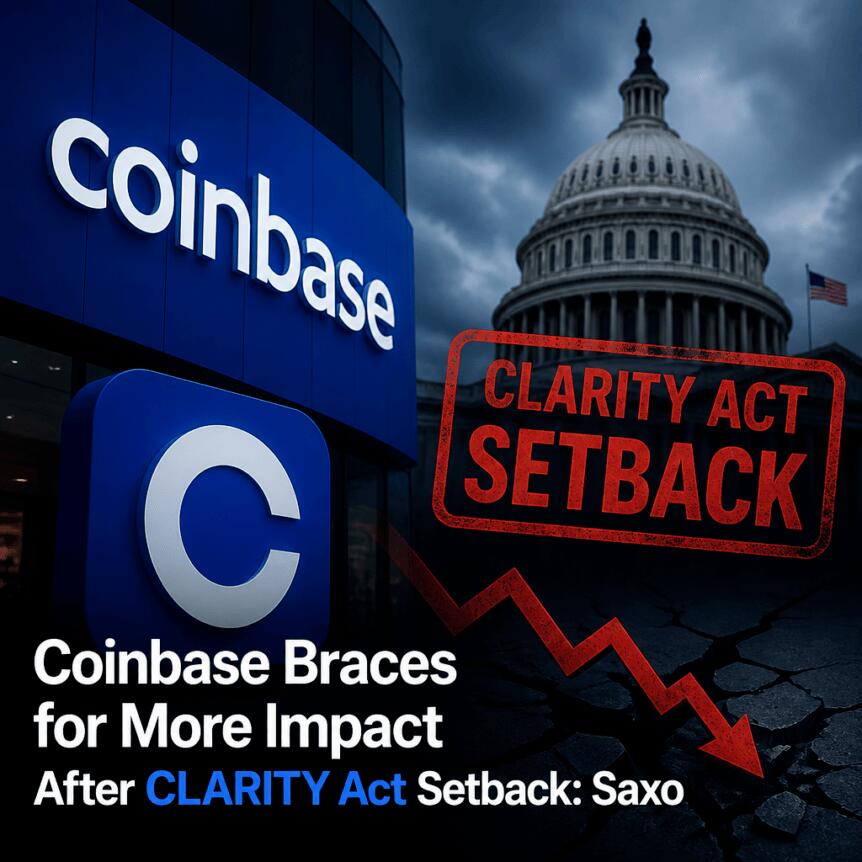
Crypto markets and crypto-adjacent equities slid sharply after the U.S. Senate failed to move forward on the Digital Asset Market Clarity (CLARITY) Act, dealing another blow to near-term prospects for comprehensive federal rules. The selloff extended beyond generic “risk-off” positioning, with investors focusing on which businesses would be most directly reshaped by any future market-structure legislation.
According to a Wednesday note from Saxo Bank strategist Ruben Dalfovo, Coinbase faces the highest regulatory exposure among the names that drew attention in the trading decline—because clearer rules around market structure could directly influence registration requirements and even shape who can participate in U.S. crypto markets, as well as which digital assets are eligible to be traded.
Key takeaways
- Saxo Bank says Coinbase is the most directly exposed to CLARITY-style market-structure rules, which could affect registration and trading participation in the U.S.
- Circle’s business links more closely to the adoption and usage of its USDC stablecoin, while Strategy is driven primarily by its Bitcoin holdings and financing setup.
- Shares of Coinbase, Circle, and Strategy fell after the Senate procedural vote failed to advance the CLARITY Act—despite differing underlying business models.
- CLARITY’s path forward this year has narrowed due to the Senate’s limited legislative calendar ahead of the Nov. 3 midterm elections and a Dec. 18 adjournment target.
Why Coinbase drew special attention
In the Saxo Bank note, Dalfovo argued that Coinbase’s revenue and business operations are tightly tied to the regulatory framework governing crypto trading. If market-structure rules are clarified, exchanges could see direct changes in how they meet compliance obligations—particularly around registration—and in what the rules ultimately allow platforms to offer.
“Coinbase is most exposed to clearer market rules because trading and crypto participation directly affect its business,” Dalfovo wrote.
This emphasis helps explain why investors reacted strongly to the Senate’s decision, even though the companies involved do not have identical exposure profiles. Where many holders of crypto-linked equities can be influenced by broader market sentiment, Dalfovo’s framing suggests Coinbase sits at the intersection of policy and day-to-day exchange operations.
Different exposures for Circle and Strategy
Saxo Bank’s breakdown also highlighted how regulatory outcomes can map unevenly onto different crypto-adjacent business models. Dalfovo characterized Circle (USDC issuer) and Strategy (a Bitcoin treasury company) as having distinct sensitivities to any legislation that may emerge.
Circle’s model, per Saxo, is more closely related to stablecoin adoption in the U.S.—including the use of USDC—and the income it earns on its reserves. In that sense, a clearer regulatory environment could matter indirectly through how confidently users and institutions adopt stablecoins, rather than through immediate exchange registration mechanics.
Strategy’s performance, by contrast, is primarily influenced by its Bitcoin holdings and the company’s financing structure. While broader regulatory certainty can affect Bitcoin sentiment and capital flows, Saxo’s view implies Strategy’s linkage is less about market-structure rules for trading platforms and more about the underlying asset and balance-sheet dynamics.
Stocks slide after CLARITY fails a key procedural vote
Following the Senate procedural vote on Tuesday, shares of the three companies—Coinbase, Circle, and Strategy—declined in the same general window even though their exposures differ. As Cointelegraph reported late Tuesday, the selloff saw each company fall between 5% and 10% after the vote.
Cointelegraph attributed the move to the fact that the Senate did not advance the CLARITY Act after lawmakers voted 49–50 against invoking cloture on a motion to proceed. The cloture motion is intended to limit debate and enable the Senate to move toward considering a bill on the floor, but it fell well short of the 60 votes required.
Early Wednesday, the decline continued. According to Yahoo Finance data referenced in the original reporting, Coinbase, Circle, and Strategy were each down roughly 2% to 6% in the opening session range.
CLARITY’s narrowing path and the ethics provisions sticking point
The Senate’s failure to advance CLARITY reflects more than scheduling friction. A major obstacle remained ethics-related provisions, according to the reporting, despite last-minute concessions intended to address concerns about public officials’ crypto interests.
The procedural setback significantly reduces the bill’s chances of revival within the current year. With the Senate facing a constrained schedule around the Nov. 3 midterm elections and targeting a Dec. 18 adjournment date, lawmakers have a relatively short window to reintroduce momentum on the legislation before the current Congress ends.
That timing constraint matters for investors because “policy uncertainty” often functions as a moving target: even if the underlying bill eventually returns, the delay can prolong the period in which firms operate without the clarity they would prefer on market structure, participation rules, and compliance expectations.
Readers following the equities trade around crypto regulation should also watch whether the ethics provisions remain a central point of disagreement. If they do, any future motion to bring CLARITY—or a revised version—forward could still face the same hurdle, regardless of broader industry support.
What to watch next
With the Senate’s calendar tightening and the ethics provisions still a focal contention, the next swing factor is whether CLARITY can be revived before the Congress concludes—and whether lawmakers can reach a compromise that satisfies both procedural requirements and lingering concerns over official crypto interests.


Payward has announced plans to bring on-chain perpetual futures to eligible U.S. clients through Hyperliquid’s HIP-3 infrastructure, using CFTC-regulated Bitnomial to deploy, clear and settle the proposed contracts.
Summary
- Payward plans regulated Hyperliquid perpetual markets for eligible U.S. clients, subject to regulatory approval first.
- Bitnomial would deploy, administer, clear and settle HIP-3 contracts under its existing CFTC-regulated infrastructure stack.
- NinjaTrader Clearing would carry client accounts, restricting access to users approved by both entities beforehand.
- Hyperliquid recorded nearly $237 billion in perpetual trading volume over thirty days, DefiLlama data shows.
- Payward reported 6.6 million funded accounts at June-end after launching regulated U.S. perpetuals through Bitnomial.
Payward, the parent company of Kraken, said on Sept. 16 that Hyperliquid would be the first blockchain protocol used for the initiative. The planned markets remain subject to regulatory approval and are not yet available for U.S. trading.
The proposal expands on Payward’s existing U.S. derivatives business. In its second-quarter 2026 financial update, the company said Bitnomial infrastructure already supports regulated U.S. perpetual futures and spot margin products. Payward reported 6.6 million funded accounts at the end of June, up 42% year over year.
Payward would put regulated markets directly on Hyperliquid
The planned structure differs from Payward’s existing U.S. perpetual futures because trades would use Hyperliquid’s public blockchain infrastructure.
Under Payward’s proposal, Bitnomial Exchange would act as the HIP-3 deployer. It would create, own and administer the perpetual markets while Bitnomial Clearinghouse handles clearing and settlement. Transactions would use Hyperliquid’s on-chain order book for matching and recording trades.
Hyperliquid’s official HIP-3 documentation says builder-deployed markets inherit HyperCore’s order books and margin system. Deployers control contract definitions, oracle prices, leverage limits and settlement procedures for the markets they create.
HIP-3 was originally designed as permissionless infrastructure. Hyperliquid recently introduced optional permissioning that lets market deployers restrict participation through on-chain allowlists. As crypto.news reported earlier this month, the feature was designed to support markets where regulatory or institutional requirements limit who can trade.
Payward plans to use that model for U.S. customers. Only traders successfully onboarded by NinjaTrader Clearing and included on the required NinjaTrader and Bitnomial allowlists would have access.
The arrangement would not give American customers unrestricted access to every market currently available through Hyperliquid. Bitnomial would determine which regulated products it deploys and administers under its exchange rules.
Bitnomial provides Payward’s CFTC-regulated stack
Federal records confirm that Bitnomial already holds the central registrations needed for Payward’s U.S. derivatives operation.
The CFTC designated Bitnomial Exchange as a contract market in 2020. The Commission’s current register continues to list the company as a designated contract market, or DCM. Bitnomial Clearinghouse is separately registered as a derivatives clearing organization. CFTC records state that it can clear futures, options on futures and fully collateralized swaps.
NinjaTrader Clearing would sit on the customer side of the proposed Hyperliquid structure. Its regulatory disclosures identify it as a CFTC-registered futures commission merchant and National Futures Association member under NFA ID 0309379.
The clearinghouse currently lists NinjaTrader Clearing among its clearing members. Payward acquired Bitnomial earlier this year. As crypto.news previously reported, the transaction gave the Kraken parent control of exchange, clearing and brokerage infrastructure for its domestic derivatives business. The acquisition had previously been valued at up to $550 million.
Kraken began offering perpetual futures to eligible American customers through Bitnomial in June. The initial setup brought perpetual contracts onto Kraken Pro alongside spot, margin and traditional futures products.
Payward’s latest plan would reuse parts of that regulated structure while moving execution of the proposed contracts onto Hyperliquid infrastructure.
Hyperliquid HIP-3 activity has grown rapidly
The proposal follows a sharp increase in trading through Hyperliquid and its builder-deployed markets. Current DefiLlama data for Hyperliquid show approximately $237 billion in perpetual futures volume over the latest 30-day period and around $45.5 billion over seven days. Cumulative perpetual volume stood above $5.3 trillion in the same snapshot.
The protocol’s HIP-3 system lets independent teams create markets using Hyperliquid’s trading infrastructure. A deployer currently needs to meet a 500,000 HYPE staking requirement to launch a mainnet perpetual DEX, according to Hyperliquid documentation.
Builder activity has extended past cryptocurrencies. HIP-3 markets have been used for products tied to equities, commodities and other financial assets.
TradeXYZ became the dominant HIP-3 operator during the second quarter. A Hyperliquid Research Collective report cited by crypto.news in September estimated that the venue processed $202.36 billion during the quarter and controlled 95.1% of HIP-3 trading volume. The figures came from independent researchers and were not audited financial results.
Payward said in its announcement that one existing HIP-3 operator accounts for around 98% of builder-deployed open interest. The company did not identify the venue by name in that statement.
CoinGecko’s 2026 State of Crypto Perpetuals report puts the size of the global market in context. Centralized perpetual exchanges handled $85.3 trillion of volume during 2025, while decentralized perpetual venues generated $6.38 trillion, up from $1.50 trillion in 2024.
CoinGecko calculated that average monthly volume among the 12 largest perpetual DEXs reached $611.57 billion during the first months of 2026.
U.S. clients would trade through approved accounts
The proposed Hyperliquid product would preserve traditional regulated-account controls even though market execution occurs on public blockchain infrastructure.
A U.S. customer would first need a futures account through NinjaTrader Clearing. The account would then need approval for the relevant Bitnomial market, while the associated address would have to appear on the permissioned HIP-3 access list.
Jon Pham, Payward’s head of U.S. derivatives, described the proposed setup as using the same clearinghouse that supports Payward’s existing American perpetual futures.
Arjun Sethi, Payward’s co-CEO, said the company intends for Bitnomial to hold the market keys and regulatory obligations. His remarks described the proposal as a way to connect public blockchain trading infrastructure with registered U.S. derivatives entities.
The plan is a more concrete version of discussions first reported in August. At the time, Hyperliquid and Payward were exploring a regulated U.S. route through Bitnomial, while Payward had presented the proposed structure to the CFTC.
A subsequent testnet upgrade supplied a technical component needed for such a structure. Hyperliquid introduced deployer-controlled allowlists for permissioned HIP-3 markets, letting operators determine which addresses could participate.
Earlier on-chain testing had already attracted attention. Crypto.news reported in August that a test deployment named “Kraken HIP-3 test DEX” had whitelisted 10 wallets and experimented with compliance-related controls. Kraken had not confirmed ownership of that test deployment at the time.
Regulatory clearance remains the next step
Payward has not announced a launch date for its Hyperliquid markets.
The company expressly described the planned on-chain contracts as subject to regulatory approval and said they would be listed under Bitnomial Exchange rules.
CFTC records reviewed for this report confirm Bitnomial’s existing DCM registration, Bitnomial Clearinghouse’s DCO registration and NinjaTrader Clearing’s FCM status. The records do not yet establish final regulatory clearance for the specific HIP-3 arrangement announced Sept. 16.
Bitnomial already lists regulated crypto perpetual products. CFTC market records include perpetual contracts tied to assets such as XRP, Stellar, Cardano, Tezos and Litecoin. The exchange separately has a HYPE/USD spot product, which should not be confused with Payward’s newly proposed Hyperliquid HIP-3 perpetual markets.
The HYPE spot contract was self-certified by Bitnomial earlier in 2026, with the exchange stating in its filing that the contract complied with the Commodity Exchange Act and relevant CFTC rules.
Payward said Hyperliquid would be the first protocol used for its planned U.S. on-chain perpetual markets and that it intends to make similar regulated infrastructure available for other partner products. No additional blockchain protocol or launch timetable was named in the Sept. 16 announcement.

Hong Kong targets stablecoin trading and tokenized real world assets

Under-fire FIFA boss Infantino to seek re-election despite calls to resign

Math Professor Accuses OpenAI of Copying His Work, Says AI Compute Power Makes Racing to Publish 'Pointless'



-

 Fashion6 days ago
Weekend Open Thread – Corporette.com
-

 Tech4 days ago
The Latest Weird Thing to Play Doom Is the Mapped-Out Brain of a Fruit Fly
-

 Business6 days ago
10 Most-Streamed Songs On Spotify In 2026 So Far, Led By Ella Langley’s Dominant Run On The Charts This Year
-

 Crypto World6 days ago
XAG/USD: Silver’s Short-Term Rally Meets Its Moment of Truth
-

 Crypto World7 days ago
2 Chip Stocks Broke Out This Week. Neither Was Nvidia
-

 Tech6 days ago
Battery life is the only iPhone 18 Pro and iPhone Duo upgrade I care about. Apple didn’t disappoint
-

 Crypto World6 days ago
Diesel Tops $6 a Gallon for the First Time as 28 States Set Records
-

 Crypto World6 days ago
OKX launches 10x OpenAI, Anthropic X-Perps in Europe
-

 Crypto World3 days ago
Elon Musk Drops a Bombshell: Grok 5 Could Be the AGI Breakthrough
-

 Business7 days ago
Western Digital Slips 2.7% as AI Storage Rally Cools After Record Cash and Guidance
-

 News Videos6 days ago
Facing Financial Fears
-

 Business4 days ago
Rivals Sam Altman and Elon Musk Rally Behind Dario Amodei’s Call for a Slowdown in AI Development
-
Crypto World6 days ago
Ethereum Price Analysis: Consolidation at $2.5K Tests Momentum as On-Chain Activity Surges
-

 Business7 days ago
Five Leading AI Experts Warn Superintelligence Could Kill Humans and Explain Their Case
-

 Crypto World5 days ago
Can AI Build a Startup in 72 Hours? Elon Musk's Team Will Livestream the Test
-

 Crypto World2 days ago
Kraken Lets xStocks Holders Earn Yield Through DeFi
-

 Crypto World7 days ago
Ant International joins Visa, Mastercard to build AI agent payment standards
-
 NewsBeat3 days ago
‘Sick conspiracy’: Trump says only guardrails AI needs is ‘a strong and smart (High IQ!) president’ in all-caps rant
-

 Crypto World6 days ago
Bitcoin ETFs Pull $167M as 2026’s Best Inflow Run Slows
-

 Crypto World6 days ago
US CPI forecast at 3.4% as tariff risks build
You must be logged in to post a comment Login