











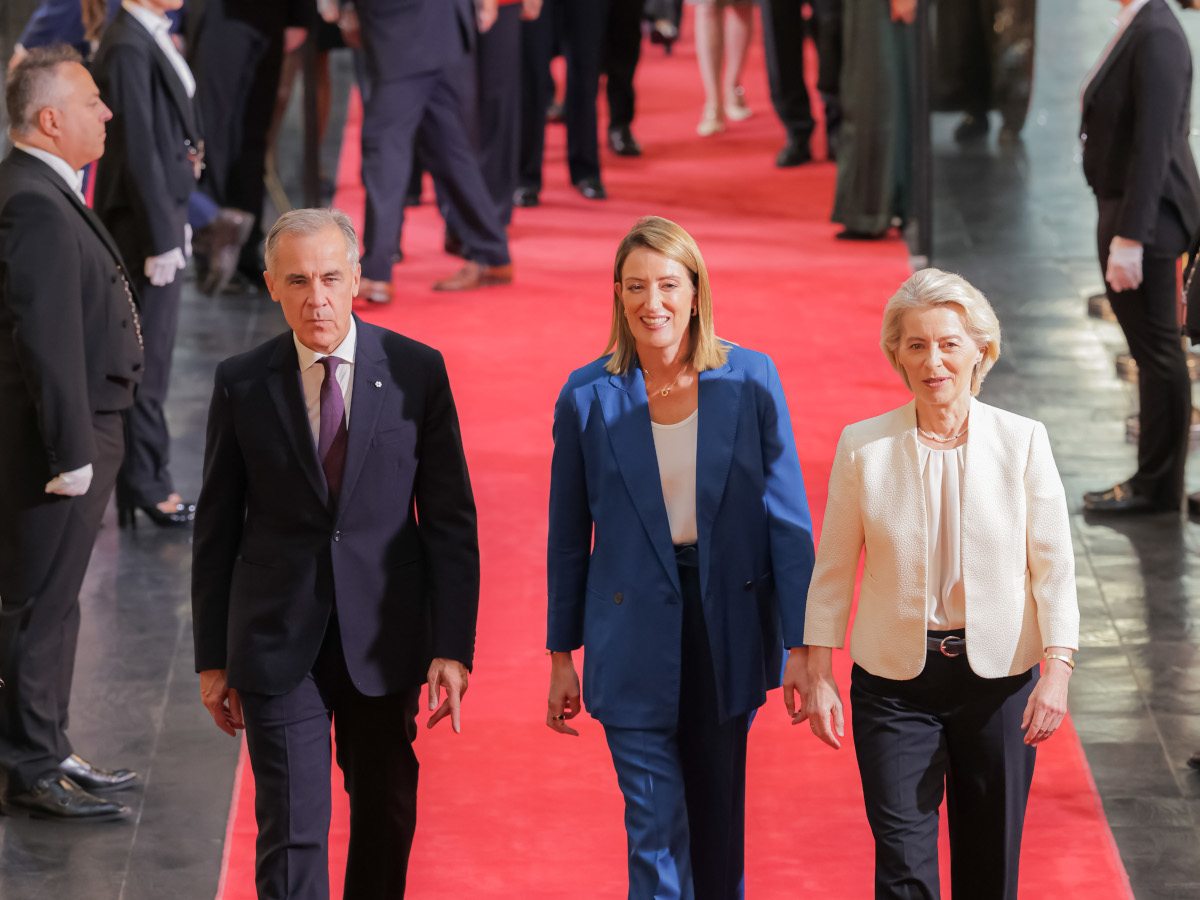

Big Tech does not decide rules, Ursula von der Leyen says, announcing plans to restrict social media usage for minors.
In her State of the Union speech today (16 September), European Commission president Ursula von der Leyen announced the EU Kids Act, a legislative proposal that intends to ban social media for children under 13.
The law takes a tiered approach to social media and video sharing platforms for minors in the bloc, proposing fully guardian-controlled accounts for children between 13 and 15, and a mandatory safe design for all accounts for under-18s.
“What we are witnessing is a great capture of our children. A capture of their attention, their focus, their minds. This is depriving children of their childhood,” von der Leyen said.
Child safety on social media has taken centre stage in recent years as parents and lawmakers grapple with the reality of an increasingly dangerous online landscape, worsened by the proliferation of technology and services such as generative AI and online prediction markets.
Governments across the world are banning popular platforms for younger minors in a bid to shield underage users from their provable harms.
Australia became the first one to ban social media for under-16s last December, though a recent study showed that eight in 10 Australian teens and preteens continued to use social media despite the complete prohibition by their government.
Meanwhile, Brazil rolled out a new law that mandates parentally-controlled accounts for under-16s, and several more countries, including Greece, Germany, Indonesia, Malaysia and Canada, are debating their own restrictions.
Last month, France’s top court blocked a proposed bill that would have banned social media for under-15s, arguing that the legislation was too broad and could infringe upon young people’s freedom of expression.
With the EU Kids Act, the Commission also wants to standardise access to social media across the bloc as part of a major government overhaul aimed at cutting red tape. If the act is passed, France’s under-15s, for example, would still be able to use these platforms.
Limiting access to social media, meanwhile, is only a part of the problem. “Children are pulled ever deeper into feeds designed to keep them scrolling,” von der Leyen said, calling algorithms the “great capture of our children”.
She added: “We do not have to accept addictive features. We do not have to accept children being drawn into ever more extreme content. We do not have to accept that girls have their photos used for AI-generated sexualised images.”
Earlier this year, the bloc greenlit a provisional deal to ban AI systems that generate non-consensual sexually explicit and intimate content or child sexual abuse material.
“Platforms will have to prove that they are safe. Because it is not about our minors accessing social media. It is about when and how do we allow social media to access minors,” von der Leyen continued.
The bloc is also introducing a new Digital Fairness Act this autumn that will aim to tackle addictive features on platforms.
“I am aware that many perceive the power of Big Tech as overwhelming and impossible to roll back. I disagree,” the president said. “Europe has the power to act. It is we who decide our rules, not Big Tech.”
US president Donald Trump, an avid critic of the EU’s strict rules, reportedly considered imposing sanctions on the EU for using its Digital Services Act against US technology heavyweights.
Don’t miss out on the knowledge you need to succeed. Sign up for the Daily Brief, Silicon Republic’s digest of need-to-know sci-tech news.


















































You must be logged in to post a comment Login