
Crypto World
Bitcoin Treasuries Add Only 5,900 BTC in 3 Months Amid Paper Losses

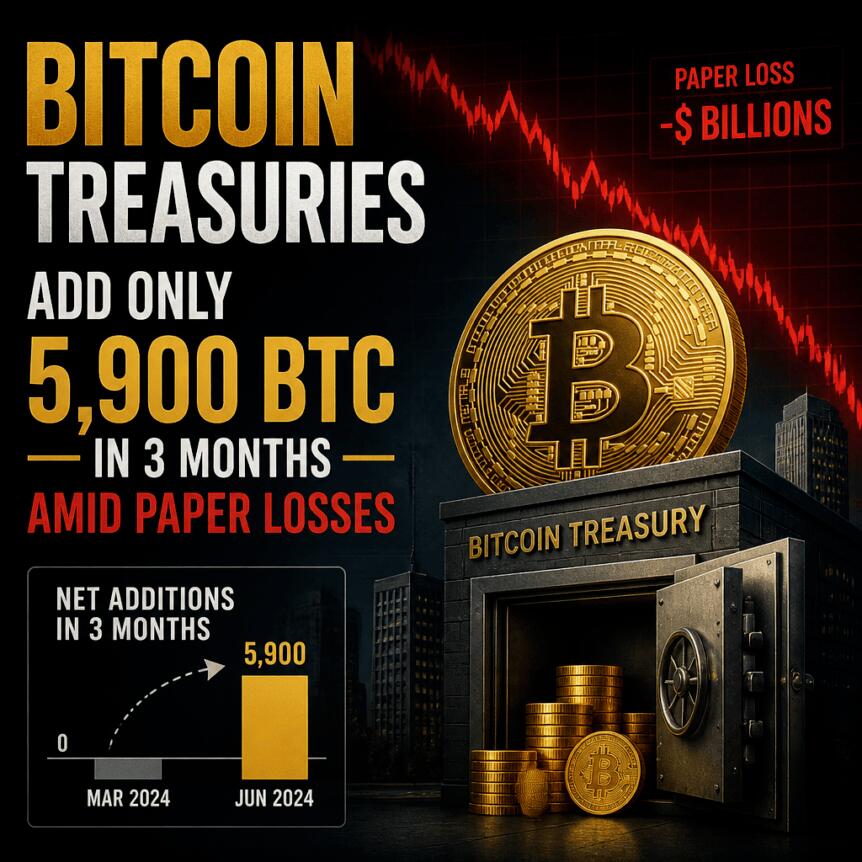
Corporate Bitcoin treasuries appear to be losing momentum, according to new on-chain analysis that suggests many current holders are still trading at a loss and new buying is not strong enough to offset that overhang. Glassnode data indicates listed companies acquired only a small fraction of the BTC they were purchasing during peak activity in mid-2025, while the group’s blended cost basis remains above current spot levels.
The result is a market where treasuries are less able to “support” price from the margin: if buyers have stopped accumulating and their positions are still underwater, the existing holdings function more like overhead supply than an active demand driver—at least for now.
Key takeaways
- Glassnode reports listed corporate treasuries added about 5,900 BTC in 2026 over roughly three months—far below the scale of purchases seen in July 2025.
- For existing corporate holders, the aggregate corporate treasury cost basis averages around $80.5K, keeping the cohort roughly 6% under water versus spot.
- Glassnode says 2026 has featured two attempts to reclaim that cost basis, but both failed as price could not stay above the level.
- ETF flows have turned negative again, with US spot Bitcoin ETFs recording net outflows of $462.7 million in the five trading days through Sept. 11.
- Glassnode frames current conditions as a “market in waiting,” pointing to weakening demand signals in realized cap.
Corporate buys shrink as treasuries stay underwater
In 2026, listed companies have accumulated approximately 5,900 BTC, Glassnode said, citing its “FlowsNetCompanies” treasury flow charts. The number is presented as notably small relative to acquisition intensity during July 2025, when companies bought around 89,000 BTC even while BTC/USD was trading above $100,000.
That contrast matters because it highlights a shift in corporate behavior: rather than continuing to add at a pace that could meaningfully change the supply-demand balance, many buyers appear to be waiting for clearer price confirmation. Glassnode notes that current treasuries have not yet normalized into a profitable position.
In the latest edition of its newsletter, The Week Onchain, Glassnode stated that the “Corporate Treasury Cost Basis” for existing holdings sits at about $80.5K—roughly 6% above spot—meaning the group is collectively underwater.
Glassnode also emphasized that 2026 has only produced two efforts to reclaim that cost basis, and both attempts were unsuccessful due to price failing to hold above the target level. The analysis argues that a buyer that has paused purchases while remaining in a paper loss is not acting as active support.
“A reclaim of $80.5K would put the treasuries back in profit and remove one layer of overhead supply; until then their entry is one more ceiling.”
Strategy’s pace slows, but it remains a dominant holder
While corporate demand is depicted as broadly muted, not every company has stopped buying entirely. Business intelligence firm Strategy—widely cited as holding one of the largest corporate Bitcoin treasuries—made its most recent purchase at the end of August, adding 4,603 BTC. The purchase is described by earlier reporting from Cointelegraph as the company’s first acquisition in two months.
Even with that incremental addition, Strategy’s broader position still reflects the same macro reality: Glassnode data cited in the report places the cost basis of Strategy’s 845,050 BTC holdings at $75,412. That figure is below the average corporate cost basis referenced for the overall treasury cohort, but the wider point remains that corporate accumulation is not currently acting as a steady, price-anchoring flow across the sector.
Why Glassnode calls it a “market in waiting”
The slowdown in corporate purchases is occurring alongside shifting macro and investor-risk conditions. Glassnode frames the current state as consistent with broader caution in the crypto market, where uncertainty about BTC’s forward strength tends to suppress incremental buying.
This caution was echoed in US policy developments: on Wednesday, the US Federal Reserve implemented its first interest-rate hike since July 2023, according to Cointelegraph’s coverage. Rate-hike cycles typically tighten financial conditions and can weigh on liquidity-sensitive assets, which helps explain why demand for Bitcoin products can become more reactive to short-term price moves.
One way to measure that sensitivity is through spot Bitcoin ETF flows. Earlier coverage from Cointelegraph noted that US spot Bitcoin ETFs saw net outflows of $462.7 million across five trading days through Sept. 11. The report also states this reversed a sequence of three consecutive weeks of net inflows, reinforcing the idea that near-term risk appetite has cooled.
Glassnode links these ETF and broader market patterns to what it calls a “market in waiting.” It further adds that Bitcoin’s realized cap—defined in crypto analytics as the cumulative price at which the supply last moved on-chain—has begun to fall as of Sept. 15. A decline in realized cap is interpreted as weaker demand at prevailing prices, suggesting fewer participants are willing to establish new cost anchors higher up the curve.
In the analysis, realized cap is cited at around $1.069 trillion. Glassnode’s interpretation is conditional: a return to positive daily realized cap changes would indicate that buyers are coming back and supporting prices. Conversely, outflows while BTC trades below the mean would suggest that “range’s buyers” are beginning to give up.
For investors and traders, this matters because the “ceiling” described for treasuries and the “waiting” posture described via realized cap both point to the same dynamic: demand is not being expressed aggressively at current levels. When both corporate accumulation and ETF-based flows soften, the market can become more dependent on narrow pockets of buying rather than a broad, continuous bid.
“A return to positive daily Realized Cap changes would say the buyers are back; a run of outflows while price sits under the mean would mean the range’s buyers have started to give up,” Glassnode concluded.
What to watch next in corporate and on-chain demand
The key question now is whether corporate treasuries and wider market participants will resume accumulating strongly enough to change the balance between overhead supply and fresh demand. Glassnode’s framework implies that reclaiming the corporate treasury cost basis near $80.5K could reduce that overhead layer—but it also notes that previous attempts in 2026 failed to hold.
Heading into the next trading weeks, readers should watch for two confirmations: sustained ETF inflows (rather than brief reversals) and signs that realized cap is stabilizing or turning upward again. Together, those signals would better indicate whether the “market in waiting” is easing—or whether the current pause in corporate buying will continue to weigh on sentiment.

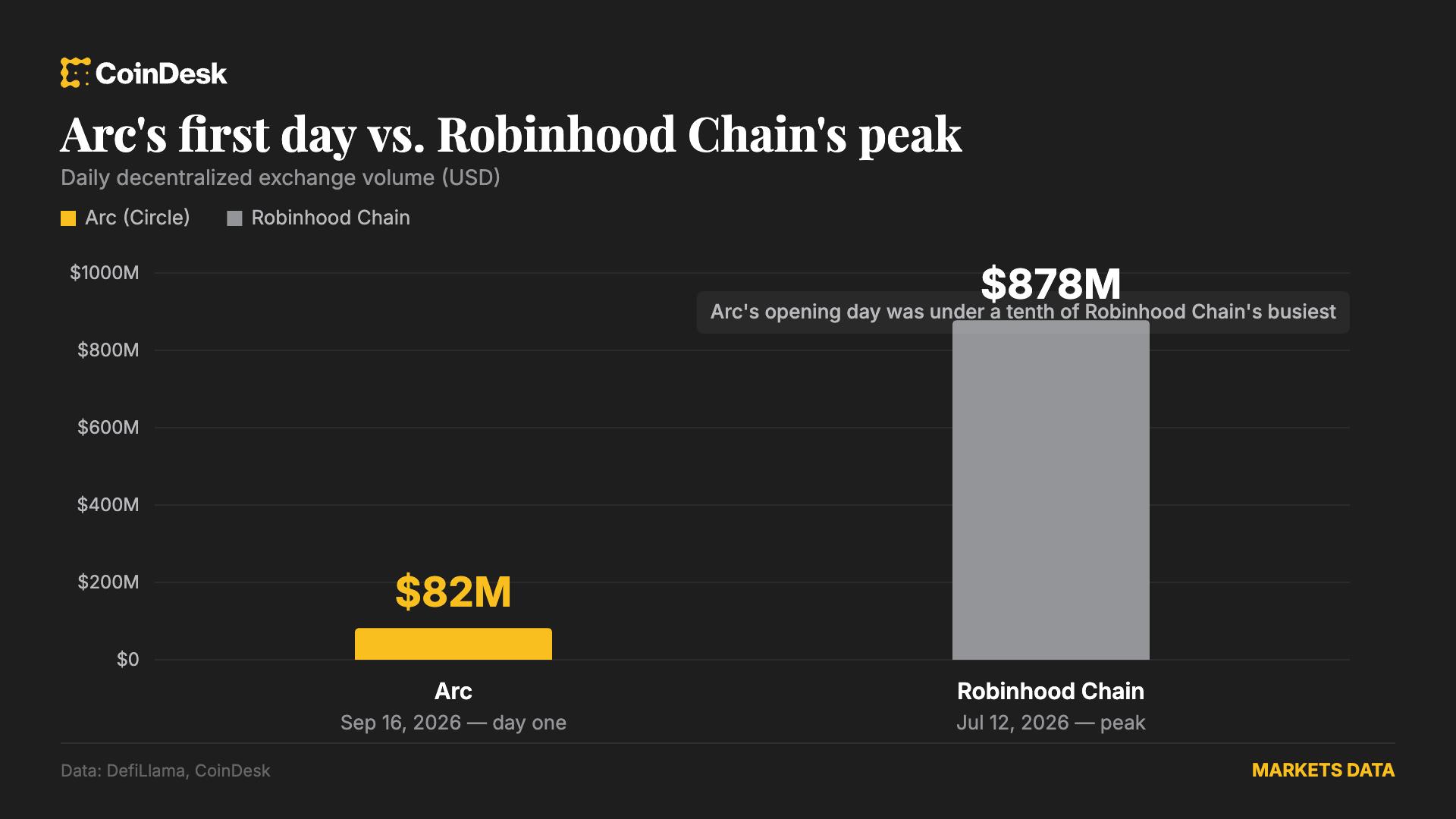
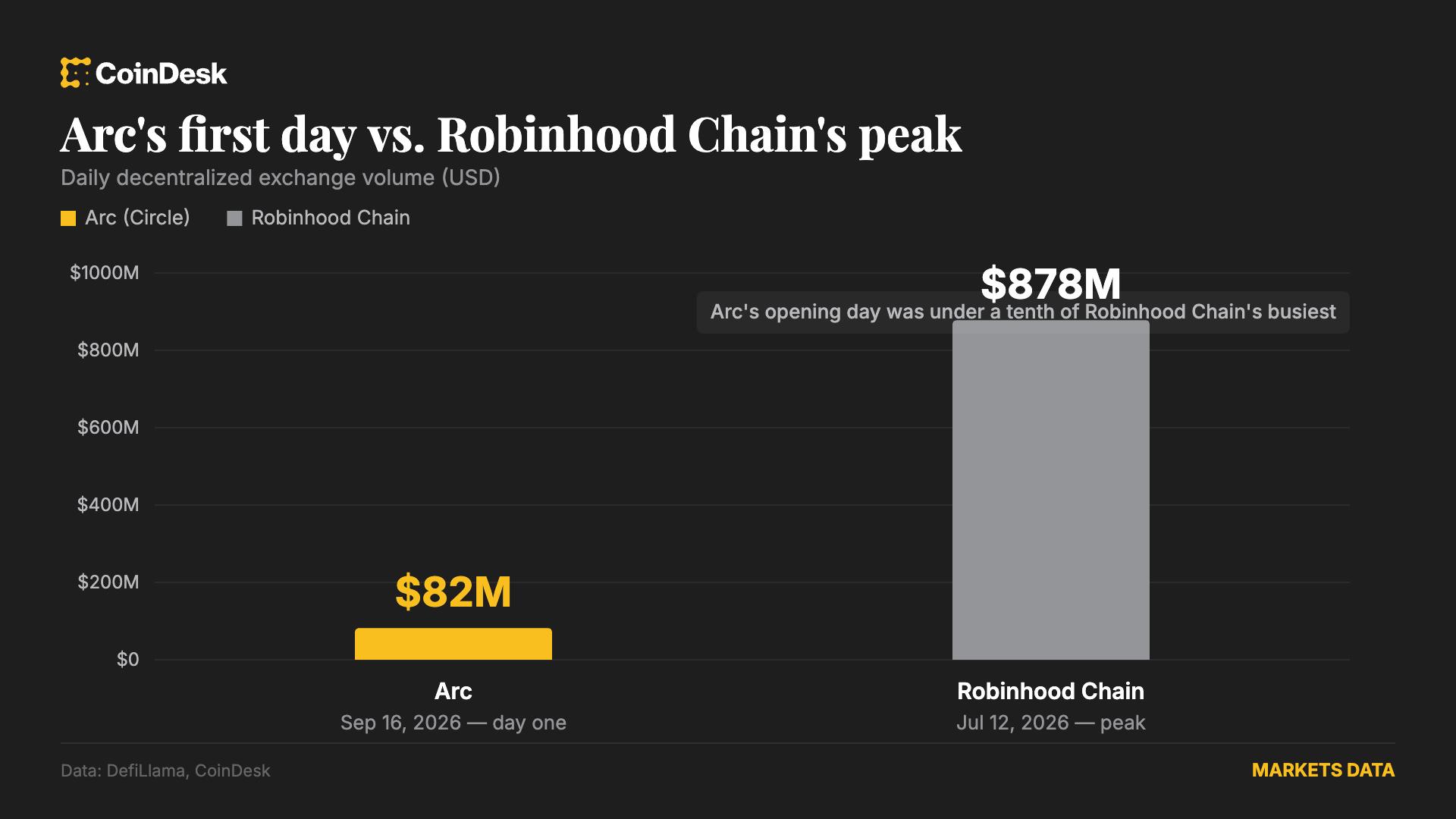
Day-one DEX volume on Arc finished at around $82 million, compared with the $878 million Robinhood Chain did on July 12, when its own institutional pitch was overtaken by memecoins and a cat token briefly hit a $156 million market cap. Arc’s largest token, ARGUS, is worth $16 million. Its second- and third-largest are cirBTC and EURC — Circle’s own products.
The sharper criticism is that Circle invited this. Rachel Mayer, Circle’s VP of product for Arc, posted an AI-generated image promoting DUKE, a memecoin, writing that it was Allaire’s dog. The post drew about 1 million views and a wave of hostile replies accusing Circle of shilling tokens to bootstrap its own network.
“You can clearly see a lot of their team fundamentally misunderstands meme culture,” wrote Abbas Khan. “Now it’s stuck in this weird middle ground where nobody really knows whether it’s supposed to be a meme chain or a corporate stablecoin chain.”
Circle did not immediately respond to a request for comment.
The chain itself is performing as designed, with half-second blocks being processed with no congestion, and DeFi platforms like Aave and Morpho live. But waning sentiment has led to feelings of frustration from the memecoin crowd, despite speculative token activity driving most of the day-one volume.
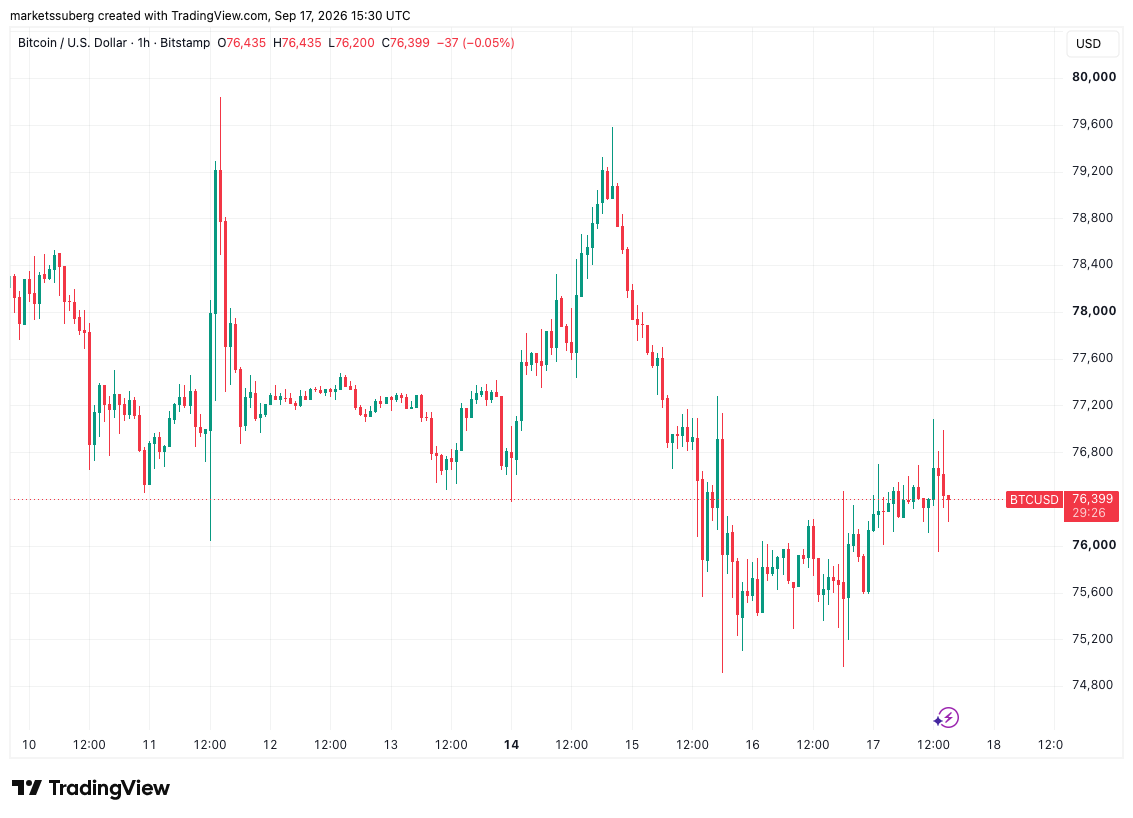
Bitcoin (BTC) traded near $76,500 after Thursday’s Wall Street open as investors snapped up US stocks following their recent dip.
Key points:
- Bitcoin consolidated after dropping below $76,000 on the back of a 0.25% interest-rate hike by the US Federal Reserve.
- US equities rebounded, with the Nasdaq Composite Index gaining 1.5% as analysis saw upside continuation.
- Bitcoin price analysis retained its bullish slant on market conditions, with CryptoQuant’s Bull Score Index circling 60/100 on Thursday.
Bitcoin halts losses as US stocks turn green
Data from TradingView showed that BTC price volatility was cooling over the last 24 hours, with only modest moves to take nearby liquidity.
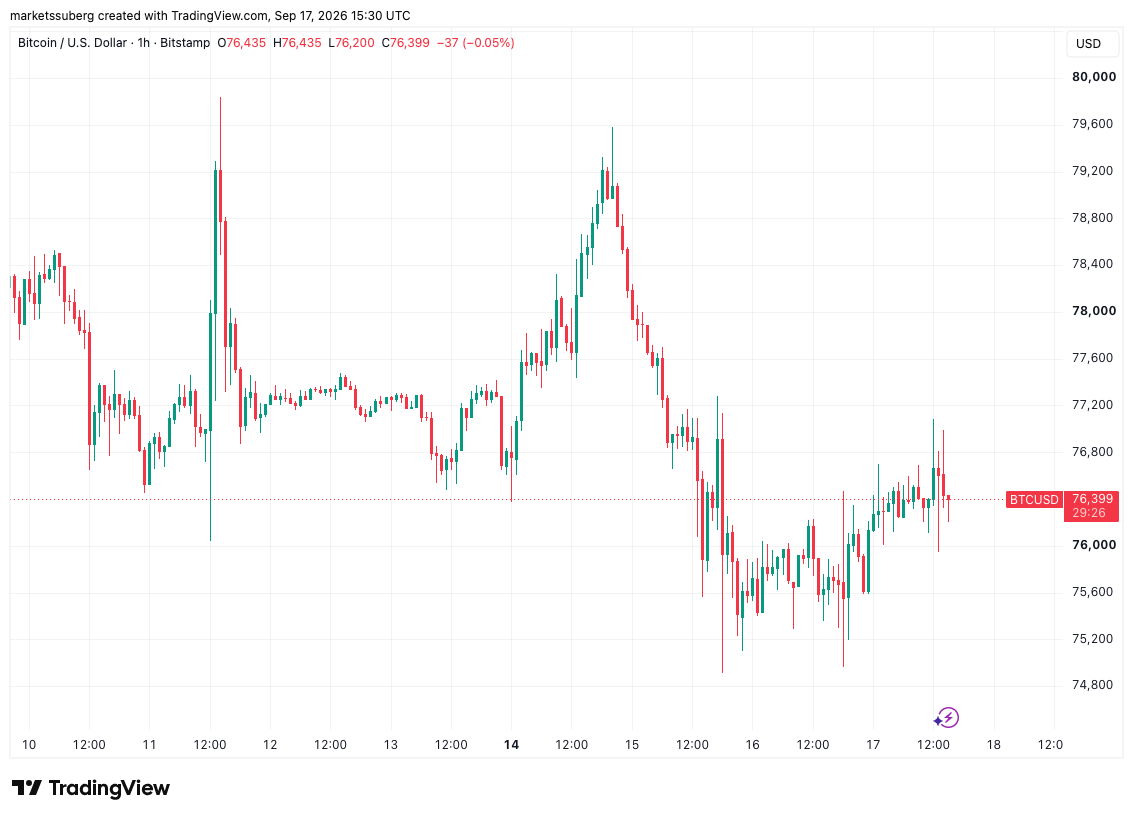
BTC/USD one-hour chart. Source: Cointelegraph/TradingView
Data from CoinGlass showed both bid and ask liquidity thickening around the current spot price, a typical feature of rangebound trading conditions.
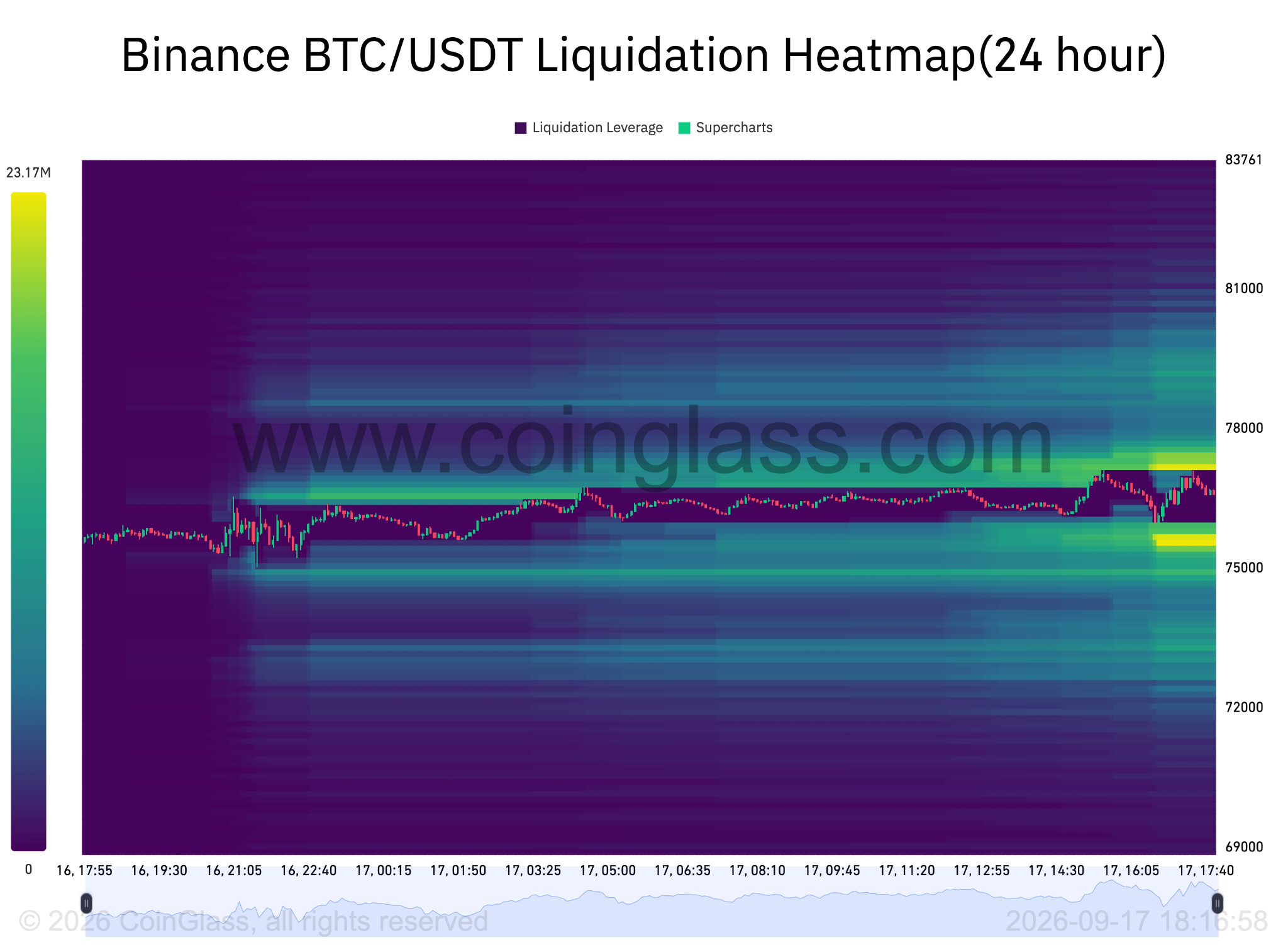
BTC/USDT liquidation heatmap (Binance). Source: CoinGlass
US equities gained on the day, as investors sought to capitalize on the local downside that followed policy tightening by the US Federal Reserve. The S&P 500 Index and tech-heavy Nasdaq Composite Index gained 0.9% and 1.5%, respectively.
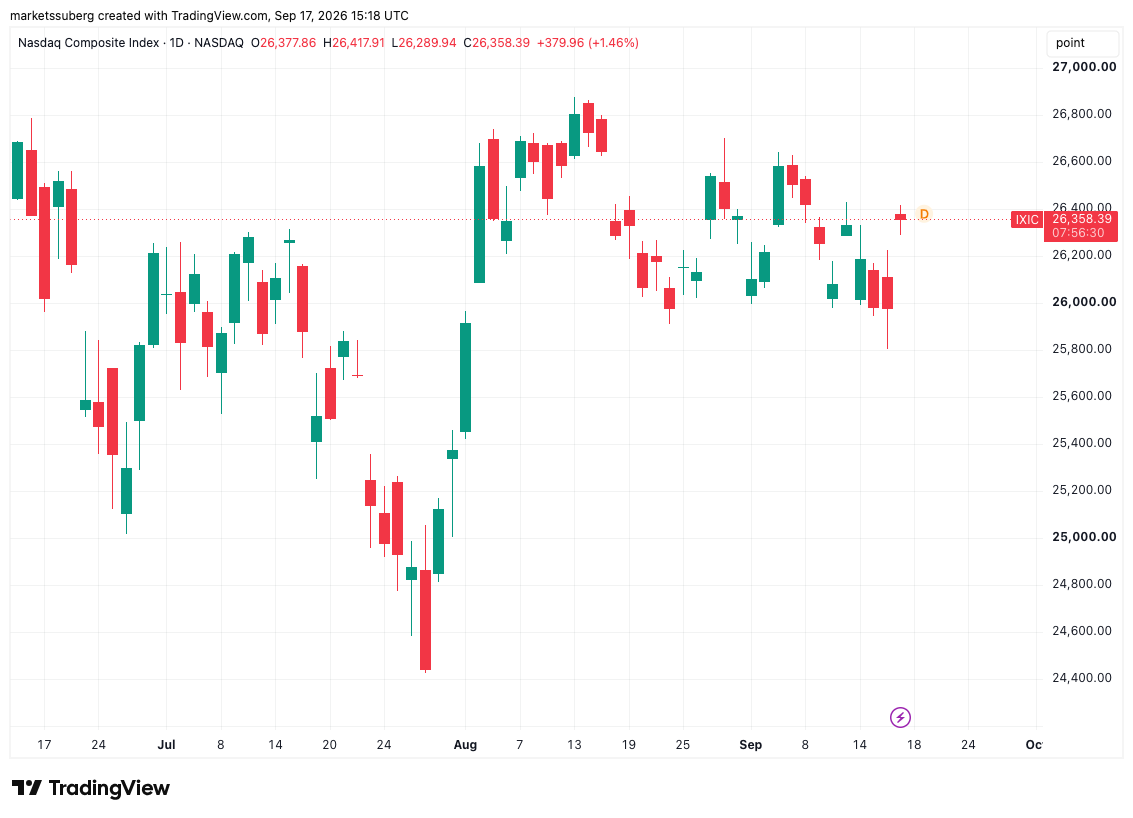
Nasdaq Composite Index one-day chart. Source: Cointelegraph/TradingView
On Wednesday, the Fed voted to increase benchmark interest rates by 25 basis points to 3.75-4%. This was its first hike since July 2023, and signaled an end to three years of easing in which the Fed either cut rates or held them in the same range between meetings.
Commenting, trading resource The Kobeissi Letter suggested that assets would continue to perform strongly despite the prospect of lower-liquidity conditions associated with the rate hikes. As Cointelegraph reported, central-bank rates are notching higher globally, as the European Central Bank hiked by 0.25% last week and the Bank of Japan is expected to follow suit on Friday.
“The asset owner economy just keeps getting better,” it wrote in a post on X, referencing the day’s gains in the Nasdaq.
Analysis sees BTC price trend “cooling, not turning”
Bitcoin also enjoyed relief after falling to new month-to-date lows on Tuesday. At the time of writing, BTC/USD traded 0.5% higher on the day.
Related: Bitcoin treasuries buy just 5.9K BTC in three months as paper losses linger
Commenting on the current market landscape, onchain analytics platform CryptoQuant described macro conditions as a hurdle to the continuation of Bitcoin’s previous rebound that totaled 25% in August.
“The trend is still bullish, but momentum and macro are working against it near-term,” head of research Julio Moreno wrote in its latest weekly report sent to Cointelegraph.
Moreno noted that one of CryptoQuant’s proprietary indicators tracking BTC price cycles, the Bull Score Index, had dropped from 80 to 60 — the cut-off point for what it describes as “bullish conditions.”
“Bitcoin is cooling, not turning. A Bull Score of 60 keeps the trend bullish, but fading US demand, rising altcoin inflows, and a week of macro risk — the delay of the CLARITY Act and a likely Fed hike — argue for consolidation. Watch $70K and $62K–$65K as support,” the report summarized.
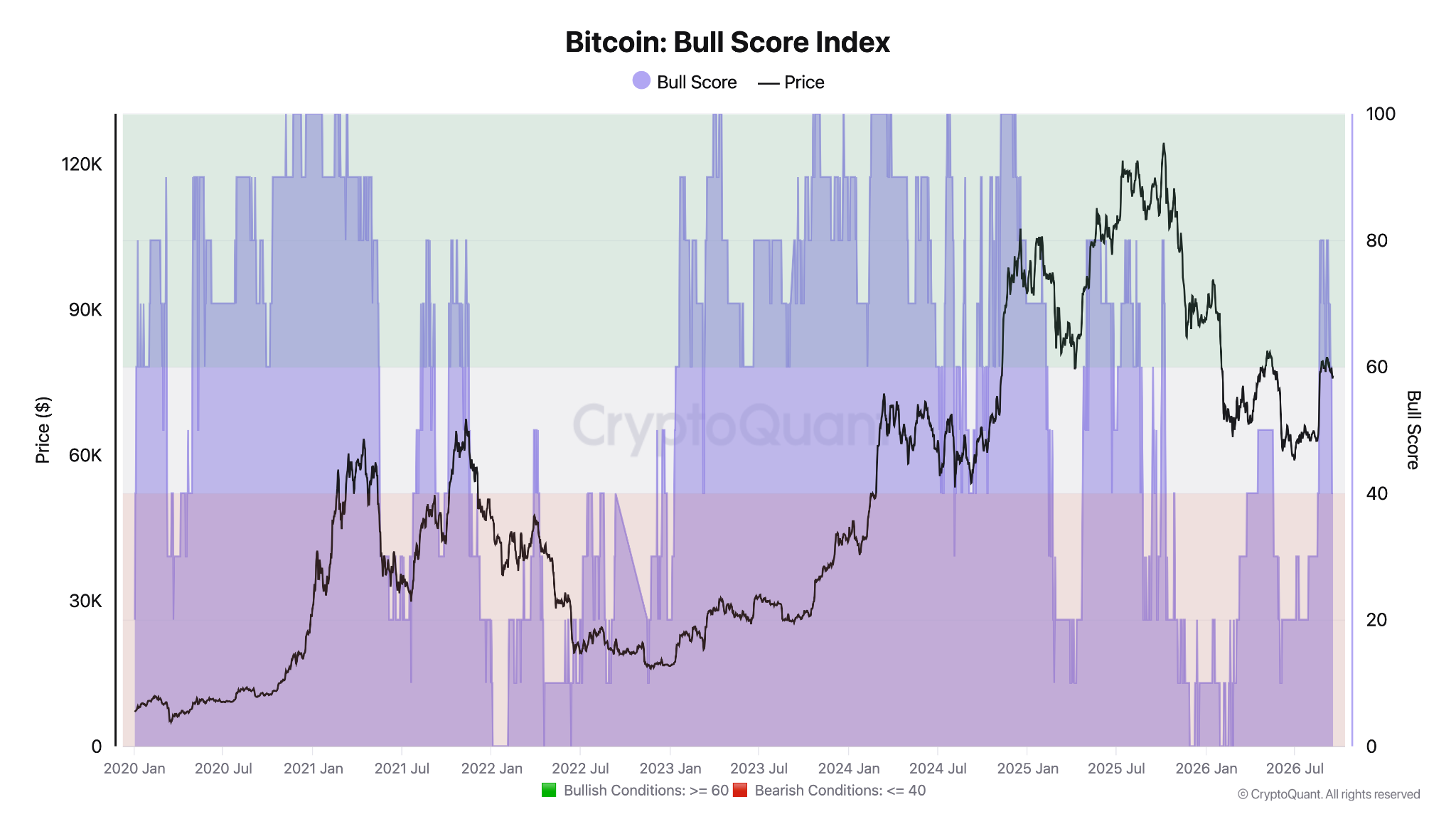
Bitcoin Bull Score Index. Source: CryptoQuant

Ethos Technologies (LIFE), today’s IBD 50 Stock To Watch, highlights the significance of having sound sell rules to preserve gains in stocks that make short-term rallies. The price action by the insurance play since the company’s Jan. 29 initial public offering illustrates why. Initially, the online platform for insurance products did not get off to a bullish start following its…
Copyright ©2026 Investor’s Business Daily, LLC. All rights reserved. 87990cbe856818d5eddac44c7b1cdeb8
Fortitude Mining has appointed former Hut 8 CEO Jaime Leverton as chief executive as the Zcash-focused miner prepares to go public through a proposed merger with HeartSciences. Leverton will succeed Andrea Childs as CEO on Sept. 21, with Childs moving to chief operating officer.
Fortitude mined 72,696 ZEC in the first half of 2026, accounting for about 28% of the network’s total production during the period. The company reported revenue of $20.9 million for the second quarter.
It operates more than 60 megawatts of power capacity across seven sites in South Dakota, Nebraska, Texas and New York, and in July agreed to purchase 9,000 Bitmain Antminer Z15 Pro machines, which are expected to add 7.56 GSol/s of equihash hashrate. Shipments are expected in the fourth quarter.
Fortitude, wholly owned by Digital Currency Group, has mined ZEC since 2019 and launched as a vertically integrated mining platform in 2025.
The company announced its proposed combination with HeartSciences in June, with the transaction expected to close in the fourth quarter of 2026 and bring Fortitude to the public markets. The combined company is expected to trade on Nasdaq under the ticker TUDE, subject to approval.
Leverton previously served as CEO of Hut 8, where she oversaw the Bitcoin miner’s merger with US Bitcoin Corp. and its transition into a US-domiciled Nasdaq-listed company. Current CEO Andrea Childs will transition to the chief operating officer role.
Related: Cypherpunk launches Zcash mining fleet controlling 18% of network hashrate
Zcash surges amid Paradigm investment
Zcash continued its rally on Thursday, with ZEC, the native token of the blockchain designed to enable private transactions using zero-knowledge proofs, trading around $1,424. The token has gained about 185% over the past 30 days and more than 2,600% over the past year, according to CoinGecko.
The latest gains came after Paradigm co-founder Matt Huang disclosed Wednesday that the crypto investment firm holds ZEC and is an investor in the Zcash Open Development Lab.
Huang described Zcash as a “private complement to Bitcoin” and backed its inflation-funded developer fund, arguing that long-term funding for privacy technology is increasingly important as artificial intelligence and quantum computing advance.
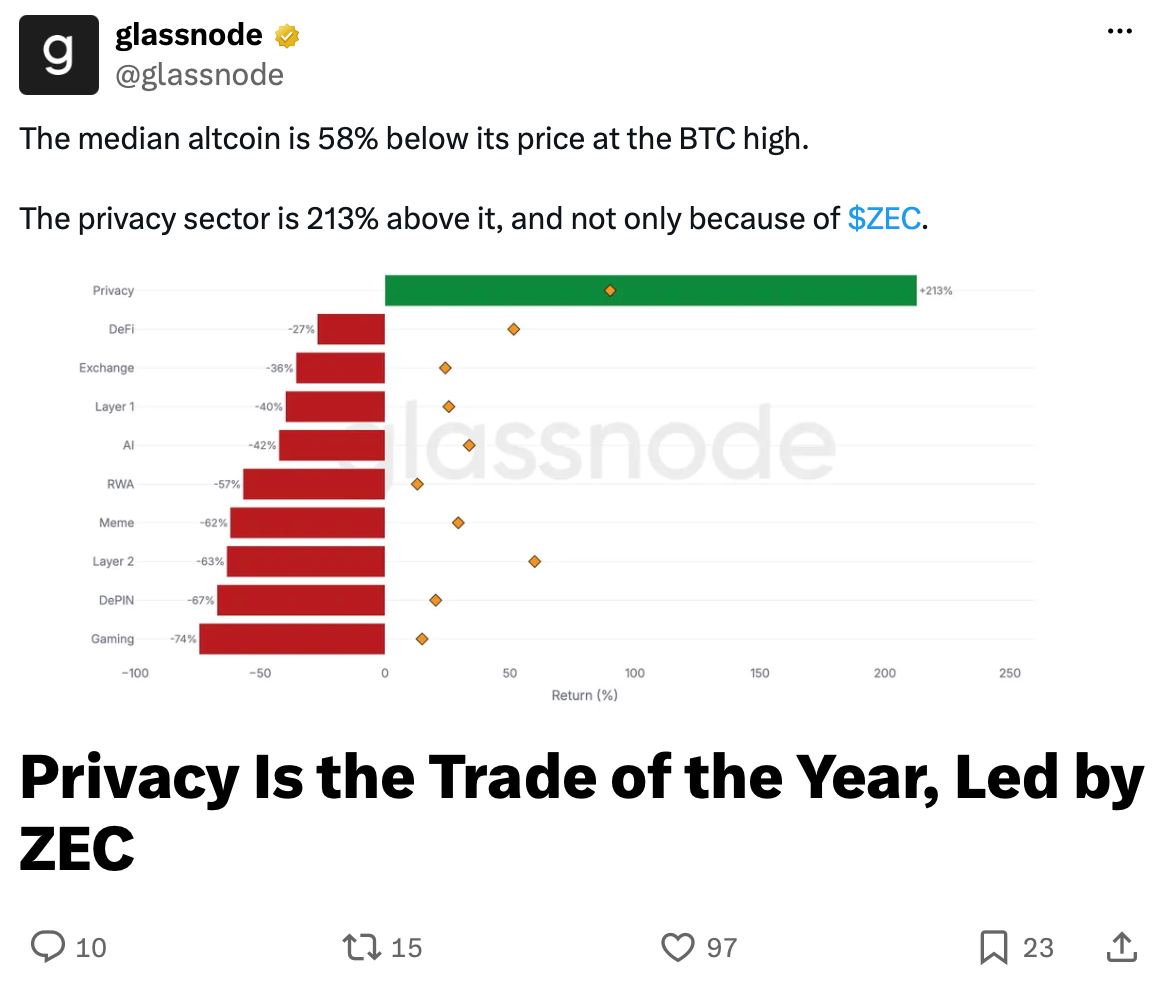
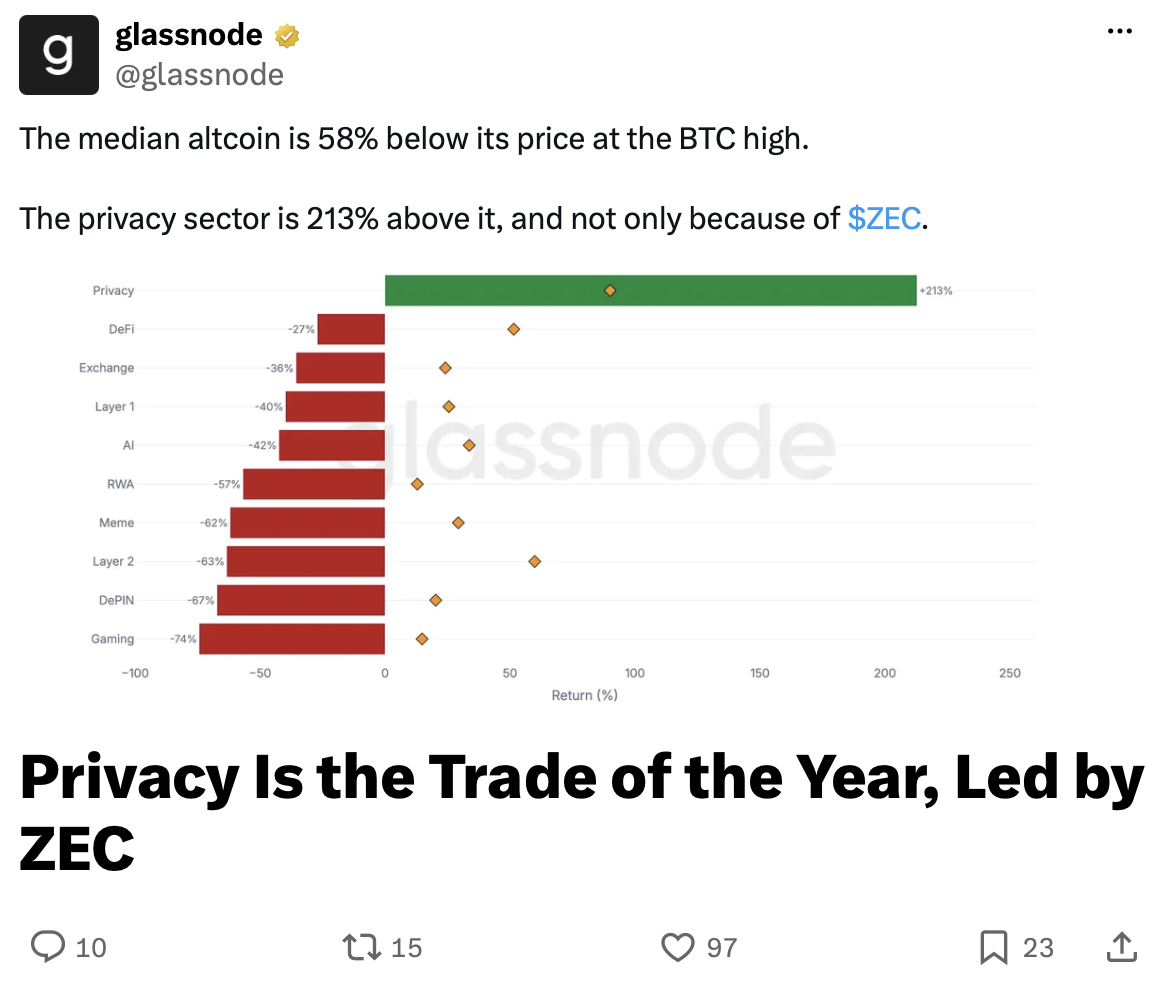
Over the past year, privacy-focused cryptocurrencies have outperformed the broader crypto market. As of Sept. 6, the sector was up 213% from Bitcoin’s October 2025 peak, while every other crypto sector tracked by Glassnode remained below its level at the time.
ZEC accounted for 62% of the privacy sector’s market capitalization, according to Glassnode data. Excluding ZEC, the firm’s cap-weighted basket of privacy tokens was still up 85% over the past year.
Source: Glassnode


The CLARITY Act failed to clear a Senate cloture vote on September 15, falling short of the 60 votes needed to advance the crypto market structure bill.
The measure remains procedurally open after Sen. Thom Tillis moved to reconsider the vote. Digital Sovereignty Alliance managing director Adrian Wall said another attempt could be considered before the current Congress ends.
He did go on to characterize that prospect as complicated and a long shot. Following the failed vote on Tuesday, prediction markets such as Kalshi now show just an 8% chance of it passing before January 1, 2027.
What are the Key Takeaways from the Failed September 15 Cloture Vote?
The September 15 cloture vote on H.R. 3633 did not reach the 60-vote threshold required to move the bill forward in the Senate. Congress.gov records that Tillis moved to reconsider the vote, which did not invoke cloture on the motion to proceed.
Wall said senators from both parties are considering another effort to advance the legislation before the current Congress concludes.
His assessment does not mean another vote will occur, but it does indicate that the legislation has not been treated as finished after the unsuccessful cloture vote.
What Is Wall Hearing From Senators?
Wall said Wednesday that he had spoken directly with senators from both parties who were considering another push on crypto regulation before lawmakers adjourn.
He made the comments on Cointelegraph’s Chain Reaction show and said the information came from senators rather than congressional staff.
The comments followed Tuesday’s failed Senate cloture vote, which left the bill short of the votes needed to proceed. Wall described the vote as a major setback but said it did not necessarily mark the end of the legislation.
The Digital Sovereignty Alliance is a nonprofit advocacy group that works with lawmakers and regulators on digital asset policy. Tillis’s motion to reconsider means the Senate has recorded a procedural step related to the failed vote.
The motion does not itself set a date for another vote, and Wall’s comments describe a possible renewed effort rather than a confirmed Senate schedule.
Wall’s Assessment of the Latest CLARITY Act Drama
Wall indicated that there is interest in advancing the legislation during Congress’s lame-duck session. However, he cautioned that the process would be challenging, complicated, and remain a long shot.
According to Wall, senators from both parties have discussed a strategy to engage with one another to assess whether there is a final opportunity to move the bill forward.
This reflects Wall’s perspective on discussions with senators, but it does not confirm any scheduled votes or provide a vote count.
DISCOVER: The Best Token Presales
What Happens Next in the CLARITY Act Story
The post-election lame-duck session is the period Wall identified for a possible second attempt at the CLARITY Act. No subsequent Senate vote is identified in the available reporting.
If another attempt in the lame-duck session fails, Wall said the next Congress could continue work on crypto market structure legislation.
For now, H.R. 3633 remains at a procedural stage following the failed cloture vote and Tillis’s motion to reconsider. Any renewed effort, based on Wall’s assessment, would be difficult and require further Senate action.
The bill’s near-term path, therefore, depends on whether lawmakers pursue the possibility Wall described during the lame-duck session.
Earn $50 and Enter $300K Prize Draw on EdgeX
The post Senate Setback Leaves CLARITY Act Facing Long-Shot Revival appeared first on Cryptonews.
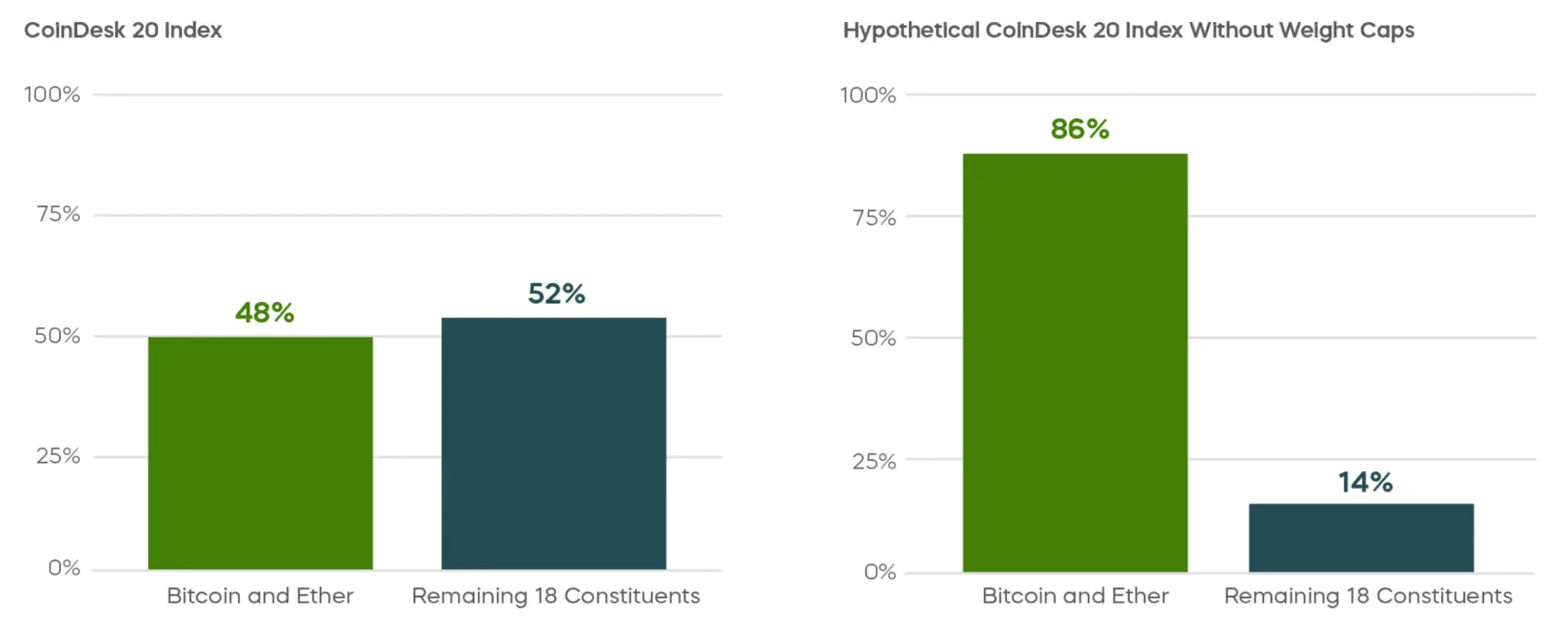
Importantly, the index is designed not only to provide broader exposure across the crypto market, but also to limit concentration in its largest assets. Bitcoin and ether represent a large share of total crypto market capitalization, meaning a traditional market-cap-weighted index would be dominated by those two assets.
The CoinDesk 20 Index addresses that concentration through a modified market capitalization weighting methodology. The index applies:
· 30% cap on the largest constituent
· 20% cap on all other constituents
These caps limit concentration in a single crypto asset and allow other major cryptocurrencies to play a larger role in the index.

Left: Source: CoinDesk, as of June 30, 2026. Right: ProShares hypothetical calculation using the CoinDesk 20 Index constituents, weighted by market capitalization without the index caps, as of June 30, 2026. For illustrative purposes only.
Without these caps, the index would largely reflect the performance of bitcoin and ether alone. By limiting concentration in the largest assets, the CoinDesk 20 Index creates more balanced exposure across a wider set of cryptocurrencies.
There is also a practical consideration. Building similar exposure directly would require an investor to purchase, custody and periodically rebalance a relatively large number of individual crypto assets. The infrastructure surrounding crypto custody has improved considerably, but holding multiple cryptocurrencies can still require navigating different exchanges, wallets, custody arrangements and operational considerations. An index-based approach can simplify that process while maintaining exposure to changes occurring across the broader market.


“I believe that tokenization holds the potential to help the securities industry achieve a real-time inventory management, which could drive efficiency, reduce settlement failures, mitigate the risk of abusive naked short selling, with the goal of eliminating that possibility altogether,” Atkins said. “Therefore, I’ve asked the staff to consider what steps can be taken to dovetail a growth-friendly environment with protections against harmful market behavior.”
Moving the U.S. securities markets beyond their weekday, daytime tradition will involve significant adjustments, Atkins and other SEC commissioners admitted, though Commissioner Hester Peirce noted, “Crypto markets certainly don’t sleep.”
Peirce said that firms may be concerned that expanding their trading hours may contribute to wider spreads, increased volatility of prices, less time to deal with technology issues and making sure the transactions are properly monitored.
“These concerns are the real consequences of extending trading into hours when human involvement is limited,” Peirce said, adding that companies may also be worried about overnight drama such as “social media rumors tanking your stock while your corporate office slumbers.”
But the SEC is steaming toward the expansion, and Atkins said that “several needed preparations are already underway or in place.”

The Senate failed to advance the CLARITY Act on September 15, with the crypto market-structure bill falling to a 50-49 vote, 10 short of the 60-vote threshold needed for cloture, according to the embedded Reuters report. Two days later, the SEC announced a temporary Innovation Exemption designed to let eligible tokenized crypto stocks trade more widely in the U.S.
— U.S. Securities and Exchange Commission (@SECGov) September 17, 2026
 TODAY: The SEC issued an order granting temporary, conditional exemptive relief to Tokenized Securities Venues from the definition of “exchange” in the Exchange Act to trade tokenized NMS stock using innovative permissioned automated market makers and liquidity pools. pic.twitter.com/VDi7Oty2d9
The CLARITY Act sought to build a comprehensive regulatory framework for digital assets. Its failure effectively put the bill on ice, with Congress preparing to leave Washington ahead of the November midterm elections. The timing makes any near-term revival uncertain, as detailed in this breakdown of the stalled vote and its path back to the floor.
The SEC’s announcement followed two days later, addressing crypto versions of stocks. The decision is one that could open the door to on-chain trading of tokenized equities becoming widely available in the U.S. for the first time. SEC Chairman Paul Atkins issued a statement titled “Statement on the Innovation Exemption: A Bridge Toward Durable Rulemaking” just now.
That distinction matters for traders parsing what actually changed. A temporary exemption issued under existing statutory authority is not the same instrument as durable legislation passed by Congress, and the SEC’s own framing acknowledges that gap rather than papering over it.
Earn $50 and Enter $300K Prize Draw on EdgeX
How Does the Industry Read the SEC Crypto Decision?
With the bill stalled, the SEC and CFTC are now positioned to fill the policy void through existing regulatory tools. Coinbase CEO Brian Armstrong said in a social media post that the CLARITY Act’s failure to advance was a disappointment, but added that the SEC and CFTC have the tools they need to create clear rules under existing authority and that he expects work on this to begin in earnest.
Industry experts cited in that report caution that only Congress can create a lasting regulatory framework, a caveat worth holding onto given how quickly administrative rules can shift with political winds or face court challenges. The Innovation Exemption is best read as a possible interim route for tokenized stocks.
Trade XRP on Bybit and Get a Chance to Win Our $1,000 USDT Airdrop
What Happens Next?
Thom Tillis switched his vote from yes to no in a procedural move that preserves his ability to bring the CLARITY Act back for reconsideration later. With Congress set to depart for the midterm recess, the bill’s near-term prospects remain uncertain.
On the regulatory side, the SEC has characterized its exemption as a bridge toward eventual durable rulemaking rather than an endpoint. Traders should watch two threads in parallel: whether Tillis or other allies revive the legislative push after the election, and how the SEC’s temporary framework for tokenized stocks evolves as the agency gathers data from early participants.

For now, Bitcoin remains under pressure after its recent decline, with traders watching whether BTC can reclaim the $76,000–$78,000 area and stabilize above key support. With macro “uncertainty” and shifting rate expectations still driving sentiment, BTC is likely to remain volatile until the market gets a clearer directional catalyst.
Discover: The Best Token Presales
The post Crypto Tokenized Stocks Gain a Temporary SEC Pathway After Senate Setback appeared first on Cryptonews.


The U.K.’s Financial Conduct Authority (FCA) said Thursday that it conducted actions to crack down on three illegal peer-to-peer crypto trading locations in London in a sign the regulator is ramping up enforcement activity as the country’s legal framework for crypto comes closer to implementation.
The financial watchdog, which said the crackdown was a joint effort with HM Revenue & Customs (HMRC) and London’s Metropolitan Police, said it issued cease-and-desist letters at the three premises, requiring traders to stop participating in illegal crypto businesses. Peer-to-peer trading occurs when individuals buy and sell crypto directly with each other, an activity that needs to be legally registered in the U.K.
“There are currently no FCA-registered peer-to-peer crypto businesses operating in the U.K.,” the FCA said. “By operating outside the FCA’s registration regime, they avoid controls designed to detect and prevent money laundering,” the agency said.
The action signals that the era of “light-touch” crypto regulation in the U.K. is ending, said Caroline Black, a consultant at Gherson Solicitors LLP.

BEIJING — The Chinese artificial intelligence startup behind the Kimi model said Thursday that financial industry giants, including investment banks, funds and venture capital firms are using its Kimi models on AI tools.
Among the companies now using Kimi are investment bank CICC and venture capital firms such as Sequoia China, now rebranded as Hong Shan.
It’s part of Beijing-based Moonshot’s announcement Thursday that it was launching Kimi for financial services — a sign of how AI companies are pursuing real-world, commercial applications.
Kimi users can directly access information commonly used for analysis and reports, thanks to a number of industry data partners such as S&P Global Market Intelligence, Crunchbase, Wind, local financial news leaders and business database Tianyancha, according to Moonshot.
The startup said Kimi can also directly access the U.S. Securities and Exchange Commission’s EDGAR system for public companies’ financial filings, the IMF, World Bank and the U.S. Federal Reserve Economic Data site (FRED).
While users don’t have to download a separate interface, a test on Kimi’s mobile app indicated different kinds of data were available to different users depending on subscription tier.
Subscriptions to Kimi start at 49 yuan ($7.31) a month, and can go up to 699 yuan ($104.23).
“The real inflection point really is the combination of stronger AI capabilities with professional expertise,” Samuel Fischer, Beijing branch manager at Deutsche Bank, said in a promotional video published by Moonshot on Thursday. “AI companies that understand real financial workflows and can deliver reliability and data security will be particularly well positioned to contribute to this transformation.”
“AI can now organize and compare this kind of information, identify inconsistencies, and support initial analysis,” he added.
It was not immediately clear whether Deutsche Bank was a client. The bank did not immediately respond to a request for comment.
The Kimi K3 model, released by Moonshot in July, competes with models from leading U.S. companies.
The Chinese startup has reportedly filed confidentially for a Hong Kong IPO. The company, however, has said it does not comment on market rumors or speculation.

Wizz Financial Office Transformation | 25,000 Sq. Ft. Workspace by Creatabar

When prepping for disaster, don’t forget to pack your teddy bear
Kalshi leads prediction market with 76% share in NFL week 1



-

 Fashion6 days ago
Weekend Open Thread – Corporette.com
-

 Tech4 days ago
The Latest Weird Thing to Play Doom Is the Mapped-Out Brain of a Fruit Fly
-

 Business6 days ago
10 Most-Streamed Songs On Spotify In 2026 So Far, Led By Ella Langley’s Dominant Run On The Charts This Year
-

 Crypto World6 days ago
XAG/USD: Silver’s Short-Term Rally Meets Its Moment of Truth
-

 Tech7 days ago
Battery life is the only iPhone 18 Pro and iPhone Duo upgrade I care about. Apple didn’t disappoint
-

 Crypto World6 days ago
Diesel Tops $6 a Gallon for the First Time as 28 States Set Records
-

 Crypto World7 days ago
OKX launches 10x OpenAI, Anthropic X-Perps in Europe
-

 Crypto World3 days ago
Kraken Lets xStocks Holders Earn Yield Through DeFi
-

 News Videos6 days ago
Facing Financial Fears
-

 Crypto World3 days ago
Elon Musk Drops a Bombshell: Grok 5 Could Be the AGI Breakthrough
-

 Business4 days ago
Rivals Sam Altman and Elon Musk Rally Behind Dario Amodei’s Call for a Slowdown in AI Development
-
Crypto World7 days ago
Ethereum Price Analysis: Consolidation at $2.5K Tests Momentum as On-Chain Activity Surges
-

 Crypto World17 hours ago
US Charges Robinhood Engineers Over Crypto Listing Trades
-

 Crypto World5 days ago
Can AI Build a Startup in 72 Hours? Elon Musk's Team Will Livestream the Test
-

 Entertainment6 days ago
News Specials, Movies, Shows, More
-
 NewsBeat3 days ago
‘Sick conspiracy’: Trump says only guardrails AI needs is ‘a strong and smart (High IQ!) president’ in all-caps rant
-

 Crypto World7 days ago
Bitcoin ETFs Pull $167M as 2026’s Best Inflow Run Slows
-

 Crypto World7 days ago
US CPI forecast at 3.4% as tariff risks build
-

 Crypto World6 days ago
Robinhood Chain Never Stopped But its Blobs Did Stop Reaching Ethereum For 14 Minutes
-
 Entertainment6 days ago
New Horror Movie Officially Earns a Rare Stephen King Recommendation
You must be logged in to post a comment Login