
Crypto World
S&P Global to Buy Smart Contract Security Company OpenZeppelin



S&P Global is set to acquire the blockchain security company OpenZeppelin, expanding the financial data, ratings and benchmark provider’s digital asset capabilities.
The deal announced on Thursday is aimed at complementing S&P Global’s risk assessment and ecosystem development capabilities in the digital asset market, it said. Financial terms were not disclosed, and the transaction remains subject to closing conditions.
“Our digital assets strategy centers on bringing trusted data, benchmarks and transparent risk assessment to markets as they move onchain,” S&P Global ratings president Yann Le Pallec said. He added that OpenZeppelin would expand his company’s smart contract and onchain technology risk assessment capabilities.
Founded in 2015, OpenZeppelin develops open-source smart contract software and provides security assessments for blockchain projects and financial institutions. Its smart contracts have facilitated more than $37 trillion in value transferred, while the company has completed over 900 security engagements, the announcement notes.
OpenZeppelin said its contracts library and other open-source applications will remain free and publicly maintained on GitHub. The platform will operate as a separate S&P Global business unit, with CEO Demian Brener continuing to lead while reporting to Le Pallec.
Earlier this week, S&P Global led a strategic investment in Kaiko, extending the Paris-based crypto market data provider’s Series B funding to $110 million as it expands its data infrastructure for tokenized financial markets.
Related: Circle to acquire Tazapay to expand USDC cross-border payments

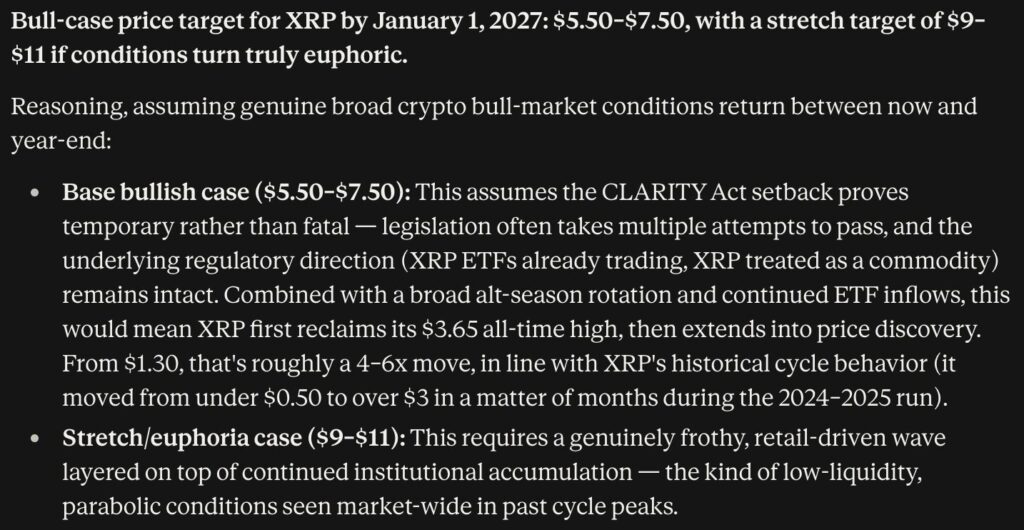
In welcome news for the Ripple army, Anthropic’s Claude AI predicts XRP could hit $11 by the end of 2026 if certain conditions are met. The update comes as CoinGecko data shows XRP trading at $1.30, up a modest +0.4% over 24 hours but down -6.6% for the week, following a significant drop after the Senate blocked the CLARITY Act.
Despite this, XRP is up around +30% in the last month and 57% over the past year, with an all-time high of $3.65. Its market cap stands at approximately $81.4Bn. Positive developments include ongoing inflows into spot XRP ETFs and Ripple’s stance that XRP is a digital commodity.

Bull-case price targets for XRP by January 1, 2027, are $5.50–$7.50, with a stretch target of $9–$11. This assumes the CLARITY Act setback is temporary and will return to bull-market conditions.
In this instance, it could help XRP reclaim its all-time high and initiate price discovery. A stretch case would require a retail-driven market flourish alongside institutional accumulation.
Earn $50 and Enter $300K Prize Draw on EdgeX
Claude AI Predicts $10+ for XRP in 2026: Does the Technical Analysis Support It?
$XRP has lost the $1.30 8hr support floor, flipped into a bearish supertrend, and formed a deathcross. There is a possibility of turning the $1.30/36 region into resistance on the next bounce. FIB support on the golden ratio sits at $1.21 if further spillover continues #NFA —
 pic.twitter.com/l30VlMOUkr
 ChartNerd
  (@ChartNerdTA) September 16, 2026
XRP’s chart shows a sharp, news-driven drop this week that pushed price down to around $1.28 before a modest recovery, a pattern of high volatility around binary regulatory events that’s been a recurring feature of XRP’s price action all year.
The key downside level is the $1.25 area (this week’s low), which needs to hold to keep the broader uptrend structure intact; a break below it would open room toward the $1.00 psychological level.
On the upside, the immediate resistance is the $1.50 zone, which capped price before this week’s drop, followed by the $2.00–$2.70 range (2025 highs) as the next major hurdle.
The most important level overall remains the $3.65 all-time high; XRP has never sustained trading above it, so a decisive breakout there would put price into undiscovered territory with no historical overhead resistance, typically the condition under which XRP has made its fastest moves historically.
Volume and ETF flow data are the tell to watch: the fact that ETF inflows continued even through this week’s regulatory selloff is a mildly bullish divergence, i.e., selling pressure came from spot/leveraged traders reacting to news, not from the ETF investor base.
Also, a resumption of strong net inflows alongside expanding spot volume would be the clearest signal that the bull case here is back on track.
Worth being direct about the caveat: this week’s CLARITY Act failure is a real, live headwind, not a hypothetical one; it directly increases regulatory uncertainty for exactly the kind of institutional adoption this bull case depends on, and further legislative delays or a genuinely negative outcome would undermine the scenario substantially.
The whole $5.50+ range assumes that the setback gets resolved constructively (an eventual re-vote or alternative legislative path) alongside broader bull-market conditions returning.
Supercharge Your Trading in 2026 With BloFin AI Trading Bots
Bitcoin Hyper Targets Early Mover Upside as Bitcoin Tests Key Levels
Bitcoin Hyper is improving network visibility. — Bitcoin Hyper (@BTC_Hyper2) September 15, 2026


Better observability helps the team track performance, understand transaction flows, identify issues earlier, and refine the ecosystem as it grows.
Read the full article https://t.co/PHfiR1IOFq pic.twitter.com/J6vKOUg1VP
A near -7% weekly drop plus $10M in liquidations confirms what the range-bound chart has hinted at for weeks: conviction is thin, and XRP at its current market cap needs a genuinely new catalyst to move meaningfully, not just a relief bounce.
For traders seeking asymmetric upside while Ripple chops sideways, attention is shifting toward earlier-stage infrastructure plays built on the Bitcoin base layer.
Bitcoin Hyper (HYPER) is building the first Bitcoin Layer 2 with SVM integration, aiming to process transactions faster than Solana while inheriting Bitcoin’s base-layer security.
The presale has raised over $33M at a token price of $0.0136863, with a huge 35% staking reward live at launch for early participants.
Its Decentralized Canonical Bridge targets low-cost, low-latency BTC transfers, solving the slow, non-programmable Bitcoin problem that’s dogged the network for over a decade.
Gain Access to New Bitcoin Layer 2 Early Here Make Your Prediction Count With $25 For Free on Kalshi
The post Anthropic Claude AI Predicts an Explosive Finish to 2026 for XRP appeared first on Cryptonews.


Aurora Intents has added Sui as a destination for one-signature cross-chain transactions, extending access to a solver network that Aurora Labs says has routed more than $30 billion.
Summary
- Users can fund and complete actions on Sui from supported external chains with one signature.
- Intents Connect removes separate bridging, wallet switching and SUI gas management from the process.
- NEAR Intents supplies the liquidity, settlement system and chain connections behind the service.
- Sui applications can use the integration for lending, trading, staking and yield-based products.
In a Sep. 17 press release shared with crypto.news, Aurora Labs said its Intents Connect product can now route supported assets from other blockchains directly into applications built on Sui.
Rather than leaving users with bridged funds in a Sui wallet, the system can deliver the assets into a completed position. Depending on the application, a transaction could end with the user lending an asset, entering a trade, or depositing funds into a yield product.
The company said users do not need to open a separate bridge, change wallets, or obtain SUI tokens to manage network fees. Intents Connect handles the process through the application the user already has open, while NEAR Intents provides the underlying liquidity, settlement, and connections between chains.
Aurora Intents turns transfers into completed Sui actions
Cross-chain services often focus on moving a token from one blockchain to another, leaving the user to complete the remaining steps. According to Aurora Labs, about three-quarters of the applications it speaks with need more than asset delivery because their users arrive intending to stake, lend, or trade.
Intents Connect is designed to bundle the transfer and the requested on-chain action. A user begins with an asset on a supported source chain, approves the transaction once, and receives the intended position on Sui without arranging each step separately.
For example, Aurora Labs said a Solana user depositing USDC into a Sui protocol would previously have needed to move between two wallets, bridge the funds, and buy SUI for gas. Through the new integration, the user can authorize the full process inside the Sui application with one signature.
Sui’s design required additional work because it does not use the Ethereum Virtual Machine model followed by many other chains supported by cross-chain products. Its object-based programming system, address format, and transaction structure differ from Ethereum-compatible networks.
Aurora Labs CEO Declan Hannon said Sui is only the second non-Ethereum-style blockchain supported by the service after Solana.
“We chose Sui because the engineering challenge is exactly what makes this integration meaningful,” Hannon said.
Hannon added that supporting Sui as a destination allows Intents Connect to handle its technical differences for users while giving developers access to funds held on other networks.
Sui applications gain access to external liquidity
For developers, the integration creates a route from wallets on supported chains into Sui-based products without requiring each application to build separate bridging and execution systems. Aurora Labs said one Intents Connect integration can make an application accessible to users and assets across every network supported by the service.
NEAR Intents coordinates the system through a solver network. Solvers compete to satisfy a user’s requested outcome, while the infrastructure manages liquidity and settlement across the connected blockchains.
Aurora Labs reported that the network has routed more than $30 billion to date. The company did not provide a Sui-specific volume figure or identify the first applications using the new destination support.
The added connection arrives as Sui developers build more lending products for retail and professional users. In August, crypto.news reported that NAVI Protocol had launched NAVI Prime, an on-chain lending framework made for funds and other professional market participants.
At the time, DefiLlama tracked approximately $124.6 million in total value locked across the NAVI Protocol group, including NAVI Lending, Volo LST and Volo Vault. Active loans stood at about $65.8 million, while supported lending assets included SUI, USDC, USDT, wrapped Ether and wrapped Bitcoin.
Sui’s stablecoin infrastructure has also expanded. The Sui Foundation said USDsui entered mainnet in March 2026 through Bridge’s Open Issuance platform, while the network had processed more than $111 billion in stablecoin transfers during January.
One-signature access reduces wallet steps
Wallet access remains an important part of Sui’s user experience because support differs across providers. Phantom announced in August that it would end Sui support on Sep. 24, removing Sui balances, transaction tools and application connections from its interface.
Phantom said the change would not delete or move user assets. Holders could retain access by importing their credentials into another compatible Sui wallet, though the company warned users to avoid unsolicited migration help and never disclose recovery phrases.
Intents Connect takes a different approach by allowing a user to begin from a wallet on another supported blockchain. Aurora Labs said the application manages the route into Sui, including the destination action, without asking the user to change wallets or hold SUI before starting.
The model does not remove the blockchain transactions involved in settlement. Instead, according to the company, it removes the need for the user to arrange each transaction, asset transfer, and gas payment separately.
Developer support is available immediately, with Aurora Labs publishing technical guides for applications that want to add Sui as a destination. The documentation covers transaction construction, address requirements and the steps needed to integrate Intents Connect into an application.
U.S. users already have regulated SUI exposure
For U.S. market participants, the new service adds an on-chain access route alongside products already offered through regulated and centralized platforms. Coinbase opened SUI staking access for eligible customers in July, setting a one-token minimum and estimating annual rewards of 1.4% to 3.3% at launch.
CME Group also introduced cash-settled SUI futures in May 2026, giving traders a way to gain price exposure without holding SUI in an on-chain wallet. CME offers standard contracts representing 50,000 SUI and micro contracts covering 5,000 SUI, with both settled against the CME CF Sui-Dollar Reference Rate.

A State Department official confirms to TIME that the department notified Congress that $52 million in foreign military funding for Iraq, North Macedonia, Slovakia, and Tunisia will be diverted to Colombia, Ecuador, Panama, and Peru, and that the funds will be used to “combat narcoterrorism in our own backyard and help continue to secure the Panama Canal.” The department did not specify how much military funding the U.S. will continue to provide those Middle Eastern and European nations following the shift.
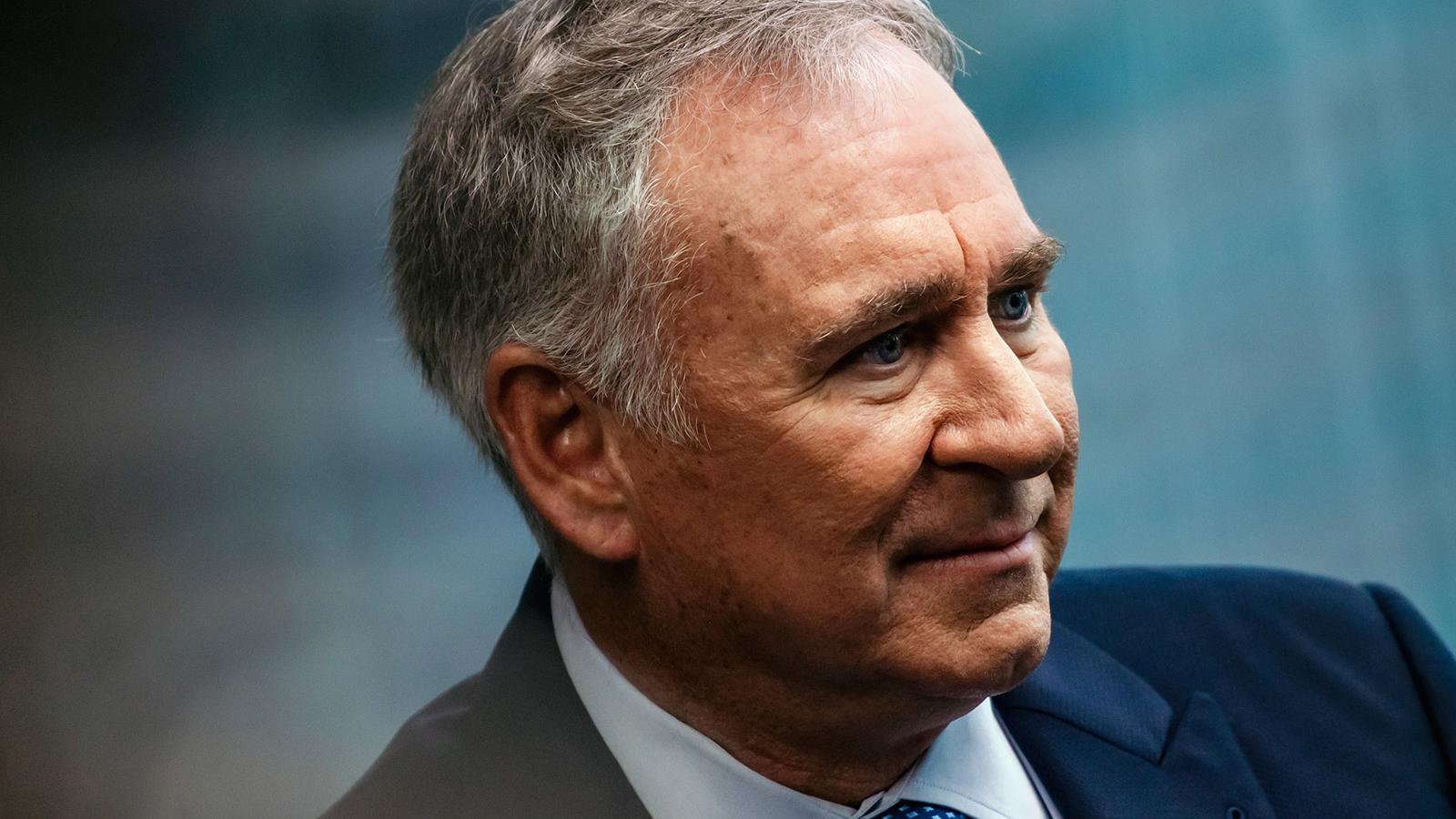
“My first love in art was the proverbial one that got away,” says Ken Griffin, the CEO of the hedge fund Citadel. In 1999, he lost out on a sculpture of a dancer by the French Impressionist Edgar Degas. He has rarely let it happen again. Over the past two decades, Griffin has emerged as one of the world’s most dogged, deep-pocketed collectors. His treasures include Abstract Expressionist paintings worth nine figures, rare historical documents, and a Madonna and Child attributed to Leonardo da Vinci.
While Griffin previously lent many of his most valuable works to museums anonymously, he has expanded and become more public about his activities over the past year, a shift he says is designed to facilitate scholarship and education as well as satisfy public curiosity. He loaned the da Vinci to the Met this spring, doubling the number of paintings by the Renaissance master on view in the U.S.
The billionaire has also expanded his support of Florida museums since his much-publicized relocation to Miami from Chicago in 2022. Over the summer, an exhibition of 10 works by Jean-Michel Basquiat from his collection went on view at the Pérez Art Museum in Griffin’s new hometown. In 2027, he will place a Richard Serra sculpture he bought earlier this year on public display in a park next to the museum. “It’s monumental, it’s thought-provoking, and, bluntly, it’s just fun,” Griffin says of the work. “An institution has a different criteria to collect than I do as a private individual. I place a huge importance on the aesthetic appeal of a work. Does this work visually make me happy?”


The Senate’s 50-49 failure to advance the CLARITY Act has left crypto firms without a federal market structure framework and could delay product launches, funding decisions, and commercial agreements, according to three industry experts.
Summary
- The CLARITY Act failed to secure the 60 Senate votes required to open debate.
- WasabiCard expects regulatory uncertainty to delay some crypto launches, partnerships and funding decisions.
- The Decentralization Research Center urged the SEC and CFTC to provide clarity under existing powers.
- Paybis called for separate US and EU checks where their stablecoin requirements differ.
CLARITY Act failure leaves jurisdiction questions open
Kyle Bligen, executive director at the Decentralization Research Center, told crypto.news that the Senate result was disappointing but did not remove the need for lasting digital asset rules.
“Congress remains the best route to a comprehensive market structure framework,” Bligen said.
In the absence of federal legislation, Bligen called on the Securities and Exchange Commission and Commodity Futures Trading Commission to use their current powers to give the industry clearer guidance. He cautioned, however, against applying rules built for conventional financial middlemen directly to decentralized systems.
The policy task, according to Bligen, is to protect consumers and counter illegal activity without placing duties on developers or other participants who lack the control needed to carry them out.
“That work cannot stop because the legislative process has stalled,” he said.
The 50-49 Senate vote fell 10 votes short of the 60 required to invoke cloture and begin formal debate on H.R. 3633. Cloture would not have passed the bill into law; it would only have allowed the Senate to proceed with debate.
All participating Democrats opposed the motion, while Republican Senators Susan Collins, Josh Hawley, Jerry Moran and Thom Tillis also voted against it. Tillis changed his vote for procedural reasons, preserving an avenue for the chamber to reconsider the motion.
Disputes over government ethics, stablecoin rewards and banking provisions had continued before the vote. Democratic negotiators delivered a late counteroffer, but lawmakers did not release its complete text before the Senate acted.
The House passed its version of the CLARITY Act in July 2025 by a 294-134 vote, with 78 Democrats supporting the measure. Republicans hold 53 Senate seats, which meant the bill’s supporters needed votes from at least seven Democrats to clear the procedural threshold.
In July, Treasury Secretary Scott Bessent had pressed for a vote after months of negotiations among lawmakers. Polymarket traders assigned the bill a roughly 30% chance of becoming law in 2026 at the time, down from 82% in February. Following the failed cloture motion, the probability dropped to 7% from 31% a day earlier.
Regulatory uncertainty could delay crypto products
Matt Price, head of global partnerships at stablecoin platform WasabiCard, said the vote had left companies with the same classification and jurisdiction questions they faced before the Senate acted.
“The failure to advance CLARITY leaves the industry with the same basic problem it had before the vote,” Price said. “Firms still do not have a clear answer on how some digital asset products will be classified or which rules apply.”
Without a settled division of authority, Price expects companies to spend more time seeking legal advice before putting capital into products. Some firms may hold a launch or commercial agreement because they do not want a regulator to adopt a different view after the product enters the market, he added.
Questions over whether the SEC or CFTC has jurisdiction may also affect funding choices and negotiations between crypto companies, according to Price. He expects some partnerships and releases to be postponed for that reason.
Banks and payment companies could exercise similar caution, Price said, because they need to understand the compliance duties attached to a digital asset project and whether regulators could change the applicable requirements after launch.
“This could slow innovation and adoption in the marketplace,” he said.
The failed vote has also increased pressure on federal regulators. Former CFTC Chair Chris Giancarlo said the SEC and CFTC could continue building rules under their existing mandates, according to a Sep. 16 report.
Coinbase CEO Brian Armstrong made a similar call after the vote, saying the industry could no longer wait for Congress and urging both agencies to use the tools already available to them. Ripple CEO Brad Garlinghouse also asked the regulators to fill the legislative gap.
Agency action cannot resolve every issue covered by the bill. In particular, SEC rules alone cannot establish a statutory split of authority between the SEC and CFTC, according to the Sep. 16 report.
H.R. 3633 remains on the Senate calendar, and Tillis’ procedural vote permits another cloture attempt. Sen. John Kennedy said the measure could return during a lame-duck session after the November elections, while Sen. Ted Cruz described it as “mostly dead.”
Any changes approved by the Senate would still need further House action before the legislation could reach the president. A shortened House calendar has reduced the number of voting days available before lawmakers leave Washington.
Foreign stablecoin rules pose a separate compliance test
Konstantins Vasilenko, co-founder and chief business development officer at MiCA-licensed crypto exchange Paybis, said regulatory uncertainty also extends to stablecoin businesses operating between the United States and Europe.
According to Vasilenko, US authorities are determining how domestic stablecoin requirements will apply to foreign issuers, while European policymakers are considering how to treat oversight conducted outside the European Union.
Under the EU’s Markets in Crypto-Assets regulation, an issuer must show that it holds authorization, manages its reserves and can honor redemption requests, Vasilenko said. The US Treasury’s lawful-order test asks a different question: whether a foreign issuer can execute an American order to freeze assets.
“How far a platform must go to satisfy that check remains open,” he said.
Treasury has raised questions about smart contracts and functions including “freeze,” “seize,” and “burn,” according to Vasilenko. A compliance review can establish whether an issuer has the technical ability and internal process to respond to a lawful order, but it cannot guarantee how the company will respond in every future case, he added.
Vasilenko called on Treasury to state what evidence would satisfy its review. Clear standards would help exchanges and wallet providers assess foreign stablecoins before making them available to customers subject to US rules, according to his comments.
Europe is separately considering how much reliance its regulators can place on supervision performed in another jurisdiction. Vasilenko said mutual recognition should be assessed one requirement at a time rather than granted through a single all-purpose decision.
Where US and EU authorities ask the same compliance question, one answer should be sufficient, he said. When the requirements differ, as they do over the ability to follow a US lawful order, Vasilenko said platforms and issuers would need to complete both checks.

Cryptocurrency adoption is advancing in Germany, particularly among younger investors, while the UK is gradually falling behind, largely due to lagging regulations, according to CoinShares crypto researcher Luke Nolan.
German cryptocurrency adoption is showing “very good progress” through “family offices, wealth managers, individual advisors” and younger generations looking to invest inherited wealth in digital assets, Nolan told Cointelegraph on the Chain Reaction show on Thursday.
In contrast, the UK is “still very much behind,” said Nolan, adding that the country’s Financial Conduct Authority (FCA) only lifted its ban on crypto exchange-traded products less than a year ago, making its digital asset market “nascent.” The regulator previously banned these products from retail participants in January 2021.
Germany has 89 licensed crypto-asset service providers, accounting for 25.5% of companies in the European Securities and Markets Authority’s (ESMA) Markets in Crypto Assets (MiCA) register, updated on Wednesday. The EU’s biggest economy was also the bloc’s leader by MiCA authorization in June, with 57 authorized crypto companies.

Source: Cointelegraph
Leading German banks are venturing into crypto
The adoption trend is not lost on the largest German banks.
The country’s biggest, Deutsche Bank, revealed on Wednesday that it was awaiting regulatory approval to launch crypto custody solutions for institutional clients in Europe, with a license expected in October.
In April 2024, Germany’s largest federal bank, the Landesbank Baden-Württemberg, started offering crypto custody solutions after partnering with the Austria-based Bitpanda for its institutional custody platform.
Related: Bernstein expects ‘aggressive’ rulemaking from SEC, CFTC, following CLARITY Act failure
Meanwhile in the UK, the FCA on Wednesday issued final guidance outlining when crypto activities may require authorization under the country’s incoming regulatory regime.
The regulator will open licensing applications on Sept. 30, with a Feb. 28, 2027 deadline for firms seeking transitional arrangements ahead of the new regime taking effect on Oct. 25, 2027.
On Thursday, the FCA announced that it sent a cease-and-desist letter to three London locations suspected of facilitating illegal peer-to-peer crypto trading.
The UK Parliament approved regulations bringing digital assets within the FCA’s regulatory remit in February and finalized a package of rules and guidance in June.
Magazine: How the EU’s crypto tax rules are expected to work for users and platforms

South Korean police have reportedly referred 18 Polymarket users to prosecutors as part of an illegal gambling investigation that involves 26 suspects and roughly 17.6 billion won (about $12.7 million) in wagers. The case is based on analysis of on-chain activity, according to a report citing data submitted by the National Police Agency.
Authorities say they identified participants by examining publicly available blockchain transactions tied to Polymarket, despite the platform operating without a conventional, real-name user registry. Suspects are accused of placing stakes on event outcomes that—under South Korean legal interpretation—amount to gambling.
Key takeaways
- South Korea’s police have referred 18 Polymarket users to prosecutors, based on an investigation covering 26 people and about 17.6 billion won in wagers.
- Investigators reportedly used publicly available blockchain transaction data to connect individuals to activity on the platform.
- Authorities argue Polymarket transactions fall under South Korea’s Criminal Act as illegal gambling, while users have framed the activity as crypto-based derivatives investment.
- Earlier actions included a June probe and an Aug. 18 decision to block Polymarket after a regulator found the platform’s structure fostered speculative gambling.
- The legal dispute hinges on how “uncertainty” and the structure of trading contracts are characterized under domestic law—especially given Polymarket’s noncustodial, smart-contract design.
How the investigation built from on-chain activity
According to Asia Economy, data provided to Democratic Party lawmaker Yoon Kun-young by the National Police Agency shows that the Gangwon Provincial Police Agency had 26 people under investigation as of Tuesday and had forwarded 18 of them to prosecutors. Asia Economy also reported that the largest wager attributed to a single user was about 5.7 billion won (roughly $4.1 million).
The report says police identified the suspects by analyzing publicly available blockchain transactions. That matters because Polymarket is described as operating on a noncustodial, peer-to-peer model with automated settlement, meaning it does not keep a traditional list of users linked to real-world identities. In other words, the investigation appears to rely on the traceability of transaction patterns rather than on account records maintained by the platform.
Polymarket’s basic premise is that participants can buy and sell contracts tied to real-world event outcomes. When those outcomes resolve, settlement is handled through smart contracts. Asia Economy’s account indicates that investigators nonetheless concluded these contract positions are functionally equivalent to wagering under local law.
The legal argument: gambling vs. derivatives
Authorities reportedly argued that Polymarket transactions constitute illegal gambling under South Korea’s Criminal Act. The basis of that classification, as described in the report, is that users stake assets on outcomes that cannot be predicted with certainty.
Users, however, pushed back. Asia Economy reports that suspects argued Polymarket should be treated as a crypto-based derivatives investment market instead of gambling. That framing reflects a common approach taken by prediction-market operators: trading event-linked contracts can resemble derivatives activity, including the ability to enter and exit positions before a contract settles.
Tae-Lim Kim, a managing attorney at AXIS Law, told Asia Economy that the transactions could meet the legal requirements for gambling. He also said that describing the activity strictly as prediction derivatives may be difficult as a defense in criminal proceedings. At the same time, he suggested that the ability to trade contracts and close positions before settlement could still become relevant for how a court evaluates the overall nature of the activity.
Regulatory pressure escalated before the referrals
The development comes after a visible escalation of South Korean enforcement against Polymarket. In June, Gangwon police launched what was described as South Korea’s first illegal gambling probe into local Polymarket users, acting at the request of the National Police Agency. Earlier coverage from Cointelegraph noted that the case began as an illegal gambling inquiry.
Then, on Aug. 18, South Korean authorities reportedly moved to block Polymarket after determining it provided an illegal gambling environment for users in the country. Cointelegraph previously reported that the blocking decision followed concerns over whether prediction-market activity was being regulated under existing gambling frameworks.
The report also cites the Korea media and communications review commission’s reasoning: it said the platform’s winner-takes-all structure encourages speculative gambling. The commission pointed to Polymarket’s role in operating the markets and setting trading rules, along with the platform’s handling of crypto deposits, withdrawals, settlement, and transaction fees.
Polymarket’s response, as summarized in the report, was that it does not provide Korean-language services or support payments in Korean won. The platform also argued that because transactions are noncustodial and executed via smart contracts, it does not directly manage users’ funds. The regulator rejected the argument, stating that technical design characteristics do not exempt a service from South Korean law.
What this means for users and for prediction markets in South Korea
For market participants, the referral of 18 users to prosecutors signals that enforcement is no longer limited to investigation or takedown efforts—it has moved into the formal legal process. The reported use of blockchain transaction analysis suggests that authorities may be able to map participants even when a platform does not maintain a direct, real-name customer list.
For prediction-market platforms and other “derivatives-like” crypto products, the dispute highlights a structural tension: even if a service is technically noncustodial and settlement is automated, regulators may still assess whether the activity resembles gambling based on how users stake value on uncertain outcomes and how profit is distributed (including whether trading resembles speculation rather than hedging).
Readers should watch whether prosecutors expand the case beyond the initial group of 26 and how courts interpret the defense arguments around derivatives characterization, particularly the practical ability to trade and exit positions before settlement.

Crypto.com is moving closer to launching single-stock futures in the United States after the SEC acknowledged a Form 1-N filing from North American Derivatives Exchange (Nadex).
CEO Kris Marszalek revealed the company is now “authorized” to bring single-stock futures to the market through OG.com, which is its CFTC-regulated standalone prediction market platform launched in February.
US Single-Stock Futures
In a post on X, Marszalek also said the team is working with the SEC and CFTC for the offering in the US. Single-stock futures are contracts linked to the future price of individual stocks. They allow traders to take positions on stocks through futures contracts rather than buying the underlying shares directly.
The SEC document, dated September 16, confirms the filing was made under Section 6(g) of the Securities Exchange Act of 1934.
Crypto.com is not the only platform looking to bring single-stock perpetual futures to the US. According to The Wall Street Journal, Kalshi is also seeking regulatory approval for the products. The prediction market operator reportedly plans to offer around 60 perpetual contracts tied to major stocks and ETFs, including Tesla, Apple, and Nvidia. The planned stock contracts would target companies with market values of at least $100 billion.
Coinbase also filed notice registrations with the SEC to offer single-stock perpetual futures domestically. Earlier this month, the company said it is working with both regulatory watchdogs to bring the products to the US market.
The development reflects a push by relatively newer platforms to expand into areas long dominated by traditional financial firms.
Prediction Markets Push
The latest development comes days after Robinhood announced expanding its partnership with Crypto.com and OG.com as prediction markets continue to grow on its platform. The companies said Robinhood will begin routing some football event contracts to OG.com from September 8.
As part of the deal, Robinhood Markets will take equity stakes in the two after OG.com becomes an independent trading platform. The stakes will be priced in line with Citadel Securities’ recent investment in Crypto.com Group at a $20 billion valuation.
The post Crypto.com Gets Green Light to Bring Single-Stock Futures to the US appeared first on CryptoPotato.

The Mark Zuckerberg Meta AI predicts Bitcoin could not only hit a new all-time high in 2026, but nearly double the $126,000 high from October 2025.
Following that move, BTC then corrected roughly -47% to around $80,000 in November. It fell further to the low-$60,000s by mid-2026 before recovering back toward the $80,000s by late summer 2026. So the past year has been a proper boom-bust-rebuild cycle, and not a straight line up.
However, Meta AI has predicted an explosive finish to the year for BTC USD, with a peak bull-run scenario of $210,000–$230,000 by Jan 1, 2027.

ETF and institution-driven demand has stretched the traditional 4-year halving cycle (April 2024 halving) longer than the 2017/2021 cycles, because spot ETFs and corporate/sovereign treasury buying create steadier, less reflexive demand than retail-driven futures leverage did in past cycles.
A blow-off top, consistent with how every prior Bitcoin cycle has ended, euphoric retail FOMO piling in on top of the institutional base once BTC reclaims and breaks its old ATH.
Supercharge Your Trading in 2026 With BloFin AI Trading Bots
Mark Zuckerberg Meta AI Predicts Bitcoin to $230K: Does the Technical Analysis Back it Up?
The clearest technical argument is a Fibonacci extension off the 2022 bear-market low. Bitcoin bottomed near $15,500 in November 2022; the rally to the October 2025 high of ~$126,000 represents roughly a 7.1x move.
Applying a 1.618 Fibonacci extension of that same $15,500 to $126,000 range projects a target zone of approximately $195,000–$225,000, a level that lines up closely with several institutional forecasts (Bernstein, Standard Chartered’s revised targets, Tom Lee’s $150K–$200K range) clustering in the same neighborhood.
That confluence of a chart-based extension level and fundamental analyst targets makes $200K+ the natural “peak euphoria” number for a bull scenario, rather than an arbitrary round figure.
Supporting that reading: the logarithmic growth channel that has bounded Bitcoin’s price action since 2013 has its upper resistance band tracking into the $180K–$240K range by early 2027, which is roughly where the Fibonacci extension also lands.
Two independent technical methods pointing to a similar ceiling add credibility to that zone as a “peak” resistance level, not just noise.
Earn $50 and Enter $300K Prize Draw on EdgeX
LiquidChain Targets Early Mover Upside as Pi Network Tests Key Levels
The quill knows what comes after L2. — LiquidChain (@getliquidchain) September 17, 2026
 https://t.co/vqvBcdSQYC pic.twitter.com/BSumZRCBFg
For traders watching PI bleed through support, the instinct to rotate capital toward earlier-stage projects with room to grow makes sense, especially when the alternative is waiting around for a $940M market cap coin to reclaim ground it’s already lost twice.
Enter LiquidChain ($LIQUID), a Layer 3 infrastructure project fusing Bitcoin, Ethereum, and Solana liquidity into a single execution environment. The presale is priced at $0.014956 with $967,410.09 raised so far.
Its core pitch, Deploy-Once Architecture, lets developers build a single application and reach all three ecosystems without rewriting code for each chain, backed by a Unified Liquidity Layer and Single-Step Execution for cross-chain trades.
Those curious can dig into the background on its cross-chain approach, which is also covered in this earlier breakdown.
Gain Special Access to Layer 3 Trading Here Supercharge Your Trading in 2026 With BloFin AI Trading Bots
The post Mark Zuckerberg Meta AI Predicts Bitcoin to Hit $230,000 appeared first on Cryptonews.


There are guardrails, however.
The software running that market must be public and auditable and deployed on a public, permissionless blockchain. Access to the trading venue itself, however, remains permissioned, according to the SEC.
So no, this does not mean Apple or Microsoft stocks suddenly start trading freely on popular decentralized crypto exchanges that run on automated liquidity protocols (or smart contracts) rather than traditional order books.
It means regulated venues can test some of the technology pioneered by decentralized finance while still controlling who is allowed to trade.
And this sandbox is also deliberately small.
For the most liquid stocks, each venue can tokenize up to 75 names and handle no more than 0.25% of average daily trading volume. For a second tier of stocks, the cap rises to 250 names and 2.5% of average daily volume, according to Jamie Selway, the SEC’s director of trading and markets.
“The motivation for that was to, obviously, make a modest start,” Selway said. “Let’s get people going, measure the effect.”
For example, Tesla — one of the most highly traded stocks — has an average daily volume of about 40 million shares. By this definition, a qualifying venue could theoretically facilitate trading in up to roughly 100,000 tokenized Tesla shares a day, which is about $36.6 million at a $366 share price.

Queen offered to restore Diana’s HRH on the day of her funeral, bombshell new book claims

leading Florida’s hotel floor with a manager’s eye for detail

Anthropic Claude AI Predicts an Explosive Finish to 2026 for XRP



-

 Fashion6 days ago
Weekend Open Thread – Corporette.com
-

 Tech4 days ago
The Latest Weird Thing to Play Doom Is the Mapped-Out Brain of a Fruit Fly
-

 Business7 days ago
10 Most-Streamed Songs On Spotify In 2026 So Far, Led By Ella Langley’s Dominant Run On The Charts This Year
-

 Crypto World7 days ago
XAG/USD: Silver’s Short-Term Rally Meets Its Moment of Truth
-

 Crypto World7 days ago
OKX launches 10x OpenAI, Anthropic X-Perps in Europe
-

 Crypto World7 days ago
Diesel Tops $6 a Gallon for the First Time as 28 States Set Records
-

 Crypto World3 days ago
Elon Musk Drops a Bombshell: Grok 5 Could Be the AGI Breakthrough
-
 Crypto World3 days ago
Kraken Lets xStocks Holders Earn Yield Through DeFi
-

 News Videos6 days ago
Facing Financial Fears
-

 Crypto World23 hours ago
US Charges Robinhood Engineers Over Crypto Listing Trades
-

 Business5 days ago
Rivals Sam Altman and Elon Musk Rally Behind Dario Amodei’s Call for a Slowdown in AI Development
-
Crypto World7 days ago
Ethereum Price Analysis: Consolidation at $2.5K Tests Momentum as On-Chain Activity Surges
-

 Crypto World5 days ago
Can AI Build a Startup in 72 Hours? Elon Musk's Team Will Livestream the Test
-

 Entertainment6 days ago
News Specials, Movies, Shows, More
-
 NewsBeat3 days ago
‘Sick conspiracy’: Trump says only guardrails AI needs is ‘a strong and smart (High IQ!) president’ in all-caps rant
-

 Crypto World7 days ago
Bitcoin ETFs Pull $167M as 2026’s Best Inflow Run Slows
-

 Crypto World6 days ago
Robinhood Chain Never Stopped But its Blobs Did Stop Reaching Ethereum For 14 Minutes
-
 Crypto World4 days ago
New Tesla Roadster Uses SpaceX Tech. Will It Impact the Stock Price?
-

 Crypto World7 days ago
US CPI forecast at 3.4% as tariff risks build
-
 Entertainment6 days ago
New Horror Movie Officially Earns a Rare Stephen King Recommendation
You must be logged in to post a comment Login