The popular Christmas event was set to return this year before organisers pulled the plug.
The Elfingrove festival has been axed this year just one day after tickets went on sale.
Advertisement
Bosses of the popular Glasgow event announced that, despite thousands of briefs being snapped up in 24 hours, the Christmas celebration would not go ahead.
Itison, which organises the event, pulled the plug, citing unsustainable costs. The first batch of tickets were released on Wednesday, September 16.
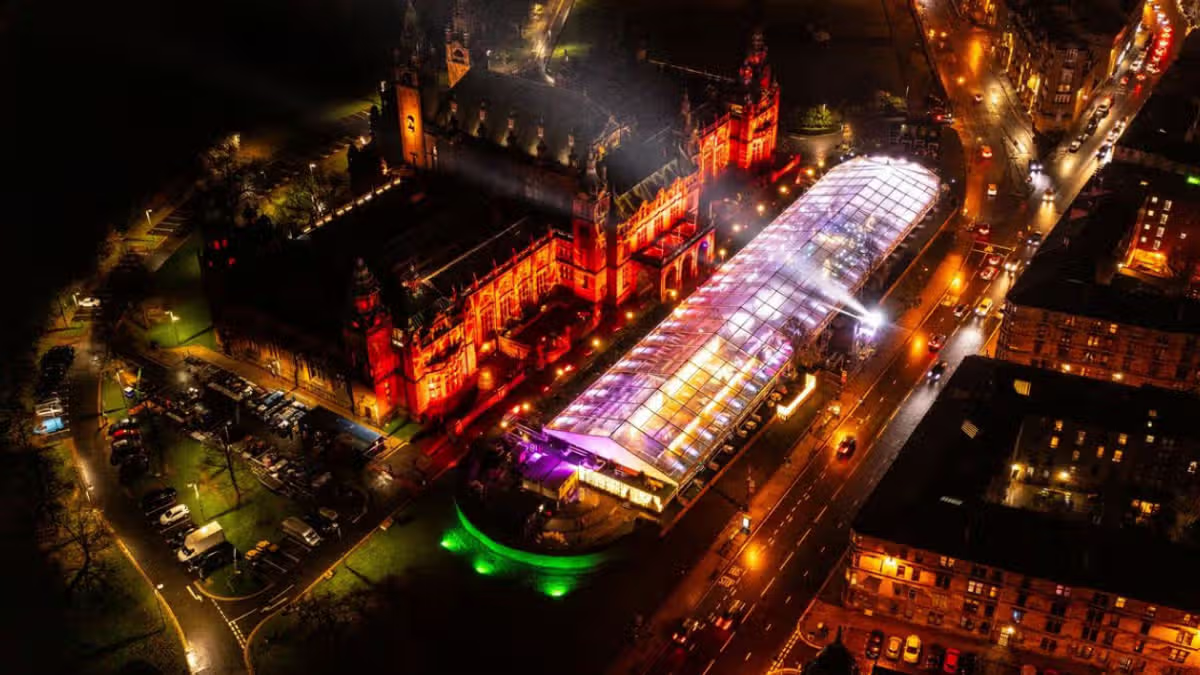
Organisers promised to transform Kelvingrove Art Gallery and Museum into a “magical grand train station” with “360° immersive projections and a cinematic score”.
But early ticket sales didn’t give Itison confidence that they would be able to offset the “huge financial risk” of putting on such a big event. Those who have already bought tickets will be refunded.
Advertisement
A post on the Elfingrove Facebook page reads: “We’re really sad to share that Elfingrove won’t be going ahead this year and want to be open about it. Everyone who has bought a ticket will receive a full refund automatically. Our team will begin processing these within the next 24 hours and you’ll receive confirmation directly.
Advertisement
“We’ve worked incredibly hard over the last few years to create and launch something we believed would be special, and thousands of you bought tickets in the first day. Thank you – we genuinely appreciate the support. Putting on major events of this scale is a huge financial risk and sadly the level of early demand is below what we need to confidently take the event forward. As a small independent business rooted right here in Glasgow, we have to be practical as well as ambitious.
“In light of this, we’ve made what has been an incredibly tough decision for us all. This choice doesn’t affect any of our other events. We’re hugely disappointed and very sorry to everyone who was looking forward to coming. Thank you for backing the idea and for all the lovely comments over the last few weeks.
“We’ll be back with more exciting things in the future.”
Ticketholders moved to social media to express their disappointment. One person wrote online: “It’s only September and 24 hours after release. You’d be amazed at how many people would yet book on.”
Advertisement
Another person said: “Bit of a quick decision there, I was intending on booking but waiting until end of the month (payday).”
A third added: “This seems a bit hasty. We were planning on booking. The tickets only went on release yesterday, give us a chance!”
Get more Daily Record exclusives by signing up for free to Google’s preferred sources. Click HERE.
‘We are the closest of friends, and I look forward to further strengthening that friendship’
Andy Burnham will host Irish Prime Minister Micheál Martin in Manchester on Friday – the first time an international leader has visited Number 10 North. Talks on trade and continued relations are expected.
Advertisement
Downing Street said it would be the first official meeting between the PM and the Taoiseach of Ireland since Mr Burnham took office.
A spokesperson said the two leaders would ‘discuss how the UK and Ireland can cooperate even more closely to create opportunities for people across both countries’.
Click here to get the biggest stories straight to your inbox in our Daily Newsletter
“They are expected to focus on shared objectives including boosting trade, supporting Ukraine, and working with the European Union as Ireland continues its presidency of the EU,” Downing Street added.
Advertisement
The visit to Manchester comes days after Mr Burnham hosted Canadian Prime Minister Mark Carney in Liverpool and NATO Secretary General Mark Rutte in Oxford.
In a statement, the PM said: “I’m delighted to be hosting the Taoiseach as the first international leader to visit No10 North – this is a historic moment and a proud day for Manchester.
“No10 North is all about creating opportunities for working people, and our partnership with Ireland as we improve the lives of people in both of our countries is a key part of that. There is so much we can achieve together: from our shared commitment to the Good Friday Agreement, to trade, to working with Europe and supporting Ukraine.
Advertisement
“We are the closest of friends, and I look forward to further strengthening that friendship.”
After a meeting at No10 North, the leaders are expected to visit an Irish community centre to meet with representatives from the Irish community in Greater Manchester.
Ireland is said to be the UK’s sixth largest trading partner, while Dublin-London is the busiest air route departing from, and landing in, two different countries in Europe.
The spokesperson added: “The UK government is committed to working with the Irish government to further strengthen this relationship, underpinned by deep historic ties and shared values, as well as the shared Common Travel Area and both countries’ enduring commitment to the Good Friday Agreement.”
Advertisement
Mr Burnham also hosted Ukrainian President Volodymyr Zelenskyy in Portsmouth in July and French President Emmanuel Macron in London earlier this month.
Speaking ahead of the meeting, the Taoiseach said it would reaffirm the ‘strength and importance of the relationship between our two countries’.
He said: “The immense potential of this bilateral relationship is recognised in, and being realised through, our UK-Ireland 2030 programme of strategic cooperation.
“This meeting is an opportunity to assess progress across the programme since the most recent UK-Ireland summit in Cork in March, and to inject further momentum into our partnership as we look ahead to the 2027 summit to be hosted by the UK.”
Advertisement
Mr Martin said they would also discuss Northern Ireland issues, including the joint framework on addressing the legacy of the Troubles.
He added: “We will also discuss how best to work in partnership to sustain the overall success of the Good Friday Agreement in all its parts in the time ahead.
“Our discussions will also cover EU and international issues, including Ireland’s current presidency of the Council of the EU and the next EU-UK Summit, and the situation in Ukraine, Gaza and the Middle East more broadly.”
Noah Woods, described in news reports as partially deaf, non-verbal and awaiting an autism assessment, was last seen at a playground in the village of Brantham on Tuesday.
He ran away from a relative as they left the playground, heading down an alleyway towards a new-build housing estate, before ultimately becoming lost.
After a huge search effort on Wednesday – which saw over one thousand people travel from as far as Birmingham to try and track down the young boy – police revealed the heartbreaking news that a child’s body had been found in a nearby pond.
On Thursday, Noah’s father Rhys Woods confirmed the worst. “Noah was the sweetest and most innocent little boy, with nothing but love to give, and we are going to miss him so very much,” Rhys Woods wrote in a post on Facebook, according to the BBC.
“This was the most heartbreaking outcome for us, we were just hoping that he would be hiding somewhere obvious where someone could find him, that’s what we kept telling ourselves the whole time.”
A body has been found in a nearby pond during the search for missing three-year-old, Noah Woods.
One parent wrote: “It’s absolutely devastating. My son often ran away at that age – he was non-verbal back then and very fast but we got lucky each time that someone found him. I just can’t fathom what the family must be going through right now.”
Another said: “We experienced numerous episode of our son eloping. We are loving and very careful parents to our now 21 year old autistic son. Yet we kept on experiencing eloping episodes when he was much younger. He was around three when he did his first one.”
Among autistic children, absconding (also known as wandering or elopement) is very common. One study found nearly half of autistic children had engaged in elopement behaviour. One quarter (26%) of those children were missing long enough to cause their parents concern.
Of those who went missing, 24% were in danger of drowning and 65% were in danger of traffic injury. The risk for elopement increased with autism severity.
In response to the latest news, Emma Ahern, a speech and language therapist specialising in autism and ADHD, shared on Instagram: “Elopement can happen in seconds, silently, in a blink, even under loving, careful, attentive supervision. This is not about a family who did something wrong. It is about how fast a child can be gone, and how much further we still have to go to keep autistic children who are at risk of elopement safe.”
Why do autistic children elope?
“Wandering or ‘elopement’, as it is sometimes called, is a recognised behaviour in autism, but it is important not to think of it simply as a child running away or being deliberately disobedient,” Dr Claudia Aymerich, consultant psychiatrist at Berkeley Psychiatrists, told HuffPost UK.
Advertisement
“Different reasons can cause an autistic child to leave a safe environment, and understanding those reasons is an important part of reducing the risk.”
Children might run off for a number of reasons. Ahern, who is founder of Zeebra Therapy, explained: “It can be a way of coping when something feels overwhelming, meeting a sensory need, moving towards something they want to reach, or pursuing a particular interest.
“They might be trying to get to a favourite place, following an interest in cars towards a road, seeking out something that has caught their attention, or moving towards water.”
Water can also be “particularly compelling” for autistic children, noted Dr Aymerich. There are a few reasons why this might be: it can be captivating from a sensory perspective (water is both calming, mesmerising and children might be interested in its visual, auditory and sensory qualities); children might not consider water dangerous; or they might want to reach something in it – a duck, stick or some other object, for example.
Autistic children are more likely to go wandering or ‘elope’.
Keeping autistic children safe
“For parents and carers, the aim should not be to live in fear of a child leaving but to put sensible safeguards in place where there is a known risk,” said Dr Aymerich.
Ahern suggested a few safety strategies for families, including:
securing locks and doors at home, and using window alarms;
taking children for adapted swimming and water-survival lessons;
putting an AirTag or tracker inside their coat, shoe or backpack;
and telling trusted neighbours, relatives and schools/childcare providers that they’re prone to eloping.
If a child repeatedly leaves a particular environment, Dr Aymerich said it’s worth asking what the behaviour may be communicating.
“If they are consistently leaving when an environment becomes noisy or overwhelming, for example, the longer-term solution may involve reducing that trigger and giving the child a predictable, safe way to communicate that they need a break or want to leave.
Advertisement
“The goal should be both to reduce immediate danger and to understand the underlying need, rather than viewing the behaviour as simply something that needs to be stopped.”
There have also been calls to make public spaces safer. Responding to the tragedy, podcaster Jessie Townz, who advocates for autism support and education, called for “stricter safety precautions” in public spaces that are near open water.
She said: “The loss for his parents and family is devastating. We can do more in public spaces to protect all children where open water is present.”
Ahern suggested play areas should be designed and built away from unfenced water, while fencing and self-closing gates need to be situated around any open areas of water near to homes, playgrounds and schools.
Advertisement
She also suggested ‘search the water first’ should be the standard response when an autistic child goes missing.
What to do if your child elopes
If an autistic child does go missing, it is important to act immediately rather than assuming they will return, said Dr Aymerich.
“The risks will depend on the individual child and their surroundings, but water and traffic are particularly important hazards to consider. Drowning is a leading cause of death following wandering in autistic people, so nearby ponds, pools, rivers, canals and other bodies of water should be considered as part of an immediate search, alongside roads and other potentially dangerous areas.”
Advertisement
She added that caregivers should also tell emergency services that the missing child is autistic and provide as much information as possible about their communication, behaviour, likely destinations, interests and any particular risks around water or traffic.
“These details can help those searching understand where the child may be and what dangers need to be prioritised.”
The psychiatrist added that “for families who have experienced this, it is important to remember that an incident of elopement is not evidence of poor parenting”.
“It is a recognised safety concern that some autistic families have to manage, and putting practical safeguards and an individualised plan in place can help reduce the risks.
Advertisement
“Families should not have to wait for a frightening incident to happen before they are given information about this potential risk.”
Kemi Badenoch last night instructed lawyers to challenge Government cuts which Tory-run Wandsworth Council says has forced it to increase council tax by 94 per cent.
The Tory leader said it was ‘outrageous’ that the amount was increasing so much but said it was due to 40 per cent cuts to their funding by Labour.
She said the Conservative Party would challenge the decision in court because of the principle behind it.
Ms Badenoch told BBC Newsnight: ‘We have actually instructed lawyers, as the Conservative Party, to see if we can challenge the government on this decision.
Advertisement
‘Because what it looks like Labour is doing is taking money from areas that don’t vote Labour and giving it to places that do vote Labour.
‘And I think that’s completely wrong. I think it is outrageous. So we’re talking to lawyers. Andy Burnham has not found 40 per cent of anything to cut, but he’s asking Wandsworth to do that. I don’t think that’s fair. I don’t think that’s right.’
She said the nearly 100 per cent increase would hit family budgets and it wasn’t fair to punish homeowners for not voting Labour.
The Tory leader has previously accused Labour of starving the council of future funding.
Advertisement
Kemi Badenoch said it was ‘outrageous’ that the council tax in Wandsworth was increasing so much but said it was due to 40 per cent cuts to their funding by Labour
Tory-run Wandsworth Council announced a 94 per cent rise in its council tax earlier this week
Ms Badenoch said the Government had left Wandsworth Council, which it lost to the Tories in May after running it for just one term, with a ‘historic’ £137 million gap in its finances.
Advertisement
She blamed Housing Secretary Angela Rayner’s controversial reforms that give more money to Labour-voting areas in the north.
This summer, a spending review published by the incoming Tory administration on the town hall said it had inherited from Labour ‘the largest government cuts, the largest projected overspending and the largest predicted budget gap in Wandsworth’s history’.
The report claimed that the previous Labour administration had used reserves to balance the budget, had increased staff by 14 per cent since taking over in 2022 and had spent and borrowed millions more without increasing revenue.
It warned that Wandsworth’s council tax ‘would have to increase by more than 230 per cent’ to balance the books if urgent action was not taken.
Advertisement
The report said that Margaret Thatcher’s favourite borough had previously been ‘synonymous with low council tax’ but that Labour ministers saw that ‘as a problem, not a positive’.
Residents in the borough currently pay £1,020 a year for Band D council tax – split equally between the council and the Mayor of London.
Under the plans, the council’s £510 share would surge by £958 while the Mayor’s portion stays unchanged. This means the total bill will almost double to £1,978.
A man has pleaded guilty to attempting to rape a woman who was travelling alone on a Bakerloo line train in south London.
Vincent Saxon, 54, of no fixed address, admitted the offence at Inner London Crown Court on Thursday, September 17.
He was remanded in custody and is due to be sentenced at the same court on Friday, October 30.
The attack happened at around 11.40pm on Saturday, July 11, as the woman travelled between Waterloo and Lambeth North.
Advertisement
Saxon approached her on the train and exposed himself before forcibly pulling her to the floor and attempting to rape her.
The woman fought back and managed to escape when the train reached Lambeth North. She alerted station staff, who contacted British Transport Police (BTP).
Saxon remained on the train and later got off at Elephant and Castle Underground station. Officers searched the area but were initially unable to locate him.
Investigators subsequently launched an urgent search for the suspect, including an appeal through the media and social media.
Advertisement
A 54-year-old man, Vincent Saxon, has pleaded guilty to attempting to ‘rape’ a woman on a Bakerloo line train between Waterloo and Lambeth North in July
The appeal led to several people providing information to police. An anonymous caller later reported seeing a man matching Saxon’s description outside a shop on Fulham Palace Road.
Officers went to the location and arrested Saxon. He was subsequently charged with attempted rape.
Advertisement
Evidence gathered during the investigation included CCTV footage and forensic evidence recovered following the attack.
Saxon remains in custody ahead of his sentencing next month.
BTP Detective Sergeant Krishan Appannah said: ‘First and foremost I would like to praise the victim for her bravery following what was clearly a terrifying ordeal. She was alone late at night when she was approached and attacked by Saxon without warning.
‘She fought back ferociously against him before he fled. Her actions helped us recover vital forensic evidence that, along with our CCTV enquiries, would leave Saxon with no choice but to plead guilty.
Advertisement
‘He is a dangerous and predatory offender and I’m pleased to see that we have secured justice for this brave victim, hopefully it will now be able to bring her some form of closure.’
Anyone who is the victim of or witnesses an offence on the Tube or railway network can text BTP on 61016.
Two people are in hospital after a serious crash in a Lanarkshire town.
Advertisement
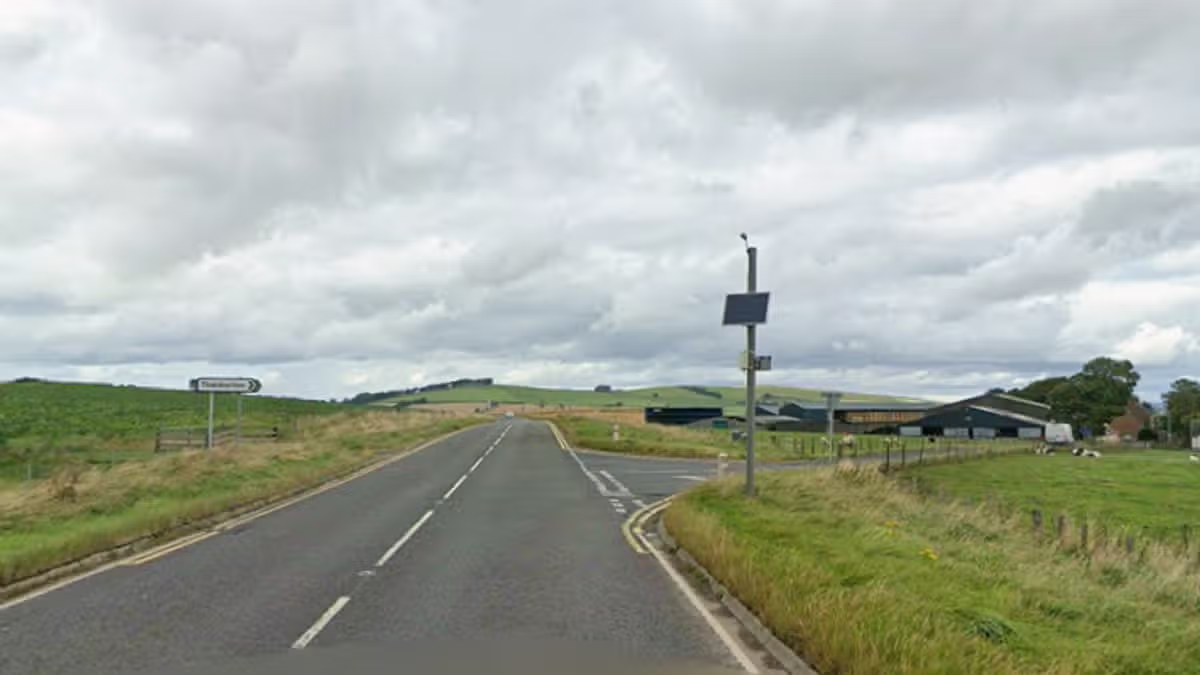
Emergency services raced to the two-vehicle collision on the A73 at the Sherifflats Road junction in Thankerton, South Lanarkshire, at 1.30pm on Thursday, September 17. Crews attended and two people were found injured.
Their current conditions are unknown. The road remains closed off while a police investigation is carried out.
A statement from Police Scotland reads: “The A73 is currently closed in both directions at Thankerton due to a serious crash which happened at the Sherifflats Road junction. Emergency services were called to the scene at around 1.30pm on Thursday, 17 September, 2026 following the crash involving two-vehicles.
“Two people have been taken to hospital. Drivers are asked to avoid the area where possible.”
Advertisement
Get more Daily Record exclusives by signing up for free to Google’s preferred sources. Click HERE.
A third person has died from malaria after an infected mosquito is believed to have got trapped on a plane at Frankfurt Airport.
The victim, who was living in Schwanheim, a district north of the airport, passed away in hospital.
They were not an airport employee nor had they travelled to a malaria-riddled region.
In August, two workers at Frankfurt Airport also died of the disease.
Advertisement
Two new cases of malaria were reported in the Schwanheim area on Tuesday.
A statement from city officials said: ‘Both individuals had become infected with the malaria-causing parasite, even though they had not travelled to a malaria-endemic region and had not worked at the airport.’
Several people were rushed to hospital in July following the rare outbreak of the disease.
The Robert Koch Institute – a German federal government agency and research institute for disease control and public health – said an imported Anopheles mosquito carried over by an aircraft was the likely cause.
Advertisement
Mosquito traps were set up around Frankfurt Airport in a bid to try and control the malaria outbreak.
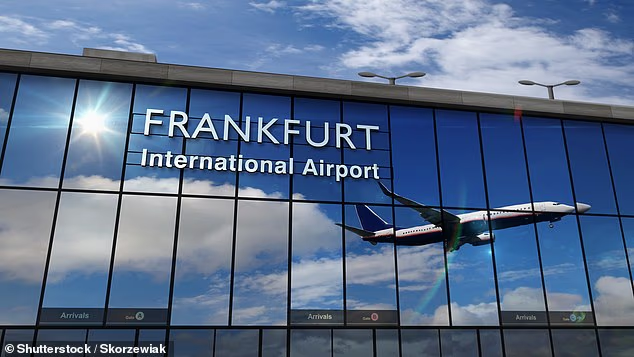
A second person has died from malaria after an infected mosquito reportedly got trapped on a plane at Frankfurt Airport (file image)
The Robert Koch Institute said the employees contracted the disease between July 4 and 6.
Advertisement
Airport malaria – also known as suitcase malaria or Odyssean malaria – is defined as when an infected mosquito becomes stuck on a plane or in luggage which then transports it to a malaria-free region and subsequently bites a person there.
The rarity of the condition means diagnosis can be delayed, increasing the chances of severe symptoms.
Airport operator Fraport previously said: ‘A total of six employees have contracted a form of malaria known as airport malaria in connection with their work at the airport.
‘Sadly, we must confirm that one employee has died as a result of the infection.
Advertisement
‘We have provided comprehensive information to all employees and encourage them to consult a doctor if they experience any symptoms.’
Officials later added that two people who had been infected had died.
A high temperature, sweats, chills and headaches, as well as tummy pain, a loss of appetite and muscle pains are all tell-tale signs of malaria.
The disease was eradicated in western Europe in the 1970s and since then almost all cases have been in travellers returning from countries where the bug is still rife.
Advertisement
But in areas where the infection is prevalent, it is one of the world’s biggest killers, particularly in sub-Saharan Africa.
Treatments exist and patients caught early with the disease usually make a complete recovery.
Actor Bobb’e J. Thompson was sentenced to 30 months in federal prison Wednesday in Sioux City, Iowa, after pleading guilty to charges of possession of a firearm by a felon this past April.
The 30-year-old actor, a one-time child star who appeared on That’s So Raven, received the sentence in connection with a 2025 arrest, according to the US Attorney’s Office in the Northern District of Iowa.
In the September 22, 2025 incident in Cerro Gordo County, police said that Thompson had been clocked driving 104 mph, 34 miles over the 70 mph speed limit.
‘Law enforcement conducted a traffic stop and as the officer was exiting his vehicle, he observed Thompson and the passenger switching seats,’ officials said in a news release. ‘The odor of marijuana was also emitting from the vehicle.’
Advertisement
Authorities said that during a search of a backpack Thompson had, they retrieved a .40-caliber handgun and ‘multiple bags of dispensary-bought marijuana.’
The gun, which was ‘fully loaded with a 15-round magazine, and a round in the chamber’ – had been reported stolen from a vehicle in Kansas City, Missouri, according to officials.
Actor Bobb’e J. Thompson, 30, was sentenced to 30 months in federal prison Wednesday in Iowa, after pleading guilty to drug and weapons charges this past April. Pictured in 2023 in Atlanta
Advertisement
The Daily Mail has reached out to representatives for Thompson for further comment on the story.
Thompson will be on supervised release for a three-year period following his release from custody, according to authorities.
Officials noted that there is no parole in the federal system.
Thompson was held by US Marshals pending a transfer to a federal facility, officials said.
Advertisement
Thompson has in the past landed in legal problems, officials said, including convictions in 2020 in connection with battery with serious bodily injury.
He was also convicted that year in connection with and assault with force (possibly resulting in great bodily injury).
In 2022, he had been convicted in connection with prohibited possession of a firearm.
Thompson pictured at a 2022 event in LA
Advertisement
Thompson pictured in 2004 in LA at the Nickelodeon Kids’ Choice Awards
Thompson has worked in entertainment for more than two decades, as he is best known for his role as Stanley on 10 episodes of the series That’s So Raven between 2004 and 2006.
He also has appeared on TV shows including Wild ‘N Out, The Tracy Morgan Show, 30 Rock, For Better or Worse and House of Payne.
Thompson has also been seen in a number of films, including School Dance, Cloudy with a Chance of Meatballs, Shark Tale, Knucklehead and Columbus Day.
Advertisement
His most recent work includes the 2026 film The Funny Thing About Love, the 2024 short film Hot Girl Getaway and the 2021 TV film Miracles Across 125th Street.
This roundup of The Conversation’s environment coverage was first published in our award-winning weekly climate action newsletter, Imagine.
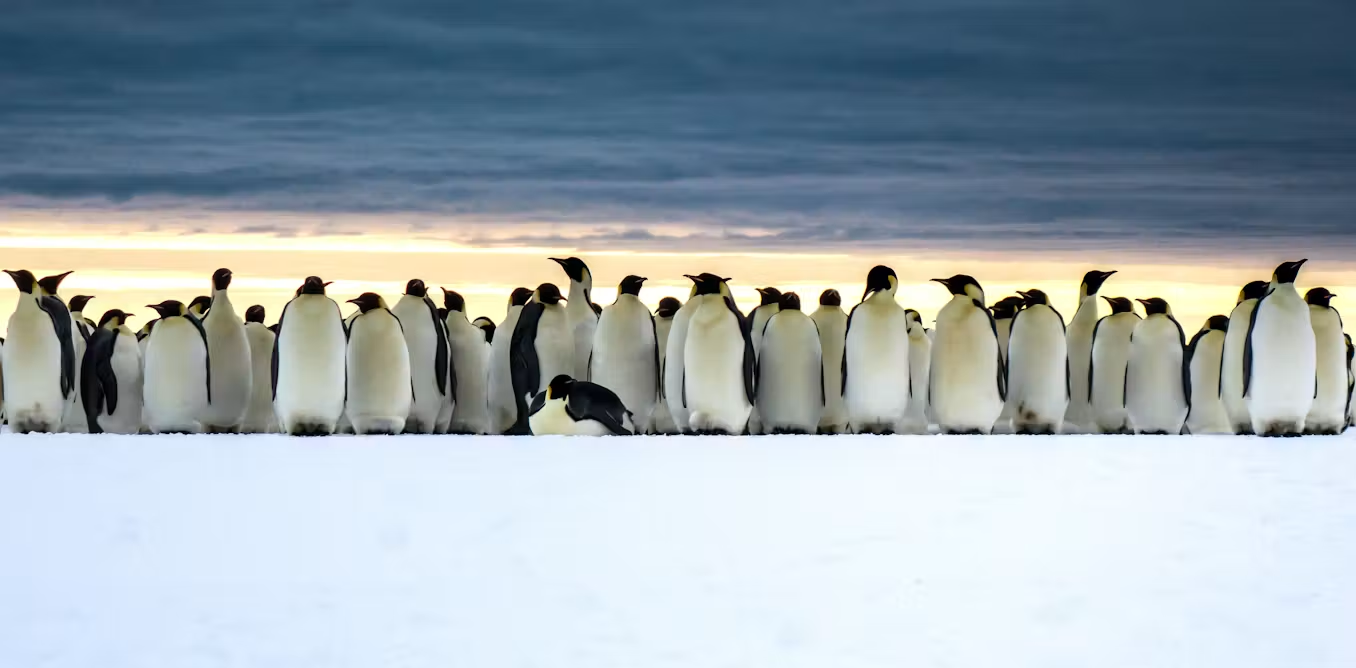
Through the winter months, emperor penguins lay their eggs, hatch their chicks, and huddle together for warmth. They do much of this in darkness, as the Antarctic sun disappears below the horizon for months on end.
That has made them surprisingly difficult to watch. Most satellite images rely on sunlight, so until recently scientists could track emperor penguin colonies only in the brighter months of the year.
But when when Grant Macdonald and his colleagues looked at images of Antarctic sea ice in winter, they spotted something unexpected: a “bright white splodge of pixels” moving across otherwise dark, smooth ice.
Advertisement
It turned out to be a penguin colony.
Macdonald, a geographer at Durham University, and his team soon identified several other colonies, and confirmed their findings with satellite images taken when the sun returned in September. For them, this new knowledge of what a penguin colony looks like from space, in the dark, opened an “exciting opportunity” to track them “throughout the whole breeding cycle”, using years of accumulated satellite images.
One colony particularly surprised them: penguins in Atka Bay repeatedly moved onto glacier ice each winter even though their preferred sea ice was still stable.
How much ice is just right?
The discovery shows how closely emperor penguins’ lives are tied to breeding in precise conditions. Dana M. Bergstrom, an ecologist at the University of Wollongong in Australia, describes this as a kind of Goldilocks zone. Too far from the ice edge and adults will take too long to return with food. Too close, and the ice may break up before the chicks have developed the waterproof plumage that keeps them safe in cold seas.
Advertisement
Leaping out of the water, and into the Goldilocks zone. Stuart Holyroyd / Alamy
That Goldilocks zone, says Bergstrom, now “appears to be reducing” as the world warms and sea ice retreats. She cites research that tracked 16 emperor penguin colonies from 2009 to 2024 and noted an average 22% fall in numbers.
This is part of a trend across Antarctica, one of the world’s fastest-warming regions. Earlier this year, Haosu Tang, a climate scientist at the University of Sheffield, wrote about a period of extraordinary warming even by Antarctic standards.
This was a heatwave in July and August 2024 – the middle of winter – when temperatures rose by “up to 28°C above average” and remained high for weeks. “To put that in perspective,” notes Tang, “a similar anomaly in the UK would push January temperatures into the mid-30°Cs.”
Advertisement
Climate change made the 2024 winter heatwave both stronger and more likely. In fact, if greenhouse gas emissions remain high, Tang and colleagues note an extreme on this scale could become “up to 20 times more frequent by the end of the century”.
Satellites are also revealing climate-driven changes across the food web of the frozen continent – such as what penguins are eating.
Pink poo from space
Casey Youngflesh of Clemson University in the US says the “colour of penguin poop, as seen from space” is showing us how Antarctica is changing.
His research focuses on Adélie penguins, a species that lives in enormous colonies on rocky outcrops all around the continent. They leave behind enough guano (poo) to be seen from space.
Advertisement
Adélie penguins on rocks stained pink by krill-heavy guano. Steven J Kazlowski / Alamy
Youngflesh and his colleagues realised this could provide a record of what the penguins were eating: krill have pinkish shells that are only partly digested, so the more krill the penguins eat, the pinker the guano. They checked this relationship by collecting samples and analysing them in a small makeshift lab on a ship in the Antarctic, “which likely smells of penguin guano to this day”.
Researchers then examined about 4,000 satellite images stretching back to the 1980s and found a clear relationship to sea ice. When there was more sea ice, Adélie penguins tended to eat more fish, but when there was less, they instead ate more krill.
Less sea ice and fewer fish are “bad news for penguins”, writes Youngflesh. “Adélie penguin chicks are typically heavier when fed fish as opposed to krill, and heavier chicks are more likely to survive into adulthood.”
Don’t have time to read about climate change as much as you’d like?
There is something remarkable about being able to view global changes play out in somewhere so remote, in such detail.
Emperor penguins were first recorded scientifically by Robert Falcon Scott on the Discovery expedition in 1902. Just over a century later, they’re in real trouble.
In early 2026, emperor penguins, along with Antarctic fur seals, were officially listed as endangered. A “swift arc from discovery to extinction risk”, note Mary-Anne Lea and her colleagues at the University of Tasmania.
The new designation reflects a combination of threats: warming seas, changes in krill, extra competition from recovering whale populations, bird flu and more. But sea ice is the main factor, and emperor penguins are especially vulnerable because their entire breeding cycle depends on it.
Advertisement
Lea and colleagues argue the new classification makes continued monitoring urgent. The satellites that are now letting us watch these colonies through the dark winter may therefore become even more important: helping scientists see the effects of climate change in the Antarctic on the animals who live there.
Named the ‘Best Cushioned Walking Shoe’ by Women’s Health in 2026, the Clarks trainers are designed to help you walk for longer
This article contains affiliate links, we will receive a commission on any sales we generate from it. Learn more
Advertisement
Now that autumn has arrived, fashion fans will no doubt be phasing out their sandals and open-toe shoes for footwear more suited to the unpredictable British weather. If you’re in need of a new pair of trainers, it’s worth turning your attention to Clarks.
The high-street retailer has launched four new colours of its award-winning Pace trainers. Named the ‘Best Cushioned Walking Shoe’ by Women’s Health in 2026, the sporty sneakers are designed to help you walk for longer.
The Pace trainers cost £89 but shoppers can get them with a 20% discount if you buy two qualifying pairs, bringing the total down to £71.20. The full range of trainers and shoes included in the ‘Buy 2 get 20% off’ offer can be browsed fully here.
The Pace trainers come in sizes four to eight, including in half sizes, in D (standard) width. There’s four colours to choose from including mauve, black, sand and pale green.
The brand’s first performance shoe, the Pace trainers are specialist designed and science-backed, crafted specifically for walking. The innovative design features Infinity Energy Capsules embedded in the sole, which compress and rebound with each step to propel you forward.
The dual-layer sole also includes Clarks’ most advanced two-part C360 foam, delivering cushioning that reduces impact and stabilizes every stride. An S-curve moulded heel counter provides a secure fit and reduces pressure on the Achilles during heel strike — meaning no break-in period needed and instant comfort right out of the shoe box for the ultimate walking shoe.
Advertisement
Elsewhere, Marks and Spencer’s Leather Side Detail Trainers come in at £49.50. Made in a regular fit with a practical lace-up fastening, the versatile sneakers feature a contrast side detail for a distinctive look.
The flat heel ensures all-day comfort, while our innovative Freshfeet technology helps minimise odour. The leather material offers durability with a touch of sophistication, perfect for styling with virtually any outfit.
Alternatively, the RTG Leather Trainers cost £90 at FitFlop. They’re powered by light, flexible Anatomicush midsoles with flex lines that let your feet move freely.
Advertisement
Anatomical arch contour that cups your feet for total comfort, so they’ve got a sportier feel than classic court shoes. Crafted in high-grade, textured leather, the versatile low-top profile means this athletic-inspired pair slips right into your work and weekend wardrobes.
Back at Clarks, the Pace trainers boast an overall star-rating of 4.7 out of five based on 61 reviews. One satisfied shopper said: “I love these sneakers. They look great and are very comfortable.”
A second wrote: “Great shoes. I have been buying Clarks for years but not casual shoes. Love all of the Cloudwalkers I have purchased.”
Advertisement
“I love these shoes,” a third penned. “They fit perfectly from the first step, there is no breaking in time. My feet are well supported for long walks and strength workouts.”
One shopper, however, had an issue with the sizing on the Pace trainers, giving them a three-star review. THey shared: “I like the shoe but it runs more than half a size small. I normally wear a 5 1/2; the 6 was too small. Had to go up a whole size to a 6 1/2.”
“I wanted to get a shoe that would support my high arches and instep,” a two-star review mentions. “They run small, so I went up 1/2 size and they still pinch my toes a bit.”
Advertisement
Nevertheless, someone else loved their latest Clarks purchase, adding: “Love these trainers. They are so comfortable and have helped me to deal with my recently diagnosed plantar fasciitis.”
Another five-star review reads: “I took a chance and bought these, and wow. Clarks has does it again. They make the most comfortable shoe for a person who walks all day long for work.
“These are a great sneaker. I got a half size larger, just to give my toes more room and it fits great.” Get the Pace trainers for £89 here.
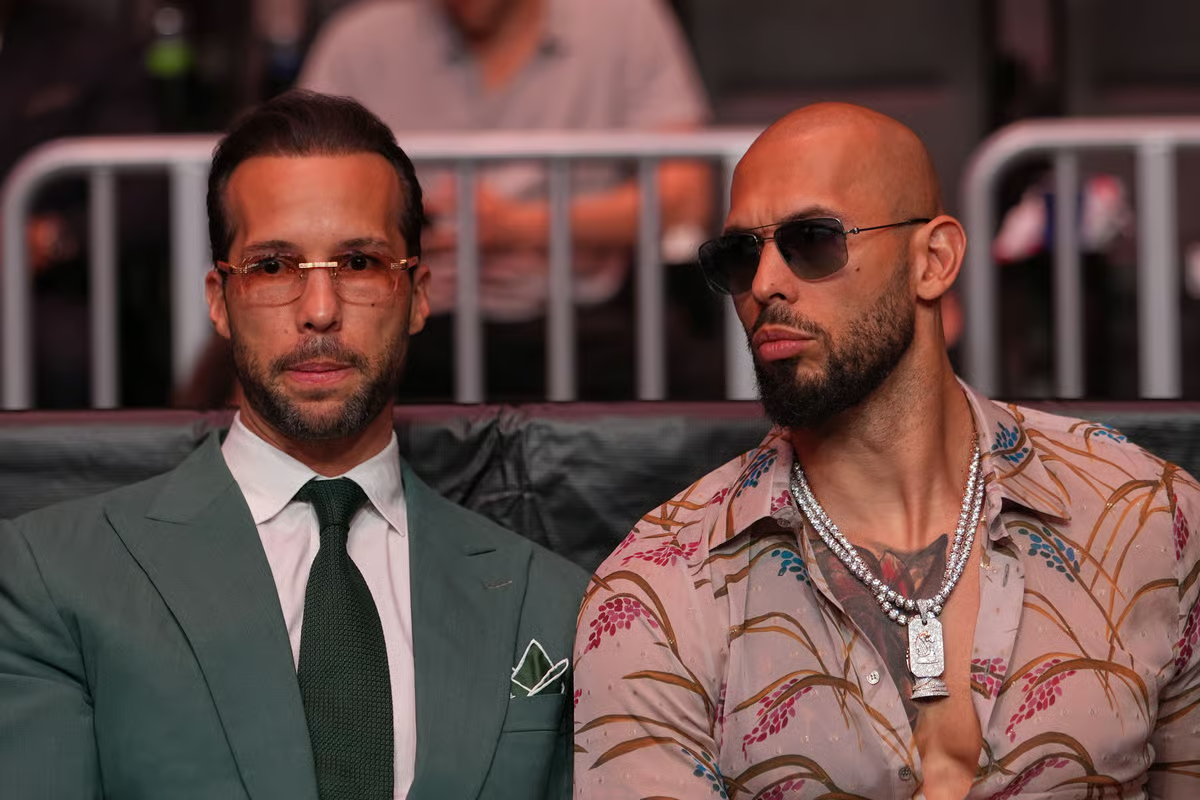
An official letter from the State Department details that Andrew Tate, 39, is “wanted to stand trial in the United Kingdom” on a series of charges, including 10 counts of rape, three counts of arranging or facilitating trafficking for sexual exploitation and three counts of assault occasioning actual bodily harm.











































You must be logged in to post a comment Login