Connect with us

NewsBeat

Why Autistic Children Are More Likely To Run Off Or ‘Elope’

Published

on

Why Autistic Children Are More Likely To Run Off Or 'Elope'

You probably saw the heartbreaking news this week that the body of a child was recovered from a pond in Suffolk, not far from where a three-year-old boy went missing after running away from a playground.

Noah Woods, described in news reports as partially deaf, non-verbal and awaiting an autism assessment, was last seen at a playground in the village of Brantham on Tuesday.

He ran away from a relative as they left the playground, heading down an alleyway towards a new-build housing estate, before ultimately becoming lost.

After a huge search effort on Wednesday – which saw over one thousand people travel from as far as Birmingham to try and track down the young boy – police revealed the heartbreaking news that a child’s body had been found in a nearby pond.

Advertisement

As of Wednesday evening, the body had not been formally identified, but Noah’s family had been told, with the discovery being treated as “not suspicious but unexplained”.

On Thursday, Noah’s father Rhys Woods confirmed the worst. “Noah was the sweetest and most innocent little boy, with nothing but love to give, and we are going to miss him so very much,” Rhys Woods wrote in a post on Facebook, according to the BBC.

“This was the most heartbreaking outcome for us, we were just hoping that he would be hiding somewhere obvious where someone could find him, that’s what we kept telling ourselves the whole time.”

A body has been found in a nearby pond during the search for missing three-year-old, Noah Woods.

There’s been an outpouring of support for the family on social media – including from parents of autistic children, who have spoken of knowing only too well that feeling of absolute terror when a child runs off.

Advertisement

One parent wrote: “It’s absolutely devastating. My son often ran away at that age – he was non-verbal back then and very fast but we got lucky each time that someone found him. I just can’t fathom what the family must be going through right now.”

Another said: “We experienced numerous episode of our son eloping. We are loving and very careful parents to our now 21 year old autistic son. Yet we kept on experiencing eloping episodes when he was much younger. He was around three when he did his first one.”

Among autistic children, absconding (also known as wandering or elopement) is very common. One study found nearly half of autistic children had engaged in elopement behaviour. One quarter (26%) of those children were missing long enough to cause their parents concern.

Of those who went missing, 24% were in danger of drowning and 65% were in danger of traffic injury. The risk for elopement increased with autism severity.

Advertisement

Drowning is also sadly a huge risk for autistic children. According to the National Autism Association, children with autism are 160 times more likely to die from accidental drowning.

In response to the latest news, Emma Ahern, a speech and language therapist specialising in autism and ADHD, shared on Instagram: “Elopement can happen in seconds, silently, in a blink, even under loving, careful, attentive supervision. This is not about a family who did something wrong. It is about how fast a child can be gone, and how much further we still have to go to keep autistic children who are at risk of elopement safe.”

Why do autistic children elope?

“Wandering or ‘elopement’, as it is sometimes called, is a recognised behaviour in autism, but it is important not to think of it simply as a child running away or being deliberately disobedient,” Dr Claudia Aymerich, consultant psychiatrist at Berkeley Psychiatrists, told HuffPost UK.

Advertisement

“Different reasons can cause an autistic child to leave a safe environment, and understanding those reasons is an important part of reducing the risk.”

Children might run off for a number of reasons. Ahern, who is founder of Zeebra Therapy, explained: “It can be a way of coping when something feels overwhelming, meeting a sensory need, moving towards something they want to reach, or pursuing a particular interest.

“They might be trying to get to a favourite place, following an interest in cars towards a road, seeking out something that has caught their attention, or moving towards water.”

Water can also be “particularly compelling” for autistic children, noted Dr Aymerich. There are a few reasons why this might be: it can be captivating from a sensory perspective (water is both calming, mesmerising and children might be interested in its visual, auditory and sensory qualities); children might not consider water dangerous; or they might want to reach something in it – a duck, stick or some other object, for example.

Advertisement

Sadly, according to Hope Autism Clinic, drowning accounts for roughly 71% of fatal elopement incidents among autistic children.

Autistic children are more likely to go wandering or 'elope'.
Autistic children are more likely to go wandering or ‘elope’.

Keeping autistic children safe

“For parents and carers, the aim should not be to live in fear of a child leaving but to put sensible safeguards in place where there is a known risk,” said Dr Aymerich.

Ahern suggested a few safety strategies for families, including:

  • securing locks and doors at home, and using window alarms;
  • taking children for adapted swimming and water-survival lessons;
  • putting an AirTag or tracker inside their coat, shoe or backpack;
  • and telling trusted neighbours, relatives and schools/childcare providers that they’re prone to eloping.

If a child repeatedly leaves a particular environment, Dr Aymerich said it’s worth asking what the behaviour may be communicating.

“If they are consistently leaving when an environment becomes noisy or overwhelming, for example, the longer-term solution may involve reducing that trigger and giving the child a predictable, safe way to communicate that they need a break or want to leave.

Advertisement

“The goal should be both to reduce immediate danger and to understand the underlying need, rather than viewing the behaviour as simply something that needs to be stopped.”

There have also been calls to make public spaces safer. Responding to the tragedy, podcaster Jessie Townz, who advocates for autism support and education, called for “stricter safety precautions” in public spaces that are near open water.

She said: “The loss for his parents and family is devastating. We can do more in public spaces to protect all children where open water is present.”

Ahern suggested play areas should be designed and built away from unfenced water, while fencing and self-closing gates need to be situated around any open areas of water near to homes, playgrounds and schools.

Advertisement

She also suggested ‘search the water first’ should be the standard response when an autistic child goes missing.

What to do if your child elopes

If an autistic child does go missing, it is important to act immediately rather than assuming they will return, said Dr Aymerich.

“The risks will depend on the individual child and their surroundings, but water and traffic are particularly important hazards to consider. Drowning is a leading cause of death following wandering in autistic people, so nearby ponds, pools, rivers, canals and other bodies of water should be considered as part of an immediate search, alongside roads and other potentially dangerous areas.”

Advertisement

She added that caregivers should also tell emergency services that the missing child is autistic and provide as much information as possible about their communication, behaviour, likely destinations, interests and any particular risks around water or traffic.

“These details can help those searching understand where the child may be and what dangers need to be prioritised.”

The psychiatrist added that “for families who have experienced this, it is important to remember that an incident of elopement is not evidence of poor parenting”.

“It is a recognised safety concern that some autistic families have to manage, and putting practical safeguards and an individualised plan in place can help reduce the risks.

Advertisement

“Families should not have to wait for a frightening incident to happen before they are given information about this potential risk.”

Source link

Advertisement
Continue Reading
Click to comment

You must be logged in to post a comment Login

Leave a Reply

NewsBeat

How Sienna Miller’s lookalike daughter Marlowe, 14, is slowly making her mark in Hollywood as the ‘little fashion monster’ attends War premiere

Published

on

How Sienna Miller's lookalike daughter Marlowe, 14, is slowly being introduced to the spotlight

She has been known for keeping her personal life to herself.

But Sienna Miller is now slowly introducing her daughter Marlowe, 14, into the spotlight.

On Wednesday, the actress, 44, was supported by the teen at the London premiere of her new series War at the Odeon Luxe in Leicester Square.

She posed with a protective arm around her offspring, who was wearing a yellow graphic print T-shirt with a black silk midi skirt and ballet flats.

Advertisement

Sienna shares Marlowe with ex Tom Sturridge – whom she split with in 2015 – and has largely kept out of the public eye.

Although joint appearances with the teenager are rare, the pair have enjoyed a handful of events together in recent years. 

In 2024, the mother and daughter duo attended Cannes Film festival alongside Sienna’s now fiancé, Oli Green, for her film Horizon: An American Saga.

Marlowe looked the spit of her stunning mother, wearing a sweet pink dress with a large bow.

Advertisement

How Sienna Miller’s lookalike daughter Marlowe, 14, is slowly being introduced to the spotlight

On Wednesday, the actress, 44, was supported by the teen at the London premiere of her new series War at the Odeon Luxe in Leicester Square

On Wednesday, the actress, 44, was supported by the teen at the London premiere of her new series War at the Odeon Luxe in Leicester Square

It marked her first ever red carpet appearance, with Sienna only showing her face for the first time in July 2020 in a spread for Vogue.

Advertisement

That year, Sienna revealed to The Guardian that Marlowe has a huge passion for style, describing her as ‘a little fashion monster’.

‘She’s so stylish. And very critical. She’s like a young Anna Wintour in her total disdain for some of the things I wear,’ the American Sniper star said. 

‘In New York she thought I was mortifying. She wishes I would brush my hair. 

‘Although now that we’re back in England she’s starting to appreciate the undone-ness.’

Advertisement

Marlowe also sat in the front row with her mother at Proenza Schouler’s New York Fashion Week in 2023, where the pair posed for cameras together in sleek sunglasses.

Sienna opened up to PEOPLE in 2020 about motherhood and described it as the ‘most loving, intense relationship that I have’.

‘She knows me, I know her. She’s really stubborn, which is very like me. I see her as her own person but I also see genetic things. She’s heaven, my kid,’ she said of her daughter.

Although joint appearances with the teenager are rare, the pair have enjoyed a handful of events together in recent years (pictured with Sienna's fiancé Oli Green at Cannes Film Festival in 2024)

Although joint appearances with the teenager are rare, the pair have enjoyed a handful of events together in recent years (pictured with Sienna’s fiancé Oli Green at Cannes Film Festival in 2024)

Advertisement
Marlowe also sat in the front row with her mother at Proenza Schouler's New York Fashion Week in 2023, where the pair posed for cameras together in sleek sunglasses

Marlowe also sat in the front row with her mother at Proenza Schouler’s New York Fashion Week in 2023, where the pair posed for cameras together in sleek sunglasses

Marlowe was born in July 2012 and Sienna previously revealed how the birth did not go as planned.

‘My birth went all wrong. I had my heart set on this natural water birth and I ended up, after 27 hours, having an emergency C-section,’ Sienna told the magazine.

‘I spent so much time thinking about the birth and not realising that you take a baby home at the end of it.

Advertisement

‘It’s a shock, of course it is, and some people find it really easy, but for me I found it really hard.’

Sienna also touched on motherhood in another interview with The Guardian at the time, saying: ‘I think having a baby really changed everything, if I’m honest.

‘The stakes are higher, you have someone that you want to be proud of you eventually. 

‘You’re aware of your own mortality, For me, as soon as I had a baby I had a vision of my life – and what was left of it.’ 

Advertisement

Meanwhile dad Tom has gushed that Marlowe is wiser than he is and he wouldn’t want to prescribe changes for her future world.

In an interview with Wintour, he said: ‘The world is not as I would wish it to be. 

‘I am a sentient adult, and have the responsibility to inflict change on it. I am excited to see how much better she will do with that than I am.’

Following her split with Tom, Sienna revealed her battle with mum guilt.

Advertisement

The actress spoke to Vogue about what she calls ‘the curse of motherhood’ and how much pressure and guilt women feel in their efforts to do things right.

She explained: ‘I’d like to be better at managing things; I’d like to be more super –although we’re never going to feel it, even if we are.

‘That’s the curse of motherhood – we just run ourselves ragged, I’m just trying to get a sense of what that guilt is. 

‘I sometimes feel like it’s a totally invented emotion, It’s strange to be punishing ourselves this way… It’s not healthy.’

Advertisement
Sienna shares Marlowe with ex Tom Sturridge - whom she split with in 2015 - and has largely kept out of the public eye

Sienna shares Marlowe with ex Tom Sturridge – whom she split with in 2015 – and has largely kept out of the public eye

Sienna now shares a toddler daughter and a newborn baby with Oli.

In May, she appeared on the Jimmy Fallon show just three weeks after giving birth to her third child. 

During her sit-down interview with the TV host she confessed that motherhood was exhausting at times.

Advertisement

Sienna said: ‘It feels like stringing sentences together is a bit challenging.

‘I’m on very little sleep but I’m madly in love with my baby.

‘It’s crazy to be talking words and wearing a dress. What has happened from pajama gate.’

Asked by the host which of her children are tougher to look after, she said: ‘I would have said the teenage girl would be harder to juggle until the transatlantic flight I took yesterday with the toddler and the newborn.

Advertisement

‘The toddler now wins hands down. It was an absolute disaster.

‘There’s no negotiating. I got to the immigration line and just broke down.’

Sienna also spoke about motherhood in a different interview with Vogue recently.

She said: ‘I’d wanted another baby for so long that my postpartum was just bliss. I had thought, by the time I was 40, that it wouldn’t happen.

Advertisement

‘That I’d have my one baby and I kind of made peace with it. It was such a surprise, and it was such a bonus that I was just euphoric. I felt existentially relieved.’

Source link

Continue Reading

NewsBeat

Barnard Castle Meet fundraiser cancelled over low sales

Published

on

Barnard Castle Meet fundraiser cancelled over low sales

The Barnard Castle Meet Committee announced with “great disappointment and regret” that its fundraising evening, due to take place on Saturday, September 26, will no longer go ahead.

The event had been organised to raise money for the annual Barnard Castle Meet, a longstanding community celebration which brings together residents and visitors for a weekend of activities and traditions.

In a statement shared online, organisers said they had been forced to make a difficult decision after sales failed to reach the level required for the event to proceed.

Advertisement

The committee said: “Unfortunately, due to lower than expected ticket sales, we have had to make the very difficult decision to cancel the event.

“This is not a decision we have taken lightly, and we are genuinely sorry for any disappointment or inconvenience caused.”

The fundraiser had been scheduled to take place at Barnard Castle Cricket Club and was set to feature live music, pie and peas, a raffle and fundraising activities.

Organisers had hoped to build on the success of previous fundraising events, which they said had attracted strong support from the community.

Advertisement

The committee thanked everyone who had purchased tickets, shared information about the event and supported fundraising efforts.

They said: “We would like to say a massive thank you to everyone who has supported the event, purchased tickets, shared our posts and helped us with the fundraising. Your support is hugely appreciated.”

Anyone who has purchased tickets has been advised to contact the person they bought them from for information on refunds and arrangements.

Advertisement

Despite the cancellation, organisers confirmed that raffle prizes donated for the event will still be given to good causes.

The committee said: “All raffle prizes that had been donated will still be donated to good causes, so the generosity of those who supported the raffle will not go to waste.


“This may be a disappointment, but it certainly isn’t the end of our fundraising efforts.

“We will take some time to regroup and look to organise another fundraising event in the future.

Advertisement

“Thank you once again for your understanding and continued support of Barnard Castle Meet.”

Source link

Advertisement
Continue Reading

NewsBeat

Teesside family reunites with BTCC star who inspired charity

Published

on

Teesside family reunites with BTCC star who inspired charity

Meeting British Touring Car Championship driver Nicolas Hamilton – the brother of F1 star Lewis Hamilton – at Croft Circuit in 2015 changed James Connaughton’s life.

James, who has cerebral palsy, met Hamilton as the driver was making his BTCC debut.

The meeting inspired his parents, Paul and Julie, to create a charity for young people with special and complex needs.

More than a decade later, motoring retailer Vertu gave James the chance to reunite with his hero.

Advertisement

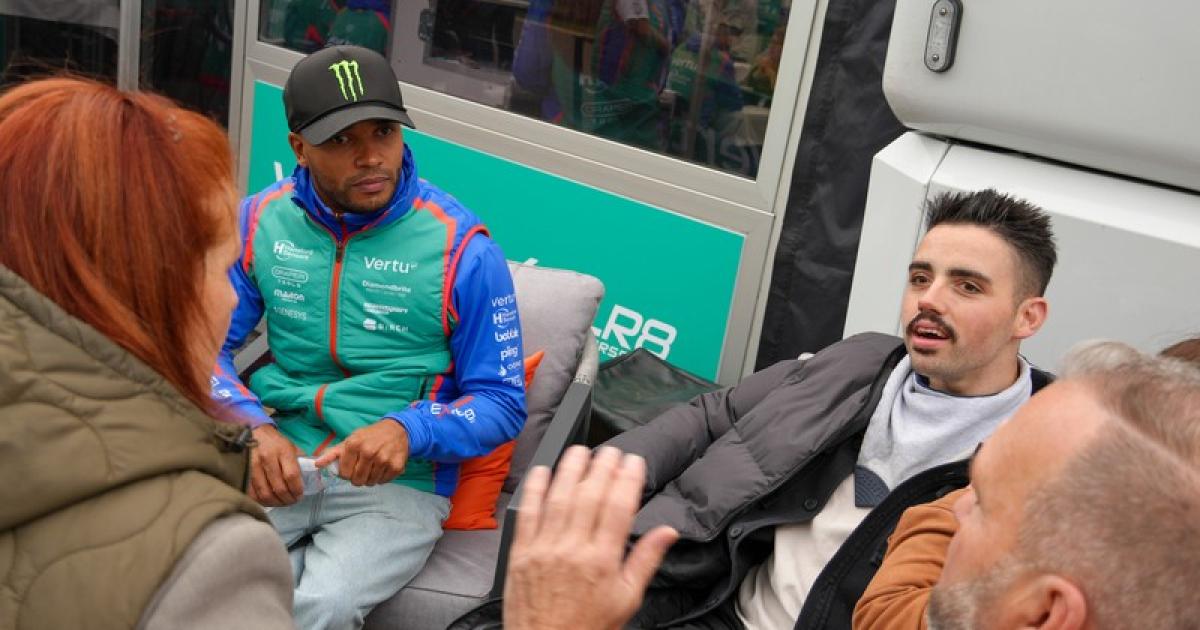
British Touring Car Championship racer Nicolas Hamilton and James Connaughton. (Image: Vertu Motors plc)

Vertu’s BMW dealerships in Sunderland, Teesside and Durham invited the Middlesbrough family to the recent BTCC meeting at Croft, arranging tickets and a reunion with Hamilton, who now races for Team VERTU.

Before taking to the track for the latest three rounds of the season, Hamilton spent time catching up with James and his family, who were able to tell him how much of an impact that first meeting had.

Paul said: “Meeting Nic back in 2015 was a hugely special moment that not only had a positive impact on our family, but also acted as the inspiration for us to create the charity to support both James and other young people in a similar position.

“Nic is a true role model for people living with disabilities and continues to show that anything is possible, particularly when you consider that he was told he would never walk as a child.

Advertisement

“A huge thank you to Vertu for providing us with the opportunity to meet up again at Croft to share with Nic what a huge impact he has had since that first meeting over ten years ago, with the Community Interest Company he inspired having now helped countless youngsters from across the North East.”

James Connaughton and Paul Connaughton. (Image: Vertu Motors plc)

The Connaughton family’s charity, JPC Community Hub CIC, helps people with special and complex needs live more independently and feel included in their communities.

Paul, who worked in the automotive industry for much of his career, also set up JPC Specialist Motorsports to host fundraisers and promote the charity’s work.

Vertu arranged the reunion after supporting the annual Smiles for Miles event at Hardwick Hall earlier this year and hearing James’ story.

Advertisement


Jeff Aynsley, head of business at Vertu BMW Sunderland, said: “We have worked alongside JPC a number of times through the years, and were delighted to support Paul at Smiles for Miles earlier in the year.

“When we heard how that first meeting with Nic had inspired Paul and his family to set up JPC, we were happy to arrange a reunion.”

He added: “Nic is a fantastic role model for people living with disabilities through his determination to achieve his dream of becoming a racing driver, and we’re proud to have been able to bring everyone together to share the story.”

Hamilton became the first disabled person to compete in the British Touring Car Championship when he made his debut at Croft in 2015.

Advertisement

The reunion gave the Connaughton family the chance to thank the driver whose determination inspired a charity that now supports people across the region.

Source link

Advertisement
Continue Reading

NewsBeat

Is England right to introduce a tourism tax?

Published

on

Is England right to introduce a tourism tax?

Supporters tend to call it a “visitor levy”. Detractors prefer to call it a “tourist tax”.

Whether you agree with it or not, an extra charge for overnight stays has become a common feature of modern travel. Recent visitors to New York, Prague, Milan and Edinburgh will have already paid it. And now mayors in England will have the chance to impose it.

Some think these fees will cause huge damage to the hospitality sector, while adding to the general cost of living for visitors. But the main argument in favour of the charge is that it is a simple way of raising much-needed revenue.

A report I worked on for the Welsh government showed that a well-implemented visitor levy can indeed have a positive effect on the tourism industry.

Advertisement

Looking at destinations in Italy, Iceland, Spain and the US, the evidence suggested that a tourism tax can bring benefits to the local community while also improving sustainability, by funding environmental projects, for example.

But getting it implemented turns out to be far from simple. There are key elements which have to be decided upon, and different places – big cities and coastal towns, for example – need different approaches.

One reason for this is how tightly tourism is woven together as an economic system. Nobody in that system operates in isolation.

Accommodation providers, restaurants, attractions, local business and residents are all tied together, and a decision that affects one of them ripples through to the others. Policies made in other sectors, such as farming or international trade, also have an impact.

Advertisement

This is why researchers refer to tourism as an “open complex system” – to account for the dependencies and connections which surround it. The effects of any levy should be monitored regularly to see how it affects other sectors.

It’s also hard to predict how levies will affect where and when tourists spend their money. There is good evidence that people tend to set an overall budget for their holiday, and when one cost rises, the total budget stays the same.

For example, research suggests that a price increase in accommodation often leads to less money being spent in restaurants and shops or on activities, rather than tourists spending more overall. This means that a levy’s true cost may end up being paid by businesses that will only marginally benefit from any funds it raises.

Who receives those funds, and how those funds are spent is another key factor.

Advertisement

Some places with tourism levies have set up specialist organisations charged with the management of the funds.

In Jackson Hole, Wyoming, the local tourism board channels part of the levy revenue into public transport, a local radio station and a wildlife foundation. In Gunnison County, Colorado, funds go towards maintaining and restoring mountain-biking trails.

In Catalonia, money has been used for floral displays and streetscape improvements, while in the Balearic Islands, levy revenue has funded 19 units of subsidised social housing in Palma.

Levies can also be used to influence when and where tourists visit. Also in Catalonia, the tourist board has stopped marketing the region during peak season, and funds are used to promote tourism during quieter months.

Advertisement

The levy was dry

Visitor levies can also do damage to destinations which openly compete with rivals on being an affordable place to stay. Benidorm in Spain, for example, is often considered to be cheaper than other nearby resorts. There, and in similar places, a levy is likely to have a negative effect on its appeal.

And a levy aimed at mitigating the negative effects of overtourism driven by day-trippers won’t be very effective if it only targets overnight stays. It may even discourage the overnight visitors a destination actually wants.

Skegness pier.
Electric Egg/Shutterstock

An overnight levy in Venice did not resolve the negative effects of day visitors, and the city is now charging an entrance fee during the high season.

So, there is no single design that fits every destination. Big cities like London and Manchester are less price sensitive than coastal or rural destinations such as Skegness or Rhyl. Business travellers are largely indifferent to cost, while families with children may be very sensitive to it.

Advertisement

If levies are to be introduced in England, all of these differences and nuances need to be taken into account and carefully examined. Get the details wrong, and a levy could end up undermining the very sector – and community – that it was meant to support.

Source link

Advertisement
Continue Reading

NewsBeat

How you sleep, not just how much, influences what diseases you get in later life

Published

on

How you sleep, not just how much, influences what diseases you get in later life

The type of sleep a person gets, rather than just the duration, influences the risk of developing dozens of diseases later in life, a large study of nearly 100,000 people reveals.

Previous research establishes that getting six to eight hours of sleep daily reduces the risk of several health conditions, including diabetes and heart disease.

But how specific sleep stages and real-world sleep patterns relate to health outcomes remains largely unclear. This is mainly because most studies use self-reported sleep measures, which often show poor correlation with objective assessments, making it difficult to capture real-world sleep patterns.

To overcome this, researchers at Peking University in China analysed the health data of 95,559 people from the UK Biobank, a research resource which stores biological, genetic, and lifestyle information of 500,000 volunteer participants in the UK. The people included in the study wore wrist accelerometers for seven consecutive days and nights.

Advertisement
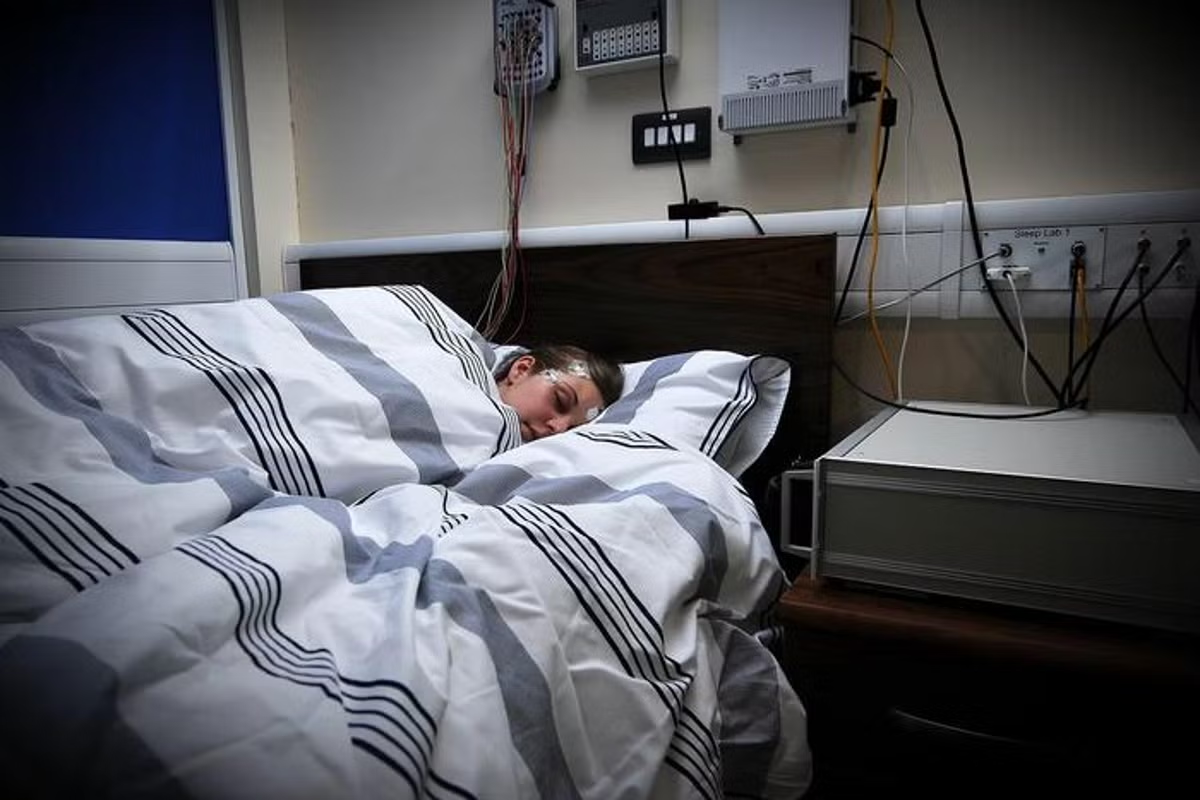
Participant takes part in a sleep study
Participant takes part in a sleep study (University of York Sleep Lab via Eurekalert)

Researchers analysed the duration of each sleep stage – REM, deep sleep, light sleep – as well as the total sleep duration, wakefulness after sleep onset, and night-to-night sleep irregularity.

They tracked each participant for an average of nine years and checked their health records for links with more than 1,000 disease outcomes.

Researchers found that more REM sleep was associated with a lower risk of 83 diseases, including heart failure, dementia, and Parkinson’s.

Greater deep sleep was linked with a lower risk of seven conditions, including type 2 diabetes and clinical depression.

Higher sleep irregularity and wakefulness after sleep onset, on the other hand, were linked to a higher risk of conditions like anxiety and substance-use disorders.

Advertisement

Researchers noted that study participants who regularly slept for six to eight hours carried the lowest risk of several diseases. Participants who slept less than five hours faced the most elevated clinical vulnerability, with a higher association for 37 health conditions, but those sleeping more than eight hours were at risk as well.

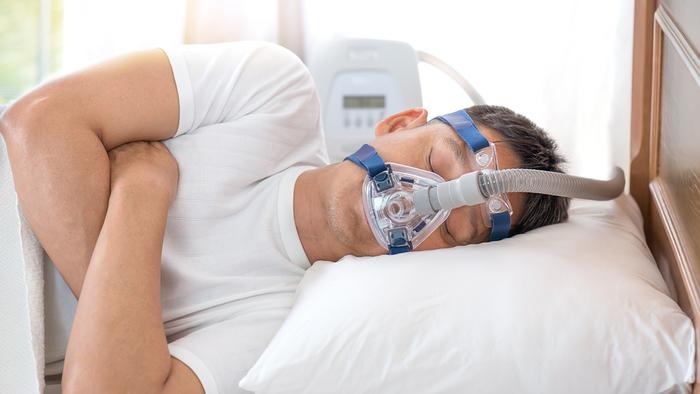
CPAP machine for sleep apnoea
CPAP machine for sleep apnoea (University of Missouri via Eurekalert)

“The minimum-risk duration for the majority of these conditions was precisely concentrated within the 6-8 hour window,” researchers wrote.

However, they cautioned that the findings were only observational and could not establish that sleep patterns directly caused disease risk.

“The findings provide additional evidence supporting the role of a 6-8 hour sleep duration as a health safeguard for middle-aged and older adults, likely attributable to more favourable distributions of the sleep stages,” the study said. “Maintaining a sleep duration of 6-8 hours can effectively reduce the risk of multiple diseases, providing new insights for health promotion and preventive practice.

Source link

Advertisement
Continue Reading

NewsBeat

It’s still illegal yet the police simply don’t seem to care why the whole country stinks of weed: PETER HITCHENS

Published

on

A man smokes from an oversized spliff at a pro-cannabis rally in Hyde Park, London, while surrounded by onlookers

Source link

Continue Reading

NewsBeat

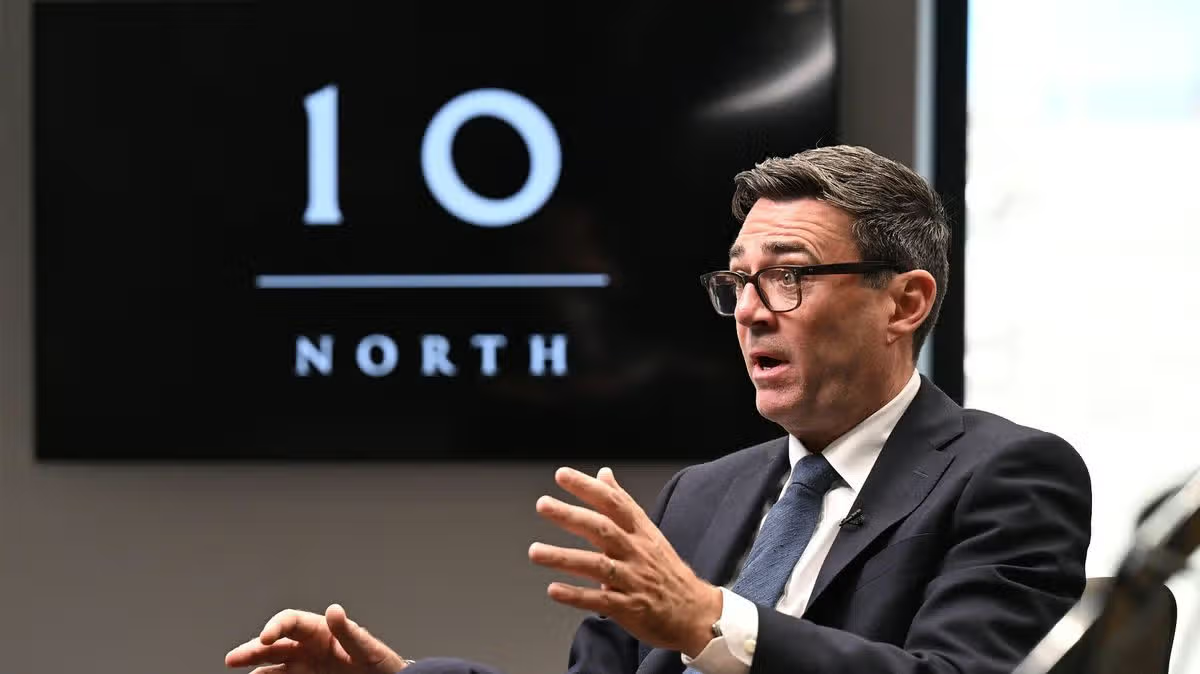
‘Historic moment’ for Number 10 North as first international leader visits Andy Burnham in Manchester

Published

on

Manchester Evening News

‘We are the closest of friends, and I look forward to further strengthening that friendship’

Andy Burnham will host Irish Prime Minister Micheál Martin in Manchester on Friday – the first time an international leader has visited Number 10 North. Talks on trade and continued relations are expected.

Advertisement

Downing Street said it would be the first official meeting between the PM and the Taoiseach of Ireland since Mr Burnham took office.

A spokesperson said the two leaders would ‘discuss how the UK and Ireland can cooperate even more closely to create opportunities for people across both countries’.

Click here to get the biggest stories straight to your inbox in our Daily Newsletter

“They are expected to focus on shared objectives including boosting trade, supporting Ukraine, and working with the European Union as Ireland continues its presidency of the EU,” Downing Street added.

Advertisement

The visit to Manchester comes days after Mr Burnham hosted Canadian Prime Minister Mark Carney in Liverpool and NATO Secretary General Mark Rutte in Oxford.

In a statement, the PM said: “I’m delighted to be hosting the Taoiseach as the first international leader to visit No10 North – this is a historic moment and a proud day for Manchester.

“No10 North is all about creating opportunities for working people, and our partnership with Ireland as we improve the lives of people in both of our countries is a key part of that. There is so much we can achieve together: from our shared commitment to the Good Friday Agreement, to trade, to working with Europe and supporting Ukraine.

Advertisement

“We are the closest of friends, and I look forward to further strengthening that friendship.”

After a meeting at No10 North, the leaders are expected to visit an Irish community centre to meet with representatives from the Irish community in Greater Manchester.

Ireland is said to be the UK’s sixth largest trading partner, while Dublin-London is the busiest air route departing from, and landing in, two different countries in Europe.

The spokesperson added: “The UK government is committed to working with the Irish government to further strengthen this relationship, underpinned by deep historic ties and shared values, as well as the shared Common Travel Area and both countries’ enduring commitment to the Good Friday Agreement.”

Advertisement

Mr Burnham also hosted Ukrainian President Volodymyr Zelenskyy in Portsmouth in July and French President Emmanuel Macron in London earlier this month.

Speaking ahead of the meeting, the Taoiseach said it would reaffirm the ‘strength and importance of the relationship between our two countries’.

He said: “The immense potential of this bilateral relationship is recognised in, and being realised through, our UK-Ireland 2030 programme of strategic cooperation.

“This meeting is an opportunity to assess progress across the programme since the most recent UK-Ireland summit in Cork in March, and to inject further momentum into our partnership as we look ahead to the 2027 summit to be hosted by the UK.”

Advertisement

Mr Martin said they would also discuss Northern Ireland issues, including the joint framework on addressing the legacy of the Troubles.

He added: “We will also discuss how best to work in partnership to sustain the overall success of the Good Friday Agreement in all its parts in the time ahead.

“Our discussions will also cover EU and international issues, including Ireland’s current presidency of the Council of the EU and the next EU-UK Summit, and the situation in Ukraine, Gaza and the Middle East more broadly.”

Source link

Advertisement
Continue Reading

NewsBeat

Kemi Badenoch orders lawyers to challenge Labour cuts which Tory-run council says has forced it to hike council tax by 94 per cent

Published

on

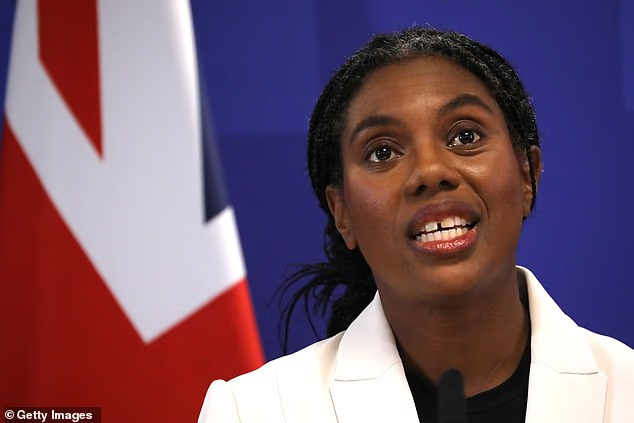
Kemi Badenoch said it was ¿outrageous¿ that the council tax in Wandsworth was increasing so much but said it was due to 40 per cent cuts to their funding by Labour

Advertisement

Kemi Badenoch last night instructed lawyers to challenge Government cuts which Tory-run Wandsworth Council says has forced it to increase council tax by 94 per cent.

The Tory leader said it was ‘outrageous’ that the amount was increasing so much but said it was due to 40 per cent cuts to their funding by Labour.

She said the Conservative Party would challenge the decision in court because of the principle behind it.

Ms Badenoch told BBC Newsnight: ‘We have actually instructed lawyers, as the Conservative Party, to see if we can challenge the government on this decision.

Advertisement

‘Because what it looks like Labour is doing is taking money from areas that don’t vote Labour and giving it to places that do vote Labour.

‘And I think that’s completely wrong. I think it is outrageous. So we’re talking to lawyers. Andy Burnham has not found 40 per cent of anything to cut, but he’s asking Wandsworth to do that. I don’t think that’s fair. I don’t think that’s right.’

She said the nearly 100 per cent increase would hit family budgets and it wasn’t fair to punish homeowners for not voting Labour.

The Tory leader has previously accused Labour of starving the council of future funding.

Advertisement

Kemi Badenoch said it was ‘outrageous’ that the council tax in Wandsworth was increasing so much but said it was due to 40 per cent cuts to their funding by Labour

Tory-run Wandsworth Council announced a 94 per cent rise in its council tax earlier this week

Tory-run Wandsworth Council announced a 94 per cent rise in its council tax earlier this week 

Ms Badenoch said the Government had left Wandsworth Council, which it lost to the Tories in May after running it for just one term, with a ‘historic’ £137 million gap in its finances.

Advertisement

She blamed Housing Secretary Angela Rayner’s controversial reforms that give more money to Labour-voting areas in the north.

This summer, a spending review published by the incoming Tory administration on the town hall said it had inherited from Labour ‘the largest government cuts, the largest projected overspending and the largest predicted budget gap in Wandsworth’s history’.

The report claimed that the previous Labour administration had used reserves to balance the budget, had increased staff by 14 per cent since taking over in 2022 and had spent and borrowed millions more without increasing revenue.

It warned that Wandsworth’s council tax ‘would have to increase by more than 230 per cent’ to balance the books if urgent action was not taken.

Advertisement

The report said that Margaret Thatcher’s favourite borough had previously been ‘synonymous with low council tax’ but that Labour ministers saw that ‘as a problem, not a positive’.

Residents in the borough currently pay £1,020 a year for Band D council tax – split equally between the council and the Mayor of London.

Under the plans, the council’s £510 share would surge by £958 while the Mayor’s portion stays unchanged. This means the total bill will almost double to £1,978.

Advertisement

Source link

Advertisement
Continue Reading

NewsBeat

Man pleads guilty to attempted rape after attacking female Tube passenger on Bakerloo line train

Published

on

A 54-year-old man, Vincent Saxon, has pleaded guilty to attempting to 'rape' a woman on a Bakerloo line train between Waterloo and Lambeth North in July

Advertisement

A man has pleaded guilty to attempting to rape a woman who was travelling alone on a Bakerloo line train in south London.

Vincent Saxon, 54, of no fixed address, admitted the offence at Inner London Crown Court on Thursday, September 17.

He was remanded in custody and is due to be sentenced at the same court on Friday, October 30.

The attack happened at around 11.40pm on Saturday, July 11, as the woman travelled between Waterloo and Lambeth North.

Advertisement

Saxon approached her on the train and exposed himself before forcibly pulling her to the floor and attempting to rape her.

The woman fought back and managed to escape when the train reached Lambeth North. She alerted station staff, who contacted British Transport Police (BTP).

Saxon remained on the train and later got off at Elephant and Castle Underground station. Officers searched the area but were initially unable to locate him.

Investigators subsequently launched an urgent search for the suspect, including an appeal through the media and social media.

Advertisement

A 54-year-old man, Vincent Saxon, has pleaded guilty to attempting to ‘rape’ a woman on a Bakerloo line train between Waterloo and Lambeth North in July

The appeal led to several people providing information to police. An anonymous caller later reported seeing a man matching Saxon’s description outside a shop on Fulham Palace Road.

Officers went to the location and arrested Saxon. He was subsequently charged with attempted rape.

Advertisement

Evidence gathered during the investigation included CCTV footage and forensic evidence recovered following the attack.

Saxon remains in custody ahead of his sentencing next month.

BTP Detective Sergeant Krishan Appannah said: ‘First and foremost I would like to praise the victim for her bravery following what was clearly a terrifying ordeal. She was alone late at night when she was approached and attacked by Saxon without warning.

‘She fought back ferociously against him before he fled. Her actions helped us recover vital forensic evidence that, along with our CCTV enquiries, would leave Saxon with no choice but to plead guilty.

Advertisement

‘He is a dangerous and predatory offender and I’m pleased to see that we have secured justice for this brave victim, hopefully it will now be able to bring her some form of closure.’

Anyone who is the victim of or witnesses an offence on the Tube or railway network can text BTP on 61016.

Advertisement

Source link

Continue Reading

NewsBeat

Two in hospital after serious crash in Scots town as police close road

Published

on

Daily Record

Their current conditions are unknown.

Two people are in hospital after a serious crash in a Lanarkshire town.

Advertisement

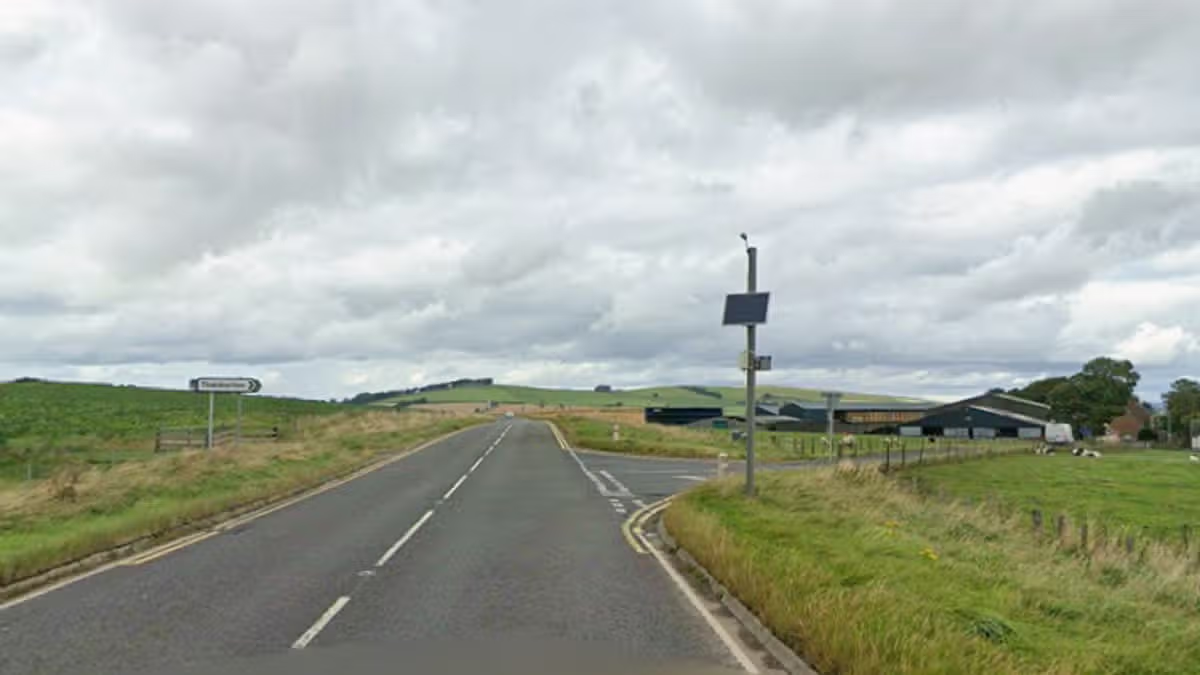
Emergency services raced to the two-vehicle collision on the A73 at the Sherifflats Road junction in Thankerton, South Lanarkshire, at 1.30pm on Thursday, September 17. Crews attended and two people were found injured.

Their current conditions are unknown. The road remains closed off while a police investigation is carried out.

Drivers have been asked to avoid the area.

A statement from Police Scotland reads: “The A73 is currently closed in both directions at Thankerton due to a serious crash which happened at the Sherifflats Road junction. Emergency services were called to the scene at around 1.30pm on Thursday, 17 September, 2026 following the crash involving two-vehicles.

“Two people have been taken to hospital. Drivers are asked to avoid the area where possible.”

Advertisement

Get more Daily Record exclusives by signing up for free to Google’s preferred sources. Click HERE.

Source link

Continue Reading

Trending

Copyright © 2025