

Hundreds of dangerous sex offenders are due to be freed from jail under Labour‘s prison reform plans despite a series of U-turns by Prime Minister Andy Burnham.
The Conservatives warned that 700 sex criminals will be ‘let loose on the streets’ as Labour abolishes so-called imprisonment for public protection (IPP) sentences.
It comes after Labour repeatedly flip-flopped over a separate programme to free thousands of criminals from jail early.
After a public outcry Mr Burnham was forced to exclude offenders convicted of rape, serious child sexual and grooming offences, and later expanded exclusions to those convicted of manslaughter and other ‘unlawful killing’ offences.
Earlier this month Justice Secretary Alex Norris outlined separate proposals to release 2,271 inmates still serving the controversial IPP sentences in order to free up space in the overcrowded jails.
Ministry of Justice (MoJ) figures obtained by Shadow Justice Secretary Nick Timothy show 700 inmates serving IPPs are sex offenders.
Of those 379 have never been released and the remaining 321 have been recalled to jail, for breaching parole terms or committing fresh crimes.
A further 791 offenders on IPPs were convicted of ‘violence against the person’, such as GBH or other assaults.
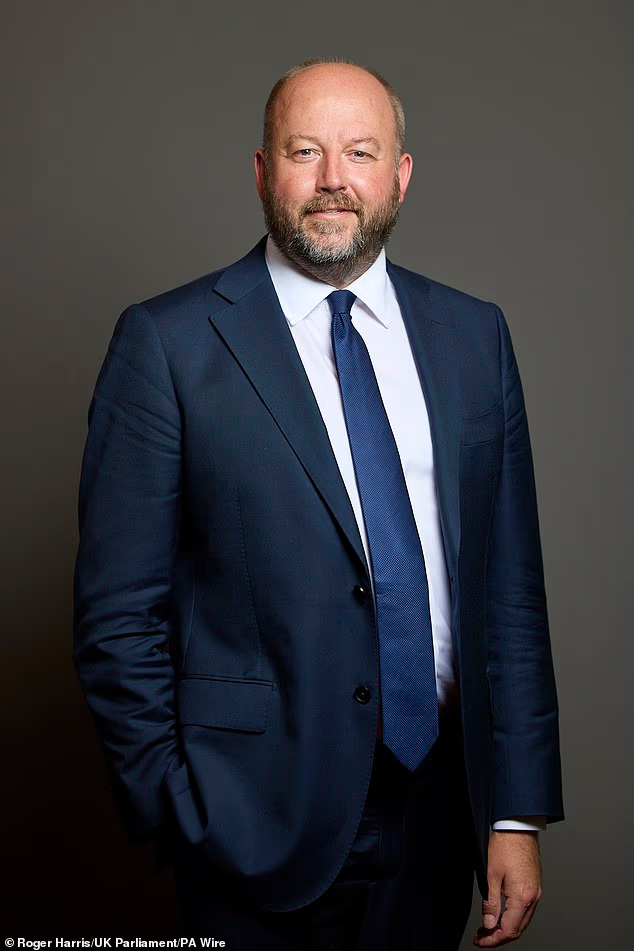
Shadow Justice Secretary Nick Timothy has urged Labour to build more jail space rather than free so-called IPP prisoners
In addition 522 were convicted of robbery, 77 of criminal damage or arson and 65 of possession of weapons.
Mr Timothy said: ‘Labour wants to abolish IPP sentences, but this would mean up to 700 dangerous sex offenders being let loose on the streets.
‘Two in three IPP prisoners are there for violent or sexual crimes, and they have not been released because the Parole Board says it is not safe to do so.
‘Labour must rule out releasing these dangerous sex offenders, and instead focus on building more prisons, expanding capacity, and maximising the space that we have.’
IPPs were introduced by Sir Tony Blair’s government in 2005 and allow offenders to be jailed indefinitely if they are ruled to pose a risk to the public.
They were abolished for new crimes in 2012 but many criminals previously handed the sentence have remained inside because the Parole Board has ruled they are still not safe to be released.
Justice Secretary Alex Norris told MPs earlier this month that he would ‘act on a long-standing injustice’ and abolish all remaining IPP sentences.
‘They were rightly abolished a decade ago, but offenders are still locked up for far longer than envisaged, often for crimes that, if committed today, would see them spend much less time in jail,’ he said.
‘Of those who have never been released, 99 per cent are beyond the tariff imposed by the court, and 80 per cent have served 10 years or more beyond it.
‘The number of IPP offenders has been reducing, but the Prime Minister and I want to go further.
‘We will soon bring forward legislation to end the sentence, once and for all, by the end of this Parliament.’
Mr Norris recognised that ‘some of these offenders have committed serious crimes’, adding: ‘Public safety will always be my top priority, but we must balance that with fairness on sentences.’
He vowed that IPP releases would be ‘safe and sustainable’.
One solution proposed by the Commons’ justice select committee in 2022 is to resentence all offenders on remaining IPP sentences.
But Labour has indicated this would carry an ‘unacceptable risk’ because the criminals would have to be freed without any probation supervision.
An official MoJ report found that 97 prisoners who were freed from IPP sentences between 2014-15 and 2023-24 committed serious further offences including murder, manslaughter, rape and serious sexual assaults.
The separate prison early release scheme was drawn up by now Home Secretary Shabana Mahmood when she was in charge of the MoJ.
Over the summer, new PM Mr Burnham moved to exclude rapists and other serious sex offenders from the programme.
He then had to announce further exclusions after forceful protests by the family of Pc Andrew Harper, after it emerged two of the officer’s killers had been due to benefit from early release.
An MoJ spokesman said: ‘While we must end the unfairness of these sentences for those who have more than served their time, we know some IPP prisoners will still pose a risk to communities.
‘That’s why we will work cross-party and with experts in this field to make sure we get this right.
‘It will take time, and public safety will be at the centre of our approach.’














































You must be logged in to post a comment Login