Neil Barron, the founder and chief executive of Litelok had a great idea and found a gap in the market – a big one, as it turns out.
15:45, 23 Sep 2026Updated 15:54, 23 Sep 2026
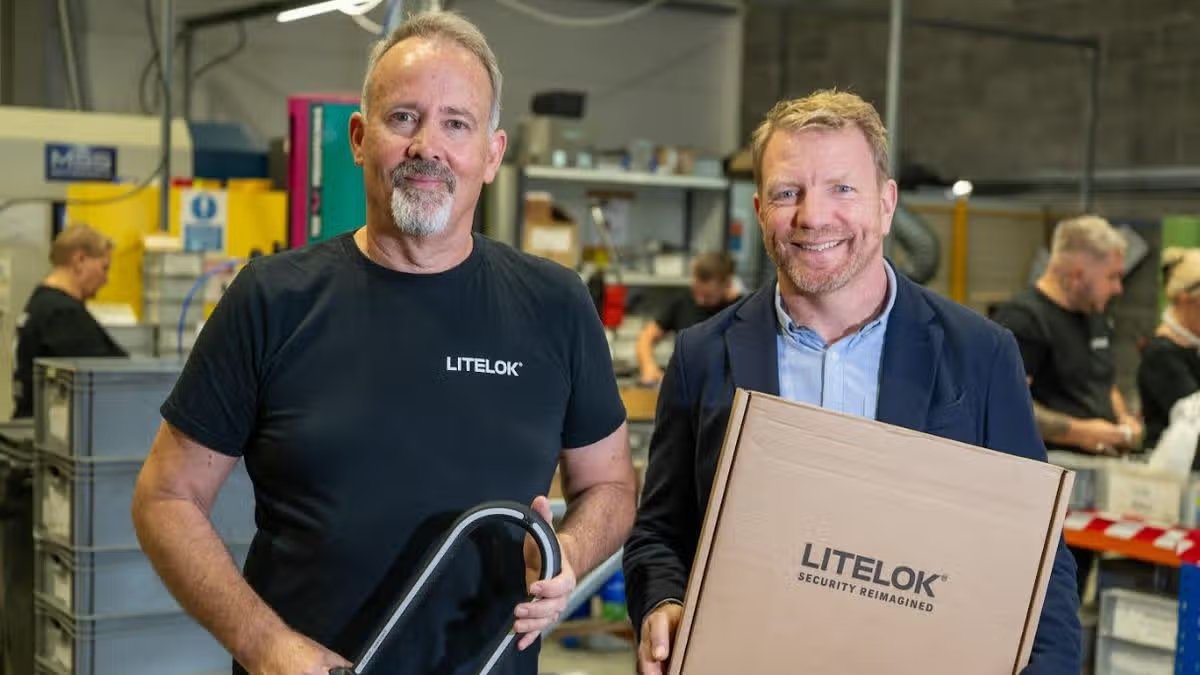
Founder of Litelok Neil Barron and chief executive of the Development Bank of Wales Giles Thorley.
One of the best parts of my job is meeting business owners who are dedicated to quietly building remarkable companies.
They’re rarely the loudest voices in the room. They’re usually too busy running their businesses.
Yet time and again I come away struck by the same thing. The businesses making the biggest difference to our economy aren’t always the largest, they’re the ones that keep improving – investing in people, embracing new ideas, prioritising customers, finding better ways to compete.
A recent visit to Zeal Innovation, which trades as Litelok, reinforced that sentiment.
The company is incredibly innovative: it designs and manufactures innovative, high-security, grinder-resistant locks for bicycles and motorcycles – all from a solar panel powered factory in Swansea. In my opinion, as a customer of several Barronium armoured X1 bike locks, they are the best in the world.
Neil Barron, the founder and chief executive of Litelok had a great idea and found a gap in the market – a big one, as it turns out.
That is why we’ve backed them through four funding rounds. But what always impressed me most was their culture of continuous improvement.
Whether investing in sustainability, developing its people or finding new ways to innovate, it is a business that never stands still.
And that is why the business exemplifies the type of company flagged by research from Economic Intelligence Wales as a “productivity hero”.
At first glance, the phrase might sound like another piece of economic jargon. But it isn’t.
A productivity hero is a business that achieves something remarkable: it grows its turnover, creates jobs and improves productivity – all at the same time. Revenue grows faster than employment, meaning the business becomes more productive without sacrificing growth or opportunities for its workforce.
In the case of Litelok, it has increased its turnover per full-time employee from some £45,000 in 2017 to some £350,000 in 2026 as annual revenues approach £10m – an extraordinary increase in productivity.
Such case studies matter, as does this wider report, because productivity is often misunderstood.
For many people, higher productivity conjures images of automation or AI replacing people or businesses doing more with fewer staff.
The reality is far more encouraging. The best businesses aren’t simply becoming leaner; they’re becoming better. They’re building stronger teams, investing in leadership, adopting technology where it makes sense and constantly looking for ways to create more value for customers.
The productivity heroes report from Economic Intelligence Wales identifies 1,732 businesses across Wales that fit this description. Together, they generated more than £6bn in turnover while creating over 5,200 jobs.
Those aren’t just impressive statistics. They’re evidence that Wales already has businesses showing us what sustainable growth looks like.
Perhaps even more encouraging is what the research tells us about how these businesses succeed and achieve this feat.
Technology often plays a role, but it isn’t the whole story.
Repeatedly, the research points to three common characteristics – an unwavering focus on customers, a willingness to invest in people through leadership and skills, and a culture that embraces innovation and digital adoption. None of those things happen overnight. They require ambition, long-term thinking and a commitment to continuous improvement.
That reflects what we’ve seen at the Development Bank of Wales. Whether we’re supporting a manufacturer investing in new production technology, a family business planning for succession, a technology company scaling internationally or a developer bringing forward new homes, the businesses that create the greatest long-term impact almost always have something in common.
They invest in their people as much as they invest in equipment. They think beyond the next quarter.
And they understand that productivity isn’t about working harder, it’s about working smarter.
One of the most valuable aspects of the productivity heroes research is that it gives us a better way of understanding which businesses are driving Wales forward.
For too long we’ve tended to judge success by looking at turnover growth or employment growth in isolation.
Those measures remain important, but they only tell part of the story. Productivity heroes provide a richer picture because they identify businesses creating more value while continuing to create opportunities for people.
Good economic evidence matters because it helps us make better decisions.
At the Development Bank of Wales, our role extends beyond providing finance. As a trusted delivery partner working alongside the Welsh Government, we want to use evidence like this to ensure support reaches the businesses where it can make the greatest difference.
That means helping ambitious companies start, grow and scale, while retaining value in Wales and strengthening the foundations of our economy.
The report also challenges some long-held assumptions. Productivity heroes aren’t confined to one sector or one part of Wales.
They can be found in manufacturing, food and drink, construction, professional services and technology. They operate in rural communities and our cities alike.
That should give us confidence because it tells us productivity is something every ambitious company can strive towards.
The question becomes, therefore, not whether Wales has productivity heroes. It is clear that we already do. The challenge is how we create many more of them.
It means ensuring businesses have access to leadership development, skills, innovation support and the finance they need to invest with confidence.
It means creating the conditions that allow good businesses to become great ones. And it means continuing to build an economy where successful Welsh businesses can grow, scale and retain their value here in Wales.
If we can do that, the next productivity heroes report won’t simply tell us which businesses are succeeding today; it will show us that Wales is creating the conditions for many more businesses to grow better, become more productive and contribute to a stronger, more prosperous economy tomorrow.
- Giles Thorley is chief executive of the Development Bank of Wales.



























































You must be logged in to post a comment Login