
Business
Sebi board meeting: PMS rules overhaul, FPI commodity trades among key decisions to watch out


The board may take up around a dozen proposals, according to reports, many of which have already gone through the consultation route. The agenda comes at a time when the regulator is trying to widen market participation, reduce regulatory friction and deepen long-term capital pools, while keeping investor protection safeguards intact.
PMS overhaul in focus
One of the biggest proposals before the board is a revamp of Portfolio Management Services regulations. Sebi has proposed several changes to the PMS framework, including allowing discretionary portfolio managers to invest in pre-IPO securities and unlisted debt. Portfolio managers may also be allowed to invest in overseas markets.
A new MF-PMS category is also proposed. This would allow PMS products that invest only in mutual funds, with a lower entry barrier compared with regular PMS products.
The regulator has also proposed changes to derivative limits for discretionary PMS, qualification requirements for principal officers, net worth norms and the definition of related party. Another proposal would allow independent fund managers to operate under registered PMS players.

If cleared, the changes could widen the PMS market and give fund managers more flexibility in portfolio construction.
Also Read:Sebi weighs lower margins for longer-term derivatives as F&O losses stay high: Tuhin Kanta Pandey
Accredited investor pool may widen
The Sebi board is also expected to consider changes to the accredited investor framework. Under the proposal, individuals holding securities-market assets of Rs 5 crore and body corporates with securities-market assets of Rs 20 crore may qualify as accredited investors. This would be in addition to the existing income and net-worth criteria.
The move is aimed at expanding the pool of sophisticated investors who can access products such as AIFs with more flexibility. Sebi’s proposal indicates that the eligible accredited investor base could expand to around 4 lakh, compared with the existing AIF investor base of about 1 lakh.
Settlement rules
The board may also review Sebi’s proposed overhaul of settlement regulations. The draft framework seeks to simplify how settlement amounts are calculated. The regulator has proposed changes that could make settlement a more practical route in enforcement matters while retaining deterrence.
The proposed changes include lower values linked to the stage of proceedings in some cases, a more balanced treatment of mitigating and aggravating factors, and a revised approach to determining base amounts.
The draft also seeks to clarify how defaults are counted, how repetitive defaults are treated, and how wrongful gains or investor losses are dealt with. Wrongful gains may be factored only towards disgorgement rather than being counted again in the base amount.
Other proposals include lower additional amounts for refiling withdrawn applications, removal of surcharge for settling multiple proceedings, more standardised interest rates on disgorgement and a weighted-average method for interest calculation in cases involving many transactions.
Common ad code for Sebi-regulated entities
A common advertisement code for all Sebi-regulated entities may also come up before the board. The regulator has proposed replacing different entity-specific and exchange-specific advertisement codes with one unified framework. The proposal also seeks to move from mandatory prior approval to post-issue reporting within 24 hours.
Another important change is the possible permission for celebrity endorsements at the brand or entity level, subject to conditions and prior approval. The aim is to reduce regulatory overlap and bring consistency across regulated entities.
FPIs may get wider commodity access
Sebi may also consider allowing foreign portfolio investors to participate in physically settled non-agricultural commodity derivative contracts on recognised domestic exchanges. At present, FPIs are allowed in cash-settled non-agricultural commodity derivatives and commodity indices, except deliverable options contracts. The proposed change would allow them into non-cash-settled contracts, subject to safeguards.
The move is aimed at improving liquidity and institutional participation in India’s commodity derivatives market.
REITs and InvITs on agenda
The board may also take up proposals linked to REITs and InvITs. One proposal would allow REITs and listed InvITs to issue depository receipts backed by their units. This would give them a route to raise foreign capital through overseas exchanges. The framework may allow fresh DR issuance against new units as well as transfer of existing units by unitholders to foreign depositories. Indian residents and NRIs would not be eligible to hold these DRs.
Another proposal would allow REITs and InvITs to invest minority stakes in under-construction third-party projects within existing exposure limits. Sebi may also consider reducing the OFS cooling-off period and recognising remote common infrastructure as real estate.
The board may also deliberate proposals related to AIFs, certification requirements for associated persons, research analyst call recordings and vault manager regulations.
Disclosure: This article has been written by Podishetti Akash, who is not a SEBI-registered Research Analyst or an Investment Adviser. Podishetti Akash and her ‘relative(s)’ (as defined under Section 2(77) of the Companies Act, 2013) do not hold any financial interest in the companies mentioned in this article as of the date of publication. The views/recommendations mentioned in this article, wherever applicable, are those of the respective SEBI-registered Research Analyst/brokerage and have been reproduced/reported with due attribution. They should not be construed as the views or recommendations of The Economic Times Digital or the journalist. Readers are advised to consider the original research report and make their investment decisions based on their own assessment. Brokerage disclaimers here.

Business
(VIDEO) Kylie Minogue Admits Nerves and ‘Voices’ of Doubt Ahead of AFL Grand Final Hometown Show at the MCG

MELBOURNE — Kylie Minogue says she is preparing to give everything she has to Saturday’s AFL grand final pre-game performance at the MCG, even as the pop star admits to grappling with nerves and self-doubt ahead of what she has described as a full-circle moment in her home city.
Speaking at a media call at the Melbourne Cricket Ground on Thursday morning, Minogue offered a preview of what the 100,024 fans expected at the sold-out stadium, along with millions more watching from home, pubs and backyard barbecues around the country, could expect from her set. “They’re getting a show,” Minogue said. “We really are throwing everything at it. They’re getting a Melbourne girl performing in her hometown, which is wild to me.”
Minogue said the full weight of the moment only truly hit her during a rehearsal on the MCG’s turf, performed without amplification alongside just her backing singers. “It just struck me … I’m singing centre stage at the MCG. I just had that little moment for myself, which was amazing and a beautiful emotion,” she said, adding candidly that she expects the emotion of the actual performance may prove difficult to contain. “I’m hoping I don’t get too overcome with emotion – I might,” she said, adding that she has been telling herself to “hold it together, hold it together.”
Despite a 38-year career that has taken her through countless stadium performances around the world, Minogue said Saturday’s set presents a distinct challenge given its compressed format. “With a longer show, you might have two or three songs to kind of settle in, but with a 20-minute set, I’ve got to get to that point quickly,” she said. Even so, she described a surprisingly comforting energy to the venue itself during rehearsals. “I did feel when we were rehearsing that as much as the MCG is gargantuan – and even when it’s empty it has this incredible energy – it’s also like a massive hug. It’s such a communal space that it did feel good out there.”
Weather remains an unresolved variable ahead of the performance. “Is it going to be gale force winds? Is it going to be boiling hot? Is it going to be pouring rain,” Minogue said, weighing the possibilities aloud, before adding, “But that’s part of the fun, isn’t it?” Forecasts for Saturday point to cold conditions around 15 degrees Celsius with up to 15 millimeters of rain expected, weather that could complicate a performance built around elaborate, Vegas-style costuming and choreography.
Minogue declined to reveal her full setlist for the performance, though she indicated that her song “Love at First Sight” may be among her personal favorites to perform. She described the broader shape of the show as a mix of familiar hits and unexpected touches, promising “songs that people know, a little bit of nostalgia, a little bit of fun, a few surprises.”
She did offer one specific preview, hinting that the set would include a personal reference to her own upbringing in Melbourne. “It makes a nice little mention of me being a young girl going to Camberwell High School and dreaming about pop music and what I might do in life, getting to the end of HSC – I’d already started acting, so there was nothing at school that made any sense to me,” Minogue said. She reflected on the improbability of the moment she now finds herself in. “And then the question of what do you want to do, how are you going to live, how are you going to pay your bills, and just how far I’ve come, I guess, and it’s led me back to centre stage at home in the most iconic venue for the most iconic game, an Australian game. There’s just so much about this moment for me that’s hard for me to grasp, so I’m kind of in awe and wonder myself at this moment.”
The Australian Football League had reportedly been trying to secure Minogue for the grand final slot for years before she finally agreed to take part this year. As part of the promotional lead-up to Saturday’s show, Minogue took part in a series of social media appearances, including one in which Hawthorn players Nick Watson and Jack Ginnivan, known to fans by their nicknames “The Wiz” and “Ginni,” coached her on how to kick a football. Minogue said the exchange left her thinking about unexpected parallels between football and live performance. “We were talking about stepping over the line, and I’ve been thinking about a lot of those parallels,” she said. “I’m not in a team sport, but I kind of am. There’s so many people working on this show, and everyone’s got each other’s back, and the self-talk in your brain, in your mind, leading up to any important gig or game – ‘You can do it, you can’t do it, this is going to go wrong, that’s going to go, what if, but maybe’ – and I just felt a nice kind of oneness with people from a completely different field.”
Minogue said the internal doubts she experiences ahead of major performances are a universal experience shared by anyone performing at the highest level, whether on a football field or a concert stage. “The voices in your head … we’ve all got the same thing. For you guys, it’s probably when you get up the race and you step onto the field everything changes,” she said. “Same for me. It’s like, ‘OK, there’s no turning back now. It’s showtime.’”
With Saturday’s pre-game slot now just days away, Minogue’s performance is set to draw one of the largest live audiences of her career, combining the scale of Australia’s biggest single sporting event with what she has described as a deeply personal homecoming moment in the city where her own pop music dreams first began.
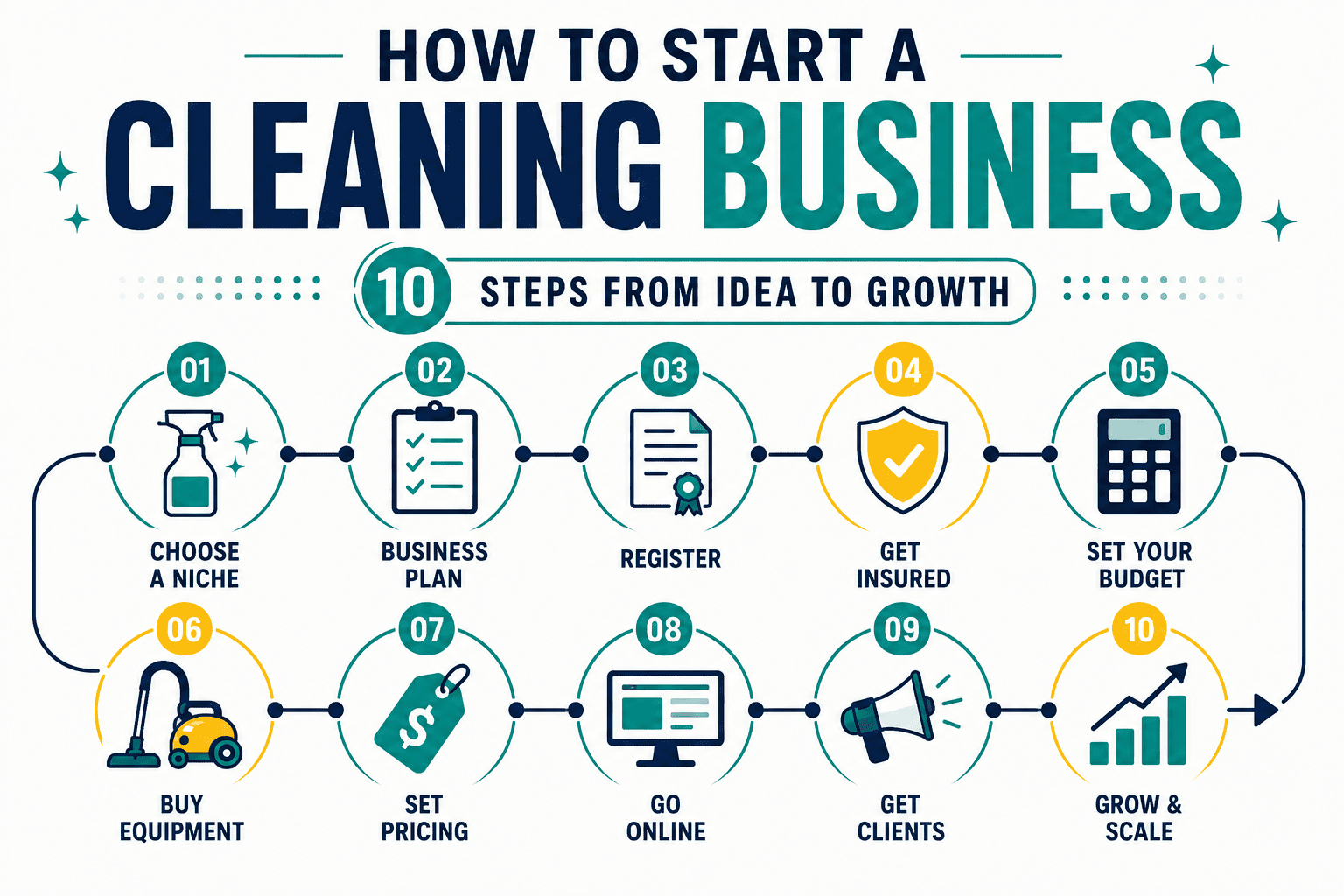
The cleaning services industry in the United States employs more than 3 million people and generates over $100 billion a year, and it doesn’t ask for a fraction of that revenue as an entry fee. A laptop for scheduling, a car, and a few hundred dollars in supplies is enough to start taking on clients. That low barrier to entry is exactly why the industry attracts so many first-time business owners, and exactly why so many of them plateau within the first year: it’s easy to start cleaning, and much harder to build a business around it.
The difference between the two usually comes down to whether you treat the early decisions, your niche, your pricing, your legal setup, as an afterthought or as the foundation. This guide walks through both, in order.
Step 1: Choose Your Cleaning Niche
“Cleaning business” covers a wider range of work than it sounds like, and picking a lane early shapes almost every decision that follows, from the equipment you buy to the clients you market to.
The broad categories worth considering:
- Residential cleaning: Recurring home cleaning for individual clients. Lower startup costs, shorter sales cycles, and the easiest entry point for a solo operator.
- Commercial and janitorial cleaning: Offices, retail spaces, and other business properties, typically cleaned after hours under longer contracts. Bigger accounts, but a longer sales cycle (often 30 to 90 days) and more equipment.
- Specialized cleaning: Carpet and upholstery cleaning, post-construction cleanup, move-in/move-out cleaning, short-term rental turnover (Airbnb-style properties), and biohazard or medical facility sanitation. These command premium rates precisely because fewer competitors offer them.
- Eco-friendly cleaning: Not a separate service so much as a positioning choice, using green-certified products as your differentiator in a market where most competitors don’t.
Residential is the most common starting point because it requires the least capital and the fastest path to your first paid job. Many owners start there and add commercial or specialized services once they have consistent revenue.
Step 2: Write a Simple Business Plan
You don’t need a 40-page document to start a cleaning business, but skipping this step entirely tends to catch up with owners around month six, usually as a pricing problem or a cash flow problem that a plan would have caught earlier.
At minimum, put in writing:
- The services you’ll offer, and specifically which niche from Step 1 you’re targeting first
- Your target market: who they are, where they’re located, and how many potential clients realistically exist in your service area
- Your competition: who else is operating in your niche and area, and what they charge
- Your pricing model (covered in detail in Step 7)
- A basic financial projection: expected monthly revenue, fixed costs, and the point at which the business covers its own expenses
This is also the point to decide whether you’re building a side income or a company you intend to hire into. That decision affects your legal structure, your insurance needs, and your pricing, so it’s worth answering honestly now rather than backing into it later.
Step 3: Choose a Business Structure and Register Your Business
Most new cleaning businesses choose between two structures:
Sole proprietorship: The simplest option. No separate legal entity, no formation paperwork, and your business income passes through to your personal tax return. The tradeoff is personal liability: if the business is sued or can’t pay a debt, your personal assets aren’t protected.
Limited liability company (LLC): A registered business entity that separates your personal assets from business liabilities. Costs more to set up (typically a few hundred dollars in state filing fees) and requires some ongoing paperwork, but it’s the more common choice once you start hiring or taking on commercial clients, since it limits your personal exposure if something goes wrong on a job.
Once you’ve picked a structure, registering typically involves:
- Filing your business name with your state (and a DBA, or “doing business as” registration, if you operate under a name different from your own or your LLC’s legal name)
- Applying for an EIN (Employer Identification Number) [a federal tax ID that functions like a Social Security number for your business] from the IRS, which you’ll need to open a business bank account and, eventually, to hire employees
- Checking whether your city or county requires a local business license, since requirements vary significantly by location and only a handful of states mandate one statewide
Step 4: Get Licensed, Bonded, and Insured
Most U.S. states don’t require a specialized cleaning license, but nearly every serious client, and every commercial contract, will expect proof of insurance before letting you in the door.
General liability insurance covers property damage and client injuries that happen on the job, a client’s flooring gets damaged, someone slips on a wet floor, and it typically runs $500 to $1,500 a year for a small operation. Most residential and virtually all commercial clients will decline to hire an uninsured cleaner, so treat this as a startup cost rather than an optional add-on.
A surety bond (often called a janitorial bond in this industry) [a policy that reimburses a client if an employee steals from them or causes intentional damage] costs somewhere between $100 and $500 a year and does double duty: it protects your clients, and it signals credibility to prospects who’ve never worked with you before.
Workers’ compensation insurance becomes a legal requirement in most states the moment you hire your first employee, with costs varying by state and payroll size.
Commercial auto insurance is worth adding once you’re driving to job sites regularly, since a personal auto policy typically won’t cover accidents that happen while conducting business.
Two more compliance areas are easy to overlook because they don’t come with a fee or a form, but they carry real liability. If your team handles cleaning chemicals, OSHA (the Occupational Safety and Health Administration) [the federal agency that sets workplace safety standards] expects proper labeling, safe storage, and basic safety training, even for a two-person operation. And if your marketing makes specific claims, “100% eco-friendly,” “satisfaction guaranteed”, those claims need to hold up. Truth-in-advertising rules apply to a solo cleaner exactly the same way they apply to a national chain.
Budget roughly $1,000 to $3,000 a year for a solo operator’s full insurance and bonding package, more once you add employees and vehicles.
Step 5: Budget for Your Startup Costs
Total startup costs for a cleaning business vary enormously depending on your niche and whether you’re hiring from day one:
Cost Category
Solo / Home-Based
Small Team / Commercial
Business registration & licenses
$50–$400
$200–$800
Insurance & bonding (first year)
$1,000–$2,300
$3,000–$6,000
Equipment & supplies
$500–$1,500
$2,000–$10,000+
Marketing & branding
$200–$1,000
$1,000–$5,000
Software (scheduling/CRM)
$0–$50/month
$100–$300/month
Typical total to launch
$2,000–$5,000
$10,000–$50,000+
A useful way to sanity-check your own number: total startup cost is roughly your one-time setup costs, plus your first month of recurring expenses, plus a cushion of one to three months of expenses in case client acquisition takes longer than expected. Commercial and franchise operations sit at the high end of this range; a solo, home-based residential operation can realistically launch closer to the low end.
Step 6: Buy Your Equipment and Supplies
What you need depends on the niche from Step 1, but a solo residential operation typically starts with the following, organized by category:
Cleaning products: An all-purpose cleaner, a streak-free glass cleaner, a degreaser for kitchens, a bathroom cleaner for soap scum and hard water stains, a wood- or tile-safe floor cleaner, and furniture polish. Stock eco-friendly versions of each if that’s part of your positioning.
Tools: Microfiber cloths in multiple colors (color-coding by room prevents cross-contamination), a mix of sponges and scrubbers for different surfaces, a spray mop for small jobs and a bucket mop for larger ones, a commercial-grade vacuum (HEPA-filtered if you’ll be working in allergy-sensitive homes), and an extendable duster for ceiling fans and high shelves.
Storage and transport: A cleaning caddy for moving supplies room to room, a rolling cart for bigger jobs, and a way to keep your vehicle organized so supplies don’t leak or shift in transit.
Safety gear: Disposable nitrile gloves, masks or respirators for dusty or heavily chemical jobs, an apron or uniform, heavy-duty trash bags, and a basic first aid kit.
Admin and marketing tools: Business cards, scheduling and invoicing software (more on this in Step 10), and branded shirts or aprons, which do quiet work toward looking established on day one.
Specialized niches add their own equipment on top of this baseline: carpet cleaning requires an extractor, post-construction work often calls for industrial-grade vacuums and heavier protective gear, and commercial contracts may require floor buffers or pressure washers. Buying equipment costs more upfront; leasing lowers the initial outlay but adds a recurring monthly cost, worth weighing against how confident you are in steady, near-term revenue.
Step 7: Set Your Pricing
Pricing is where a lot of new cleaning businesses either underprice out of nervousness or guess too high and lose bids, and both mistakes are avoidable if you start from your own numbers rather than a competitor’s website.
Before picking a model, calculate your baseline cost per hour of cleaning: your own labor (or your team’s wages, plus taxes and any benefits), the supplies used per job, transportation (gas and vehicle wear), and a share of your fixed overhead, insurance, licensing, software, marketing. Add your target profit margin on top of that number, and you have a floor you shouldn’t price below, whatever model you choose.
From there, four pricing models cover most of the industry:
| Pricing Model | How It Works | Best For |
|---|---|---|
| Hourly rate | Charge for time worked, typically $25–$50/hour per cleaner | New businesses still learning how long jobs actually take |
| Flat rate | A fixed price per job regardless of time spent | Established businesses with a clear sense of job duration and value-based positioning |
| Room rate | A set price per room | Simple, predictable jobs with consistent room sizes |
| Square footage rate | Priced per square foot of the space | Larger commercial jobs where footage is the clearest cost driver |
Hourly pricing is the safer starting point precisely because you don’t yet know your average job duration. Once you’ve completed enough jobs to estimate time accurately, flat-rate pricing tends to be more profitable, since efficient work no longer costs you money the way it does under an hourly model. Whichever model you use, check what comparable cleaners in your area actually charge, and be transparent in your quotes about what’s included, laundry, dishwashing, and inside-appliance cleaning are common gray areas, so a client isn’t surprised by an add-on fee mid-job.
Step 8: Build a Professional Online Presence
Before you actively market anything, get the basics in place. Over 80% of people research a cleaning service online before hiring one, and a missing or thin online presence is one of the fastest ways to lose a job to a competitor who simply looks more established.
At minimum:
- A Google Business Profile [a free Google listing that shows your business in local search and maps results], fully filled out with services, service area, and photos
- A simple website with your services, service area, and a way to request a quote or book directly
- A consistent visual identity: a name, logo, and color scheme used across your website, vehicle, and materials, since a professional look is doing real work to build trust before a client has any other reason to believe you’re reliable
Step 9: Market Your Business and Land Your First Clients
Once the foundation is in place, the highest-return marketing tactics for a new cleaning business tend to be the ones that cost the least:
- Referrals from friends, family, and early clients. Offer a discount or credit for referrals; it’s consistently one of the cheapest ways to acquire a new client.
- Google Business Profile optimization, since it’s free and typically starts driving calls within weeks of being set up properly.
- Neighborhood platforms like Nextdoor and local Facebook groups, especially for residential cleaning.
- Google Local Services Ads, which show up when someone is actively searching to hire a cleaner, making them more efficient than general display advertising.
- An introductory offer (a percentage off the first cleaning, for example) to lower the barrier for a first-time client to say yes.
For commercial and specialized niches, direct outreach tends to outperform digital marketing: contacting property managers, real estate agents, and local businesses directly, and joining your local chamber of commerce to build the relationships that lead to referrals and contracts.
Whichever channels you use, track where each client actually came from. It’s the only way to know which dollar of marketing spend is doing the work.
Step 10: Choose Software and Plan for Growth
Even a solo operation benefits from scheduling and invoicing software rather than a paper calendar, both for your own organization and because clients expect the convenience of online booking. Tools built specifically for the industry (options like Jobber, Housecall Pro, and ZenMaid come up often) typically bundle scheduling, invoicing, and client communication in one place.
As the business grows, the same questions come up for most owners: when to hire your first employee, whether to expand into a second niche or a wider service area, and how to keep quality consistent once you’re no longer the one holding the vacuum. None of that needs to be solved on day one, but it’s worth revisiting once you have a handful of steady clients and a clearer sense of what’s actually working.
The Bottom Line
Starting a cleaning business doesn’t require much capital, but it does require getting the unglamorous parts right early: the right legal structure, real insurance, a pricing model you can actually defend, and a plan for finding clients that doesn’t rely on luck. Get those in place, and the industry’s biggest advantage, low overhead and genuinely recurring revenue, starts working in your favor instead of exposing you to risk you didn’t plan for.
Business
IFCI, New India Assurance, other stocks drop up to 3% as NSE makes a muted market debut. What to expect?

NSE’s market debut today will wrap up a long-running process that faced several delays. The stock exchange’s initial public offering was launched earlier this month to raise Rs 22,562 crore entirely through an offer for sale (OFS) of 12.64 crore shares by existing shareholders at a price band of Rs 1,700 to Rs 1,785 apiece.
Since the IPO entirely comprised an offer for sale with no fresh issue component, all the issue proceeds will go to the selling shareholders, and none will be received by NSE itself. A day before the IPO opened for public bidding, the stock exchange raised Rs 6,746 crore from more than 150 anchor investors.
Also read |NSE debut may not set D-St on fire, sparks to come later
How are IFCI, NIACL, other stocks linked to NSE IPO?
IFCI shares have surged more than 50% in 2026 so far, with the majority of gains being driven by the optimism around NSE’s IPO. The company owns more than a 50% stake in Stock Holding Corporation of India (SHCIL), which in turn holds over a 4% stake in NSE and sold up to 62 lakh shares as part of the stock exchange’s offer for sale. Through its controlling interest in SHCIL, IFCI has indirect exposure to NSE.
New India Assurance Company (NIACL), meanwhile, was set to offload 1.05 crore NSE shares through the offer-for-sale, according to the IPO papers. It held a 1.42% stake in NSE ahead of its maiden public issue. The stock has gained over 23% in 2026 so far.
General Insurance Corporation of India (GIC) was set to sell around 61.88 lakh shares as part of the OFS component of the IPO. The company held a nearly 2% stake in NSE ahead of the IPO.Also read | NSE shares get ‘The Dominator’ tag as Macquarie initiates coverage with Outperform ahead of listing
What to expect from NSE’s mega listing?
NSE shares will list on BSE as well as the newest peer, the Metropolitan Stock Exchange of India (MSEI). Ahead of listing, the unlisted shares of NSE were trading with a mere 2% premium over the IPO price, signalling a muted listing tomorrow. But analysts signal long-term potential in the stock.
Macquarie initiated coverage with an Outperform rating and a Rs 1,965 target price, implying an upside potential of 10% from the upper price band. The international brokerage described NSE as “The Dominator,” citing its leading market share and strong market position. It highlighted NSE’s full suite of services, technology and deep liquidity, which make it a key part of India’s financialization, calling it the “lynchpin” of India’s financialization. Strong network effects, profitability, and cash generation further support the business.
Strong network effects, profitability and cash generation further support the business, according to Macquarie, which expects platform expansion to drive revenue growth, while noting near-term pressure from CAS.
Also read |LIVE updates on NSE’s mega listing
Disclaimer: This article has been written by Debaroti Adhikary, who is not a SEBI-registered Research Analyst or an Investment Adviser. Debaroti Adhikary and his/her ‘relative(s)’ (as defined under Section 2(77) of the Companies Act, 2013) do not hold any financial interest in the companies mentioned in this article as of the date of publication. The views/recommendations mentioned in this article, wherever applicable, are those of the respective SEBI-registered Research Analyst/brokerage and have been reproduced/reported with due attribution. They should not be construed as the views or recommendations of The Economic Times Digital or the journalist. Readers are advised to consider the original research report and make their investment decisions based on their own assessment. Brokerage disclaimers here.

Oracle Japan Q1 FY27 slides: cloud revenue surges 32%, margins expand

Available for over a year
The presidents of the world’s two biggest economies are meeting in Washington. Donald Trump and Xi Jinping meet at the White House amid tensions over Iran, Taiwan, artificial intelligence and international trade. Our North American business correspondent Samira Hussain and senior China correspondent Laura Bicker assess what both sides want from the visit and how the relationship between the two leaders could shape the outcome.
Presenter: Vishala Sri-Pathma
Producer: Gideon Long
You can email the team: businessdaily@bbc.co.uk
(Picture: U.S. President Donald Trump with Chinese President Xi Jinping in Beijing, May 2026. Credit: Kenny Holston/Pool via REUTERS)

Galan Lithium boss Juan Pablo Vargas de la Vega says the company remains confident of meeting key upcoming targets at its flagship Hombre Muerto West lithium project in Argentina.

The purchase order, dated September 22, 2026, was received pursuant to a rate contract previously awarded by Zetwerk to Avantel. The order includes the manufacturing and supply of satellite communication equipment along with a one-year comprehensive onsite warranty.
According to the company’s regulatory filing, the order is a domestic manufacturing contract required to be executed by March 2027. The total order value is Rs 177.35 crore.
The company stated the order was not awarded by a related party, and the promoter or promoter group has no interest in the entity awarding the contract.
Share Price, Valuation and Technical Indicators
Following today’s surge, Avantel’s market capitalisation stands at around Rs 3,884 crore, while the stock’s 52-week high is Rs 215.
On the valuation front, Avantel has a P/E ratio of 224.29, while its Price-to-Sales (P/S) ratio stands at 15.08 and Price-to-Book (P/B) ratio at 11.39.
According to Trendlyne data, from a technical perspective, Avantel is currently trading below all eight key Simple Moving Averages (SMAs), indicating the stock remains below these widely tracked technical levels.FII Holding: In the June 2026 quarter, Foreign Institutional Investors (FIIs) increased their stake in Avantel to 1.54%, up from 0.55% in the previous quarter.
Quarterly Results (June 2026): Avantel reported revenue of Rs 71 crore in Q1 FY27, registering a 35.8% year-on-year growth. The company’s net profit rose 67.2% YoY to Rs 5 crore during the quarter.
Disclaimer: The views/recommendations mentioned in this article, wherever applicable, are those of the respective SEBI-registered Research Analyst/brokerage and have been reproduced/reported with due attribution. They should not be construed as the views or recommendations of The Economic Times Digital or the journalist. Readers are advised to consider the original research report and make their investment decisions based on their own assessment. Brokerage disclaimers here

Retail AI solutions now span a wide range of jobs: some handle customer service, others forecast demand, others personalize product recommendations, and a few do all three at once. There’s no single “best” platform the right one depends on whether you’re running a single storefront or a multi-location chain, and whether your biggest pain point is inventory, customer support, or conversion. Below is a breakdown of the strongest retail AI solutions on the market right now, organized by what each one actually solves. New to the topic first? Our guide to AI in retail covers the underlying use cases and benefits before you start comparing platforms.
Retail AI Solutions at a Glance
1. Shopify Magic : Best for Small E-Commerce Retailers
Shopify’s built-in AI toolkit, Magic, is included across Shopify’s plans and covers product description generation, AI-assisted email marketing, and basic customer insights without requiring a separate integration. For a small retailer already running on Shopify, this is the lowest-friction way to start using AI – there’s no new platform to learn, and the features live directly inside the admin dashboard already in use.
Key features: AI product descriptions, AI-assisted email and ad copy, built-in customer and sales insights Pricing: Bundled into existing Shopify plans at no separate cost Best for: Store owners who want AI features without adding a new vendor to the stack.
2. Square for Retail : Best AI-Assisted POS for Brick-and-Mortar
Square’s retail point-of-sale system has layered in AI-driven inventory forecasting and sales analytics for physical stores. It’s particularly well suited to independent retailers who need forecasting and reporting but don’t have the volume or budget to justify an enterprise inventory platform.
Key features: AI-assisted inventory forecasting, integrated POS hardware, real-time sales analytics Pricing: Free core POS software; paid tiers add advanced inventory and reporting, plus standard payment-processing fees Best for: Independent and small-chain brick-and-mortar retailers.
3. Tidio : Best for AI-Powered Customer Service
Tidio combines live chat, AI chatbots, and multichannel messaging in a single dashboard built for small and mid-size retail and e-commerce teams. It’s positioned as an accessible entry point into AI customer service – a store can automate FAQs, order-status questions, and basic troubleshooting without hiring additional support staff.
Key features: AI chatbot (Lyro), live chat, unified multichannel inbox Pricing: Free plan available; paid tiers scale by conversation volume, with AI chatbot capacity often metered or gated to higher tiers – worth checking current plan details before budgeting, as this is a common source of surprise cost Best for: Retailers that want to automate routine customer service without an enterprise support stack.
4. Gorgias : Best AI Helpdesk for Shopify Stores
Gorgias is a support helpdesk purpose-built for Shopify merchants, with AI features that draft responses, tag and route tickets, and surface order data directly inside the support conversation. It’s a common next step for stores that outgrow basic live-chat tools and need a full support workflow.
Key features: AI-drafted ticket responses, automated tagging and routing, order data inside the conversation view Pricing: No free tier; paid plans scale by monthly ticket volume Best for: Shopify-based retailers scaling their support operations.
Salesforce’s retail AI, branded Einstein, powers product recommendations, predictive search, and dynamic content across Salesforce’s commerce platform. It’s built for retailers already operating on Salesforce’s broader CRM and marketing stack, and it’s most effective at that enterprise scale, where there’s enough customer data to make the personalization models genuinely predictive.
Key features: AI product recommendations, predictive search, dynamic personalized content Pricing: Enterprise, custom quote-based Best for: Larger retailers already invested in the Salesforce ecosystem.
6. Oracle NetSuite : Best Integrated ERP-Plus-AI Platform
NetSuite centralizes inventory, supply chain, and financial data in one system, with AI capabilities layered on top rather than bolted on as a separate tool. For a retailer whose data currently lives across disconnected platforms, NetSuite’s pitch is consolidation first, AI second – the forecasting and reporting only get more accurate once the underlying data is unified.
Key features: Unified inventory, finance, and supply chain data; AI-assisted demand and cash-flow forecasting Pricing: Custom quote-based, typically licensed per user and module Best for: Growing retailers dealing with fragmented systems across inventory, sales, and finance.
7. Blue Yonder : Best for Enterprise Demand Forecasting
Blue Yonder is a longstanding leader in supply chain and demand forecasting software, with deep integration options for large, multi-location retail operations. It’s generally regarded as the most accurate forecasting option at enterprise scale, though that comes with enterprise-level implementation timelines and cost.
Key features: Demand forecasting, supply chain planning, warehouse and transportation optimization Pricing: Enterprise, custom quote-based; typically a longer implementation timeline than mid-market alternatives Best for: Large chains with complex, multi-warehouse supply chains.
8. RELEX Solutions : Best for Mid-Market Demand Forecasting
RELEX offers similar demand-forecasting and inventory-optimization capabilities to Blue Yonder, but with a faster implementation path and a more accessible interface – making it a common choice for mid-market retailers that want forecasting accuracy without a multi-year rollout.
Key features: Demand forecasting, inventory and replenishment optimization, promotion planning Pricing: Custom quote-based; positioned as faster and less costly to implement than Blue Yonder Best for: Mid-size retail chains that need forecasting but not full enterprise infrastructure.
Dynamic Yield, now operating as part of Mastercard’s enterprise portfolio, specializes in on-site personalization, A/B testing, and algorithmic product recommendations for e-commerce retailers. It’s frequently used alongside a broader commerce platform rather than as a standalone system, layering testing and personalization on top of an existing storefront. It’s built for large-traffic retailers with a dedicated personalization or CRO team, not small or self-serve merchants.
Key features: On-site personalization, A/B testing, AI product recommendations, conversational commerce Pricing: Enterprise-only, custom annual contracts – not a self-serve or small-business product Best for: E-commerce teams that want to systematically test and personalize the on-site experience.
10. Algolia : Best for AI-Powered Site Search
Algolia focuses specifically on search and product discovery – using AI to rank and surface products based on relevance, behavior, and intent rather than exact keyword matches. For retailers with large catalogs, a weak on-site search function is a common, quietly expensive source of lost conversions, and Algolia is one of the more established tools built to fix it.
Key features: AI-ranked site search, product discovery, personalized search results Pricing: Free tier for low search volume; paid tiers scale with search requests and catalog size Best for: Retailers with large product catalogs where search quality directly affects conversion.
11. Lightspeed Retail : Best All-in-One POS with Built-In AI Insights
Lightspeed combines point-of-sale, inventory, and reporting in one platform, with AI-driven analytics for sales trends and stock levels built into the core product rather than sold as an add-on. It’s aimed at independent and multi-location retailers that want forecasting and reporting without stitching together separate tools.
Key features: Integrated POS and inventory, AI-driven sales and stock analytics, multi-location reporting Pricing: Tiered monthly plans based on features and number of locations Best for: Independent retailers and small chains that want POS and AI insights in a single system.
Dynamics 365 brings AI-assisted forecasting, customer insights, and store operations tools into Microsoft’s broader business platform, with Copilot layered in for natural-language reporting and task automation. It’s the natural fit for retailers already running on Microsoft’s productivity and data tools, since the AI features draw directly on data already inside that ecosystem.
Key features: AI-assisted forecasting, Copilot natural-language reporting, integrated store operations tools Pricing: Per-user monthly licensing; total cost scales with the modules added Best for: Retailers already standardized on Microsoft 365 and Azure.
How to Choose the Right Retail AI Solution
With this many options, the deciding factors tend to come down to a short list:
- What problem are you actually solving? Forecasting, customer service, personalization, and loss prevention are different problems with different tools – start with the pain point, not the platform.
- Does it integrate with what you already run? A powerful AI tool that doesn’t connect cleanly to your existing POS, CRM, or inventory system will create more manual work, not less.
- What’s the realistic implementation timeline? Enterprise platforms like Blue Yonder or Salesforce deliver strong results but take longer to roll out than lighter tools like Tidio or Shopify Magic.
- Is the pricing model built for your size? Several tools on this list scale their pricing by usage or store count, which matters more for a growing retailer than a flat enterprise fee.
Pricing and features for AI platforms shift quickly – confirm current plans and integrations directly with each vendor before making a final decision.
The Bottom Line
There’s no single best retail AI solution, only the best one for the specific problem in front of you. Smaller retailers are usually better served starting with a tool built into a platform they already use, like Shopify Magic or Square, before evaluating standalone platforms like Salesforce or Blue Yonder that require more setup and budget to justify.
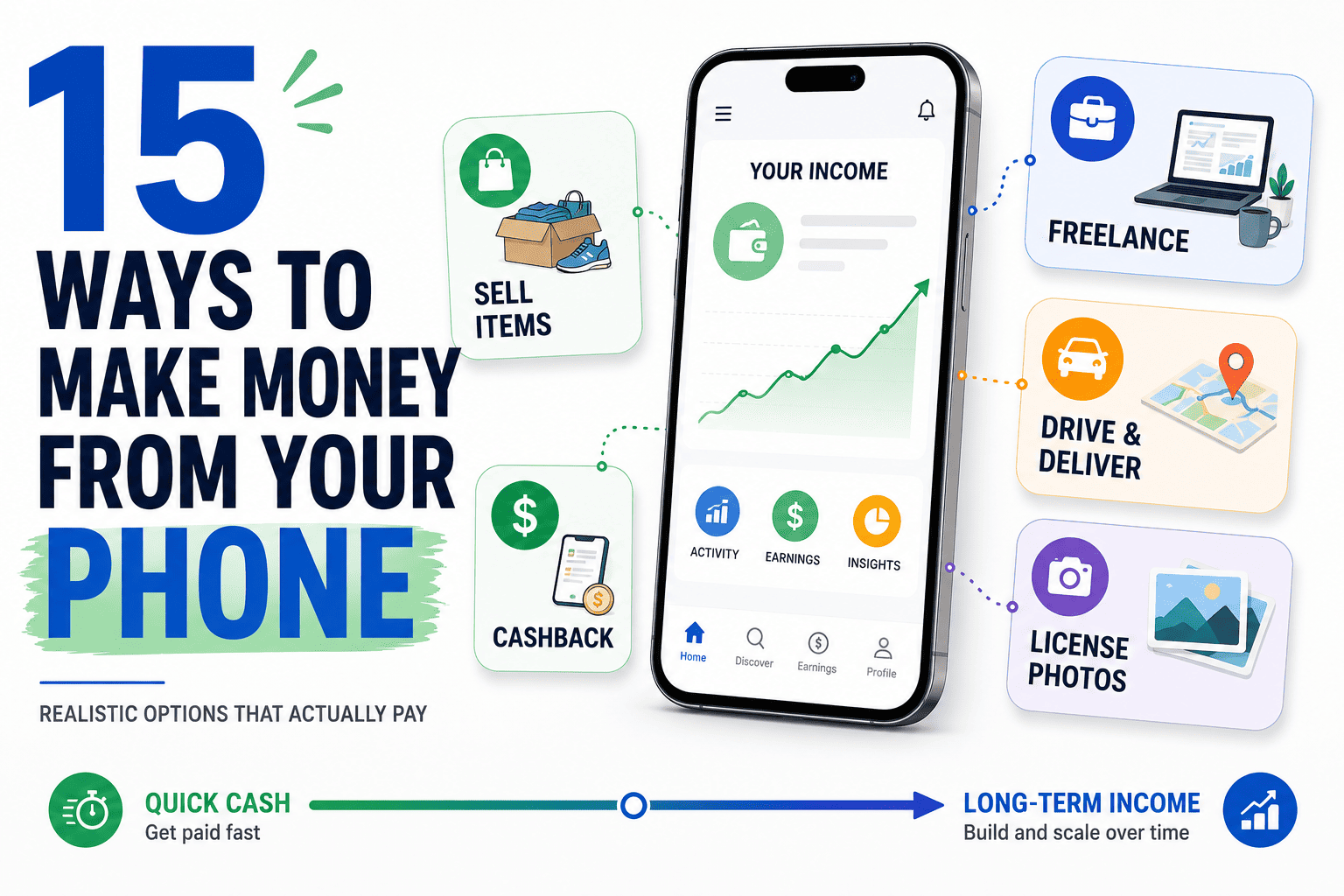
Quick answer: The most reliable ways to make money from your phone are reselling apps (fastest cash, lowest effort), cashback apps (small but genuinely passive), and freelance platforms (highest long-term earning ceiling). Survey and micro-task apps are legitimate but pay far less than most marketing promises – plan on $20–$80 a month, not $50 an hour.
Roughly one in six American adults has ever earned money through an online gig platform, according to Pew Research Center, so this isn’t a fringe activity, it’s become a normal way to supplement income. But “normal” doesn’t mean “equally worth your time,” which is the point of this guide.
Search “make money from your phone” and you’ll find lists promising 28, 40, even 46 different methods. Most of those lists pad their word count with app-testing gigs that pay $0.30 a task and “opportunities” that require you to first buy something. This guide cuts that down to 15 methods that produce real, verifiable income, along with what you should actually expect to earn from each one, because the gap between marketing copy and reality is where most people waste their time.
None of these will replace a full-time salary overnight. A few of them, done consistently, can become a meaningful second income stream. The rest are better thought of as ways to convert spare minutes into spare cash.
The quick list
- Sell items you already own
- Take paid surveys
- Stack cashback apps on purchases you’re already making
- Drive or deliver through gig-economy apps
- Freelance an existing skill
- Get paid for user testing and feedback
- License your photos and videos as stock content
- Launch a print-on-demand shop
- Create short-form video content
- Try affiliate and creator-commerce links
- Rent out things you’re not using
- Pet sit or dog walk through a marketplace app
- Pick up local task-based gig work
- Transcribe or caption audio and video
- Tutor or coach online
A quick word on scams
Because this space attracts so much hype, it also attracts a disproportionate number of scams. The FTC has specifically warned about “task scams,” where an app shows a fake, ever-increasing earnings balance and then asks you to deposit your own money often in crypto to “unlock” a withdrawal. Its broader guidance on avoiding side-hustle scams is worth a skim before you hand any app your bank details: research the company first, and treat any offer promising big money for minimal effort as a red flag.
Here’s how each one actually works, and what it realistically pays.
1. Sell items you already own
The lowest-effort entry on this list is also the fastest to cash out: list what’s sitting unused in your closet or garage on a resale app.
Which app you use matters more than it used to, because the fee structures have diverged. Poshmark charges a flat 20% commission. Mercari takes about 10%, plus a buyer-side processing fee. Depop currently charges 0% seller commission in the US, though that’s worth double-checking before you build a shop around it, since eBay is in the process of acquiring Depop and fee structures tend to shift after an acquisition closes. For general household items, electronics, and anything outside of fashion, Mercari or eBay typically finds a wider buyer pool than the fashion-focused Depop or Poshmark.
Realistic income: Highly variable, but sellers who list consistently across two or three platforms report 30–50% higher monthly revenue than single-platform sellers, since different apps skew toward different buyers.
2. Take paid surveys
Survey apps are the most oversold item on almost every “make money” list, so it’s worth setting expectations before you download anything. Legitimate platform Swagbucks, Survey Junkie, Toluna, InboxDollars, and the invite-only Pinecone Research – pay real money, but the hourly rate is closer to pocket change than a side job.
Realistic income: Casual users earn roughly $20–$80 a month running two or three apps for 15–30 minutes a day. Academic-style research platforms like Prolific occasionally pay closer to $10–$15 an hour for longer studies, but availability is inconsistent. Treat anything promising more than that as a red flag.
3. Stack cashback apps on purchases you’re already making
Cashback apps don’t ask you to do anything new, they pay you a small percentage back on spending you’d do regardless. The category has consolidated around a handful of reliable names: Rakuten for online shopping (1–10% at most retailers, paid quarterly), Ibotta and Checkout 51 for grocery receipt-scanning, Fetch for a lower-effort version of the same thing, and Upside for gas station cashback.
The real value comes from stacking. Scanning the same grocery receipt into both Ibotta and Fetch, on top of a cashback credit card, can turn a $100 grocery trip into $15–$20 of combined rebates.
Realistic income: $10–$40 a month for casual use; up to a few hundred dollars a year for households that shop deliberately around active offers.
4. Drive or deliver through gig-economy apps
Uber, DoorDash, and Instacart remain the three largest platforms for phone-based driving and delivery work, and all three let you work whenever your schedule allows. Pay varies significantly by city, time of day, and vehicle costs, gas, maintenance, and depreciation eat into take-home pay more than most new drivers expect.
We’ve covered the earnings breakdown for delivery apps specifically, base pay, tips, and how the economics compare across platforms in our dedicated delivery-apps earnings guide, since it deserves more space than a single list entry.
Realistic income: Wide range depending on market and hours worked; expect this to require the most active time of anything on this list, in exchange for the highest per-hour ceiling.
5. Freelance an existing skill
If you already have a marketable skill like writing, graphic design, bookkeeping, video editing, virtual assistance – Fiverr and Upwork both have functional mobile apps that let you message clients, deliver work, and manage payments from your phone. This won’t replace a laptop for the actual work in most cases, but it’s enough to land clients, negotiate scope, and handle client communication on the go.
Realistic income: The most scalable method on this list. Beginners often start with $15–$30 per small gig; established freelancers with a portfolio and reviews can charge professional day rates for the same skill.
6. Get paid for user testing and feedback
Companies pay for real people to test websites, apps, and prototypes and record their reactions. UserTesting and similar platforms typically pay a flat rate often $10–$60 per completed test, depending on length and complexity. The catch is availability: tests are assigned based on your demographic profile, and you may go days without matching one.
Realistic income: $20–$100 a month for occasional testers; higher for those who qualify for longer paid research studies.
7. License your photos and videos as stock content
If your phone camera is decent, apps like Foap, EyeEm, and Snapwire let you upload photos directly from your phone and earn a royalty typically 20–50% of the license fee every time someone buys one. Foap also runs brand-sponsored “missions” with fixed cash prizes for the winning submission, and EyeEm distributes accepted photos to Getty Images for additional reach.
Realistic income: Casual contributors earn roughly $50–$300 a month with a growing portfolio; income scales with volume and how commercially useful the subject matter is (business, lifestyle, and diversity-representative photos tend to outperform scenery).
8. Launch a print-on-demand shop
Print-on-demand [POD — a model where products are only manufactured after a customer orders, so you never hold inventory] lets you design custom products t-shirts, mugs, phone cases and sell them online without upfront cost. Printify’s mobile app covers the core workflow: browsing the product catalog, uploading a design, previewing mockups, and connecting the shop to an online store.
Realistic income: Highly dependent on marketing and niche selection; this is closer to running a small business than a quick side gig, with income potential that scales well beyond the rest of this list if a design or niche catches on.
9. Create short-form video content
TikTok’s Creator Rewards Program pays eligible creators based on video performance rather than a flat pool, which was the old model under the discontinued Creator Fund. To apply, you’ll generally need at least 10,000 followers and 100,000 video views in the past 30 days, an account in good standing, and videos of at least 60 seconds. Payout works out to roughly $0.40–$1.20 per 1,000 qualified views [RPM — revenue per mille, or earnings per 1,000 views], depending on niche, audience location, and engagement.
We’ve written a more detailed walkthrough of building a TikTok income stream including strategy for reaching the follower threshold in our TikTok money-making guide, since the mechanics deserve their own space.
Realistic income: Meaningful only past the eligibility thresholds; below that, LIVE gifts and brand partnerships are more accessible starting points than platform payouts.
10. Try affiliate and creator-commerce links
Once you have any kind of audience – a TikTok following, an Instagram page, or even a group chat people trust for recommendations – affiliate links let you earn a commission on products you point people toward. Amazon’s Influencer Program and platforms like LTK (formerly LikeToKnowIt) or ShopMy are built specifically for mobile-first creators to build shoppable link pages.
Realistic income: Negligible without an existing audience; scales directly with trust and reach once you have one.
11. Rent out things you’re not using
Apps like Turo let you rent out a car you’re not driving every day, while apps like Neighbor connect people with unused garage or storage space to renters who need it. Both operate on the same principle as home-sharing platforms, applied to smaller assets.
Realistic income: Highly asset-dependent; a car in a high-demand market can generate meaningful monthly income, while storage space rental tends to produce smaller, steadier amounts.
12. Pet sit or dog walk through a marketplace app
Rover and Wag connect pet owners with sitters and walkers nearby, with everything booking, messaging, and payment handled through the app. This is one of the few entries on this list with genuinely flexible, set-your-own-hours scheduling.
Realistic income: Typically $15–$25 per walk or $25–$75 per overnight stay, depending on market and the sitter’s ratings.
13. Pick up local task-based gig work
TaskRabbit and similar apps connect you with people who need help with furniture assembly, moving help, minor home repairs, or errands. Pay is set per task or hourly, and you choose which jobs to accept.
Realistic income: Varies by skill and local demand; taskers with in-demand skills (furniture assembly, handyman work) tend to out-earn general errand-runners.
14. Transcribe or caption audio and video
Rev and GoTranscript both pay per audio minute transcribed or captioned, and both have mobile-friendly workflows for claiming and submitting short jobs. This is genuinely a phone-compatible task for short clips, though longer transcription work is still easier on a full keyboard.
Realistic income: Roughly $0.30–$1.10 per audio minute depending on the platform and job type, which translates to modest hourly pay for fast, accurate transcribers.
15. Tutor or coach online
If you have subject-matter expertise, a language, a school subject, a musical instrument, test prep – apps like Preply and Wyzant connect you with students for paid video sessions, bookable and manageable from your phone.
Realistic income: Typically $15–$40 an hour depending on subject and experience, with established tutors commanding more once they’ve built a review history.
More ways to earn (smaller payouts, still legitimate)
The 15 methods above are the ones worth building a routine around. The methods below are lighter-touch, smaller, more passive amounts, but still real and worth knowing about if you want to round out the list.
16. Refer friends to apps you’re already using
Many of the apps already covered in this guide – cashback apps, survey apps, delivery apps offer a cash or credit bonus for referring someone who signs up and completes a first action. It costs nothing beyond sharing a link.
Realistic income: $5–$20 per successful referral; adds up mainly for people with a genuinely large network, not as a standalone strategy.
17. Get paid for walking or exercising
Apps like Sweatcoin, StepBet, and HealthyWage convert daily steps or fitness goals into cash, gift cards, or wagered payouts. These reward activity you might be doing anyway, rather than paying a real hourly rate.
Realistic income: A few dollars a month in most cases; HealthyWage-style wager formats can pay more but require putting your own money on the line first.
18. Join a research panel that pays for anonymized usage data
Market research firms – Nielsen’s consumer panels are the best-known example – pay a small amount for permission to passively track anonymized app or browsing usage in the background. This is the most hands-off method on this list, but it’s worth being clear-eyed about the trade-off: you’re being paid for data access, not a task, so read what’s actually being collected before opting in.
Realistic income: Typically $5–$15 a month or occasional gift cards; not meaningful as a standalone income source.
19. Round spare change into automatic micro-investments
Apps like Acorns round up your everyday purchases and invest the difference. This isn’t really “earning” money from your phone – it’s automating small, regular investing, and like any investing, the balance can go down as well as up. It’s worth including on this list only with that distinction clear: this is a savings habit, not guaranteed income, and it’s worth talking to a financial advisor before treating it as an income strategy rather than a savings one.
Realistic income: Not applicable in the same sense as the rest of this list — outcomes depend on market performance, not effort.
20. House-sit or plant-sit through a marketplace app
Platforms like TrustedHousesitters connect homeowners who need someone to watch their house (and often pets or plants) while traveling with people willing to stay there for free or for a fee.
Realistic income: Often non-cash (free lodging) rather than a fee; occasional paid arrangements exist but are less common than the unpaid house-sitting-for-lodging model.
21. Sell unused gift cards for cash
Sites and apps like CardCash and Raise buy unwanted gift cards at a discount to face value, which is still better than letting them expire unused in a drawer.
Realistic income: Typically 70–90% of the card’s face value, paid out once the card is verified.
22. Rent out a driveway or parking space
In cities with limited parking, apps like Neighbor also list parking spaces and driveways alongside storage space, connecting owners with drivers who need a spot.
Realistic income: Modest and highly location-dependent; most valuable in dense urban areas near event venues, stadiums, or transit hubs.
23. Get paid to recycle old electronics
Kiosk networks like ecoATM pay cash on the spot for old phones and other devices, based on condition and current resale demand.
Realistic income: One-time payout per device, not a recurring income stream, but a fast way to turn a drawer of old phones into cash.
Getting started without wasting time
The apps on this list fall into two categories: ones that pay for time (surveys, testing, transcription, gig driving) and ones that pay for an asset you already have (unused items, a spare room in your camera roll, a skill, an audience). The time-based methods are the fastest to start and the easiest to quit; the asset-based ones take longer to build but scale further.
Most people who make meaningful money from their phone aren’t running all 15 of these at once – they’ve picked two or three that fit their schedule and their existing skills, and stuck with them long enough to build momentum.

Discovering The Next Generation Of Nasdaq Innovators

Institutions Held Crypto Through 50% Drawdown, Bitwise Finds

2026 Presidents Cup Thursday TV coverage: How to watch Day 1 | News

Bitcoin Price From 2010-2021 | How Bitcoin Increased Day By Day




-

 Fashion6 days ago
Weekend Open Thread: Talbots – Corporette.com
-

 Tech3 days ago
Researchers escape OpenAI Codex sandbox to run commands on host
-

 Crypto World1 day ago
Goldman Sachs and Deutsche Bank Agree: The S&P 500 Rally Isn't Over
-

 Crypto World5 days ago
Circle launches Arc Studio AI agent for building onchain apps
-

 Crypto World3 days ago
Who Needs CLARITY Anyway? ARB Could See 70X Increase: Hodler’s Digest
-
 NewsBeat5 days ago
Trump says US has reached an agreement to take permanent control of Greenland’s security
-

 Crypto World5 days ago
Trading Bitcoin on Robinhood? Why 2% Spread Has Traders Worried
-

 Crypto World6 days ago
Mortgage and refinance interest rates today, Thursday, September 17, 2026
-

 Crypto World5 days ago
Bitcoin price breaks channel as RSI climbs to 63
-

 Tech3 days ago
Google’s $899 Googlebook is a bet that you’ll buy a new laptop for Gemini
-

 Business3 days ago
Analog Devices (ADI) Bets $1.35 Billion on Chips that Let Machines Think for Themselves
-

 Crypto World3 days ago
Coinbase, Robinhood, Circle Seen as Tokenized-Stock Winners
-

 Tech5 days ago
Trump suggests rebranding AI with a new name, says he’s also creating an AI Force
-

 Tech6 days ago
GPT-6 Astra Reached the Nether in Minecraft, Lost Its Stash to a Creeper, and Farmed Potatoes for Hours
-
 Business1 day ago
Oil Price Today (September 23): Crude oil below $100 on hopes of US-Iran talks. What did Trump say?
-

 Crypto World5 days ago
World Money launches in 150+ countries with Stripe
-

 Crypto World6 days ago
Silver prices recover quickly, hitting weekly high today
-

 Crypto World3 days ago
Bitcoin price holds above $81K as key catalysts line up
-
 NewsBeat6 days ago
US was ‘on brink of war’ with China over false AI report of nukes moving in Middle East
-

 Crypto World2 days ago
Meta Jumps 11% As Muse Shines and Investors Show an Appetite for Advancing AI
You must be logged in to post a comment Login