




Up to 4,500 more cancer cases will be reviewed by an NHS trust that admitted women had their breasts removed unnecessarily.
County Durham and Darlington NHS Foundation Trust today agreed to widen its investigation into its dysfunctional breast unit.
Victims have told how they were left in agonising pain after being ‘butchered’ and ‘mutilated’ by surgeons, with at least 20 women known to have been subjected to mastectomies they did not need.
Officials probing the scandal will now examine breast cancer cases going back more than a decade to 2015 in a process that is expected to take five years.
The trust’s ‘lookback review’ began in April last year and initially looked at patients treated between January 2023 and February 2025.
It has so far reviewed 538 cases and identified 321 who experienced some form of harm, including one death.
It will now examine up to 4,500 more cases, starting with the most recent and working backwards, taking the total past 5,000.
The decision to extend the review was taken at an extraordinary meeting of the trust’s board in Durham this morning.
Denise Howarth is one of several women who have now been told by the NHS that their breast was removed unnecessarily.
Board chair Alison Marshall said: ‘I would like to offer a sincere apology to all the women and their families who have been affected by the failings in our breast services.
‘I can’t imagine the impact that has had.’
She said they could ‘not turn back the clock’ but would be ‘open, honest and transparent’ about the failings.
Chief nurse Gill Hunt told the board concerns were first raised in 2015 after a ‘service reconfiguration’ and loss of breast surgical trainee posts.
Over the following years patients and bodies such as the Northern Cancer Alliance, Care Quality Commission and NHS England raised multiple issues, she said.
The key ‘themes’ included treatment ‘not aligned to best practice’, excessive surgery and delayed diagnosis, she added.
About 640 patients have contacted a special helpline asking for their cases to be reviewed, the board heard.
The review cost £523,000 in its first year and involved nine reviewers looking at about 80 cases a month, a report to the board said.

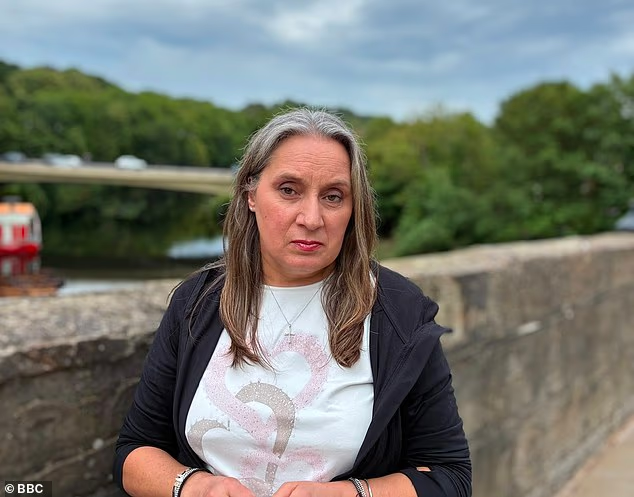
Pam Brown, from Durham, was an NHS patient who underwent a mastectomy in 2022 at Spire Hospital in Washington, where one of the outsourced private clinics was based.
Ms Hunt said the expanded review would ‘provide a proportionate and evidence-led clinical approach’ in response to ‘emerging findings’, while decisions would be ‘supported by clear clinical rationale and formal governance review’.
‘We are committed to doing the right thing,’ she stressed.
The National Crime Agency is working with Durham Police to investigate allegations by former patients and determine if any criminal offences have taken place.
The Daily Mail previously told how consultant surgeon Amir Bhatti, who was CDDFT’s clinical lead for breast services from 2013 to 2024, has been suspended from clinical practice while an internal investigation is carried out – but he remains employed by the trust on full pay.
The trust spent nearly £6million over six years on breast cancer diagnostic clinics and surgery companies run privately by Mr Bhatti in what Mr Russell admits was a ‘conflict of interest’.
A 2025 review into the running of the trust – carried out by governance specialist Mary Aubrey – raised concerns about the arrangement.
She said there was a ‘clear financial incentive’ for Mr Bhatti’s firms to treat more NHS patients when it was paid per case, potentially creating a ‘risk to clinical standards’.
Consultants performed significantly more operations and consultations per session when acting in a private capacity than doing their usual NHS shifts, it found.
Further concerns were raised last year in a report by the Royal College of Surgeons that breast cancer cases had not been discussed properly in multi-disciplinary team meetings (MDTs), leaving surgeons to largely act as they pleased.
The trust had a high rate of repeated procedures, low uptake of breast reconstruction immediately after mastectomy, and operations that may have been carried out ‘too quickly’.
The Aubrey review also suggested patients were potentially treated by locum consultants who were not competent, and noted that Mr Bhatti had repeatedly raised concerns about trust delays in obtaining vital diagnostic equipment.
Mr Bhatti last week denied performing unnecessary mastectomies and blamed the NHS for paying £6million to his private clinics in just six years.
He refused to apologise to women who said they had been ‘mutilated’ under his care and instead said of the unnecessary removal of breasts: ‘Nobody ever does anything like that.’
The Daily Mail approached Mr Bhatti at his large detached farm conversion in Hetton-le-Hole, near Sunderland, where a Range Rover Sport with a personalised numberplate sits on the drive.
Speaking via the Ring doorbell, he said he was out of the country, adding: ‘I can’t say anything because obviously it’s all under investigation and it is all in legal hands really.
‘I wish I could say more.’
One of Mr Bhatti’s companies, Durham Surgical Services Ltd, currently has assets of more than £2.6million, company accounts show.
Chief executive Steve Russell today said the trust was ‘incredibly conscious women and their families’ had experienced ‘distress, uncertainty and harm’.
He said no apology could undo that but the trust would ‘support women who have been impacted’ in any way possible.
For example, some women who had undergone unnecessary mastectomies could be offered breast reconstruction surgery as they previously should have been, Russell said.
He also said the trust was currently exceeding national standards for breast cancer treatment, including for the number of women having breast conservation surgeries and being offered immediate reconstruction.
‘None of that changes what has happened to women in the past but hopefully gives confidence the changes made in the service have had an impact on the outcomes,’ Mr Russell said.
He said patients today could be ‘confident’ they would be ‘treated appropriately’ and get ‘good clinical outcomes’.
The helpline, which is available by phone or email, would remain open with any concerned patients encouraged to contact it ‘irrespective’ of when they were treated, he said.


















































You must be logged in to post a comment Login