

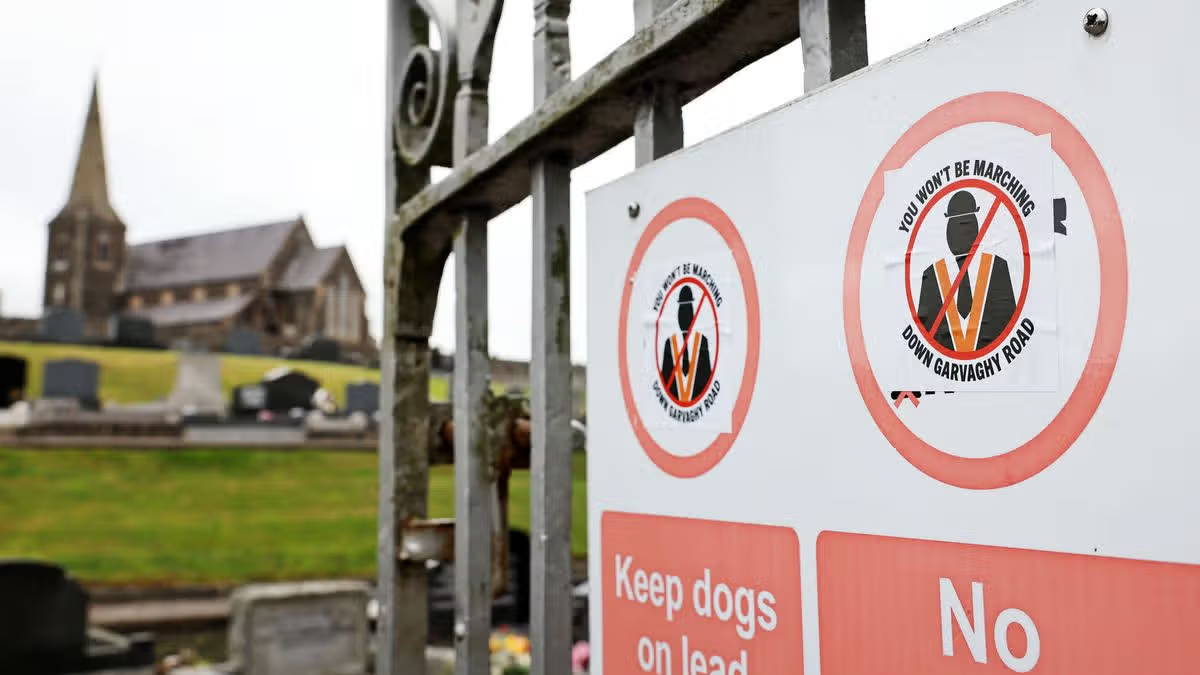
The Drumcree dispute has returned to the political spotlight more than two decades after the Orange Order was last permitted to march along the Garvaghy Road.
At the centre of the row is a relatively short stretch of road in Portadown, which became one of the most heavily contested pieces of territory in Northern Ireland during the Troubles and the peace process.
The dispute became a wider battle over identity, territory, cultural rights and the ability of the state to maintain public order without appearing to favour one community over another.
With a new application to march along the Garvaghy Road now before the Parades Commission, here is what you need to know about the history of the Drumcree conflict.
What is the Drumcree dispute?
The dispute centres on Orange Order parades between Portadown town centre and Drumcree Church, with the return route passing along the Garvaghy Road.
For the Orange Order, the march is regarded as an important expression of Protestant and unionist culture and tradition.
For many nationalist residents of the Garvaghy Road, the parade has historically been viewed as sectarian and triumphalist, particularly because the route passes through what became a predominantly Catholic and nationalist area.
The dispute became particularly intense during the 1990s, when annual confrontations at Drumcree became a symbol of the wider divisions within Northern Ireland.
Why is the route so controversial?
The geography of Portadown changed significantly during the 20th century. For much of the 19th and early 20th centuries, the route from the town centre to Drumcree Church passed through relatively open farmland.
That changed as housing estates were developed along the Garvaghy Road and Obins Street during the 1960s.
The Troubles then accelerated population displacement and segregation, leaving the areas around the route increasingly divided along Catholic-nationalist and Protestant-unionist lines.
The traditional Orange route, therefore, came to pass directly through a densely populated Catholic and nationalist neighbourhood rather than through the open countryside it had historically crossed.
When did the controversy begin?
The history goes back much further than the Troubles. The first official Orange parade to and from Drumcree Church took place in July 1807.
There were episodes of sectarian violence associated with parades in the area during the 19th and early 20th centuries, with clashes recorded in a number of years, including 1873, 1883, 1885, 1886, 1892, 1903, 1905, 1909, 1917, 1931 and 1950.
The dispute intensified significantly in the 1980s, however, as nationalist residents began challenging loyalist parades through Catholic areas.
What happened on Obins Street?
Before Drumcree became the major flashpoint, the focus was on Obins Street, a Catholic area of Portadown known locally as “the Tunnel”.
Tensions escalated in 1985 after a nationalist St Patrick’s Day parade was rerouted following objections from loyalists, while Orange parades through Catholic areas continued to receive extensive police protection.
Later that year, thousands of Orangemen marched through Obins Street while residents staged a sit-down protest.
The RUC cleared the protesters using batons, resulting in injuries and arrests.
Violence intensified in 1986 and, following widespread loyalist rioting, the RUC eventually banned the Orange Order’s parade from Obins Street.
The Orange Order subsequently concentrated its efforts on defending the return route along the Garvaghy Road.
What happened at Drumcree in 1995?
The first major Drumcree crisis came in July 1995. Catholic residents, organised through the Garvaghy Road Residents Coalition, staged a sit-down protest to prevent an Orange return parade from travelling along the road.
The RUC decided the march could not safely proceed through the crowd and ordered the Orange Order to reroute. The Orangemen refused.
Around 10,000 Orangemen and supporters gathered at Drumcree Church while approximately 1,000 RUC officers formed a security cordon.
Violence followed, with loyalists attacking police and roadblocks being established across Northern Ireland.
A compromise was eventually reached, allowing the march to proceed provided the Orangemen marched in silence and residents remained on the pavements.
The agreement was overshadowed when UUP leader David Trimble and DUP leader Ian Paisley joined hands and raised their arms in celebration as the march entered Portadown.
For nationalist residents, the episode reinforced the perception that concessions represented capitulation rather than compromise.
Why was 1996 even more serious?
The following year’s confrontation was significantly more violent. The RUC initially banned the Orange parade from the Garvaghy Road, leading thousands of Orangemen to gather at Drumcree.
The standoff triggered widespread loyalist civil disobedience, road blockades and sectarian violence.
Catholic families were forced from their homes in parts of North Belfast and, on 7th July, Catholic taxi driver Michael McGoldrick was murdered.
On 11th July, RUC Chief Constable Sir Hugh Annesley reversed the decision and ordered the parade down the Garvaghy Road, citing threats to life and public order.
The decision triggered widespread nationalist rioting, with thousands of plastic bullets fired during the disturbances.
What happened in 1997?
The following year, security forces took a different approach. Fearing another outbreak of loyalist violence and citing threats against Catholic civilians, thousands of troops and RUC officers sealed off the Garvaghy Road before the parade.
Residents were effectively contained within their housing estates while the march proceeded along the road, surrounded by security forces.
The resulting violence left more than 100 people injured and resulted in 117 arrests.
However, the crisis eventually de-escalated, and the IRA announced its final ceasefire on 19th July 1997.
That helped clear the way for the all-party negotiations, which ultimately produced the Good Friday Agreement.
Why was the Parades Commission created?
The Drumcree crisis exposed a fundamental problem for the state. The RUC was responsible both for maintaining public order and, under the old system, making decisions about contentious parade routes.
That meant decisions could become effectively influenced by the threat of violence.
Following the North Report, the Public Processions (Northern Ireland) Act 1998 established the independent Parades Commission and transferred responsibility for imposing conditions on contentious parades away from the police.
Organisers were also required to provide 28 days’ notice.
The Commission’s decisions are based on factors including the potential for public disorder, disruption to community life, the effect of a procession on community relations and compliance with its code of conduct.
What happened at Drumcree in 1998?
The Parades Commission formally banned the Orange Order from marching along the Garvaghy Road in June 1998.
The Orange Order refused to accept the decision and thousands gathered at Drumcree.
The security response was enormous, involving around 1,000 British troops and 1,000 RUC officers.
The confrontation was accompanied by a wave of loyalist violence across Northern Ireland.
There were 2,561 public order incidents between 4th and 14th July, including 615 attacks on security forces, 632 petrol bombs thrown and 467 vehicles damaged.
The crisis culminated in the murder of three young Catholic brothers, Richard, Mark and Jason Quinn, who died after their home in Ballymoney was firebombed.
Their deaths caused widespread revulsion and helped bring an end to the mass mobilisation surrounding Drumcree.
The Orange parade was never again permitted to travel along the Garvaghy Road.
How were loyalist paramilitaries involved?
The Drumcree dispute became increasingly intertwined with loyalist paramilitary activity.
Billy Wright was a prominent figure around the Drumcree protests and subsequently formed the Loyalist Volunteer Force after breaking with the mainstream UVF leadership.
The LVF went on to carry out a campaign of sectarian murders and bombings against Catholic civilians.
Wright was assassinated by INLA prisoners in the Maze Prison in December 1997. His death was followed by retaliatory loyalist killings and contributed to a wider loyalist feud..
What happened to solicitor Rosemary Nelson?
Rosemary Nelson became a key legal representative for the Garvaghy Road Residents’ Coalition.
She challenged parade decisions through the courts and represented residents in their dealings with the authorities.
Nelson faced severe intimidation and death threats and was publicly warned about the danger to her life.
She was assassinated outside her home in Lurgan on 15th March 1999, when a bomb was attached to the underside of her car.
A loyalist group calling itself the Red Hand Defenders claimed responsibility. Her murder led to a major public inquiry and further damaged confidence in the RUC.
Did the Good Friday Agreement resolve Drumcree?
It helped contain the violence but did not resolve the underlying dispute. From 1998 onwards, the Orange Order was not permitted to march down the Garvaghy Road. Instead, a prolonged stalemate developed.
The Orange Order maintained a symbolic protest at Drumcree Church, with weekly demonstrations continuing while the Parades Commission repeatedly refused permission for the traditional route.
In that sense, Drumcree became a frozen conflict rather than a settled one.
What changed in 2026?
The long-standing arrangement was dramatically disrupted in August 2026. The High Court in Belfast quashed the latest Parades Commission determination blocking the Drumcree parade.
However, the ruling did not establish that the Orange Order had a substantive right to march along the Garvaghy Road, nor did it remove the human rights concerns raised by residents.
Instead, the court challenge succeeded because of a procedural problem in that the Parades Commission accepted that not all six commissioners had properly signed off on the final determination before it was published.
The judge criticised the Commission’s procedures, describing its handling of the decision as involving “errors, shortcuts, and sloppy procedures”.
What happened after the court ruling?
The ruling immediately reignited political tensions with criticism from unionist politicians who argued the judgment exposed problems with the Parades Commission.
Nationalist representatives, meanwhile, expressed concern that the ruling could reopen the type of confrontation associated with the 1990s.
Garvaghy Road residents maintained that parades through the area were finished following the events of 1998.
The Northern Ireland Secretary subsequently appointed senior judge Sir John O’Hara to conduct an independent review of the Parades Commission’s decision-making processes and governance.
What is being proposed now?
Portadown District LOL No. 1 has submitted a new notification seeking permission for 60 members to march along the Garvaghy Road on 27th September 2026.
The Parades Commission attempted to appoint TIDES Mediation NI as a third-party mediator.
However, the Garvaghy Road Residents Coalition rejected the appointment, citing the organisation’s previous working relationship with the Orange Order as a conflict of interest.
That leaves the dispute facing another potentially significant test of the institutions established in the aftermath of the original Drumcree crises.
For all the latest news, visit the Belfast Live homepage here and sign up to our daily newsletter here.














































You must be logged in to post a comment Login