- Hong Kong and Singapore are advancing tokenised deposits into live commercial use, with major banks including HSBC and Standard Chartered already serving institutional clients on blockchain-based treasury platforms. Thailand is pursuing a parallel but slower path, designing a fully reserved, baht-pegged stablecoin intended first for wholesale interbank settlement.
- The divergence reflects differing regulatory philosophies rather than differing destinations. Banks across the region are favouring tokenised deposits over stablecoins partly due to deposit insurance protections and lighter compliance requirements, while Thailand’s sequenced approach prioritises design completeness and public consultation over speed to market.
Asia-Pacific’s financial institutions have split into two distinct tracks in the race to build programmable digital money. Hong Kong and Singapore are already moving tokenised deposits into commercial production, while Thailand is deliberately taking a slower, more sequenced route toward a baht-pegged stablecoin. The contrast says as much about regulatory philosophy as it does about market readiness, and it is shaping where institutional capital and infrastructure investment land next.
Hong Kong moves from pilot to real money
Hong Kong’s tokenisation programme has gone furthest, fastest. In November 2025 the Hong Kong Monetary Authority shifted its tokenised deposit pilot from test transactions to real-value settlement, bringing in seven banks to issue tokenised deposits and settle interbank transfers on a shared platform: Bank of China (Hong Kong), China Construction Bank (Asia), Fubon Bank, Fusion Bank, Standard Chartered Hong Kong, Bank of East Asia and HSBC. Asset managers BlackRock and Franklin Templeton joined as participants alongside Hong Kong Exchanges and Clearing and payment network JETCO.
The initial focus is tokenised money market fund transactions, letting banks and asset managers manage liquidity and treasury positions in real time rather than waiting on traditional settlement cycles. The programme runs through all of 2026, using Hong Kong’s existing Real Time Gross Settlement system before the HKMA upgrades to 24/7 settlement in tokenised central bank money. Four themes frame the wider experimentation: fixed income and investment funds, liquidity management, green and sustainable finance, and trade and supply chain finance.
Standard Chartered has already taken the model commercial. Its Hong Kong and Singapore units launched a tokenised deposit solution built on Ant International’s blockchain treasury platform, Whale, moving the collaboration from pilot to production and covering HKD, CNH, USD and SGD for Ant’s intragroup treasury flows. HSBC has gone further still, debuting its Tokenized Deposit Service in Hong Kong with Ant International as first client before extending the product to corporate clients in the US and UAE in the first half of 2026.
Singapore leans on corporate treasury use cases
Singapore’s push has centred on the same Standard Chartered-Ant International partnership, with the bank’s Singapore unit enabling SGD and USD transactions that interoperate with the Hong Kong leg’s HKD, CNH and USD capabilities. For Ant International, which runs merchant services and treasury solutions for SMEs worldwide, the appeal is near real-time, 24/7 liquidity movement between entities without relying on traditional correspondent banking rails.
More broadly, Singapore is positioning itself alongside Hong Kong and the UAE as a jurisdiction that can combine regulatory clarity with credible financial infrastructure to attract institutional stablecoin and tokenisation business, a competitive dynamic playing out as more of the region’s fintech investment concentrates in fewer, better-regulated hubs.
Why banks prefer tokenised deposits for now
The tilt toward tokenised deposits over stablecoins is not incidental. Regulatory reclassification is doing much of the work: both the EU’s MiCAR framework and the US GENIUS Act treat most stablecoins as e-money tokens requiring specific licensing that many issuers do not hold, while tokenised deposits, as regulated bank liabilities, sidestep that compliance burden entirely. There is also a protection gap that matters to treasurers moving large balances: stablecoins carry no deposit insurance, whereas tokenised deposits do.
The competitive pressure behind this shift is real. In IBM’s 2026 banking survey, 42 percent of executives said it was likely that major corporations would issue their own stablecoins, a scenario that could erode banks’ transaction fees, deposit bases and customer data. Sixty-three percent of corporate banking executives now see providing tokenised services, rather than resisting them, as their primary role going forward.
Thailand’s wholesale-first, carbon-linked approach
Thailand is building toward the same destination by a different, slower road. The Bank of Thailand’s design study for a baht-backed stablecoin is nearing completion, with a strict full-reserve requirement: tokens pegged 1:1 to the baht and backed by reserves held in segregated accounts at licensed institutions, redeemable on demand. Public hearings are expected before the end of 2026, with formal regulations targeted for late 2026 or early 2027, as Thailand Business News has reported.
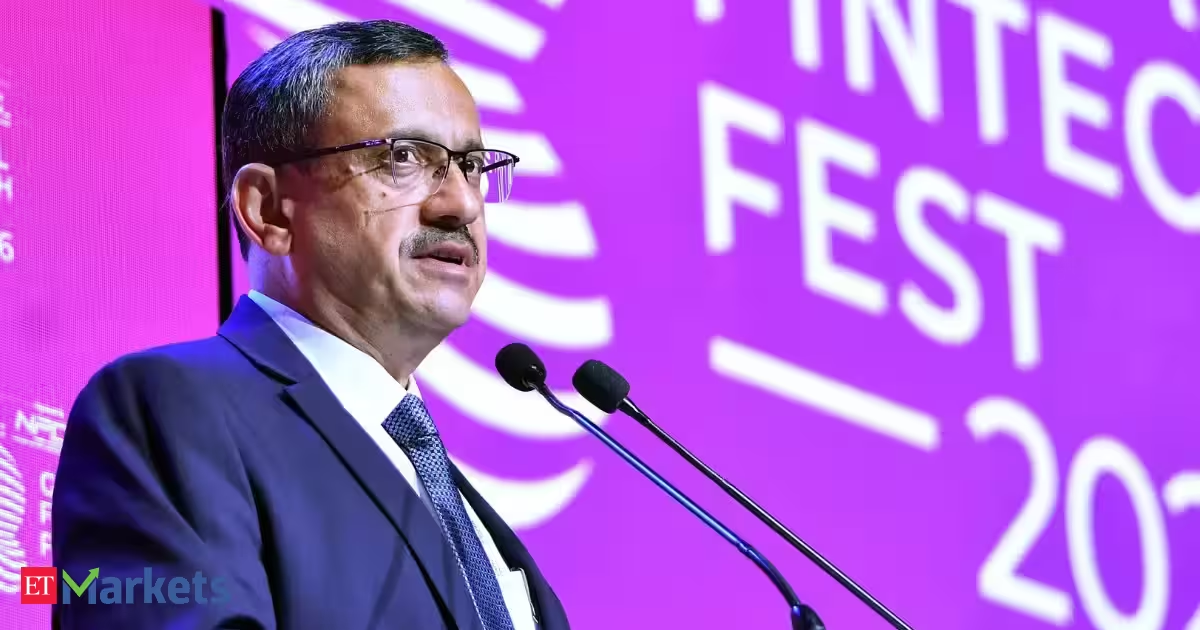
The sequencing is deliberate. BoT governor Vitai Ratanakorn has said the stablecoin will function first as a settlement instrument between licensed financial institutions, with any public rollout considered only afterward, an approach that mirrors Hong Kong’s wholesale-first pilot more than it does a retail-facing product launch. Authorities are also examining a role for the stablecoin in carbon credit trading, tying the initiative to Thailand’s net-zero commitments alongside its payments modernisation goals.
This builds on groundwork already laid through the BoT’s wholesale CBDC work under Project Inthanon and mBridge, and its Programmable Payment Sandbox, launched in 2024 and expanded in December 2025 to test baht-backed stablecoins and programmable payment use cases under supervision. The central bank has also used the period to tighten enforcement around unregulated settlement loops, including a crackdown that saw roughly 5,000 accounts linked to peer-to-peer renminbi payment activity suspended between February 2025 and May 2026.
What the contrast means
Hong Kong and Singapore are racing ahead on live, bank-led infrastructure serving multinational treasuries today. Thailand, by contrast, is building toward the same wholesale settlement function but insisting on a completed design study, full-reserve rules and public consultation before anything goes live, a pace consistent with the BoT’s broader caution on digital assets. That gap creates near-term opportunity for regional banks and treasury platforms operating out of Hong Kong and Singapore, but it also means Thai institutions have longer to prepare for a framework designed to avoid the reserve and redemption gaps that regulators elsewhere are still working through.
For now, the practical test will be the BoT’s public hearings later this year and the results emerging from its sandbox, both of which will determine whether Thailand’s cautious sequencing pays off in a more resilient rollout, or simply cedes first-mover advantage to its regional rivals. The broader pattern is one Thailand Business News has tracked across Southeast Asian fintech more generally: rapid regional growth running up against fragmented, jurisdiction-by-jurisdiction regulation that leaves institutions weighing speed against consistency.





























































You must be logged in to post a comment Login