
Crypto World
U.S. SEC’s steadiest crypto advocate, Hester Peirce, to depart next week

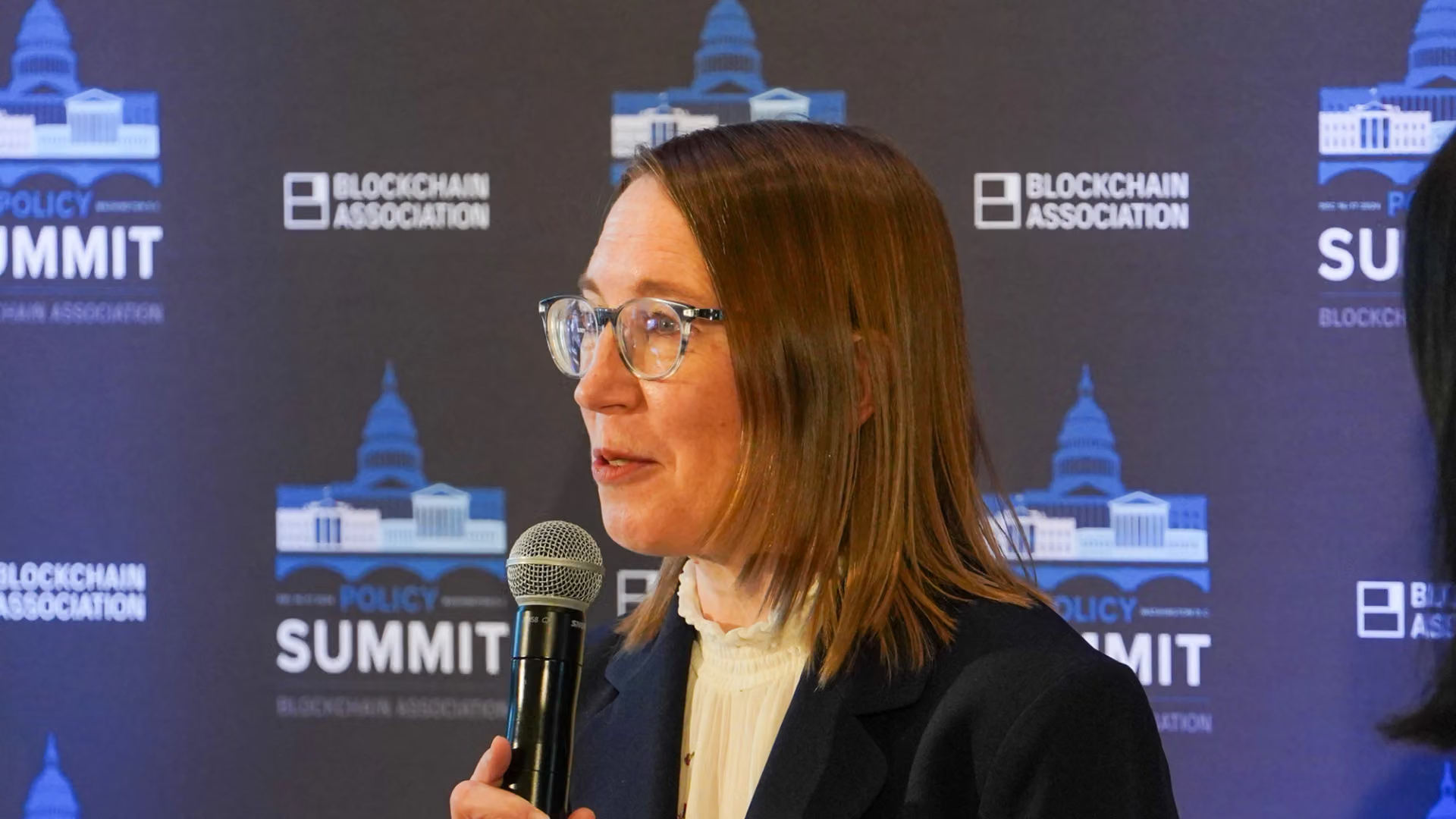
Her crypto work included a wide range of policy statements and guidance that clarified the agency’s position on various aspects of the industry, including mining, staking, memcoins and — most importantly — a series of definitions for classifying different types of crypto assets and which regulator would have dominion. More recently, the agency began proposing formal rules, beginning with one known as Regulation Crypto Assets, which set up a system for offering crypto assets without triggering stringent securities regulations.
The agency’s biggest splash, though, may have been its recent opening of the pathway for tokenizing securities. The effort known as the “innovation exemption” is meant to launch the tokenized securities era in a limited, five-year approach that will inform plans for eventual agency rules that make it more permanent.
“Maximizing people’s freedom to choose what is best for themselves and their families within sensible regulatory parameters designed to give them the confidence to transact with others is a delicate and vitally important task for the regulator,” Peirce, who’s going to be an associate professor at Regent University School of Law, wrote in her resignation.
Peirce acknowledged her nickname, “Crypto Mom,” in a 2019 speech during the industry-resistant era at the agency, and she also noted the agency had “hindered innovation and growth,” saying, “The only guidance out of the SEC is a parade of enforcement actions and a set of staff guidance documents and staff no-action letters.”

Polymarket has partnered with OpenWorlds to bring autonomous AI agents to prediction markets covering politics, sports, and thousands of other events.
Summary
- OpenWorlds says its agents can search for markets, evaluate events, and place trades.
- The company is developing the service for consumers and retail traders.
- Polymarket’s international platform and regulated U.S. operation have different access rules.
- A New York lawsuit has challenged Polymarket’s sports contracts under state gambling law.
According to OpenWorlds’ announcement and information shared with crypto.news, the AI lab is working with Polymarket to let agents handle steps that traders would otherwise perform themselves: finding an event market, assessing it, and making a trade. OpenWorlds describes its software as a way to run that process repeatedly across live markets.
The company says it is building personal trading agents for consumers and retail traders. Its proposed workflow gives an agent the ability to search across markets and act on its assessment, rather than presenting a list of possible trades for a person to execute manually. OpenWorlds also compares the process with the research and trading work carried out by investment firms.
How OpenWorlds agents would trade on Polymarket
OpenWorlds describes three linked tasks for its agents: discovery, evaluation, and trading. In practice, an agent searching Polymarket would need to identify a contract tied to a specific event before assessing the available information and deciding whether to take a position. The company says its system is designed to repeat that process as events and markets change.
Polymarket lists contracts tied to outcomes in politics, sports, and other subjects. Prices in those markets move as participants buy and sell positions before an event is resolved. OpenWorlds’ proposal places an automated trader in that existing process, with the agent carrying out the research and execution steps described by the company.
For a retail user, the degree of control given to an agent matters because finding a market and placing an order are different actions. OpenWorlds’ privacy policy says users own their wallets through their chosen wallet provider and that the company does not collect or store private keys. It also says its services may support delegated signing for AI operations.
The policy says OpenWorlds records agent configurations, action logs, and results. When a user enables an integration, requests and related data can be sent to a third-party market platform to execute actions and return results, according to the company. OpenWorlds also says it uses data from AI system activity to train and improve its models and platform features.
The partnership brings the agent workflow to a platform that has been changing how trading information reaches its applications. In September, Polymarket moved its main blockchain indexing system in-house. Vice President of Engineering Josh Stevens said the new setup could surface some onchain events up to 14 blocks, or about 28 seconds, faster, while Goldsky remained available as a backup. The indexing system update covers data behind trades, positions, and balances.
Polymarket integrations have expanded beyond its own app
Other companies have also built ways for users to reach Polymarket markets through separate products. In August, Fortune Protocol integrated Polymarket liquidity into Fortune Markets alongside Predict.fun. Its interface lets users compare liquidity, trading volume, and market probabilities, then choose an outcome and preview a position before trading.
OpenWorlds describes a different set of functions. Its announcement focuses on an agent that searches, evaluates and trades, while Fortune’s integration presents market information and a trading flow to the user. Both arrangements involve outside products interacting with prediction markets, but the companies describe different roles for their software.
Polymarket’s own technology work has also included automated execution tools. As covered in September, the company acquired DeFi infrastructure startup Brahma in March, adding programmable smart-account technology intended to support wallets, deposits, asset routing and redemption of prediction-market outcome tokens. Polymarket had also purchased the registered derivatives exchange QCEX and prediction-market data company Dome.
U.S. access depends on which Polymarket platform is used
For American traders, Polymarket’s international blockchain platform and its regulated U.S. operation are separate. Following a 2022 settlement with the Commodity Futures Trading Commission, Polymarket agreed to prevent U.S. customers from using its international operation. It later returned to the U.S. market through a CFTC-registered exchange it acquired. An August report on Polymarket’s midterm surveillance described the distinction between the two operations.
Polymarket’s global head of investigations and intelligence, Shana Bautista, told Reuters in August that the company combines machine learning, blockchain analytics and trade surveillance to identify unusual activity. Polymarket said it had referred more than 100 cases to law enforcement. Its monitoring work included preparations for trading tied to the U.S. midterm elections.
State rules present another question for U.S. access to event contracts. On Sep. 24, New York Attorney General Letitia James sued Polymarket over sports contracts, alleging that it offered gambling products without a state license and allowed users aged 18 to 20 onto its platform. The state is seeking to stop the alleged unlicensed activity, obtain customer restitution, and impose civil penalties. Polymarket can contest the allegations in court.
The New York petition cites contracts tied to sports outcomes, including a July baseball game between the Los Angeles Dodgers and New York Mets. State officials argue that federal oversight of event contracts does not remove New York’s authority over sports wagering. Prediction-market operators have argued in related cases that qualifying contracts traded on federally regulated exchanges fall under CFTC jurisdiction.

Cosmos Hub validators have secured 1.23 million ATOM taken in a Neutron governance attack after halting the network for about 24.5 hours and moving the tokens to a recovery wallet.
Summary
- Roughly 1.73 million stolen ATOM reached the Cosmos Hub from Neutron.
- Validators moved 1,227,121 ATOM to a wallet requiring four of six signers to approve a transaction.
- Another 168,990.9 ATOM reached the attacker after the restart and was moved to Osmosis and sold.
- Returning the secured funds will require a Cosmos Hub governance vote.
Cosmos Labs said in a Sep. 25 update that the Hub itself was not attacked and Hub user funds were unaffected. The stolen ATOM came from Neutron, where a malicious governance proposal gave the attacker control over contracts used by Astroport and other protocols.
At the time of the Hub’s halt, 1,227,121 ATOM remained in the attacker’s address. Validators restarted the network on Sep. 23 using Gaia v28.3.0, a software update that moved the balance to a wallet controlled by six community validators. Four of them must approve any transaction from that wallet.
The tokens are being held while the Neutron recovery team prepares a plan. Under the arrangement described by Cosmos Labs, the signers cannot return the funds until a Cosmos Hub governance proposal authorizes the transfer.
Cosmos Hub halt stopped the remaining ATOM from leaving
After the Neutron attack on Sep. 22, the attacker sent stolen assets to several chains and began swapping some of the ATOM through THORChain, according to the Cosmos Labs account. About 1.73 million ATOM reached the Hub, where the attacker could have continued moving it even after Neutron stopped producing blocks.
Neutron contributors and community members alerted Hub validators and Cosmos Labs at about 09:50 UTC. Validators representing more than one-third of the Hub’s voting power then stopped their nodes, bringing the network to a halt at block 33,086,740 by about 11:18 UTC.
During the pause, Cosmos Labs prepared a one-time software change at the validators’ request. Its written plan identified the attacker’s address, the destination wallet, the six proposed signers and the single account that the update would affect. Validators received that plan before the patched software was distributed.
Nansen, Keplr, Enigma, Silknodes, Kiln and Polkachu agreed to hold the six signing keys. Cosmos Labs said the signers independently checked the wallet address and verified it with a test transaction before developers added it to the update.
By the time of the scheduled restart, validators representing more than two-thirds of voting power had installed v28.3.0. Block production resumed at 12:00 UTC on Sep. 23, and the 1,227,121.37 ATOM transfer took effect about six minutes later. Cosmos Labs said 174 of the Hub’s 180 validators were online by the end of that day.
The participating validators included Coinbase and Kraken, according to the update. Their role was part of the Hub’s coordinated software restart; Cosmos Labs said exchanges and other operators were subsequently told that deposits and withdrawals could resume once the network was stable.
Some ATOM left before and after the restart
The secured balance represents only the ATOM still in the attacker’s Hub address when validators halted the chain. Cosmos Labs said roughly 500,000 ATOM had already been swapped for ETH through THORChain before the halt and could not be recovered through the Hub update.
A separate THORChain transaction returned 168,990.9 ATOM to the attacker’s address shortly after block production resumed. The attacker moved that balance to Osmosis and sold it, according to the forum post.
Cosmos Labs said the possible refund was identified while validators were preparing to restart, after the patched software had been distributed and installed by many operators. The update authorized a single transfer of the balance present at the halt height. It did not block later transactions from the attacker’s address or move funds that arrived after the restart.
The Hub response also did not cover assets sent to other networks. Cosmos Labs identified stolen funds that had moved through dYdX, Noble, Osmosis, Axelar and EVM chains, as well as assets still on Neutron. Teams handling those networks are coordinating their own recovery efforts, the company said.
An earlier, separate incident affected software used by other Cosmos networks. In August, crypto.news reported that attackers exploited a Cosmos EVM flaw across six chains and converted stolen tokens into about $5.72 million in other assets. Cosmos Labs’ account of the Neutron case describes a governance attack on Neutron, not that Cosmos EVM flaw.
ATOM return depends on a Hub governance vote
The six signers have agreed to hold the recovered ATOM without staking, lending or trading it, Cosmos Labs said. They describe their role as carrying out an authorized return, rather than deciding for themselves which affected accounts should receive funds.
A Cosmos Hub governance proposal must pass before the wallet can make that transfer. The Neutron recovery team expects to submit a proposal in the coming week, once it has set out the proposed destination and return process. Neutron’s maintainers also expect to publish their account of the attack early next week.
The governance requirement gives ATOM holders a direct role in the next step. Cosmos Hub governance has previously decided other matters affecting the token: a March Osmosis proposal sought to convert OSMO to ATOM and place unclaimed tokens in the Hub community pool, though a later Hub vote rejected that plan.
For the Neutron recovery, Cosmos Labs said the secured ATOM remains in the validator wallet while the proposal is prepared. The company has shared the attacker’s addresses with more than 30 exchanges, bridges, and custodians, and said several have confirmed that they blocked the addresses.
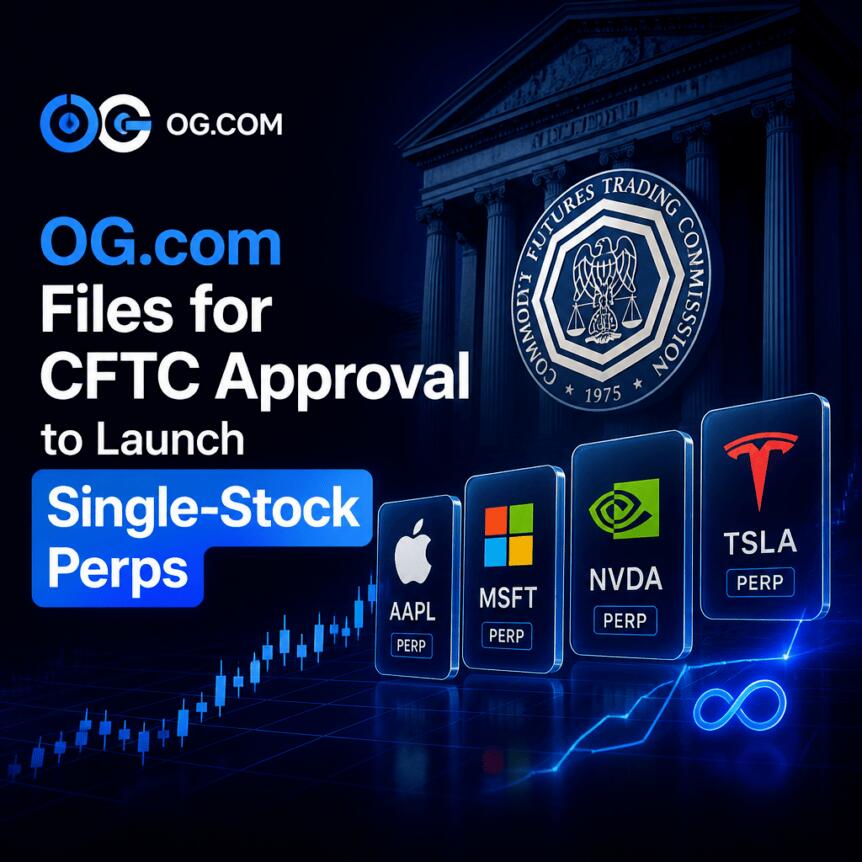
OG.com Markets has filed with the U.S. Commodity Futures Trading Commission (CFTC) to seek permission to offer cash-settled perpetual futures tied to individual stocks—an attempt to bring “perps” to U.S. equity derivatives.
In a filing submitted Thursday, the company proposed rules for single-stock futures that do not expire and can be traded continuously, 24 hours a day, five days a week. If approved, the structure could give traders an alternative to dated futures contracts by allowing them to maintain exposure without periodically rolling into new contracts.
Key takeaways
- OG.com Markets is seeking CFTC approval for cash-settled, perpetual single-stock futures that never expire.
- The proposed contracts would run 24/5, aiming to extend around-the-clock derivatives trading to U.S. equities.
- OG.com emerged as an independent platform after being spun out of Crypto.com, and it has since drawn attention from established market participants.
- The filing arrives amid broader efforts by other U.S. derivatives venues—including Coinbase, Kraken’s Bitnomial, and prediction market operator Kalshi—to pursue similar products.
- Regulators have been gradually creating pathways for perpetual-style crypto derivatives, setting the stage for further expansion into traditional markets.
OG.com Markets seeks CFTC rules for stock-linked perps
The core of OG.com Markets’ request is regulatory authority to list cash-settled single-stock futures with perpetual terms. Unlike traditional futures—where contracts have defined expiration dates—perpetual futures are designed to keep positions open across contract cycles without requiring traders to roll into a new instrument.
According to OG.com’s Thursday CFTC filing, the company is asking for permission to trade these instruments on a nearly continuous schedule: 24 hours per day, five days per week. That trading window is aligned with how crypto markets often operate, and it reflects the industry’s push to match derivatives trading to the real-time nature of financial flows.
How OG.com got here: spin-off and partnerships
OG.com was recently spun out of the crypto exchange Crypto.com and re-established as an independent prediction markets and derivatives platform valued at $5 billion, as previously reported by Cointelegraph.
At the time of the spin-off, CEO Kris Marszalek said the platform planned to expand beyond prediction markets into futures and perpetual contracts. Shortly after the restructuring, Cointelegraph also reported that Robinhood took an equity stake in OG.com as part of a multi-year deal. The agreement includes plans to use OG.com’s CFTC-regulated derivatives exchange and clearinghouse for prediction markets.
While the current filing focuses on stock-linked perps, the sequence matters: OG.com is positioning itself as a venue where existing regulatory infrastructure used for derivatives and prediction markets could extend into single-stock futures.
Why perps are attracting equity market attention
OG.com’s application is part of a wider trend: trading platforms and prediction market firms are increasingly exploring whether the perpetual futures model can be adapted to U.S. equities.
In the same general push, Cointelegraph previously reported that on Sept. 18, Coinbase, Kraken’s parent through its Bitnomial exchange, and Kalshi filed applications to offer perpetual futures tied to individual U.S. stocks. The wave of filings underscores that the regulatory pathway is no longer seen as purely speculative by major market players.
At the policy level, the timing came after U.S. congressional efforts to advance the CLARITY Act stalled in the Senate on Sept. 15, according to earlier coverage by Cointelegraph. Still, regulators continued moving on targeted crypto initiatives. Just days after the vote, the SEC cleared limited onchain trading of tokenized U.S. stocks under its Innovation Exemption, while the CFTC expanded regulatory relief for software providers connecting users to regulated derivatives platforms, including those that support perpetual contracts—also previously covered by Cointelegraph.
Taken together, these steps suggest a partial but growing willingness to carve out permission structures for specific use cases, even as broader, comprehensive crypto legislation has not advanced.
CFTC groundwork for perpetual contracts
OG.com’s filing fits into work the CFTC began earlier to clarify how perpetual contracts can be reviewed. According to CFTC press materials referenced by Cointelegraph, the agency established a case-by-case review process for perpetual contracts in May, then approved Kalshi’s Bitcoin perpetual futures product.
In June, the CFTC also issued temporary relief that allowed certain registered exchanges to convert existing crypto futures into contracts without expiration dates. That matters for stock-linked perps because it indicates regulators have already been willing—at least under defined conditions—to treat perpetual structures as something beyond the initial crypto derivatives experimentation cycle.
For investors and traders, the practical question now becomes what changes once equity becomes the underlying asset. Perpetual stock futures would bring the derivative form closer to the mechanics many crypto traders know, but the economic drivers—such as stock-specific market dynamics, hedging costs, and settlement rules—could differ substantially from crypto benchmarks.
What to watch next
OG.com’s CFTC filing is a step toward making perpetual, stock-linked derivatives available in the U.S., but approval is not guaranteed. Market participants should track how the CFTC evaluates perpetual contract mechanics for single stocks—especially around settlement design and the regulatory boundaries between traditional securities markets and crypto-style trading infrastructure.
Crypto World
Another appeals court rules against prediction market provider Kalshi, says sports contracts are subject to state regulations

States have tried to wrangle prediction markets offering sports-related contracts under their regulatory frameworks since they started taking off after the 2024 election, arguing that these markets are competing with state gambling platforms and offering identical products to gambling sites and apps. For many states, the issue is that federally regulated platforms do not pay state taxes, while still competing with state-regulated platforms. Another major point of contention is the fact that prediction markets often offer their products to people as young as 18, rather than 21, like most state gambling operators.
In Friday’s ruling, the three-judge panel said it agreed that Kalshi did have the right to bring a case, but disagreed that the products in question were federally regulated swaps.
“While we agree with Kalshi that its sports-event contracts are conditioned on the occurrence of ‘event[s],’ we conclude that Kalshi’s contracts do not depend on events that are ‘associated with a potential financial, economic, or commercial consequence’ within the meaning of the statute,” the ruling said.
The ruling used the New York Giants winning a Super Bowl as an example case, saying the result could depend on how the “event” in question is defined. If the event is the Giants winning, then that victory would be described as “that event having occurred.”

Google has disclosed that its PageBreak AI security agent has found over 500 cross-site scripting vulnerabilities across the company’s web applications.
Summary
- Google says PageBreak tests suspected flaws against running applications before sending reports to product teams.
- The agent uses Gemini models for most scans and separate tools to confirm whether an exploit works.
- Applications built on Google’s high-assurance frameworks had two XSS findings as of Sep. 4.
- Google plans to connect PageBreak more closely with CodeMender, which generates security fixes.
The Google Product Security team said PageBreak began as a pilot in November 2025 and became a formal project in January 2026. It tests Google’s own web applications and has found cross-site scripting, or XSS, flaws even on sensitive company domains. Google did not identify the affected applications in its announcement.
XSS occurs when an application allows an attacker’s script to run in another user’s browser. Depending on the application and the attacker’s access, the flaw can expose data or let someone act through an affected user’s session. Google reported more than 500 findings across its applications, but did not give a breakdown by product or severity.
How PageBreak confirms suspected flaws
Rather than sending every suspected bug to a product team, PageBreak passes each candidate to a specialized validator. For an XSS finding, the validator inserts a JavaScript payload, loads the affected page, and checks whether the script runs. Google said the validation step has kept the system’s false positive rate close to zero.
The agent can also test other types of flaws. According to Google, its validators check whether an injected input changes a database query, whether an application exposes a file through path traversal, or whether it can be made to execute code. A separate check looks for requests that an application sends to internal services.
Most PageBreak scans use Gemini models, including Gemini 3.1 Pro and Gemini 3.5 Flash, although Google said the agent can work with different models. The validators themselves are not written by the AI agent. Google also runs agents through repeated attempts because a model can follow an unproductive path before finding a workable exploit.
Google built the validation process in response to a problem its security staff had encountered: AI-generated reports can describe convincing attack paths that fail when tested. Under PageBreak’s process, unverified candidates stay within the security team’s workflow. They can guide later scans or help engineers build new validators, but Google said they are not sent to product teams as confirmed bugs.
PageBreak found two flaws in protected applications
Among hundreds of applications built on Google’s high-assurance web frameworks, PageBreak identified two XSS vulnerabilities as of Sep. 4, Google said. Both were confined to internal applications or debug endpoints with gaps in their security protections. The result covers that group of applications; Google’s figure of over 500 findings covers its first-party web applications more generally.
The framework result gives Google a way to test how its application design holds up against repeated scans. PageBreak also has access to company tools that help it inspect applications at scale. Google said its code repository lets the agent follow paths across services, while security data from live web traffic can connect a requested page to the relevant source code. Existing scanners give it authenticated access to internal sites that can be difficult for an outside researcher to examine.
Those resources help explain the scope of Google’s findings without suggesting that another organization could obtain the same results simply by running a Gemini model. PageBreak’s reported count comes from scans of Google’s applications with access to Google’s code, traffic data and testing systems.
Crypto teams face the same verification workload
The problem of checking AI-generated security reports has also surfaced in crypto software. In July, Ethereum Foundation security research described a process in which agents develop potential findings and separate reviewers try to reproduce them. The foundation reported one confirmed flaw in libp2p, later disclosed as CVE-2026-34219, while warning that plausible reports can involve unreachable code or attack conditions that do not hold in practice.
For teams that handle crypto users’ funds, the difference between a candidate issue and a working exploit affects how quickly a report can lead to a fix. An August Bitcoin Red Team scan logged 7,958 findings across 501 open-source projects after 108 hours. At that point, 24.7% of the findings had reproducible proofs; the full tally did not represent 7,958 confirmed exploitable vulnerabilities.
Earlier reporting on crypto bug bounties described a similar review burden. Cosmos Labs co-CEO Barry Plunkett said in April that submissions to its program had risen 900% from the previous year, including both valid and invalid reports. PageBreak is an internal Google tool, and Google has not said it is available to crypto projects.
Google plans to pair findings with fixes
Even after limiting reports to verified findings, Google said its product teams still receive a high volume of security work. PageBreak is therefore working with other Google projects, including CodeMender, an agent that generates bug fixes. Google plans to deepen that connection so product teams can review proposed fixes alongside confirmed vulnerabilities.
OG.com Markets is seeking US regulatory approval to offer perpetual futures tied to individual stocks, as trading platforms push to bring the popular derivatives product to US equity markets.
In a Thursday filing with the Commodity Futures Trading Commission (CFTC), OG.com proposed new rules allowing it to list cash-settled single-stock futures that never expire and can trade 24 hours a day, five days a week.
OG.com was recently spun out of crypto exchange Crypto.com as an independent prediction markets and derivatives platform valued at $5 billion. At the time, CEO Kris Marszalek said the platform planned to expand beyond prediction markets into futures and perpetual contracts.
Shortly after the spin-off, Robinhood took an equity stake in OG.com as part of a multi-year deal to use its CFTC-regulated derivatives exchange and clearinghouse for prediction markets.
Unlike traditional futures contracts, perpetual futures, or “perps,” have no expiration date, allowing traders to maintain exposure without periodically rolling into new contracts. The product was pioneered in crypto by BitMEX in 2016.
Related: President Trump’s media company to terminate Crypto.com deal
Perpetual futures push expands into US stocks
Crypto trading platforms and prediction markets are increasingly looking to bring one of the digital asset market’s most popular derivatives products to US stocks, with OG.com joining a growing group seeking regulatory approval.
On Sept. 18, Coinbase, Kraken parent Payward through its Bitnomial exchange, and prediction market Kalshi all filed to offer perpetual futures tied to individual US stocks.
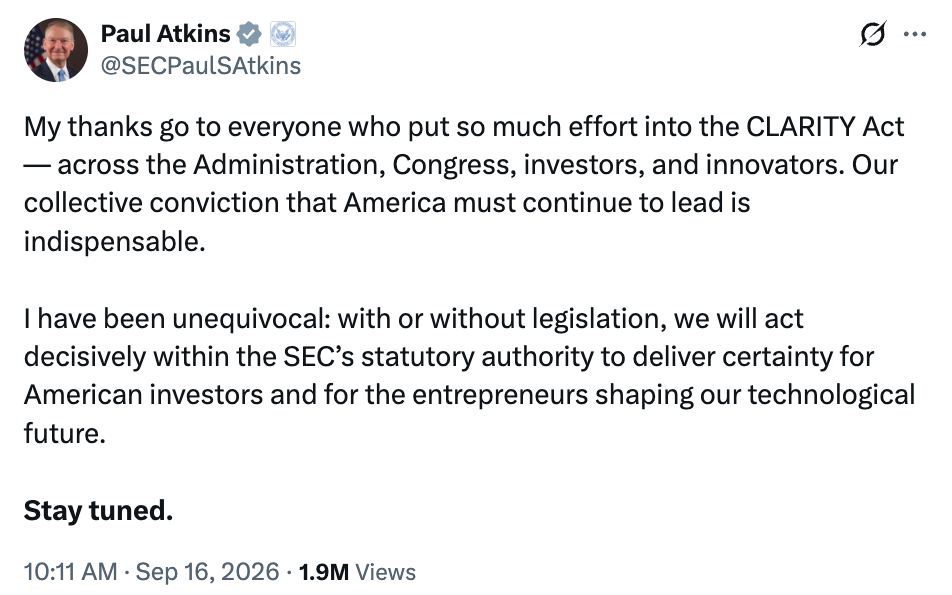
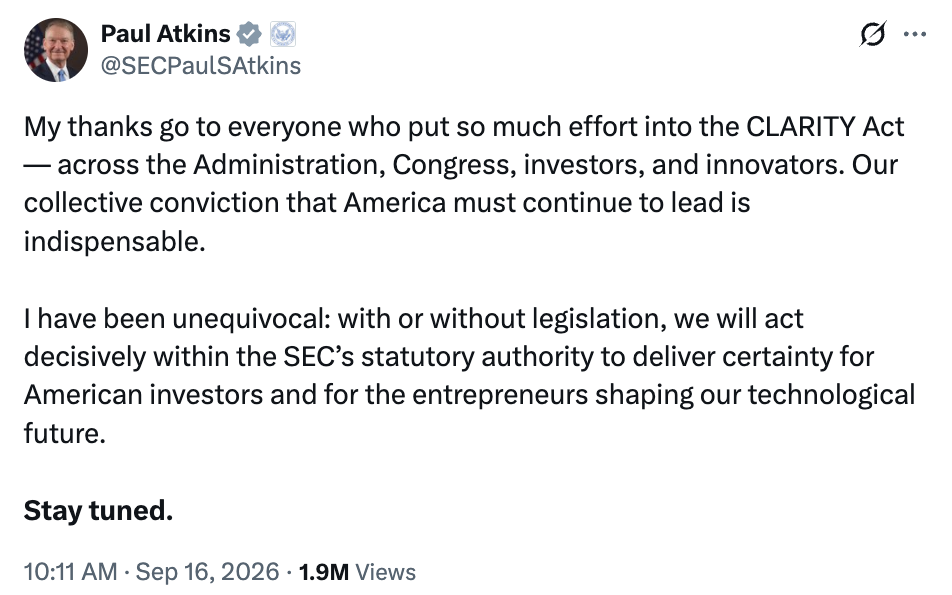
The filings came after US regulators, including the Securities and Exchange Commission (SEC) and CFTC, pushed ahead with crypto initiatives despite the CLARITY Act failing to advance in the Senate on Sept. 15.
Source: Paul Atkins
Just days after the vote, the SEC cleared limited onchain trading of tokenized US stocks under its Innovation Exemption, while the CFTC expanded regulatory relief for software providers connecting users to regulated derivatives platforms, including those offering perpetual contracts.
The CFTC had already begun laying the regulatory groundwork for perpetual futures months earlier.
In May, the agency established a case-by-case review process for perpetual contracts and approved Kalshi’s Bitcoin perpetual futures product, followed in June by temporary relief allowing certain registered exchanges to convert existing crypto futures into contracts without expiration dates.
Magazine: Exchanges reporting crypto gains to IRS becomes tax nightmare
Crypto World
Appeals court rules that states can regulate Kalshi’s sports prediction markets, dealing another legal blow to platforms
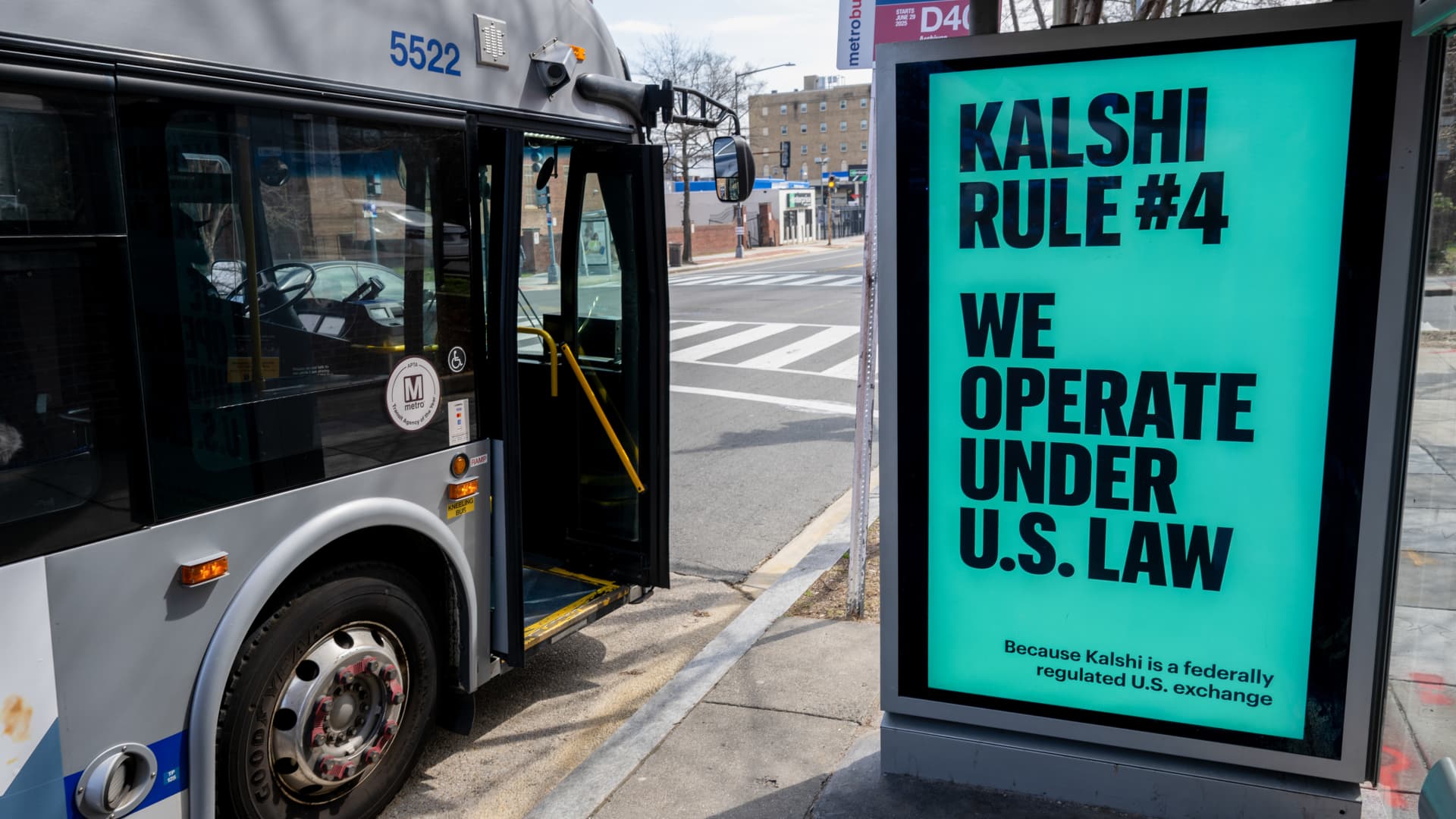
The 6th U.S. Circuit Court of Appeals ruled on Friday that states have a right to regulate sports-related event contracts on prediction market platforms, marking a second major legal defeat for the industry as a fight at the U.S. Supreme Court looms.
In a unanimous decision, the three judge panel said that Ohio and Tennessee are permitted to apply their state gambling laws to Kalshi’s sports-related event contracts.
“We hold that Kalshi has not shown that its sports-event contracts satisfy the statutory definition of a ‘swap’ so as to fall within the scope of the CFTC’s ‘exclusive jurisdiction,’” the opinion said.
Kalshi and other prediction market platforms argue all event contracts are swaps, a type of financial derivative that is regulated by the Commodity Futures Trading Commission. However, states assert that platforms’ sports-related offerings amount to gambling, and thus should be regulated by their laws related to sports betting.
This disagreement has spawned a legal battle across the country as states sue platforms for operating what they often claim are illegal gambling operations, while exchanges also sue states to block them from enforcing local laws on what they argue should be federally-regulated financial exchanges.
The CFTC has sued nine states to defend what it believes is its exclusive right to regulate event contracts, given to it by the Commodity Exchange Act. But the 6th Circuit panel rejected that notion.
“Even assuming that Kalshi’s sports-event contracts are swaps, we alternatively hold that the CEA neither expressly nor impliedly preempts Ohio’s or Tennessee’s gambling laws,” the opinion said. The decision overturns a Tennessee federal district court ruling that sided with Kalshi, and reaffirms a decision by a federal district court in Ohio that sided with the states’ argument.
“Kalshi attempted an end run around Tennessee law to avoid any of the rules or taxes associated with sports gambling. They failed,” said Jonathan Skrmetti, Tennessee’s attorney general.
“Sports wagering is heavily regulated because it can do a lot of harm, and I’m glad we thwarted Kalshi’s efforts to remove every safeguard and put Tennessee sports bettors at risk,” he added.
Kalshi nor the CFTC immediately responded to requests for comment. CNBC has also reached out to the Ohio attorney general’s office for comments.
The latest ruling now means prediction market platforms have notched two losses in legal fights at the appeals court level. The 9th U.S. Circuit Court of Appeals ruled last month that Nevada has a right to regulate sports-related event contracts, stating that they were sports bets and not swaps. Meanwhile, the 3rd U.S. Circuit Court of Appeals ruled against New Jersey in April and said the CFTC has the exclusive right to regulate all swaps, no matter the contract type.
New Jersey appealed that decision in a petition to the Supreme Court earlier this month. It is not clear whether the Supreme Court will take up the case now, or wait until further decisions from circuit courts on the issue of sports-related event contracts are delivered.
Disclosure: CNBC and Kalshi have a commercial relationship that includes customer acquisition and a minority investment.

The psychological experiment scenes presented a different challenge. Tremblay was strapped to a chair, limiting his movement and expressions. “I learned to utilize that unfamiliar and uncomfortable environment to my advantage,” Tremblay says. “Because Ted himself in that moment is also experiencing that discomfort and unfamiliarity at the same time.”
How accurate is the Netflix movie?
Unabomber is grounded in documented events from Kaczynski’s life, but the film also takes creative liberties with gaps in the historical record.
“But that was fun for the filmmakers and us actors as we got to create something unique from the story we pieced together and that excited me because it distinguishes our film from other tellings of the Unabomber’s story,” Tremblay says.
For Metz, the film was also an opportunity to explore parts of Kaczynski’s story that are less familiar to audiences.
“In developing the film, we found that the psychological experiments conducted on Ted Kaczynski during his time at Harvard were unknown to most people, some were not even aware he attended Harvard,” Metz says. “While our film doesn’t offer a complete biography, we chose to present a filmic take on his story and a narrative opening into the mind of Ted Kaczynski.”
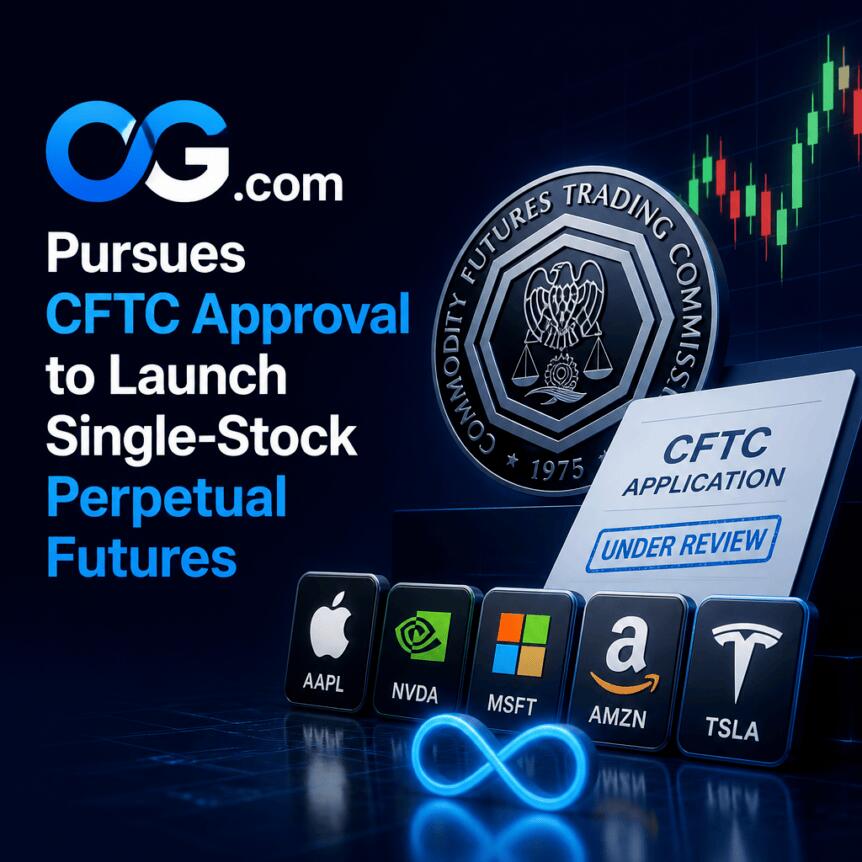
OG.com Markets has submitted a filing to the U.S. Commodity Futures Trading Commission (CFTC) seeking approval to launch cash-settled perpetual futures linked to individual stocks—an effort to bring a product format widely used in crypto derivatives into traditional equity markets.
According to the CFTC filing released Thursday, the proposed rules would cover single-stock futures that do not expire (“perpetuals”), trade around the clock, and are designed to offer continuous exposure without requiring traders to roll positions into new contract months.
Key takeaways
- OG.com Markets is pursuing CFTC approval for perpetual futures tied to specific U.S. equities.
- The product is described as cash-settled and perpetual, with continuous trading for five days a week.
- Regulatory momentum comes as other major crypto trading and prediction-market players also seek permission to offer similar stock-linked perps.
- The CFTC has been building a framework for perpetual contracts through approvals and temporary relief tied to specific arrangements.
OG.com’s CFTC filing outlines stock-linked “perps”
In a Thursday filing with the CFTC, OG.com Markets outlined a proposed rule set intended to enable the listing of cash-settled single-stock futures that never expire. The proposal also calls for trading to operate 24 hours a day, five days a week.
Perpetual futures differ from traditional futures by removing the need for contract expiration. For traders, that structure can reduce the operational friction of rolling between dated contracts, while for markets it can support more continuous liquidity and positioning.
The concept is not new in crypto. Perpetual contracts were pioneered in digital-asset derivatives, with BitMEX introducing an early version of the model in 2016—helping make “perps” one of the most actively traded derivatives formats in the sector.
How OG.com ties into the wider prediction-markets and derivatives shift
OG.com Markets recently emerged as an independent prediction markets and derivatives platform after being spun out from crypto exchange Crypto.com. At the time of the separation, OG.com was described as being valued at $5 billion, and CEO Kris Marszalek said the company planned to expand beyond prediction markets into futures and perpetual contracts.
Shortly after the spin-off, Robinhood acquired an equity stake in OG.com as part of a multi-year agreement. The deal includes the use of OG.com’s CFTC-regulated derivatives exchange and clearinghouse for prediction markets. That backdrop matters because it places OG.com’s U.S. equity-derivatives ambitions directly within a set of business relationships already aligned with regulated derivatives infrastructure.
Importantly, while OG.com is now aiming at stock-linked perpetual futures, its current positioning originates in prediction markets—where the mechanics of cash settlement and continuous trading can be attractive to participants who want to express views over time without physical delivery.
Not alone: Coinbase, Kraken’s parent, and Kalshi have also filed
OG.com’s move fits into a growing cluster of filings from platforms attempting to introduce perpetual futures tied to individual U.S. stocks. Earlier coverage noted that Coinbase, Kraken parent Payward through its Bitnomial exchange, and prediction market platform Kalshi all filed to offer similar stock-linked perpetual futures.
The timing also reflects a regulatory environment that has been more permissive toward certain crypto-adjacent activities than some market participants expected. The shift gained attention after U.S. Senate action failed to advance the proposed CLARITY Act on Sept. 15—yet regulators continued moving forward on crypto initiatives through other channels.
In particular, after the Senate vote, the SEC cleared limited onchain trading of tokenized U.S. stocks under its Innovation Exemption, and the CFTC expanded regulatory relief for software providers that connect users to regulated derivatives platforms, including those offering perpetual contracts.
The CFTC’s groundwork for perpetual contracts
The CFTC’s approach to perpetual futures has not been confined to one company or one application. The agency previously began laying out a path for perpetual contracts through a combination of case-by-case review and targeted relief.
In May, the CFTC established a case-by-case review process for perpetual contracts and approved Kalshi’s Bitcoin perpetual futures product. It then followed in June with temporary relief allowing certain registered exchanges to convert existing crypto futures into contracts without expiration dates.
That incremental regulatory scaffolding helps explain why the market is converging on perpetual structures now. Even without a single comprehensive rule that automatically covers every new product variation, firms can structure applications around how the CFTC has already evaluated perpetual contracts—making the approval process feel more navigable than it might have been in earlier years.
For investors and traders, the key question is how quickly the CFTC can translate precedent from crypto perpetuals and targeted relief into approvals for cash-settled, stock-linked perps. Watch for updates on the OG.com rulemaking process and whether regulators request changes to trading mechanics, settlement terms, or operational guardrails as these filings move through review.

“Not every storm is becoming more intense, but the intense storms are becoming more intense—whether that be a thunderstorm, a hurricane, one of these nor’easters,” Barlow says.
One thing that doesn’t seem to be changing is the number of storms, Barlow adds. “We’re not seeing any changes in the overall average, and the total number of storms might actually be going down a little bit,” he notes.
In an ever warming world, storms are only going to continue to intensify. Climate change is increasing the number of “billion dollar disasters,” disasters that top at least $1 billion in damage, that take place in the U.S. each year. The average length of time between billion-dollar disasters has fallen—from 82 days during the 1980s to 16 days during the last 10 years. In 2025, the U.S. experienced a billion-dollar weather or climate disaster once every 10 days.
“Until we stop increasing the amount of greenhouse gasses in the atmosphere, the intensity of rainfall, the intensity of these storms, will continue to increase as well,” says Barlow. “Until we stop making things worse, things are going to keep getting worse.”

At Meta Connect, the company’s smart glasses were everywhere

Best-value winter sun destinations for UK travellers this year – report

Polymarket partners with OpenWorlds on AI trading agents





-

 Crypto World3 days ago
Goldman Sachs and Deutsche Bank Agree: The S&P 500 Rally Isn't Over
-

 Tech5 days ago
Researchers escape OpenAI Codex sandbox to run commands on host
-

 Fashion2 days ago
8 iPhone Accessories That Add Personality
-

 Crypto World5 days ago
Who Needs CLARITY Anyway? ARB Could See 70X Increase: Hodler’s Digest
-

 Crypto World7 days ago
Circle launches Arc Studio AI agent for building onchain apps
-

 Tech6 days ago
Trump suggests rebranding AI with a new name, says he’s also creating an AI Force
-

 Business5 days ago
Analog Devices (ADI) Bets $1.35 Billion on Chips that Let Machines Think for Themselves
-

 Crypto World5 days ago
Coinbase, Robinhood, Circle Seen as Tokenized-Stock Winners
-

 Crypto World3 days ago
This Bearish Netflix Stock Trade Can Cash In On Video Streaming Giant’s Woes
-
 Crypto World3 days ago
Trump-Xi Polymarket Odds for Handshake Hit 50%
-

 Tech4 days ago
Google’s $899 Googlebook is a bet that you’ll buy a new laptop for Gemini
-

 Entertainment3 days ago
These 17 Fall Amazon Dresses Seriously Look Like Anthropologie
-

 Crypto World2 days ago
Crude Oil Prices Pressured by Diplomatic Hopes in the Middle East
-
 Business3 days ago
Oil Price Today (September 23): Crude oil below $100 on hopes of US-Iran talks. What did Trump say?
-
 Crypto World2 days ago
Bitcoin price tests $83,600 Supertrend support after $87K rejection
-

 Crypto World7 days ago
World Money launches in 150+ countries with Stripe
-

 Crypto World2 days ago
Bitcoin Threatens Sub-$84,000 Breakdown as Long Liquidations Spike
-
 NewsBeat7 days ago
Ed Sheeran protegees Katseye UNFOLLOW star… days after Macklemore was dropped from his tour over Free Palestine remarks
-
 Crypto World4 days ago
Meta Jumps 11% As Muse Shines and Investors Show an Appetite for Advancing AI
-

 Crypto World3 days ago
Did Jim Cramer Just Give GameStop Stock the Kiss of Death When He Said the Turnaround Is Working?
You must be logged in to post a comment Login