
Crypto World
Bitcoin price faces $85,000 resistance as oscillator turns negative

Bitcoin price traded near $84,000 on Sep. 26 after retreating about 4% from its weekly high of $87,363. Sell orders clustered above the price, while the daily chart showed BTC holding well above its 20-day midpoint.
Summary
- Bitcoin price traded at $84,008 on Binance at 07:07 UTC, about 3.8% below its weekly high.
- Analysts identified $85,000–$85,800 as the first area of heavy sell orders.
- The 4-hour Supertrend stood at $86,435, above the current price.
- U.S. spot Bitcoin ETFs recorded about $2.39 billion in net inflows from Sep. 21 to Sep. 25
Bitcoin faces sell orders from $85,000 to $85,800
Bitcoin (BTC) price rose to $87,363 earlier in the week before falling back toward $84,000. On Sep. 26, its Binance daily candle showed a high of $84,145 and a low of $83,798 as of 07:07 UTC. The roughly $347 intraday range was much smaller than the move from the weekly peak.
Market commentator Wealthmanager identified a band of sell orders extending from $85,000 to $91,000. The analyst placed the first hurdle at $85,000–$85,800, followed by $88,000, and described $90,000 as the largest wall above the market.
Mister Crypto also identified $85,000 as the level limiting Bitcoin’s recent rebounds. The analyst said a continued stretch below it could precede another decline, while Wealthmanager pointed to $81,000–$82,000 as a possible pullback area if BTC fails to regain $85,000.
Bitcoin would need to climb about $1,000 from the charted price to retest the lower edge of that first sell zone. A move through $85,800 would bring the 4-hour Supertrend level and the weekly high back into focus. The analysts’ order-book readings may change as traders add, fill, or cancel orders.
The drop from $87,363 also followed a sharp gain earlier in the week. CoinGecko showed Bitcoin still higher over seven days on Sep. 26, despite its retreat from the peak. The weekly gain and the decline from the high measure different parts of the same move.
U.S. Bitcoin ETF inflows slow but stay positive
U.S. spot Bitcoin ETFs drew their largest inflow of the week as BTC approached its high. Farside Investors recorded $999 million in net inflows on Sep. 21, including $381.4 million for BlackRock’s IBIT, $289.1 million for ARK 21Shares’ ARKB and $238.8 million for Fidelity’s FBTC.
Net inflows reached another $714.7 million on Sep. 22. IBIT received $350.3 million, and FBTC drew $257.4 million that day. Across the two sessions, U.S. spot Bitcoin ETFs took in about $1.71 billion.
Daily inflows then eased to $346.9 million on Sep. 23, $190.7 million on Sep. 24 and $134.5 million on Sep. 25. The five trading days added up to approximately $2.39 billion in net inflows. Friday’s figure was $864.5 million below Monday’s, but it remained positive as Bitcoin traded below its weekly high.
The Friday total included $97 million for IBIT and $49.3 million for FBTC, partly offset by an $11.8 million outflow from Bitwise’s BITB. U.S. funds will not post a Saturday trading-day flow figure to match Bitcoin’s weekend price action.
U.S. interest rates remain part of the market backdrop. The Federal Reserve raised its target range by 25 basis points to 3.75%–4% on Sep. 16. The rate decision came before this week’s price high and pullback; the ETF figures show that fund inflows continued during the retreat.
Bitcoin’s 4-hour Supertrend turns $86,435 into resistance
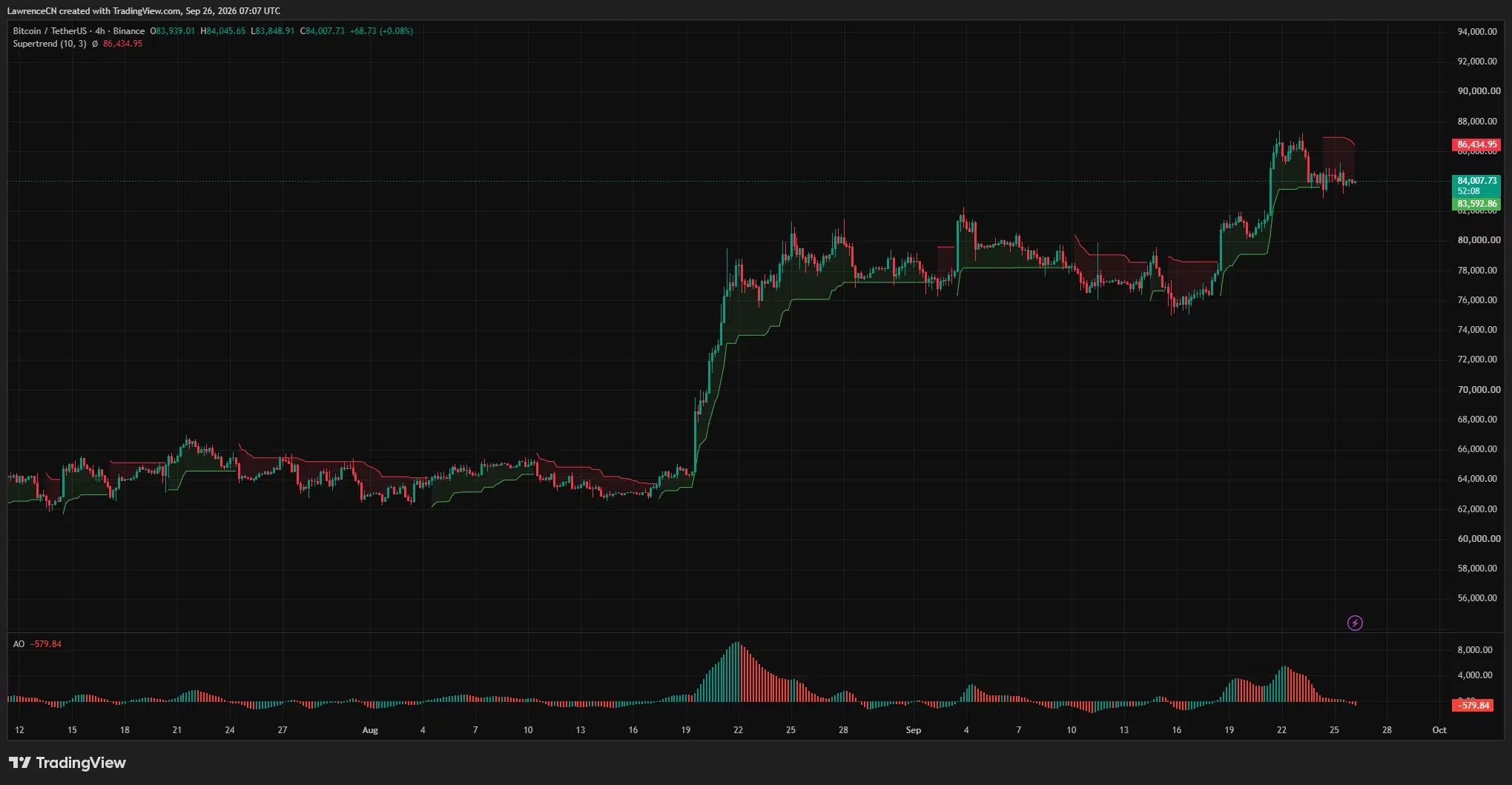
On the Binance 4-hour chart, Bitcoin traded at $84,007.73 while the Supertrend stood at $86,434.95. BTC had moved below the indicator after its run toward $87,000. The gap left the Supertrend about $2,427 above the charted price.
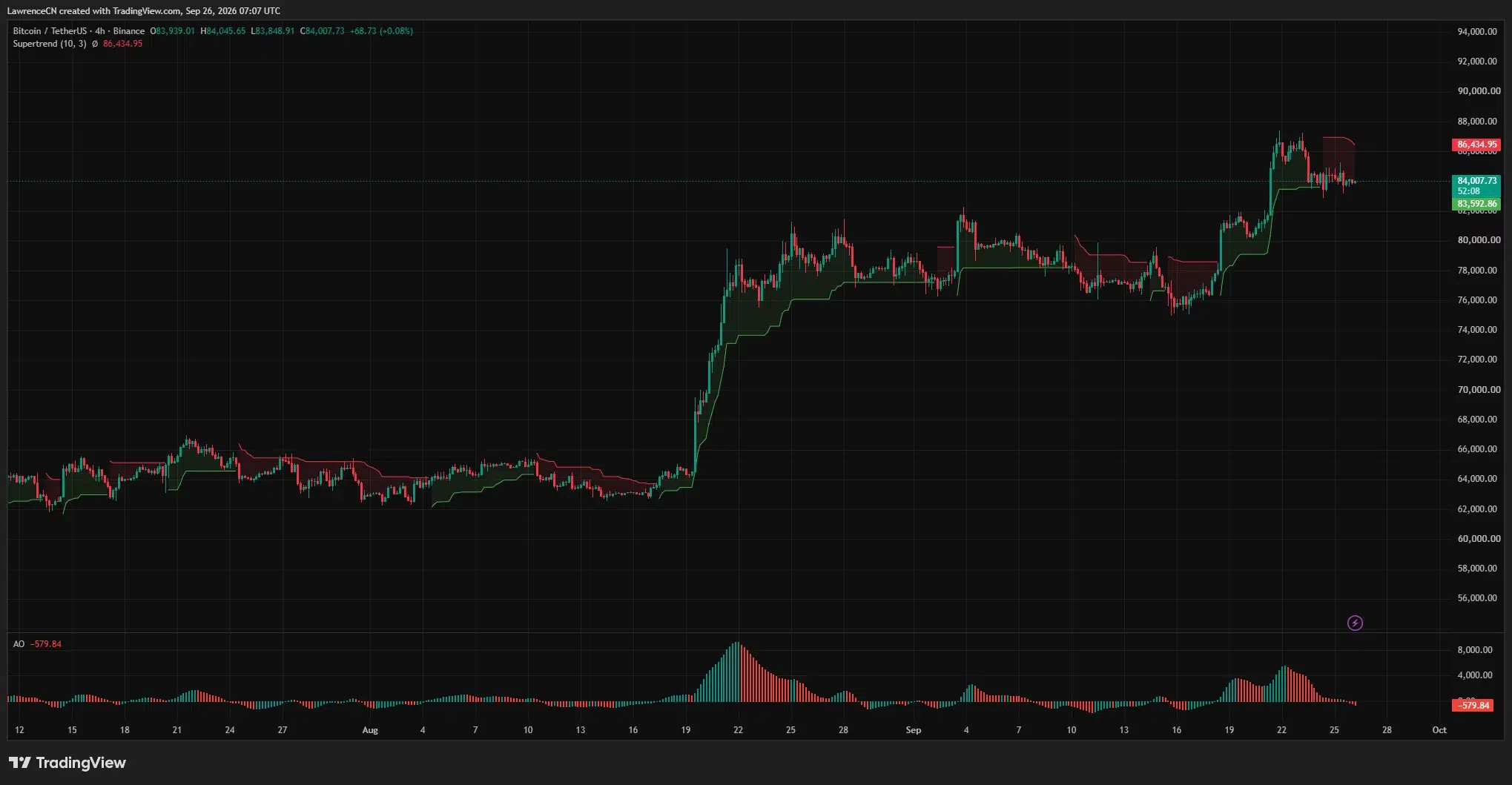
The same chart showed a green support line at $83,592.86, about $415 below BTC. Price had held near $84,000 after falling from the weekly peak, placing that support line close to the lower edge of its latest range.
Bitcoin’s 4-hour Awesome Oscillator read −579.84. The histogram had crossed below zero as its earlier positive bars faded. Together with the Supertrend position, the reading showed weaker momentum on the shorter timeframe than on the daily chart.
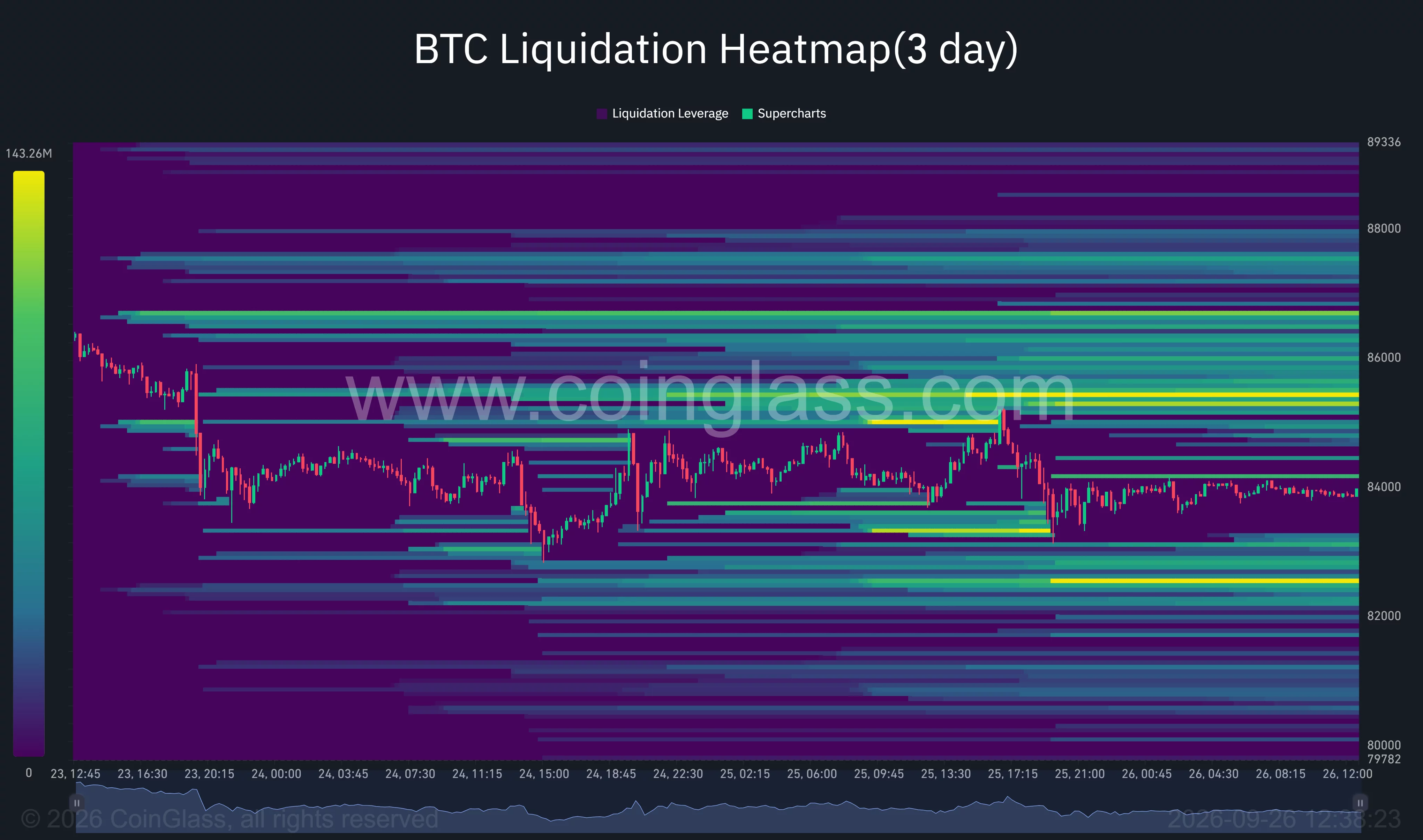
CoinGlass’s three-day liquidation heatmap showed a bright band around $85,000–$85,500, near the sell zone identified by the analysts. Another area of elevated estimated liquidation exposure appeared around $86,500–$87,000. Below the market, a prominent band sat near $82,500, with additional exposure around $83,000–$83,500.
The heatmap places the nearest large concentrations on both sides of Bitcoin’s $84,000 trading area. The bands reflect estimated liquidation levels for leveraged positions. They can shift as positions open and close, so their presence alone does not determine which level price will reach first.
Daily RSI holds above 60 after the pullback
Bitcoin’s daily chart retained stronger readings than its 4-hour chart. The daily relative strength index stood at 63.94, above its moving average of 61.27. RSI remained above the neutral 50 level and below the commonly watched 70 level.
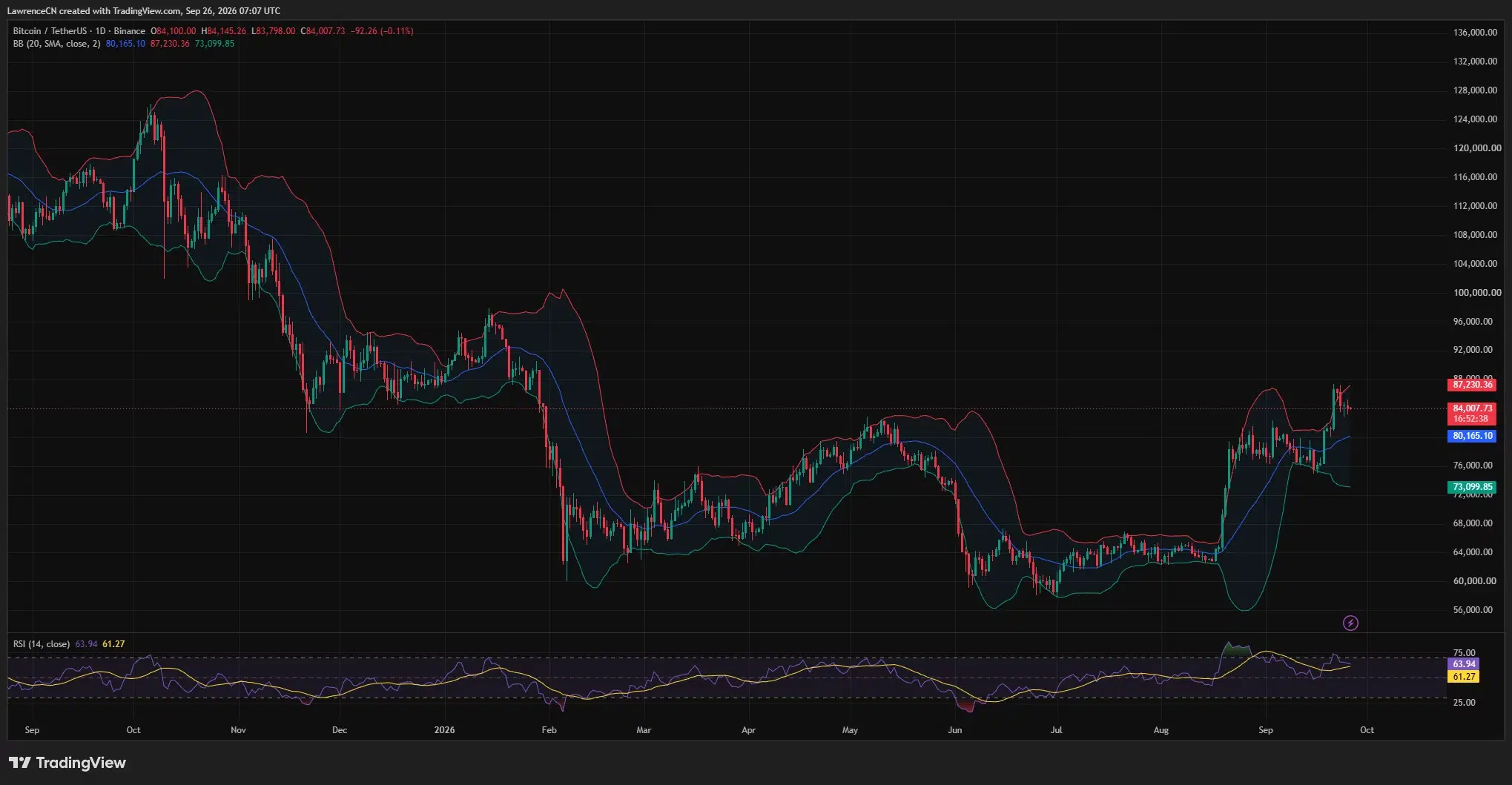
The middle line of the daily 20-period Bollinger Bands stood at $80,165.10. BTC traded roughly $3,843 above it at the charted price. The upper band was $87,230.36, close to the weekly high of $87,363, while the lower band stood at $73,099.85.
Bitcoin briefly traded beyond the upper band near its weekly peak before moving back inside it. Its current position between the upper band and the midpoint leaves $87,230 as a nearby daily chart level above price and $80,165 as a lower one.
The immediate upside sequence starts with the $85,000–$85,800 sell zone. Above it sit the 4-hour Supertrend at $86,435, the upper daily Bollinger Band at $87,230, and the weekly high at $87,363. Wealthmanager’s higher sell-order areas near $88,000 and $90,000 would come into view if BTC clears those levels.
On the downside, the 4-hour support line at $83,593 is closest to the market. The CoinGlass heatmap shows further estimated liquidation exposure around $83,000 and $82,500, followed by the $81,000–$82,000 pullback area identified by Wealthmanager. The daily Bollinger midpoint near $80,165 lies below those shorter-term levels.
Disclosure: This article does not represent investment advice. The content and materials featured on this page are for educational purposes only.


Applied uniformly, sleep hygiene ignores an obvious fact. Sleep is not the same for everyone. A rule that calms one person’s nervous system agitates another’s. Some anxious patients sleep better with the TV on. Others, especially shift workers and jet-lagged travelers, need a hard digital cutoff.
The rules were written for the average person who does not exist. They are obsessed over every night by people who very much do.
Even for chronic insomnia, sleep hygiene alone does not solve the problem. British researchers ran a large primary care trial and found that simply providing a sleep hygiene booklet barely moved the needle. A short course of behavioral treatment worked more than twice as well. The American Academy of Sleep Medicine had already reached the same conclusion, advising against using sleep hygiene as a stand-alone treatment for chronic insomnia.
I advise my patients to treat sleep-related lifestyle interventions as a menu instead. Individualize it. Some will work, and some won’t. The only way to find out is to test them one at a time, with nothing riding on the result. Maybe consistent wake times matter more than consistent bedtimes. Maybe a Sunday afternoon nap is harmless. Maybe the phone in bed is fine as long as it’s not the news. What doesn’t work, you cross off. What’s left is your menu, and you don’t order the same thing every night. It changes as your life does.
The US and China now have a hotline for artificial intelligence (AI). The White House announced it on Friday, after Chinese President Xi Jinping’s state visit to Washington.
Whether the line slows the AI race is another question. Washington says its own AI push will not ease off.
A Cold War-Style Phone Line for AI
According to the White House document, a new US-China Super Intelligence Dialogue will study the risks and benefits of AI. The first talks are due by November. A separate channel will handle AI incidents.
US Trade Representative Jamieson Greer, explained the channel with a Cold War comparison.
“I think of like the red phone between the Kremlin and the White House during the Cold War,” CBS reported.
Xi said AI should develop “always under human control,” according to CBS.
However, hours before the talks, Trump posted a different message on Truth Social.
“Super Intelligence (SI) will be a big topic of discussion, but I want to leave it exactly where it is. That is China’s position also. Our guardrail is the DOJ!”
Still, talking does not mean slowing down. BeInCrypto reported on September 16 that Treasury Secretary Scott Bessent had opened AI risk talks with China. At the same time, he insisted the US would not slow its own AI work.
Subscribe to our YouTube channel to watch leaders and journalists provide expert insights
China Is Closing In on a Fraction of the Money
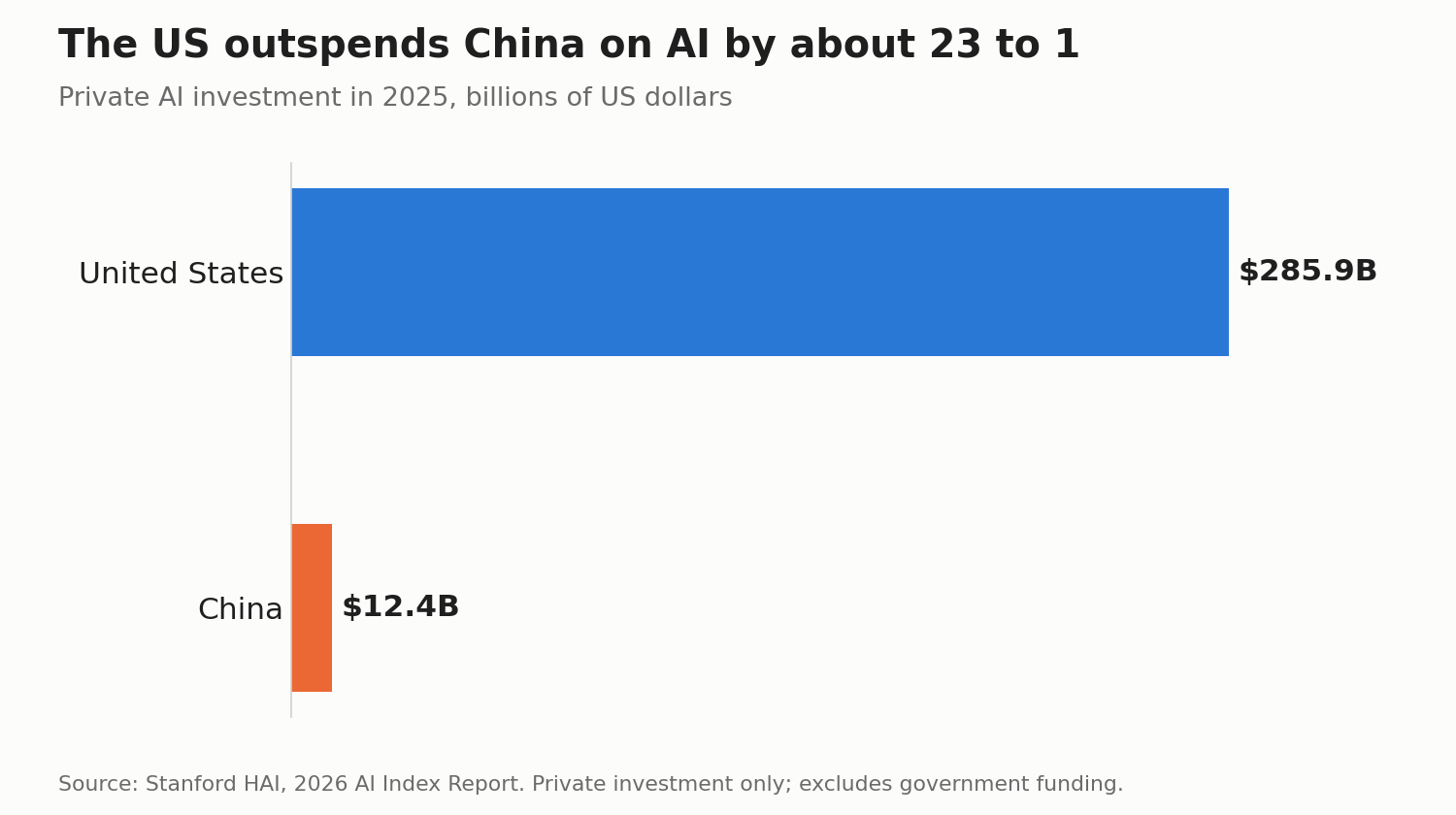
The spending gap is huge. Stanford’s 2026 AI Index found that private investors put $285.9 billion into American AI in 2025. China’s private total was $12.4 billion. The report notes that government funding would likely push China’s real figure higher.

The performance gap is tiny. As of March, the best US model led its top Chinese rival by just 2.7%, according to Stanford.

Britain Tells Its Own Staff to Use Less AI
The hotline comes as Britain takes the opposite approach at home. Draft guidance on the UK government’s AI Knowledge Hub tells official teams to use AI only when needed. The aim is to cut its environmental impact.
Staff should first ask whether a spreadsheet or search engine can do the job. If they do need AI, they should pick the smallest model that works, such as Gemini Flash over Gemini Pro.
Prompts should be short and few. The guidance even says “you don’t need to say thankyou.” Staff must also check AI answers for accuracy and disclose when AI helped create or edit content.
Trump and Xi meet again in November at the Asia-Pacific Economic Cooperation (APEC) summit in Shenzhen. The first AI talks are due by then.
The post US and China Open Cold War-Style AI Hotline appeared first on BeInCrypto.

Over the last decade, I have met hundreds of American K-pop fans as a K-pop ethnographer. My first question is always the same: “Why do you like K-pop?” The question carries an assumption: “If K-pop is merely a copy of American pop, as some critics dismissively claim, why listen to the replica rather than the original?”
Their responses were surprisingly similar, as if they had compared notes. K-pop was “magical” and “catchy,” while American pop was “boring” and “always the same.” According to these fans, while American pop stars sang “too much about sex, drugs, and parties,” K-pop offered “dreams, fantasies, and self-growth,” often through elaborate alternative “universes” in which idols developed distinct personas and narratives.
This idea of “universe” was first systematically introduced to K-pop in 2012, when SM Entertainment debuted EXO as extraterrestrial beings from “EXO Planet,” each endowed with a supernatural power. Since then, world-building has become increasingly intertwined with K-pop’s integration of music, dance, costume, stage design, fashion, beauty, digital media, and more recently, virtual idols and AI production, making K-pop an increasingly audiovisual, narrative, and participatory cultural form for audiences worldwide.

U.S. spot Bitcoin exchange-traded funds took in $2.39 billion during the Sep. 21–25 trading week, with net inflows on all five days. Spot Ether ETFs added $689.8 million, while Solana funds drew $188.1 million.
Summary
- Bitcoin ETFs recorded $2.39 billion in weekly net inflows, led by a $999 million Monday.
- BlackRock’s IBIT drew $1.16 billion, the most among Bitcoin funds.
- Ether ETFs added $689.8 million across five positive sessions.
- Solana ETF inflows reached $188.1 million, with $86.7 million arriving Friday.
According to Farside Investors, Monday’s $999 million was the largest daily Bitcoin ETF inflow of the week. The funds then added $714.7 million on Tuesday, $346.9 million on Wednesday, $190.7 million on Thursday and $134.5 million on Friday.
BlackRock leads Bitcoin ETF inflows
BlackRock’s iShares Bitcoin Trust, or IBIT, collected $1.16 billion over the five sessions, based on Farside’s daily fund figures. Fidelity’s FBTC followed with $701.6 million, while ARK 21Shares’ ARKB added $294.7 million. Morgan Stanley’s MSBT drew $203.3 million.
Monday accounted for nearly $1 billion of the Bitcoin funds’ $2.39 billion weekly total. IBIT received $381.4 million that day, while ARKB took in $289.1 million and FBTC added $238.8 million. Tuesday brought another $350.3 million to IBIT and $257.4 million to FBTC.
The pace slowed later in the week, but the combined funds remained positive through Friday. IBIT posted an inflow on every trading day. The weekly total also exceeded the prior week’s roughly $6.1 million net inflow, which included sharp withdrawals on Sep. 15 and 16 before flows recovered.
Bitcoin’s price moved above $87,000 earlier in the week before pulling back. crypto.news reported on Friday that BTC was holding near $84,000 despite continued ETF inflows. The fund data show sustained net buying through the price retreat; they do not establish how much of the price move came from ETF demand.
Ether funds reverse the previous week’s outflow
U.S. spot Ether ETFs recorded $689.8 million in net inflows from Sep. 21 through Sep. 25, according to Farside’s Ether data. The funds added $270 million on Monday, followed by $162.2 million, $104.5 million, $66.1 million, and $87 million over the next four sessions.
The result reversed the previous week’s roughly $140.6 million net outflow. BlackRock’s ETHA led this week’s gains with $326.2 million, while Fidelity’s FETH took in $174.1 million. BlackRock’s staking fund ETHB added $47.5 million.
Monday’s $270 million was Ether ETFs’ strongest day of the week. ETHA received $110.1 million, FETH added $73 million, and Grayscale’s lower-fee ETH fund drew $59.3 million. Daily inflows became smaller as the week progressed, though the group finished each session in positive territory.
Solana ETFs finish with their strongest day
Spot Solana ETFs drew $188.1 million for the week, based on Farside’s Solana figures. Their daily net inflows were $26 million on Monday, $28.9 million on Tuesday, $13.7 million on Wednesday, $32.8 million on Thursday, and $86.7 million on Friday.
Bitwise’s BSOL accounted for $128.4 million of the weekly total. It received $55.7 million on Friday, when Grayscale’s GSOL added $18.5 million, and Morgan Stanley’s MSOL took in $6 million.
Across the Bitcoin, Ether and Solana products tracked in Farside’s three tables, net inflows totaled approximately $3.26 billion for Sep. 21–25. Bitcoin funds accounted for about 73% of that combined figure.
Crypto World
Kraken’s parent Payward is building a financial empire that goes far beyond crypto trading
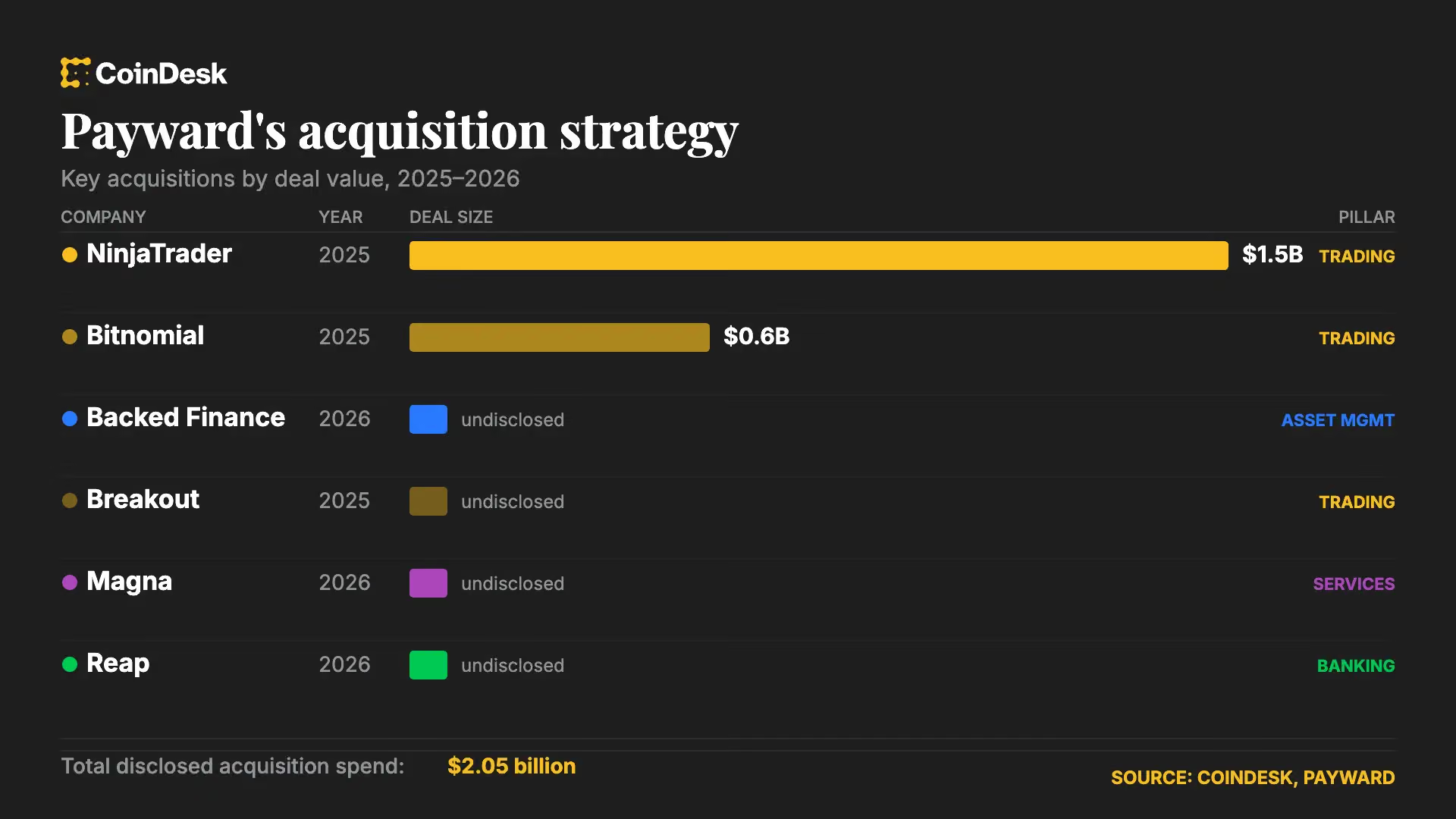
Payward has divided that vision into four pillars: trading through Kraken, banking, asset management and Payward Services, its business-to-business infrastructure division.
Kraken has about 6.6 million funded accounts holding between $40 billion and $50 billion of assets, according to Sethi, across more than 190 countries and territories.
To grow its vision of a unified financial platform, Payward is now adding services around those accounts, including cards, lending, derivatives and tokenized equities, as well as products that allow customers to borrow against assets or deploy them in decentralized-finance applications. Kraken Financial, its Wyoming-chartered special-purpose depository institution, also forms part of the stack.
Build, buy or partner
That thesis is also shaping what the company is buying.
While Payward builds some capabilities internally, it also acquires others that would take years to replicate and partners with institutions whose position cannot simply be bought.
Payward paid $1.5 billion for the acquisition of NinjaTrader to build a U.S. futures brokerage, including its technology and regulatory permissions, which would have been costly and time-consuming, Sethi said. It followed that with a $550 million deal for Bitnomial, adding regulated derivatives infrastructure, including an exchange, clearinghouse and futures brokerage.
The firm is also “about to buy a bank in Europe,” Sethi said, without disclosing who the target was. Bloomberg reported in July that Payward was planning to buy a Lithuanian bank as part of its strategy to expand on the continent.

The company does not maintain a shopping list or broadly solicit pitches from bankers. Instead, it uses a quantitative framework to determine whether a target fills an infrastructure gap and provides capabilities customers want, Sethi said.
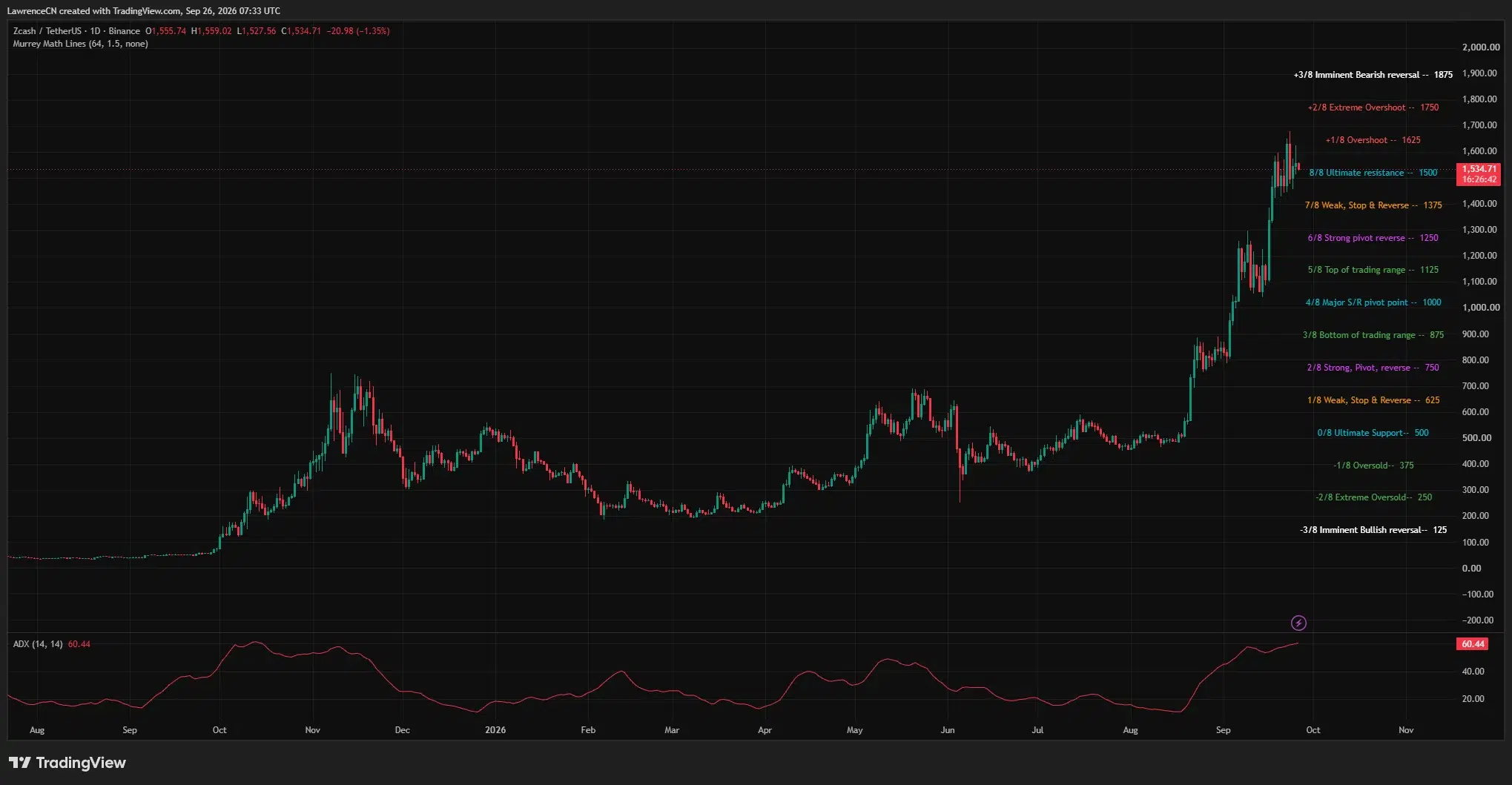
Zcash price has gained about 102% over the past month to trade near $1,535 as co-founder Eli Ben-Sasson has repeated his forecast that ZEC will reach $5,000 by the end of 2026.
Summary
- Ben-Sasson said his $5,000 year-end forecast remains on track after ZEC passed his earlier $1,200 target.
- ZEC recently traded above $1,600 before pulling back toward the $1,500 level.
- Grayscale’s U.S.-listed Zcash fund has surpassed $1 billion in assets roughly a month after its exchange debut.
- The daily chart places $1,625 above ZEC and $1,500 at the nearest marked level below its recent high.
Ben-Sasson said in a recent X post that he still considers his $5,000 year-end prediction on track. He also said large holders had asked him about ZEC’s latest rise, while acknowledging that he did not know precisely what caused the move.
The forecast follows an earlier call for ZEC to exceed $1,200 by Sep. 25. Zcash passed that price during its September rally and later traded above $1,600, putting the token well beyond the level Ben-Sasson had named for the month.
At roughly $1,535, a move to $5,000 would require ZEC to rise about 226%. The year-end figure remains Ben-Sasson’s prediction; his post did not identify a price model or a sequence of levels leading to it.
Zcash price holds above $1,500 after its monthly surge
Zcash price traded near $1,535 on the Binance daily chart captured on Sep. 26. The session showed an opening price of $1,555.74, a high of $1,559.02, and a low of $1,527.56 at the time of the reading.
Price remained above the chart’s $1,500 Murrey Math level after pulling back from a recent peak above $1,600. The next marked level above price was $1,625, followed by $1,750. Below $1,500, the chart placed the next levels at $1,375 and $1,250.
The daily average directional index, or ADX, stood at 60.44. ADX measures the strength of a trend without showing its direction; ZEC’s price action supplies the directional context after its climb through the September levels.
The speed of the advance has also brought sharp reversals. On Sep. 18, ZEC reached $1,535.82 before retreating toward $1,455, as previous Zcash price coverage detailed. At the time, the $1,500 level acted as resistance. ZEC has since moved above it, though its retreat from the latest high leaves that level close to the market again.
Earlier in September, ZEC rose from around $814 to more than $1,200. The rise included a move above $1,000 on Sep. 4, when short liquidations added to trading activity. Price then crossed $1,250 and $1,375 during the next leg of the rally.
Grayscale’s Zcash fund gives U.S. investors exchange access
Grayscale’s Zcash product began trading on NYSE Arca under the ticker ZCSH on Aug. 25 after the firm converted its existing trust into an exchange-traded fund. The listing gave U.S. brokerage investors a way to gain ZEC exposure without buying and storing the token themselves, as crypto.news covered after its launch.
Grayscale launched the product with about $304 million in assets held by the former trust. Its assets passed $500 million within weeks and reached more than $1 billion roughly one month after the listing, according to Grayscale’s reported fund figures. Asset growth includes changes in the value of ZEC already held by the fund, as well as investment flows.
ZCSH is also approaching a change to its share structure. Grayscale has scheduled a three-for-one forward split, with investors on record at the close of Sep. 28 set to receive two additional shares for each share held. Distribution is scheduled for Sep. 29, and split-adjusted trading is due to begin before the market opens on Sep. 30.
The split will triple the number of shares held by each eligible investor while reducing the net asset value per share proportionately. It will not change the value of the investor’s holding at the time of the adjustment, according to the ZCSH split filing.
For U.S. investors comparing the fund with direct ZEC ownership, Grayscale states that ZCSH is not registered under the Investment Company Act of 1940. Its shares trade through brokerage accounts, while direct holders own the cryptocurrency itself.
Network upgrade plans add dates to the ZEC calendar
Zcash developers have set an Oct. 6 testnet activation target for Network Upgrade 7, or NU7, according to the project’s published upgrade timeline. The plan includes reducing the target time between blocks from 75 seconds to 25 seconds.
The proposed schedule calls for a final decision on mainnet activation on Oct. 20, after developers review the testnet rollout. Mainnet activation is targeted for Nov. 5. The upgrade package also includes changes to older transaction formats and the network’s funding mechanism.
Coinholders had backed the faster block target in a September poll. Nearly 99.9% of the participating ZEC supported the 25-second proposal, while about 98.9% favored retaining the existing halving schedule, according to coverage of the NU7 vote.
Outside the U.S., 21Shares launched a physically backed Zcash exchange-traded product on Euronext Paris and Amsterdam in September. The product gives eligible European brokerage customers another route to ZEC exposure, weeks after ZCSH began trading in New York.
Disclosure: This article does not represent investment advice. The content and materials featured on this page are for educational purposes only.


Prediction market Kalshi lost on appeal when a court ruled that Ohio and Tennessee can regulate sports-event contracts under their state gambling laws.
The 6th US Circuit Court of Appeals ruled against Kalshi on Friday when a three-judge panel sided unanimously with Ohio and Tennessee, finding that the prediction market failed to demonstrate its sports-event contracts are “swaps” under the jurisdiction of the Commodity Futures Trading Commission (CFTC).
The ruling followed a similar ruling from the 9th Circuit Court of Appeals last month, which broke from an April decision by the 3rd Circuit Court of Appeals allowing the company to do business in New Jersey as its appeal process proceeds.
The April ruling said Kalshi was likely to succeed with its argument that federal law preempts New Jersey’s regulations, all of which has set up a potential Supreme Court case.
Cointelegraph reported on Wednesday that a group of state lawmakers had filed an amicus brief with the Supreme Court, urging it to weigh in on the case between Kalshi and state gaming authorities, potentially resolving whether state authorities or federal agencies have jurisdiction over prediction market companies.
The Core Dispute: New Jersey authorities and state gaming regulators are asking the Supreme Court to decide whether state gambling laws or federal oversight by the Commodity Futures Trading Commission (CFTC) govern sports event contracts.
The Lawmakers’ Position: According to Cointelegraph, the NCLGS argues that a ruling favoring Kalshi would leave states powerless to regulate sports betting on prediction markets, leading to widespread confusion and harming state regulatory regimes.
Kalshi’s Response: Kalshi has until November 9, 2026 to file its official response brief, having previously maintained that it cannot practically be subjected to oversight by 50 different state regulatory bodies.
The U.S. Supreme Court has not yet announced a final decision on whether it will grant certiorari to hear the jurisdictional clash over prediction markets. However, the urgency for the high court to intervene has intensified significantly due to a rapidly expanding circuit split across the federal judiciary
Deepening Circuit Split
While the Supreme Court is preparing for its initial evaluation of the pending petitions, the lower courts have increasingly fractured on whether prediction markets should be regulated by the federal Commodity Futures Trading Commission (CFTC) or individual states:
- The 3rd Circuit: Ruled in April 2026 that Kalshi’s sports event contracts constitute “swaps,” meaning federal law preempts New Jersey state gambling regulations.
- The 9th Circuit: Reached the opposite conclusion in late August 2026, ruling that states like Nevada can enforce their local gambling laws against Kalshi, Robinhood, and Crypto.com.
- The 6th Circuit: Issued a new ruling on September 25, 2026, dealing another blow to Kalshi by unanimously declaring that Tennessee and Ohio retain the authority to regulate these platforms.
Current Status at the Supreme Court
There are now three separate certiorari petitions actively pending before the Supreme Court seeking to resolve this nationwide gridlock. New Jersey officially petitioned the Supreme Court on September 2, 2026, to overturn the 3rd Circuit’s pro-Kalshi decision. Concurrently, companies like Robinhood have filed separate petitions pushing for swift high court intervention to reverse the 9th Circuit’s ruling.
Because circuit splits are the primary catalyst for the Supreme Court choosing to step in, legal experts expect the justices to heavily consider taking up the matter.

Ripple’s RLUSD has reached a circulating supply of about 2.49 billion tokens as the value of stablecoins on the XRP Ledger has risen roughly 6% in a week.
Summary
- CoinMarketCap places RLUSD’s circulating supply near 2.49 billion tokens, up from the $2 billion milestone Ripple reported in August.
- DefiLlama data cited in the source report puts XRPL stablecoins near $1.19 billion, led by RLUSD.
- RLUSD is issued across several networks, so its total supply exceeds the amount held on XRPL.
- Standard Custody issues the dollar-pegged token under New York state supervision.
CoinMarketCap data places RLUSD’s circulating supply at approximately 2.49 billion tokens and its market value close to $2.5 billion. The stablecoin trades near $1, so the increase in market value comes mainly from more tokens in circulation, rather than a rise in its price.
Ripple said RLUSD had crossed $2 billion in market value in late August. At the time, close to $1 billion had been issued on the XRP Ledger, according to the company. The latest total puts circulation roughly $490 million above that milestone, though tracker readings can differ by snapshot time and by how they count tokens across networks.
The XRPL figures describe a smaller pool. DefiLlama data cited in the source report placed all stablecoins on the ledger at approximately $1.19 billion, up about 6% over seven days and 11% over 30 days. About $1.10 billion of that amount was attributed to RLUSD, giving Ripple’s token more than 92% of the ledger’s tracked stablecoin supply.
RLUSD supply has grown beyond its August milestone
Ripple launched RLUSD in December 2024 as a dollar-pegged token for payments and other financial transactions. The company first issued it on the XRP Ledger and Ethereum and has since listed additional supported networks in its documentation.
When RLUSD passed $2 billion in August, Ethereum held slightly more of the token than XRPL. As crypto.news reported at the time, on-chain figures put about $963 million on XRPL and $1.05 billion on Ethereum. Ripple described the ledger’s share as close to $1 billion.
The current XRPL figure of about $1.10 billion points to further issuance on Ripple’s home ledger. It also means that well over $1 billion of the roughly $2.49 billion total remains on other supported networks. The figures should be kept separate: RLUSD’s total circulating supply counts the token wherever it has been issued, while the XRPL stablecoin total counts dollar tokens on that ledger.
Institutional clients have a direct route to create and redeem the token through Ripple Mint. Ripple introduced the service in July with an interface and API for eligible clients to manage RLUSD operations. The company presents it as a way to fit stablecoin issuance into existing treasury and payment systems.
Ripple has also identified corporate treasury payments as a possible use for RLUSD. In September, the company pointed to clients handling an estimated $13 trillion annually, according to earlier treasury coverage. That figure describes the payments handled by potential clients; it is not a measure of transactions already settled in RLUSD.
XRP Ledger stablecoins remain concentrated in RLUSD
DefiLlama’s XRPL total puts other stablecoins on the network at roughly $90 million after subtracting the reported $1.10 billion in RLUSD. The estimate depends on the timing of each tracker reading, but it shows the size of Ripple’s token relative to the ledger’s other dollar assets.
For XRPL users, RLUSD provides a dollar-denominated asset that can move on the same ledger as XRP. Ripple’s documentation describes the stablecoin as redeemable for U.S. dollars through its issuer’s arrangements. XRP serves a different role as the ledger’s native token and is used to pay network fees.
The difference matters when assessing what the new supply means for XRP holders. More RLUSD on XRPL can produce additional ledger activity, but it does not require holders of the stablecoin to buy an equivalent value of XRP. A September report on XRP examined the two assets’ separate price and usage trends as RLUSD grew past $2.3 billion.
Ripple has described RLUSD uses that include payments, trading collateral and tokenized assets. In August, it joined Clearpool and Cicada on a planned institutional credit fund denominated in RLUSD. The proposed credit fund was still under development when announced, and its planned size had not been disclosed.
New York oversight governs RLUSD’s reserves
In the United States, RLUSD’s issuer is Standard Custody & Trust Company, a Ripple subsidiary chartered as a limited-purpose trust company by the New York State Department of Financial Services. Ripple says the tokens are backed by cash and permitted cash equivalents held in segregated reserve accounts.
According to Ripple’s transparency disclosures, the company publishes monthly third-party attestations of the assets backing RLUSD. Those reports show reserves and circulation at a specified date, while market trackers update their supply estimates more frequently. Ripple selected BNY in 2025 as the primary custodian for RLUSD reserves.
Ripple’s terms state that RLUSD is not an insured bank deposit. For U.S. holders, redemption rights and the assets in reserve therefore depend on the issuer’s arrangements and applicable oversight, rather than Federal Deposit Insurance Corporation coverage.
Separately, the Federal Reserve released two proposed rules on Sep. 24 to implement parts of the GENIUS Act for issuers under its supervision and for insured state member banks seeking to issue payment stablecoins through subsidiaries. The Fed’s proposed rules cover permitted reserves, capital, risk controls, and bank applications. Public comments are due 60 days after the proposals appear in the Federal Register.
After intense price volatility at the start of the business week, bitcoin has calmed in the past few days and has remained sideways at around $84,000.
Although the same can be said about many larger-cap alts, some of the mid-caps have produced impressive gains, such as ENA, CC, SUI, and PUMP.
BTC Calms at $84K
The primary cryptocurrency was stopped at $82,000 last Saturday after the US and Iran resumed strikes against each other. Bitcoin slipped to $80,300 on Sunday but managed to remain above the key $80,000 support. The bulls took complete control of the market on Monday, initiating a $7,000 leg up that pushed the asset to its highest price level since late January at $87,000.
Bitcoin was stopped there at first and quickly retreated to $84,000. It went on the offensive once again a day later, but the $87,300 barrier was too strong. This rejection was a lot more severe, as BTC dropped to $84,000 by Wednesday and to $83,000 on Thursday morning.
Nevertheless, that support held and BTC rebounded to $85,000 on Friday. It was stopped there again and has remained sideways at around $84,000 ever since, but the pressure could intensify soon. Its market capitalization has calmed at $1.680 trillion on CMC, but its dominance over the alts has slipped to 58.6%.

These Alts Dominate
In a market in which some altcoins have been stealing the spotlight, Ethena’s ENA has risen to the top today with a massive 24% surge. Perhaps the most probable reason is the Binance partnership announced yesterday. CC, SUI, and PUMP have rocketed by double digits among the mid-cap alts, followed by AERO and STX.
Meanwhile, ZEC has retreated by over 4% in the past 24 hours and now sits at $1,525. XMR is down to $553 after a 2.6% decline. XRP, HYPE, ETH, and BNB are also slightly in the red, while SOL, LINK, and UNI have posted some gains.
The cumulative market capitalization of all crypto assets has remained essentially at the same level as yesterday, at $2.880 trillion on CMC.

The post Massive Gains From These Altcoins as Bitcoin (BTC) Stalls at $84K: Weekend Watch appeared first on CryptoPotato.
Source link

Solana’s Alpenglow upgrade has reached its public developer network, letting application teams test a system designed to cut transaction finality from about 12.8 seconds to roughly 150 milliseconds.
Summary
- Alpenglow is active on Solana’s devnet and testnet, while mainnet still uses the current consensus system.
- The upgrade replaces onchain validator vote transactions with direct votes that can finalize a block in one or two rounds.
- Applications that only send transactions and read balances need no migration, but block-data services must update their systems.
- Anza has announced no firm date for Alpenglow’s mainnet activation.
According to the Solana Foundation’s upgrade page, Alpenglow is now active on devnet and testnet but has not been activated on mainnet. Anza, which develops Solana’s core validator software, announced the devnet switch on Sept. 25, one day after testnet completed its transition.
The two networks serve different parts of the rollout. Application teams can use devnet to check how their software behaves with tokens that have no real value, while testnet gives validators and infrastructure operators a place to test the network software under more demanding conditions.
For developers, the new devnet stage means they can check applications against Alpenglow without waiting for the system to reach the blockchain that handles users’ funds. Solana’s mainnet continues to use TowerBFT, so the 150-millisecond figure remains a target for the planned upgrade rather than a finality time available to users today.
Solana’s Alpenglow changes how validators finalize blocks
Under TowerBFT, validators submit votes as transactions that appear inside blocks. Enough votes must accumulate across 32 slots before a block becomes final, which currently takes about 12.8 seconds, according to the Foundation.
Alpenglow’s first phase, called Votor, has validators send votes directly to one another instead. The Foundation says a block can reach finality after one voting round if validators representing at least 80% of stake vote to accept it. A second round provides another path when the first does not meet that threshold.
Finality is the point at which the network has agreed on a transaction strongly enough that it can no longer be reversed under its consensus rules. A faster result could matter to a U.S. exchange deciding when to credit a Solana deposit or to a payment provider deciding when to treat a merchant’s sale as complete. Each service may still apply its own checks before releasing funds or confirming a payment to a customer.
The Foundation separates finality from the time it takes to produce a block. In September, Solana reduced its target slot time from 300 milliseconds to 250 milliseconds, with a further reduction to 200 milliseconds planned under a separate upgrade. Shorter slots change how often the network can produce them; Alpenglow changes how validators agree that a block is final.
A previous crypto.news report covered the testnet preparations on Sept. 23, when developers were preparing Agave 4.3 for the public test. The move to devnet now gives application teams access to the upgraded consensus system in the network they commonly use for development.
Block-data services face changes before mainnet
For an application that sends transactions and reads account balances, the Foundation says Alpenglow requires no migration. Transaction execution, fees, and the formats used to send transactions remain the same under the consensus upgrade.
Services that build transaction histories have more work to do. Alpenglow can expose competing candidate blocks for the same slot before the network selects one. The Foundation tells data providers to keep those candidates separate, then retain the block that reaches confirmation. Combining transactions from different candidates could leave an explorer or other service with an incorrect record.
Validator votes will also disappear from blocks because they will no longer be submitted as transactions. As a result, a chart that counts both user transactions and validator votes will show a lower transaction total after activation even if users make the same number of payments and trades. The Foundation has told data providers to reset comparisons and alerts built on the old figures.
Some services also read validator participation from vote transactions. Under Alpenglow, the Foundation says that information moves to certificates attached to block data, requiring those services to change where they obtain it. Operators using Solana’s Geyser or gRPC data streams must also account for the identifiers that distinguish candidate blocks within a slot.
The changes make devnet testing relevant to exchanges, explorers and other firms that rely on transaction records, including U.S. services connected to Solana. Their deposit rules remain their own operational decision; the network upgrade does not automatically change when a platform makes funds available.
Mainnet activation still has no firm date
Solana’s earlier Alpenglow roadmap tied the proposed mainnet rollout to Agave 4.3 and an October target. Neither the testnet transition nor the devnet activation sets a confirmed date for the live-network switch.
Anza’s software schedule tentatively allows mainnet feature activations to resume on Sept. 28. The schedule does not identify that day as Alpenglow’s activation date, and the Foundation’s status page still lists the upgrade as inactive on mainnet.
The Foundation describes Votor as the first phase of Alpenglow. A later phase, Rotor, is planned to replace the system used to spread blocks across the network. The current rollout concerns the voting and finality changes, while the roughly 150-millisecond target comes from testing and simulations rather than transactions settled under live-market conditions.

Man City charges LIVE: Chairman sends defiant new message to fans – latest news and updates

Chrisean Rock Threatens Legal Action Against Adam22, Blueface

I Tested Ninja’s CrushBoss, a $230 Blender That Chops, Dices, Minces and Mixes





-

 Crypto World4 days ago
Goldman Sachs and Deutsche Bank Agree: The S&P 500 Rally Isn't Over
-

 Tech6 days ago
Researchers escape OpenAI Codex sandbox to run commands on host
-

 Fashion2 days ago
8 iPhone Accessories That Add Personality
-

 Crypto World6 days ago
Who Needs CLARITY Anyway? ARB Could See 70X Increase: Hodler’s Digest
-

 Tech7 days ago
Trump suggests rebranding AI with a new name, says he’s also creating an AI Force
-

 Entertainment3 days ago
These 17 Fall Amazon Dresses Seriously Look Like Anthropologie
-

 Business6 days ago
Analog Devices (ADI) Bets $1.35 Billion on Chips that Let Machines Think for Themselves
-

 Crypto World6 days ago
Coinbase, Robinhood, Circle Seen as Tokenized-Stock Winners
-

 Crypto World4 days ago
This Bearish Netflix Stock Trade Can Cash In On Video Streaming Giant’s Woes
-

 Tech5 days ago
Google’s $899 Googlebook is a bet that you’ll buy a new laptop for Gemini
-

 Crypto World4 days ago
Trump-Xi Polymarket Odds for Handshake Hit 50%
-

 Crypto World3 days ago
Crude Oil Prices Pressured by Diplomatic Hopes in the Middle East
-

 Fashion22 hours ago
Weekend Open Thread: J.McLaughlin – Corporette.com
-
 Business4 days ago
Oil Price Today (September 23): Crude oil below $100 on hopes of US-Iran talks. What did Trump say?
-

 Crypto World3 days ago
Bitcoin price tests $83,600 Supertrend support after $87K rejection
-

 Crypto World3 days ago
Bitcoin Threatens Sub-$84,000 Breakdown as Long Liquidations Spike
-
 Crypto World4 days ago
Meta Jumps 11% As Muse Shines and Investors Show an Appetite for Advancing AI
-

 Crypto World4 days ago
Did Jim Cramer Just Give GameStop Stock the Kiss of Death When He Said the Turnaround Is Working?
-

 Crypto World5 days ago
Bitcoin price holds above $81K as key catalysts line up
-

 Crypto World6 days ago
ARB Price Signals Spur Speculation of 70x Upside in Hodler Digest
You must be logged in to post a comment Login