Sometimes I end up drowning in browser tabs containing web pages I don’t remember opening, and sometimes I have a few tabs that I want to close, but I can’t, because I know I’ll need them later.
Tuck is a completely free browser extension for all the major browsers that helps with this. You know how, in Gmail, you can “snooze” an email so that it’s hidden from your inbox until later? This is like that, but for your browser tabs. Tuck can also automatically close idle tabs after a certain amount of time, saving them to a list so you can open them again when you need to.
To get started, simply install the extension. It works in just about every browser: Chrome, Safari, Edge, Firefox, Brave, Arc, Vivaldi, and a few others. There is no need to sign up for an account.
Advertisement
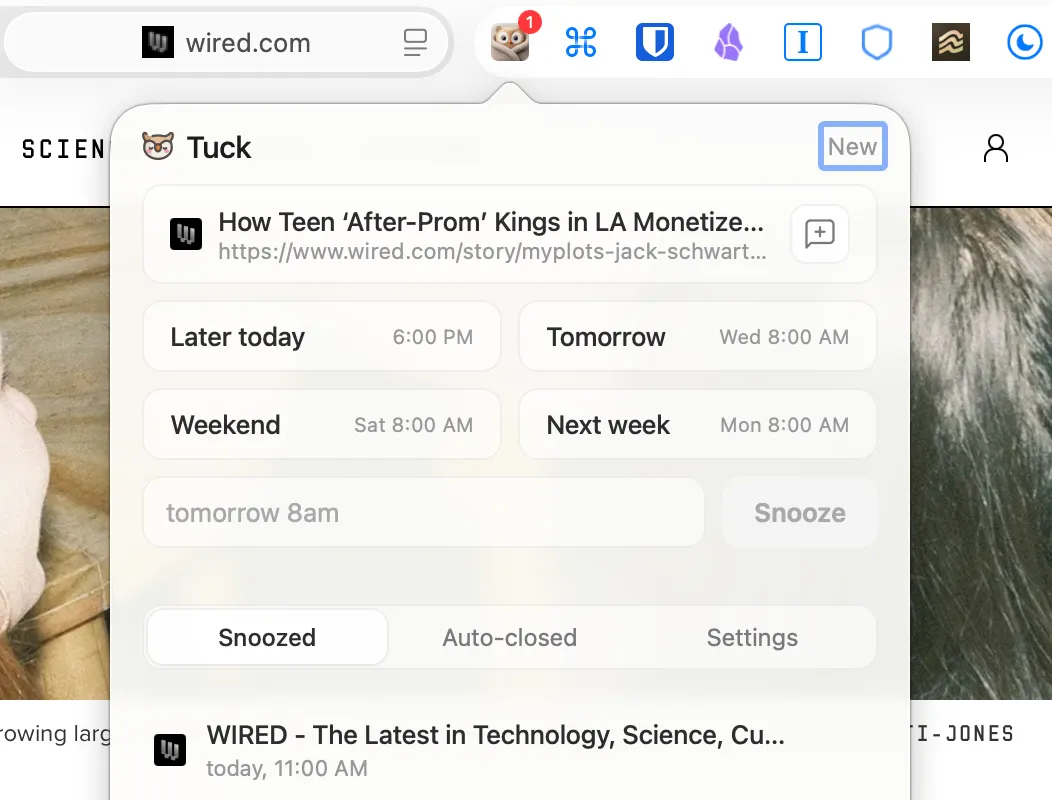
After installing the extension, you’ll see the icon—an owl wrapped in a blanket—in your browser bar. Click it and you’ll see the snoozing options: Later today, Tomorrow, Weekend, and Next week.
Photograph: Justin Pot
Click any of these options and the tab will close, ready to reopen later at the appointed time. If you prefer keyboard commands, the extension has shortcuts for Windows (Ctrl-Shift-1, 2, or 3) and macOS (Cmd-Shift-1, 2, or 3) that allow you to snooze tabs to reopen later today, tomorrow, or next week, respectively.
There’s also a text box, allowing you to type a time that you’d like the current tab to reopen. This text field uses natural language processing, meaning you can type something like “Monday at 2 pm” and the extension will figure out what you mean.
The extension, by default, will automatically close any tabs you leave idle for 24 hours. These auto-closed tabs are collected in the extension, allowing you to find them, click them, and open them back up if you need to. You can change how long tabs need to sit idle before this happens—three hours, 12 hours, 24 hours, three days, and seven days are all options. You can also turn this auto-close functionality off, if you prefer.
Advertisement
Pinned tabs and tab groups will never auto-close, and you can prevent tabs from any given domain from closing—useful for making sure your Google Docs or Gmail never close.
The snoozing and auto-closing features combined do a lot to curb your worst tab instincts. Try this extension out if you’re tired of drowning in tabs you never actually get around to.
PCB circuits are cool, but you know what is cooler? Terminator circuits that’s what! And what if the same material that makes Terminator circuits could also be used for smart heat sinks, flexible circuits, and self-healing material properties? Well, that is exactly what the lab at Virginia Tech’s VT MADE Lab has created, presented by Joel from [3DPrintingNerd].
So what does a Terminator circuit actually entail? Well, just like in Terminator 2, the circuits are made of liquid metal. Specifically, small drops of liquid metal alloy made of gallium and indium. These drops are contained within a matrix of PDMS polymer, which contains the magical liquid for conductivity, thermal and electrical . This makes a flexible and stretchy composite which can even self-repair when punctured or cut by bridging the
Little “bubbles” of liquid alloy form a composite that will pop when applied over a threshold of force or puncture.
broken circuit with the liquid alloy. Having a polymer matrix allows this self-repairing property but also makes the material insulating by default, only allowing current to flow after selectively “popping” the matrix bubbles.
To create something with the composite material, you’ll find it similar to many other resin-based materials. You can pour, mold, and even 3d print a custom geometry. A short bake later and you get a solidified model made for whatever custom flexible circuitry you have in mind.
While this process requires chemicals, polymerization reactions, and a taste for liquid alloys, that shouldn’t stop you from trying out flexible electronics. For a more hands on method to flexible electronics check out this glove with circuits running throughout!
If you want the styling of a 1967 Ford Mustang without the complications of owning an older car, you could always build it yourself. That’s what YouTuber 1194video did, anyway. Using all new components and materials, he got all the measurements of an original 1967 Mustang and began a tough assembly process.
1194video started with the structure and floor by using stamped-in bevels as alignment guides. He then hole-punched and screwed the side panel before welding. Before committing to any welds, he made sure to carefully measure everything, making sure the quarter panel, roof line, and B-pillar all lined up. Getting the body squareness right was one of his biggest challenges, requiring him to strap and pull the body straight before welding.
Advertisement
When it came to the roof structure, 1194video installed front and rear roof braces, then set the roof skin on top to ensure it sat correctly against the body side rails. At this stage, he noticed a bend in the roof skin that had to be corrected. He then screwed and clamped the tail light panel, quarter panels, and other parts of the fastback rear structure into place, trimming off excess metal. This was followed by welding the inner and outer wheel tub sections, then installing the doors and trunk lid. Safe to say, it was not an easy process.
Advertisement
One of the most important and overlooked parts of building a new 1967 Mustang
One of the biggest focuses of building a brand-new 1967 Ford Mustang was rust protection. 1194video felt he had to be proactive, coating various welding points and panels with primer and high-heat paint before enclosing them. He noted that wheel tub welds and cowl panels are common rust points for this model. At one point he said: “It could settle up in between these two pieces of steel and then cause rust and rot out like all the others in the world do.”
Classic Mustangs are known for falling victim to rust – an unfortunately common problem with classic cars – and the wheel wells are a common spot to find hidden damage. This is because this component sits so close to the ground, especially if you drive on roads with snow, salt, and loose stones. Snow and rain can also splash upwards and get the Mustang’s lower body. If you see faded or chipped paint in that area, it could be prone to rusting.
After the initial body work video, 1194video posted a follow-up video tackling a step most home-built Mustangs never have to deal with: getting a legitimate title and VIN for a car assembled entirely from new reproduction panels. This entailed meticulous photography and receipt compilation, heading to the clerk’s office, and then having a state inspector verify the car was legal and contained no stolen parts. A week later, the title showed up in the mail. This specific Mustang isn’t ready for the road just yet, but one surprising obstacle is now out of the way. If you plan on building a custom vehicle yourself — or even swapping engines — you’ll need to check your state’s regulations.
Anthropic’s Claude Opus 5.5 appears to be changing how it writes, with new analysis showing fewer obvious AI writing patterns, shorter sentences, and simpler wording compared with Opus 5.
Claude Opus 5.5 is not only one of the best models for coding, but it also appears to be a bit better at writing, as Anthropic appears to be changing how AI writes.
According to Arena, an AI benchmarking tool, Opus 5.5 has fewer obvious AI writing patterns, so you’re less likely to create AI slop content with this model.
It also found that sentences are now shorter, which means you have fewer long sentences and simpler wording compared with Opus 5.
Advertisement
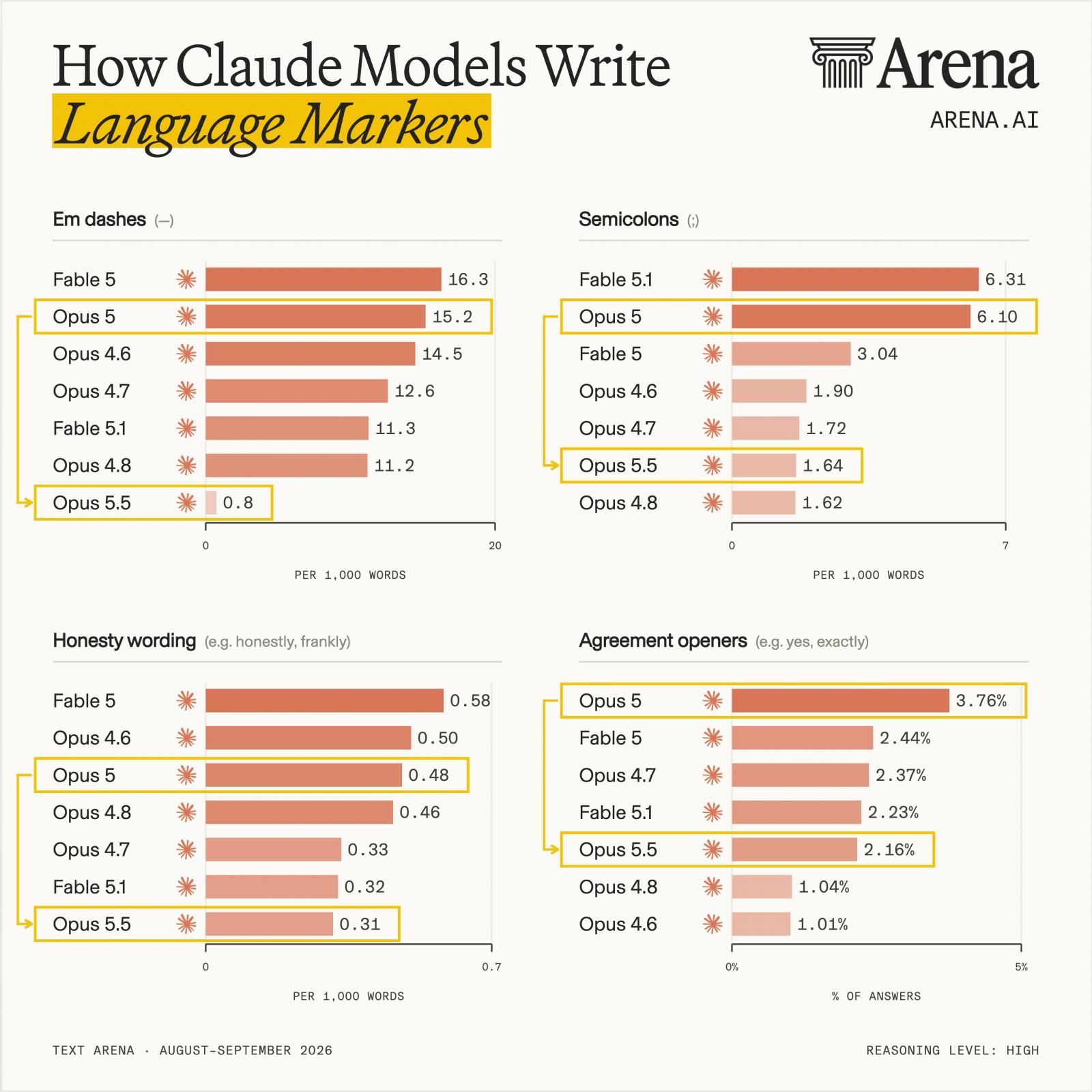
Arena analyzed high-reasoning Text Arena responses from August and September 2026 and observed that 10 of 12 writing measures moved in what it considers a better direction.
Interestingly, Arena’s data confirms that Opus has almost stopped using em dashes, which was one of the biggest signs of AI-generated content.
Claude writing pattern has changed
Source: Arena
Opus 5 used 15.2 em dashes per 1,000 words, while Opus 5.5 dropped that figure to just 0.8, a reduction of roughly 95%. It also found that semicolon usage fell sharply from 6.10 to 1.64 per 1,000 words.
The newer model writes shorter sentences, averaging 10.03 words compared with 12.14 for Opus 5. However, there is one obvious tradeoff, and that is that Opus 5.5 is more verbose.
In other words, average answers increased from 453 to 481 words, making it the longest-writing Opus model in the comparison.
Advertisement
More lately, AI models have focused mostly on the coding side of things, so it’s quite interesting to watch Anthropic change how Claude writes, and if anything, you’ll see fewer em dashes on the internet.
Join Mikko Hyppönen and security leaders from the NFL, CHANEL, and Atlassian for a two-hour digital summit on what AI-speed attacks change, what defenders should stop doing, and how to validate, decide, fix, and re-validate at machine speed.
Across the infrastructure layer that powers AI applications, Markdown has been emerging as a new standard. More providers are turning to it as the default output for anything a model needs to read, and moving beyond JavaScript Object Notation (JSON) as the go-to, one-size-fits-all format.
This real, ongoing shift reflects how large language models are trained, how chat interfaces render answers, and how developers actually build with tokens, context windows, and cost in mind. And there is good reason for this adoption.
Markdown fits how models work
Large language models have been trained on enormous amounts of Markdown. Think of documentation sites, README files, technical blogs, forum threads, knowledge bases and so on. That exposure means models already speak Markdown fluently; they know how to analyze its headers, lists, tables, and code fences, and treat them as semantic signals rather than noise.
At the same time, user-facing chat interfaces can already render answers from Markdown. When a model outputs Markdown, the front end can display it cleanly without extra transformation. When the same model ingests Markdown, it receives information in a form that mirrors its training distribution and the way it is expected to respond. The result is a more natural input-output loop than feeding models dense, nested JSON that must be mentally unpacked before use.
Advertisement
If you look at things from a token perspective, Markdown is also the leaner approach. It strips away structural overhead and keeps the informational payload. For AI agents that must fit large amounts of context into a limited window, that efficiency translates directly into more relevant content per request and lower cost per inference.
A visible trend
The move to Markdown isn’t speculative either. It’s already being encoded in best-practice guidance from major model providers. OpenAI’s prompt engineering documentation explicitly recommends structuring developer messages with Markdown headers, bullet lists, and tables where helpful. The guidance advises using ‘##’ for major sections, inline backticks for code, and clear hierarchical formatting to improve model compliance and readability.
Third-party prompting guides are echoing this same pattern. They use Markdown headings to create section breaks, lists for enumerations, and tables for comparisons. Several analyses note that Markdown is more token-efficient and more naturally understood by models trained on documentation, which makes it a preferred formatting tool for complex prompts, especially with newer GPT-5 series models.
Infrastructure providers agree
API and data providers have also been won over by Markdown. Where JSON once ruled as the universal interchange format, many are now offering Markdown variants optimized for LLM consumption. The rationale is exactly the same: they want to reduce token bloat, simplify parsing for agents, and align with how models are prompted and how answers are displayed.
Advertisement
SerpApi, a nine-year-old, search-data API company, recently launched Markdown output across all 100+ of its APIs at no extra cost. SerpApi serves developers, researchers, and Fortune 500 companies with structured insights from Google, Bing, YouTube, and other sources. The feature lets developers request search results in a token-light Markdown format instead of JSON, aimed specifically at AI agents and LLM-powered applications. No new endpoint is required, and the format is requested via a query parameter, route extension, or header on existing integrations.
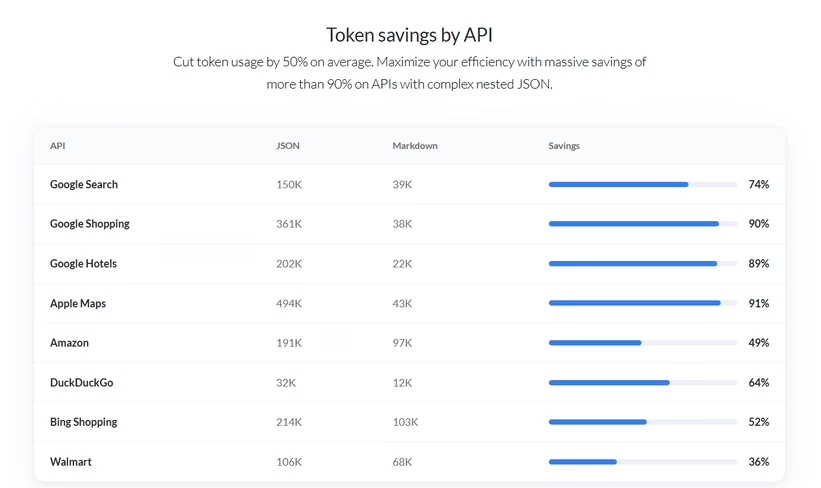
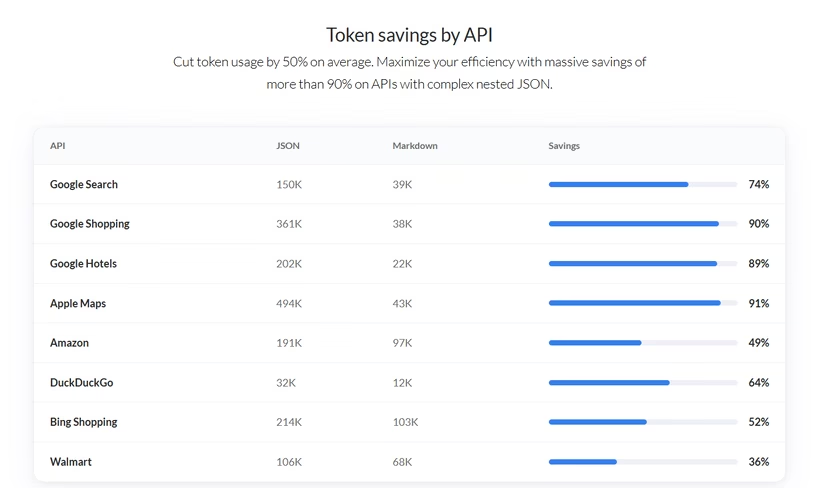
In a real-world example from SerpApi’s own benchmarks, a single Google search for “coffee” costs 24,723 tokens as JSON and 6,435 tokens as Markdown, adding up to a 74% reduction. When combined with field filtering, the same response dropped further to 1,298 tokens. Across its APIs, SerpApi reports average token savings of roughly 50%, with some endpoints seeing reductions of up to 90%.
Token savings across eight APIs, according to figures published by SerpApi. — Credit: SerpApi
These numbers matter because search results are among the noisiest, most nested payloads that agents ingest. JSON responses carry redirect links, favicons, tracking parameters, and deeply nested metadata that models do not need to reason over. Markdown output, in contrast, preserves the core information, such as titles, snippets, links, prices, and ratings in tables and lists while automatically stripping much of the internal tracking noise and duplicate fields.
Developers can access the new Markdown format by adding ‘output=md’ to the query string, calling the ‘/search.md’ route, or setting an ‘Accept: text/markdown’ header. The responses include YAML frontmatter for metadata, structured Markdown tables for result sets, and native inline links, all designed to be dropped directly into prompts or agent memory.
What this all means
As more of the web gets consumed by agents instead of humans, the infrastructure layer will increasingly optimize for machine readability over human-friendly nesting. JSON remains essential for programmatic manipulation and strict schema enforcement, but for the context ingestion phase of AI workflows, Markdown is emerging as the new default.
Advertisement
In the coming months, one should therefore expect more data providers to offer Markdown variants of their responses, especially for search, e-commerce, maps, and content APIs where token efficiency has an immediate impact on cost and performance. Prompt templates and agent frameworks are also likely to standardize on Markdown sections, tables, and lists as the canonical way to present retrieved context to models. Tooling should also evolve around measuring and minimizing token footprint, with Markdown as a primary lever.
For developers building with LLMs today, the writing is on the wall. When feeding external data into models, one should prefer formats that match how models are trained and how they output. Markdown is no longer just a documentation tool. It’s becoming the new lingua franca between search data and AI models.
Artificial intelligence has spent the past year learning how to write songs, create fake artists, imitate real ones, manufacture album covers, and upload music at a rate that would make Prince during his vault years look lazy. Qobuz would now like its subscribers to know when some of that music was made by a machine.
The French streaming service has officially rolled out an in-app tag identifying music that its proprietary system determines was generated by AI. That fulfills a promise Qobuz made earlier this year when it published its AI Charter and began scanning both new releases and its existing catalog for synthetic content.
The label itself is useful, but the numbers behind it are far more interesting. Qobuz says just 0.38% of streams on its service currently come from tracks identified as AI-generated, while 60% of streams from those tracks are deemed fraudulent by its anti-fraud systems and excluded from royalty payments.
Qobuz has also removed more than one-third of AI-generated albums with no listening activity from its search engine, representing roughly four million tracks. Those recordings have not necessarily been deleted from the catalog; Qobuz specifically says they have been removed from search.
Advertisement
That difference matters because the AI music problem is increasingly not about somebody using generative software to help finish a song. It is about enormous quantities of synthetic material being uploaded cheaply and rapidly, sometimes accompanied by artificial streams designed to siphon money away from the royalty pool.
Related Reading:
Why Qobuz Is Doing This
Qobuz has been heading in this direction since February. Its AI Charter states that editorial recommendations including playlists, Albums of the Week and Qobuzissimes remain selected by human editors, while its personalized discovery tools are designed to prioritize music drawn from those editorial selections and other trusted sources.
That philosophy now extends directly to AI-generated recordings. When Qobuz identifies music as AI-generated, subscribers can see that information instead of having to investigate whether the singer suddenly appearing in front of them has ever actually inhaled oxygen.
More importantly, Qobuz says identified AI-generated material is excluded from its editorial recommendations. That helps put the remarkably low 0.38% share of listening into context because synthetic content may exist on Qobuz, but the service is not deliberately placing it alongside human artists in its curated discovery channels.
That approach says a lot about how Qobuz views its role. It is not simply offering access to a gigantic catalog and leaving listeners to sort out the mess themselves; it is making an editorial decision about what deserves active promotion.
Advertisement
The 60% Number Is The Real Story
The most troubling figure is not how much AI music Qobuz subscribers are actually listening to. It is what appears to be happening around those streams.
Qobuz says 60% of streams associated with tracks it has identified as AI-generated are currently considered fraudulent by its systems. Those plays are excluded from royalty reporting and payouts, and Qobuz says content can also be removed when it detects fraudulent practices.
Advertisement. Scroll to continue reading.
That suggests the immediate threat is not that listeners are abandoning musicians for endless AI-generated albums. On Qobuz, at least, the available data suggests almost the opposite.
Advertisement
The larger problem is scale because generative systems can produce enormous quantities of music at almost no marginal cost. Upload enough tracks, manufacture enough plays, and even tiny payments can become meaningful when multiplied across millions of recordings.
Streaming was not designed for an environment where someone can effectively operate an automated record label containing more releases than entire generations of musicians could create. Qobuz is trying to prevent that volume from distorting discovery and pulling money away from legitimate rights holders.
For listeners, that makes the AI tag more than an ethical warning sticker. It is one visible part of a much larger effort to stop streaming catalogs from turning into digital landfill.
How Is Qobuz Different From TIDAL?
TIDAL has arguably taken the harder line when it comes to money. As we reported previously, the service labels recordings it determines are wholly AI-generated and does not attribute royalties to them.
Advertisement
Subscribers can also disable AI-labeled recordings entirely in Settings. Once enabled, that control prevents those recordings from playing and gradually removes them from personalized recommendations as those recommendations refresh.
TIDAL can also remove synthetic music tied to impersonation, deceptive behavior, high-volume uploads or fraudulent streaming. That gives its subscribers something Qobuz has not publicly announced: a direct “I don’t want AI music”switch.
Qobuz takes a somewhat different approach by combining its own detection technology with editorial curation, search controls and fraud enforcement. TIDAL gives listeners more explicit control over whether AI music enters their experience, while Qobuz is attempting to keep much of the questionable material from becoming prominent in the first place.
Neither service is simply banning AI. The distinction is how aggressively each one separates synthetic content from the normal machinery of discovery and payment.
Advertisement
Spotify Has A Different AI Problem
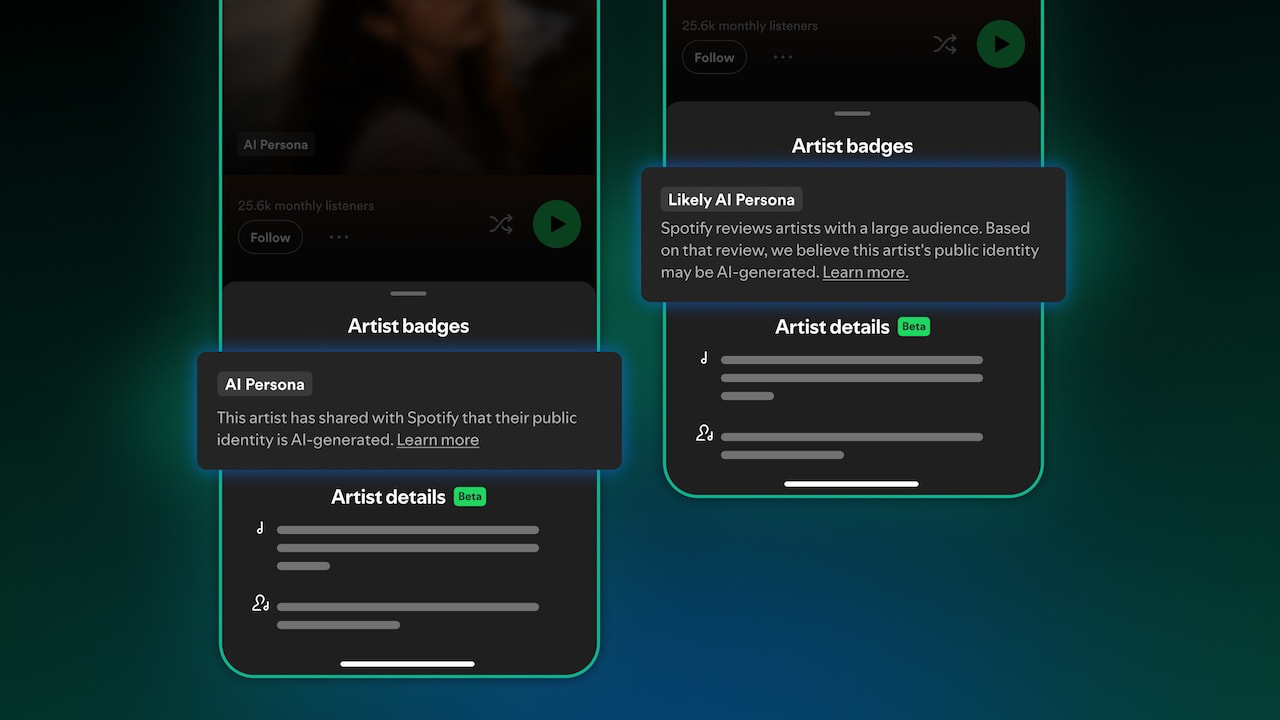
Spotify’s approach has focused heavily on identity and disclosure. Its AI Persona system is designed to identify artist profiles whose public identity may represent an AI-generated person rather than an actual human being, while those profiles can be excluded from editorial and algorithmic recommendations unless listeners deliberately engage with them.
That is not quite the same thing as what Qobuz is doing. Spotify’s badge tells listeners something about who or what the artist supposedly is, whereas Qobuz is identifying the recording itself as AI-generated.
Spotify has also supported richer AI credits so artists, labels and distributors can disclose whether artificial intelligence contributed to vocals, lyrics, instrumentation or production. At the same time, it has tightened policies around impersonation, spam and other deceptive uses of generative technology.
Advertisement. Scroll to continue reading.
We have already covered the tension inside that strategy. Spotify wants stronger protection against synthetic impersonation and AI spam while continuing to explore licensed generative tools that could allow subscribers to manipulate commercially released music.
Advertisement
That makes Spotify’s position increasingly about authorization rather than opposition to AI itself. Synthetic deception is the problem; transparent, licensed and commercially useful AI remains very much on the table.
Apple Music Is Relying More On The Supply Chain
Apple Music is approaching the problem from another direction by leaning heavily on metadata supplied by labels and distributors. Its AI transparency framework can indicate when artificial intelligence materially contributed to artwork, a sound recording, a composition or a music video.
That model potentially provides more nuance than a single AI-generated label because Apple can distinguish where the technology was used. A recording created entirely by software is obviously a different proposition from an album where AI was used only for artwork or some element of post-production.
The weakness is equally obvious: much of that information depends on the people delivering the content reporting it accurately. Qobuz, by comparison, has built its own detection system rather than relying entirely on disclosure from the supply chain.
Advertisement
Apple’s approach may ultimately provide the most detailed metadata if everybody behaves. History suggests that last part deserves an asterisk the size of a record store.
Why Should Listeners Care?
Nobody should need a forensic-audio degree to determine whether the artist being recommended to them exists. Streaming services already exercise enormous influence over how music is discovered through playlists, recommendations, search placement and editorial promotion.
When synthetic music can be generated almost infinitely, allowing it to flow into those systems unchecked creates a basic mathematical problem. Human artists cannot release 10,000 albums before lunch, while software certainly can.
That makes transparency important, but discovery policy may matter even more. Qobuz’s most significant decision is not adding a small AI tag beside a recording; it is keeping identified synthetic content outside its editorial ecosystem while using fraud detection to prevent suspicious streams from entering royalty calculations.
Advertisement
That distinction matters directly to listeners because discovery is part of what they are paying for. A streaming service filled with endless automated uploads is not inherently more useful just because the catalog number keeps getting larger.
There is also a trust issue. If a recommendation engine places something in front of you, knowing whether it came from an actual artist or a synthetic production should not require investigative work after the fact.
The Bottom Line
Qobuz is not banning artificial intelligence from music, nor is it claiming that every use of AI is inherently fraudulent. It is drawing a much clearer distinction between AI used as a creative tool and synthetic content generated at industrial scale, while giving subscribers more information about what they are hearing.
Advertisement. Scroll to continue reading.
Advertisement
The most revealing statistic remains 0.38% because, despite the enormous volume of AI material being added to streaming catalogs, Qobuz subscribers appear to spend very little time listening to it. At the same time, the company says 60% of streams attached to identified AI-generated tracks are being flagged as fraudulent.
Those figures only describe activity on Qobuz, so they should not be treated as evidence for the entire streaming market. They do, however, raise an obvious question about the narrative that consumers are demanding an endless supply of machine-generated music.
If the listeners are barely listening and a large percentage of the plays are fraudulent, perhaps the machines are not only making the music.
The ShinyHunters extortion gang is using a URL-encoding trick to bypass web application firewall rules that mitigate the Oracle PeopleSoft CVE-2026-35273 flaw, allowing the threat actors to resume widespread exploitation of a flaw on vulnerable servers.
Google’s Mandiant and Threat Intelligence Group (GTIG) say this new technique has allowed the threat actor to once again target PeopleSoft servers that had not applied security updates and instead blocked access to the vulnerable PSEMHUB endpoint using a WAF.
On June 10, BleepingComputer first reported that the ShinyHunters extortion gang was targeting Oracle PeopleSoft servers using a zero-day vulnerability, allowing them to steal data from 100 organizations.
Google also reported that same day that ShinyHunters, whom they track as UNC6240, was exploiting the CVE-2026-35273 flaw in attacks on the education sector, confirming BleepingComputer’s reporting.
At the time, Mandiant advised organizations that could not immediately install the security updates or disable the Environment Management Hub to block external access to the vulnerable `/PSEMHUB/*` endpoint.
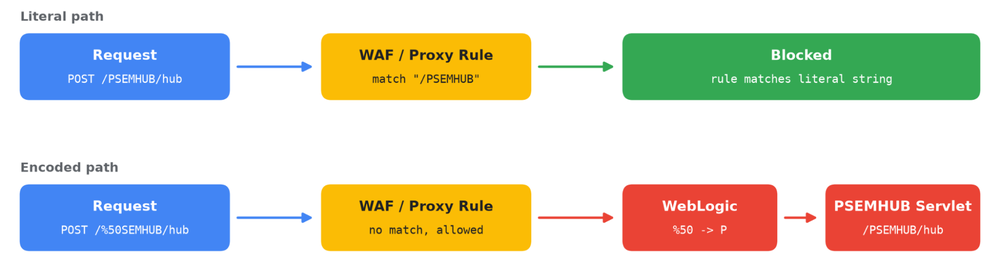
However, in a new report, Google says ShinyHunters has now modified its exploit to bypass WAF rules that look for this literal path, rather than encoded versions of it.
For example, instead of sending requests to:
Advertisement
/PSEMHUB/
the attackers are requesting:
/%50SEMHUB/
The ‘%50’ sequence is the percent-encoded version of the letter ‘P’.
Mandiant says many WAFs and reverse proxies compare the literal request path before decoding it, causing rules designed to block ‘/PSEMHUB/’ to miss the encoded version.
Oracle WebLogic, on the other hand, decodes the encoded ‘P’ and routes the request to the vulnerable endpoint, bypassing the WAF rule.
Advertisement
“This allows the threat actor to reach the endpoint on systems whose operators may have believed their WAF rules had mitigated the exposure,” Mandiant explains.
PSEMHUB WAF bypass Source: Mandiant
Google warns ShinyHunters may not always use the ‘%50’ bypass variation, and could switch to other percent-encoded, mixed-case, or other variations of ‘/PSEMHUB/’ to bypass WAFs.
Instead of relying on a web application firewall, Mandiant urges organizations to install the latest security update to protect against CVE-2026-35273.
Organizations are also advised to search WebLogic access logs for requests to ‘/PSEMHUB/’ and encoded variants such as ‘/%50SEMHUB/’ to detect signs of exploitation.
WAF bypass leads to new data-theft attacks
Google says the new wave of attacks has deployed web shells on dozens of systems worldwide within higher education, technology, IT services, healthcare, agriculture, transportation, and government organizations.
Advertisement
“Mandiant recommends that organizations running Oracle PeopleSoft take the following immediate actions. Additional remediation and hardening guidance is included later in this post,” warns Mandiant.
Before attempting exploitation, the attackers typically send between five and 15 POST requests to `/%50SEMHUB/hub` containing serialized Java objects.
On vulnerable systems, these requests return information about the host operating system without writing files or disrupting the service, allowing ShinyHunters to determine whether a server can be exploited quietly.
Once they determine a system is vulnerable, the threat actors exploit the flaw again to execute commands directly in memory or deploy JSP web shells.
Advertisement
Google says the attackers deploy an ‘x.jsp’ web shell for command execution and ‘u.jsp’ and ‘u2.jsp’ shells for uploading larger files.
On compromised Windows servers, ShinyHunters used these shells to deploy an executable named ‘Ple64.exe’, which masquerades as a signed Light Alloy media player installer but installs a backdoor tracked by Google as SIDEEYE.
The SIDEEYE malware is used to steal credentials, for process and file management, to create interactive reverse shells, and for reverse proxy functionality.
The threat actors also deployed the open-source Neo-reGeorg tunneling toolkit via the ‘tunnel.jsp’ and ‘tunnel.jspx’ files.
Advertisement
This toolkit allows SOCKS5 proxy traffic to be tunneled over normal HTTP and HTTPS connections, letting the compromised PeopleSoft server be used to spread laterally into the internal network.
Mandiant also observed ShinyHunters using the legitimate MeshAgent remote management software to maintain access to compromised Linux systems.
ShinyHunters previously claimed a new PeopleSoft zero-day
ShinyHunters told BleepingComputer on September 22 that the alleged vulnerability allowed remote code execution and was used to access the FBI Jobs platform, then spread laterally into the FBI’s AWS GovCloud infrastructure.
Advertisement
The group claimed it stole between 2TB and 3TB of data related to current and former FBI employees, job applicants, and other internal systems.
At the time, BleepingComputer could not independently verify the alleged zero-day, the claimed lateral movement, or the amount of data reportedly stolen.
The FBI confirmed that it was investigating claims of unauthorized activity affecting FBIjobs.gov but did not confirm that its systems had been breached or that data was stolen.
ShinyHunters has confirmed to BleepingComputer that they used this WAF bypass against FBI Jobs, but continue to claim that they also exploited “NEW unknown vulnerability in the same PSEMHUB component.”
Advertisement
Join Mikko Hyppönen and security leaders from the NFL, CHANEL, and Atlassian for a two-hour digital summit on what AI-speed attacks change, what defenders should stop doing, and how to validate, decide, fix, and re-validate at machine speed.
Hope there’s extra room in your pockets. A new rumor says Apple’s iPhone 20 Pro and Pro Max could have the largest displays in iPhone history, alongside a quad-curved, nearly all-glass exterior.
Digital Chat Station, a prominent anonymous tech insider on the Chinese social media platform Weibo and a reliable source of Apple news in the past, posted over the weekend that the iPhone 20 Pro screen would be 6.41 inches and the Pro Max 6.96 inches, measured diagonally. The iPhone 18 Pro and Pro Max, which hit stores last Friday, measure 6.27 inches and 6.86 inches (which Apple rounds up to 6.3 inches and 6.9 inches). The iPhone Duo, Apple’s long-awaited first foldable phone, which reaches stores on Oct. 23, has a diagonal 7.6-inch inner display when open.
A representative for Apple did not immediately respond to a request for comment.
CNET Senior Reporter Abrar Al-Heeti said that larger screens are great for watching videos and working on the go, but bigger displays also mean higher costs for consumers, serving as an “excuse for companies to charge you more.”
Advertisement
“Along with the commemorative angle of the iPhone’s 20th anniversary, it’s likely Apple could use design elements like a bigger screen and an all-glass design to hike prices,” Al-Heeti said.
More glass, smaller Dynamic Island
Digital Chat Station backed Bloomberg reporter Mark Gurman’s August report that the exterior of the new flagship phones would be nearly all glass in what’s called a quad-curved design. That means the glass will wrap around all four sides of the phone, making it look as if there is no bezel.
In his report last month, Gurman said that the glass on the front and back of the phones would “curve into the sides of the devices, with a metal band in the middle.”
The exteriors of the iPhone 18 Pro and Pro Max are made of aluminum and ceramic glass.
Advertisement
The iPhone 20 Pro and Pro Max will also have a smaller Dynamic Island and a tiny punch-hole selfie cutout on the front, according to Digital Chat Station.
The Dynamic Island is the capsule-shaped region at the top of the front screen that houses the selfie camera. It also expands and contracts to display notifications, system alerts and background activities.
The iPhone 20 Pro and Pro Max are expected to launch in September 2027 as the next iteration in the series. Apple is widely expected to skip over the iPhone 19 name and jump straight to iPhone 20 next year, marking the 20th anniversary of the first iPhone launch in 2007.
Ever since being admittedly fascinated by the Cambridge coffee webcam from the 1990s, I’ve written about VPNs, the NFL, smartphones, living wages, over/unders and everything in between.
See full bio
A ton of attention was paid recently to some offhand statements from OpenAI and Microsoft employees that surfaced in filings in the NY Times’ ongoing case against OpenAI, which has been consolidated into a much larger class action lawsuit. As I argued earlier, that struck me as something of a nothingburger of a story, because it should have no impact on the actual legal questions regarding copyright infringement and fair use. However, on Wednesday evening, OpenAI and Microsoft filed something far more stunning, accusing Susman Godfrey (which represents the plaintiffs in the consolidated case) of effectively end-running basic rules of discovery and evidence by (1) paying for research to supply evidence its clients lacked, (2) hiding from the defendants that it had paid for that research, and (3) sneaking the paid-for research into the case outside the normal expert process.
This filing should be seen as the massive bombshell (if not fraud on the court) that people tried to make out that earlier filing to be. Professor Ed Lee, who runs ChatGPT is Eating the World (which tracks all of the various AI lawsuits), has called this an “explosive motion.” But it’s a little bit complex to understand why, which is why it will not get nearly as much attention as some offhand comments by a Microsoft employee.
To understand why this is such a big deal, we need to take a few steps back to explain. There are a bunch of different cases going on in the US regarding whether or not AI training is “fair use” and therefore not a copyright infringement. There were two important rulings in California last year, one after the other, where one judge (William Alsup) found training to be somewhat obviously fair use, while the other judge (Vince Chhabria) found it to be somewhat obviously not fair use.
As often happens in fair use cases, a lot of time is spent on the “effect on the market” argument, and part of that is whether or not the new works “dilute” the market for earlier works. In the Anthropic case, Alsup didn’t buy the claims of dilution, which is maybe not surprising, since he found training to be fair use. But perhaps more interesting is that in the Meta case, Chhabria — even as he found against fair use — wasn’t persuaded about the “dilution” argument:
Advertisement
As for the potentially winning argument—that Meta has copied their works to create a product that will likely flood the market with similar works, causing market dilution—the plaintiffs barely give this issue lip service, and they present no evidence about how the current or expected outputs from Meta’s models would dilute the market for their own works.
That was a federal judge signalling to potential plaintiffs, if you’re bringing infringement cases like this, maybe find some evidence of dilution?
And… that happened. Earlier this year, a preprint came out on Arxiv seemingly providing evidence on that specific point, claiming that “Generative AI floods and dilutes the market for books” written by four researchers, most notably Jane Ginsburg, who is one of the most famous copyright scholars around (though is also well known as one of the most extreme copyright maximalists, not to mention a general hater on a broad interpretation of fair use). But the lead name on the paper is Tuhin Chakrabarty, a recent PhD. (2024) grad who is now a computer science professor at SUNY Stony Brook. Chakrabarty received his PhD. from Columbia University, where Ginsburg teaches.
A friend had sent me that report when it came out and I found the analysis… perplexing. I had put it on my list of things to write about, but never got to it. Thankfully, Thad McIlroy, who runs “The Future of Publishing” and has been a long term contributing editor at Publishers Weekly, took it upon himself to examine the paper and found it deeply problematic, mainly because they relied on Kindle Unlimited to get copies of the books that they used for the analysis. But as McIlroy points out, that’s distortionary for many reasons regarding how KU works, and suggests that many of the underlying assumptions in the paper simply don’t hold up to scrutiny:
But the author earns income on KU solely on the number of actual pages of their book that are read by a subscriber. Just getting downloaded provides no income. The complex formula is well-described here. There is no method available to estimate the page reads for a book, nor the KU income. Chakrabarty writes, “We measure Kindle Unlimited as whether a title is available on the service, not as how much of it readers actually read. The panel does not tell us whether a given unit is a Kindle Unlimited borrow, a page read allocation, or an ordinary purchase.”
An interesting aspect of KU is that a book’s income there may relate far more closely to quality than it does under royalty systems. If a reader downloads a low-quality AI-generated book on KU, starts to read it, and recognizes the low quality, they will stop reading and move onto another book. The author will earn an insignificant amount of money. On the other hand, if a reader buys the same book, the author receives their full royalty (unless the reader goes to the trouble of returning the book and seeking a refund).
Advertisement
An AI-generated book on KU will only earn significant page revenue if readers find it to be of quality sufficient to match the genre books they are used to reading on the platform.
With these factors in mind, the prevalence of Kindle Unlimited titles in this study appears to be a distorting influence. First, AI-generated books are more likely to appear on Kindle Unlimited than they are more broadly on the Amazon Kindle platform. Second, there is no clear method available to estimate a book’s actual KU income.
Even more bizarre, when McIlroy shared a copy of his critique with Chakrabarty, he was dismissed on moral grounds, because McIlroy has argued for ethical ways to use AI in publishing, which Chakrabarty claims is “morally not okay with me.” That alone should raise some serious red flags about the objectiveness of Chakrabarty in this research. He did not come to this with an open mind. He came bearing a grudge.
A few months earlier, Chakrabarty and Ginsburg (along with Xinyue Liu, who was also an author of the paper above, and who appears to be a first or second year PhD. student working for Charkrabarty) put out another paper called “Alignment Whack-A-Mole: Finetuning Activates Verbatim Recall of Copyrighted Books in Large Language Models.” That piece claimed there was evidence that AI models “store copies of copyrighted works” and even pointed out that this “undermine[s] a key premise of recent fair use rulings.” Indeed, it calls out the Alsup and Chhabria rulings in the paper itself, and effectively notes that they’re responding to the judge’s concerns regarding the effect on the market.
Advertisement
In short, Chakrabarty, Liu, and Ginsburg have been publishing research that attempts to fill in the gaps that multiple judges had called out, and to help plaintiffs argue that training is not fair use. This was especially important because if such evidence was widely available, other plaintiffs would have brought it up. But they have not. Likely because it doesn’t really exist unless you stretch your methodology to its breaking point.
Of course, my biases are known: I’m quite convinced that training AI on copyrighted works is fair use, and I find the argument that slop books “dilute” non-slop books to be beyond nonsensical. Similarly, knowing a little bit (just enough to be dangerous) about how LLM training works, makes it difficult for me to believe that models are, in fact, holding full copies of works they are trained on. That’s just not how they work. But you don’t have to take my word for it. A. Feder Cooper, a well-known computer science professor at Yale who has (somewhat famously) done research on getting LLM’s to spit out “memorized books,” or other full works, had some pretty blunt criticisms of the “whack-a-mole” paper:
As will become clear soon, I think the paper has significant methodological and presentation problems. I’ve spent considerable time reviewing and re-reviewing the paper, and have consulted with two trusted senior colleagues who are experts on memorization to gut-check my reading. And, in brief, I’m confident that Alignment Whack-a-Mole’s headline claims are incorrect. These results rest on aspecific memorization metric and elicitation methodologythat I don’t think hold up to scrutiny, anddon’t support the broad claimsthe paper makes. At best, I think the claims are seriously overstated; at worst, the large majority are wrong. I can’t tell which because the paper doesn’t report enough detail to distinguish the two.
That alone should be concerning, but the media — including the NY Times — really loved to report on these studies, even as their methodology seemed questionable to some experts, and despite the clear potential conflict of interest.
Now, that takes us to the claims in the OpenAI filing from earlier this week: it’s that the plaintiffs’ lawyers at Susman Godfrey secretly paid at least Chakrabarty to do these studies, hid that fact, and then took further steps to launder the studies as non-biased expertise. It appears this wasn’t just a conflict of interest at work, it was a conflict piled upon a conflict, and then potential fraud on the court.
Advertisement
Unable to muster any evidence of harm after years of discovery, Class Plaintiffs’ counsel Susman Godfrey L.L.P. (“Class Counsel” or “Susman”) paid Stony Brook University professor Dr. Tuhin Chakrabarty to research “[h]ow AI generated books dilute the market for human authors.” Declaration of Victor Chiu ISO Motion to Strike (“Chiu Decl.”), Ex. A. Dr. Chakrabarty then coauthored a working, non-peer-reviewed paper purporting to show exactly that (the “Chakrabarty Paper”). The paper was initially self-published on July 22, 2026. Susman had disclosed Dr. Chakrabarty and one of his co-authors as retained experts months earlier—but the resumes Susman provided omitted that Susman had funded Dr. Chakrabarty’s research. Neither Dr. Chakrabarty nor the other disclosed expert ever served an expert report in this case. And after Defendants specifically objected that Dr. Chakrabarty’s resume was incomplete, Susman provided what it represented was an “updated resume” that still omitted Susman’s own funding of his market-dilution research.
Now, some people will point out that it’s not uncommon for companies to pay for research and then use that research elsewhere in ways that are beneficial to them. That’s absolutely true. The problem here isn’t who paid for the research, but the lengths the plaintiffs’ lawyers went to in hiding who paid for it from the court (and from OpenAI and Microsoft)… and how the evidence was laundered into the case long past the normal deadline where it could have been challenged.
Normally, if you bring expert witnesses into a case, the other side gets to challenge their expertise and any research findings that they’re providing. But here, the class plaintiffs’ lawyers took a bunch of steps that at least suggest they deliberately sought to make that effectively impossible with this bit of research. They had named Chakrabarty as a potential witness, providing an incomplete resume for him, but then didn’t use him as such. Instead, they did a kind of evidence two step to get it into the case in a way that would make it harder to challenge:
On July 22, 2026—after the deadlines for all expert reports had passed—Dr. Chakrabarty, Dr. Dhillon, Xinyue Liu, and Professor Jane Ginsburg uploaded to the internet a working paper titled “Generative AI floods and dilutes the market for books.”… They then uploaded two subsequent versions of the paper on July 26, 2026 and August 3, 2026, respectively…. The paper remains identified as a “Working Paper Under Review.” …
The Chakrabarty Paper purports to “measure[] how generative AI” impacts “a real book market once its output reache[s] the catalog and compete[s] for sales.” … Its abstract asserts that the research “bear[s] directly on the market-effect question at the center of the fair use defense to copyright infringement.” … The July 22 and July 26 versions of the Chakrabarty Paper did not disclose that it was funded by Susman and did not make any of its underlying data available. … The August 3 version of the Chakrabarty Paper again did not disclose its funding source. …
[…..]
Advertisement
On Sunday, August 2, 2026, the afternoon before Mr. Lasinski’s deposition, Class Plaintiffs served a supplemental report devoted entirely to the Chakrabarty Paper and which cited the July 26, 2026 version. … At his deposition the next day, Mr. Lasinski testified that he did not analyze any of the data underlying the Chakrabarty Paper…. Mr. Lasinski also testified that he had never spoken with Dr. Chakrabarty or any of his co-authors “about this paper or any other matters related to this litigation.” … When Mr. Lasinski was asked whether he understood that Dr. Chakrabarty and Dr. Dhillon “were retained as experts by Plaintiffs in this matter,” counsel from Susman objected: “I’m not sure why this is appropriate to ask Mr. Lasinski about.” … Mr. Lasinski ultimately testified that he did not “know that this means that [Dr. Chakrabarty and Dr. Dhillon] were retained.”
Mr. Lasinski likewise did not know who had funded the research he was relying upon. When asked whether “the study was funded by Plaintiffs in this case or the Susman Godfrey firm,” Mr. Lasinski testified: “I don’t know the funding sources,” but “to be clear . . . funding something like this would be inconsistent with what I’ve known the Susman Godfrey firm to do.” … Counsel from Susman, who was defending the deposition, did not correct the record or comment on the issue of funding.
Got that? After the deadlines for expert reports were past, the Susman lawyers filed a “supplemental report” from a different expert, Lasinski, which was all about this report that Chakrabarty et al had only just published, effectively getting it into evidence after the deadline passed, and through a non-author of the paper, who had little actual knowledge of the paper’s methodology or data. And, yes, it’s notable that Lasinski said it would be “inconsistent” with what he knew of Susman Godfrey for the firm to fund something like this. Meanwhile, the Susman lawyers in the room objected to questions about whether the paper’s authors were retained experts, and then said nothing at all when Lasinski vouched that the firm wouldn’t fund such research. How… interesting.
There’s also the bit about how the lawyers for OpenAI and Microsoft figure this out:
Advertisement
After Mr. Lasinski’s deposition, OpenAI independently located a substantially similar version of Dr. Chakrabarty’s resume on his website…. Unlike the “updated” resume Susman provided in February, however, the version OpenAI found contains a section specifying $100,000 in “Funding” from Susman in December 2025:
The resume identifies the $100,000 as an “Unrestricted Gift for sponsored research” on “How AI generated books dilutes the market for human authors?”—the same subject covered in the Chakrabarty Paper and in Mr. Lasinski’s supplemental report….
Thus, according to Dr. Chakrabarty’s own resume, Susman’s funding had begun approximately two months before Susman provided Defendants with his supposedly “updated” resume, and the stated subject of that funding was the same market-dilution issue addressed by the Chakrabarty Paper and Mr. Lasinski’s supplemental report. Neither of the resumes Class Plaintiffs provided in February disclosed that the research was sponsored or the source of funding...
That looks bad! This looks worse:
Two days later, on August 27, 2026, Dr. Chakrabarty changed the resume on his public-facing website and removed the reference to Susman’s $100,000 gift. Chiu Decl. ¶ 15, Ex. M. The revised resume now states, in fine print and barely legible font, that “[a] previous version of [Dr. Chakrabarty’s] resume stated that [he] received an unrestricted gift for sponsored research from Susman Godfrey LLP in the amount of $100,000. This was incorrect as the research was done for In re Mosaic LLM litigation for which [his] institution was compensated in a lesser amount:”
Even taken at face value, the revised resume does not deny that Susman funding facilitated the research presented in the Chakrabarty Paper. Whether the money was nominally earmarked for this MDL or the In re Mosaic LLM Litigation case, it supported the same researcher investigating the same market dilution question that is the subject of the Chakrabarty Paper, which in turn is the subject of Mr. Lasinski’s supplemental report.
OpenAI and Microsoft have asked the court to toss the paper entirely, and it’s the plaintiffs’ key evidence on dilution, the exact thing Chhabria said was missing in the Meta case. But also, they point out that this appears to be an attempted fraud on the court.
The Lasinski Supplement is not just late; it instead appears to be a deliberate effort to gain an advantage by evading Rule 26. “It is troublesome, to say the least, for a party to engage a consulting, non-testifying expert; pay for that individual to conduct and publish a study, or otherwise affect or influence the study; engage a testifying expert who relies upon the study; and then cloak the details of the arrangement with the consulting expert . . . in order to conceal it from a party opponent and the Court.” … To make matters worse, Susman appears to have concealed its funding of the Chakrabarty Paper from Class Plaintiffs’ own expert, Mr. Lasinski, despite asking him to rely on it. Dr. Chakrabarty himself was also apparently ignorant of the fact that the tens of thousands of dollars Susman was funneling his way to conduct market-dilution research and publish papers was tied to a specific litigation, much less which one. And Class Plaintiffs have now completed the maneuver: their summary judgment submissions rely extensively on the Chakrabarty Paper and describe it to the Court simply as an “academic stud[y],” without disclosing that their own counsel funded the underlying research.
This maneuver deprived Defendants of the opportunity to fully analyze and rebut the Chakrabarty Paper—and the Court of the ability to properly assess its reliability. Had Class Plaintiffs properly disclosed the Chakrabarty Paper and underlying data and materials, Defendants would have evaluated the data on which the study is based, deposed Dr. Chakrabarty and his co-authors, and tested the study’s methodology and conclusions through the ordinary discovery process. Instead, Defendants were only able to depose Mr. Lasinski, who knew nothing about Dr. Chakrabarty’s underlying data and who mistook the Chakrabarty Paper to reflect neutral, independent research.
Advertisement
Courts recognize that it is “fundamentally unfair” for a party “to supplement the record with reports of alleged ‘consulting experts’”—like Dr. Chakrabarty here—“whose identity and opinions have been shielded [from disclosure].”
The Court also has the inherent authority to preclude the Lasinski Supplement and Chakrabarty Paper to “prevent [Class Plaintiffs] from perpetrating a fraud on the court,” Yukos Capital S.A.R.L. v. Feldman, 977 F.3d 216, 235 (2d Cir. 2020), or interfering with the judicial system’s ability to impartially adjudicate this action. Such interference includes concealing counsel’s role in creating purportedly neutral scientific evidence. See Hazel-Atlas Glass Co. v. Hartford-Empire Co., 322 U.S. 238, 251 (1944) (vacating judgment obtained using an article ghostwritten by counsel but presented as the work of a disinterested expert).
That is what Susman did here. When disclosing Dr. Chakrabarty as an expert, Susman omitted that it funded the research subject of the Chakrabarty Paper, continued to omit that funding even after providing what it represented was an “updated resume,” and allowed Mr. Lasinski to testify at his deposition that Susman would not provide such funding. And even since its funding of the research has come to light, Susman has refused to answer straightforward questions about the nature of its relationship with Dr. Chakrabarty and his co-authors. As Mr. Lasinski himself acknowledges, it would be “inconsistent” for a law firm to fund a study for litigation and then present it through an expert as neutral academic literature.
Once again, the issue isn’t even that the research is sketchy (although… it is). Nor is it that the research was paid for by an interested party (though… it was). The main issue is that the funding appears to have been deliberately hidden from the defendants, and then the sketchy, paid-for research was laundered into the case through a different expert after the deadline for expert reports had passed.
Advertisement
Literally everything about this bit of research — which is a key plank in the anti-fair use argument — comes out of this as suspect.
Google’s $15bn AI datacentre project in Andhra Pradesh has state environmental clearance for 2.51GW of capacity, more than double the 1GW announced, according to clearance papers seen by the Guardian.
Hannah Ellis-Petersen and Aakash Hassan reported the story from Tarluvada, one of the villages where the project is being built. The Guardian said 2.51GW is roughly the output of two large nuclear reactors, and more than 30% of the state’s current yearly power use.
Google announced the Visakhapatnam AI hub in October 2025, with partners AdaniConneX and Airtel. In its reply to the Guardian, Google called it a gigawatt-scale hub, comparable to other projects.
The state gave the green light in nine days, with no public hearing, the Guardian reported. The Human Rights Forum has since filed three petitions at India’s National Green Tribunal, and a separate case is before the Andhra Pradesh High Court.
Advertisement
The project covers three sites around Visakhapatnam. One is a few metres from a reserve forest, a drinking water reservoir and a wildlife sanctuary.
In Tarluvada, 520 families recently had land taken back that the government had given them about 20 years ago, according to the Guardian. Villagers said security guards working for the Adani Group put up fences in April and blocked them from plots they had farmed for years.
Some of the 47 Dalit farmers who were paid for their land said they have not yet got the new plots and jobs they were promised. One farmer, P Venkat Rao, said he received $40,000 for his only acre but now has no livelihood.
“I am a farmer, without my land I am nothing,” Rao told the Guardian.
The state government said no land was taken by force and that those who qualified were paid well. The Adani Group said all legal approvals were in place.
Advertisement
Google said the site will be cooled by air, not water, so it will not affect local drinking water. It also said it expects no impact on the local community and will create thousands of jobs around Visakhapatnam.
Meanwhile, the state’s tax breaks and cheap land, power and water for Google are estimated to be worth 220bn rupees ($2.2bn) over 20 years, the Guardian reported.
The dispute mirrors datacentre protests in the US and elsewhere. The tribunal petitions have not yet been decided.
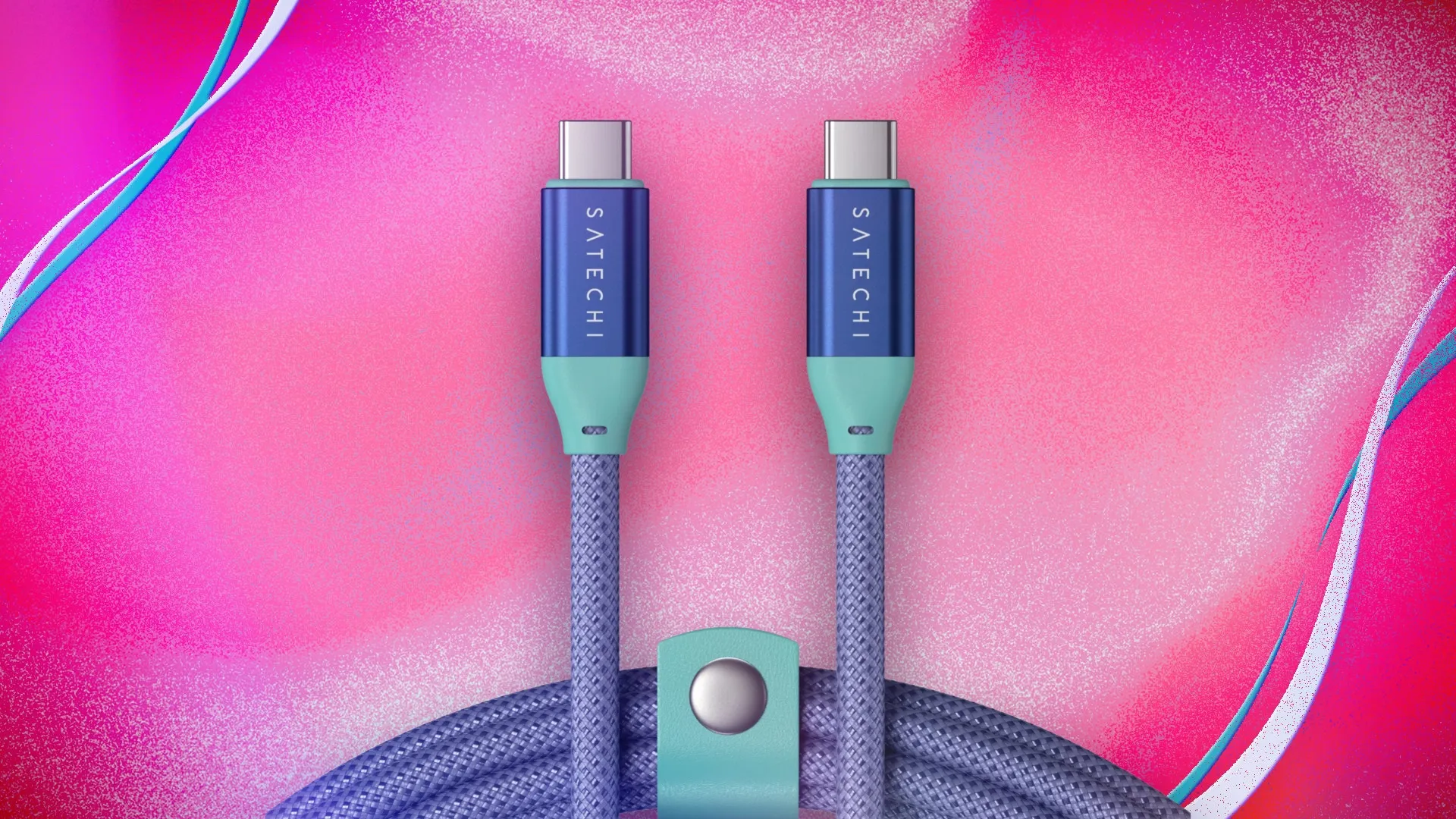
Save 50%: Satechi is offering a whopping 50% off some of its USB-C cables when you enter the discount codeS3KZUUN3 at checkout. Whether you’ve just bought a shiny new iPhone 18 Pro, you’re waiting for the iPhone Duo to launch next month or you just need a new cable for your current phone, this is the early Prime Day deal for you.
Prefer to order your cables direct? The Satechi store is offering the same deals with the discount codeIPHONE18CABLE. But no matter where you choose to order from, you’ll need to do it soon — this 50% off sale ends tonight.
Save 50% with code S3KZUUN3
Satechi USB-C cables
Advertisement
There are tons of cables for you to choose from, ranging from short ones to long ones, black ones to pink ones and everything in between. The company’s 240-watt USB-C cable comes in a funky purple, for example, and it’s yours for just $13, down from $25. It’s 3.3 feet long and braided for longevity and its anti-tangle properties.
If you want a cable that’s perfect for the road, Satechi’s OntheGo Lanyard Cable offers 60-watt charging in a 4.9-foot braided cord that doubles as a lanyard when attached to your iPhone. It normally sells for $30, but it’s just $15 right now, with three colors for you to choose from.
Advertisement
There are plenty more options in the sale, too. Take a look through the options, and we’re sure you’ll find the right cable for you and your phone.
Alternatives you might like
The USB-C cable market is full of options, but it’s always recommended to choose a cable from a company that you trust. Satechi definitely falls into that category, as does Anker — and you can snag two 6-foot cables for $10 at Amazon currently. They’re rated for 60 watts, which means they can charge your MacBook as well.
Oliver Haslam has been writing about phones, computers, games, and anything else that takes a battery or plugs in for more than he’d like to admit.
With a focus on mobile and laptops, Oliver is never too far away from whatever social network is trending today and is never short of an opinion to share.
See full bio


























































You must be logged in to post a comment Login