
Crypto World
NFT sales rise 57.17% to $55.5M as Ethereum leads

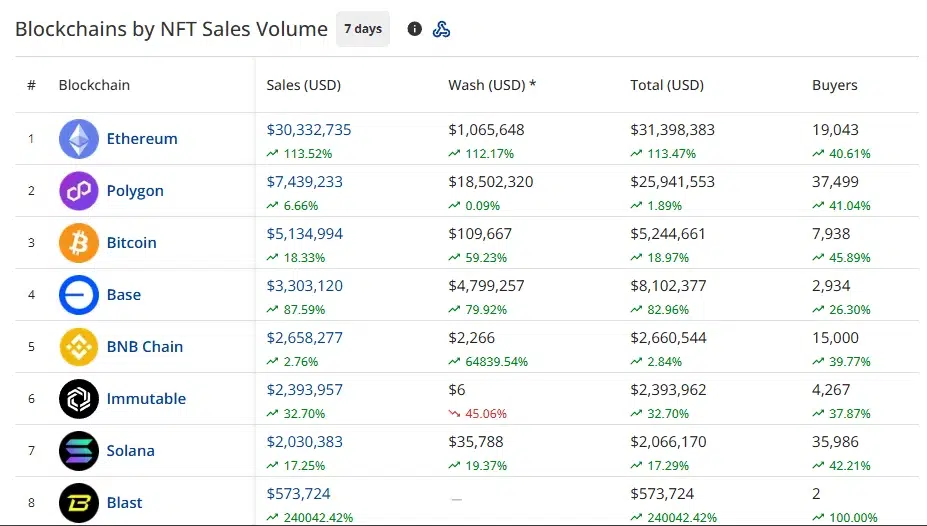
NFT sales reached approximately $55.51 million over the seven days ending Sep. 26, up 57.17% from the prior seven-day period, according to a CryptoSlam dashboard captured on Sep. 26. Ethereum led blockchain sales, while CryptoPunks ranked first among collections.
Summary
- NFT sales rose 57.17% to $55.51 million across the rolling seven-day period.
- Buyer addresses increased 39.65% to 160,565; transactions rose 5.93% to 825,513.
- Ethereum led blockchains with $30.33 million in sales, up 113.52%.
- Bitcoin ranked third with $5.13 million in sales, up 18.33%.
- CryptoPunks led collections at $8.24 million; Beezie #4365 was the largest listed sale at $1 million.
According to data from CryptoSlam, seller addresses rose 39.19% to 150,410. The 39.65% increase in buyer addresses was much larger than the 5.93% rise in transactions. CryptoSlam counts addresses, so those buyer and seller figures do not establish how many individual people traded NFTs.
The NFT increase took place alongside gains in the two largest cryptocurrencies. Bitcoin traded near $83,914, up 3.60% over seven days, while Ethereum traded near $2,686, up 2.70%. CoinGecko put the total crypto market capitalization near $2.97 trillion.
Ethereum leads NFT sales with $30.33 million
Ethereum recorded approximately $30.33 million in seven-day NFT sales, a 113.52% increase. Its 19,043 buyer addresses were up 40.61%. CryptoSlam separately listed about $1.07 million in wash-trading volume for the network; that measure should not be added to its sales figure.
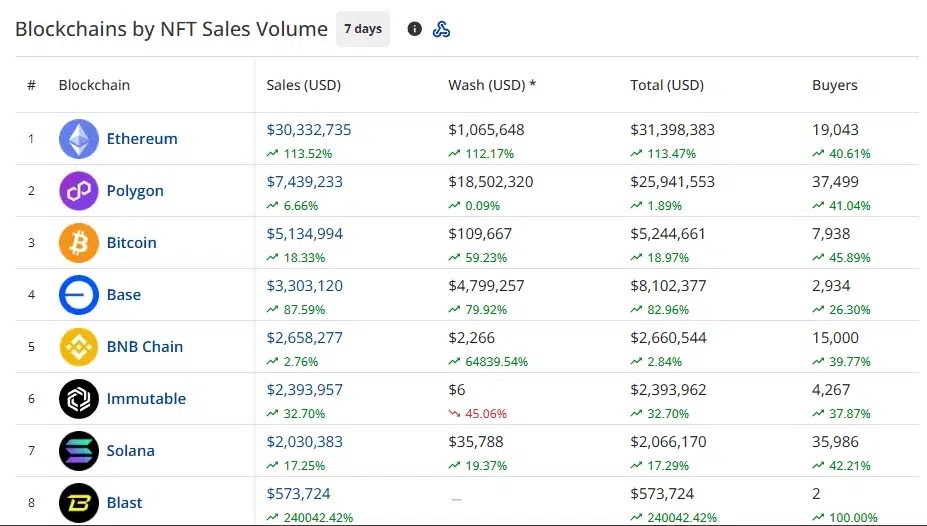
Polygon placed second with $7.44 million in sales, up 6.66%, and 37,499 buyer addresses, up 41.04%. Its listed wash-trading volume was far larger, at $18.50 million. CryptoSlam’s separate “Total” column combined those figures to show $25.94 million for Polygon, but that total is not the same as the network’s $7.44 million sales figure. Polygon also hosted Courtyard, the second-ranked collection by sales.
Bitcoin followed with $5.13 million in sales, up 18.33%. Its buyer addresses climbed 45.89% to 7,938, while listed wash-trading volume came to $109,667. Two Bitcoin NFTs appeared among the five largest individual sales, although Bitcoin’s overall network sales remained below Ethereum and Polygon.
Base ranked fourth with $3.30 million in sales, up 87.59%, and 2,934 buyer addresses, up 26.30%. Its listed wash-trading volume reached $4.80 million. Beezie, a Base collection, accounted for $1.69 million in sales, including the week’s largest listed individual trade.
BNB Chain completed the top five at $2.66 million in sales, up 2.76%, with 15,000 buyer addresses. Immutable followed closely with $2.39 million, up 32.70%, while Solana recorded $2.03 million, up 17.25%. The six leading chains from Ethereum through Immutable accounted for about $51.23 million in sales, most of the $55.51 million global figure.
CryptoPunks tops weekly NFT collection sales
Ethereum-based CryptoPunks ranked first among collections with $8.24 million in sales, up 1,066.53% from the prior period. CryptoSlam recorded 85 transactions, 62 buyer addresses and 55 seller addresses. Transactions rose 844.44%, while the buyer-address count increased 520%.
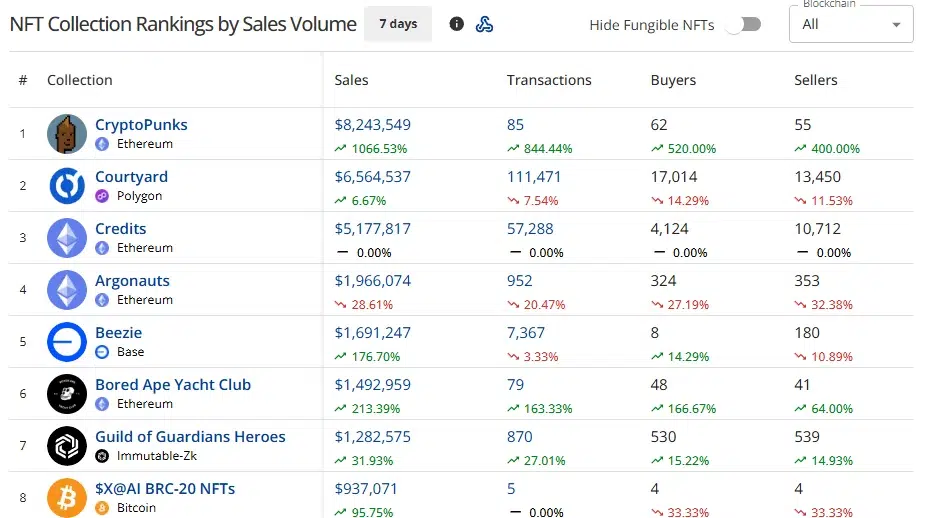
Courtyard, on Polygon, ranked second with $6.56 million in sales, up 6.67%. Its 111,471 transactions were down 7.54%, and its 17,014 buyer addresses declined 14.29%. The collection’s sales increase therefore came alongside fewer recorded transactions and buyer addresses.
Credits, an Ethereum collection, placed third at $5.18 million. CryptoSlam showed no week-over-week change in its displayed sales, 57,288 transactions or 4,124 buyer addresses. Another Ethereum collection, Argonauts, followed with $1.97 million in sales, down 28.61%, across 952 transactions.
Base-based Beezie ranked fifth with $1.69 million in sales, up 176.70%, across 7,367 transactions and eight buyer addresses. Its $1 million sale of Beezie #4365 represented about 59% of the collection’s weekly sales. That concentration makes the collection’s increase a poor measure of trading across all its items.
Bored Ape Yacht Club placed sixth with $1.49 million in sales, up 213.39%, from 79 transactions and 48 buyer addresses. Immutable-based Guild of Guardians Heroes ranked seventh with $1.28 million, up 31.93%, from 870 transactions and 530 buyer addresses.
Beezie leads high-value NFT sales with $1 million trade
CryptoSlam listed Beezie #4365 as the largest individual sale at $1 million, settled in 1 million USDC on Base about three days before the dashboard capture. The transaction alone represented roughly 1.8% of global seven-day NFT sales.
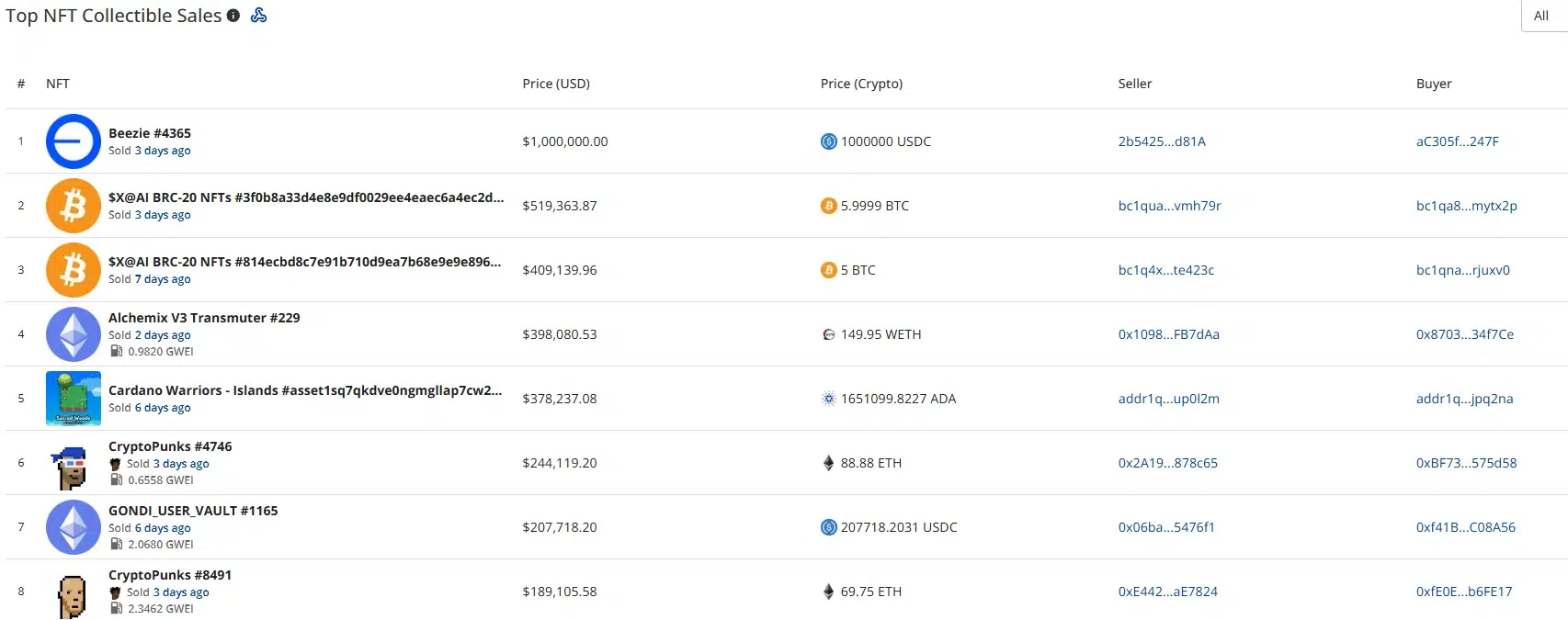
The next two listed sales came from $X@AI BRC-20 NFTs on Bitcoin. One sold for approximately $519,364, or 5.9999 BTC, about three days before the capture. Another sold for approximately $409,140, or 5 BTC, about seven days before it. Together, the two transactions accounted for about $928,504 of Bitcoin’s $5.13 million weekly NFT sales.
Alchemix V3 Transmuter #229 ranked fourth at approximately $398,081, settled in 149.95 WETH on Ethereum about two days before the capture.
The fifth-largest listed sale was Cardano Warriors – Islands #asset1sq7qkdve0ngmgllap7cw2… at approximately $378,237, settled in 1,651,099.8227 ADA on Cardano about six days before the capture. These five transactions totaled about $2.70 million, or roughly 4.9% of CryptoSlam’s global seven-day sales figure.

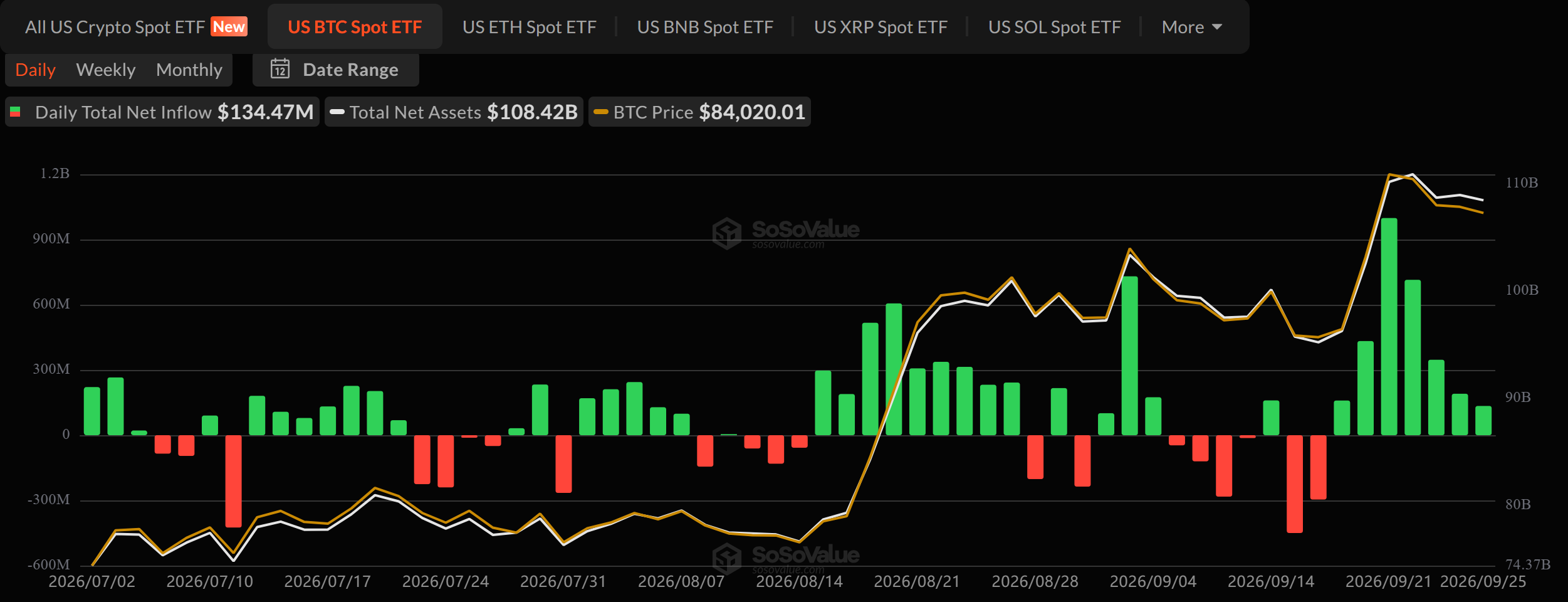
U.S. spot Bitcoin ETFs (exchange-traded funds) drew $2.39 billion in net inflows this week, the largest weekly total of 2026.
These funds trade on the stock market like ordinary shares and hold real Bitcoin for investors. Yet the daily flow data and on-chain research point to thinner buying than the weekly record suggests.
Bitcoin ETF Inflows Hit a Record, Then Slowed Every Day
The week opened with $998.95 million on September 21, according to SoSoValue. Inflows then fell each session, reaching $134.47 million on Friday. That is about 87% below Monday, though money still came in for a seventh straight day.

Monday’s surge followed a 6.7% jump in Bitcoin on its heaviest volume since August 21. About $262 million in bets against Bitcoin were forcibly closed within an hour, which pushes those traders to buy.
Funds had returned after the Federal Reserve’s September 16 hike to a 3.75% to 4% range.
The mood shifted on September 23. S&P Global’s business survey showed the fastest U.S. growth since July 2021, and the 10-year Treasury yield rose above 5%. Bitcoin fell below $84,000 within an hour, and BeInCrypto flagged the next day that ETF buying had shrunk three sessions running.
Bitcoin now trades near $84,241, down 0.06% in 24 hours, per BeInCrypto Markets. ETFs hold $108.42 billion in total assets.

Signs That Bitcoin Buyers Are Still Active
Other data backs the case for demand. About $2.52 billion in net BTC left major exchanges between September 22 and 24, according to CryptoQuant. Coins leaving trading platforms usually move into long-term storage.
Large holders are also adding. Wallets holding 100 to 1,000 BTC have bought 113,950 BTC since July 15, Santiment data shows.
Moreover, long-term holders have added more than 3 million BTC since 2020, according to River, a Bitcoin financial services firm.
Why River Says Supply, Not Demand, Is Driving the Rally
River reads the same market differently. Its data shows 81% of Bitcoin’s supply, or 16.3 million BTC, has not moved in at least six months. Exchange trading volume sits 30% below where it began the year.
ETFs had also bought only about 18,000 BTC in September as of River’s September 23 report. That pace trails their monthly average since launch.
“Bitcoin has risen 50% without a real increase in demand,” the team wrote.
In River’s view, fewer coins changing hands has lifted the price more than fresh buyers have.
The next test arrives September 30 with August’s personal consumption expenditures (PCE) inflation report, the Fed’s preferred price gauge.
Economists expect a measurement change in that report to pull inflation lower. River cautions that nobody can predict when demand will return.
The post Bitcoin ETFs Pull In a Record $2.39 Billion: Is There Real Demand Behind It? appeared first on BeInCrypto.

SEC staff has clarified when staking receipt tokens may be treated as digital tools rather than securities under U.S. law, alongside new answers on wrapped assets, token buybacks, and functional crypto networks.
Summary
- A staking receipt for a digital commodity can qualify as a digital tool under the conditions described by SEC staff.
- A receipt issued by a protocol-based liquid staking provider may instead qualify as a digital commodity.
- Staff said token buybacks on functional networks do not, by themselves, amount to promises of essential managerial work.
- The answers are staff views and create no new legal obligations.
The Securities and Exchange Commission’s Division of Corporation Finance issued the FAQs on Sep. 25 to explain parts of the agency’s March interpretation of federal securities law. The answers describe how the staff would classify certain tokens and assess an issuer’s promises to buyers; they are neither a new rule nor a Commission decision.
For staking receipts, the staff focused on what the token gives its holder. If it serves as proof of ownership of an underlying digital commodity that is not subject to an investment contract, the receipt is a digital tool under the circumstances set out in the March interpretation.
A receipt issued by a protocol-based liquid staking provider may also be classified as a digital commodity when its value is linked to the operation of a functional crypto system and market supply and demand.
When SEC staff treats a staking token as a receipt
In the FAQs, staff described a receipt as proof that a stated amount of an asset has been deposited while the holder retains ownership. It does not change the rights or benefits attached to the deposited asset, or give the holder an added financial benefit.
The issuer of a receipt also cannot use the deposited asset as its own. According to the staff, the issuer cannot transfer, lend, pledge, or otherwise put the asset to use, and the asset cannot become subject to claims by the issuer’s creditors. The explanation applies to the receipt concept used for both staking tokens and redeemable wrapped tokens in the March interpretation.
Although a holder may receive rewards earned on the underlying staked asset, the receipt token itself does not create that entitlement or set the reward amount, the SEC staff said. The distinction turns on the token’s actual rights and the way the underlying asset is held, rather than its name alone.
The agency had addressed a related activity in August 2025. As previously covered by crypto.news, its Corporation Finance staff said certain liquid staking arrangements did not involve the offer or sale of securities when users received tokens documenting ownership of staked assets. The Sep. 25 answers add detail on how those receipts fit into the token categories established by the later interpretation.
How a functional network changes the analysis
The FAQs also address a token that was previously sold as part of an investment contract. In that setting, staff looks at whether buyers can still reasonably expect an issuer to carry out the essential managerial work it promised, rather than assuming the token keeps the same legal treatment indefinitely.
After a crypto system becomes functional, work to secure, maintain, or improve it does not necessarily count as essential managerial work, according to the staff. Its answer includes software upgrades, funding development projects and efforts to help network use grow. An issuer’s promise to continue those services after functionality, on its own, would not satisfy the cited part of the Howey test, staff said.
Functionality depends in part on the promise being assessed. The staff said each issuer’s own description determines whether it has delivered the functionality or decentralization it promised buyers. The definitions in the March interpretation still govern how the SEC classifies a crypto asset, but they do not replace the terms of an issuer’s earlier representations when assessing whether its promised work has been completed.
In March, the SEC and CFTC set out a token framework that distinguished a non-security crypto asset from an investment contract associated with its sale. The interpretation also addressed staking and wrapped assets. The new staff answers deal with narrower questions raised by that framework, including what happens when responsibility for promised work changes hands.
If another party takes over an issuer’s promise to perform essential managerial work, the asset does not separate from the investment contract merely because the party responsible has changed, staff said. By comparison, once a functional network has no central party able to control its success or failure, statements by its original issuer about the network would be unlikely to create a new investment contract, according to the FAQs.
Why token buybacks and marketing remain case-specific
A buyback announcement receives different treatment depending on the network’s state and the issuer’s claims. For a functional crypto system, staff said an issuer’s announcement that it will buy back a non-security token does not amount to a promise to perform essential managerial work. Before a system is functional, however, a buyback could matter if the issuer presents it as a way to produce yield or returns for holders.
The distinction is relevant to an August SEC proposal on crypto offerings, which included a conditional path for an asset to cease being subject to an investment contract once an issuer permanently completed or stopped the essential managerial work it had promised. The proposal described possible rules for qualifying offerings; the Sep. 25 FAQs instead state the Corporation Finance staff’s answers under existing interpretations.
Staff also drew a line between describing a network’s uses and promising work that buyers may expect to produce profits. Promoting functions a system already has would generally not, on its own, be a promise of essential managerial efforts. Broad statements about possible future features would likewise be less likely to count when they make no claim about potential profit. The staff said the result depends on the facts of the communication.
For U.S. trading platforms, listing a token in a secondary market does not automatically make the platform its promoter. The FAQs say a platform would have to meet the existing definition of “promoter” in Securities Act Rule 405 for that label to apply. The SEC said the staff answers have no legal force, do not change federal securities law, and have not been approved or disapproved by the Commission.

Crypto and blockchain companies announced more than $104.2 million across eight disclosed financings from Sep. 19 to Sep. 25, 2026.
Summary
- Eight disclosed transactions brought in more than $104.2 million, including $25 million from a public stock offering.
- HIFI raised $37 million in a Series A led by Left Lane Capital.
- Forward Industries completed a $25 million registered direct offering for its Solana treasury strategy.
- Atum launched with $13.5 million from investors including Variant and PayPal Ventures.
- Stablecoin payments accounted for several of the largest private financings.
HIFI’s $37 million Series A was the largest venture round. The total also includes Forward Industries’ $25 million registered direct stock offering, which is public-company financing rather than venture capital.
Atum’s $13.5 million raise and MeshWallet’s $10 million private round put payment infrastructure among the week’s largest deals. The total is a floor because infiniFi described its new round as more than $3 million. Two other tracked investments had no disclosed amount.
The inventory draws on DropsTab’s funding table and DefiLlama’s raises database, with material deals checked against company announcements, filings, and crypto.news coverage. The total counts new financing announced during the reporting period. It excludes acquisitions, older rounds, and valuations.
HIFI raises $37 million for stablecoin infrastructure
HIFI announced a $37 million Series A on Sep. 24, led by Left Lane Capital. The company said the funding will support its stablecoin settlement platform and expansion into card issuance and tokenized capital markets. HIFI also plans to add staff and deepen its regulatory coverage.
The New York company offers payment infrastructure that connects stablecoins with conventional financial services. Its announcement cites a Visa Direct integration for payouts and a connection to the Circle Payments Network. HIFI said its platform processes more than $7 billion in annualized volume, a business measure separate from the amount raised.
Forward Industries completes $25 million stock offering
Forward Industries completed a $25 million registered direct offering to an institutional investor. Its SEC filing says the company sold 3,125,000 common shares for approximately $25 million in gross proceeds before fees and expenses. The filing does not name the buyer.
Forward said the financing is intended to expand its SOL treasury. The U.S. public company holds and stakes Solana as part of a digital-asset strategy it began in 2025. Its share sale is included in the overall financing total but is separate from the private venture rounds.
Atum launches with $13.5 million for payments network
Atum announced $13.5 million in funding as it emerged from stealth on Sep. 22. Its investors include Variant, PayPal Ventures, Abstract Ventures, Road Capital, Mirana Ventures, First Commit and Credibly Neutral.
The company is building a network to coordinate transfers across stablecoins, blockchains and other payment systems. Atum says it does not issue a currency or take custody of customer funds. It is targeting financial institutions and stablecoin card issuers. The announcement disclosed the amount and investors but did not give the financing a seed or Series A label.
MeshWallet secures $10 million for USDT wallet
TRON-based MeshWallet raised $10 million in a private round backed by private investors and small family offices. The Tallinn-based company said it will use the money to develop its self-custodial wallet and add services for retail and business users.
MeshWallet’s product lets users send TRC-20 USDT without keeping a separate TRX balance for network fees. The company did not identify an individual lead investor in the crypto.news report. Its round, together with HIFI’s and Atum’s, brought disclosed payment-related financing to $60.5 million for the week.
Funding from $6 million to $8 million
- CatchBack — $8 million seed: Foundation Capital led the collectibles marketplace’s round, with Y Combinator, Robinhood Ventures, Coinbase Ventures and the Solana Foundation participating, according to RootData. CatchBack links digital mystery packs to physical trading cards that users can trade or redeem.
- Infini — $6 million seed: The company announced the close of its round on Sep. 22. Its platform uses stablecoin settlement for accounts, payments, cards, and treasury services. DefiLlama lists Reforge, Enlight Capital, Fortwest Capital, NexGen Capital, SNZ Capital and Vernal Capital among the investors.
Funding below $5 million
- infiniFi — more than $3 million: Electric Capital led the DeFi protocol’s latest round, with New Form Capital, Generative Ventures, Fasanara Capital and others participating. The company said the financing brings its total outside funding across earlier and current rounds to more than $6 million. Only the newly announced amount is counted this week.
- functionSPACE — $1.7 million pre-seed: Maven 11 Capital led the round for an onchain pricing protocol, with Blockwall and Smape Capital participating, according to CryptoRank. DropsTab dates the round to Sep. 24.
Undisclosed strategic and seed rounds
- XStable — undisclosed investment: DefiLlama lists YZi Labs, the Sui Foundation, Taisu Ventures and CatcherVC as backers of the project, which is building onchain trading infrastructure for precious metals and foreign-exchange markets. The amount is excluded from the weekly total.
- Travix — undisclosed seed round: DefiLlama lists Amber Group as lead investor in the onchain perpetuals project. The database dates the entry to Sep. 21 and gives no amount.
Large XRP holders accumulated 470 million tokens worth $724 million in five days, while spot ETFs extended their inflow streak.
The combination of whale demand and institutional buying puts XRP price $1.60 resistance level firmly back in focus.
XRP Whale Accumulation Signals Stronger Demand
On-chain data cited by analyst Ali Martinez shows whale balances rising from approximately 12.37 billion to 12.80 billion XRP. The increase represents more than 470 million tokens, worth roughly $724 million at recent prices.
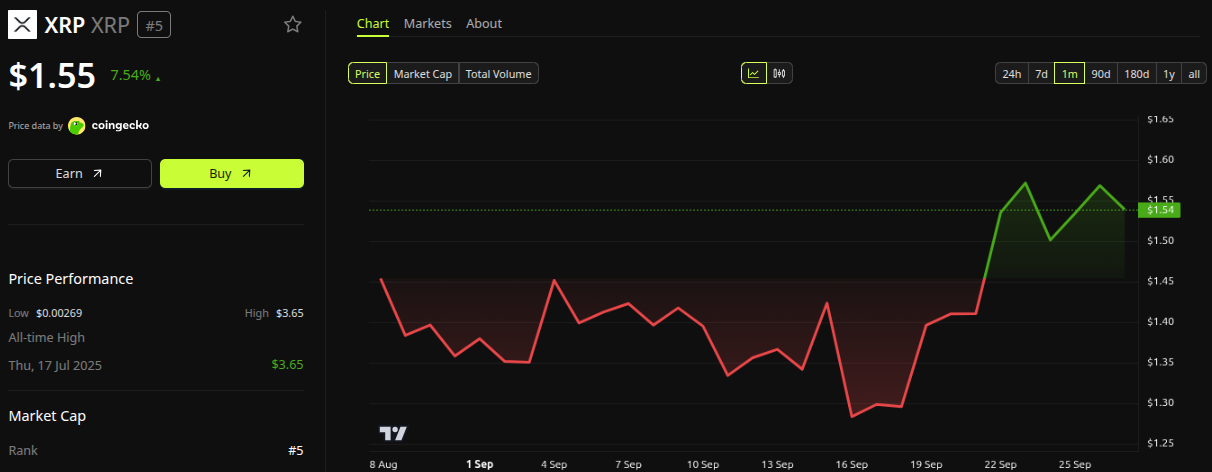
XRP trades around $1.55, according to BeInCrypto data. The token has rebounded approximately 28% from the $1.25 area. It recently reached a local high near $1.58.
That recovery has developed alongside an inverse head-and-shoulders structure on XRP daily chart. Its neckline sits close to $1.60.

A confirmed move above that level could activate a measured target near $2. That would represent roughly 30% upside from current levels. Conversely, a rejection could expose XRP price to initial support around $1.53, followed by $1.50. A deeper correction could bring $1.46 and $1.32 into focus.
Technical analysts have also identified an RSI setup that preceded strong advances in the past. However, confirmation requires the indicator to reclaim its key moving average.
Can ETF Demand Help XRP Price Break $1.60?
Institutional demand has provided another source of support through United States spot XRP ETFs. SoSoValue data shows continued positive weekly flows.
The products attracted $75.59 million during the week ending September 25. Cumulative net inflows reached $1.79 billion. Total net assets stood near $1.77 billion, while the funds recorded their 11th consecutive week of net inflows.
The streak began with the week of July 17 and continued through September 25. Several individual weeks also delivered substantial contributions.

Bitwise’s XRP ETF has remained a key driver of recent activity. On September 18, the firm filed a post-effective amendment to its registration statement.
The filing updated prospectus disclosures and incorporated recent financial reports. Meanwhile, XRP price repeatedly tested resistance around $1.60 after recovering from approximately $1.40.
The key question now centers on whether whale accumulation and institutional flows can reinforce one another. A sustained break above $1.60 would provide technical confirmation.
The post XRP Whales Bought $742 Million This Week. How Will Price React? appeared first on BeInCrypto.
Investors were rattled this week as the benchmark 10-year Treasury yield soared to its highest level since 2007, but sticky inflation is just one of the factors behind this latest surge.
The key 10-year Treasury yield, which influences mortgages, leapt to 5.23% on Friday for its highest level since 2007. It was the latest leg higher for the benchmark yield, which earlier this month was trading just below 4.8%. Bond yields and prices move inversely to one another.
The 10-year yield’s rapid climb above 5% shows how quickly investors’ expectations have shifted toward additional tightening from the Federal Reserve in light of stubborn inflation. Fed funds futures trading shows a 64% likelihood of a rate hike in October, according to the CME FedWatch tool.
Indeed, the University of Michigan’s consumer sentiment index showed that year-ahead inflation expectations leapt to 4.6% in September, rising from 4% in August and marking the highest reading since June.
When it comes to the runup in yields, stubborn inflation and the market’s growing anticipation for more rate hikes only tell part of the story, according to Thierry Wizman, global FX and rates strategist at Macquarie Group.
“I think this year it has more to do with the bond issuance than the inflation story,” he told CNBC.
Wizman said yields at these levels are not themselves unusual, particularly because they are not being accompanied by extreme inflation expectations or an aggressively tightening Fed.
“We don’t have a Federal Reserve that’s tightening aggressively, so a lot of things look pretty normal. The thing that’s abnormal is that we’re in the midst of a very strong investment cycle,” he said.
Heavy bond issuance
The federal government is issuing debt to finance a large deficit, while companies are borrowing heavily to fund artificial intelligence infrastructure.
Wizman said it is that combination that has increased bond supply enough to put upward pressure on yields.
The AI spending boom is adding another source of bond supply to compete with Treasuries.
Vanguard estimates that Alphabet, Amazon, Meta Platforms, Microsoft and Oracle issued about $132 billion of debt through July, up sharply from the roughly $35 billion annual average between 2020 and 2024. Broader AI-related debt issuance could reach $300 billion to $570 billion this year as companies across the data-center, semiconductor and utility ecosystem borrow to finance the buildout.
At the same time, higher yields can weigh down stocks by raising borrowing costs for companies and making bonds seem more attractive to income-seeking investors.
Wizman said the capital-spending plans of hyperscalers and their suppliers are likely to keep bond issuance elevated through this year and into next year.
“So these yields could go higher,” he said.
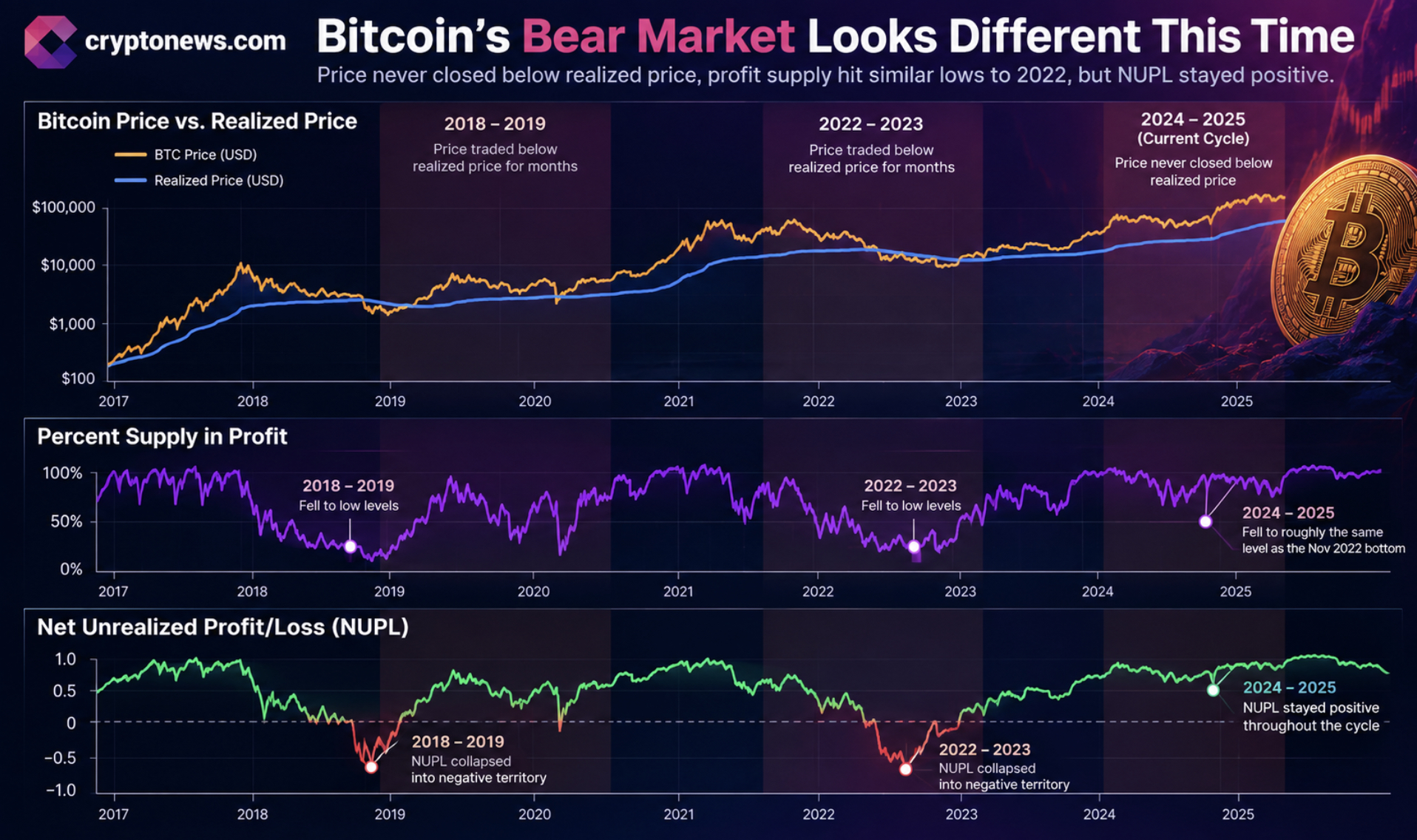
Bitcoin never posted a daily close below its realized price during the current bear market, and the June 2026 low held above that aggregate cost basis. If price holds above the True Market Mean near $77,000, the June low becomes the shallowest bear-market bottom in Glassnode’s comparison set stretching back to 2017.
Bitcoin’s current bear-market phase has looked ugly on a headline-percentage basis at times this year, but the realized-price metric measures something narrower: whether the average holder, in aggregate, was ever underwater. In the 2018–19 and 2022–23 cycles, Bitcoin price traded below the realized price for months at a stretch. This time, it didn’t happen once on a closing basis.
Glassnode’s data shows that the Percent Supply in Profit fell to roughly the same level at the June low as at the November 2022 bottom; a comparable share of coins was sitting at a loss. The difference is in magnitude. Net Unrealized Profit/Loss, or NUPL, which tracks the aggregate paper gain or loss across the entire supply, stayed positive throughout the cycle. In 2018 and 2022, NUPL collapsed deep into negative territory as the market flipped into aggregate loss.
Smaller losses generally translate into less structural pressure to sell, which helps explain why this drawdown didn’t produce the kind of forced capitulation seen in prior cycles. It doesn’t mean downside risk is off the table. It means the aggregate cost-basis damage has been narrower this time, a pattern consistent with the on-chain accumulation signals that have shown up alongside this recovery.
Earn $50 and Enter $300K Prize Draw on EdgeX
The Levels That Decide the Thesis
Price now trades above the True Market Mean near $77,000 and above the Short-Term Holder Cost Basis, both of which capped rallies for most of 2026. The largest nearby long-term-holder supply cluster sits at $84,000–$85,000, just above the current price.
The next major resistance at the mean MVRV price of $96,700. This is the level where the average holder’s unrealized profit returns to its long-run norm.
Options positioning on Deribit reinforces the upper boundary. Positive gamma has built up sharply near $95,000, while negative gamma sits between spot and $92,000. This can be read that dealer hedging tends to accelerate moves in that lower band and slow them once the price approaches the mean MVRV zone.
Holding above $84,000 keeps the path to $96,700 open; a drop back below it puts $77,000 back in play, and a break of that level would undercut the shallow-bear-market read entirely.
Trade Bitcoin on Bybit and Get a Chance to Win Our $1,000 USDT Airdrop
Bitcoin Price, ETF Flows, and Volume
U.S. spot Bitcoin ETFs took in approximately $1.3 billion over the five trading days since the current squeeze began, following two weeks of net outflows, with the most recent day marking the largest single inflow since early July, per Glassnode.
It was a meaningful reversal after a stretch where flows had weakened, and it lines up with an institutional bid that didn’t exist during the 2018 or 2022 downturns, a structural difference worth weighing against any Federal Reserve policy shifts that could swing that flow in either direction.
Spot volume across exchanges more than doubled off its August trough, up 121% since the rally began. Every prior volume expansion from late 2025 through mid-2026 came on a leg down, marking capitulatory selling. August broke that pattern as the first spike in a year to coincide with rising Bitcoin price.

The seven-day average still sits roughly 30% below year-ago levels, so this reads as recovery off a floor rather than a full return to 2025 conditions.
Weekly realized profit-taking during this run remains a fraction of what it was at the 2024 and 2025 tops, even though almost all short-term holders are now sitting in profit. That’s the bullish read: holders aren’t rushing to lock in gains despite the setup.
A rise toward those 2024–2025 realized-profit levels would flag that recent buyers are converting the rally into exit liquidity, which is the first sign the thesis is weakening.
This cycle’s low was the mildest since 2017, as realized-price impairment falls apart, and the market reverts to a more conventional test of support.
Discover: Best Crypto IPO this September
The post Bitcoin Price Never Closed Below Expectation in 2026 Bear Market appeared first on Cryptonews.
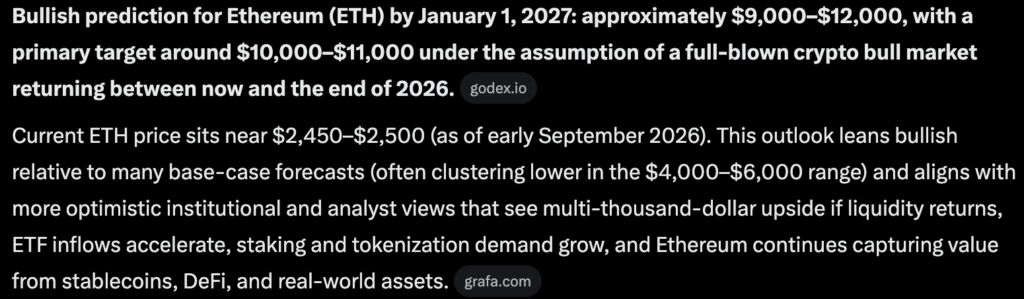
When prompted, the Elon Musk-backed Grok AI predicts a bold move for Ethereum (ETH) over the remainder of 2026. It claims that if a full-blown crypto market returns in Q4, ETH could hit $12,000 by January 1, 2027.
ETH is currently trading near $2,600–$2,725. This outlook leans bullish relative to many base-case forecasts, which often cluster lower in the $4,000–$6,000 range.
This aligns with more optimistic institutional and analyst views that see multi-thousand-dollar upside if liquidity returns, ETF inflows accelerate, demand for staking and tokenization grows, and Ethereum continues to capture value from stablecoins, DeFi, and real-world assets.
The core premise is a return to strong risk-on conditions in late 2026, fueled by improving macro liquidity, sustained institutional demand, and Ethereum’s role as settlement infrastructure.
Historical patterns suggest ETH could rise from around $2,500 to its previous all-time high of ~$4,800–$5,000, potentially reaching the $10k+ zone by early 2027.
While this is not guaranteed due to crypto’s volatility, a bullish scenario suggests ETH might trade between $9,000–$12,000 by January 1, 2027, with $10,000–$11,000 as a central target.
Claude AI Opus 5 Predicts ETH to Hit $12K: Does the Technical Analysis Agree?

On higher timeframes, ETH has been consolidating after a significant drawdown from 2025 highs, holding above key demand zones in the $2,500–$2,700 region while testing near-term resistance around $2,720.
A sustained break and weekly close above the $2,700–$2,800 area (with volume confirmation) would flip the intermediate structure bullish, opening measured-move and Fibonacci extension targets toward the prior cycle high near $4,800–$5,000.
In a full bull-market environment, that reclaim often acts as a launchpad; subsequent continuation could target the 1.618–2.0 extension zones from the multi-year base, which project into the $8,000–$12,000 range.
Momentum indicators (such as a rising RSI from neutral/oversold territory on the weekly chart and positive divergence on longer timeframes) would reinforce the upside once the downtrend structure breaks.
Key supports to hold on any retests would be the $2,300–$2,500 demand zone and the rising 200-week moving average region; losing either would invalidate the near-term bullish path.
Overall, the chart setup favors a multi-leg advance if risk appetite returns, consistent with historical post-consolidation breakouts in prior Ethereum bull cycles.
Supercharge Your Trading in 2026 With BloFin AI Trading Bots
Bitcoin Hyper Targets Early Mover Upside as Ethereum Tests Key Levels
A +4% weekly gain feels good if already positioned. For anyone buying Ethereum fresh over $2,500, the math is less exciting. A move to $12,000 from here is around +400% upside, solid, but not the kind of asymmetric return that built early crypto fortunes.
Now, the same reasoning pushed capital toward earlier-stage infrastructure plays, and Bitcoin’s own scaling limitations (still slow, still expensive for anything beyond simple transfers) are exactly the gap projects like Bitcoin Hyper are built to fill.
The city sleeps. $HYPER stays charged. — Bitcoin Hyper (@BTC_Hyper2) September 22, 2026
 pic.twitter.com/LKBUzZLH39
Bitcoin Hyper ($HYPER) is positioning as the first Bitcoin Layer 2 with native SVM integration, aiming for execution speeds faster than Solana while settling back to Bitcoin’s base layer.
The presale has raised more than $33.1M at a current token price of $0.0136867, with staking APY available for early participants.
Its decentralized canonical bridge handles BTC transfers without custodial intermediaries, and traders can research Bitcoin Hyper directly on the presale page.
Gain Access to New Bitcoin Layer 2 Early Here Earn $50 and Enter $300K Prize Draw on EdgeX
The post Elon Musk Grok AI Predicts a Bold Move for Ethereum in 2026 appeared first on Cryptonews.

Dan Morehead, founder and CEO of Pantera Capital, told CNBC News that Ripple is going after the cross-border payments turf long dominated by SWIFT, reviving a comparison that has trailed XRP for years without ever being tested at institutional scale. The remark says more about how a prominent crypto investor frames competitive positioning in payments than about how much of Ripple’s actual settlement volume runs through the XRP token itself.
$XRP "Ripple is going after Swift" — XRP_Cro
– Dan Morehead, the founder of Pantera Capital pic.twitter.com/gOt5YXgGF3
 AI / Gaming / DePIN (@stedas) September 17, 2025
Morehead made the comment during a Squawk Box segment that also touched on Solana’s transaction throughput and Bitcoin’s role as digital gold. He described Ripple’s SWIFT ambition as one of several major blockchain use cases shaping the industry, not as an imminent takeover of the network banks rely on for cross-border messaging.
SWIFT, the Society for Worldwide Interbank Financial Telecommunication, functions as the dominant messaging system connecting financial institutions across borders, it coordinates payment instructions between banks. Ripple has spent years building infrastructure aimed at offering faster, cheaper settlement as an alternative to the correspondent-banking chain.
Earn $50 and Enter $300K Prize Draw on EdgeX
Per Ripple’s own cross-border payments page, its platform supports RLUSD, USDC, USDT, or fiat, “whichever asset your business requires,” and the company states its settlement layer is decoupled from any single issuer’s token. That is a direct architectural admission that XRP is one option among several in the payment flow.
Ripple’s site also reports payout access across more than 60 markets and cumulative processed volume above $100 billion. Those are company-reported figures, and they say nothing about what share of that volume actually settled in XRP versus stablecoins or fiat rails. The gap between enterprise-scale numbers and token-specific usage is exactly where the SWIFT comparison breaks down.
Trade XRP on Bybit and Get a Chance to Win Our $1,000 USDT Airdrop
News on Enterprise Progress vs. XRP Demand
This gap has shadowed Ripple since the SEC filed its lawsuit against the company in December 2020, alleging XRP constituted an unregistered security. Ripple secured a partial win in 2023 when a federal judge ruled that XRP was not a security when sold to retail investors on public exchanges, though the broader regulatory picture around institutional sales remained unresolved.
Throughout that fight, Ripple kept expanding its payments network and partner list. This is a track record investors have repeatedly treated as a signal for XRP’s price, even when the two move independently.

That habit of reading corporate wins as token catalysts shows up elsewhere in Ripple’s current push. Reports on Ripple’s AI-payments integration with Stripe generated similar optimism without settling how much of that flow touches XRP specifically, and the question of whether payment-network growth translates into token demand isn’t unique to Ripple.
Ripple’s own materials, including its explainer on how it utilizes XRP in cross-border payments, describe a hybrid model where digital assets act as bridge currencies alongside stablecoins and fiat conversion, useful for reducing pre-funding requirements, but not proof that XRP carries the majority of the flow.
Morehead’s recognition of Ripple’s SWIFT ambition is real institutional validation of the company’s strategy. It is not a substitute for Ripple disclosing what fraction of its payment volume actually settles in the token, and until that number surfaces, the SWIFT comparison remains a narrative rather than a measured outcome.
Discover: The Best Token Presales
The post XRP News: Ripple Takes Aim at SWIFT, Pantera CEO Says appeared first on Cryptonews.
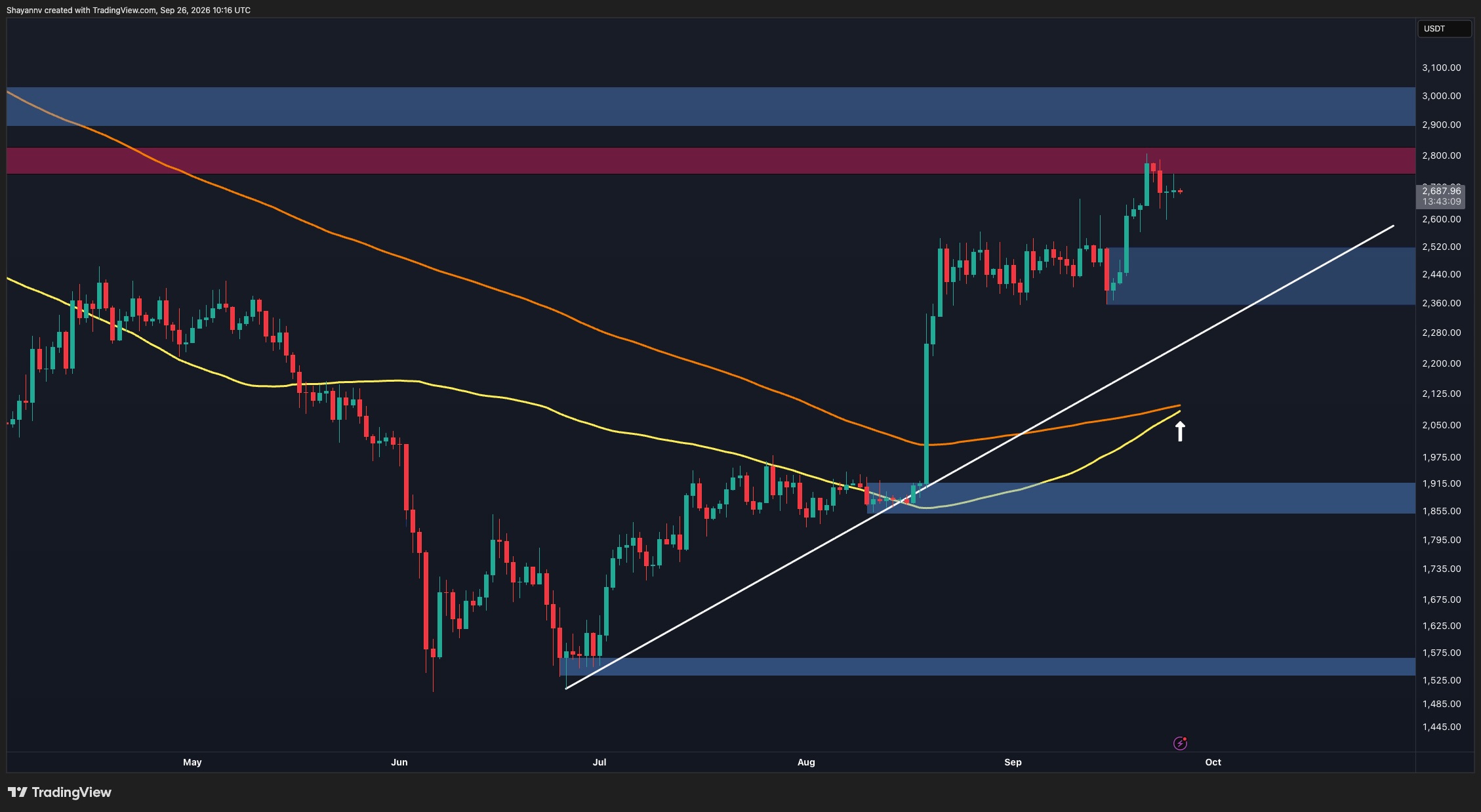
Ethereum remains in a constructive broader structure despite cooling off after its latest rally. ETH is consolidating below $2.7K after rejection from the $2.75K-$2.82K resistance zone, while the daily moving averages are approaching a potentially important bullish crossover.
ETH Price Analysis: The Daily Chart
On the daily timeframe, Ethereum’s structure remains bullish following the explosive breakout from the $1.85K-$1.92K demand zone in August. Since then, the market has established a sequence of higher lows, with the ascending trendline continuing to provide structural support.
The latest rally pushed ETH directly into the major $2.75K-$2.82K resistance zone, where selling pressure emerged and prevented an immediate breakout. The asset has since stabilized around $2.69K rather than undergoing a correction, suggesting buyers are still maintaining control of the broader structure.
Another notable development is the convergence of the two displayed moving averages. The faster yellow average is rising sharply toward the slower orange average around the $2.05K-$2.10K region. If the faster average crosses above the slower one, it would form a golden cross and provide further technical confirmation that the medium-term trend has shifted in favor of buyers. However, the crossover has not occurred yet and therefore remains a potential signal rather than a confirmed one.
A daily breakout above the $2.75K-$2.82K resistance zone could open the door toward the next major supply area around $2.90K-$3K. Meanwhile, the $2.36K-$2.52K zone, reinforced by the rising trendline, represents the key support area if a deeper pullback develops.
ETH/USDT 4-Hour Chart
The 4-hour chart shows ETH compressing immediately beneath the $2.75K-$2.82K resistance area. Following the rejection from roughly $2.8K, the price briefly dipped toward $2.63K before recovering and entering a tight consolidation around $2.68K-$2.70K.
At the same time, the rising trendline connecting the recent higher lows is gradually approaching price. This creates a tightening structure between ascending support and the overhead resistance zone. As long as ETH remains above this trendline, short-term momentum appears constructive, and another challenge of $2.75K-$2.82K remains plausible.
A confirmed breakout above $2.82K would strengthen the continuation scenario toward the $2.90K-$3K resistance zone. Conversely, losing the ascending trendline could trigger a deeper correction, initially putting the $2.43K-$2.49K demand zone back into focus. Below there, the larger $2.21K-$2.28K support area would become relevant.

Sentiment Analysis
The one-week Binance ETH/USDT liquidation heatmap shows significant concentrations of leveraged positions on both sides of the current price, although the most prominent nearby liquidity is above the market.
A particularly dense liquidation cluster has developed around $2.78K-$2.82K, closely overlapping with the technical resistance visible on both price charts. This makes the area especially important. If ETH manages to break above resistance, the liquidation concentration could act as a magnet and potentially amplify the move as short positions are forced out.
On the downside, another substantial liquidity pool is visible around $2.60K-$2.62K. Therefore, failure to break higher and a loss of short-term support could draw the price toward this region first.
Overall, Ethereum is effectively caught between downside liquidity near $2.6K and a larger overhead cluster around $2.8K. Combined with the tightening 4-hour structure and the potential daily golden cross, a decisive break from the current consolidation could lead to a notable expansion in volatility.

The post Ethereum Price Analysis: ETH Eyes $3K, but These Major Hurdles Stand in the Way appeared first on CryptoPotato.
Circle and Tether, the companies behind dollar-linked tokens USDC and USDT, have already frozen about $320,000 in stablecoins connected to the breach. Their tokens contain controls that allow the companies to blacklist addresses.
Read More: Circle and Tether step in to freeze hacker wallet after massive Bitget crypto heist
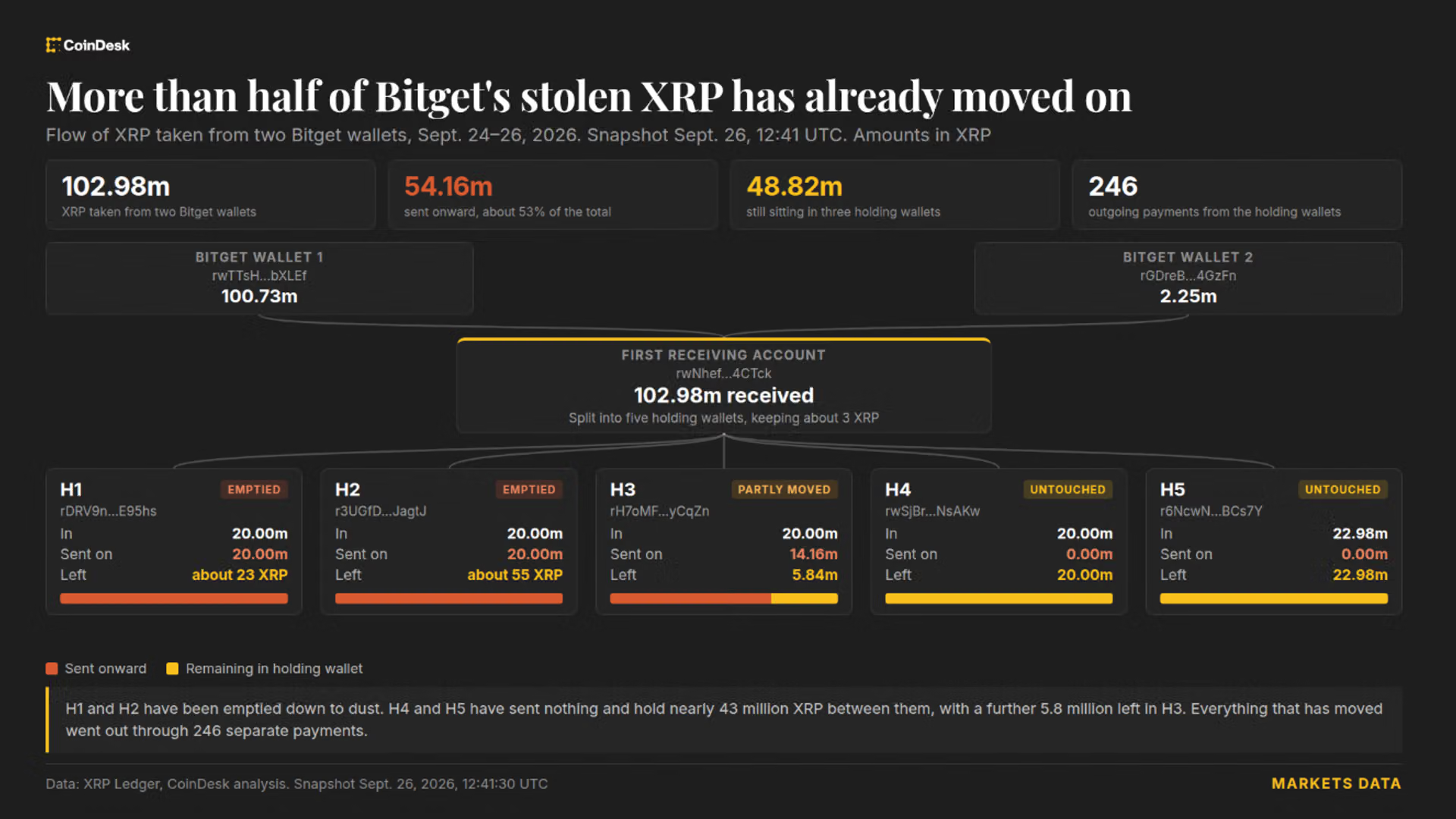
The XRP transfers accelerated overnight. At 04:32 UTC Saturday, about 70 million tokens remained in the original five accounts. Roughly eight hours later, that balance had fallen to 49 million.
Some payments followed routes already used by the first wallet. After an attempted transfer of about 521,000 XRP failed because that account lacked sufficient funds, the second sent an identical amount to the intended recipient roughly an hour later.
About 54 million XRP has now left the original holding accounts. The transfers show the attacker distributing the stolen funds across more wallets, although they do not reveal how much has been sold.
XRP traded around $1.54 on Saturday, down about 4% over 24 hours while retaining a weekly gain of about 9%, according to CoinGecko.
At that price, the original XRP haul was worth roughly $160 million, or equivalent to about 4% of the token’s $4.4 billion in reported daily trading volume. How much a sale would move the price depends on the buy orders available when it happens.

Microsoft wants Copilot to become an “OS” that writes your documents and manages your work

Frantic search for man who vanished in early hours of morning in Dunfermline

The ecstasy of buying our first home was short-lived after we found 150 faults





-

 Crypto World4 days ago
Goldman Sachs and Deutsche Bank Agree: The S&P 500 Rally Isn't Over
-

 Tech6 days ago
Researchers escape OpenAI Codex sandbox to run commands on host
-

 Fashion2 days ago
8 iPhone Accessories That Add Personality
-

 Crypto World6 days ago
Who Needs CLARITY Anyway? ARB Could See 70X Increase: Hodler’s Digest
-

 Fashion1 day ago
Weekend Open Thread: J.McLaughlin – Corporette.com
-

 Entertainment4 days ago
These 17 Fall Amazon Dresses Seriously Look Like Anthropologie
-

 Business6 days ago
Analog Devices (ADI) Bets $1.35 Billion on Chips that Let Machines Think for Themselves
-

 Crypto World6 days ago
Coinbase, Robinhood, Circle Seen as Tokenized-Stock Winners
-

 Crypto World4 days ago
This Bearish Netflix Stock Trade Can Cash In On Video Streaming Giant’s Woes
-

 Tech5 days ago
Google’s $899 Googlebook is a bet that you’ll buy a new laptop for Gemini
-

 Crypto World4 days ago
Trump-Xi Polymarket Odds for Handshake Hit 50%
-

 Crypto World3 days ago
Crude Oil Prices Pressured by Diplomatic Hopes in the Middle East
-
 Crypto World3 days ago
Bitcoin price tests $83,600 Supertrend support after $87K rejection
-
 Business4 days ago
Oil Price Today (September 23): Crude oil below $100 on hopes of US-Iran talks. What did Trump say?
-

 Crypto World3 days ago
Bitcoin Threatens Sub-$84,000 Breakdown as Long Liquidations Spike
-
 Crypto World5 days ago
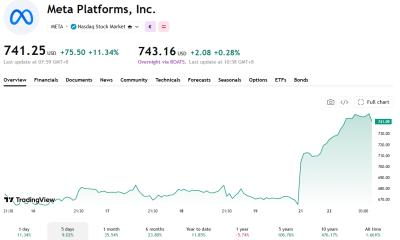
Meta Jumps 11% As Muse Shines and Investors Show an Appetite for Advancing AI
-

 Crypto World4 days ago
Did Jim Cramer Just Give GameStop Stock the Kiss of Death When He Said the Turnaround Is Working?
-

 Crypto World6 days ago
Bitcoin price holds above $81K as key catalysts line up
-

 Crypto World6 days ago
ARB Price Signals Spur Speculation of 70x Upside in Hodler Digest
-
 Crypto World5 days ago
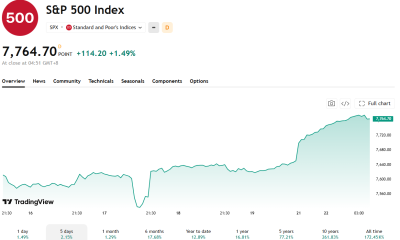
Trump, Xi Meet on S&P 500's Best Day Since Early August: Will Markets Stay Bullish?
You must be logged in to post a comment Login