
Crypto World
MicroStrategy Buys More Bitcoin, Up 75% From Last Week: Is the Buying Picking Up?

![MicroStrategy Bitcoin holdings chart showing 847,666 BTC, Source: Strategy]](https://wordupnews.com/wp-content/uploads/2026/09/a9c752ccc492482daf7f15df1b39143f.webp)
Strategy, formerly MicroStrategy, bought 1,666 Bitcoin (BTC) in its latest weekly purchase. The company now holds 847,666 BTC, more than any other public company.
Strategy is a Nasdaq-listed software firm that turned itself into a Bitcoin holding company. It reports its purchases to US regulators, usually on Mondays.
![MicroStrategy Bitcoin holdings chart showing 847,666 BTC, Source: Strategy]](https://assets.beincrypto.com/img/QtxBgLGUYXVc9E0iVnHdZz7QymA=/smart/a9c752ccc492482daf7f15df1b39143f)
MicroStrategy Bitcoin Buying Grows 75% From Last Week
The new purchase is about 75% larger than the previous one. Last Monday, Strategy disclosed a 950 BTC buy worth about $76 million, which took its holdings to 846,000 BTC.
Before that, the company ended a 10-week pause on August 31 with 4,603 BTC. The week in between showed no buying at all.
Bitcoin trades near $83,251, down 2.3% over 24 hours, according to BeInCrypto data. At that price, the 1,666 coins are worth roughly $138.7 million.
Saylor’s “Even More Orange” Post Came a Day Earlier
Executive Chairman Michael Saylor hinted at the buy on Sunday. He posted a chart of Strategy’s purchases, where each orange dot marks a buy, with the caption “Even more orange.”
BeInCrypto reported Saylor’s latest signal that evening and said Monday’s filing would confirm any new purchase. The week before, his “A little more orange” post also came a day before the 950 BTC buy.
Strategy’s buying has been uneven this year. Its ledger lists four sales between June 30 and August 10, totaling 6,916 BTC. Last week, it also spent $174 million buying back its own preferred shares, more than twice its Bitcoin spend.
As of last week, Strategy’s average cost stood at roughly $75,400 per coin. Today’s price sits about 10% above that level.
Next Monday’s filing will show whether this week’s larger buy marks a steadier pace or another one-off.
The post MicroStrategy Buys More Bitcoin, Up 75% From Last Week: Is the Buying Picking Up? appeared first on BeInCrypto.


Bitget CEO Gracy Chen said the crypto exchange’s recent $388 million exploit stemmed from a vulnerability in a third-party security product that allowed the attacker to obtain “high-level internal credentials.”
In comments to Cointelegraph, Chen said the attacker used those credentials to issue fraudulent withdrawal commands. Bitget’s private keys were not compromised, and its cold wallets were not affected, she said.
Bitget said it has since addressed the security flaw and tightened its withdrawal controls, including restricting internal access, adding independent verification for withdrawals and increasing monitoring for unusual activity.
The attack occurred on Sept. 24, when Bitget detected unauthorized transfers from several of its hot wallets and temporarily suspended withdrawals. The exchange initially estimated that about $352 million in assets had been affected.
Related: Bitget resumes Bitcoin withdrawals as hacker swaps ETH via THORChain
Bitget has yet to disclose recovery figures
The exchange has not disclosed how much of the stolen crypto has been recovered or frozen. Chen said some assets have been frozen with help from other industry participants, but Bitget would release a total only after verifying the amounts.
Bitget had previously called on THORChain, a protocol for swapping assets between blockchains, to refuse services to addresses linked to the attack.
The exchange said it is not asking THORChain to halt its network as it attempts to prevent the stolen assets from being moved. THORChain has said it cannot selectively blacklist individual addresses.
“We understand that THORChain operates as a decentralized protocol and has said that it cannot selectively blacklist individual addresses. We respect the technical constraints of different networks and are not asking any protocol to take actions that are not technically possible,” Chen said.
Chen also addressed Bitget’s earlier suspicion that North Korea may have been behind the attack.
“What was shared previously was based on preliminary indicators identified during the investigation,” Chen said.
“Those indicators are still being assessed. Mandiant and SlowMist are supporting the independent forensic investigation, and that work is ongoing. We will share further findings as they are verified,” she added.
Additional reporting by Helen Partz.
Magazine: THORChain under fire over Bitget, ETH evolves beyond blockchain: Hodler’s Digest


What’s your personality like? There are scientifically validated ways to learn more about yours (though they’re not perfect). But there are also plenty of descriptors that can lead people astray.
One of these is the notion of an “addictive personality,” meaning a single profile of a person who’s at risk for developing an addiction. People often use this term to explain why someone overdoes it with alcohol or other substances, or with habits like shopping or gambling. Likewise, people sometimes claim they don’t have an addictive personality to justify why they feel they can imbibe, consume, or participate in certain acts without restraint..
But experts say there’s actually no such thing as an addictive personality. “The idea that people can have a specific personality type that makes them prone to addiction has been around for a long time, but it’s not scientifically supported,” says Ryan Carpenter, a substance-use researcher and assistant professor of psychology at the University of Notre Dame.
Despite decades of research on this issue, scientists haven’t been able to identify a personality type that reliably predicts whether someone will have problems with excessive use of alcohol or other substances. “The story is way more complicated than the label [‘addictive personality’] suggests,” says Dr. Manassa Hany, division director of addiction psychiatry at Northwell’s Zucker Hillside and South Oaks Hospitals.
And there are risks to putting stock in the concept of an addictive personality, according to experts. It might give someone a false sense of security if they believe they don’t have an addictive temperament, or it may make someone reluctant to seek help if they’re overdoing it with a particular substance or behavior because they believe they’re not predisposed to having an issue, says Hany.
On the other hand, “if we label people as having an addictive personality, that can be harmful,” Hany adds. “It can cause even more stigma and judgment for those who fit the stereotype.”
“Addiction is something that can happen to anyone,” says Dr. Ryan Marino, an associate professor of emergency medicine and psychiatry at the Case Western Reserve School of Medicine in Cleveland. “It’s a complex interplay between genetics, our internal biology, physiology, and psychology, and external factors. None of those individual things is the determining factor. It can be a combination of any of those factors.”
Who is at risk for addiction, and why?
While the concept of an addictive personality is not backed by scientific evidence, some research suggests that certain individual traits—but not a single personality “type”—are linked to a higher risk of developing an addiction. Research has found, for example, that impulsivity plays a role in all types of addictive disorders, and drug and alcohol-use disorders tend to be more common among people who score lower on measures of agreeableness and extraversion. People who are sensation-seekers or novelty-seekers also have a higher risk of developing an addiction, according to research.
Other studies have revealed a link between neuroticism and a higher risk of developing different addictions, and there appears to be a connection between compulsivity and a greater risk of behavioral addictions (such as gambling).
In addition, having depression, anxiety, loneliness, or post-traumatic stress disorder (PTSD) can increase the risk of developing an addiction, says Carpenter. So can having attention-deficit/hyperactivity disorder (ADHD). Experiencing trauma during childhood also can increase the risk, adds Hany.
People with borderline personality disorder have an increased risk of developing a substance-related disorder or addiction at some point in their lives, and the same is true of those with anti-social behavior, Carpenter says.
None of these risk factors adds up to a single personality type. And one of the things that makes these connections tricky is there’s a two-way street between personality elements and addiction, notes Carpenter. “Somebody who is using a substance is caught in a cycle that can impact behavior and how they interact with people.”
Family history and genetic factors can play a part, as well, says Robert Leeman, a psychologist and addiction researcher and a professor in the department of public health and health sciences at Northeastern University. “Fifty percent of one’s risk has to do with family history,” he estimates.
There isn’t a single known gene that predisposes people to developing an addiction. And if substance-use disorders or other addictions run in your family, that doesn’t mean you’re destined to develop one. But it is something to be aware of. “If you have addiction in the family, you’ve got to be a bit more careful,” says Hany.
On the other hand, certain factors seem to protect people from developing an addiction. These include having stable housing and economic security, a sense of meaning and purpose in life, and strong social connections, Hany says. But these aren’t a guarantee, either—and they’re not limited to one type of personality.
How to spot the warning signs of addiction
“The issue with addiction is it creeps in,” says Hany. “It’s a very gradual process.” That’s why it’s important to be alert to signs that a problem may be developing. For a substance-use disorder, these criteria include having impaired control over substance use; an impaired ability to fulfill obligations at work, home, or school; persistent use despite negative consequences from it; or having cravings or a pressing desire to use the substance.
“The more substance use starts to take up more of your time or take over all aspects of your life, the more likely you are to have problems with it,” says Carpenter.
Your individual response to consuming alcohol, for example—which has nothing to do with personality—can also affect your risk. “People who are at risk for problems with alcohol have a greater than average level of stimulation from alcohol and a dampened sedative response,” says Leeman. “They get more of the good and less of the bad effects.”
If you suspect you could be developing a problem with substance use or a behavior, seek help early, advises Hany. And if you have a mental-health condition or chronic pain—either of which could increase your risk of developing a substance use-disorder—seek treatment for them, he urges. With interventions, “the majority of people with addiction recover,” says Hany.
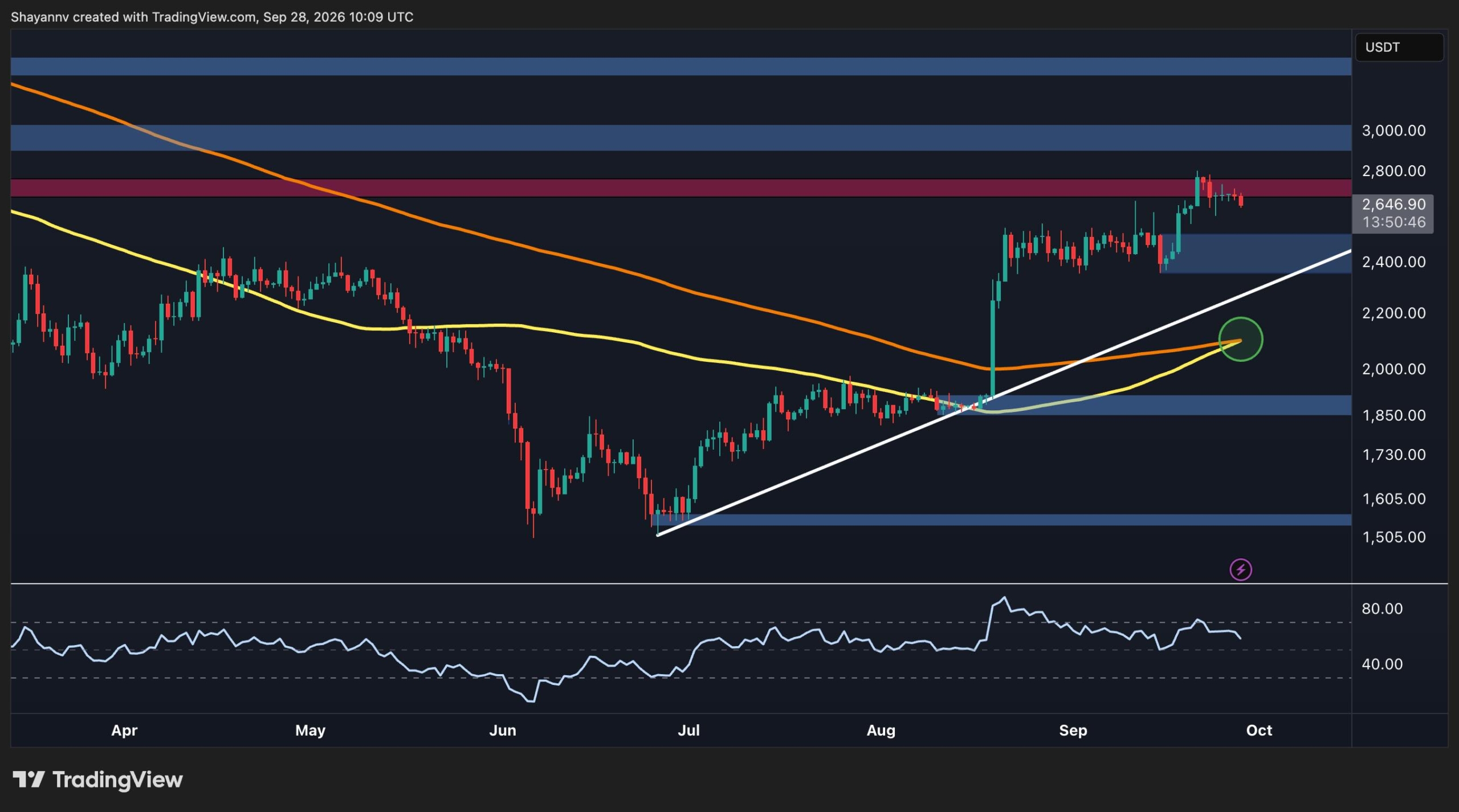
Ethereum is consolidating below $2.7K after a sharp recovery from the June lows. The charts show a constructive medium-term structure, although momentum has cooled after ETH failed to sustain its move into the $2.7K resistance area. The key question now is whether the price can hold above the rising trendline and the nearby demand zone around $2.4K.
Ethereum Price Analysis: The Daily Chart
On the daily timeframe, ETH has undergone a significant structural improvement since the June low near $1.5K. The asset has formed a sequence of higher lows along the ascending trendline and recently broke above the $2.4K area, which had previously acted as resistance.
The breakout accelerated ETH toward the $2.7K region, where the market encountered a clearly defined resistance zone. The price briefly pushed toward $2.8K before retreating, and the latest candles show a modest pullback around $2.68K. This suggests that buyers have yet to establish a sustained breakout above the upper resistance band.
The most immediate support is around $2.4K, where the latest consolidation occurred. The moving averages also provide an important structural reference. The 100-day and 200-day moving averages are converging around the $2.1K region and are likely to form a bullish crossover soon, which could indicate a long-term bullish shift in market structure after months of bearish price action.
ETH/USDT 4-Hour Chart
The 4-hour chart provides a more neutral short-term picture. ETH rallied sharply from roughly $2.4K and established a new local high near $2.8K, but the price has subsequently entered consolidation beneath the $2.7K resistance zone.
The current price around $2.65K is therefore positioned between resistance near $2.7K and the short-term bullish order block around $2.5K. The latter is particularly important because it represents the area from which the latest impulsive move higher began.
The rising white trendline remains another structural reference. It has supported the sequence of higher lows and currently points toward the $2.3K-$2.4K area. A decisive break below this trendline would signal a more meaningful deterioration in the short-term structure.
The 4-hour RSI has fallen back below the mid-range after reaching overbought territory during the September rally. This cooling-off period is consistent with the current consolidation rather than an outright trend reversal.
Therefore, the immediate structure can be viewed as a range between approximately $2.5K and $2.7K. A breakout from either side should provide greater clarity on the next directional move. Above resistance, the $3K psychological level becomes the main reference, while below support, the $2.2K-$2.3K area becomes increasingly relevant.

On-Chain Analysis
The Ethereum transaction-count chart shows an interesting divergence between network activity and price. The total transaction count has recovered significantly from the lows seen around early 2026. The metric recently jumped from roughly 1.6M transactions to above 2M, indicating a renewed increase in network activity.
However, the latest price recovery toward $2.6K coincides with a drop in transaction activity, which provides some key insights about market participation. This divergence could indicate that the rise in price has led to more holding by investors rather than engaging in short-term trading and profit-taking.
Therefore, with the price chart being the most constructive seen in months, and the divergence in network activity pointing to holding behavior, investors can be optimistic that ETH will likely reach higher prices in the coming weeks. Unless a catastrophic event in geopolitics or the macroeconomy overpowers the positive sentiment in the crypto market.

The post Ethereum Price Analysis: Is a Drop to $2.4K Next After ETH’s Latest Rejection? appeared first on CryptoPotato.
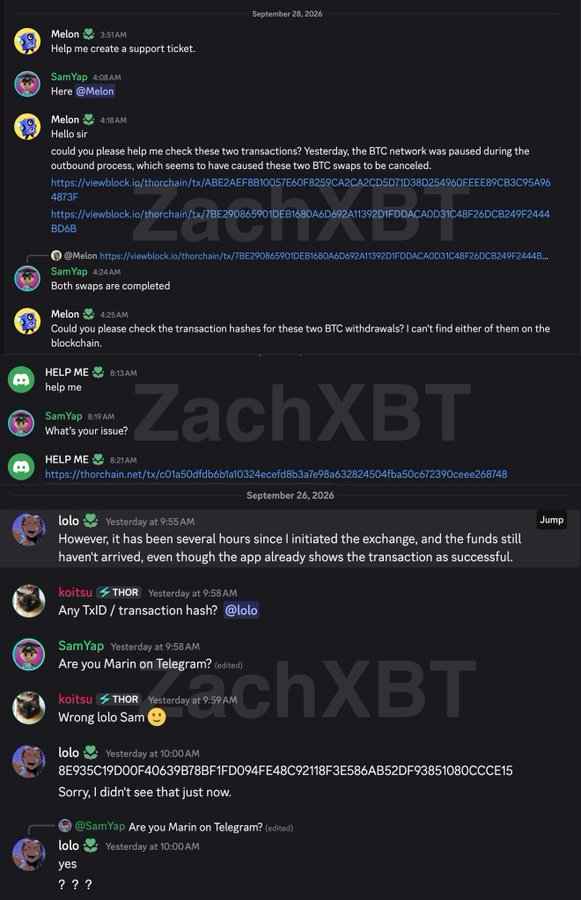
People allegedly laundering money from the $387 million Bitget hack have been asking for customer support in public chat rooms, according to blockchain investigator ZachXBT.
He said the group are Chinese money launderers working for the suspected North Korean attackers. They posted openly in the Discord servers and Telegram channels of services they use to move the funds.
What the Bitget Hack Suspects Posted
Bitget lost $387.5 million on September 24. CEO Gracy Chen said attackers tricked the exchange’s internal approval system into signing the transfers, and that North Korea was “very likely” behind it. BeInCrypto’s Bitget hack timeline lays out how it happened.
ZachXBT named five accounts and matched each one to a transaction. His screenshots show them complaining to staff at THORChain, a network that swaps coins between blockchains without an account, that XRP-to-Bitcoin swaps never arrived.
One user, “Cc,” wrote that 277,724 XRP went in but only 431 came back. Another, “jack,” said losing the assets “would cause a lot of trouble in my life.” A moderator for the swap service SwapKit answered with a photo of Kim Jong Un.
Kelp DAO Link and the North Korean Pattern
ZachXBT said one account, “lolo,” also laundered money from the $292 million Kelp DAO exploit in April. In the chat, lolo confirmed going by “Marin” on Telegram.

“I’ve observed the same pattern after multiple TraderTraitor attributed exploits, and I’ve closely tracked these groups,” the on-chain sleuth wrote.
TraderTraitor is the FBI‘s name for a North Korean hacking group. The bureau blamed it for the $308 million theft from Japanese exchange DMM Bitcoin in 2024.
The funds are now hopping between blockchains through bridges and landing in mixers such as Wasabi, a wallet that blends coins to hide their trail, he said.
THORChain has refused to block wallets tied to the attackers. Bitget said withdrawals reopen Monday. ZachXBT plans to release more data on the groups in the coming weeks.
The post Investigator Finds $387M Bitget Hack Suspects Asking for Help in Public Chats appeared first on BeInCrypto.
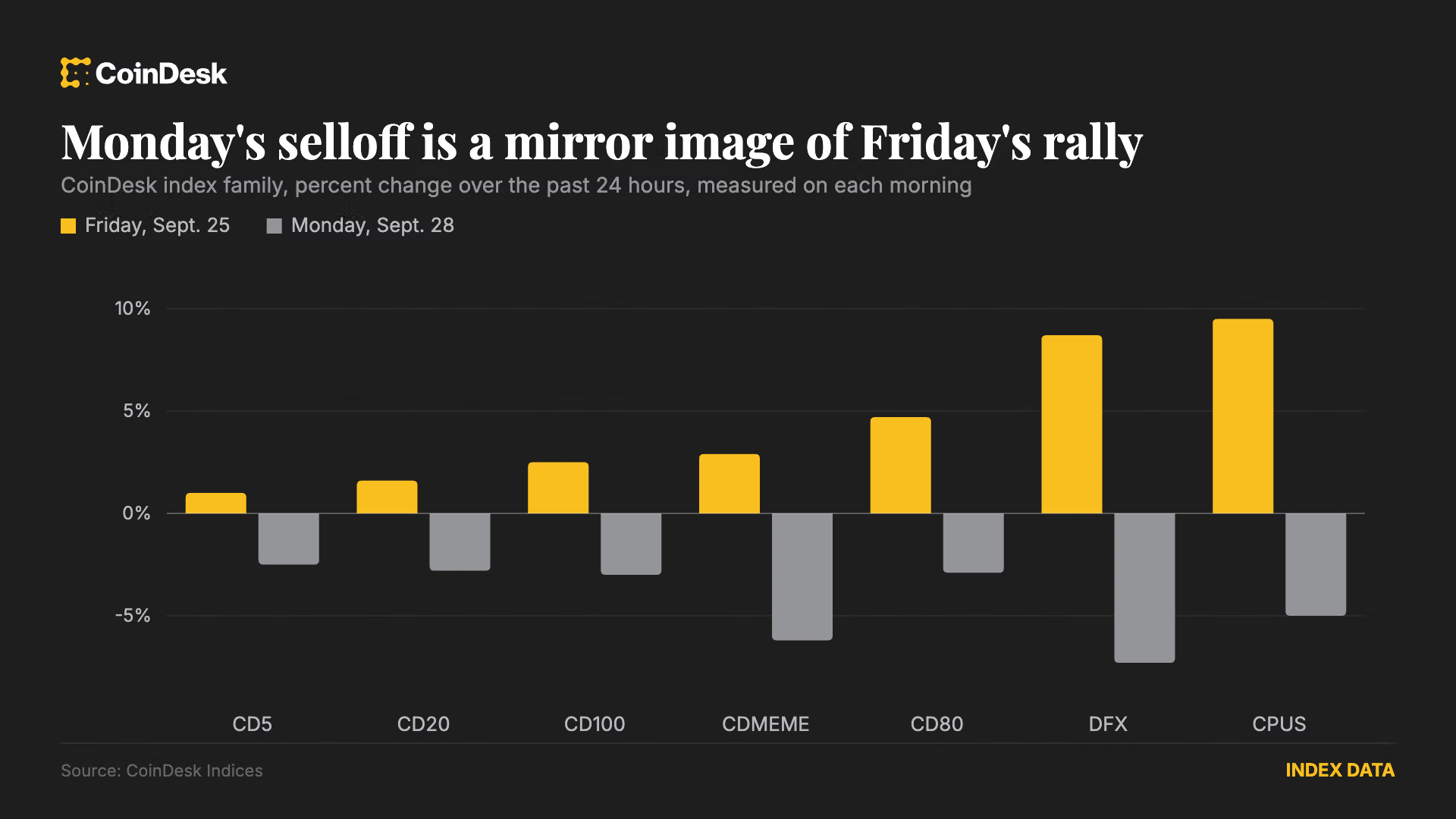
Bitcoin fell to $83,000 on Monday, down 1.7% since midnight UTC and 2.1% over 24 hours, though it is the altcoin market taking the brunt of the damage, with 91 of the 100 CoinDesk 100 constituents lower on the day and the index down 2.6% to 1,874.56.
The unwind is almost a mirror image of Friday, with quant (QNT) falling 16% since midnight after rising 39% over 24 hours in Friday’s session, indexing protocol token the graph is down 12% having gained 14%, and tokenization token ondo is 12% lower. The sector indices that led the advance are leading the retreat, with the DeFi Select Index (DFX) down 6.4% and 7.3% over 24 hours while the CoinDesk Computing Index (CPUS) lost 3.2% and 5.0%.
The trigger sits in oil rather than in crypto, with President Donald Trump rejecting Iran’s latest terms for reopening the Strait of Hormuz, conditions that included the release of frozen Iranian funds, the lifting of oil sanctions and an end to the U.S. naval blockade of Iranian ports. Brent crude has climbed back above $100 to $100.83, up 3.2% on the day, reversing Friday’s move below that level.

Digital asset-friendly financial institution Franklin Templeton is expanding its “off-exchange collateral program” to Bybit, allowing the exchange’s users to use shares in Franklin Templeton’s tokenized money market funds for crypto trading.
The partnership allows investors and wallet holders on the exchange to pledge shares, which represent about $686 million in net assets, as collateral to borrow stablecoins USDT or USDC while earning yield on the underlying assets, according to a press release on Monday.
The key point is that users will not have to move the underlying assets to Bybit. Instead, regulated custody platform ByCustody will hold the underlying assets off-exchange, with the value mirrored in Bybit’s trading environment to enable yield generation while unlocking trading liquidity, the release said.
This is not Franklin Templeton’s first off-exchange collateral partnership; the firm also offers its tokenized money market funds to customers of Binance and OKX. The work continues the buildout of collateral mirroring in the crypto space and the opportunities that brings, said Sandy Kaul, Head of Digital Assets and Innovation at Franklin Templeton.

LayerZero blamed Kelp for using one verifier instead of several, while Kelp said LayerZero staff had reviewed its setup and never objected. CoinGecko data showed nearly half of active LayerZero apps used the same one-verifier arrangement, and Kelp said it would move rsETH to Chainlink.
CCIP 2.0 offers a similar menu of verifiers, which lets companies run their own or hire outside providers such as Infosys and Nethermind. Chainlink’s own network of 16 independent node operators still checks every transfer, regardless of what else a user adds.
Users shouldn’t have to be “cross-chain security infrastructure experts,” the company told CoinDesk.
“Historically, legacy bridges have lost billions due to insecure infrastructure, while in-house builds are slow and expensive,” Johann Eid, Chainlink Labs’ chief business officer, said in a statement.
The upgrade also changes a safeguard Chainlink used to promote heavily; its Risk Management Network, a separate set of nodes that double-checked transactions, no longer plays that role. Chainlink said that kind of independent check can now come from the optional verifiers instead, which suggests a user who adds nothing now relies on one verifier network, where previously there were two.
Existing Chainlink users were automatically moved to the new version. Still, the company has not named any institution using the new verifiers yet, saying only that Aave and Maple have started adopting some of the upgrade’s other features.

“If every household used AI agents to optimize the return on their cash balances, banks could lose a large share of the cheap deposits they rely on to make loans, which would be a problem for the entire financial system,” he noted.
Agentic finance refers to AI that acts rather than just answers. These agents can monitor balances in real time, compare returns across institutions, move idle cash into higher-yield accounts and move it back in time for bills.
Estimates of the market’s size vary widely. Mordor Intelligence puts agentic AI in financial services at $7.78 billion in 2026 and projects $43.52 billion by 2031. MarketsandMarkets sizes the narrower AI agents segment at about $845 million in 2025.
Crypto is already building the payment rails these agents would need. Coinbase’s x402 protocol, the most widely used agentic payment standard, lets an AI agent pay for online services in stablecoins within seconds, with no account, card or human approval.
To date, the x402 Protocol has reportedly processed approximately 188 million to over 205 million cumulative transactions, with around 69,000 active agents.
Cloudflare, Google, Visa, Mastercard, AWS, Circle and Stripe have joined the x402 Foundation, which the Linux Foundation now governs.
Nate Geraci, co-founder of the ETF Institute, has previously said that AI and crypto are both coming for the traditional banking model.


Key takeaways
- Bitcoin traded below $83,000 on Monday after gaining more than 4% last week.
- Ethereum slipped below $2,700, while XRP consolidated around $1.500.
- BTC remains above its 50-day, 100-day, and 200-day exponential moving averages.
Bitcoin, Ethereum, and XRP began the week on a quieter note after last week’s gains. Bitcoin pulled back below $83,100 on Monday, Ethereum traded below $2,700, and XRP hovered around $1.500.
The moves suggest traders are reassessing the market’s next direction following its recent advance.
Bitcoin’s technical picture remains constructive despite the dip. The largest cryptocurrency is holding above several closely watched moving averages, while its momentum indicators still lean positive.
The immediate question is whether buyers can carry BTC back toward $85,000 or whether the pause develops into a deeper pullback.
Bitcoin holds above key moving averages
Bitcoin was trading at $83,100 on Monday after rising more than 4% last week. Its retreat from recent highs has so far left the broader near-term uptrend intact: BTC remains above its 50-day, 100-day and 200-day exponential moving averages (EMAs).
The 50-day EMA stands at $77,323. The 100-day EMA is at $73,931, while the 200-day EMA is at $74,253.
Together, these levels form a series of potential support areas if selling pressure increases. Holding above them would suggest that the latest dip is a pause within the recent advance.
For now, BTC is trading well above that group of averages. That gives buyers room to absorb a modest pullback, although a drop toward the 50-day EMA would represent a more meaningful test of the rally than Monday’s move below $83,600.
The distinction matters after a strong week. A market can ease from its highs while retaining its upward trend, but repeated failures to recover may gradually weaken buyer confidence. Traders will therefore be watching both how far BTC falls and how quickly demand returns.
Momentum cools as $85,000 caps the upside
Bitcoin’s relative strength index (RSI) was near 61, a reading consistent with positive momentum. It remains below the level commonly associated with overbought conditions, leaving room for another rise if buyers regain control.
The moving average convergence divergence (MACD) indicator has cooled but remains slightly positive.
That combination points to an uptrend that is still present, though less forceful than during the recent rally. Momentum readings can change quickly, so price action around nearby resistance will offer a clearer test.
The first barrier is approximately $85,000. Bitcoin would need to overcome selling around that level to make a stronger case for extending last week’s gains. A failed attempt could keep BTC in a period of sideways trading as buyers and sellers weigh the recent move.
On the downside, the current price area provides the first place to look for support. A more substantial decline would put the 50-day EMA at $77,323 in focus, followed by the longer-term averages near $74,000. Previously established horizontal support levels at $66,500 and $62,300 sit further below.
These levels outline the range of possible tests rather than a forecast that BTC will reach them. For the near term, the contest is much narrower: whether Bitcoin can stabilize above $83,000 and make another attempt at $85,000.
Ethereum’s move below $2,700 and XRP’s consolidation around $1.500 add to the cautious start to the week.

Both assets are taking a breather alongside Bitcoin, although the figures provided do not establish equivalent support or resistance levels for either token.
For traders following the three largest cryptocurrencies, Bitcoin’s response to $85,000 may offer a useful gauge of broader market appetite.
A renewed push above that barrier could signal that buyers remain willing to pursue last week’s gains. Continued consolidation, meanwhile, would leave the market waiting for a clearer direction.


Strategy sold 1.47 million MSTR shares for $246.2 million, using the proceeds for Bitcoin purchases and STRC preferred stock repurchases.

Detachable mop heads and top-tier cleaning make the affordable Roborock Qrevo 2 Pro a dream for mixed floors

Andreessen Horowitz backs AI-era college alternative with $42M

Screw It, Helen Keller Vs. Nightwolves Is On Tubi. Just Go Watch It.





-

 Fashion3 days ago
Weekend Open Thread: J.McLaughlin – Corporette.com
-

 Tech17 hours ago
OpenAI is preparing “o,” an always-on ChatGPT assistant that could handle email
-

 Crypto World6 days ago
Goldman Sachs and Deutsche Bank Agree: The S&P 500 Rally Isn't Over
-

 Fashion4 days ago
8 iPhone Accessories That Add Personality
-

 Entertainment5 days ago
These 17 Fall Amazon Dresses Seriously Look Like Anthropologie
-

 Tech6 days ago
Reolink’s solar 4K security camera falls to its lowest price in months
-

 Crypto World6 days ago
This Bearish Netflix Stock Trade Can Cash In On Video Streaming Giant’s Woes
-

 Crypto World6 days ago
Trump-Xi Polymarket Odds for Handshake Hit 50%
-

 Crypto World5 days ago
Crude Oil Prices Pressured by Diplomatic Hopes in the Middle East
-
 Crypto World5 days ago
Bitcoin price tests $83,600 Supertrend support after $87K rejection
-
 Business6 days ago
Oil Price Today (September 23): Crude oil below $100 on hopes of US-Iran talks. What did Trump say?
-

 Crypto World6 days ago
BitGo says Bitcoin absorbed Fed hike, CLARITY failure
-

 Crypto World5 days ago
Bitcoin Threatens Sub-$84,000 Breakdown as Long Liquidations Spike
-

 Tech16 hours ago
Anthropic turns Claude into an AI marketplace with 2,000+ plugins and connectors
-

 Crypto World6 days ago
Meta Jumps 11% As Muse Shines and Investors Show an Appetite for Advancing AI
-

 Crypto World6 days ago
Did Jim Cramer Just Give GameStop Stock the Kiss of Death When He Said the Turnaround Is Working?
-
 Crypto World7 days ago
Trump, Xi Meet on S&P 500's Best Day Since Early August: Will Markets Stay Bullish?
-
 Tech5 days ago
UiPath’s Dines says AI needs a manual and launches Cartographer to write it
-

 Crypto World5 days ago
Strategy resumed Bitcoin buying, but Strive gained more BTC per share
-

 Crypto World5 days ago
As Amazon Stock Prospers, Traders Might Consider This Option Play
You must be logged in to post a comment Login