
Crypto
JPMorgan makes bullish call in fixed income space, suggests it’s a once in a generation opportunity

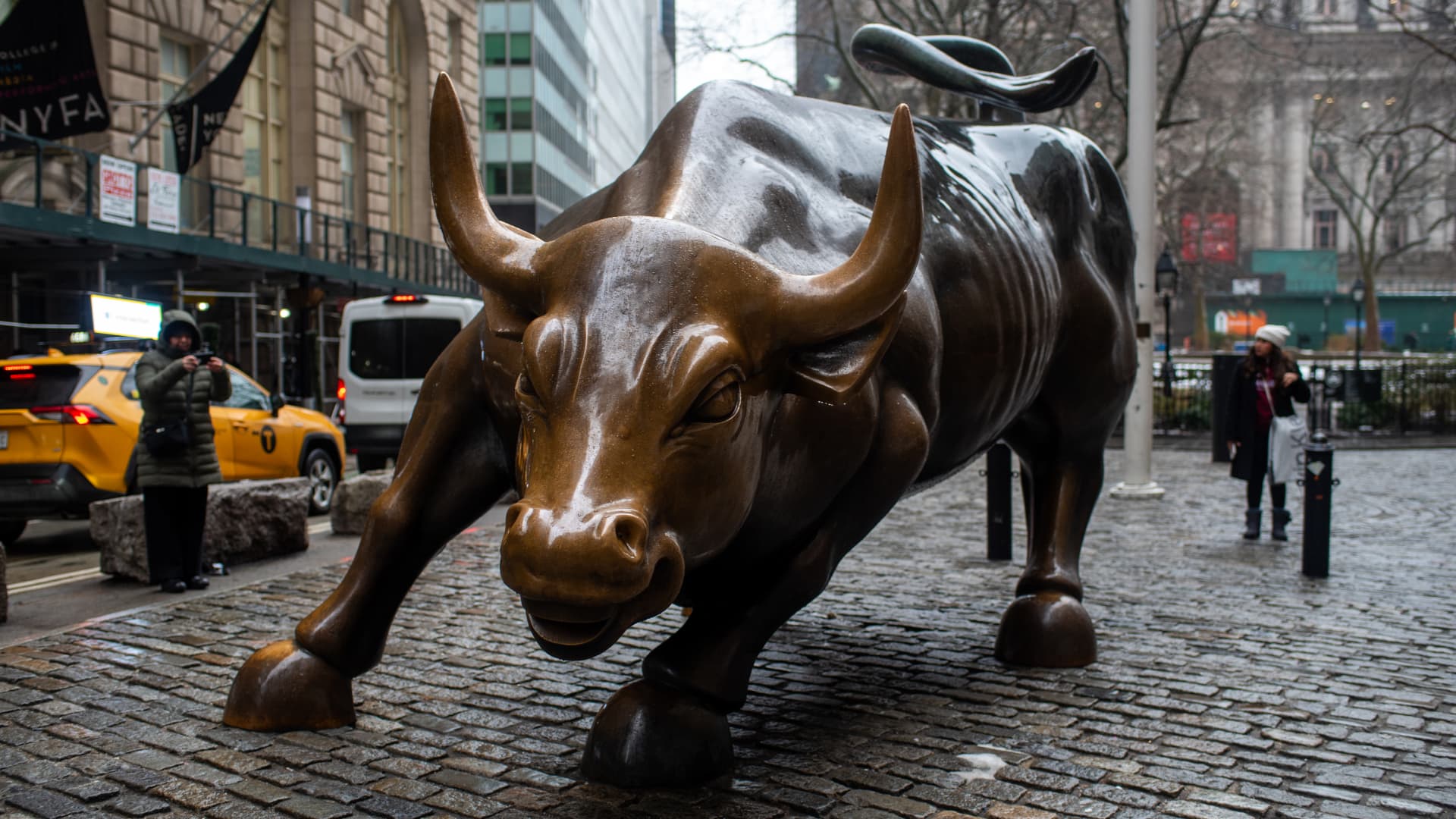
J.P. Morgan Asset Management is making a bullish call on an underinvested market group: high-quality fixed income.
Priya Misra, a portfolio manager at the firm, sees a once in a generation opportunity for investors.
“You can actually take credit risk in the highest quality companies and still get [a] 6.5% [yield], Misra told CNBC’s “ETF Edge” this week. “So, you actually don’t have to go down in credit [quality].”
She suggested the strategy is particularly well suited for investors concerned about having too much exposure to artificial intelligence stocks.
“There’s a huge AI exposure,” Misra said. “What fixed income gives you is this diversified set of returns. It’s not just an AI trade or a tech trade. You have the Treasury trade. You have credit outside of AI.”
Misra co-manages the JPMorgan Core Plus Bond Fund ETF (JCPB). The fund has almost $16 billion in assets under management, with just over three-quarters of its holdings in BBB-rated debt and above, according to the firm’s website as of Aug. 31.
“We’ve actually been increasing some of the double-B [and] single-B exposure because there has been a widening in high yield spread,” she said. “We like some investment grade. And now, we’ve started in the last few days to increase some duration as well, thinking we may be nearing the end of that rate move.”
The JPMorgan Core Plus Bond Fund ETF is down more than 5% so far this year as of Friday’s close, according to FactSet.
“You want to be looking bond by bond and sort of sector by sector to see where the macro and you have to do the bottom up as well to make sure that companies are not over levered,” noted Misra, who’s concerned about how higher rates could hurt the housing market.
BondBloxx co-founder Joanna Gallegos is also advising investors to take advantage of “historically attractive” yields across debt markets.
“You want to really consider getting some corporate debt into your portfolio,” Gallegos said in the same interview. “It’s really in the investor’s best interest to start looking at the income that’s back in fixed income. It can offset the volatility in your portfolio.”
Part of her bull case: Base rates are high, and they’re stable.
“The fundamentals of these corporations are so strong, and the economy continues to grow,” added Gallegos. “We really think that’s being lost in the narrative around Treasury rates.”
Her firm BondBloxx is known for fixed-income exchange-traded funds in sectors including Treasury, corporate, private credit and emerging markets.
One of its funds includes the BondBloxx Private Credit CLO ETF (PCMM). As of Friday’s close, it’s down 0.6% so far this year, according to FactSet.


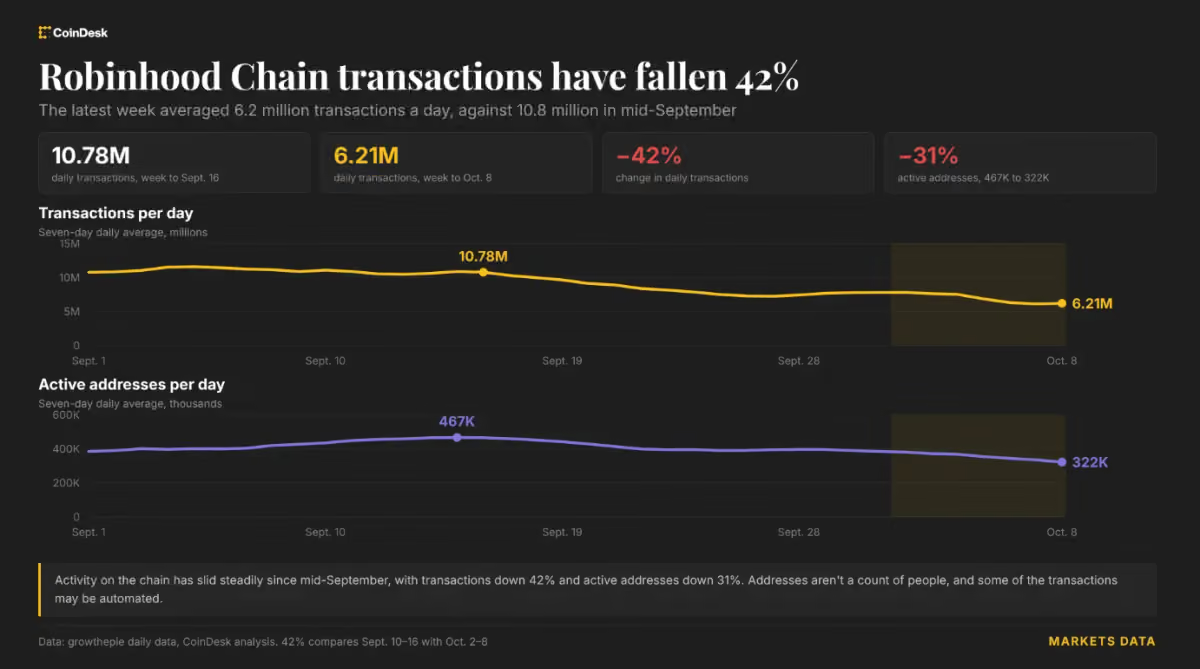
Daily active addresses averaged about 322,000 in the latest week, down 31% from mid-September, suggesting fewer people, and fewer of the trading bots they run, are using the chain each day.
The drop is likely smaller in human terms than the raw number implies, since one trader can run many addresses and a single automated program can account for thousands of transactions.

Less trading, steady balances
Spot exchanges, where users buy and sell tokens directly, handled $7.45 billion during Oct. 2–8, down 21% from $9.46 billion the week before, according to CoinDesk calculations using DefiLlama. Uniswap, an app that lets people swap tokens with each other without a company in the middle, handled roughly 77% of that.
Users aren’t pulling their money out, though. Deposits in the chain’s lending and trading apps rose about 2% over the week to $1.04 billion, and the supply of stablecoins, tokens pegged to the dollar, ticked up to roughly $1.10 billion.
That suggests the pile of money is simply being traded less, with traders keeping their funds on Robinhood Chain and waiting.
Futures are the exception, however. DefiLlama’s rolling seven-day figures on Friday showed about $7.35 billion in perpetual futures volume, contracts that let traders bet on prices without owning the tokens, up 26%.
Crypto
Mashinsky Accepts Lifetime Industry Ban and Up to $35 Million in Conditional Payments | The Defiant

The New York settlement ties the money to federal forfeiture and prison-sentence conditions, adding to existing FTC and CFTC restrictions…. Read the full story at The Defiant
Source link


Key takeaways
- Dogecoin traded near $0.085 on Friday after losing more than 11% this week.
- Two large-wallet cohorts reduced their combined holdings by 100 million DOGE since Tuesday.
- A close below $0.084 could expose $0.078 and $0.070, with resistance beginning at $0.086.
Dogecoin traded around $0.085 on Friday, approaching a key trendline area after a weekly decline of more than 11%.
Falling balances among some large holders and weakening technical momentum suggest continued downside pressure.
However, derivatives positioning offers a more mixed picture, with long positions outnumbering shorts in CoinGlass’ tracked ratio.
Large Dogecoin holders reduce exposure
Santiment’s supply distribution data shows that wallets holding between 1 million and 10 million DOGE and those holding between 10 million and 100 million DOGE have collectively reduced their balances by 100 million tokens since Tuesday.
The decline suggests some large holders are reducing exposure, potentially through profit-taking. Wallet balance changes alone do not confirm that every token was sold, but the movement adds to concerns about near-term supply pressure.
CryptoQuant’s summary indicators also point to caution. Its data identifies overheating conditions in both spot and futures markets, alongside large orders and sell-side dominance in futures.
These signals suggest that selling pressure remains significant as DOGE approaches nearby support.
Despite the price decline, CoinGlass’ DOGE long-to-short ratio stood at 0.90 on Friday, approaching its highest level in more than a month.
A reading above one indicates that longs outnumber shorts within the positions or accounts tracked by the metric.
Funding rates also remained positive at 0.0010%, meaning long traders were paying short traders to maintain their positions.
Together, the readings suggest some traders are positioning for a recovery. They do not establish that buying demand is strong enough to reverse the decline, particularly while price momentum remains weak.
DOGE tests $0.084 as momentum deteriorates
Dogecoin is trading just above the trendline area near $0.084, which serves as the immediate technical support reference.
A daily close below that level could open the way toward $0.078. A deeper correction would bring the next structural floor at $0.070 into focus.
The Relative Strength Index sits near 40, below its neutral midpoint and consistent with weaker buying momentum.
The Moving Average Convergence Divergence line remains below both zero and its signal line. Its negative, slightly expanding histogram also suggests sellers retain the near-term advantage.
DOGE remains beneath several important exponential moving averages, creating successive barriers to a rebound.


The first resistance is the 100-day EMA near $0.086. Above it, the 50-day EMA and a horizontal resistance level converge around $0.088.
Clearing those levels would help ease immediate bearish pressure. A stronger recovery would require a move above the 200-day EMA at $0.093, followed by a challenge of major resistance near $0.102.
For now, the balance between support at $0.084 and the moving averages overhead will help determine whether DOGE stabilizes or extends its weekly losses.

Three armed men have forced a Chinese expatriate with Turkish citizenship to transfer approximately $820,000 in cryptocurrency during a robbery at his luxury home near Pattaya, Thailand, prompting a police investigation into the suspects and the movement of the stolen assets.
Summary
- Three armed men broke into a luxury home near Pattaya, Thailand, and forced a Chinese expatriate with Turkish citizenship to transfer approximately $820,000 in cryptocurrency.
- The attackers threatened the victim at gunpoint and stole cash and three luxury watches before escaping in a vehicle that police later recovered.
- Thailand police are examining CCTV footage and tracing cryptocurrency transactions to identify the suspects, whose nationalities have not been confirmed.
- The robbery follows a series of violent attacks targeting cryptocurrency holders, with Chainalysis estimating losses of more than $30 million from such incidents in the first half of 2026.
According to initial reports, the robbery took place at around 3:30 a.m. on Tuesday, October 6, inside a gated residential community in Nongprue, where the attackers entered the property using a ladder before confronting the victim in his bedroom.
The masked men reportedly threatened the resident with firearms and ordered him to open a safe containing cash and valuables. They took an undisclosed amount of money and three luxury watches before demanding access to his cryptocurrency holdings.
Under threat, the victim transferred digital assets valued at roughly $820,000 to accounts controlled by the attackers. Reports indicate that the cryptocurrency was subsequently sold, although authorities have not disclosed which assets were involved or how the transactions were carried out.
The resident eventually escaped and contacted police. His identity has not been publicly released.
Thailand police trace stolen crypto and suspects’ getaway vehicle
Police Region 2 has taken charge of the investigation, with officers examining both the physical evidence left behind and the transactions involving the stolen cryptocurrency.
Police Lieutenant General Wasan Techa-akrakesom, commissioner of Police Region 2, said investigators had made significant progress in the case. The Immigration Bureau has been brought into the investigation as authorities work to establish the identities and movements of the suspects.
Initial information suggested that the three attackers might be Chinese nationals, but police have not confirmed their citizenship. No arrests were disclosed in the initial reports.
Investigators have reportedly recovered the vehicle used by the suspects after it was abandoned in a remote location.
CCTV footage placed the same vehicle in the area on October 5, one day before the robbery. Police are examining the footage as part of efforts to reconstruct the suspects’ movements before and after the break-in.
Alongside the search for the attackers, authorities are tracing the digital assets transferred from the victim’s holdings.
Investigators are reportedly examining accounts connected to the subsequent sale of the cryptocurrency in an effort to identify the individuals who received or handled the funds.
Details about the destination wallets, exchanges involved and potential recovery of the stolen assets have not been made public.
Police have yet to establish whether the attackers knew about the resident’s cryptocurrency holdings before entering the property or discovered them during the robbery.
The distinction remains unresolved because the intruders demanded several forms of property, including cash, watches and digital assets.
Crypto wrench attacks have cost victims millions in 2026
The robbery in Thailand follows several violent incidents involving cryptocurrency holders, including home invasions where attackers have used threats or physical force to obtain access to digital wallets.
Such crimes are commonly described as wrench attacks, a term used for robberies involving physical coercion to steal cryptocurrency or force victims to authorize transfers.
In an August investigation, crypto.news previously reported that criminals had stolen more than $30 million through violent attacks against cryptocurrency holders during the first half of 2026, citing research from blockchain analytics firm Chainalysis.
The firm documented 46 incidents during the six-month period, compared with 40 in the corresponding period of 2025. Only 12 of the 46 attacks resulted in payments, giving criminals a reported success rate of 26%.
Home invasions accounted for 37% of documented cases, compared with 14% in 2025. Kidnappings represented 52% of incidents, although Chainalysis noted that some cases could involve more than one type of crime.
A separate investigation by security firm CertiK identified 52 verified wrench attacks worldwide during the first half of 2026, with financial exposure totaling $124.1 million.
CertiK’s figure included stolen cryptocurrency, ransom demands, frozen assets and other amounts connected to reported incidents. It did not represent the amount criminals successfully obtained.
The firm’s findings placed France at the top of its list, with 33 verified attacks accounting for nearly 64% of the worldwide total. Europe recorded 39 incidents, while the United States accounted for four.
Armed home robberies have targeted crypto holders in France and the US
Several recent cases have involved attackers entering residential properties and demanding cryptocurrency transfers from occupants.
In September, four masked men held a family captive for more than three hours in Vendin-le-Vieil, northern France, before forcing the father, who worked in the cryptocurrency sector, to surrender access codes linked to approximately €40,000 in digital assets.
The attackers assaulted the father, while his 12-year-old daughter was struck in the face. French authorities investigated the incident as kidnapping and extortion by an organized gang.
Earlier that month, a couple in Alès was restrained and threatened by two armed intruders who demanded cryptocurrency transactions.
The attackers reportedly carried a handgun and a knife and held the couple for more than two hours while their young child was inside the house. Neighbors alerted police after hearing screams, prompting the suspects to flee.
Similar incidents have reached US courts. In June, two Texas brothers pleaded guilty in an $8 million cryptocurrency robbery case involving a Minnesota family.
Federal prosecutors said the brothers held the victims at gunpoint for approximately nine hours while forcing them to transfer digital assets. Both pleaded guilty to interference with commerce by robbery.
Meanwhile, investigators in Thailand are examining the abandoned getaway vehicle, CCTV footage, immigration records and cryptocurrency transactions connected to the Pattaya robbery.
According toPattaya Mail’s October 9 report, officers located a black Toyota Fortuner in a wooded area and identified footage showing the vehicle near Phatthanakan Road and Soi Wat Boonsamphan at approximately 3:38 p.m. on October 5.
Police have not publicly confirmed the suspects’ identities or nationalities, and the investigation remains ongoing.


Cryptocurrency and the technology behind it are no longer a fringe curiosity for Britain’s financial regulator — they are becoming central to how the UK hopes to keep its capital markets competitive. In a speech delivered this week, the Financial Conduct Authority (FCA) made clear that tokenisation, artificial intelligence and digital assets are now core pillars of its multi-year reform programme, not side projects bolted onto traditional finance.
Jon Relleen, the FCA’s director of infrastructure and exchanges, told delegates at the Reform of the UK Public and Private Capital Markets Summit 2026 that the regulator has “been very busy” completing major elements of a long-running overhaul designed to ensure markets “work well for our economy and support growth.” Crucially, he singled out tokenisation — the process of representing traditional assets like shares, bonds or funds as digital tokens on blockchain-style infrastructure — as one of the fastest-moving frontiers the FCA is now preparing to regulate.
Why cryptocurrency infrastructure is entering the mainstream conversation
For years, cryptocurrency was treated by many regulators primarily as a consumer protection headache: a space rife with scams, volatile prices and speculative trading. The FCA’s own website still carries extensive warnings about crypto investment scams and maintains a public list of firms operating without authorisation. That caution hasn’t disappeared. But Relleen’s speech signals a parallel track, where the underlying technology of cryptocurrency markets is increasingly viewed as a legitimate tool for modernising how capital itself is raised, traded and settled.
This dual-track approach — tightening consumer safeguards while embracing the infrastructure — reflects a broader pattern seen across global financial regulation. Authorities are trying to separate the speculative trading culture that surrounds cryptocurrency from the distributed ledger technology that underpins it, betting that the latter can make markets faster, cheaper and more transparent without necessarily importing the volatility of coins like Bitcoin or Ether.
Trust and risk-taking as twin priorities
Relleen was explicit that reform cannot come at the expense of market integrity. “Trust, market integrity and high standards set the foundations for sustainable growth,” he said, while also stressing that regulators must “enable informed risk-taking.” That balancing act is especially delicate in the context of cryptocurrency-adjacent innovation, where enthusiasm for new technology has historically outpaced investor protections.
The FCA’s framing suggests it wants to avoid repeating past cycles in which cryptocurrency products were sold to retail investors with little understanding of the underlying risks, only for sharp price crashes or platform failures to follow. By building tokenisation into a broader, more deliberate reform agenda — alongside AI adoption and new markets for trading shares in private companies — the regulator appears to be trying to get ahead of the technology rather than reacting to it after problems emerge.
What reform could mean for everyday investors
For ordinary savers and investors, the practical implications of this shift may not be felt immediately, but they could be significant over time. Tokenised versions of traditional assets could, in theory, make it cheaper and faster to buy and sell investments, lower barriers to entry for smaller investors, and create new ways to trade assets that are currently illiquid, such as stakes in private companies.
At the same time, the FCA’s own consumer-facing warnings underline that cryptocurrency-linked products remain high-risk. The regulator continues to flag crypto investment scams as a priority concern and maintains tools allowing the public to check whether a firm is properly authorised before investing. Anyone tempted by new tokenised products emerging from this reform push would be wise to apply the same scrutiny long urged for conventional cryptocurrency investments: verifying authorisation, understanding volatility, and being wary of promises of guaranteed returns.
A multi-year programme nearing a turning point
Relleen described the FCA’s broader capital markets reform effort as having already completed “major aspects” of a multi-year programme, with more changes still to come. Tokenisation and artificial intelligence were named specifically as areas where markets and technology are evolving rapidly enough that regulation must adapt in real time rather than simply catching up after the fact.
This positions cryptocurrency-related innovation not as a one-off experiment but as an ongoing feature of how UK capital markets will likely operate in the coming years. Whether that translates into tangible benefits for everyday investors, or simply shifts where the risks sit, will depend heavily on how the FCA follows through on the detailed rules still to be written. For now, the message from one of Britain’s top financial regulators is unambiguous: cryptocurrency-based tokenisation has moved from the margins of policy discussion to the centre of the UK’s plan for economic growth.
Explore more on this topic with Vexel Search.

“While Tether claims to operate out of El Salvador, the vast majority of its assets reside in the United States under your custodianship,” the Connecticut lawmaker wrote. “As Congress considers how to best regulate digital assets, your partnership with Tether will provide important insights into the inner workings of this industry.”
One of the letter’s many requests: “Please describe all steps Cantor Fitzgerald has taken to investigate allegations that Tether’s stablecoin has been used in illicit finance and money laundering, including within Iran’s shadow banking network and for purposes of Russia sanctions evasion.”
Neither Cantor Fitzgerald nor Tether immediately responded to requests for comment sent to their spokespeople.
While Blumenthal and other aggressive congressional critics of the crypto industry, such as Senator Elizabeth Warren, have suffered from a limited authority as members of the minority party, securing a Democratic majority for next year would change that. If they win several more seats in that chamber, they could find themselves atop committees with subpoena power to legally compel information and testimony.
As it stands, the prediction markets suggest that Democrats have a better-then-even shot at returning to the majority. Kalshi has it at 61% and Polymarket at 64%. That number was closer to 50-50 several weeks ago. And the picture in the U.S. House of Representatives is even more positive for Democrats, with both platforms showing the likelihood of a majority shift at more than 90%.

The guidance said authorized crypto firms must stop offering services that let EU customers buy, trade, swap or otherwise increase their holdings of affected stablecoins.
The rules cover exchange services, trade execution, transfers, custody, administration, advice and portfolio management.
National regulators should require any remaining customer holdings to be resolved “as soon as possible, and no later than three months” after the opinion’s publication, ESMA said. That places the deadline at Jan. 8, 2027.
In the meantime, platforms may provide limited services to resolve existing holdings. These can include selling, converting, withdrawing, transferring or safekeeping tokens, but not purchases, promotion, trading or continued market availability.
EU users who keep USDT on an exchange will have to follow that platform’s instructions. Some may be able to sell or withdraw it during the wind-down period; others may face an earlier cutoff.
ESMA said keeping noncompliant stablecoins available through authorized platforms would weaken the reserve, redemption, governance and disclosure rules MiCA imposes on authorized issuers.
The opinion is directed at national regulators, who will decide how individual platforms handle their remaining client balances within the three-month outer limit.

Crypto.com is rolling out a new partnership that hands everyday traders the kind of execution tools once reserved for institutional desks, without charging them a cent extra or asking them to move their funds elsewhere.
The exchange has struck a deal with Insilico Terminal, a platform built for active crypto traders who want faster order execution and more sophisticated trade management. The integration lets Crypto.com Exchange accounts connect directly to Insilico’s system, giving users access to professional-grade tools while their assets stay put on Crypto.com.
What Crypto.com Users Actually Get
The feature list reads like something out of a Wall Street trading desk: Chase and Swarm orders, TWAP execution, Scale orders, Depth of Market visibility, programmable hotkeys, automated position sizing and one-click strategy execution. These are the kinds of tools typically used by high-frequency and high-volume traders to manage risk and speed across volatile markets, and now they’re available to Crypto.com’s retail and professional user base alike.

Crucially, the integration isn’t limited to a single market view. Traders can monitor and execute across their Crypto.com accounts alongside positions held on other exchanges, all from one customizable workspace. For anyone juggling multiple platforms, that consolidation could cut down on the lag and guesswork that comes with switching between tabs during fast-moving sessions.
No Fees, No Custody Risk
Perhaps the most notable part of the arrangement is how it’s priced: there isn’t a price tag at all. Insilico’s execution tools are being made available to Crypto.com users free of subscription costs or hidden charges. The connection runs through an API-only setup with two-factor authentication support, and Insilico has been explicit that it does not take custody of user funds or store sensitive account information.
That distinction matters in an industry still recovering from a string of custody failures and collapsed platforms. By keeping funds on Crypto.com rather than routing them through a third party, the partnership is designed to let traders access advanced functionality without taking on additional counterparty risk.
Insilico has positioned itself around low-latency performance, pitching its infrastructure as built specifically to handle the kind of volatility that defines crypto markets, where price swings of several percent in minutes are routine rather than exceptional.
Targeting the High-Volume Trading Crowd
Crypto.com and Insilico both frame the collaboration as aimed squarely at serious traders, from high-volume futures players to active spot traders looking to sharpen their execution. Iskandar Vanblarcum, Managing Director of Crypto.com Exchange, said the move reflects the exchange’s commitment to its more advanced trading community.
“By integrating with Insilico Terminal, we are making it even easier for users to engage with our markets using professional-grade, low-latency execution tools at the speed and scale they require,” Vanblarcum said.
The companies describe the partnership as a way of combining Crypto.com’s existing market access with Insilico’s execution technology, layering a more advanced trading environment on top of the exchange without disturbing where customer funds are actually held.
The announcement lands at a moment when exchanges are under growing pressure to differentiate themselves beyond simple spot trading, as competition intensifies for traders who want institutional-style tooling without institutional account minimums. For Crypto.com, bundling Insilico’s toolkit into its existing platform offers a way to court that audience directly, positioning the exchange as a venue capable of serving both casual investors and professional desk traders from the same infrastructure.
Explore more on this topic with Vexel Search.


Bitcoin ETFs erased October’s net inflows with $485 million in withdrawals, while Ether funds logged a seventh straight outflow session.

Glasgow’s power game leaves Connacht chasing shadows

Turkey’s social media ban for under-15s starts on 1 November

Valve Releases Hardware And CAD Reference For New VR Headset


-

 Sports3 days ago
Saracens’ Venter Brands Premiership Rugby ‘Autocratic’ Over £5,000 Media Fine
-
 Entertainment2 days ago
10 Flawless Movies With the Cleverest Protagonists
-

 Sports2 days ago
Enzo Maresca all smiles as Man City return to training after guilty verdict
-

 Sports2 days ago
Southampton’s Eckert Spared Ban as FA Suspends Six-Week Sentence Over Spygate
-
 Sports2 days ago
Asiad selection row: Para-shooters allege corruption; PCI denies claims | Asian Games 2026
-

 Sports2 days ago
Multiple Power Four programs face College Sports Commission investigations over alleged NIL cap evasion
-

 Crypto2 days ago
Crypto.com Teams Up With Insilico Terminal to Give Traders Free Pro-Level Tools
-

 Sports13 hours ago
College Football Week 6 Bets: Three Picks for Saturday’s Biggest Games
-

 Sports1 day ago
Morocco and Senegal await AFCON final verdict after arbitration hearing – Sports
-

 Crypto1 day ago
Mashinsky Accepts Lifetime Industry Ban and Up to $35 Million in Conditional Payments | The Defiant
-
Crypto17 hours ago
Robinhood Chain slowdown spreads from fees to trading as transactions fall 40%
-

 Tech & AI2 days ago
ICE Emails Discuss Using Palantir-Supported Tool to Investigate Voter Fraud
-
Crypto2 days ago
ESMA gives EU crypto platforms 3 months to drop non-MiCA stablecoins such as USDT
-

 Sports4 days ago
Harry Kane Ties Peter Shilton’s 125-Cap England Record in Wembley Win Over Czech Republic
-

 Sports19 hours ago
Saudi oil crisis affects Neom project, 2034 World Cup plans
-

 Tech & AI5 days ago
Common Mistakes You Should Avoid When Using Foldable Phones
-

 Sports3 days ago
Internationals make history with emphatic Bridges Cup win at Trump Turnberry | News
-

 Sports1 day ago
Eagles stars Barkley and Smith ruled out of London game against Jaguars
-

 Crypto3 days ago
Bitcoin ETF Outflows Hit $485M, Erasing October Inflows
-
 Sports2 days ago
Arsenal statement adds to Man City misery after guilty 115 verdict
You must be logged in to post a comment Login