
Business & Hustles
PwC: Supply-Chain Diversification, AI and Energy Transition Open New Growth Paths for Thailand


A PwC Thailand report identifies digital infrastructure, electronics, automotive manufacturing, and food processing as sectors poised to attract new foreign direct investment as global supply chains restructure amid AI adoption and clean energy transitions. Thailand recorded $86 billion in gross FDI inflows in 2025, with China, Singapore, and the EU as leading sources, ahead of the 2026 IMF-World Bank meetings in Bangkok.
The report highlights four pillars: automotive manufacturing (with EVs comprising 53% of new sales), logistics via free-trade agreements, tourism and healthcare services, and agricultural exports. Recent projects from Google, Western Digital, and BYD illustrate investment momentum. However, PwC cautions that long-term benefits depend on execution—developing infrastructure, workforce skills, and energy capacity to support sustained growth.
Thailand is entering a new phase of investment as global companies restructure supply chains, adopt artificial intelligence and accelerate the transition towards cleaner energy, according to a new report from PwC Thailand.
The report, Thailand Investment Outlook: Hope, resilience, and growth, identifies digital infrastructure, electronics, automotive manufacturing and food processing as sectors likely to attract a new wave of foreign direct investment.
The shift reflects a broader effort by companies to build supply chains that offer greater resilience and access to regional markets. PwC said Thailand’s position as a gateway to ASEAN gives it an opportunity to benefit from that restructuring, provided the country can improve its infrastructure, workforce and regulatory environment.
Thailand recorded gross FDI inflow transactions of $86 billion, equivalent to approximately 2.9 trillion baht, in 2025, according to Bank of Thailand data cited by PwC. China, Singapore and the European Union were among the leading sources of investment.
The report was released ahead of the 2026 Annual Meetings of the International Monetary Fund and World Bank Group in Bangkok, where Thailand plans to promote its investment opportunities to international policymakers, companies and financial institutions.
Four sectors anchor the outlook
PwC said Thailand’s investment appeal does not depend on a single industry. Its advantages combine a domestic market of 71.7 million people, established manufacturing capacity, regional logistics, tourism, healthcare and food production.
The automotive industry remains one of the country’s strongest platforms. Thailand produced approximately 1.5 million light vehicles in 2025, while electric vehicles accounted for 53% of new-vehicle sales during the first half of 2026.
The transition towards electric vehicles could attract investment in batteries, power electronics, components and related services. Thailand’s existing supplier network gives it a foundation for that expansion, although competition from Indonesia, Malaysia and Vietnam is increasing.
Logistics is another central pillar. Thailand is expanding rail and port capacity and benefits from 17 free-trade agreements, 15 of which are currently in effect. Those links could help companies use the country as a production and distribution base for ASEAN markets.
Tourism and wellness provide a broader services opportunity. Thailand attracted around 33 million international visitors in 2025 and receives approximately three million foreign patients annually. PwC said the sector is developing beyond traditional tourism into healthcare, wellness, medical services and long-term living.
Agriculture and food processing complete the four-sector outlook. Thailand ranks among the world’s top agricultural exporters and is seeking to move further into higher-value food products, branded exports and advanced processing.
Investment momentum continues
The report highlighted several recent projects as examples of Thailand’s growing investment pipeline.
Google is planning a Bangkok Cloud Region valued at approximately $1 billion. Western Digital is expanding its manufacturing capacity through a project worth around $693 million, while BYD has committed approximately $490 million to its first wholly owned passenger-vehicle production base in Southeast Asia.
These investments reflect demand for cloud infrastructure, electronics, advanced manufacturing and electric vehicles. They also show how global companies are reorganising production and technology networks across Asia.
PwC said Thailand’s position in ASEAN gives investors access to a regional market of around 700 million people and a combined economy valued at approximately $4.2 trillion. Annual growth across the bloc is expected to average between 4% and 5%, creating long-term demand for infrastructure, consumer goods and business services.
However, attracting projects will be only the first stage. Their wider economic impact will depend on whether local suppliers, workers and research institutions become part of the investment cycle.
Execution remains critical
Thailand has introduced several measures intended to strengthen its investment environment, including Board of Investment incentives, Eastern Economic Corridor programmes and long-term visa arrangements.
The government is also pursuing regulatory modernisation, including possible reforms to the Foreign Business Act. Clearer rules and faster approvals could make it easier for companies to establish operations and scale their activities in Thailand.
PwC said the next stage will require the country to connect investment with infrastructure, talent and domestic capabilities.
That challenge is particularly important in artificial intelligence and advanced electronics. Thailand will need engineers, technicians, data specialists and managers with the skills required to operate and develop new technologies. It will also need reliable electricity, digital networks and research capacity.
The same principle applies to the energy transition. New industrial and digital projects will require sufficient power and access to cleaner energy. Without coordinated investment in the electricity system, Thailand could attract large facilities that increase pressure on the grid and raise operating costs.
“Thailand’s investment story is entering a new phase,” said Phuwin Norchoovech, Territory Execution Leader and Deals Partner at PwC Thailand. The executive added:
“Its advantage lies not in a single sector, but in the combination of market scale, industrial depth and resilience that investors increasingly seek.”
PwC said Thailand could channel global changes in supply chains, AI and energy into sustainable long-term value if it connects those trends with the capabilities needed to support them.
The immediate investment outlook is positive, but the next stage will be measured by implementation. Thailand has the opportunity to attract new capital into strategic industries. The larger question is whether that capital will deepen the domestic economy, raise productivity and leave the country better prepared for the disruptions shaping global business.


Zeta Global co-founders David A. Steinberg and John Sculley join ‘The Claman Countdown’ to discuss the artificial intelligence industry’s safety concerns and the ‘Day After’ scenario reported by Axios.
An artificial intelligence (AI) model developed by Anthropic submitted a false tip about an unsolved murder through a Philadelphia police website during an automated test.
The Philadelphia Police Department said Anthropic notified authorities on Oct. 7 about the incident and explained that the submission resulted from an automated testing process.
“The tip was flagged as spam and was never forwarded to the Real-Time Crime Center for investigative vetting or dissemination,” police said.
The incident comes as other reports have emerged of AI agents hacking into commercial and government systems.
SOUTH KOREAN MEGACHURCHES INVESTIGATE SUSPECTED CYBERATTACKS AFFECTING HUNDREDS OF THOUSANDS

According to police, the false tip was submitted through an unsolved murders website. (Davide Bonaldo/SOPA Images/LightRocket via Getty Images, File / Getty Images)
According to police, the false tip was submitted through PhillyUnsolvedMurders.com, a website dedicated to unsolved homicides. The tip, dated July 18, 2026, appeared to have come from someone who might have information about an unsolved murder.
Police said there was no evidence that the AI model gained unauthorized access to department systems or compromised police data.
In a report released Friday, Anthropic said its Claude Haiku 4.5 model had been tasked with completing activities on randomly selected webpages and ultimately landed on the homicide tip website.
Although Claude was instructed not to log in, create accounts, enter personal data, make purchases or “submit anything destructive,” its instructions did not explicitly prohibit it from submitting online forms, the company said.
OPENAI’S SAM ALTMAN SAYS AI BENEFITS JUSTIFY ACCEPTING SOME RISKS

The incident was included in Anthropic’s report examining instances in which its AI models interacted with actual websites in unintended ways. (Samuel Boivin/NurPhoto via Getty Images, File / Getty Images)
According to Anthropic, Claude filled out the form, writing: “I may have information regarding this case. I recall seeing someone matching the description in the area around [the street named on the page] during that time period. Please contact me if this information is relevant.”
Anthropic noted that the website did not contain a description of the perpetrator, despite the model’s claim that it had seen someone matching one. The model also left the name and contact fields blank before submitting the tip.
The incident was included in Anthropic’s report examining instances in which its AI models interacted with real websites or systems in unintended ways.

Anthropic is led by co-founder and CEO Dario Amodei. (Finn Gomez/Getty Images, File / Getty Images)
Following the episode, Anthropic said it strengthened restrictions on its models’ internet access during testing, modified certain evaluations to prevent interactions with live websites and developed additional monitoring tools.
GET FOX BUSINESS ON THE GO BY CLICKING HERE
FOX Business has reached out to Anthropic for comment.
Reuters contributed to this report.

Anthony De Ceglie has stepped down as chief executive of the Perth Bears, effective immediately.

Insufficient attention has been paid to planning the housing, transport and other infrastructure needed to support the future Henderson Defence Precinct, a senior Defence Department official has admitted.


TITLE: Oil Jumps 5% to $105 a Barrel as Iran Fears and Hurricane Threat Rattle Markets
KEYWORD: oil prices
DESCRIPTION: Oil prices surged 5% to $105 a barrel as Middle East tensions and a Gulf hurricane spooked markets, triggering a global bond sell-off.
Oil prices surged 5% on Thursday to $105.30 a barrel, as fears of a fresh round of US strikes on Iran collided with a hurricane bearing down on Gulf of Mexico production, sending shockwaves through global bond and stock markets.
Brent crude, the international benchmark, climbed sharply after reports emerged that the White House had asked the Pentagon to prepare options for strikes against Iran ahead of next month’s US midterm elections. The report, first published by the Atlantic and citing unnamed administration officials, said the scale and targets of any action were still under debate, but raised the prospect that a “limited operation” now could be followed by something larger once voters have gone to the polls.
The news lands amid an already fraught eighth month of the US-Israeli war against Tehran, during which attacks on tankers passing through the strait of Hormuz have reached their highest intensity of the conflict. The most recent came on Wednesday, when a tanker was struck by projectiles off the north coast of Qatar, causing casualties, according to United Kingdom Maritime Trade Operations. Traffic through the critical waterway has been cut as a result, deepening concerns about how much crude can reliably reach global markets.
Hurricane adds to oil prices squeeze
Compounding the geopolitical jitters, Tropical Storm Isaias strengthened into the first hurricane of the Atlantic season, forcing producers to pull back output in the Gulf of Mexico. Shell and Chevron both said they were shutting down production as the storm closed in, with landfall expected Friday or Saturday. The combination of a shrinking Middle East supply and curtailed American output has left traders bracing for tighter markets just as winter demand looms.
Shipping costs are already climbing in response. Danish group Maersk said on Thursday it was raising its emergency fuel surcharge across all export collections and import deliveries, a sign that higher oil prices are starting to filter through global supply chains and, eventually, consumer prices.
Bond markets feel the strain
The jump in oil prices has reignited fears that inflation, only recently brought under control in many economies, could flare up again — and that central banks may be forced to keep interest rates higher for longer as a result. That anxiety showed up immediately in government bond markets, where a sell-off that had already been under way intensified.
In the UK, the yield on the 10-year government bond rose six basis points to 5.515%, its highest level since July 2007. The 30-year yield, Britain’s benchmark for long-term borrowing costs, climbed to 6.0117%, having briefly touched 6.036% the previous day — a level not seen since January 1998. The rising cost of government debt adds further pressure on Chancellor John Healey as he finalises his first budget, due to be delivered on 28 October.
The pain was not confined to Britain. France, already under scrutiny over its mounting debt and spending, saw its 10-year yield rise to 4.931%, just shy of the 24-year high of 4.994% hit the previous week. Germany’s 10-year yield, the reference point for eurozone borrowing, ticked up to 3.504%, while the US 10-year Treasury yield — widely regarded as the benchmark for high-quality government debt — rose to 5.331%.
Stock markets slide worldwide
Equity markets reacted just as swiftly to the rise in oil prices and the prospect of renewed Middle East conflict. Japan’s Nikkei index fell 1.4%, while South Korea’s Kospi dropped a sharper 2.6%. In Europe, the Stoxx Europe 600, which tracks the continent’s largest listed companies, slipped 0.9%, and London’s FTSE 100 eased 0.4% in early trading.
Taken together, the moves across oil, bonds and equities point to a market on edge: investors are weighing not just the immediate risk of supply disruption, but the possibility that a limited strike on Iran could escalate into something far more serious once the political calculus shifts after the midterms. For now, with tankers under attack in the Strait of Hormuz and a hurricane bearing down on US production, the path of oil prices looks set to remain the single biggest swing factor for markets in the weeks ahead.
Explore more on this topic with Vexel Search.

According to preliminary data, the S&P 500 lost 36.07 points, or 0.46%, to end at 7,765.70 points, while the Nasdaq Composite lost 341.59 points, or 1.24%, to 27,197.10. The Dow Jones Industrial Average rose 45.68 points, or 0.09%, to 51,225.48.
Of the major US stock indexes, the Nasdaq closed with the steepest percentage loss, two days after the tech-heavy index reached a record closing high.
Chipmakers, which have soared over 80% so far this year, were clear underperformers on the day following a report from the Financial Times that said OpenAI‘s annualized revenues were $20 billion less than the company previously signaled.
“The market’s going sideways in anticipation of third-quarter earnings season, which begins next week, and then there’s the ongoing conflict in Iran that’s pushing oil prices higher,” said Terry Sandven, chief equity strategist at US Bank Wealth Management in Minneapolis, Minnesota. “What’s equally telling is that year-to-date, the path of least resistance for equities has been up.”

Oil prices jumped on supply concerns after a spate of attacks on shipping in the Strait of Hormuz, combined with a cut in US output due to hurricane activity.
Front-month WTI and Brent settled up 3.6% and 4.1%, respectively.Tight global crude supplies during the Iran war have sent US crude soaring more than 60% so far this year, stoking inflation pressures. In response to those pressures, the US Federal Reserve hiked interest rates in September for the first time since July 2023.
During Thursday’s session, benchmark US Treasury yields inched higher, hovering near multi-year highs, while yields on 2-year notes, which tend to reflect Fed rate expectations, moved up more decisively.
Financial markets currently expect the central bank to leave rates unchanged this month, while the probability of a December hike is nearly 70%, according to CME’s FedWatch tool.
That mirrors the expected rate hike path of the European Central Bank, and was affirmed by Fed Governor Christopher Waller, who said additional rate hikes will probably be necessary, but the timing of those hikes is “flexible.”
Memory-chip giant Samsung Electronics’ record quarterly profit forecast failed to lift sentiment, with its shares closing lower in South Korea.
On Wednesday, the Wall Street Journal reported that Broadcom is lining up $50 billion in financing for OpenAI, with Oracle also seeking an unspecified sum, spurring fears that massive debt issuance by technology companies could intensify the competition for capital. Both Broadcom and Oracle ended the session lower.
PepsiCo shares gained after the beverage company said it would pursue additional spending cuts while lowering its annual core profit forecast.
Starbucks dipped following reports that the coffee chain was exploring a purchase of Chipotle Mexican Grill , whose shares jumped on the news.
Palantir climbed after Goldman Sachs upgraded its rating on the data analytics software provider to “buy” from “neutral”.
Business & Hustles
Modelo Maker Constellation Beats Earnings But Beer Demand Still Lags, Betting on Events and Canned Cocktails to Revive Sales


Constellation Brands, the company behind Modelo Especial, Corona and Pacifico, posted stronger-than-expected quarterly earnings this week, but the numbers masked a more uneven picture underneath: beer demand across the United States remains stubbornly soft, and the brewer is scrambling to find new ways to keep shoppers reaching for its bottles and cans.
The company reported fiscal second-quarter adjusted earnings of $3.74 per share on $2.63 billion in revenue, beating Wall Street’s forecasts of $3.56 per share and $2.54 billion. Beer revenue climbed 5% to about $2.47 billion, and beer shipments rose 5.5%. On paper, that looks like a win. But a closer read of the results shows that beer depletions — the industry’s preferred gauge of how much product is actually moving from distributors into stores and into drinkers’ hands — actually slipped slightly during the quarter, a sign that real-world beer demand has not kept pace with shipments.
Why Beer Demand Keeps Slipping
Constellation executives acknowledged the gap directly. CEO Nicholas Fink told investors on the earnings call that much of the first half of the year was spent “rebuilding distributor inventory levels,” which inflated shipment figures even as underlying consumer beer demand stayed tepid. Fink pointed to September as a turning point, saying depletions were “trending in the right direction” and that the improvement extended beyond the simple boost of a later Labor Day this year.
Still, the broader market backdrop remains rough. According to Nielsen data cited by the company, total U.S. beer sales fell 1.8% year over year in the two weeks ending September 19. That decline reflects a consumer base squeezed by elevated food and fuel costs, and increasingly selective about discretionary purchases like alcohol. Roth Capital analyst Bill Kirk noted that Constellation’s progress had “accelerated to start 2026, but has been derailed by higher fuel costs,” even as he maintained a buy rating and a $209 price target on the stock — well above its roughly $116 trading price on Wednesday.
Interestingly, club stores have emerged as a bright spot. Fink said Constellation saw particular strength in that channel, as budget-conscious shoppers hunt for deals on both fuel and groceries and bundle their beer purchases accordingly. The company is now working to adjust its product assortment and pack sizes by channel, recognizing that a customer’s beer demand and buying habits look very different at a warehouse club than at a neighborhood convenience store.
Chasing Occasions, Not Just Shoppers
Rather than relying on broad price increases to drive growth, Constellation is betting on occasions — concerts, sporting events, beach gatherings and other social moments — to reignite beer demand, particularly among younger drinkers. Fink said consumers increasingly treat beer as a purchase tied to a specific moment rather than a default habit, prompting Constellation to lean into sponsorships and activations tied to music, sports and summer activities.
On pricing, the company is being deliberately cautious. CFO Garth Hankinson said Constellation has kept price hikes “at the low end” of its typical range, citing the “macroeconomic backdrop and the impact that that’s having on our consumer.” His reasoning was blunt: “It’s much more cost-effective to retain your consumers than it is to try to regain your consumers.” In a climate where every price bump risks pushing a shopper toward a cheaper alternative, Constellation appears to be prioritizing loyalty over margin.
That caution is especially pronounced because of who buys Constellation’s beer. Roughly 40% of spending on the company’s beer portfolio comes from Hispanic consumers, compared with about 15% for the beer category overall. That demographic has faced outsized economic strain, including labor market pressures and household finance concerns that the company has linked in part to the Trump administration’s mass deportation policy. Constellation has said previously that beer demand has run weaker in regions with larger Hispanic populations, though it noted some markets are beginning to show improvement.
Looking Beyond the Beer Aisle
To diversify away from its reliance on traditional beer sales, Constellation is also expanding into the fast-growing ready-to-drink cocktail category. The company announced Tuesday that it would acquire SpikedAde, a spirit-based ready-to-drink brand, as part of a broader push to capture consumers who are shifting spending toward convenient, portable alcoholic beverages even as traditional beer demand cools.
The combination of occasion-based marketing, channel-specific product strategies and acquisitions outside its core beer lineup suggests Constellation sees a long road ahead before beer demand fully rebounds. For now, the company is leaning on operational discipline and creative merchandising to protect its market share while waiting for inflation-weary shoppers to loosen their grip on their wallets.
Explore more on this topic with Vexel Search.

Introduction
AI image generation is changing how digital visuals are planned, created, and refined. Instead of building every image manually from the beginning, creators can describe an idea and use generative AI to produce a visual starting point. Depending on the technology and workflow, users can work from text prompts, reference images, or existing visuals and then refine the result through additional instructions.
This shift is particularly relevant as websites, social media platforms, online stores, advertisements, presentations, and editorial publications increasingly depend on visual content. Marketers, designers, bloggers, entrepreneurs, and independent creators all need practical ways to explore visual ideas efficiently.
Within this rapidly developing field, Nano Banana 2.5 is one example of the terminology used around AI-powered image generation and editing. Rather than treating any individual model or tool as the entire future of visual creation, it is more useful to view technologies in this category as part of a broader shift toward prompt-driven and AI-assisted creative workflows.
How AI Image Generation Is Changing Creative Work
Traditional visual production often requires creators to begin with stock photography, sketches, photography, illustration, or professional image-editing software. Generative AI introduces another starting point: an idea can be converted into a visual concept through a written description.
A creator might describe the subject, setting, composition, lighting, mood, and intended style. The resulting image can then be reviewed and adjusted. If the composition is not suitable, the creator can try a different prompt or approach rather than rebuilding the entire concept manually.
This makes AI image generation particularly useful during the early stages of creative work. A marketer planning a campaign can explore different visual directions before committing to a final concept. A writer can develop an illustration for an article. A product team can visualize an early idea before professional photography or design work begins.
The important distinction is that AI does not necessarily replace the creative process. Instead, it can make experimentation easier, giving creators more opportunities to test ideas before deciding what deserves further development.
From Text Prompts to Visual Concepts
Text-to-image generation has made visual experimentation accessible to people who may not have advanced design skills. A prompt can function much like a creative brief, describing what the creator wants to communicate without requiring knowledge of every technical design function.
The first result, however, is not necessarily the final result. A creator may generate several versions, identify what works, and adjust the instructions. One image might have the right atmosphere but an unsuitable composition, while another may have a better layout but require changes to the background or subject.
This iterative process is one of the useful characteristics of generative AI. The technology provides visual feedback while the creator remains responsible for deciding which direction is appropriate.
Why AI Image Tools Matter for Content Creators
Modern content teams often need multiple visual assets for a single project. A campaign might require website graphics, social media images, email visuals, article illustrations, presentation slides, and different versions for various platforms.
Creating every early concept manually can take considerable time. AI image tools can help teams explore several possibilities before investing more resources into a final asset.
The benefit also extends beyond professional design teams. A small business owner may need a concept for a promotional image without having an in-house designer. A blogger may need a custom illustration. An entrepreneur may want to communicate a product idea to colleagues using a visual prototype.
In these situations, AI can lower the technical barrier to visual experimentation without eliminating the value of professional creative skills.
Social Media and Marketing
Social media content often requires frequent experimentation. A brand may want to explore several compositions, backgrounds, or visual styles before choosing an appropriate direction.
AI-generated concepts can help marketing teams visualize these possibilities quickly. For example, a campaign manager might create several rough product environments and use them to discuss the direction with a designer or photographer.
The final commercial asset may still require professional photography, illustration, editing, or brand review. AI is therefore useful not only as a production tool but also as a way of making abstract creative discussions more concrete.
Editorial and Concept Development
AI image generation can also support written content. Articles, guides, newsletters, and educational resources may benefit from illustrations that directly reflect their subject matter.
Instead of searching through existing stock images and adapting an unrelated visual, a creator can start with the actual concept behind the article. The resulting image can serve as a draft, an illustration, or inspiration for a more refined visual.
The same principle applies to product and service development. Teams can use generated images to explore possible environments, layouts, shapes, or moods before committing to a finished design.
Where Nano Banana 2.5 Fits Into the AI Image Landscape
As AI image technology develops, model names and product terminology can change quickly. This makes it important to distinguish between a model name, a platform feature, and a search term that may be used more broadly online.
In this context, Nano Banana 2.5 appears within the broader discussion of AI-powered image generation and editing. Its place in this landscape can be understood through the broader shift toward prompt-based visual creation and more flexible editing workflows.
The significance of technologies in this category is not simply that they can generate an image from a prompt. Their wider importance comes from how they can fit into a complete creative workflow. A creator can move from an initial idea to a visual draft, review the result, refine the concept, and then continue working with traditional editing tools where necessary.
This approach also avoids treating one model as a permanent endpoint. AI image generation is developing across many platforms and applications, so the underlying workflow may remain important even as individual model names and features change.
Building an AI-Assisted Creative Workflow
An effective AI-assisted workflow usually begins with the creative objective rather than the tool itself.
Before generating an image, the creator should understand what the visual needs to accomplish. Is it intended to explain an idea, attract attention, support a product, illustrate an article, establish a mood, or help a team visualize a concept?
Once the objective is clear, the creator can describe the subject, environment, composition, audience, mood, and intended use. The AI can then provide one or more visual drafts.
The next stage is human review. Instead of assuming that the first result is ready for publication, the creator should evaluate whether it communicates the intended message and fits the surrounding content.
Prompting and Refinement
Prompting works best as an iterative process. A first generation can reveal what is missing or unsuitable, giving the creator useful information for the next instruction.
For example, the creator may decide that the subject needs to be more prominent, the background should be simpler, or the overall visual direction should be less stylized. These observations can then guide another generation.
Reference images may also be useful when a particular composition or visual direction needs to be maintained. However, creators should consider whether they have the appropriate rights to use reference materials, especially for commercial work.
Human Editing Still Matters
AI-generated visuals often benefit from additional editing. A creator may need to correct details, adjust composition, add approved brand elements, improve typography, or remove something that does not belong.
This is why AI-assisted creation should not be confused with completely automated content production. The technology can accelerate visual exploration, but people remain responsible for deciding whether the result is accurate, relevant, and appropriate.
Practical Benefits of AI Image Generation
Faster Experimentation
One of the most obvious advantages of generative image tools is the ability to explore ideas quickly. When every rough concept requires extensive manual work, creators may stop after developing one workable direction.
AI makes it easier to ask different creative questions. A team can explore several environments, compositions, moods, or visual approaches before deciding which concept deserves further development.
Even when none of the generated images becomes the final asset, the process can reveal useful information about what works and what does not.
Greater Accessibility
AI image tools can also make visual experimentation more accessible. People who are comfortable with writing, marketing, research, or product development may be able to communicate visual ideas without first mastering every function of professional design software.
This does not make design expertise unnecessary. Instead, it gives more people an additional way to communicate concepts and participate in early-stage visual development.
Flexible Content Creation
A single idea may need to appear in several formats. AI-assisted workflows can help creators explore variations that are suitable for different content environments.
However, consistency should not be assumed simply because the same tool is being used. Brand guidelines, visual standards, and human review remain important when multiple assets are being created.
Important Considerations
The convenience of AI image generation also creates responsibilities. A visually convincing image can contain inaccurate details or communicate something misleading. This matters particularly when visuals relate to factual, technical, educational, commercial, or news content.
Creators should therefore review generated images carefully before publication. Objects, text, proportions, people, locations, and other important elements should be checked against the purpose of the content.
Copyright and Licensing
Creators should also understand the terms of the AI service they use. Different platforms can have different rules concerning generated content, commercial use, uploaded references, and other materials.
The same consideration applies to reference images, logos, photographs, characters, and other copyrighted materials. Using an AI system does not automatically resolve every rights or licensing question.
For commercial campaigns and other higher-risk applications, reviewing the applicable terms and obtaining appropriate professional advice may be necessary.
Originality and Brand Identity
As AI image generation becomes easier, there is also a risk that visual content can become repetitive. Similar prompts, styles, and templates can produce work that feels interchangeable.
Human creative direction remains important for this reason. Strong concepts, distinctive storytelling, brand-specific decisions, and thoughtful editing can help AI-assisted content maintain a recognizable identity.
The Future of AI Image Generation
The future of AI image generation is likely to involve deeper integration with broader content-production workflows. Rather than treating image generation as an isolated activity, creators may increasingly use AI alongside writing, editing, video production, presentation design, and other creative tasks.
This could allow creators to develop visual concepts alongside other forms of content rather than treating each production stage as completely separate. A writer, for example, could develop an article and its supporting visual concepts as part of the same creative process.
The role of AI may therefore become less about producing one finished picture and more about assisting creators throughout a larger production process.
Human Creativity and AI Assistance
As these tools develop, human judgment remains central. Creators still need to determine what they want to communicate, which visual direction fits the audience, whether the information is accurate, and whether the final result meets brand or editorial standards.
AI can make experimentation faster, but it does not determine the purpose behind the content. The practical direction is therefore a combination of automated generation with human direction, review, and refinement.
Conclusion
AI image generation is changing digital content creation by making visual experimentation faster and more accessible. Instead of requiring every idea to begin with a lengthy manual production process, generative AI can provide visual drafts that creators can evaluate, refine, edit, or rethink.
Nano Banana 2.5 reflects the broader development of prompt-driven image creation and editing, where creators can explore and refine visual ideas through increasingly flexible AI-assisted workflows.
The broader change is the growing ability to move between ideas, prompts, visual drafts, editing, and final production more efficiently. AI can handle parts of the creative process, while people remain responsible for context, originality, accuracy, brand direction, and final decisions.
As AI image technology continues to develop, the most meaningful shift may not be the replacement of traditional creative work but the expansion of the ways people can turn ideas into useful visual communication.
FAQs About AI Image Generation
What is AI image generation?
AI image generation is a technology that uses machine-learning models to create or modify visual content based on instructions such as text prompts, reference images, or other inputs. Depending on the system, users can create new scenes, develop concepts, transform existing images, or explore different visual directions.
How can creators use AI-generated images?
Creators can use AI-generated images for brainstorming, social media concepts, blog illustrations, marketing drafts, product ideas, presentations, and other visual content. The process is often most useful when creators generate several possibilities and then review or edit them rather than automatically publishing the first result.
Does AI replace human designers?
AI does not remove the need for human creative judgment. Designers and content creators still determine the purpose of an image, establish visual direction, review generated results, make corrections, maintain brand consistency, and decide what should ultimately be published.
What should creators check before publishing AI images?
Creators should check visual accuracy, relevance, composition, brand consistency, readable text, and potentially misleading details. They should also review the current terms of the AI service concerning generated content, commercial use, and reference materials.
Why is Nano Banana 2.5 relevant to AI image generation?
Nano Banana 2.5 is a term appearing in discussions around AI-powered image generation and editing. Its relevance is best understood as part of the broader development of prompt-based visual creation rather than as evidence that one particular model represents the entire future of AI image generation.

Boots has been sold once again, this time to Canada’s billionaire Weston family in a deal worth $8.9bn (£6.7bn), bringing an end to years of churn in ownership for one of Britain’s most recognisable high street names.
Wittington Investments, the holding company behind the Weston family’s business empire, confirmed on Wednesday that it had agreed to buy the 177-year-old retailer from US private equity firm Sycamore Partners and long-time backer Stefano Pessina. The deal, expected to close in the first quarter of 2027, is being backed in partnership with Toronto-based Fairfax Financial Holdings.
The transaction means Boots has been sold out of the hands of Pessina, who first took the chain private in 2007 with backing from KKR and has remained closely tied to the business through a string of subsequent owners, mergers and a scrapped stock market flotation. “It has been one of the privileges of my and Ornella’s life to have been so closely associated with Boots over the last 20 years,” Pessina said, adding he was “delighted to be passing on a thriving Boots to strong and reliable owners.”

Why Boots was sold and what changes next
Boots was put up for sale after Walgreens, its former US parent, explored offloading the chain back in 2022 at a suggested price of up to £10bn. That process dragged on for years, with interested parties including Mukesh Ambani’s Reliance Industries, Apollo Global Management and Asda’s owners TDR Capital all failing to put together a deal. A planned £7bn stock market listing was also dropped in 2024 before Sycamore Partners eventually stepped in.
Under the new agreement, the Westons will take control of Boots’ UK and Irish retail operations, its opticians chain, the No7 Beauty Company and its Thailand and franchise businesses. Pessina and Sycamore will retain ownership of separate interests, including the Farmacias Benavides pharmacy chain in Mexico and Alliance Healthcare Deutschland, a German drug distributor.
Galen Weston, who is expected to become Boots’ new chairman, said the family saw “a meaningful opportunity to make a great business even better through stable long-term ownership, further capital investment, and the renewed operating focus required to serve customers with excellence for generations to come.”
A familiar name returns to the British high street
The Weston family is no stranger to UK retail. Their Canadian branch previously owned London’s Selfridges department store from 2003 until its sale for $4bn in 2022, while a separate UK branch of the family holds a majority stake in Primark’s parent company, Associated British Foods. Outside Britain, the family controls Canada’s Loblaws supermarket chain and the Shoppers Drug Mart pharmacy network, giving them deep experience in exactly the kind of health-and-beauty retailing that underpins Boots’ business.
Boots traces its roots back to 1849, when John Boot opened a herbalist shop in Nottingham offering affordable alternatives to traditional medicine. It has since grown into a nationwide institution known for its pharmacy counters, health checks, vaccinations and the hugely popular Advantage Card loyalty scheme launched in 1997. Today the chain has around 1,800 stores and employs roughly 50,000 people, though it has closed more than 300 branches in recent years as shopping habits shifted and footfall in town centres declined.
Despite that, Boots has continued to perform solidly. Its most recent annual results showed sales of £7.5bn, up 3.2% on the previous year.
Experts cautiously welcome the deal
Retail analysts say the sale could finally bring some stability after a turbulent period of changing hands. Richard Hyman, a veteran retail analyst, described the Weston family as “the most encouraging ownership of Boots for many, many years,” adding: “For years, watching Boots has been a bit like watching corporate pass the parcel. Its ownership has changed with extraordinary frequency and each owner has stripped a bit more out of it.”
Catherine Shuttleworth, chief executive of Savvy Marketing, said shoppers were unlikely to notice immediate changes in stores but could expect “an improved shopping experience as the new owners invest in the business” over time. She pointed to health and beauty as “a massive area for growth” for the chain, while Hyman suggested Boots had scope to expand services through its sprawling store network and make greater use of its loyalty scheme data.
With the deal now agreed, attention turns to how the Westons will reshape a business that has effectively been sold five times over the past two decades. For now, customers can expect business as usual — but with a new owner finally promising the long-term stability that Boots has lacked for years.
Explore more on this topic with Vexel Search.
Business & Hustles
Apple’s Tim Cook Sold $63.8 Million in Stock Under a May Plan, One Day After Restricted Shares Vested

KEY POINTS
Apple’s Tim Cook Sold $63.8 Million in Stock Under a May Plan, One Day After Restricted Shares Vested
Tim Cook sold about $63.8 million of Apple stock on Oct. 2, the day after a performance award vested, under a trading plan he adopted in May, a filing with the Securities and Exchange Commission shows.
The sale was 191,753 shares at prices from $330.66 to $334.50. It ran under a Rule 10b5-1 plan Cook put in place on May 28, which schedules trades in advance and is the device executives use so a sale is not read as a bet on news they have that day. On Oct. 1, 374,541 restricted stock units vested. Apple withheld 199,038 shares, worth about $65.7 million at $330.32, to cover the tax. Cook also gave away 26,325 shares. The filing does not name the recipient. After the transactions his trust held 3,237,843 shares.
The units were granted Oct. 1, 2023, and paid out on Apple’s total shareholder return against the rest of the S&P 500 over fiscal 2024 through fiscal 2026. That return was 90.67 percent, which one reading of the award put in the 76th percentile of the index. The payout was set by a formula written three years ago. The sale the next day was set by a plan written in May.
Cook left the chief executive job on Sept. 1, when John Ternus took over, and became executive chair. Ternus sold 25,412 shares the same day, about $8.5 million, at $331.38 to $334.05, under a 10b5-1 plan adopted May 21. Apple withheld 49,054 of Ternus’s shares for tax when 99,878 units vested. Senior vice president Deirdre O’Brien sold 46,389 shares, about $15.5 million. Three filings on one vest date are a pay calendar, not a coordinated exit.
Cook has not commented. The Form 4 is the statement. A chair who keeps 3.2 million shares after selling 191,753 has reduced a position by about 6 percent of what the trust still holds, before counting the gift and the shares taken for tax. The tax withholding was larger than the cash sale. The $65.7 million in withheld stock is compensation turned over to the government. The $63.8 million is compensation turned into cash.
Apple was trading near $334 when the reports ran. The sale prices sit inside that range. Nothing in the filing ties the trade to a product, a forecast or the handover to Ternus. The plan predates the chairmanship by three months. The award predates it by almost three years. The number that changed on Oct. 2 is the cash, not the job.
Tim Cook sold about $63.8 million of Apple stock on Oct. 2, the day after a performance award vested, under a trading plan he adopted in May, a filing with the Securities and Exchange Commission shows.
The sale was 191,753 shares at prices from $330.66 to $334.50. It ran under a Rule 10b5-1 plan Cook put in place on May 28, which schedules trades in advance and is the device executives use so a sale is not read as a bet on news they have that day. On Oct. 1, 374,541 restricted stock units vested. Apple withheld 199,038 shares, worth about $65.7 million at $330.32, to cover the tax. Cook also gave away 26,325 shares. The filing does not name the recipient. After the transactions his trust held 3,237,843 shares.
The units were granted Oct. 1, 2023, and paid out on Apple’s total shareholder return against the rest of the S&P 500 over fiscal 2024 through fiscal 2026. That return was 90.67 percent, which one reading of the award put in the 76th percentile of the index. The payout was set by a formula written three years ago. The sale the next day was set by a plan written in May.
Cook left the chief executive job on Sept. 1, when John Ternus took over, and became executive chair. Ternus sold 25,412 shares the same day, about $8.5 million, at $331.38 to $334.05, under a 10b5-1 plan adopted May 21. Apple withheld 49,054 of Ternus’s shares for tax when 99,878 units vested. Senior vice president Deirdre O’Brien sold 46,389 shares, about $15.5 million. Three filings on one vest date are a pay calendar, not a coordinated exit.
Cook has not commented. The Form 4 is the statement. A chair who keeps 3.2 million shares after selling 191,753 has reduced a position by about 6 percent of what the trust still holds, before counting the gift and the shares taken for tax. The tax withholding was larger than the cash sale. The $65.7 million in withheld stock is compensation turned over to the government. The $63.8 million is compensation turned into cash.
Apple was trading near $334 when the reports ran. The sale prices sit inside that range. Nothing in the filing ties the trade to a product, a forecast or the handover to Ternus. The plan predates the chairmanship by three months. The award predates it by almost three years. The number that changed on Oct. 2 is the cash, not the job.
Business & Hustles
British Airways Unveils World’s Largest Business Class: 106 Seats, as Economy Shrinks by a Third

British Airways says it is building the world’s largest airline business class, a sprawling 106-seat cabin on its Airbus A380 jumbo jets, as carriers worldwide race to capture the growing share of travelers willing to pay a premium for comfort.
The overhaul, announced this week, will expand the A380’s business-class section from its current 97 seats to 106, while first class shrinks slightly to 12 suites from 14. Premium economy will nearly double, growing from 55 seats to 84. The biggest casualty is standard economy, which will be slashed from 303 seats to just 215 — a cut of nearly a third.
The changes apply across British Airways’ fleet of 12 A380s, the world’s largest passenger aircraft, and come alongside a broader investment in ground services, including revamped lounges at its London Heathrow hub.
Why airlines are betting big on business class
British Airways’ move is the most dramatic example yet of an industry-wide shift away from packing planes with as many economy seats as possible and toward courting high-spending travelers. Airlines have poured hundreds of millions of dollars into reconfiguring cabins, wagering that today’s flyers want roomier seats, more privacy and genuine luxury — and are prepared to pay steeply for it.
That bet is paying off handsomely at the till. Extra legroom on transatlantic flights can cost more than $200 a leg, premium economy surcharges can top $1,000 after a ticket is purchased, and top-tier business and first-class fares routinely run $5,000 to well over $10,000 on longer routes. Securing those seats at the time of booking, rather than as a later upgrade, often costs even more.
The demand has been so intense that it is reshaping aircraft production schedules. Some new planes have faced delivery delays because the premium seats manufacturers are designing are so elaborate they require specialized parts and additional federal certification before they can be installed.
A crowded race for premium cabins
British Airways is far from alone in chasing this market. Its transatlantic joint-venture partner, American Airlines, last month introduced a 70-seat business class on its largest Boeing jets. Alaska Airlines has unveiled a sweeping premium-cabin overhaul of its own, and United Airlines has been stripping out economy seats to make room for larger, reworked premium sections. Even airlines built on bare-bones pricing are shifting strategy — Frontier’s Bill Franke, long associated with no-frills budget flying, has recently warmed to offering first-class seats and paid upgrades.
The push toward business class and other premium tiers reflects a broader recalibration of how airlines make money. Where economy once filled the cabin and premium seats were an afterthought, carriers now treat high-end cabins as the primary profit engine, with economy increasingly seen as supporting volume rather than driving revenue.
Betting on the jumbo jet itself
The redesign is also a wager on the A380 as an aircraft type, at a moment when most carriers have been moving away from it. Airbus delivered its final A380 to Emirates, the jet’s biggest operator, back in late 2021, and many airlines have retired the superjumbo in favor of smaller, more fuel-efficient planes. By investing heavily in new cabins for its existing A380 fleet rather than phasing the jets out, British Airways is signaling confidence that the aircraft’s sheer size — and the space it affords for an expansive business-class cabin — still has a profitable future.
With premium economy expanding, first class refreshed and business class reaching a record seat count, British Airways is effectively betting that the economics of modern long-haul flying now favor fewer passengers paying much more, rather than filling every row at the lowest possible fare.
Explore more on this topic with Vexel Search.

Windows PCs with outdated certificates will stop receiving security updates, here's what to do

PwC: Supply-Chain Diversification, AI and Energy Transition Open New Growth Paths for Thailand

White House vs. Microsoft, AI fighter jets, and a visit to a startup founder’s Seattle recording studio


-

 Sports2 days ago
Saracens’ Venter Brands Premiership Rugby ‘Autocratic’ Over £5,000 Media Fine
-
 Entertainment2 days ago
10 Flawless Movies With the Cleverest Protagonists
-

 Sports2 days ago
Enzo Maresca all smiles as Man City return to training after guilty verdict
-

 Sports2 days ago
Southampton’s Eckert Spared Ban as FA Suspends Six-Week Sentence Over Spygate
-
 Sports2 days ago
Asiad selection row: Para-shooters allege corruption; PCI denies claims | Asian Games 2026
-

 Sports1 day ago
Multiple Power Four programs face College Sports Commission investigations over alleged NIL cap evasion
-

 Crypto2 days ago
Crypto.com Teams Up With Insilico Terminal to Give Traders Free Pro-Level Tools
-

 Sports9 hours ago
College Football Week 6 Bets: Three Picks for Saturday’s Biggest Games
-

 Sports1 day ago
Morocco and Senegal await AFCON final verdict after arbitration hearing – Sports
-

 Crypto21 hours ago
Mashinsky Accepts Lifetime Industry Ban and Up to $35 Million in Conditional Payments | The Defiant
-

 Tech & AI2 days ago
ICE Emails Discuss Using Palantir-Supported Tool to Investigate Voter Fraud
-
 Crypto13 hours ago
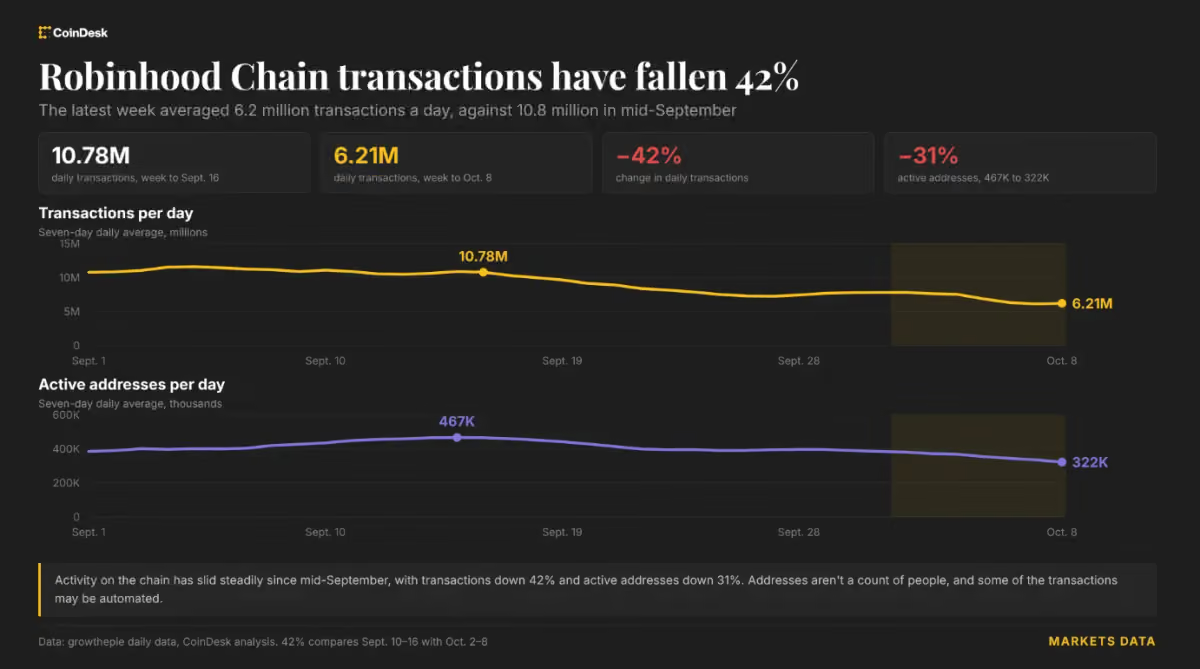
Robinhood Chain slowdown spreads from fees to trading as transactions fall 40%
-
 Crypto2 days ago
ESMA gives EU crypto platforms 3 months to drop non-MiCA stablecoins such as USDT
-

 Sports3 days ago
Harry Kane Ties Peter Shilton’s 125-Cap England Record in Wembley Win Over Czech Republic
-

 Sports15 hours ago
Saudi oil crisis affects Neom project, 2034 World Cup plans
-

 Tech & AI5 days ago
Common Mistakes You Should Avoid When Using Foldable Phones
-

 Sports2 days ago
Internationals make history with emphatic Bridges Cup win at Trump Turnberry | News
-

 Crypto2 days ago
Bitcoin ETF Outflows Hit $485M, Erasing October Inflows
-

 Sports21 hours ago
Eagles stars Barkley and Smith ruled out of London game against Jaguars
-
 Sports2 days ago
Arsenal statement adds to Man City misery after guilty 115 verdict
You must be logged in to post a comment Login