Connect with us

Tech & AI

How Ireland can become a leader in sovereign AI inferencing

Published

on

DeepTechAndQuantumFocus IAG

Dell’s Mark Hopkins explores why Ireland should stop focusing on every ‘layer of the AI stack’ and instead work towards becoming Europe’s home for sovereign AI inferencing.

Click here to read the complete Deep Tech & Quantum Focus

Despite a somewhat complex sounding name, sovereign AI inferencing is simply the process of running AI models on infrastructure that stays within a particular country or region and where it is subject to the places’ rules and regulations. 

It enables organisations, governments and countries to manage their own AI activity and to ensure that it meets certain standards, often in areas such as security, compliance, risk management and even sustainability. It can also give a business or country a competitive edge in a landscape that is increasingly AI-driven. 

With that in mind, many companies worldwide and indeed countries are putting more effort into developing their own technologies and infrastructure, both as a means of reducing external dependencies and maximising homegrown capabilities. 

Advertisement

For Mark Hopkins, a managing director at Dell Technologies Ireland, now is the time for Ireland to take a closer look at how it wants to compete both at home and abroad. He is of the opinion that, rather than focusing on every layer of the AI stack, the country’s real focus should be on becoming Europe’s home for sovereign AI inferencing. 

Hopkins said: “As Ireland holds the Presidency of the Council of the EU, it does so at a defining moment for Europe’s AI ambitions. The question facing Europe is no longer whether AI will transform economies and public services. It already is. 

“The challenge now is more practical; where AI will run, who will control it and whether organisations can deploy it at scale while maintaining trust, security and sovereignty. I believe that challenge presents Ireland with a significant opportunity.”

Friendly neighbours

He explained that many of Ireland’s geographical neighbours are striving to emerge as leaders in AI development, semiconductor manufacturing and research excellence, and that amid some of the noise, the country has the potential to find opportunities elsewhere. 

Advertisement

He said: “As we move from experimenting with AI to deploying it more broadly, inference, the process of putting AI models to work in the real world, could become Ireland’s defining contribution to Europe’s AI ecosystem. Ireland does not need to win the race to build every AI model. But it can become one of the places Europe trusts to run them.”

Hopkins added: “Training models may capture headlines, but inference powers the everyday applications we all depend upon. It enables government departments to improve citizen services, hospitals to support clinical workflows, tax authorities to analyse compliance risks and businesses to make faster decisions.

“Many European organisations will not build their own foundation models. Almost all, however, will need to deploy AI. The strategic question for Europe is not simply who trains AI, but who provides the trusted infrastructure that allows it to operate securely, responsibly and at scale.”

This, he said, is where Ireland can lead. He explained that Europe’s ambitions are suitably aligned with Ireland’s strengths, which include world-class digital infrastructure, data expertise, skilled talent, public and private sectors working closely together and decades of experience in digital technology.

Advertisement

Perhaps most importantly, he is of the opinion that AI sovereignty can address one of Europe’s most pressing challenges, the protection of highly sensitive materials. 

He said: “For years, digital sovereignty was largely a policy discussion. Today, it is an operational requirement. Public bodies and highly regulated industries increasingly need assurance that sensitive data remains protected, AI systems are transparent and workloads operate within trusted regulatory frameworks.

“Inference is therefore becoming a strategic capability. It is where sovereignty moves from aspiration to execution. Organisations need confidence not only in AI models, but in the infrastructure, governance and safeguards surrounding them.”

Taking the lead

Hopkins said that as the holder of the EU Presidency, Ireland has a chance to drive the conversation on topics that affect both the country and the continent. 

Advertisement

He said: “The National Digital and AI Strategy provides a clear direction, while Ireland’s growing ecosystem of AI innovators is helping turn ambition into practical capability. Combined with the country’s international technology relationships and enterprise base, these foundations give Ireland a credible route to AI leadership.”

But leadership will require focus and while “Ireland cannot be everything to everyone in the AI economy”, he explained, there is opportunity in playing to your strengths and owning a “critical part of the value chain”. 

“Inference may not attract the same attention as the race to build ever-larger models. Yet it is where AI becomes trusted, operational and economically valuable. It is where public services improve, businesses become more competitive and Europe’s sovereignty ambitions become real.”

He added: “While Ireland holds the EU Presidency, it should champion the next phase of Europe’s AI agenda; turning ambition into trusted deployment at scale. Now Ireland must seize the opportunity. As Europe enters the deployment era of AI, inference can become Ireland’s national advantage within the European AI ecosystem.”

Advertisement

Don’t miss out on the knowledge you need to succeed. Sign up for the Daily Brief, Silicon Republic’s digest of need-to-know sci-tech news.

Source link

Advertisement
Continue Reading
Click to comment

You must be logged in to post a comment Login

Leave a Reply

Tech & AI

Oppo K14 Plus Review: The Mid-Range Phone I’d Buy for Battery Life

Published

on

K14 plus 3

Amid this AI RAM price-increase debacle, it’s hard for any mid-range phone to stand out. Everyone is cutting corners to survive. Some focus on cameras, others on performance, and then there are phones like the Oppo K14 Plus that put a massive battery at the center of the experience. If you’re in the market for a phone with battery life to spare even after two days, then the OPPO K14 Plus could be worth a look. It packs an 8,000mAh battery, a sharp 1.5K AMOLED display with a 144Hz refresh rate, and a design that looks more expensive than it actually is.

But should you spend ₹32,999 of your hard-earned money? Well, I’ve been using the K14 Plus for more than a month now and have taken it on a few work trips. Here’s how it stacked up.

OPPO K14 Plus Review

Hisan Kidwai

Advertisement

Summary

The Oppo K14 Plus gets the basics right. The battery life is excellent, the 1.5K AMOLED display is great for watching videos, and the design feels better than you’d expect from a phone with a plastic frame and back. That said, the gaming performance is merely adequate, and the camera setup lacks an ultrawide lens.

Advertisement

Design & Hardware

A person holding the K14 Plus

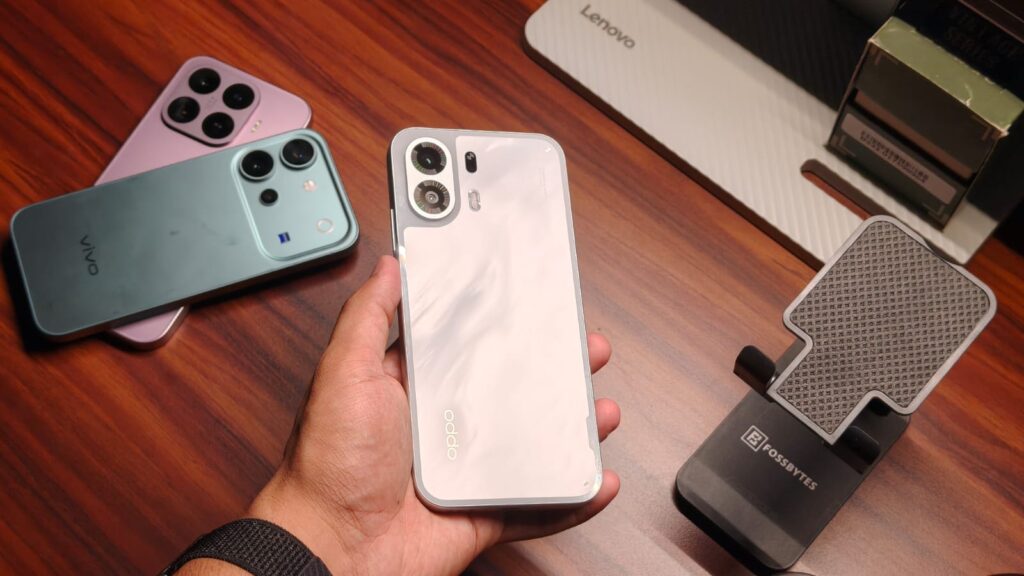
Oppo has done a good job with the K14 Plus’ design. The marble-like finish on the back adds character without looking too flashy. The rest of the rear panel has a smooth finish that complements the design nicely. Everyone I’ve shown the phone to has liked the look. The texture also helps with grip. Despite weighing 207 grams, the phone feels comfortable to hold for extended periods. You can tell there’s some heft to it, but I never found it particularly uncomfortable to carry around or use with one hand.

The buttons feel tactile, and the overall construction feels sturdy. Oppo has used a plastic frame and back panel, but the phone doesn’t feel cheap in the hand. That matters because a fancy-looking back means little if the rest of the device feels poorly built. The camera island on the back is fairly standard, with two lenses inside. It doesn’t get in the way, and looks pretty sophisticated.

Side profile

Oppo has also equipped the K14 Plus with IP66, IP68, IP69, and IP69K ratings. That’s an extensive list of dust and water resistance certifications, though you should generally avoid dipping your phone in water, since water damage isn’t covered under warranty. The front houses an optical fingerprint sensor. It isn’t the fastest, but it did the job well with my greasy fingers.

Display

Dune 3 trailer

The OPPO K14 Plus houses a 6.78-inch AMOLED panel with a 1.5K resolution and a 144Hz refresh rate. Those are flagship-grade numbers, and in my testing, it felt that way too. The AMOLED panel delivers deep blacks and punchy colors, making darker scenes look especially good. I spent my testing watching Shrinking on Apple TV, and it was a great experience. Colors were super vibrant without that oversaturated look.

Outdoor visibility is decent, too. I could use the phone under direct sunlight without constantly shielding the display with my hand. Oppo claims a peak brightness of 3,600 nits, but that’s a peak figure, not a guarantee that the entire display will reach that level in normal use. As for durability, the K14 Plus’ display is protected by the AGC DT-Star D. While I didn’t intentionally throw the phone, it slipped out of my pocket once and fell from hip height. Despite it landing face-first, there was no major damage, and OPPO pre-applies a screen protector.

Performance

A person holding he K14 Plus

Inside, the OPPO K14 Plus uses MediaTek’s Dimensity 7360 Max processor. Alongside, there’s 8GB of LPDDR4X RAM and 256GB of UFS 3.1 storage. ColorOS is my favorite Android skin, and using it on the Oppo K14 Plus reminds me why. Both lightweight apps and heavier ones, such as the camera, open quickly. Switching between tasks is smooth, and the available RAM is enough to keep multiple apps running in the background without aggressively closing them. The animations aren’t quite as pretty as they are on my Find X8, but they’re still fluid enough to make the K14 Plus feel more premium than its price might suggest. You also get some of my favorite AI features, including AI Portrait Retouching, Recompose, and Perfect Shot.

Unfortunately, Oppo still hasn’t figured out how to keep bloatware under control. The phone comes with plenty of pre-installed apps, including the annoying Hot Apps folder, which you’ll need to remove manually. It’s frustrating because the software itself is one of the phone’s strengths, yet you still have to spend time cleaning things up before settling in. Oppo promises three years of software updates and four years of security patches, which is reasonable.

BGMI settings on the phone

Since this is a review, I also ran benchmarks to test the performance ceiling. In Geekbench, the K14 Plus scored 880 in single-core and 2980 in multi-core. In AnTuTu, the phone scored 970,821 points, which is respectable. For gaming, I played BGMI on Smooth graphics, and the phone maintained 60 FPS without major drops. That’s good enough for most casual players. Call of Duty: Mobile was less consistent, though. While the game can run at up to 90 FPS on Low graphics, it throttled performance a lot during battle scenes.

Battery Life & Charging

Battery life stats

The biggest reason to buy the K14 Plus is the 8,000mAh battery. It will easily last you multiple days. For some context, I used the phone for gaming, watching videos, scrolling through Instagram, and occasionally using it as a Wi-Fi hotspot. And I still made it to the end of the day with 30% remaining. That’s the sort of battery life that makes a difference in everyday use. I didn’t have to keep checking the battery percentage or worry as much about finding a charger before heading out

The charging situation, however, is less impressive. The included 45W SuperVOOC charger took the battery from empty to full in more than 1.5 hours. That’s not terrible for an 8,000mAh battery, but it isn’t especially fast, either.

Advertisement

Cameras

A person taking a photo with the K14 Plus camera

The Oppo K14 Plus has a 50MP main camera with optical image stabilization, and that’s it. The other lens is a useless 2MP monochrome sensor, and an ultrawide sensor would have been much better. Regardless, the primary camera does a solid job. In daylight, the photos look sharp, and the highlights are generally well controlled. Shadows struggled in the harshest situations, but nothing major. Night shots are usable, with OIS helping keep things steady, although there’s some noise in darker areas and fine details aren’t as sharp as they are during the day.

Portraits use the same sensor and retain plenty of detail, with accurate skin tones and a nice shallow depth of field, at least in daylight. The selfie camera is decent enough for social media and video calls. Skin tones look natural, facial details are reasonably sharp, and the default skin-smoothing effect is subtle. Unlike the S2 FE, the K14 Plus can record video at up to 4K at 30 FPS. The results are actually usable.

Verdict

K14 plus home screen on a stand

The Oppo K14 Plus gets the basics right. The battery life is excellent, the 1.5K AMOLED display is great for watching videos, and the design feels better than you’d expect from a phone with a plastic frame and back. ColorOS is still my favorite Android skin. But a few things hold it back. Gaming performance is merely adequate, the camera setup lacks an ultrawide lens, and the pre-installed apps are frustrating. None of these issues are a deal-breaker if your main priority is battery life and watching content.

Source link

Continue Reading

Tech & AI

AI delivers ‘zero financial payoff’ to most companies, Apollo economist says

Published

on

GettyImages 1308803174

AI hasn’t benefited the bottom line of any big corporations outside the tech industry, according to a note recently published by the chief economist at Apollo Global Management (the private equity giant that used to own TechCrunch).

Apollo’s Torsten Slok focuses on what he calls the S&P 493 — the S&P 500, minus Alphabet, Amazon, Apple, Meta, Microsoft, Nvidia and Tesla — finding that profit margins and revenue per worker appear to be flat, with no evidence that AI is improving productivity.

“Despite massive investments and widespread hype around artificial intelligence, the technology has delivered zero financial payoff to corporate America outside of tech,” Slok said.

Is this simply a matter of non-tech companies lagging behind the tech giants? Slok sounded skeptical, arguing that it will be tough for corporate America to “turn increasingly cheap intelligence into higher revenue growth and higher profit margins.”

Advertisement

“AI may be a great calculator, but in business, intelligence is mostly judgment,” he wrote, later adding, “AI does not understand accountability, trust, culture, unwritten rules, ethical trade-offs or fairness, all of which shape reputational risk and ultimately drive revenue growth and profit margins.”

Recent studies have also found that AI has yet to deliver significant productivity gains.

Source link

Advertisement
Continue Reading

Tech & AI

NC State Feather Star Robot Swims in Three Dimensions Using Only Two Actuators

Published

on

nc state feather star robot 3d

NC State Feather Star Robot 3D
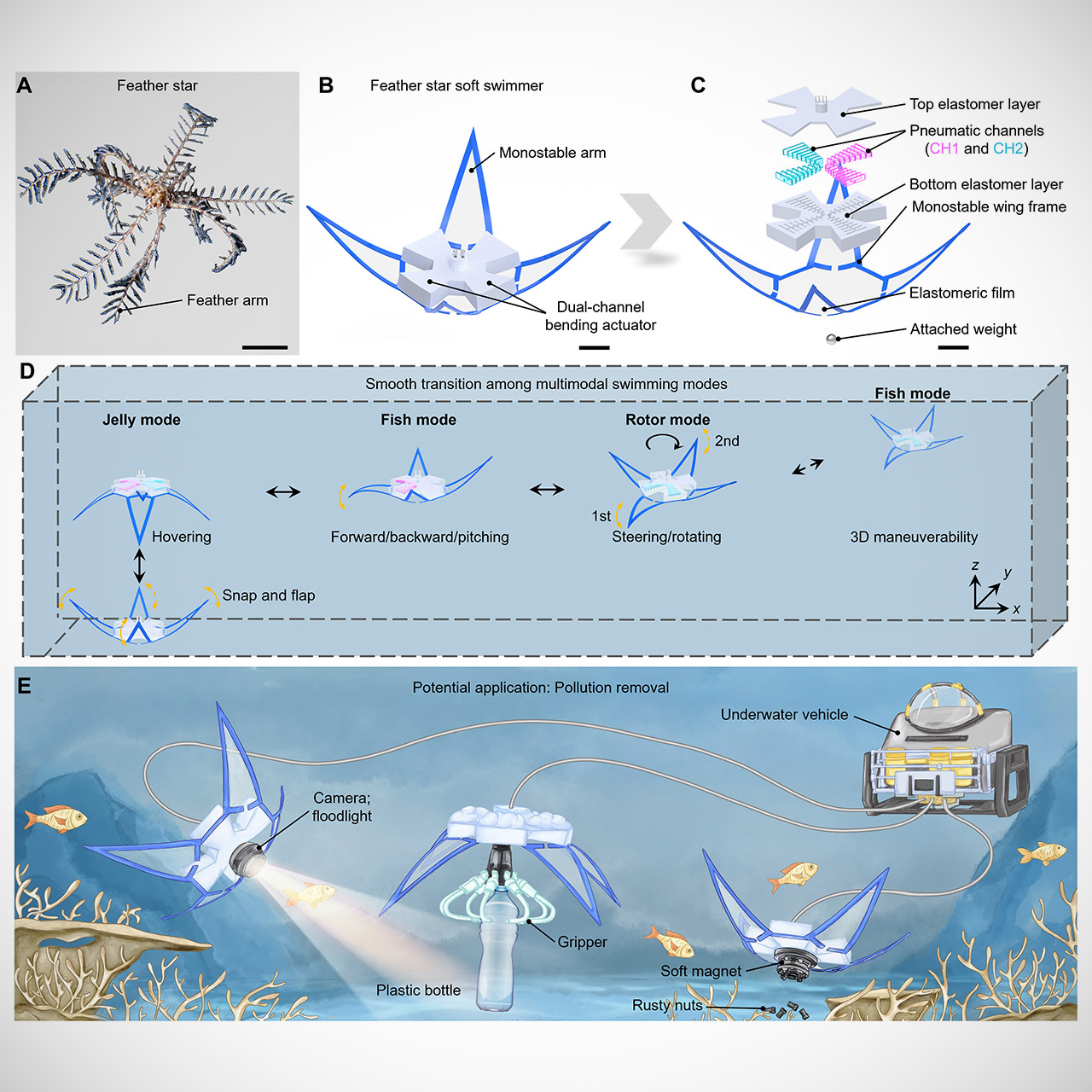
Marine invertebrates called feather stars drift and turn by coordinating clusters of flexible arms, rising, sinking, or hovering with almost no visible effort. Researchers at North Carolina State University copied that coordination in a soft underwater robot that manages the same range of motion with only two actuators.


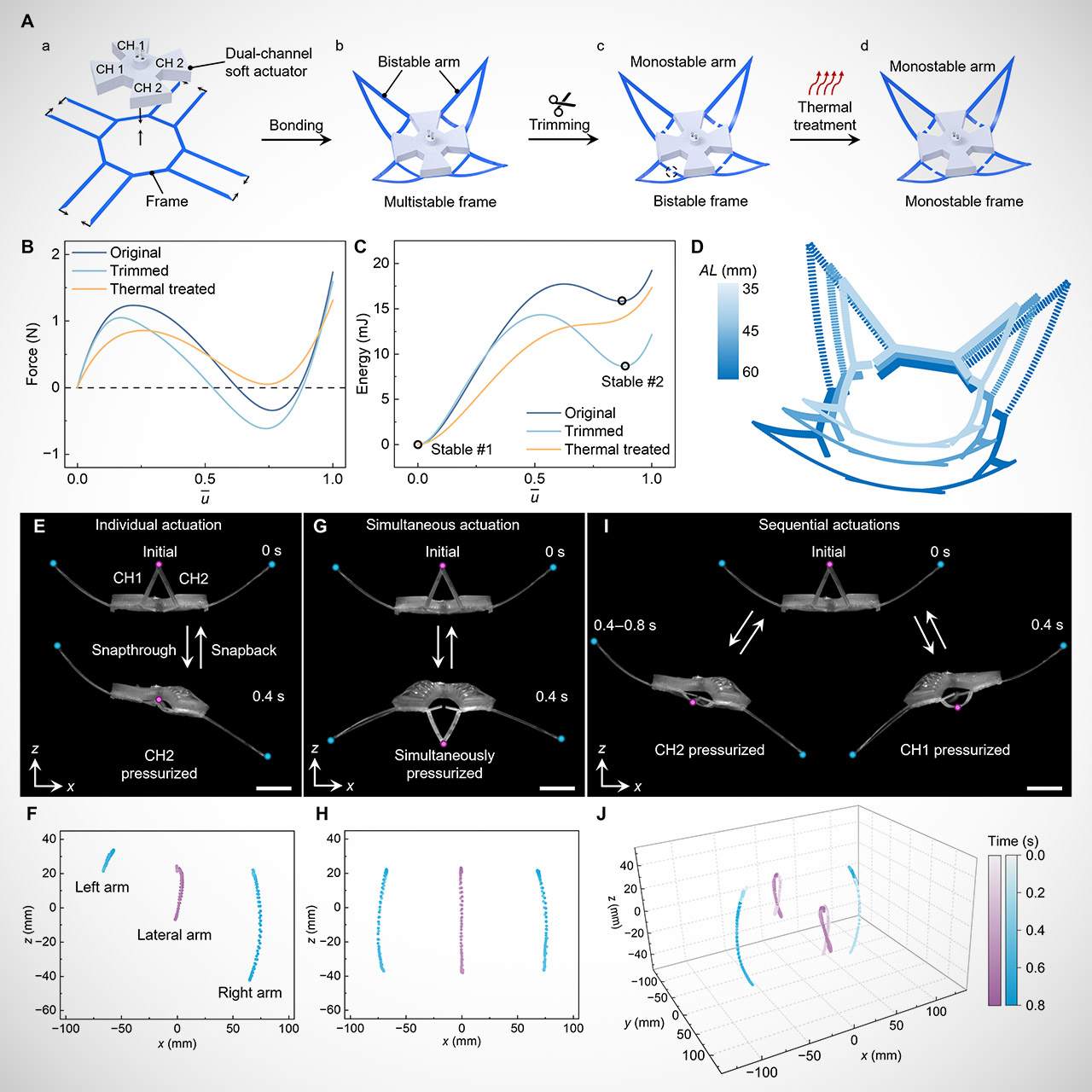
A core disk about 2.2 inches across has two separate air routes going through it. Four little arms made of thin plastic ribbon emerge from the center, curving into a bouncy triangle that snaps back into shape once bent. When both channels fill with air at the same time, all four arms snap down and drive the robot upward in around 26 milliseconds. Let the air go, and the arms will spring back on their own, allowing the machine to sink or stay steady depending on how quickly you repeat the pulses.


Bambu Lab A1 mini 3D Printer + LED Lamp Kit, Ready-to-Use for Beginners | Beginner-Friendly Ecosystem…
  • A1 mini + LED Lamp Kit for Creative Light Projects: Bring your ideas to life with the included LED Lamp Kit. Simply print compatible lamp models and…
  • The Perfect 3D Printer for Beginners: A1 mini 3D Printer is designed to make 3D printing easy from day one with automatic calibration, simple setup…
  • Experience the Bambu Lab Ecosystem: Access MakerWorld’s huge library of ready-to-print models, manage prints through the Bambu Handy app, and enjoy…

Sending air into only one channel causes one arm to wobble like a tail fin, propelling the robot forward or back across the tank; however, alternating the two channels quickly enough causes the robot to spin around on its axis at up to 90 degrees per second. Being able to switch between these three modes, such as having all of the arms flap together for vertical travel, one arm wobbling for straight-line movement, and the two channels pulsing for turning, allows the robot to climb, change direction, and take off in an entirely different direction.

NC State Feather Star Robot 3D
Machines attempting to achieve full 3D movement typically require at least a half-dozen additional actuators, but with this design, the body itself transforms two simple air inputs into numerous distinct swimming modes, a brilliant feat the team refers to as “mechanical intelligence.” It can move at 1.64 body lengths per second, which is significantly quicker than the 0.1 to 0.4 lengths per second achieved by other soft robots such as jellyfish. The entire item weights approximately half an ounce.

NC State Feather Star Robot 3D
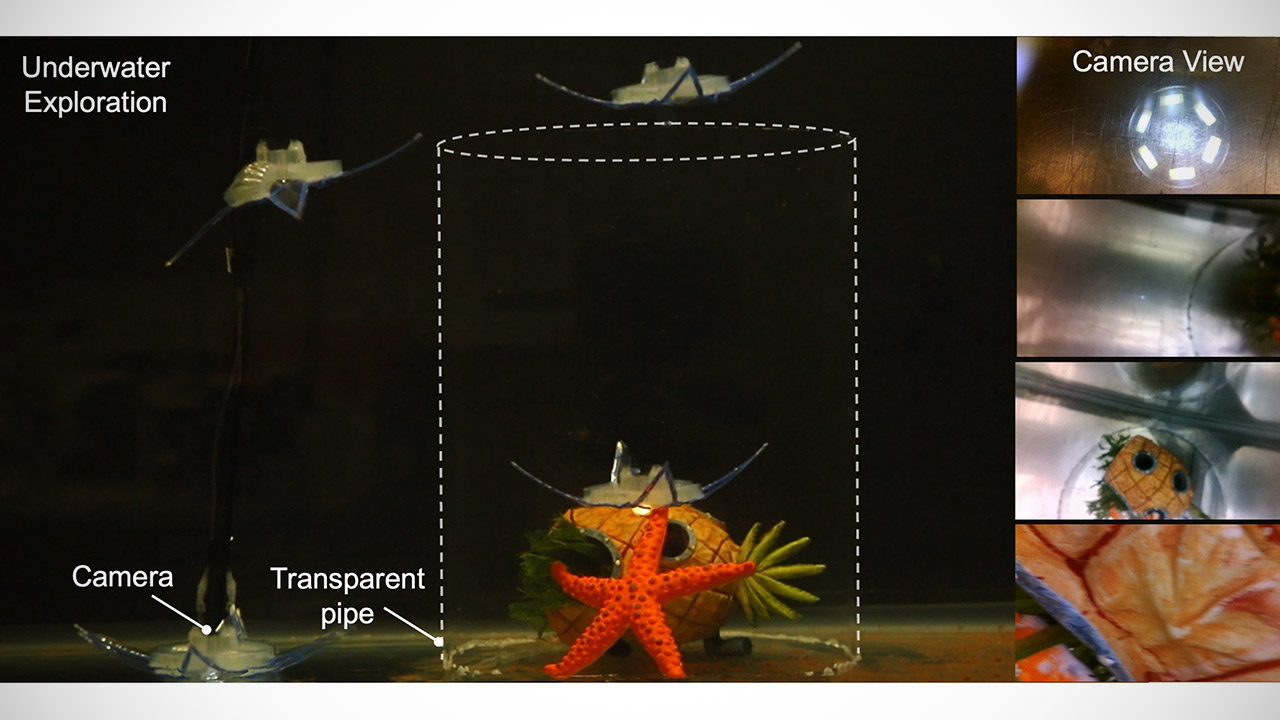
In lab tests, one robot carried a camera smaller than a pencil eraser into a clear tube, another used a magnet pad to pick up screws from the bottom of a tank, and pairs of robots lifted a crumpled bottle or a plastic bag using small hooks. An earlier robot from the same group, which resembled a manta ray, could swim quickly but was primarily limited to horizontal movement. However, this feather star design allows for vertical movement and 360-degree rotation without the use of additional motors.

NC State Feather Star Robot 3D
The robot is still linked to its air supply, which generates some drag and can get stuck in tight spots. Currently, it only follows pre-programmed commands and lacks built-in sensors to adjust for currents or impediments, but the researchers are preparing a fully wireless version and hope to collaborate with experts who can identify methods to use this platform for specific underwater jobs.

NC State Feather Star Robot 3D
Jie Yin, a professor of mechanical and aerospace engineering at NC State, and lead author Haitao Qing, who began this work as a doctorate student at the university, recently published an article presenting their findings in Science Advances. The National Science Foundation and the Office of Naval Research provided funding for this research. This method aims to simplify other soft machines that need to move through fluid by including useful motion into their design.
[Source]

Advertisement

Source link

Continue Reading

Tech & AI

The next MacBook Air could arrive early next year, but OLED will have to wait

Published

on

MacBook Air screen with trees in background scaled

Apple may be about to give the MacBook Pro one of its biggest upgrades in years, but the MacBook Air apparently has to wait a little longer for its turn.

According to Bloomberg’s Mark Gurman, Apple is planning to refresh the MacBook Air in early 2027. The upcoming model is expected to stick with a non-OLED display, even as Apple prepares to move its higher-end MacBook Pro lineup to OLED and touch support.

The current MacBook Air is still pretty fresh

Apple last updated the MacBook Air in March, moving the lineup to its M5 chip. The refresh also doubled the starting storage to 512GB and added Wi-Fi 7 and Bluetooth 6 via Apple’s N1 wireless chip. The design itself stayed largely unchanged. It is still fanless, thin, and lightweight, with a Liquid Retina display and up to 18 hours of battery life.

An early 2027 refresh would therefore put the next MacBook Air roughly a year after the M5 model, which lines up fairly neatly with Apple’s recent update cycle.

The next model could arrive with a simple chip upgrade

The 2027 model of MacBook Air is expected to move to an Apple M6 chip, which has debuted in the Mac mini. Apple’s first 2-nanometer chip uses a new 12-core CPU and 12-core GPU and is designed to improve both performance and power efficiency. We can expect this chip to also power the entry-level MacBook Pro and the refreshed 24-inch iMac, expected to arrive on October 28.

RELATED COVERAGE:

Advertisement

Source link

Continue Reading

Tech & AI

Do you know the Gilliverse? This ultimate Breaking Bad quiz will find out

Published

on

diM9tpwF2Lz85R8q85CT78


It’s been 18 years since Breaking Bad first graced our screens, and four since its final spin-off wrapped up, bringing to a conclusion the story of a drug empire and its characters.

Breaking Bad is cited as one of the best TV shows ever put to screen, and so is its spin-off Better Call Saul. Along with movie El Camino, they make up the Gilliverse, and I hope you’ve seen some of it or you wouldn’t be reading this article.

Source link

Advertisement
Continue Reading

Tech & AI

Preethi Ashwath Went From Chip Lab to Center Stage

Published

on

smiling portrait of a young south asian woman seated in front of her work computer

smiling portrait of a young south asian woman seated in front of her work computer

Many engineers are more comfortable working behind the scenes developing technology than speaking to consumers about products. But Preethi Ashwath has learned to take center stage, talking about the “hearable” and wearable devices she has had a hand in developing as an analog integrated circuit designer in the consumer electronics division at Analog Devices of Wilmington, Mass.

The IEEE member is one of the few women who work in the specialized field, where about 11 percent are female, according to career platform Zippia.

Preethi Ashwath

Employer

Advertisement

Analog Devices, in Boston

Title

Integrated circuit designer

Member grade

Advertisement

Member

Alma maters

SJB Institute of Technology in Bengaluru, India; University of California, Irvine

Ashwath stepped out from behind the scenes last year to meet with attendees at the Consumer Electronics Show (CES) in Las Vegas. She demonstrated Analog’s new earbuds, which track people’s heart and lung health through vibrations in their ear canals.

Advertisement

After she demonstrated her ability to explain the technology to consumers in simple terms, Analog selected her to represent the company at other events. She says she has “come to see speaking as part of contributing to the field, rather than something separate from technical work.”

She also gives technical talks on various aspects of electrostatic discharge (ESD) and other topics, as well as participates in panel discussions, she says, because they “reach engineers well beyond my immediate team.”

Ashwath is an active volunteer with the IEEE Circuits and Systems Society.

“Whether through designing semiconductor products, publishing technical articles, reviewing conference papers, or speaking at industry events, I try to contribute to the growth of the engineering community and the advancement of the field,” she says.

Advertisement

Discovering circuit design at Intel

Ashwath, who grew up in Bengaluru, India, learned about electronics engineering from her high school physics tutor.

That introduction led her to take electronics as one of her core courses in her final years there. At the time, Ashwath’s older sister was pursuing an engineering degree.

“Between my interest in electronics and seeing her already on that path, it became clear to me that engineering was the way to go,” Ashwath says.

After earning a bachelor’s degree in electronics and communications engineering at the SJB Institute of Technology, in Bengaluru, she wanted to pursue a career in very-large-scale integration. But that changed once she moved to the United States and began her master’s program in electrical engineering at the University of California, Irvine.

Advertisement

She discovered her passion for circuits and devices during an internship at Intel in Santa Clara, Calif. She learned about circuit design, package design, and reliability verification tools such as Ansys Totem.

“Seeing every layer of the chip development process gave me a more complete picture of what goes into building a semiconductor product,” she says. “Through that experience, I realized I felt most connected to design.

“It was the hard work and creativity that drew me in. You start with a specification, build a circuit, simulate it, then wait for the chip to come back from fabrication. When your design works, it’s a real feeling of satisfaction. It teaches you patience and perseverance.”

After attaining her master’s degree, she was hired by Intel as an analog design engineer. She gained experience in mixed-signal circuit design before joining Analog. In her current role, she works on consumer hearables such as earbuds and wearables including fitness trackers and health monitors.

Advertisement

Her main focus is designing ESD pad rings, the borders of specialized circuits built around a microchip’s outermost edge to protect it from the discharge, which can damage circuit paths or introduce latent defects that lead to failures later in the chip’s life cycle.

“On a chip with multiple voltage domains, you have to plan how the protection structures are placed and connected across the whole pad ring—and get it right,” Ashwath says. “A mistake there could cause a chip to fail in the field in ways that are very hard to debug afterward.

“It’s detailed work that requires understanding both the device physics and how the whole chip fits together.”

Part of the job is designing and creating an integrated circuit’s building blocks, including ESD protection structures and other mixed-signal blocks. Ashwath conducts rigorous checks to verify they work as intended before being integrated into a chip.

Advertisement

She collaborates with ESD advisors, layout designers, and the digital team that designs the chip’s digital logic.

“I work with them to make sure my analog circuits and their digital blocks work together correctly,” she says. “No two days look exactly the same.”

In 2024 she was recognized with the company’s Impact Award for her “exceptional work on a critical project with significant cross-functional business impact.”

Presenting the final product

Ashwath was selected to represent Analog at events after a senior leader encouraged her to ask for high-visibility opportunities, she says.

Advertisement

“Most of my time is spent on designing circuits and simulations,” she says. “At CES, I stood in front of customers, engineers, and members of the press, explaining our technology and answering questions on the spot.”

The earbuds she demonstrated monitor minute vibrations from a user’s heart and lungs, according to the Analog website. The vibrations can detect arrhythmia, a leaky heart valve, or fluid in the lungs.

“Hearables are evolving from playing back audio to becoming health-monitoring platforms,” she says. “The ear turns out to be a good location for picking up physiological signals, so these devices can capture vital signs while someone is simply wearing them normally.

“The hard part is achieving high signal quality. The signals you’re trying to detect are very small and buried in the noise from the person’s movements and the surrounding environment.

Advertisement

“That’s where analog front-end design becomes critical. Extracting a meaningful signal from a noisy real-world environment is fundamentally an analog problem.”

Being face-to-face with customers at the conference was new to her.

“What struck me most was seeing how people react to the technology,” she says. “When you’re designing a block, you’re focused on specifications and margins. At CES, after explaining what the product does, I had a better understanding of why it matters to them.

“That connection between the circuit work and the final product is something you don’t always see from the design bench.”

Advertisement

Since the CES, Ashwath has presented other technologies she’s worked on. At the annual National Association of Music Merchants show in Anaheim, Calif., she demonstrated the A2B Automotive Audio Bus to the audio industry. The bus uses a low-cost unshielded twisted-pair cable to carry multichannel digital audio, control data, synchronized clock signals, and power in fewer than 50 microseconds, according to Analog.

“IEEE connects you with academia, which you don’t get much exposure to once you’re in industry. That connection between industry and academic work is valuable in both directions.”

At the company’s Global Technology Conference—an internal event held in Boston that draws engineers from the company’s more than 50 sites around the world—Ashwath led a demonstration of its solutions for augmented reality smart glasses.

“Each of these events has a different audience,” she says. “Learning to explain my technical work to different people has become a skill I’ve acquired.”

Advertisement

The most rewarding part of her job, she says, is seeing the end result of her work.

“You spend months on a design, and there’s a long wait between finishing it and finding out whether your instincts were right,” she says. “When the measurements match what you simulated, that’s the most satisfying moment in this job.

“The other part is knowing my work ends up in a real product. The circuits I design go into devices people actually use every day.”

Giving back to the community

Like many engineers, Ashwath joined IEEE to access research published in the IEEE Xplore Digital Library. It keeps her current in a field that keeps moving, she says.

Advertisement

During her first year of membership, in 2021, she discovered other perks including networking and educational opportunities.

“IEEE connects you to a community outside your own company,” she says. “Attending lectures and technical talks exposes you to approaches and problems you wouldn’t encounter in your own work.”

She eventually began seeking out volunteer opportunities, specifically with IEEE conferences and journals, because they are “how you stay current with what’s happening in circuits and systems beyond your own day-to-day work,” she says.

“As an analog designer,” she says, “being connected to that broader community matters. The field moves, and you need a way to keep learning from it.”

Advertisement

She serves as a peer reviewer of papers for several IEEE conferences including the IEEE International Symposium on Circuits and Systems and the IEEE International Midwest Symposium on Circuits and Systems. ISCAS is the flagship conference of the IEEE Circuits and Systems Society. MWSCAS is the oldest U.S. conference on the technologies.

“Someone has to assess whether submitted work is technically sound and worth presenting,” she says, “and that only happens if practicing engineers are willing to put in the time.”

The combination of learning from the community and contributing to it is what makes her membership worthwhile, she says.

“Analog design is a field where you’re always learning. Just when you feel you understand one architecture, there’s another one to learn,” she says. “Being an active learner isn’t optional in this field; it’s the requirement, and being part of the IEEE community helps with that.

Advertisement

“IEEE also connects you with academia, which you don’t get much exposure to once you’re in industry.

“Reviewing papers means reading what researchers are working on, which is often quite different from how the same problems get approached in a product environment. That connection between industry and academic work is valuable in both directions.”

From Your Site Articles

Related Articles Around the Web

Advertisement

Source link

Continue Reading

Tech & AI

The AI agents Muse and Dots, explained: What are they and what they do

Published

on

gettyimages 2300550254

There are some days when there’s so much that needs to get done, I daydream about having a clone of myself. Between paying bills, life admin like renewing my driver’s license, keeping up with doctor’s appointments, and planning meals, it’s a lot. And that doesn’t even begin to touch the work that goes into making a podcast or managing my social life.

This feeling of overwhelm resonates with Sari Azout. She’s a mom of three who works in tech. “There is just so much doing,” she told Explain It to Me, Vox’s weekly call-in podcast. “I wake up, and I have to do meal coordination and get my kids up for breakfast, coordinate carpools. Then a lot of work during the day, but there’s the email from the teacher, there’s the 20 group chats asking if you want to participate in this group gift. They don’t call it ‘the invisible load’ for no reason.’”

Silicon Valley says it has a fix for this kind of mental overload. They don’t want to clone us — at least not yet. But they do think they have the next best thing: AI agents.

Azuot was skeptical when she first got an invite to try an agent, but she says she eventually came around on the technology after back-to-school shopping snuck up on her. She used her agent to get it done. “It blew me away,” she said. “I remember that night coming home just feeling so calm and reading my son a book and feeling present. And I was like, ‘Wow, I actually was very cynical about something that is giving me more time for living.’”

Advertisement

Azout’s experience is, more or less, the sales pitch for AI agents: They’ll help you save time with everyday tasks, so you have more of it for what you want to do. But what are agents, exactly? Are they really all that? And what do we gain — and give up — when we use the technology?

On this week’s episode of Explain It to Me, I spoke with Reece Rogers, a senior software reporter at Wired, to find out. Rogers says to think of agents as the next evolution of AI chatbots like Claude and ChatGPT.

“I’d create this mental model of a tiny digital assistant that’s constantly searching the web, going through your email, and checking your calendar, trying to find ways it could proactively be helpful for you,” he explains. “Agents are more proactive. It’s scanning your email 24/7 and sending you a message, maybe highlighting a potential calendar conflict.”

Below is an excerpt of my conversation with Rogers, edited for length and clarity. You can listen to the full episode on Apple Podcasts, Spotify, or wherever you get your podcasts. If you’d like to submit a question, send an email to askvox@vox.com or call 1-800-618-8545.

Advertisement

What agents are out there right now?

At the start of this year, there was a tool called OpenClaw that really sparked this with early adopters in San Francisco, but now there are much more consumer-friendly versions, with one of the most notable being Meta’s Muse.

There’s also a tool from OpenAI called Dots. But where Meta’s Muse is free to download, OpenAI’s Dots is still behind a $100/month paywall.

You tried an AI agent for a recent story you wrote. How was that experience?

Advertisement

One personal example, to share something that I’ve actually been using agents for, is our couch. It’s broken, and finding a new couch has been a pain. We want a sleeper bed, but we want these specific colors. We have this specific budget. I’ve been using Meta’s Muse and OpenAI’s Dots to try to find a few different options for us.

One interesting thing is that Meta’s Muse is connected to Facebook Marketplace. There are these really good integrations where I can give it all these details, and it found a few good couches that are only maybe a couple blocks from me.

I really enjoyed OpenAI’s Dots experience as well. I spent about an hour talking to it on the phone, and the AI agent made a packet of all these different options I could find. Just this morning, it flagged that one of them is now 40 percent off.

Is that how this tech is typically used?

Advertisement

Most people are using this as part of a workflow. I attach it to my email, I attach it to my calendar, and I’m using it as a personal assistant to organize my life. But people have been quite creative.

One of the breakout uses for Meta’s Muse is people have been connecting their bank account statements and then using it to scan for subscriptions they might want to cancel. So it can be used in many different ways, though I will say I do not connect it to my own bank account for a myriad of reasons.

I’m not going to lie, the idea of giving any third party access to my bank information does not thrill me. I don’t love that concept.

That’s one of my biggest concerns about these AI agents: how much personal information we’re handing over to these large companies.

Advertisement

When I tested Meta’s Muse, it wanted access to my email, my bank account, even my passport expiration details. The pitch is convenience, but Muse users are automatically opted in to having all of their interactions with Muse used to train Meta’s AI models.

I would definitely recommend, if you’re sharing personal details, go into the settings and turn that off because you might be handing over even more information about yourself than you initially realize.

What is the privacy situation with all of this? We all have various apps where we don’t read and still click “I agree,” but this feels like it could be more invasive.

Yes, especially because it’s all about automation. If you’re automating things and it has access to all of your data, it could make mistakes and embarrass you in ways you might not even be thinking about.

Advertisement

There was this one really interesting story of someone who had connected an AI agent to their work Slack in addition to their bank account. And their agent just automatically posted how much money was in their checking account for all of their coworkers to see.

I would be mortified. So there are these kinds of mistakes that these AI tools can still make. If you’re interested in experimenting with them, I would be really thoughtful with how you’re setting up these tools as well as what kind of information you feel comfortable sharing.

“You can see in the marketing that these companies are trying to find some way to entice new users.”

How are these AI agents being marketed? AI is not popular right now. Just ask any politician who has a data center coming to their state. People are not loving it. How are they trying to sell this to the average person?

Advertisement

The AI backlash really is at a fever pitch right now. You could almost see that in the way that AI companies are trying to market these tools. They’ve really, really leaned into cuteness and into adorable mascots.

Muse, if you haven’t seen its agent, looks like a mix between a Labubu and an Ewok. It’s very furry, very cuddly, very cute. OpenAI’s tools also have similar kinds of blobs with large eyes that might be a little endearing.

I feel like companies are hearing this kind of feedback that people aren’t trusting AI right now, or maybe they have moral or ethical reasons they don’t want to use these tools. You can see in the marketing that these companies are trying to find some way to entice new users.

Do you think AI agents are ultimately going to worm their way into our lives despite how unpopular AI companies are?

Advertisement

I do think so. I think in a couple months, maybe when I go home from Christmas, I would not be surprised if my mom had an agent on her phone because it does feel like it’s breaking through to average people in the way that ChatGPT had a moment a few years ago.

Even though there’s a lot of distrust for large companies like Meta, I think there are some appealing parts of this that will bring in millions of people. I do see this as the future of the internet.

When I think of the dream of the average person working in AI in Silicon Valley, it’s “We’re going to use AI. It’s going to free up the free time of so many people. Work is going to get done faster. You’re going to have more leisure time.”

Has that been the case for the people you’ve spoken with who are using this? Has it given them more free time to enjoy themselves or has it done something else?

Advertisement

You would think so, right? You would think that if people are automating these boring aspects of their life, that they would have more time to go touch grass, go see a movie, have some fun. But it does feel like that time just gets filled with other work, other productivity measures.

While agents may be able to take some more annoying or tedious things off of your plate, I am not as optimistic that it’s going to give us this utopia or freedom where I’m always at the beach.

Source link

Advertisement
Continue Reading

Tech & AI

I Caved to the TikTok Trend of Cooking Bacon in Water. Here’s How It Went

Published

on

68ba59d6 43a6 42de a4f0 94053f5b9422

Bacon has become a mainstay on American breakfast plates. This cured, often-smoked pork product, cut mostly from a pig’s belly, adds a one-of-a-kind crunch and savoriness to breakfast, providing a salty counterpoint to other signature dishes like scrambled eggs, pancakes and oatmeal. 

CNET Home Tips badge; click her for more

We all have bacon preferences: charred and crisp, soft and chewy and, for most of us, somewhere in the middle. Regardless of the outcome, a trending TikTok cooking hack claims to at least guarantee even cooking, prevent dangerous, dirty oil splatters, and keep the meat from burning beyond recognition. But does it hold up? I put the viral video tip to the test. 

The water-cooked bacon process

Though I’m a fan of the quick, easy, CNET-approved oven-baking technique and even speedier air fryer method, the water-cooked method allegedly renders the bacon’s fat slowly and consistently, resulting in uniform cooking, fewer splatters and even reduced sodium. 

Here’s how it works.

raw bacon placed flat in pan
The technique couldn’t be simpler.Joey Skladany/CNET

The stovetop process is simple: 

  1. Place bacon slices in an oversized skillet so they lie flat. 
  2. Add ¼ cup of water to the skillet and cook over medium heat. 
  3. Allow the water to steam and evaporate. Once the water is gone, lower the heat to medium-low and cook the bacon until it reaches your desired crispiness. 
  4. Remove the cooked bacon from the skillet and place on a paper towel to soak up excess oil. 
bacon sizzling in pan with water
I assumed the water would cause grease bombs, but it did the opposite. Joey Skladany/CNET

Ultimately, the water is said to suppress hot grease from popping violently and landing on stovetops or, more importantly, your skin. It also lets the meat cook low and slow before it fries in its own grease, rather than crisping immediately as the skillet heats up.  

Water can also draw out some of the bacon’s sodium, which is ideal for those who find it too salty. 

Advertisement

The results

crispy cooked bacon in pan
The bacon turned out crisp with a slight chew.Joey Skladany/CNET

Color me shocked by the results: This cooking tip was executed flawlessly and lived up to the hype. The bacon strips were chewy yet crispy, with no bitter char, and cleanup took mere seconds with a quick wipe with a sponge and towel. (Pro tip: Reserve the leftover bacon grease to cook everything, from vegetables to rice, for added flavor). 

My only gripe was that it took a few minutes longer than using an oven or cast-iron skillet. And, frankly, the clean-up of pesky splatters would far surpass the time it takes to cook with water, at least with the latter tool. 

3 strips of cooked bacon on paper towel
TikTok cooking tips are a mixed bag, but this bacon hack proved itself a winner.Joey Skladany/CNET

In an industry full of gimmicks and unverifiable shortcuts, it’s nice to sift through the culinary fluff and find something that actually works, especially with an ingredient as universally beloved as bacon. The fact that this trick has trended on TikTok is just a footnote and proof that social media sometimes gets it right. 

Hungry for more tips? Here’s how to recycle frying oil, plus a neat trick for degreasing a frying pan before washing.

Source link

Continue Reading

Tech & AI

Moonshot tells Kimi AI to code away, but leave the hacking alone

Published

on

DT 2026 10 25T123235.741

Chinese AI startup Moonshot AI is deliberately limiting the hacking capabilities of its latest artificial intelligence model, highlighting a growing dilemma for the industry: how do companies make AI more powerful without making cyberattacks easier to carry out?

The company introduced Kimi K3.1 Pro on October 24, describing it as a highly capable, open-weight model with around 3 trillion parameters. Unlike conventional AI services that operate entirely through a provider’s servers, open-weight models allow developers to download the underlying model files, run them on their own systems, and modify how they work.

Moonshot said it removed cyber-related data from the model’s training dataset and reinforcement-learning environments to reduce its ability to conduct offensive cyber operations, while retaining its general coding capabilities. The company plans to release the model’s weights on November 4, opening it up to a wider developer community. 

Moonshot reduces hacking capabilities without sacrificing coding

Moonshot’s internal testing suggests the safeguards have made a measurable difference. Kimi K3.1 Pro scored 81% on the company’s cybersecurity benchmark, which involved finding and exploiting software vulnerabilities in a controlled environment. A similar version without the risk-reduction measures scored 90.5%.

Advertisement

That represents a 9.5-percentage-point drop in the reported score. However, the results have not been independently verified, and the model reportedly still outperformed its predecessor.

The distinction matters because the same AI capabilities can be used for both defence and offence. Security teams could use AI to identify weaknesses in software before criminals exploit them. Attackers, meanwhile, could use models that write code, operate software tools and complete multi-step tasks to automate parts of an attack.

Moonshot argues that open-weight AI can help organisations inspect and secure neglected or older software. But once model files are distributed widely, the original developer has less control over who uses them and whether safeguards remain effective.

AI security concerns are becoming a global policy issue

Moonshot’s decision comes as governments and technology companies worry that increasingly capable AI could make sophisticated cyberattacks cheaper and easier to execute. China has also proposed export controls targeting AI-driven malware-generation technology and certain AI-assisted vulnerability-discovery tools. The proposals remain subject to public comment.

For businesses and ordinary users, the stakes extend beyond individual computers. More automated attacks could increase pressure on organisations responsible for protecting personal information, financial systems and critical infrastructure. At the same time, restricting AI security research too aggressively could leave vulnerabilities undiscovered.

Kimi K3.1 Pro also features a one-million-token context window, allowing it to process large amounts of information in one go. Moonshot has introduced a Highspeed version that it says runs two to three times faster than the standard model.

Advertisement

The next major test will come when Moonshot releases the model weights on November 4. Developers and security researchers will then have greater access to examine its capabilities, while the industry will face a difficult question: can safeguards remain effective once a powerful AI model is available for independent use?

RELATED COVERAGE:

Source link

Advertisement
Continue Reading

Tech & AI

Greece Enacts Social Media Ban For Kids Under 15

Published

on

twitter icon large

Greece has passed a law banning children under 15 from social media platforms beginning January 1, 2027. The legislation requires platforms to implement reliable age verification and parents to use government-backed apps to restrict access, with penalties for noncompliance under the EU’s Digital Services Act. Engadget reports: “It would have been very easy to do absolutely nothing today and wait for the perfect European law. But the challenge is here. Children are sinking into the internet every day, and I believe a responsible government must do what it is obliged to do,” said Greece’s digital governance and AI minister, Dimitris Papastergiou.

The legislation was opposed by Greece’s minority parties, so Mitsotakis used his majority government to pass the bill. The nation previously barred mobile phones in schools in 2024, and opinion polls show that the new social media ban for children is widely supported by Greece’s adult population. Mitsotakis previously said that his government’s “goal is to push the European Union in this direction as well.”

Read more of this story at Slashdot.

Advertisement

Source link

Continue Reading

Trending

Copyright © 2025