


Connect with us

Tech

Water, power, and transparency: Amazon’s $12B data center deal signals a new era of accountability

Published

on

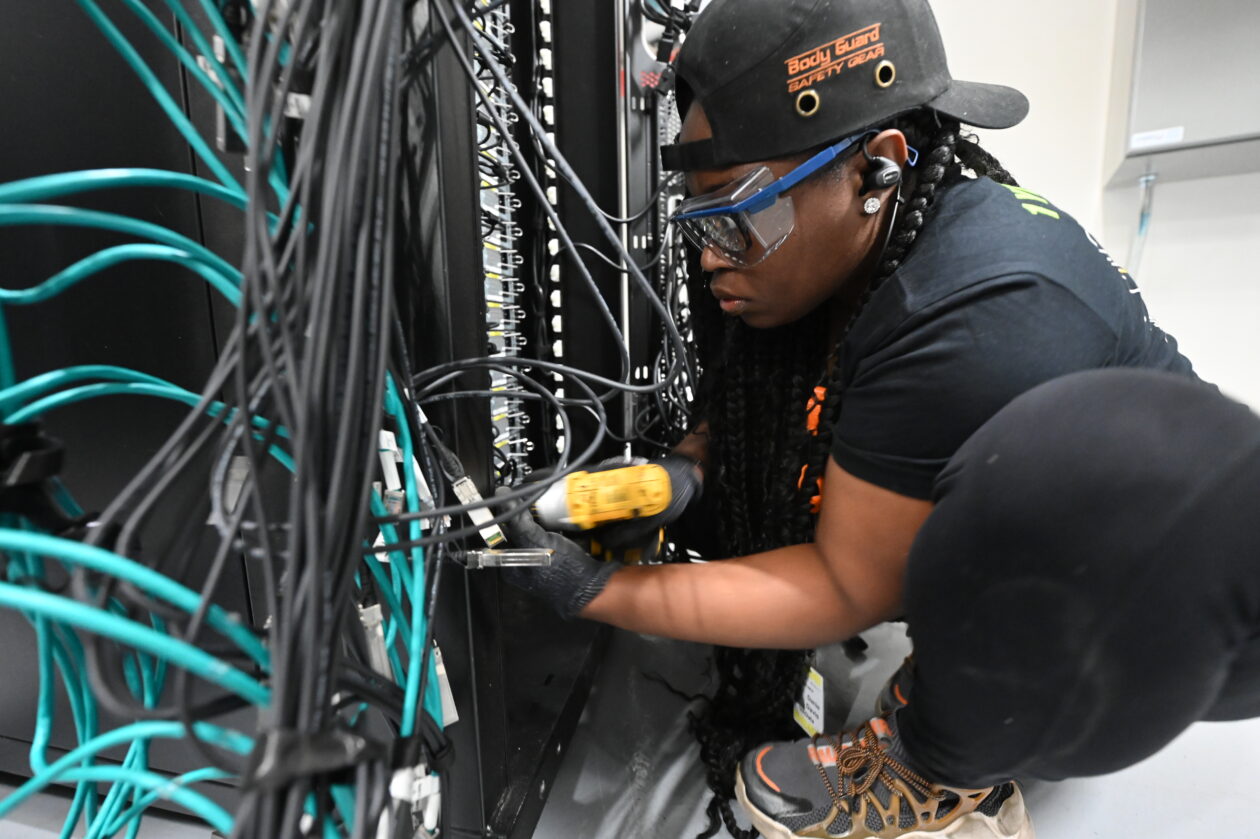
Inside an Amazon data center. (Amazon Photo / Noah Berger)

Amazon on Monday announced a $12 billion data center project in Louisiana in which the company vowed to pay its own way for energy and other infrastructure.

The deal highlights the unwritten expectations now placed on tech giants to cover upfront power costs and other impacts. Such pledges have become commonplace as leaders at the state and national levels move to codify these commitments with new laws.

Amazon’s Louisiana project includes a deal with Southwestern Electric Power Company (SWEPCO) to pay for “energy infrastructure and upgrades required to serve the data centers, which also strengthens overall grid reliability for all SWEPCO customers. In addition, Amazon has invested in solar energy projects in Louisiana, bringing up to 200 [megawatts] of new carbon-free energy onto the grid,” the company said.

Amazon is also pledging to use “only verified surplus water” — which refers to water that is otherwise deemed unneeded by the community where the data centers are based.

Water is used by data centers to cool the electronics that produce heat while computing. Amazon expects to mostly use air to fan the machines, tapping into water cooling for less than 13% of the year in the peak of summer heat.

Advertisement

The company will also spend up to $400 million to improve water infrastructure, plus an additional $250,000 earmarked for the Amazon Northwest Louisiana Community Fund. The philanthropic dollars will help pay for STEM education, sustainability efforts, health and other local needs.

“Amazon is making a long-term commitment to Louisiana because our state delivers — prime sites, strong infrastructure and a skilled, hard-working workforce ready to support the next generation of technological innovation,” Louisiana Gov. Jeff Landry said in a statement.

New rules of engagement

Amazon’s deal in Louisiana comes amid mounting pushback to data centers from local communities and lawmakers.

On Monday, Sen. Bernie Sanders called again for a moratorium on data center deployments, citing Denver’s move to temporarily ban new facilities. The Vermont senator called out data centers’ environmental impacts, as well as AI’s threat to jobs and overall risks to humanity.

Advertisement

Washington state, where Amazon is based, is among the areas pursuing legislation to control the impact of data centers on local communities, including their use of energy and water to run the computer hubs that underpin the internet and support the growing use of artificial intelligence.

The measure, House Bill 2515, passed the House last week and is now being considered by the Senate. The legislation includes public reporting requirements about sustainability impacts and projected energy use, bringing heightened transparency to a sector that has often expanded and operated secrecy.

Meanwhile, tech companies like Amazon and fellow Seattle-area hyperscaler Microsoft are adjusting their approach as they spend heavily to build out the infrastructure needed to power their AI ambitions.

Microsoft last month made a good neighbor pledge for all of its new data centers, vowing to pay the company’s full power costs, reject local property tax breaks, replenish more water than it uses, train local workers, and invest in AI education and community programs.

Advertisement

“This sector worked one way in the past, and needs to work in some different ways going forward,” Microsoft President Brad Smith told GeekWire.

Pursuit of clean power

Amazon has committed to spending $200 billion this year on capital expenditures worldwide, predominately for its Amazon Web Services cloud business. Microsoft expects to shell out up to $140 billion in capital expenses this fiscal year.

Both companies are racing to secure clean energy for their expansions. Beyond wind, solar and batteries, their strategies include new and existing nuclear facilities — and Microsoft is even eyeing fusion energy, an unproven but potentially transformative technology.

Data centers are expected to drive roughly half of the energy growth demand in the U.S. by 2030, according to new data from the International Energy Agency. Solar will provide much of the supply, but so will natural gas, which contributes to the continued warming of the planet.

Advertisement

A new report from BloombergNEF found that Amazon, Microsoft, Meta and Google made nearly half of the world’s new clean energy deals last year. Amazon alone — which tied with Meta in making the most power purchase agreements — paid for nearly 10 gigawatts of energy globally. That’s about one-third of the power demand annually in California.

Overall, the volume of power purchase agreements declined for the first time in a decade as corporations in other sectors stepped back from the deals.

Since 2023, Amazon has annually bought enough clean energy to match its electricity use worldwide.

Last week, Microsoft announced that it, too, hit that benchmark in 2025. That doesn’t mean the companies are literally using only climate friendly power — depending on when and where they operate, their data centers and operations will require fossil fuels while still supporting clean energy use globally.

Advertisement

Source link

Continue Reading
Click to comment

Leave a Reply

Your email address will not be published. Required fields are marked *

Tech

Bungie says ‘no second chances’ if you’re caught cheating in Marathon

Published

on

Bungie isn’t taking any prisoners when it comes to cheating on its upcoming extraction shooter, Marathon. In a detailed blog post explaining its anti-cheat measures, Bungie took a very declarative position against those caught trying to gain an unfair advantage.

“We are taking a strong stance against cheating and anyone found to be cheating or developing cheats will be permanently banned from playing Marathon forever, no second chances,” the blog post read, adding that there will be an appeals system in place.

However, Bungie’s anti-cheat standards go beyond punishment. In the blog post, Bungie detailed that Marathon‘s dedicated servers have full authority on movement, shooting, actions, and inventory. Since these key actions rely on the server, it will translate to smoother gunplay for players as well as the prevention of cheats related to teleportation, unlimited ammo or damage manipulation. Bungie is also incorporating a “Fog of War” system that limits an individual player’s client to see only certain regions of a map, which should prevent wall hacks, ESP cheats or loot revealers.

On top of these robust regulations, Bungie is utilizing BattlEye, a kernel-level anticheat that’s seen with other popular multiplayer shooters like Fortnite, Rainbow Six Siege and Destiny 2. Bungie added that in the event of disconnecting, you’ll be able to reconnect to your run without any hitches. If players can’t reconnect due to an issue with the servers, Bungie said it will “attempt to return the starting gear to all impacted players.”

Advertisement

Marathon isn’t out until March 5, but Bungie is doing a preview weekend with the Server Slam event starting February 26. Still, it’s obvious that Bungie already wants to get ahead of the competition, since Arc Raiders, another recently released extraction shooter, has been dealing with its own cheating problem. To address the rise in cheating, the game’s developer, Embark Studios, implemented a three-strike system, which some players have criticized as too lenient.

Source link

Continue Reading

Tech

6 Best Duffel Bags We Tested While Traveling (2026)

Published

on

This is not a true duffel bag so much as “the world’s first true wide-mouth packing system,” as Rux calls it, but it is nevertheless an impressive piece of equipment from a company known for its modular gear-toting systems. Not unlike a foldable version of the popular 70L storage container, the Duffel box starts completely flat, but the sides pop up, and the patent-pending top rolls down to form a box that stays open on its own. There are no zippers involved in its construction, but there are multiple straps, panels, and pockets, and you will most likely need to watch an instructional YouTube video to make full use of all the features. However, the beauty of this bag is that it can be just about anything you want it to be. Long-term storage, luggage, a gear box—even a backpack. All is possible with the included straps and dividers in the right places.

Over the past four months, my family has used it as a traditional duffel bag, a storage box, and, currently, a portable equipment organizer for my son’s club soccer team. It’s been stepped on, rained on, and thrown in wagons and vehicle trunks, with nary a scratch on the 105D nylon gridstop fabric. (Though it did get stuck in a downpour once, and I will say I’m not sure I’d quantify the fabric as fully waterproof—closer to water resistant.) Lash points along the inside walls allow it to integrate with Rux’s line of accessories and packing bags (sold separately), in which we’re currently keeping pinnies and goalkeeper gear.

The Duffel Box will be officially for sale on March 16 in two sizes, 55L and 75L; pictured is the 55L. Note that a “Plus” version will include a removable universal shoulder strap, which connects to lash points on the outside, for an extra $25. —Kat Merck

Capacity 55L, 75L
Color Options 2
Dimensions 14.2″ x 18.1″ x 12.6″
Materials Nylon gridstop with waterproof coating and PFAS-free DWR. 3-mm EVA foam.
Additional Features Zipper-free. Water-resistant. Compatible with various accessories and packing bags.
Warranty Lifetime

Source link

Advertisement
Continue Reading

Tech

Spain arrests suspected hacktivists for DDoSing govt sites

Published

on

Arrest

Spanish authorities have arrested four alleged members of a hacktivist group believed to have carried out cyberattacks targeting government ministries, political parties, and various public institutions.

The group, which called itself “Anonymous Fénix” and claimed they were affiliated with the Anonymous hacker collective, conducted distributed denial-of-service (DDoS) attacks against targets in Spain and several South American countries, according to the Spanish Civil Guard.

The first attacks occurred in April 2023 and peaked after the flash floods that struck Valencia in late October 2024, when the group’s members attacked multiple government websites, claiming Spanish authorities were responsible for the deaths and destruction caused by the storm.

Wiz

Anonymous Fénix also used X and Telegram to spread anti-government messaging and recruit volunteers for its campaigns.

“From September 2024 they increased their activity and initiated a campaign of recruitment of volunteers with the aim of perpetrating cyberattacks against relevant domains,” the Spanish Civil Guard said over the weekend.

Advertisement

“They reached their peak after the DANA of Valencia when they managed to successfully attack different websites of the Public Administration, justifying that they were ‘the responsible for the tragedy.’”

The Civil Guard arrested the group’s administrator and moderator in May 2025, in Alcalá de Henares, near Madrid, and Oviedo, in the northern region of Asturias. After analyzing the evidence collected following those arrests, investigators identified two additional members of the group as its most active operatives, who were arrested earlier this month in Ibiza and Móstoles, near Madrid.

Following the arrests, Spanish courts also ordered the seizure of the group’s accounts on X and YouTube and ordered the closure of its Telegram channel. No details on specific charges or potential penalties were provided in the Civil Guard’s announcement.

In recent months, Spanish authorities also detained a 19-year-old suspect in Barcelona for allegedly breaching nine companies and dismantled the “GXC Team” crime-as-a-service (CaaS) platform that pushed AI-powered phishing kits, Android malware, and voice-scam tools.

Advertisement

More recently, in January, the Spanish National Police arrested 34 suspects linked to a criminal network involved in cyber fraud and believed to be connected to the Black Axe crime ring.

Modern IT infrastructure moves faster than manual workflows can handle.

In this new Tines guide, learn how your team can reduce hidden manual delays, improve reliability through automated response, and build and scale intelligent workflows on top of tools you already use.

Source link

Advertisement
Continue Reading

Tech

QUOD Is A Quake-Like In Only 64kB

Published

on

The demoscene is still alive and well, and the proof is in this truly awe-inspiring game demo by [daivuk] : a Quake-like “boomer shooter” squeezed into a Windows executable of only 64 kB he calls “QUOD”. We’ve included the full explanation video below, but before you check out all the technical details, consider playing the game. It’ll make his explanations even more impressive.

OK, what’s so impressive? Well, aside from the fact that this is a playable 3D shooter in 64kB, with multiple enemies, multiple levels, oodles of textures, running, jumping et cetera–it’s so Quake-like he’s using TrenchBroom to make the levels. Of course he’s reprocessing them into a more space-efficient, optimized format. Yeah, unlike the famous .kkrieger and a lot of other demos in the 64kB space, this isn’t all procedurally generated. [daivuk] did make his own image editing program for procedurally generated textures, though. Which makes sense: as a PNG, the QUOD logo is probably half the size of the (compressed) executable.

The low-poly models are created in Blender, and all created to be symmetric–having the engine mirror the meshes saves 50% of the vertex data. . Blender is just exporting half of a low-poly mesh; just as he wrote his own image editor, he has his own bespoke model tool. This allows tiling model elements, as well as handling bones and poses to keyframe the model’s animation.

Audio is treated similarly to textures and meshes: built up at runtime from stored data and a layered series of effects. When you realize all the sounds were put together in his sound tool from square and sine waves, it makes it very impressive. He’s also got an old-style tracker to create the music. All of these tools output byte arrays that get embedded directly in the game code.

Advertisement

The video also gets into some of his optimization techniques; we like his use of a map file and analyzing it with a python tool to find the exact size of game elements and test his optimizations thereby. One thing he notes is that his optmizations are all for space, not for speed. Except, perhaps, for one thing: [daivuk] created a new language and virtual machine for the game, which seems downright extravagant. It actually makes sense, though, as the virtual machine can be optimized for the limits of the game, as he explains starting at about 20 minutes into the video. Apparently it saved a whole 2kB, which seems like nothing these days but actually let [daivuk] fit an extra level into his 64kB limit. Sure, it’s still bigger than Quake13k–and how did we never cover that?–but you get a lot more game, too.

So, to recap: [daivuk] didn’t just make a game with an impressively tiny size on disk, he made the entire toolchain, and a language for it to boot. If you think this is overoptimized, check out Wolfenstien in 600 lines of AWK. Of course in spite of the 1980s file size, this needs modern hardware to run. You can get surprising graphics performance from a fraction of that, like this ATtiny sprite engine.

Thanks to [Keith Olson] for the tip, which probably took up more than 64kB on our tips line.

Advertisement

Source link

Continue Reading

Tech

MAHA People Are Mad At RFK Jr. And For Good Reason As He Reverses Stance On Glyphosate

Published

on

from the about-face dept

One of the more perplexing questions in all of the coverage I’ve done on RFK Jr. has been whether or not Kennedy is some misguided true believer or if this is all some grift for power, influence, and/or money. While most people who watch how RFK Jr. has operated on the topic of vaccines, for instance, both before and after he entered government, they assume he’s a real, if stupid, crusader. But they will tell you the same when it comes to processed foods and pesticides, two topics on which Kennedy has also crusaded for years, and two topics that have been noticeably absent or reversed now that he’s in government.

The pesticide topic was recently thrust back into the news. Trump signed an executive order that essentially demanded that two chemicals be produced in higher quantities: phosphorus and glyphosate. Kennedy then came out to cheerlead the executive order as well, which was odd when you consider what glyphosate is chiefly used for.

Trump on Wednesday night signed an executive order invoking the Defense Production Act to compel the domestic production of elemental phosphorus and glyphosate-based herbicides. Glyphosate is the chemical in Bayer-Monsanto’s Roundup and is the most commonly used herbicide for a slew of U.S. crops. Trump, in the order, said shortages of both phosphorus and glyphosate would pose a risk to national security.

Kennedy backed the president in a statement to CNBC Thursday morning.

“Donald Trump’s Executive Order puts America first where it matters most — our defense readiness and our food supply,” he said. “We must safeguard America’s national security first, because all of our priorities depend on it. When hostile actors control critical inputs, they weaken our security. By expanding domestic production, we close that gap and protect American families.”

Advertisement

Bayer-Monsanto has been the defendant in a number of lawsuits over its Roundup product. Specifically, those suits have been powered by claims that glyphosate causes non-Hodgkin’s lymphoma, a form of cancer primarily impacting blood cells. Whether or not you or I think those claims are true, Kennedy sure said he did, since he acted as counsel in some of these suits.

Kennedy, a former environmental attorney, notably once won a nearly $290 million case against Monsanto for a man who claimed his cancer was caused by Roundup. The executive order came down one day after Bayer proposed paying $7.25 billion to settle a series of lawsuits claiming Roundup causes cancer.

The MAHA crowd is understandably pissed. Building a career on these very concrete health stances, only to reverse course while in government to appease Dear Leader, is a fairly horrible look. And it’s actually a worst of both worlds situation, as his MAHA crowd is pointing to his failed promises and hypocrisy, while those who are generally his opponents are pointing out that this might be a stance in which he was actually acting rationally before pulling a u-turn.

“This was one of the few issues where Secretary Kennedy actually embraced credible science,” said Kayla Hancock, Director of Public Health Watch, a project of Protect Our Care. “But RFK Jr. tossed out his years of anti-pesticide advocacy and conviction like a used tissue to stay in the good graces of Donald Trump, who cares more about making his chemical company donors happy than protecting the public’s health. This makes it clear, Secretary Kennedy has no problem selling out his supposed value if there’s a quick buck to be made for special interest donors, or political points to be scored.” 

This seems as close to a solid answer to the question I posed at the start of this post as we’re likely to get. Kennedy, whatever else he might be, is not a true-believing crusader willing to hold firm to his beliefs. He simply does and says whatever will propel his influence and revenue. That’s it.

You’ve been lied to, MAHA people. Lied to and used to put in office the very people who have betrayed you. Let that sink in.

Advertisement

Filed Under: donald trump, executive order, glyphosate, health, health and human services, maga, maha, pesticides, rfk jr., roundup

Companies: monsanto

Source link

Advertisement
Continue Reading

Tech

New Microsoft Gaming CEO Has ‘No Tolerance For Bad AI’

Published

on

In her first major interview as Microsoft’s new gaming chief, Asha Sharma said that “great games” must deliver emotional resonance and a distinct creative voice, while making clear that she has “no tolerance for bad AI.” Stepping in after Phil Spencer’s retirement, she’s pledging consistency, community trust, and a human-first approach to storytelling as Xbox enters a new era. Variety reports: Sharma was quick in laying out her top priorities for Microsoft Gaming in an internal memo announcing her promotion, noting “great games,” “the return of Xbox” and the “future of play” as her three main commitments to the gaming community. So first, what makes a great game for Sharma, whose roles prior to CoreAI include top positions at Instacart and Meta? The new Microsoft Gaming CEO tells Variety it’s all about games with “deep emotional resonance” and “a distinct point of view.” She wants to develop stories that make players “feel something,” like the kind of feelings Campo Santo’s 2016 first-person mystery “Firewatch” elicited in her.

Sharma takes on the mantle as head of the leading competitor to Sony’s PlayStation and Nintendo knowing full well she’s entering the role as an outsider to the larger gaming community and has “a lot to learn” still. But Sharma says she’s got a commitment to “being grounded in what the community is telling us.” “I’m coming into gaming as a platform builder,” Sharma said, adding that her goal is to “earn the right to be trusted by players and developers” and show the fanbase that “consistency” over time. In her interview with Variety, Sharma acknowledged the tumultuous state of the gaming industry, referencing Matthew Ball’s recent State of Video Gaming in 2026 report as evidence that the larger “transformation” of the sector is “protecting what we believe in while remaining open-minded about the future.”

Due to her strong background in AI, initial reactions to Sharma’s appointment have raised concerns about what her specific views are on the use of generative AI in game development. Sharma says her stance is simple: she has “no tolerance for bad AI.” “AI has long been part of gaming and will continue to be,” Sharma said, noting that gaming needs new “growth engines,” but that “great stories are created by humans.”

Source link

Advertisement
Continue Reading

Tech

Take a peek into Apple's efforts to bring Mac mini assembly and chip fabrication stateside

Published

on

Apple is working to bring more manufacturing to the United States, including chip fabrication and Mac mini assembly, but it’s a slow-moving project.

A screenshot of the Apple Maps application satellite view of the TSMC facility, which shows several buildings in an arid environment
TSMC is building several fabs near Phoenix, Arizona

There is increasing pressure to bring more of Apple’s manufacturing and assembly stateside. However, even with $600 billion in investments, what can be done in the US is insignificant compared to the global supply chain.
The Wall Street Journal got special access to various facilities in the United States to examine how Apple is repatriating its supply chain. Executives like COO Sabih Khan joined tours of the TSMC Arizona plant, the Foxconn Houston facility, and others.
Continue Reading on AppleInsider | Discuss on our Forums

Source link

Continue Reading

Tech

Nikon’s Nikkor Z 70-200mm f/2.8 VR S II is official, and improves on first-gen version in several key areas

Published

on


  • New Nikkor Z 70-200mm f/2.8 VR S II weighs just 998g
  • It promises quieter, faster autofocus and six stops of stabilization
  • Available from March, costing £2,999 / $2,999 / AU$5,399

Nikon has announced the Nikkor Z 70-200mm f/2.8 VR S II, a second-gen overhaul of its telephoto zoom promising class-leading weight savings, a faster autofocus system and a redesigned optical formula – all while retaining the f/2.8 maximum aperture that makes this type of lens so useful in low light. The new lens will be available from March 2026, priced at $2,999 / £2,999 / AU$5,399.

The headline figure is its weight. At just 998g (with the tripod collar removed), the new lens is 362g lighter than the original Nikkor Z 70-200mm f/2.8 VR S and, according to Nikon, the lightest lens among 70-200mm f/2.8 options for full-frame mirrorless cameras.

Source link

Advertisement
Continue Reading

Tech

Today’s NYT Mini Crossword Answers for Feb. 24

Published

on

Looking for the most recent Mini Crossword answer? Click here for today’s Mini Crossword hints, as well as our daily answers and hints for The New York Times Wordle, Strands, Connections and Connections: Sports Edition puzzles.


Need some help with today’s Mini Crossword? I thought 5-Down was very tricky, and not really representative of the clue, either. Read on for all the answers. And if you could use some hints and guidance for daily solving, check out our Mini Crossword tips.

If you’re looking for today’s Wordle, Connections, Connections: Sports Edition and Strands answers, you can visit CNET’s NYT puzzle hints page.

Advertisement

Read more: Tips and Tricks for Solving The New York Times Mini Crossword

Let’s get to those Mini Crossword clues and answers.

completed-nyt-mini-crossword-puzzle-for-feb-24-2026.png

The completed NYT Mini Crossword puzzle for Feb. 24, 2026.

Advertisement

NYT/Screenshot by CNET

Mini across clues and answers

1A clue: Goosebumps-inducing
Answer: SCARY

6A clue: Buddy, informally
Answer: HOMIE

7A clue: Rub off, as pencil markings
Answer: ERASE

Advertisement

8A clue: Enjoys a quiet weekend morning, perhaps
Answer: LAZES

9A clue: David Szalay novel that won the 2025 Booker Prize
Answer: FLESH

Mini down clues and answers

1D clue: Section of a bookcase
Answer: SHELF

2D clue: Color similar to salmon that’s also named for a sea creature
Answer: CORAL

Advertisement

3D clue: Leave speechless
Answer: AMAZE

4D clue: Gets out of bed
Answer: RISES

5D clue: “Uff-da!”
Answer: YEESH

Advertisement

Source link

Continue Reading

Tech

How Copyright Litigation Over Anne Frank’s Diary Could Impact The Fate Of VPNs In The EU

Published

on

from the copyright-gone-mad dept

“The Diary of a Young Girl” is a Dutch language diary written by the young Jewish writer Anne Frank while she was in hiding for two years with her family during the Nazi occupation of the Netherlands. Although the diary and Anne Frank’s death in the Bergen-Belsen concentration camp are well known, few are aware that the text has a complicated copyright history – one that could have important implications for the legal status and use of Virtual Private Networks (VPNs) in the EU. TorrentFreak explains the copyright background:

These copyrights are controlled by the Swiss-based Anne Frank Fonds, which was the sole heir of Anne’s father, Otto Frank. The Fonds states that many print versions of the diary remain protected for decades, and even the manuscripts are not freely available everywhere.

In the Netherlands, for example, certain sections of the manuscripts remain protected by copyright until 2037, even though they have entered the public domain in neighboring countries like Belgium.

A separate foundation, the Netherlands-based Anne Frank Stichting, wanted to publish a scholarly edition of Anne Frank’s writing, at least in those parts of the world where her diary was in the public domain:

To navigate these conflicting laws, the Dutch Anne Frank Stichting published a scholarly edition online using “state-of-the-art” geo-blocking to prevent Dutch residents from accessing the site. Visitors from the Netherlands and other countries where the work is protected are met with a clear message, informing them about these access restrictions.

However, the Anne Frank Fonds was unhappy with this approach, and took legal action. Its argument was that such geo-blocking could be circumvented with VPNs, and so its copyrights in the Netherlands could be infringed upon by those using VPNs. The lower courts in the Netherlands dismissed this argument, and the case is now before the Dutch Supreme Court. Beyond the specifics of the Anne Frank scholarly edition, there are important issues regarding the use of VPNs to get around geo-blocking. Because of the potential knock-on effect the ruling in this case will have on EU law, the Dutch Supreme Court has asked for guidance from the EU’s top court, the Court of Justice of the European Union (CJEU).

Advertisement

The CJEU has yet to rule on the issues raised. But one of the court’s advisors, Advocate General Rantos, has published a preliminary opinion, as is normal in such cases. Although that advice is not binding on the CJEU, it often provides some indication as to how the court may eventually decide. On the main issue of whether the ability of people to circumvent geo-blocking is a problem, Rantos writes:

the fact that users manage to circumvent a geo-blocking measure put in place to restrict access to a protected work does not, in itself, mean that the entity that put the geo-blocking in place communicates that work to the public in a territory where access to it is supposed to be blocked. Such an interpretation would make it impossible to manage copyright on the internet on a territorial basis and would mean that any communication to the public on the internet would be global.

Moreover:

As the [European] Commission pointed out in its written observations, the holder of an exclusive right in a work does not have the right to authorise or prohibit, on the basis of the right granted to it in one Member State, communication to the public in another Member State in which that right has ceased to have effect.

Or, more succinctly: “service providers in the public domain country cannot be subject to unreasonable requirements”. That’s a good, common-sense view. But perhaps just as important is the following comment by Rantos regarding the use of VPNs to circumvent geo-blocking:

as the Commission points out in its observations, VPN services are legally accessible technical services which users may, however, use for unlawful purposes. The mere fact that those or similar services may be used for such purposes is not sufficient to establish that the service providers themselves communicate the protected work to the public. It would be different if those service providers actively encouraged the unlawful use of their services.

That’s an important point at a time when VPNs are under attack from some governments because of concerns about possible copyright infringement by those using them.

Advertisement

The hope has to be that the CJEU will agree with its Advocate General’s sensible and fair analysis, and will rule accordingly. But there is another important aspect to this story. The basic issue is that the Anne Frank Stichting wants to make its scholarly edition of Anne Frank’s diary available as widely as possible. That seems a laudable aim, since it will increase understanding and appreciation of the young woman’s remarkable diary by publishing an academically rigorous version. And yet the Anne Frank Fonds has taken legal action to stop that move, on the grounds that it would represent an infringement of its intellectual monopoly in some parts of Frank’s work, in some parts of the world. The current dispute is another clear example of how copyright has become for some an end in itself, more important than the things that it is supposed to promote.

Follow me @glynmoody on Mastodon and on Bluesky. Republished from Walled Culture.

Filed Under: anne frank, anne frank’s diary, cjeu, copyright, diary of anne frank, geoblocking, netherlands, public domain, vpns

Companies: anne frank fonds, anne frank stichting

Advertisement

Source link

Continue Reading

Trending

Copyright © 2025