
Crypto World
Russia-Linked Crypto Activity Drove Illicit Wallet Inflows to a 5-Year High in 2025: TRM Labs



Russia-aligned crypto activity surged even as illicit transactions fell to just 1.2% of total on-chain volume in 2025.
Illicit cryptocurrency activity rebounded sharply in 2025, driven primarily by Russia-linked sanctions designations and improved attribution. A new report by TRM Labs estimates that fraudulent wallets received approximately $158 billion in incoming value during the year, which is the highest level recorded over the past five years.
The increase is a dramatic reversal from 2024, when illicit inflows fell to $64.5 billion, following a steady multi-year decline from $85.9 billion in 2021 to $75.4 billion in 2022 and $73.3 billion in 2023.
Sanctions, Stablecoins, and State Strategy
TRM Labs attributed the 2025 surge not only to intensified enforcement actions but also to expanded use of cryptocurrency by nation-state actors and technological advances that enabled the identification of previously unattributed illicit volumes. The most significant shift was concentrated in sanctions-linked activity tied overwhelmingly to Russia, as volumes associated with sanctioned entities and jurisdictions rose sharply.
The A7A5 token alone accounted for an estimated $72 billion in incoming value, followed by $39 billion linked to the A7 wallet cluster, with the majority of this activity connected to Russia-linked actors, including Garantex, Grinex, and A7.
The blockchain intelligence firm stated that the increase does not reflect sanctions evasion growth alone, but rather the combination of new sanctions designations targeting large entities and improved attribution of cryptocurrency addresses to actors that had already been sanctioned.
Among these, A7 emerged as a central node and functioned as a centrally coordinated sanctions evasion architecture tied to Russian state interests. On-chain activity analyzed by TRM indicates that A7 operates as a hub linking Russia-aligned actors with counterparties across China, Southeast Asia, and Iran-linked networks, in a major pivot toward crypto-enabled, state-aligned financial infrastructure.
While the A7 wallet cluster is closely associated with sanctions evasion activity, the A7A5 token supports a wider push to reduce reliance on USD-based financial systems through the expansion of a ruble-pegged stablecoin. As a result, the high transaction volumes linked to A7A5 do not exclusively represent sanctions evasion, but sanctioned activity more broadly, including state-aligned economic flows.
You may also like:
Fraudulent Crypto Grows
Zooming out from sanctions-related activity, the firm also revealed that overall illicit crypto inflows rose to an all-time high in 2025, even as such activity accounted for a smaller share of the crypto ecosystem. Measured as a proportion of total attributed on-chain volume, illicit activity declined slightly to 1.2% in 2025 from 1.3% in 2024, and remained well below the 2.4% peak recorded in 2023.
A similar pattern was observed when illicit activity was assessed relative to incoming liquidity, as illicit entities received 2.7% of incoming VASP flows in 2025, compared with 2.9% in 2024 and 6.0% in 2023. TRM Labs said these metrics indicate that while certain illicit categories expanded significantly in absolute terms, illicit actors absorbed a smaller proportion of new capital entering the crypto ecosystem.
SECRET PARTNERSHIP BONUS for CryptoPotato readers: Use this link to register and unlock $1,500 in exclusive BingX Exchange rewards (limited time offer).


A bipartisan group of seven House members has formally pressed the Commodity Futures Trading Commission (CFTC) to account for its approach to insider trading in prediction markets and event contracts tied to geopolitical events. In a letter to CFTC Chair Michael Selig, the lawmakers argued that the agency wields clear authority under the Commodities Exchange Act to prevent evasion of the act’s underlying swap provisions, signaling support for Selig’s view that the CFTC has jurisdiction over prediction markets.
The letter also raises questions about how the CFTC polices contracts deemed “morally obscene,” including wagers on U.S. military actions in Iran and Venezuela. The lawmakers pointed to instances of suspicious trades related to the timing and outcomes of such actions, calling for swift and decisive oversight to prevent exploitation of these markets. They warned that allowing these contracts to persist could undermine confidence in a federal regulatory framework intended to ensure fair, transparent markets.
Key takeaways
- Lawmakers request a formal response from the CFTC by April 15 on six questions related to insider trading and the regulation of prediction markets.
- The seven-member letter reinforces the CFTC’s claimed jurisdiction over prediction markets by tying them to the agency’s swap provisions under the Commodities Exchange Act.
- Concerns over “morally obscene” event contracts—such as bets tied to U.S. military actions—highlight ongoing scrutiny of market content and potential misuse.
- Regulatory battles unfold at federal and state levels, including lawsuits by state gaming authorities against Kalshi and Polymarket, with questions of preemption and enforcement increasingly central.
- CFTC enforcement chief David Miller signaled a pragmatic stance on insider trading—prosecuting only cases involving tipping or misappropriated information, not pursuing every minor violation.
Regulatory scope and the arc of enforcement
The exchange between lawmakers and the CFTC underscores a broader debate about how federal commodities rules should apply to prediction markets and event contracts. The letter cites the Commodities Exchange Act as granting the CFTC the authority to apply rules designed to prevent evasion of swaps provisions, reinforcing the agency’s position that prediction markets fall within federal regulation rather than purely state purview. This stance sits against a backdrop of legal challenges to market operators ranging from Kalshi to Polymarket, with state authorities pursuing enforcement actions that argue unlicensed gambling or sports betting violations.
The legal landscape is drafting itself in real time as courts weigh the reach of federal preemption against state gaming statutes. For example, the Third Circuit recently affirmed a lower court ruling blocking New Jersey gaming authorities from pursuing enforcement actions against Kalshi, with two of three judges indicating Kalshi had a reasonable chance of success in arguing that federal commodities laws preempted state actions. The outcome of these jurisdictional questions could shape how prediction markets operate across multiple states and whether state regulators can curb activities they deem unlawful without clashing with federal authority.
Beyond court battles, industry players continue to navigate a patchwork of state laws and regulatory expectations. Kalshi and Polymarket have faced separate suits and inquiries as states seek to police unlicensed gambling while federal regulators frame certain event contracts as swaps. The evolving regulatory posture matters for investors and builders who rely on predictable rules for creating, listing, or trading contracts tied to real-world events.
Insider trading enforcement: a measured approach
As lawmakers pressed for more aggressive oversight, CFTC enforcement chief David Miller weighed in on how insider trading in prediction markets would be pursued. Miller indicated that the agency would prosecute cases involving tipping or trading on misappropriated information but would not allocate resources to “trivial” instances that do not rise to a material manipulation of market integrity. The distinction—between serious, information-based misconduct and routine or minor mispricings—speaks to a broader enforcement philosophy that weighs market impact against prosecutorial effort.
For market participants, the comment signals that while insider trading remains a crucial concern, the CFTC’s approach may prioritize cases with clear, material harm to market fairness. This stance could influence how platforms design surveillance, disclosure, and antifraud controls to deter misuse without hampering legitimate price discovery and hedging activity.
What to watch next: implications for platforms and investors
The administration of prediction markets sits at the intersection of financial regulation, consumer protection, and national security considerations. The current letter and the broader regulatory dialogue suggest several trajectories to monitor:
- Regulatory clarity could emerge on whether prediction markets are categorically swaps under federal law or if alternative regulatory frameworks apply in specific contexts. The outcome will affect platform licensing, product design, and cross-state operations.
- State actions against prediction-market operators may continue to test the balance between state gaming authority and federal preemption, with potential implications for market access and compliance costs.
- Enforcement priorities could tilt toward high-impact, information-based misconduct, prompting platforms to strengthen anti-insider trading controls, surveillance analytics, and governance standards to deter misconduct.
- Investors and developers should watch how sensitive event contracts—especially those tied to geopolitical or military actions—are treated in terms of content guidelines, listing approvals, and risk disclosures.
The exchange between lawmakers and regulators arrives amid broader conversations about how to harmonize innovation in on-chain or off-chain prediction markets with robust oversight. As platforms adapt to the regulatory rhythm, participants should weigh the potential for policy shifts that could either broaden permissible activities under uniform federal standards or tighten restrictions at state levels. The next formal response from the CFTC by mid-April will be a telling signal of how aggressively the agency plans to police insider trading and whether it will pursue a more centralized, comprehensive framework for prediction-market regulation.
For readers following the evolution of prediction markets, the unfolding dynamic between federal regulators, state enforcers, and market operators like Kalshi and Polymarket will shape both the viability of these platforms and the risk landscape for traders who rely on event-based contracts to hedge or speculate. The coming weeks will reveal whether lawmakers’ questions translate into tangible regulatory clarity or simply intensify the ongoing debate over the proper scope of the CFTC’s powers in this evolving arena.
Readers should stay attentive to any formal CFTC responses, upcoming court decisions affecting jurisdiction, and platform-level governance changes that may arise as a result of increased scrutiny into insider trading and the content of event contracts.

TLDR
- SOL Strategies has acquired Darklake Labs for $1.2 million to expand its role in Solana’s ecosystem.
- The deal includes $200,000 in cash and $1 million in SOL Strategies common shares, with the stock portion subject to a four-month lockup.
- Darklake’s Zyga zero-knowledge proof system will enhance privacy features and reduce transaction vulnerabilities on the Solana blockchain.
- The acquisition brings in Darklake’s core team, including CEO Vitor Py Braga and COO Amber Hales, both of whom have extensive blockchain experience.
- SOL Strategies has been scaling its Solana holdings, with a treasury of 533,040 SOL valued at approximately $43.9 million.
SOL Strategies has confirmed the acquisition of Darklake Labs, a Solana-native zero-knowledge startup, for $1.2 million. The deal includes $200,000 in cash and $1 million in common stock, subject to a four-month lockup. This acquisition will bring privacy technology and new expertise to SOL Strategies as it increases its involvement in the Solana ecosystem.
SOL Strategies Strengthens Its Solana Presence Through Acquisition
In a strategic move, SOL Strategies has agreed to acquire Darklake Labs, a privacy-focused startup specializing in zero-knowledge proofs (ZKPs). This acquisition is aimed at expanding SOL Strategies’ involvement in Solana’s blockchain development. Darklake’s expertise in ZKP technology will enhance the company’s offerings and provide a new layer of privacy-focused solutions.
The $1.2 million deal is divided between $200,000 in cash and $1 million in SOL Strategies common shares. The stock portion is subject to a four-month lockup period. This purchase positions SOL Strategies as a more active participant in Solana’s technological growth, especially in the growing privacy and security space. Darklake’s proprietary Zyga ZKP system is designed to improve transaction privacy on the Solana blockchain.
The Acquisition Brings Talented Individuals and Research Partnerships
The acquisition also includes Darklake’s core team, led by CEO Vitor Py Braga, a former infrastructure engineer at Meta and IBM. He will join SOL Strategies, bringing his deep technical expertise in blockchain infrastructure. Amber Hales, Darklake’s co-founder and COO, will also join the team, offering her valuable experience in compliance from previous roles at Coinbase and Coincover.
Darklake has developed strong academic partnerships in Brazil and is in the process of filing a patent for its ZKP technology. SOL Strategies will benefit from these collaborations, further strengthening its research capabilities. The company’s acquisition of Darklake is not just a hire; it reflects a deeper commitment to advancing Solana’s ecosystem with innovative solutions.
SOL Strategies Pushes Forward with Solana Growth and Institutional Access
As part of its ongoing strategy to expand its Solana holdings, SOL Strategies also reported a treasury balance of 533,040 SOL. This includes liquid staked SOL, worth around $43.9 million based on the April 1 price of SOL. In addition to the treasury, SOL Strategies has seen growth in its validator operations, managing 3.8 million SOL under delegation and 768,022 SOL in its liquid staking product, STKESOL.
The company has been expanding institutional access to its staking infrastructure. In March, Balance, a digital asset custodian, integrated SOL Strategies as a staking provider for its clients. ARK Invest’s Digital Asset Revolutions Fund also selected SOL Strategies as a Solana staking provider, further validating its role in Solana’s expanding ecosystem.



Solana DEX Stabble has urged its users to withdraw all liquidity after a former employee was outed as a North Korean operative.
The IT worker in question, who has also worked for Solana crypto fund Elemental, was named by crypto sleuth ZachXBT on Tuesday during a back and forth with Elemental founder “Moo.”
When the discussion turned to the issue of trust – something that Moo says they’ve been “obsessing over” for four years – Zach responded, “Stop virtue signaling you conveniently left out the fact that you had a DPRK IT worker on payroll at Elemental for years.”
The investigator then went on to reveal details of the alleged mole, naming him as Keisuke Watanabe, aka “kasky53,” and posting his GitHub aliases and email address.
Read more: The solution to crypto’s Lazarus problem could be simpler than expected
Stabble quickly quote tweeted Zach and urged its users, “To be safe – everyone please temporally [sic] withdraw your liquidity instantly!
“Better safe than sorry.
“This is the new team from Stabble, that aimed to repair the project.
“We will do new audits to be safe about our LPs.
“Then we can continue. Safety first.”
It then admitted that it employed Watanabe a year ago.
DPRK plants have been on crypto payrolls ‘for years’
The warning comes as the industry grapples with fresh revelations from ZachXBT, who revealed this week that North Korean IT workers have been quietly embedded on crypto project payrolls for years.
Previous investigations have shown millions of dollars flowing to suspected DPRK-linked developers operating under fake identities, raising concerns about insider access and long-term infiltration risks.
Footage circulating on X appears to show suspected DPRK IT workers abruptly leaving a Zoom call after being prompted to criticize North Korean leader Kim Jong Un, further fueling speculation about covert operatives inside crypto teams.
The developments follow the recent Drift Protocol hack, one of the largest DeFi exploits of 2026, in which more than $200 million – and potentially up to $285 million – was drained.
Analysts and blockchain researchers have linked the attack to North Korean hacking groups, citing patterns consistent with past operations tied to the Lazarus Group.
Read more: CHART: North Korea stole $2.8B in crypto hacks since 2024, report
One trading firm with close ties to Drift said it was “bombed back to the stone age” by the exploit, highlighting the scale of the damage across interconnected Solana liquidity providers.
The attack itself was notable not for a smart contract bug, but for a prolonged social engineering campaign.
Investigators say attackers spent months building trust, infiltrating contributor circles, and ultimately exploiting governance mechanisms to drain funds in a matter of minutes.
Protos has reached out to Stabble for comment and will update if we hear back.
Got a tip? Send us an email securely via Protos Leaks. For more informed news and investigations, follow us on X, Bluesky, and Google News, or subscribe to our YouTube channel.
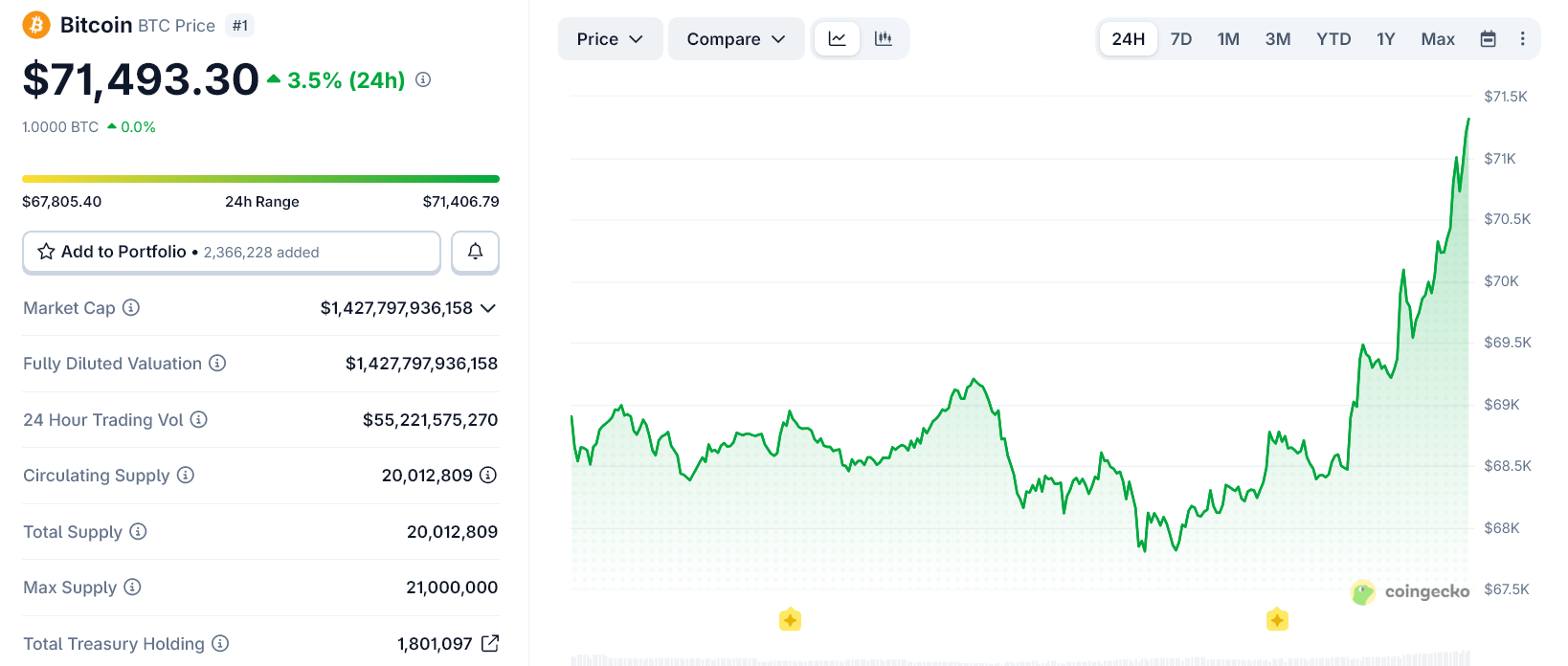
Bitcoin jumped to around $71,500 late April 7 after US President Donald Trump announced a sudden pause in planned military action against Iran, signaling a potential de-escalation in the ongoing conflict.
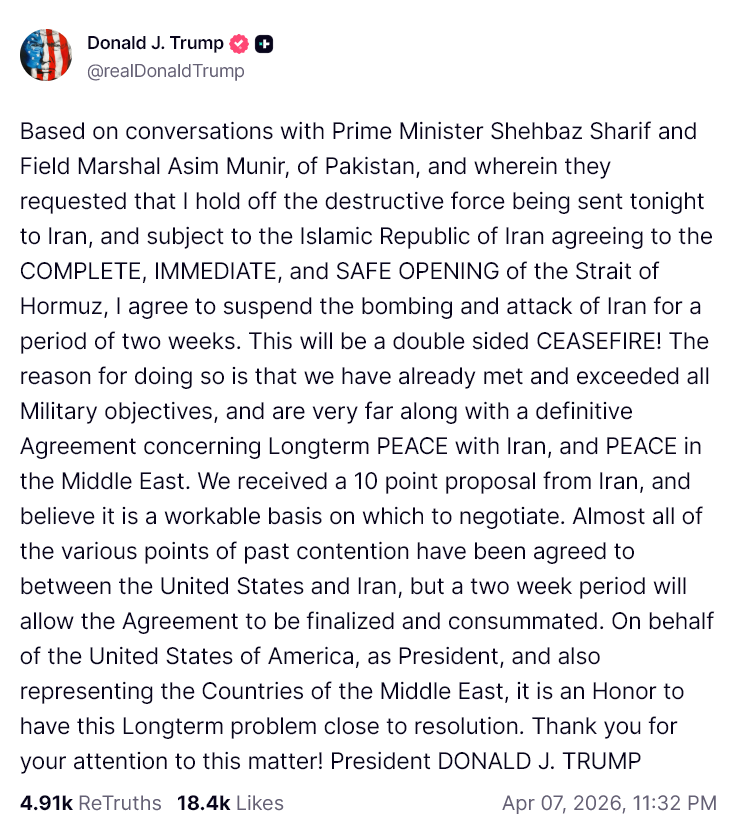
In a post on Truth Social, Trump said he agreed to suspend strikes on Iran for two weeks following direct conversations with Pakistan’s PM and Army Chief Asim Munir.
He added the pause is conditional on Iran agreeing to the “complete, immediate, and safe” reopening of the Strait of Hormuz.
Trump framed the move as part of a broader diplomatic breakthrough. He said the US had already achieved its military objectives and was close to finalizing a long-term peace agreement with Iran.
According to the statement, Tehran has submitted a 10-point proposal that Washington sees as a workable basis for negotiations.
Markets reacted instantly. Bitcoin surged nearly 3%, reclaiming the $71,500 level, while earlier pressure on risk assets eased as traders priced in reduced escalation risk.
The announcement follows hours of heightened tension ahead of Trump’s self-imposed deadline, which had raised fears of large-scale strikes on Iranian infrastructure. The two-week window now shifts focus back to negotiations.
The post Bitcoin Surges Past $71,000 as Trump Pauses Iran Strikes, Signals Ceasefire appeared first on BeInCrypto.
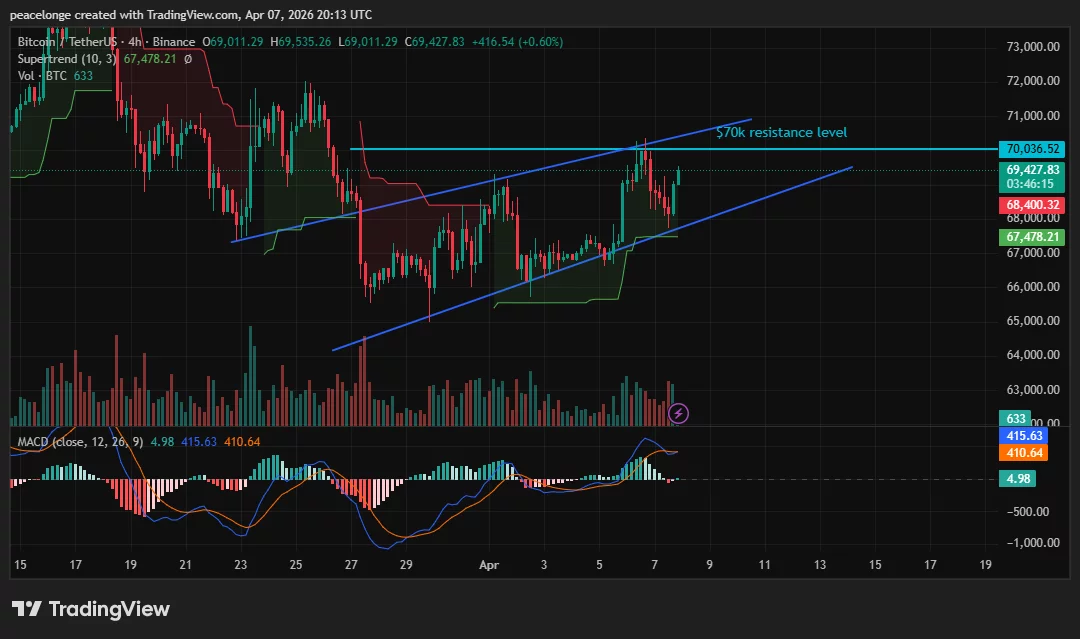
Bitcoin price briefly touched $70,000 on April 7 within a well-formed ascending channel on the 4H chart, as spot ETF inflows logged $471 million on April 6, the strongest single-day institutional demand figure since late February.
Summary
- Bitcoin price reached an intraday high of $70,036 on April 7 before easing to $69,427, pressing the upper boundary of a 4H ascending channel that has held since late March.
- The 4H MACD is printing a bullish cross with the MACD line at 415.63 above the signal at 410.64 and a positive histogram of 4.98, while the Supertrend at $67,478 provides trailing support below price.
- A confirmed 4H close above $70,036 targets $71,000 resistance, while a break below the Supertrend at $67,478 exposes $66,300 as the next structural level.
Bitcoin (BTC) price is trading at $69,427 on April 7, having touched an intraday high of $70,036, the first test of the $70,000 level since March 26. The move came alongside $471 million in spot Bitcoin ETF inflows on April 6, the 6th-largest single-day figure of 2026 per SoSoValue data. The 4H chart shows an ascending channel in place since late March, with price printing consecutive higher lows from the $65,000 zone toward $70,000, but the round-number resistance has capped the advance through multiple sessions.
On the 4H chart, Bitcoin is trading within a defined ascending channel built by two parallel diagonal trendlines. The lower boundary aligns with the Supertrend at $67,478 and has acted as dynamic support throughout the recovery. The upper boundary coincides with the $70,036 resistance annotated on the chart. The 4H MACD is in a confirmed bullish cross, with the MACD line at 415.63 trading above the signal at 410.64 and a positive histogram of 4.98, reflecting building momentum even as price hesitates at resistance.
Analyst Michael van de Poppe of MN Trading Capital wrote on X on April 4 that “the longer the range persists, the heavier the breakout becomes,” adding: “I expect a break above $71,000.” Technical analysis from Investtech published April 7 shows Bitcoin “has given a positive signal from the double bottom formation by a break up through the resistance at $68,120,” with a further rise to $69,769 or more signalled. That target has already been cleared, strengthening the short-term case.
Key Levels: $68,400 Support, $71,000 Bull Target, $67,478 Invalidation
The $68,400 level visible on the 4H chart is the immediate structural support below current price. A close below it exposes the Supertrend at $67,478, which is the invalidation level for the bullish thesis. Investtech identifies $66,300 as the next support below, representing a potential 4.5% decline from current levels in the bear case. On the upside, a confirmed 4H close above $70,036 resolves the current resistance and opens the path to the $71,000 level per van de Poppe’s analysis, with the ascending channel structure remaining intact as long as the Supertrend holds.
ETF Inflows Driving Independent Institutional Demand
Spot Bitcoin ETFs have drawn consistent inflows across recent sessions, with the $471 million on April 6 reflecting renewed institutional appetite at current price levels. According to Binance Research, Bitcoin’s correlation with its Global Easing Breadth Index “turned strongly negative after the launch of spot bitcoin ETFs,” suggesting ETF demand now operates more independently from broader macro conditions. The Iran ceasefire talks on April 6 and 7 provided a short-term macro catalyst, but ETF buyers were already positioned ahead of the move, reinforcing the institutional demand floor near current levels.
If $70,036 continues to hold as resistance, a retest of $68,400 and then the Supertrend at $67,478 becomes the more probable near-term path before any further breakout attempt. A clean 4H close above $70,036 with volume confirmation targets $71,000 as the next resistance.

Grayscale Research has called for the early rollout of quantum-resistant blockchain upgrades following a new warning from Google Quantum AI. The report suggests that quantum computing could undermine current cryptographic encryption methods sooner than previously anticipated. As a response, Grayscale highlights the XRP Ledger and Solana’s efforts in post-quantum cryptography as potential solutions to address these emerging security risks.
XRP Ledger’s Quantum-Resistant Efforts
The XRP Ledger (XRPL) has begun experimenting with quantum-resistant technologies to prepare for future threats posed by quantum computing. The ledger is currently testing ML-DSA signatures on its AlphaNet. Although these efforts are still in the early stages, Grayscale notes that they represent a critical step toward enhancing the security of blockchain systems in a post-quantum world.
Grayscale emphasizes the need for the blockchain community to accelerate the implementation of such solutions. The crypto industry faces challenges like engineering and consensus-building, which require significant collaboration across networks. Moreover, any quantum-resistant upgrade must address potential issues, including a reduction in transaction throughput, which could affect the network’s scalability.
While XRPL is not entirely ‘quantum-proof,’ the experiments on the AlphaNet represent meaningful progress in preparing for quantum threats. Grayscale advocates for further testing and the eventual deployment of these cryptographic updates to safeguard the blockchain from quantum attacks. The project is still evolving, but it is an important step forward in the industry’s readiness.
Solana’s Post-Quantum Cryptography Research
Solana is also taking proactive steps in response to the potential risks posed by quantum computing. The network has partnered with Project Eleven to experiment with quantum-resistant cryptographic signatures. These efforts aim to secure the blockchain from future quantum threats that could undermine the existing encryption methods.
However, Grayscale cautions that quantum-resistant upgrades on Solana have shown the potential to significantly reduce network speed. The tests indicate that the implementation of quantum-resistant signatures could lead to a 90% decrease in the network’s speed. While security is a top priority, the challenge remains to balance quantum resistance with maintaining the blockchain’s scalability.
Despite these challenges, Grayscale views Solana’s initiative as another significant step toward ensuring the blockchain ecosystem’s resilience. The company emphasizes that the crypto industry must continue to experiment with and refine these solutions. Solana’s involvement in post-quantum cryptography is just one example of how blockchain networks are preparing for the future.
The Impact of Quantum Computing on Bitcoin
Grayscale’s report also highlights how quantum computing poses different risks to blockchains based on their structures. Bitcoin, for example, uses a UTXO (unspent transaction output) model, which Grayscale argues makes it less susceptible to quantum threats than blockchains with an account model, such as Ethereum. Bitcoin’s lack of native smart contracts further reduces its exposure to quantum computing vulnerabilities.
However, Grayscale points out that the primary concern with quantum computing is the potential loss of private keys. If a private key becomes inaccessible, it could lead to the loss or inaccessibility of coins. This situation could result in coins being burned, deliberately withheld, or simply left unused.
Bitcoin’s network also faces challenges in reaching consensus on protocol changes. Grayscale references last year’s debate over the inclusion of image data in blocks as an example of the hurdles the Bitcoin community must overcome when addressing security upgrades. The road ahead for quantum-resistant solutions will require significant collaboration and decision-making within the community.

Fresh on-chain data indicates Bitcoin may be carving out a new phase of supply dynamics, with long-term holders expanding their wallets and fewer coins circulating on exchanges. By early April 2026, the total amount held by accumulating cohorts surpassed 4.37 million BTC, reflecting a sustained shift of supply into HODL-oriented addresses even as the price hovered below previous all-time highs.
The pattern coincides with a notable uptick in network activity and a stubborn drawdown in active short-term participation, painting a nuanced picture for traders and investors alike as the market contends with shifting liquidity and potential price implications.
Key takeaways
- Accumulating cohorts now hold about 4.37 million BTC as of April 7, with long-term wallets continuing to absorb supply into Q2 2026.
- Retail-investor accumulation added roughly 857,000 BTC, while accumulating-pattern wallets expanded by about 1.29 million BTC—both contributing to the broader growth in long-term holdings.
- Exchange inflows have cooled markedly, averaging roughly 300,000 to 350,000 BTC—far below the 1.2–1.5 million BTC ranges seen during prior expansion phases in 2023–2024.
- The Bitcoin network activity index climbed to about 3,600, up from 3,320 on March 22, moving above its 365-day moving average for the first time since December 2024 and entering a bull-phase classification for the first time since April 2025.
- Active-address momentum slumped to -0.25 on April 6, the lowest reading since 2018, suggesting diminished short-term participation and a market dominated by long-term holders.
Long-term wallets expand holdings, reshaping liquidity
According to CryptoQuant data, the cohorts that accumulate BTC in regular, capped-out flows have continued to grow in the first quarter of 2026. The total BTC held by these accumulating cohorts reached 4.37 million BTC as of April 7, a substantial rise from the 2 million BTC level observed in early 2024. This acceleration points to a deliberate shift of BTC away from liquid markets into long-term storage or strategic accumulation pockets.
Breaking down the composition, retail-investor-linked accumulation addresses added about 857,000 BTC, while accumulating-pattern wallets—defined as entities that steadily add BTC at recurring intervals with minimal outflows—expanded by roughly 1.29 million BTC. Collectively, these movements illustrate a persistent absorption of supply by patient holders, even as the price lingered below the $70,000 mark through Q1 2026.
By contrast, inflows from centralized exchanges and highly active addresses have cooled. In 2023–2024, inflows during expansion phases often exceeded 1.2–1.5 million BTC. In the latest period, inflows have averaged around 300,000–350,000 BTC, signaling a meaningful shift in how coins move between on-chain activity and exchange wallets.
Network activity metrics corroborate the macro shift
The CryptoQuant Bitcoin network activity index rose to about 3,600, up from 3,320 on March 22, underscoring a broad rebound in on-chain usage signals. The index, which aggregates transaction counts and network throughput, pushed above its 365-day moving average—the first time since December 2024 that it crossed that threshold and the first appearance in a “bull-phase” classification since April 2025.
Meanwhile, Bitcoin’s active addresses momentum slipped to -0.25 on April 6—the lowest level since 2018. The metric tracks the rate of change in active addresses, with negative readings indicating waning user participation. CryptoQuant notes that the low activity levels echo a period in 2024 that preceded a roughly 35% price correction, suggesting the market may be experiencing a period of consolidation or a longer-term rebalancing rather than immediate selling pressure.
Analysts have interpreted the data as signaling a market increasingly driven by long-term holders rather than short-term participants or “tourists.” Gaah, a CryptoQuant analyst cited in the data notes that the pattern reflects a sector where long-term accumulation dominates network activity, potentially reducing near-term sell pressure even as on-chain usage fluctuates.
Implications for investors: what changes, and what remains uncertain
The divergence between rising long-term holdings and cooling exchange inflows presents a nuanced risk-reward picture. If the trend toward accumulating wallets persists, liquidity available for rapid selling could tighten, potentially supporting a floor for BTC during periods of price hesitation. Historically, large pockets of long-term holding have coincided with periods of price resilience during broader market uncertainty.
However, the current combination of rising on-chain activity and thinning short-term participation warrants a careful read of price dynamics. While the data suggest that the market is gradually shifting away from high-frequency turnover, the actual price trajectory will still depend on macro factors, sentiment, and the pace of new adoption or regulatory developments. The latest readings imply a potential for renewed price stability or gradual upside, contingent on continued supply absorption and sustained on-chain engagement.
For market watchers, the next few quarters will be telling. Will long-term wallets continue the inflow that’s reshaping the liquid BTC supply, and will the lower frequency of exchange inflows translate into firmer price support? How new regulatory or macro developments influence retail participation and exchange flows remains an open question, even as the on-chain metrics point toward a more durable, holder-led regime.
Looking ahead, readers should monitor whether accumulation momentum maintains its pace into Q2 and beyond, and whether the network activity index can sustain its newly regained footing above the 365-day average. If the long-term holder community continues to swell while on-chain usage remains constructive, Bitcoin could see a gradual decoupling from the most frenetic short-term trading cycles—an outcome that would carry meaningful implications for both traders and long-term investors.
Crypto World
Caroline Ellison made a ‘fatal mistake’ that triggered the total collapse of FTX, Zhao says


Binance founder Changpeng Zhao (CZ) says Sam Bankman-Fried asked him for “a couple of billion dollars nonchalantly, as if he were asking for a bologna sandwich” during the phone call that preceded Binance’s attempt to acquire FTX in November 2022, and that he never had any intention of going through with it.
“I didn’t have any interest in owning FTX. I also wasn’t that interested in helping SBF,” Zhao writes in his memoir Freedom of Money, released Tuesday. “But we may have to step in to protect the users and the industry.” He signed the non-binding Letter of Intent, he says, purely as a formality: “I was explicit that we were not making any commitment. Our team would simply assess the numbers and then decide.”
On the collapse itself, Zhao is clear about where it unraveled. When Alameda CEO Caroline Ellison publicly offered to buy Binance’s FTT holdings at $22 each — an attempt to stabilize the market — Zhao says she made “a fatal mistake.”
“She had just revealed her floor price,” he writes. Professional traders immediately shorted FTT through that level. The token fell to $15, then $10, then $5. Within 72 hours, $6 billion had exited FTX.
Zhao also discloses the existence of “Exchange Collaboration,” a Signal group set up by FTX’s Zane Tackett during the Terra/LUNA collapse earlier that year, which included Zhao, Bankman-Fried, Brian Armstrong of Coinbase, Jesse Powell of Kraken and others. The group later attracted scrutiny from DOJ and SEC investigators. “They were keen to find any possible hint of collusion or market manipulation between the exchanges,” Zhao writes. “Of course there was no such thing in this case.”
By Nov. 9, Binance had walked away from the deal. Binance’s own FTT holdings — worth $580 million at their peak — had become “basically worthless,” Zhao writes, echoing the company’s $1.6 billion LUNA wipeout six months earlier.
The aftermath brought a bank run on Binance, with $7 billion withdrawn in a single day on Dec. 14. Zhao says he spent that evening at dinner with friends. “I was not worried,” he writes. “All user funds were in our reserves.” Within a month, he says, users had deposited it all back — and more.
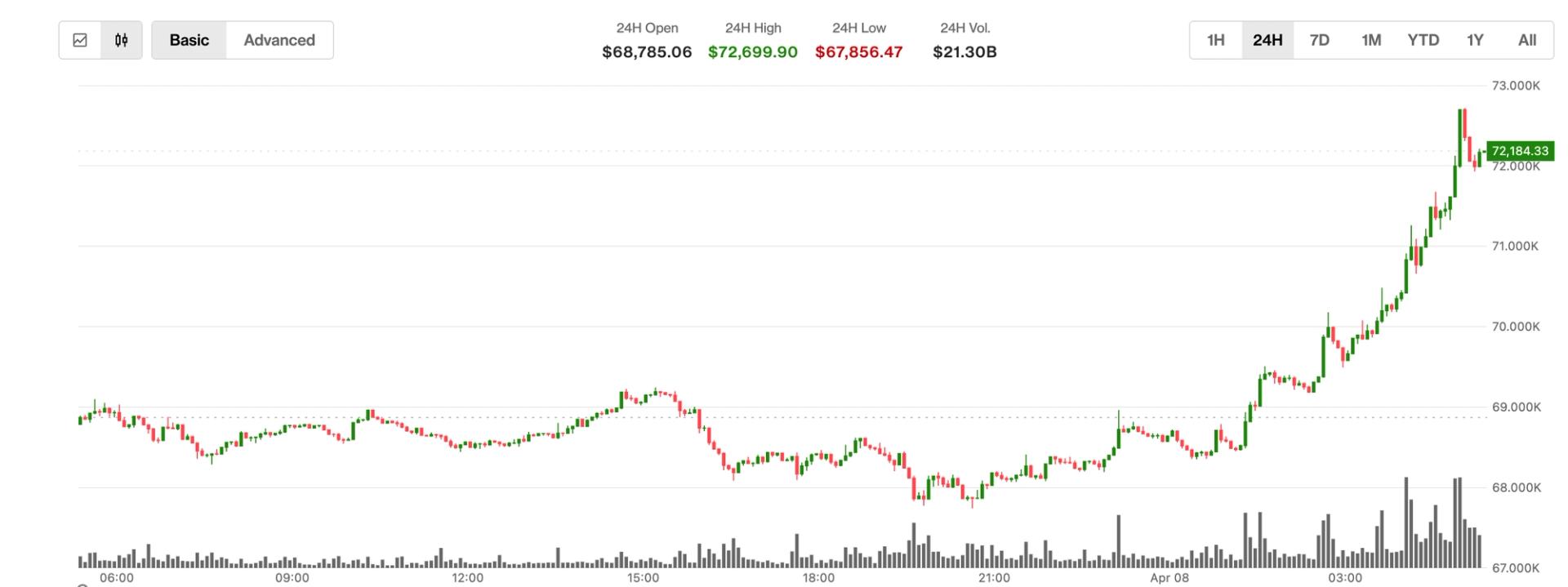
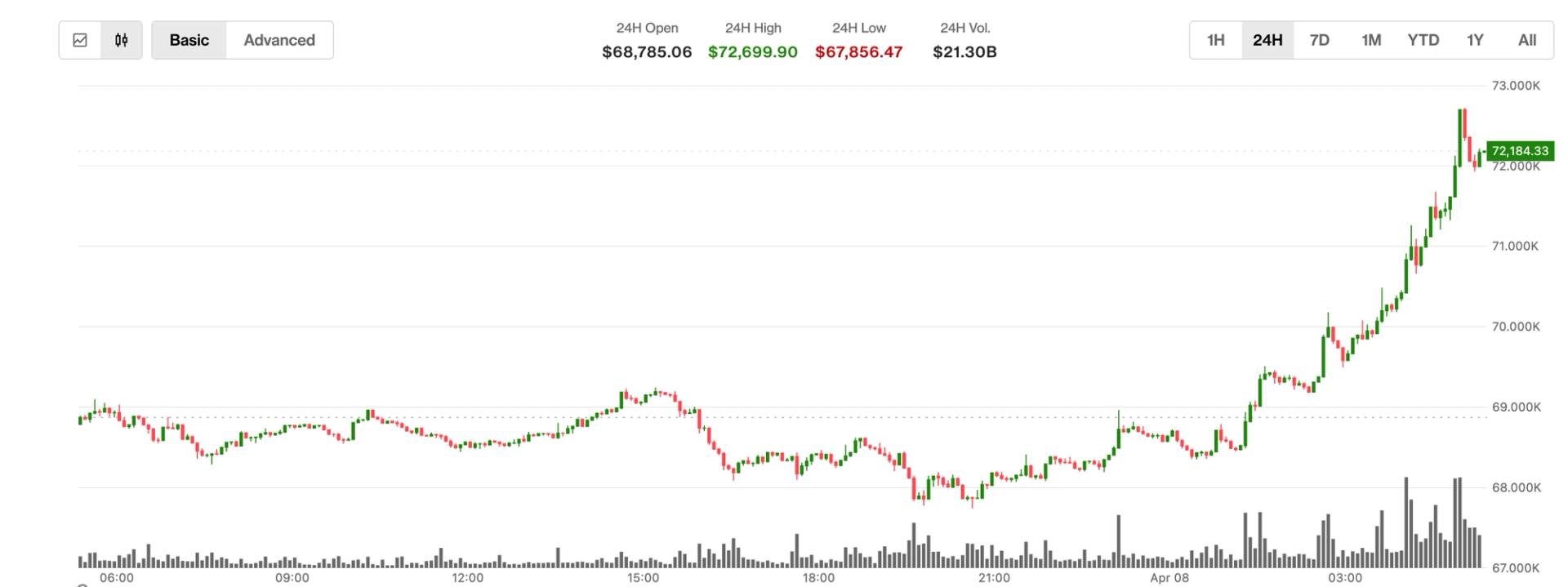
Bitcoin and U.S. stock futures surged Tuesday evening while oil prices collapsed after President Donald Trump confirmed a two-week ceasefire between Iran and the U.S. via Truth Social.
BTC, the leading cryptocurrency by market value, rose to a high of $72,699, up 5% in 24 hours, according to CoinDesk data. The broader market followed suit with the CoinDesk 20 Index jumping 5% to 2,034 points. Futures tied to the S&P 500 climbed 1.9%, while those linked to the tech-heavy Nasdaq popped 2.2%. Dow Jones futures jumped roughly 1.8%.
Meanwhile, the per-barrel price of West Texas Intermediate (WTI) crude collapsed more than 10% to $95 alongside a similar decline in Brent oil.
The risk-on action followed a two-week suspension of a planned widespread bombing campaign against Iran.
“I agree to suspend the bombing and attack of Iran for a period of two weeks,” Trump wrote in a post to Truth Social Tuesday evening, just before his 8 p.m. ET deadline.
“This will be a double sided CEASEFIRE! The reason for doing so is that we have already met and exceeded all Military objectives, and are very far along with a definitive Agreement concerning Longterm PEACE with Iran, and PEACE in the Middle East.”
Iran confirmed the ceasefire, saying that t “if attacks against Iran are halted, our Powerful Armed Forces will cease their defensive operations.” It added that oil tankers could safely transit the Strait of Hormuz for two weeks via coordination with Iran’s armed forces and with due consideration to technical limitations.
“Iran also confirms a two-week ceasefire. But the reopening of the Strait of Hormuz is somewhat muddled, with a warning of “technical limitations” and the need of “coordination” with the Iranian military. Still, it re-opens the flow of oil and LNG,” Javier Bias, Bloomberg’s opinion columnist covering energy and commodities, said on X.
For over a month, uncertainty tied to the Iran war kept risk assets under pressure. While bitcoin mostly traded choppy, its upside was persistently capped by the resulting oil rally, and inflation fears while spurring traders to seek bearish positioning in futures market.
The the latest upswing in prices has seen exchanges liquidate nearly $600 million in leveraged crypto futures positions. Of that amount, over $400 million came from bearish short bets.
This implies strong bullish momentum and a squeeze against short‑sellers, reinforcing upward pressure on the price as traders scram to cover their losing positions.


The latest AI news China Iran artificial intelligence military US bases geopolitics story escalated on April 5 when an ABC News exclusive revealed that the US Defense Intelligence Agency has confirmed Iran’s Islamic Revolutionary Guard Corps is actively using AI-enhanced satellite imagery from a Chinese firm called MizarVision to identify, prioritize, and target US military installations across the Middle East.
Summary
- MizarVision, a partially state-owned Chinese geospatial AI company, has been publishing AI-annotated high-resolution satellite imagery of US military bases on open-source platforms, with automated detection of aircraft, Patriot missile batteries, fuel depots, radar systems, and troop concentrations — capabilities once limited to classified national intelligence agencies
- DIA officials assess that the IRGC is actively using these datasets to refine missile and drone strike planning, compressing what previously required days of intelligence analysis to minutes; one intelligence official characterized the activity as a Chinese company “we believe maliciously, providing intelligence on an open-source platform”
- MizarVision posted at least six detailed analyses of Saudi Arabia’s Prince Sultan Air Base between February 24 and 27, identifying Patriot positions and aircraft locations; the base was struck less than 48 hours later, and one US service member later died from injuries sustained in the attack
The latest AI news China Iran artificial intelligence military US bases geopolitics threat took concrete form on April 5 when ABC News first reported that the US Defense Intelligence Agency had assessed Iran’s IRGC as actively exploiting satellite imagery datasets from MizarVision — a Chinese geospatial AI firm with approximately 5.5% Chinese government ownership — to improve the precision and tempo of missile and drone strikes against US and allied forces.
MizarVision’s platform integrates machine learning trained on military signatures, automatically classifying aircraft types, radar arrays, hardened shelters, fuel depots, command centers, and naval vessels based on shape, thermal patterns, and contextual indicators. The AI adds geospatial metadata tags that can be directly integrated into targeting software and command-and-control systems. Its stated mission is to “democratize and universalize geospatial intelligence” — a goal that US defense officials now say Iran has operationalized for warfare.
Traditional targeting intelligence collection, processing, analysis, and dissemination cycles take days. MizarVision’s AI reduces that to minutes by automatically generating tagged, geolocated target packages from commercially available satellite imagery. For Iran’s IRGC — which lacks the classified satellite constellation and imagery analysis units of a major power — this represents asymmetric capability: outsourcing targeting intelligence from a commercially accessible platform while maintaining operational plausibility.
DIA officials told ABC News that Iran is using these datasets not just to identify targets but to conduct pattern-of-life analysis, tracking deployment routines and periods of maximum vulnerability. That allows the IRGC to shift from broad saturation attacks toward selective strikes against air defense radars, maintenance shelters, and fuel storage facilities — the specific nodes that reduce US air combat effectiveness.
The Prince Sultan Air Base Sequence
The most alarming evidence centers on Prince Sultan Air Base in Saudi Arabia. MizarVision published detailed posts identifying Patriot missile battery positions on February 24, and aircraft parking locations on February 27. On March 1, satellite imagery showed smoke rising from damaged sections of the base following an Iranian strike. US intelligence later confirmed one service member was seriously wounded and subsequently died.
The Geopolitical Dimension
MizarVision has also published imagery of Diego Garcia, Israeli positions, Australian naval movements, and TSMC’s semiconductor plant construction, extending the concern from conflict intelligence to strategic industrial surveillance. China officially maintains a neutral position on the Iran war. The firm operates within a Chinese government framework that analysts describe as providing Beijing “plausible deniability” — the ability to assist regional partners while avoiding direct military involvement.
As crypto.news reported, Iran has already struck tech and energy infrastructure across the Gulf as part of its asymmetric response strategy. As crypto.news noted, each confirmed escalation in the conflict has produced immediate crypto market sell-offs, with the AI targeting dimension now adding a new layer of unpredictability to any de-escalation timeline.
“Future wars will be shaped as much by who can interpret and weaponize data fastest as by who fields the most advanced missiles, aircraft, or air defense systems,” one GDC analyst assessed — a conclusion the MizarVision case has now made difficult to dispute.

“Lo, Ditta Ek Point”: PBKS Captain Shreyas Iyer’s Sister Shresta’s Hilarious Post After KKR Get 1st Point In Abandoned IPL 2026 Game

2 Cases Show Supreme Court Isn’t Holding ISPs Responsible for Piracy

Forgotten crime show that has viewers ‘holding onto pillow’ streaming now


-

 NewsBeat5 days ago
Steven Gerrard disagrees with Gary Neville over ‘shock’ Chelsea and Arsenal claim | Football
-

 Business5 days ago
No Jackpot Winner and $194 Million Prize Rolls Over
-

 Fashion4 days ago
Weekend Open Thread: Spanx – Corporette.com
-

 Crypto World6 days ago
Gold Price Prediction: Worst Month in 17 Years fo Save Haven Rock
-

 Business2 days ago
Three Gulf funds agree to back Paramount’s $81 billion takeover of Warner, WSJ reports
-

 Business4 days ago
Expert Picks for Every Need
-

 Sports3 days ago
India men’s 4x400m and mixed 4x100m relay teams register big progress | Other Sports News
-

 Business6 days ago
Login and Checkout Issues Spark Merchant Frustration
-

 Tech3 hours ago
How Long Can You Drive With Expired Registration? What Florida Law Says
-
Business3 days ago
No Jackpot Winner, Prize to Climb to $231 Million
-
Crypto World7 days ago
Bitcoin stalls below key resistance as technical signals skew bearish
-

 Tech5 days ago
Commonwealth Fusion Systems leans on magnets for near-term revenue
-

 Politics7 days ago
Starmer’s centre has collapsed, and the left was right all along
-

 Fashion2 days ago
Massimo Dutti Offers Inspiration for Your Summer Mood Board
-

 Tech6 days ago
Drawing Tablet Controls Laser In Real-Time
-

 Crypto World6 days ago
Ripple rolls out enterprise crypto treasury platform for corporates
-

 Crypto World6 days ago
Why It’s Partnering, Not Issuing
-

 Business3 days ago
Akebia Therapeutics, Inc. (AKBA) Discusses Pipeline Progress and Strategic Focus on Kidney Disease Treatments at R&D Day – Slideshow
-

 Fashion7 days ago
Debenhams Occasion Dresses for Girls 2026 Collection
-
Politics5 days ago
Wings Over Scotland | The quality of mercy
You must be logged in to post a comment Login