If no party has a majority, the next Welsh Government will be judged not by the elegance of its agreements but by its ability to make the Welsh state work better.
11:46, 01 May 2026Updated 11:52, 01 May 2026
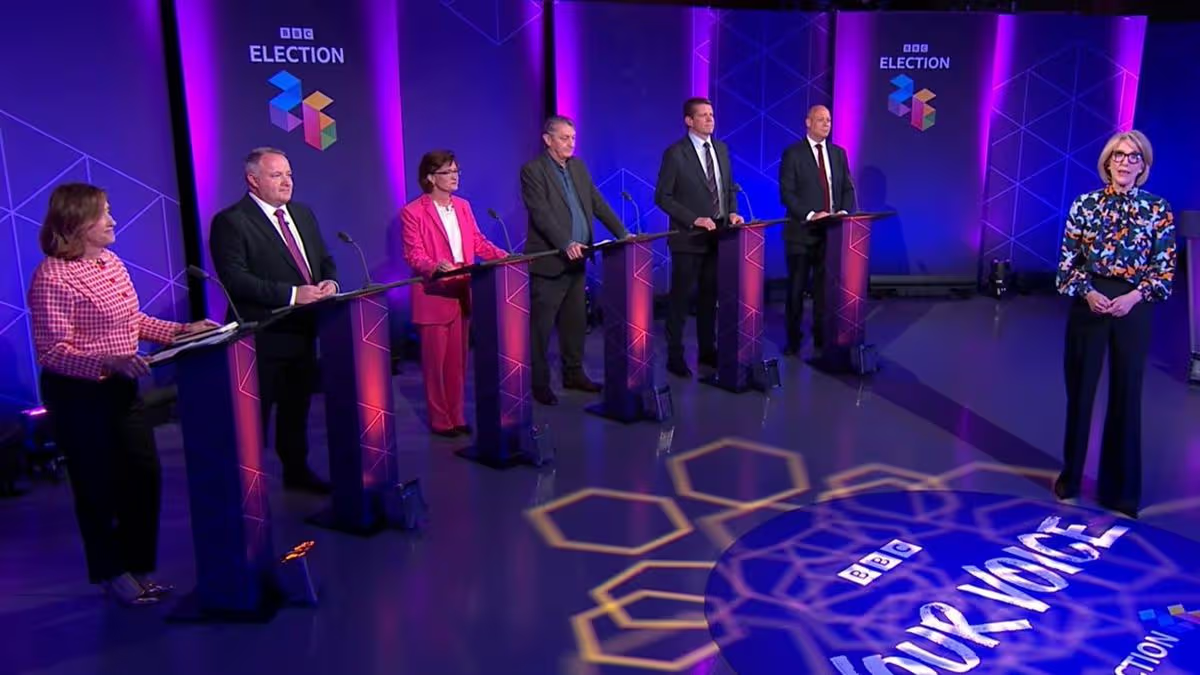
The leaders of the main parties in Wales take part in a BBC debate ahead of the Senedd election(Image: BBC Wales)
Since devolution began twenty seven years ago, Welsh politics has been shaped by Labour’s dominance, even when that dominance has depended on agreements with others.
Whilst some would argue that the result has been a stable political system, waiting lists have grown, the economy has underperformed, housing pressure has intensified, and the same arguments about productivity, poverty, and public services have been rehearsed year after year.
With the polls currently suggesting that no party will secure an overall majority in the Senedd, the country’s future may depend on whether parties can agree on enough specific measures to pass budgets, shape legislation and keep a government in office. Indeed, when you read all six manifestos, there is a suggestion that the parties are much closer than their campaign language suggests.
The biggest issue is health, and every party, from Labour to Reform, begins with the same judgment: that the NHS in Wales is under severe strain and that public confidence has been badly damaged. That matters because, in a Senedd without a majority, health is the obvious ground for agreement.
Labour wants to focus on new hospitals and shorter waiting times, while Plaid Cymru is promising surgical hubs and a stronger link between health and care. The Liberal Democrats want to expand care capacity to relieve pressure on hospitals, and the Conservatives say they would declare a health emergency. Despite agreeing on almost nothing else, Reform and the Greens both argue that urgent intervention is needed.
There are profound differences over how the NHS should be funded, managed and reformed, but there could be enough overlap for an administration to secure backing for a pragmatic programme to cut waiting lists, expand planned care and tackle the indignity of corridor care. In a hung Senedd, that is likely to be the first test of whether politicians can accept that compromise is not weakness if it gets patients treated sooner.
READ MORE: Wales doesn’t need grants but a new approach to IP and innovation that sustains business successREAD MORE: The knowhow built up in Wales’ contact centre sector is an asset worth redirecting
Childcare is one of the few policy areas where there is some agreement, even if they differ on whether expansion should be universal or targeted. Plaid Cymru and the Lib Dems want a universal childcare offer from nine months, whilst the Greens back universal childcare from nine months, and the Conservatives support extending free childcare for children from nine months to four years. Labour has again made childcare expansion one of its main promises.
This is not a minor point, as childcare is increasingly treated as economic infrastructure that helps parents return to work and supports family incomes. If Wales ends up with no party in command, childcare expansion looks like one of the easiest areas for a cross-party deal.
The economy offers a similar, if more limited, opportunity, and no party argues that Wales is performing as it should. Labour wants a new industrial strategy; Plaid and the Conservatives are proposing a National Development Agency; and the Liberal Democrats are talking about changing business rates. Even Reform, for all its populist language, frames its offer around backing business, rewarding work and cutting waste.
That does not amount to a shared economic philosophy, but it does suggest room for agreement on measures such as reforming business rates, improving support for apprenticeships and simplifying business support. Those are not glamorous policies, but they are the sort of interventions a minority government could get through in the next four years.
Housing is more politically divided, but even here, there are points of common agreement. Labour, Plaid Cymru, the Liberal Democrats and the Greens all argue that Wales needs more affordable and social housing, stronger action on homelessness and a bigger state role in fixing a market that is failing too many people. The Welsh Conservatives are more focused on planning reform, whereas Reform places less emphasis on expanding social housing.
So housing is not an issue on which all six parties can meet in the middle, but if the arithmetic points to a centre-left understanding, it is an area where that agreement could become substantial.
Then there is the environment, where Net Zero remains a dividing line, especially with Reform. However, on issues such as river pollution and water quality, there is a much broader consensus than many might expect. Labour, the Liberal Democrats, the Greens, the Conservatives and Reform all promise, in one form or another, tougher action on polluted rivers and sewage discharges, and that ought to be enough to support tougher enforcement.
Tax is the one example where consensus will be hardest to reach. Labour says it will not raise Welsh income tax, whilst the Conservatives and Reform want tax cuts. In contrast, the Liberal Democrats leave the door open to a temporary rise to fund social care, Plaid wants broader tax powers and a more progressive framework, and the Greens want much wider tax reform. That is not a basis for easy agreement, nor are the constitutional questions, with Plaid remaining fundamentally different from those of the Conservatives, Reform and the Liberal Democrats.
What should we conclude from all this? A Senedd without a majority need not mean paralysis, and it is unlikely there will be a grand coalition around a shared view of the country’s future, as the ideological divides are too deep. But it may produce a more negotiated politics in which parties are forced to agree on specific measures in areas where the public is demanding action.
After nearly three decades in which Welsh politics has been shaped by one party’s dominance, such a shift would be significant. The frustration in Wales is not simply that politicians disagree, but that we still face the same problems as we did two decades ago.
If no party has a majority, the next government will be judged not by the elegance of its agreements but by its ability to make the Welsh state work better. Therefore, the real test may not be who comes first on election night, but whether the next Senedd can make difficult compromises that lead to shorter waits, better services and a stronger economy.


























































You must be logged in to post a comment Login