

Business
IonQ Shares Surge 22% on Explosive Q4 Revenue Beat, Bullish 2026 Guidance


IonQ, Inc. (NYSE: IONQ), a leading quantum computing company, saw its shares rocket more than 21% Thursday after reporting fourth-quarter results that far exceeded expectations and issuing optimistic revenue guidance for 2026 that topped Wall Street forecasts.

The stock closed regular trading at $40.88, up $7.29 or 21.70% from the previous close of $33.59, on massive volume exceeding 69 million shares — well above its average. Intraday trading ranged from a low of $38.75 to a high of $41.90, reflecting strong investor enthusiasm following the earnings release.
IonQ reported fourth-quarter revenue of $61.9 million, a staggering 429% increase from $11.7 million in the prior-year period. The figure beat the company’s own guidance midpoint by 55% and surpassed analyst expectations. For full-year 2025, revenue reached $130 million, up 202% year-over-year and 20% above the guidance midpoint, marking the first time a publicly traded quantum computing firm surpassed $100 million in annual GAAP revenue.
Adjusted loss per share narrowed to $0.20, better than the consensus estimate of a $0.23 loss. The results highlighted accelerating commercial demand, with more than 60% of 2025 revenue from commercial customers and over 30% from international sales. Organic growth approached 80% year-over-year.
CEO Niccolo de Masi described the performance as evidence of IonQ’s evolution into the “world’s only full-stack quantum platform company.” He emphasized strong backlog, pipeline visibility and momentum positioning the firm for continued expansion.
For 2026, IonQ guided full-year revenue between $225 million and $245 million, with a midpoint of $235 million — about 22% above the average analyst estimate of roughly $193 million. First-quarter revenue is projected at $48 million to $51 million. The outlook implies roughly 81% year-over-year growth at the midpoint, driven by sustained demand for trapped-ion quantum systems, software and services.
The company anticipates an adjusted EBITDA loss of $310 million to $330 million for 2026, reflecting heavy investments in scaling operations, R&D and recent acquisitions. IonQ maintains a robust cash position of approximately $3.3 billion, providing runway for these initiatives.
A key catalyst in the report was IonQ’s announcement of deploying one of Europe’s largest operational quantum key distribution networks in Romania as part of the RoNaQCI project. The deployment underscores growing adoption in quantum networking and security applications across government and enterprise sectors.
IonQ also highlighted progress toward major milestones, including shipments of its Tempo system in 2026 and a planned 256-qubit demonstration. The company is pursuing a $1.8 billion acquisition of SkyWater Technology, a quantum chip foundry, to bolster manufacturing capabilities and reduce costs for future high-qubit systems.
Analysts reacted positively overall, though some adjusted targets modestly. Jefferies maintained a Buy rating but trimmed its price target, while JP Morgan lowered its target from $47 to $42 while keeping a Neutral stance. The average one-year price target from 12 analysts stands around $71, implying significant upside from current levels, with highs reaching $100.
Technical indicators show IonQ breaking key resistance near $40, with the surge pushing it well above recent trading ranges but still below its 52-week high of $84.64 from October 2025. The 52-week low sits at $17.88. The stock’s beta of around 2.6 indicates high volatility, typical for emerging tech in quantum computing.
Market observers note IonQ’s results as a potential inflection point for the quantum sector, demonstrating commercial traction amid competition from rivals like Rigetti, Quantinuum and IBM. The company’s trapped-ion approach has achieved notable performance benchmarks, including a world-record 99.99% two-qubit gate fidelity in 2025.
Despite the rally, IonQ remains unprofitable on an adjusted basis, with full-year 2025 net losses at $510.4 million and adjusted EBITDA loss of $186.8 million. Investors are betting on the long-term transformative potential of quantum computing in fields like drug discovery, materials science, financial modeling, logistics, cybersecurity and defense.
The stock’s performance contrasts with broader market trends Thursday, where some tech names faced pressure. IonQ’s surge stood out as a bright spot in speculative growth sectors.
As quantum adoption accelerates, IonQ’s focus on full-stack solutions, international expansion and strategic partnerships positions it as a frontrunner. Traders will monitor execution on 2026 milestones, backlog conversion and any updates on the SkyWater deal for further catalysts.
For now, the earnings beat and raised outlook have reignited enthusiasm, sending shares to their strongest close in recent months and signaling renewed confidence in quantum computing’s commercial path.

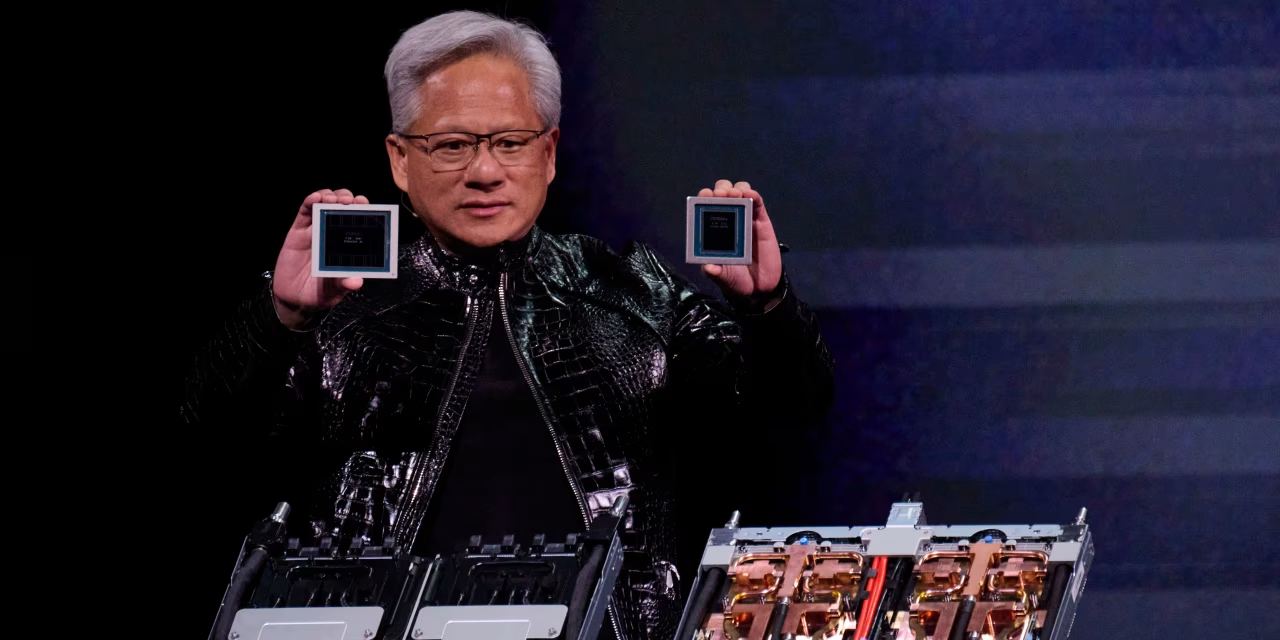
Nvidia NVDA -4.16%decrease; red down pointing triangle now makes more revenue in a single quarter than most other chip companies generate in an entire year. In a turbulent market awash in a new class of AI fears, that’s no longer enough.
The chip maker’s fiscal fourth-quarter results Wednesday showed why the company remains the undisputed leader in artificial-intelligence computing. Revenue of $68.1 billion was up 73% from the same period a year earlier and represented the company’s best growth rate in four quarters. Nvidia projected an even higher growth rate for the current quarter, and that forecast actually beat Wall Street’s consensus target by the widest range in two years, according to FactSet data.
Copyright ©2026 Dow Jones & Company, Inc. All Rights Reserved. 87990cbe856818d5eddac44c7b1cdeb8

Form 144 CONSOLIDATED EDISON INC For: 27 February


Pakistan, Afghan Taliban forces clash as diplomatic efforts intensify

Netflix Declines to Match Paramount’s Offer for Warner Bros.
Business
US Stocks: Trump Media considers spinning off Truth Social into public company, reports wider annual loss

The company is in discussions with TAE Technologies and Texas Ventures Acquisition III about the proposed transaction, the company said on Friday.
Under the proposal, shares in the spun-off company would be distributed to eligible TMTG shareholders, after which the new entity would merge with a special purpose acquisition company.
This would separate TMTG’s social media and digital media assets from its recently announced fusion energy venture, effectively splitting the company into two publicly traded businesses with distinct strategies.
The Truth Social-parent’s net loss widened to $712.3 million in 2025 from $400.9 million a year earlier, mostly reflecting unrealized losses from the company’s purchase of bitcoin and Cronos.

TMTG ended 2025 with about $2.5 billion in financial assets, more than triple the $776.8 million it had a year earlier, the company said. Net sales edged up to $3.68 million from $3.62 million in 2024.
Founded by Trump and known for its Truth Social platform aimed at conservative audiences, TMTG has faced challenges scaling its media business amid competition from larger social networks and uneven user growth. It is now seeking to reposition itself beyond its core Truth Social platform and tap investor interest in emerging energy technologies.
TMTG said no definitive agreement has been reached on the spin-off and discussions are ongoing. In December, TMTG agreed to merge with TAE in an all-stock deal valued at more than $6 billion, marking a pivot toward fusion energy and the creation of a publicly traded company focused on developing utility-scale power plants to help meet rising electricity demand, including from AI data centers.
TAE Technologies is a California-based private company developing advanced nuclear fusion technology that has raised more than $1 billion from investors, including Alphabet’s Google and Chevron.
The startup focuses on a form of fusion designed to produce electricity without releasing large amounts of neutron radiation, reducing radioactive waste.

Cuba says attacking speedboat had nearly 13,000 rounds of ammunition

Spot gold was up 1% at $5,238.75 an ounce by 11:31 a.m. ET (1631 GMT), hitting its highest level since January 30. Prices climbed 7.6% so far in February.
U.S. gold futures for April delivery rose 1.1% to $5,254.
“There’s a lot of nervousness surrounding geopolitics, you have all the set-up for a high probability of a military operation over the weekend, so it’s a risk-off in a flight to safety,” said Phillip Streible, chief market strategist at Blue Line Futures.
The United States and Iran made progress in Thursday’s nuclear talks, mediator Oman said, but hours of negotiations ended without a breakthrough that could avert possible U.S. strikes amid a major military buildup.
Meanwhile, the U.S. Embassy in Jerusalem also permitted non-emergency staff and families to leave Israel citing safety risks.
U.S. 10-year Treasury yields slipped to a three-month low, making non-yielding gold more attractive by lowering its opportunity cost. Gold’s next likely upside target is $5,450, with key support near $5,120, Streible said.
Data showed that U.S. producer prices increased more than expected in January, suggesting inflation could pick up in the months ahead.
Markets are pricing in about a 42% chance of a 25-basis-point U.S. Federal Reserve rate cut in June, as per the CME FedWatch tool.
Elsewhere, top consumer China’s net gold imports via Hong Kong in January rose by 68.7% from December, Hong Kong Census and Statistics Department data showed.
China’s central bank moved to curb the yuan’s rise by removing risk-reserve rules for forex forwards, encouraging more dollar buying.
Spot silver rose 6% to $93.67 an ounce, on course for a 10.3% monthly gain.
Spot platinum climbed 3.5% to $2,352.05 an ounce while palladium was up 0.1% at $1,785.47. Both metals were headed for monthly gains.

The two sides agreed to extend indirect negotiations into next week but traders grew skeptical that an agreement between U.S. President Donald Trump‘s administration and Iran was possible.
“The likelihood Iran is going to agree to what the Trump administration wants doesn’t seem possible,” said Phil Flynn, senior analyst with Price Futures Group. “There’s got to be an endgame to this and the market seems to think that’s where we are headed.”
OIL BENCHMARKS ON TRACK FOR WEEKLY GAINS
The Brent and WTI benchmarks were trading at their highest since July and August, respectively, and were poised to register weekly gains well above 1%.
“Uncertainty prevails, fear is pushing prices higher today,” said Tamas Varga, an oil analyst at brokerage PVM. “It is completely driven by the outcome of the Iranian nuclear talks and possible military action the U.S. might take against Iran.” The United States and Iran held indirect talks in Geneva on Thursday after Trump ordered a military buildup in the region.
Oil prices gained more than a dollar a barrel during the talks, on media reports indicating that discussions had stalled over U.S. insistence on zero enrichment of uranium by Iran. However, prices eased after the Omani mediator said the two sides had made progress. They plan to resume negotiations with technical-level discussions scheduled next week in Vienna, Omani Foreign Minister Sayyid Badr Albusaidi said on X.”We think the latest round of talks offers some hope on chances of a peaceful resolution, but military strikes are in no way out of the equation,” said DBS analyst Suvro Sarkar. Trump said on February 19 that Iran must make a deal over its nuclear programme within 10 to 15 days or “really bad things” will happen.
Geopolitical risk premiums of $8 to $10 a barrel have been built into oil prices on fears that a conflict will disrupt Middle East supply through the Strait of Hormuz, where about 20% of global oil supply passes, Sarkar said. To cushion the impact from a possible strike, UAE oil producer Abu Dhabi is set to export more of its flagship Murban crude in April, two trade sources said on Friday. Earlier this week, other sources said Saudi Arabia would also increase oil production. Additionally, Saudi Arabia may raise its April crude price to Asia for the first time in five months due to higher demand from India to replace Russian supplies, potentially raising it by about $1 a barrel. Producer group OPEC+, meanwhile, is likely to consider raising oil output by 137,000 barrels per day for April at its March 1 meeting, sources said, after suspending production increases in the first quarter. (Reporting by Erwin Seba, Anna Hirtenstein, Florence Tan and Nicole Jao; Editing by Rod Nickel)

Form 144 CASELLA WASTE SYSTEMS INC For: 28 February
Business
Anthropic hack puts IT stock pack on slide row in February; Nifty IT’s 19% fall worst since 2008 crisis

The index declined in 12 out of 21 trading sessions, wiping out nearly Rs 5.7 lakh crore in market capitalisation during the month, according to data from the ET Intelligence Group.
Selling pressure intensified after Anthropic, a US-based artificial intelligence firm, unveiled its tools Claude Cowork and Claude Code, triggering a sell-off in technology services stocks across the US and India.
 ETMarkets.com
On Friday the Nifty IT index edged up 0.16% to 30,603.85, even as the benchmark Nifty fell 318 points, or 1.25%, to 25,178.65. The Nifty has declined 0.6% for the month.
Among individual stocks, Coforge, LTIMindtree, Tech Mahindra, Persistent Systems, and Infosys fell more than the index, dropping between 21% and 28%, with Coforge the worst hit. Oracle Financial Services declined the least, by 10.7%, followed by Wipro, while Tata Consultancy Services, Mphasis and HCL Technologies fell by 15–18%.

Ultrahuman’s Pro smart ring can go for two weeks

Dorit Kemsley’s Divorce Drama Intensifies With Financial Red Flags + Kyle Richards Put on Notice!
Why Nvidia’s Huge Numbers Don’t Settle the Latest AI Fears

Smart energy pays enters the US market, targeting scalable financial infrastructure

Why Israel is blocking foreign journalists from entering

Bitcoin: We’re Entering The Most Dangerous Phase
Dorit Kemsley’s Divorce Drama Intensifies With Financial Red Flags + Kyle Richards Put on Notice!

Michael Saylor: How We Plan to Double Bitcoin Per Share in Just 7 Years

Steve Questioned EVERYTHING After She Said THIS! | Fast Money | Family Feud Classics
-

 Politics6 days ago
Baftas 2026: Awards Nominations, Presenters And Performers
-

 Sports4 days ago
Women’s college basketball rankings: Iowa reenters top 10, Auriemma makes history
-

 Fashion11 hours ago
Weekend Open Thread: Iris Top
-

 Politics5 days ago
Nick Reiner Enters Plea In Deaths Of Parents Rob And Michele
-

 Business3 days ago
True Citrus debuts functional drink mix collection
-

 Politics1 day ago
ITV enters Gaza with IDF amid ongoing genocide
-

 Crypto World4 days ago
XRP price enters “dead zone” as Binance leverage hits lows
-

 Business6 days ago
Mattel’s American Girl brand turns 40, dolls enter a new era
-

 Business6 days ago
Law enforcement kills armed man seeking to enter Trump’s Mar-a-Lago resort, officials say
-

 NewsBeat2 days ago
Cuba says its forces have killed four on US-registered speedboat | World News
-

 Tech4 days ago
Unsurprisingly, Apple's board gets what it wants in 2026 shareholder meeting
-
 NewsBeat2 days ago
Manchester Central Mosque issues statement as it imposes new measures ‘with immediate effect’ after armed men enter
-
 NewsBeat5 days ago
‘Hourly’ method from gastroenterologist ‘helps reduce air travel bloating’
-

 Tech6 days ago
Anthropic-Backed Group Enters NY-12 AI PAC Fight
-

 NewsBeat5 days ago
Armed man killed after entering secure perimeter of Mar-a-Lago, Secret Service says
-

 Politics6 days ago
Maine has a long track record of electing moderates. Enter Graham Platner.
-

 Business2 days ago
Discord Pushes Implementation of Global Age Checks to Second Half of 2026
-
 NewsBeat3 days ago
Police latest as search for missing woman enters day nine
-
 Sports5 days ago
2026 NFL mock draft: WRs fly off the board in first round entering combine week
-

 Business1 day ago
Only 4% of women globally reside in countries that offer almost complete legal equality