
Crypto World
Mt. Gox’s former CEO floats a hard fork to recover 80K hacked Bitcoin


Mark Karpelès, the former CEO of Mt. Gox, has revived a controversial bid to claw back billions stolen from the once-dominant Bitcoin exchange. In a Friday GitHub submission, Karpelès proposed a consensus-rule change that would enable the transfer of 79,956 BTC—currently held in a single recovery address without the original private key—to a dedicated recovery wallet. The move targets more than $5.2 billion in assets based on recent price levels and comes as the Mt. Gox trustee Nobuaki Kobayashi continues creditor distributions. The proposal unfolds against a backdrop of ongoing debates about Bitcoin’s immutability and the governance process that underpins the network.
Key takeaways
- The proposal seeks a hard fork to retroactively validate a previously invalid on-chain transaction, enabling the movement of Mt. Gox’s recovered BTC to a recovery address.
- Activation would require a broad network upgrade, as every node would need to adopt the change for the recovery operation to occur.
- The Mt. Gox trustee remains focused on creditor distributions, and on-chain recovery has not been pursued by him—creating a potential procedural deadlock that Karpelès aims to address with a concrete proposal.
- Critics argue that authorizing a recovery via a hard fork could undermine Bitcoin’s core principle of immutability, while supporters say the move could deliver restitution to affected creditors and bring clarity to an unresolved chapter in the exchange’s history.
- The discussion is publicly visible on forums and social media, with a mix of skepticism, caution, and some creditors expressing interest in recovering funds if feasible.
- Regardless of outcome, the debate highlights the tension between restitution and the decentralized integrity of the Bitcoin protocol.
Tickers mentioned: $BTC
Sentiment: Neutral
Market context: The episode sits at the intersection of governance debates in decentralized networks and the broader attention on restitution for legacy hacks, underscoring how on-chain recovery ideas can surface amid creditor proceedings and evolving regulatory scrutiny.
Why it matters
The Mt. Gox saga is embedded in Bitcoin’s history, and any attempt to move coins via a protocol change raises foundational questions about what Bitcoin is allowed to be in practice. The proposal, if discussed seriously and pursued, would test the boundary between protocol-level immutability and the legitimate pursuit of restitution for victims of one of the most infamous hacks in crypto history. Bitcoin’s developers, miners, and node operators would be convened to evaluate whether a consensus-rule upgrade could safely reconcile a dispute that sits outside the typical on-chain transaction flow. Critics argue that even discussing such a mechanism could erode confidence in a system built on a trustless, irreversible ledger. Proponents, however, point to the nearly two-decade-long wait for a definitive resolution and the ethical imperative to return assets to creditors when a solvency and theft case is clear in law and in fact.
The discussion also spotlights the role of the Mt. Gox trustee, Nobuaki Kobayashi, who has been tasked with distributing recoveries to creditors under a bankruptcy framework. His team has indicated that on-chain recovery would require a level of legal certainty and community consensus that may not exist, effectively stalling potential recovery pathways. Karpelès argues that the plan would not circumvent established processes but would catalyze a debate that could lead to a pragmatic resolution if there is broad agreement among stakeholders. The tension between procedural caution and the desire for restitution is a central theme, with the Bitcoin community weighing the long-term implications for the protocol’s governance and perceived neutrality.
The broader crypto environment is watching closely. While the specifics of the Mt. Gox funds are unique, the questions raised—whether a protocol-level change should ever unlock previously inaccessible assets, and under what circumstances—resonate with ongoing discussions about on-chain governance and the limits of what a decentralized network should decide collectively. The episode also intersects with regulatory conversations about how restitution cases should be handled in crypto, and how such moves could influence investor expectations in a space that continues to grapple with hacks, mismanagement, and the accountability of project teams.
What to watch next
- The Bitcoin community’s formal response to the GitHub proposal, including any follow-up discussions on Core developers’ channels.
- Whether the proposed activation height and upgrade path gain support from miners, node operators, and major ecosystems participants.
- Any concrete statements from Nobuaki Kobayashi or the Mt. Gox creditor committee about on-chain recovery viability under new consensus rules.
- New commentary from prominent developers or industry observers on the precedent such a change could set for future hacks or thefts.
- Updates from the Bitcointalk forum threads and social-media discussions that could influence perceptions of immutability and recovery ethics.
Sources & verification
- GitHub pull request: https://github.com/bitcoin/bitcoin/pull/34695
- Bitcoin address cited for unmoved coins: https://www.blockchain.com/explorer/addresses/btc/1FeexV6bAHb8ybZjqQMjJrcCrHGW9sb6uF
- Jameson Lopp discussion post: https://x.com/lopp/status/2027482550415847770
- Luke Dashjr update: https://x.com/LukeDashjr/status/2027594666690912414
- Bitcointalk discussion thread: https://bitcointalk.org/index.php?topic=5575915.new#new
Hard fork debate over Mt. Gox funds: Key figures and next steps
The core idea, as laid out by Karpelès, centers on a patch that would render a targeted, previously invalid transaction valid, thereby enabling a significant on-chain recovery. He emphasizes that this is a hard fork, not a stealth change: “This is a hard fork. It makes a previously invalid transaction valid. All nodes would need to upgrade before the activation height.” The explicit acknowledgment of a forked path helps separate the conversation from a passive suggestion and places it firmly in the realm of a concrete, testable proposal. He stresses that the intention is not to bypass Bitcoin’s normal development process but to invite structured debate among developers and the wider community.
On the other side, critics argue that creating a mechanism to recover stolen funds by altering the on-chain consensus could erode Bitcoin’s trustless design. The Bitcointalk thread contains strong cautions that such a change could set a troubling precedent, potentially inviting future appeals to “undo” losses through protocol changes rather than through traditional enforcement and restitution mechanisms. A recurring theme in the discussions is the risk of undermining irreversibility, which many proponents regard as a foundational feature of Bitcoin’s security model. Yet some creditors who persisted through the bankruptcy process indicate a personal incentive to see any possible recovery move forward if a legitimate avenue exists.
The tension between immutability and restitution is not unique to Mt. Gox, but the scale of the potential recovery—79,956 BTC—renders this debate unusually consequential. If the proposal gains momentum, it would require not only the cooperation of a critical mass of node operators but also a clear legal and regulatory framework that supports on-chain recovery in a way that remains coherent with global enforcement standards. For now, the proposal remains a discussion starter, with proponents hoping it could catalyze a path toward restitution and critics urging caution to protect Bitcoin’s core principles.
Why it matters for the crypto ecosystem
For investors and creditors, the Mt. Gox case is a reminder that legacy hacks can linger for years and that governance questions remain unsettled in decentralized networks. The possible on-chain recovery would be a precedent-setting event, raising questions about how restitution can be reconciled with the long-standing commitment to a permissionless, immutable ledger. For developers, the episode underscores the challenge of balancing innovation with the risk of unintended consequences to the network’s security and reliability. It also highlights the practical constraints of building consensus around controversial changes in a space where decisions are ultimately collective and technically demanding.
Beyond Mt. Gox, the discussion speaks to a broader market dynamic: asset recovery remains a persistent theme as regulators and market participants assess how to treat stolen or misappropriated funds within crypto ecosystems. While some stakeholders advocate for aggressive on-chain remedies, others insist that irreversibility is a non-negotiable attribute of Bitcoin’s value proposition. The ongoing dialogue could shape how future governance proposals are evaluated, how recovery pathways are designed, and how much weight the community assigns to restitution versus protocol integrity.
What to watch next
- Public consensus-building on GitHub PR 34695 and any formal follow-ups or discussions with Bitcoin Core maintainers.
- Updates from Nobuaki Kobayashi and the Mt. Gox creditor committee regarding whether on-chain recovery could be pursued under any future framework.
- New technical assessments of activation heights, potential vulnerabilities, and the overall risk-reward profile of a hard fork to recover funds.
- Reactions from major exchanges, miners, and node operators about the viability and acceptability of such a change.
Sources & verification
- GitHub pull request: https://github.com/bitcoin/bitcoin/pull/34695
- Original recovery address for references: https://www.blockchain.com/explorer/addresses/btc/1FeexV6bAHb8ybZjqQMjJrcCrHGW9sb6uF
- Jameson Lopp discussion: https://x.com/lopp/status/2027482550415847770
- Luke Dashjr discussion: https://x.com/LukeDashjr/status/2027594666690912414
- Bitcointalk thread: https://bitcointalk.org/index.php?topic=5575915.new#new

“Passive income” is one of the most seductive phrases in crypto. It suggests a world where capital works harder than you do—where tokens quietly multiply while you sleep, and DeFi protocols function like automated ATMs for financial freedom.
That story sells well. It just doesn’t fully survive contact with reality.
In practice, most so-called passive income strategies in crypto are closer to low-intensity active management than true set-and-forget investing. The difference matters—because misunderstanding it leads to unrealistic expectations, poor risk management, and often, avoidable losses.
The Illusion of “Set It and Forget It”
At the surface level, decentralized finance (DeFi) offers compelling yield opportunities: liquidity provision, staking rewards, lending interest, and incentive programs. Many platforms market these as passive income streams.
But beneath the branding, these systems are dynamic, reactive environments. Yields shift constantly. Risk profiles change overnight. Incentives migrate between protocols like heat-seeking capital.
What looks passive is often just out-of-sight responsibility.
What “Passive” Actually Requires in Crypto
Even the most conservative DeFi strategies demand ongoing attention. Not occasionally—continuously.
1. Monitoring Liquidity Pools
Liquidity providers must track:
- fee generation vs. impermanent loss
- volume fluctuations
- incentive emissions
A pool that looked attractive yesterday can become inefficient today. Ignoring it doesn’t make it passive—it just delays the consequences.
2. Rebalancing Positions
Yield strategies often rely on shifting allocations between protocols or pools.
That means:
- moving capital when APYs change
- adjusting exposure across chains
- optimizing for gas fees vs. returns
In traditional finance, this would simply be called portfolio management. In crypto, it’s rebranded as “earning passively.”
3. Reacting to Depegs
Stablecoins are only “stable” until they aren’t.
When depegging events occur, users are forced into rapid decisions:
- exit liquidity positions
- unwind leveraged exposure
- assess contagion risk across protocols
Nothing passive about panic management.
4. Chasing Yield Migrations
Incentives in DeFi are rarely static. Capital flows toward higher yields, and protocols respond by:
- launching new reward programs
- ending old liquidity incentives
- shifting emissions schedules
Participants who don’t adapt get diluted. Those who do essentially become active yield hunters.
The Branding Problem: “Passive” as Marketing Language
Calling these strategies “passive income” is less a technical description and more a psychological one.
It lowers the perceived barrier to entry. It frames participation as effortless wealth accumulation. And it encourages users to underestimate both risk and workload.
A more accurate term might be:
Active income with automation and better UX.
That doesn’t make it bad. It just makes it honest.
Why the Myth Persists
There are three main reasons the “passive income” narrative survives:
1. Early-Stage Excitement
In bull markets, yields are high enough that mistakes feel profitable anyway. Attention to detail seems optional—until it isn’t.
2. Interface Simplicity
DeFi platforms abstract complexity into clean dashboards. When everything is one click away, it feels like nothing important is happening under the hood.
3. Incentive Design
Protocols compete for liquidity. Marketing “passive yield” is more effective than “ongoing portfolio management responsibilities.”
The Real Nature of Crypto Yield
Crypto income isn’t passive—it’s conditionally active.
You can reduce effort with automation, diversified strategies, and long-term positioning. But you cannot eliminate decision-making without also accepting higher risk exposure.
Even “lazy” strategies require:
- periodic review
- risk reassessment
- exit planning
In other words, you’re still in the game—you’re just playing at a slower tempo.
Conclusion: Reframing the Expectation
The idea of passive income in crypto isn’t entirely false—it’s just incomplete.
Yes, capital can be productive without constant manual trading. But productivity does not equal absence of responsibility.
A more grounded framing is this:
Crypto doesn’t eliminate work. It redistributes it into monitoring, adaptation, and risk awareness.
Or put less politely:
You’re not escaping effort—you’re outsourcing it to market conditions.
And the market never really stops working.
REQUEST AN ARTICLE

Key Highlights
- Brady Corporation has agreed to acquire Honeywell’s Productivity Solutions and Services (PSS) division for $1.4 billion in an all-cash transaction
- The PSS business recorded approximately $1.1 billion in annual revenue during 2025 and maintains a workforce of about 3,000 employees worldwide
- The transaction values PSS at around 8x its 2025 EBITDA multiple
- This divestiture represents another step in Honeywell’s strategic portfolio restructuring prior to its anticipated Aerospace business separation in the third quarter of 2026
- Brady anticipates the acquisition will deliver double-digit accretion to adjusted diluted earnings per share in year one, alongside $25 million in yearly cost savings achievable within three years
On April 20, 2026, Honeywell (HON) revealed its decision to divest the Productivity Solutions and Services division to Brady Corporation (BRC) through a $1.4 billion all-cash transaction.
The PSS division specializes in manufacturing mobile computing devices, barcode scanning equipment, and industrial printing technologies, primarily serving warehouse operations and logistics customers. The business unit generated approximately $1.1 billion in annual sales throughout 2025.
The acquisition price of $1.4 billion represents approximately 8 times the PSS division’s 2025 EBITDA performance. Transaction completion is anticipated during the latter half of 2026, contingent upon receiving necessary regulatory clearances.
Honeywell International Inc., HON
Vimal Kapur, Honeywell’s Chief Executive Officer, described the divestiture as an important milestone in executing the organization’s “multi-year portfolio transformation” strategy. The corporation continues advancing plans to separate into two distinct publicly traded entities — one concentrating on Aerospace operations, the other on Automation technologies.
The planned Aerospace business separation remains scheduled for the third quarter of 2026.
This transaction marks another in a series of recent divestitures by Honeywell. The corporation previously sold its Personal Protective Equipment division in 2024 and completed the spinoff of its Advanced Materials business as Solstice Advanced Materials (SOLS) during October 2025.
Additionally, Honeywell continues evaluating strategic alternatives for its Warehouse and Workflow Solutions operations, which encompass the Intelligrated and Transnorm product lines.
Strategic Expansion for Brady Corporation
For Brady, this acquisition represents a substantial strategic expansion. The Milwaukee-headquartered producer of identification solutions, signage, and workplace safety products is leveraging the PSS transaction to enter the data capture, mobile computing, and workflow automation markets.
Brady management projects the acquisition will generate double-digit accretion to adjusted diluted earnings per share during the first complete fiscal year following transaction closure. The organization has established a target of achieving at least $25 million in annual cost synergies within a three-year timeframe.
Following transaction financing, the deal is expected to elevate Brady’s pro forma net debt to EBITDA leverage ratio to approximately 2.5x — a metric that investors will monitor closely throughout the integration phase.
Transaction Structure and Expected Timing
The agreement is structured as an all-cash acquisition, with Centerview Partners serving as Honeywell’s financial advisor. Legal representation includes Kirkland & Ellis, Baker McKenzie, and Womble Bond Dickinson.
Transaction closure is projected for the second half of 2026, pending customary regulatory approvals and satisfaction of closing conditions.
PSS currently operates within Honeywell’s Industrial Automation business segment. Following deal completion, the unit will function under Brady’s corporate structure as a component of an expanded industrial productivity and safety platform.
Since 2023, Honeywell has disclosed approximately $14 billion in strategic acquisitions while concurrently divesting non-strategic assets. The PSS divestiture represents the most recent action in this comprehensive portfolio repositioning initiative.
Brady’s PSS acquisition incorporates roughly 3,000 employees and an established customer base spanning warehouse operations, logistics providers, and manufacturing facilities.
The transaction remains subject to regulatory examination, with integration execution and talent retention identified as potential challenges to achieving the forecasted synergy benefits.

Key takeaways
-
Mastercard is integrating stablecoins into its payment infrastructure to modernize the back-end settlement process, allowing banks and issuers to settle card transactions using regulated digital dollars such as SoFiUSD.
-
The partnership with SoFi Technologies enables SoFi Bank to settle Mastercard transactions in SoFiUSD, while Galileo’s platform allows other banks and fintech issuers to adopt stablecoin settlement.
-
Stablecoin settlement focuses on the post-transaction clearing stage, meaning consumers will continue using cards normally while the underlying settlement between banks may occur through blockchain-based digital assets.
-
By leveraging its Multi-Token Network (MTN), Mastercard aims to support multiple forms of tokenized money, including stablecoins, tokenized deposits and digital representations of fiat currencies.
Stablecoins are increasingly moving beyond the crypto niche and into mainstream financial discussions. A prime example is Mastercard’s move to integrate stablecoins into its card payment settlement process. Rather than abandoning the traditional card model, Mastercard is simply upgrading the back-end infrastructure by introducing regulated digital dollars into the mix.
By teaming up with SoFi Technologies, the payments giant is testing how these digital assets can streamline transaction settlements across its massive network. This initiative signals that the world’s largest payment rails are preparing for a future in which traditional banking and digital assets exist side by side.
The SoFiUSD partnership
Mastercard’s recent initiative involves a partnership with SoFi Technologies, which has introduced a dollar-backed stablecoin called SoFiUSD.
Under this arrangement, SoFi Bank, N.A. intends to use SoFiUSD to settle its Mastercard credit and debit card transactions. Meanwhile, SoFi’s payments infrastructure platform, Galileo Financial Technologies, will enable banks and fintech issuers on its network to opt for stablecoin settlement through Mastercard’s system.
SoFiUSD is issued by a nationally chartered US bank and is reported to maintain a 1:1 cash reserve structure, positioning it closer to bank-issued digital money than to a typical crypto-native asset.
Did you know? The first credit card to gain wide acceptance across multiple merchants was launched by Diners Club in 1950. Cardholders originally received paper statements and paid their bills monthly, laying the foundation for today’s global card payment networks.
Understanding card settlement
Mastercard’s approach makes more sense once you understand how card payments usually work. When a consumer taps or swipes their card, the following steps take place:
-
The payment is authorized.
-
The transaction is recorded.
-
The merchant receives confirmation.
-
The issuing and acquiring banks complete settlement at a later stage.
This final settlement phase traditionally occurs through conventional banking channels during designated clearing windows.
Mastercard’s stablecoin strategy targets this back-end settlement process specifically. It does not change how users experience or initiate payments. From the shopper’s perspective, the payment process would remain unchanged.
How stablecoin settlement would work
Through stablecoin settlement, Mastercard’s network would enable participating banks and issuers to meet transaction obligations using a digital dollar rather than relying solely on traditional fiat transfers.
In practice, the process could unfold as follows:
-
A customer initiates a card payment in their local currency.
-
Mastercard determines the settlement obligations between the issuing bank and the acquiring bank.
-
Instead of relying only on conventional banking channels, one or both parties may settle using stablecoins such as SoFiUSD.
Because stablecoins operate on blockchain infrastructure, they offer the potential for 24/7 settlement independent of traditional banking hours.
This method could reduce delays in cross-border payments and streamline liquidity management for financial institutions.
Did you know? The term “stablecoin” became popular around 2014, but the concept of digital dollars backed by real-world assets had been explored even earlier through experimental crypto projects that attempted to maintain price stability using collateral and algorithmic mechanisms.
The role of Mastercard’s multi-token network
The foundation of this initiative is Mastercard’s Multi-Token Network (MTN). It is designed to support multiple forms of tokenized money, including:
By bridging conventional banking systems with blockchain-based tokens, Mastercard seeks to create a versatile settlement ecosystem in which regulated digital assets can operate alongside traditional financial infrastructure.
The network would enable financial institutions to transfer value more efficiently while continuing to comply with established regulatory standards.
Why Mastercard is entering the stablecoin space
Stablecoins have become one of the fastest-growing parts of the digital asset market in recent years. They combine the price stability of fiat currency with the speed and efficiency of blockchain technology. As a result, they can support fast transfers, programmable payments and near-instant settlement across global networks.
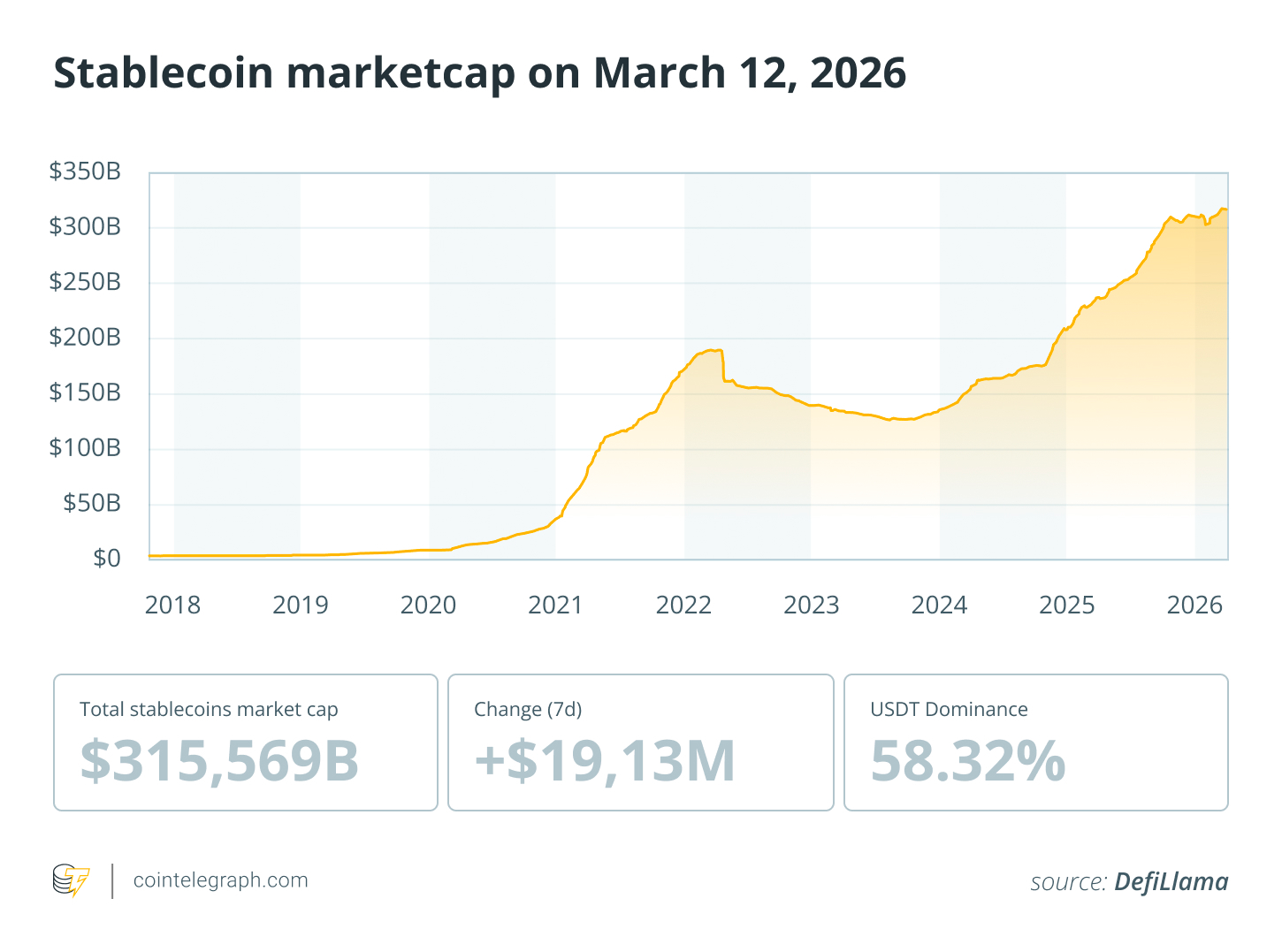
As of March 2026, the stablecoin market had reached a significant milestone, with its total valuation climbing to approximately $314 billion, according to DefiLlama data. This growth followed a breakout year in 2025, during which transaction volumes reached a record $969.9 billion in a single month. Experts now project that monthly volumes are on track to surpass the $1 trillion mark by the end of 2026.

For Mastercard, incorporating stablecoins into its settlement infrastructure helps ensure the company remains central to the changing digital payments ecosystem.
Rather than competing with blockchain systems, Mastercard is positioning itself as a connector between traditional finance and digital asset networks.
Expanding beyond simple payments
The partnership between SoFi and Mastercard also seeks to explore additional financial applications for stablecoins.
Potential uses include:
-
Cross-border remittances
-
Business-to-business payments
-
Treasury management tools
-
Stablecoin-linked card programs
Stablecoins could allow companies to automate complex financial workflows through programmable transactions.
For example, businesses could automatically release payments when contractual conditions are met, reducing manual intervention and operational costs.
Competition from Visa
Mastercard is not alone among global card networks in exploring stablecoin integration. Its main competitor, Visa, has also expanded its use of digital currencies for payment settlement.
Visa has tested cross-border settlement using stablecoins such as USD Coin (USDC), allowing financial institutions to pre-fund international transfers with tokenized dollars. The company has also explored enabling businesses to send payouts directly to stablecoin wallets.
These efforts suggest that stablecoins are becoming a key part of the broader infrastructure competition among leading payment networks.
Why regulation will be crucial
Adoption of stablecoins within mainstream financial systems depends heavily on regulation.
Financial institutions need clear regulatory frameworks that address key concerns, including:
Because SoFiUSD is issued by a regulated US bank, it is likely to inspire greater confidence among regulators and financial institutions than stablecoins that originate in the crypto space.
Payment networks such as Mastercard are therefore prioritizing regulated stablecoins issued by licensed institutions.
Did you know? Global card payment systems process tens of billions of transactions each year, with card networks handling thousands of payments per second during peak shopping periods such as Black Friday and major online retail events.
Challenges to widespread adoption
Despite growing interest, several challenges could limit the wider adoption of stablecoin settlement.
These challenges include:
-
Integration complexity for banks and payment processors
-
Regulatory differences across jurisdictions
-
Liquidity management between fiat and digital assets
-
Interoperability between blockchains and financial networks
Moreover, consumers are unlikely to notice major changes because the technology mainly affects back-end infrastructure rather than the front-end payment experience.
The bigger picture for digital payments
Mastercard’s stablecoin initiative is part of a broader transformation taking place in global finance. Stablecoins were initially used mainly for cryptocurrency trading. Today, they are increasingly viewed as potential tools for payments, remittances and broader financial infrastructure.
If stablecoin settlement proves efficient and reliable, card networks could eventually operate within a hybrid system that combines traditional banking rails with blockchain-based digital assets.
Mastercard is not looking to replace traditional payments. Rather, it is upgrading the under-the-hood infrastructure of global card networks. By integrating regulated stablecoins like SoFiUSD into its Multi-Token Network, the company is preparing its infrastructure for a more digital economy.
The goal is to create a system that is faster, more flexible and available 24/7, while ensuring the average shopper notices no difference at the checkout counter.
Cointelegraph maintains full editorial independence. Guides are produced without influence from advertisers, partners or commercial relationships. Content published in Guides does not constitute financial, legal or investment advice. Readers should conduct their own research and consult qualified professionals where appropriate.
Crypto World
Nearly $1 billion in bitcoin (BTC) ETF inflows power bull case as Kelp hack fuels DeFi jitters: Crypto Daily
Market dynamics continue to paint a bullish picture for bitcoin even as Iran-related developments and DeFi hacks dominate headlines.
U.S.-listed spot ETFs pulled in $663 million on Friday, the most since Jan. 15. Total inflows reached $996 million last week, up from $786 million the week prior, according to data source SoSoValue. This points to strong institutional interest in the largest cryptocurrency.
For a meaningful price rally to emerge, it’s a trend that needs to be sustained.
“ETF flow regimes provide a secondary read: Sustained inflows signal structural demand, while intermittent flows indicate tactical positioning, with consistency mattering more than magnitude,” said Timothy Misir, head of research at BRN, in an email.
Bitcoin is trading just above $75,000 after hitting highs above $78,000 on Friday, according to CoinDesk data. The prices has largely held steady over the past 24 hours. Similar patterns are evident in ether (ETH), XRP (XRP), Solana (SOL) and other major tokens.
DeFi platform Aave’s AAVE token has dropped 1% to $90 as the protocol faces collateral damage from the weekend hack of KelpDAO. The DeFi dominance rate, which measures the share of DeFi coins in the total crypto market value, has held flat at around 3%.
“The pressure on the leading cryptocurrency is linked to negative reactions in stock markets to news about Iran, which has reduced risk appetite. BTC has lagged significantly behind equities in recent days, building potential but not yet moving to realize it,” Alex Kuptsikevich, the chief market analyst at FxPro, said in an email.
According to the latest reports, the U.S. attacked and seized an Iranian cargo ship attempting to bypass restrictions on Iran’s ports.
Meanwhile, traders are actively building short positions, betting against a breakout. This could fuel a “short squeeze” if prices hold steady, forcing traders to cover bearish bets and potentially pushing spot prices higher. Stay alert!
Read more: For analysis of today’s activity in altcoins and derivatives, see Crypto Markets Today . For a comprehensive list of events this week, see CoinDesk’s “Crypto Week Ahead.”
What’s trending
Today’s signal

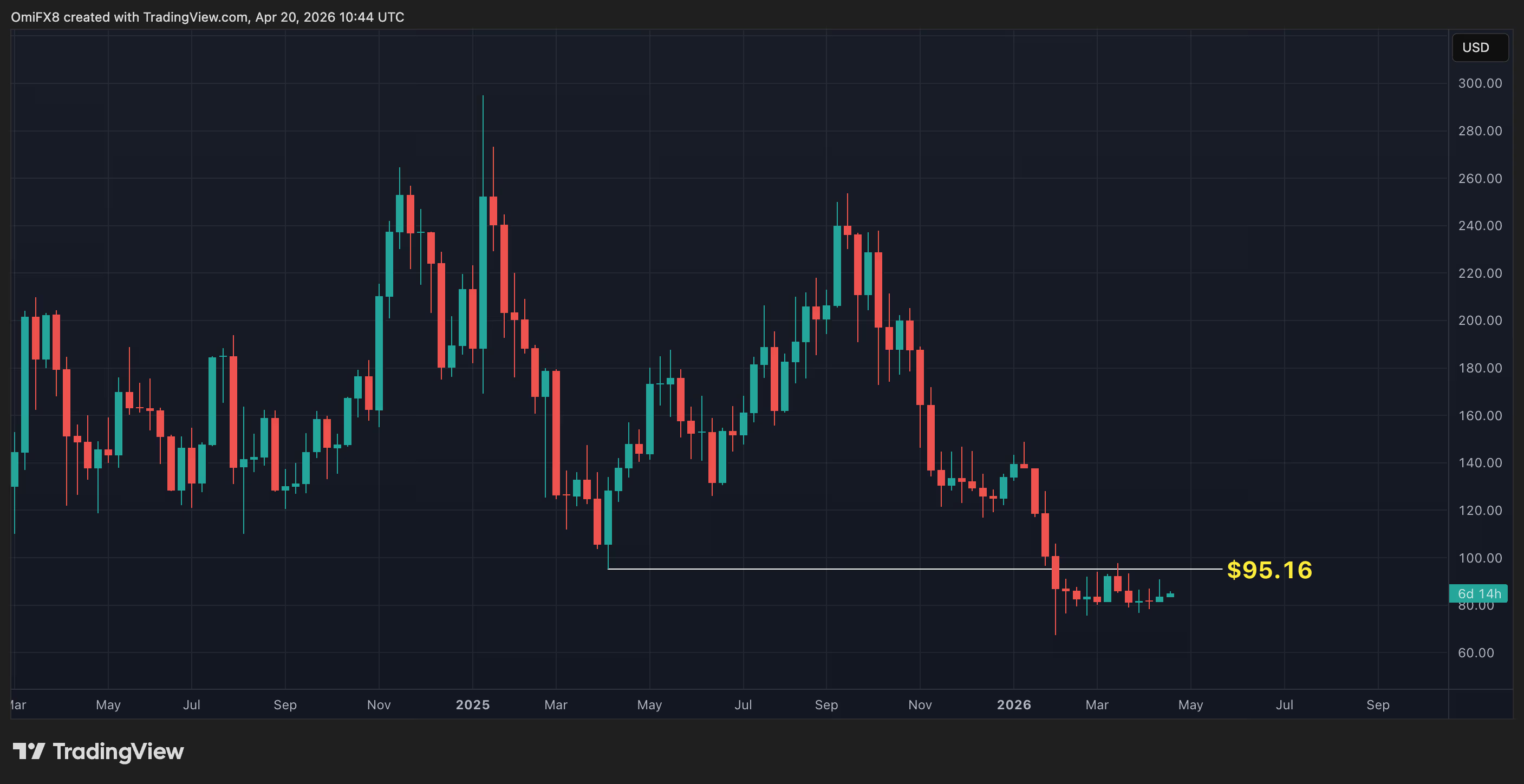
The chart shows weekly price swings in solana (SOL), with each candle showing a full week of trading activity, including the opening, closing, high and low prices.
One level stands out: $95.16, the low registered in April.
SOL has remained below that level for 11 consecutive weeks after dropping below it in early February. In technical analysis, a level that previously acted as “support,” a price floor where buying interest tends to emerge, often becomes “resistance” once it is broken. That means traders who previously bought around that level may now look to sell if prices revisit it, limiting upside momentum.
The fact that SOL has not yet climbed back points to a sustained bearish sentiment and potential for deeper losses. The next major support is seen directly at $50.
A strong move above that level, backed by a surge in trading volumes, is needed to invalidate the bearish outlook.


Mastercard is quietly upgrading its payments back-end by testing the use of regulated stablecoins to settle card transactions. The pilot, conducted in collaboration with SoFi Technologies and its Galileo platform, aims to move settlement between banks off traditional rails and onto digital dollars, while keeping the consumer checkout experience unchanged at the point of sale. The initiative centers on SoFiUSD, a dollar-backed stablecoin issued by SoFi Bank, N.A., and is positioned within Mastercard’s broader Multi-Token Network (MTN) vision for tokenized money.
As the industry watches the evolution of stablecoins from crypto-native instruments to mainstream settlement rails, Mastercard’s approach signals a strategic pivot: the networks that power card payments may increasingly rely on regulated digital assets to clear and settle transactions faster and with greater liquidity efficiency. The company’s plan also places it in a competitive stance with Visa, which has already piloted stablecoin-backed settlement capabilities for cross-border transfers and merchant payouts.
Key takeaways
- Mastercard is testing stablecoin-backed settlement, aiming to streamline the post-transaction clearing process across its global network.
- SoFi Bank, N.A. will use SoFiUSD to settle Mastercard credit and debit transactions; Galileo Financial Technologies will enable other banks and fintech issuers to participate in stablecoin settlement through Mastercard’s system.
- The initiative targets back-end settlement rather than altering the consumer payment experience, preserving the familiar card workflow at checkout.
- Mastercard’s Multi-Token Network is designed to support multiple forms of tokenized money, including stablecoins, tokenized deposits, and digital representations of fiat currencies.
- Regulatory clarity and cross-border liquidity considerations remain pivotal as stablecoins move toward mainstream financial infrastructure; market data in 2026 show a growing stablecoin sector with substantial transaction volumes ahead.
Back-end settlement reimagined
Behind the scenes, Mastercard’s approach reframes how settlement between issuing and acquiring banks could occur. When a consumer initiates a card payment, the traditional flow involves authorization, recording, merchant confirmation, and later settlement through standard banking channels. The new model concentrates settlement on the back-end, potentially using a regulated stablecoin such as SoFiUSD to fulfill the investment obligations between banks, rather than relying solely on fiat transfers.
Under this structure, a typical transaction would proceed as usual at the point of sale, but when the time comes to settle the obligation between the issuer and the acquirer, a stablecoin-based transfer could be executed. Stablecoins operate on blockchain infrastructure, offering the possibility of around-the-clock settlement that is not constrained by conventional banking hours. If successful, this could reduce settlement latency and improve liquidity management for financial institutions involved in card networks.
How stablecoin settlement would operate
In a practical sense, the workflow might look like this: a customer pays with a card in their local currency; Mastercard determines the net settlement obligation between the issuing bank and the acquiring bank; instead of exclusively relying on traditional rails, both parties could settle using a regulated stablecoin like SoFiUSD through the Mastercard system. SoFiUSD is issued by a federally regulated bank and is described as backed by cash reserves on a 1:1 basis, positioning it closer to bank-issued digital money than to a crypto-native asset.
Such a model aligns with a broader trend toward programmable, low-latency settlements that can cross borders and operate outside standard banking hours. While the user experience remains unchanged for the consumer, the underlying transfer of value between institutions could become more fluid and resilient in digital form.
MTN: A multi-token vision for payments
The backbone of this initiative is Mastercard’s Multi-Token Network, which is intended to support multiple forms of tokenized money. By bridging traditional financial rails with tokenized assets, MTN aims to create a versatile settlement ecosystem that can accommodate regulated digital currencies alongside conventional money. In theory, this could enable quicker cross-border movements, enhanced liquidity management, and greater interoperability between banks, card networks, and digital-asset infrastructure—without sacrificing regulatory compliance.
Why this matters for regulators, issuers, and users
Stablecoins have moved from niche crypto tools to a focal point of mainstream payments strategy. The appeal lies in their potential for fast, low-friction transfers and programmable payments, which could transform how businesses manage cash flows and how cross-border settlements operate. SoFi USD’s status as a dollar-backed instrument issued by a regulated bank is intended to help ease regulatory concerns, offering a more familiar framework for financial institutions wary of unbacked crypto exposure.
According to recent data, the stablecoin market has grown substantially. As of March 2026, the market’s total value stood around $314 billion, according to DefiLlama, reflecting growing adoption and increasing scale. The year 2025 also saw record activity, with monthly stablecoin transaction volumes approaching the trillions and market participants projecting that volumes could surpass $1 trillion per month by late 2026. These indicators help explain why payment networks are exploring stablecoin settlement as a means to improve efficiency and resilience in a rapidly digitizing ecosystem.
Competition and regulatory horizons
Mastercard is not alone in pursuing stablecoin-enabled settlement. Visa has already expanded its own stablecoin settlement capabilities, including cross-border transfers and merchant payout scenarios using tokenized dollars. This competitive dynamic underscores a broader shift in how the largest card networks view the future of payments: not as a replacement for traditional rails, but as an augmentation that leverages digital assets under a regulated umbrella.
Regulation remains a central determinant of how quickly and widely these innovations can be adopted. Banks and payment networks require clarity on issues such as reserve security, consumer protections, cross-border compliance, and interoperability with various blockchain ecosystems. SoFiUSD—issued by a chartered US bank—offers a regulatory-inclined path that other institutions may find more palatable as pilots scale.
Challenges on the path to wider adoption
Despite the promise, several barriers could temper the pace of adoption. Integration complexity for banks and payment processors stands out as a practical hurdle, along with regulatory variance across jurisdictions. Liquidity management between fiat and digital assets, and achieving seamless interoperability across different blockchains and legacy financial networks, are additional technical and operational considerations. Importantly, for most consumers, the transition will be invisible at the point of sale; the benefit will be measured in faster, more predictable settlement behind the scenes.
Broader implications for the payments landscape
Mastercard’s move fits into a wider evolution in digital payments. Stablecoins are increasingly seen as infrastructure components for remittances, business-to-business payments, treasury operations, and even stablecoin-linked card programs. If the current testing proves robust, card networks could evolve into hybrid ecosystems that blend traditional rails with blockchain-enabled settlement, delivering speed and efficiency without disrupting the familiar checkout experience.
Ultimately, the timing and scale of this transition will hinge on regulatory clarity, cross-border cooperation, and the ability of banks and issuers to integrate stablecoin settlement into complex, high-volume networks. The coming quarters are likely to reveal pilots, partner churns, and potentially early live deployments that will indicate how far such a back-end upgrade can take mainstream payments.
For investors and builders, the key takeaway is that stablecoins are moving from theory to execution within major payment rails. The attention now shifts to how regulators respond, how smoothly banks can onboard into MTN-enabled workflows, and how quickly other issuers and networks adopt similar back-end settlement architectures.
Watch closely for updates on pilot outcomes, regulatory milestones, and any additional partnerships that broaden the set of stablecoins approved for settlement across major networks. The next phase will reveal whether this is a scalable blueprint for faster, more resilient payments or a pilot with limited reach.


Digital asset investment products recorded $1.4 billion in net inflows last week, marking the strongest weekly total since January, according to CoinShares.
Summary
- Crypto investment products recorded $1.4 billion in inflows, the strongest weekly total since January this year.
- Bitcoin led with $1.116 billion, while Ethereum posted $328 million in weekly inflows globally.
- Total assets under management reached $155 billion as US-based products drove most fund demand.
Meanwhile, the latest reading also extended the streak of positive flows to three consecutive weeks. CoinShares said total assets under management rose to $155 billion during the period.
Weekly flows accounted for 0.91% of total assets under management, which the report described as the highest weekly intensity seen so far this year.
Bitcoin investment products attracted the largest share of the new money. CoinShares reported that Bitcoin funds recorded $1.116 billion in inflows last week, lifting year-to-date inflows to $3.1 billion.
The report said Bitcoin’s move above $76,000 during the week helped support market sentiment. CoinShares linked the stronger flows to improving risk appetite as ceasefire extension talks between the US and Iran continued. It also said March CPI data appeared to have had limited effect on investor positioning.
Additionally, Ethereum investment products posted $328 million in inflows, their strongest weekly result since January. That lifted Ethereum’s year-to-date inflows to $197 million and added to signs of improved demand for the asset.
At the same time, short-Bitcoin products saw just $1.4 million in inflows. This showed that some hedging demand remained in the market, but the scale stayed limited compared with the flows going into long digital asset products.
Regional flows show broad demand with one exception
The United States accounted for most of the weekly inflows. CoinShares said US-based products brought in $1.5 billion during the week, making the country the clear driver of global fund activity.
Germany also recorded positive flows, with $28 million in inflows. Switzerland moved in the opposite direction, posting $138 million in outflows. CoinShares said this was the largest outflow from Switzerland since November and stood out against the broader risk-on trend in digital asset markets.
Other assets posted weaker results than Bitcoin and Ethereum. The report said XRP and Solana products recorded outflows of $56 million and $2.3 million, respectively. Even so, the broader market picture remained positive as total weekly inflows reached their highest level in months.
Crypto World
Bitcoin (BTC) price drops from recent highs as traders watch CME gap, Kelp fallout: Crypto Markets Today
The crypto market is trading back in familiar territory following a short-lived spike to its highest point since early February on Friday.
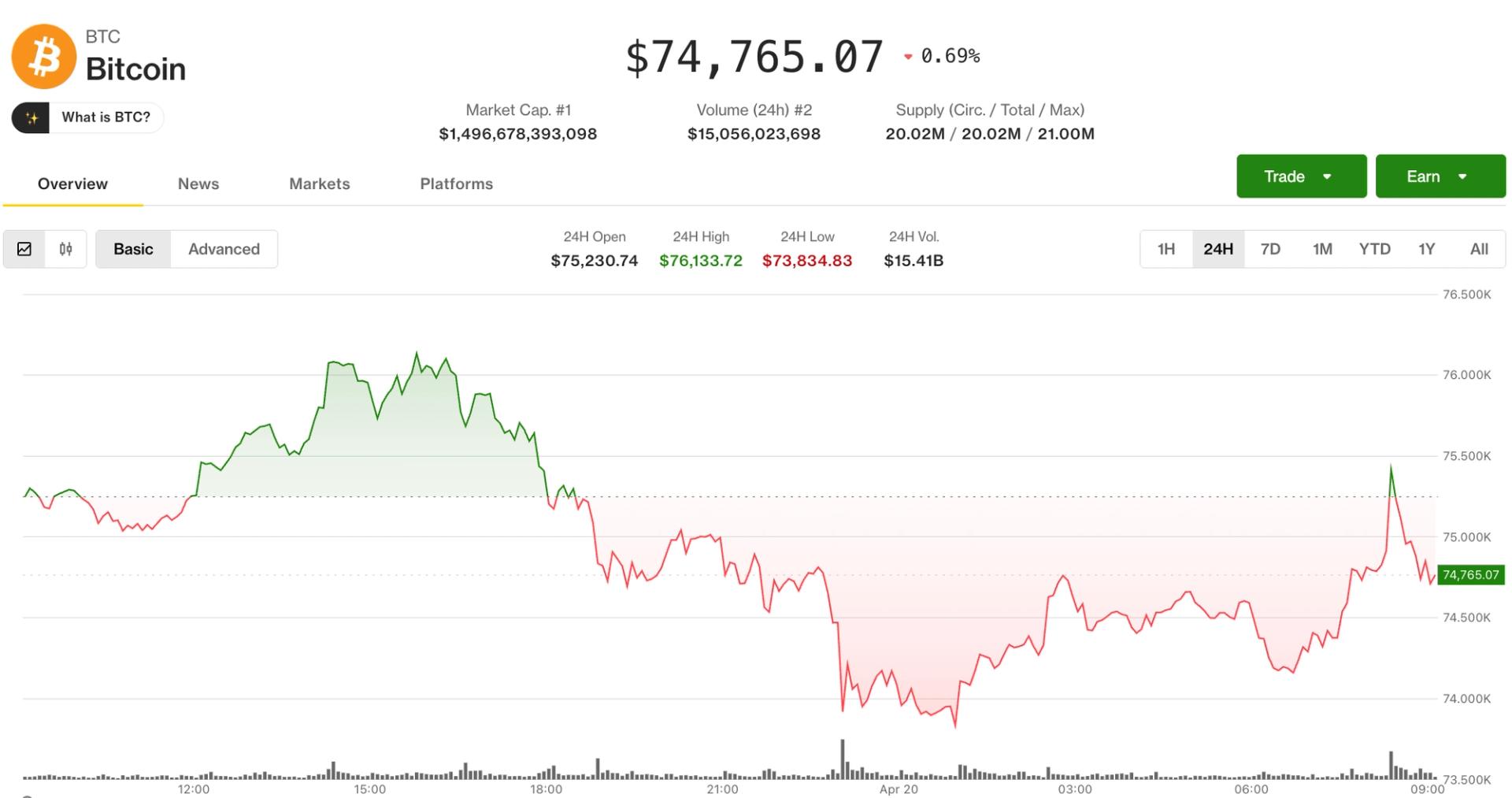
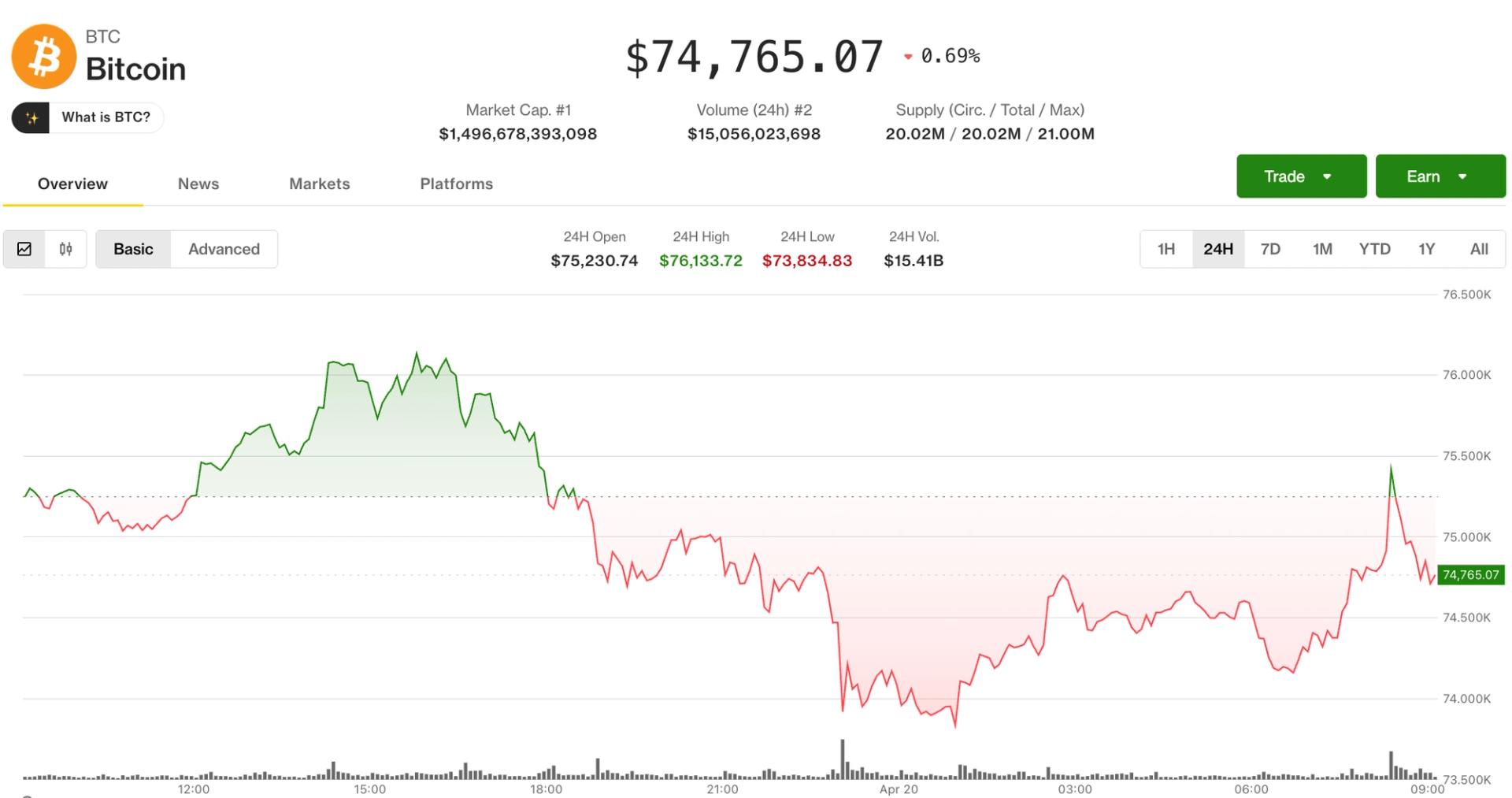
Bitcoin is trading a hair under $75,000 while ether (ETH) is at $2,300, both significantly lower than Friday’s highs of $78,300 and $2,460.
One reason for traders to be bullish is that the bitcoin futures market on the CME, a venue favored by institutions, closed at $77,540 on Friday and opened at $74,600 to create “CME gap” that spans 3.8% to the upside. A similar gap occurred last week and was filled before the end of the day on Monday.
The first steps have been taken: Bitcoin’s gained 1.5% since midnight UTC, suggesting sentiment is warming following a volatile weekend.
The market tumbled over the weekend as shipping through the Strait of Hormuz came to a halt after opening on Friday. The renewed closure led to a jump in the price of crude oil from $78 to $88 per barrel.
This weighed on risk assets, with Nasdaq 100 and S&P 500 futures both down by 0.59% since midnight.
Derivatives positioning
- Marketwide, crypto open interest (OI) held steady near $120 billion over the past 24 hours. Trading volume, in contrast, jumped 30%, suggesting a surge in activity without a corresponding increase in new positions. That potentially points to increased turnover, short-term positioning or traders rotating risk rather than deploying fresh capital.
- OI in solana (SOL), bitcoin , ether (ETH) and XRP (XRP) held largely steady. OI in HYPE futures declined by 3% alongside as the price fell, pointing to capital outflows. Elsewhere, OI in AVAX and SP 500 perpetuals rose by 6% to 10%, respectively.
- OI in AAVE futures surged to a record high of 3.46 million tokens as collateral damage from the weekend exploit of KelpDAO led to rapid withdrawals of from the Aave lending platform.
- Funding rates tied to BTC, ETH and several other tokens flipped negative, indicating a bias for short positions that would benefit from a price drop in these tokens.
- BTC and ETH options on Deribit continue to trade pricier than calls in a sign of lingering downside concern.
- Block flows featured bias for BTC call spreads, which are directional bets, and ether straddles, a volatility play.
Token talk
- The altcoin sector was rocked by a $292 million exploit of Kelp DAO’s rsETH token over the weekend, leading to contagion risks across the DeFi market.
- Total value locked (TVL) on Aave dropped from $26.5 billion to $17.5 billion as a result, with the exploit sparking fears of bad debt hitting Aave’s WETH pool, triggering heavy withdrawals and a liquidity crunch.
- Aave’s token, AAVE, rose 2.2% on Monday after tumbling 22% on Saturday.
- The bitcoin-dominant CoinDesk 20 (CD20) Index advanced 1% on Monday, outperforming the altcoin-weighted CoinDesk 80 (CD80) and the DeFi Select Index (DFX), which are up by 0.6% and 0.9%, respectively.
- One particularly volatile token is celestia (TIA), which remains 3.9% down over the past 24 hours even after surging by more than 4% since midnight.
- CoinMarketCap’s “Altcoin Season” indicator is at 36/100, demonstrating investor preference for bitcoin following Friday’s short-lived breakout.

In crypto, “tokenomics” is often presented as a rigorous branch of economics—complete with charts, emission schedules, vesting cliffs, and supply-and-demand models that look convincing at first glance.
But beneath the polish, many token models rely less on economic fundamentals and more on narrative engineering. In other words, tokenomics is frequently storytelling… supported by charts that make the story feel real.
This article breaks down three common structural patterns that appear across many token systems.
1. Future Users Funding Current Rewards
One of the most widespread design patterns in token economies is the implicit assumption that future participants will fund today’s rewards.
At first, this appears sustainable:
- Early users provide liquidity or activity
- They are rewarded with tokens
- The system grows through adoption
But in many cases, the mechanism quietly depends on continuous inflows of new participants to absorb token emissions.
This creates a structural loop:
- Early users earn rewards in newly minted tokens
- Those tokens require new demand to maintain value
- New users enter and effectively “pay” for earlier rewards through dilution or capital inflow
The model works—until it doesn’t. Sustainability is not driven by productivity or revenue, but by a steady expansion of participants willing to buy into the system.
A more honest framing would be:
“This system rewards early activity using future demand that must continuously materialize.”
2. Artificial Scarcity Narratives
Scarcity is one of the most powerful economic concepts in human behavior. Tokenomics often leverages this psychology heavily.
However, not all scarcity is equal.
Many token models rely on engineered scarcity narratives, such as:
- Fixed maximum supply figures
- Burn mechanisms with limited real impact
- Vesting schedules framed as “supply control.”
- Staking lockups presented as a reduced circulating supply
On paper, these mechanisms create the impression of limited availability. In practice, scarcity is often temporarily cosmetic, because:
- New emissions continue through staking rewards or incentives
- Locked tokens eventually unlock
- Burns are sometimes offset by ongoing issuance
- Governance can modify supply rules over time
The result is a paradox:
Scarcity is advertised as structural, but behaves as conditional.
A simple way to think about it:
If supply can expand when incentives require it, scarcity is not a constraint—it is a design choice.
3. Emissions Repackaged as Yield
Perhaps the most misunderstood element of tokenomics is “yield.”
Many protocols advertise attractive APYs, staking rewards, or liquidity incentives. These are often interpreted as “returns,” similar to dividends or interest.
In reality, a large portion of these rewards comes from token emissions, not revenue generation.
This means:
- New tokens are created
- They are distributed to participants
- The system does not necessarily generate external cash flow to support them
So where does the yield come from?
In many cases:
- From the dilution of existing holders
- From speculative inflows required to sustain the token value
- From temporary incentive budgets designed to bootstrap activity
This creates a subtle reframing:
Emissions are not profit. They are redistribution mechanisms.
Calling emissions “yield” is less financial engineering and more linguistic packaging. It transforms dilution into something that sounds like income.
Why the Charts Still Work
If these structures are fragile, why do tokenomics models still convince people?
Because they are visually compelling.
Token charts typically include:
- Emission curves that slope downward over time
- Supply caps that suggest finality
- Reward schedules that appear mathematically precise
- Growth projections that assume continued adoption
These visuals create a sense of inevitability. The design implies that if you understand the chart, you understand the system.
But charts are not guarantees—they are assumptions made visual.
And assumptions can be optimistic, conservative, or conveniently selective.
The Core Truth Behind Most Token Models
Stripped of narrative, many token systems rely on three foundational beliefs:
- There will always be new participants
- Demand will eventually outpace emissions
- Incentives today will generate value tomorrow
If even one of these assumptions fails, the entire structure can shift from growth model to liquidity extraction mechanism.
That doesn’t mean all tokenomics are flawed. Some systems do evolve into real fee-generating, utility-driven economies.
But it does mean a healthy level of skepticism is warranted when:
- Yield looks unusually high
- Scarcity feels overly emphasized
- Sustainability depends heavily on continued inflows
Final Thought
Tokenomics is not just math—it is narrative design wrapped in economic language.
And like all narratives, it can be powerful, persuasive, and occasionally misleading.
Or, as a more blunt summary would put it:
If the system needs constant new believers to keep existing rewards meaningful, it’s less a financial model—and more a story that hasn’t hit its final chapter yet.
REQUEST AN ARTICLE
The petrodollar system, a global financial arrangement in which most international oil trade is priced and settled in US dollars, faces growing threats amid the US-Iran war.
Under this system, countries that import oil must hold US dollars to pay for it, creating a constant global demand for the currency and reinforcing its role as the world’s dominant reserve currency.
Petrodollar System Faces Mounting Pressure Amid Gulf Disruptions
According to The Wall Street Journal, the United Arab Emirates has initiated discussions with the United States over a potential financial safety net amid escalating risks from the Iran conflict.
Officials said Central Bank Governor Khaled Mohamed Balama raised the possibility of a currency swap line in meetings with Treasury Secretary Scott Bessent and Federal Reserve officials in Washington.
The talks come as the conflict has disrupted Emirati energy infrastructure and constrained oil exports through the Strait of Hormuz, limiting dollar inflows.
While the UAE has not made a formal request, officials framed the discussions as precautionary. Nonetheless, they also noted that US military action against Iran “entangled their country in a destructive conflict whose effects may not be over.”
“Emirati officials told the US officials that if the UAE runs short of dollars, it may be forced to use Chinese yuan or other countries’ currencies for oil sales and other transactions, some of the officials said. In that scenario is an implicit threat to the US dollar, which reigns supreme among global currencies, partially because of its near-exclusive use in oil transactions,” the WSJ reported.
Subscribe to our YouTube channel to watch leaders and journalists provide expert insights
In parallel, alternative settlement practices have already emerged. Reports indicated that, in early April, Iran was charging commercial vessels transit fees through the Strait of Hormuz in yuan.
“While it is unclear how many vessels have made payments in yuan, at least two had done so as of March 25,” Al Jazeera reported, citing Lloyd’s List.
Tehran had also signaled plans to extend these measures to digital assets, including levying Bitcoin-based tanker transit fees as part of a broader effort to bypass traditional financial channels.
All of these developments point to a growing structural threat to the petrodollar system. However, pressure on the system predates the current conflict.
Deutsche Bank noted that US sanctions on oil exports from Russia and Iran had already led to parallel trading networks that increasingly rely on non-dollar currencies, such as the Chinese yuan.
Yuan Shift Could Challenge Dollar’s Dominance
Previously, several experts raised concerns about the dollar’s dominance. Bridgewater founder Ray Dalio warned that failing to secure Hormuz could sharply raise the risks to the dollar’s reserve status.
Similarly, Balaji Srinivasan argued that an Iranian victory could accelerate the end of multiple geopolitical and financial eras, including the petrodollar system.
Meanwhile, Harvard economist Kenneth Rogoff projects that the Chinese yuan could emerge as a global reserve currency within five years, citing growing investor demand to diversify away from the US dollar.
Follow us on X to get the latest news as it happens
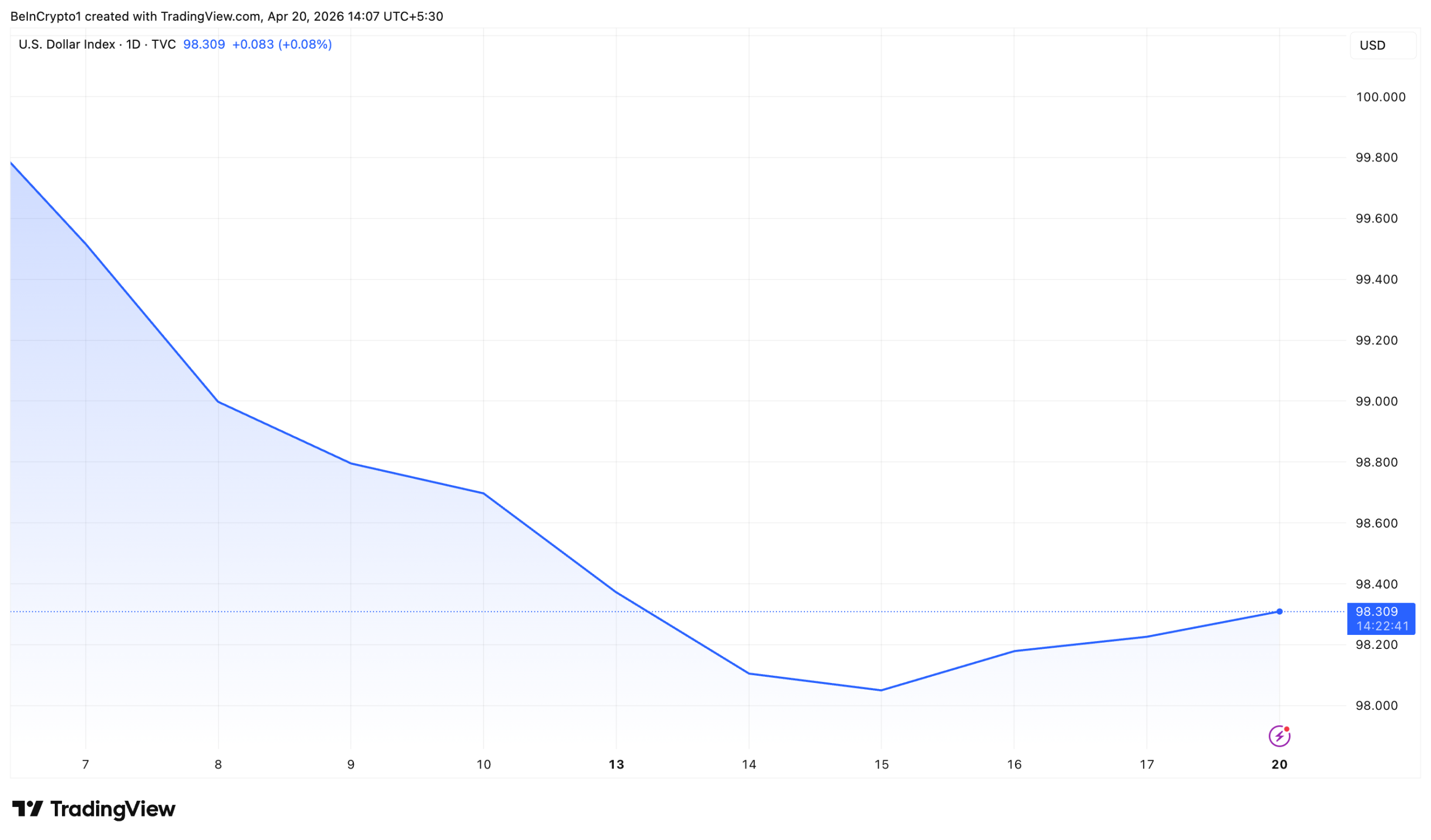
Despite these long-term concerns, short-term market dynamics continue to offer intermittent support to the dollar. The dollar index dropped nearly 2% between April 7 and 15 after the US-Iran ceasefire announcement.
However, renewed uncertainty around the war pushed oil back up, reviving the petrodollar effect.
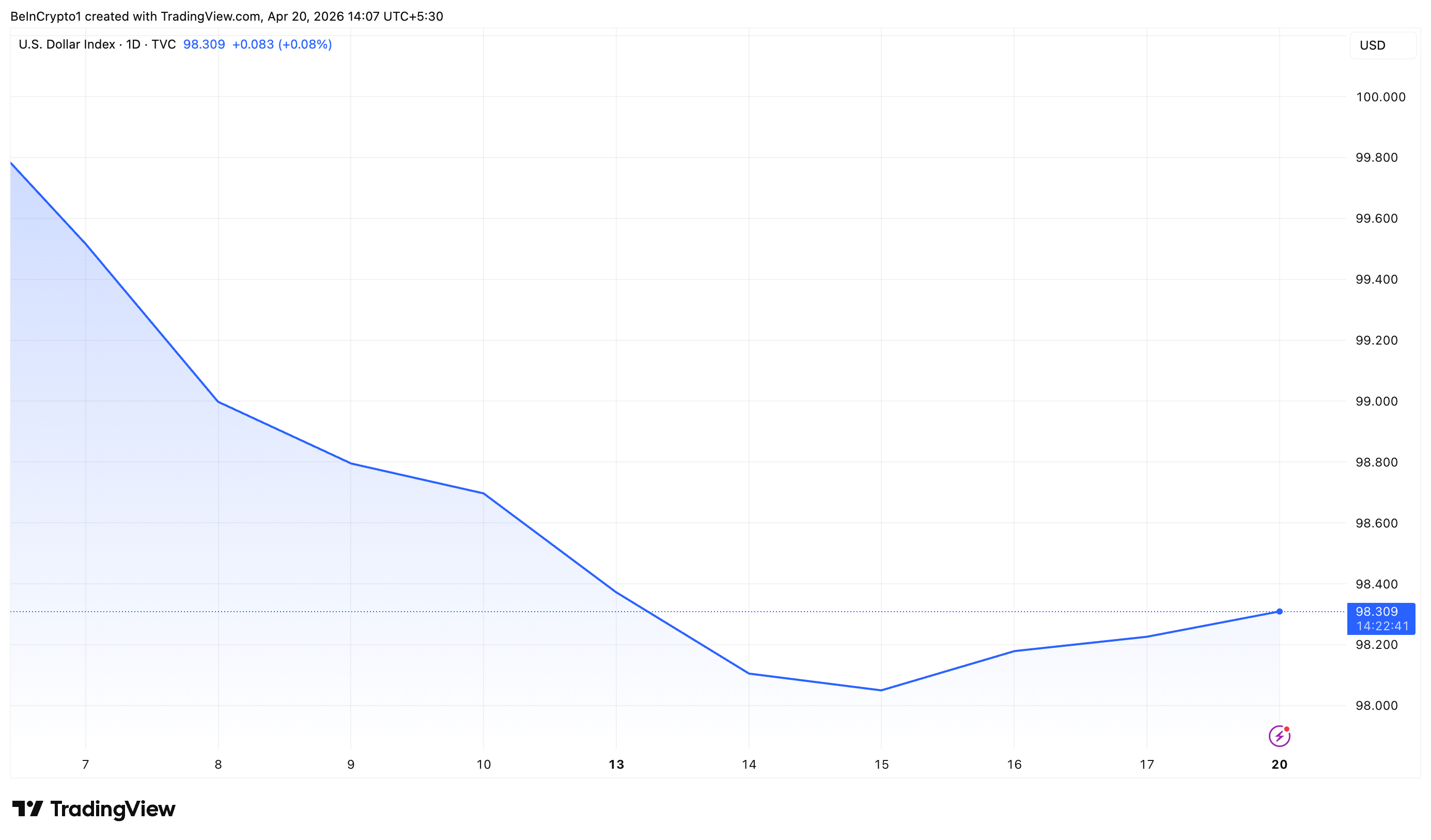
For now, geopolitical tensions are sustaining the petrodollar’s relevance. Yet, structural shifts beneath the surface raise questions about its long-term durability.
The post Petrodollar System Faces 3 Threats as Yuan Challenges Dollar appeared first on BeInCrypto.
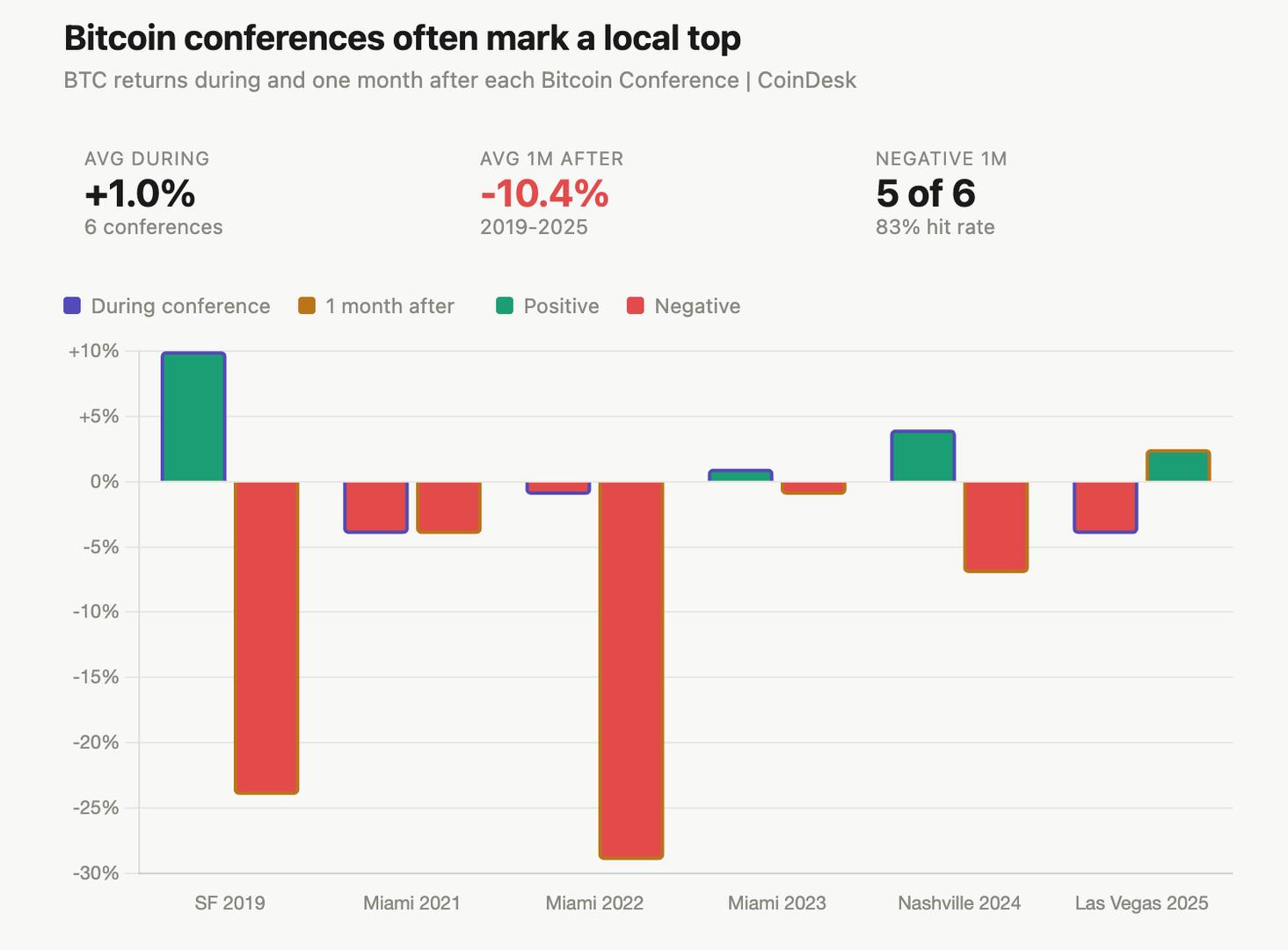
As bitcoin heads into this year’s flagship Bitcoin Conference in Las Vegas next week, traders will be watching for a familiar pattern, a potential “sell-the-news” event that has played out in previous years.
The largest cryptocurrency is trading around $75,000, recovering from a local bottom of around $60,000 in early February after collapsing more than 50% from its October all-time high.
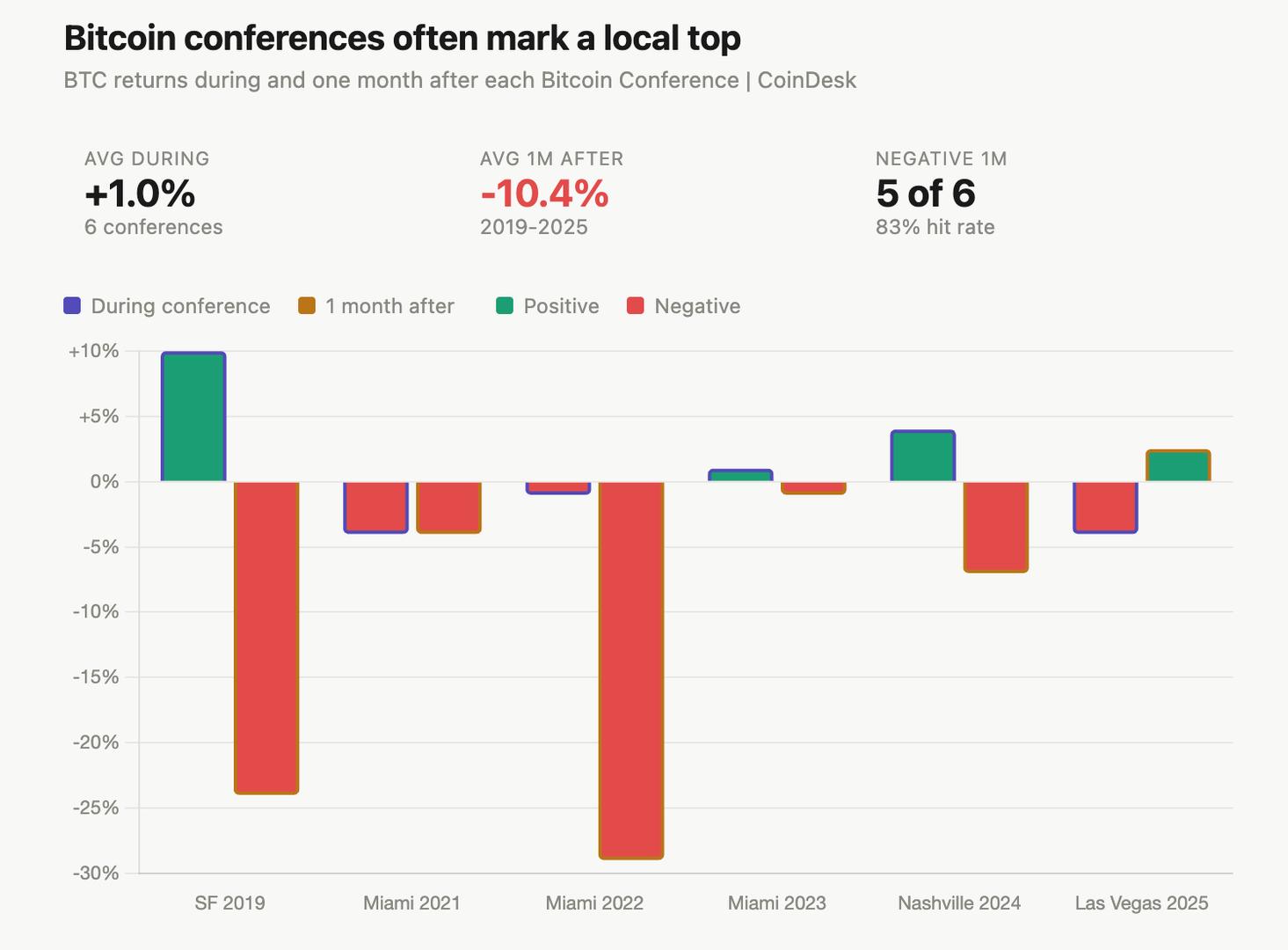
Data from Galaxy Research and Investing.com spanning 2019 to 2025 show the price of bitcoin tends to rise in the run-up to these conferences, delivers a mixed performance during the event and declines substantially afterward.
For instance, bitcoin gained about 3% in the 24 hours before the 2024 event in Nashville (featuring then-presidential candidate Donald Trump) and roughly 10% ahead of the 2019 conference in San Francisco, suggesting positioning builds into peak attention. Price action during the conference is typically subdued as the narrative fails to deliver, and the weakest performance occurs in the days and weeks that follow.
In the 2022 bear market, often compared to the current 2026 bear market environment, bitcoin fell just 1% during the Miami conference before sliding nearly 30% over several weeks. Similar post-conference weakness was seen in 2019, 2021 and 2023, where any momentum failed to hold.
Even in 2024, when Nashville hosted Trump to outline plans to position the U.S. as a bitcoin superpower, gains during the event were short-lived and marked a local top, just ahead of the yen carry-trade unwind in August that pushed bitcoin as low as $49,000.
Conferences tend to coincide with peaks in attention and liquidity as bullish narratives build up to the event, creating conditions for investors to unwind positions.
With sentiment still fragile and prices recovering from deep losses, the key question for 2026 is whether Bitcoin Vegas will once again act as an exit liquidity event.

The Myth of “Passive Income” in Crypto: You’re Always Doing Something

This Digital Card Is The Last-Minute Solution To Forgotten Colleague Birthdays

Corbin Burners And 3 Other Valuable Fantasy Baseball Injury Stashes


-

 Crypto World7 days ago
The SEC Conditionalises DeFi Platforms to Be Avoided for Broker Registration
-

 NewsBeat6 days ago
Trump and Pope Leo: Behind their disagreement over Iran war
-

 Fashion3 days ago
Weekend Open Thread: Theodora Dress
-

 Crypto World7 days ago
SEC Signals Exemption for Crypto Interfaces From Broker Registration
-

 News Videos5 days ago
Secure crypto trading starts with an FIU-registered
-

 Sports3 days ago
NWFL Suspends Two Players Over Post-Match Clash in Ado-Ekiti
-

 Crypto World6 days ago
SEC Proposes Certain Crypto Interfaces Don’t Need to Register as Brokers
-

 Business21 hours ago
Powerball Result April 18, 2026: No Jackpot Winner in Powerball Draw: $75 Million Rolls Over
-

 Crypto World3 days ago
Russia Pushes Bill to Criminalize Unregistered Crypto Services
-

 Politics3 days ago
Palestine barred from entering Canada for FIFA Congress
-
 Business4 days ago
Creo Medical agree sale of its manufacturing operation
-

 Politics1 day ago
Zack Polanski demands ‘council homes not luxury flats for foreign investors’
-
 Entertainment6 days ago
Brand New Day’ Footage Reveals the Devastating Impact of ‘Now Way Home’
-

 Tech5 days ago
Microsoft adds Windows protections for malicious Remote Desktop files
-
 Entertainment6 days ago
Karol G’s ‘Ultra Raunchy’ Coachella Set Gave ‘Satanic Vibes’
-

 Sports7 days ago
Aaron Judge says Yankees need to ‘simplify’ approach amid offensive slump
-

 Crypto World3 days ago
Russia Introduces Bill To Criminalize Unregistered Crypto Services
-

 Entertainment7 days ago
How Babylon 5 Turned Brief Side Story Into Emotional Masterpiece
-

 Tech6 days ago
What was the first ransomware attack to demand payment in Bitcoin?
-

 Tech4 days ago
‘Avatar: Aang, The Last Airbender’ Leaked Online. Some Fans Say Paramount Deserves the Fallout
You must be logged in to post a comment Login