LAREDO, Texas (AP) — A month after ICE agents sent the young Ecuadorian mother and her 7-year-old daughter to a sprawling detention center 1,300 miles from their Minnesota home, they were finally free.
But when the bus pulled up to a migrant shelter in the border city of Laredo, dropping off a half-dozen families lugging bags stuffed with belongings, the stress of recent weeks tracked mother and daughter like the long shadows on that mid-February afternoon.
Night after night inside south Texas’ Dilley Immigration Processing Center with hundreds of other families, the grade-schooler wept and pleaded to know why they were being held.
“She would tell me, ‘Mom, what crime did I commit to be a prisoner?’ I didn’t know what to tell her,” said the 29-year-old, who spoke on condition of anonymity for fear being identified could negatively affect their immigration case. Her husband was deported to Ecuador soon after they were taken into custody.
Advertisement
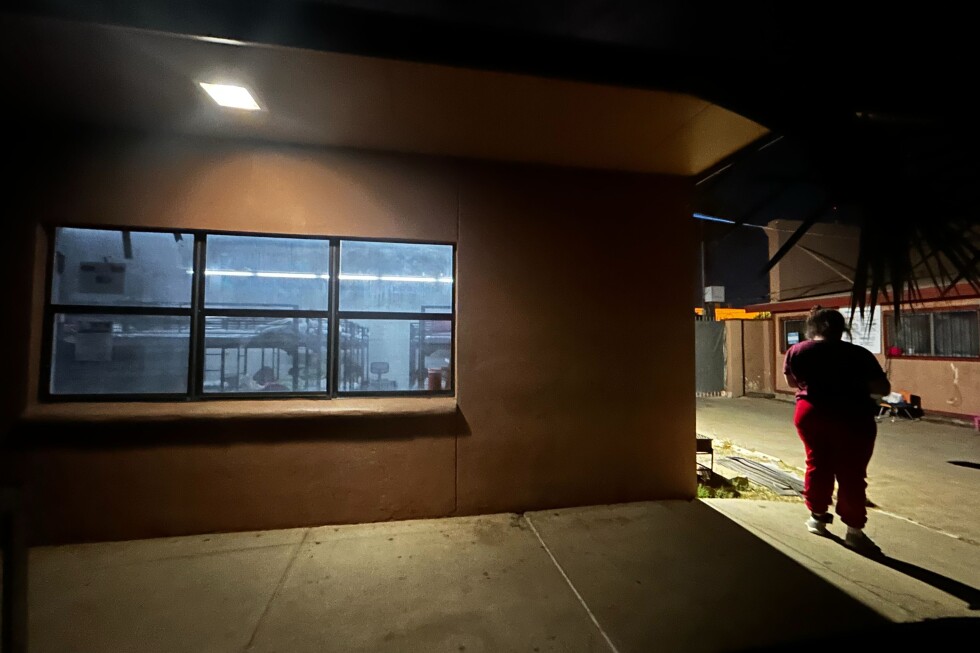
Immigrant families settle in for the night at the Holding Institute in Laredo, Texas, on Feb. 12, 2026. (AP Photo/Valerie Gonzalez)
Advertisement
Immigrant families settle in for the night at the Holding Institute in Laredo, Texas, on Feb. 12, 2026. (AP Photo/Valerie Gonzalez)
Advertisement
Advertisement
Advertisement
Advertisement
Many Americans were alarmed last month when photos circulated showing U.S. Immigration and Customs Enforcement agents in Minneapolis detaining a 5-year-old boy wearing a bunny hat and carrying a Spiderman backpack. The concern followed Liam Conejo Ramos and his father when they were sent to Dilley, surrounded by chain-link fences on a dusty plain about 75 miles south of San Antonio.
But Liam was hardly an outlier. ICE has been holding hundreds of children at Dilley — many for months.
“We are all Liam,” Christian Hinojosa, an immigrant from Mexico, said by phone from Dilley, where she and her 13-year-old son were held for more than four months. They were released this month and allowed to return home to San Antonio where she works as a health aide.
She noted that Liam and his father were released from Dilley after 10 days, when members of Congress and a judge intervened.
Advertisement
“My son says, ‘That’s unfair, Mama. What’s the difference between him and us?’”
Ramping up family detentions
When the Obama administration opened Dilley in 2014, nearly all families detained there had recently crossed the border from Mexico. Detentions at the facility were scaled back by the Biden administration in 2021, before it was closed three years later.
___
EDITOR’S NOTE — This story includes discussion of suicide. If you or someone you know needs help, the national suicide and crisis lifeline in the U.S. is available by calling or texting 988.
Advertisement
___
Since being reopened by President Donald Trump’s administration last spring, life inside Dilley — a compound of trailers and other prefabricated buildings — has been shaped by three decisive changes.
The number of detained families has risen sharply since last fall. The government is holding many children well beyond the 20-day limit set by longstanding court order. And many detainees have lived in the U.S. for several years, with roots in neighborhoods, workplaces and schools, according to lawyers and other observers.
“Just imagine that you’re a child and you’re taken out of your surroundings,” said Philip Schrag, a Georgetown University law professor and author of “Baby Jails: The Fight to End the Incarceration of Refugee Children in America.”
Advertisement
Suddenly you’re in “a completely strange environment with the doors locked and guards in uniform roaming around,” said Schrag, who counseled Dilley detainees as a volunteer lawyer during the Obama administration.
ICE booked more than 3,800 children into detention during the first nine months of the new Trump administration, according to an Associated Press analysis of data from the University of California, Berkeley’s Deportation Data Project. On an average day more than 220 children were held, with most of those detained longer than 24 hours sent to Dilley. More than half of Dilley detainees during that period were children.
Advertisement
A young immigrant girl who just arrived at the Holding Institute, a shelter in Laredo, Texas on Feb. 12, 2026, pets a cat as her mother and other families receive a welcome and instructions on how to purchase tickets to get back to their homes in the U.S. (AP Photo/Valerie Gonzalez)
A young immigrant girl who just arrived at the Holding Institute, a shelter in Laredo, Texas on Feb. 12, 2026, pets a cat as her mother and other families receive a welcome and instructions on how to purchase tickets to get back to their homes in the U.S. (AP Photo/Valerie Gonzalez)
Advertisement
Advertisement
Advertisement
Nearly two-thirds of children detained by ICE were eventually deported and almost 1 in 10 left the country when their parents accepted voluntary departure, according to an AP analysis of the latest comprehensive data. About a quarter were released in the U.S., requiring their parents to check in regularly with ICE as their legal cases proceed.
The number of detainees at Dilley has risen sharply since the period covered by the data, nearly tripling between last fall and late January to more than 1,300, according to Relevant Research, which analyzes immigration enforcement data.
“We’ve started to use 100 days as a benchmark for prioritizing cases because so many children are exceeding 20 days,” said Leecia Welch, the chief legal director at Children’s Rights, who visits Dilley regularly to ensure compliance. In a visit this month, Welch said she counted more than 30 children who had been held for over 100 days.
Advertisement
The increased detention of children comes as the Trump administration has gutted a Department of Homeland Security office responsible for oversight of conditions inside Dilley and other facilities.
“It’s a particular concern that family detention is being increased,” said Dr. Pamela McPherson, a child and adolescent psychiatrist contracted by DHS from 2014 until last year to inspect and investigate conditions at Dilley and other ICE facilities holding children.
“Just who’s providing that check-and-balance now?”
Rep. Tony Gonzales, who represents the congressional district where Dilley is located, said multiple visits have convinced him criticism of the center is unfair.
Advertisement
He said he’d been impressed by Dilley’s facilities and the professionalism and dedication of staff. “They’re not doing policy. They’re just fulfilling a duty,” said Gonzales, a Republican.
DHS did not respond to detailed questions about Dilley submitted by the AP. But both DHS and ICE sharply refuted allegations of poor care and conditions there.
“The Dilley facility is a family residential center designed specifically to house family units in a safe, structured and appropriate environment,” ICE Director Todd M. Lyons said in a statement this week. Services include medical screenings, infant care packages as well as classrooms and recreational spaces.
But concerns about Dilley are personal for Kheilin Valero Marcano, a Venezuelan immigrant detained with her husband and 1-year-old daughter, Amalia, in December and held for nearly two months.
Advertisement
Migrants from Venezuela, Stiven Arrieta Prieto and his wife, Kheilin Valero Marcano, with their 18-month-old daughter, Amalia Arrieta Valero, pose for a photo in Southern California on Tuesday, Feb. 10, 2026. (AP Photo/Damian Dovarganes)
Advertisement
Migrants from Venezuela, Stiven Arrieta Prieto and his wife, Kheilin Valero Marcano, with their 18-month-old daughter, Amalia Arrieta Valero, pose for a photo in Southern California on Tuesday, Feb. 10, 2026. (AP Photo/Damian Dovarganes)
Advertisement
Advertisement
Advertisement
When the child got a high fever, Valero Marcano said Dilley staff told her it was just a virus. Two weeks later, Amalia started vomiting, then losing weight. Valero Marcano said she took her to the Dilley doctor’s office at least eight times but was offered Tylenol and ibuprofen.
Advertisement
The baby was eventually sent to two hospitals, where doctors diagnosed COVID, bronchitis, pneumonia and stomach virus, she said.
ICE disputed Valero Marcano’s account, saying in a statement the baby “immediately received proper medical care” at Dilley before being sent to the hospital. Back in Dilley, “she was in the medical unit and received proper treatment and prescribed medicines,” it said.
The family’s return to Dilley coincided with a measles outbreak there. They were released earlier this month after their lawyers petitioned the court.
“I’m so worried for all the families who are still inside,” Valero Marcano said.
Advertisement
A teen in distress
After more than two months in a cramped room at Dilley with three other families, the 13-year-old girl’s depression turned increasingly dark.
The eighth grader stopped eating after finding a worm in her food, family members said. Staff sometimes withheld medications she’d long been prescribed to keep her anxiety in check and help her sleep.
When a total lockdown was imposed, a guard blocked the teen from leaving the crowded room to join her mother and sister in the bathroom. She spiraled into crisis, and used a plastic knife from the cafeteria to cut her wrist.
“She said she didn’t want to live anymore because she preferred to die rather than having to keep living in confinement,” her mother, Andrea Armero, told the AP in a video call from Colombia, where the family was deported this month. The AP generally avoids identifying people who attempt or die by suicide.
Advertisement
The girl’s struggles began before she arrived at Dilley. Soon after starting middle school in Colombia, she learned a family member had sexually abused her younger sister. Armero said she saw no option but to leave and in early 2024 she and her daughters traveled to the U.S. border with Mexico, applying for asylum.
Living with family in Florida, the 13-year-old was doing well in school but sometimes experienced panic attacks about being sent back to Colombia. Under a psychiatrist’s care, she was prescribed anti-anxiety and anti-depression medications and regularly saw a therapist. Then, in December, ICE agents detained Armero and her daughters during a routine check-in.
At Dilley, the 13-year-old calmed herself by drawing, producing haunting pictures of a girl locked inside gates. But when she and other detainees took part in a protest after 5-year-old Liam and his father got to Dilley, guards took away drawing materials and ordered everyone to stay inside.
Advertisement
This image provided by the family in February 2026 shows a drawing made by a 13-year-old Colombian girl when she was detained at South Texas Family Residential Center in Dilley, Texas, where the Trump administration is holding immigrant families. (AP Photo)
Advertisement
This image provided by the family in February 2026 shows a drawing made by a 13-year-old Colombian girl when she was detained at South Texas Family Residential Center in Dilley, Texas, where the Trump administration is holding immigrant families. (AP Photo)
Advertisement
Advertisement
The teen’s mental health collapsed. She tried to harm herself with the plastic knife, Armero said, and repeatedly hit her head. The family was put into isolation without seeing a doctor, then deported to Colombia on Feb. 11 after a judge ordered them removed, she said.
Dilley discharge documents described “active problems,” including a “suicide attempt by cutting of wrist” and “self-harm,” in addition to a “history of post-traumatic stress disorder” and “history of anxiety.” AP also spoke with detainees and attorneys who independently described the girl’s suicide attempt.
Advertisement
Responding to questions from AP, a DHS official acknowledged there had been “a case of self-harm” inside the facility, but did not specify what had happened, or how staff handled the incident. When AP asked for details, DHS did not respond to follow-up questions.
“No child at Dilley … has been denied medical treatment or experienced a delayed medical assessment,” said Ryan Gustin, a spokesman for CoreCivic, the for-profit prison company that operates the facility under contract with ICE. Gustin declined to answer specific question about the 13-year-old girl, citing privacy rules.
Detention weighs on children
On a phone call from inside Dilley, 13-year-old Gustavo Santino-Josa introduced himself to a reporter by name and the 9-digit identification number ICE assigned him when he was taken into custody with his mother.
“Until today I don’t know what we did wrong to get detained,” Gustavo said. “I’ve seen my mom cry almost daily and I ask God that we can go out and go home soon.”
Advertisement
He worried they might never be released.
“My mom says that as long as there is hope it is worth fighting for,” Gustavo said before handing the phone to his mother, Christian Hinojosa, the health care aide originally from Mexico.
“All his friends have left already,” his mother said. “Some were deported. Some got released recently. And it hurts. It hurts to see people leaving and you’re staying here.”
Advertisement
Andrea Armero, right, and her daughter, who were deported from the United States, sit in a park in Colombia, on Wednesday, Feb. 18, 2026. (AP Photo/Fernando Vergara)
Advertisement
Andrea Armero, right, and her daughter, who were deported from the United States, sit in a park in Colombia, on Wednesday, Feb. 18, 2026. (AP Photo/Fernando Vergara)
Advertisement
Advertisement
Dilley was built to hold 2,400 people, housed in clusters ICE calls “neighborhoods.” Bunk beds are arranged side-by-side for up to four families, frequently putting parents with young children in close quarters.
Once in full operation, Dilley is expected to generate about $180 million in annual revenue for CoreCivic, according to the company’s recent filing with securities regulators.
Advertisement
In a video on its website, CoreCivic says Dilley’s “open campus layout allows residents to move freely and unescorted throughout the day.”
It does not mention that parents and their children are locked inside.
In response to questions from the AP, CoreCivic’s Gustin said the staff at Dilley includes a pediatrician, pediatric nurse practitioner, other trained medical professionals, as well as mental health services to “meet the needs of children and families in our care.”
In talks with parents of children held at Dilley, however, the same problems come up repeatedly, said Welch, the children’s rights lawyer.
Advertisement
Kids cry often and don’t get enough sleep, in part because lights are on around the clock, she said. The water tastes terrible and causes stomachaches and rashes, so some families stick to what they can buy in the commissary.
Their children don’t eat enough and have lost weight, Welch said. There are classrooms, but instruction is limited to an hour daily, mostly filling out worksheets.
A 14-year-old girl, identified in court papers by the initials NVSM, reported there were tensions with up to 12 people sharing their room. At night when she and her mother tried to sleep, others insisted on turning up the TV.
“I feel very sad and stressed to be here,” the teen said in an account filed with the court that oversees a binding settlement governing detention and release of children. “My nerves are so high. I don’t know what is happening. My muscles will twitch because I’m so nervous and on edge.”
Advertisement
Concerns about oversight
As the government’s detention of parents and their children came under scrutiny in 2014, an ICE official insisted that family detention centers, equipped with basketball courts and medical clinics, were “more like a summer camp.”
The characterization irritated McPherson, the child psychiatrist who, along with another physician, was retained in 2014 by DHS to inspect family detention centers. Their contracts were not renewed by the Trump administration last year after DHS announced sweeping staff reductions.
“Having a clean place to sleep, having food, that’s not the same thing as having family and community,” McPherson said.
The doctors’ investigations of family detention centers exposed consistently inadequate staffing and disregard by administrators for the trauma caused by detention, concerns they reported in 2018 to a Senate caucus set up to hear from whistleblowers.
Advertisement
At Dilley, the doctors noted a persistent shortage of pediatricians and the inability to hire a child psychiatrist from the time they began their inspections until they alerted senators.
Employees unsure how to deal with 2-year-olds biting and hitting each other placed the children and their parents in medical isolation for days, McPherson and her colleague told senators. Without supervision, a nurse at Dilley gave adult-strength hepatitis A shots to about 250 children in 2015, the American Immigration Lawyers Association reported.
Advertisement
Kheilin Valero Marcano, hugs her 18-month-old daughter, Amalia Arrieta Valero, in Southern California on Tuesday, Feb. 10, 2026. (AP Photo/Damian Dovarganes)
Kheilin Valero Marcano, hugs her 18-month-old daughter, Amalia Arrieta Valero, in Southern California on Tuesday, Feb. 10, 2026. (AP Photo/Damian Dovarganes)
Advertisement
Advertisement
Advertisement
DHS responded to many of the findings by making changes before a special committee recommended in late 2016 that the government discontinue family detention except in rare cases. The first Trump administration increased family detention before the Biden administration began phasing it out in 2021.
That the Trump administration is again holding families at Dilley after so many warnings feels “dystopian,” McPherson said.
“The decision to knowingly traumatize children and subject them to chronic stress, I just have no words for it,” she said.
Advertisement
Worries even after release
Huddled around picnic tables at the Laredo migrant shelter, parents released from Dilley searched anxiously for flights back to the homes they left behind. They called relatives, friends, teachers, anyone who might help with money to get there.
The young Ecuadorian mom talked of returning to Minneapolis, where her 2-year-old daughter, born in the U.S., was staying with a friend. With her husband deported, parenting will be entirely her responsibility.
That means getting her 7-year-old back in school. Then the woman, who had a work permit and a job in a Minneapolis restaurant before being detained, needs to keep her children fed.
“Let’s go home, Mom, but don’t go back to work because ICE is going to pick you up again,” the little girl said. Her mother tried to reassure her.
Advertisement
That won’t happen, she said, because now they have a special paper telling ICE to leave them alone.
She hopes that’s a promise she can keep.
—
AP Data Reporter Aaron Kessler contributed from Washington.
Advertisement
___
Contact AP’s global investigative team at [email protected] or https://www.ap.org/tips/
Gardeners are being urged to check their patches as invasive bluebells are spreading rapidly across the UK and threatening the future of the nation’s native blooms. Plant experts at GardeningExpress.co.uk warn that many homeowners may already have the invasive Spanish bluebell plants growing in their gardens – but they can quickly take over and outcompete native English bluebells.
Spanish bluebells were originally introduced as ornamental garden plants, but their ability to spread aggressively means they are now one of the biggest threats to native bluebells. They grow faster, produce more seeds and easily hybridise with native varieties, creating crossbreeds that dilute the UK’s iconic woodland flower.
Native bluebells are a protected species and a vital part of the UK’s natural heritage, but once Spanish bluebells escape gardens, they can spread into nearby countryside and woodlands, making gardens a key battleground in protecting the native species. Experts say many gardeners are unintentionally helping the problem grow, often because they don’t realise the difference between the two plants.
Advertisement
With bluebell season underway, homeowners are now being urged to learn how to identify Spanish bluebells in case they need to take action in their gardens. Spanish bluebells grow upright, with flowers all around the stem, whereas native bluebells droop to one side in a curved shape.
The Spanish varieties are often pale blue or lilac, and can sometimes appear pink or white, while native bluebells are usually deep violet-blue. There are also differences in scent and foliage – native bluebells have a strong, sweet fragrance, whereas Spanish bluebells have little to no scent and their leaves are broader and thicker compared with the narrow leaves of native plants.
Spanish bluebells are not on the government’s list of invasive plants in England and Wales. However, they are considered an invasive non-native plant in Northern Ireland and the Republic of Ireland, while in Scotland, it is an offence to plant any non-native plant in the wild.
Advertisement
Chris Bonnett, plant expert and founder of Gardening Express, said: “Spanish bluebells can spread more easily than our native species, so gardeners need to be aware of how quickly they can multiply. “The biggest risk comes from gardens, where they may be planted for their beauty but can spread beyond boundaries through seeds, bulbs and garden waste if left unchecked.
“Gardeners play a crucial role in protecting native bluebells. Even a single garden population can establish in surrounding areas within a few years, so early identification and careful management can make a big difference.”
Five tips to help homeowners control Spanish bluebells in their gardens:
Advertisement
Dig up bulbs carefully
Spanish bluebells spread through underground bulbs, so removing the entire bulb is essential to controlling the plant.
Dispose of plants properly
Never compost them or dump garden waste in the countryside. Bag plants and dispose of them via general waste.
Advertisement
Avoid planting or sharing bulbs
Even giving bulbs to friends or neighbours can spread the invasive species further afield.
Monitor your garden each spring
New plants can regrow from missed bulbs or seeds.
Advertisement
Choose native alternatives
Plant native bluebells or other UK-friendly spring flowers instead.
The latest cast of I’m A Celebrity… South Africa learned more than they needed to about Amanda Holden, thanks to her Heart Radio co-star Ashley Roberts
Samantha Masters Content Editor
10:10, 15 Apr 2026
Amanda Holden made her return to Heart Radio on Wednesday, and it wasn’t long before she confronted her co-star Ashley Roberts over a recent television moment. The Pussycat Dolls singer is currently featuring in I’m A Celebrity… South Africa, which was recorded last year. In a recent episode, Ashley, 44, left her campmates laughing after disclosing Amanda’s surprisingly swift bathroom habits.
“She can poo quicker than anybody I’ve ever met in my life,” Ashley told them. “She’ll have her stiletto heels on from the studio. A song will be playing and she’ll run off during the link. Then suddenly she’s back and I’m like, ‘You did not just…’
Advertisement
“And she’s like, ‘Yep, feeling great!’ Then she’s straight back on-air doing a link like nothing happened.”
Responding to the clip live on Heart Radio alongside Ashley and Jamie Theakston, the 55-year-old revealed she had watched the footage and “loved” it.
She went on to say: “You know I can run down there, do a poo and come back before the end of a song.”
While Jamie acknowledged his co-host’s famously rapid comfort breaks, he questioned why Ashley felt compelled to share the story with the wider world.
“I’m proud of it,” Amanda laughed, confirming she was perfectly happy for people to know.
“She is the quickest poo-er in the land!” Ashley quipped. “I need a sash or a crown,” Amanda replied.
The Britain’s Got Talent judge went on to say that she doesn’t understand why anyone would want to “hang around” in the bathroom. “Just get out,” she added. “I don’t even like sitting down – especially in public toilets. Fire and go!”.
Advertisement
Leaving her co-star astonished by the revelation she doesn’t sit down, Amanda joked: “I’ve got the strongest thighs in showbiz!”.
During the conversation, Ashley also revealed who she missed most from the programme. Those battling to be crowned Legend of the Jungle are; Ashley, Scarlett Moffatt, Sinitta, Sir Mo Farah, Seann Walsh, Adam Thomas, David Haye, Beverley Callard, Gemma Collins, Craig Charles, Jimmy Bullard and Harry Redknapp.
Looking back on her experience, she said: “I had good relationships with everybody, I was lucky in that sense. But, me and Scarlett were bush sisters – and we still are.
Advertisement
“Honestly, I couldn’t have gotten through that without her. We just kept each other sane. You know when you look at someone across the room and you just know what they’re thinking? We were always on the same page. It was pretty much that.”
Meanwhile, tensions escalated in camp on Tuesday evening after the Rhinos defeated the Lions in another challenge. The victory meant the Rhinos had more food for dinner, while the losing side were left with rice and beans.
Frustrated by the outcome, David threatened to pinch the other team’s food when it passed their camp.
Speaking in the Bush Telegraph, he outlined his strategy: “If the food comes across, whoever it was potentially for – or not for – is neither my concern. I’m going to take it and I’m going to eat it.”
Advertisement
The I’m a Celebrity… South Africa airs weekdays from 9pm on ITV and ITVX. The live final airs on April 24th.
Will you be changing your holiday plans due to the new EES changes?
UK travellers now face new data checks at European airports as the EU’s Entry/Exit System (EES) is fully implemented across 29 countries in the Schengen area, including Spain, Italy and Greece.
Advertisement
The new system means UK holidaymakers now have to “create a digital record” when they first travel to the Schengen area. This will require travellers to provide additional information upon arrival at the border, replacing the previous system of passport stamping.
However, the introduction of the system has led to significant travel disruptions, including hundreds of people missing flights after being stuck in queues at an airport in Milan at the weekend.
Click here to get the biggest stories straight to your inbox in our Daily Newsletter
She has since had to cover the extra expense of staying in Italy for longer as the next available flight back was five days after her original departure date.
Representative body Airports Council International recently reported that EES was causing delays of up to three hours, with airports in Spain, Portugal, France and Italy among the worst affected.
And the chief executive of Advantage Travel Partnership, Julia Lo Bue-Said, has since warned of a “summer of chaos” if changes aren’t made.
Advertisement
In an interview on BBC Radio 4, the travel expert said: “The real issue is the volume of passengers that are trying to go through border control at one time. It’s clearly creating significant bottlenecks. The biggest frustration is these airports know what passengers are arriving, they know how many flights are coming in.
“There needs to be better coordination on arrival and on departure – because the same thing happens when you leave – to ensure we are not facing a summer of complete chaos.”
She added to the Press Association that what happened in Milan is “a warning sign that cannot be ignored”.
She said: “Even isolated incidents at Schengen borders are having serious knock-on effects, with passengers missing flights, facing long waits and navigating processes that are unclear and inconsistent. That is simply not good enough.”
Advertisement
She claimed some airports have the “physical infrastructure to handle demand but are simply not deploying the staff to match it”, which “demands explanation”.
She added: “We have consistently called for a pause in EES registration during peak travel periods and at times of high passenger volumes, to minimise disruption and protect the customer experience.”
Luke Petherbridge, director of public affairs at travel trade organisation Abta, said: “While for many the travel experience remains smooth, we’re disappointed and frustrated to see some passengers being caught up in delays due to EES.
“Abta has been warning destinations and the (European) Commission for some time about the need for proactive steps to be taken to avoid delays, including the full use of contingency measures to stand down biometric checks at busier times, and adequate staffing especially at peak times.”
The actress shared a string of adorable snaps as she was seen returning to her Manchester wedding location, a year after tying the knot
Emmerdale star Isabel Hodgins has shared a string of adorable snaps as she was seen returning to her Manchester wedding location with her baby daughter, as she and her husband marked one year since their big day.
Advertisement
The actress, who is best known for having played Victoria Sugden in the ITV soap for two decades, recently gave birth to her and her husband Adam Whitehead’s daughter, Georgie.
Isabel and Adam shared the news of their baby girl’s arrival in a sweet social media post on February 13. The video showed Isabel in the hospital in labour, before a blank screen appeared with the message: “On the 11th of February at 1:02am… Georgie Grace Whitehead. 11.02.26. 8lbs5oz [heart emojis].”
Click here to get the biggest stories straight to your inbox in our Daily Newsletter
The couple have since been candidly sharing their parenthood journey with fans, having posted a number of adorable updates on their baby girl on social media in recent weeks and months.
Advertisement
But they were recently seen celebrating one another as they marked a year since they tied the knot. Isabel and Adam said ‘I Do’ in a fair-tale wedding at Castlefield Rooms in the city centre. The elegant celebration was attended by Isabel’s Emmerdale co-stars Danny Miller, Mark Jordon, Laura Norton, Jeff Hordley and Zoë Henry.
And Isabel, who hails from Salford, previously admitted that Manchester was the only place for her to tie the knot. “Some of our first dates were in town,” she previously told the Mirror. “And we like to run there, so I think it was nice that we kept it there.”
Now, Isabel and Adam have take Georgie to The Castlefield Rooms and shared a string of photos from their return to their wedding location with their newborn in tow. Sharing the sweet images on Instagram, the soap star wrote: “Showing Georgie where Mum and Dad got married. What a difference a year makes.”
Advertisement
Emmerdale co-star Laura Norton was quick to respond, as she commented on the post: “Unbelievable [heart eyes emojis],” and after sharing a number of their wedding snaps in between the new family images, their original photographer THE BRIDE TRIBE by Louise Cuppello, gushed: “Oh guys! How emotional.”
It comes after Isabel marked her one year anniversary on social media by sharing pictures from her and Adam’s wedding day. Alongside the post, she wrote: “Happy 1st wedding anniversary to My Love My husband. My best friend. My biggest supporter. What an incredible 3 and a half years HOW LUCKY ARE WE?!” Also in the post, Isabel shared their first Valentine’s together, the night Adam proposed, the day they found out they were expecting, and their first family photo together.
Adam also took to his own Instagram and posted a heartfelt tribute to their big day. He penned: “Happy 1st Anniversary 3 and a half years together… and this last year has been the best yet We didn’t just get married, we built a whole new life together. And honestly, the best part has been watching you become a mum. It’s made me fall in love with you in a completely different way. The way you look after her, even on little sleep, is unreal.
Advertisement
“You’re my best mate, my audience to my shows and the person I’m proud to call my wife. What we’ve got, our little family, means everything to me. Love you more than ever.”
Planners admitted it would be good to “bring life back into” the former Masons Arms in Abbeygreen, but expressed concern over car parking and other issues.
A bid to convert an empty Lesmahagow hotel into houses and flats has been turned down.
Advertisement
Planners admitted it would be good to “bring life back into” the former Masons Arms in Abbeygreen, but expressed concern over car parking and other issues.
The two-storey town centre hotel and pub closed during the Covid 19 pandemic and hasn’t re-opened.
Glendevon Group lodged conversion plans with South Lanarkshire Council. The idea was to create two three-bedroom terraced houses and two flats.
A report by the authority’s planning department stated: “The principle of conversion to residential use is acceptable.
Advertisement
“The building has been vacant for some time without any apparent interest in reopening it as a pub or hotel.
“Bringing the building back into productive use would generally be beneficial in terms of securing its future and bringing life back into it.”
However, the report said there were “significant concerns about certain details of the proposal”.
The flats would have “little or no natural light” and views would be “oppressive”.
There were also concerns over access arrangements and roads officials had objected because of the lack of car parking spaces.
The report concluded: “The proposal does not comply fully with the relevant policies of the adopted development plan and consent must, therefore, be refused.”
*Don’t miss the latest headlines from around Lanarkshire. Sign up to our newsletters here.
Advertisement
And did you know Lanarkshire Live had its own app? Download yours for free here.
A baby who died after being found with heroin and cocaine in her system arrived at the hospital “unkempt and smelly”, despite several concerns being raised to social services, an inquest has heard.
She had been transferred from a house on Meaford Drive, Blurton, on the morning of October 25, 2019, after reports that the infant had gone into cardiac arrest. Despite treatment at the paediatric intensive care unit, she died four days later, on October 29.
The court was told that a urine sample taken on the day of the baby’s death revealed a level of cocaine, and further testing on hair samples confirmed she had been exposed to cocaine, heroin and cannabis, StokeonTrentLive reports.
Advertisement
Parents Rachel Bourne and John Douglas both admitted child cruelty at Stoke-on-Trent Crown Court in 2024. Bourne was jailed for 31 months and Douglas was given a 10-month custodial sentence, suspended for two years.
An inquest into Phoebe-Rose’s death is now being held this week at Swann House, Stoke.
Phoebe-Rose was born in Halifax in August 2019, where her father lived, and returned to Stoke-on-Trent with her mother a month later, the inquest heard.
Both parents were drug users, with several referrals having previously been made to social services before Phoebe-Rose’s birth, prompted by concerns amongst family members. One such concern was raised in July 2019, relating to their living conditions.
Advertisement
The couple were subsequently evicted from the property, where drug paraphernalia was later discovered. Paediatrician Dr Deborah Stalker told the inquest that hospital discharge notes from Phoebe-Rose’s birth showed no signs of neonatal abstinence syndrome – withdrawal symptoms that newborn babies may experience if they have been exposed to opiates while still in the womb.
“But she was a bit of a struggle to feed, reading between the lines of notes”, Dr Stalker said. “There was also evidence that feeding bottles were not sterilised prior to use – that had been observed in hospital.”
Dr Stalker told the inquest how, when Phoebe-Rose was admitted to hospital in October 2019, “she was unkempt and she was unclean”, adding “She was smelly and she had dirty fingernails and feet and creases under arms and neck.”
Advertisement
Dr Roger Malcolmson, a consultant paediatric and perinatal pathologist, was involved in post-mortem examinations conducted following Phoebe-Rose’s death. He described her to the inquest as “relatively small”.
“There was no evidence of external injuries of any significance that would suggest a pattern of physical abuse”, he said.
“Her brain was swollen, which correlates with injury to brain cells and hypoxia (reduced oxygen to the brain). There was no obvious underlying cause. I think the biggest risk factor for this death we can identify from the history is maternal drug use and smoking.”
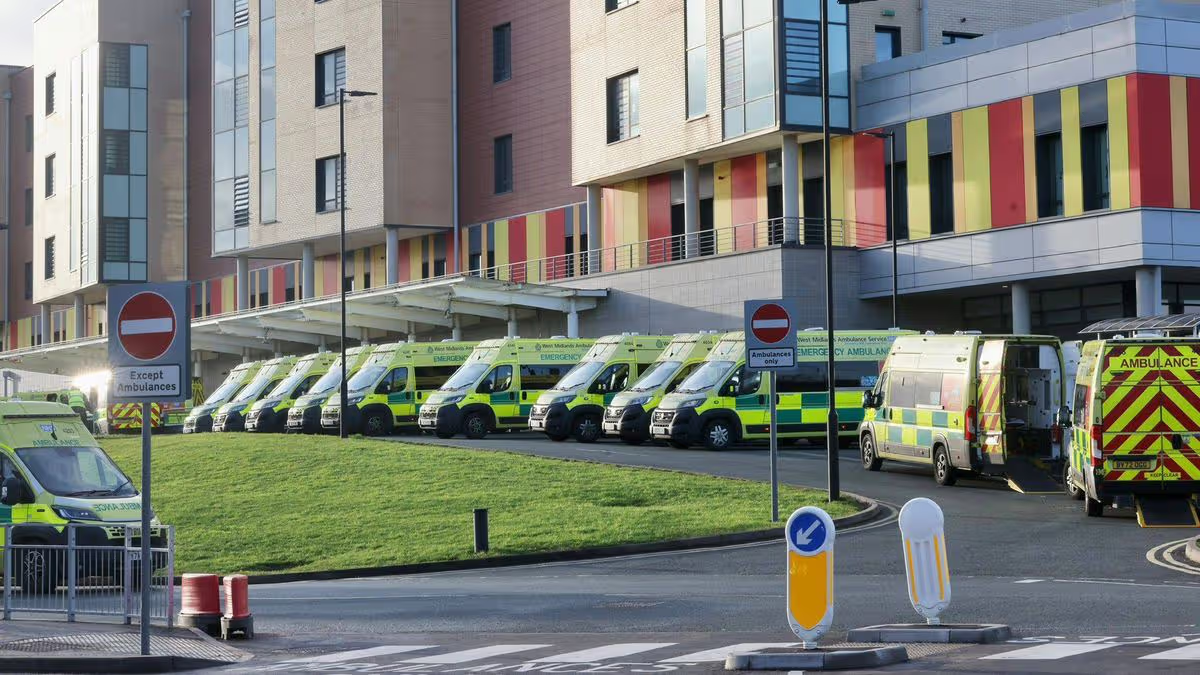
Ekitike is facing a lengthy spell on the sidelines (Picture: Getty)
Hugo Ekitike is expected to be sidelined for at least nine months with a serious Achilles tendon injury suffered in Liverpool’s Champions League exit against Paris Saint-Germain.
Liverpool’s last hope of silverware this season ended on Tuesday night after defeat to the French champions at Anfield who sealed a 4-0 aggregate victory to progress to the semi-finals of the competition.
Eiktike fell to the ground unchallenged after 34 minutes, clutching the back of his ankle in visible pain.
Advertisement
Despite two attempts, the striker was unable to get back to his feet and received treatment from Liverpool’s medical staff before he was carried off the pitch in tears.
Arne Slot provided a grim update after the match, admitting the injury was ‘not good’ with Ibrahima Konare also fearing the worst for his teammate.
Liverpool are still to officially confirm the extent of the injury but L’Equipe report the former Eintracht Frankfurt star has ruptured his Achilles tendon which will sideline him for approximately nine months.
There have been concerns among fans this season that the game’s top teams, faced with stubborn man-to-man defensive set-ups, are taking a less risky approach in attack.
But Kompany’s Bayern lean into that risk, playing freely both in and out of possession. They often dominate, and are exciting to watch – an approach that involves all 11 players and starts right from the back.
In the Champions League last 16, Bayern faced an Atalanta side who opted to man-mark across the pitch. So Kompany rotated his players around, dragging opposition defenders out of position.
For instance, attacking midfielder Serge Gnabry frequently dropped into centre-back positions to get on the ball. His Atalanta marker followed him. That opened up space for Gnabry’s team-mates. As a result, Atalanta ended up with attackers in defence and defenders in attack. Bayern Munich won 10-2 on aggregate.
Advertisement
Juventus head coach Luciano Spalletti was particularly impressed, noting Bayern’s fluidity. In his words: “They showed us a whole encyclopedia of movement and positioning in football.”
Barcelona were knocked out of the Champions League by Atletico Madrid on Tuesday 3-2 on aggregate, with Marcus Rashford feeling the sting of European football away from Manchester United
Raphinha has claimed that Barcelona were “robbed” as his club were knocked out of the Champions League – a match that Marcus Rashford was widely expected to start in but was given just 20 minutes. The Catalan giants faced Atletico Madrid at the Riyadh Air Metropolitano on Tuesday evening in a second leg quarter-final clash.
Advertisement
Hansi Flick’s side understood the monumental task at hand. given they headed into the 8pm kick-off with a 2-0 deficit to overcome thanks to Julian Alvarez and Alexander Sorloth raining on their parade last week at the Camp Nou.
However, Barca were ultimately unable to conquer their La Liga rivals on the road, leaving the Spanish capital 2-1 up on the night – but 3-2 down on aggregate. Lamine Yamal took very little time to offer his team a glimmer of hope by netting withing four minutes, before Ferran Torres diminished Atleti’s 2-0 aggregate lead completely 20 minutes later.
Get MEN Premium now for just £1 HERE – or get involved in our United WhatsApp group by clicking HERE. You can also join our United Facebook page by clicking HERE and don’t miss out on our brilliant selection of newsletters HERE.
It took Ademola Lookman a matter of moments to ensure that Atletico ultimately advanced to the semi-finals of Europe’s premier footballing competition, however, with a goalless second half seeing Barcelona sent packing.
Advertisement
However, Raphinha had some strong words for referee Clément Turpin in the aftermath. He told TNT Sports Brasil: “For me, we were robbed.
“I don’t want to talk about the refereeing, but we played extremely well, they committed I don’t know how many fouls, and the referee didn’t even pull out a single yellow card against them. The refereeing was very bad in all the decisions he made.
“What I really want to understand is, by what criteria is Barca being refereed? I’d really like to understand the secret behind this fear that haunts these people at the thought of Barca winning.
Get MEN Premium now for just £1 HERE – or get involved in our United WhatsApp group by clicking HERE. You can also join our United Facebook page by clicking HERE and don’t miss out on our brilliant selection of newsletters HERE.
Advertisement
“Yes, we’re all human and we can make a mistake in a match, that’s something I can understand, but for it to happen in two consecutive matches? That’s not normal. I think the result of this double confrontation isn’t fair.”
Elsewhere, Manchester United loanee Rashford suffered a double heartbreak in the fixture. Not only were Barcelona ousted from the Champions League in what has otherwise been a largely successful spell for the 28-year-old, but he also didn’t have the full 90 minutes to make a difference.
That’s despite Spanish media touting Rashford to start the match. The Englishman was afforded just over 20 minutes to make a difference as he entered the field as a late substitute for Fermin Lopez.
However, he was ultimately unable to make much of an impact as Barcelona crashed out of the Champions League. It comes as Rashford’s future in sunny Spain is currently up in the air.
While Barcelona have an option to make his move permanent come season’s end to the tune of around £26million, it looks as though they are set to use limited funds to recruit Alessandro Bastoni from Inter Milan to strengthen their defence.
But with Robert Lewandowski potentially leaving the club this summer, the board could opt to keep Rashford as a replacement for their talisman – given he can also operate through the middle as well as on his favoured left flank.
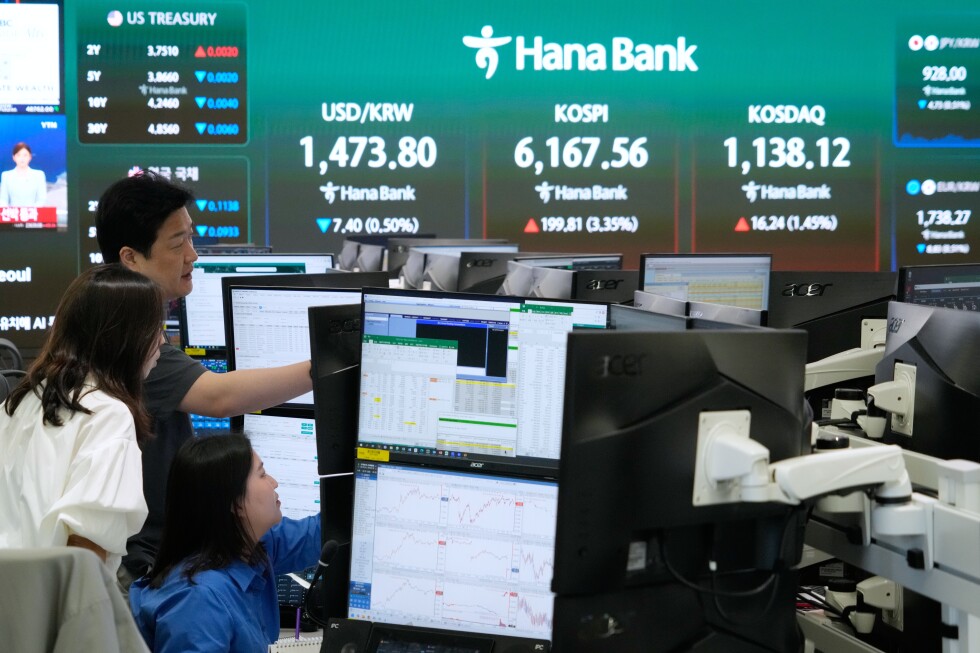
TOKYO (AP) — Asian shares mostly rose in Wednesday trading, echoing the rally on Wall Street that came as oil prices eased on hopes the United States and Iran may try again on talks to end their war.
Japan’s Nikkei 225 gained 0.4% in afternoon trading to 58,122.52. Australia’s S&P/ASX 200 was little changed, inching up less than 0.1% to 8,978.70. South Korea’s Kospi jumped 2.1% to 6,092.77. Hong Kong’s Hang Seng edged up 0.4% to 25,980.69, while the Shanghai Composite declined less than 0.1% to 4,023.40.
On Wall Street, the S&P 500 added 1.2% to its leap from the day before, and the index at the heart of many 401(k) accounts is just 0.2% below its record set in January.
The Dow Jones Industrial Average rose 317 points, or 0.7%, and the Nasdaq composite climbed 2%.
Advertisement
On Wednesday, benchmark U.S. crude fell 58 cents to $90.70 a barrel. Brent crude added 7 cents to $94.86, or less than 1% after falling 4.6% the day before. While that’s still above its roughly $70 price from before the war began in late February, it’s well below the peak level of $119.
Lower oil prices help bring down costs for all kinds of businesses. But some analysts noted the war was still ongoing, warning that the optimism may be unfortunately unfounded.
“The counterintuitive decline in crude appears driven by growing hopes that a second round of peace talks between Washington and Tehran could soon materialize, after the first attempt fizzled out. Traders are clearly choosing to price in the possibility of de-escalation rather than the immediate reality of restricted flows,” said Tim Waterer, chief market analyst at KCM Trade.
Asian nations depends on access to the Strait of Hormuz, a narrow waterway that’s the main avenue for crude oil produced in the Persian Gulf area to reach customers worldwide. Blockages there have kept oil off the global market, which has in turn driven up its price.
Advertisement
Global inflation this year looks set to accelerate to 4.4% from 4.1% in 2025, according to the International Monetary Fund, which had earlier thought inflation would slow to 3.8%. The IMF on Tuesday also downgraded its forecast for global economic growth to 3.1% this year from the 3.3% it had forecast in January.
All told, the S&P 500 rose 81.14 points to 6,967.38. The Dow Jones Industrial Average gained 317.74 to 48,535.99, and the Nasdaq composite climbed 455.35 to 23,639.08.
In the bond market, Treasury yields eased as the fall for oil prices took some of the pressure off inflation. The yield on the 10-year Treasury fell to 4.25% from 4.30% late Monday.
In currency trading, the U.S. dollar edged up to 158.95 Japanese yen from 158.79 yen. The euro cost $1.1790, down from $1.1797.
Advertisement
___
AP Business Writer Stan Choe in New York contributed to this report.






















































You must be logged in to post a comment Login