For those caught up in the violence and attacks, it’s unimaginable – and for those looking on from afar, the feelings of fear and helplessness can be overwhelming.
For children, who have less of an idea of what is going on, this can be even more terrifying.
Advertisement
Hearing words like ‘bombing’ and ‘World War Three’ without a full understanding of what’s going on is worrying for us all, and it doesn’t escape our little ones.
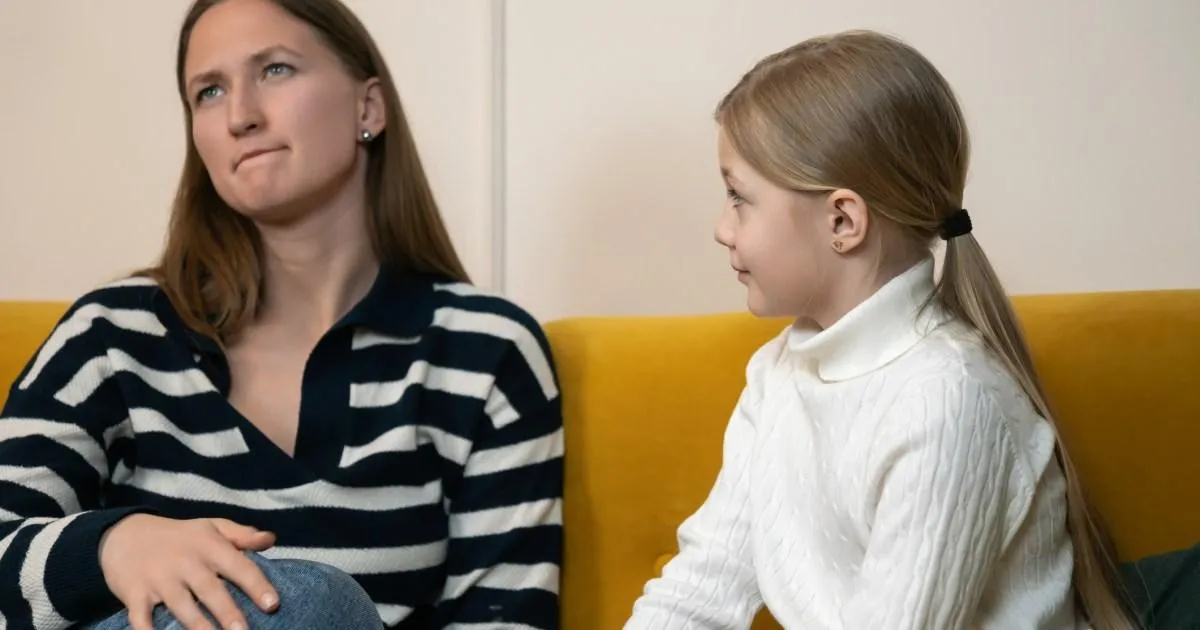
The news can be terrifying for little ones (Picture Getty Images)
‘Whether it’s on the news, someone talking to the shop checkout lady, parents chatting in the playground, or a TikTok video, much of what they are hearing, especially once at school, is out of your control.
‘And sometimes, external factors (for example, Kevin in the playground telling everyone that World War Three is starting and we’re all going to die) can provoke more of a fear response.’
Even very young children may be more aware of what war is than we might even realise.
Advertisement
‘Many children have been exposed to adults or older siblings playing war-type computer games or watching YouTube influencers play such games on their ownor a friend’s mobile phone or tablet,’ Tania says.
‘So, words like “bombing” may not be as unfamiliar to our children as we might assume.’
Therefore, it’s worth considering your language around younger children.
But how is best to explain what’s going on to the children in your life? And how can you go about reassuring any anxieties (while also managing your own)?
Advertisement
Kids might be familiar with words like ‘war’ and ‘bombing’ because of video games and social media (Picture: Getty Images)
How to approach the subject
As parents and carers, we can feel like what we should be doing is giving them all of the facts and keeping them informed. But this approach can sometimes leave children feeling overwhelmed, Tania explains.
‘Children tend to be really good at spontaneous questioning. If they want to know something, they’ll ask,’ she says.
But if they do ask, or you feel that they need some explanation or reassurance, it’s important to think about how you’re feeling first.
Tania recommends: ‘First of all, you need to consider your own state of mind in relation to what is going on and how much information you would personally like to give your child.
‘This is important as even if you are led by your child’s questioning, you begin with at least some self-awareness of how you are feeling and where you want to go with it.
Advertisement
‘If you are particularly anxious about it all, it may be that you choose to wait until a time when you’re feeling less anxious to talk about it. Or perhaps having a discussion with another important adult in your child’s life, who can talk to your child instead, like a teacher or grandparent.’
Tania suggests that you may want to start with a non-specific question, like ‘have you learned about wars at school?’, and then listen to your child’s response.
‘What you’re doing here is enabling your child an opportunity to talk about something which they may not realise they can talk about,’ she notes.
‘If your child isn’t interested, they’ll tell you so, and there’s no need to push the conversation. If they go on to hear something at school, they’ll know you know about it, and be more likely to approach you with any questions.’
Advertisement
It’s always a good idea to let children know that, if they have any questions, they can ask you.
Let children ask you questions (Picture: Getty Images)
What can parents do and say to explain but not frighten?
Talking about the distance between the UK and ongoing events can be helpful, suggests Tania.
‘As much as we don’t want to normalise war, it is something that has been happening at varying points across the globe for the whole of your child’s life,’ she explains.
‘Knowing this can help to reassure your child that the chance they will be directly impacted is quite minimal.
‘Although they may want to talk to you about the people who are directly impacted. Keep language age-appropriate and be led by your child.
Advertisement
‘Taking action, such as getting in touch with a charity organisation that may accept shoebox-type gifts, is a really good way of showing your child that although this is happening far away, there are still small actions we can take to give our support.’
Active listening
Tania also recommends a technique called ‘active listening’, which you can use if your child is interested and wants to know more.
‘What you are doing here is paying full attention to your child during the whole conversation, ignoring distractions, and putting all your focus on listening to your child’s words,’ she tells us.
‘Listen to what they’re asking, and don’t give more information than they are asking for. We humans have a habit of oversharing, which is a situation when that’s not necessarily helpful.’
Advertisement
And if you don’t know all the answers to their questions, don’t be afraid to say you don’t know.
Tania adds: ‘Perhaps you can spend time searching for information together, or maybe you feel more comfortable saying you’ll find out and let them know later on.’
How to talk to kids of different age groups
News like this can be scary to children if not handled in the right way, and it will be different for different ages, explains Kirsty Ketley, a qualified early years and parenting consultant.
‘There is no ‘one way’ approach, as all children are different, but it is important that the subject is treated with sensitivity and understanding of what children need to know, weighed against what they are hearing from other sources,’ she tells us.
Advertisement
‘Children of all ages will also feel more worried when they think that no one is willing to talk about things that are worrying to them – they will think that it is too scary or upsetting to talk about, which then adds to their worries.’
Under seven
‘I think it is unlikely for this age group to properly pick up on what is going on,’ says Kirsty.
‘But, if they do overhear your conversations or see the news and ask questions, it is important to make sure they know they are safe and that what is happening is not in our country – perhaps showing them on a map or globe, so they can grasp the distance.
Advertisement
‘Kids of this age don’t need to be burdened with news that they are unable to understand, so if they don’t mention it, don’t bring it up. Let them be blissfully unaware.’
Jacqui O’Connell is a Youth Leader and Co-founder of the charity Spiritus, supporting homeschooled children in West London.
She says: ‘For younger children, we recommend reading a book about general worries and how to deal with them, such as Scared and Worried by psychiatrist James J Crist, PhD. You can then apply this to their worries about the situation with Ukraine and Russia.
‘Age-appropriate books on worries can help us discuss concerns and support children without too much detail.’
Advertisement
Tweens (between eight and 12)
‘Tweens are at an impressionable age and are more aware of the world around them,’ says Kirsty.
‘They will have learned about war and conflict in history lessons at school, and so they will have preconceived ideas of what it is all about.
She recommends watching something like Newsround, aimed towards 6-12-year-olds, which explains things in an appropriate way. ‘If you are worried about how to go about things, watch it with your child and then have a discussion about what you have watched.’
Advertisement
Another key to talking to children between the ages of 7-12 yrs is also how we question them.
‘Keep it positive,’ says educational expert and founder of KidCoachApp Kavin Wadhar.
‘Don’t ask why they are worried. Children often struggle to understand their emotions, which can lead to further anxiety. Instead, ask them questions to help them work out solutions to their worries.’
‘It is also crucial for parents to be aware of how they discuss the situation in the Middle East with other adults around children or in earshot.
Advertisement
‘Children are susceptible to how parents respond to issues, which can have a massive impact on a child’s anxieties. Studies have shown that children from as young as one to two years old will mimic parents’ behaviour.’
Teens (12 and above)
Kirsty suggests asking them what they already know and giving them lots of reassurance if they are worried.
‘Let them know that you are there to talk through things,’ she says.
Advertisement
‘I think it is important that they know that what they are seeing on social media won’t all be accurate and suggest that they watch the news or read reliable news sources online, instead.’
For teenagers, it is important to research the issues, look at the history of wars, and discuss why we have wars,’ support worker and joint founder of Spiritus, Gemma Eni Cherish, says.
‘We have had group discussions to give everyone a chance to share their point of view after exploring what is happening and why, which helps ease their concerns.
‘It also helps support children in finding their confidence as we suggest they develop ways to deal with anxieties. They build trust and confidence by sharing, and we all learn how to support each other.’
A United Airlines passenger plane was forced to make an emergency landing at Los Angeles International Airport after reportedly suffering an engine fire Monday.
United Flight 2127 took off from LAX for Newark, New Jersey on Monday morning but was forced to turn back within an hour with a smoking engine, according to reports.
About 180 passengers were evacuated, with only minor injuries. Some other flights were temporarily grounded.
A spokesperson for the Federal Aviation Administration said: “United Airlines Flight 2127 returned safely to Los Angeles International Airport around 11:20 a.m. local time on Monday, March 2, due to a left engine issue. Passengers deplaned on a taxiway.
Advertisement
“The Boeing 787-9 Dreamliner was heading to Newark Liberty International Airport in New Jersey. The FAA will investigate.
“Please contact the airline and airport for additional information.”
“We haven’t even started hitting them hard,” he told CNN. “The big wave hasn’t even happened. The big one is coming soon.”
“This was our last, best chance to strike – what we’re doing right now – and eliminate the intolerable threats posed by this sick and sinister regime,” Mr Trump said later.
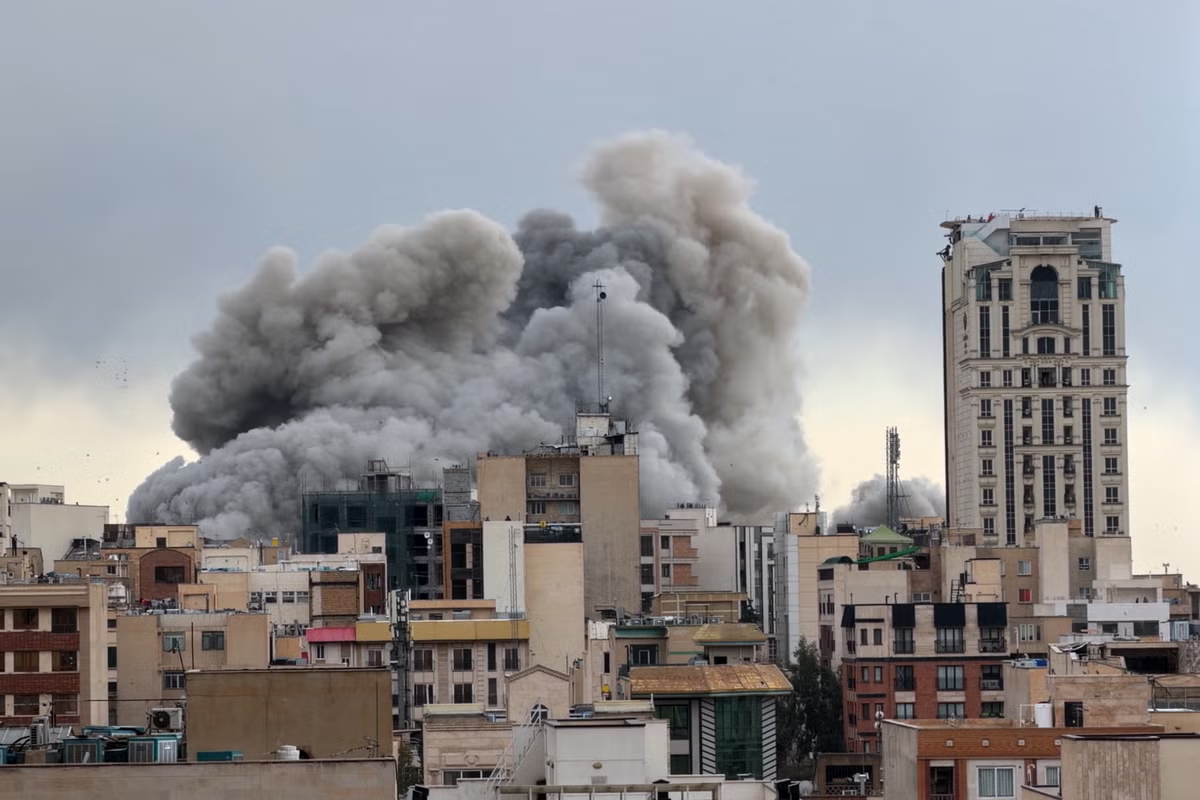
A plume of smoke rises after a strike in Tehran on Monday (AP)
A series of loud explosions were heard across Gulf cities on Monday, with civilian targets in the region, including hotels and airports, also hit.
Tourists and residents in supposed Middle Eastern safe havens like Dubai have described missiles flying past their windows, while hundreds of thousands of airline passengers have found themselves stranded by flights cancelled in hotspot areas.
Advertisement
The conflict is already having a global economic impact with oil prices shooting up in response to the crisis.
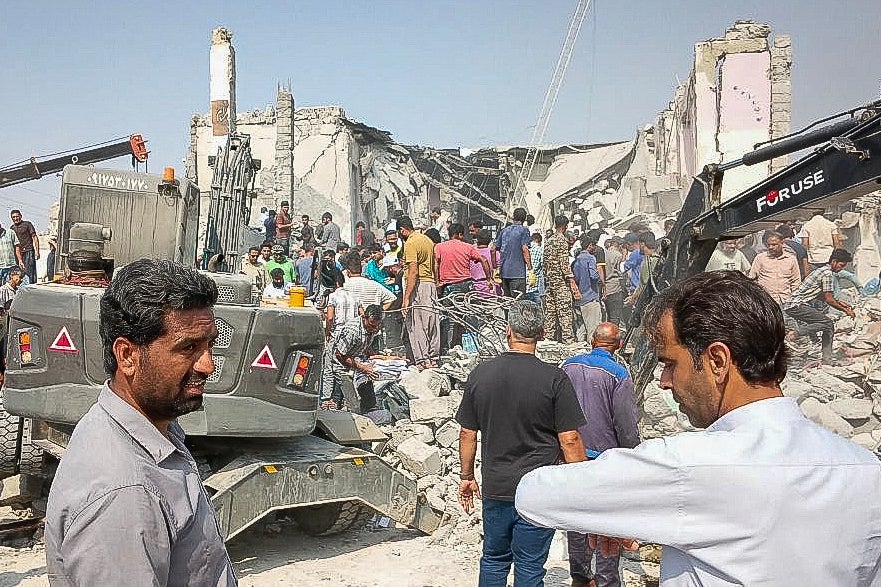
The death toll continues to climb on all sides, with fears the strikes could go on for weeks. The Iranian Red Crescent Society said that the US-Israeli operation has already killed at least 555 people, with reports of 165 victims at a girls’ school in southern Iran.
In Israel, where several locations were hit by Iranian missiles, 11 people were killed. The Iranian-backed Hezbollah militant group also targeted Israel, which responded with strikes on Lebanon, killing 52 people.
Advertisement
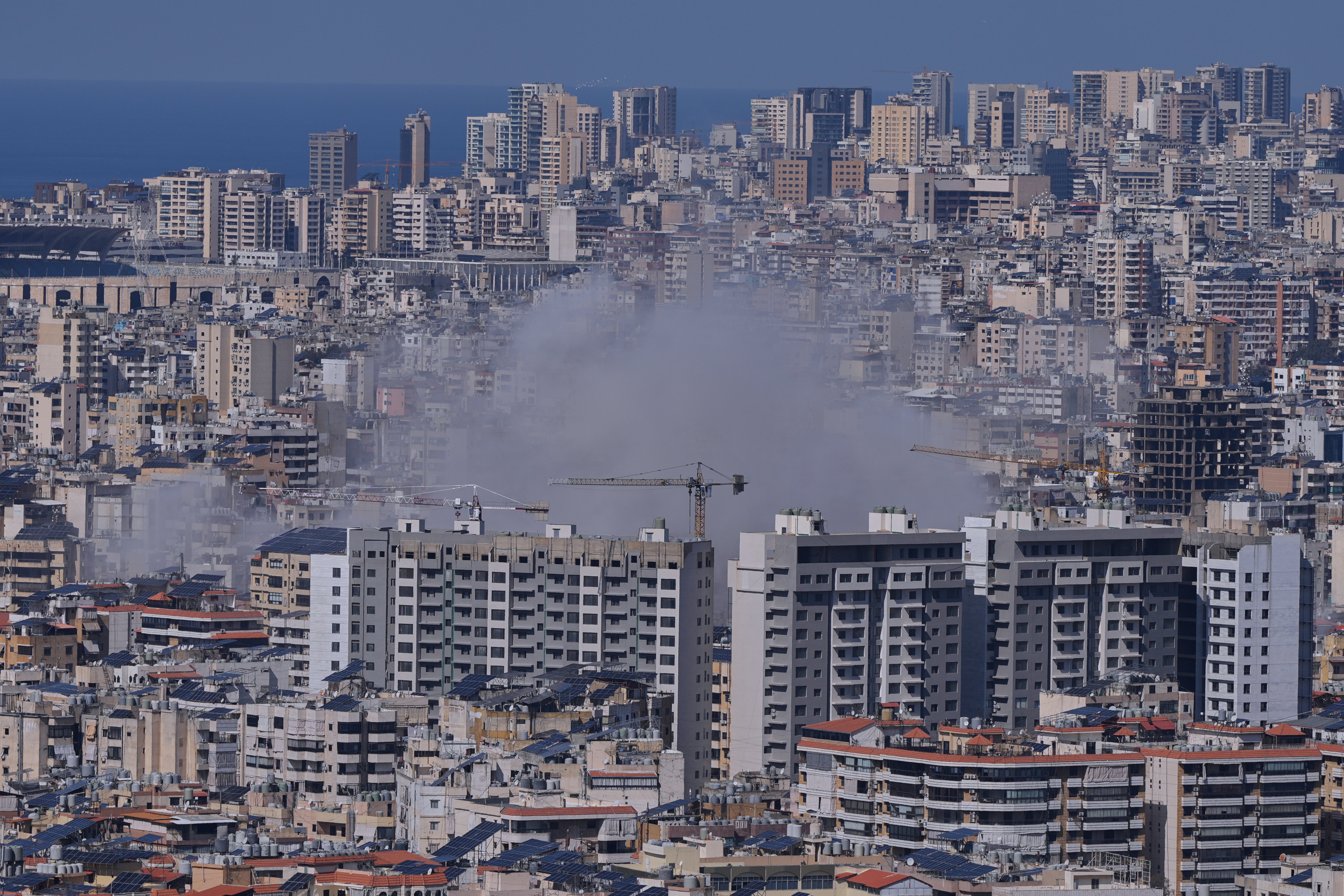
Smoke rises from Israeli airstrikes on Dahiyeh, a southern suburb of Beirut (AP)
Four US service members have now been killed. There people were also killed in the UAE, and one each in Kuwait and Bahrain.
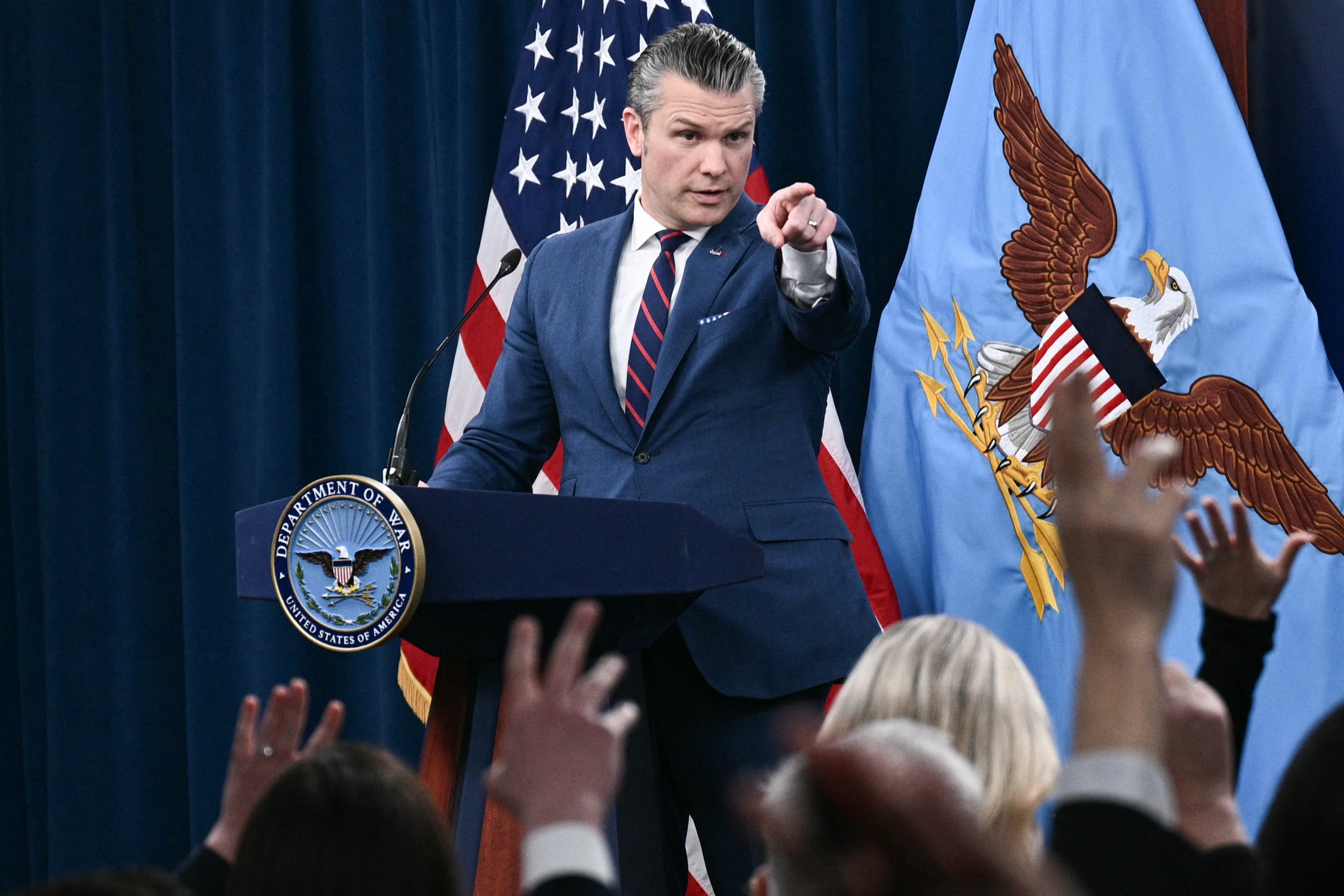
Amid growing concerns that the conflict could spiral into a protracted regional war, including over the lack of any apparent exit plan, US defense secretary Pete Hegseth insisted “this is not endless” as he held the Trump administration’s first news briefing since strikes were launched on Saturday.
In an indication that the war could draw in yet more nations, the UK, France and Germany have pledged to help the US stop Iranian attacks.
Advertisement
A drone hit the British RAF Akrotiri base in Cyprus on Sunday with two more intercepted on Monday. Sir Keir Starmer said this was “not in response to any decision that we have taken” but was launched before Britain’s announcement that it would allow America to use its bases.
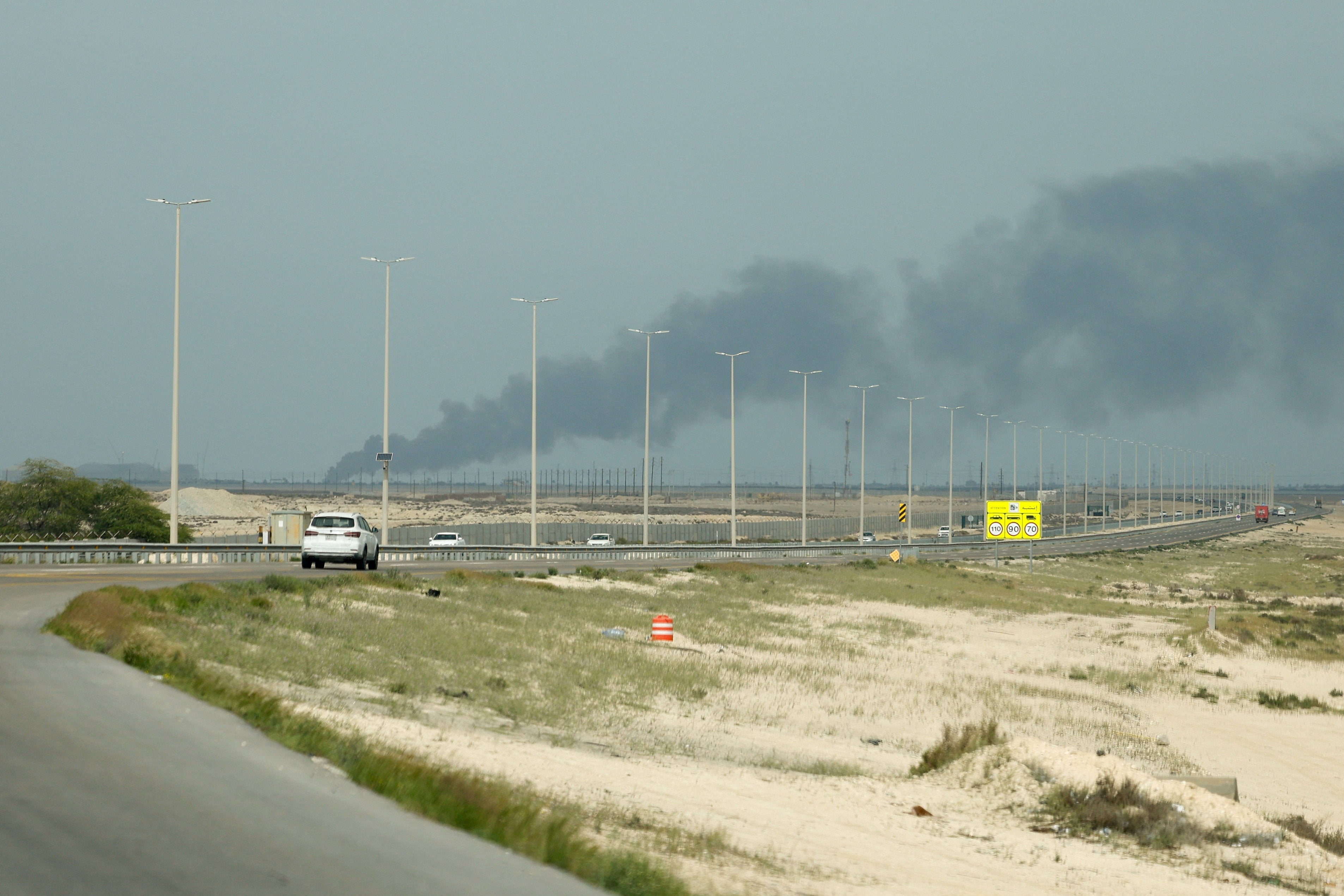
Smoke billows from Saudi Aramco’s Ras Tanura oil refinery after a reported Iranian drone strike (Reuters)
The chaos of the conflict was further highlighted on Monday when the US military said Kuwait had shot down three American F-15E Strike Eagles during a friendly fire incident. US Central Command said all six pilots ejected safely and are in a stable condition.
In Kuwait City, fire and smoke rose from inside the American embassy compound, shortly after the US issued a warning to Americans to take cover and stay away from the complex. There were no immediate reports of damage or casualties.
Advertisement
Meanwhile, Saudi Arabia’s Ras Tanura oil refinery came under attack from drones, with defences downing some of the incoming aircraft, a military spokesperson told the state-run Saudi Press Agency. The refinery has a capacity of over half a million barrels of crude oil a day.
With world markets already rattled by the fighting, QatarEnergy said it would stop its production of liquefied natural gas, taking one of the world’s top suppliers off the market. It offered no timeline for restoring its production. European natural gas prices surged by 40 per cent in response.
Rescuers at the site of a strike on a girls’ school in Minab, in Iran’s southern Hormozgan province, on Saturday (ISNA)
Iran has long threatened that, if attacked, it would drag the region into total war, targeting Israel, the Gulf Arab states and the flow of crude oil crucial for global energy markets. All of these came under attack on Monday.
Advertisement
But Mr Hegseth insisted Iran “had a gun to our head” as he defended the joint US-Israeli attacks that sparked the widening conflict.
The conflict erupted on Saturday when Mr Trump launched what he described as a “major combat operation” to destroy Iran’s military capabilities and eliminate the threat of the country creating a nuclear weapon, following weeks of pressure.
Sir Keir has defended the UK’s “deliberate” decision not to join in with the wave of strikes by the US and Israel on Iran at the weekend, after Mr Trump said he was “very disappointed in Keir”.
Advertisement
US defense secretary Pete Hegseth claimed his country had not started the war – but they would end it (AFP via Getty)
Speaking in the House of Commons on Monday afternoon, the prime minister responded: “It is my duty to judge what is in Britain’s national interest. That is what I’ve done, and I stand by it.”
The government insisted that Britain is not at war, but Sir Keir did condemn Iran’s “reckless” and “dangerous” actions and vowed to continue “defensive” actions in the region.
Israeli prime minister Benjamin Netanyahu, meanwhile, claimed he and Mr Trump are saving the world from the threat of Iran.
“We set out to protect ourselves, but in doing so we protect many others,” he said as he visited the site of a deadly Iranian missile attack in central Israel.
Advertisement
Iran’s cabinet has vowed that this “great crime will never go unanswered”, and the Revolutionary Guard threatened to launch its “most intense offensive operation” ever, targeting Israeli and American bases.
The Belfast Health and Social Care Trust is conducting an investigation about how a man died in hospital after he was given the wrong blood
A man has opened up about the death of his husband, who died at the Royal Victoria Hospital after receiving a transfusion of the wrong blood type.
Advertisement
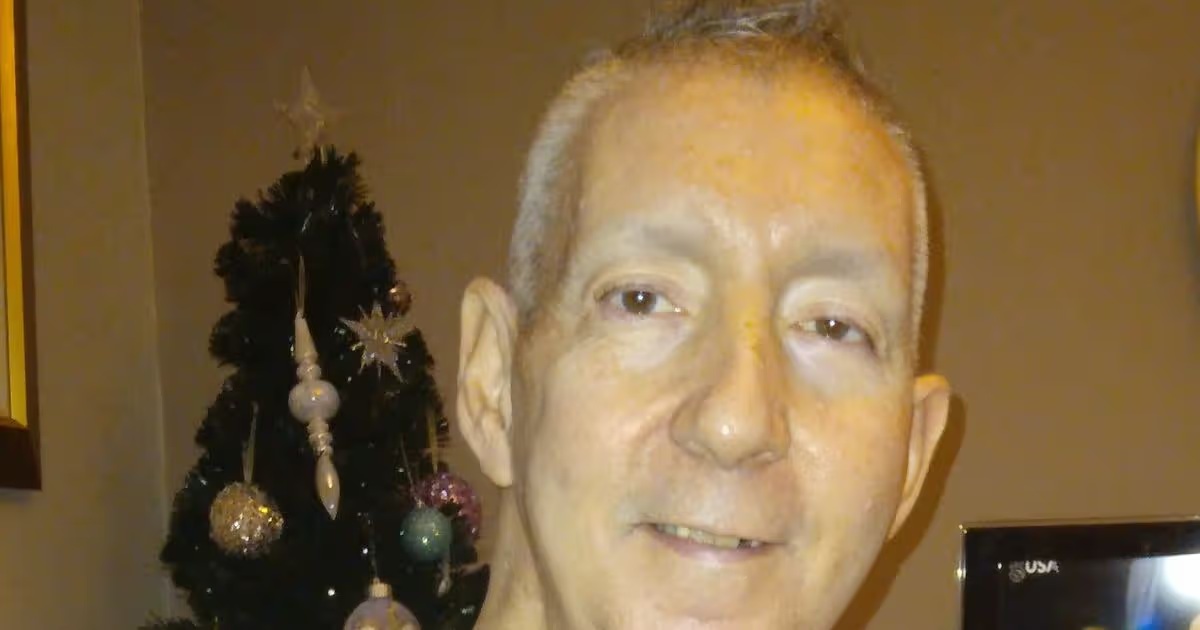
Charlie Begley, who was 55 years old when he lost his life on January 23, told his partner, David O’Prey, he was scared of dying just days before he passed away. Mr Begley died roughly two months after he was given incompatible blood.
Mr O’Prey, 66, from South Belfast was the partner of Mr Begley for 36 years and the pair had been married for the last eight years. Both men had previously been employed in a hospital in Belfast, and Mr O’Prey is now seeking answers about how this happened.
He believes the incident shortened his husband’s life. An investigation by the trust is currently underway after a Level Two Serious Adverse Incident was declared.
Advertisement
Speaking to Belfast Live, the bereaved man said: “You go in the hospital to get fit and get back on your feet, not to get the wrong blood. On January 21, Charlie said to me, ‘David, I am scared, I think I am going to die.’ I need the person or people who did this to be held accountable, I can’t have them doing this to someone else.
“My partner can’t speak for himself because he is dead but I am not going away, the trust needs to give me answers. I am sitting here with my husband’s ashes in the house, the hospital has shortened my husband’s life.
“I can’t bring my husband back but maybe someone else can be helped from this situation — It’s not right, my voice needs to be heard. If I didn’t do anything and sat here being quiet and someone else had this happen, I could not live with myself. I can’t sleep now, I don’t want anyone else to suffer.”
A spokesperson for the Trust said: “Belfast Trust has identified some areas of concern regarding Mr Begley’s care and treatment and has notified a Serious Adverse Incident principally regarding administration of an incorrect blood product.
“We understand this is a difficult time for Mr Begley’s family and offer our sincerest sympathies. It would not be appropriate to comment further while a review is underway.”
Want to see more of the stories you love from Belfast Live? Making us your preferred source on Googlemeans you’ll get more of our exclusives, top stories and must-read content straight away. To add Belfast Live as a preferred source, simply click here.
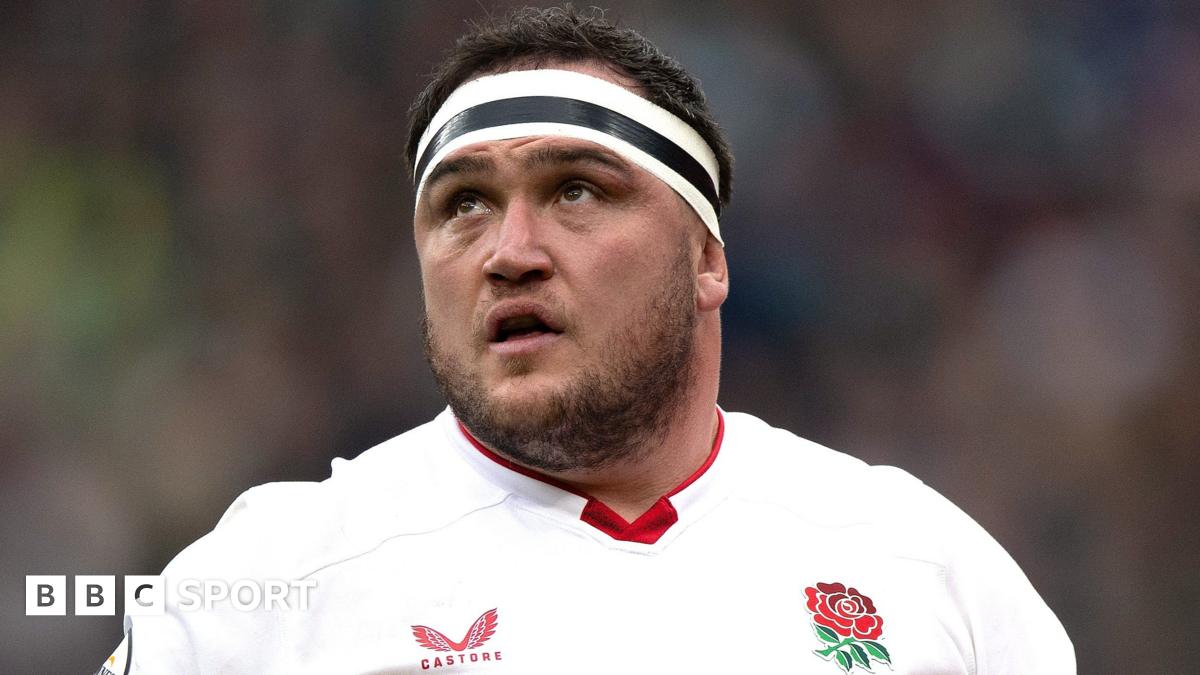
George added he would be happy to let his two-year-old daughter play the sport if she chose to.
While a group of former players are taking legal action against rugby’s authorities claiming that more should have been done to protect their brain health in the past, there are a series of measures in place to protect players from concussion.
They include ‘smart’ gumshields that measure the forces players heads withstand in a tackle, pitchside doctors, mandatory assessments and stand-down periods for players diagnosed with having had a concussion.
“We are in very, very safe hands,” George added.
Advertisement
“Of course, there is a risk that you might get a concussion in a full-contact sport. We are aware of the risks that come with that, but at the same time, we have the utmost confidence in the people around us, the protocols that are in place and that we are being as well looked after as we possibly can be.”
Ben Earl, George’s Saracens and England team-mate, is equally confident in the care he gets for both club and country.
“I have never once felt like I’ve been managed poorly,” he said.
“If anything, it’s probably too far the other way. They’re probably sometimes holding you back when you feel like you’re ready to go, but actually they’re just looking after you and your body.
Advertisement
“So, in terms of my personal experience with the game and safety, I have felt unbelievably well cared for.”
Kodiaq Edition X marks 10 years since the unveiling of the SUV that helped transform Skoda into the brand it is today.
In this instalment of Drive Time, John examinesnew limited edition Skoda SUV, the Kodiaq Edition X, and discovers that MG has now racked-up one million sales in Europe.
Advertisement
Czech firm Skoda is adding a special limited-edition model to its Kodiaq range.
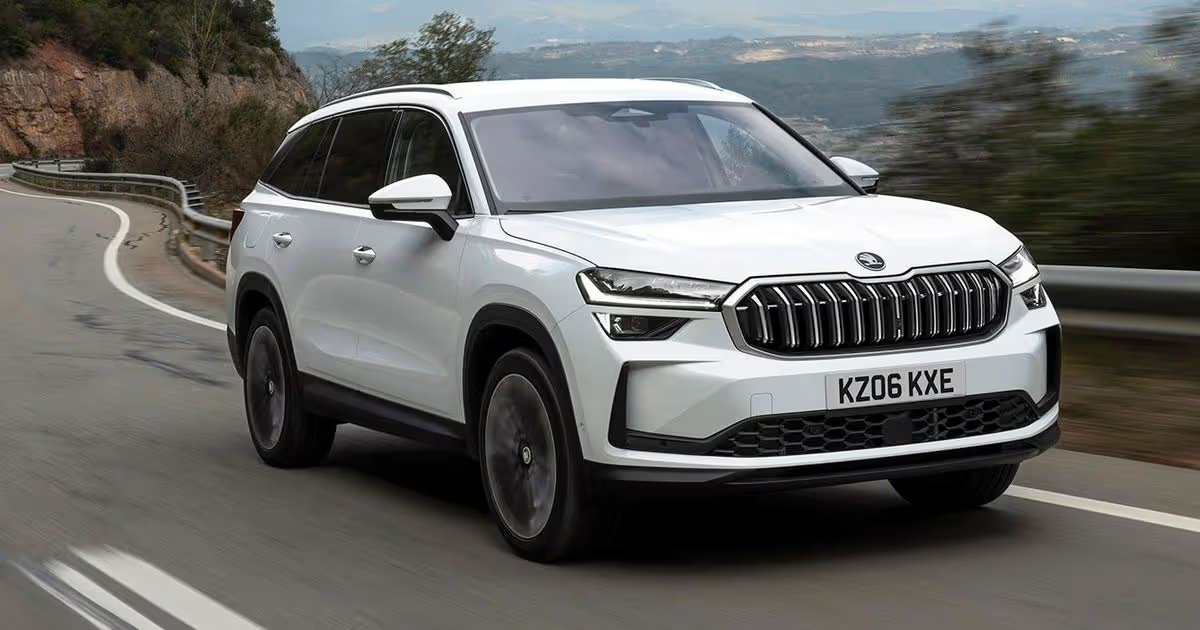
The new Kodiaq Edition X marks 10 years since the unveiling of the SUV that helped transform Skoda into the brand it is today.
The new model, which features a value-packed standard specification, celebrates the ongoing success of Skoda’s flagship SUV, which has sat at the top of the brand’s product line-up since its introduction in 2016.
Priced at £40,590, the new Kodiaq Edition X sits below the Government Expensive Car Supplement threshold, meaning lower running costs for owners.
Advertisement
The Kodiaq Edition X builds on the specification of the Kodiaq SE L, but adds a host of additional features.
Standard equipment includes 19-inch anthracite alloy wheels, metallic paint and an exterior styling package consisting of a black rear-pillar, unique dark chrome front grille and chrome roof rails.
Rear privacy glass, a front grille with horizontal light strip and a red decorative strip between the rear LED lights complete the external design enhancements.
Advertisement
Inside, the Kodiaq Edition X features an ecoSuite black design selection with perforated black leather/artificial leather and grey dashboard and decorative door inserts.
Comfort is boosted by an electrically adjustable driver’s seat with memory function and power adjustable lumbar support for the driver’s seat.
In terms of technology, the Edition X is fitted as standard with LED Matrix headlights with AFS (adaptive front light system), and AWL (all weather lighting system) with cornering function.
At the rear, LED lights with welcome effect and dynamic indicators give the Edition X a striking light signature. Keyless entry and start/stop system and an electrically operated boot complete the specification list.
Advertisement
The new Kodiaq Edition X is fitted with Skoda’s 1.5 TSI e-TEC 150ps engine, mated to a seven-speed DSG transmission as standard.
Equipped with a mild hybrid system, this advanced engine features 48V technology and an electric motor for fuel-saving, smoother start-stop, and coasting.
Like the rest of the Kodiaq range, it offers class-leading levels of practicality thanks to its seven-seat layout, large boot and generous levels of cabin space.
Order books for the Edition X open in April, with first deliveries expected late spring.
The rest of the Kodiaq range remains unchanged with five core trim grade options including the recently introduced new flagship model, the Kodiaq L&K and the sporty vRS.
There is a choice from a range of six powertrains, including plug-in hybrid, with outputs ranging from 150ps to 265ps.
All-wheel drive is fitted as standard on models equipped with 2.0 TDI 193ps DSG, 2.0 TSI 204ps DSG and 2.0 TSI 265ps DSG engines.
Advertisement
In other mototing news, MG has confirmed that it has delivered its one millionth customer car in Europe.
MG returned to the UK market in 2011 with the MG6 and since then the Chinese owned firm has become an increasingly prominent and popular brand across Europe with over 1300 dealers and representation in 34 markets.
A major factor behind MG’s ascent has been the brand’s ability to offer affordable, stylish, and fun to drive electric and advanced hybrid vehicles which were available ahead of many other marques, with the original and the MG4 EV proving to be a notable success.
MG has now delivered 317,000 electric vehicles in Europe and has just launched the 2026 MG4 EV and all-new MG4 EV Urban.
The company has also spearheaded the introduction of performance-focussed electric vehicles with the MG Cyberster offering a forward-looking way to experience open-top motoring.
Envisioned at the company’s London design studio, the award-winning Cyberster played a leading role at MG’s 100th anniversary celebrations at the Goodwood Festival of Speed.
MG also achieved a significant surge in orders during 2025 with its highly efficient and practical Hybrid+ cars with 139,000 deliveries further propelling the brand’s growth.
Advertisement
Guy Pigounakis, commercial director at MG Motor UK, who has helped steer MG’s return to a top 10 position in the UK market and a total of 386,000 sales said: “MG has successfully returned to Europe’s motoring mainstream with its one millionth customer delivery.
“The underlying affection for MG, the iconic British sportscar brand, which includes a flourishing classic car culture and many passionate owner groups, is valuable and greatly appreciated.
“This heritage continues to shape our strategy direction and reinforces our commitment to electric performance cars.
“However, the MG of today has also returned to prominence by offering customers an extensive choice of cars and adopting a forward-looking approach and especially to hybrid and electric vehicles, often ahead of others, as well as investing in relevant and attainable technology.
Advertisement
“We’ve also made an engaging and consistent case for overall value which many customers have responded to.”
MG Motor will make several key announcements, covering technology and design, in the first half of 2026 which it claims will emphasize its commitment to European customers.
*Don’t miss the latest headlines from around Lanarkshire. Sign up to our newsletters here.
And did you know Lanarkshire Live had its own app? Download yours for free here.
WASHINGTON (AP) — A federal court on Monday rejected the Trump administration’s attempt to slow the process of refunding billions of dollars’ worth of tariffs the Supreme Court struck down as illegal last month.
The U.S. Court of Appeals for the Federal Circuit started the next phase in the refund process by sending it to a lower court to sort out.
In a court filing Friday, Trump’s Justice Department had urged the Federal Circuit to proceed cautiously and hold off for 90 days. But the judges refused.
The Supreme Court ruled Feb. 20 that Trump’s sweeping tariffs on most countries in the world were illegal, clearing the way for the importers who paid them to seek refunds.
Advertisement
The government had collected more than $130 billion from the tariffs by mid-December, and could ultimately be on the hook for refunds worth $175 billion, according to calculations by the Penn Wharton Budget Model.
But the Supreme Court offered no guidance on refunds; its decision did not even mention them. Now the U.S. Court of International Trade in New York will decide how the complicated refund process should proceed.
“I would expect the Court of International Trade to quickly issue an order requesting a status update from the government on their plans with respect to refunds (or expedited briefing),” said trade lawyer Ryan Majerus, a partner at King & Spalding and a former U.S. trade official. “I expect the court to take an aggressive posture, asking the government to justify how they intend to comply with the Supreme Court’s ruling.”
Siddartha Rao, a partner at law firm Hoguet Newman Regal & Kenney, said he has been getting a lot of calls from clients with questions.
Advertisement
“We are somewhat in uncharted territory,” he said.
The Trump administration has been reaching for new tariffs to replace the ones the Supreme Court struck down.
One question, he said, is how the government might actually pay for these refunds.
“Everyone is sort of cognizant of the fact that it’s not like there’s over a hundred billion dollars sitting in, you know, in a room somewhere to just cut checks,” Rao said. “So, you know, this is a Treasury problem, and it may very well be that the administration is reimposing tariffs for the reasons that it’s cited … it’s important for strategic trade agreements and for bargaining power and all of that. But it also might be that they need to raise revenue to pay out refunds.”
Advertisement
____
Mae Anderson reported from New York.
AP Writer Lindsay Whitehurst in Washington contributed to this story.
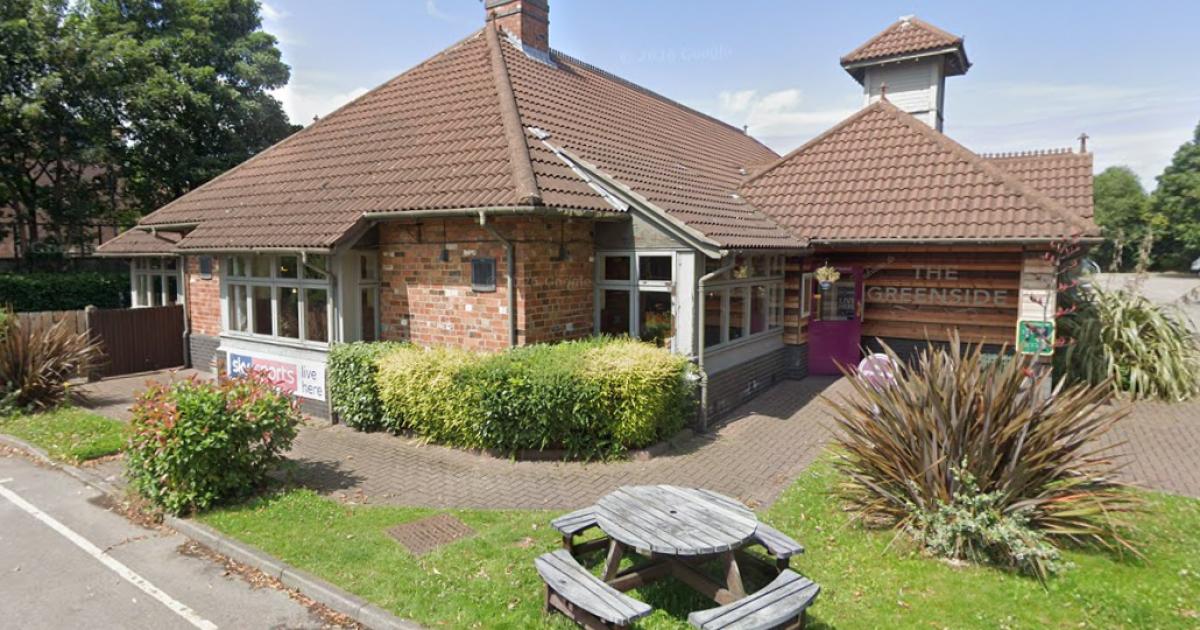
The Greenside in Hartlepool will reopen on Wednesday, March 18, as one of Marston’s newest ‘Grandstand’ sports pubs, following an investment of more than £190,600.
The pub closed its doors on Monday, March 2, to begin the revamp.
The redesign promises a ‘stadium-like experience’, with cinema-style screens. (Image: Marston’s)
Alison Marcus, pub partner, said: “We’re so excited to show off the new and improved pub.
“With a calendar of sports up ahead, The Greenside will be the perfect destination to get involved in big event atmosphere and soak up the action, especially thanks to some amazing new technology, food and drink offers, and events.”
Advertisement
The redesign promises a stadium-like experience, with cinema-style screens, upgraded sound systems, and tiered seating to create an immersive environment for sports fans.
Guests will be able to order through Marston’s ‘Order & Pay’ app for added convenience. (Image: Marston’s)
The centrepiece will be a three-metre-wide screen paired with a state-of-the-art audio setup.
Outside, a refurbished outdoor area with TV screens means customers won’t have to miss any of the action.
Guests will be able to order through Marston’s ‘Order & Pay’ app for added convenience.
Advertisement
The centrepiece will be a three-metre-wide screen paired with a state-of-the-art audio setup. (Image: Marston’s)
The pub is encouraging the community to contribute sports memorabilia, including photos and items, to help celebrate Hartlepool’s sporting heritage.
The pub will screen a wide array of sporting fixtures, including football, rugby, cricket, F1, tennis, darts, horse racing and more.
Recreational features include regulation dart boards, pool tables, and new competition leagues.
A new ‘Match Day’ food menu has also been introduced, featuring snacks like wings and nachos alongside traditional pub favourites.
Advertisement
All draught beers will be available in two-pint cups.
The Greenside has been selected for this new Grandstand concept due to its close ties with local teams, charities, and community groups.
Marston’s say that nationwide, 86 per cent of sports fans say they prefer watching games in sports pubs because of the better screens, sound and atmosphere.
The Department for Work and Pensions has clarified the reason behind the massive increase in Universal Credit claims
The Department for Work and Pensions has responded to the sharp surge in Universal Credit claimants over recent years, clarifying that the figures are not what they might appear. Nearly 80% of these new recipients did not submit fresh claims for the benefit.
Advertisement
Since 2022, six legacy benefits have been progressively consolidated into Universal Credit, and the DWP confirmed this accounts for the overwhelming majority of the striking rise in claims. The department posted on X: “Nearly 80% of the increase is people being moved from old benefits onto Universal Credit. Not new claims. A transition we inherited.
“And it’s the same story for those with no work requirements – at least 72% of that increase is legacy benefit claimants moving across.”
In December 2025, the total number of Universal Credit claimants across Britain reached 8.34 million, an increase of almost one million since December 2024. Figures released on Tuesday revealed that more than 775,000 of these individuals had been transferred from legacy benefits.
In short, the considerable rise in Universal Credit recipients since 2022 is largely the result of a managed administrative transfer rather than an emerging pattern suggesting significantly more people are likely to lodge new claims for the benefit going forward. The transition from legacy benefits to Universal Credit has been progressing through a managed migration process, reports the Express.
Advertisement
Those affected were issued migration notices and given the opportunity to transfer their claim to Universal Credit with Transitional Protection before their existing benefits ceased.
Legacy benefits being moved to Universal Credit:
Income-related Employment and Support Allowance (ESA)
Child Tax Credit
Working Tax Credit
Housing Benefit
Income Support
Income-based Jobseeker’s Allowance (JSA)
Certain benefits, such as Working Tax Credits and Child Tax Credits, have already officially come to an end. The Government expects the final stages of the migration to be concluded by the end of March.
The managed migration process commences when an individual receives their migration notice. This will include their own personal deadline by which they must apply for Universal Credit in order to receive Transitional Protection, which guarantees they will not be left financially worse off under the new system.
For instance, if someone was receiving £600 a month from Tax Credits but only qualifies for £400 from Universal Credit under standard eligibility rules, the Transitional Protection will supplement this with an additional £200. However, should you miss the deadline stated in your migration notice, you will forfeit any entitlement to Transitional Protection.
Those unable to meet the deadline outlined in their migration notice may also be eligible for reasonable adjustments from the DWP. These could include extended deadlines or the appointment of representatives for individuals who are unable to manage their own affairs.
Advertisement
Earlier this month, Sir Stephen Timms disclosed that more than 150 Complex Case Coaches have been mobilised to offer tailored support, collaborating with local safeguarding teams for especially vulnerable individuals.
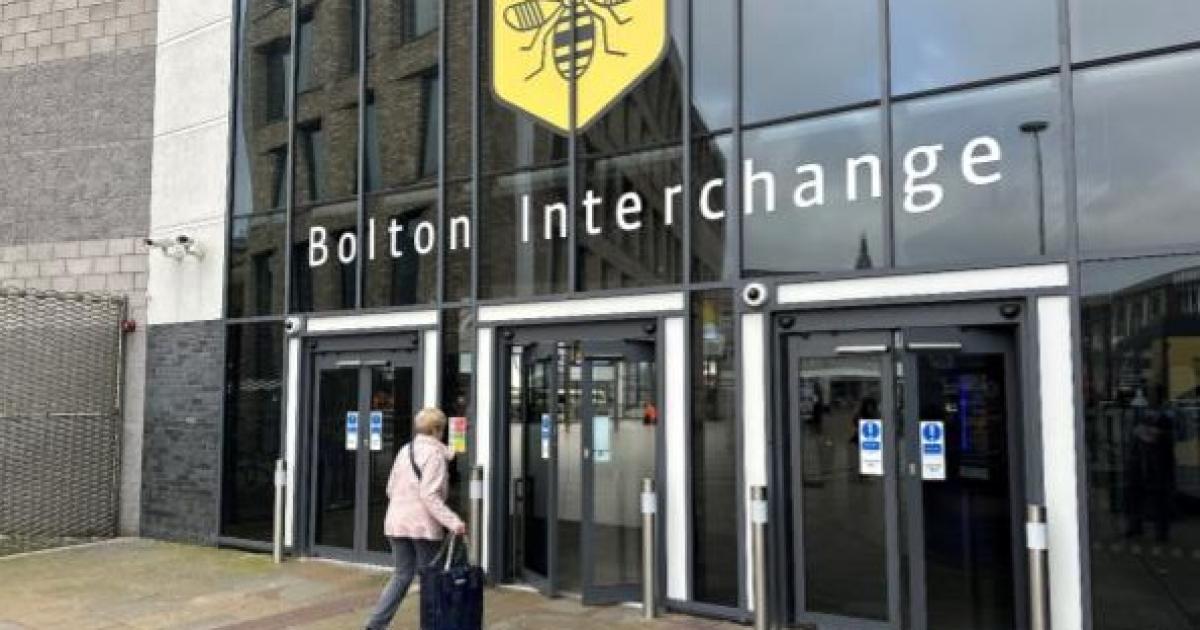
It is a familiar four-word sentence that bus users across Greater Manchester have heard for 20 years. A sentence that cost ‘hundreds of thousands’ of bus passengers dearly or frustratingly delayed the start of their days.
It was said by bus drivers apologising to older and disabled people they were ‘too early’ to use their bus passes, as government restrictions prevented free travel before 9.30am, so passengers needed to buy a cut-priced ticket instead.
Two trials in Greater Manchester have since shown the early-morning ban actually slowed the network down, creating a second rush hour just after 9.30am, when a ‘crash’ of passholders could finally get onboard. That meant the ‘9.30am rule’ mainly forced disabled and old people to pay for tickets or compelling them to start their days late, pushing appointments and meetings back to mid-morning.
Advertisement
But those days are behind Greater Manchester, after Andy Burnham scrapped the 9.30am rule on Sunday (March 1).
“Permanent freedom from the 9.30am rule means that older and disabled people can get out and about without any restriction – to hospital appointments, to work or to care for their grandkids,” the mayor said on Friday (February 27).
“We’re really proud to be doing this and we can do it because we put our buses back under public control. The people are in charge again and that’s why we’re making this change – to benefit the people of Greater Manchester.”
Removing the rule now spreads demand more evenly, with an August pilot finding 100,000 elderly and disabled people using their passes earlier every day. A similar trial in November, the busiest month for bus use, found 120,000 made the same move.
Advertisement
The ban was first introduced in 2006, when old people’s bus passes were rolled out, as a compromise between the government and bus firms following a row about the loss of revenue. Officials estimate the move will cost the Bee Network £5m annually.
For passholders, it’s ‘life-changing’, according to Nakib Narat, co-chair of the Greater Manchester Older People’s Equality Panel. He said: “It’s a life-changing move and it’s not just a win for older and disabled people – it’s a massive boost for the Greater Manchester economy and a genuine lifeline during the cost-of-living crisis.
“We’re not just passengers. We’re active contributors to the economy. By allowing people to travel when they actually need to, we’re putting an end to that notorious 9.30am bus crash and the frustration of being one of the ‘Twirlies’.”
The mayor’s move means passengers using a concessionary pass issued by Transport for Greater Manchester under the English National Concessionary Travel Scheme can use their pass on any bus in Greater Manchester, Bee Network or not, at any time.
“It is frustrating and upsetting to be dealing with another instance of tragedy abuse.”
Rangers have released a statement after Celtic supporters were seen mocking the Ibrox disaster during Sunday’s Old Firm match and police launched a probe.
Advertisement
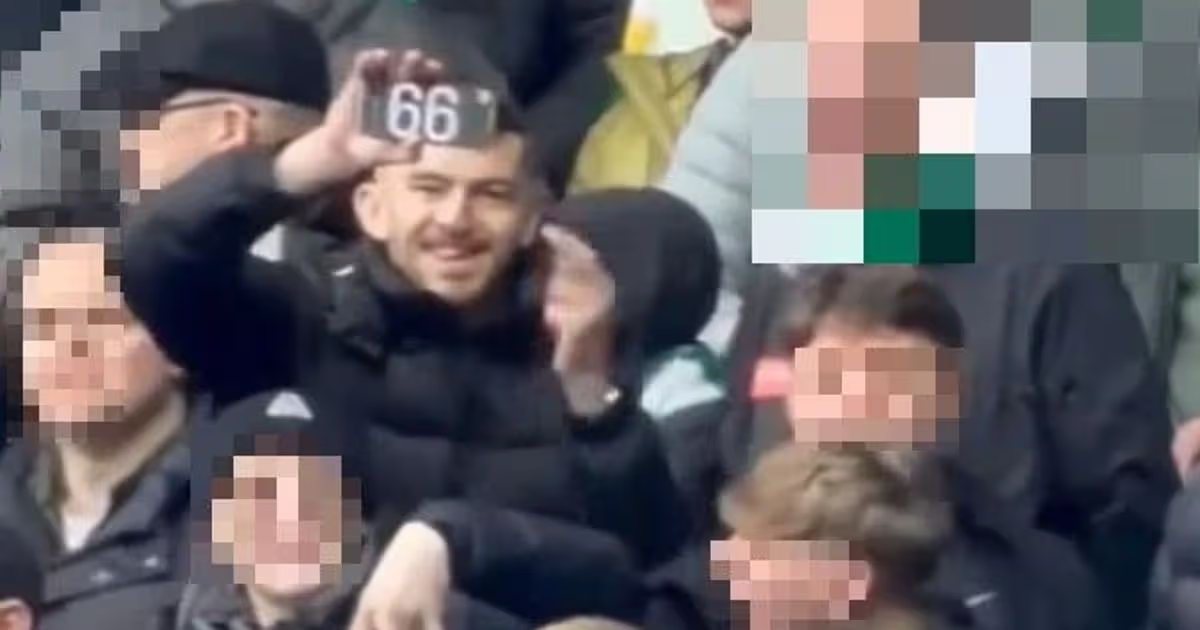
Some Hoops fans were filmed making the sick gestures during the 2-2 draw against their bitter rivals. One twisted fan was videoed holding up his phone with the number 66 on the screen – the number of Rangers fans who lost their lives in the 1971 stairway crush.
Another supporter in front of him was spotted making a diving gesture with his hands, which is used as another vile way of mocking the tragedy. Meanwhile, a fan nearby was seen making a gun gesture with his hands.
As police confirmed they were investigating the incidents, the Ibrox side have condemned “another instance of tragedy abuse”.
Advertisement
A spokesperson for Rangers said: “It is frustrating and upsetting to be dealing with another instance of tragedy abuse. After a similar event last season, an individual was prosecuted, highlighting there are serious consequences for such actions. The club will fully support the authorities in any investigation into this matter.”
The sick scenes come after a Celtic fan was prosecuted for mocking the Ibrox disaster at another Old Firm clash. Action was taken against Darren Malloch in October after he mocked the tragedy in May last year.
The 34-year-old was banned from football games for 14 months and fined £520 after pleading guilty to conducting himself in a disorderly manner. The Celtic fan also lost his job when the clip went viral.
A Police Scotland spokesperson said: “We are aware of this incident and enquiries are ongoing.”
The Scottish Premiership clash saw two goals from Youssef Chermiti give the Light Blues a 2-0 lead over their rivals at half time.
Advertisement
Celtic dominated the second half, though, as they found a way back with a goal from Kieran Tierney. Reo Hatate then equalised late on after needing three attempts to beat Jack Butland with a stoppage time penalty.
Get more Daily Record exclusives by signing up for free to Google’s preferred sources. Click HERE.