It is a familiar four-word sentence that bus users across Greater Manchester have heard for 20 years. A sentence that cost ‘hundreds of thousands’ of bus passengers dearly or frustratingly delayed the start of their days.
It was said by bus drivers apologising to older and disabled people they were ‘too early’ to use their bus passes, as government restrictions prevented free travel before 9.30am, so passengers needed to buy a cut-priced ticket instead.
Two trials in Greater Manchester have since shown the early-morning ban actually slowed the network down, creating a second rush hour just after 9.30am, when a ‘crash’ of passholders could finally get onboard. That meant the ‘9.30am rule’ mainly forced disabled and old people to pay for tickets or compelling them to start their days late, pushing appointments and meetings back to mid-morning.
Advertisement
But those days are behind Greater Manchester, after Andy Burnham scrapped the 9.30am rule on Sunday (March 1).
“Permanent freedom from the 9.30am rule means that older and disabled people can get out and about without any restriction – to hospital appointments, to work or to care for their grandkids,” the mayor said on Friday (February 27).
“We’re really proud to be doing this and we can do it because we put our buses back under public control. The people are in charge again and that’s why we’re making this change – to benefit the people of Greater Manchester.”
Removing the rule now spreads demand more evenly, with an August pilot finding 100,000 elderly and disabled people using their passes earlier every day. A similar trial in November, the busiest month for bus use, found 120,000 made the same move.
Advertisement
The ban was first introduced in 2006, when old people’s bus passes were rolled out, as a compromise between the government and bus firms following a row about the loss of revenue. Officials estimate the move will cost the Bee Network £5m annually.
For passholders, it’s ‘life-changing’, according to Nakib Narat, co-chair of the Greater Manchester Older People’s Equality Panel. He said: “It’s a life-changing move and it’s not just a win for older and disabled people – it’s a massive boost for the Greater Manchester economy and a genuine lifeline during the cost-of-living crisis.
“We’re not just passengers. We’re active contributors to the economy. By allowing people to travel when they actually need to, we’re putting an end to that notorious 9.30am bus crash and the frustration of being one of the ‘Twirlies’.”
The mayor’s move means passengers using a concessionary pass issued by Transport for Greater Manchester under the English National Concessionary Travel Scheme can use their pass on any bus in Greater Manchester, Bee Network or not, at any time.
Locals raised concerns about noise from people gathering at night and potential increases in antisocial behaviour
Darren Calpin, Local Democracy Reporter
13:17, 20 Apr 2026
Locals have raised concerns about a shop opening soon in Peterborough that has applied for permission to sell alcohol. A meeting of Peterborough City Council’s Licensing Sub-Committee next week will consider whether a premises licence should be granted to the owner of the Londis Indigo, which is set to open in Northminster.
In his initial application, the shop’s owner, Mr Muthukumar Radhakrishnan requested a licence that would cover alcohol sales for off-site consumption and provide late-night refreshment into the early hours, every day of the week. This request met opposition from local residents, a number of whom submitted formal objections to the application.
Advertisement
The objections highlighted fears that the Londis shop’s license would lead to potential public nuisance issues, such as noise from customers gathering outside late at night and increases in antisocial behaviour.
Objectors also argued that, because the shop is located within a residential area where families live, the shop’s late-night hours could negatively impact residents’ quality of life.
Cambridgeshire Constabulary stepped in to mediate with the applicant. This resulted in a number of proposed amendments being added to the initial application in order to mitigate any potential risks relating to associated public nuisance and disorder.
These included revised opening hours from 6am to 2am, restrictions on selling single cans or high-strength alcohol above 6.5% ABV (except craft beers), and requirements for labelling all alcohol sold.
Advertisement
The Licensing Sub-Committee meeting will take place at Sand Martin House on April 24. It will consider the application based on its merits and in relation to the four licensing objectives: preventing crime and disorder, ensuring public safety, preventing public nuisance, and protecting children from harm.
Writing for Belfast Live, Minister Andrew Muir argues that climate action is an investment
Minister Andrew Muir MLA
13:25, 20 Apr 2026Updated 13:26, 20 Apr 2026
As we all continue to suffer the fallout of the conflict in Iran, it was surprising to see calls for Northern Ireland to roll back on our climate goals last week. If anything, we should be more determined than ever to get off the fossil fuel rollercoaster that continues to hit all of our pockets.
As the Minister leading on climate policy, I am acutely aware of the scale and urgency of the challenge, but I am also optimistic and ambitious about the opportunities of climate action.
My vision for Northern Ireland would see us all share in the benefits of good green jobs, locally produced clean energy, warmer homes, a thriving environment which enables healthier and more active communities.
Advertisement
The evidence is clear that every pound we spend on climate action brings two to four times the economic and social benefit, whilst avoiding billions in climate damage.
Climate action is an investment, not a cost. Whilst some question our climate goals, I ask why they want to see Northern Ireland miss out on its share of the £57 billion of green growth that the CBI predicts will benefit the UK by 2030.
Since taking up office, I have been working hard for us to join our neighbours in delivering action to address the climate challenge.
I have published Northern Ireland’s third Climate Adaptation Programme to build resilience and protect our communities, natural environment and infrastructure from the worst impacts of climate change.
Advertisement
I have set our first three carbon budgets and interim emissions reduction targets with work well underway on Northern Ireland’s first Climate Action Plan that will ensure we meet our goals as we invest in clean energy, warm homes, public transport, active travel, support agriculture, our environment and the circular economy.
At the heart of this work must be a just transition to ensure fairness is at the core of decarbonisation. That’s why I have brought forward plans for a Just Transition Commission made-up of a cross-section of sectors and groups, which will help inform policy around climate action. I have also secured over £12m for a Just Transition Fund for Agriculture to assist farmers as they reduce emissions. We must leave no one behind on this journey.
The draft Climate Action Plan sets out a realistic, phased programme, based on the best available evidence and focused on what is affordable and deliverable. If we all work collectively towards these goals, we can realise the economic, social and environmental benefits for Northern Ireland for many years to come.
These are not abstract benefits. They translate to more stable household budgets, healthier communities, greater food and energy security and resilient local economies.
Advertisement
And the public knows this, with 74 per cent of people wanting to see politicians doing more to tackle climate change. Human-driven climate change is an undeniable fact, one that is practically undisputed by the scientific experts.
Temperatures are rising, extreme weather events are more frequent and intense, and the effects of Climate Change are already here on our shores.
We have just had our wettest January for 149 years, with 170 per cent of the average rainfall for that month; in July last year, Killowen in Co Down got almost a month’s worth of rain in one afternoon; and Storm Eowyn was our most significant storm event for over 25 years, with over 240,000 homes and businesses without power.
At Lough Neagh, climate change is contributing to the blue-green algae blooms, which, for successive summers, have blighted its waters with all of those consequences for drinking water, recreation and livelihoods around the Lough.
Advertisement
Climate change is also being felt by our food and farming sector, with the recent sustained period of wet weather impacting the harvesting of crops and the storage of slurry on farms. There is also a direct correlation with the arrival of Bluetongue, as warmer temperatures encourage new animal diseases.
I will not roll back on our commitment to the public to meet our climate goals, which were unanimously agreed when the Climate Change Act was passed at Final Stage in 2022. Not only would it mean missing out on the many benefits of climate action, but it also means leaving constituents vulnerable to climate damage and a volatile fossil fuel market.
In the face of escalating climate impacts and international uncertainty, my message is clear: we must take climate action to safeguard a more prosperous future for our people and communities.
Psaki, who was Joe Biden’s first White House press secretary before joining the network, was appearing on Stephen A Smith’s Straight Shooter show on SiriusXM when she was asked about the prospect of the constitutional mechanism being deployed to remove Trump from the Oval Office on mental health grounds.
“I have no issue with people saying they’re for invoking the 25th Amendment, but it’s not going to happen,” Psaki told Smith. “So, it’s like, why are we spending so much time, you know?”
Stephen A Smith and Jen Psaki discuss President Donald Trump and recent calls to remove him from power by invoking the 25th Amendment to the Constitution (Straight Shooter)
The newspaper described Trump engaging in an hours-long tantrum, raging that a failed rescue could mean the end of his presidency, prompting Goldman to say on X (Twitter): “The commander-in-chief was excluded from commanding a military operation because he was acting so crazy.
Advertisement
“Think about that. Trump is not well. We need the 25th Amendment before something really bad happens on U.S. soil.”
If passed, the bill would create a commission to assess whether the emergency amendment should be invoked, an outcome that in reality stands little chance of ever being realized, given that it would require the approval of the vice president and a majority of the cabinet before it could be enacted.
The same calls have also come from rebels on the right like Marjorie Taylor Greene, Candace Owens, and Alex Jones, all of whom have openly demanded Trump’s ousting.
The prospect of removing Trump has been repeatedly raised over the last month amid concerns about his wild social media posting in particular (Reuters)
“How do we 25th Amendment his ass?” Jones asked on his InfoWars show recently, responding, like others, to Trump’s increasingly wild rhetoric over Tehran’s stranglehold on the Strait of Hormuz, which has caused global oil prices to spike.
Elsewhere in her interview with Smith, Psaki said that many Democrats feel “their entire identity is being questioned and challenged” by the president and his policies, leading to what the man himself has long diagnosed as “Trump Derangement Syndrome.”
The pundit said that, for many, a way for them to be able to “consider themselves progressive” in these trying times is by “scream[ing] at the top of [their] lungs about everything that comes out of the Trump administration.”
She acknowledged that while she herself is “outraged by a lot of it… I don’t think screaming about every single thing is the most constructive thing” as it ultimately amounts to little more than background noise that can be ignored, unlike more targeted criticisms.
Brock Lesnar has hinted at a retirement from professional wrestling, after leaving his gloves and boots in the ring on Sunday.
Lesnar, 48, had competed in the first match of the second night of WrestleMania 42 – the latest edition of WWE’s annual showpiece event.
Going up against rising star Oba Femi, Lesnar lost a short but entertaining match, with the fans in Las Vegas’s Allegiant Stadium showing their delight at the result.
Brock Lesnar at WWE SummerSlam in August 2025 (Getty)
However, there were mixed emotions after the final bell, when Lesnar sat on the ring canvas and removed his boots and mixed-martial-arts-style gloves.
“Thank you, Brock,” was the chant from the crowd as Lesnar embraced his longtime friend Paul Heyman, a writer on WWE’s creative team who has played the role of Lesnar’s manager – on and off – for more than 20 years.
Advertisement
WWE share two clips of Lesnar’s post-fight actions, first writing, “WHAT ARE YOU DOING, BROCK?!” then adding: “What’s next for The Beast?!”
It was expected that Lesnar might retire at WWE’s second-biggest show of the year, SummerSlam, given it will take place in his home city of Minneapolis, Minnesota in August.
That could still be the case, especially given fellow WWE star Gunther is currently going by the nickname “Career Killer”.
Sunday’s moment may simply set up a proper retirement angle later this year, with Lesnar taking on Gunther in Minneapolis, as the latter looks to retire another legend – having beaten John Cena and AJ Styles in their final matches over the last several months.
Advertisement
Lesnar made his name in the WWE in the early 2000s, as he was quickly pushed into a prominent position and made a world champion in the promotion. However, this first stint in the company was short lived, with Lesnar leaving in 2004.
Lesnar’s UFC win over Mark Hunt in 2016 was overturned when Lesnar failed a drug test (Getty)
An attempted NFL career failed, but he ventured into mixed martial arts and became the UFC heavyweight champion in 2008, holding the title until 2010. He returned to WWE in 2012 and has starred in the promotion on and off ever since.
In 2025, Lesnar was named in a lawsuit filed by Janel Grant against former WWE CEO Vince McMahon, who continues to fight the suit. Grant, a former WWE employee, filed a new 40-page affidavit this month, accusing McMahon of rape, coercion, and physical and mental abuse.
Although the lawsuit alleges Lesnar was complicit, he has not been accused of any direct abuse. He has also never commented publicly on the allegations. The Independent has approached a representative of Lesnar for comment.
A fierce inheritance battle ignited after a brother claimed he dropped his ‘film industry’ career to look after his parents but his siblings branded him a ‘disappointment’ and ‘financial drain’
A man dubbed a “parasite” by his siblings for “lounging around watching movies non-stop” while his elderly mum looked after him is locked in a £600,000 inheritance battle.
Advertisement
Robert Chung, 62, moved back into his parents’ Essex home more than 30 years ago and stayed there until his dad and mum died. The son claimed the house was promised to him because he gave up a “well-paid” job in the “film industry” to care for them when he was still in his 30s. Robert claimed he sacrificed his career to work in a Job Centre for over two decades while looking first after his dad, Victor, and mum, Irene Chung, until her death in 2016.
A massive row broke out after his successful siblings – senior accountant Marina Bennett, 60, and IT manager Richard Chung, 58 – argued the house and the rest of her estate should be split three ways.
The siblings labelled Robert a “disappointment” and a “financial drain” on their parents who never cared for them. They also claimed the mum had actually cared for Robert by cooking his meals and washing his clothes while her health deteriorated.
Advertisement
The brother and sister dubbed Robert a “pathological liar” with a “grandiose view” of himself, who never properly flew the nest and whose claims of involvement in the “film industry” amounted to a job in a Blockbuster video shop. Central London County Court heard Victor and Irene Chung brought up their three children in a three-bed detached home, now worth about £400,000, in South Woodford.
Barrister Faisel Sadiq, representing Robert’s siblings, told Recorder Lawrence McDonald that they had always instilled a sense of “self-reliance” in their children. But while Marina and Richard had gone off to forge successful careers – Marina in the US and Canada, and Richard in London – Robert had been a “disappointment.”
Robert had moved out of the family home to Berkshire but moved back in 1990. Giving evidence, Robert told the judge that he went back home because he had been asked to do so to provide care for his elderly parents.
Advertisement
His father had cancer and died in 1998, but asked that he stay on to look after his mum, who Robert said needed help with cooking and cleaning. He claimed both his parents promised that if he did he’d get the house, but that a will his mother drew up in his favour during her final days was not executed before her death in 2016.
As she died intestate, her estate was to be split three ways with his two siblings, leading to an eviction notice from the professional administrator of the estate, sparking Robert’s court fight for ownership of the house. Representing himself, he said he had acted to his detriment in moving back home in 1990, leaving behind his “film industry” job.
Robert told the judge: “I didn’t want to end up working in a Job Centre, but that’s what I did for 22 years. That’s a choice I made for my parents.” Outside court, he said he had worked for Blockbusters, but had also written promotional copy for movies and also worked in merchandising.
Advertisement
Mr Sadiq however said it was his siblings’ case that no promises were made about the house and it would have been out of character for their parents to have done so. He also claimed the parents did not need, nor get, any care from their son but he became a “financial drain”.
The barrister added that Robert’s claim of moving back in because his dad had been diagnosed with cancer was “simply untrue” as the diagnosis was not until 1992. He said: “Our case is that you were the son that was a bit of a disappointment, who didn’t leave home and was financially dependent on his parents.”
He added: “Your father didn’t need or get any care from you at any point before he died. His cancer did not lead to him needing any care, save for the last month of his life. Your mother didn’t need any help or care until the last couple of years. She remained the strong, determined woman she had been.
“In fact it was the position that it was your mother who looked after you until the last year of her life. She cooked your meals, did your laundry. When her health deteriorated, you didn’t provide her with the care she needed, did you? You provided your mum with no care. You didn’t feed her, didn’t really deal with her dirty clothes, and you left the house a tip.”
Advertisement
Responding, Robert denied that, telling the judge that he always made sure his mum’s clothes were clean and arranged her meals before he left for work. In her evidence, Marina said she had been a regular visitor of her mum even after she emigrated to North America, but missed 2015 and been shocked when she came home the following year.
The sister said: “She had lost 30lbs in weight. For someone supposedly looking after mum, Robert Chung had failed.” She described her brother as a “pathological liar” and accused him of “just lounging in the living room watching movies non-stop, with mum doing everything around you”.
She said: “Robert has a grandiose view of his importance. He boasts he was self-employed when in reality he worked in a video store.” Addressing him directly, she added: “Mum and dad wanted you to live on your own and have your own house. They would have supported you in that respect, but everything I have seen so far doesn’t support a promise that you would have the house.”
Denying she hates her brother, Marina told the judge she instead ignores him, as she has done since she was a small child, because to dislike him “would require energy and emotion.” But Robert told the judge that the evidence of his sister and brother should be treated with caution due to the obvious bad feeling between them and the fact they will benefit financially if he doesn’t get the house.
Advertisement
After a week in court, Recorder McDonald reserved his decision on the dispute until a later date. The case has been brought by the professional administrator of Irene Chung’s estate, who is asking the judge to rule that Robert has to get out of the house so it can be sold and the proceeds divided up.
Robert is defending the possession claim, while counterclaiming for ownership of the house on the basis of the alleged promises made to him by his parents. The administrator is also claiming almost £200,000 from Robert on behalf of the estate in rent for the years he has remained in the house since first being asked to leave after his mum’s death.
Shoppers are calling this lip stain a ‘game-changer’ for stunning lip looks that last all day (Picture: Wonderskin/Getty)
Metro journalists select and curate the products that feature on our site. If you make a purchase via links on this page we will earn commission – learn more
Looking for a lippie that stays looking gorgeous all day without the usual dryness, flaking, or fading that comes with regular lipstick? We’ve got you.
Designed to deliver the bold colour of a lipstick but with the staying power of a stain, the Wonderskin Wonderblading Lip Stain been making waves in the beauty world, gathering millions of TikTok views and rave reviews from users who call it ‘my favourite lip tint ever.’
A product that can give us a full-on lipstick look without any reapplication needed? Sign us right up.
Wonderskin Wonderblading Lip Stain – buy one get one half price
Used by celebrity makeup artist Carola Gonzalez, whose client list includes Hailey Bieber and Olivia Wilde, the lip stain is an essential for those who don’t want to worry about topping up their makeup throughout the day.
Shop the Wonderskin Wonderblading Lip Stain today and get a second for half price.
Giving your lips a gorgeously vibrant yet lightweight wash of pigment in seconds, the Wonderskin stain feels like nothing on your lips, ensuring zero heaviness or dryness for kissable, transfer-proof lips that last all day.
Whether you love a vibrant red but cant bear the anxiety of smudging or teeth-transfer, or prefer a dusty nude but hate how easily it fades, you’re sure to find a Wonderskin shade to suit you.
Whether you love a vibrant red or prefer a dusty nude, you’re sure to find a Wonderskin shade to suit you. Models wear shade Lovely, a chestnut brown (Picture: Wonderskin)
Take your pick from 17 stunning stain colours, from hot pink and deep red to standout coral and chestnutty brown, each boasting the brand’s patented Liquid Blading technology which infuses pigments into the top layer of lips then seals them in so they don’t fade or budge for hours.
Yup, that means you can apply the stain in the morning and still be enjoying the gorgeous hue when you get home in the evening, no top-ups required.
Advertisement
For a quick and simple application, apply the lip stain and let it set for 10-30 seconds before wiping it away with a damp tissue or cloth. Reapply if you’re after a more vibrant finish.
Alternatively, for an even harder-working stain, apply and let it set for 10-45 seconds – leaving it on longer for a more vibrant and intense colour.
Then, simply follow with the WONDER BLADING Activator to instantly seal in the pigment so it doesn’t fade or budge for up to 10 hours, finishing with the TikTok-worthy peel and reveal.
Simply peel, or wipe away to reveal gorgeously vibrant, long-lasting colour that’s as comfortable as it is stunning (Picture: Wonderskin)
Unlike many lip stain formulas on the market, the Wonderskin Lip Stain has a natural-based formula, made entirely without lip-drying alcohol and with vegan squalane to keep the lips feels soft and comfortable all day long.
Aside from going super viral on TikTok, the Wonderskin Wonderblading Lip Stain has been garnering thousands upon thousands of five-star reviews online from users who can’t get enough of it, calling it a ’game-changer’ and saying it leaves them with the ‘perfect tint.
Advertisement
‘Absolutely love this lip stain!’ Raved one impressed five-star reviewer. ‘Does not feel dry, doesn’t crack, peel and flake as the day goes on, just gradually fades. Put it on about 6 am and I’m good for 10+ hours!’
A second added: ‘Love love love!!! Wonderblading is so easy to use and the color stays on your lips all day! It’s a natural color that isn’t glossy or matte, it looks just like your lips, but better!’
‘This lip stain is kiss proof, brunch proof (with lots of messy syrup), swim-proof, sweat-proof, etc. I went for brunch and then immediately went out for hiking and it can really withstand it all.’ Wrote a third.
A meeting of the local authority’s communities committee is due to take place on April 27 to deliberate the plans, which could see the rink replaced by a play and fitness area.
Concerned Monklands skaters have hit out at council proposals to close the ice rink at The Time Capsule leisure facility in Coatbridge.
Advertisement
A meeting of the local authority’s communities committee is due to take place next Monday, April 27, to deliberate the plans, which could see the rink replaced by a play and fitness area.
Members of North Lanarkshire Figure Skating Club say the ice rink is a “vital training ground” and its closure would “remove a key pillar of sporting infrastructure in the area”, while Coatbridge politician Fulton MacGregor has called on people to “make their voice heard” regarding the proposals.
An online petition against the plans has also been launched and gathered nearly 3700 signatures.
Janet Maxwell, a North Lanarkshire Figure Skating Club committee member, said: “While play facilities are already well provided for and, in many cases, saturated, across the area, ice rinks are extremely limited resources that serve a much smaller but highly dedicated user base.
Advertisement
“As a committee member of North Lanarkshire Figure Skating Club, as well as a parent of a competitive skater who trains at the rink, I was extremely concerned and disappointed to learn that this proposal has come forward, particularly as this is the first that many of us within the skating community have heard of it.
“This rink is not just a leisure facility; it is a vital training ground that has helped develop local talent over many years.
“Skaters from this very rink have gone on to compete at high levels, including performances in Disney on Ice productions and other competitive achievements. Removing such a facility would not only disrupt current development pathways but would also significantly limit future opportunities for young people in the area.”
Advertisement
Gemma Chaddock, a North Lanarkshire Figure Skating Club coach, added: “Our club is proud to support a thriving community of approximately 60 members, all of whom are female.
“At a time when participation rates for women and girls in sport remain significantly lower than for their male counterparts, our club represents a rare and vital success story within North Lanarkshire. The ice rink itself is an essential facility that serves a broad age range.
“Removing this facility would disproportionately impact these age groups and further reduce accessible pathways into sport.
“For these athletes, the Time Capsule rink is not simply a recreational venue—it, is a critical training base and a stepping stone towards representing Team GB on the global stage, including potential Olympic participation.”
Meanwhile, Coatbridge politician Fulton MacGregor posted on Facebook: “We need to understand the impact of closing such a well used resource on the groups that use it and the communities it serves. No decision has been taken yet so it’s therefore important that if you are likely to be affected by these changes, or you are affiliated with a club that uses it, that your voice is heard.
“You can email me on fulton.macgregor@snp.org and I’ll make sure your views are passed to councillors.”
Advertisement
And Mr MacGregor told Lanarkshire Live: “No-one seemed to know about this. The council seems to have effectively said, lets just close this and then let people know.
“There is nowhere else nearby for people to go and losing this facility would be a major blow.
“The strength of feeling has blown me away and I am sure this will lead to these plans not being approved.”
Council leader Jim Logue said “As part of the budget in February, the council agreed to an investment of £2.5m to modernise the Time Capsule with a view to increasing the number of users thus ensuring long term community and commercial viability.
“Leisure Industry Consultants were commissioned to look at all possible options to effect such changes.
“Their report highlighted that the Time Capsule was opened in 1991 and that a number of areas now required significant attention and investment. It also highlighted the decreasing amount of customers using the ice rink, with an annual reduction of over 14 per cent year on year with the overwhelming use now being confined to skating and ice hockey clubs.
“As such, the removal of the ice rink area would allow greater flexibility to attract more individual users to the facility.
Advertisement
“I appreciate that this will be disappointing news for the private clubs but to sustain future leisure facilities, at a time of less grant funding, there is a compelling need to maximise the number of users in every leisure facility.”
A North Lanarkshire Council spokesperson said: “A report will be discussed at the communities committee on April 27.”
To sign the petition, visit www.change.org and search for “Time Capsule Ice Rink”.
London is a city of cycling enthusiasts. Every week, thousands of us take to the streets on two wheels – whether for fun, for the daily commute or to hit our exercise goals. With the London Tube strikes throwing everything into chaos this week, it’s expected that more commuters will cycle to work as a method of alternative travel.
For the novice cyclist, this can be a daunting prospect. Cycling is also risky: sharing the road with buses, lorries and cars also means running the risk of injury.
But as with anything, with a bit of prep and the right advice, cycling around the city becomes a lot more manageable. Here’s what you need to know.
Tips for cycling safely during the Tube strikes
Advertisement
When it comes to cycling, first thing’s first: invest in good gear. That includes a helmet, hi-vis wear and clothes that it’s possible to cycle in without feel encumbered – that won’t catch in the wheels or gears, like a dress or a pair of loose jeans. Ideally, get some proper cycling gear: women’s cycling brand Luca do great shorts that are designed to wick sweat like nothing else (ideal for a London summer), and a super-comfortable gilet which has been tapered to reduce wind resistance here.
In terms of extras, check out Van Rysel for their great selection of most cycling gear – but especially their glasses and gloves. Their cool wraparound shades keep the wind from your eyes (and more importantly, all the grit from getting in said eyes), while the gloves are a must for keeping away the elements, while also letting you grip and control the bike without compromising on warmth. Plus, British brand Le Col is a must-visit for those in need of clothes to keep out the elements: their snood is a great option for doing just that, while also being light and breathable.
Roman Koester on Unsplash
Do also invest in a pannier bag: it takes the pressure off having to balance an overstuffed rucksack on your back as you cycle London’s streets. Adventure brand Thule does a great one (plus a pannier rack, if it’s needed) – it’s big, easy to clip and off the bike itself and surprisingly roomy. Plus, it can be transformed into a rucksack with the pull of a zip. No excuse for not taking a packed lunch, storing a bike pump or (if you’re commuting) bringing a change of clothes: get it here.
In terms of buying a bike helmet, it’s important to find one that fits properly. It’s probably best to opt for a standard road bike helmet here, which is lightweight and well-ventilated, if not too aerodynamic. And it should fit right: there should be two fingers’ width between your eyebrows and the helmet, while the strap should be tight enough that you can’t fit a finger underneath.
Advertisement
In terms of where to look, Halfords offer a great selection of beginner helmets. Their trail cycling helmet is lightweight and easy to wear, while their urban cycling helmet offers a slightly rounder dome and, while less aerodynamic, is specifically designed with the road in mind. That said, if you want to splash out on something that looks great and comes with the latest engineering, then POC are the place to go: their Commute helmet is literally designed for city cycling. It’s lightweight, sleek, and it features an integrated red light that flashes and alerts others to your presence. It’s a must-have, especially for cycling after dark: check it out here.
And then there’s bike etiquette.
“Indicate all your moves (overtaking, turning, slowing, stopping) and always look behind you before changing trajectory,” says Alex Gaudé. As an ambassador for adventuring brand Thule and founder of Moloko, a cycling guiding and adventure business based in London, she knows a thing or two about respecting the rules of the road.
Adli Wahid from Pixabay
That also includes being wary of parked car doors opening, allowing plenty of space when cycling along parked cars, and being sensible about traffic lights. Which means respecting the rules of the road and not blowing through red ones. As Gaudé says, “assume no car or bus or moped has seen you.” London is a busy city, and it pays to be careful.
Advertisement
The next thing to do is prep. Before even buying a bike, Gaudé advises measuring up to ensure you buy the right size (speak to your local bike shop for advice on this).
And banish all thoughts of splashing out on fancy clip-in cycling shoes. “Start with flat pedals and don’t get clipped in before you are confident enough to handle the bike properly and take off one of your hands to indicate your turns,” she says.
Then, make sure you find a reputable bike shop that will be able to dispense advice along with repairs and upkeep. A good place to start is Halfords, which offers bike services of varying levels at the stores it has dotted around London: Bronze for basic maintenance, Silver for a more in-depth check and Gold for an intensive check. If you haven’t ridden your bike for a while, it might be a good idea to opt for the Platinum service, in which it is dismantled, cleaned and fixed, all in about three hours. For the £140 price tag, it’s a good investment and it means you can hit the road confident that everything has been taken care of.
Check your rented bike before beginning your journey
Ross Lydall
Advertisement
“Get some help with setting up your bike or have a basic bike fit: accurate saddle height and reach are very important to prevent niggles and injuries,” Gaudé says. Even if you can’t use it yourself, she suggests investing in a puncture repair kit as well – which consists of tyre levels, a pump and a spare tube.
“Even if you don’t know how to change a puncture, other cyclists will be more able to help you providing you have what you need,” she says – though she also advises checking with your local bike shop about what inner tube size you need.
Her other advice? “When you first start riding, make sure to use a route you know well, so you don’t have to keep stopping to look for directions or checking your phone.”
The internet abounds with apps that make it easy to plan routes around the city. To start with, check out the Safe Cycling in London map, which is run by run by a LCC volunteer linked to the London Cycling Campaign.
Advertisement
Not only does it collate the big cycle lanes, but it also points out quieter backstreets that can be used to avoid busy roads, and it overlays on Google maps.
Other ones that are well worth checking out are Komoot (which applies around the UK), Citymapper, and Cyclestreets, which spans the whole UK and plans out routes with good cycling infrastructure.
On your bike: MPs want wider access to the Cycle to Work scheme
Shutterstock
Most of these will also let you choose between easy, moderate and fast journeys – which allows you to choose about whether to prioritise speed or safety – but it’s also worth remembering that they’re apps, and won’t be perfect, seeing as London’s fast-changing infrastructure is hard to keep up with. The best teacher is experience.
Advertisement
TfL is also a goldmine of information when it comes to cycling safety. A quick glance on their website turns up all sorts of useful information – including pre-set leisure routes, a guide to London’s extensive network of cycle highways and even information on where the nearest Santander bike docking station is. It’s worth having a browse, which you can do here.
Plus, one of the nicest things about being in a city is that it’s always possible to find your tribe – and that goes for cycling too. Moloko hosts a series of community rides and events (including ones for women only) for those looking to gain confidence by riding in a group.
Splendid Hotels Ltd has proposed to transform an office block and its associated coach house in Tanner Row into brand-new luxury accommodation.
The hotel would feature 12 bedrooms and 26 one to three-bedroom suites, sharing services with the firm’s flagship hotel – The Grand, in Station Rise.
Recommended reading:
Advertisement
The Grade II, four storey building was established in 1850, when it opened as The George Hotel.
It was converted to offices in the mid-20th century and is currently occupied by Historic England.
The new hotel would be operated by the Splendid Hospitality Group Ltd – named one of the fastest growing hospitality services in the UK – who hope to restore the building to its original use – achieving the same 5* rating as The Grand in York.
Speaking on behalf of the firm, O’Neill Associates said: “The Splendid Hospitality Group already holds a varied portfolio of hotels in the city including the Ibis Styles on the Mount, Hotel Indigo in Walmgate, the Holiday Inn at Hopgrove and the Grand Hotel and Spa on Toft Green, as the flagship hotel in York.
Advertisement
“The proposal is to return the building to its original function as a high-status hotel.
“This will involve stripping out the low-grade fittings, finishes and mounted services which have accumulated within the building during its use as an office to facilitate its sensitive conversion to a 5-star hotel.”
The company would use its expertise, O’Neill Associates said, to change the internal features of the building.
It added that the design team had worked closely with planning officers at City of York Council and Yorkshire Heritage Consultants in preserving the building’s historic features, with respect to the original floorplan.
Advertisement
Planning documents explained that Historic England were now actively seeking for alternative smaller facilities nearby, after staffing levels within the building had dropped due to home-working practices.
Recent findings from research we have been carrying out at the Large Hadron Collider (LHC) at Cern in Geneva suggest that we might be closing in on signs of undiscovered physics.
If confirmed, these hints would overturn the theory, called the Standard Model, that has dominated particle physics for 50 years. The findings suggest the way that specific sub-atomic particles behave in the LHC disagrees with the Standard Model.
Fundamental particles are the most basic building blocks of matter – sub-atomic particles that cannot be divided into smaller units. The four fundamental forces – gravity, electromagnetism, the weak force and the strong force – govern how these particles interact.
The LHC is a giant particle accelerator built in a 27km-long circular tunnel under the French-Swiss border. Its main purpose is to find cracks in the Standard Model.
Advertisement
This theory is our best understanding of fundamental particles and forces, but we know it cannot be the whole story. It does not explain gravity or dark matter – the invisible, so far unmeasured type of matter that makes up approximately 25% of the universe.
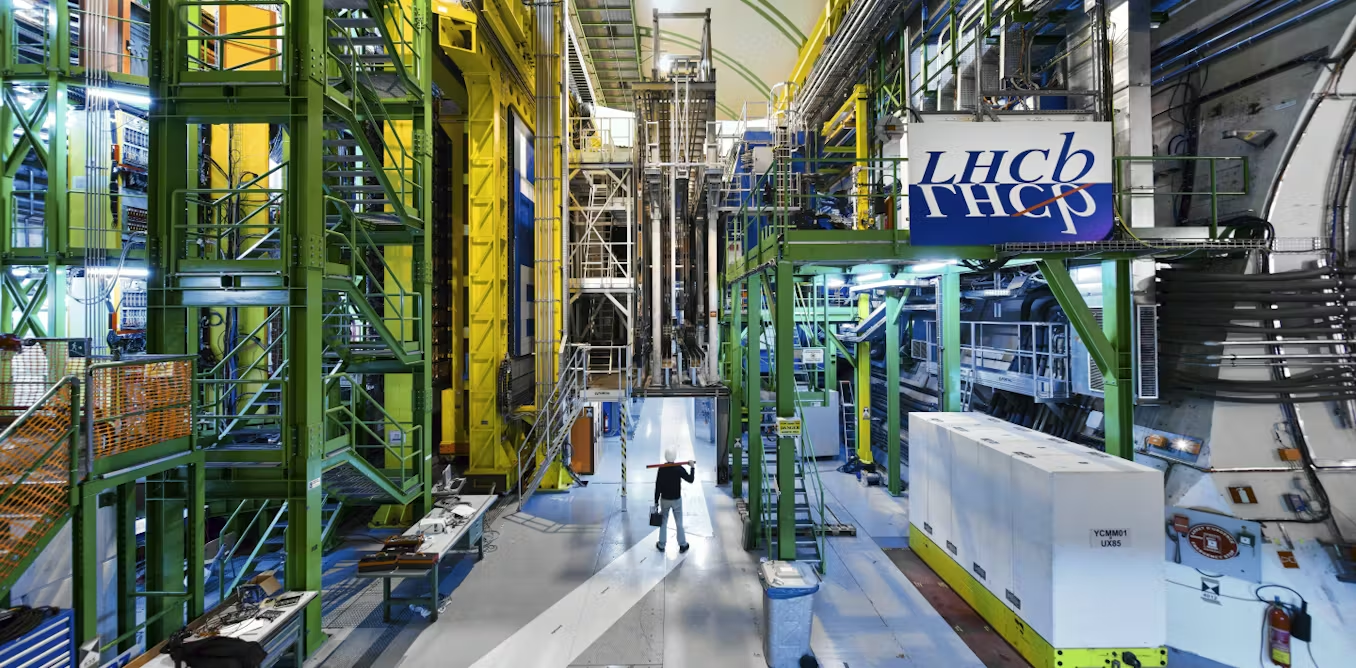
In the LHC, beams of proton particles travelling in opposite directions are made to collide, in a bid to uncover hints of undiscovered physics. The new results come from LHCb, an experiment at the Large Hadron Collider where these collisions are analysed.
The result comes from studying the decay – a kind of transformation – of sub-atomic particles called B mesons. We investigated how these B mesons decay into other particles, finding that the particular way in which this happens disagrees with the predictions of the Standard Model.
An elegant theory
The Standard Model is built on two of the 20th century’s most transformative advances in physics; quantum mechanics and Einstein’s special relativity.
Advertisement
Physicists can compare measurements made at facilities such as the LHC with predictions based on the Standard Model to rigorously test the theory.
Despite the fact that we know the Standard Model is incomplete, in over 50 years of increasingly rigorous testing, particle physicists are yet to find a crack in the theory. That is, potentially, until now.
The Standard Model is the best understanding of fundamental particles and forces, but we know it cannot be the whole story. Alionaursu / Shutterstock
Our measurement, accepted for publication in Physical Review Letters, shows a tension of four standard deviations from the expectations of the Standard Model.
In real world terms, this means that, after considering the uncertainties from the experimental results and from the theory predictions, there is only a one in 16,000 chance that a random fluctuation in the data this extreme would occur if the Standard Model is correct.
Advertisement
Although this falls short of science’s gold standard – what’s known as five sigma, or five standard deviations (about a one in 1.7 million chance) – the evidence is starting to mount. Adding to this compelling narrative are results from an independent LHC experiment, CMS, that were published earlier in 2025.
Although the CMS results are not as precise as those from LHCb, they agree well, strengthening the case. Our new results have been found in a study of a particular kind of process, known as an electroweak penguin decay.
Rare events
The term “penguin” refers to a specific type of decay (transformation) of short-lived particles. In this case we study how the B meson decays into four other subatomic particles – a kaon, a pion and two muons.
With some imagination, one can visualise the arrangement of the particles involved as looking like a penguin. Crucially, measurements of this decay let us study how one type of fundamental particle, a beauty quark, can transform into another, the strange quark.
Advertisement
This penguin decay is incredibly rare in the Standard Model: for every million B mesons, only one will decay in this manner. We have carefully analysed the angles and energies at which these particles are produced in the decay, and precisely determined how often the process takes place. We found that our measurements of these quantities disagree with Standard Model predictions.
At the LHC, magnets bend proton particles around a 27km-long tunnel, built under the French-Swiss border. Cern
Precise investigations of decays like this are one of the primary goals of the LHCb experiment, and have been since its inception in 1994. Penguin processes are uniquely sensitive to the effects of potentially very heavy new particles that cannot be created directly at the LHC.
Such particles may still exert a measurable influence on these decays over the small Standard Model contribution. This kind of indirect observation is not new. For example, radioactivity was discovered 80 years before the fundamental particles that are responsible for it (the W bosons) were directly seen.
Future directions
Our studies of rare processes let us explore parts of nature that may otherwise only become accessible using particle colliders planned for the 2070s. There are a wide range of potential new theories that can explain our findings. Many contain new particles called “leptoquarks” that unite the two different types of matter: “leptons” and “quarks”.
Other potential theories contain particles that are heavier analogues of those already found in the Standard Model. The new results constrain the form of these models and will direct future searches for them.
Advertisement
Despite our excitement, open theoretical questions remain that prevent us from definitively claiming that physics beyond the Standard Model has been observed. The most serious question arises from so-called “charming penguins”, a set of processes present in the Standard Model, whose contributions are extremely tricky to predict. Recent estimates of these charming penguins suggest their effects are not large enough to explain our data.
Furthermore, a combination of a theory model and experimental data from LHCb suggests that the charming penguins (and therefore, the Standard Model) struggle to explain the anomalous results.
New data already collected will let us confirm the situation in the coming years: in our current work we studied approximately 650 billion B meson decays recorded between 2011 and 2018 to find these penguin decays. Since then, the LHCb experiment has recorded three times as many B mesons.
Further advances are planned for the 2030s to exploit future upgrades to the LHC and accrue a dataset 15 times larger again. This ultimate step will allow definitive claims to be made, potentially unlocking a new understanding of how the universe works at the most elementary level.



















.jpeg?trim=250,0,0,0&quality=75&auto=webp&width=960)









































You must be logged in to post a comment Login