





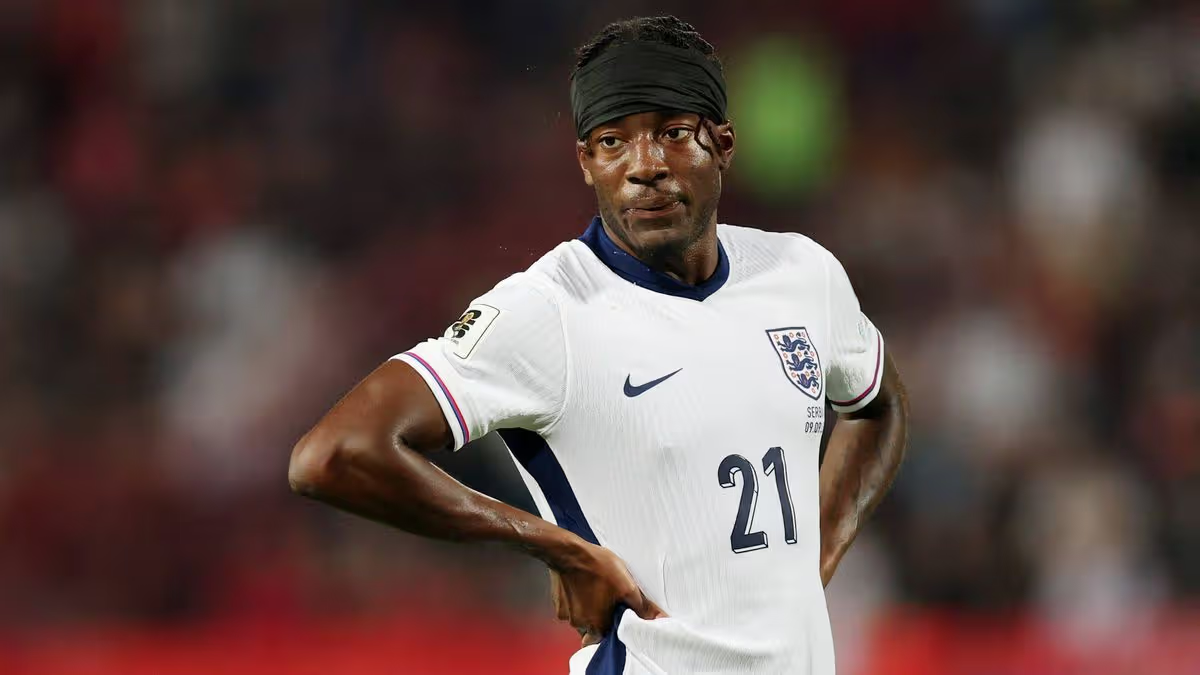
Arsenal’s Noni Madueke is ready to be the ‘difference maker’ as he faces three-way battle for his place on the plane to the World Cup
Noni Madueke insists he is in no mood to “sulk” and is ready for the biggest fight of his career. Madueke has been an important part of Arsenal ’s squad this season but suffered the heartbreak of losing the Carabao Cup final at Wembley.
But Madueke has got used to proving people wrong and battling for his place which will be the case again for a place in England’s World Cup squad.
Gunners winger Madueke is probably up against club teammate Bukayo Saka and Jarrod Bowen with two from three making the plane to North America.
Madueke is set to get his audition against Uruguay on Friday night with Saka one of the eleven England regulars only due to report up for next Tuesday’s friendly with Japan.
READ MORE: BBC and ITV given green light to show World Cup games on YouTube in landmark dealREAD MORE: Wayne Rooney explains the key difference between Thomas Tuchel and Gareth Southgate
It is a challenge that Madueke is ready to embrace as he targets a dream end to the season with a place in the squad and trophies with title-chasing Arsenal as they are still in the hunt for three even after losing to Manchester City on Sunday.
Madueke said: “Listen, my focus now is on England for sure. Of course it’s difficult, those type of games but you take it in your stride, you can’t sulk, you have to carry on.
“We’ve got important games for England coming up, which I’m fully focused on to try and do my best and when we get back to club it’ll be the final push to try and finish where we want to.
“In terms of my mindset, when you play at the highest level for England and for club, you need to have that mindset of trying to just do your best and compete and help your team win.
“In terms of World Cup places, I don’t really think too much about that. I just try to do my best whenever I’m on the pitch and everything will play out how it’s meant to.
“Of course as a player these things cross your mind. It would be naïve to think it wouldn’t. It’s an amazing stage and an amazing honour to play for your country at a World Cup so, yeah, it definitely has.”
Madueke, 24, has had highs and lows at Arsenal this season. He was brilliant in the autumn when Saka was out injured and that is when he really pushed himself to the fore with England. Saka (who everyone at Arsenal calls B) and Madueke also happen to be great pals.
Madueke’s game time has been much less in recent weeks but he is still a big part of the squad in terms of starts and also making an impact from the bench.
But he definitely knows what he has to do to get a place on the plane because Tuchel has been very clear that he effectively wants two players for each slot.
Madueke said: “I think for any player it’s great to know what you need to do, to know who you’re competing against. The manager’s made it very clear to all of us. It’s fantastic.
“There’s great competition for places and that’s only going to make the overall level of the group higher. I feel like in that sense he’s been really, really, really good with us.
“There’s always an edge in training. It’s one of the most competitive squads in the world with some of the best players in the world so regardless of who is here training is of a very high level.
“We have very high standards for ourselves and each other and that doesn’t change, regardless of the set up and who is here.
“First and foremost with me, Jarrod and Bukayo for England, or me and B for Arsenal, at the end of the day we want the team success first before ourselves. I feel like if you don’t want to have that it’s hard to really achieve something great.
“That’s at the forefront of your minds. And then of course it’s normal, you’re a competitor, you’re trying to play as much as possible. That’s just the competition, that’s just the nature of the game.”
Madueke was signed by Arsenal to be a “difference maker” and specifically be the player to unlock a “low block” when facing opponents.
He also feels he has matured as a player and a person since his £50m move to Arsenal this season.
Madueke added: “I think it’s clear what my strengths are. Anytime I go onto the pitch, I try and use my strengths to the best of my ability to help the team.
“I think I’m maturing as a player, I’m a little bit older now than when I first played for England and in terms of having an England shirt on, I’ve always really proud to play for my country and I’ve always felt really, really good to be in this environment as well.
“I think my performances for England have shown that so I hope I just kick on and continue to do my thing for the country.”
Join our new WhatsApp community and receive your daily dose of Mirror Football content. We also treat our community members to special offers, promotions, and adverts from us and our partners. If you don’t like our community, you can check out any time you like. If you’re curious, you can read our Privacy Notice.
England’s 2026 World Cup kits

England and Nike have launched the new home, away and goalkeeper kits to be worn at this summer’s FIFA World Cup. You can get free delivery on all orders with the code: ENGFREEDEL








































You must be logged in to post a comment Login