

Crypto World
Grayscale Lays Out 3 Arguments for Long-Term Crypto Investment



The crypto market has faced a significant drawdown this year, extending the decline that followed the October market crash.
However, in its latest market commentary, Grayscale Investments noted that now may be an appropriate time for long-term investors to consider allocating to crypto.
Grayscale Report Highlights AI’s Resilience Amid Crypto Market Decline
Grayscale highlighted that the crypto markets saw a notable decline in early February, following the downturn in high-growth software stocks and other equity sectors tied to early-stage technology. Market data showed that during the first week alone, the total crypto market cap dropped by around 10.8%.
The market experienced a notable decline towards the end of the first week, with Bitcoin (BTC) falling to $60,000, while other major assets also saw significant losses.
The FTSE/Grayscale Crypto Sectors Index dropped 26% from January 30 to February 5. The report also revealed that the artificial intelligence (AI) segment emerged as the top performer in February among crypto sectors. The sector experienced a more modest drawdown compared to others.
Follow us on X to get the latest news as it happens
“The outperformance seemed due to renewed enthusiasm around AI agents — autonomous software that can work independently on your behalf to pursue a complex set of objectives. Technological innovation appears to be accelerating with the rise of agent-based systems, particularly OpenClaw — a locally hosted productivity assistant that became one of the fastest-growing open-source projects in history,” the report read.
Kite AI, centered on agent-native stablecoin payments, and Pippin AI, which develops on-chain AI agents, both saw strong performance.
However, Grayscale’s report indicated a rebound, with the FTSE/Grayscale Crypto Sectors Index recovering 4% by the end of the month. The report added that metrics such as trading volumes and implied volatility have also “settled down.”
Grayscale Identifies Key Reasons for Long-Term Crypto Allocation
With market conditions stabilizing, Grayscale presents three core arguments for long-term accumulation. First, is the relationship between blockchain and AI. The report asserts that AI and blockchain are complementary, not competing.
“In fact, blockchains will likely be the financial rails for AI agents, given certain advantages over traditional bank-based finance — as discussed in the popular report by Citrini Research on possible AI disruptions,” Grayscale wrote.
While crypto assets declined alongside software stocks amid the market slump, the report suggested that investors may eventually differentiate between technologies disrupted by AI and those that complement it.
Second, the report pointed to stablecoin and tokenization trends. According to Grayscale, regulatory clarity, including the passing of the GENIUS Act last year, is encouraging institutional investment in stablecoins and tokenized assets. Recent actions by companies like Meta, Stripe, and BlackRock further demonstrate the sector’s growth potential.
“In February, reports indicated that Meta may reinvest in stablecoins after shelving its Libra/Diem project amid regulatory headwinds, and Stripe said in its annual letter that ‘stablecoin payments are advancing quietly and inexorably as real-world uptake continues apace.’ Separately, BlackRock said it would integrate its tokenized money market fund BUIDL with UniswapX,” the report highlighted.
Although the Clarity Act is delayed in the Senate, Grayscale highlights that its potential passage could facilitate institutional capital inflows into the asset class.
Lastly, the firm stated that the US economy remains healthy, with some indicators suggesting further potential growth. While there is uncertainty regarding the new Fed Chair nominee, Grayscale views the overall macro environment as supportive of risk assets.
“Overinvestment in AI is a medium-term risk, but the pace of innovation remains rapid and there are still shortages of data center capacity. The market reacted negatively to the nomination of Kevin Warsh to replace Jerome Powell as Fed Chair, but we doubt he will be as hawkish in practice as some of his viewpoints while Fed governor (2006-2011) might suggest,” Grayscale said.
Thus, Grayscale Investments presents a compelling case for long-term crypto growth. However, investors must carefully assess their risk appetite and time horizon, as the crypto market’s unpredictability can affect short-term returns despite long-term opportunities.
Subscribe to our YouTube channel to watch leaders and journalists provide expert insights


Although it has been around for over half a decade in one form or another, and its Open Network was officially released over a year ago, Pi Network continues to be the center of tons of controversy related to its KYC procedures, as users are quite vocal about their failed migration processes.
Now, though, Dr. Nicolas Kokkalis, one of the project’s co-founders, spoke about some key details, including what could be next for Pi.
Pi’s KYC System
The exec began by explaining that the Pi Network community had “spent years collectively building Pi KYC solution.” They have created a system that allows people from all over the world to interact while keeping their privacy safe, he added. Because Pioneers are located worldwide, the KYC system had to achieve broad geographic coverage and scalability.
In addition to regular identity verification, the solution also integrates sanction screening and compliance checks in a single system. He outlined several reasons why the Core Team had decided to invest “so heavily” into building a robust KYC system:
“From Pi Network’s perspective, it is foundational to the integrity and authenticity of the network. We also wanted to mitigate the need for Pioneers to pay out of pocket in order to verify their identity and thereby ensure accessibility to the entire community.”
He said the team sees KYC as a critical but unsolved problem in Web3. Consequently, they decided to build their system in-house rather than outsource it.
KYC’s Next Stage
Dr. Kokkalis further explained that the next phases of Pi’s KYC solution would be to treat it as a service, not just an internal system. Now, any transfer of funds or information begs the question of the identities of the sides involved in the move.
Being a project that has internally created its own KYC solution, the co-founder said Pi Network will offer their tech and product (not the data itself) as a service to other projects in Web3 or traditional businesses. He explained that Pi’s KYC approach is distinctive in several ways from other similar solutions:
- Global coverage
- Scalabity
- A hybrid model that combines AI and human verification
- Completed solution
He said the team is also working on adding additional safety steps, such as fingerprint verifications, to ensure no user information is lost or compromised. Lastly, he believes this step will allow the onboarding of non-Pi users to the Pi Network ecosystem.
The user comments below the official post on X were split on the matter. Some were supportive, indicating that if Pi KYC becomes a “true platform capability, that could be a major step toward real-world utility.” Others continue to be dismissive about Pi’s potential, saying, “What you are doing right now is preventing people who have been mining Pi Coin for 6 years from claiming their Pi coins, out of fear that the price might drop even further.”
The post Pi Network Co-Founder Shares Key KYC Updates Pioneers Must Know appeared first on CryptoPotato.
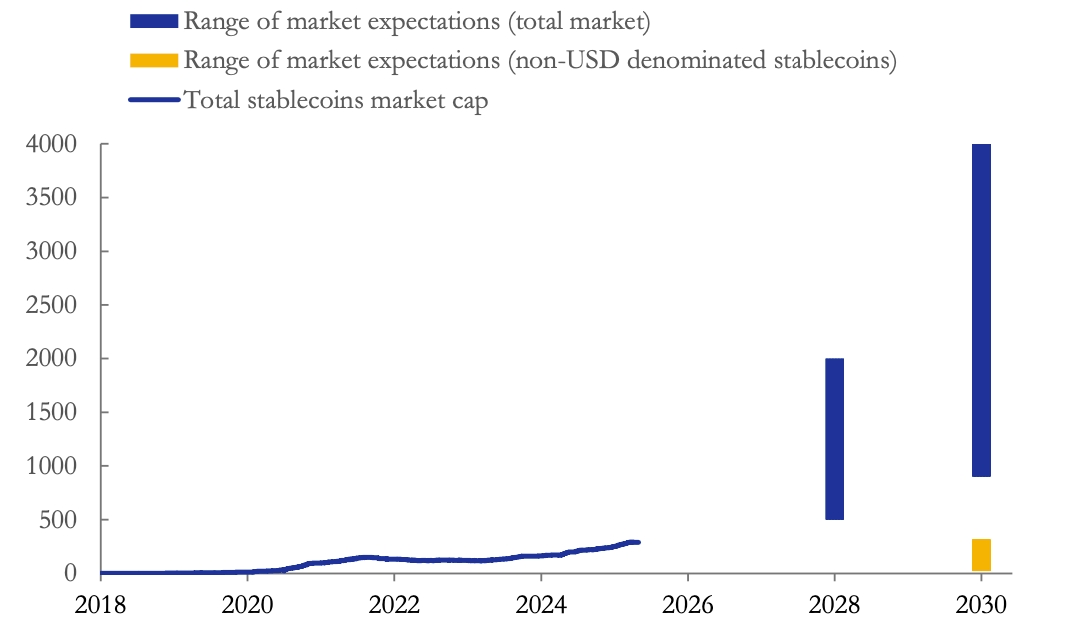
The European Central Bank said rising stablecoin use can pull money out of bank deposits and weaken the way monetary policy flows through to lending, according to a new ECB working paper published Tuesday.
Growing adoption of stablecoins, which are digital assets often pegged to currencies such as the US dollar or euro, is expected to draw funds away from traditional bank deposits, the ECB said in its latest working paper series, “Stablecoins and Monetary Policy Transmission,” released Tuesday.
“Our analysis shows that rising interest in stablecoins is linked to a measurable decline in retail bank deposits and a reduction in lending to firms,” the report said, noting that stablecoins can reduce the amount of credit banks provide to the real economy.
The ECB noted that the effects are nonlinear and vary depending on the scale of stablecoin adoption, their design features, and how they are regulated.
The report is part of the ECB’s ongoing efforts to monitor stablecoins, whose market capitalization has more than doubled over the past three years to $312 billion and is projected to reach $2 trillion by 2028.
Stablecoin impact: Banks, monetary policy and why currency matters
In assessing the impact of growing stablecoin adoption on banks, the ECB highlighted a deposit-substitution effect, where households and firms move funds from retail bank deposits to digital assets.
“Banks rely heavily on deposits as a stable and low-cost source of funding to support lending to households and businesses,” the study said.
“When deposits decline, banks may be forced to rely more on wholesale or market-based funding, which is typically more expensive and less stable,” it added.

The report also finds that stablecoins can change how policy interest rates affect bank funding costs and lending, with impacts varying by adoption scale, design and regulation.
“We find that stablecoin adoption interferes with multiple monetary policy transmission channels, potentially weakening the predictability of policy actions,” the ECB said.
Related: ECB targets 2027 digital euro pilot as provider selection begins in Q1 2026
The central bank warned that foreign-currency stablecoins could further weaken the connection between domestic monetary policy and bank lending, with risks amplified when the market is dominated by non-euro-denominated tokens.
The study reiterated that US dollar-backed stablecoins make up the vast majority of the stablecoin market. Data from CoinGecko shows these dollar-pegged tokens are valued at $301 billion, representing 97% of total stablecoin market capitalization at publishing time.
Magazine: Clarity Act risks repeat of Europe’s mistakes, crypto lawyer warns

[PRESS RELEASE – Toronto, Canada, March 3rd, 2026]
Paradex has announced that the Token Generation Event for its native token, $DIME, is expected to take place soon. The launch represents the next phase in the exchange’s development.
Institutional Background and Market Growth
Paradex was developed by the team behind Paradigm, an institutional crypto derivatives liquidity network that has processed more than $1 trillion in trading volume. That background is reflected in Paradex’s focus on execution quality, capital efficiency, and market structure.
Since launching their on-chain perpetuals exchange, Paradex has recorded:
- Over $250 billion in cumulative trading volume
- Approximately $550 million in open interest
- More than 75,000 users
- Peak daily trading volume above $3 billion
The exchange operates with an off-chain central limit order book (CLOB) for matching, and settles transactions through a high-throughput Layer 2 appchain secured by zk-STARK proofs on Ethereum.
Focus on Market Structure and Privacy
A key differentiator for Paradex is its approach to information exposure. On transparent blockchains, position sizes and liquidation levels can often be observed publicly. Paradex encrypts sensitive state data prior to settlement while using zero-knowledge proofs to maintain validity. Access to detailed account information is restricted to verified users.
In addition, the exchange incorporates:
- Zero trading fees for retail participants
- Retail Price Improvement flow segmentation
- A no auto-deleveraging risk model
- On-chain vault infrastructure for yield strategies
These features are designed to reduce execution friction and mitigate structural risks that have historically limited institutional participation in decentralized derivatives markets.
$DIME and Network Alignment
According to Messari’s research coverage, $DIME will launch on Paradex’s spot market and will serve as the native gas token of Paradex Chain.
Messari notes that the token is structured to reduce the traditional conflict of interest between equity holders and tokenholders by directing economic value accrual to the $DIME token itself. Rather than implementing automatic buyback formulas, Paradex intends to conduct buybacks on a discretionary basis, with decisions guided by market conditions and ecosystem considerations.
Token Allocation Overview
Messari outlines the following allocation structure for $DIME:
- 25.1 percent Core Contributors
- 25.0 percent Community Airdrop
- 20.0 percent to Season 2 XP holders
- 5.0 percent to Pre-Season and Season 1 XP holders
- Fully unlocked at launch
- 21.6 percent Ongoing Community Rewards
- 13.4 percent Paradigm Shareholders
- 10.4 percent preferred equity investors subject to a 12-month linear unlock beginning one month after listing
- 1.0 percent common equity holders
- 2.0 percent reserved for Paradigm’s balance sheet
- 6.0 percent Foundation Budget
- 5.0 percent Liquidity Programs
- 3.9 percent Future Core Contributors and Advisors
80% of the tokens allocated to Core Contributors and Paradigm shareholders are subject to performance-based unlock conditions. The remaining 20 percent follows a time-based vesting schedule, with 25 percent unlocking one year after listing and the remainder vesting monthly over the following 36 months.
This structure is intended to align long-term incentives between contributors and the broader community.
Looking Ahead
Paradex has stated that it plans to expand beyond perpetual futures into spot markets, options, real-world asset products, and more. The $DIME TGE represents a shift toward a network model in which the token underpins economic coordination and value accrual across the platform.
With measurable trading activity, defined tokenomics, and a focus on privacy-preserving infrastructure, the upcoming launch of $DIME will provide a clearer view into how Paradex intends to scale its on-chain derivatives model over the long term.
Further details regarding timing and listing specifics are expected to be released in the coming days. Users can check Paradex’s socials for more information.
About Paradex
Paradex is a privacy-focused decentralized perpetual futures exchange built on its own high-performance Layer 2 appchain using the Starknet stack. The platform combines an off-chain central limit order book for execution with zk-STARK-secured on-chain settlement to deliver centralized-level efficiency within a self-custodial framework.
Developed by the team behind Paradigm, an institutional crypto derivatives liquidity network that has processed over $1 trillion in trading volume, Paradex emphasizes market structure, capital efficiency, and position confidentiality. The exchange currently supports more than 100 markets and integrates features such as Retail Price Improvement flow segmentation, a no auto-deleveraging risk model, and on-chain vault infrastructure.
Paradex aims to expand its ecosystem beyond perpetual futures into spot markets, options, real-world asset products, and more, positioning itself as a broader on-chain financial infrastructure platform.
For more information, users can visit Paradex’s official website and social channels.
The post Paradex Signals Upcoming $DIME Token Generation Event appeared first on CryptoPotato.

Key Takeaways
- Drone strikes directly impacted two AWS facilities in the UAE, with a third location in Bahrain suffering collateral damage.
- Critical cloud services like EC2, S3, and DynamoDB reported increased error rates and reduced performance.
- While AWS has brought the Management Console partially back online, full recovery is expected to take considerable time due to infrastructure damage.
- Customers received guidance from Amazon to shift their operations to alternative AWS regions across the United States, Europe, or Asia Pacific.
- Shares of AMZN declined more than 2% during Tuesday’s pre-market session after the incident was disclosed.
Amazon (AMZN) shares experienced a decline exceeding 2% in pre-market hours on Tuesday after Amazon Web Services disclosed that military drone attacks connected to escalating Middle East tensions had inflicted damage on its infrastructure in the UAE and Bahrain.
The attacks occurred early Sunday morning according to local time zones. AWS initially communicated through its health status dashboard that unidentified “objects” had impacted UAE-based facilities, resulting in “sparks and fire.”
Later on Monday evening, AWS provided more detailed information. Two facilities located in the UAE sustained “direct strikes,” while a third installation in Bahrain went offline following a nearby strike that caused substantial physical infrastructure damage.
“These strikes have caused structural damage, disrupted power delivery to our infrastructure, and in some cases required fire suppression activities that resulted in additional water damage,” AWS said in a statement.
The resulting damage caused significant disruptions to multiple critical services within the affected geographic zones. EC2 compute instances, S3 storage solutions, and DynamoDB — AWS’s managed NoSQL database platform — all experienced higher-than-normal error rates and diminished performance.
According to AWS, DynamoDB error rates “remain elevated” with no “meaningful improvement” observed as of their latest update. Additional services including Lambda, Kinesis, and CloudWatch also “remain degraded.”
One bright spot: AWS successfully brought its Management Console back to partial functionality, allowing customers to access the web-based interface for managing their cloud resources. However, the restoration remains incomplete, with certain console pages continuing to generate error responses.
Extended Recovery Expected
AWS indicated that the recovery process will be “prolonged given the nature of the physical damage involved.” Engineering teams continue to evaluate the complete scope of infrastructure damage while making worker safety their top priority.
The cloud provider noted that certain data retrieval capabilities and service functionality can be brought back online without requiring complete facility restoration — and those efforts are currently in progress.
AWS holds the position as the global leader in cloud infrastructure services, meaning that even geographically limited outages can affect a substantial customer base.
The tech giant recommended that customers operating workloads in Middle Eastern regions implement data backup procedures and evaluate migrating their resources to alternative AWS regions spanning the United States, Europe, or Asia Pacific territories.
AWS also cautioned that the continuing instability throughout the Middle East region could lead to “unpredictable” operational conditions in the foreseeable future.
Effects on Amazon’s Broader Operations
The disruption extended beyond cloud infrastructure to impact Amazon’s e-commerce operations throughout the region. The company posted advisory notices across its online marketplaces in Israel, Saudi Arabia, Kuwait, Bahrain, and the UAE alerting customers to expect “extended delivery time in your area.”
The drone attacks coincided with Iran’s launch of missiles and unmanned aerial vehicles targeting Israel and facilities associated with U.S. interests throughout the Gulf region, representing retaliation for coordinated U.S.-Israeli military operations against Iranian positions.
Amazon acknowledged the connection between the service disruptions and the regional military conflict in its Monday evening communication — marking the first official confirmation linking the infrastructure damage to the geopolitical escalation.
According to the most recent status update, conditions at the UAE-based facility “remain largely unchanged,” with technical teams continuing efforts to achieve complete infrastructure restoration.
Financial analysts on Wall Street continue to rate AMZN as a Strong Buy, with 40 Buy recommendations and 3 Hold ratings issued over the preceding three-month period. The consensus price target stands at $282.21, suggesting approximately 35% potential upside from present trading levels.

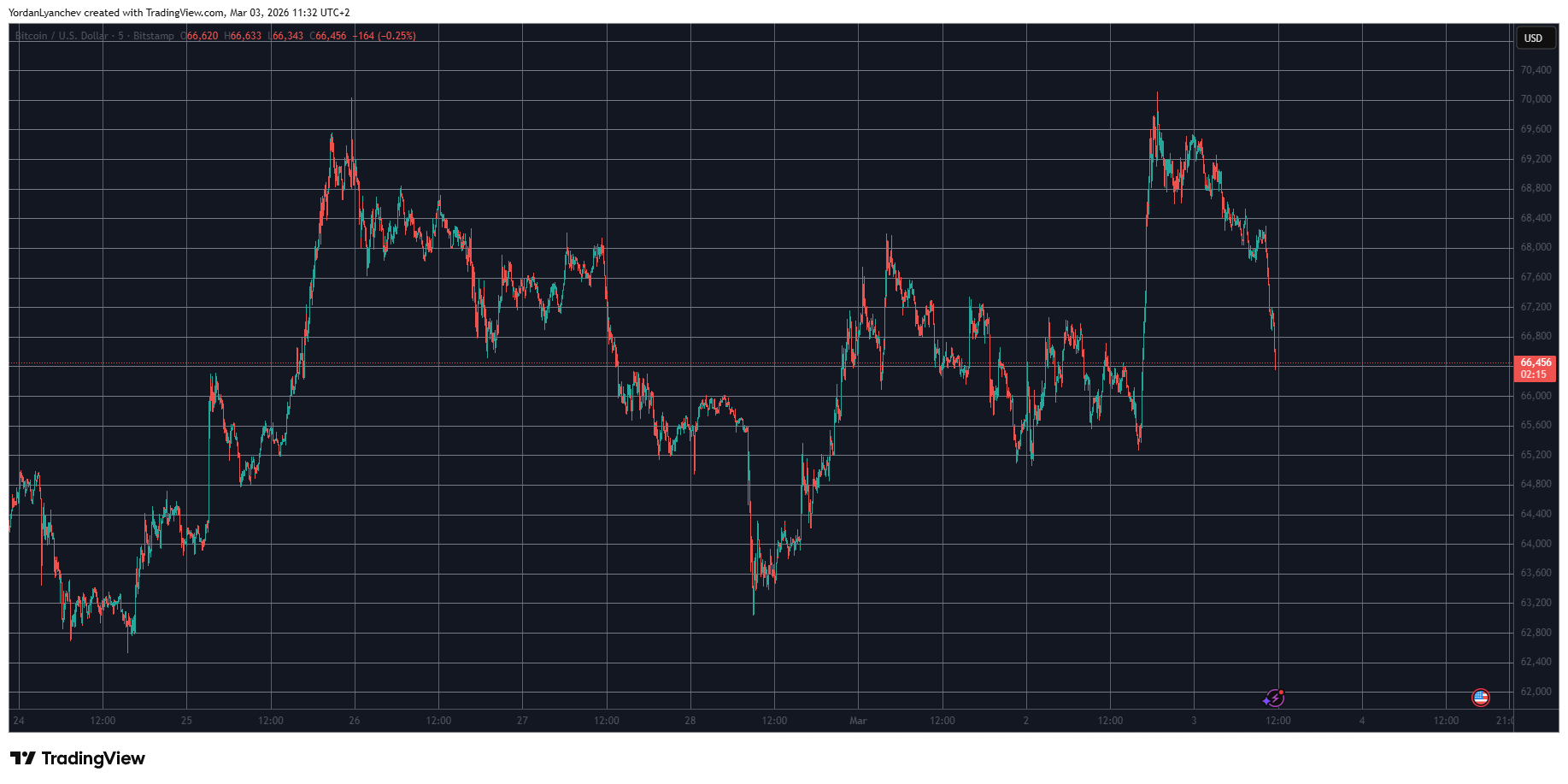
Bitcoin’s price exploded on Monday by several grand, reaching a new multi-week peak of just over $70,000, only to be rejected and driven south by $3,000.
Most larger-cap alts experienced similar volatility but have stalled and now sit at essentially the same levels as yesterday. HYPE is among the few gainers from the larger caps, while XMR is deep in the red.
BTC Stopped at $70K
The primary cryptocurrency’s intense volatile ride began on Saturday morning when the US and Israel attacked Iran with numerous strikes. BTC dipped immediately from $67,000 to $63,000. Iran retaliated against several nations in its region, but bitcoin remained relatively unfazed. Moreover, it bounced to just over $68,000 after reports emerged that Iran’s Supreme Leader was killed during the attacks.
It dipped further after the legacy financial markets opened, but managed to remain above $65,000. Then came an unexpected rally that shook the bears. In just under an hour, bitcoin skyrocketed by roughly five grand, going from $65,200 to a multi-week peak of $70,150 (on Bistamp).
This came ahead of Trump’s speech on the Iranian situation, in which he claimed the US has complete control but warned that the war could last weeks. BTC was stopped once again at $70,000 as it happened last week, and driven south to $68,500. Minutes ago, it began to nosedive once again, and now trades below $66,500.
Its market cap is down to $1.330 trillion, while its dominance over the alts stands tall at 56.4% on CG.
NEAR Rockets
Ethereum flew past $2,000 yesterday, only to be rejected once again at that level, and is now down to $1,950. BNB was stopped ahead of $650, while XRP dropped from $1.45 to $1.35 as of now. On a daily scale, ADA, XMR, DOGE, HBAR, and XLM have lost the most value from the larger caps, while HYPE is up by almost 5% to nearly $32.
NEAR has charted the most substantial gains, soaring by over 15% to $1.37. MORPHO and ENA are next, while M has dropped by 9%.
The total crypto market cap is down by almost $100 billion since yesterday’s peak to $2.360 trillion on CG.

The post NEAR Skyrockets 15% Daily, BTC Price Plummets Below $67K: Market Watch appeared first on CryptoPotato.

Cardano’s native token was among the few larger-cap alts that failed to chart a new all-time high during the late 2024/2025 bull run. Its upward move was capped at around $1.30, and it couldn’t break through.
However, its subsequent correction has been quite painful. ADA currently trades at around $0.26, which means that it’s lost over 80% of its value since its 2024/2025 peak. Moreover, it’s down by 91.4% since its all-time high marked in early September 2021.
Popular crypto analyst, Ali Martinez, outlined in a recent post ADA’s most significant support levels. The first is closeby at $0.245, which, if broken, could lead to a more profound nosedive to $0.112.
In case such a 60% decline also takes place if the crypto winter worsens, ADA’s next line of defense could be at $0.051. These levels might seem nearly impossible for the Cardano bulls, but the asset has produced numerous corrections of more than 60% in its past.
3 support levels for Cardano $ADA:
• $0.245
• $0.112
• $0.051 pic.twitter.com/ofHqqLWugn— Ali Charts (@alicharts) March 3, 2026
X User Mentor also weighed in on Cardano’s future price performance and brought up a level close to the first support line from Ali Martinez. They made a bold claim that ADA will never go below $0.25 again, and even forecasted a massive surge to $1.00.
The post These Are ADA’s Most Important Support Levels as Cardano’s Price Drops 11% Monthly appeared first on CryptoPotato.

A US federal court ruling has increased the risk that Nevada regulators could seek to halt prediction-market trading in the state after a judge sent a dispute involving Polymarket’s parent company Blockratize back to state court.
A federal judge rejected arguments that US regulation under the Commodity Exchange Act (CEA) and the Commodity Futures Trading Commission (CFTC) fully preempts state gaming laws for prediction markets, according to a Monday order.
The judge found that the CEA’s savings clause does not completely displace state authority and that the companies had not shown a basis to block Nevada’s action at this stage.
The decision means the Nevada Gaming Control Board can continue pursuing its civil enforcement case in state court, where it could seek an injunction restricting Nevada residents from accessing event contracts offered by Polymarket or Kalshi.

In response to the ruling, Polymarket’s parent company submitted a motion to request a brief administrative stay of the court’s remand order, the filing shows.
The motion is a legal request seeking to freeze a court ruling or enforcement action seen as a short-term emergency measure.
Related: Prediction markets emerge as speculative ‘arbitrage arena’ for crypto traders
Predictions markets face mounting pressure after Nevada ruling: Lawyer
The Nevada decision comes as prediction markets face mounting pressure from state regulators, including Kalshi, which has been fighting Nevada’s gaming regulator since 2025.
On Tuesday, a federal judge also remanded Nevada’s civil enforcement action against Kalshi back to state court, exposing Kalshi to an “imminent temporary restraining order” barring it from offering event contracts in the state, according to a court filing seen by sports betting and gaming-focused lawyer Daniel Wallach.
“The ruling could embolden other states to sue Kalshi in state court and seek injunctions to block event contracts, a strategy that has so far succeeded in every case brought,” wrote Wallach, in a Tuesday X post.

Kalshi sued the state of Nevada in March 2025 after receiving a cease-and-desist order to halt all sports-related betting markets within the state.
However, in February, the US Court of Appeals for the Ninth Circuit denied Kalshi’s bid to stop Nevada’s gaming regulator from taking action on its sports event contracts.
Related: ‘Elite’ traders hunt dopamine-seeking retail on prediction markets: 10x Research
Insider trading concerns add to scrutiny
The legal fight is unfolding as prediction markets draw scrutiny over information advantage and potential insider activity.
Suspected insider wallets netted $1.2 million by betting on the outcome of blockchain sleuth ZachXBT’s investigation into Axiom, Cointelegraph reported on Friday.
ZachXBT released the much-anticipated investigation on Thursday, alleging that Axiom employee Broox Bauer and others had been responsible for insider trading activity since early 2025.

Insider trading concerns were first highlighted in January after a Polymarket account profited $400,000 after it placed a bet on a contract predicting that Venezuelan President Nicholas Maduro would be captured, wagering the funds just hours before US forces captured him during a military operation.
Earlier in February, Israeli authorities arrested and indicted two people suspected of using secret information related to Israel striking Iran for insider trading on Polymarket.
Magazine: Train AI agents to make better predictions… for token rewards
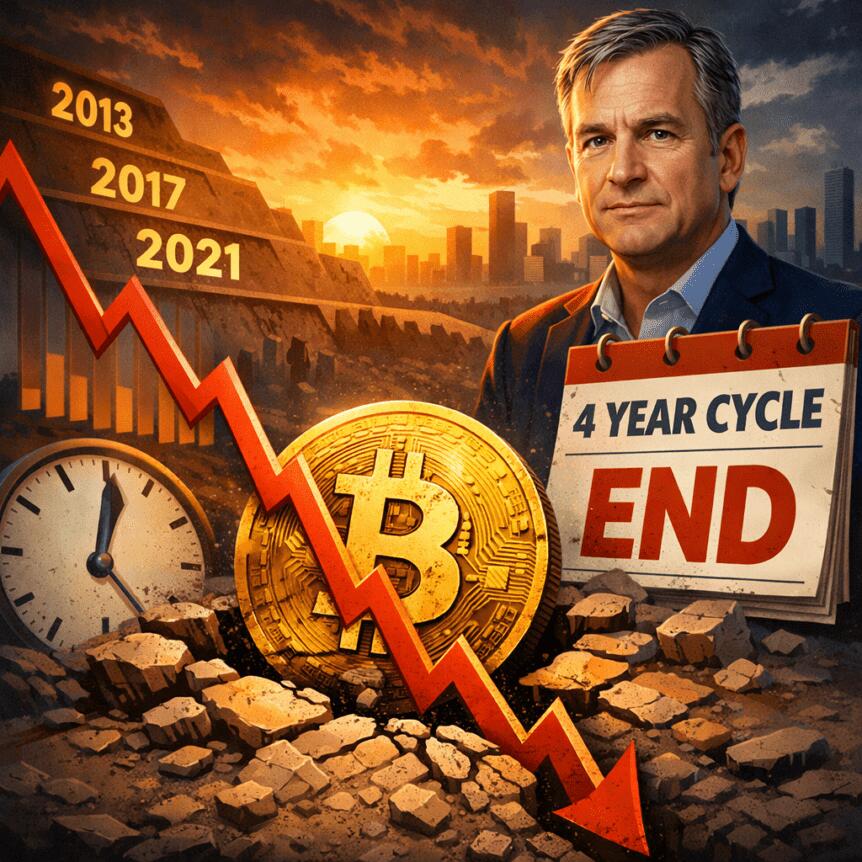
As investors weigh where the flagship cryptocurrency stands in 2026, VanEck’s chief executive says the market is likely near a bottom of its long-running cyclical pattern. The four-year cycle has framed price moves for years, with the reward halving compressing supply and influencing sentiment. While on-chain metrics and fundamentals have shown pockets of improvement, many observers remain cautious about the pace and durability of any rebound. In a recent interview, Jan van Eck argued that the asset may have found a base as it transitions through the cycle, a claim that dovetails with a wider debate about whether the old playbook still holds in a more mature market.
Key takeaways
- The CEO of VanEck sees Bitcoin’s price near a bottom as the four-year cycle winds down, arguing that the cycle has historically driven much of the recent price action.
- VanEck links the near-term bottom to the halving-driven supply dynamic, suggesting that 2026 represents the fourth year in a typical four-year pattern where gains fade and a bottom forms.
- BTC was around $68,400 at the time of writing, up roughly 2.6% in the prior 24 hours and about 7.6% over the past week, according to CoinGecko.
- Analysts remain split on the relevance of the four-year cycle, with macro catalysts such as ETF demand, USD movements, and regulatory progress cited as potential deviations from the historical script.
- Geopolitical tensions in the Middle East have coincided with a recent crypto rally, with some observers noting that crypto rails could facilitate cross-border flows when traditional banking channels face friction.
- VanEck suggested that the recovery may be tied to a broader shift toward crypto-centric mechanisms for moving value in uncertain political environments, pointing to regions like the UAE as more favorable for crypto activity.
Tickers mentioned: $BTC
Sentiment: Bullish
Price impact: Positive. The asset’s price has moved higher in the wake of remarks suggesting a bottoming process amid cycle dynamics.
Trading idea (Not Financial Advice): Hold. The argument centers on a potential transition from a cycle-driven bear to a gradual uptick, underscored by macro and regulatory developments that could sustain a cautious uptick.
Market context: The discussion sits at a time when crypto markets are weighing the durability of a four-year pattern against rising institutional adoption, ETF activity, and regulatory clarity, all of which can alter traditional cycle expectations.
Why it matters
The debate over whether the four-year Bitcoin cycle remains a reliable predictor has shaped investor expectations for years. Proponents of the cycle point to halving events—the mechanism by which miners’ block rewards are cut by half every four years—as a fundamental driver of price dynamics, creating multi-year bull phases followed by sharper downswings. Critics argue that as institutions enter the market and as macro conditions evolve, the cycle’s predictive power may wane. The VanEck view adds a new layer to the discussion by tethering the near-term bottom to this long-standing pattern while acknowledging a broader regime change in market maturity.
Beyond supply-side mechanics, macro factors loom large. ETFs and other institutional demand can alter price trajectories by providing channels for large-scale inflows, while a weakening U.S. dollar or a more favorable regulatory backdrop can bolster risk appetite. In the interview, VanEck framed the cycle as a lens through which to view price action but did not discount the possibility that external forces could support a more resilient recovery than in prior bear-market episodes.
The topic of the four-year cycle has persisted through recent months as analysts weigh macro risks against momentum-driven moves. While some observers argue that external drivers—such as ETF activation, macro liquidity, and policy signals—can override the cycle, others maintain that the underlying halving mechanism remains a meaningful structural factor in the market’s long-run equilibrium. The conversation is far from settled, but the proximity to a potential bottom is a focal point for traders watching for confirmation signals that the next leg higher is underway.
The interview also touched on the broader usefulness of crypto rails during periods of geopolitical strain. VanEck suggested that in scenarios where traditional financial channels face friction, digital assets and crypto payment rails could serve as an alternative for moving value, particularly in regions perceived as crypto-friendly. He pointed to the Middle East—specifically the UAE and Dubai—as an environment where crypto activity might facilitate cross-border settlement and capitalize on more permissive regulatory attitudes compared with some other corridors. The framing underscores a broader theme: as the crypto market matures, it increasingly intersects with real-world financial flows and geopolitical risk, shaping both price and adoption trajectories.
The price development around the remark mirrors a cautious but constructive tone in markets. The latest run has been modest by historical standards, but it has punctured bear-market rhetoric and raised the possibility that 2026 could mark the start of a renewed cycle, even if the path remains uncertain. The discussion also reflects a broader industry interest in how much of the narrative is driven by traditional macro factors versus on-chain fundamentals—an ongoing debate that will likely persist as more capital enters the space and as regulatory landscapes evolve.
The original article and linked materials also explore contrasting viewpoints on the cycle’s sustainability. Critics highlight macro demand from ETFs, a weaker USD, and favorable regulatory developments as signs that the market’s drivers are expanding beyond the classic halving-focused paradigm. Supporters, meanwhile, continue to emphasize the structural tightness of supply and the influence of miner economics on price behavior. In this tension lies the market’s current temperament: uncertain but attentive to any data point that could signal a durable bottom or the onset of a new cycle.
What to watch next
- Follow BTC price action around key milestones in 2026, including potential reaction to the next halving cycle’s window as the market digests supply dynamics.
- Monitor ETF-related inflows and regulatory developments in major markets that could alter institutional participation and liquidity.
- Track macro indicators such as USD strength, interest-rate expectations, and risk sentiment, which historically influence the pace of cross-asset capital allocation.
- Observe on-chain metrics for signs of accumulation or distribution, which could corroborate or challenge near-term bottoming narratives.
Sources & verification
- CNBC interview with VanEck on March 2, 2026 discussing Bitcoin’s bottoming potential and the four-year cycle.
- BTC price data and performance metrics from CoinGecko (as cited in the article).
- Cointelegraph reporting on bitcoin price movements and cycle debates.
- Iran-related crypto outflows and related commentary, as covered by Cointelegraph.
- In-depth magazine piece examining market narratives around liquidity, manipulation, and market structure.
Bottoming thesis as the cycle winds down
In a conversation that bridged investment strategy and market timing, Jan van Eck framed Bitcoin (CRYPTO: BTC) as entering a phase where the four-year cycle’s cooling effect on price could harmonize with an improving macro backdrop. The interview, conducted with CNBC, emphasized that the once-rapid gains associated with earlier cycles have given way to a more measured pace of appreciation, aligned with the notion that supply constraints and miner economics continue to shape price floors. The veteran investor’s view centers on a bottoming process that could precede a gradual reacceleration, albeit with the caveat that external forces may still alter the trajectory.
“There’s been an investing cycle, Bitcoin (CRYPTO: BTC) goes up three years in a row, goes down pretty massively in that fourth year. 2026 is that fourth year. So that’s why we are in a Bitcoin bear market. So I think we can overcomplicate it. Now I think we are making a bottom.”
VanEck’s perspective sits amid a broader debate over the cycle’s durability. Some analysts argue that external catalysts—macro demand from ETFs, a softer dollar, and regulatory breakthroughs—can override the historical rhythm. Others insist that the structural impulse provided by the halving remains a core fixture of price dynamics, even as the market expands to include more institutional players and sophisticated investors. The interview and surrounding discourse reflect a crypto ecosystem grappling with how much of its future is tethered to the cycle versus evolving fundamentals.
As markets digest the possibility of a bottom, attention also turns to capital flows in other regions where crypto rails could provide practical advantages in uncertain times. The discussion about using digital assets to move value away from traditional banking systems, especially in geopolitically sensitive contexts, underscores the potential for crypto to function as an alternative channel for settlement and liquidity. While such narratives can carry speculative risk, they also highlight the growing integration of digital assets into broader financial infrastructure and risk-management considerations.
What to watch next
- Public disclosures and filings related to ETF activity and exposure limits that could intensify or dampen institutional flows.
- Regulatory developments that signal a more mature market environment or prompt caution among new entrants.
- On-chain indicators (e.g., balance sheets of major exchanges, miner revenue trends) that could confirm or contradict a bottoming scenario.
As macro conditions regain influence over digital assets, investors are increasingly asking whether a rebound in economic activity, particularly a Purchasing Managers Index (PMI) reading above 50, could ignite the next altcoin season.
Summary
- PMI above 50 would signal improving economic conditions and a potential return of risk appetite
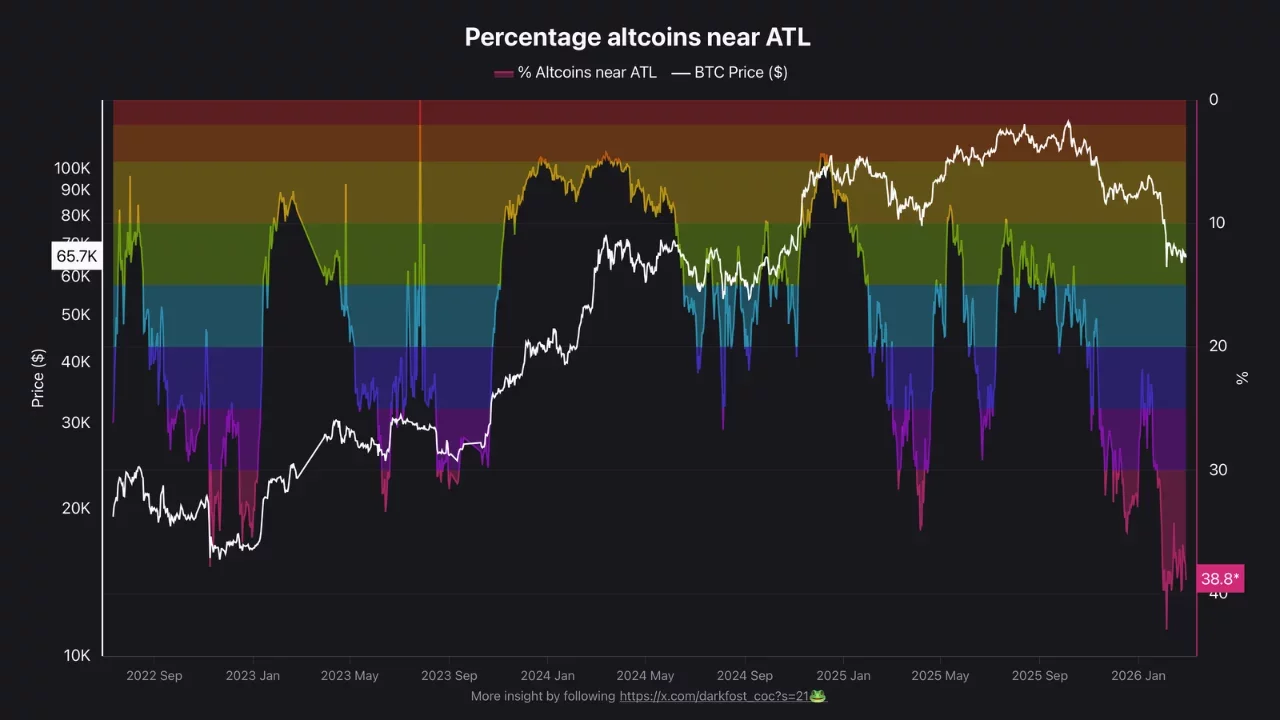
- Nearly 40% of altcoins trading near all-time lows reflects extreme weakness but possible late-stage capitulation
- Bitcoin dominance remains elevated, suggesting rotation into altcoins has not yet begun
What PMI means for Altcoin Season
The Purchasing Managers’ Index (PMI) is a forward-looking economic indicator that measures manufacturing and services activity. A reading above 50 signals expansion, while below 50 indicates contraction.
Crypto markets, especially altcoins, are highly sensitive to liquidity and risk appetite. When PMI rises above 50 after a contraction phase, it typically signals improving growth expectations, stronger corporate activity, and loosening financial conditions.
Historically, periods of macro expansion have coincided with greater investor willingness to rotate into higher-beta assets, including mid- and small-cap cryptocurrencies.
Bitcoin often reacts first to improving macro conditions, benefiting from institutional flows. Altcoin season tends to follow when investors move further out the risk curve in search of higher returns. In prior cycles, altcoin rallies have emerged during early-to-mid expansion phases when liquidity conditions improved but speculative excess had not yet peaked.
Current conditions: Pressure before rotation?
However, the present backdrop remains fragile.
According to a CryptoQuant analyst, 38% of altcoins are trading near their all-time lows, a worse reading than both April 2025 (35%) and even the immediate aftermath of the FTX collapse (37.8%). This marks the deepest regression for altcoins in the current cycle, underscoring persistent risk aversion.
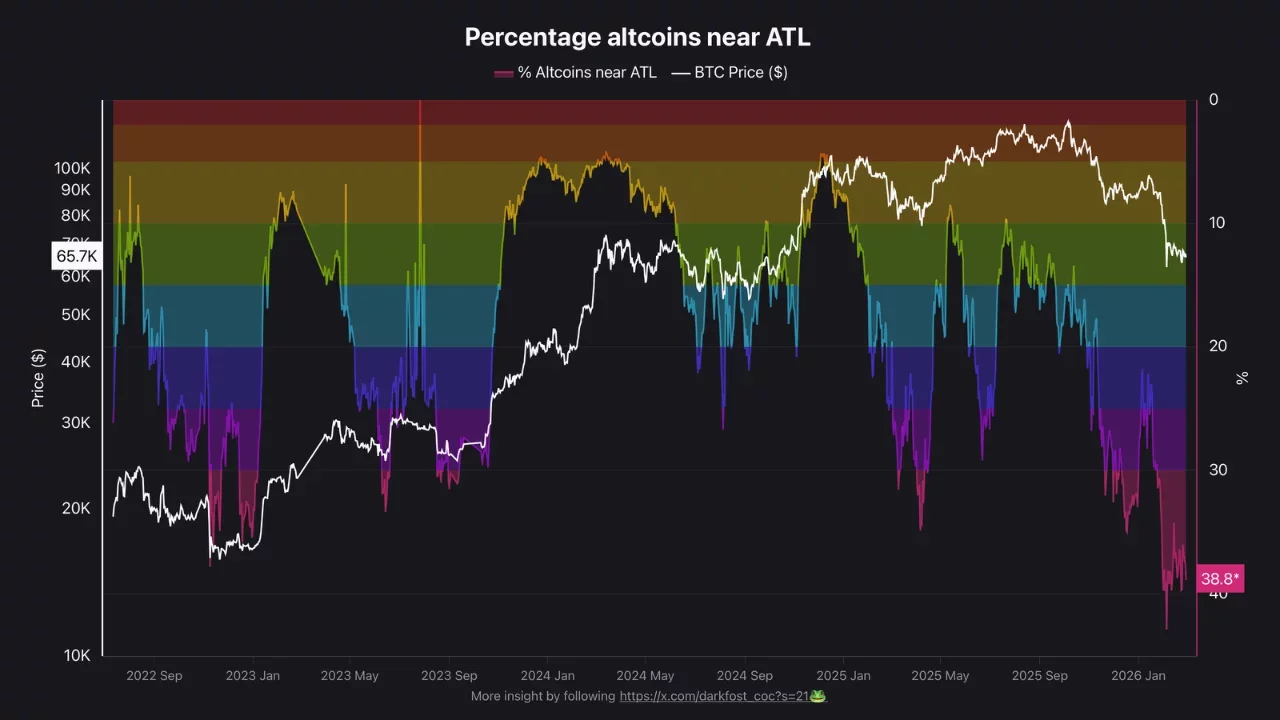
Moreover, the Bitcoin Dominance (BTC.D) chart reinforces this narrative. Dominance remains elevated near 58–59%, after peaking around 60% in February.
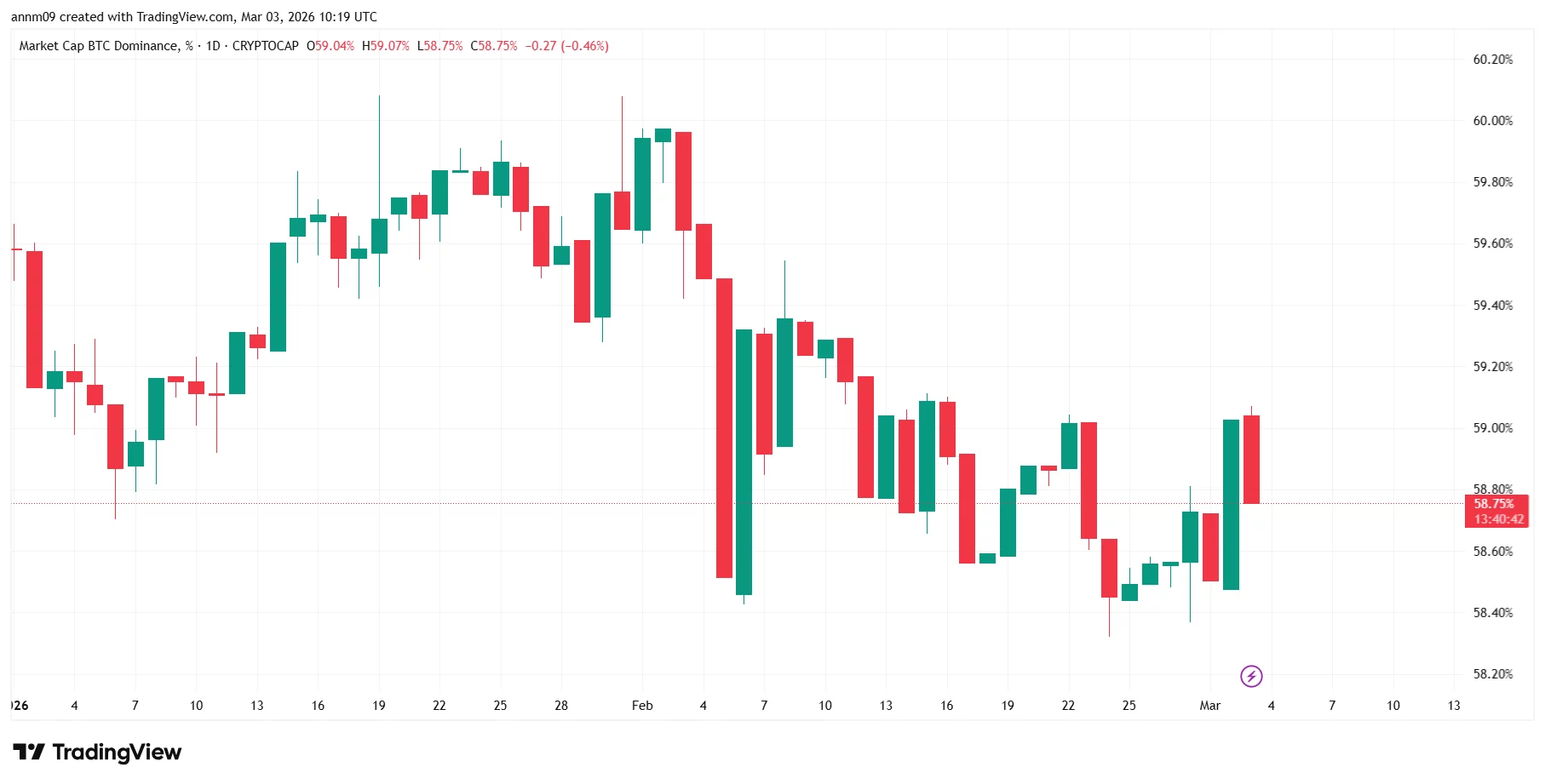
While BTC.D has pulled back slightly from local highs, it has not broken into a decisive downtrend, a necessary condition for sustained altcoin outperformance.
For a PMI-driven altcoin season to materialize, three things likely need to occur simultaneously: PMI moving sustainably above 50, Bitcoin consolidating rather than trending sharply higher, and BTC dominance breaking below key support to confirm capital rotation.
Until then, macro stabilization may first benefit Bitcoin before liquidity meaningfully spreads into the broader altcoin market.
In short, a PMI recovery could be the spark, but dominance trends suggest altcoin season has not yet begun.

Riot Platforms (NASDAQ: RIOT) closed 2025 with a record revenue footprint, anchored by a surge in Bitcoin (CRYPTO: BTC) mining and a strategic pivot toward AI-friendly data infrastructure. The miner reported $647.4 million in revenue for the year, up 72% from $376.7 million in 2024, with Bitcoin mining revenue accounting for the bulk of that rise — $576.3 million — as the company’s hashrate climbed and Bitcoin prices firmed. The year saw Riot mine 5,686 BTC, up from 4,828 BTC in 2024. The average cost to mine one Bitcoin, excluding depreciation, rose to $49,645 from $32,216 in 2024, reflecting a 47% increase in the global network hashrate and higher mining difficulty, though power credits grew 68% over the year, helping offset some costs. Engineering revenue also climbed to $64.7 million from $38.5 million in 2024.
Key takeaways
- Full-year revenue reached $647.4 million, a 72% year-over-year rise, driven largely by Bitcoin mining.
- Bitcoin mining revenue totaled $576.3 million in 2025, with Riot producing 5,686 BTC for the year.
- The average cost to mine one BTC rose to $49,645 due to a 47% jump in the global network hashrate and higher mining difficulty; power credits rose 68% to help compensate.
- Riot still posted a net loss of $663 million for 2025 due to accounting adjustments and the paper value of its Bitcoin holdings, though adjusted EBITDA reached $13 million.
- At year-end, Riot held 18,005 BTC on its balance sheet (3,977 BTC pledged as collateral), valued at about $1.6 billion at the period’s price; the company maintained $309.8 million in cash, including $76.3 million restricted.
- The year featured notable strategic moves, including an AMD data-center agreement and the sale of Bitcoin to fund a 200-acre land purchase in Rockdale, Texas, amid activist pressure to accelerate a pivot toward AI/HPC infrastructure.
Tickers mentioned: $BTC, $RIOT, $AMD
Sentiment: Neutral
Market context: The 2025 crypto cycle remained volatile, with miners navigating lower price environments and rising mining difficulty as global hashrates expanded. Riot’s results reflect both the resilience of Bitcoin mining revenue and the pressures of noncash accounting on reported profits, while the sector-wide shift toward data-center and AI infrastructure gained pace among peers.
Why it matters
Riot’s 2025 numbers underscore the enduring profitability potential of Bitcoin mining when operational scale and efficiency align with favorable Bitcoin price trends. The company’s ability to produce 5,686 BTC in a year demonstrates the continued relevance of large-scale, purpose-built mining operations even as macro conditions vary. Yet the sizable net loss for 2025 highlights the distinction between cash generation and reported earnings, driven by noncash accounting adjustments and the mark-to-market treatment of Bitcoin holdings. For investors, the key takeaway is whether Riot’s business model can convert its rising revenue into sustainable cash flow as it diversifies beyond mining into AI-focused data-center infrastructure.
Riot’s strategic pivot toward AI and HPC infrastructure is a central theme in the sector. The company’s leadership has signaled a broader trend among leading miners to repurpose existing power capacity for AI workloads, aligning with a market where demand for GPU-accelerated data centers and related services remains robust. This pivot aligns Riot with peers that have begun converting mining capacity into AI computing, a move that could unlock new monetization avenues beyond BTC production. The balance between mining economics and the potential upside from AI/HPC deployments will be critical to assess in the coming quarters, particularly as the company explores capital allocation decisions that could affect liquidity and leverage metrics.
The year’s narrative is also shaped by external pressures from activist investors. Starboard Value’s position suggested the AI/HPC pivot could unlock a valuation up to $21 billion, a view that intensifies scrutiny on how Riot deploys capital and scales its non-mining businesses. The broader mining ecosystem is undergoing a similar transformation, with other miners converting facilities and power capacity into data-center operations. In this environment, Riot’s execution on both mining efficiency and AI-centric expansion will be watched closely by holders and analysts alike.
Beyond Riot’s internal dynamics, the sector faced notable earnings results from peers during 2025. Core Scientific reported Q4 revenue of $79.8 million, down 16% year over year and short of estimates, while TeraWulf posted quarterly mining revenue of $35.8 million, below expectations. Marathon Digital Holdings (MARA) faced a steeper quarterly loss of $1.71 billion as revenue declined, underscoring the difficult backdrop for miners even as some players pursue diversification into AI infrastructure. The industry’s earnings narrative in 2025 highlighted both the fragility of pure mining profits and the potential for strategic pivots to sustain growth.
Riot’s year-end results also mirror a broader financial landscape in crypto by illustrating how the balance sheet interacts with price movements. The company finished the year with 18,005 BTC on hand, including nearly 4,000 BTC pledged as collateral, valued at approximately $1.6 billion using year-end Bitcoin prices. With $309.8 million in cash and $76.3 million restricted, Riot’s liquidity position provides a foundation for ongoing investments, including data-center expansions and potential acquisitions linked to its AI/HPC strategy. The role of Bitcoin as a treasury asset remains a focal point for investors evaluating the risk-reward profile of mining-centric businesses in a volatile market.
What to watch next
- Progress of the AMD data-center agreement and any related deployment milestones at Riot’s facilities.
- Updates on the Rockdale, Texas land development and whether additional capital is deployed toward AI/HPC infrastructure.
- Regulatory or market developments that could impact mining economics or Bitcoin’s treasury treatment in Riot’s financials.
- Future quarterly results for any signs of improved profitability from AI/data-center initiatives or changes in BTC holdings strategy.
- Ongoing discourse with activists and any governance actions tied to Riot’s strategic pivot and capital allocation plan.
Sources & verification
- Riot Platforms, Inc. announces full-year 2025 financial results and strategic highlights — official press release.
- Riot Platforms’ 2025 earnings report (PDF): Riot earnings report. Source: Riot.
- Details on the AMD data-center agreement and Rockdale land purchase: Riot Platforms Bitcoin AI HPC Texas land deal — original reporting.
- Activist investor Starboard Value commentary on Riot’s strategic pivot and potential valuation upside: Starboard Value discussion.
- Industry context on AI infrastructure and mining sector shifts: article on AI-focused data centers and high-yield bonds in BTC mining.
Riot Platforms’ 2025 results reflect a record top line and a pivot toward AI infrastructure
Riot Platforms (NASDAQ: RIOT) posted a year that underscored both the durability of large-scale Bitcoin mining and the strategic tension between traditional mining economics and the opportunity set created by AI-centric data centers. The revenue trajectory was unmistakable: a $647.4 million top line, a 72% ascent from the prior year, with BTC-driven mining revenue powering the majority of that growth. The company’s annual Bitcoin production reached 5,686 BTC, a solid step up from 4,828 BTC in 2024, illustrating how scale and efficiency can translate into tangible output even amid a volatile crypto environment. The mining segment’s strength is tempered by cost dynamics that have evolved in tandem with a rapidly expanding network hashrate — up 47% globally — and a corresponding rise in mining difficulty. Excluding depreciation, Riot’s estimated custo to mine a single Bitcoin rose to $49,645, a signal that margins can compress when the network grows quickly, though the resilience of power credits, which rose 68% in the year, helped cushion some of that pressure.
The company’s 2025 earnings narrative was not simple arithmetic. A net loss of $663 million dominated headlines, but much of that figure traces noncash accounting adjustments and changes in the paper value of Riot’s Bitcoin holdings. When noncash items are stripped away, adjusted EBITDA stood at $13 million for the year. Investors were reminded that cash-generating capacity can coexist with paper losses on the balance sheet, a dynamic that has become increasingly common among miners that carry substantial Bitcoin positions on their books. The disclosures around these noncash effects underscore the importance of parsing GAAP results from the underlying cash flow and operating performance when evaluating Riot’s long-term trajectory.
On the balance sheet, Riot ended 2025 with a sizable cache of Bitcoin — 18,005 BTC — worth roughly $1.6 billion using year-end prices, of which 3,977 BTC were pledged as collateral. The company also held $309.8 million in cash, with $76.3 million classified as restricted. These figures provide Riot with a degree of financial flexibility as it navigates capital allocations in a field that remains sensitive to Bitcoin’s price trajectory and mining economics. The year’s liquidity position supports ongoing initiatives tied to the AI/HPC pivot, including potential expansions of data-center capacity or related partnerships.
Strategically, Riot’s year highlighted deliberate steps toward redefining its role beyond pure mining. In January, Riot struck a data-center agreement with AMD (NASDAQ: AMD), signaling a potential shift toward AI accelerator workloads and high-performance computing. In tandem, the company disclosed plans to monetize Bitcoin to fund a 200-acre land purchase in Rockdale, Texas, a move that aligns with a broader push to increase on-site compute capacity while pursuing productive uses for capital. Activist investor Starboard Value pressed for a more accelerated pivot into AI infrastructure, arguing that the transformation could unlock substantial value. This tension between immediate mining returns and longer-term data-center profitability mirrors a wider industry debate about how miners should allocate capital as demand for AI infrastructure continues to grow.
Riot’s narrative sits within a broader ecosystem of miners pursuing similar diversification. Peers such as Hive, Hut 8, TeraWulf, and Iren have repurposed some of their power assets for data-center operations, while CoreWeave has moved toward fully AI infrastructure. The evolving earnings mix reflects an industry-wide recalibration: mining revenues remain a foundational contributor, but AI-focused data centers promise new avenues for revenue and margin expansion if executed with discipline and scale. The 2025 results thus offer a snapshot of a sector in transition — one where the fate of an individual miner hinges on execution across multiple fronts: efficiency, balance-sheet discipline, capital allocation, and the ability to monetize AI compute opportunities as demand for AI workloads climbs.
Looking ahead, Riot’s path will depend on how successfully it translates its AI/HPC ambitions into tangible earnings and how it navigates Bitcoin’s price volatility. The company’s forthcoming disclosures and quarterly updates will be critical for assessing whether the AI pivot can meaningfully augment free cash flow and provide a sustainable alternative to mining-driven revenue. As miners balance the traditional economics of BTC production with the strategic imperative to invest in AI infrastructure, Riot’s 2025 experience could serve as a bellwether for the broader market’s willingness to embrace diversification as a route to enduring profitability.

A 10-minute vigorous workout creates a hostile environment for cancer cells

C64 Gets A Modern Interactive Disassembler

Warning: Financial Wall Ahead! | Online Campus Experience Shorts #financialfreedom


-

 Politics4 days ago
ITV enters Gaza with IDF amid ongoing genocide
-

 Fashion4 days ago
Weekend Open Thread: Iris Top
-

 Tech2 days ago
Unihertz’s Titan 2 Elite Arrives Just as Physical Keyboards Refuse to Fade Away
-

 Business7 days ago
True Citrus debuts functional drink mix collection
-

 Politics3 hours ago
Alan Cumming Brands Baftas Ceremony A ‘Triggering S**tshow’
-
Sports3 days ago
The Vikings Need a Duck
-

 NewsBeat5 days ago
Cuba says its forces have killed four on US-registered speedboat | World News
-
 NewsBeat3 days ago
Dubai flights cancelled as Brit told airspace closed ’10 minutes after boarding’
-

 Tech7 days ago
Unsurprisingly, Apple's board gets what it wants in 2026 shareholder meeting
-
 NewsBeat6 days ago
Manchester Central Mosque issues statement as it imposes new measures ‘with immediate effect’ after armed men enter
-
 NewsBeat3 days ago
The empty pub on busy Cambridge road that has been boarded up for years
-

 NewsBeat2 days ago
‘Significant’ damage to boarded-up Horden house after fire
-

 NewsBeat3 days ago
Abusive parents will now be treated like sex offenders and placed on a ‘child cruelty register’ | News UK
-
 NewsBeat7 days ago
Police latest as search for missing woman enters day nine
-

 Entertainment1 day ago
Baby Gear Guide: Strollers, Car Seats
-

 Business5 days ago
Discord Pushes Implementation of Global Age Checks to Second Half of 2026
-

 Business5 days ago
Only 4% of women globally reside in countries that offer almost complete legal equality
-
 Tech4 days ago
NASA Reveals Identity of Astronaut Who Suffered Medical Incident Aboard ISS
-

 Crypto World7 days ago
Entering new markets without increasing payment costs
-
Politics2 days ago
FIFA hypocrisy after Israel murder over 400 Palestinian footballers