Connect with us

Tech

AI and collaboration critical for cyber professionals in 2026

Published

on

Ciaran Luttrell and George O’Mahony discuss Ireland’s cyber landscape and the impact of AI on the sector.

Late last week (26 February), managed detection and response platform eSentire awarded the fifth annual MTU Sean Hennessy Bursary to Bartosz Lipinski, from Fermoy, Cork. In partnership with MTU’s Department of Computer Science, the award was established as a means of honouring a former colleague and supporting young people in the security sector.  

SiliconRepublic.com spoke with Ciaran Luttrell, the vice-president for global SOC operations at eSentire and George O’Mahony, the head of the Department of Computer Science at Munster Technological University (MTU), to hear more about the bursary, Ireland’s cybersecurity sector and the skills needed to succeed. 

“The Bursary provides a huge opportunity for students to work in an international operations centre that supports thousands of customers, to refine their skills during their placement and then look at this as a career after they graduate,” explained Luttrell.

Advertisement

“This is the fifth year of the bursary, and it has been a great way to find and develop new talent. So far, all of the recipients of the previous years that have graduated have joined us full time and remain with the company and those that are still going through their studies continue to work with us on a part time basis.”

Next in line

According to O’Mahony, developing a pipeline of cybersecurity expertise is of key importance, not just for professionals based in Ireland, but worldwide. 

He said, “There is still a cyber skills gap, not only in Ireland, but across the globe. This is a global issue that is faced by both small companies and multinational organisations. There’s just not enough people available.” 

He stated, by building a graduate pipeline, for example like the programme at MTU, in collaboration with companies based in Cork and the wider south-west region, there is potential to develop a strong and connected ecosystem. But it can’t depend solely on the participation of graduates.  

Advertisement

He said, “Graduates are not going to fill the entirety of the skills gap. MTU has run the Cyber Skills Initiative as a lead institution. This is a collaboration between MTU, University of Limerick and Technological University Dublin, which is an HEA HCI Pillar III project that was awarded back in 2021. 

“The project has now been running for five years and has allowed us to expand access to cybersecurity programmes by looking at short courses and micro-credentials, which are all university accredited. 

“This allowed more people to upskill or reskill and these types of alternatives, at the postgraduate level, are really important in solving this talent gap, especially when aligned to international standards, like the NIST/NICE framework.” 

It’s an AI world now

Cybersecurity, like virtually every STEM role, has been impacted by AI advancements, with significant fears that artificial intelligence limits career opportunities for professionals young and older alike. 

Advertisement

O’Mahony is of the opinion that this is an even greater issue in academia as the onset of GenAI has had a detrimental effect on graduates. But it is, he finds, an opportunity to commit to robust hard and soft upskilling, with the professional at the core. 

He said, “AI will probably have an impact in automating some tasks within IT like vulnerability scanning, log analysis and others, that are important but also repeatable. 

“What will remain as valuable to the student or graduate is around critical analysis, critical thinking, problem-solving, and being able to reason in areas of uncertainty, like not knowing exactly what the attacker can do. And hence companies will still need graduates to understand and apply this skillset, while being able to use AI and take advantage of new technologies. “


For both Luttrell and O’Mahony, AI-literacy simply can not be ignored, especially among those expecting a career in a field as critical as cybersecurity. O’Mahony noted collaboration among educational institutions and companies is going to be vital in bringing young people up to speed on the topics that most affect cyber careers, such as emerging risks, as well as shifting regulatory and operational requirements.

Advertisement

He said, “With AI, some of the technologies that are affecting the market did not exist even months ago, so how can you help students understand what is involved or how to secure those new environments? At this point, we have to help them understand first principles and take a ‘life-long learning’ approach, so that they are able to apply their knowledge and skills in the most effective way.”

For Luttrell, “getting a foot in the door is a huge achievement”, but what organisations truly need to prioritise for their employees and long-term growth strategies, is a commitment to a mutually beneficial career progression plan. 

He explained, companies often worry about hiring early career professionals, as it may not seem like a strong investment. He said, employers bring people in, train them up and then if they choose to move on, it can impact the organisation. 

“The old mindset here is that you are spending on training and recruitment, then someone else sees all the benefits. It’s very much a zero sum mindset and I think it is the wrong one to take.

Advertisement

“More skilled people benefits everyone. The world is more connected and so any company that you work with or partner with can potentially affect your security as well. We have seen attacks through service providers and software supply chains, and so the number of skilled professionals in the market helps to improve the overall state of security for everyone.”

Don’t miss out on the knowledge you need to succeed. Sign up for the Daily Brief, Silicon Republic’s digest of need-to-know sci-tech news.


Source link

Advertisement
Continue Reading
Click to comment

Leave a Reply

Your email address will not be published. Required fields are marked *

Tech

2025 was the year AI grew up. How will AI evolve in 2026?

Published

on

In 2025, AI crossed an important threshold. After years of experimentation, generative AI moved decisively into enterprise workflows, while agentic systems and long-term memory capabilities began to take shape in real-world deployments.

Sarah Hoffman

Director of AI Thought Leadership, AlphaSense.

Advertisement

Source link

Advertisement
Continue Reading

Tech

These Awesome Concept Gadgets Make MWC an Exciting Place to Be

Published

on

Mobile World Congress in Barcelona is where the tech world’s biggest companies get together to show off their latest gadgets. At MWC 2026 we’ve seen some amazing products, including the Leica Leitzphone by Xiaomi and the super skinny Honor Magic V6 foldable phone. But the show always provides a wealth of quirky concept devices and this year is no exception. 

From wild cars to transforming phones, these are the most exciting concepts we’ve seen on the MWC show floor so far. 

Advertisement
xiaomi-vision-gt-concept-hypercar-08

The Vision GT looks amazing but I don’t think I’ll ever get to drive one.

Andrew Lanxon/CNET

Xiaomi Vision GT

Xiaomi is no stranger to EVs, but this is the first time the company has designed a hypercar specifically to be used as a digital asset in the PlayStation 5 racing game Gran Turismo. But Xiaomi didn’t stop there — it actually built the car for real and gave it pride of place on its enormous booth at the conference center. 

The Vision GT, as it’s called (GT stands for Gran Turismo, obvs) is an all-electric hypercar that Xiaomi says is “sculpted by wind.” By which it means, it’s designed with all kinds of swooping lines and flowing inlets that allow it to pass through the air with minimal resistance. It’s got an enormous rear… umm…section? Whatever it is, it’s basically one massive hole to allow for airflow. 

The car looks incredible and I’d love to have been able to sit inside the LED-strewn cockpit but sadly the doors remained firmly closed. This is a concept model designed for the game, and the company has made no statement on whether it ever plans to put something like this into production. 

Advertisement

One thing’s for sure though: It sure as hell won’t come cheap. 

tecno-modular-camera-phone-03

This modular really “lens” itself to photography

Andrew Lanxon/CNET

Tecno modular camera phone

I may have been bowled over this year by Xiaomi and Leica’s incredible camera powerhouse of a phone but Tecno’s concept may even be able to take things further. At its heart is essentially a skinny Android phone but the series of electric contact pins on the back allow you to slap on a variety of modular accessories to completely change what the phone can do. 

Advertisement

One module that particularly caught my eye was a camera unit, that added not just a whopping great zoom lens to the phone, but actually had its own larger camera sensor too. It basically turned the phone into a fully fledged camera that just used the display as the viewfinder. 

Hopefully that larger image sensor would also allow the phone to take some pretty awesome photos, though I’ll have to reserve judgement on what its images look like for at such point Tecno puts it into production. 

Honor Robot Phone

The robot peeks out of the back of the Honor phone.

Advertisement

Katie Collins/CNET

Honor Robot phone

Honor first showed off its concept Robot Phone back at CES in Las Vegas but we’ve been able to get much closer up with the thing this year. It looks sort of like the love child of an Android phone and a DJI Osmo Pocket 3, with a gimbal-stabilized camera unit folding out from inside the phone. 

As a YouTuber myself, I love the idea of having a compact way to shoot my photography videos. Honor has actually had to develop its own tiny motors — based on the technology it uses in the hinges for its folding phones — and CNET’s own Katie Collins was impressed when the camera’s built-in AI complimented her “soft and shiny hair.”

While the robot phone is still in the concept stage right now, Honor has said that it will go into full production and we may even be able to buy it in the second half of the year. 

Advertisement
A man stands in front of the Yoga Book 3D concept using the clip-on tools to alter the picture on the dual-screen computer. The bottom screen shows a 2D image of a mouse, while the top screen shows a 3D render of the same image.

We got hands-on experience with the Yoga Book 3D concept — this picture of a mouse turned into a fully rendered 3D model before our very eyes.

Josh Goldman/CNET

Lenovo Yoga Book 3D concept

Lenovo and sister brand Motorola have frequently shown off some fun concepts at the show, my favorite being Motorola’s wrist-worn phone from 2024. This year Lenovo is leading the way with its concept Yoga Book 3D laptop display, which shows images in 3D — and you don’t even need to wear those stupid glasses to see it. 

Like any tech item launched recently, the device leans on AI to achieve its goals. In this case, the AI goes to work in helping transform 2D drawn objects into full 3D renderings. It has two displays, with the bottom display being your “working screen” where you’ll draw and interact with your creations while the top one uses stereoscopic screen technology to render your images in a way that makes them look actually three dimensional.

We tested it at a hands-on event ahead of the show and CNET’s Tyler Graham remarked that “if you aren’t standing directly in front of the computer, the projection feels less impressive and more headache-inducing.” This has been my experience using any glasses-free 3D technology so I don’t see this kind of tech being deployed in a mass-market product just yet. But it’s nice to see it being experimented with.

Advertisement
man shaking hands with robot

Honor CEO James Li greets the company’s robot on stage at MWC

Katie Collins/CNET

Honor Humanoid robot 

Did you think Honor was done with robots after the aforementioned Robot Phone? Oh no, the company has much bigger plans with robotics and laid its cards out clearly on the table at this year’s show. Its first humanoid robot took to the stage during the company’s press conference, dancing, moonwalking and even backflipping to show off how easily it can move around versus, say, a 38-year-old tech journalist whose knees struggle with standing up, let alone backflipping. 

The robot will be packed with AI smarts, of course, and rather than focusing on industrial applications, Honor is aiming its robot firmly towards the consumer world. It says it’ll be able to help us in the workplace, as a humanoid companion in the home and for assisting with shopping. Though if I hear one word from it about how I maybe don’t need to buy a second pack of biscuits I’m kicking it straight into the sea. 

Advertisement

Source link

Continue Reading

Tech

The MacBook Air M5 starts at $1,099, up $100 from the M4

Published

on

Reports had suggested that Apple wasn’t going to reveal a refreshed MacBook Air with an M5 chip during its week of announcements, but whaddyaknow? Apple just went ahead and did that exact thing.

Let’s deal with the bad news first: Apple is reverting a price cut from last year. It dropped the M4-powered MBA’s starting price down to $999, but for the M5-equipped model, you’ll need to shell out at least $1,099.

The company claimed the M5 MacBook Air will be able to deliver four times faster performance in AI tasks than the M4 MBA. Compared with the M1 MacBook Air, you’ll get up to 9.5 times faster performance, the company said.

Along with swapping in a more powerful chip, Apple has upgraded the starting storage by doubling it from 256GB to 512GB. The company says the SSD has “2x faster read/write performance compared to the previous generation.” You can kit out the MacBook Air with 4TB of internal storage if you have the will and the means.

Advertisement

You’ll also get 16GB of RAM for starters. The memory has 153GB/s of bandwidth, which Apple said is a 28 percent improvement over the M4 MBA. The latest MacBook Air can be equipped with up to 32GB of memory.

Just like it did with the latest iPad Air, Apple has upgraded the connectivity hardware. Thanks to the inclusion of the company’s N1 wireless chip, the M5 MacBook Air supports Wi-Fi 7 and Bluetooth 6.

As you’d imagine, the M5 MacBook Air runs on macOS Tahoe and it supports Apple Intelligence features. It has a Liquid Retina display, 12MP Center Stage camera, a sound system with Spatial Audio support and a pair of Thunderbolt 4 ports, which allows the laptop to support up to two external displays. Apple claims the M5 MacBook Air will run for up 18 hours on a single charge.

The M5 MacBook Air is available in 13-inch and 15-inch models, with the latter starting at $1,299. It’s available in sky blue, midnight, starlight and silver. Pre-orders start on March 4 at 9:15AM ET. The laptops will be available in stores in 33 countries and regions on March 11.

Advertisement

Source link

Continue Reading

Tech

Building A Hackerspace Entry System

Published

on

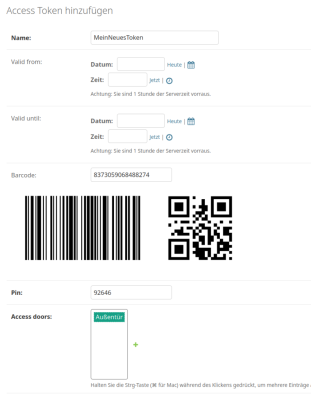
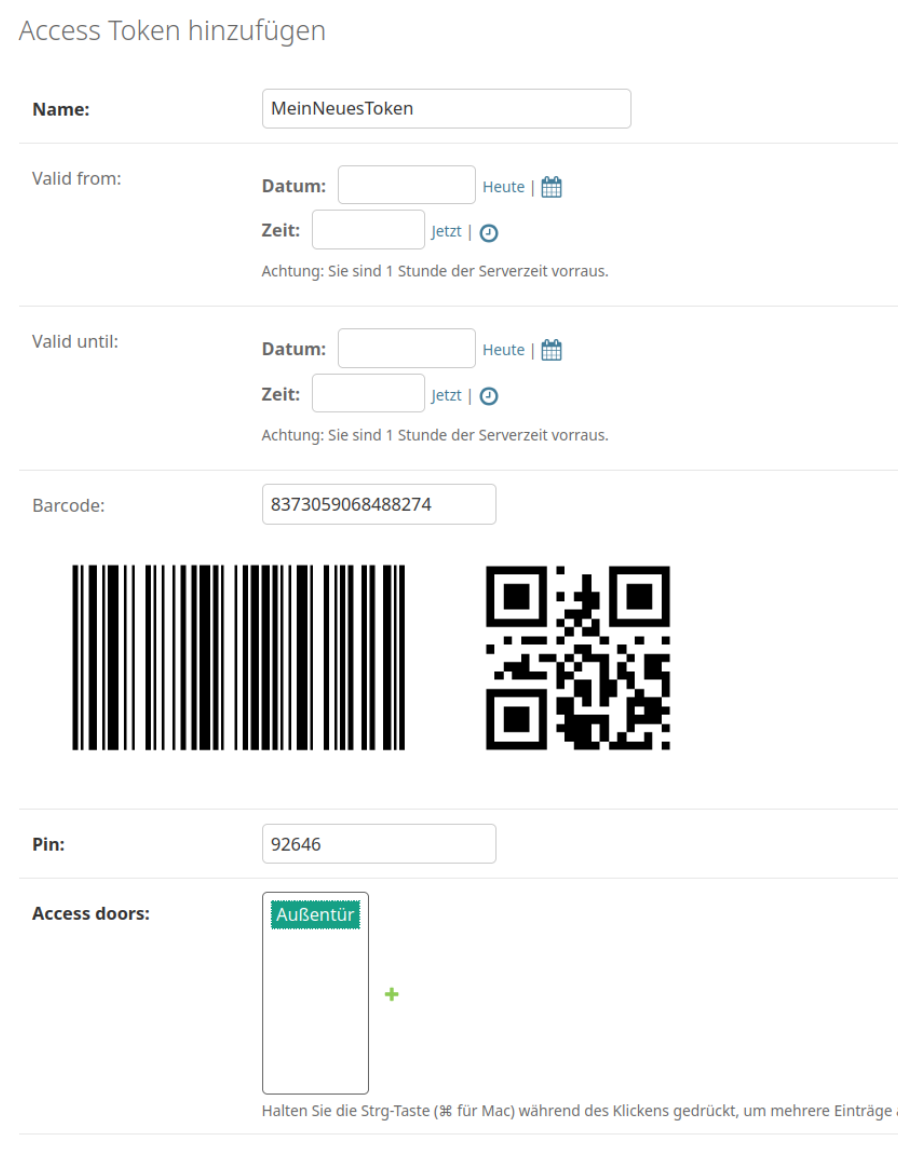
A hackerspace is a place that generally needs to be accessed by a wide group of people, often at weird and unusual hours. Handing around keys and making sure everything is properly locked up can be messy, too. To make it easy for hackers to get in to [Peter]’s local hackerspace, a simple electronic system was whipped up to grant access.

The combined use of QR code & PIN adds a layer of security.

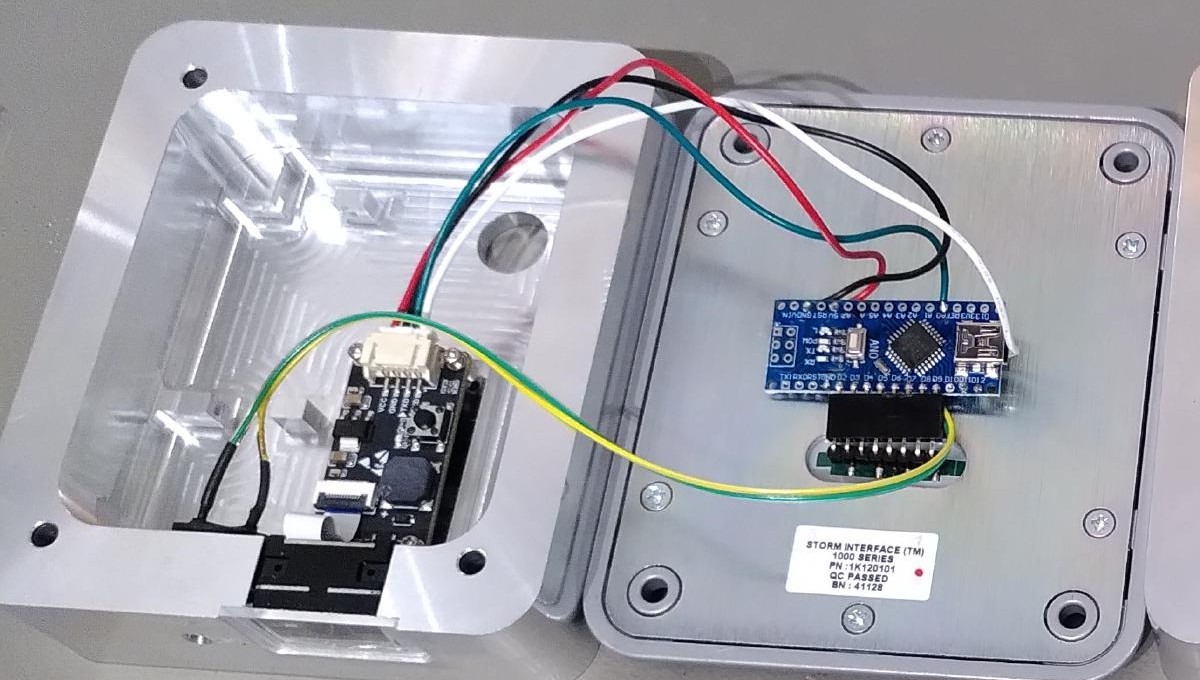
The basic components of the system are a keypad, a QR code and barcode scanner, a stepper motor, an Arduino Nano, and a Raspberry Pi. The keypad is read by an Arduino Nano, which is also responsible for talking to a stepper motor driver to actuate the lock cylinder.

The system works on the basis of two-factor authentication. Regular users authenticate to enter by presenting a QR code or barcode, and entering a matching PIN number. The system can also be set up for PIN-only entry on a temporary basis.

For example, if the hackerspace is running an event, a simple four-digit pin can allow relatively free access for the duration without compromising long-term security. Actual authentication is handled by the Raspberry Pi, which takes in the scanned barcode and/or PIN, hashes it, and checks it against a backend database which determines if the credentials are valid for entry.

While it’s not technically necessary for a project like this — in fact, you could argue it’s preposterously overkill — we have to take particular note of the machined aluminum enclosure for the keypad. Mere mortals could just run it off on their 3D printers, but if you’ve got access to a CNC router and a suitably chunky piece of aluminum, why not show off a bit?

Advertisement

It’s a nifty system that has served the hackerspace well over some time. We’ve featured some neat access control systems before, too. If you’ve got your own solution to this common problem, don’t hesitate to notify the tipsline!

Source link

Advertisement
Continue Reading

Tech

LLMs can unmask pseudonymous users at scale with surprising accuracy

Published

on


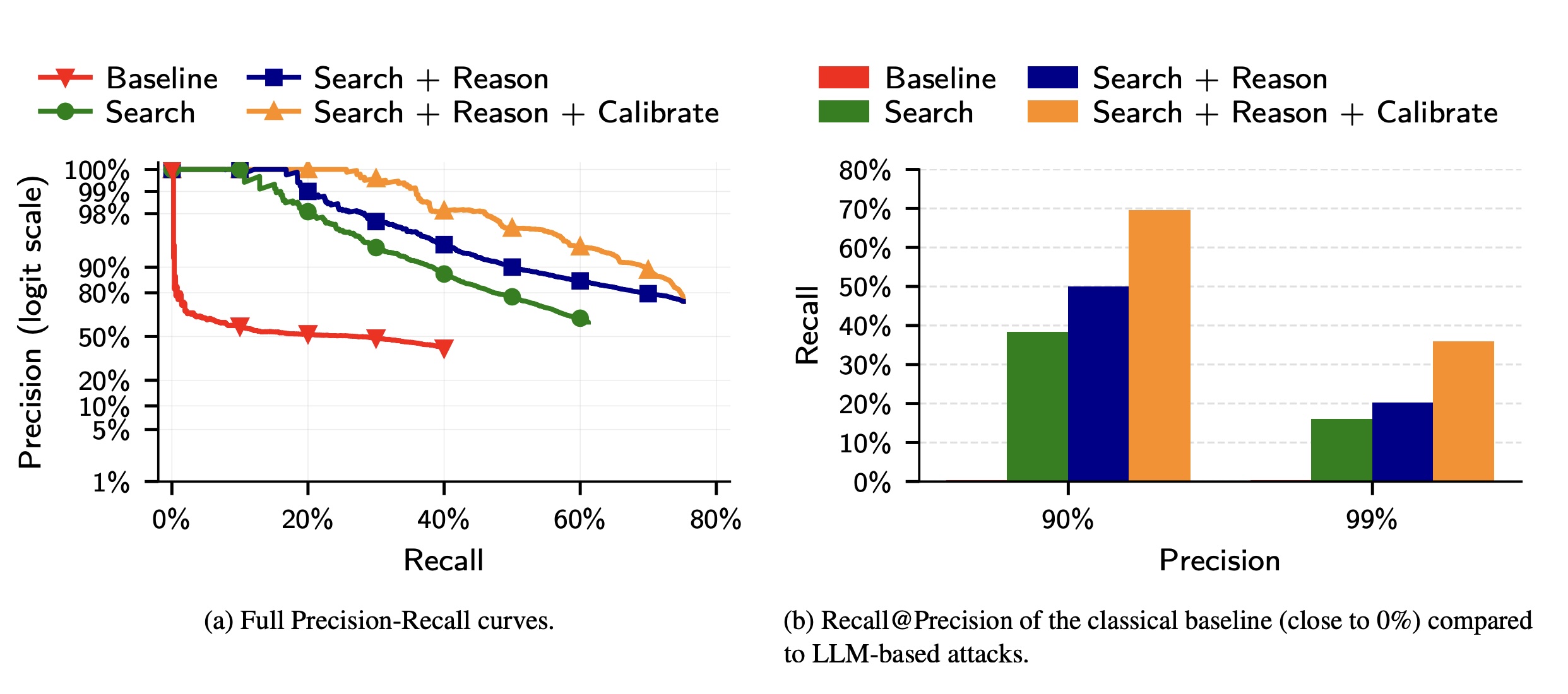
Recall at various precision thresholds.

Advertisement

Recall at various precision thresholds.

In a third experiment, the researchers took 5,000 users from the Netflix dataset and added another 5,000 “distraction” identities of people not in the results. They then added to the list of 10,000 candidate profiles 5,000 query distractors comprising users who appear only in a query set, with no true match in the candidate pool.

Compared to a classical baseline that mimics the Netflix Prize attack to LLM deanonymization, the latter far outperformed the former.

Advertisement


Screenshot

Advertisement

The researchers wrote:

(a) The precision of classical attacks drops very fast, explaining its low recall. In contrast, the precision of LLM-based attacks decays more gracefully as the attacker makes more guesses. (b) The classical attack almost fails completely even at moderately low precision. In contrast, even the simplest LLM attack (Search) achieves non-trivial recall at low precision, and extending it with Reason and Calibrate steps doubles Recall @99% Precision.

The results show that LLMs, while still prone to false positives and other weaknesses, are quickly outstripping more traditional, resource-intensive methods for identifying users online.

The researchers went on to propose mitigations, including platforms enforcing rate limits on API access to user data, detecting automated scraping, and restricting bulk data exports. LLM providers could also monitor for the misuse of their models in deanonymization attacks and build guardrails that make models refuse deanonymization requests.

Of course, another option is for people to dramatically curb their use of social media, or at a minimum, regularly delete posts after a set time threshold.

Advertisement

If LLMs’ success in deanonymizing people improves, the researchers warn, governments could use the techniques to unmask online critics, corporations can assemble customer profiles for “hyper-targeted advertising,” and attackers could build profiles of targets at scale to launch highly personalized social engineering scams.

“Recent advances in LLM capabilities have made it clear that there is an urgent need to rethink various aspects of computer security in the wake of LLM-driven offensive cyber capabilities, the researchers warned. “Our work shows that the same is likely true for privacy as well.”

Source link

Advertisement
Continue Reading

Tech

As a comic book fan, TCL showed me my dream smartphone at MWC 2026

Published

on

MWC 2026 is in full swing here in Barcelona, Spain, and while my usual beat for TechRadar is all things computing, I’ve been walking around the show floor of this huge tech event on the lookout for a new smartphone to get excited about.

I’ve felt for a while that smartphone designs and technology have hit a plateau. The hardware and form factor are now pretty much perfect for what we currently use our phones for (doom scrolling, taking photos, and making the rare phone call, essentially, in my case), which has left phone makers scrambling to find a reason to convince us to upgrade from our perfectly fine handsets.

Source link

Continue Reading

Tech

SpaceX says Starlink V2 will deliver 100x data density, pushing 5G mobile satellite service forward

Published

on


The shift coincides with the rebranding of Starlink’s “Direct to Cell” business as Starlink Mobile, a service that enables connectivity between smartphones and the satellite network without requiring dedicated user terminals such as dishes.
Read Entire Article
Source link

Continue Reading

Tech

S’pore kids tech startup myFirst raises US$8M in Series A funding

Published

on

The funds will allow it to expand further across North Asia, the Middle East, the US & Europe

Singapore-based kids tech company myFirst has announced today (Mar 3) that it has raised over US$8 million in its Series A funding round. The round, led by Vertex Ventures Southeast Asia & India, was conducted in a bid to scale myFirst’s ecosystem of devices and services designed specifically for children.

In a press release, the startup shared that the funds will support its international expansion across North Asia, the Middle East, the US, and Europe through partnerships with retailers and telcos, including Walmart and Best Buy.

It will also accelerate the development of the company’s kids tech ecosystem, combining devices, connected services, and a secure social platform for children’s first digital experiences in communication, creativity, and self-expression.

“Every child deserves their first digital device to be built just for them, at a price point that makes it accessible. This new funding will help us bring safer, kid-ready tech to even more families worldwide, while giving parents confidence in their child’s first steps into the digital world,” shared G-Jay Yong, co-founder and CEO of myFirst.

Advertisement

Jessica Koh, Senior Executive Director at Vertex Ventures Southeast Asia & India, noted a structural shift in how children are introduced to tech by their families. Instead of simply adapting products for adults, there is a demand for such gadgets made for kids.

“The global kids tech market is still under-penetrated, and with its integrated ecosystem and global reach, myFirst is well positioned to define the category at scale.”

One of the first-movers in the kids tech industry

myFirst was founded by Yong and Brian Tan in 2018, making them one of the first-movers in the kids tech industry in Singapore.

The duo first launched a kid-friendly digital camera, and has since expanded their range to include products and services, like the myFirst watchphones and myFirst Circle family app.

Advertisement
myFirst Fone S4 and myFirst Circle social app interfacemyFirst Fone S4 and myFirst Circle social app interface
(Left): myFirst Fone S4, (Right): myFirst Circle social app / Image Credits: myFirst

The Fone allows children to communicate safely with their family members, and it’s equipped with a built-in GPS, safety zones, and an SOS button for parental reassurance. On the other hand, the app provides a closed, ad-free environment where kids can share moments with approved family and friends, free from strangers and inappropriate content.

Beyond watches and apps, myFirst’s ecosystem now includes cameras, headphones, drawing tablets, and other devices, all designed to support safe, purposeful, and joyful digital experiences for children.

Since their launch, the startup has grown their customer base of over a million families in 60 countries, and plans to expand its reach in markets with larger child populations, including Vietnam, Indonesia and Thailand, while maintaining a strong presence in established regions.

In a world where everyone is increasingly connected, children can stand to benefit from technology. However, one cannot deny the risks that are involved, including the exposure to inappropriate content and addiction.

As such, having ecosystems that provides safer environments for children to interact with technology matter more than ever.

Advertisement

“If kids are not allowed any exposure to tech, but yet all they see around them are grown-ups and their peers using tech, it would most likely feel tempt them and could spell trouble once they are allowed access. It could be really easy for them to over-immerse themselves and get addicted to their devices,” shared Yong.

  • Learn more about myFirst here.
  • Read more stories we’ve written on Singaporean businesses here.

Featured Image Credit: myFirst

Source link

Advertisement
Continue Reading

Tech

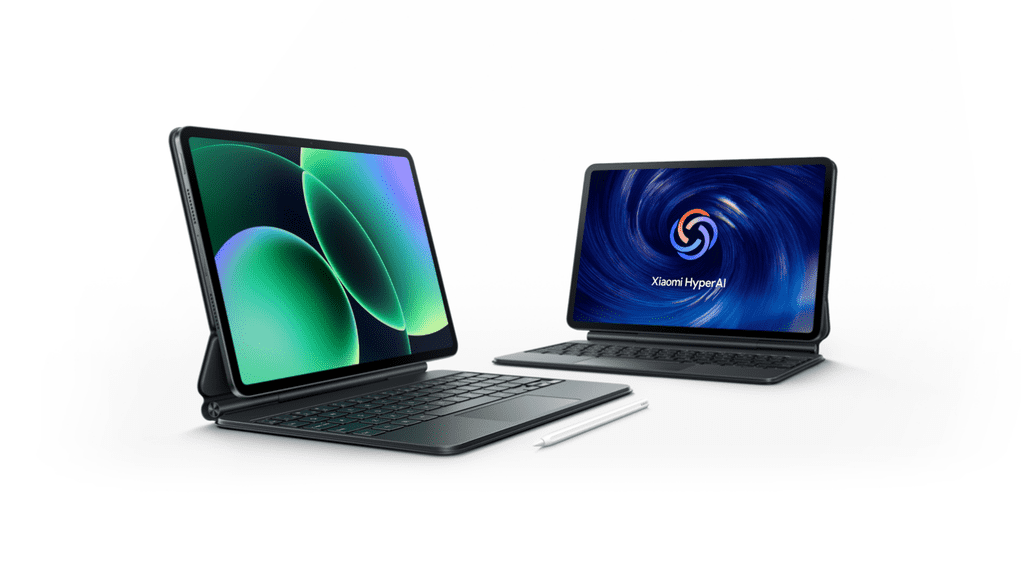
Xiaomi Pad 8 Series Launched: Big Battery, Flagship Chip & Sleek 11.2-Inch Display

Published

on

After the pretty exciting Xiaomi 17 series, the Chinese maker announced the new Xiaomi Pad 8 Series, comprising the Pad 8 and the Pad 8 Pro. The devices are a blend of power and portability, offering a slim design along with a large battery. Indian consumers can expect the Xiaomi Pad 8 Series to go official on March 11.

The biggest highlight of the Xiaomi Pad 8 Series is the 11.2-inch 3.2K display, which is a significant feature of the tablet series. The high-resolution display ensures crisp text and image quality, and the 800 nits of peak brightness are helpful in outdoor conditions. In addition, the display’s 144Hz refresh rate makes it smooth, especially for gaming.

Furthermore, both models in the Xiaomi Pad 8 Series feature a large 9,200mAh battery, ensuring longer battery life throughout the day. Despite the slim 5.75mm body, Xiaomi has managed to include a bigger battery than previous generations. This makes the tablet reliable for travel, long meetings, and extended work sessions. Users can work, stream, or browse without worrying about frequent charging.

Xiaomi Pad 8 Pro

image of Xiaomi Pad

The Xiaomi Pad 8 Pro stands out as the most powerful model in the series. It comes with the Snapdragon 8 Elite Mobile Platform. This provides a significant boost to CPU and GPU performance for intensive operations. Moreover, it can handle video editing, multitasking, and other operations.

The device supports fast charging up to 67W. This device’s camera features a 50MP primary camera and a 32MP front-facing camera. Storage options go up to 512GB, and the Matte Glass option with anti-reflective coating is a professional’s dream come true.

Advertisement

Xiaomi Pad 8

Xiaomi Pad 8 with the keyboard accessory

The Xiaomi Pad 8 uses a Qualcomm Snapdragon 8s Gen 4 Mobile Platform, offering reliable performance in running multiple tasks at once. It can run several apps simultaneously, stream, browse, and edit, all without any lag. It can be topped up quickly with 45W turbo charging.

For camera needs, the Xiaomi Pad 8 has a 13MP rear camera and an 8MP front camera, making it perfect for photo shoots and video calls. Storage capacity can reach 256GB, offering enough room for most users without being too expensive.

For colors, the Pad 8 is available in Pine Green, Gray, and Blue, starting at a price of €449.9. The Pad 8 Pro is available in the same colors, starting at a price of €549.9. For a premium look, the Pad 8 Pro Matte Glass version is available only in Gray and costs €769.9 for the 12GB + 512GB version.

Source link

Advertisement
Continue Reading

Tech

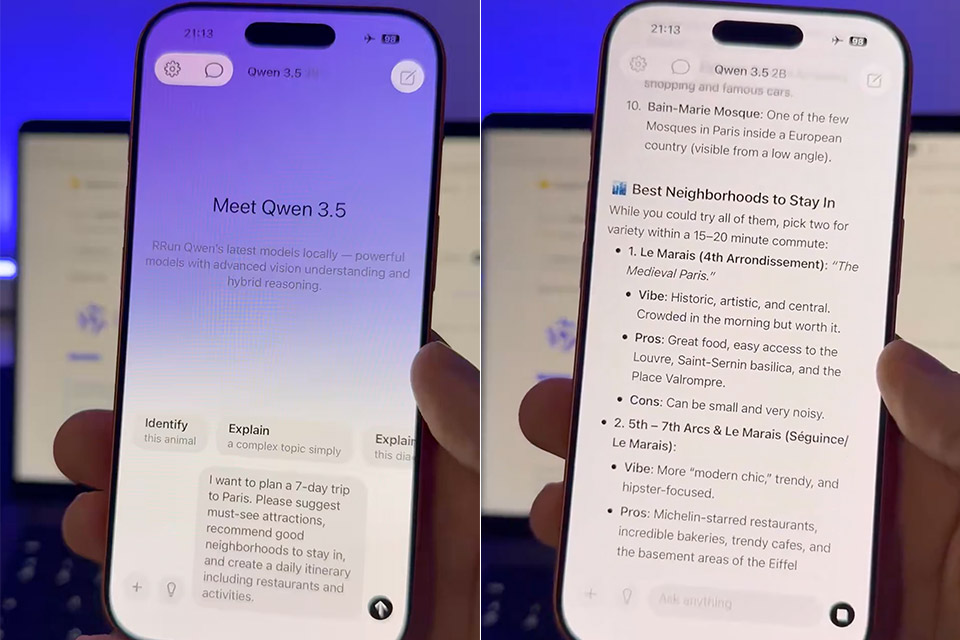
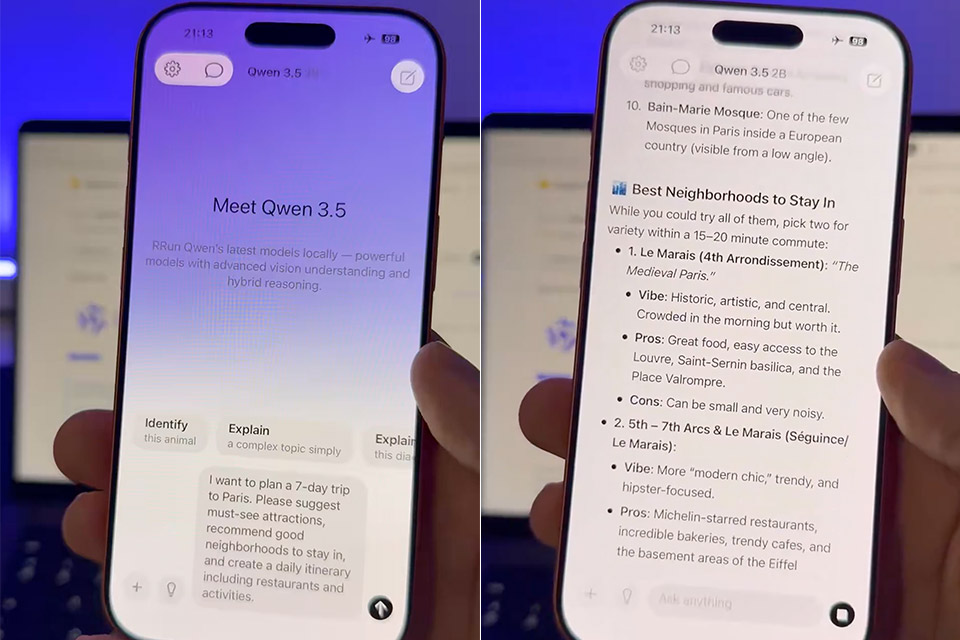
Alibaba’s New Qwen 3.5 Small AI Model Can Run Directly On an iPhone 17

Published

on

Alibaba Qwen 3.5 On-Device AI iPhone 17
Alibaba has just taken a significant step forward by introducing a line of small AI models that will fit perfectly into your existing smartphone. Qwen 3.5’s smaller cousins pack a punch that used to take a full server configuration to deliver, and even the smallest of them will work flawlessly on your iPhone 17.

Alibaba’s Qwen team introduced four new models today: 0.8 billion, 2 billion, 4 billion, and 9 billion parameter versions. Built on the same upgraded architecture as the bigger Qwen 3.5 series, which launched in February 2026, these smaller versions were built for efficiency and can natively handle both text and graphics. The 0.8B and 2B versions are ideal for phones, laptops, and edge hardware where memory and battery life are critical, while the 4B is designed for lightweight tasks, and the 9B model approaches the capabilities of larger models in terms of reasoning, math, multilingual knowledge, and document analysis.


Plaud Note Pro AI Voice Recorder, Transcribe & Summarize with AI, App Control, Note Taker for Meetings…
  • AI-POWERED TRANSCRIPTION & MULTI-DIMENSIONAL SUMMARIES: Plaud Note Pro is your professional voice transcriber, delivering high-accuracy transcription…
  • ENHANCED CONTEXT WITH MULTIMODAL INPUT: Capture audio, type notes, add images, and press to highlight key moments for richer context. During…
  • CHAT WITH YOUR RECORDINGS USING “ASK Plaud”: Unlock deeper insights with this interactive AI. Ask questions, extract key points, draft emails, and get…

The results are pretty mind-blowing, as Alibaba claims that the 9B variant produces results that are almost on par with systems with 120 billion parameters, implying that it matches (and in some cases outperforms) the capabilities of big hitters like ChatGPT and Gemini in a series of critical tests. In contrast, the 4B variation performs at levels comparable to prior 80B models. They may have sacrificed depth in favor of speed and resource economy, but they can still perform basic picture recognition and text.


Community testing has demonstrated that these models can be run on a mobile device using tools such as MLX, with some even managing to fit a quantized version of the 2B model into an iPhone 17. You receive lightning-fast responses without having to go online or pay for subscription fees or data transfer to servers. The 0.8B and 2B variants are offline-ready and compatible with normal phones, and users say that the 4B model delivers nearly as much power in real-world use as the larger models. Plus, with open-source weights on Hugging Face and ModelScope, deployment is quite simple using familiar frameworks. You can find them all here.

Advertisement

Source link

Advertisement
Continue Reading

Trending

Copyright © 2025